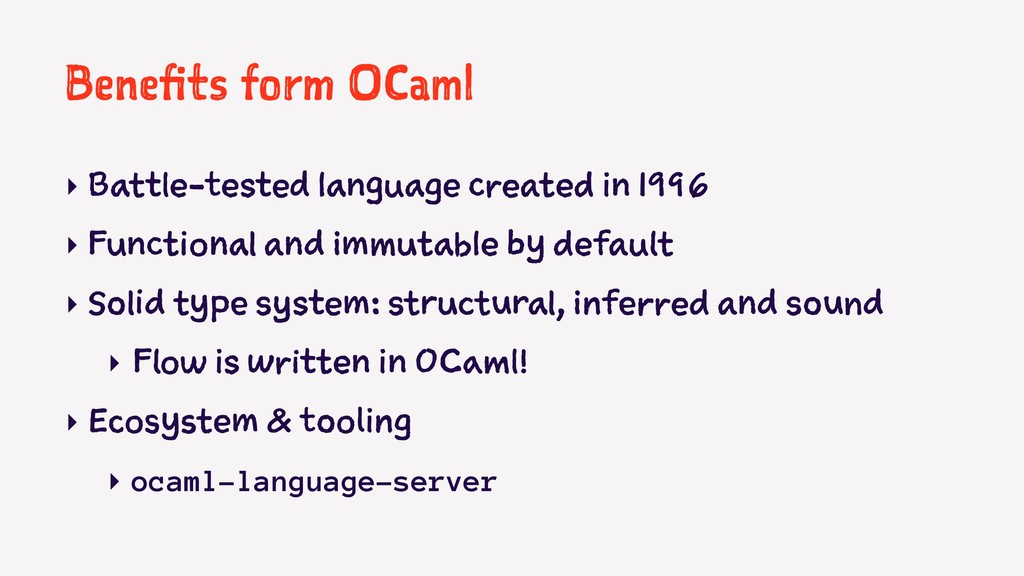
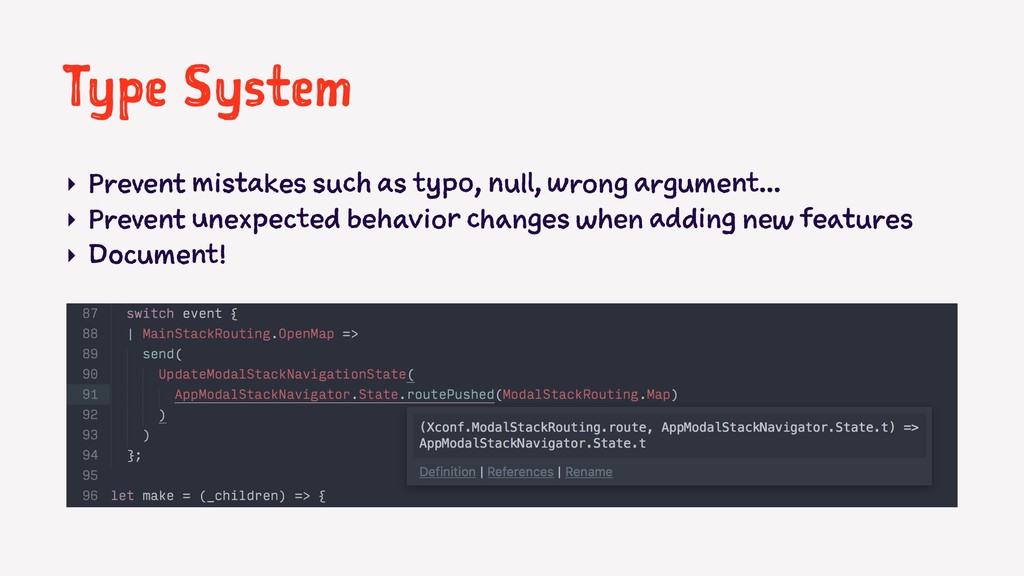
Functional and immutable by default ‣ Solid type system: structural, inferred and sound ‣ Flow is written in OCaml! ‣ Ecosystem & tooling ‣ ocaml-language-server
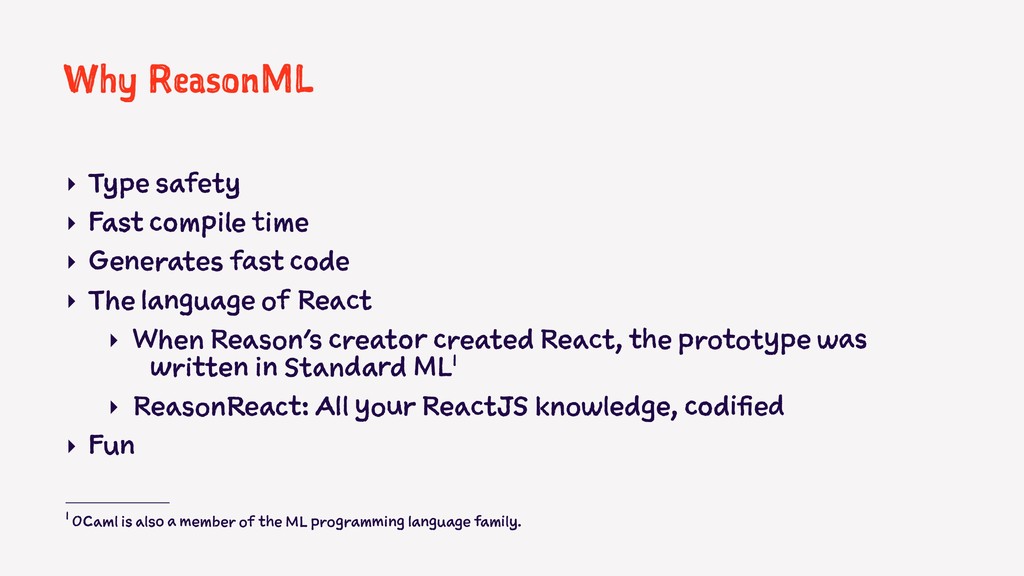
Generates fast code ‣ The language of React ‣ When Reason's creator created React, the prototype was written in Standard ML1 ‣ ReasonReact: All your ReactJS knowledge, codified ‣ Fun 1 OCaml is also a member of the ML programming language family.
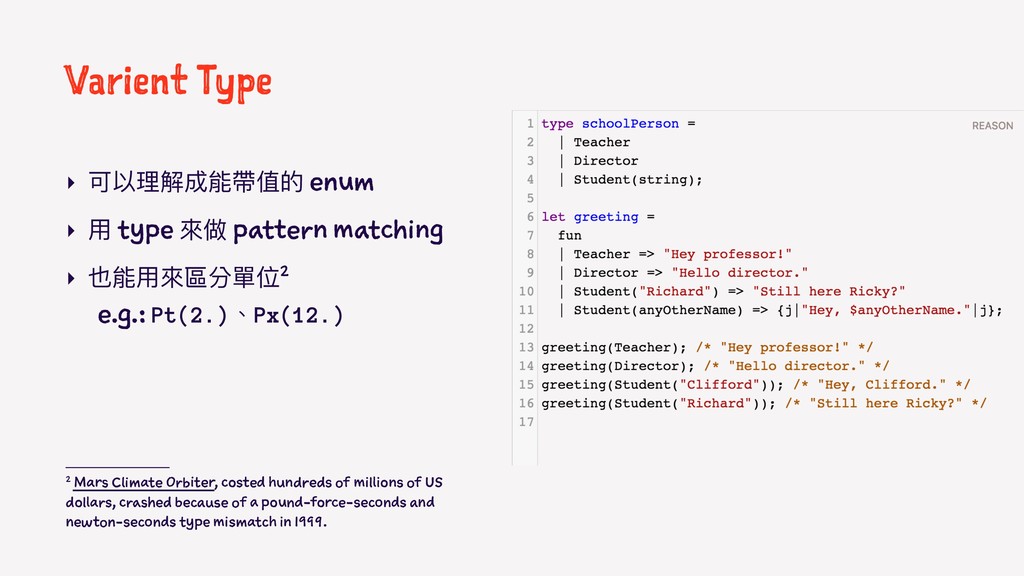
matching ‣ 犖胼አ㬵玟獤㻌֖2 e.g.: Pt(2.)牏Px(12.) 2 Mars Climate Orbiter, costed hundreds of millions of US dollars, crashed because of a pound-force-seconds and newton-seconds type mismatch in 1999.
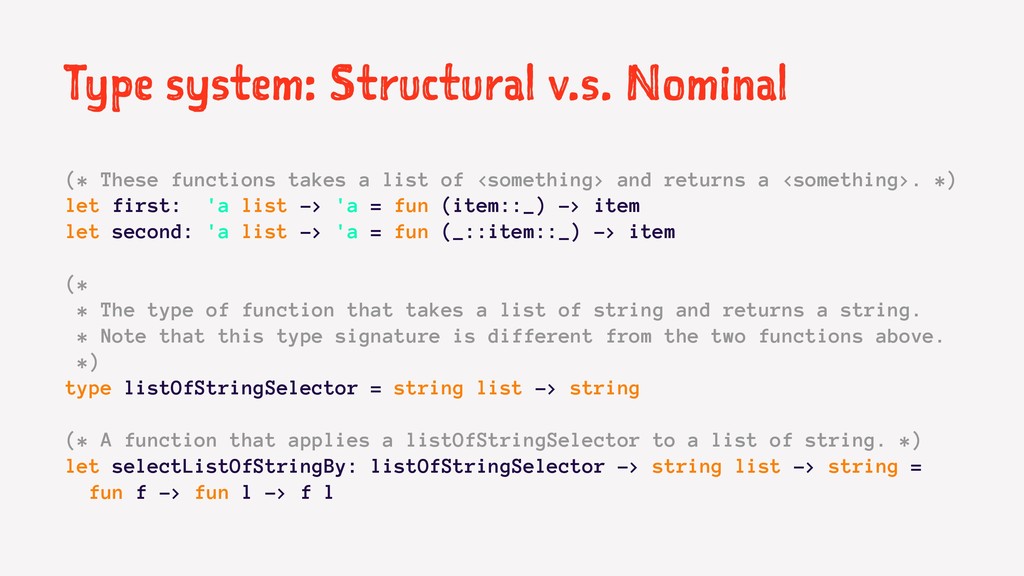
list of <something> and returns a <something>. *) let first: 'a list -> 'a = fun (item::_) -> item let second: 'a list -> 'a = fun (_::item::_) -> item (* * The type of function that takes a list of string and returns a string. * Note that this type signature is different from the two functions above. *) type listOfStringSelector = string list -> string (* A function that applies a listOfStringSelector to a list of string. *) let selectListOfStringBy: listOfStringSelector -> string list -> string = fun f -> fun l -> f l
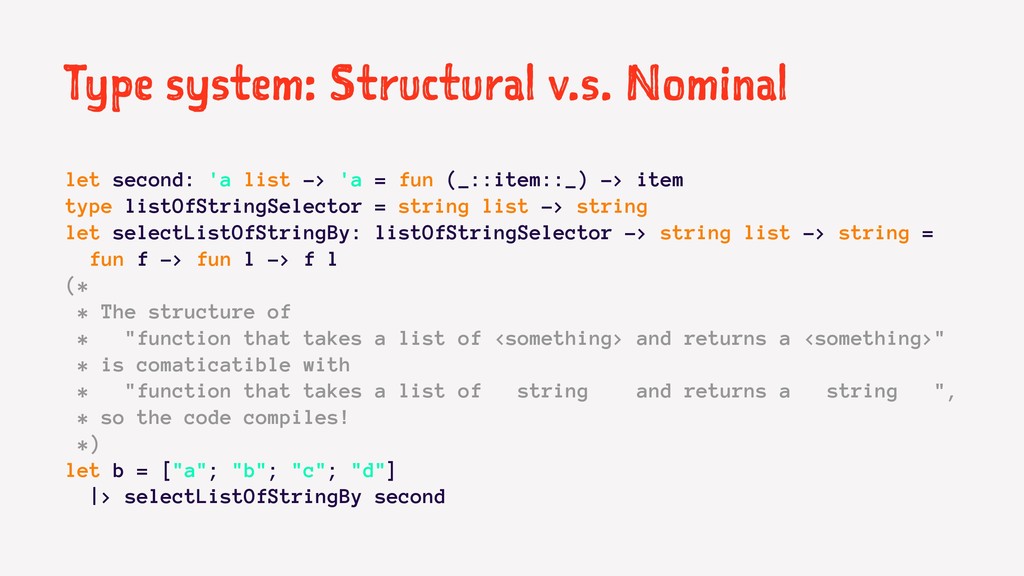
'a = fun (_::item::_) -> item type listOfStringSelector = string list -> string let selectListOfStringBy: listOfStringSelector -> string list -> string = fun f -> fun l -> f l (* * The structure of * "function that takes a list of <something> and returns a <something>" * is comaticatible with * "function that takes a list of string and returns a string ", * so the code compiles! *) let b = ["a"; "b"; "c"; "d"] |> selectListOfStringBy second
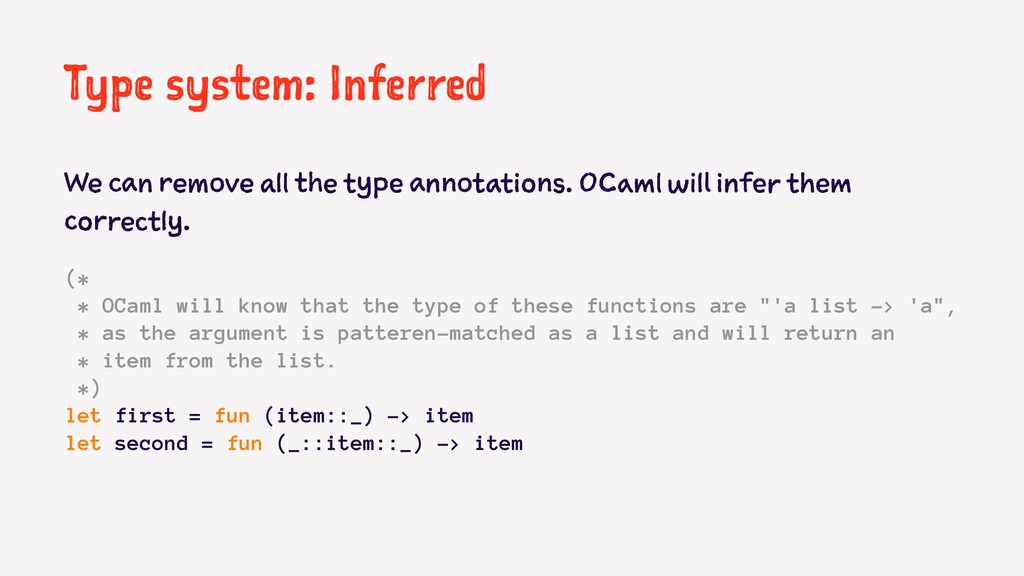
OCaml will infer them correctly. (* * OCaml will know that the type of these functions are "'a list -> 'a", * as the argument is patteren-matched as a list and will return an * item from the list. *) let first = fun (item::_) -> item let second = fun (_::item::_) -> item


 zetavg
 teamlab
 koukihosaka
 akhino
 pfn
pfn
 tomokusaba
 persolserverworks
 takonda
 usanchuu
 suikabar
 codmoninc
 sue445
 glaforge
 andyhume
 addyosmani
 katarinadahlin
 maggiecrowley
 jonrohan
 livdayseo
 aleyda
 tmiket
 427marketing
 geoffreycrofte
 holman


![Expectable Conventions length [1, 2, 3] # "length" tuple_size {:ok,](https://files.speakerdeck.com/presentations/88537cdec3f04e76a0001911818db61e/slide_13.jpg)