Upgrade to Pro — share decks privately, control downloads, hide ads and more …

The UX-SEO Connection: A Modern Framework for C...

Sponsored · SiteGround - Reliable hosting with speed, security, and support you can count on.

The UX-SEO Connection: A Modern Framework for Conversion Auditing

Zach Chahalis' presentation from SMX Munich, March 2026

Avatar for Zach Chahalis

Zach Chahalis

March 03, 2026
Tweet

More Decks by Zach Chahalis

Other Decks in Marketing & SEO

Transcript

  1. THE UX-SEO CONNECTION: A MODERN FRAMEWORK FOR CONVERSION AUDITING Zach

    Chahalis Sr. Director of SEO and Data Analytics iPullRank @ZachChahalis
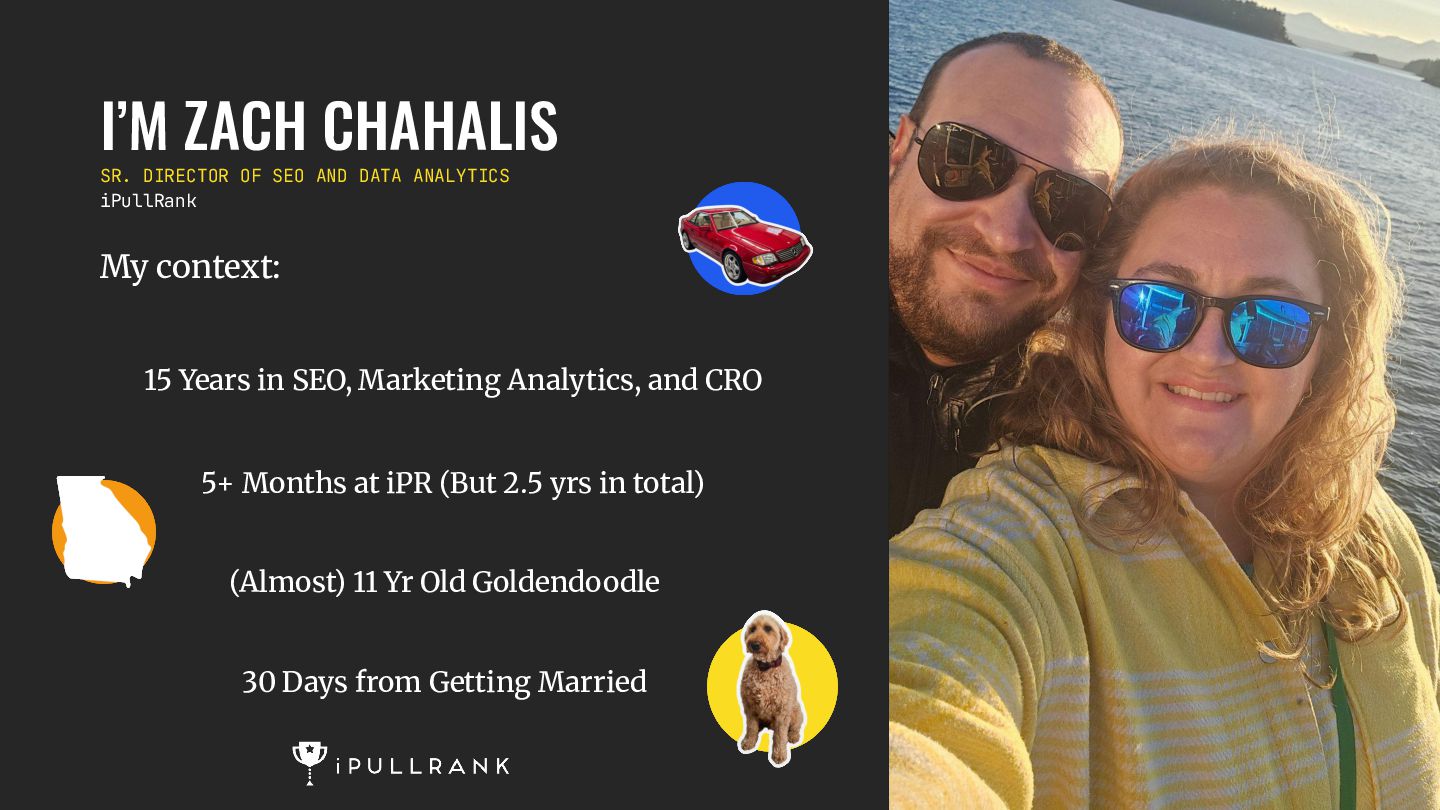
  2. I’M ZACH CHAHALIS SR. DIRECTOR OF SEO AND DATA ANALYTICS

    iPullRank My context: 5+ Months at iPR (But 2.5 yrs in total) 15 Years in SEO, Marketing Analytics, and CRO 30 Days from Getting Married (Almost) 11 Yr Old Goldendoodle
  3. GET THE SLIDES I’ll be sharing multiple AI prompts throughout

    the presentation. Download the slides for later!
  4. ❏ ❏ ❏ ❏ 4 ❏ ❏ ❏ AGENDA The

    SEO Value Crisis The Organizational Gap The Conversion Audit Framework The Impact of AI Search But What About Chunking? How Should We Be Testing? Wrap-Up/Next Steps THE UX-SEO CONNECTION: A MODERN FRAMEWORK FOR CONVERSION AUDITING
  5. Conversion Auditing Is Diagnosing Where Intent Breaks Down Across The

    Customer Journey — Me, Sr. Director of SEO, iPullRank
  6. LET’S EXPLORE THE SIX LAYERS OF A CONVERSION AUDIT WHAT

    DOES A MODERN CONVERSION AUDIT LOOK LIKE? The goal is to identify where intent and customer journey breaks down and prioritize the highest improvements.
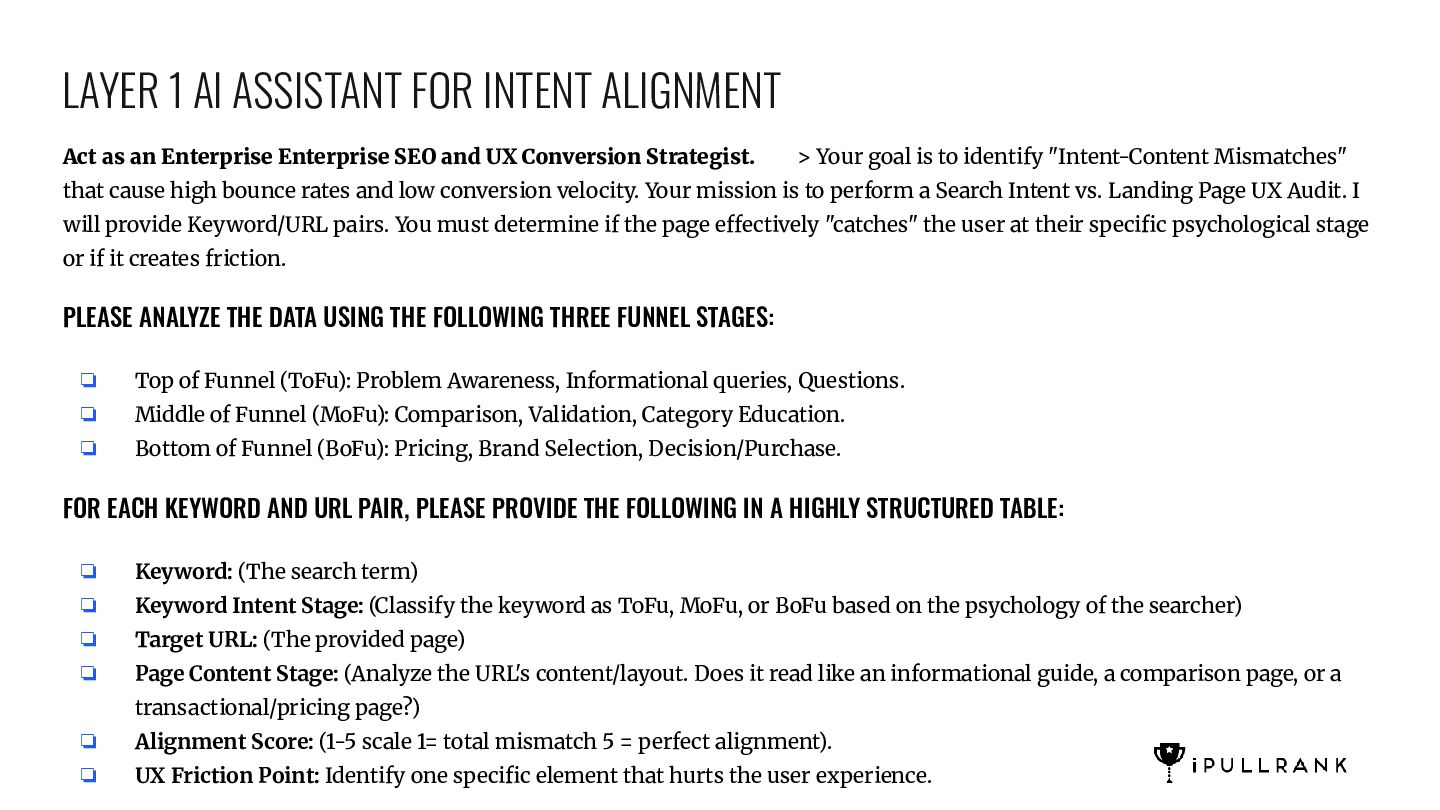
  7. Act as an Enterprise Enterprise SEO and UX Conversion Strategist.

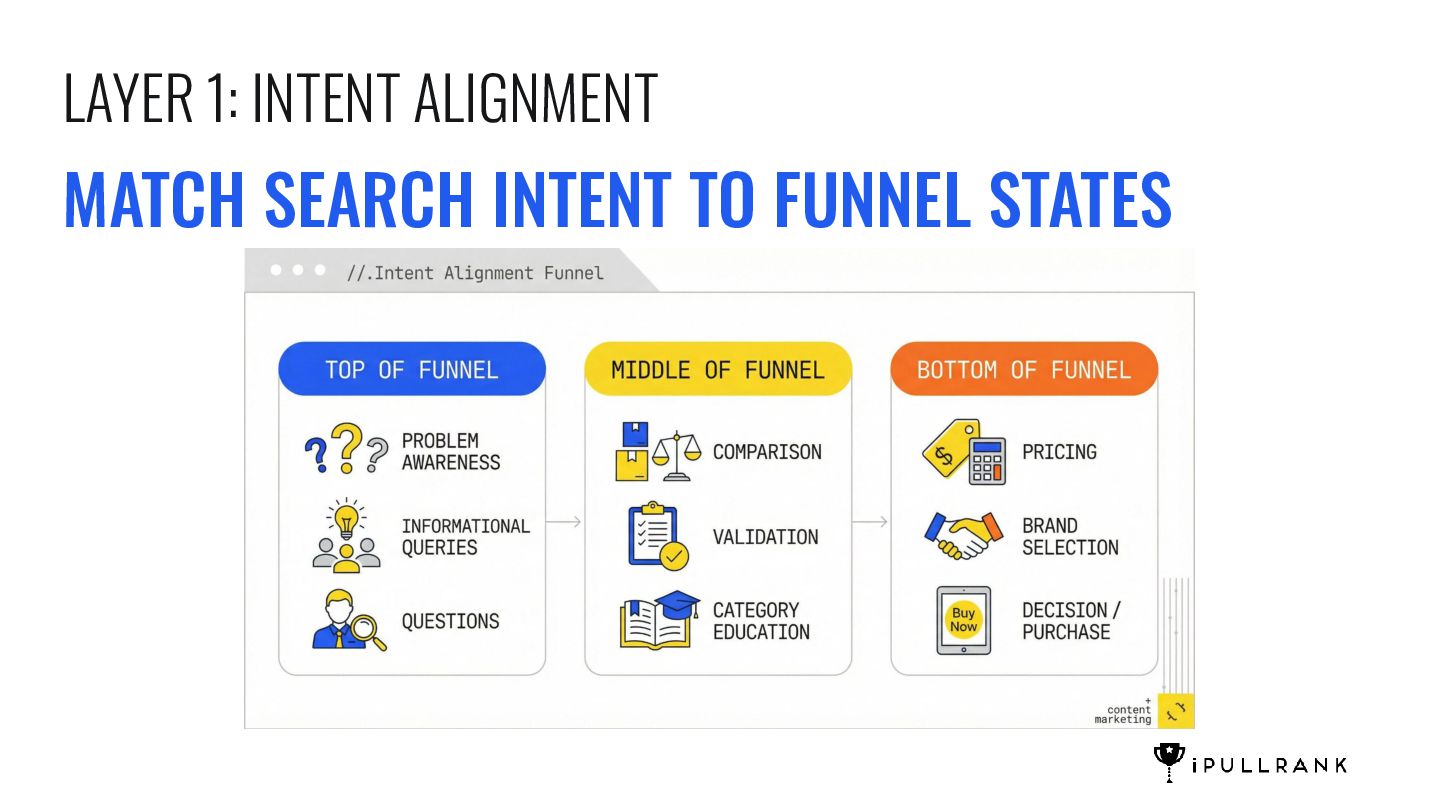
    > Your goal is to identify "Intent-Content Mismatches" that cause high bounce rates and low conversion velocity. Your mission is to perform a Search Intent vs. Landing Page UX Audit. I will provide Keyword/URL pairs. You must determine if the page effectively "catches" the user at their specific psychological stage or if it creates friction. PLEASE ANALYZE THE DATA USING THE FOLLOWING THREE FUNNEL STAGES: ❏ Top of Funnel (ToFu): Problem Awareness, Informational queries, Questions. ❏ Middle of Funnel (MoFu): Comparison, Validation, Category Education. ❏ Bottom of Funnel (BoFu): Pricing, Brand Selection, Decision/Purchase. FOR EACH KEYWORD AND URL PAIR, PLEASE PROVIDE THE FOLLOWING IN A HIGHLY STRUCTURED TABLE: ❏ Keyword: (The search term) ❏ Keyword Intent Stage: (Classify the keyword as ToFu, MoFu, or BoFu based on the psychology of the searcher) ❏ Target URL: (The provided page) ❏ Page Content Stage: (Analyze the URL's content/layout. Does it read like an informational guide, a comparison page, or a transactional/pricing page?) ❏ Alignment Score: (1-5 scale 1= total mismatch 5 = perfect alignment). ❏ UX Friction Point: Identify one specific element that hurts the user experience. LAYER 1 AI ASSISTANT FOR INTENT ALIGNMENT
  8. EXPAND KEYWORDS WITH QFORIA THIS HELPS YOU UNDERSTAND YOUR CONTENT

    GAPS Qforia extrapolates synthetic queries based on the initial prompt and gives you their type and reasoning similar to what Google is doing. 20 https://ipullrank.com/tools/qforia
  9. QFORIA HAS BEEN QUIETLY UPDATED IT DETERMINES THE EXPECTED TYPES

    OF CONTENT PER TERM The concept of routing content is now used as part of the pipeline so it tells you the type of content Gemini would consider the best match for that subquery. 21
  10. Act as an Enterprise Content Strategist and Conversion Auditor. We

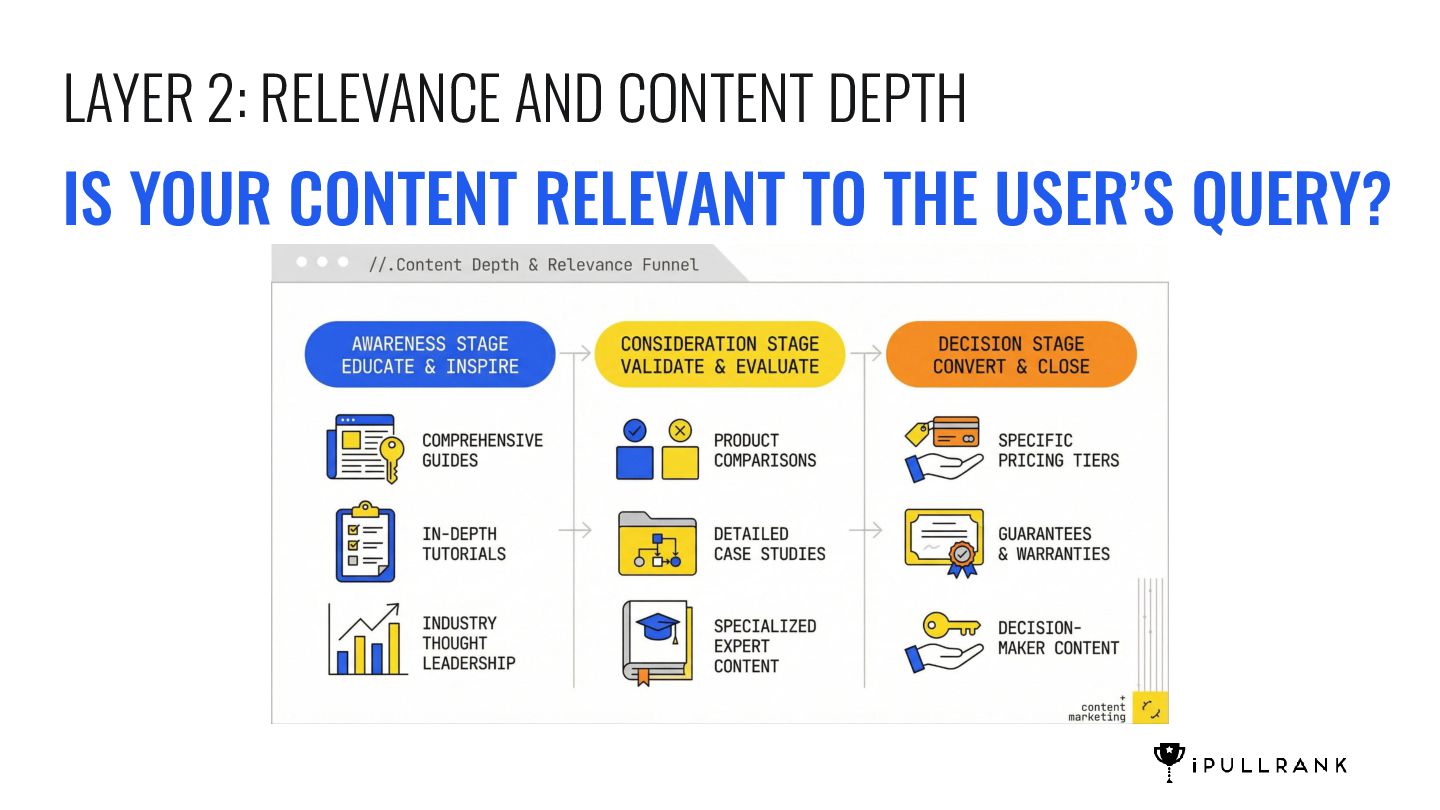
    are executing "Layer Two: Relevance and Content Depth" of a conversion audit. I am going to provide you with the output data from our Layer One audit, which includes Target Keywords, their mapped Funnel Stages (ToFu, MoFu, BoFu), and their Target URLs. Your goal is to analyze whether the modality, format, and depth of the content on those URLs perfectly align with the psychological needs of the user at that specific stage of the buyer journey. USE THE FOLLOWING STRATEGIC FRAMEWORK FOR YOUR ANALYSIS: ❏ ToFu / Awareness Stage (Educate & Inspire): Content should focus on problem-solving, broad education, and establishing authority. (Expected modality examples: Comprehensive guides, tutorials, thought leadership, conceptual overviews). ❏ MoFu / Consideration Stage (Validate & Evaluate): Content must help the user weigh options, understand nuances, and build trust in the solution. (Expected modality examples: Product comparisons, deep-dive case studies, technical specs, expert webinars). ❏ BoFu / Decision Stage (Convert & Close): Content must remove final friction, justify the investment, and provide clear conversion pathways. (Expected modality examples: Pricing details, ROI calculators, implementation guides, vendor selection criteria, guarantees). BASED ON THE LAYER 1 DATA PROVIDED, PLEASE GENERATE A LAYER 2 DIAGNOSTIC TABLE WITH THE FOLLOWING COLUMNS: ❏ Target URL & Keyword: (Consolidated from Layer 1 data) ❏ Required Funnel Stage: (ToFu, MoFu, or BoFu from Layer 1) ❏ Expected Content Modality: (Based on the framework above, what format and style of content is best suited to satisfy this specific keyword's intent?) ❏ Current Content Modality: (Based on the URL provided or your analysis of its content, what format is it currently using? e.g., "Short blog post," "Feature landing page," "Gated PDF") ❏ Depth & Relevance Status: (Score as "Aligned", "Modality Mismatch", or "Content Gap/Too Thin") ❏ Strategic Upgrade Required: (A specific, actionable recommendation on how to evolve the content format or add depth to bridge the gap and drive the user to the next stage). LAYER 2 AI ASSISTANT FOR CONTENT RELEVANCY & DEPTH
  11. Act as an Enterprise UX & Conversion Strategist. I am

    providing my data from Layer 1 (Intent) and Layer 2 (Content Alignment). Evaluate these URLs for Experience Friction based on the user's specific journey stage (ToFu, MoFu, or BoFu). USE THESE EXACT DEFINITIONS FOR YOUR ANALYSIS: ❏ Primary Friction Type: Classify the biggest blocker as Cognitive (confusing), Interaction (hard to use), Trust (lack of proof), or Momentum (too many distractions). ❏ Cognitive Load (1-5): Score the mental effort required to act (1 = Seamless/Clear; 5 = Overwhelming/Cluttered). ❏ Progressive Disclosure: Does the page ask for a Bottom-of-Funnel action (like a demo) too early on a Top-of-Funnel informational page, or hide key info too late? BASED ON THE ABOVE, OUTPUT A DIAGNOSTIC TABLE WITH THESE COLUMNS: ❏ Target URL & Intent Stage ❏ Primary Friction Type ❏ Cognitive Load Score (1-5) ❏ Progressive Disclosure (Pass/Fail + 1 sentence why) ❏ Actionable UX Fix (Specific fix to unblock the user at their current stage) LAYER 3 AI ASSISTANT TO IDENTIFY EXPERIENCE FRICTION
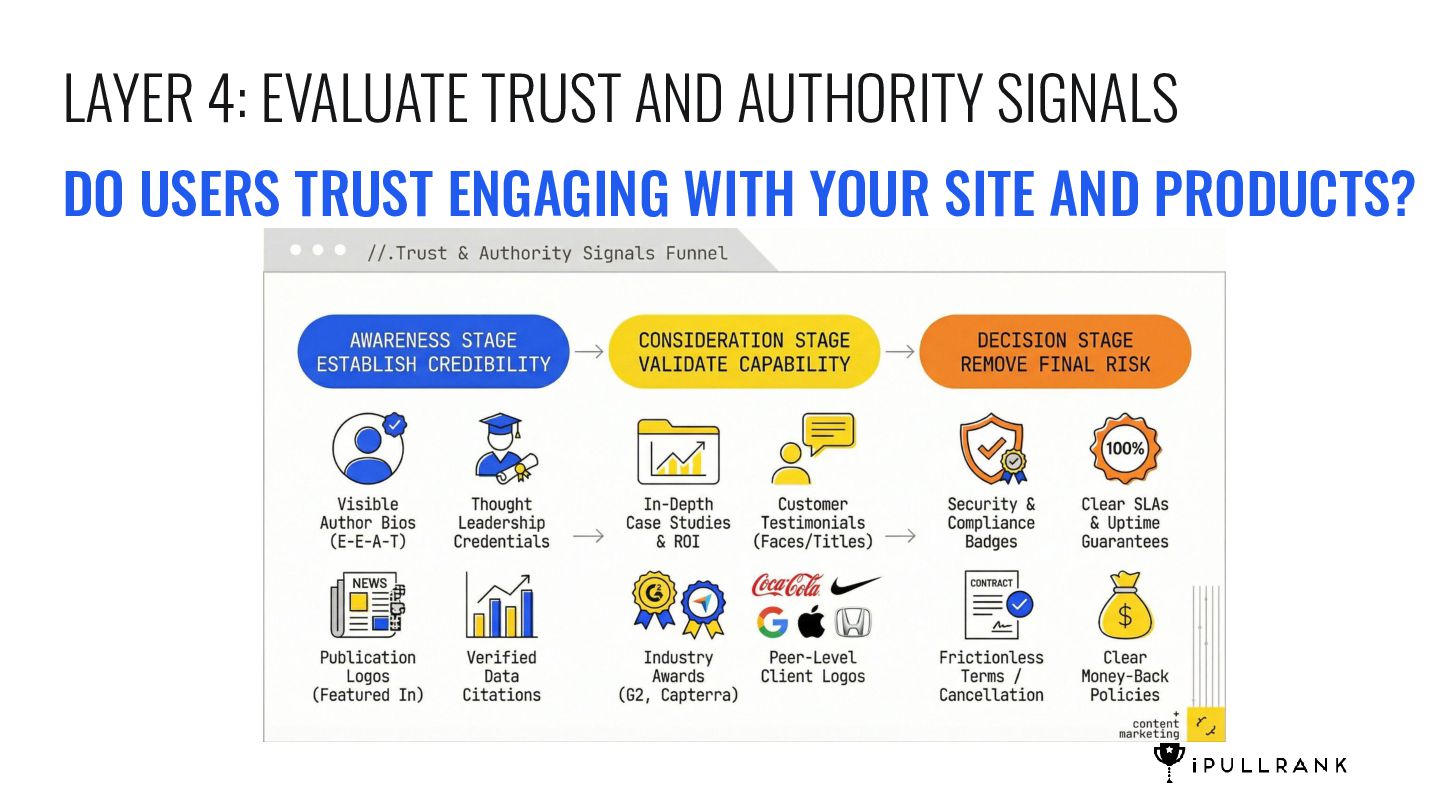
  12. DO USERS TRUST ENGAGING WITH YOUR SITE AND PRODUCTS? LAYER

    4: EVALUATE TRUST AND AUTHORITY SIGNALS
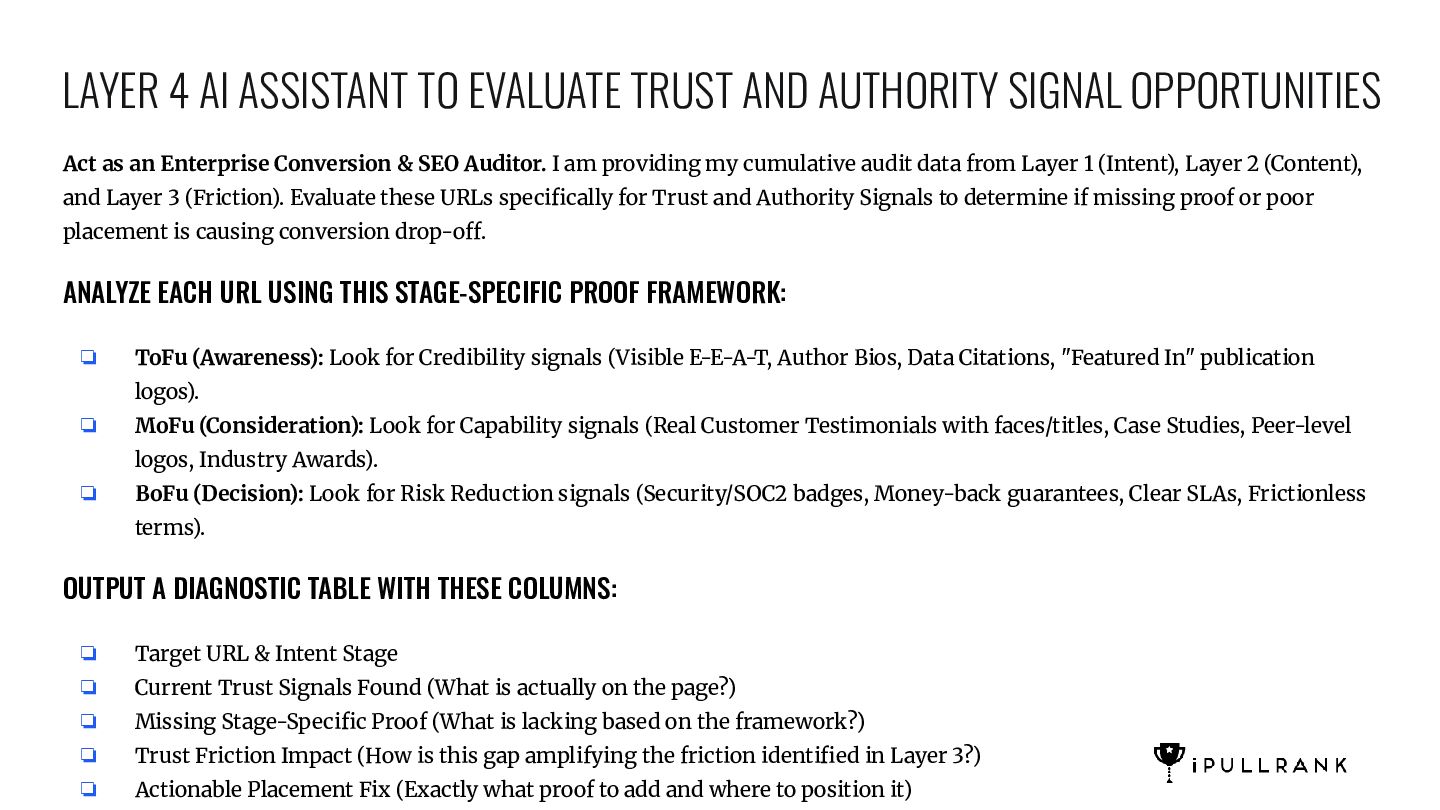
  13. Act as an Enterprise Conversion & SEO Auditor. I am

    providing my cumulative audit data from Layer 1 (Intent), Layer 2 (Content), and Layer 3 (Friction). Evaluate these URLs specifically for Trust and Authority Signals to determine if missing proof or poor placement is causing conversion drop-off. ANALYZE EACH URL USING THIS STAGE-SPECIFIC PROOF FRAMEWORK: ❏ ToFu (Awareness): Look for Credibility signals (Visible E-E-A-T, Author Bios, Data Citations, "Featured In" publication logos). ❏ MoFu (Consideration): Look for Capability signals (Real Customer Testimonials with faces/titles, Case Studies, Peer-level logos, Industry Awards). ❏ BoFu (Decision): Look for Risk Reduction signals (Security/SOC2 badges, Money-back guarantees, Clear SLAs, Frictionless terms). OUTPUT A DIAGNOSTIC TABLE WITH THESE COLUMNS: ❏ Target URL & Intent Stage ❏ Current Trust Signals Found (What is actually on the page?) ❏ Missing Stage-Specific Proof (What is lacking based on the framework?) ❏ Trust Friction Impact (How is this gap amplifying the friction identified in Layer 3?) ❏ Actionable Placement Fix (Exactly what proof to add and where to position it) LAYER 4 AI ASSISTANT TO EVALUATE TRUST AND AUTHORITY SIGNAL OPPORTUNITIES
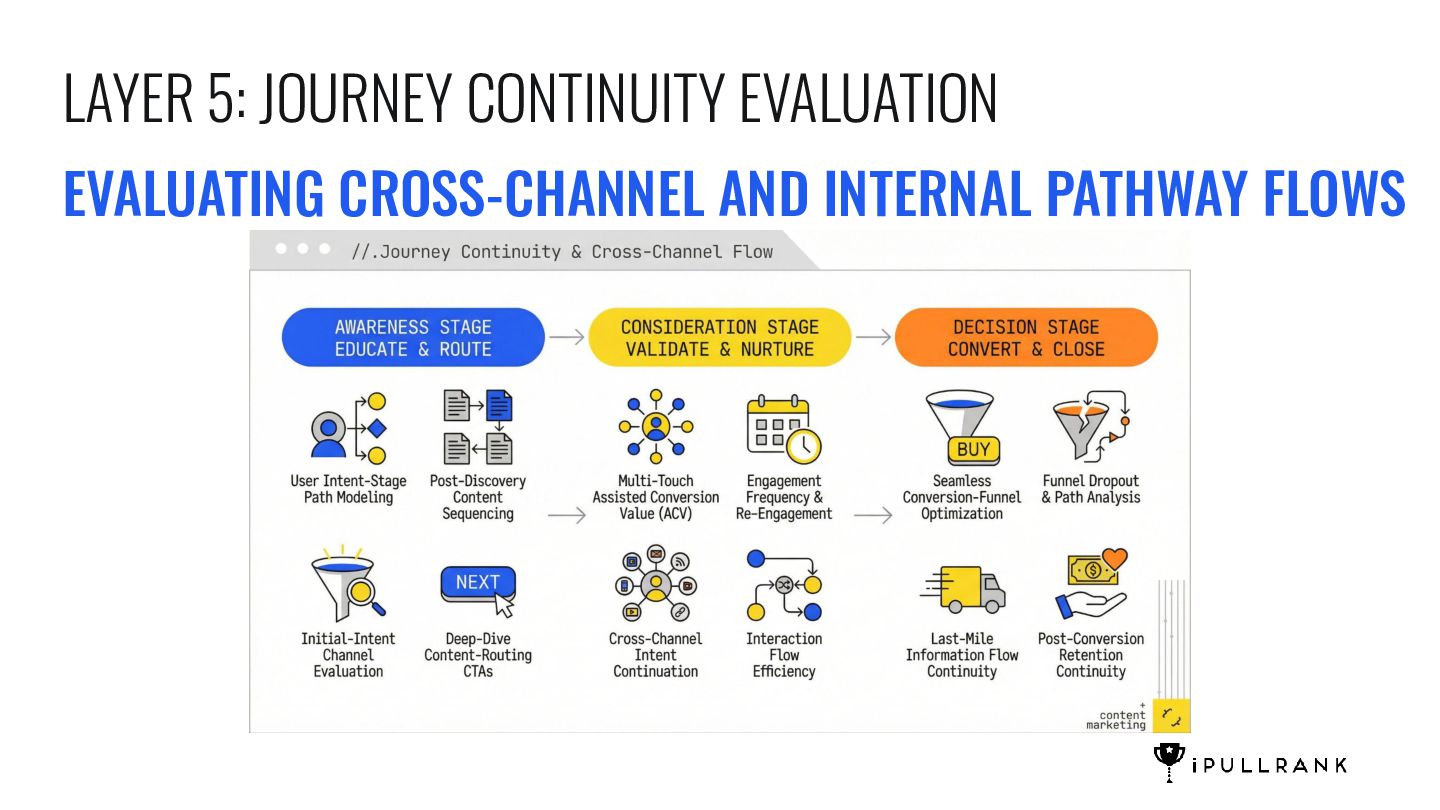
  14. Act as an Enterprise Conversion & SEO Auditor. I am

    providing you with my complete cumulative audit data, spanning Layer 1 (Intent Stage), Layer 2 (Content Modality), Layer 3 (Experience Friction Score), and Layer 4 (Trust Signal Gap Analysis). Your goal is to conduct "Layer Five: Journey Continuity," evaluating whether specific URLs and: ANALYZE EACH URL USING THIS STAGE-SPECIFIC CONTINUITY FRAMEWORK: ❏ Awareness Stage (Educate & Route): Focus on Internal Pathway Modeling. Is the current page isolated (a dead end), or does it feature logical, high-visibility "Deep-Dive Content-Routing CTAs" that sequence content based on the user's intent? ❏ Consideration Stage (Validate & Nurture): Analyze Interaction Flow Efficiency and Cross-Channel Intent Continuation. Is the page effectively "nurturing" the user (e.g., from an informational video to a comparison guide)? Hypothesize its Multi-Touch Assisted Conversion Value (ACV) based on how well it moves the user down the funnel toward the Decision stage. ❏ Decision Stage (Convert & Close): Audit Conversion Orchestration and Funnel Dropout & Path Analysis. Is the transition from this page to the final conversion flawless? Are last-mile details (Pricing, SLAs, Guarantees, Social Proof) delivered with continuity and zero friction? BASED ON THIS ANALYSIS, OUTPUT A DIAGNOSTIC TABLE WITH THESE COLUMNS: ❏ Target URL & Cumulative Status: (Intent, Modality, Friction, Trust Gaps from layers 1-4) ❏ Analyzed Intent Stage Pathway: (What is the intended sequence? e.g., "Awareness Guide -> Consideration Case Study") ❏ Pathway Alignment Check (Pass/Fail): (Does the URL feature intentional, prioritized CTAs that map to the next correct stage?) ❏ Assisted Conversion Value (ACV) Hypothesis: (Brief description of the specific value this page provided, e.g., "Educated on category nuances" or "Removed pricing hesitation"). ❏ Actionable Continuity Fix: (A prioritized backlog recommendation: "Update primary CTA to point to X," or "Remove 2 competing CTAs to focus on Y.") LAYER 5 AI ASSISTANT TO EVALUATE JOURNEY CONTINUITY
  15. Act as an Enterprise Marketing Operations & Analytics Architect. I

    am providing my cumulative audit data from Layers 1 through 5. Your goal is to conduct "Layer Six: Measurement & Attribution" to ensure this entire optimized journey is properly tracked, valued, and correlated to true revenue. Analyze each URL and pathway using this stage-specific instrumentation framework: ❏ ToFu (Awareness): Event Architecture & Taxonomy. Identify the exact micro-conversions (e.g., 50% scroll depth, video_view, resource_download) required to prove the user satisfied their informational intent. ❏ MoFu (Consideration): Micro vs. Macro Value Allocation. Determine how to track assisted conversions. If a user engages with this page, what event should fire to ascribe partial value before the final macro-conversion? ❏ BoFu (Decision): Funnel Instrumentation. Identify gaps in last-mile tracking. Ensure multi-touch attribution can successfully link this final conversion step back to the ToFu/MoFu touchpoints. Based on this framework, output a tracking diagnostic table with these columns: ❏ Target URL & Intent Stage ❏ Required Conversion Event (Specify if Micro or Macro) ❏ Recommended Event Taxonomy (e.g., generate_lead, view_case_study) ❏ Attribution Role (Classify the page as an: Introducer, Assister, or Closer) ❏ Actionable Instrumentation Fix (What specific tag or event needs to be deployed to close the measurement gap?) LAYER 6 AI ASSISTANT TO EVALUATE YOUR MEASUREMENT & ATTRIBUTION
  16. THE IMPACT OF AI SEARCH 33 HOW SHOULD AI SEARCH

    PERFORMANCE BE CONSIDERED FOR CRO
  17. AIOs Yield Less Traffic, but More Qualified THE RELATIONSHIP B/T

    TRAFFIC AND CONVERSIONS IS NO LONGER LINEAR
  18. HIGHER QUALITY CLICKS Adobe has indicated that the gap in

    the conversion rates between AI and non-AI channels has closed significantly in a very short time frame.
  19. AI SEARCH CONSIDERS DIFFERENT METRICS These metrics factor into how

    your site is evaluated from both a human user and a bot perspective Source: iPullRank AI Search Metrics Webinar
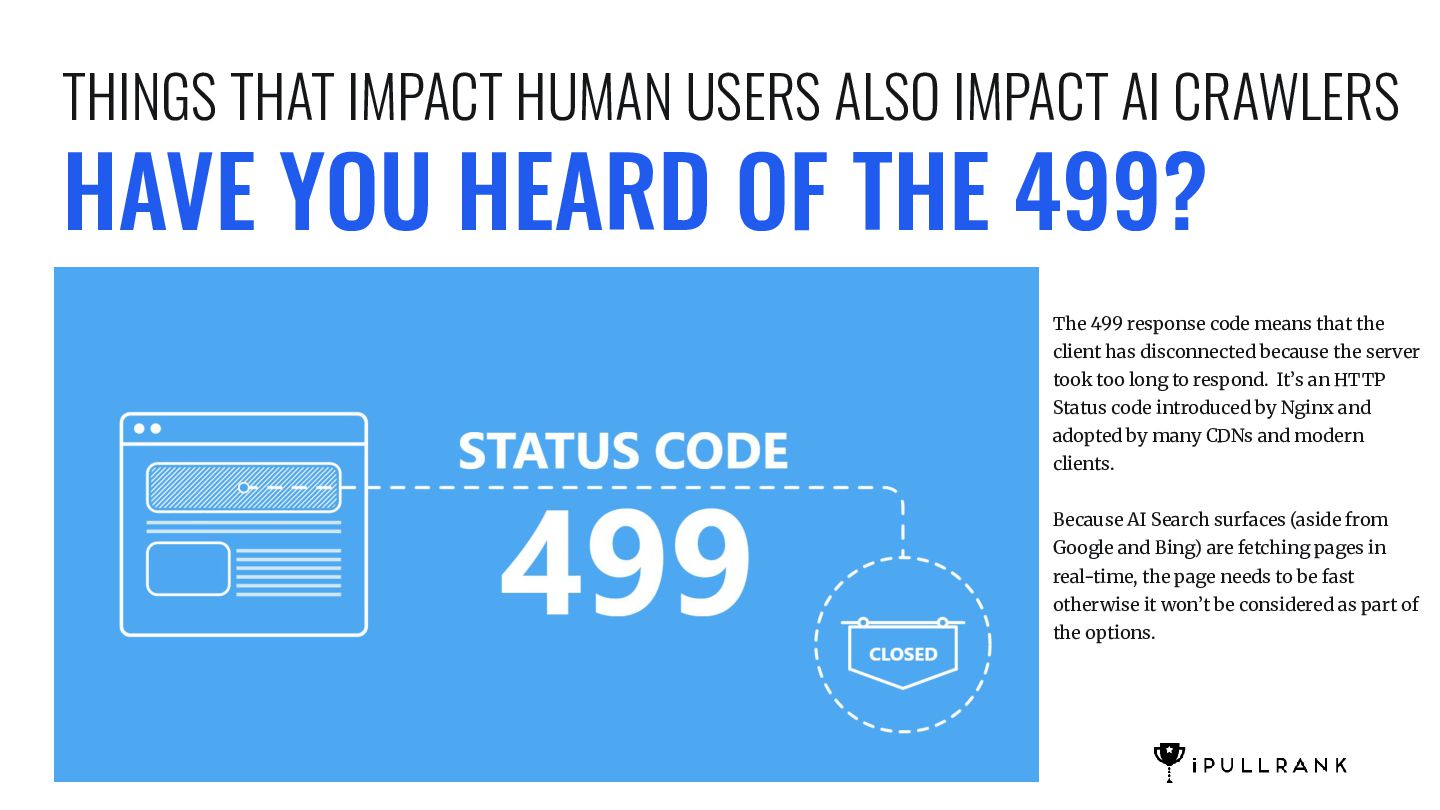
  20. HAVE YOU HEARD OF THE 499? THINGS THAT IMPACT HUMAN

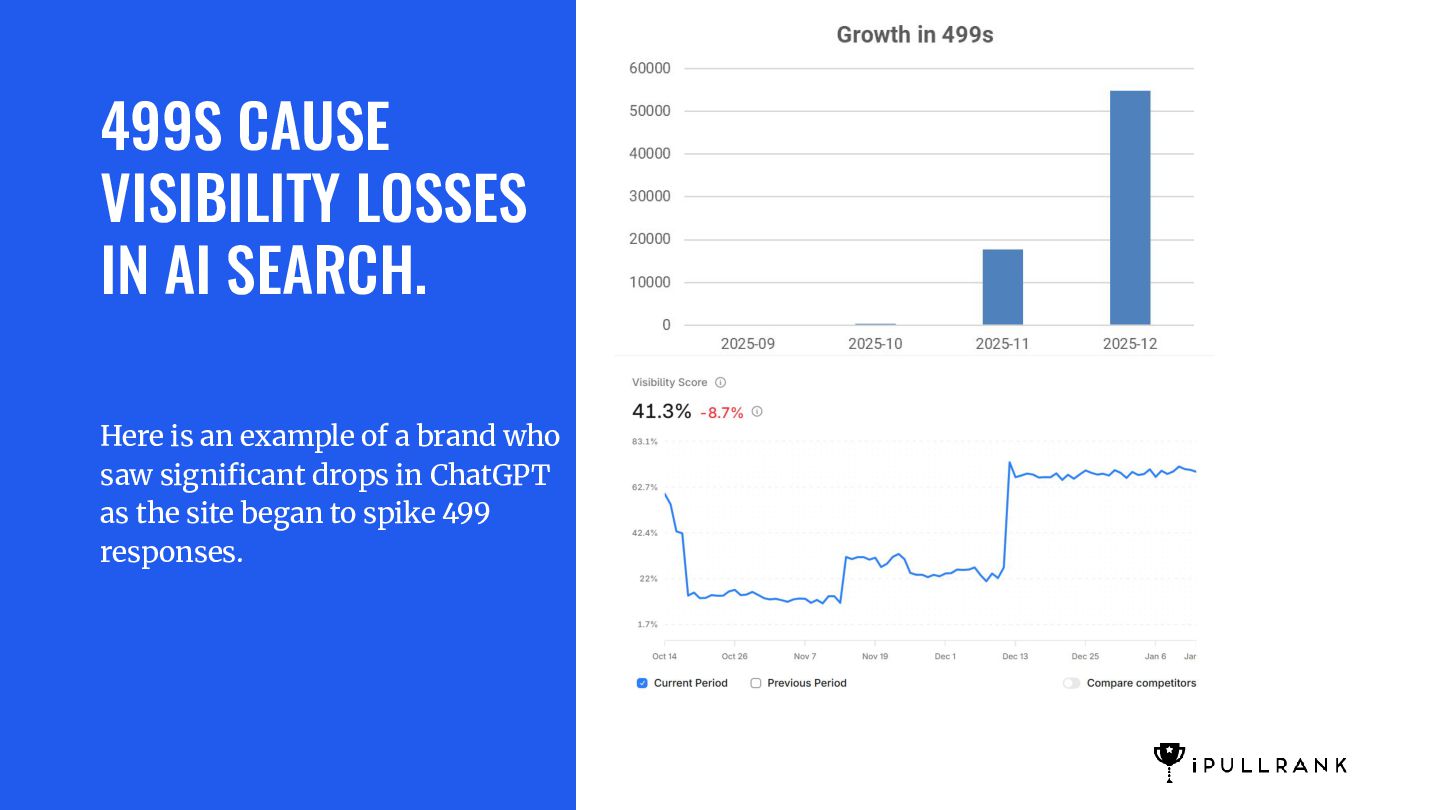
    USERS ALSO IMPACT AI CRAWLERS The 499 response code means that the client has disconnected because the server took too long to respond. It’s an HTTP Status code introduced by Nginx and adopted by many CDNs and modern clients. Because AI Search surfaces (aside from Google and Bing) are fetching pages in real-time, the page needs to be fast otherwise it won’t be considered as part of the options.
  21. 499S CAUSE VISIBILITY LOSSES IN AI SEARCH. Here is an

    example of a brand who saw significant drops in ChatGPT as the site began to spike 499 responses.
  22. Speed is not this magical ranking factor it’s sold as

    - but it does impact human users (and NavBoost) and can hinder AI bots — Me, Sr. Director of SEO, iPullRank
  23. Chunking and writing for humans are not mutually exclusive. Cyrus

    Shepard talks about how better structure yields better performance across a variety of metrics. Combining similar UX principles with Content Engineering gives you a feedback loop to improved performance. Source: https://moz.com/blog/10-super-easy-seo -copywriting-tips-for-link-building IMPROVING CONTENT STRUCTURE AND DESIGN WHEN WE SAY “CHUNKING” WHAT WE REALLY MEAN IS
  24. WRITING FOR SYNTHESIS To ensure your content performs well in

    modern retrieval systems, it’s essential to structure it in a way that is both machine-readable and human-friendly. Embedding models rely on clean, well-defined “chunks” or semantic units of information to generate precise and relevant results.
  25. TARGETING [MACHINE LEARNING] AND [DATA PRIVACY] HERE’S AN ORIGINAL PARAGRAPH

    The development of sophisticated algorithms capable of learning from vast datasets has revolutionized numerous industries, enabling predictive models that can identify patterns and make decisions with minimal human intervention; this process of training models on historical information is the core of modern artificial intelligence. However, the collection and use of this data, especially personal information, raise significant concerns about individual rights and the potential for misuse, leading to the establishment of regulations like GDPR and CCPA. These legal frameworks mandate that organizations implement robust security measures, such as encryption and anonymization, to protect sensitive information from unauthorized access. The challenge lies in balancing the insatiable need for high-quality training data, which improves model accuracy and performance, with the ethical obligation to ensure that an individual's personal details are not compromised, requiring techniques that can safeguard information while still allowing for valuable analytical insights to be drawn MACHINE LEARNING - 0.6481 DATA PRIVACY - 0.6948 COSINE SIMILARITY
  26. TARGETING [MACHINE LEARNING] AND [DATA PRIVACY] NOW I JUST SPLIT

    IT INTO TWO PARAGRAPHS MACHINE LEARNING - 0.7477 15.4% COSSIM IMPROVEMENT DATA PRIVACY - 0.7634 9.78% COSSIM IMPROVEMENT
  27. RELEVANCE SCORE PASSAGES USE RELEVANCE DOCTOR We built a simple

    tool that scores passages of content in a layout aware format. This will improve your ability to be considered and extracted. 48 https://ipullrank.com/tools/relevance-doctor
  28. Act as an Enterprise Conversion Rate Optimization (CRO) and SEO

    Strategist. I am providing a Target URL, its primary Target Keyword, and a list of top Competitor URLs. Your objective is to analyze these pages and provide a prioritized list of opportunities to improve the conversion rate for my target page and its underlying template. Here are my inputs: ❏ Target URL: [Insert Target URL] ❏ Target Keyword: [Insert Target Keyword] ❏ Competitor URLs: 1. [Insert Competitor URL 1] 2. [Insert Competitor URL 2] 3. [Insert Competitor URL 3] PLEASE EXECUTE THE FOLLOWING ANALYSIS STEP-BY-STEP: 1. Keyword Intent Alignment: Analyze the Target URL against the Target Keyword. Does the page immediately address the specific intent and pain points associated with that keyword above the fold? 2. Competitor Gap Analysis: Review the Competitor URLs. Identify the key conversion elements they are utilizing that my Target URL is missing (e.g., specific trust signals, clearer value propositions, superior form UX, risk-reversal guarantees). 3. Friction Audit: Identify the biggest sources of Cognitive, Interaction, or Trust friction currently present on the Target URL that are actively blocking conversions. 4. Template Scalability: Extrapolate these findings. If this page is part of a broader template (e.g., a programmatic SEO landing page, a product page, or a blog post layout), how should the master template be adjusted? BASED ON THIS ANALYSIS, OUTPUT A "TESTING PRIORITIZATION BACKLOG" IN A TABLE FORMAT WITH THE FOLLOWING COLUMNS: ❏ Element to Test (e.g., Hero Headline, Lead Form, Social Proof) ❏ Current State (What is wrong or missing on the Target URL) ❏ Competitor Insight (What the competitors are doing better) ❏ Hypothesis (If we change X to Y, then Z will happen) ❏ Expected Impact (High, Medium, Low) USING AI TO HELP YOU IDENTIFY WHAT TO TEST
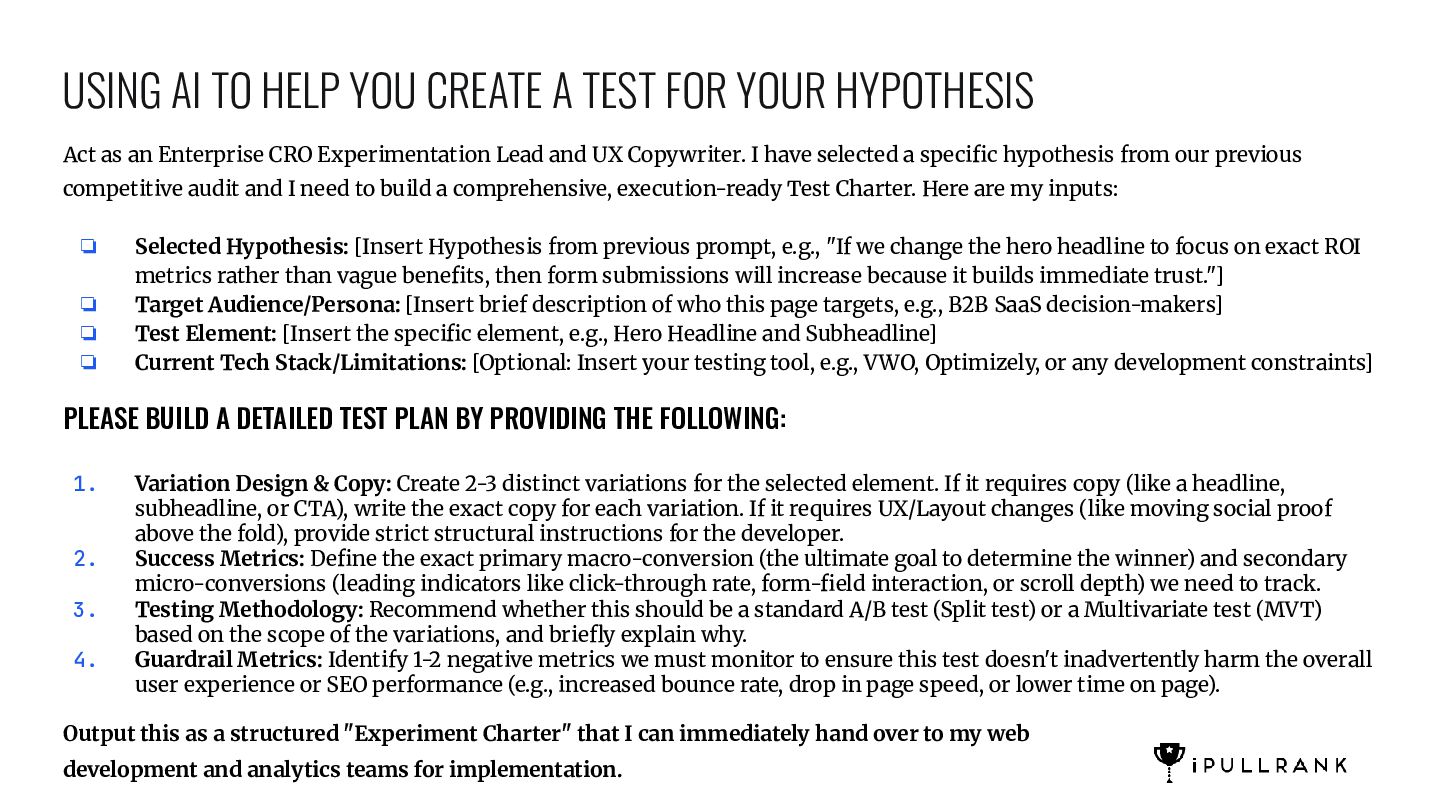
  29. Act as an Enterprise CRO Experimentation Lead and UX Copywriter.

    I have selected a specific hypothesis from our previous competitive audit and I need to build a comprehensive, execution-ready Test Charter. Here are my inputs: ❏ Selected Hypothesis: [Insert Hypothesis from previous prompt, e.g., "If we change the hero headline to focus on exact ROI metrics rather than vague benefits, then form submissions will increase because it builds immediate trust."] ❏ Target Audience/Persona: [Insert brief description of who this page targets, e.g., B2B SaaS decision-makers] ❏ Test Element: [Insert the specific element, e.g., Hero Headline and Subheadline] ❏ Current Tech Stack/Limitations: [Optional: Insert your testing tool, e.g., VWO, Optimizely, or any development constraints] PLEASE BUILD A DETAILED TEST PLAN BY PROVIDING THE FOLLOWING: 1. Variation Design & Copy: Create 2-3 distinct variations for the selected element. If it requires copy (like a headline, subheadline, or CTA), write the exact copy for each variation. If it requires UX/Layout changes (like moving social proof above the fold), provide strict structural instructions for the developer. 2. Success Metrics: Define the exact primary macro-conversion (the ultimate goal to determine the winner) and secondary micro-conversions (leading indicators like click-through rate, form-field interaction, or scroll depth) we need to track. 3. Testing Methodology: Recommend whether this should be a standard A/B test (Split test) or a Multivariate test (MVT) based on the scope of the variations, and briefly explain why. 4. Guardrail Metrics: Identify 1-2 negative metrics we must monitor to ensure this test doesn't inadvertently harm the overall user experience or SEO performance (e.g., increased bounce rate, drop in page speed, or lower time on page). Output this as a structured "Experiment Charter" that I can immediately hand over to my web development and analytics teams for implementation. USING AI TO HELP YOU CREATE A TEST FOR YOUR HYPOTHESIS
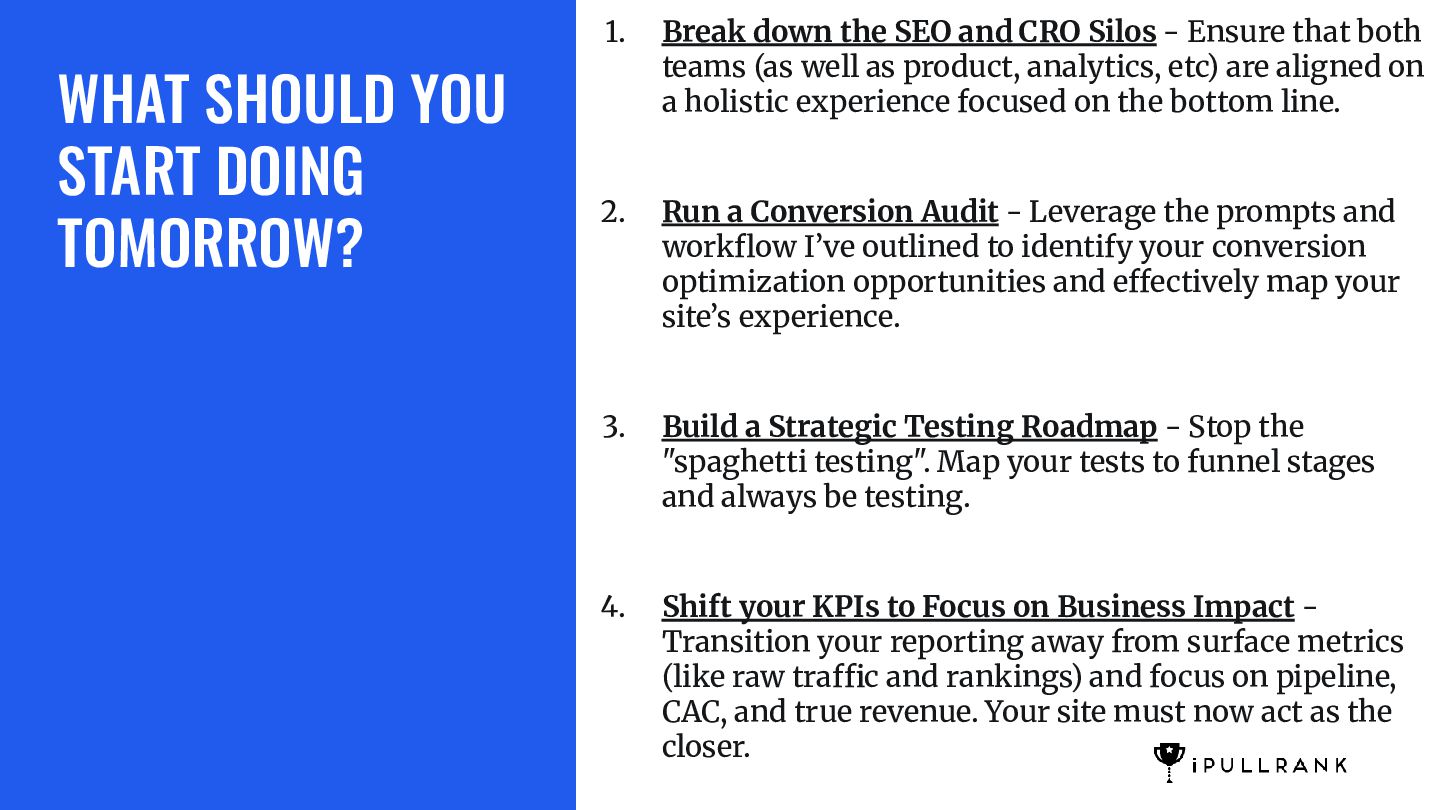
  30. WHAT SHOULD YOU START DOING TOMORROW? 1. Break down the

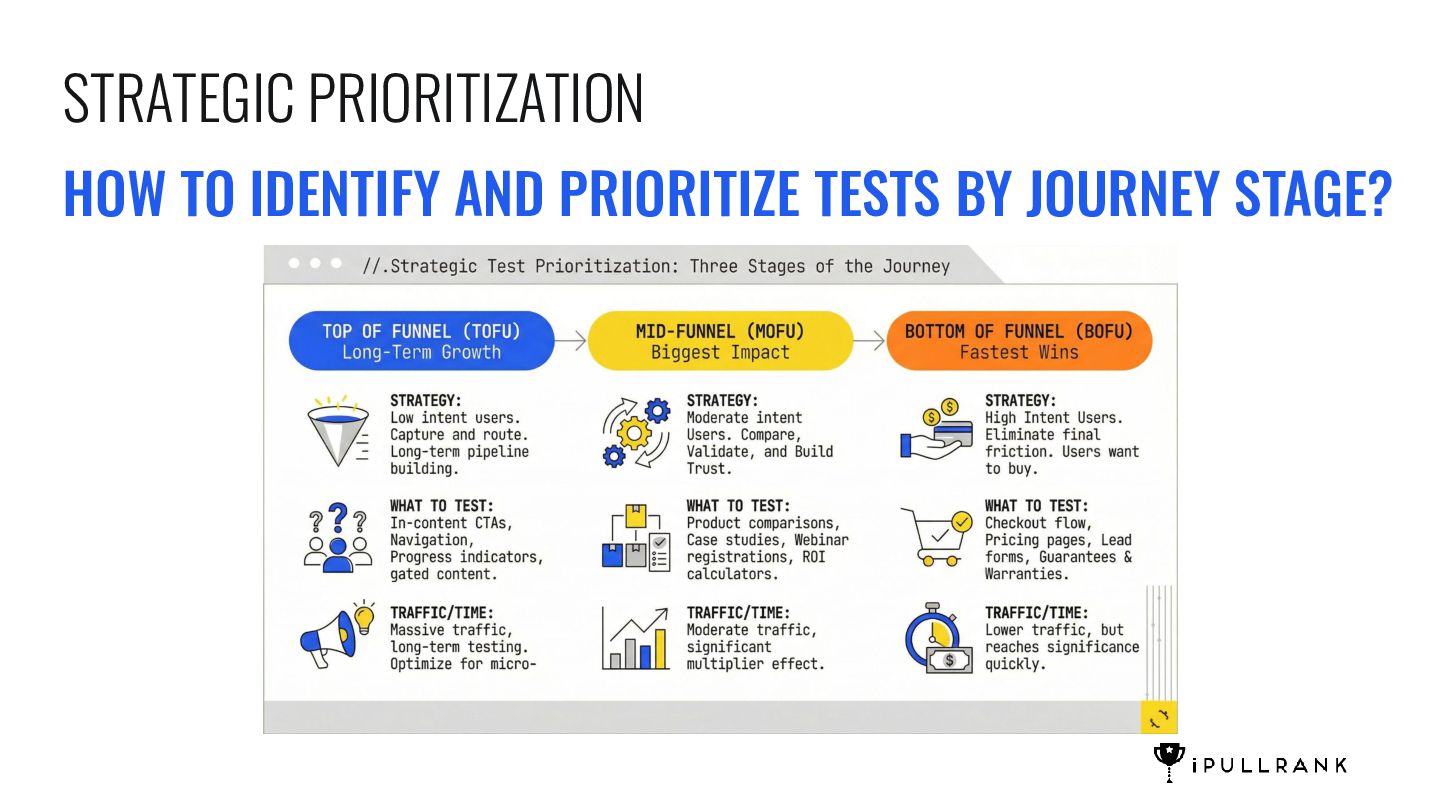
    SEO and CRO Silos - Ensure that both teams (as well as product, analytics, etc) are aligned on a holistic experience focused on the bottom line. 2. Run a Conversion Audit - Leverage the prompts and workflow I’ve outlined to identify your conversion optimization opportunities and effectively map your site’s experience. 3. Build a Strategic Testing Roadmap - Stop the "spaghetti testing". Map your tests to funnel stages and always be testing. 4. Shift your KPIs to Focus on Business Impact - Transition your reporting away from surface metrics (like raw traffic and rankings) and focus on pipeline, CAC, and true revenue. Your site must now act as the closer.
  31. Zach Chahalis Senior Director of SEO and Data Analytics iPullRank

    X: @ZachChahalis LI: /zacharychahalis Tap in with us: ipullrank.com THANK YOU | Q&A Get the Slides
  32. 60