Upgrade to Pro — share decks privately, control downloads, hide ads and more …

The New Playbook for AEO Content in 2026 - Digi...

Sponsored · SiteGround - Reliable hosting with speed, security, and support you can count on.

The New Playbook for AEO Content in 2026 - Digital Summit 2026

The New Playbook for AEO Content in 2026: How to Get Your Brand Chosen as the Answer

As search evolves from “10 blue links” to AI-generated answers, the biggest opportunity for marketers isn’t just ranking—it’s becoming the source AI systems trust and cite. In this session, you’ll learn how to optimize your content for Relevance Engineering/Answer Engine Optimization (AEO) by aligning with how modern AI platforms discover, interpret, and reuse information.

Designed for content teams and marketers, this talk focuses on practical strategies to make your pages more “answer-ready.” We’ll explore how AI evaluates content at the passage level, why chunking and structure matter more than ever, and how marketers can create content that performs well across synthetic fan-out queries (the many follow-up questions AI generates behind the scenes). You’ll also learn how semantic relationships and “triples” help AI connect your brand to the topics that matter most.

Attendees will walk away with a clear framework for building content that is not only searchable—but usable in the next generation of AI-driven discovery.

Key Takeaways

How to structure and write content so AI engines can extract the best passages and choose your brand as the answer.

A marketer-friendly approach to passage relevance, chunking, and embedding-driven optimization without needing to be an engineer.

How to explore fan-out queries and build content ecosystems that anticipate the questions AI will ask next.

Avatar for Zach Chahalis

Zach Chahalis

March 17, 2026
Tweet

More Decks by Zach Chahalis

Other Decks in Marketing & SEO

Transcript

  1. The New Playbook for AEO Content in 2026 How to

    Get Your Brand Chosen as the Answer Zach Chahalis Sr. Director of SEO and Data Analytics iPullRank X: @ZachChahalis LI: /zacharychahalis
  2. I’M ZACH CHAHALIS SR. DIRECTOR OF SEO AND DATA ANALYTICS

    iPullRank My context: 5+ Months at iPR (But 2.5 yrs in total) 15 Years in SEO, Marketing Analytics, and CRO 26 Days from Getting Married (Almost) 11 Yr Old Goldendoodle
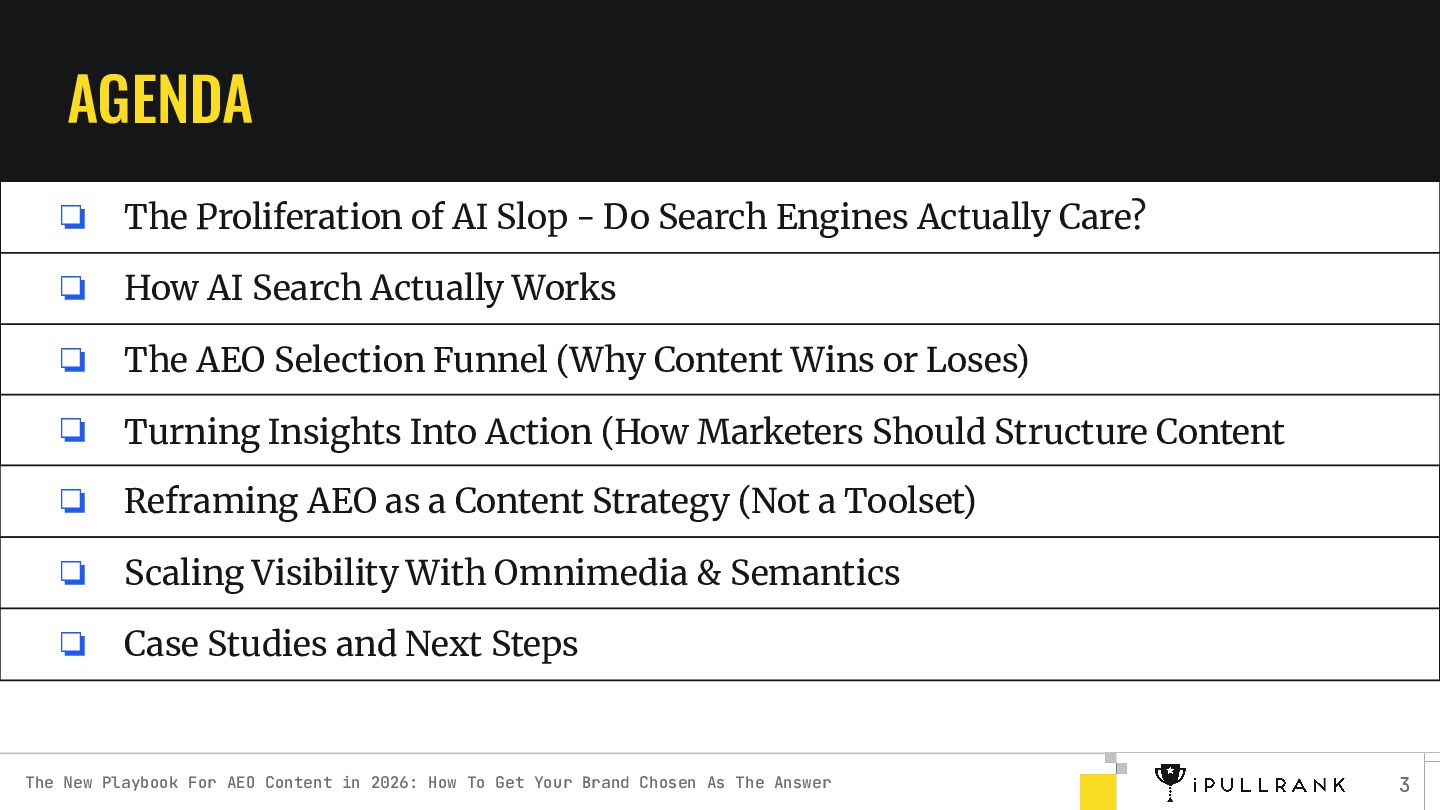
  3. ❏ ❏ ❏ ❏ 3 ❏ ❏ ❏ AGENDA The

    Proliferation of AI Slop - Do Search Engines Actually Care? How AI Search Actually Works The AEO Selection Funnel (Why Content Wins or Loses) Turning Insights Into Action (How Marketers Should Structure Content Reframing AEO as a Content Strategy (Not a Toolset) Scaling Visibility With Omnimedia & Semantics Case Studies and Next Steps The New Playbook For AEO Content in 2026: How To Get Your Brand Chosen As The Answer
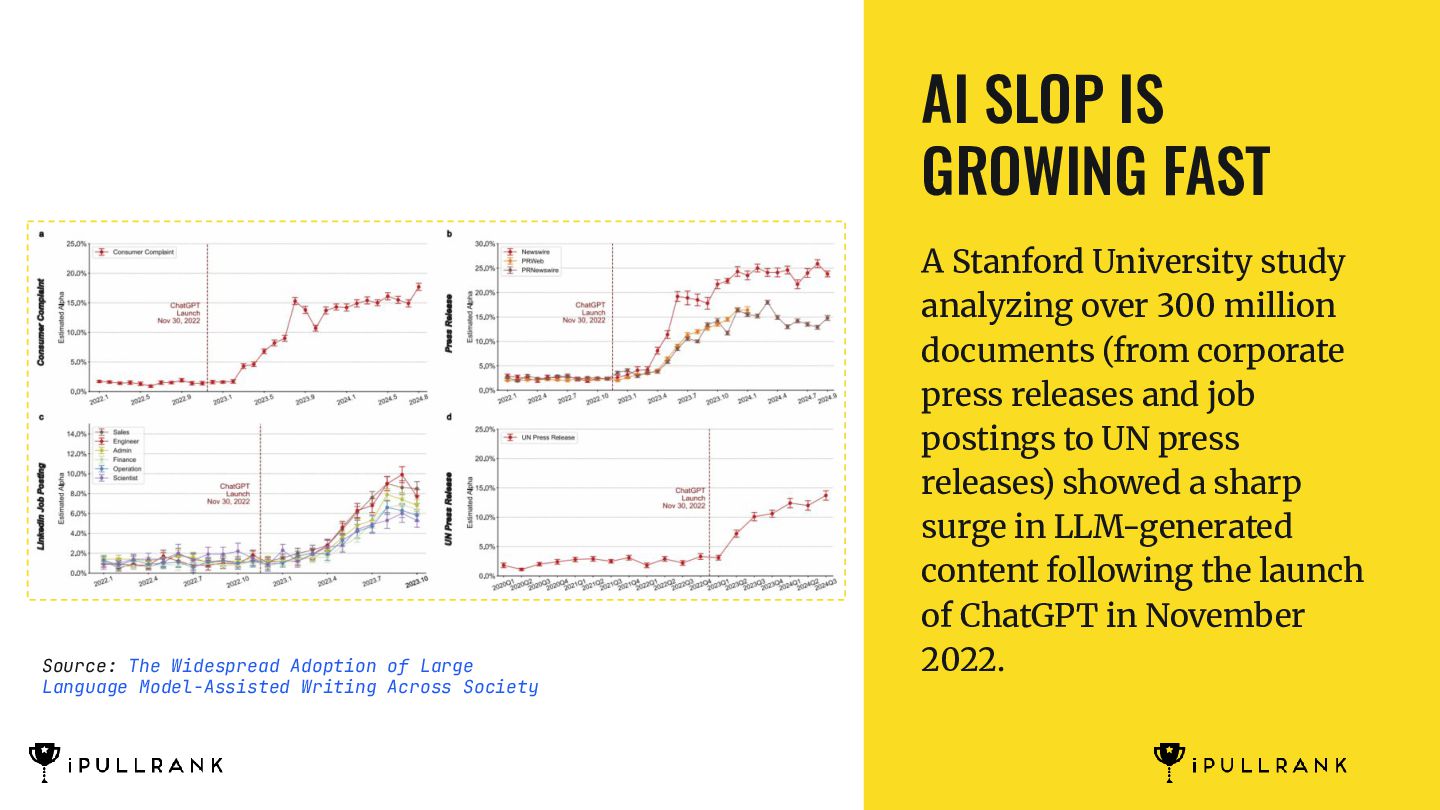
  4. AI SLOP IS GROWING FAST A Stanford University study analyzing
    over 300 million documents (from corporate press releases and job postings to UN press releases) showed a sharp surge in LLM-generated content following the launch of ChatGPT in November 2022. Source: The Widespread Adoption of Large Language Model-Assisted Writing Across Society
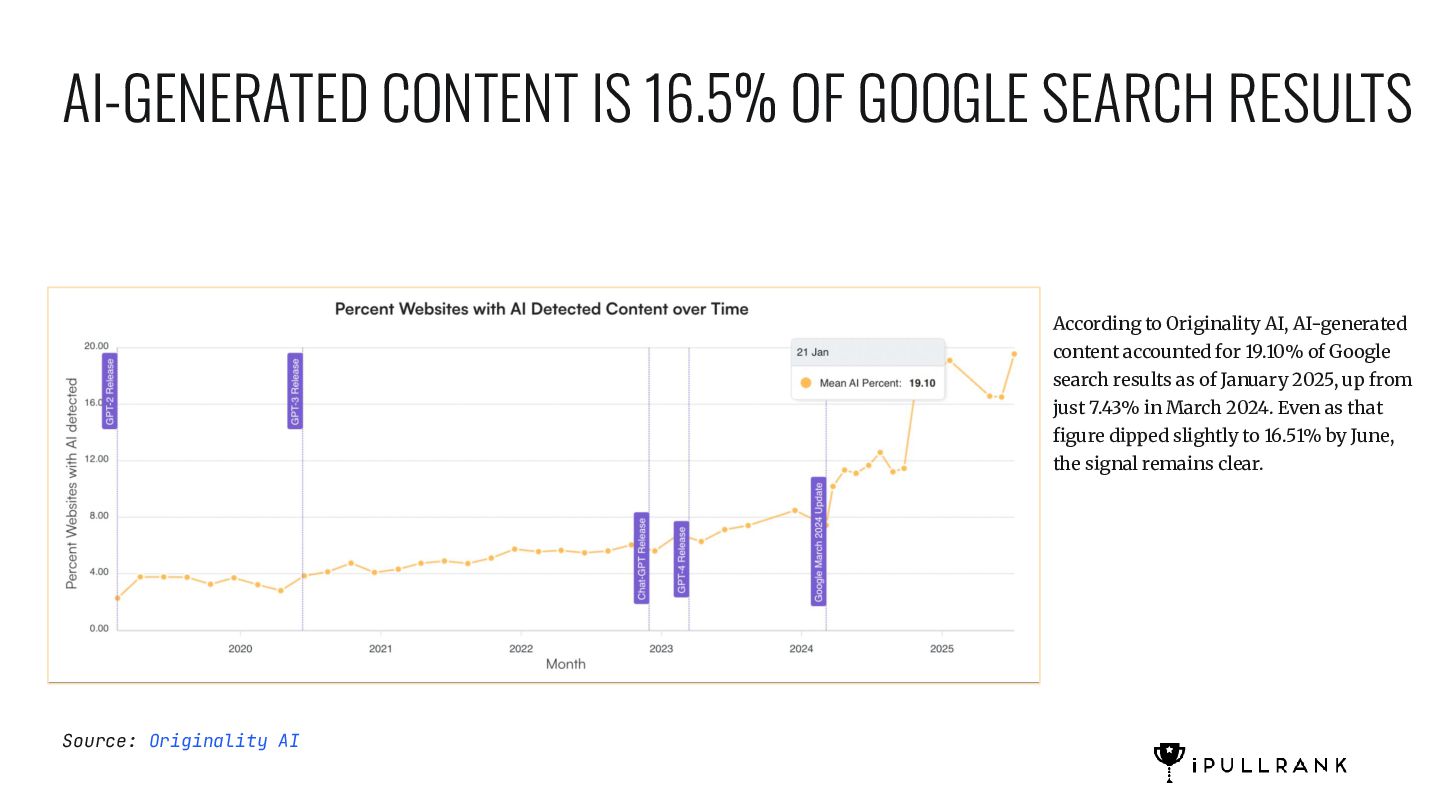
  5. According to Originality AI, AI-generated content accounted for 19.10% of

    Google search results as of January 2025, up from just 7.43% in March 2024. Even as that figure dipped slightly to 16.51% by June, the signal remains clear. AI-GENERATED CONTENT IS 16.5% OF GOOGLE SEARCH RESULTS Source: Originality AI
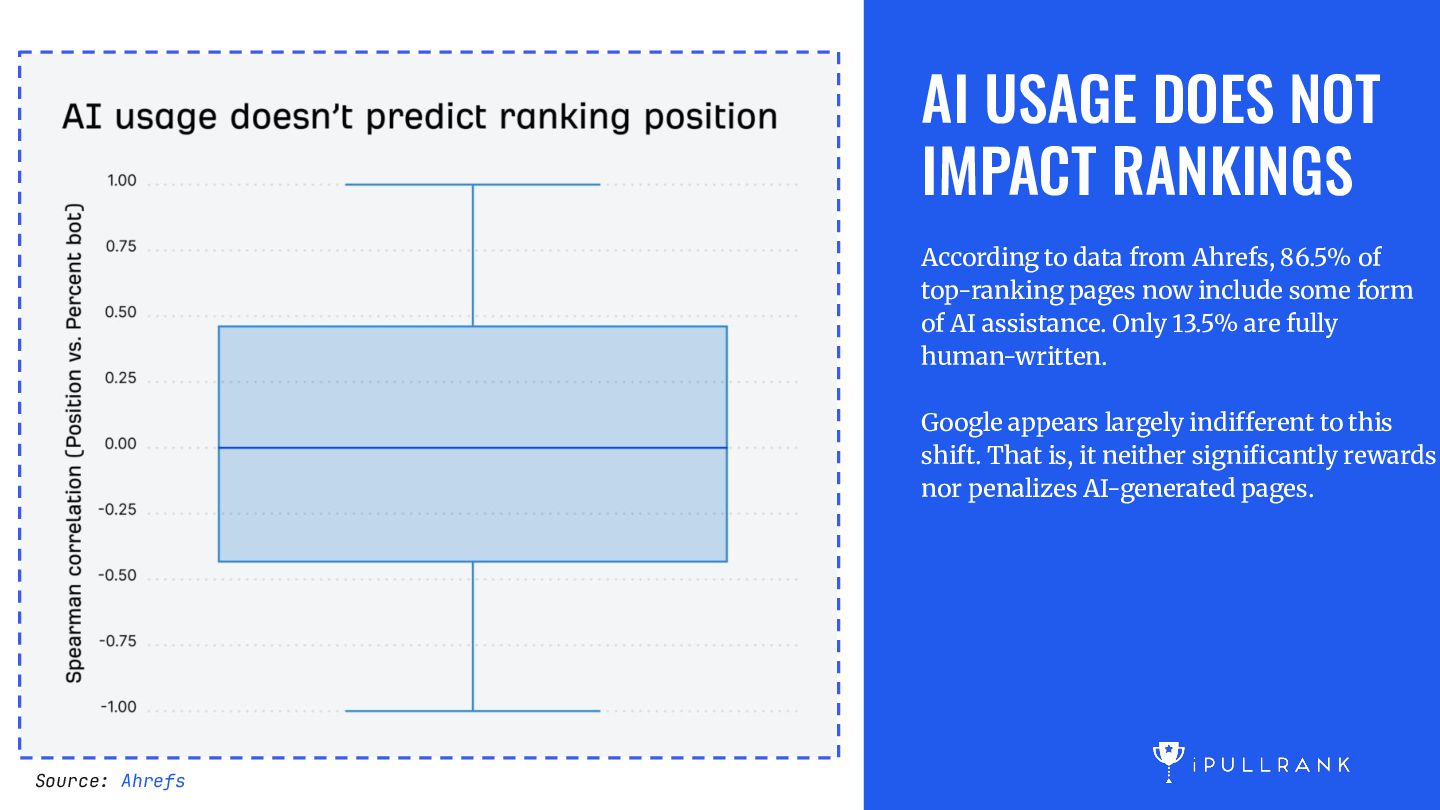
  6. AI USAGE DOES NOT IMPACT RANKINGS According to data from

    Ahrefs, 86.5% of top-ranking pages now include some form of AI assistance. Only 13.5% are fully human-written. Google appears largely indifferent to this shift. That is, it neither significantly rewards nor penalizes AI-generated pages. Source: Ahrefs
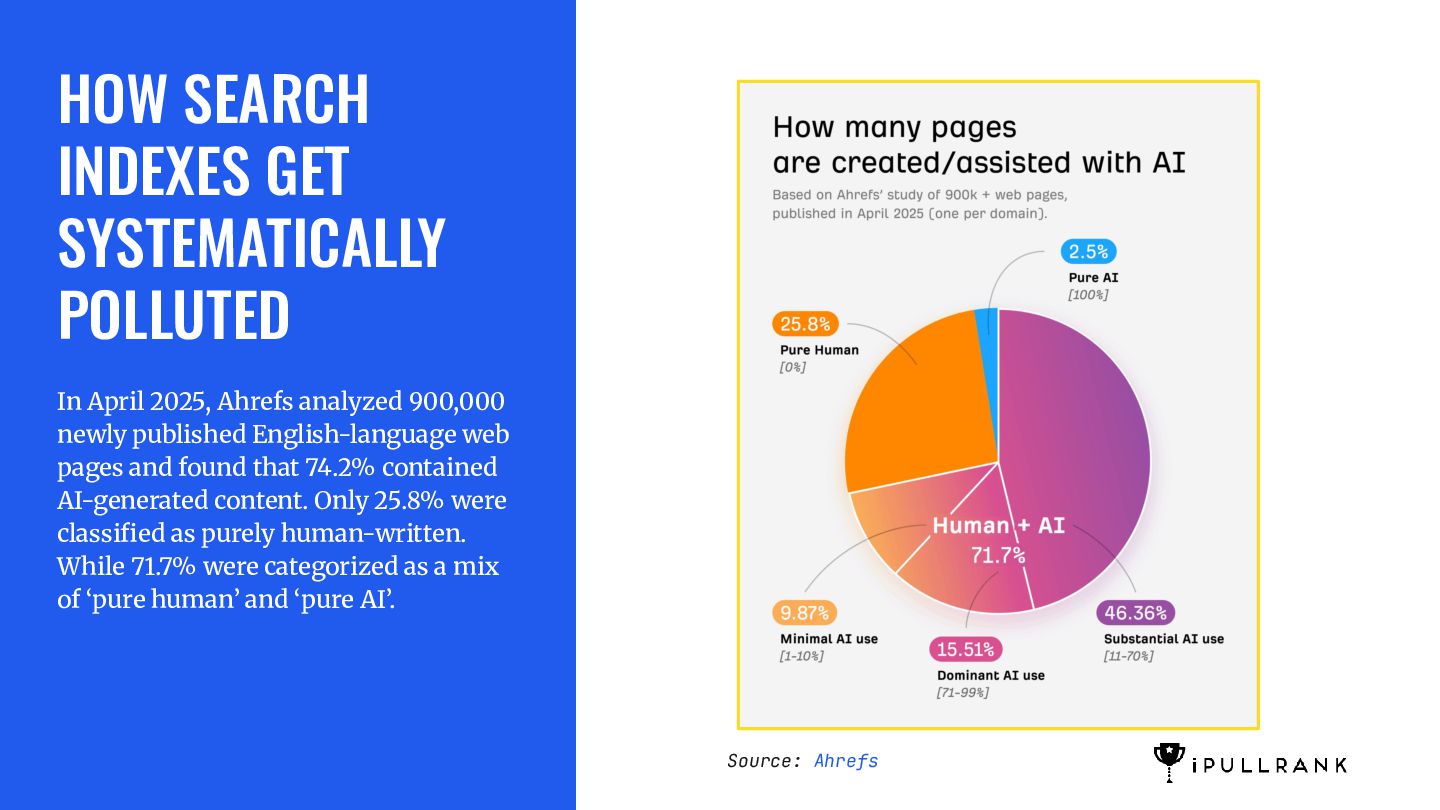
  7. HOW SEARCH INDEXES GET SYSTEMATICALLY POLLUTED In April 2025, Ahrefs

    analyzed 900,000 newly published English-language web pages and found that 74.2% contained AI-generated content. Only 25.8% were classified as purely human-written. While 71.7% were categorized as a mix of ‘pure human’ and ‘pure AI’. Source: Ahrefs
  8. 90% OF ONLINE CONTENT MAY BE AI-GENERATED BY 2026 Digital

    Ouroboros is on the way with experts estimating that as much as 90% of online content may be AI-generated by 2026. For creators, marketers, and businesses, this raises urgent new questions. How do you compete, rank, or even stay visible in an ecosystem buried under an avalanche of low-quality synthetic content?
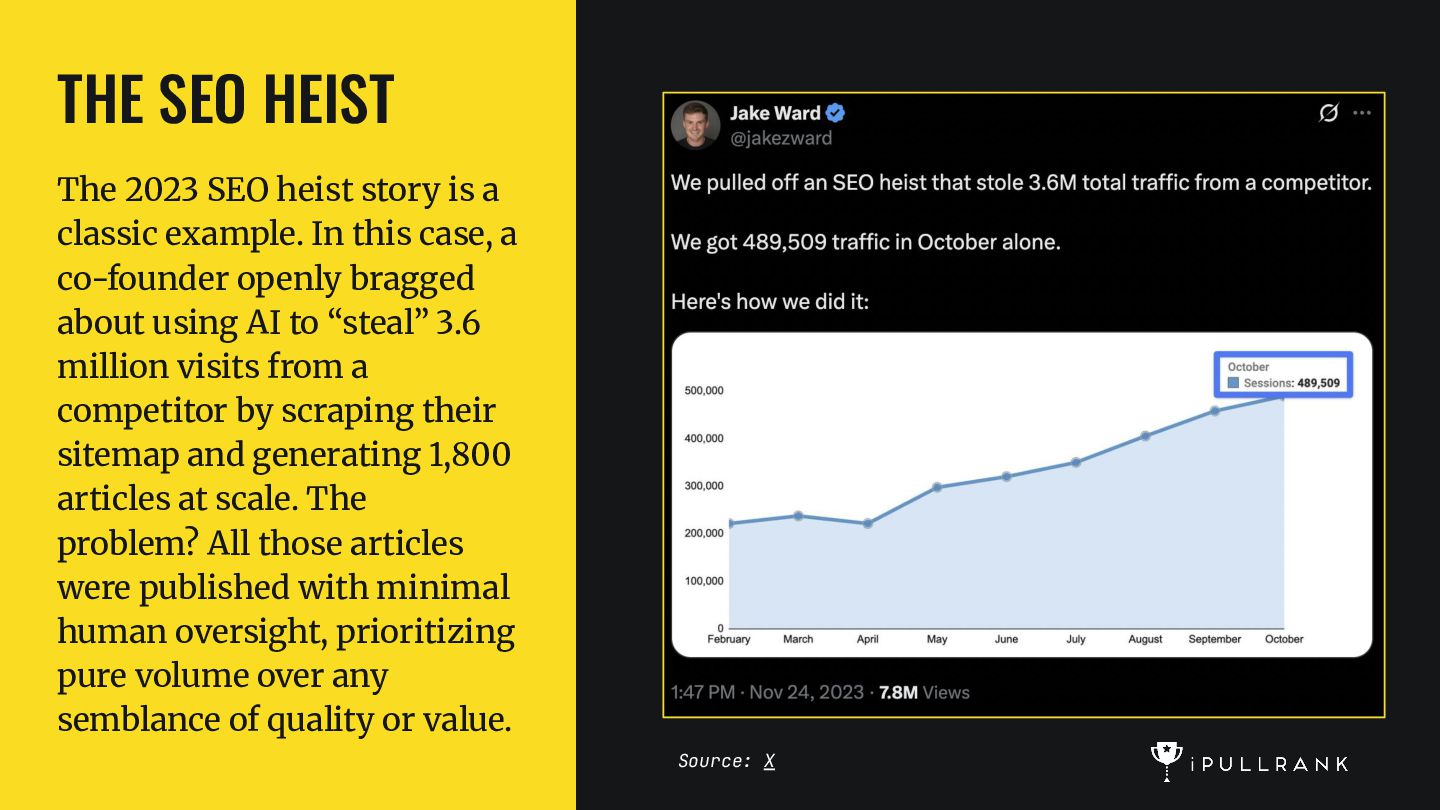
  9. THE SEO HEIST The 2023 SEO heist story is a

    classic example. In this case, a co-founder openly bragged about using AI to “steal” 3.6 million visits from a competitor by scraping their sitemap and generating 1,800 articles at scale. The problem? All those articles were published with minimal human oversight, prioritizing pure volume over any semblance of quality or value. Source: X
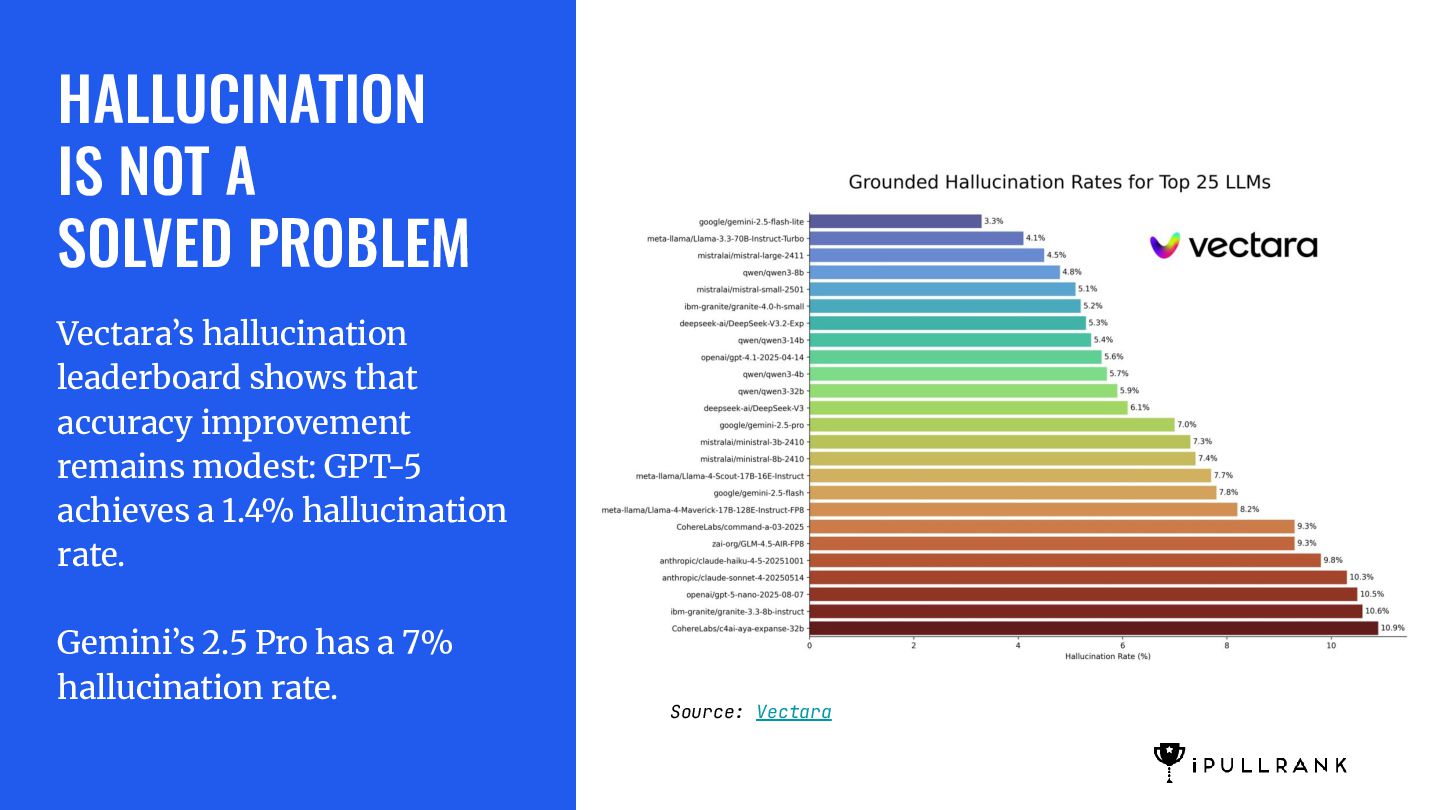
  10. HALLUCINATION IS NOT A SOLVED PROBLEM Vectara’s hallucination leaderboard shows

    that accuracy improvement remains modest: GPT-5 achieves a 1.4% hallucination rate. Gemini’s 2.5 Pro has a 7% hallucination rate. Source: Vectara
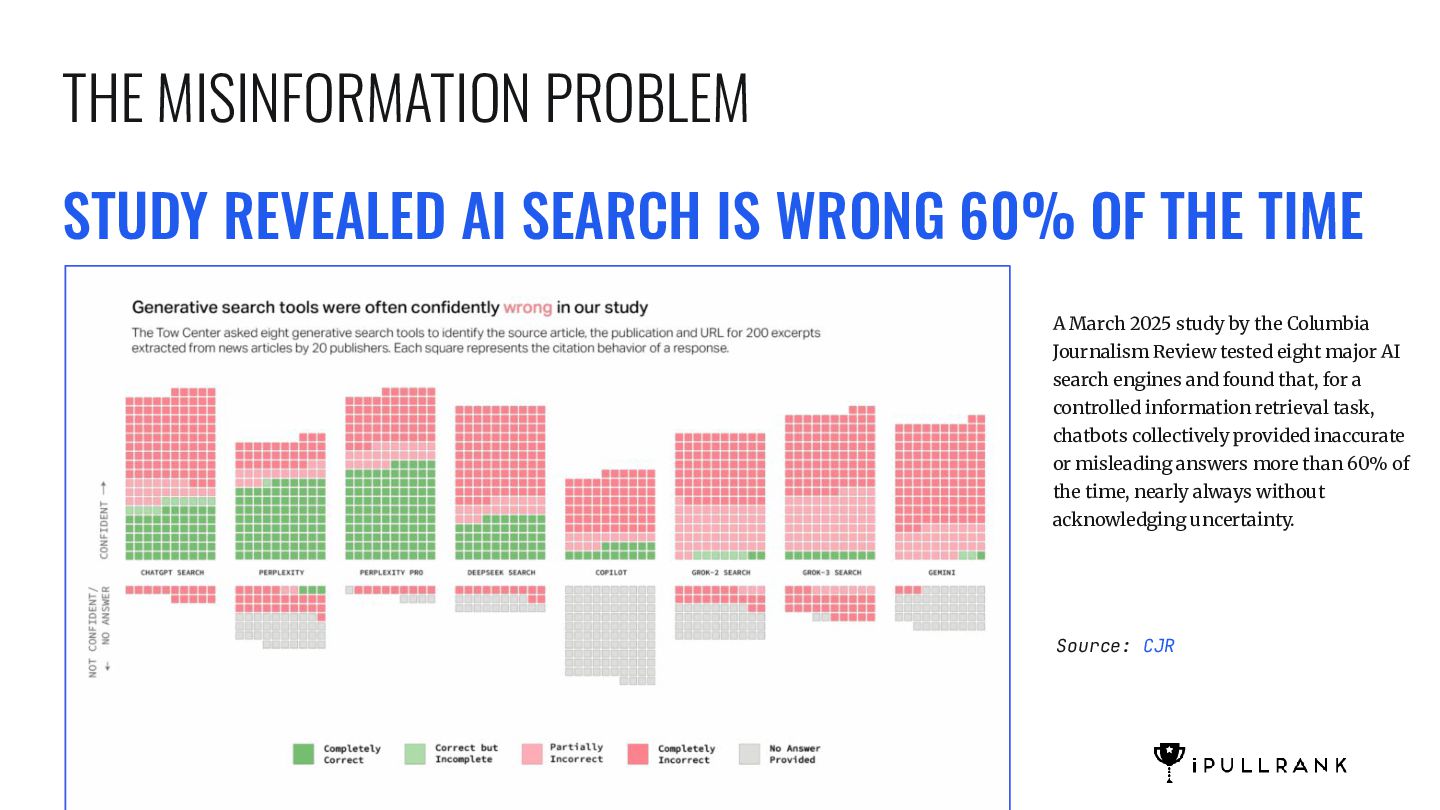
  11. STUDY REVEALED AI SEARCH IS WRONG 60% OF THE TIME

    A March 2025 study by the Columbia Journalism Review tested eight major AI search engines and found that, for a controlled information retrieval task, chatbots collectively provided inaccurate or misleading answers more than 60% of the time, nearly always without acknowledging uncertainty. THE MISINFORMATION PROBLEM Source: CJR
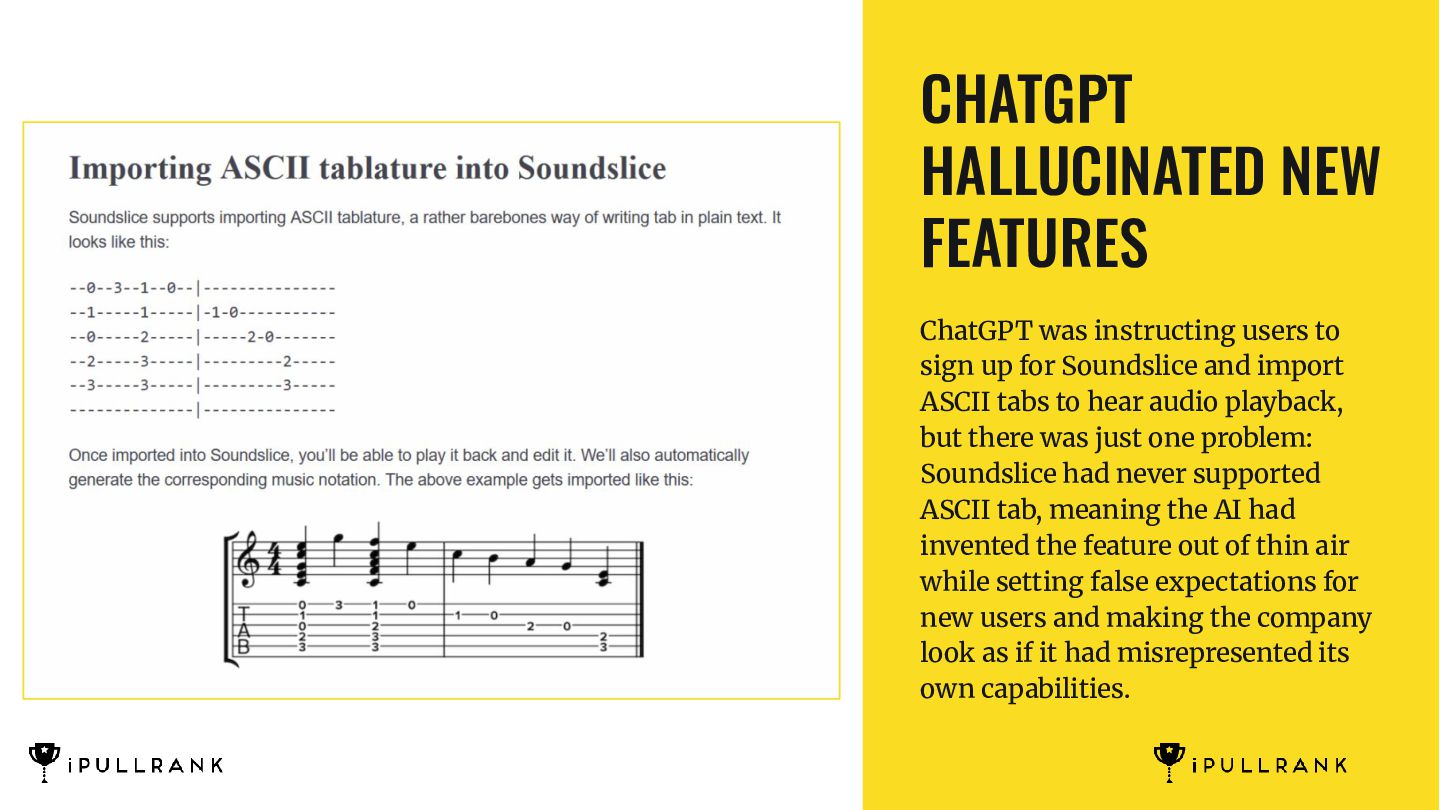
  12. CHATGPT HALLUCINATED NEW FEATURES ChatGPT was instructing users to sign

    up for Soundslice and import ASCII tabs to hear audio playback, but there was just one problem: Soundslice had never supported ASCII tab, meaning the AI had invented the feature out of thin air while setting false expectations for new users and making the company look as if it had misrepresented its own capabilities.
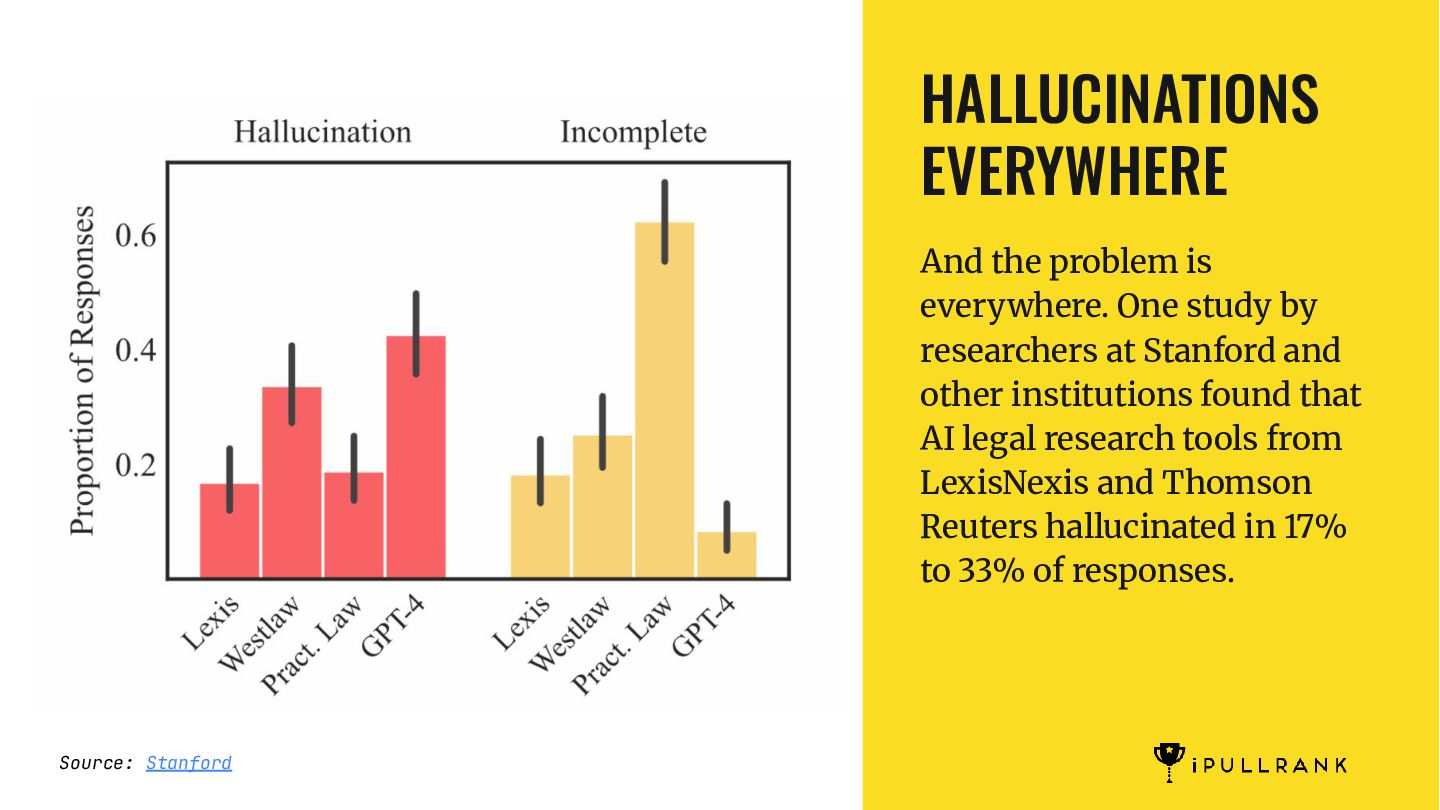
  13. HALLUCINATIONS EVERYWHERE And the problem is everywhere. One study by

    researchers at Stanford and other institutions found that AI legal research tools from LexisNexis and Thomson Reuters hallucinated in 17% to 33% of responses. Source: Stanford
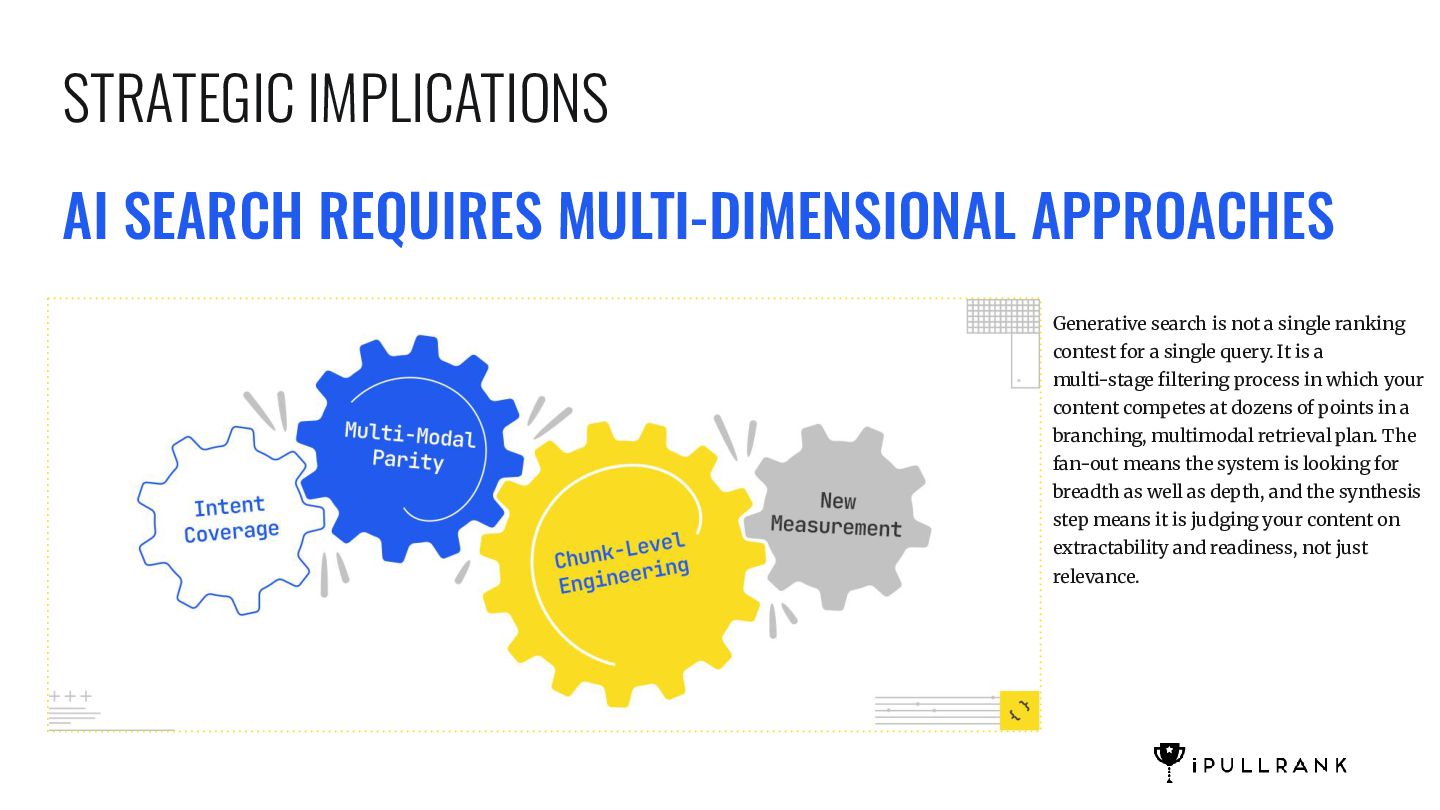
  14. AI SEARCH REQUIRES MULTI-DIMENSIONAL APPROACHES Generative search is not a

    single ranking contest for a single query. It is a multi-stage filtering process in which your content competes at dozens of points in a branching, multimodal retrieval plan. The fan-out means the system is looking for breadth as well as depth, and the synthesis step means it is judging your content on extractability and readiness, not just relevance. STRATEGIC IMPLICATIONS

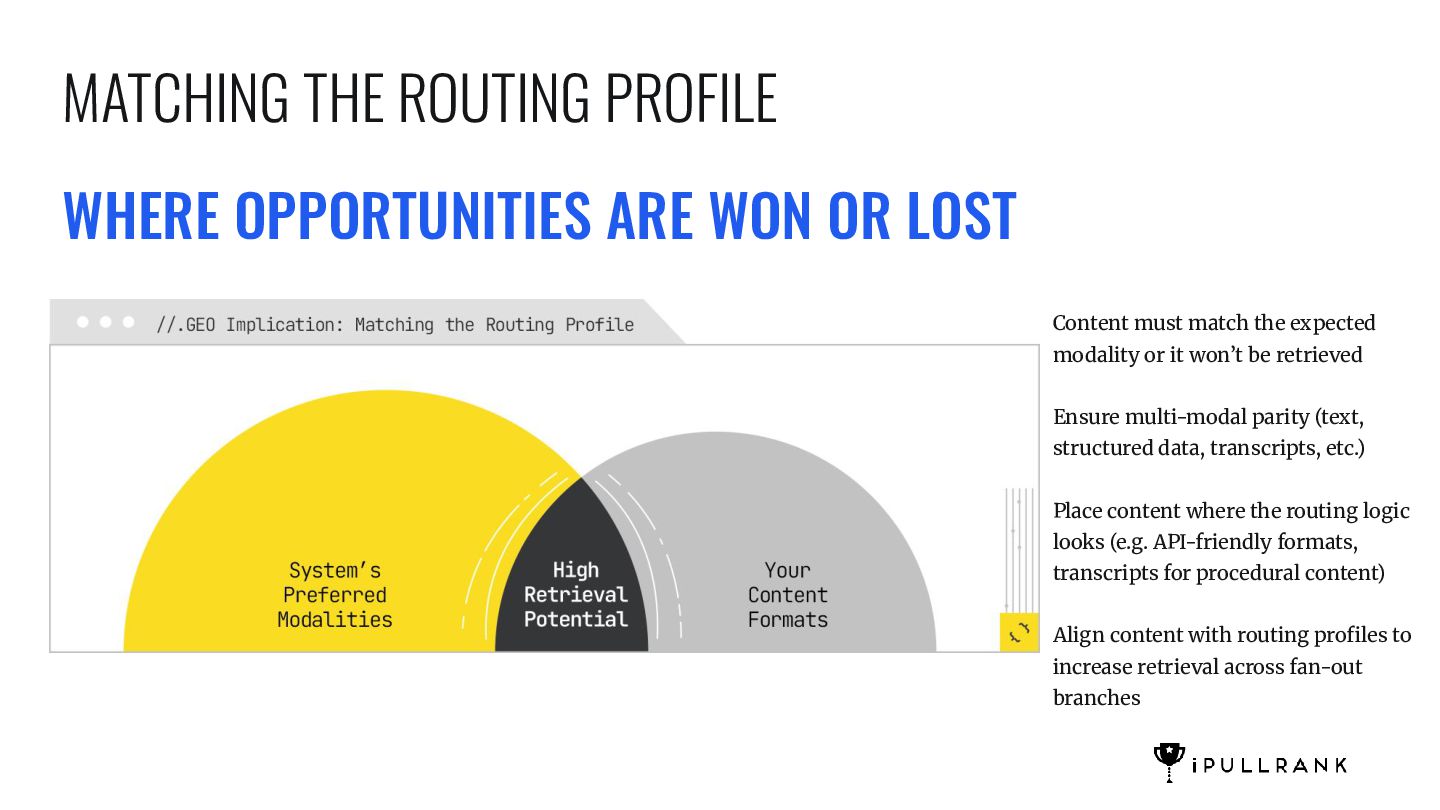
  15. WHERE OPPORTUNITIES ARE WON OR LOST Content must match the

    expected modality or it won’t be retrieved Ensure multi-modal parity (text, structured data, transcripts, etc.) Place content where the routing logic looks (e.g. API-friendly formats, transcripts for procedural content) Align content with routing profiles to increase retrieval across fan-out branches MATCHING THE ROUTING PROFILE
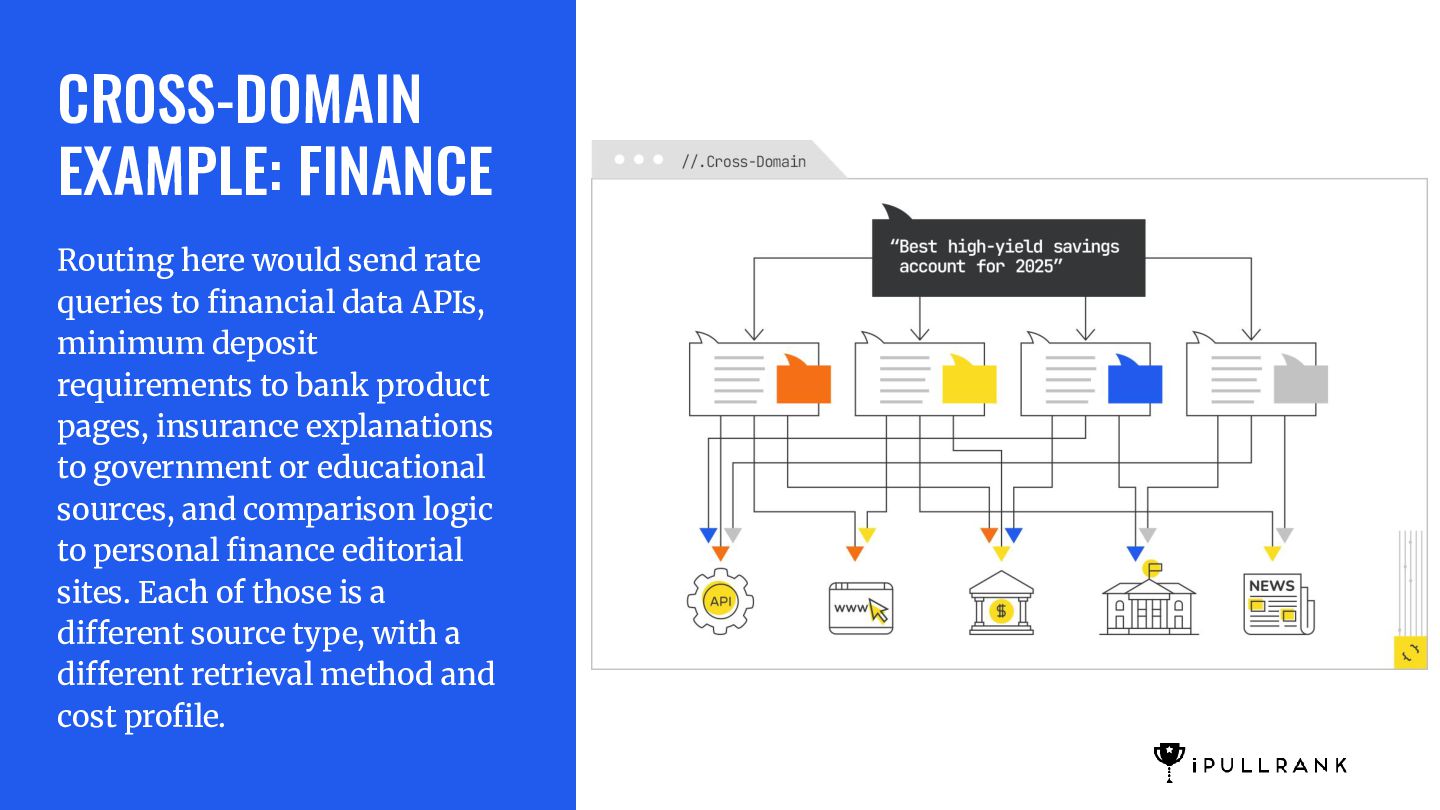
  16. CROSS-DOMAIN EXAMPLE: FINANCE Routing here would send rate queries to

    financial data APIs, minimum deposit requirements to bank product pages, insurance explanations to government or educational sources, and comparison logic to personal finance editorial sites. Each of those is a different source type, with a different retrieval method and cost profile.
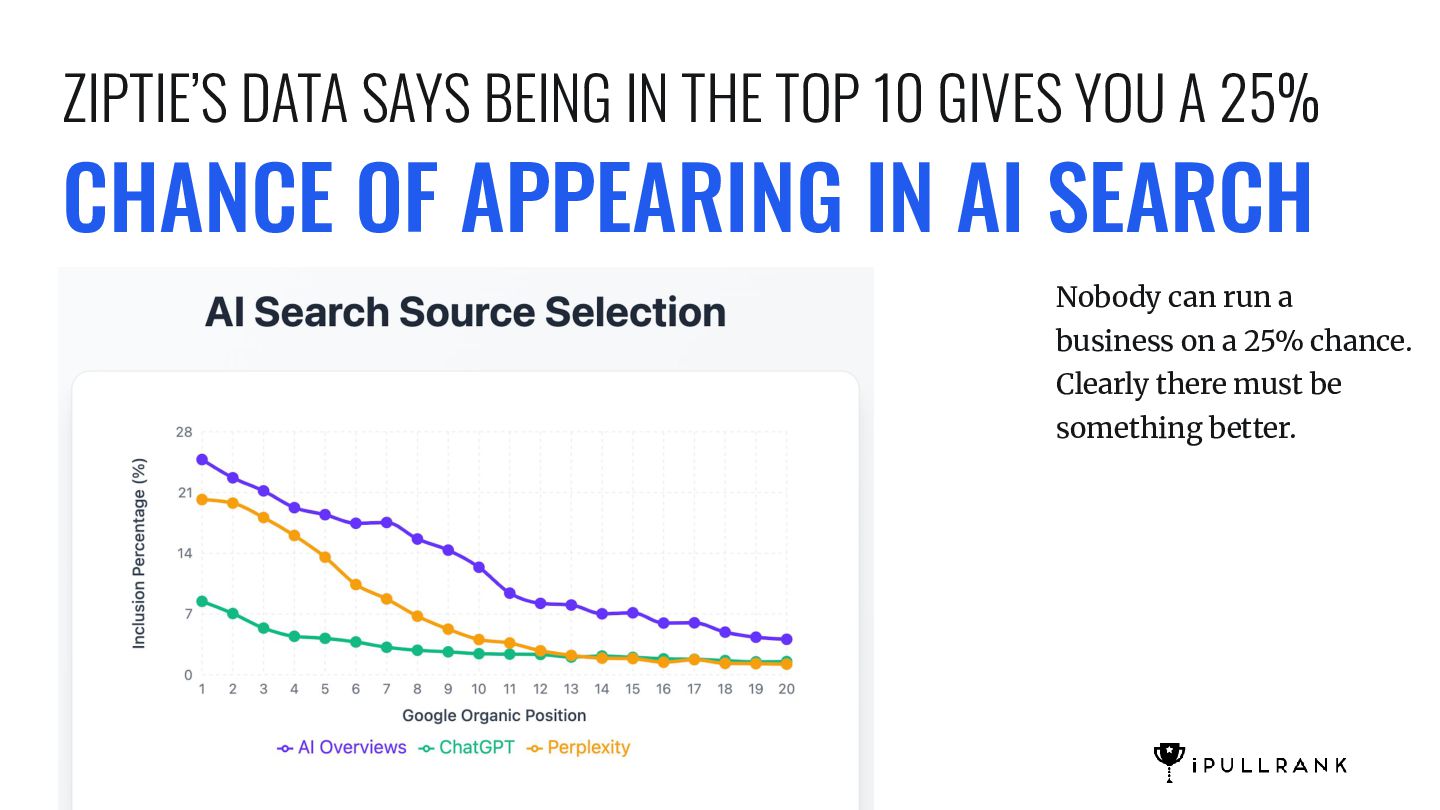
  17. CHANCE OF APPEARING IN AI SEARCH Nobody can run a

    business on a 25% chance. Clearly there must be something better. ZIPTIE’S DATA SAYS BEING IN THE TOP 10 GIVES YOU A 25%
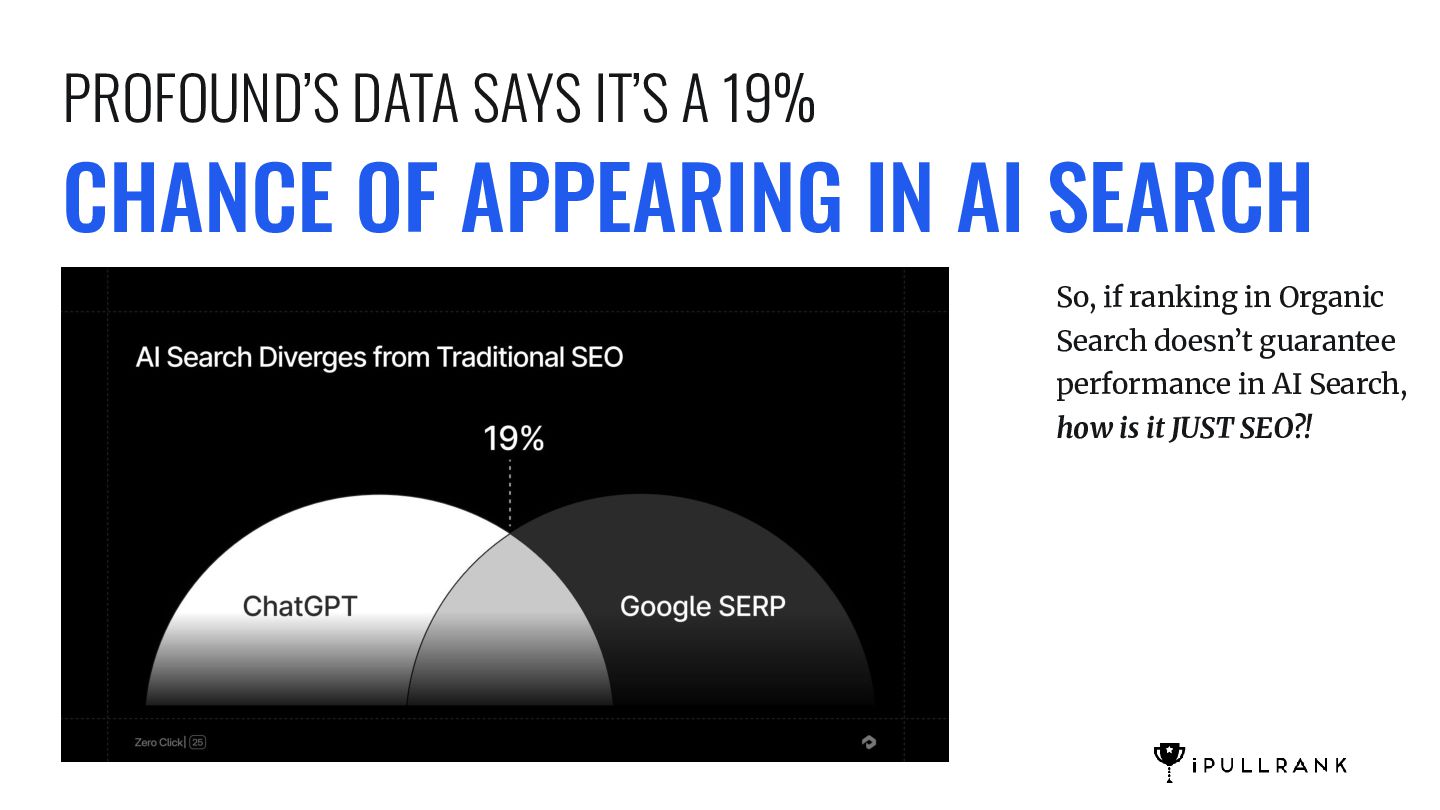
  18. CHANCE OF APPEARING IN AI SEARCH So, if ranking in

    Organic Search doesn’t guarantee performance in AI Search, how is it JUST SEO?! PROFOUND’S DATA SAYS IT’S A 19%
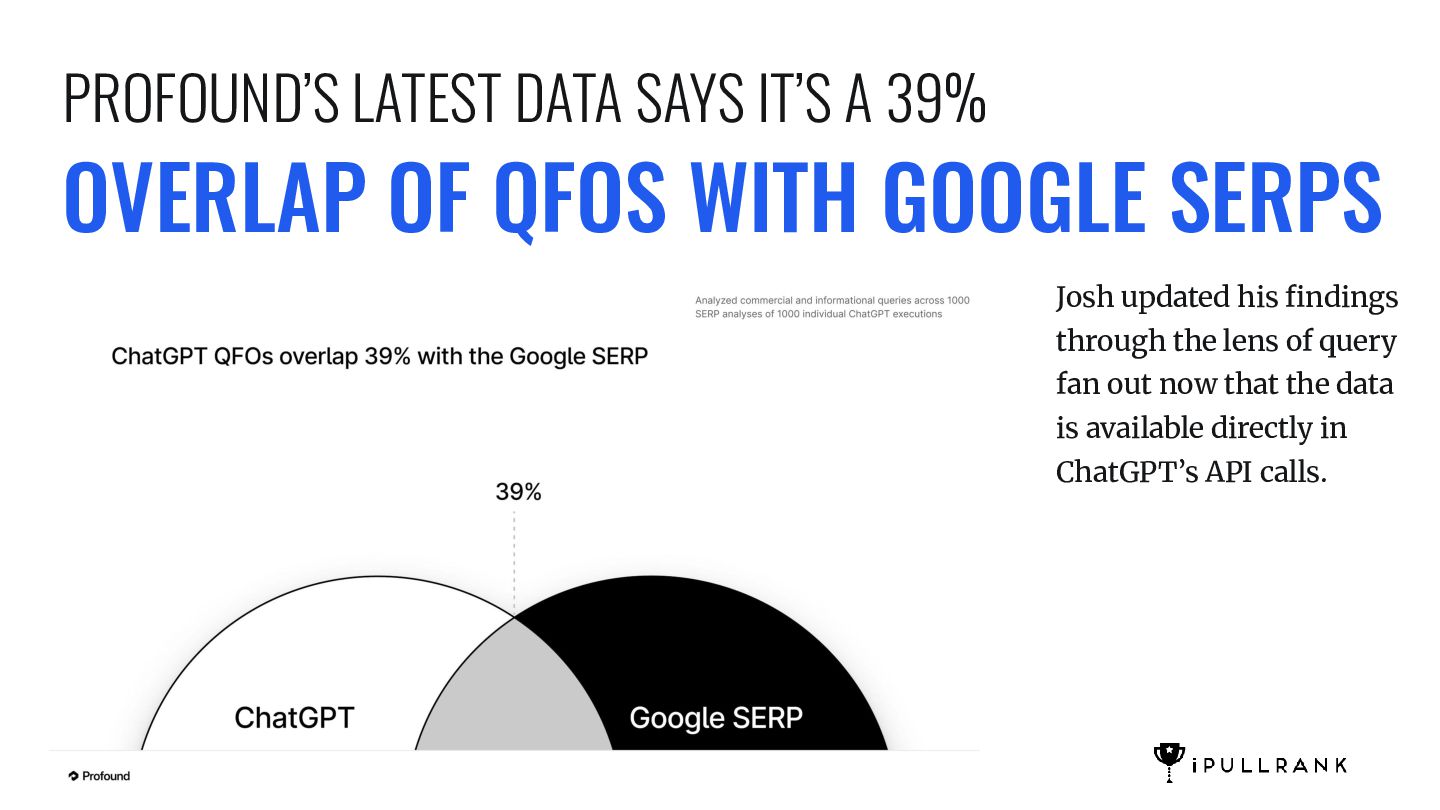
  19. OVERLAP OF QFOS WITH GOOGLE SERPS Josh updated his findings

    through the lens of query fan out now that the data is available directly in ChatGPT’s API calls. PROFOUND’S LATEST DATA SAYS IT’S A 39%
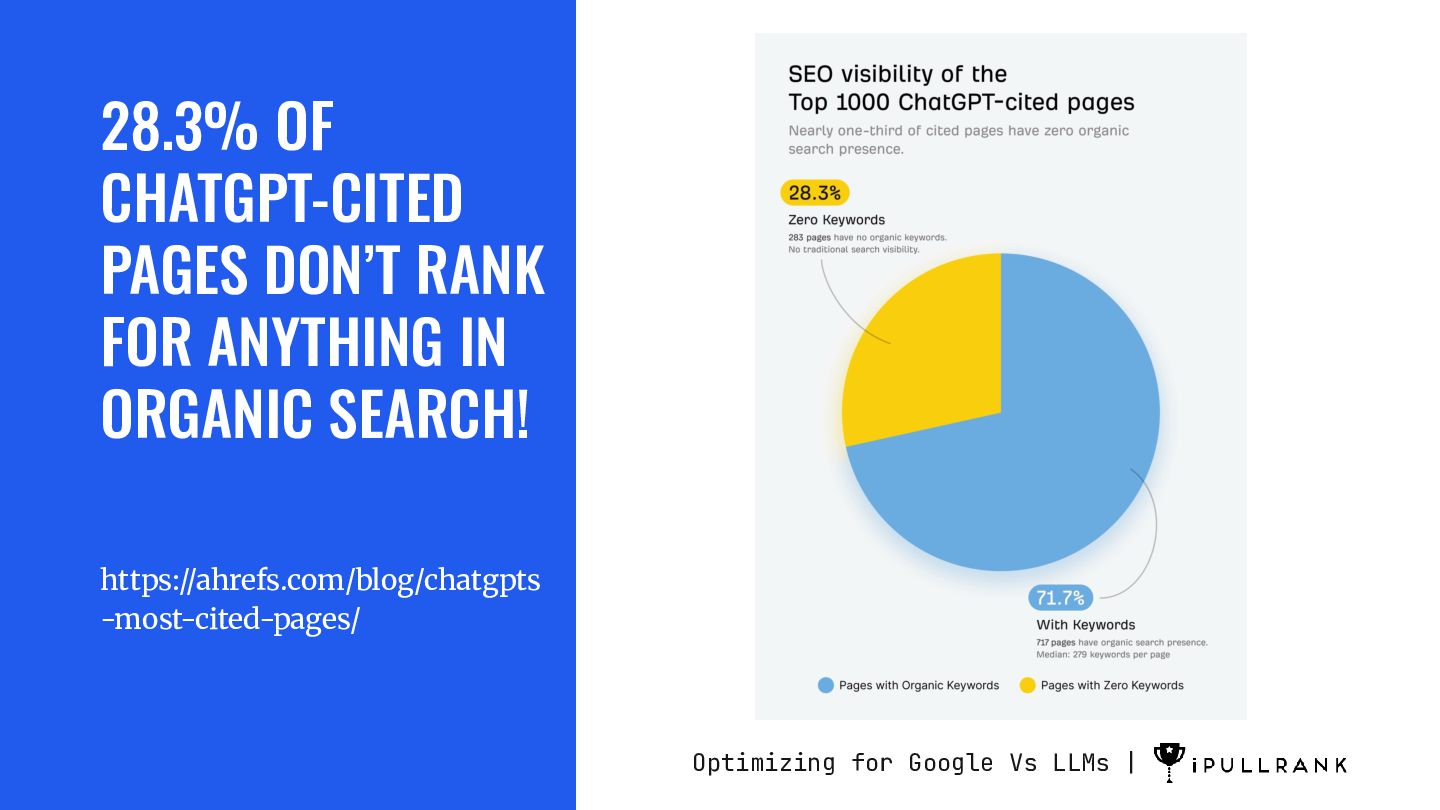
  20. 28.3% OF CHATGPT-CITED PAGES DON’T RANK FOR ANYTHING IN ORGANIC

    SEARCH! https://ahrefs.com/blog/chatgpts -most-cited-pages/ Optimizing for Google Vs LLMs |
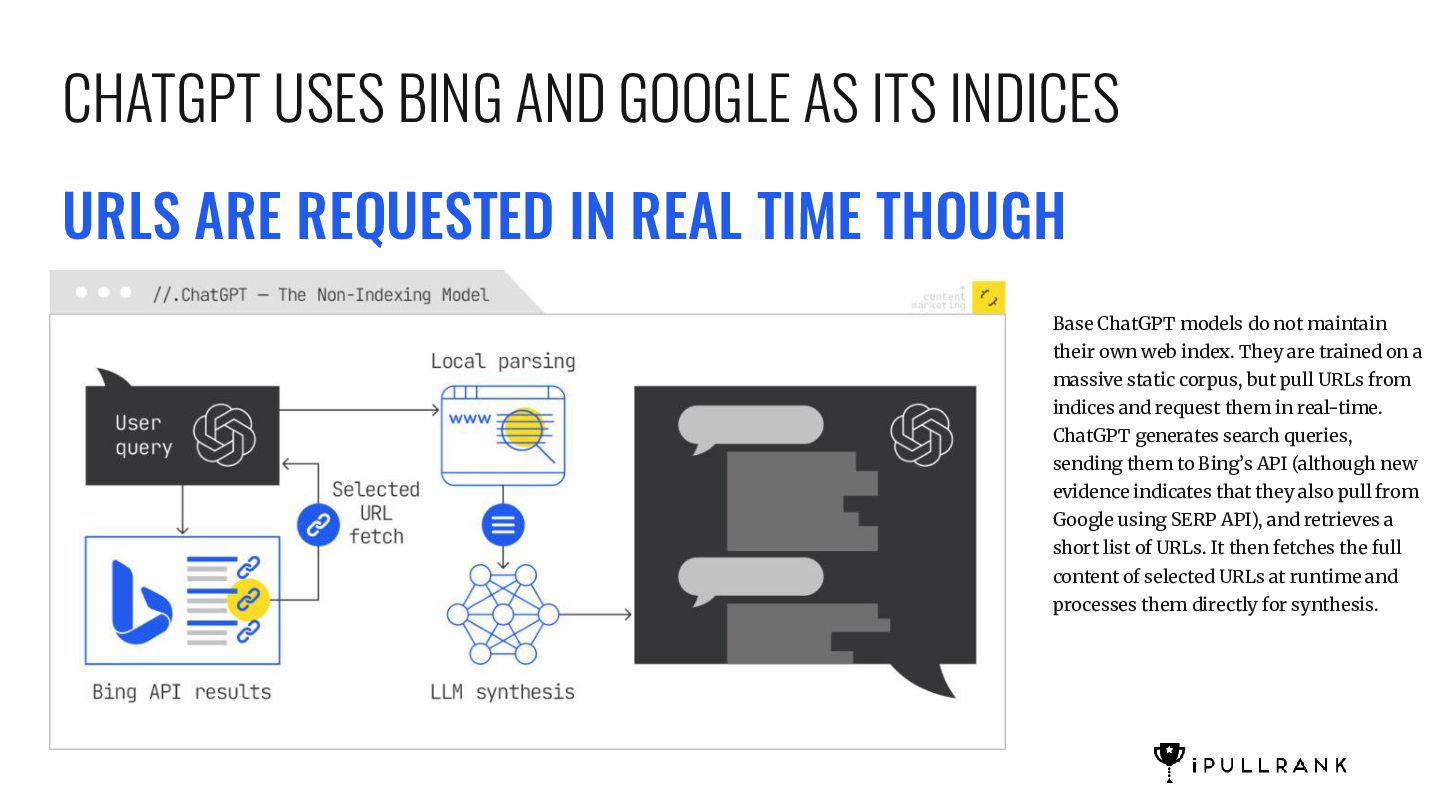
  21. URLS ARE REQUESTED IN REAL TIME THOUGH Base ChatGPT models

    do not maintain their own web index. They are trained on a massive static corpus, but pull URLs from indices and request them in real-time. ChatGPT generates search queries, sending them to Bing’s API (although new evidence indicates that they also pull from Google using SERP API), and retrieves a short list of URLs. It then fetches the full content of selected URLs at runtime and processes them directly for synthesis. CHATGPT USES BING AND GOOGLE AS ITS INDICES
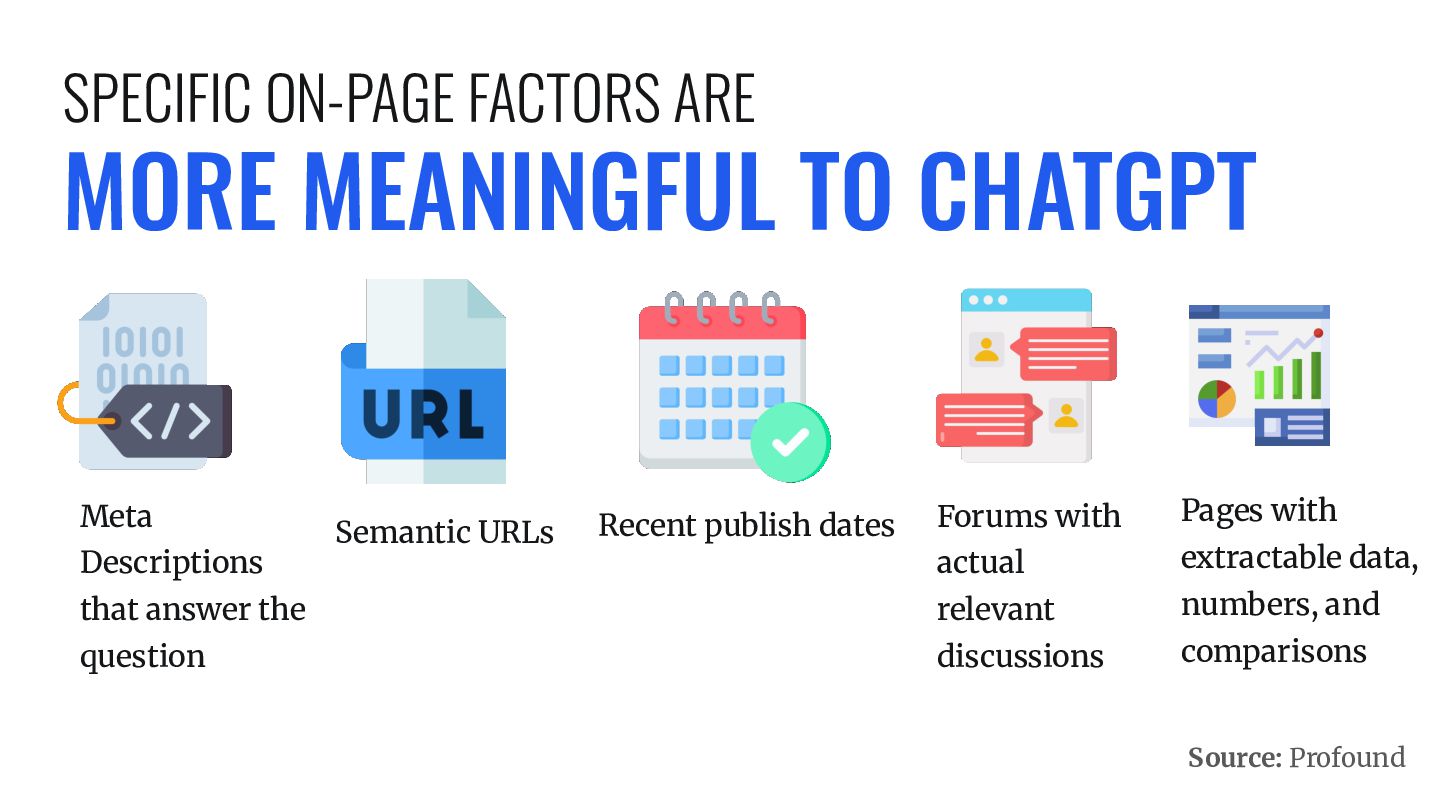
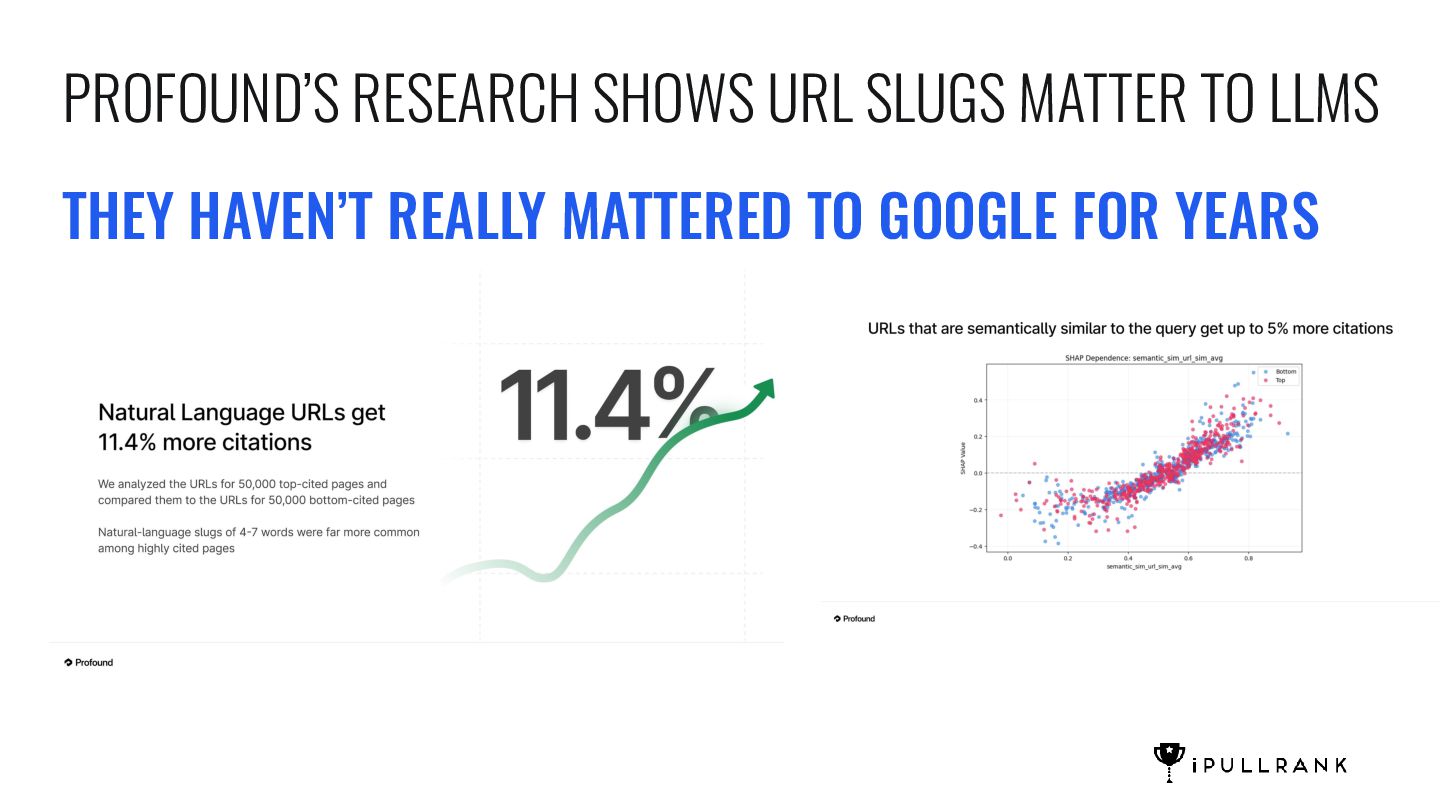
  22. MORE MEANINGFUL TO CHATGPT SPECIFIC ON-PAGE FACTORS ARE Source: Profound

    Recent publish dates Semantic URLs Meta Descriptions that answer the question Forums with actual relevant discussions Pages with extractable data, numbers, and comparisons
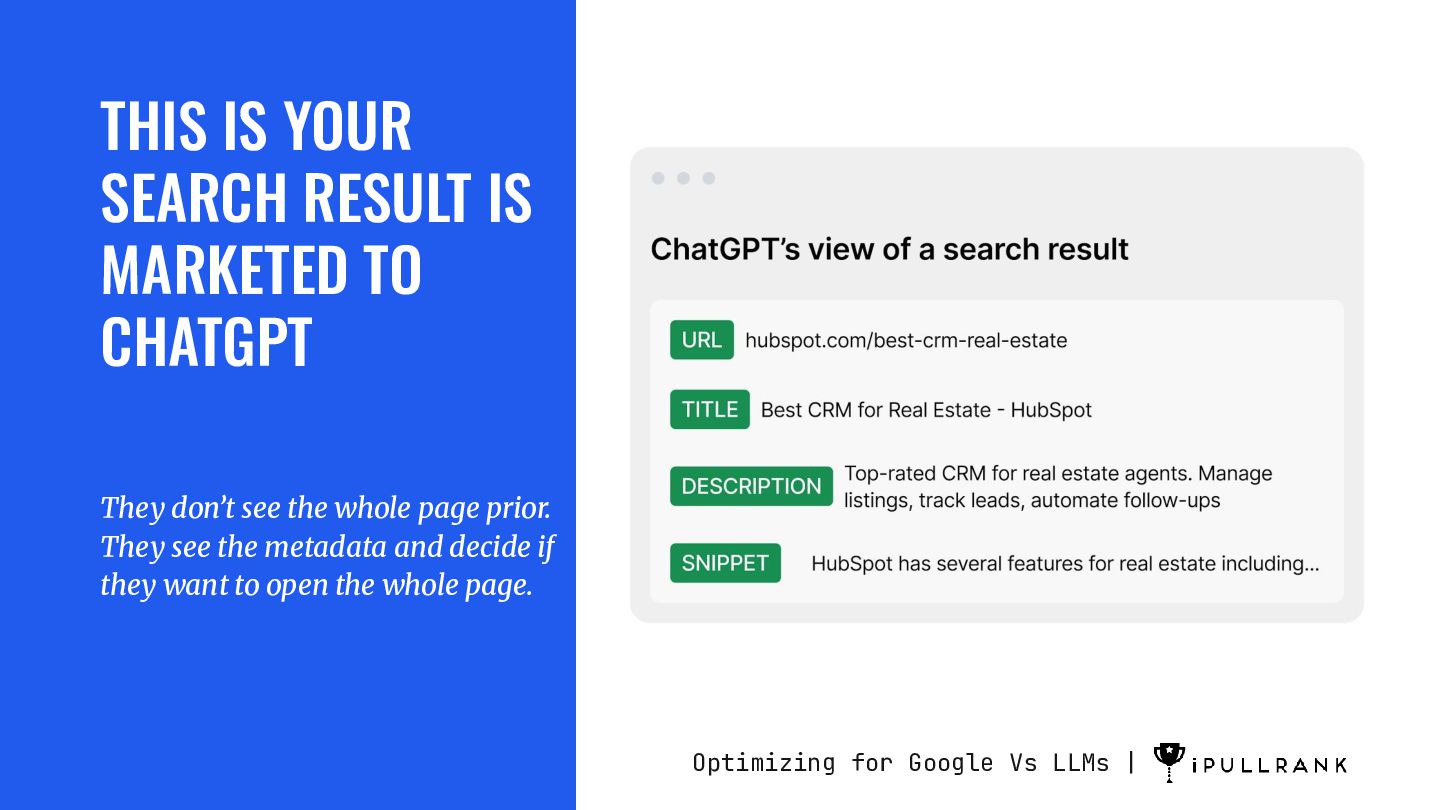
  23. THIS IS YOUR SEARCH RESULT IS MARKETED TO CHATGPT They

    don’t see the whole page prior. They see the metadata and decide if they want to open the whole page. Optimizing for Google Vs LLMs |
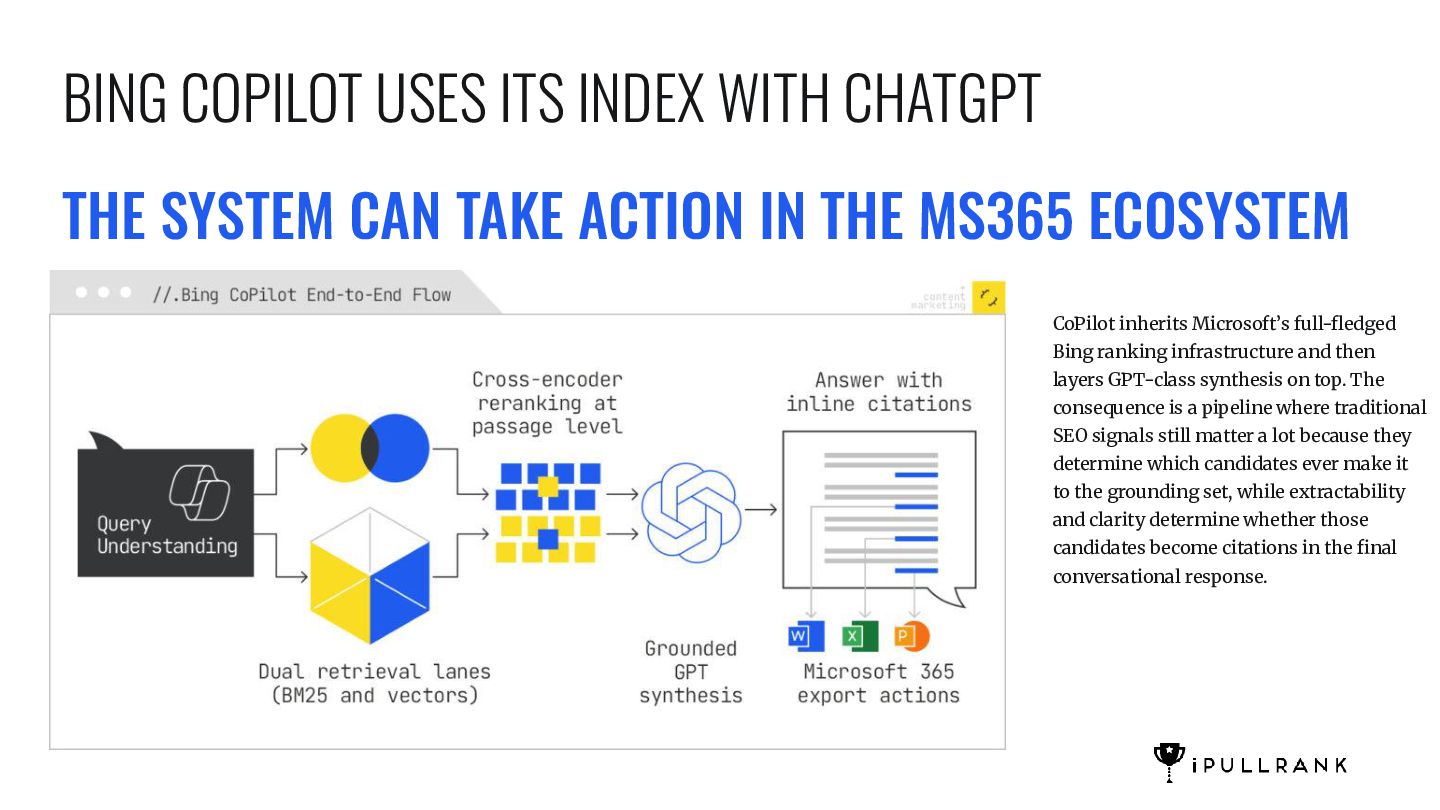
  24. THE SYSTEM CAN TAKE ACTION IN THE MS365 ECOSYSTEM CoPilot

    inherits Microsoft’s full-fledged Bing ranking infrastructure and then layers GPT-class synthesis on top. The consequence is a pipeline where traditional SEO signals still matter a lot because they determine which candidates ever make it to the grounding set, while extractability and clarity determine whether those candidates become citations in the final conversational response. BING COPILOT USES ITS INDEX WITH CHATGPT
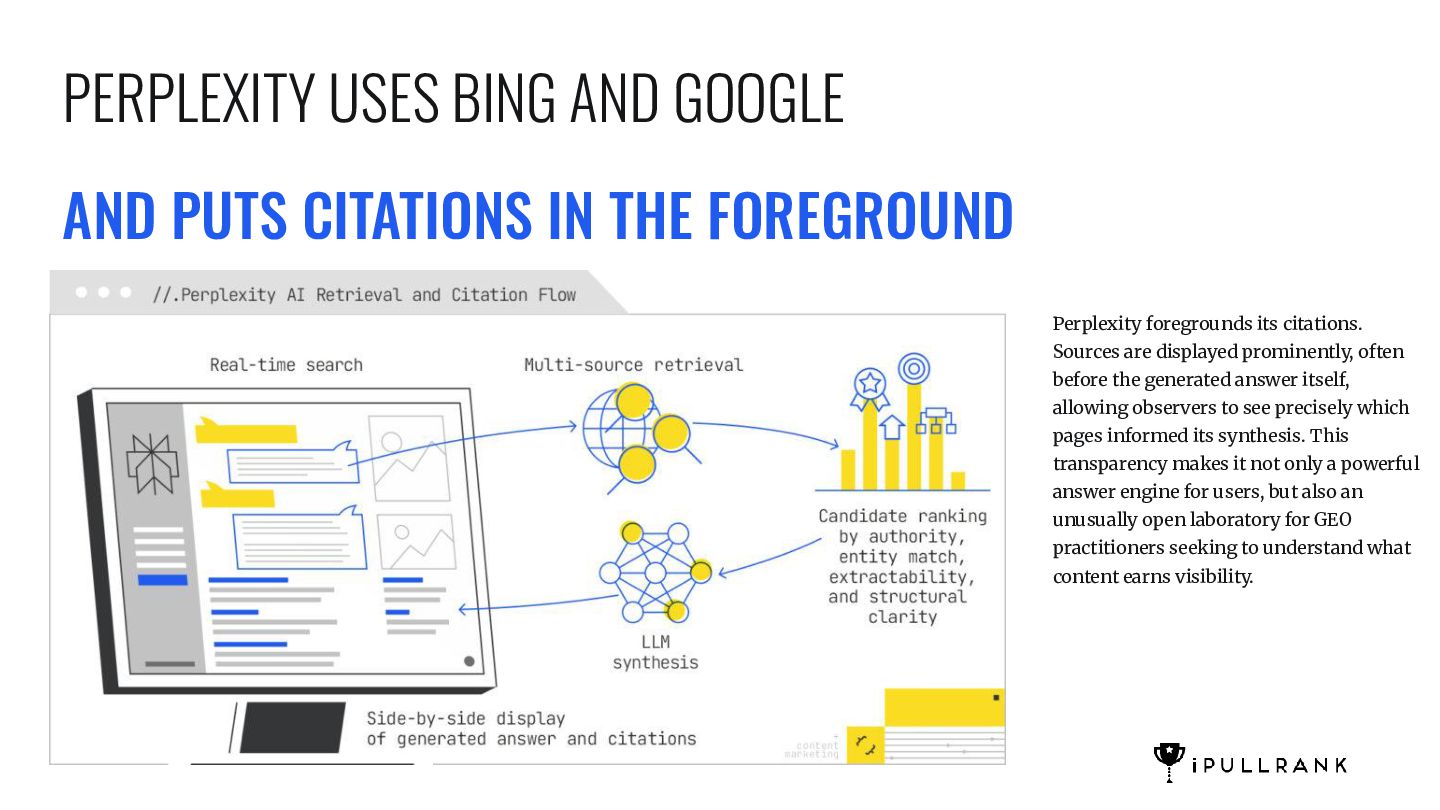
  25. AND PUTS CITATIONS IN THE FOREGROUND Perplexity foregrounds its citations.

    Sources are displayed prominently, often before the generated answer itself, allowing observers to see precisely which pages informed its synthesis. This transparency makes it not only a powerful answer engine for users, but also an unusually open laboratory for GEO practitioners seeking to understand what content earns visibility. PERPLEXITY USES BING AND GOOGLE
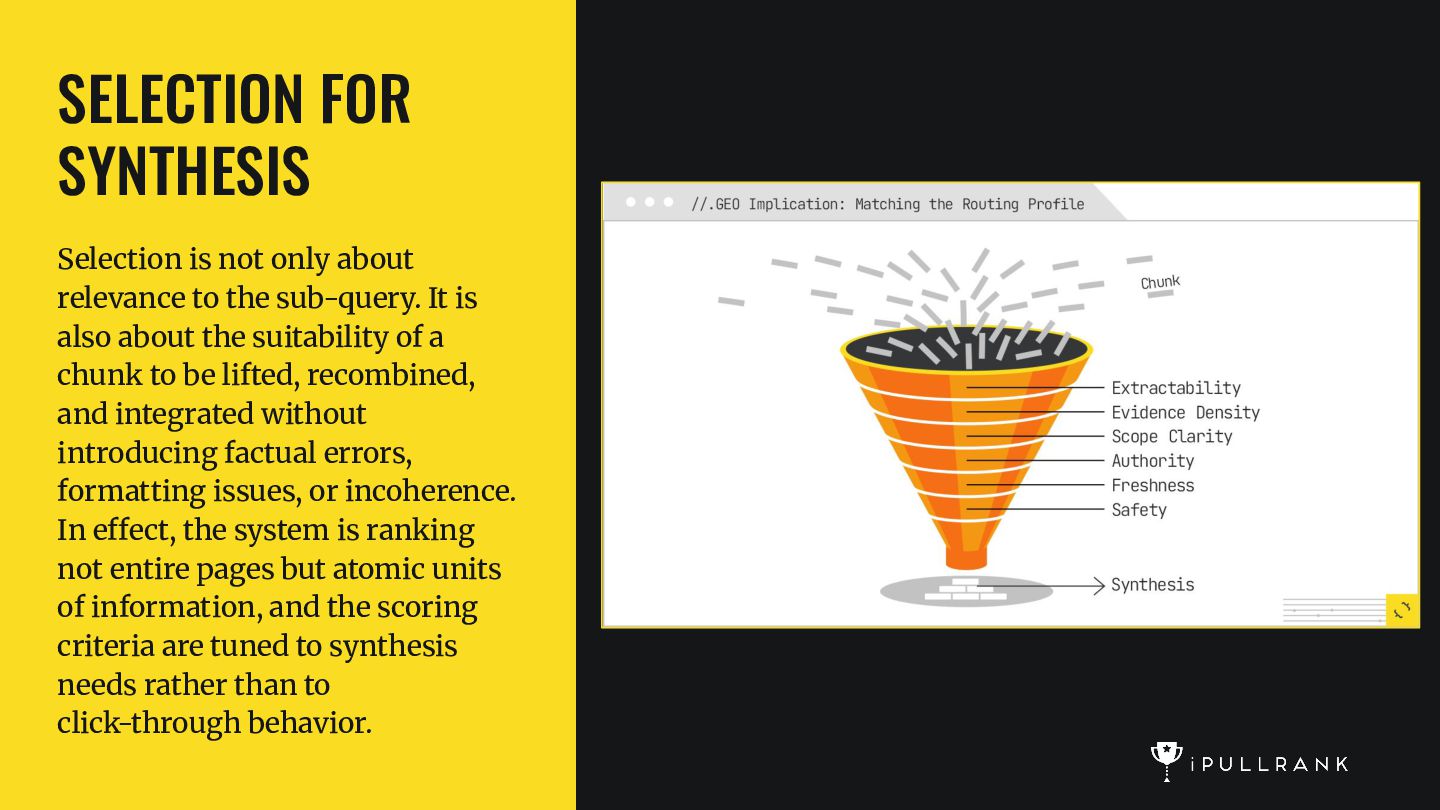
  26. SELECTION FOR SYNTHESIS Selection is not only about relevance to

    the sub-query. It is also about the suitability of a chunk to be lifted, recombined, and integrated without introducing factual errors, formatting issues, or incoherence. In effect, the system is ranking not entire pages but atomic units of information, and the scoring criteria are tuned to synthesis needs rather than to click-through behavior.
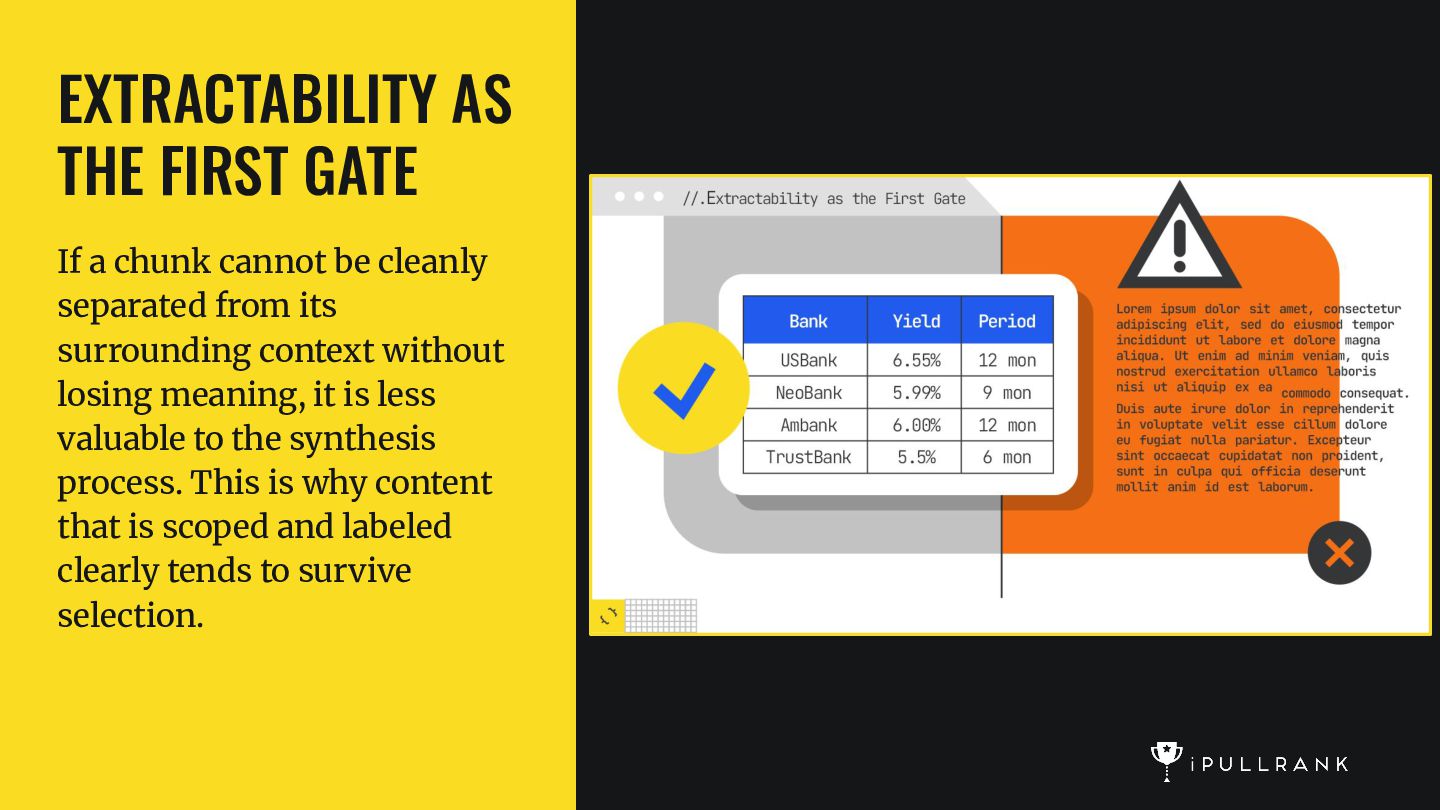
  27. EXTRACTABILITY AS THE FIRST GATE If a chunk cannot be

    cleanly separated from its surrounding context without losing meaning, it is less valuable to the synthesis process. This is why content that is scoped and labeled clearly tends to survive selection.
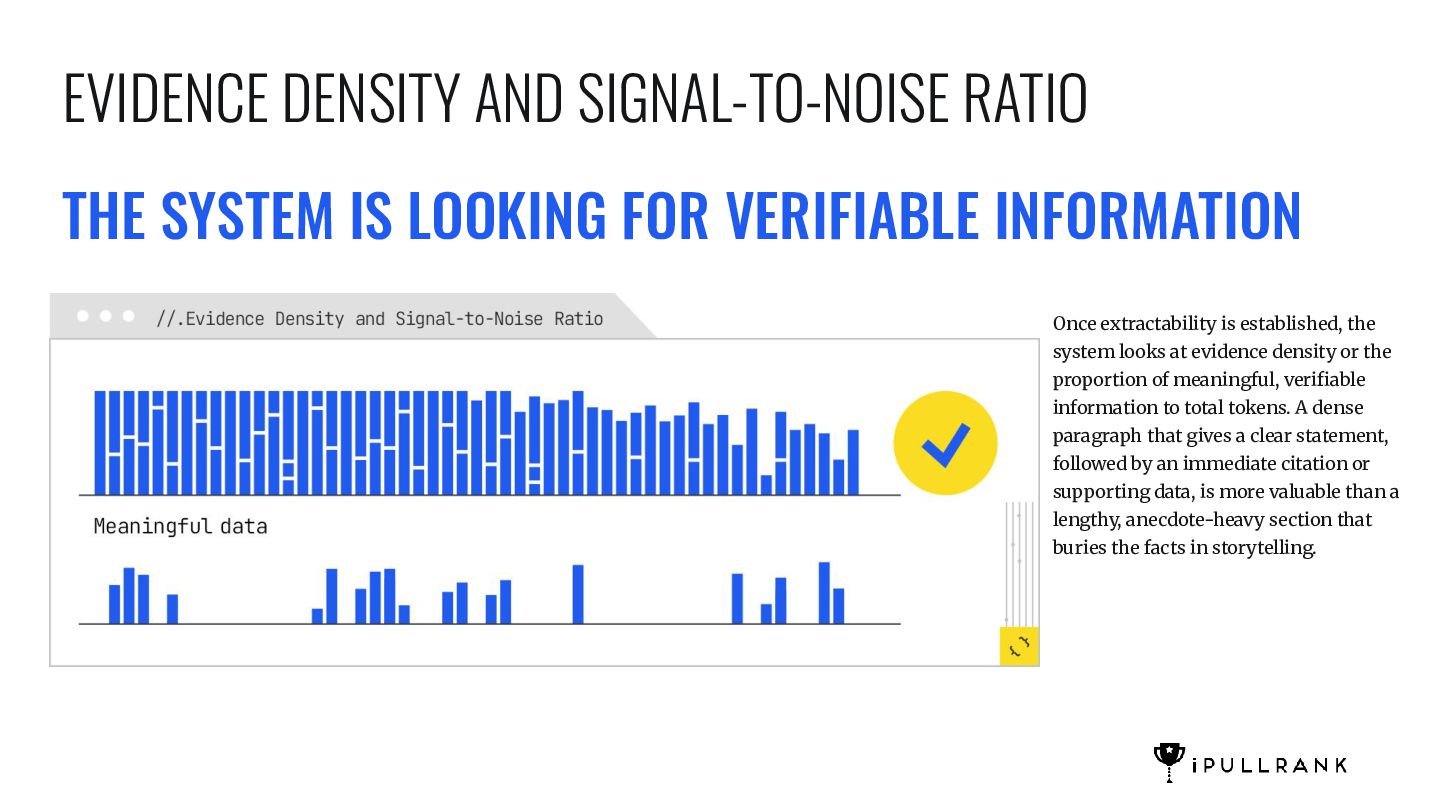
  28. THE SYSTEM IS LOOKING FOR VERIFIABLE INFORMATION Once extractability is

    established, the system looks at evidence density or the proportion of meaningful, verifiable information to total tokens. A dense paragraph that gives a clear statement, followed by an immediate citation or supporting data, is more valuable than a lengthy, anecdote-heavy section that buries the facts in storytelling. EVIDENCE DENSITY AND SIGNAL-TO-NOISE RATIO
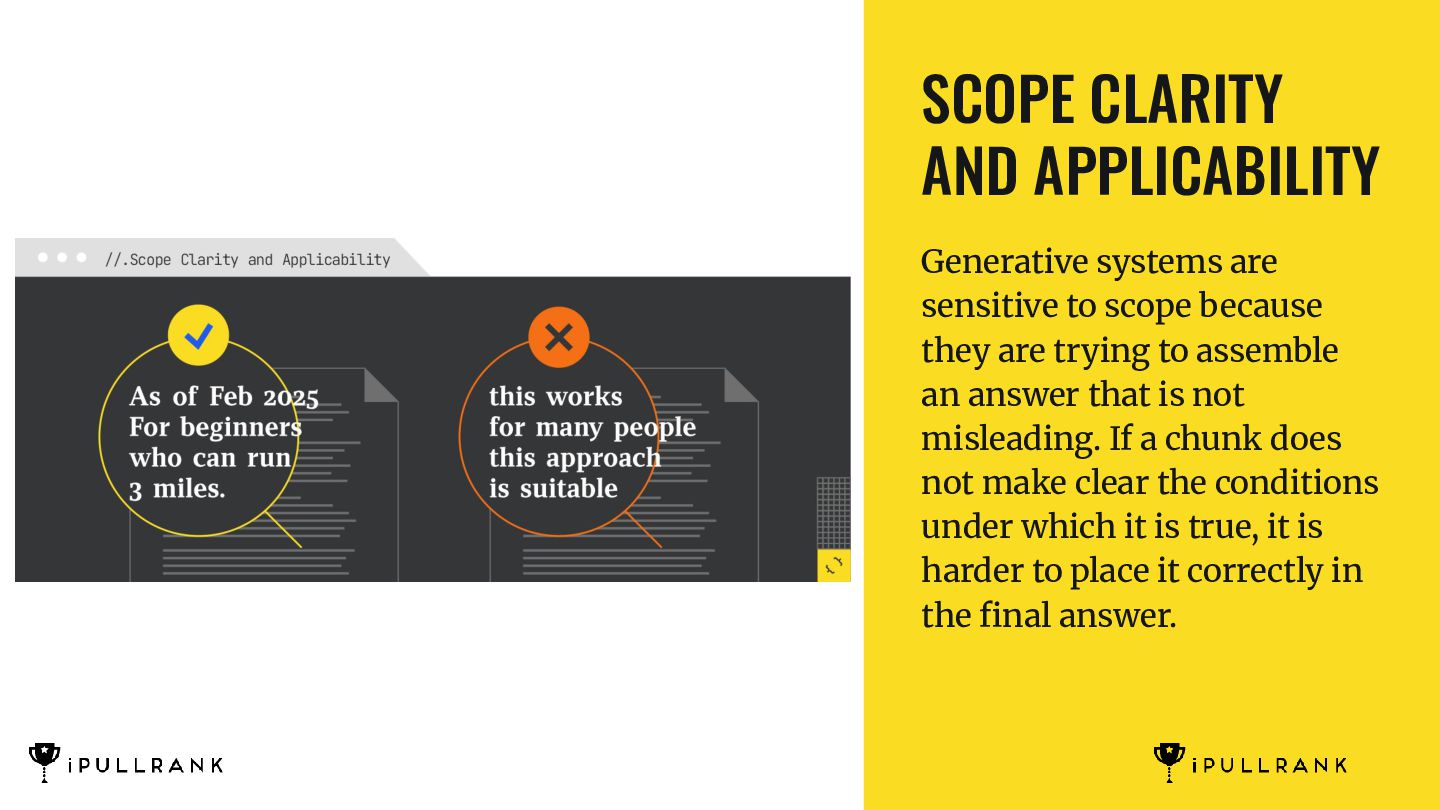
  29. SCOPE CLARITY AND APPLICABILITY Generative systems are sensitive to scope

    because they are trying to assemble an answer that is not misleading. If a chunk does not make clear the conditions under which it is true, it is harder to place it correctly in the final answer.
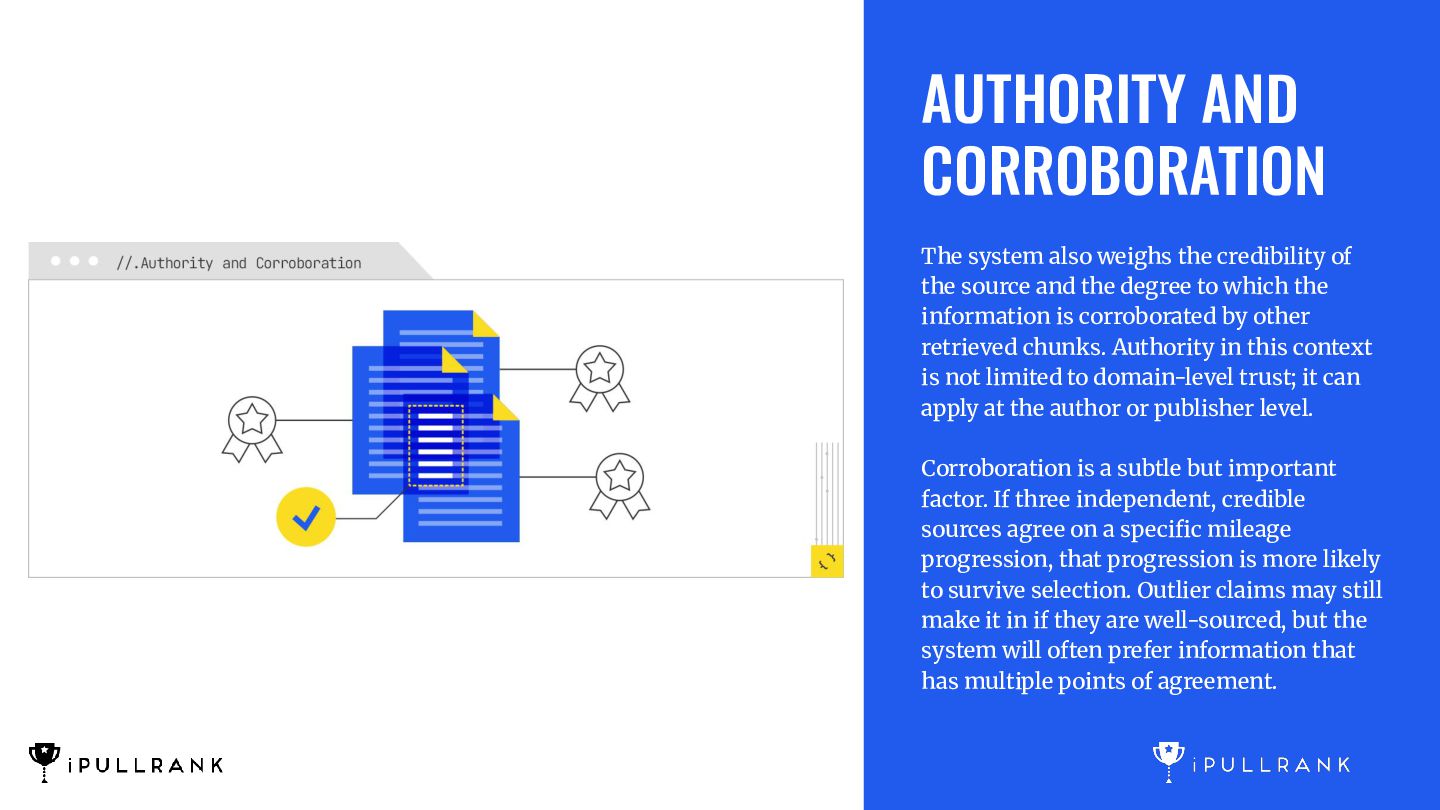
  30. AUTHORITY AND CORROBORATION The system also weighs the credibility of

    the source and the degree to which the information is corroborated by other retrieved chunks. Authority in this context is not limited to domain-level trust; it can apply at the author or publisher level. Corroboration is a subtle but important factor. If three independent, credible sources agree on a specific mileage progression, that progression is more likely to survive selection. Outlier claims may still make it in if they are well-sourced, but the system will often prefer information that has multiple points of agreement.
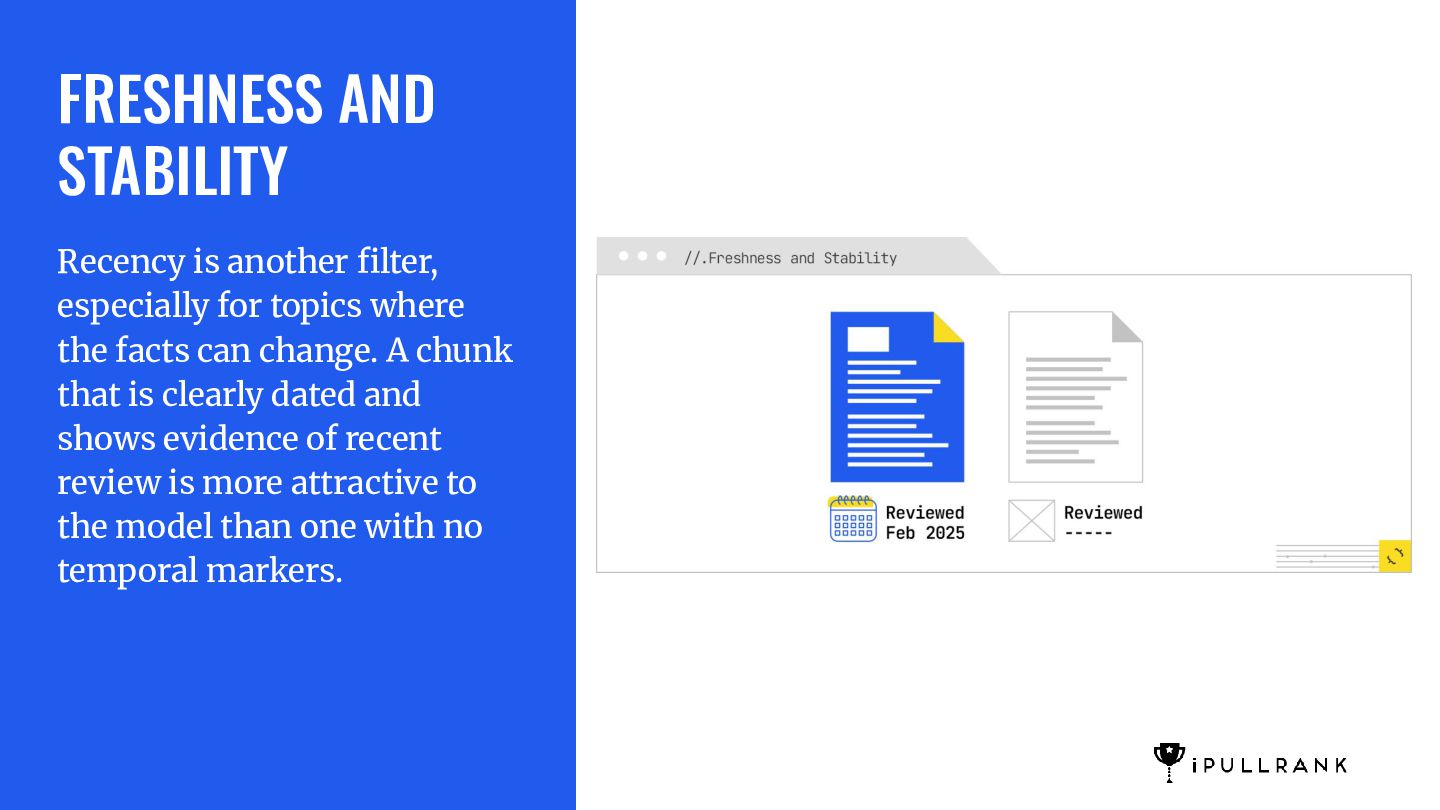
  31. FRESHNESS AND STABILITY Recency is another filter, especially for topics

    where the facts can change. A chunk that is clearly dated and shows evidence of recent review is more attractive to the model than one with no temporal markers.
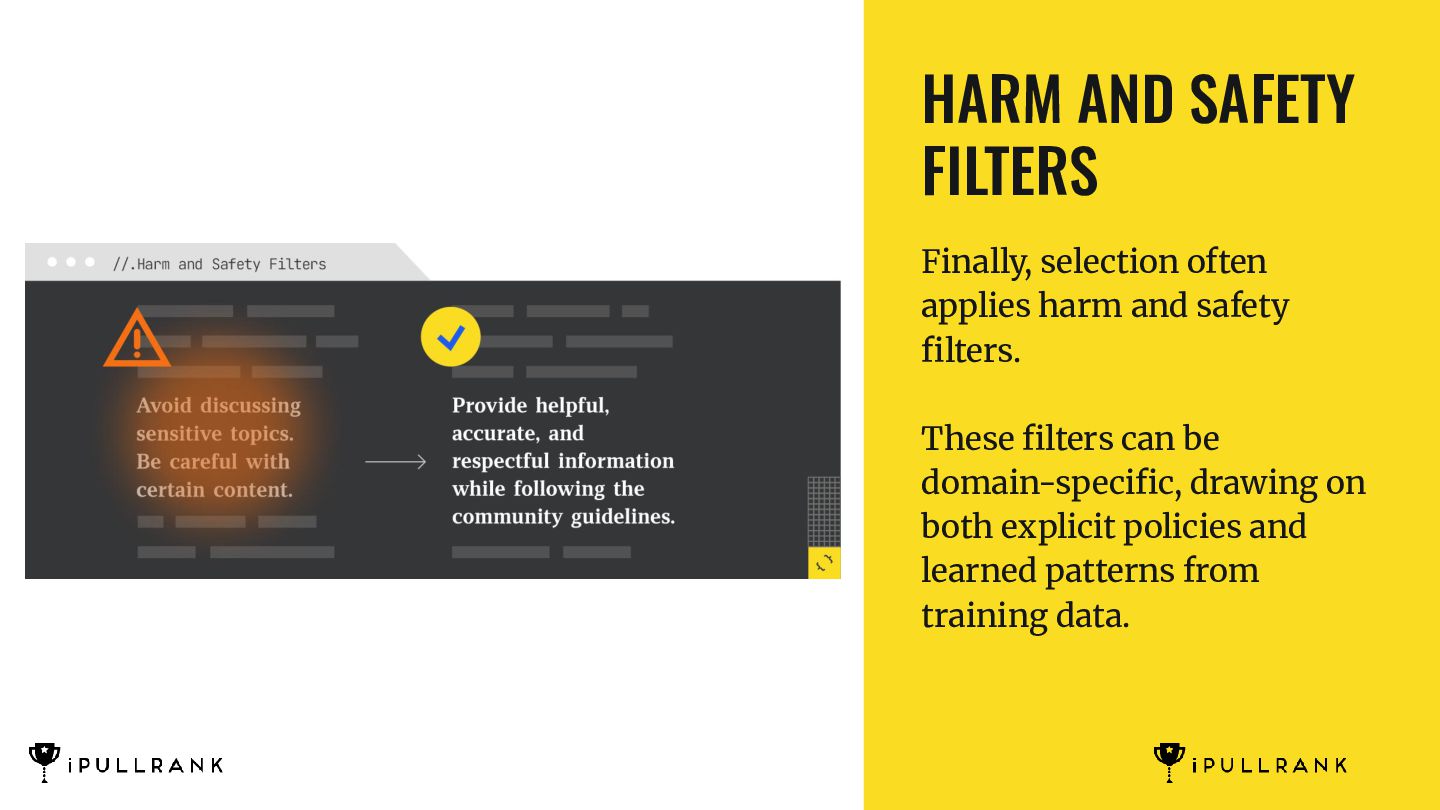
  32. HARM AND SAFETY FILTERS Finally, selection often applies harm and

    safety filters. These filters can be domain-specific, drawing on both explicit policies and learned patterns from training data.
  33. WHY GOOD CONTENT GETS EXCLUDED High-quality content can be excluded

    from synthesis if it isn’t easily extractable— interactive designs that aren’t crawlable or long-form narratives that bury key facts risk being skipped in favor of denser, more accessible material.
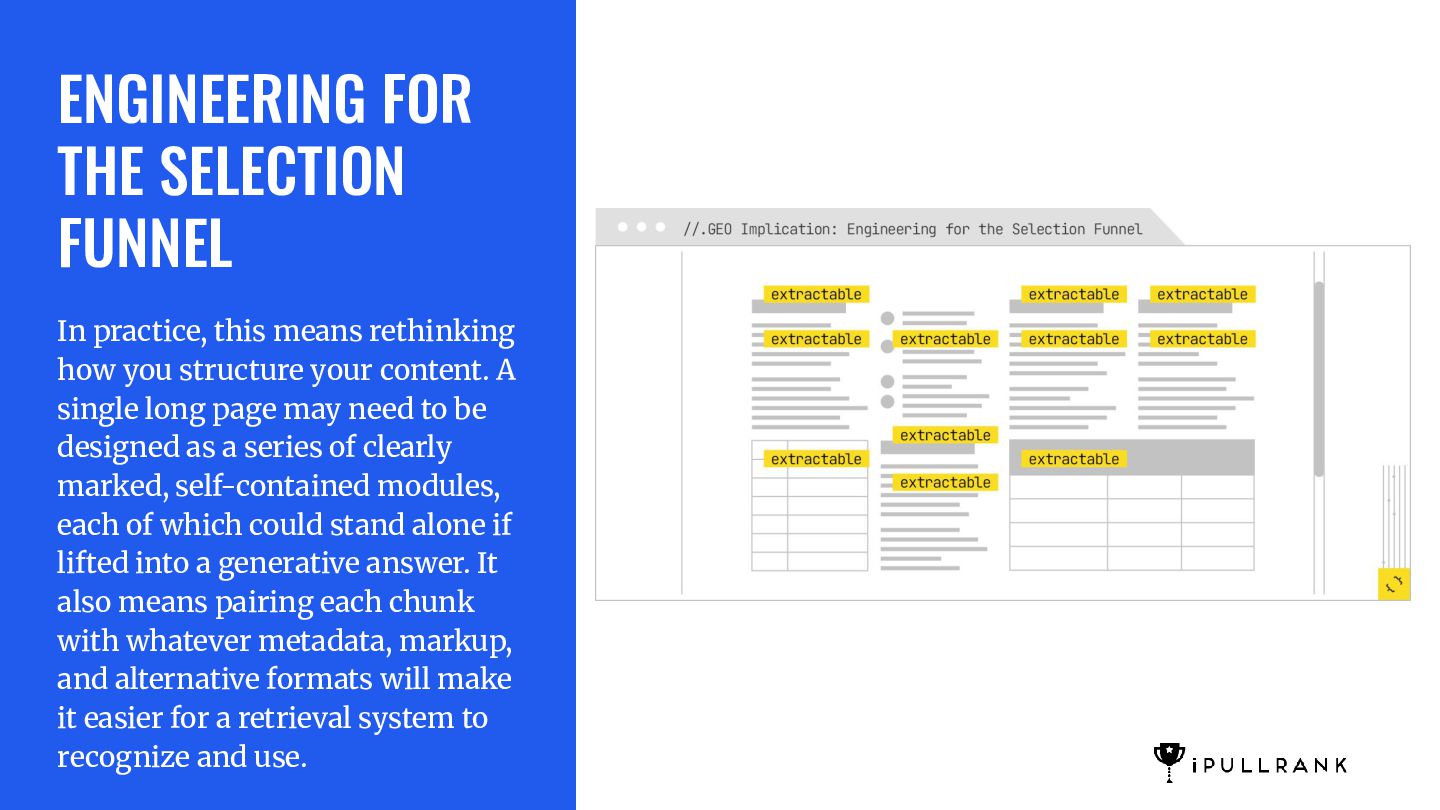
  34. ENGINEERING FOR THE SELECTION FUNNEL In practice, this means rethinking

    how you structure your content. A single long page may need to be designed as a series of clearly marked, self-contained modules, each of which could stand alone if lifted into a generative answer. It also means pairing each chunk with whatever metadata, markup, and alternative formats will make it easier for a retrieval system to recognize and use.
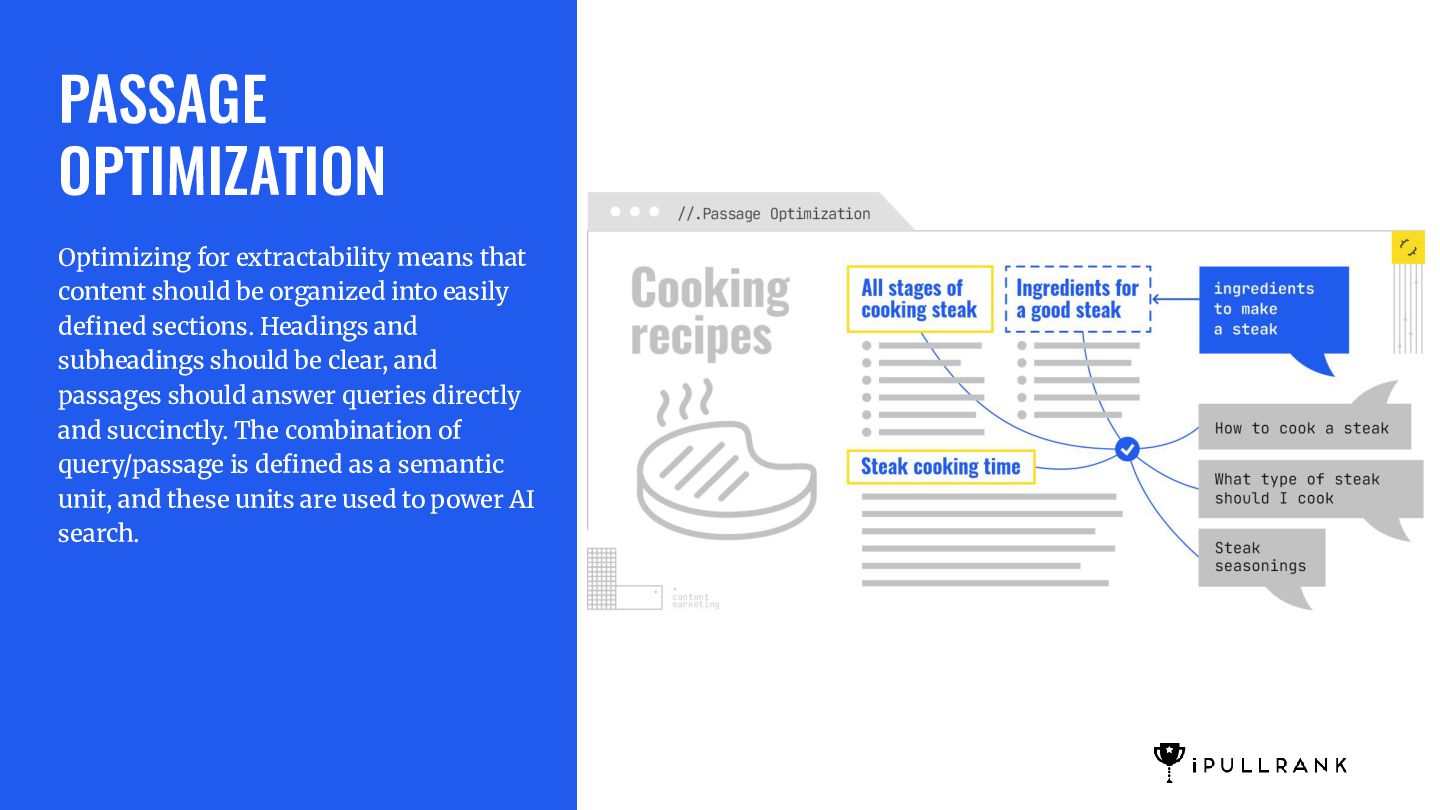
  35. Optimizing for extractability means that content should be organized into

    easily defined sections. Headings and subheadings should be clear, and passages should answer queries directly and succinctly. The combination of query/passage is defined as a semantic unit, and these units are used to power AI search. PASSAGE OPTIMIZATION
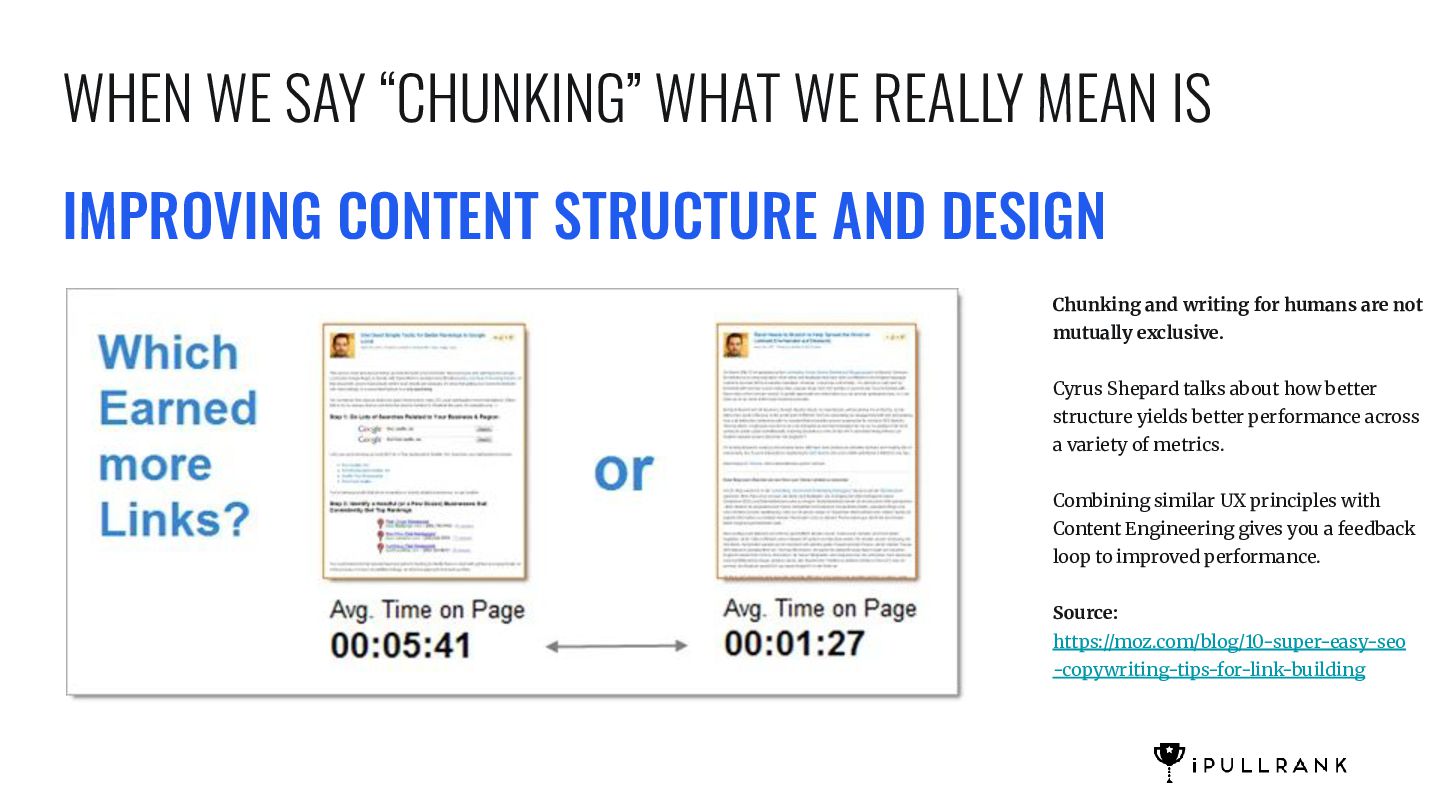
  36. Chunking and writing for humans are not mutually exclusive. Cyrus

    Shepard talks about how better structure yields better performance across a variety of metrics. Combining similar UX principles with Content Engineering gives you a feedback loop to improved performance. Source: https://moz.com/blog/10-super-easy-seo -copywriting-tips-for-link-building IMPROVING CONTENT STRUCTURE AND DESIGN WHEN WE SAY “CHUNKING” WHAT WE REALLY MEAN IS
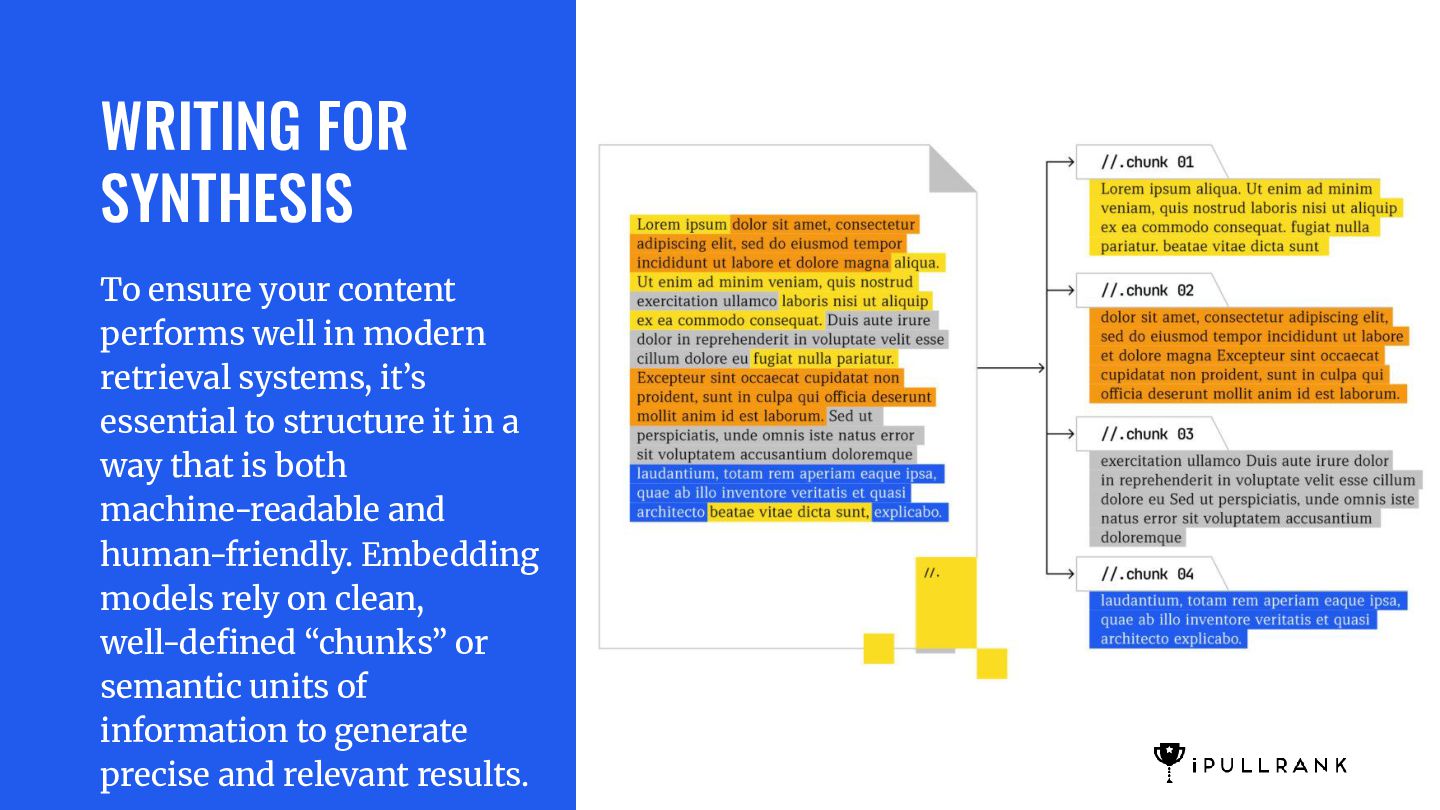
  37. WRITING FOR SYNTHESIS To ensure your content performs well in

    modern retrieval systems, it’s essential to structure it in a way that is both machine-readable and human-friendly. Embedding models rely on clean, well-defined “chunks” or semantic units of information to generate precise and relevant results.
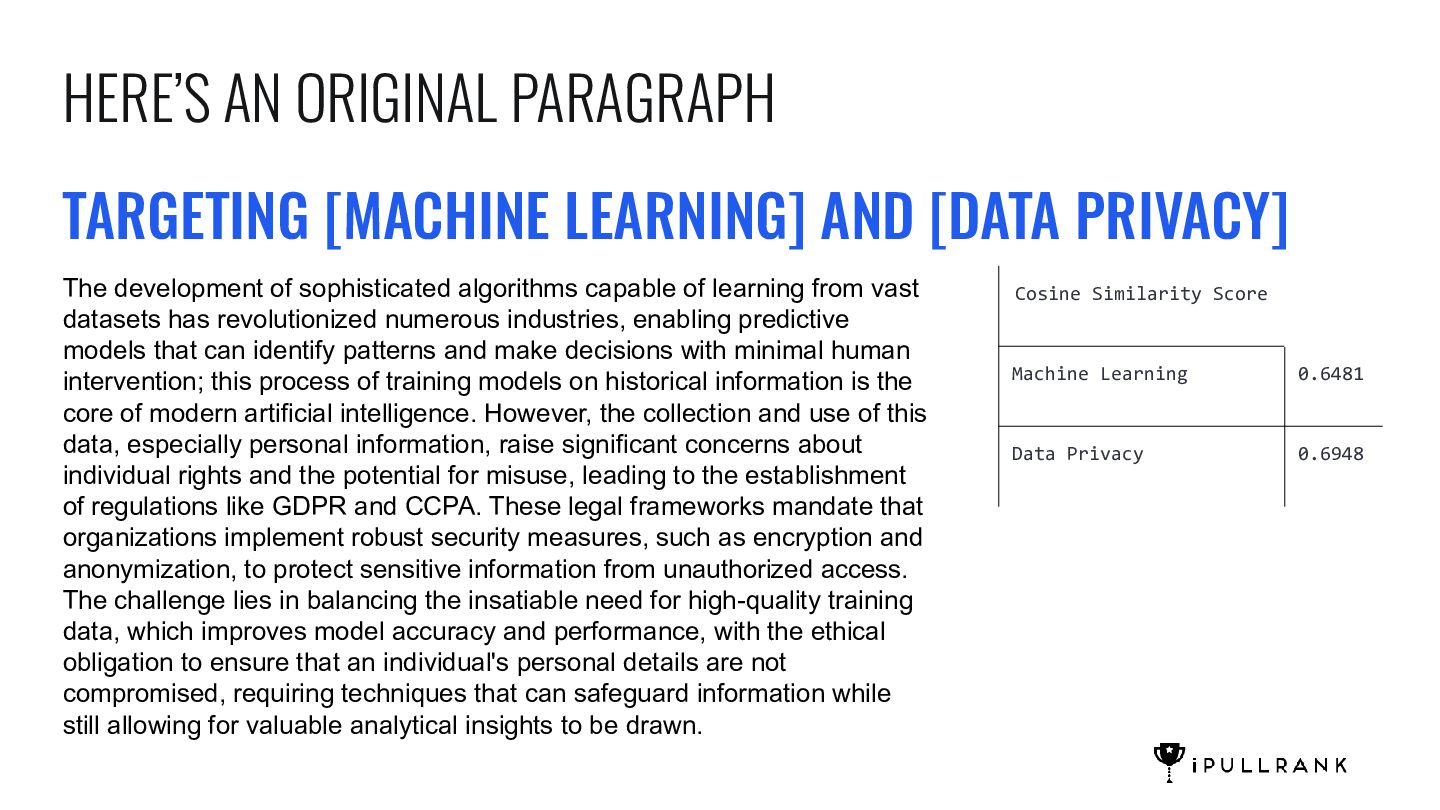
  38. TARGETING [MACHINE LEARNING] AND [DATA PRIVACY] HERE’S AN ORIGINAL PARAGRAPH

    The development of sophisticated algorithms capable of learning from vast datasets has revolutionized numerous industries, enabling predictive models that can identify patterns and make decisions with minimal human intervention; this process of training models on historical information is the core of modern artificial intelligence. However, the collection and use of this data, especially personal information, raise significant concerns about individual rights and the potential for misuse, leading to the establishment of regulations like GDPR and CCPA. These legal frameworks mandate that organizations implement robust security measures, such as encryption and anonymization, to protect sensitive information from unauthorized access. The challenge lies in balancing the insatiable need for high-quality training data, which improves model accuracy and performance, with the ethical obligation to ensure that an individual's personal details are not compromised, requiring techniques that can safeguard information while still allowing for valuable analytical insights to be drawn MACHINE LEARNING - 0.6481 DATA PRIVACY - 0.6948 COSINE SIMILARITY
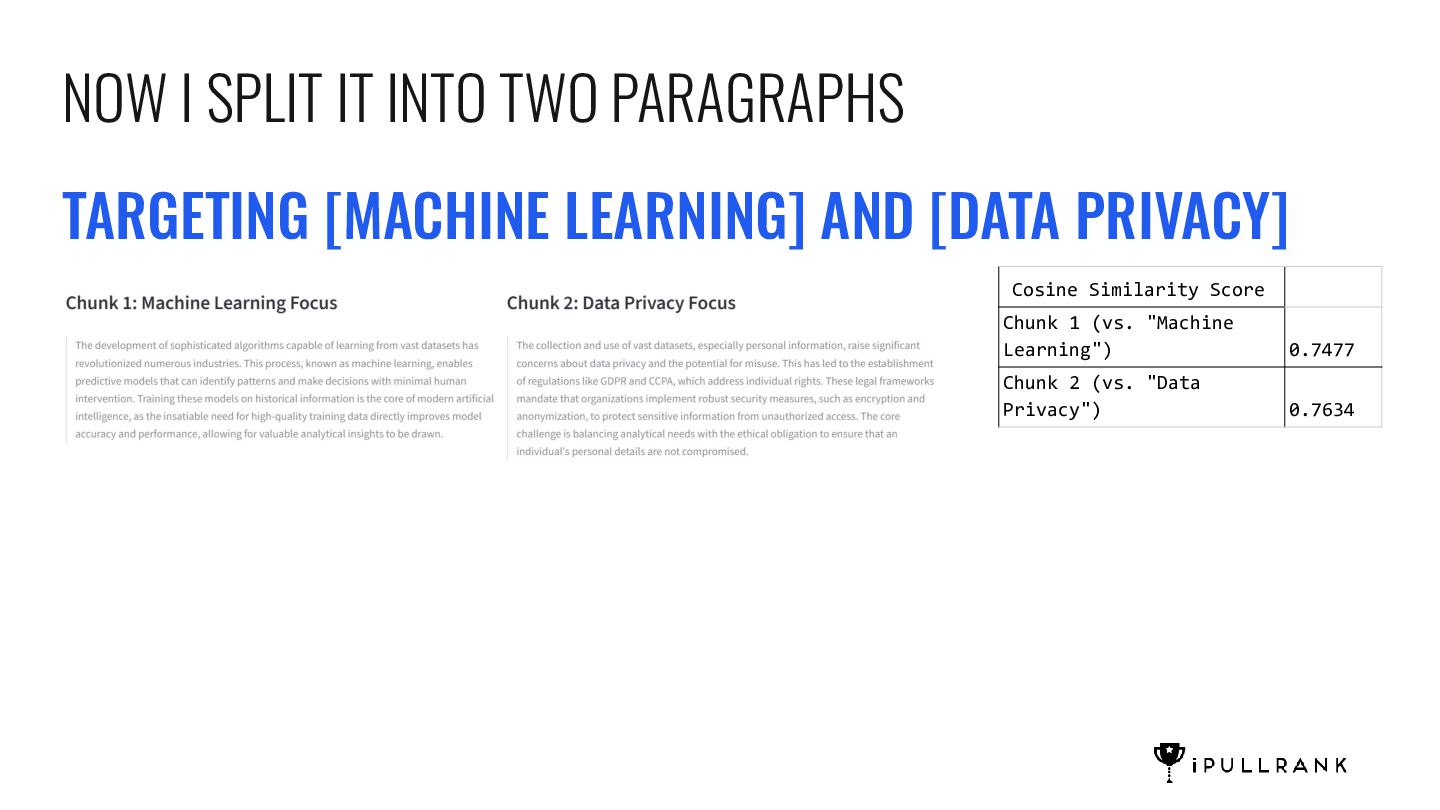
  39. TARGETING [MACHINE LEARNING] AND [DATA PRIVACY] NOW I JUST SPLIT

    IT INTO TWO PARAGRAPHS MACHINE LEARNING - 0.7477 15.4% COSSIM IMPROVEMENT DATA PRIVACY - 0.7634 9.78% COSSIM IMPROVEMENT
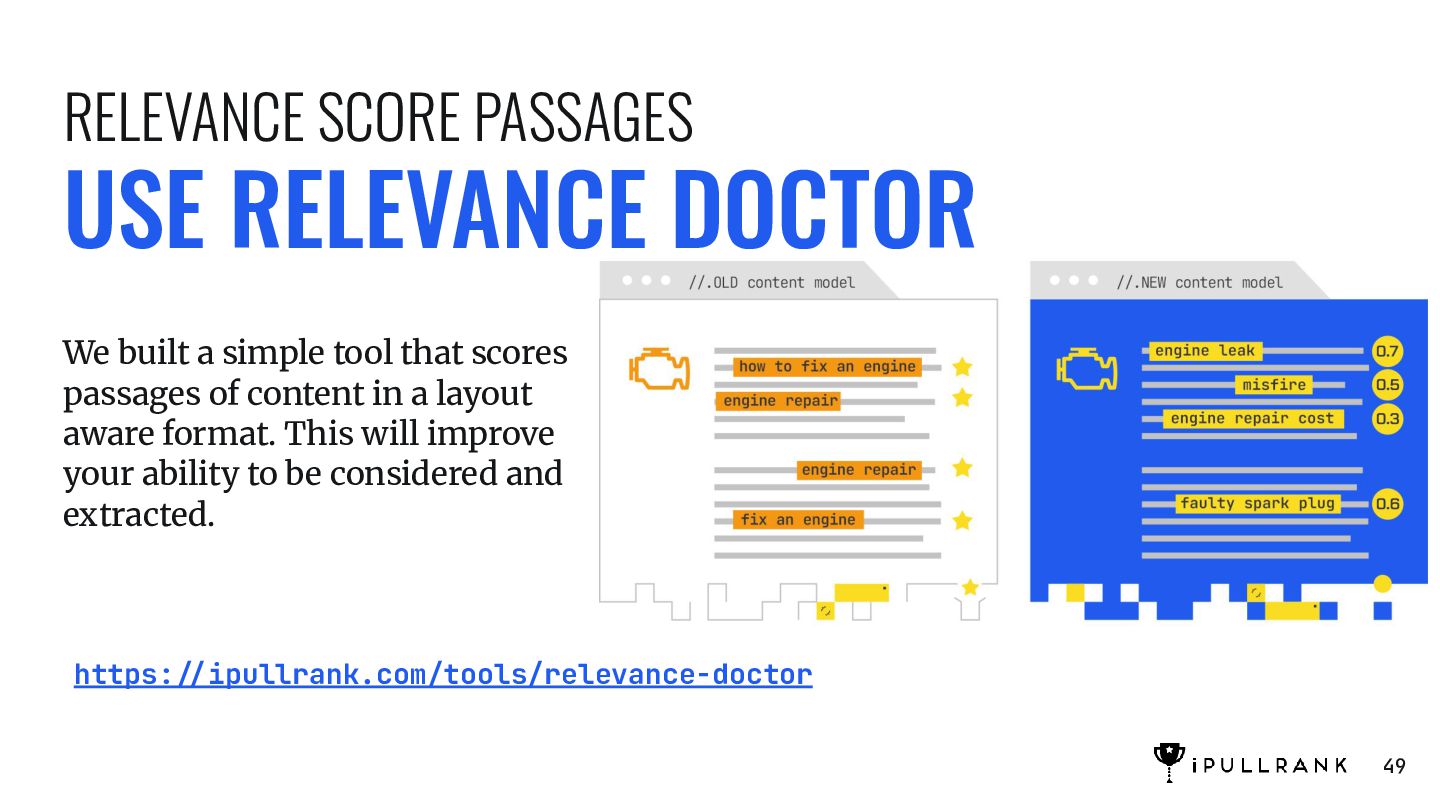
  40. RELEVANCE SCORE PASSAGES USE RELEVANCE DOCTOR We built a simple

    tool that scores passages of content in a layout aware format. This will improve your ability to be considered and extracted. 49 https://ipullrank.com/tools/relevance-doctor
  41. TARGETING [MACHINE LEARNING] AND [DATA PRIVACY] HERE’S AN ORIGINAL PARAGRAPH

    The development of sophisticated algorithms capable of learning from vast datasets has revolutionized numerous industries, enabling predictive models that can identify patterns and make decisions with minimal human intervention; this process of training models on historical information is the core of modern artificial intelligence. However, the collection and use of this data, especially personal information, raise significant concerns about individual rights and the potential for misuse, leading to the establishment of regulations like GDPR and CCPA. These legal frameworks mandate that organizations implement robust security measures, such as encryption and anonymization, to protect sensitive information from unauthorized access. The challenge lies in balancing the insatiable need for high-quality training data, which improves model accuracy and performance, with the ethical obligation to ensure that an individual's personal details are not compromised, requiring techniques that can safeguard information while still allowing for valuable analytical insights to be drawn. Cosine Similarity Score Machine Learning 0.6481 Data Privacy 0.6948
  42. TARGETING [MACHINE LEARNING] AND [DATA PRIVACY] NOW I SPLIT IT

    INTO TWO PARAGRAPHS Cosine Similarity Score Chunk 1 (vs. "Machine Learning") 0.7477 Chunk 2 (vs. "Data Privacy") 0.7634
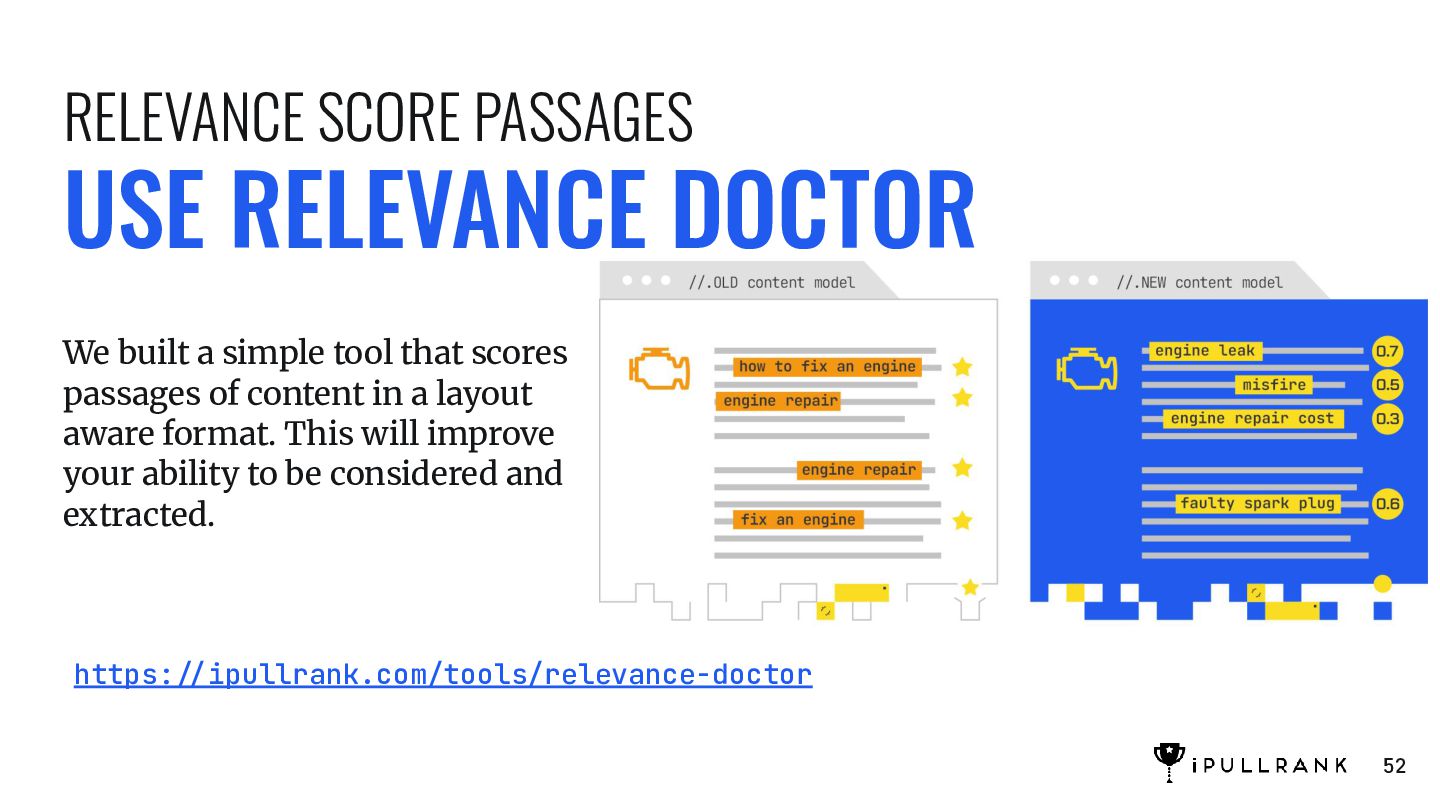
  43. RELEVANCE SCORE PASSAGES USE RELEVANCE DOCTOR We built a simple

    tool that scores passages of content in a layout aware format. This will improve your ability to be considered and extracted. 52 https://ipullrank.com/tools/relevance-doctor
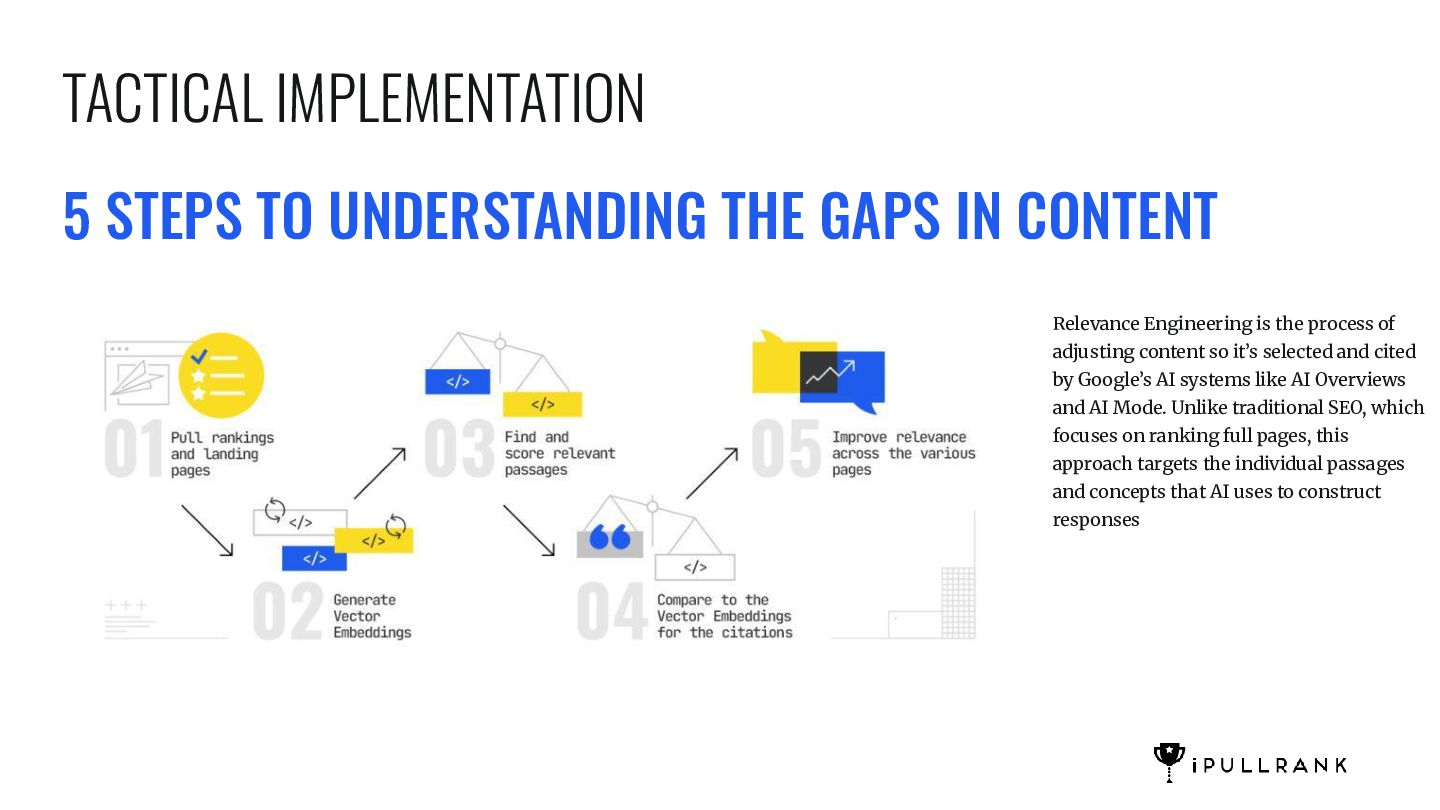
  44. 5 STEPS TO UNDERSTANDING THE GAPS IN CONTENT Relevance Engineering

    is the process of adjusting content so it’s selected and cited by Google’s AI systems like AI Overviews and AI Mode. Unlike traditional SEO, which focuses on ranking full pages, this approach targets the individual passages and concepts that AI uses to construct responses TACTICAL IMPLEMENTATION
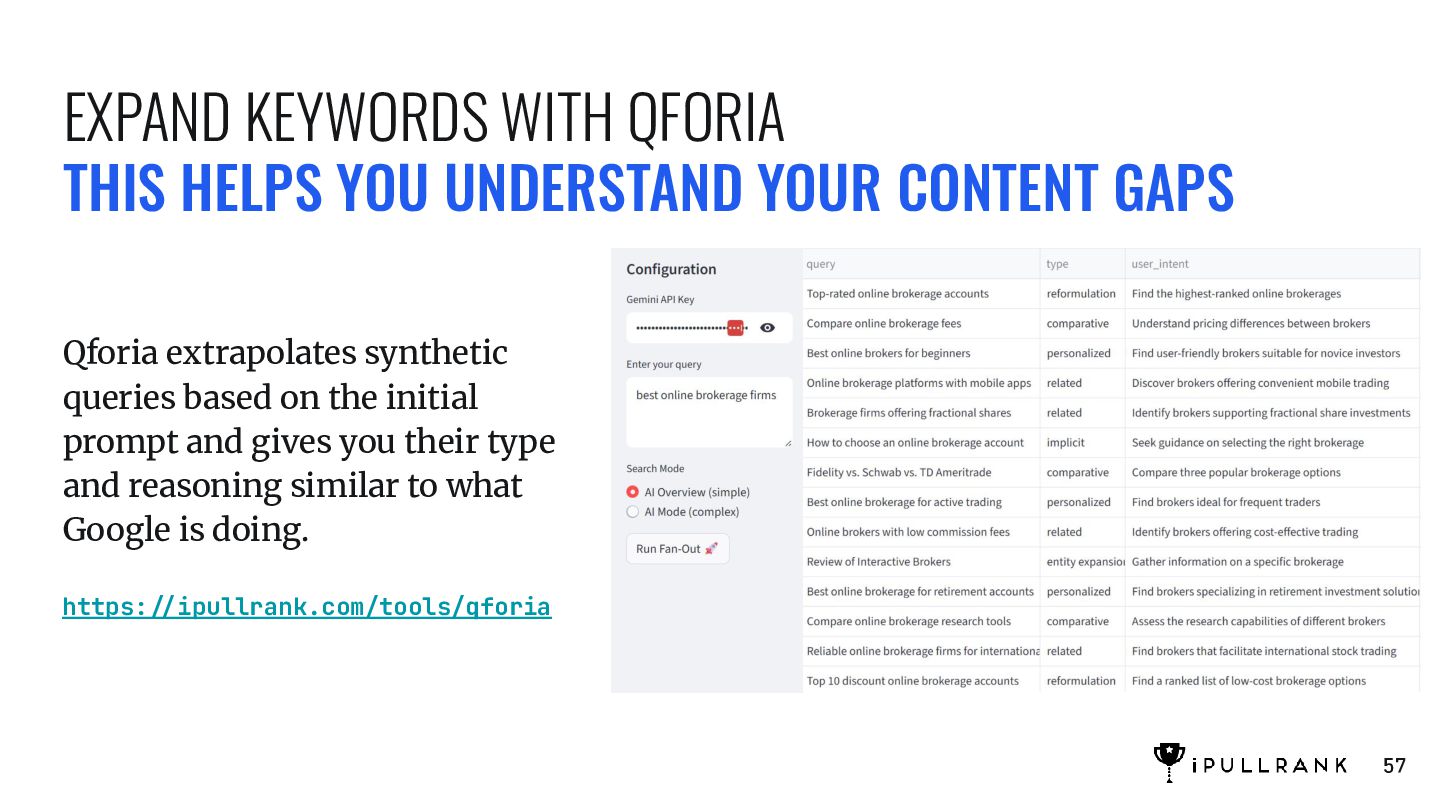
  45. EXPAND KEYWORDS WITH QFORIA THIS HELPS YOU UNDERSTAND YOUR CONTENT

    GAPS Qforia extrapolates synthetic queries based on the initial prompt and gives you their type and reasoning similar to what Google is doing. 57 https://ipullrank.com/tools/qforia
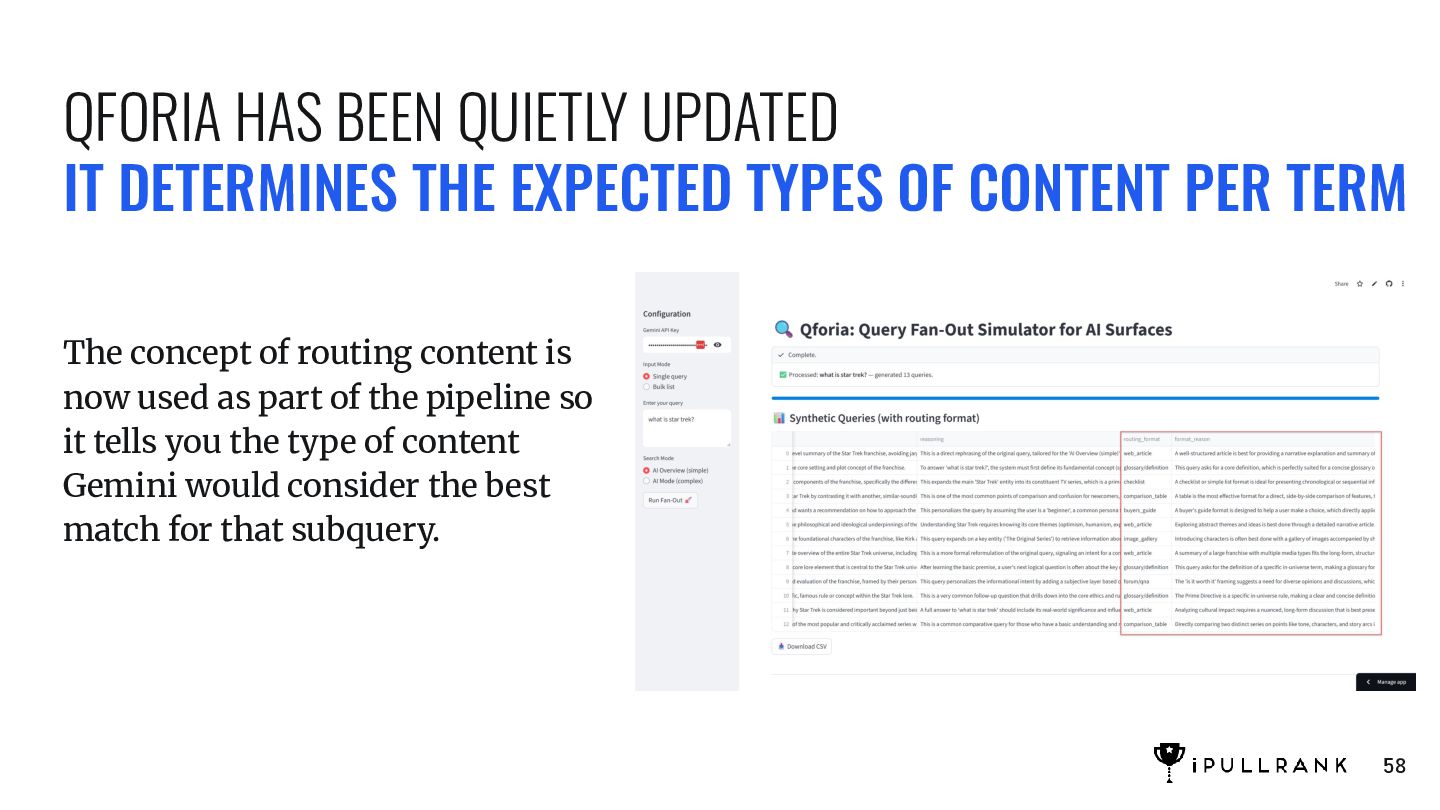
  46. QFORIA HAS BEEN QUIETLY UPDATED IT DETERMINES THE EXPECTED TYPES

    OF CONTENT PER TERM The concept of routing content is now used as part of the pipeline so it tells you the type of content Gemini would consider the best match for that subquery. 58
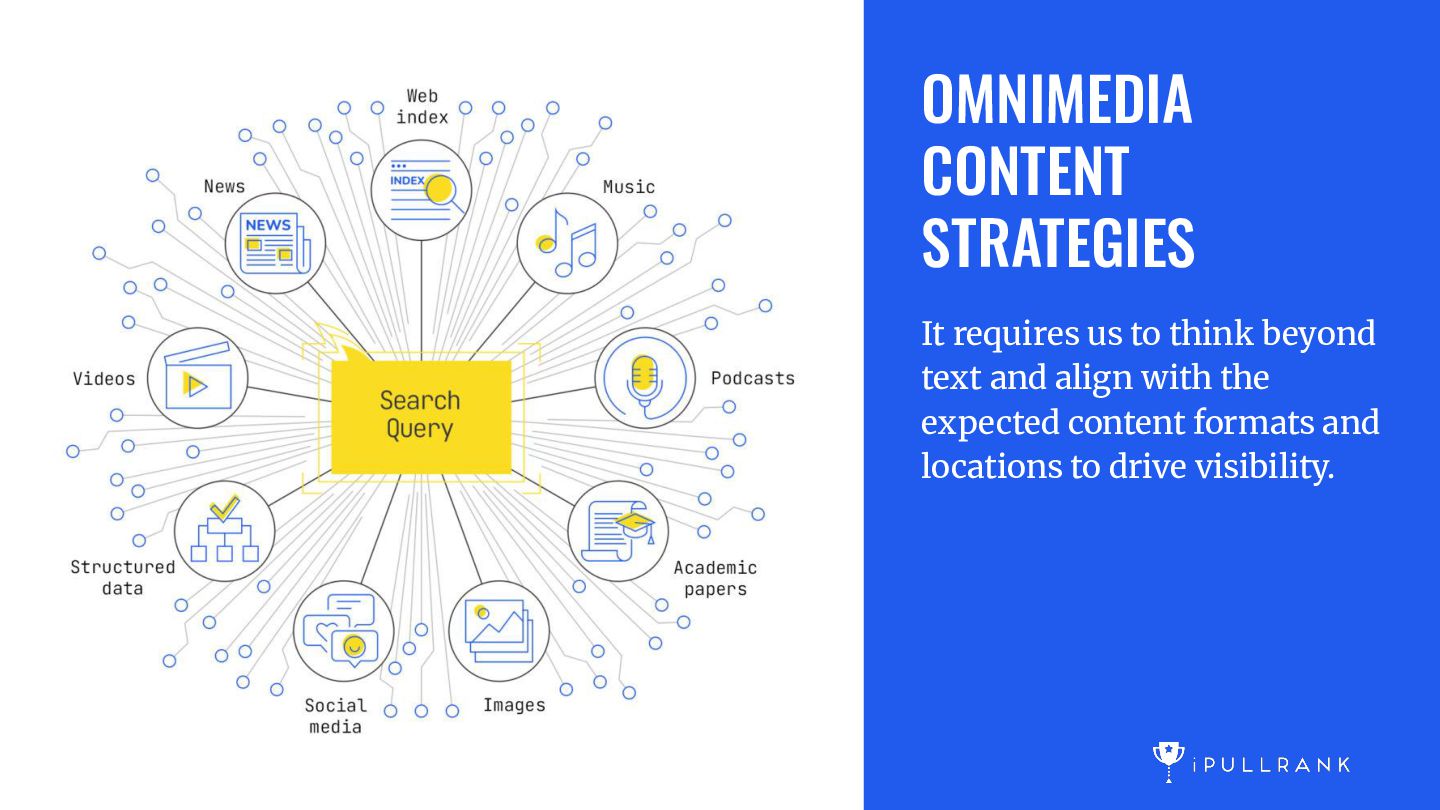
  47. OMNIMEDIA CONTENT STRATEGIES It requires us to think beyond text

    and align with the expected content formats and locations to drive visibility.
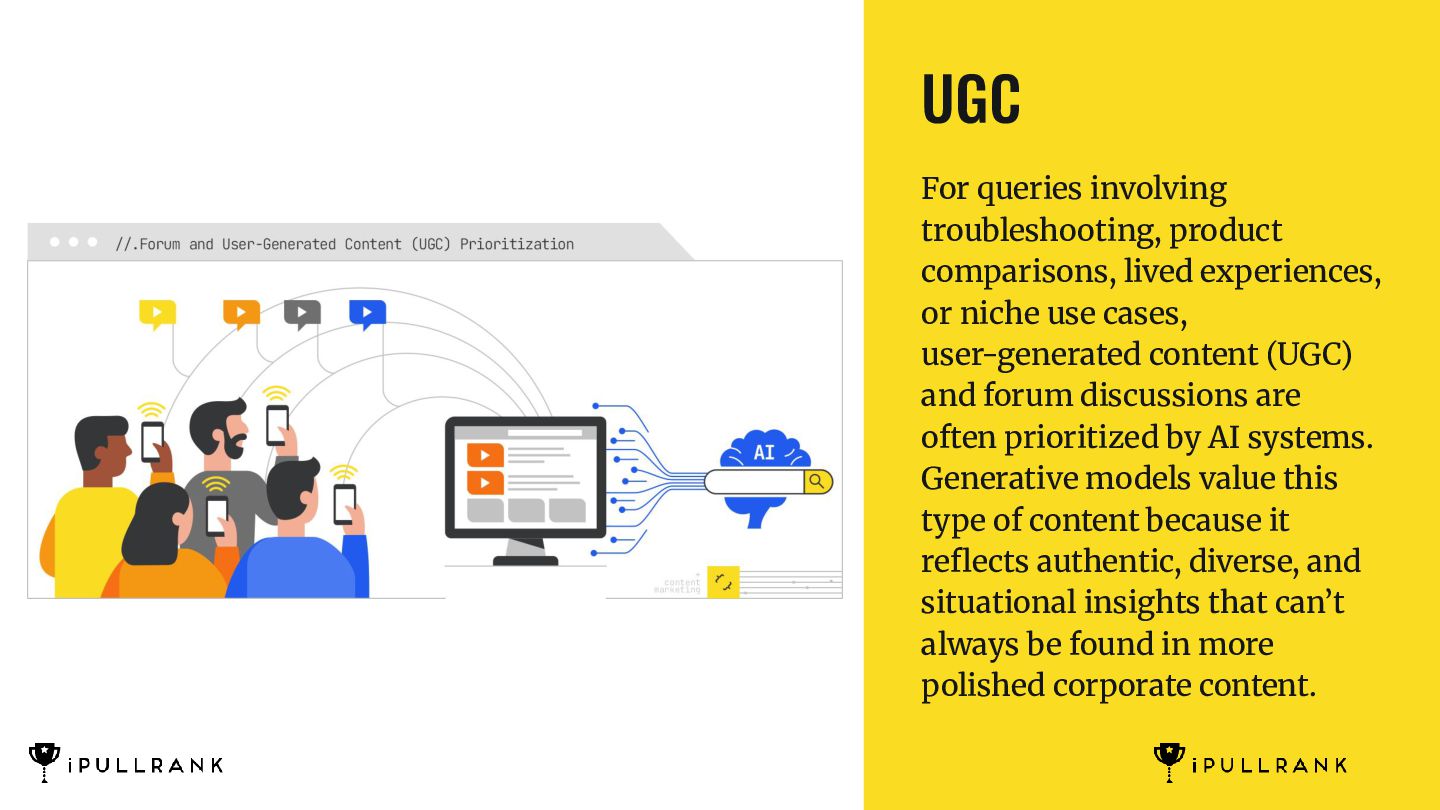
  48. UGC For queries involving troubleshooting, product comparisons, lived experiences, or

    niche use cases, user-generated content (UGC) and forum discussions are often prioritized by AI systems. Generative models value this type of content because it reflects authentic, diverse, and situational insights that can’t always be found in more polished corporate content.
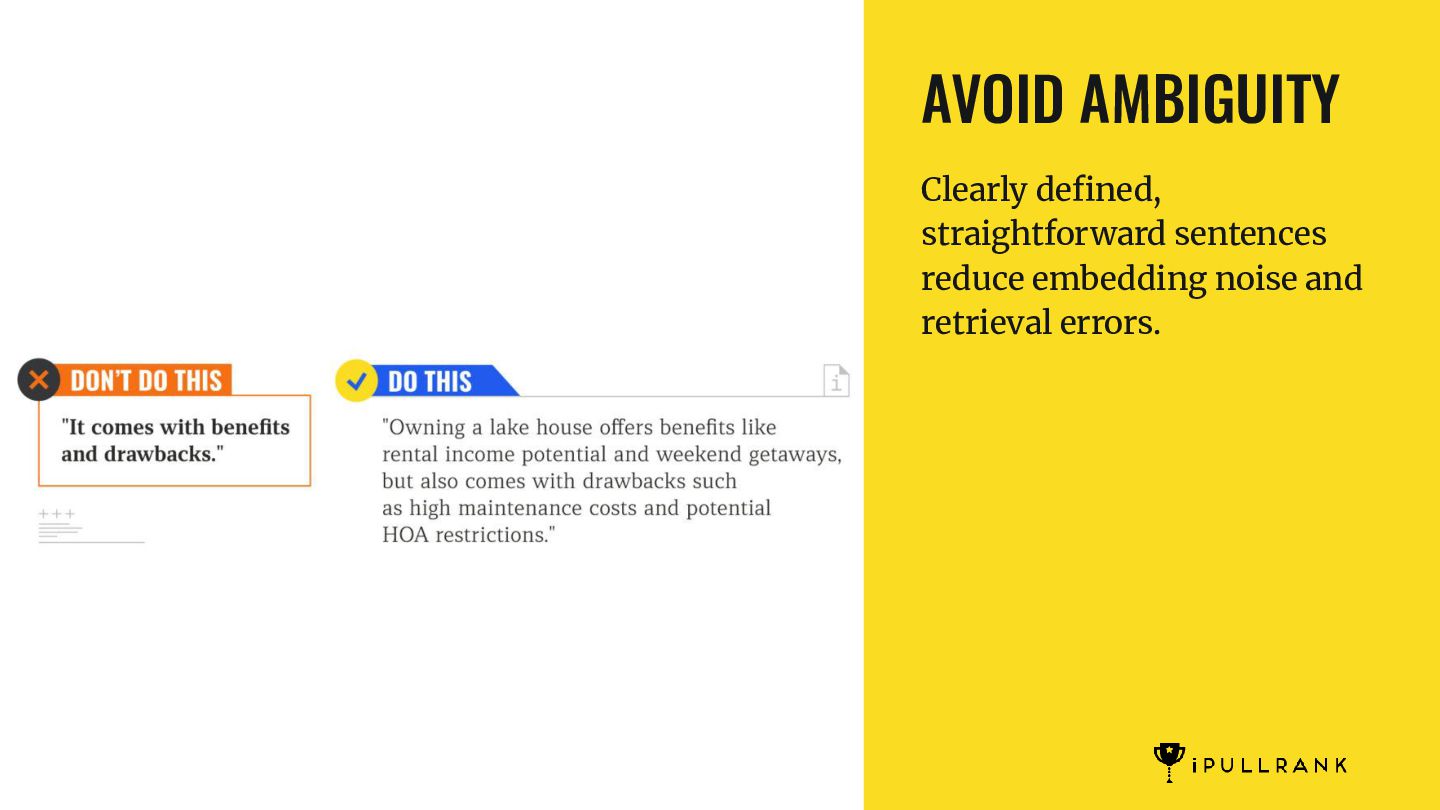
  49. ENTITY-RICH, EMBEDDING-FRIENDL Y LANGUAGE Write with clearly defined entities Use

    consistent terminology Include modifiers and descriptors: Qualifiers like size, function, location, and purpose help differentiate similar entities.
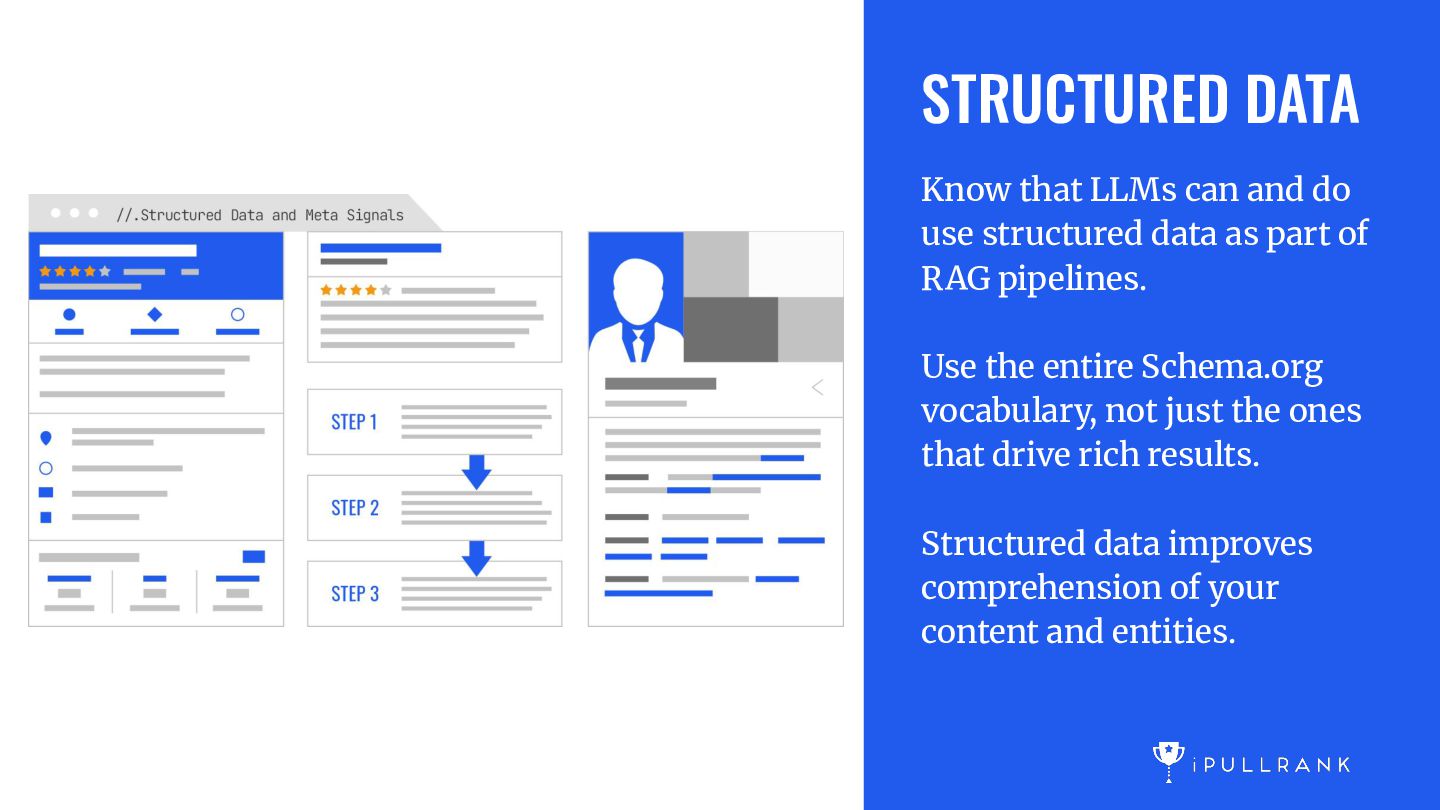
  50. STRUCTURED DATA Know that LLMs can and do use structured

    data as part of RAG pipelines. Use the entire Schema.org vocabulary, not just the ones that drive rich results. Structured data improves comprehension of your content and entities.
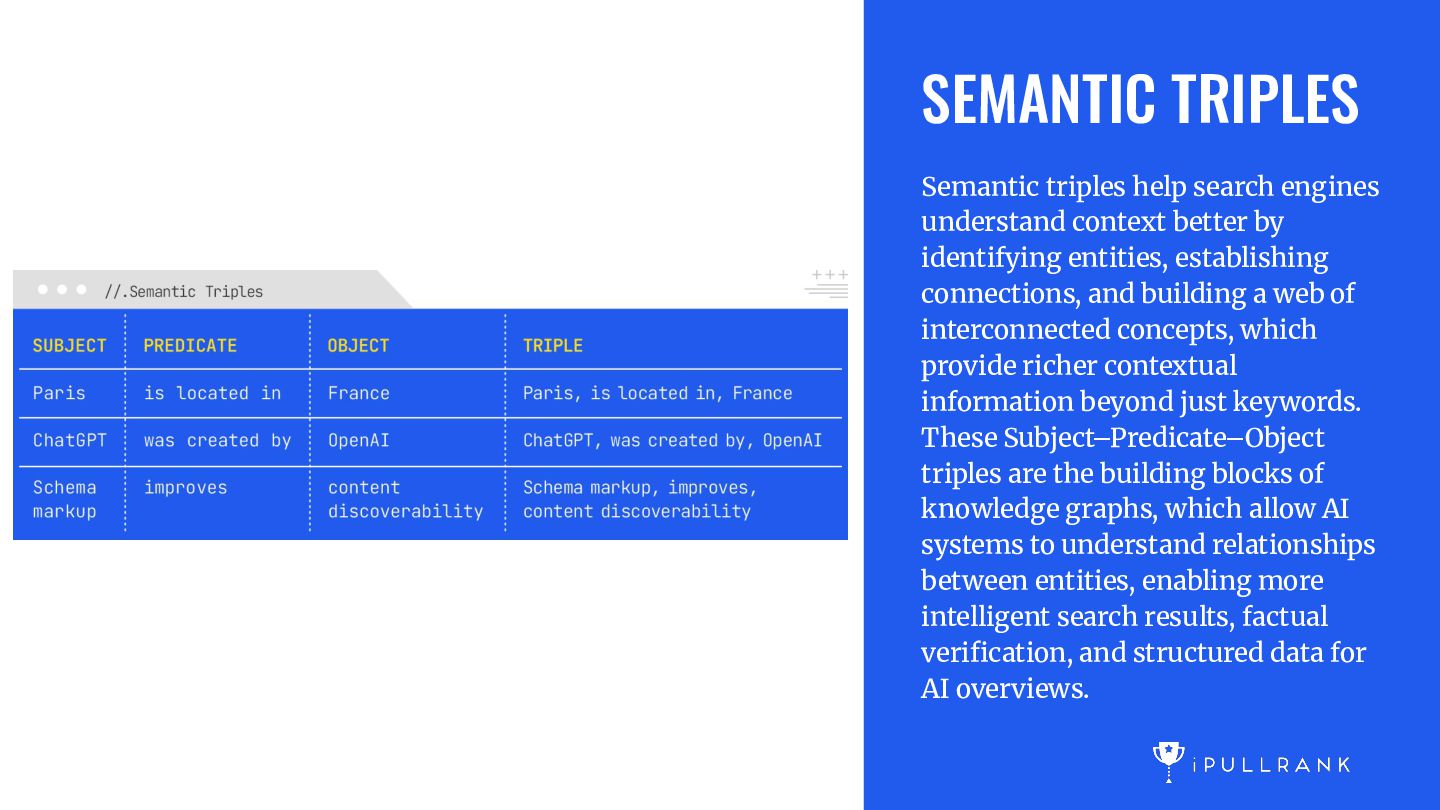
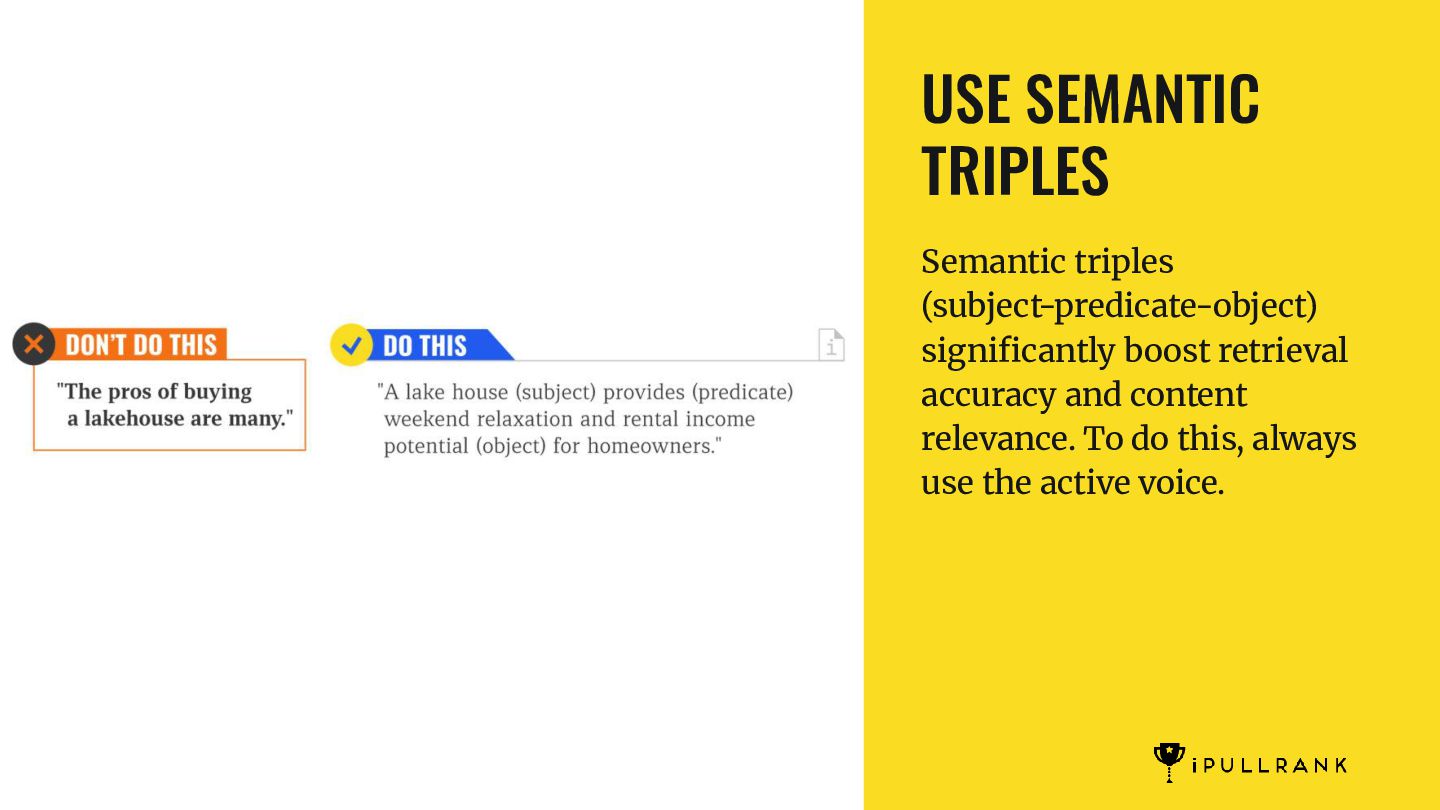
  51. SEMANTIC TRIPLES Semantic triples help search engines understand context better

    by identifying entities, establishing connections, and building a web of interconnected concepts, which provide richer contextual information beyond just keywords. These Subject–Predicate–Object triples are the building blocks of knowledge graphs, which allow AI systems to understand relationships between entities, enabling more intelligent search results, factual verification, and structured data for AI overviews.
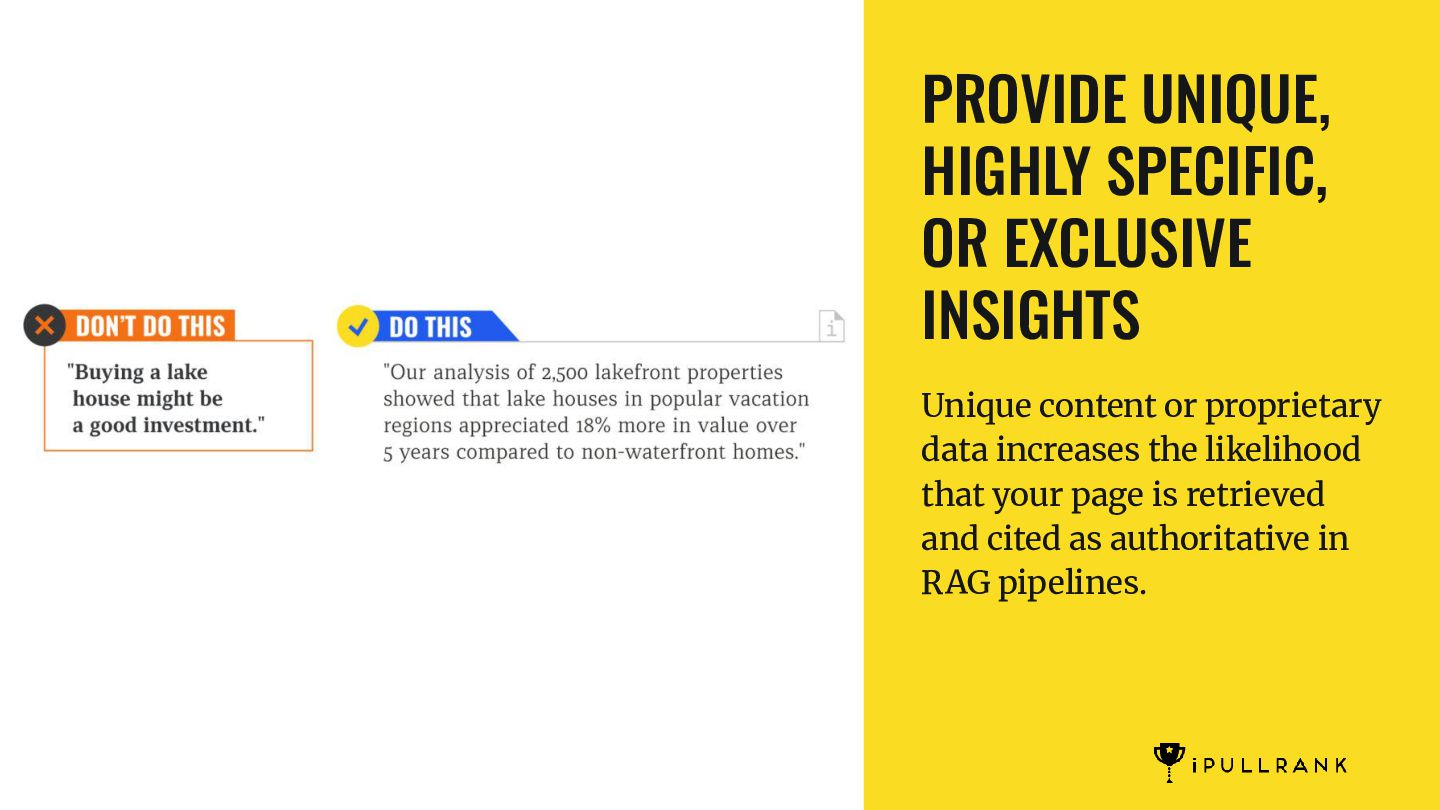
  52. PROVIDE UNIQUE, HIGHLY SPECIFIC, OR EXCLUSIVE INSIGHTS Unique content or

    proprietary data increases the likelihood that your page is retrieved and cited as authoritative in RAG pipelines.
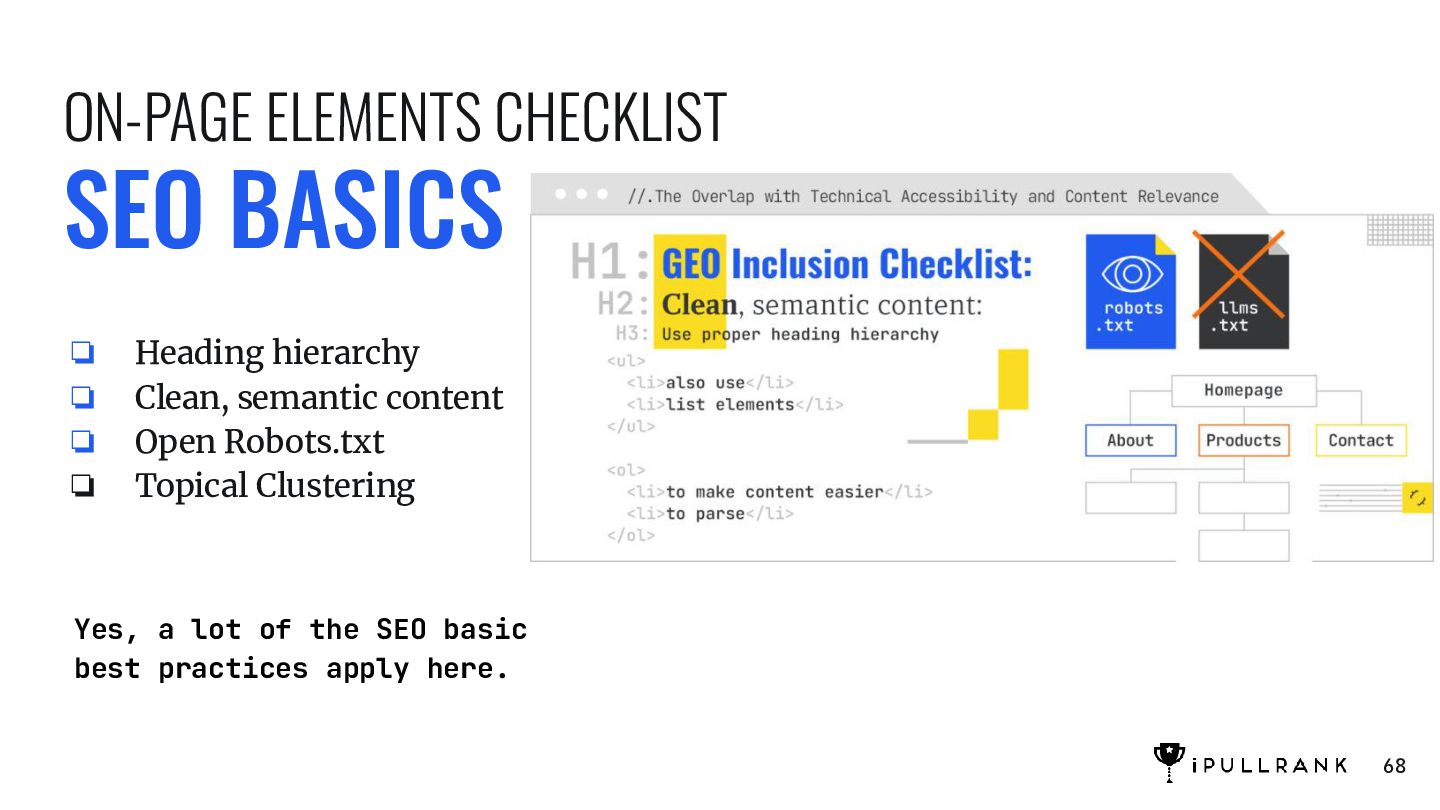
  53. ON-PAGE ELEMENTS CHECKLIST SEO BASICS ❏ Heading hierarchy ❏ Clean,

    semantic content ❏ Open Robots.txt ❏ Topical Clustering 68 Yes, a lot of the SEO basic best practices apply here.
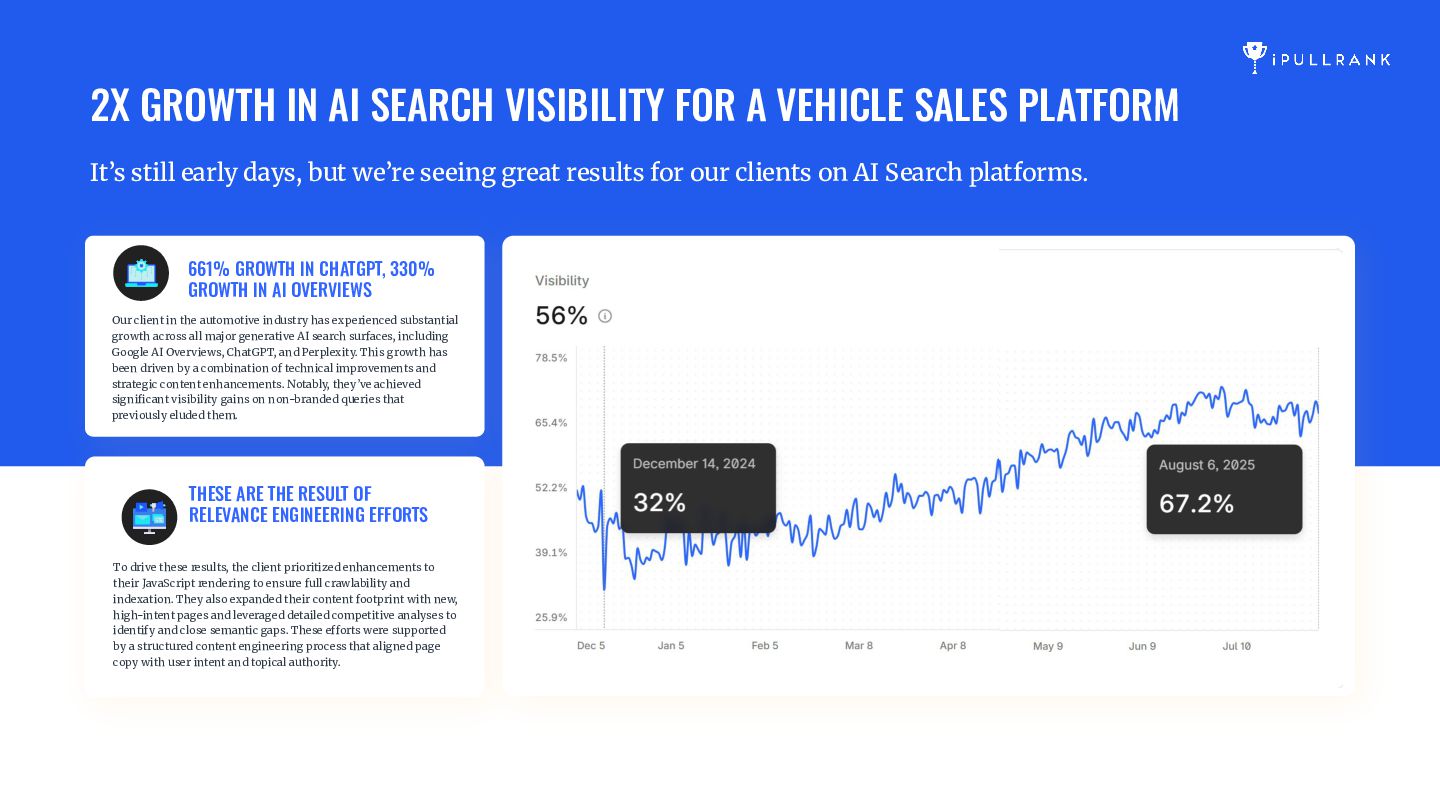
  54. 661% GROWTH IN CHATGPT, 330% GROWTH IN AI OVERVIEWS THESE

    ARE THE RESULT OF RELEVANCE ENGINEERING EFFORTS Our client in the automotive industry has experienced substantial growth across all major generative AI search surfaces, including Google AI Overviews, ChatGPT, and Perplexity. This growth has been driven by a combination of technical improvements and strategic content enhancements. Notably, they’ve achieved significant visibility gains on non-branded queries that previously eluded them. To drive these results, the client prioritized enhancements to their JavaScript rendering to ensure full crawlability and indexation. They also expanded their content footprint with new, high-intent pages and leveraged detailed competitive analyses to identify and close semantic gaps. These efforts were supported by a structured content engineering process that aligned page copy with user intent and topical authority. 2X GROWTH IN AI SEARCH VISIBILITY FOR A VEHICLE SALES PLATFORM It’s still early days, but we’re seeing great results for our clients on AI Search platforms.
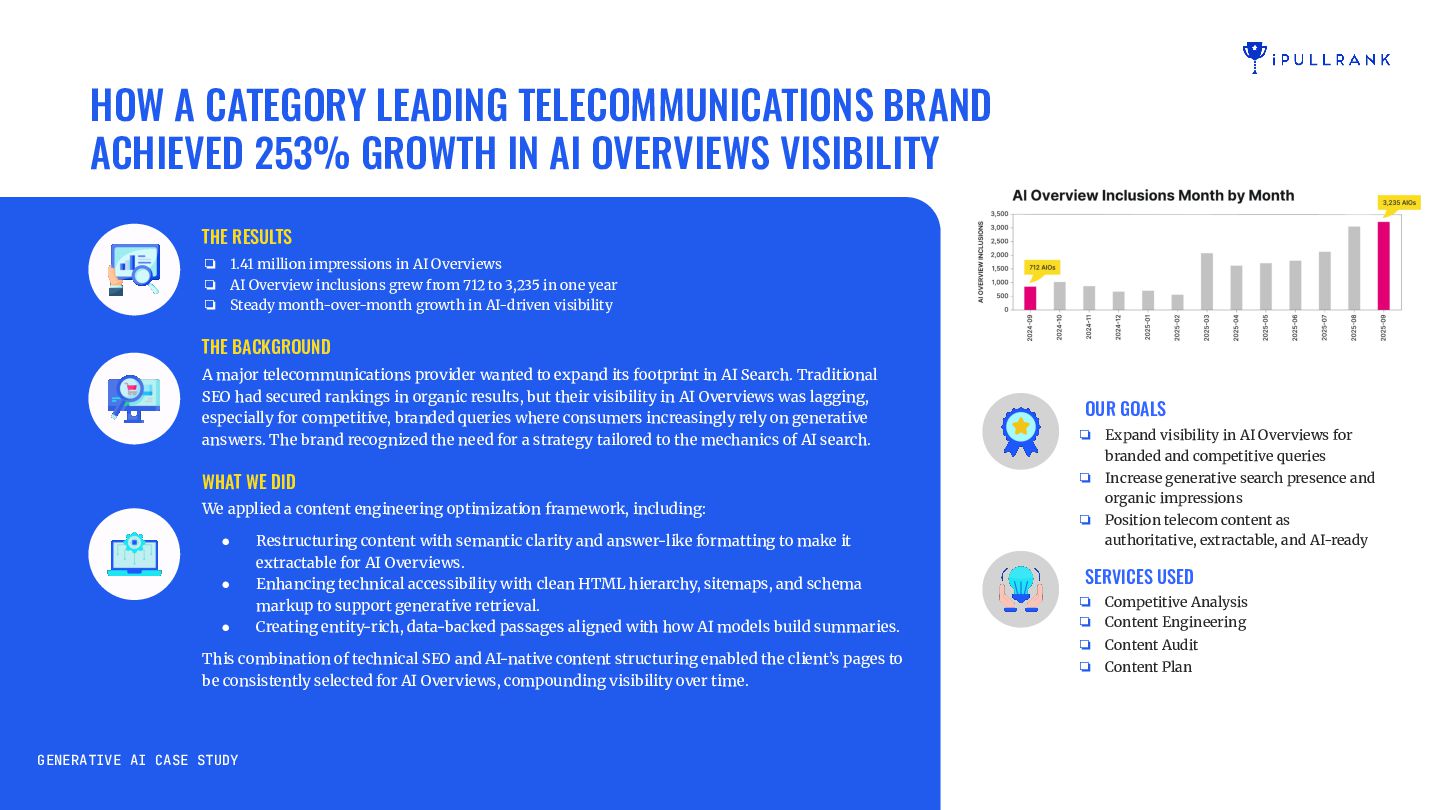
  55. HOW A CATEGORY LEADING TELECOMMUNICATIONS BRAND ACHIEVED 253% GROWTH IN

    AI OVERVIEWS VISIBILITY THE RESULTS ❏ 1.41 million impressions in AI Overviews ❏ AI Overview inclusions grew from 712 to 3,235 in one year ❏ Steady month-over-month growth in AI-driven visibility THE BACKGROUND A major telecommunications provider wanted to expand its footprint in AI Search. Traditional SEO had secured rankings in organic results, but their visibility in AI Overviews was lagging, especially for competitive, branded queries where consumers increasingly rely on generative answers. The brand recognized the need for a strategy tailored to the mechanics of AI search. WHAT WE DID We applied a content engineering optimization framework, including: • Restructuring content with semantic clarity and answer-like formatting to make it extractable for AI Overviews. • Enhancing technical accessibility with clean HTML hierarchy, sitemaps, and schema markup to support generative retrieval. • Creating entity-rich, data-backed passages aligned with how AI models build summaries. This combination of technical SEO and AI-native content structuring enabled the client’s pages to be consistently selected for AI Overviews, compounding visibility over time. OUR GOALS ❏ Expand visibility in AI Overviews for branded and competitive queries ❏ Increase generative search presence and organic impressions ❏ Position telecom content as authoritative, extractable, and AI-ready ❏ Competitive Analysis ❏ Content Engineering ❏ Content Audit ❏ Content Plan SERVICES USED GENERATIVE AI CASE STUDY
  56. REMEMBER THESE FIVE THINGS If You Don’t Remember Anything Else…

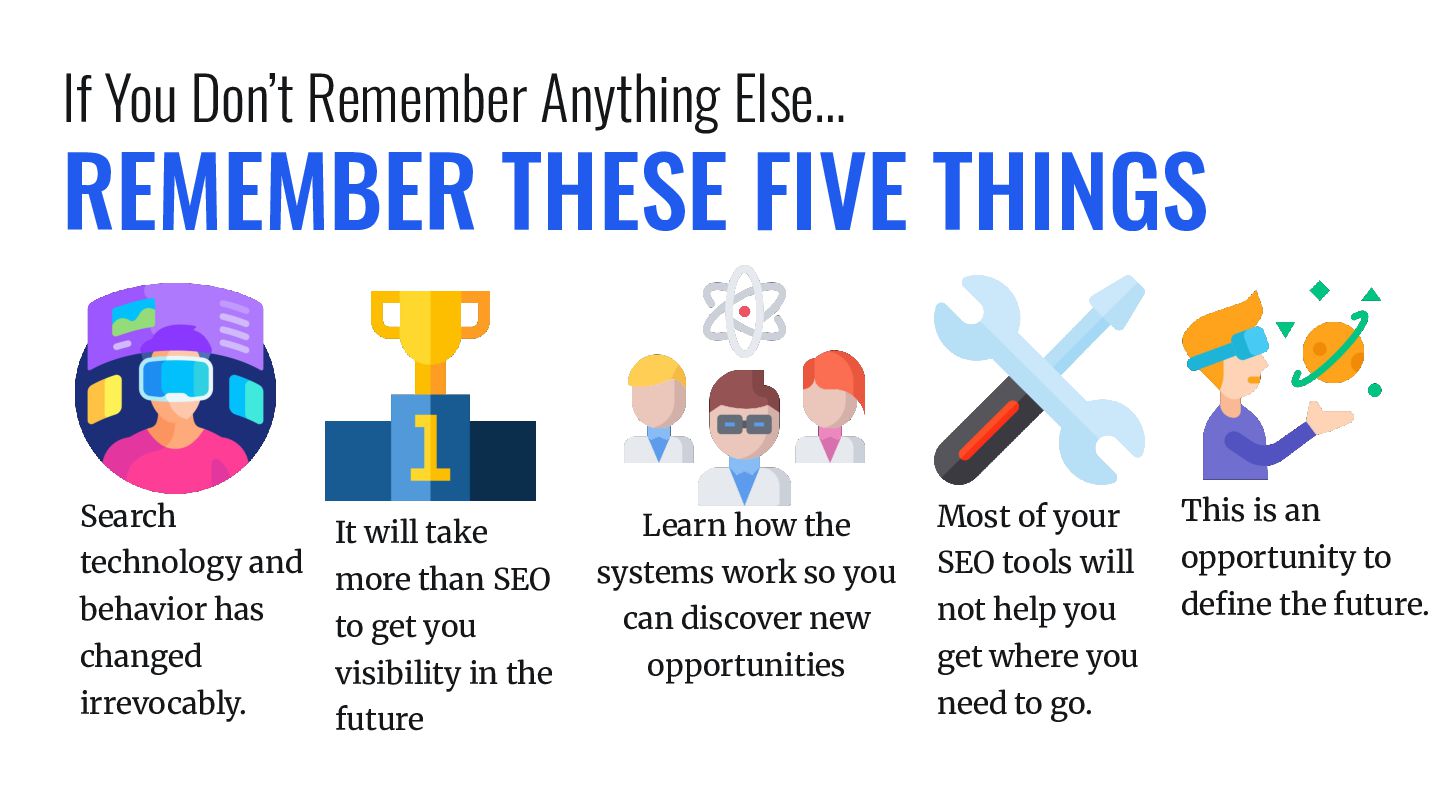
    Learn how the systems work so you can discover new opportunities It will take more than SEO to get you visibility in the future Search technology and behavior has changed irrevocably. Most of your SEO tools will not help you get where you need to go. This is an opportunity to define the future.
  57. SCREAMING FROG + OLLAMA I generate embeddings as I crawl,

    asset content, take screenshots and analyze as I crawl. All on my own local GPU. The New Playbook For AEO Content in 2026: How To Get Your Brand Chosen As The Answer
  58. 24 CHAPTERS OF PURE 🔥🔥🔥 Everything you need to know

    about how AI Search works. No vagueries. And… three new chapters coming! The New Playbook For AEO Content in 2026: How To Get Your Brand Chosen As The Answer
  59. ipullrank.com/ai-search-manual AI Search to Sale: What the Data Reveals About

    AI Search eCommerce Behavior The New Playbook For AEO Content in 2026: How To Get Your Brand Chosen As The Answer
  60. Title THANK YOU // Q&A The New Playbook For AEO

    Content in 2026: How To Get Your Brand Chosen As The Answer Zach Chahalis Senior Director of SEO and Data Analytics iPullRank X: @ZachChahalis LI: /zacharychahalis Tap in with us: ipullrank.com Get the Slides: https://bit.ly/4cXX1EB
  61. 80