Share
Embed
Using an API
Talk about API basics and also more details on actually using an API and programming for it.
Adam Culp
August 08, 2012
Transcript
32 slides
-
Using an API Tools HTTPie CURL
Charles – http://www.charlesproxy.com Firebug – https://getfirebug.com -
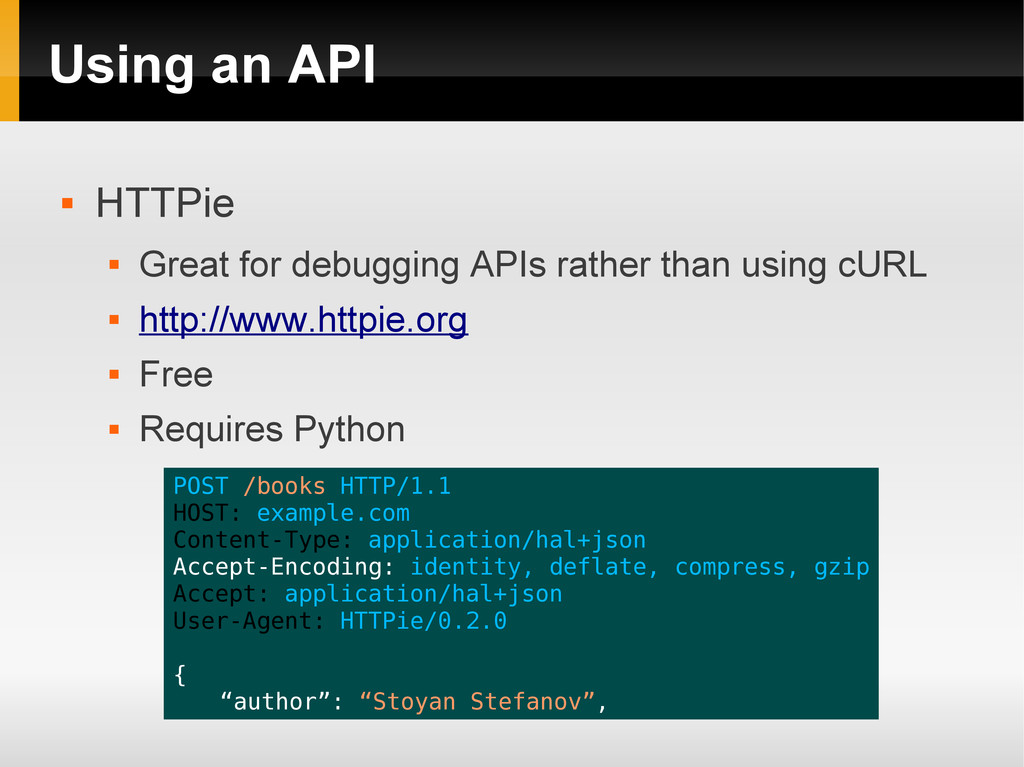
Using an API HTTPie Great for debugging APIs
rather than using cURL http://www.httpie.org Free Requires Python POST /books HTTP/1.1 HOST: example.com Content-Type: application/hal+json Accept-Encoding: identity, deflate, compress, gzip Accept: application/hal+json User-Agent: HTTPie/0.2.0 { “author”: “Stoyan Stefanov”, -
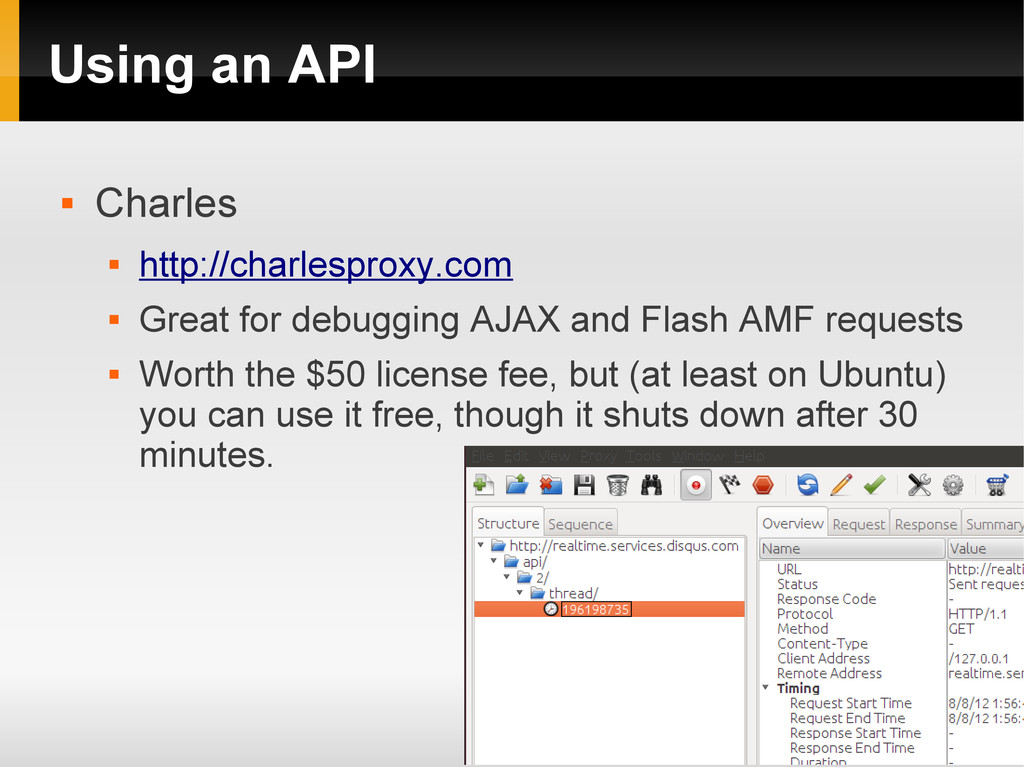
Using an API Charles http://charlesproxy.com Great for
debugging AJAX and Flash AMF requests Worth the $50 license fee, but (at least on Ubuntu) you can use it free, though it shuts down after 30 minutes. -
Using an API cURL Great to use via
PHP, but for command line use HTTPie. Firebug Great for debugging from Firefox. Others I hear IE has an OK debugging tool like Firebug. I have also heard Chrome has a great Firebug'ish tool also. -
Using an API What is an API? Application
programming interface A specification intended to be used as an interface by software components to communicate with each other. - wikipedia -
Using an API API types (popular) SOAP –
Simple Object Access Protocol REST – Representational State Transfer (RFC 2616) Javascript Screen scrape -
Using an API SOAP basics Relies on XML
as its message format. Uses HTTP, SMTP, TCP, or JMS for transport, but usually HTTP. Generally uses a WSDL (Web Services Description Language) configuration file making it easier to build for or connect to the API. Cross platform and cross language. Very structured – each action is defined (addUser, getUsers, getNewUsersSince, etc.) -
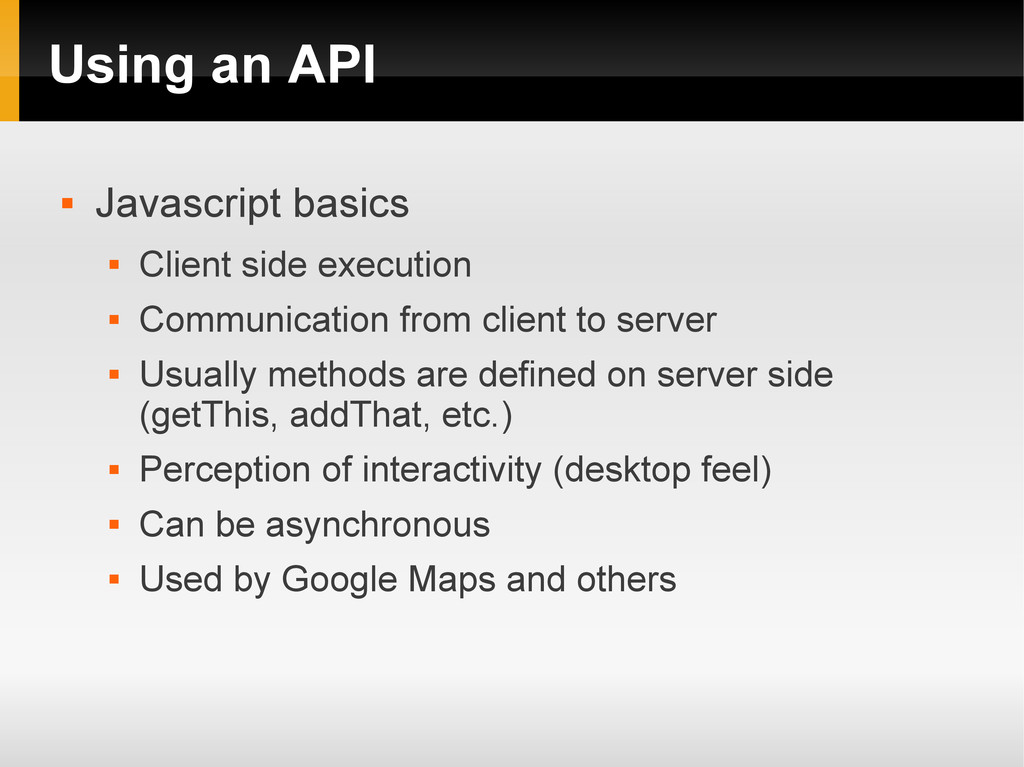
Using an API Javascript basics Client side execution
Communication from client to server Usually methods are defined on server side (getThis, addThat, etc.) Perception of interactivity (desktop feel) Can be asynchronous Used by Google Maps and others -
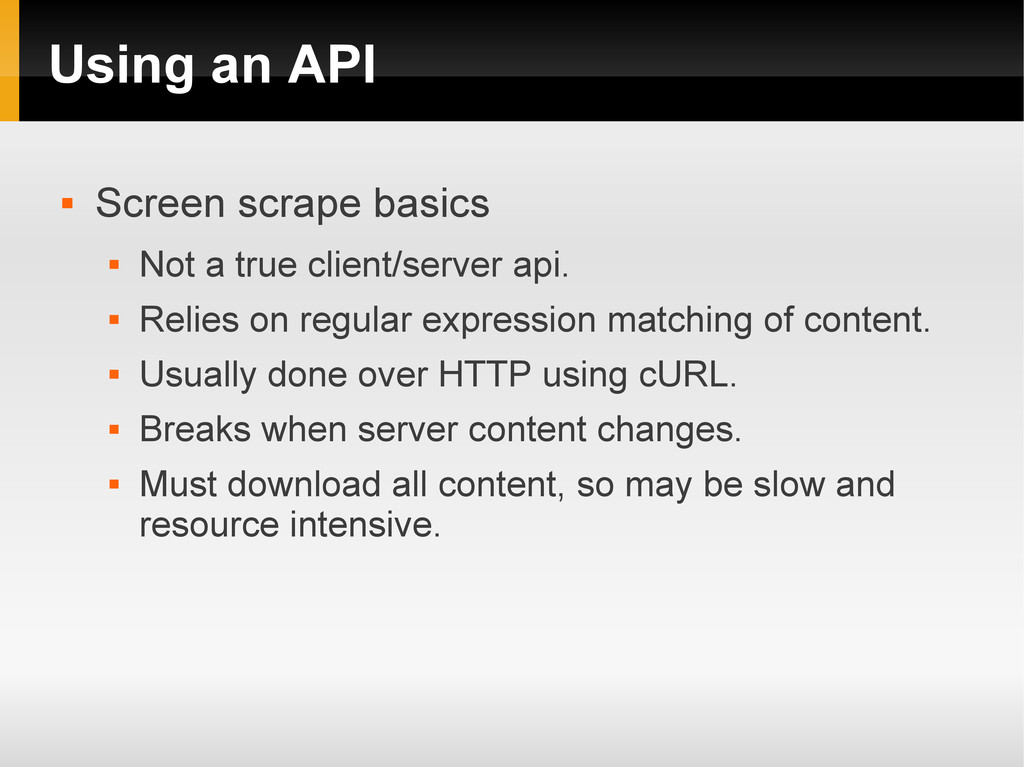
Using an API Screen scrape basics Not a
true client/server api. Relies on regular expression matching of content. Usually done over HTTP using cURL. Breaks when server content changes. Must download all content, so may be slow and resource intensive. -
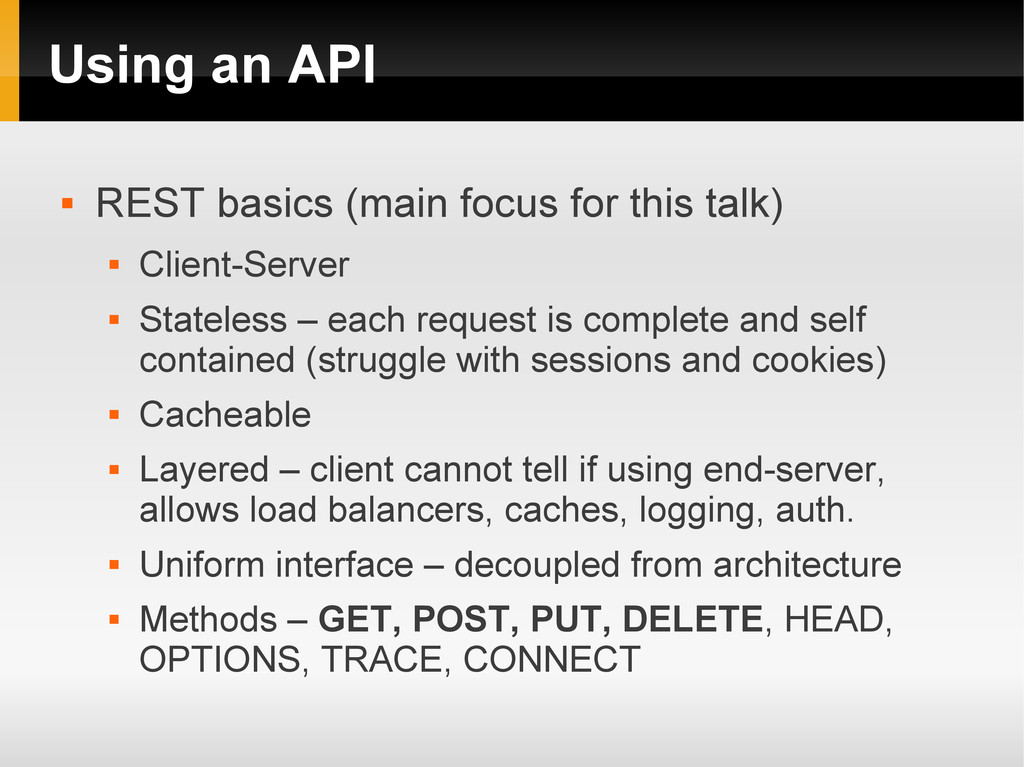
Using an API REST basics (main focus for this
talk) Client-Server Stateless – each request is complete and self contained (struggle with sessions and cookies) Cacheable Layered – client cannot tell if using end-server, allows load balancers, caches, logging, auth. Uniform interface – decoupled from architecture Methods – GET, POST, PUT, DELETE, HEAD, OPTIONS, TRACE, CONNECT -
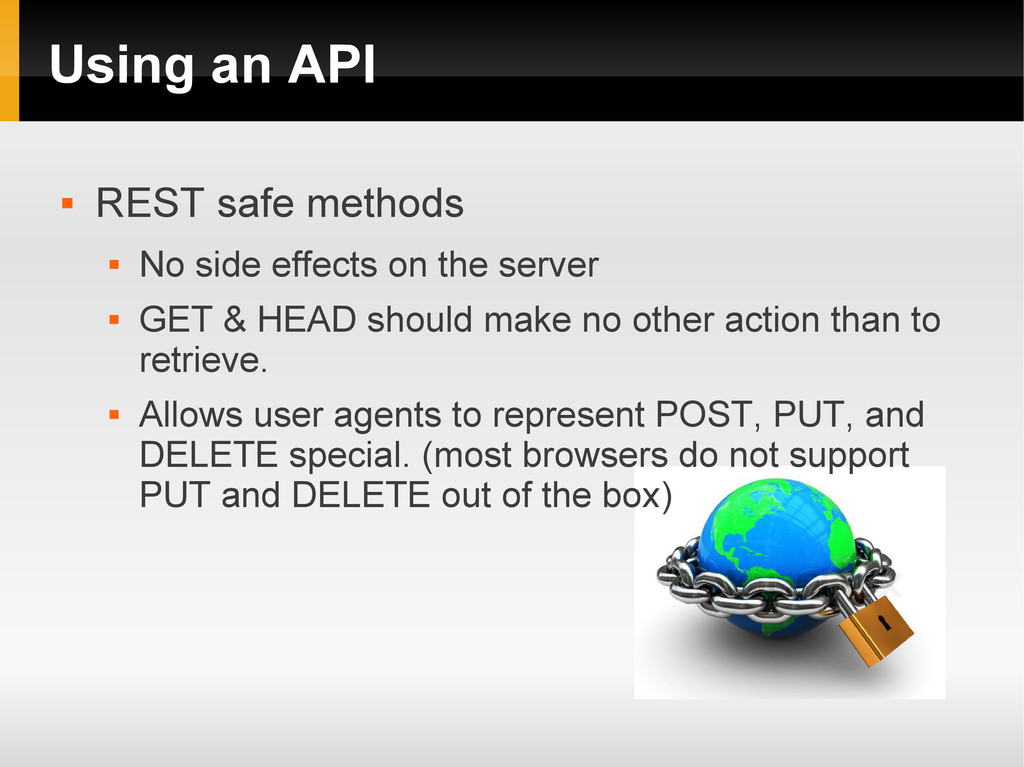
Using an API REST safe methods No side
effects on the server GET & HEAD should make no other action than to retrieve. Allows user agents to represent POST, PUT, and DELETE special. (most browsers do not support PUT and DELETE out of the box) -
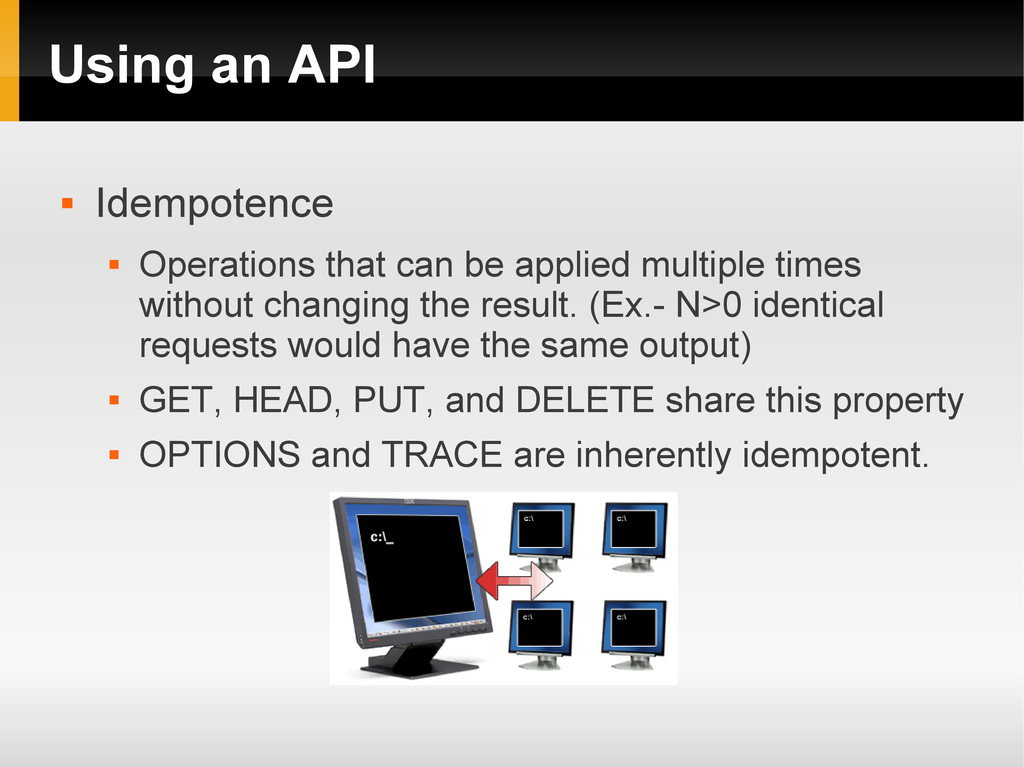
Using an API Idempotence Operations that can be
applied multiple times without changing the result. (Ex.- N>0 identical requests would have the same output) GET, HEAD, PUT, and DELETE share this property OPTIONS and TRACE are inherently idempotent. -
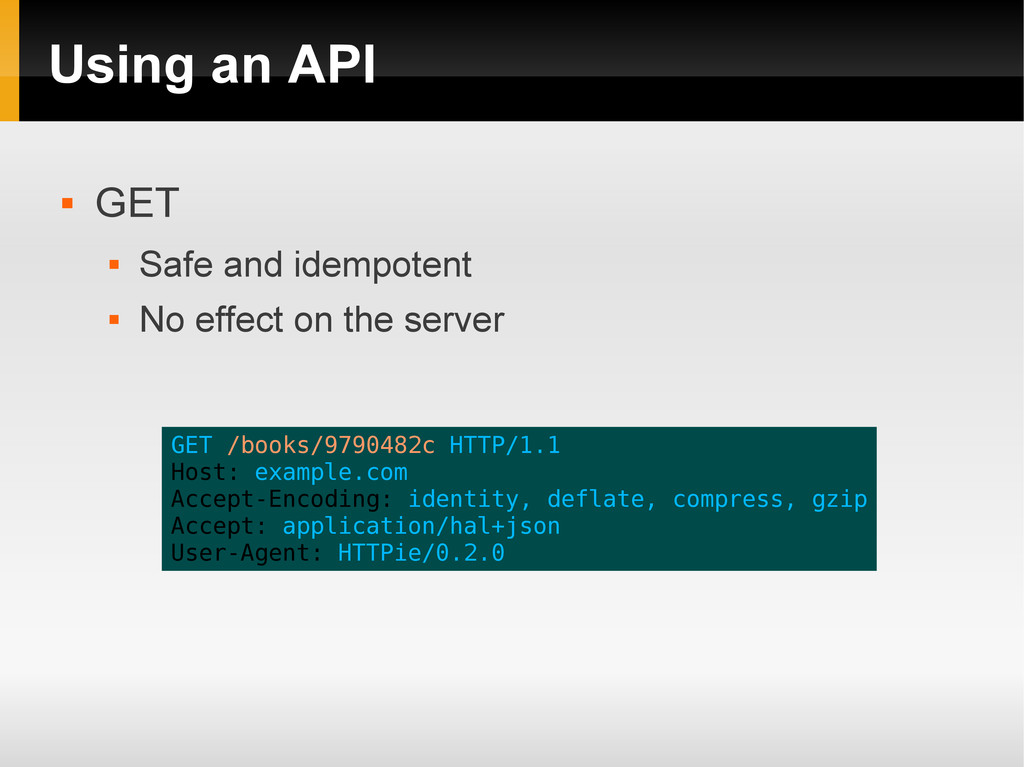
Using an API GET Safe and idempotent
No effect on the server GET /books/9790482c HTTP/1.1 Host: example.com Accept-Encoding: identity, deflate, compress, gzip Accept: application/hal+json User-Agent: HTTPie/0.2.0 -
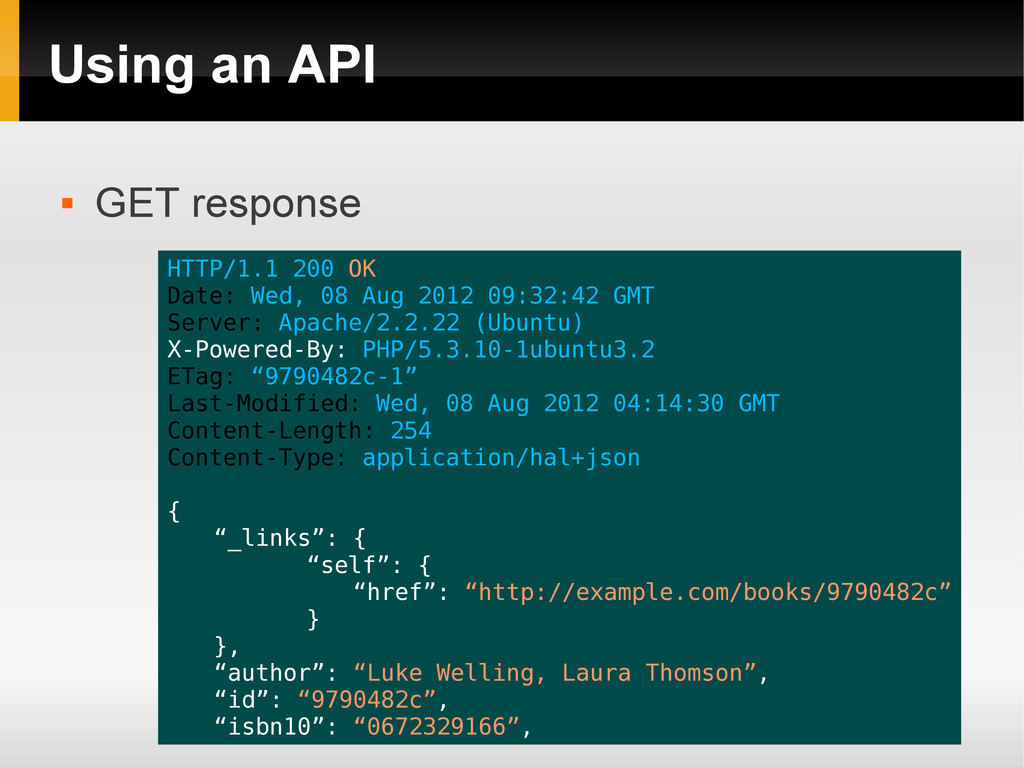
Using an API GET response HTTP/1.1 200 OK Date:
Wed, 08 Aug 2012 09:32:42 GMT Server: Apache/2.2.22 (Ubuntu) X-Powered-By: PHP/5.3.10-1ubuntu3.2 ETag: “9790482c-1” Last-Modified: Wed, 08 Aug 2012 04:14:30 GMT Content-Length: 254 Content-Type: application/hal+json { “_links”: { “self”: { “href”: “http://example.com/books/9790482c” } }, “author”: “Luke Welling, Laura Thomson”, “id”: “9790482c”, “isbn10”: “0672329166”, -
Using an API POST Not safe Not
idempotent (same post multiple times could have different effects on server) Used to create resource Is often used to also update a resource, though PUT is more for updating. -
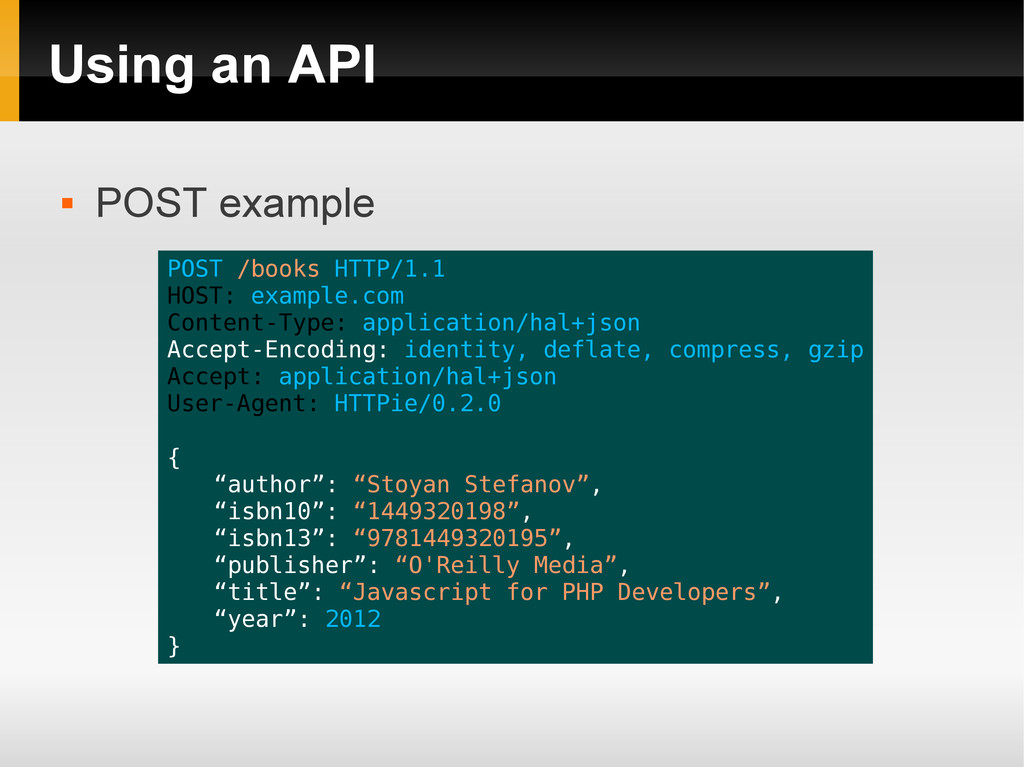
Using an API POST example POST /books HTTP/1.1 HOST:
example.com Content-Type: application/hal+json Accept-Encoding: identity, deflate, compress, gzip Accept: application/hal+json User-Agent: HTTPie/0.2.0 { “author”: “Stoyan Stefanov”, “isbn10”: “1449320198”, “isbn13”: “9781449320195”, “publisher”: “O'Reilly Media”, “title”: “Javascript for PHP Developers”, “year”: 2012 } -
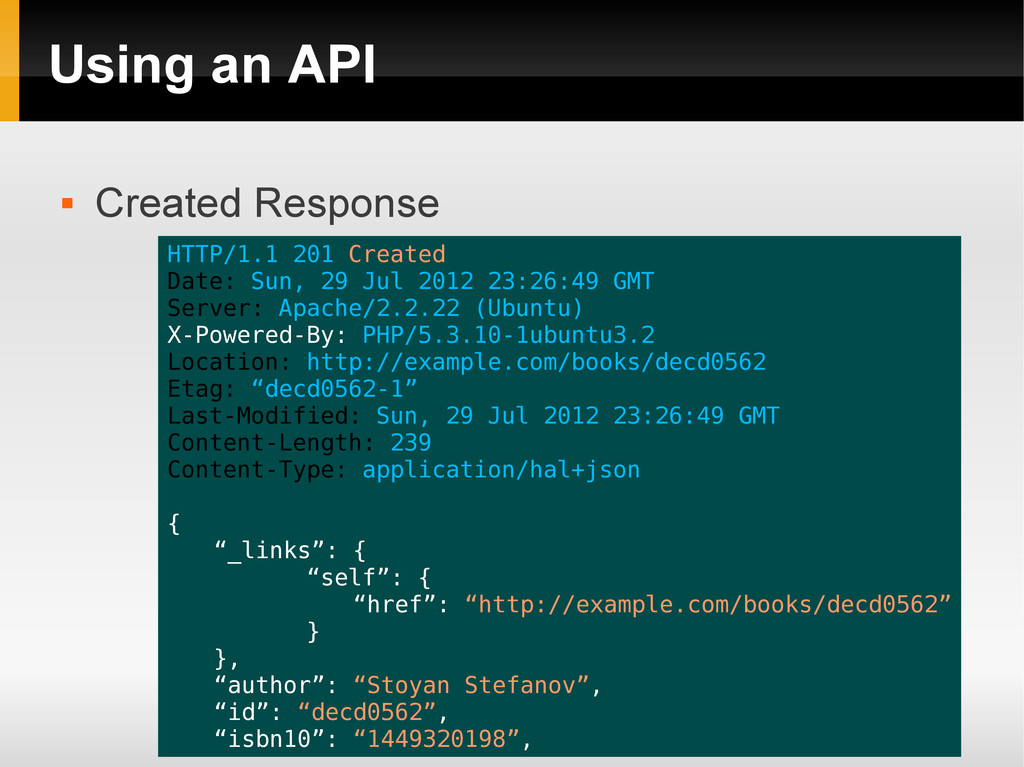
Using an API Created Response HTTP/1.1 201 Created Date:
Sun, 29 Jul 2012 23:26:49 GMT Server: Apache/2.2.22 (Ubuntu) X-Powered-By: PHP/5.3.10-1ubuntu3.2 Location: http://example.com/books/decd0562 Etag: “decd0562-1” Last-Modified: Sun, 29 Jul 2012 23:26:49 GMT Content-Length: 239 Content-Type: application/hal+json { “_links”: { “self”: { “href”: “http://example.com/books/decd0562” } }, “author”: “Stoyan Stefanov”, “id”: “decd0562”, “isbn10”: “1449320198”, -
Using an API PUT Not safe But
is idempotent Primarily an update action, but can also be used to create though POST should be used for that. -
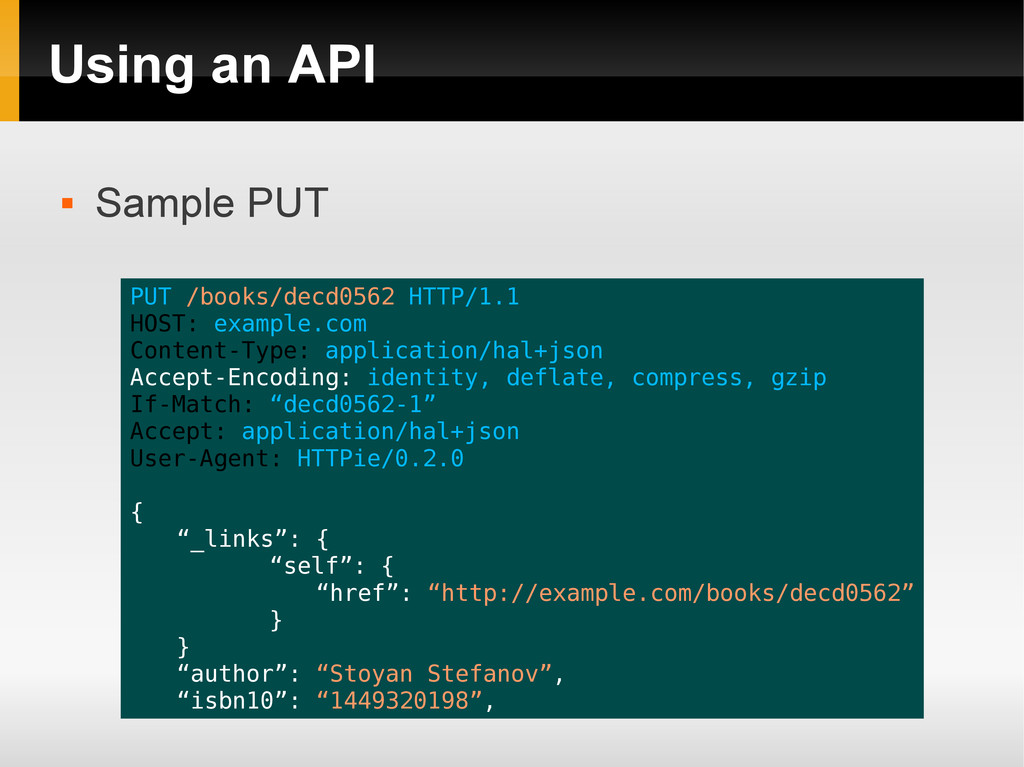
Using an API Sample PUT PUT /books/decd0562 HTTP/1.1 HOST:
example.com Content-Type: application/hal+json Accept-Encoding: identity, deflate, compress, gzip If-Match: “decd0562-1” Accept: application/hal+json User-Agent: HTTPie/0.2.0 { “_links”: { “self”: { “href”: “http://example.com/books/decd0562” } } “author”: “Stoyan Stefanov”, “isbn10”: “1449320198”, -
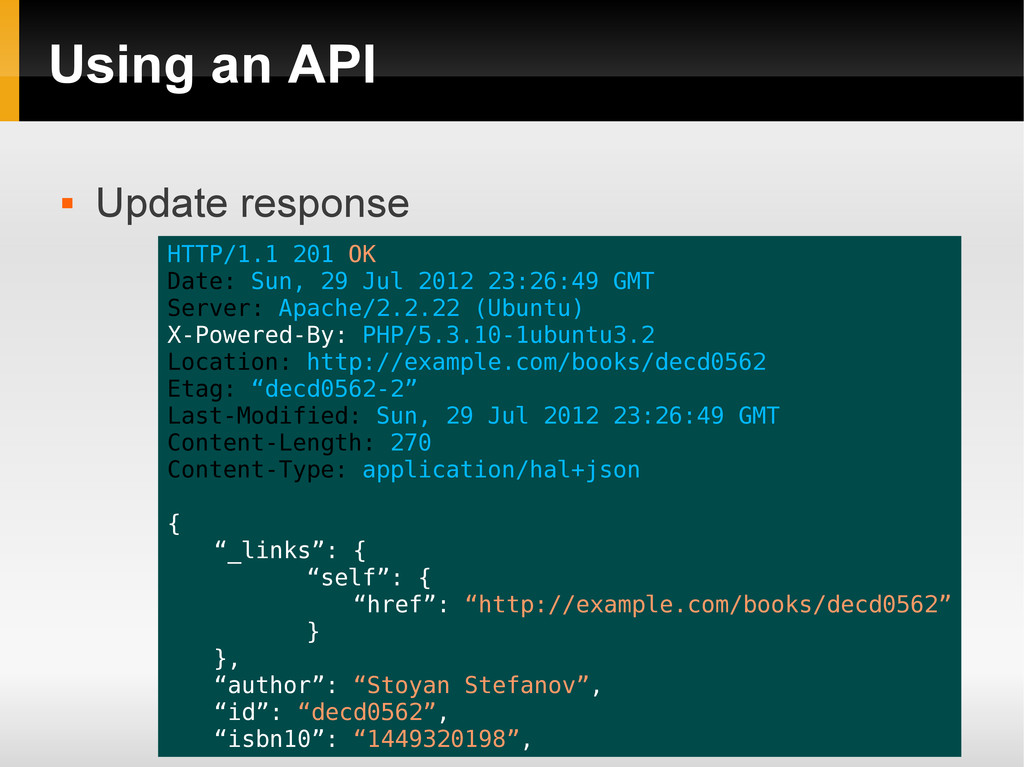
Using an API Update response HTTP/1.1 201 OK Date:
Sun, 29 Jul 2012 23:26:49 GMT Server: Apache/2.2.22 (Ubuntu) X-Powered-By: PHP/5.3.10-1ubuntu3.2 Location: http://example.com/books/decd0562 Etag: “decd0562-2” Last-Modified: Sun, 29 Jul 2012 23:26:49 GMT Content-Length: 270 Content-Type: application/hal+json { “_links”: { “self”: { “href”: “http://example.com/books/decd0562” } }, “author”: “Stoyan Stefanov”, “id”: “decd0562”, “isbn10”: “1449320198”, -
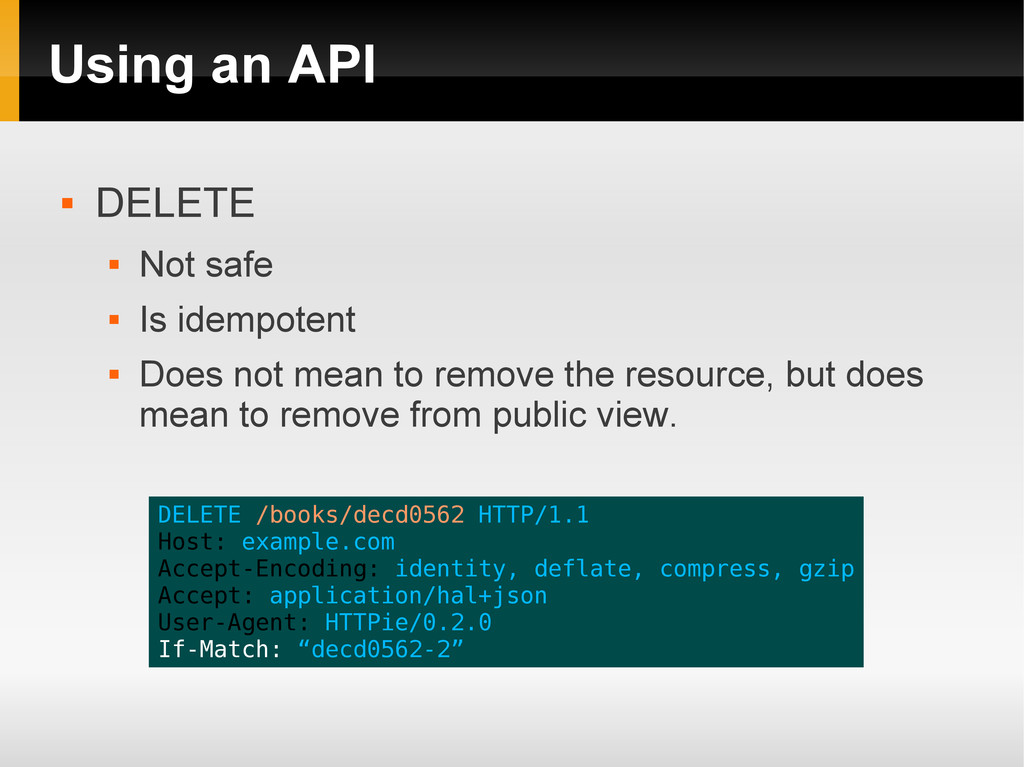
Using an API DELETE Not safe Is
idempotent Does not mean to remove the resource, but does mean to remove from public view. DELETE /books/decd0562 HTTP/1.1 Host: example.com Accept-Encoding: identity, deflate, compress, gzip Accept: application/hal+json User-Agent: HTTPie/0.2.0 If-Match: “decd0562-2” -
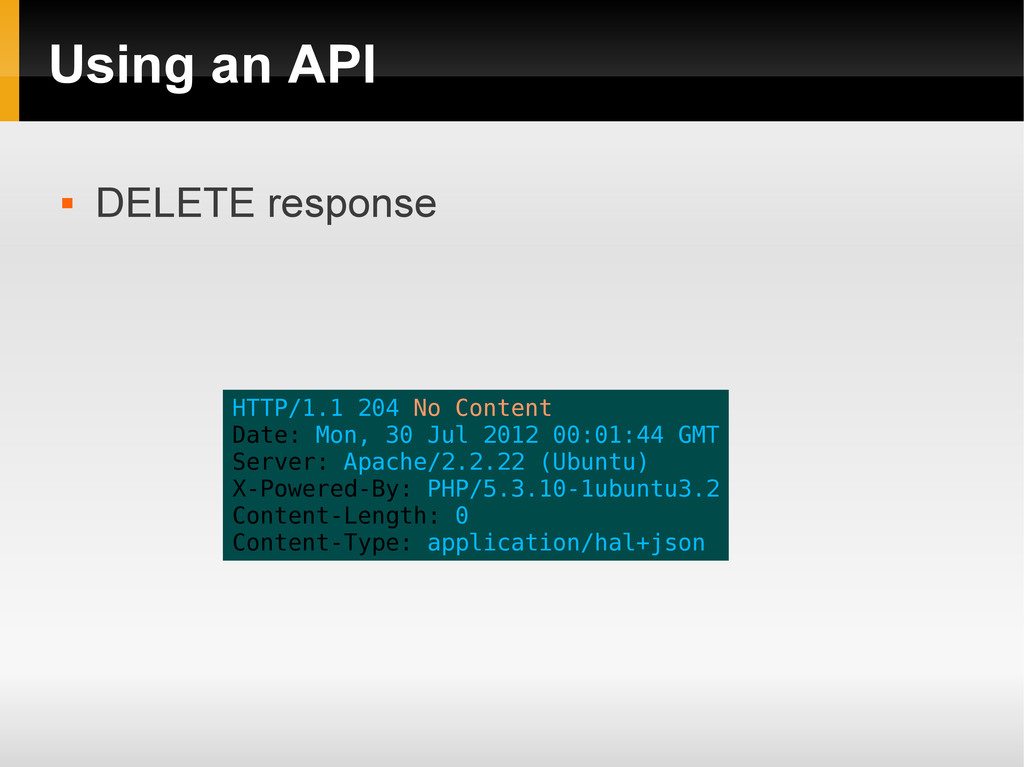
Using an API DELETE response HTTP/1.1 204 No Content
Date: Mon, 30 Jul 2012 00:01:44 GMT Server: Apache/2.2.22 (Ubuntu) X-Powered-By: PHP/5.3.10-1ubuntu3.2 Content-Length: 0 Content-Type: application/hal+json -
Using an API HEAD Same as GET, but
doesn't return the body An example of use would be to check content length before actually requesting it. -
Using an API Status codes Informational (1xx)
Successful (2xx) Redirection (3xx) Client error (4xx) Server error (5xx) -
Using an API Common usage Most developers aren't
building an API Using for sites and application content Leverage resources/services (Google Maps) Cut development time, add functionality -
Using an API Resources for great APIs available
Mashery.com https://developer.mashery.com/apis Apigee.com https://apigee.com/providers Google https://developers.google.com Let's take a look!!! -
Using an API Documention tools Mashery http://mashery.github.com
I/O Docs – interactive API documentation I/O Alfred – Alfred app to use some APIs I/O Wraps – API client library generator Oauth Signature Tool Oauth 1.0 JS Testing Tool AppMobi Sample Apps -
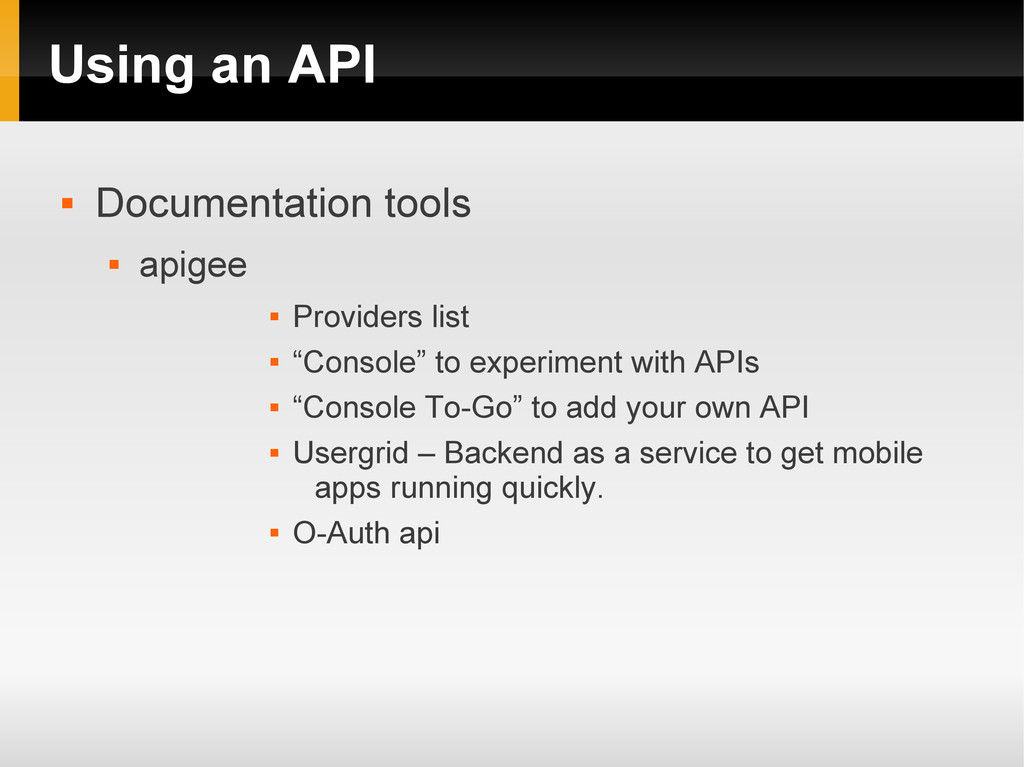
Using an API Documentation tools apigee Providers
list “Console” to experiment with APIs “Console To-Go” to add your own API Usergrid – Backend as a service to get mobile apps running quickly. O-Auth api -
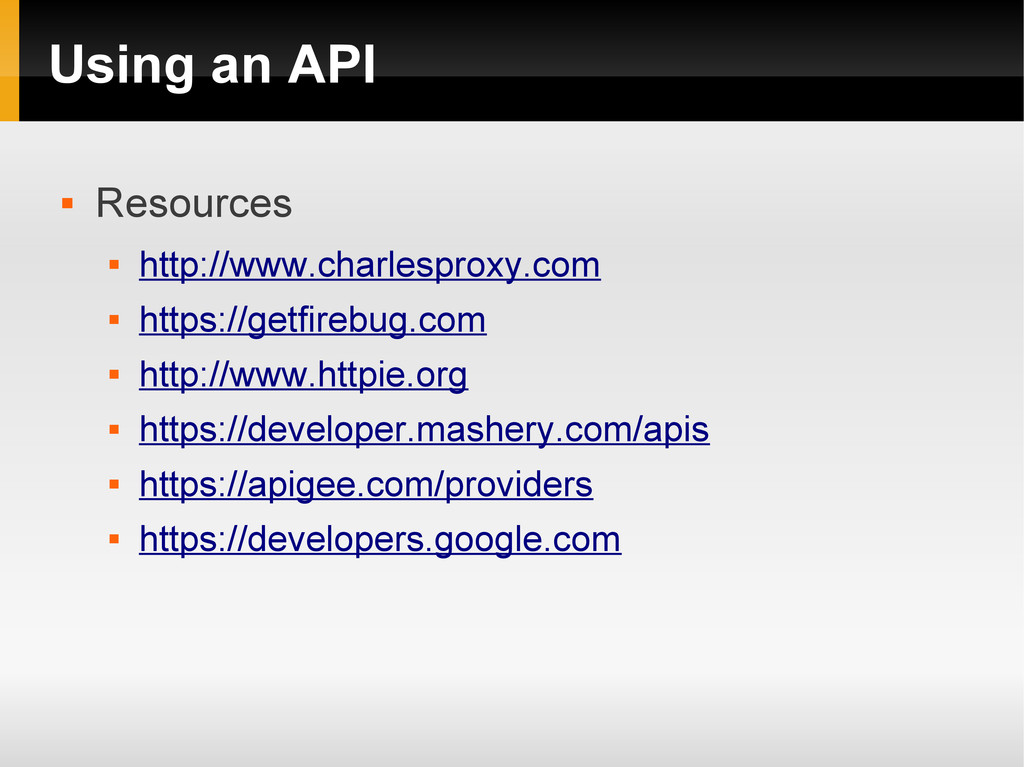
Using an API Resources http://www.charlesproxy.com https://getfirebug.com
http://www.httpie.org https://developer.mashery.com/apis https://apigee.com/providers https://developers.google.com -
Using an API Thank You Adam Culp @adamculp http://geekyboy.com
Please rate this talk at: http://joind.in/6739