Share
Embed
Real-time message handling and notifications with API Platform and Symfony
To meet the current demands for responsiveness and scalability in web applications and APIs, we will explore how to build a modern architecture for message handling using API Platform, Symfony Messenger and Mercure. Our goal is to establish a robust workflow that enables message processing and real time user notifications.
We will demonstrate how to orchestrate these technologies to deliver a seamless and immediate user experience, while ensuring high availability and optimal performance. This talk will give you a good foundation to address some of today’s performance and responsiveness requirements.
a_guilhem
September 25, 2024
Transcript
47 slides
-
SEPTEMBER 19 -20, 2024 - LILLE, FRANCE & ONLINE Real-time
message handling and notifications with API Platform and Symfony -
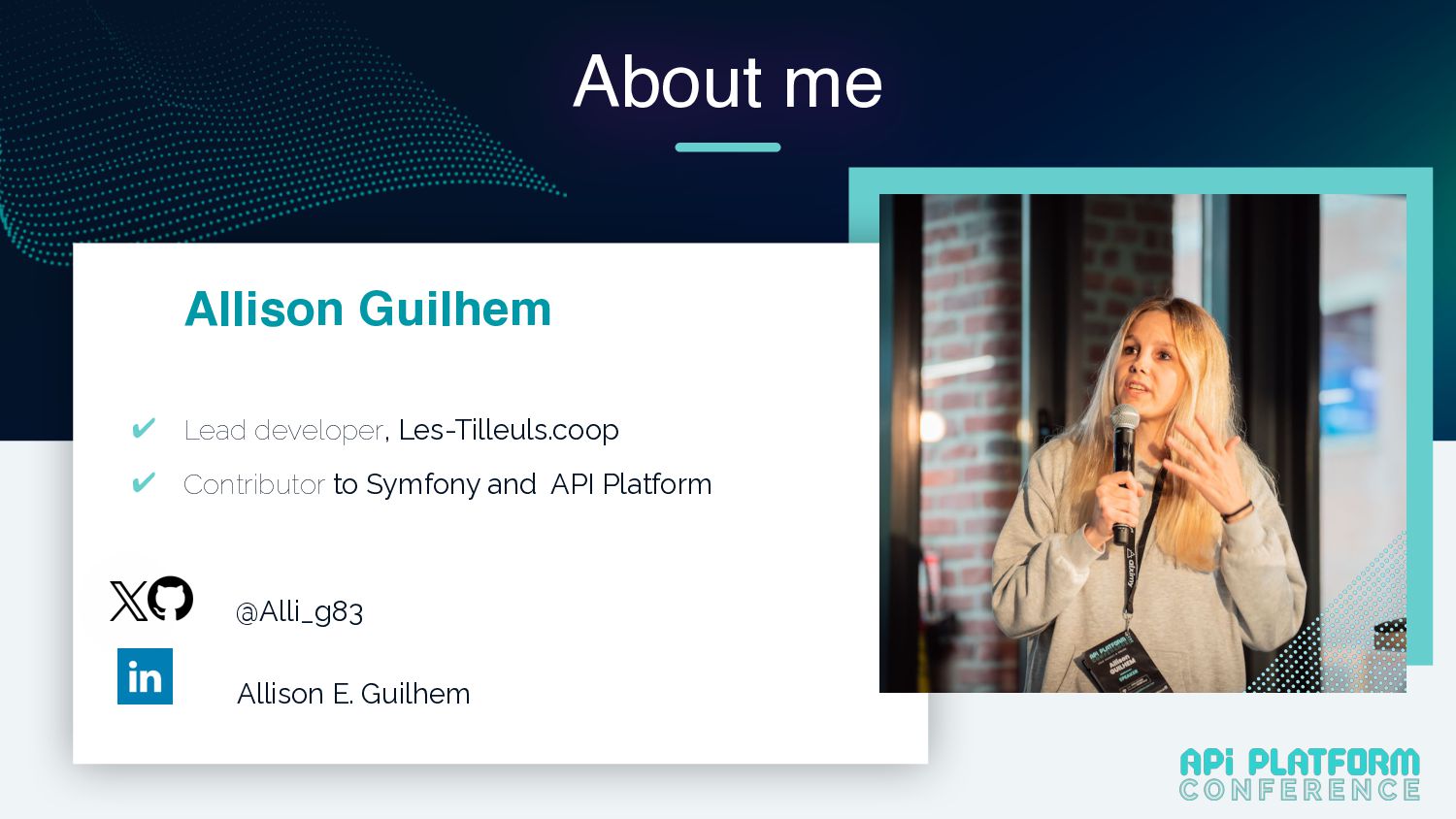
About me Allison Guilhem ✔ Lead developer, Les-Tilleuls.coop ✔ Contributor
to Symfony and API Platform @Alli_g83 Allison E. Guilhem -
Real time notifications with Mercure via a use case scenario
01 02 Real time notifications: techniques and protocols -
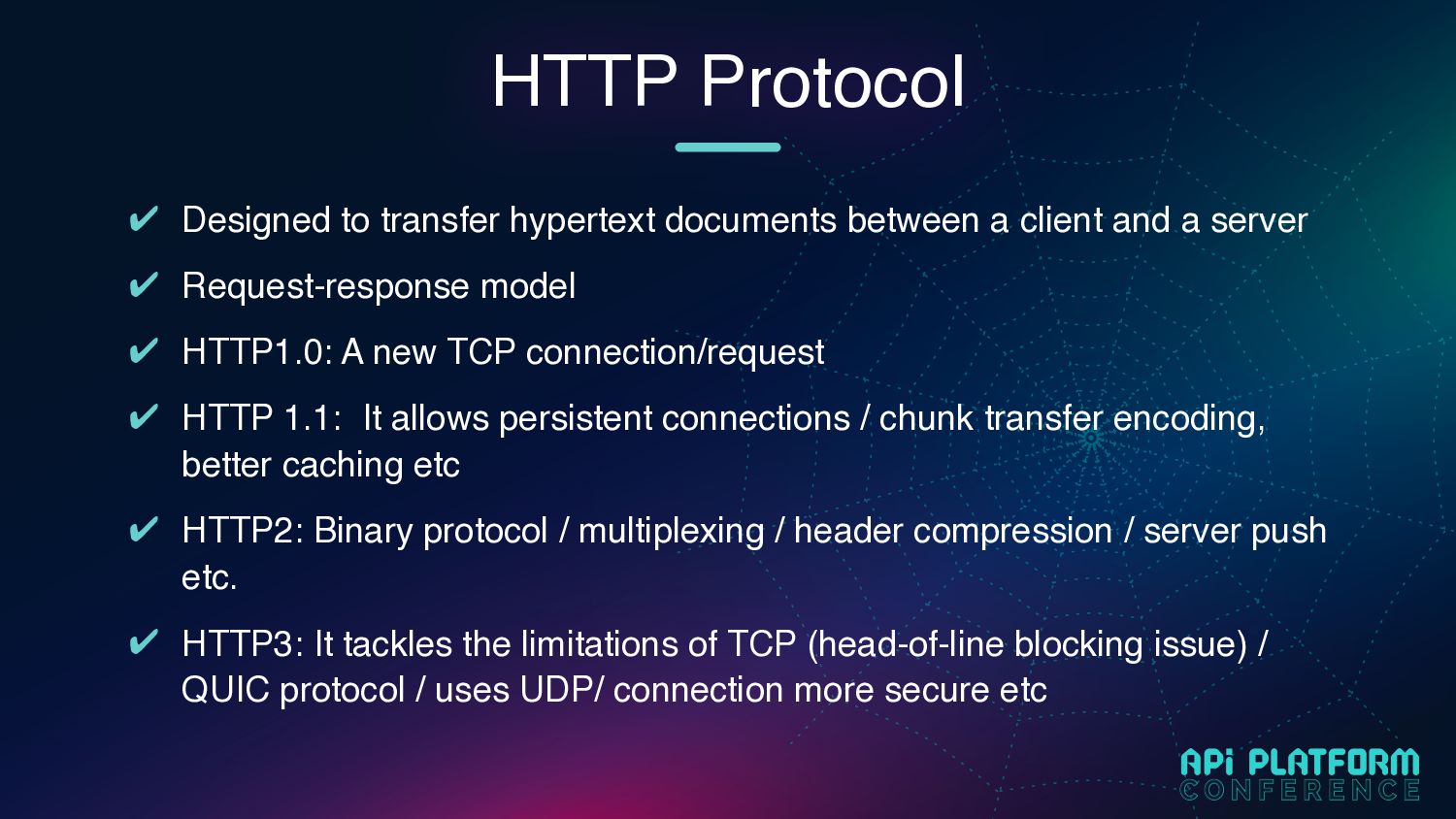
HTTP Protocol ✔ Designed to transfer hypertext documents between a
client and a server ✔ Request-response model ✔ HTTP1.0: A new TCP connection/request ✔ HTTP 1.1: It allows persistent connections / chunk transfer encoding, better caching etc ✔ HTTP2: Binary protocol / multiplexing / header compression / server push etc. ✔ HTTP3: It tackles the limitations of TCP (head-of-line blocking issue) / QUIC protocol / uses UDP/ connection more secure etc -
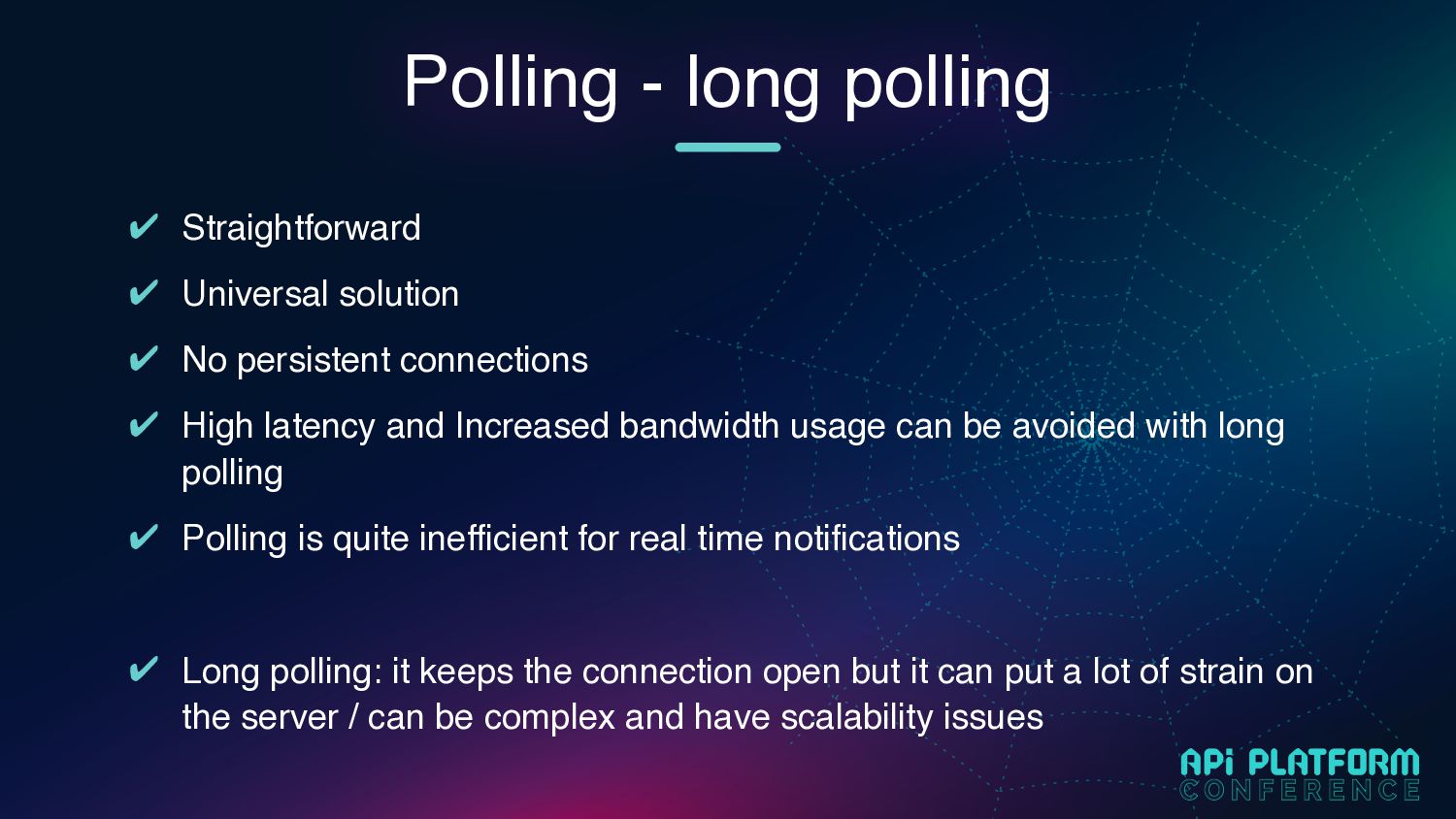
Polling - long polling ✔ Straightforward ✔ Universal solution ✔
No persistent connections ✔ High latency and Increased bandwidth usage can be avoided with long polling ✔ Polling is quite inefficient for real time notifications ✔ Long polling: it keeps the connection open but it can put a lot of strain on the server / can be complex and have scalability issues -
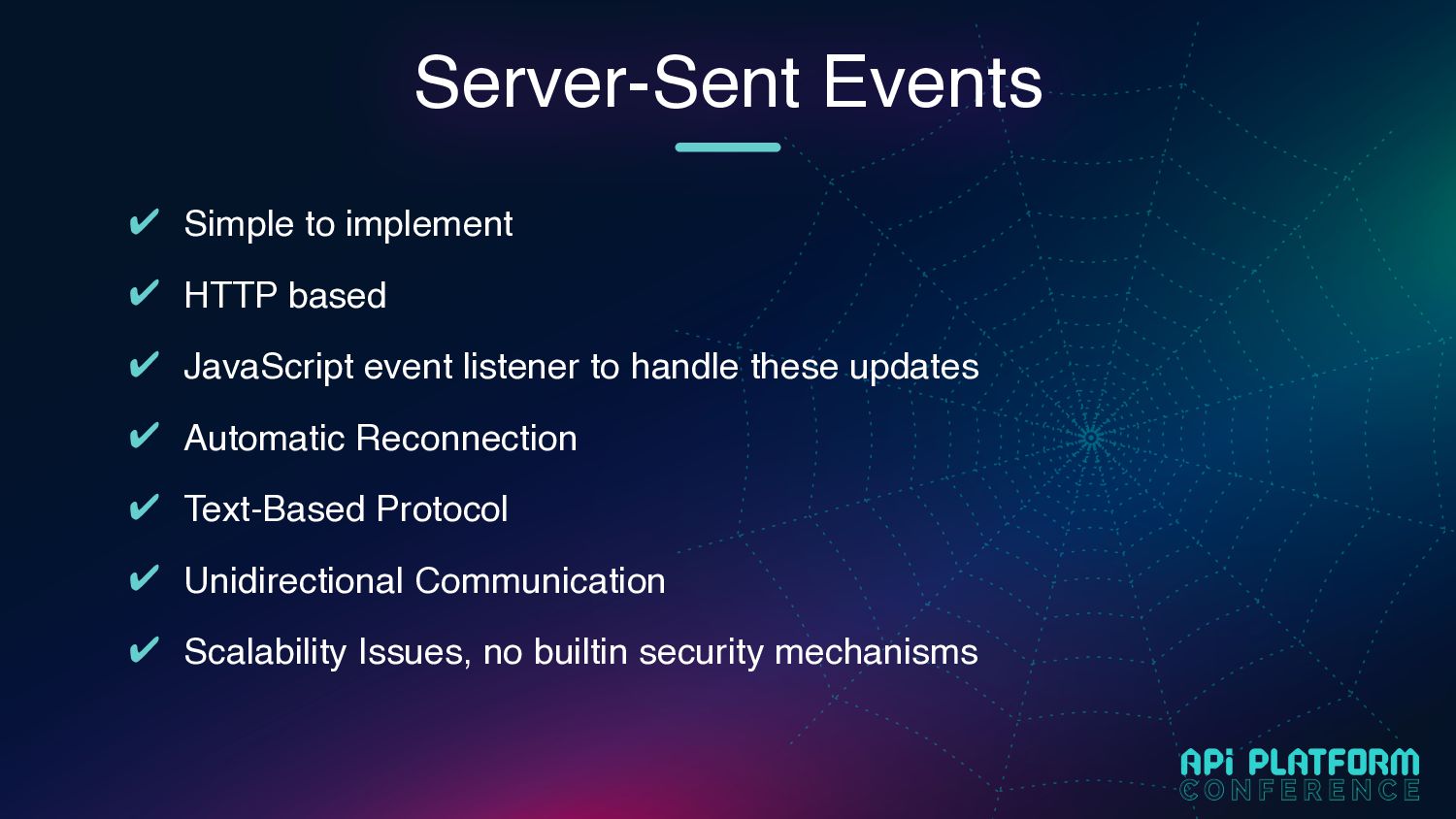
Server-Sent Events ✔ Simple to implement ✔ HTTP based ✔
JavaScript event listener to handle these updates ✔ Automatic Reconnection ✔ Text-Based Protocol ✔ Unidirectional Communication ✔ Scalability Issues, no builtin security mechanisms -
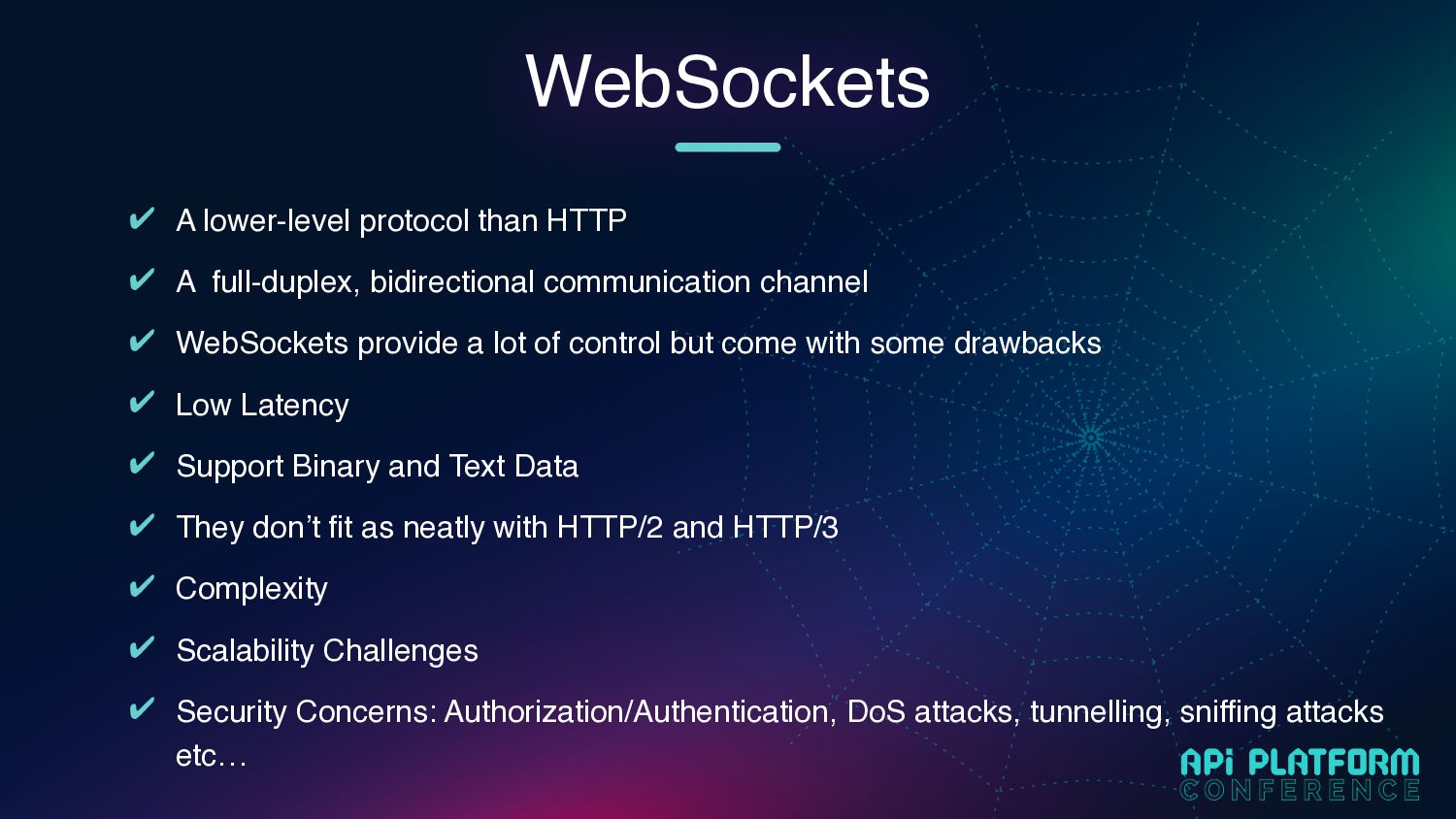
WebSockets ✔ A lower-level protocol than HTTP ✔ A full-duplex,
bidirectional communication channel ✔ WebSockets provide a lot of control but come with some drawbacks ✔ Low Latency ✔ Support Binary and Text Data ✔ They don’t fit as neatly with HTTP/2 and HTTP/3 ✔ Complexity ✔ Scalability Challenges ✔ Security Concerns: Authorization/Authentication, DoS attacks, tunnelling, sniffing attacks etc… -
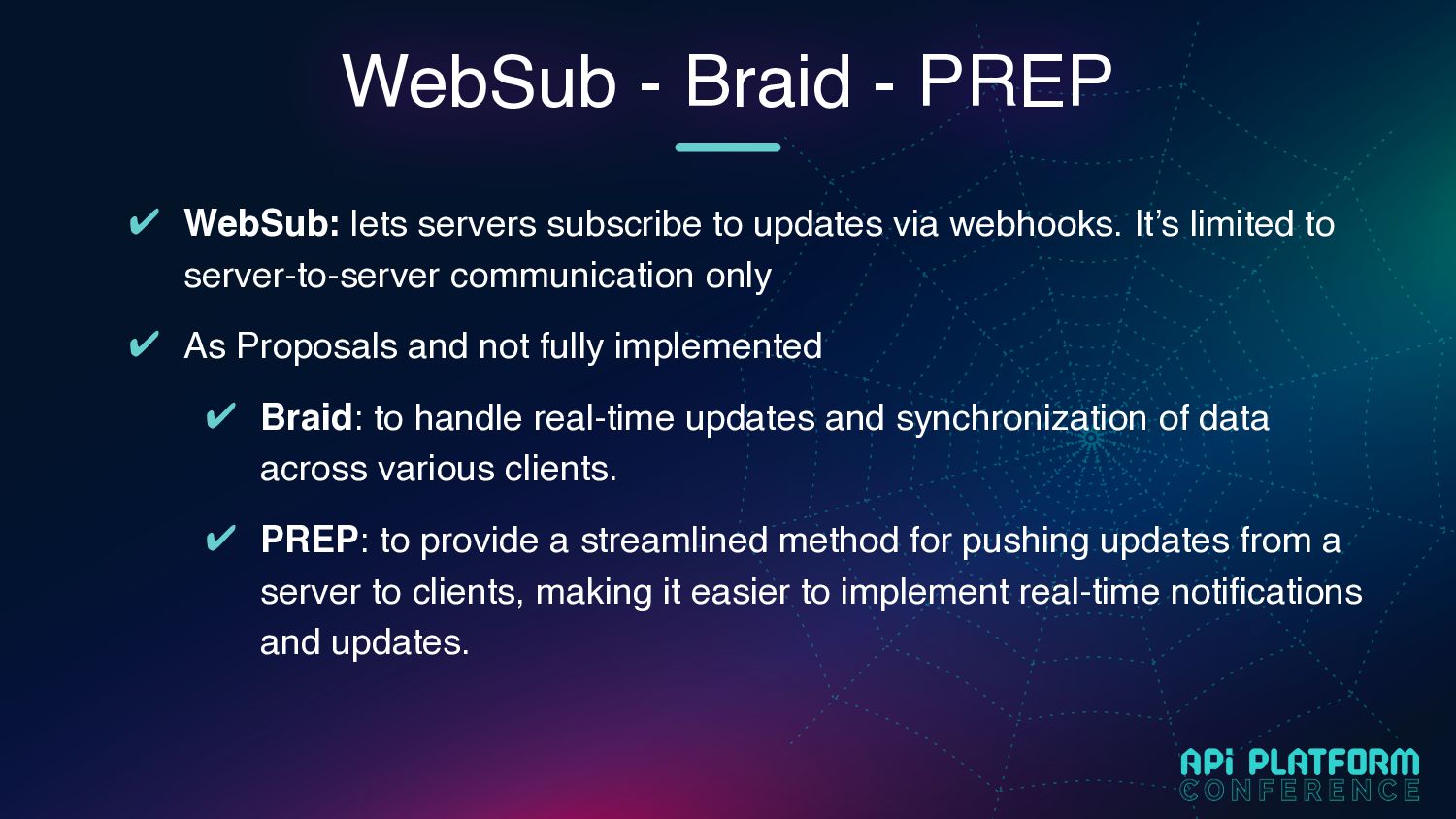
WebSub - Braid - PREP ✔ WebSub: lets servers subscribe
to updates via webhooks. It’s limited to server-to-server communication only ✔ As Proposals and not fully implemented ✔ Braid: to handle real-time updates and synchronization of data across various clients. ✔ PREP: to provide a streamlined method for pushing updates from a server to clients, making it easier to implement real-time notifications and updates. -
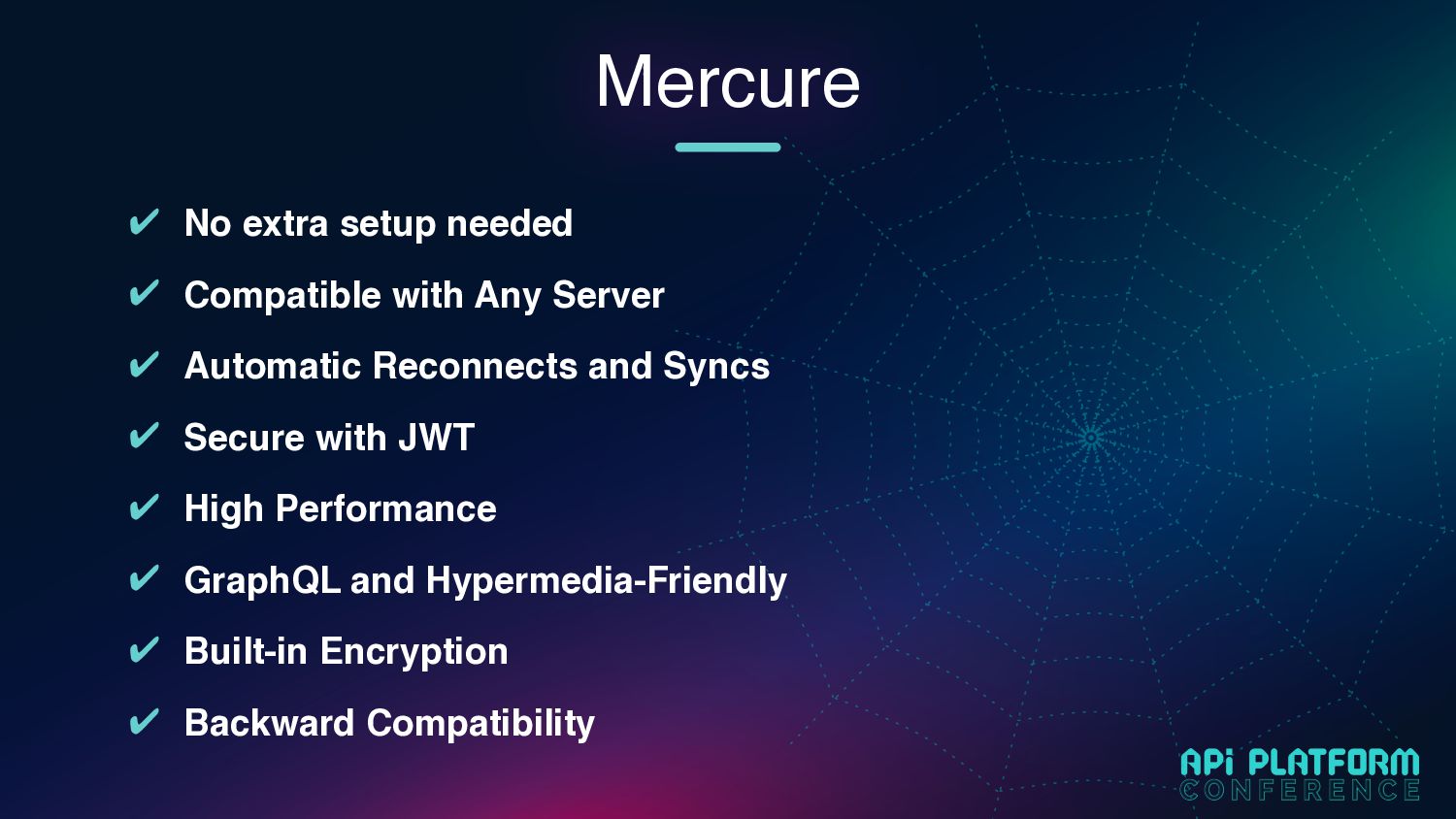
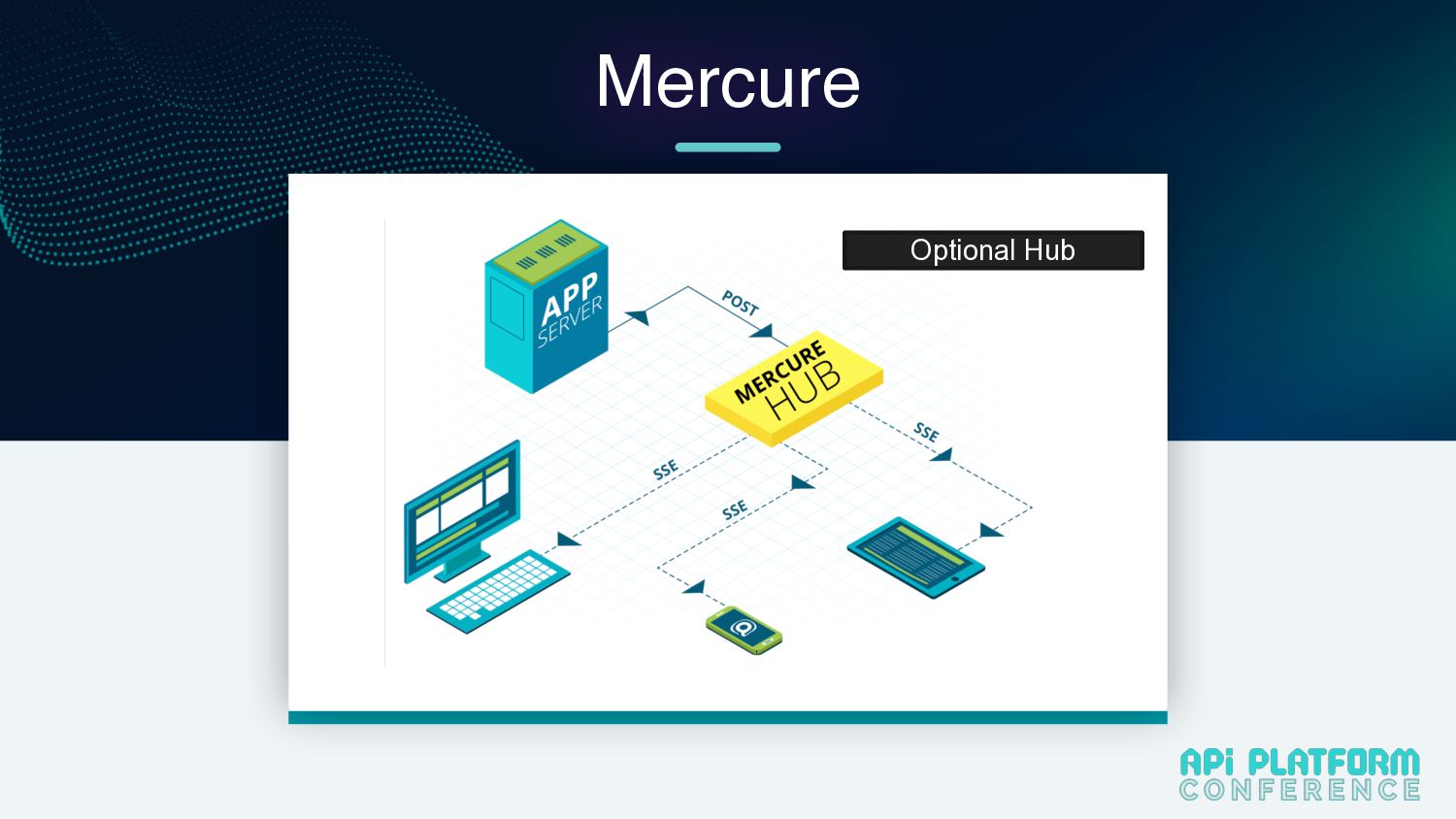
Mercure ✔ No extra setup needed ✔ Compatible with Any
Server ✔ Automatic Reconnects and Syncs ✔ Secure with JWT ✔ High Performance ✔ GraphQL and Hypermedia-Friendly ✔ Built-in Encryption ✔ Backward Compatibility -
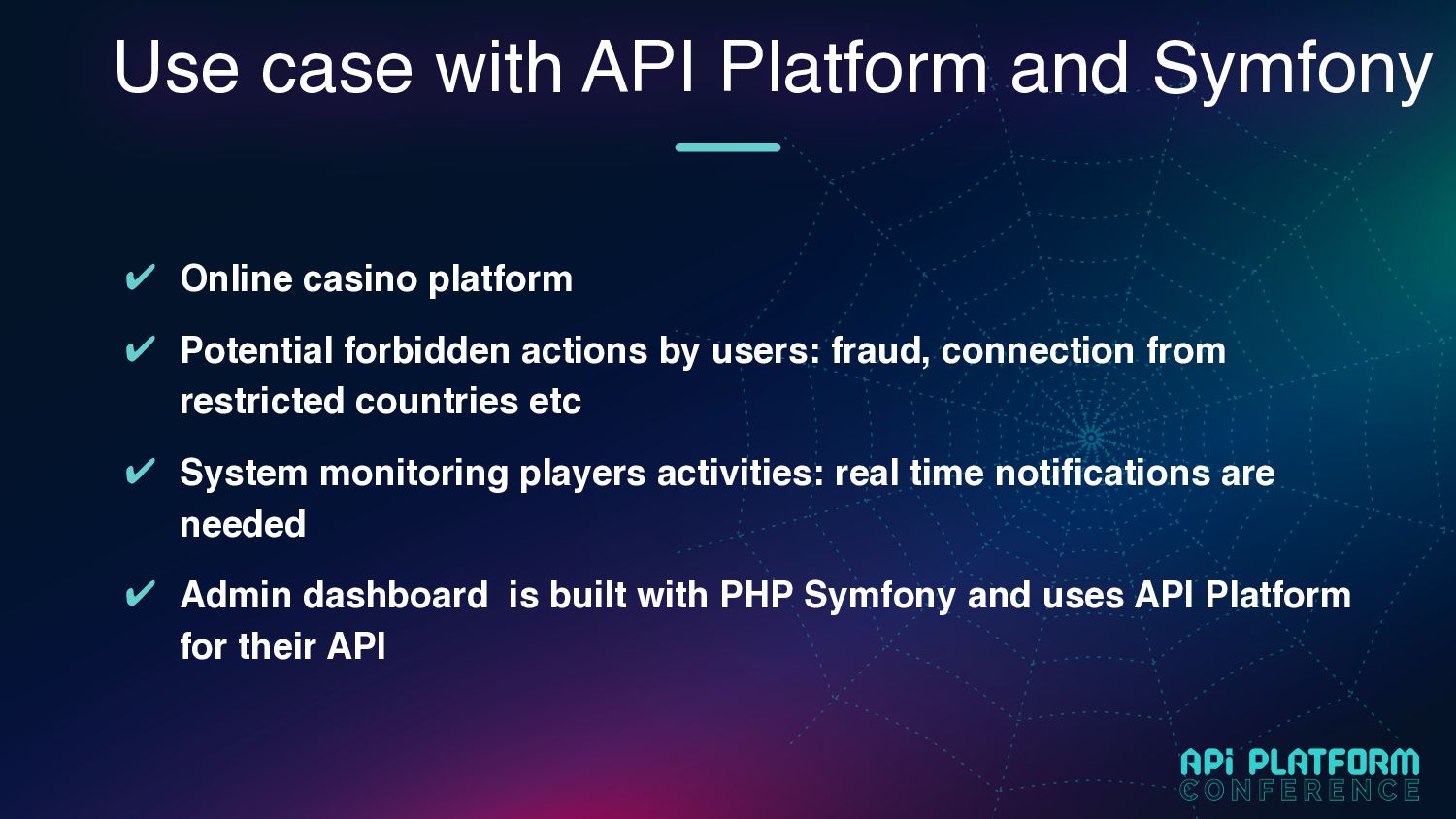
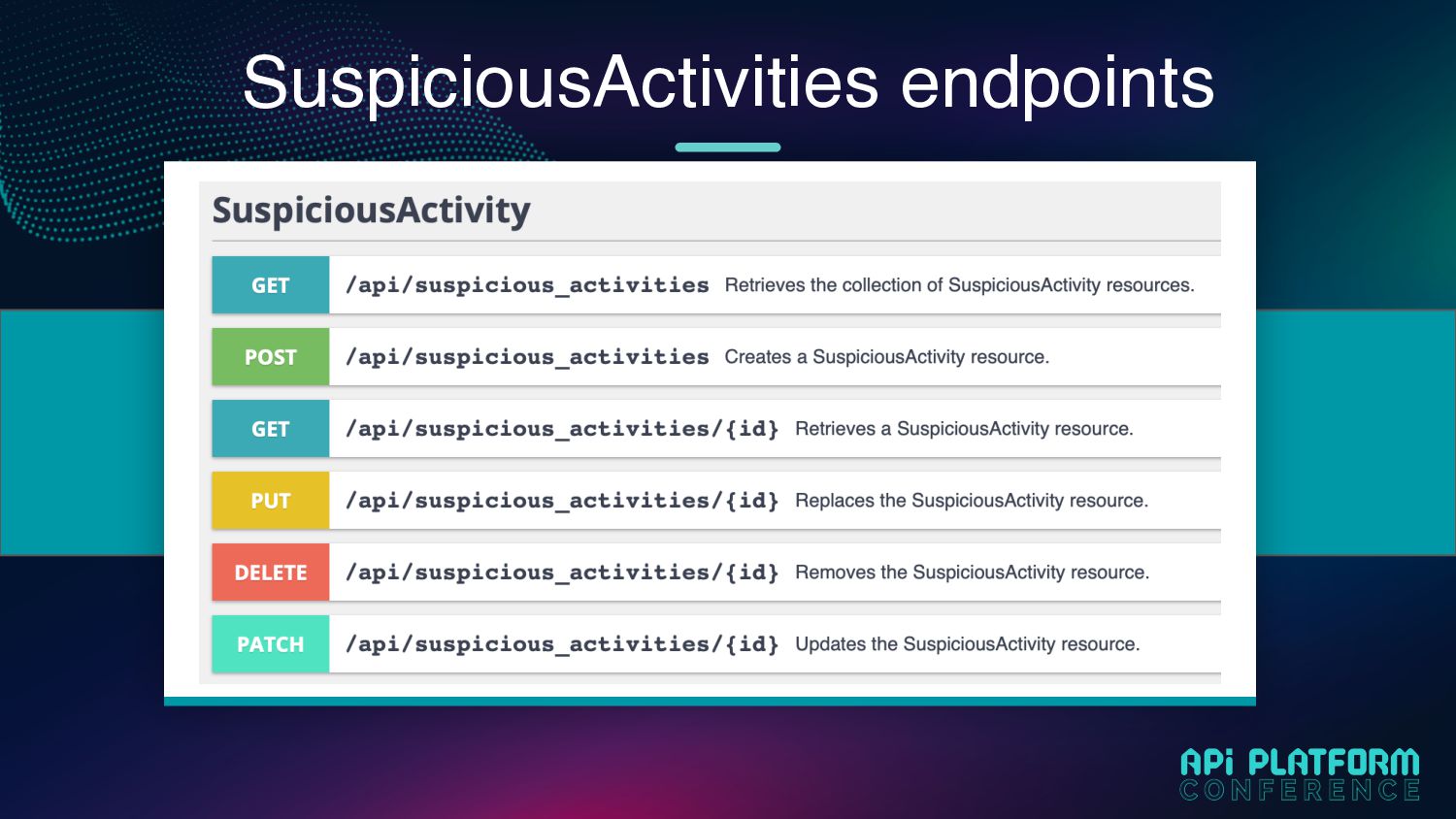
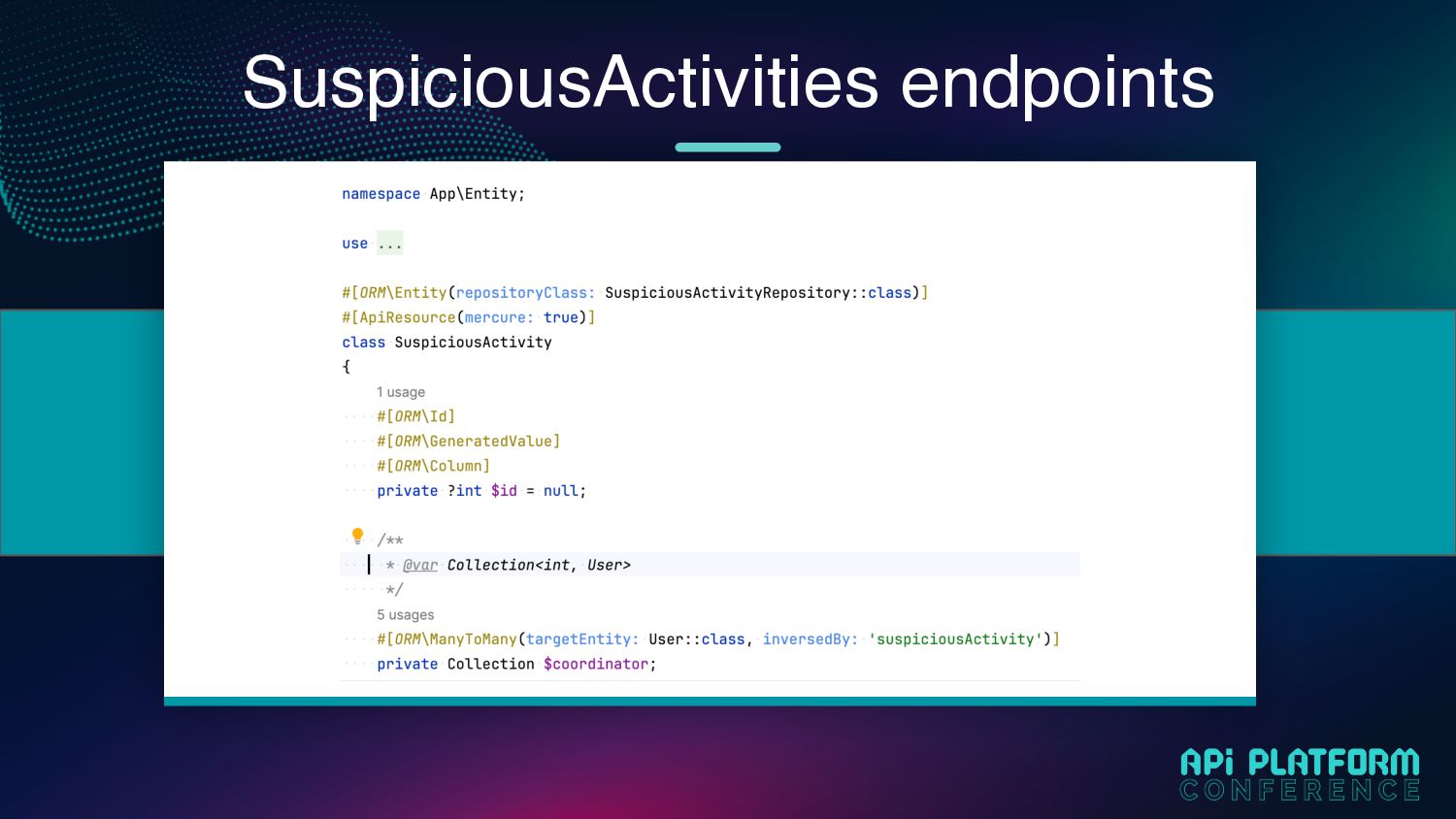
Use case with API Platform and Symfony ✔ Online casino
platform ✔ Potential forbidden actions by users: fraud, connection from restricted countries etc ✔ System monitoring players activities: real time notifications are needed ✔ Admin dashboard is built with PHP Symfony and uses API Platform for their API -
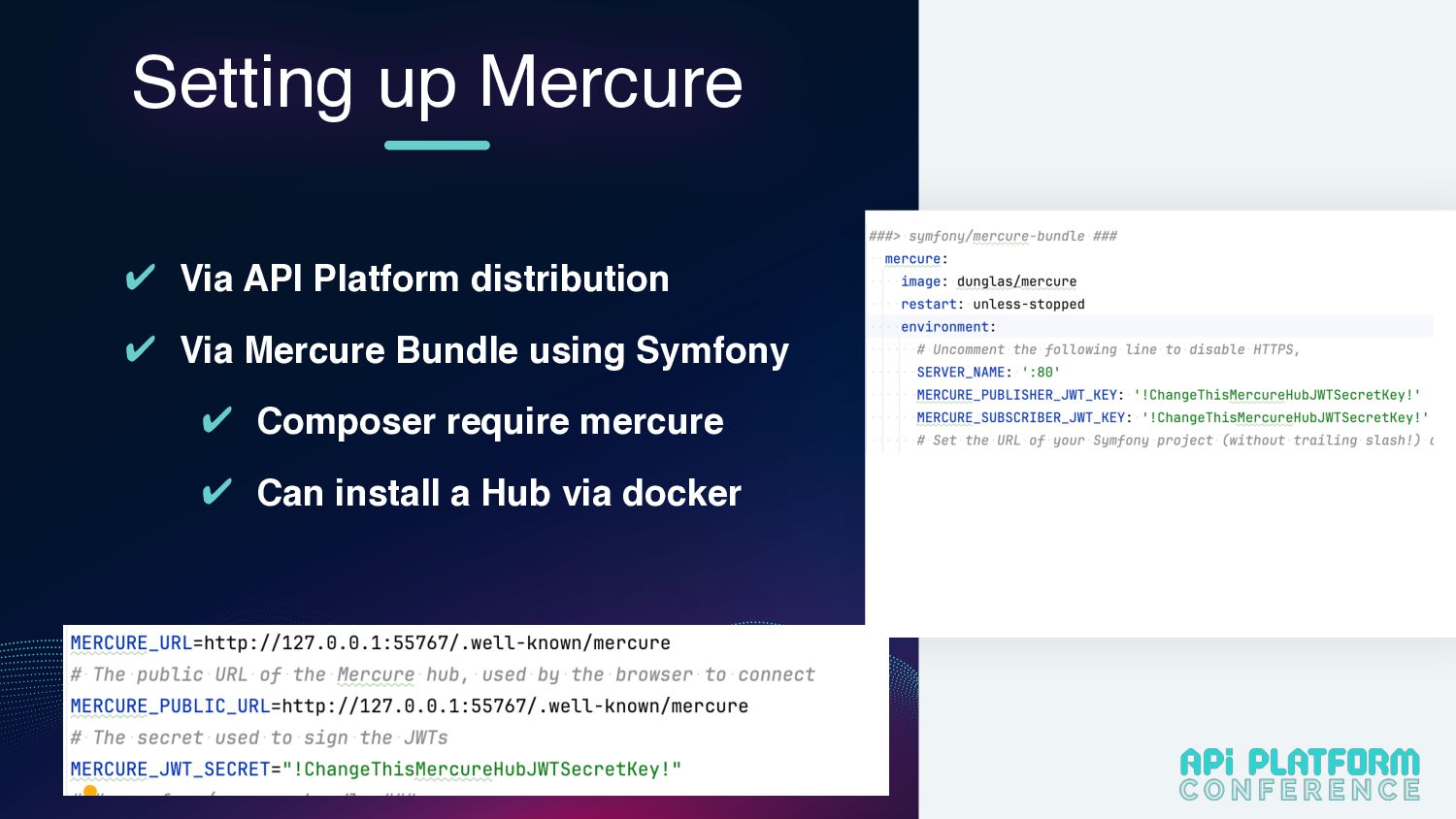
Setting up Mercure ✔ Via API Platform distribution ✔ Via
Mercure Bundle using Symfony ✔ Composer require mercure ✔ Can install a Hub via docker -
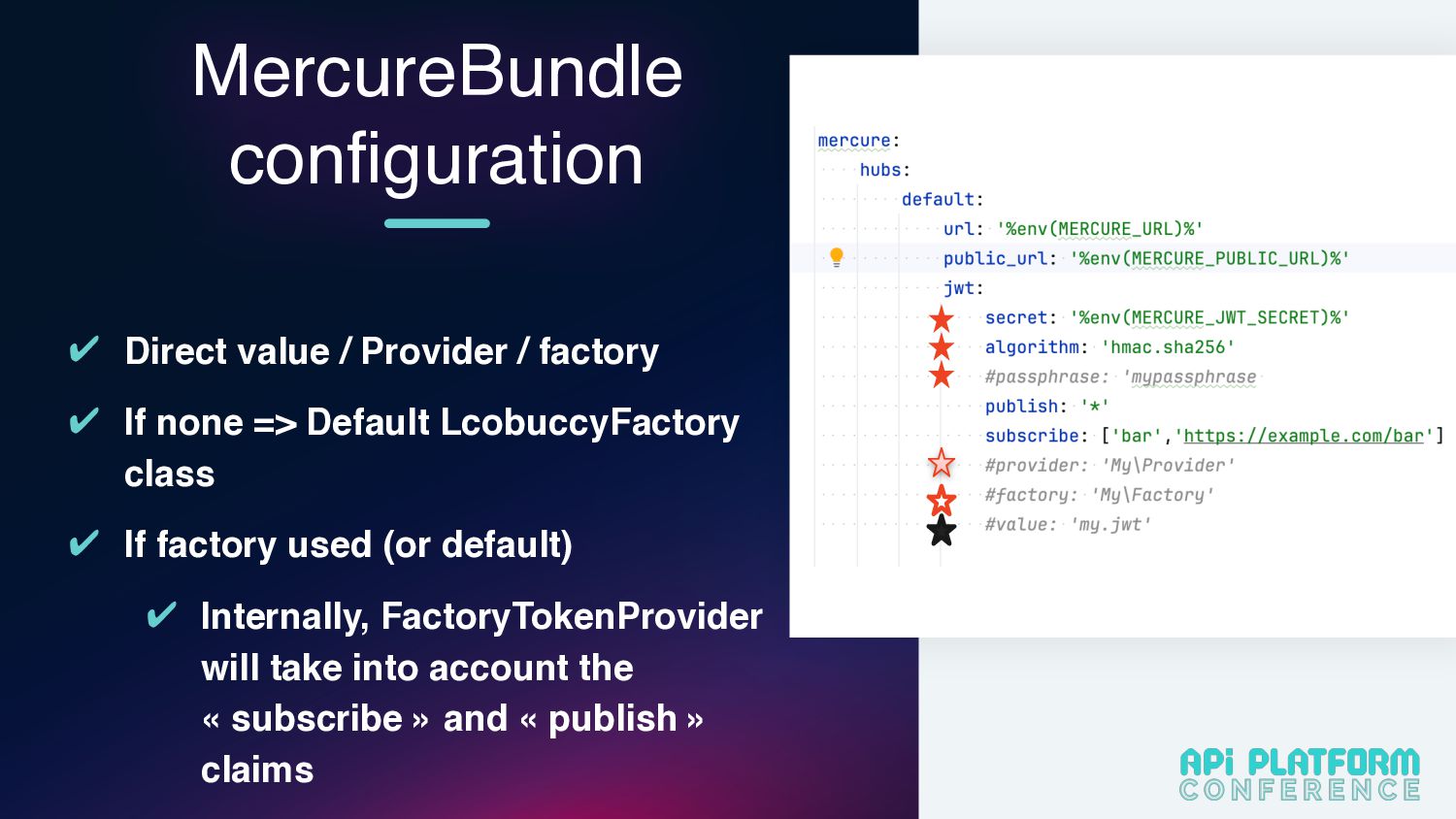
MercureBundle configuration ✔ Direct value / Provider / factory ✔
If none => Default LcobuccyFactory class ✔ If factory used (or default) ✔ Internally, FactoryTokenProvider will take into account the « subscribe » and « publish » claims -
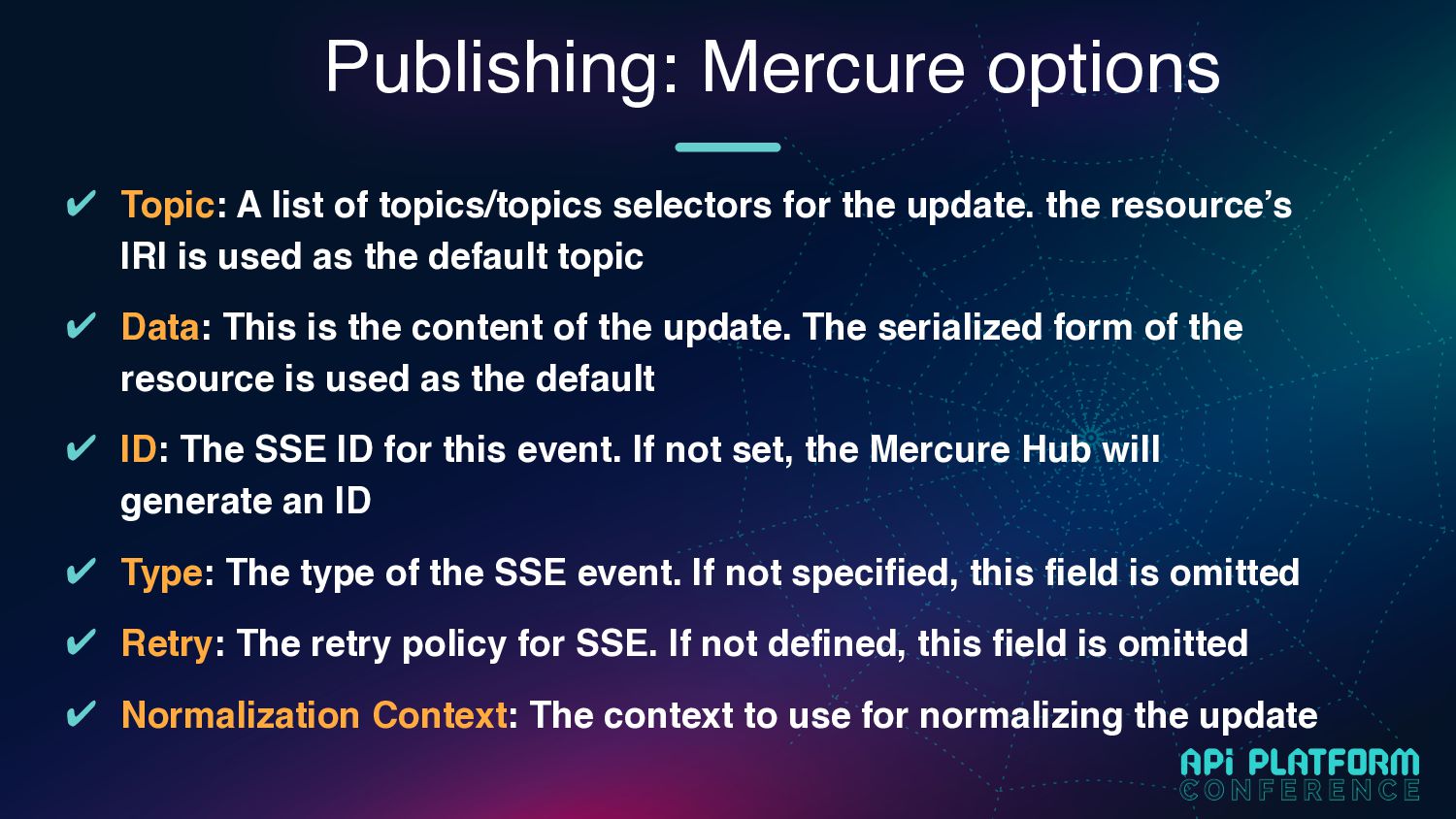
Publishing: Mercure options ✔ Topic: A list of topics/topics selectors
for the update. the resource’s IRI is used as the default topic ✔ Data: This is the content of the update. The serialized form of the resource is used as the default ✔ ID: The SSE ID for this event. If not set, the Mercure Hub will generate an ID ✔ Type: The type of the SSE event. If not specified, this field is omitted ✔ Retry: The retry policy for SSE. If not defined, this field is omitted ✔ Normalization Context: The context to use for normalizing the update -
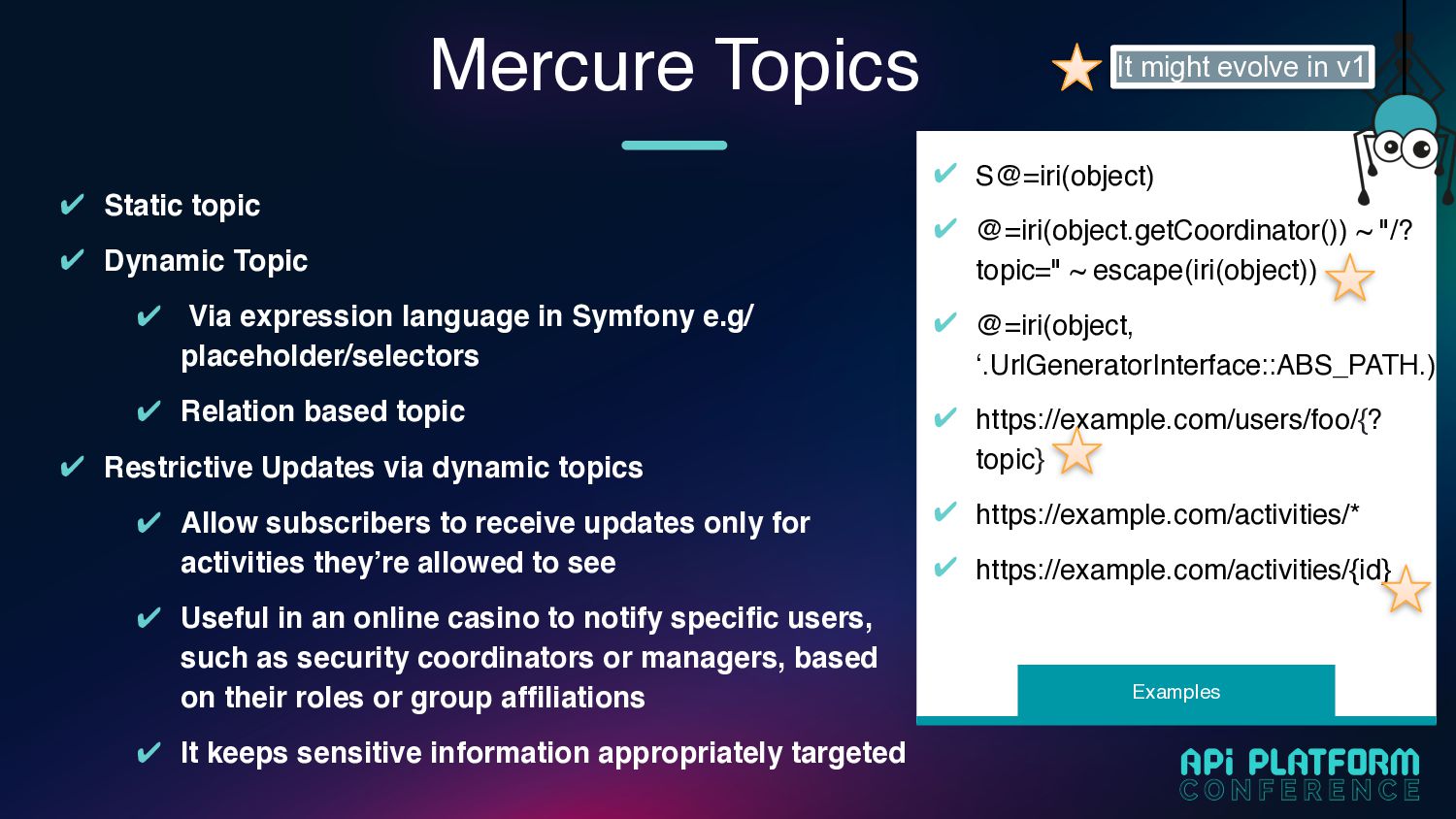
Mercure Topics ✔ Static topic ✔ Dynamic Topic ✔ Via
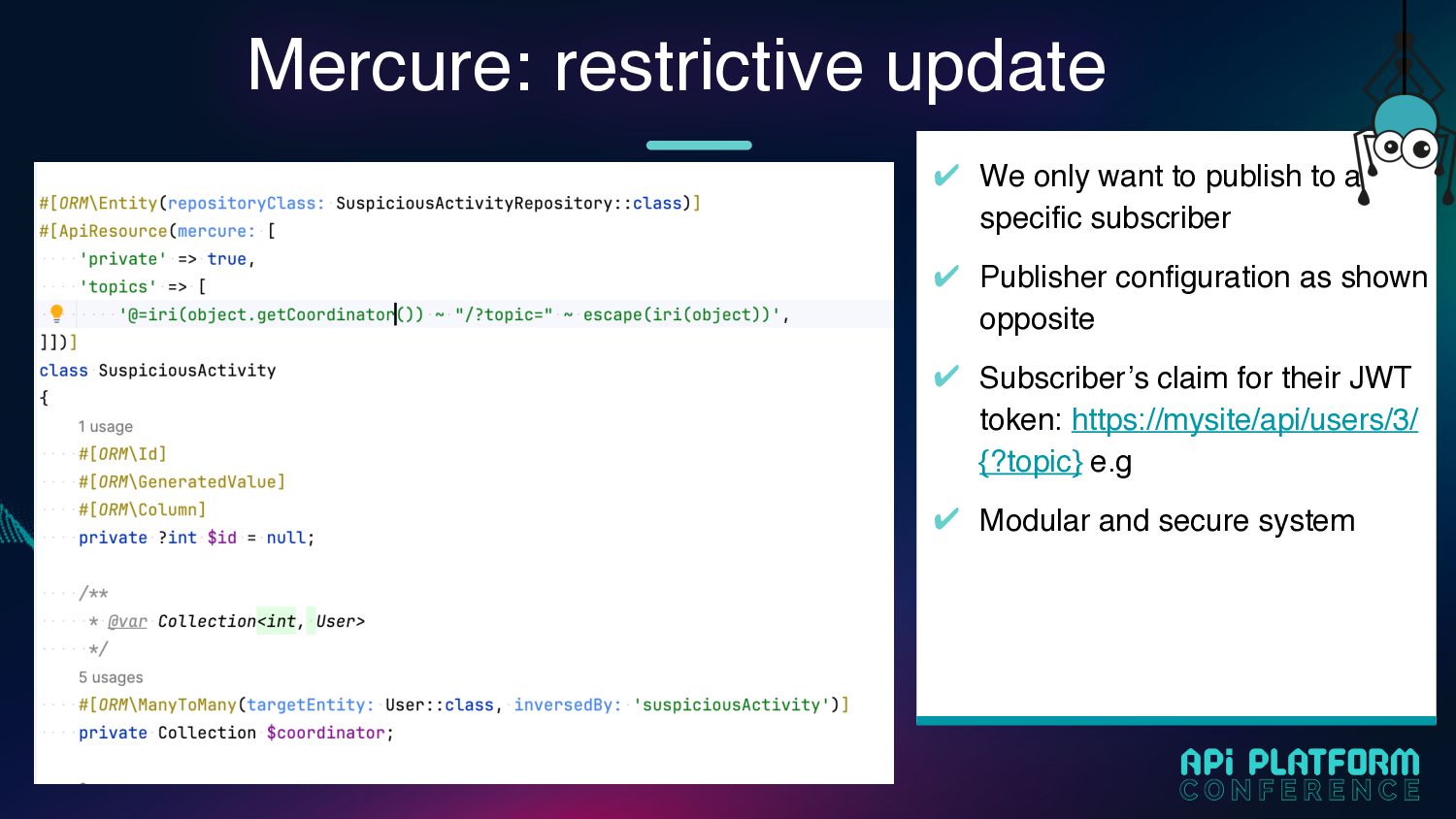
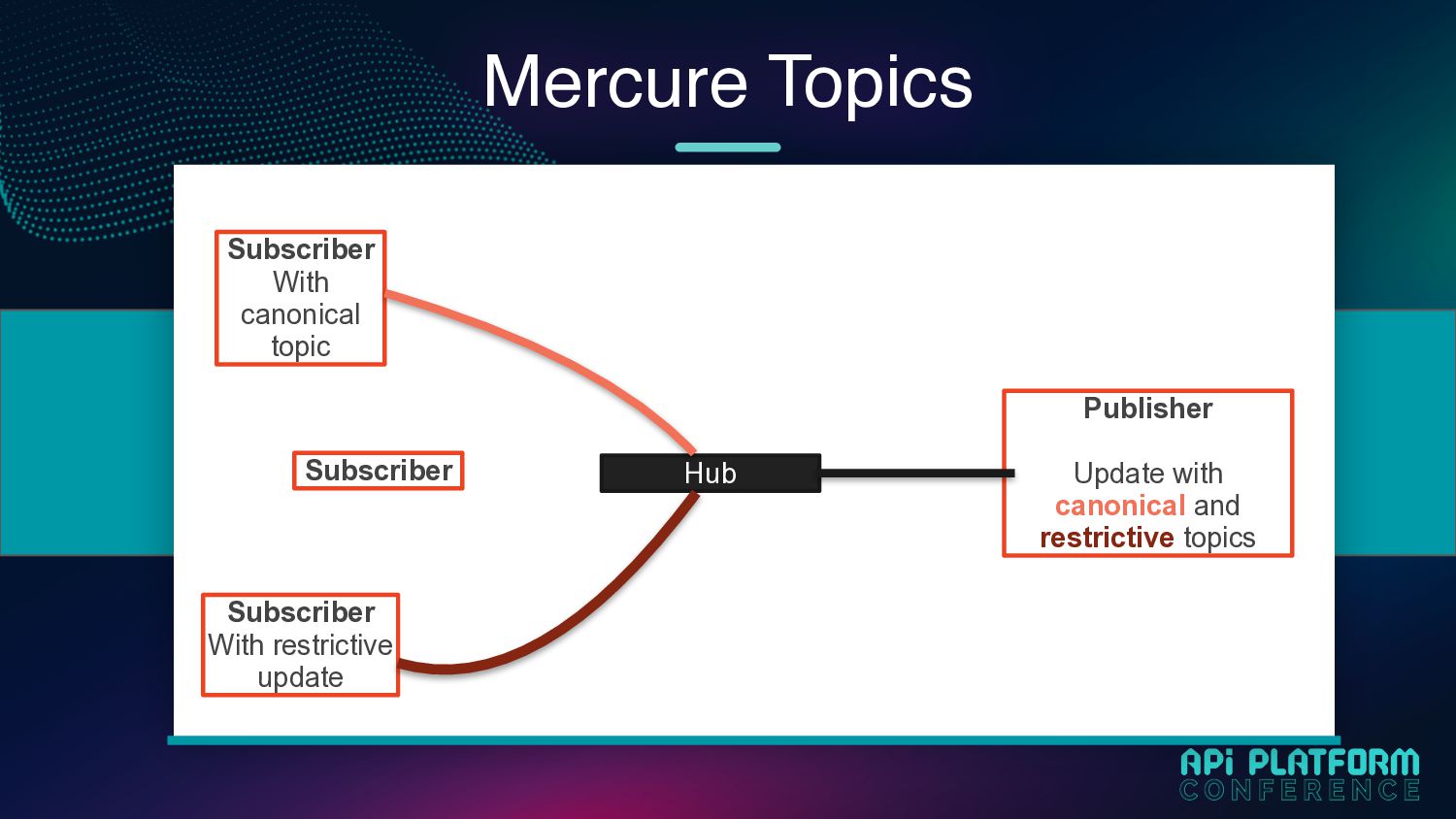
expression language in Symfony e.g/ placeholder/selectors ✔ Relation based topic ✔ Restrictive Updates via dynamic topics ✔ Allow subscribers to receive updates only for activities they’re allowed to see ✔ Useful in an online casino to notify specific users, such as security coordinators or managers, based on their roles or group affiliations ✔ It keeps sensitive information appropriately targeted ✔ S@=iri(object) ✔ @=iri(object.getCoordinator()) ~ "/? topic=" ~ escape(iri(object)) ✔ @=iri(object, ‘.UrlGeneratorInterface::ABS_PATH.) ✔ https://example.com/users/foo/{? topic} ✔ https://example.com/activities/* ✔ https://example.com/activities/{id} Examples It might evolve in v1 -
Mercure: restrictive update ✔ We only want to publish to
a specific subscriber ✔ Publisher configuration as shown opposite ✔ Subscriber’s claim for their JWT token: https://mysite/api/users/3/ {?topic} e.g ✔ Modular and secure system -
Mercure Topics Publisher Update with canonical and restrictive topics Subscriber
With canonical topic Subscriber With restrictive update Subscriber Hub -
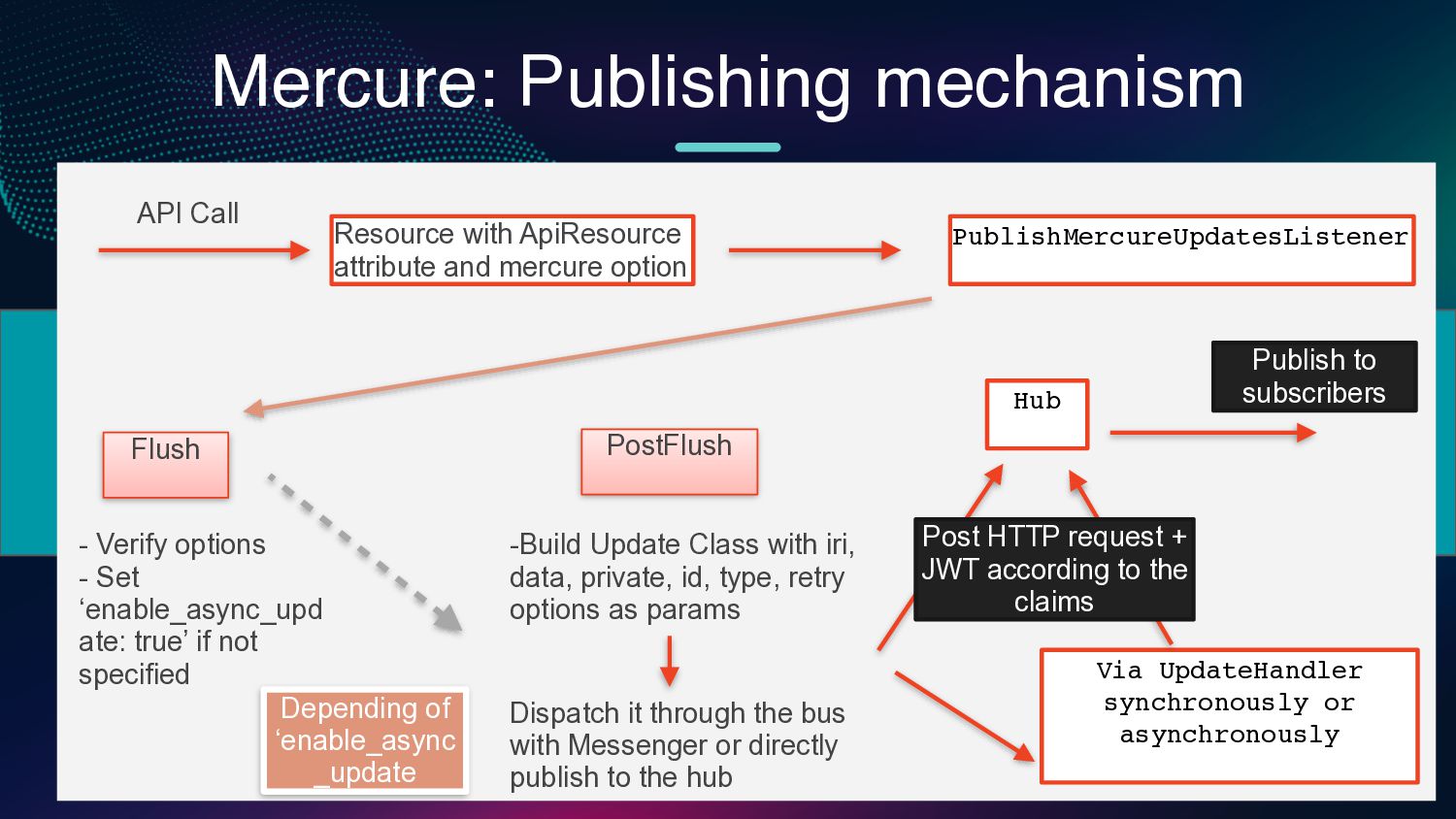
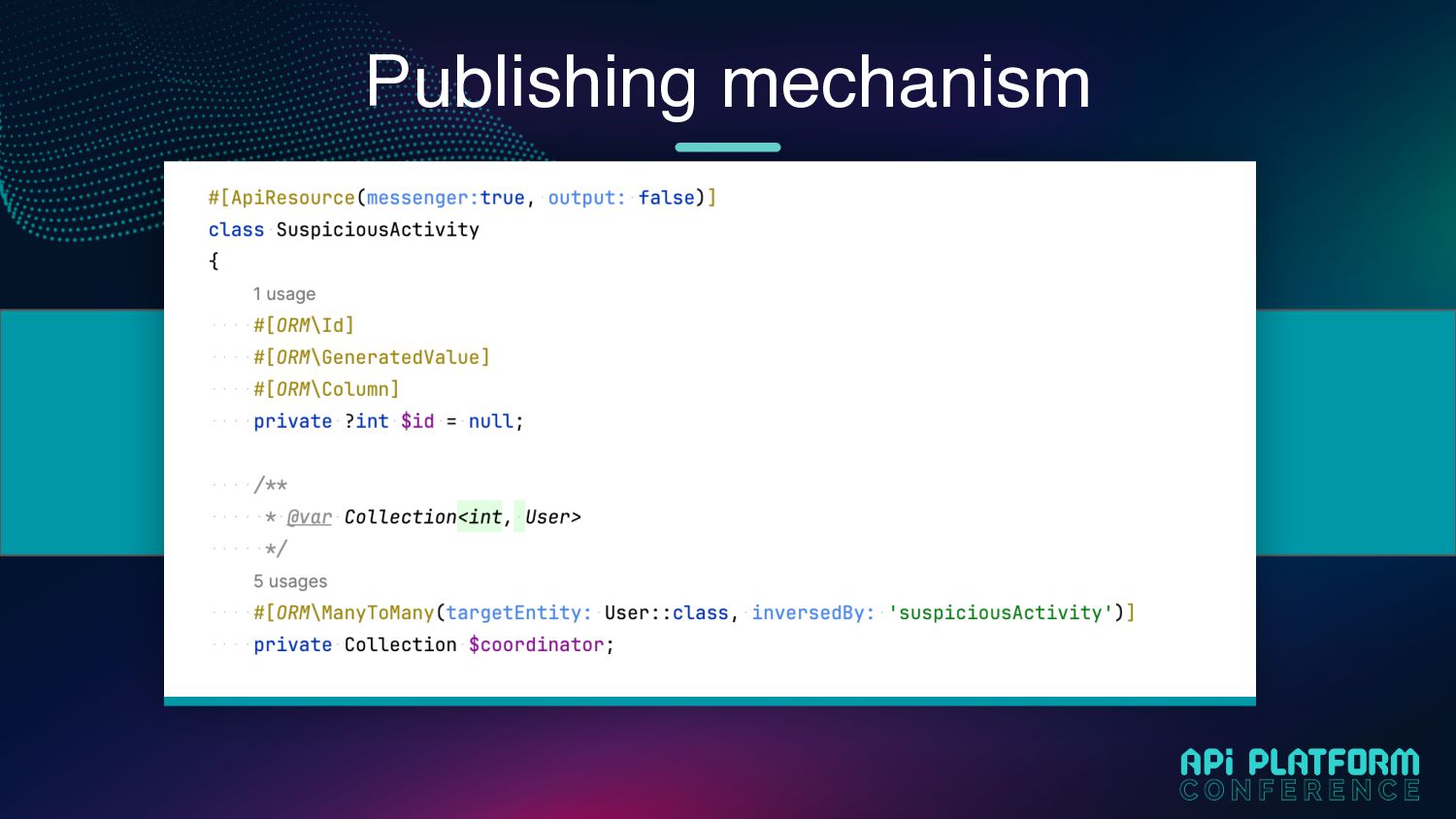
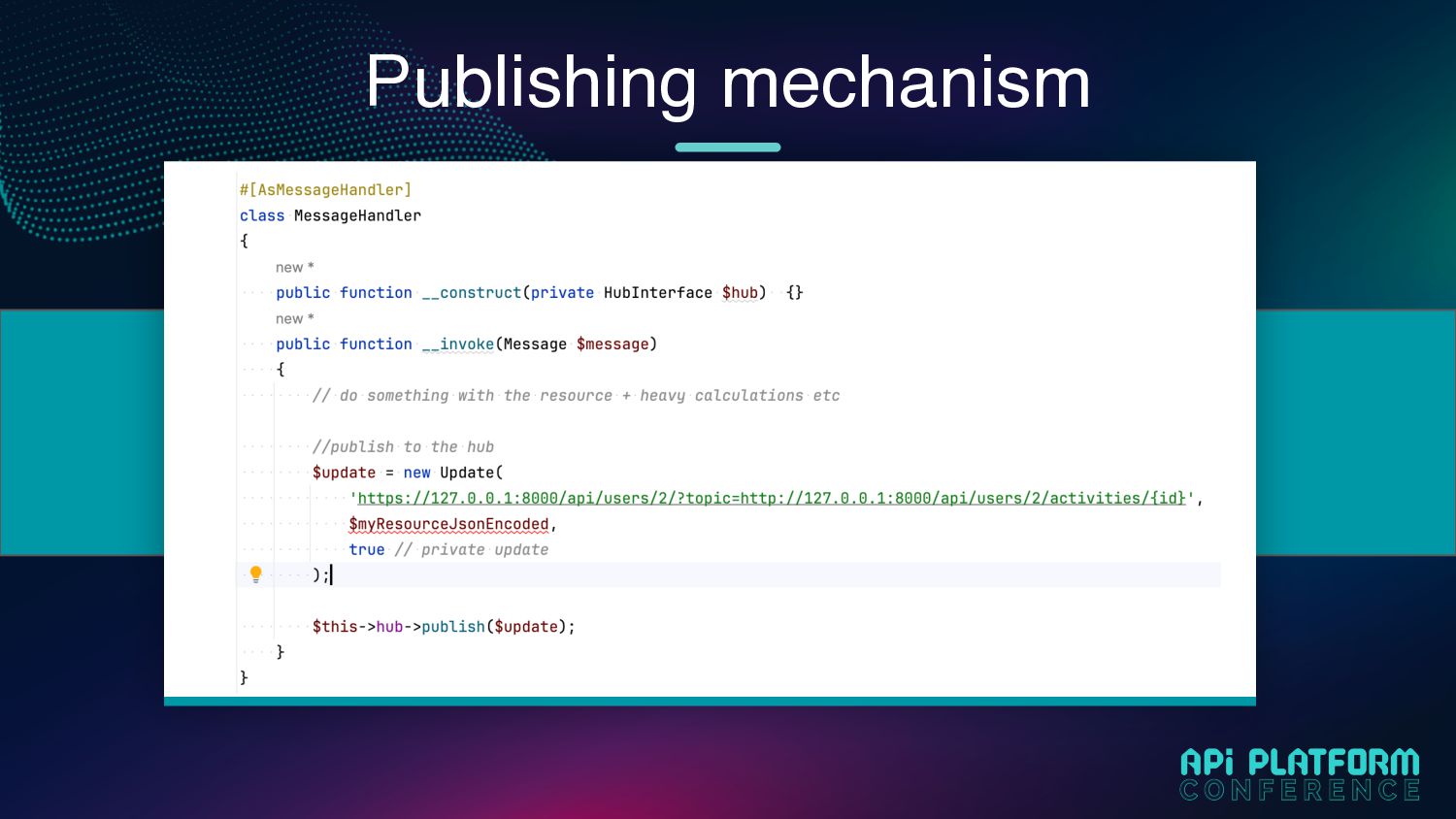
Mercure: Publishing mechanism API Call Resource with ApiResource attribute and
mercure option PublishMercureUpdatesListener Flush PostFlush - Verify options - Set ‘enable_async_upd ate: true’ if not specified -Build Update Class with iri, data, private, id, type, retry options as params Dispatch it through the bus with Messenger or directly publish to the hub Depending of ‘enable_async _update Via UpdateHandler synchronously or asynchronously Post HTTP request + JWT according to the claims Hub Publish to subscribers -
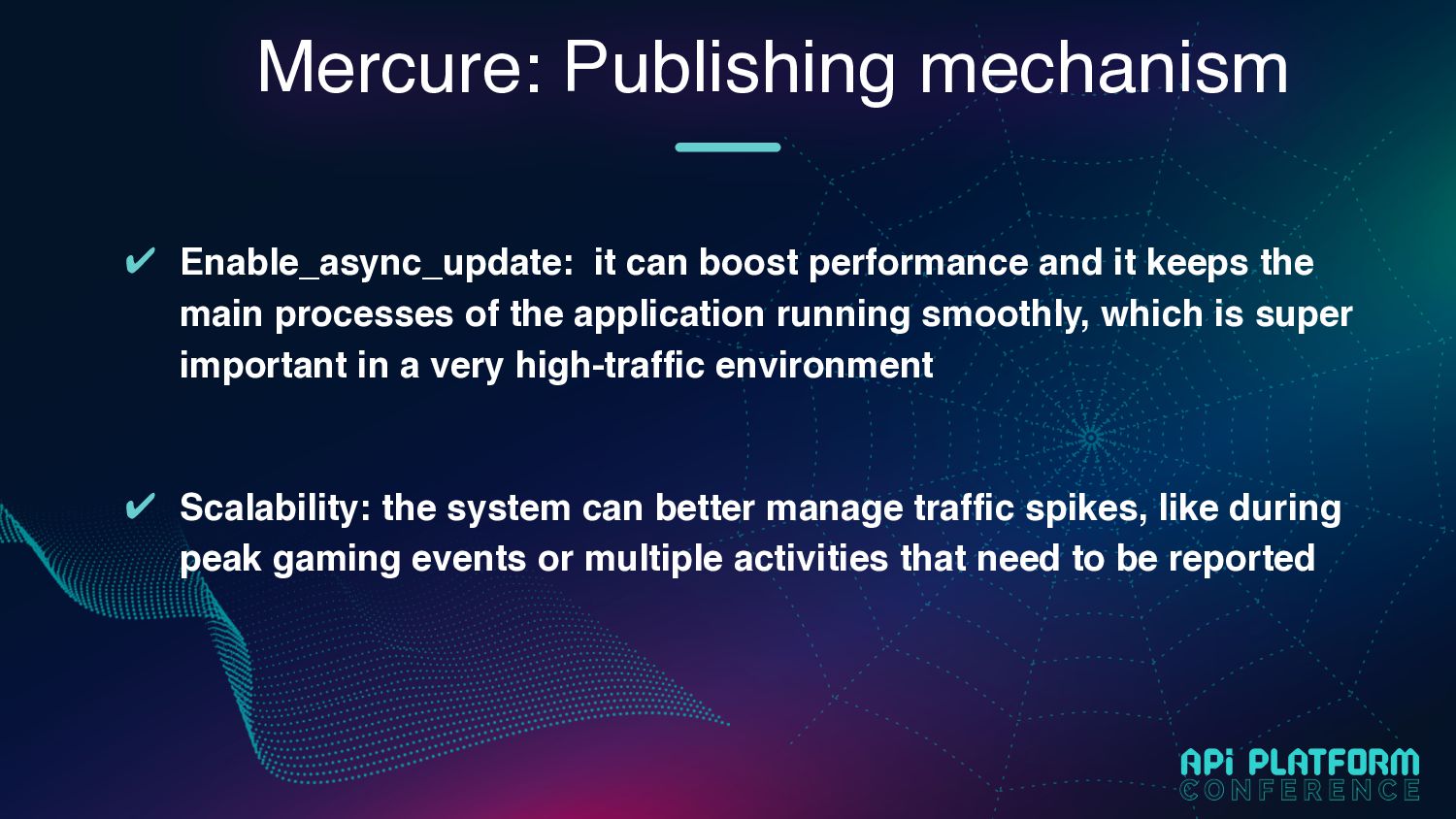
Mercure: Publishing mechanism ✔ Enable_async_update: it can boost performance and
it keeps the main processes of the application running smoothly, which is super important in a very high-traffic environment ✔ Scalability: the system can better manage traffic spikes, like during peak gaming events or multiple activities that need to be reported -
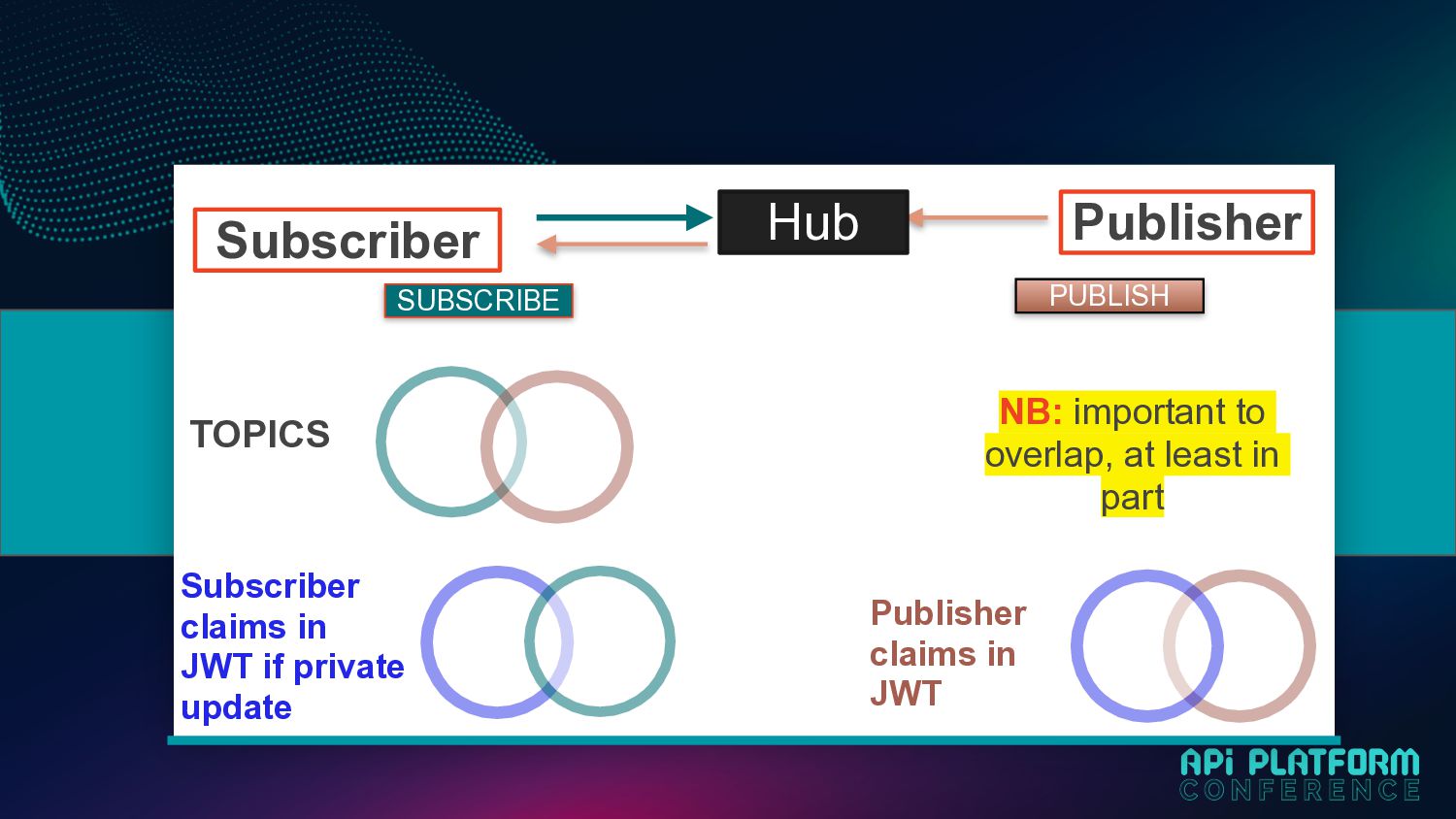
Subscriber Publisher Hub SUBSCRIBE PUBLISH TOPICS Subscriber claims in JWT
if private update Publisher claims in JWT NB: important to overlap, at least in part -
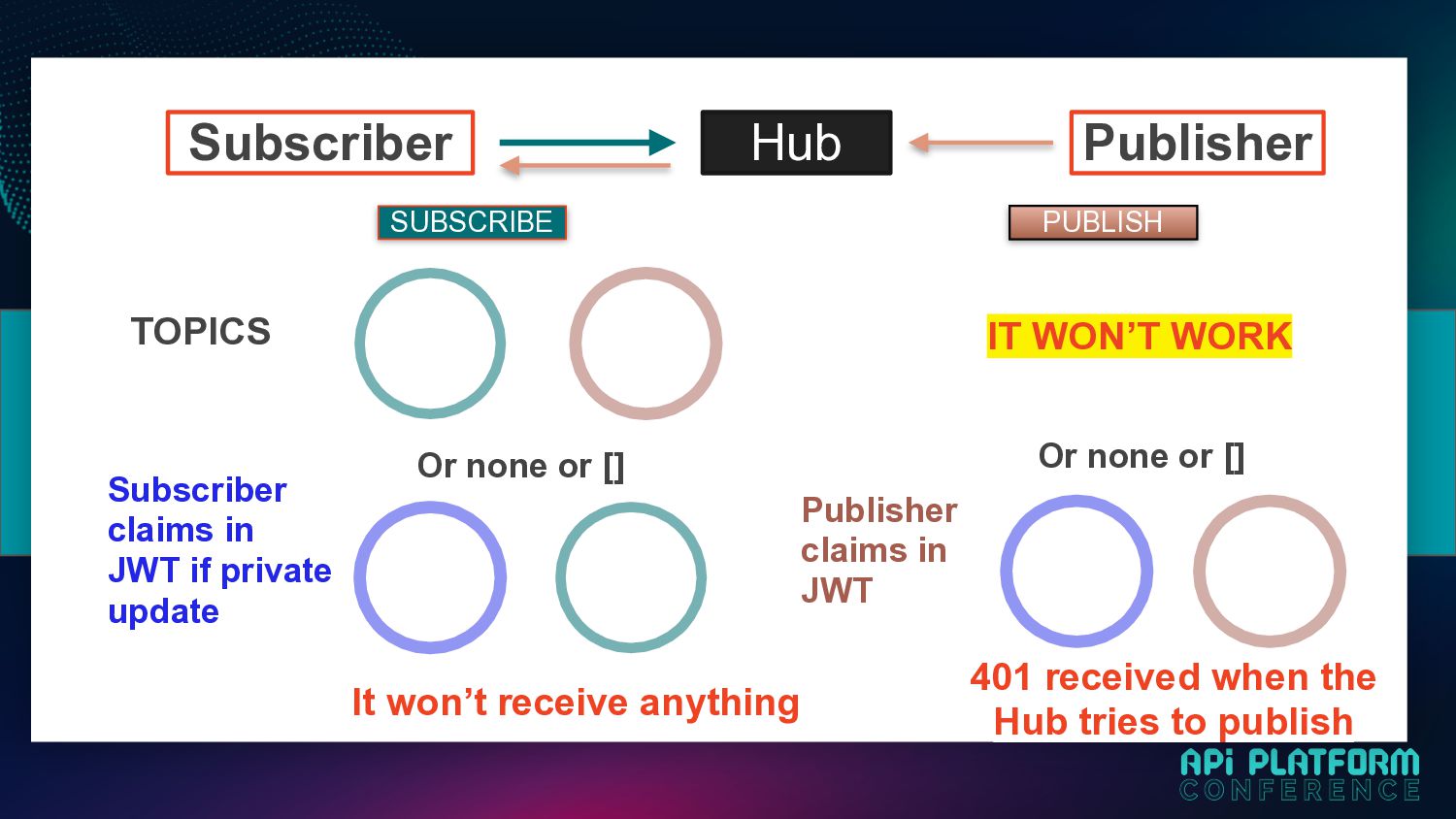
Subscriber Publisher Hub SUBSCRIBE PUBLISH TOPICS Subscriber claims in JWT
if private update Publisher claims in JWT IT WON’T WORK Or none or [] Or none or [] It won’t receive anything 401 received when the Hub tries to publish -
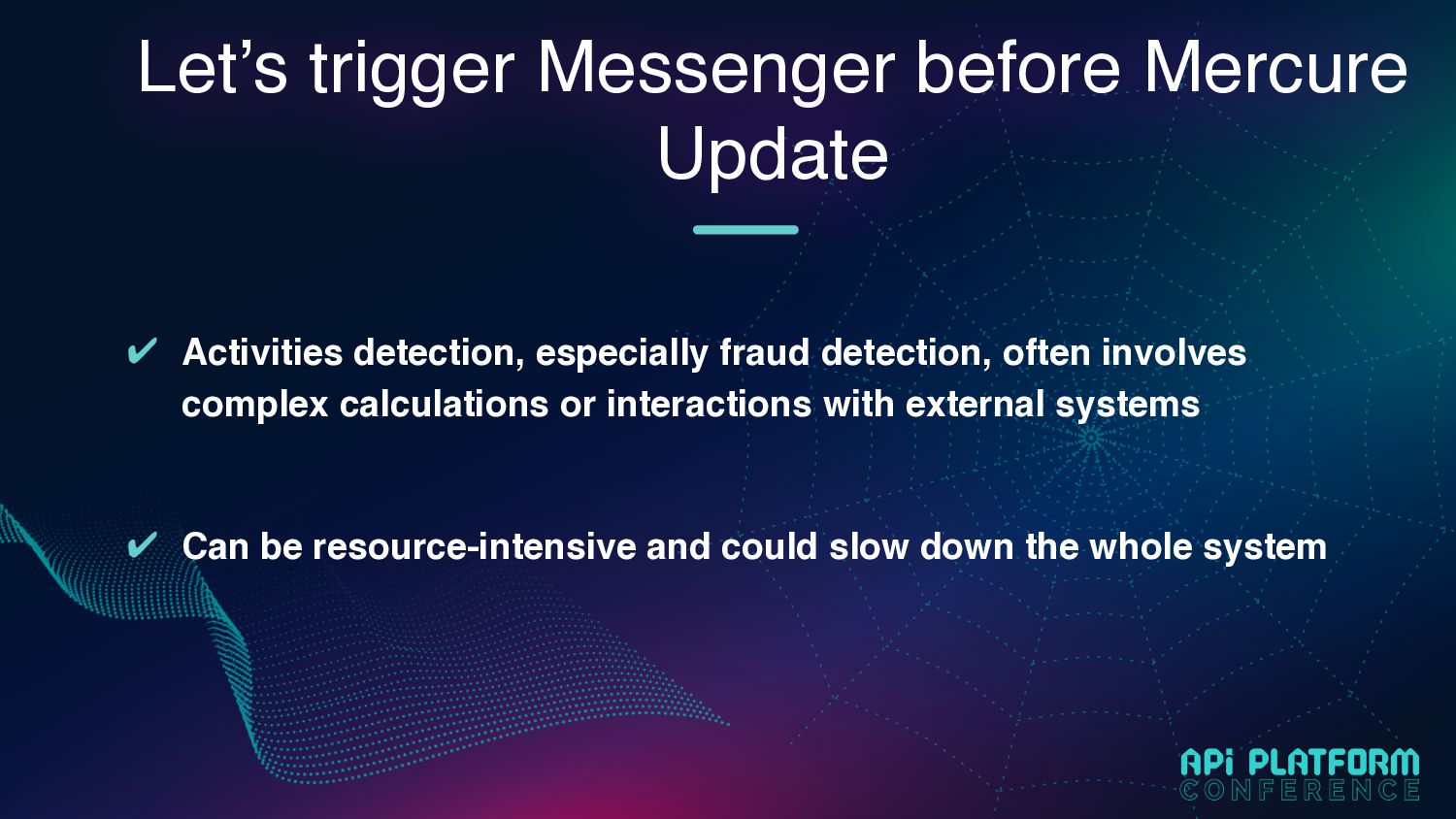
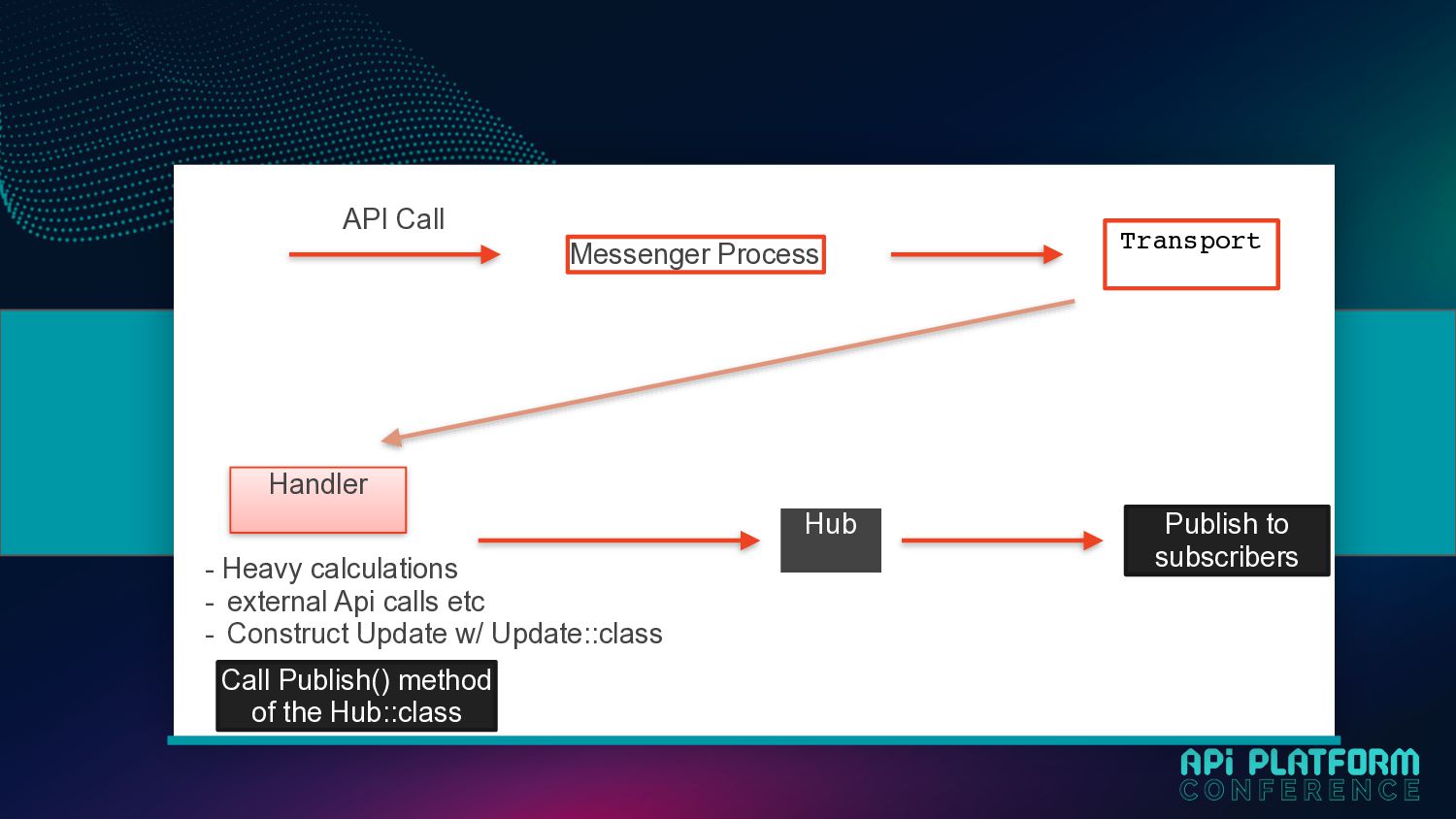
Let’s trigger Messenger before Mercure Update ✔ Activities detection, especially
fraud detection, often involves complex calculations or interactions with external systems ✔ Can be resource-intensive and could slow down the whole system -
API Call Messenger Process Transport Handler - Heavy calculations -
external Api calls etc - Construct Update w/ Update::class Hub Call Publish() method of the Hub::class Publish to subscribers -
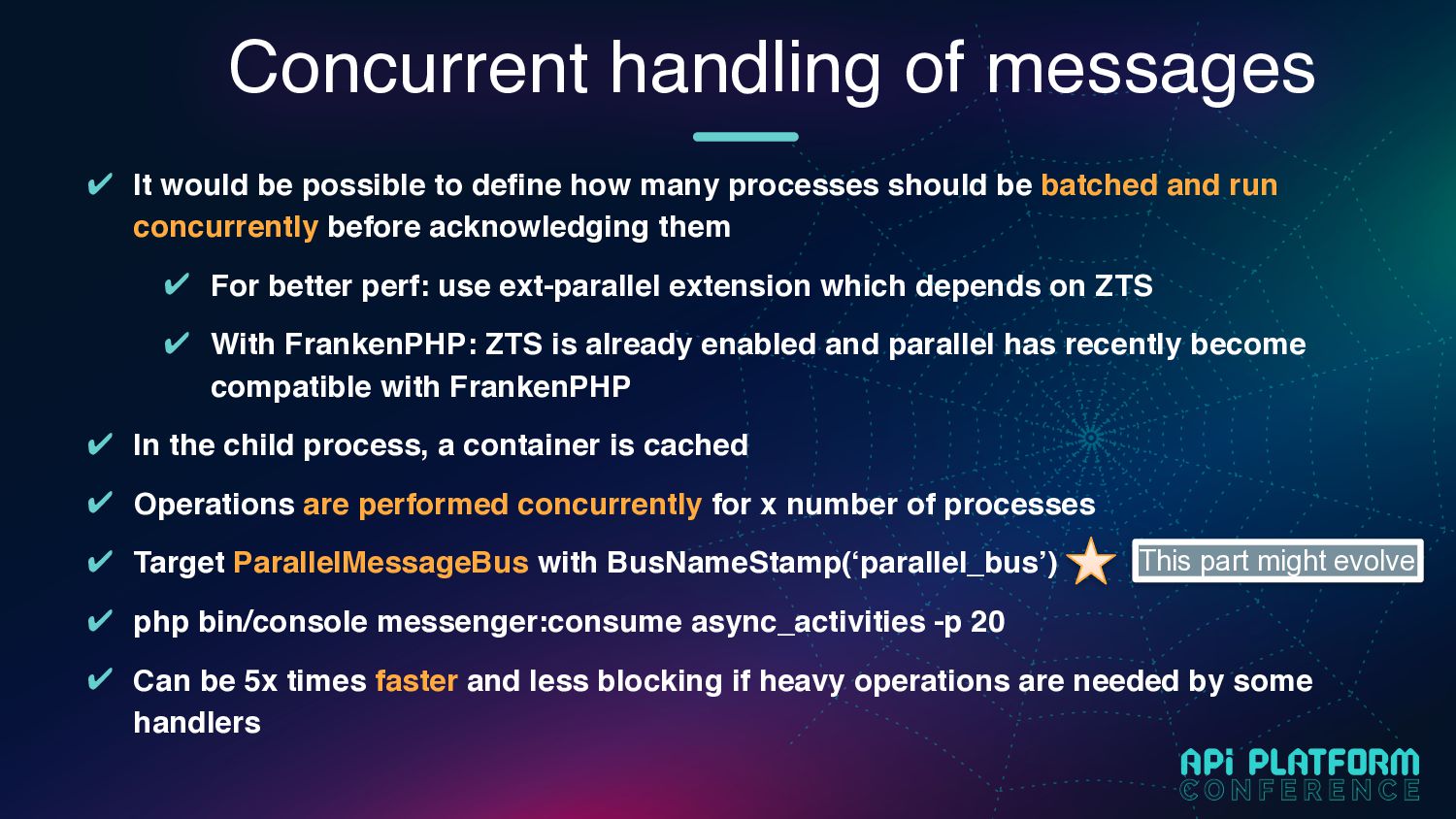
Concurrent handling of messages ✔ It would be possible to
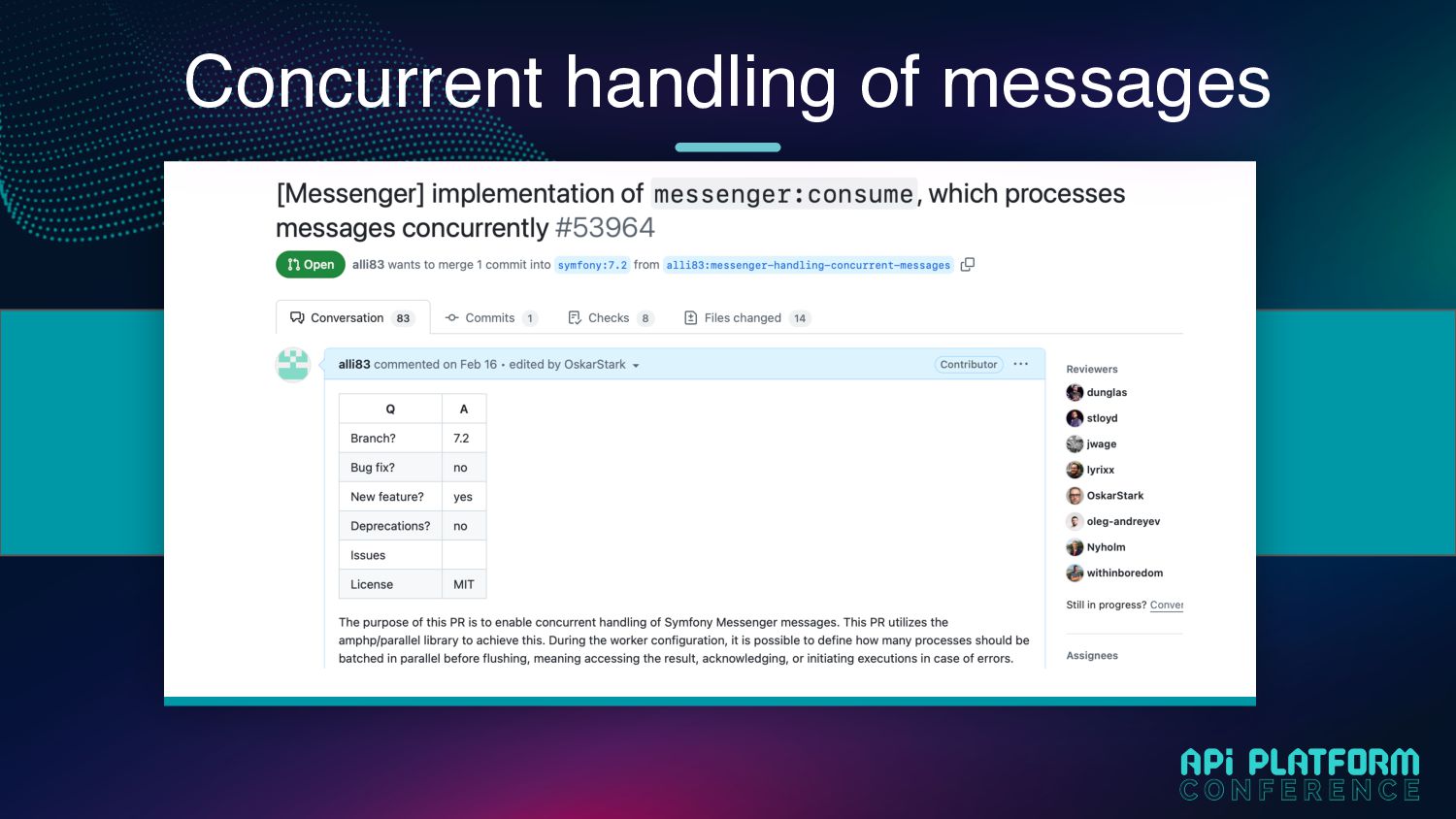
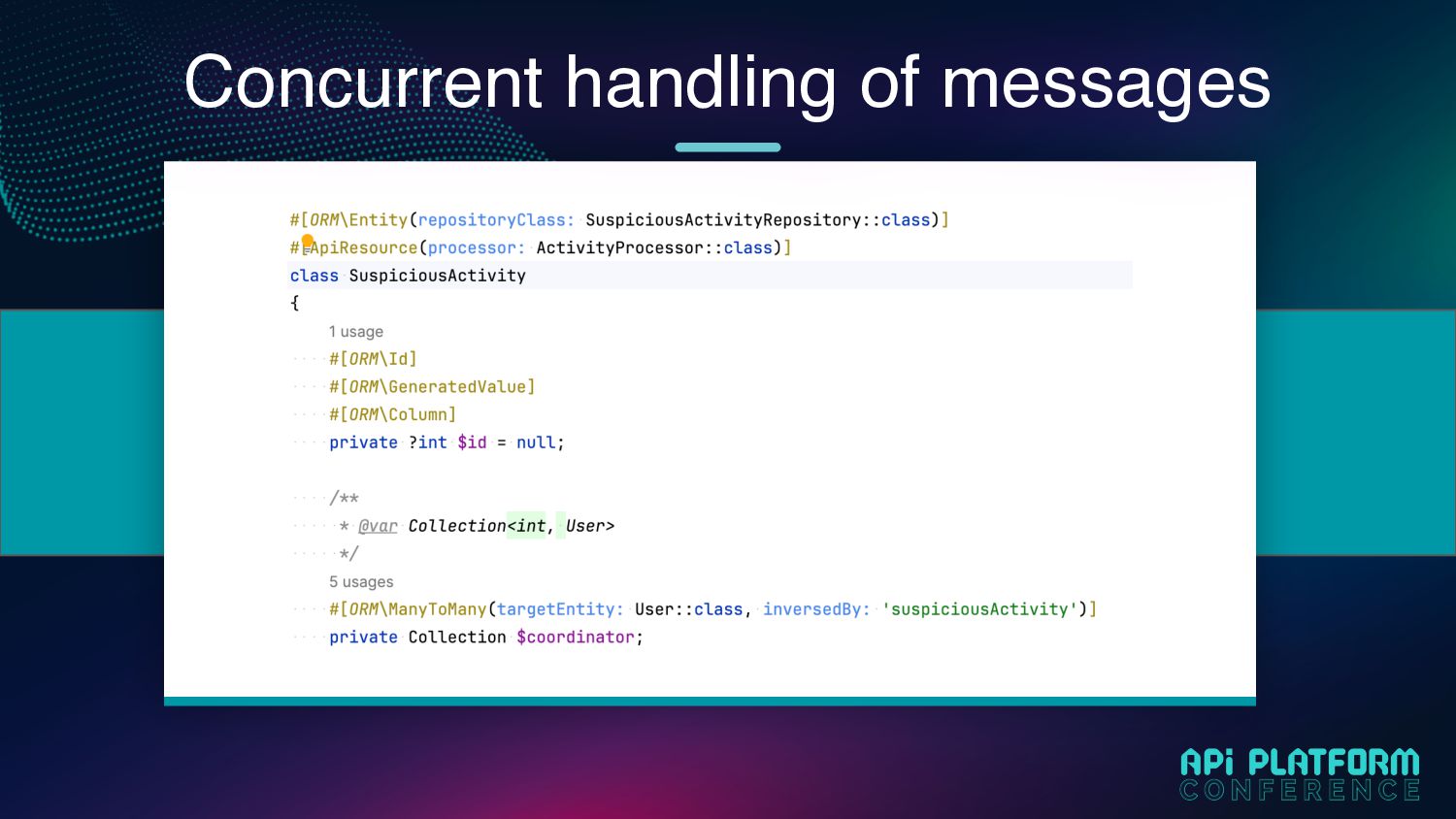
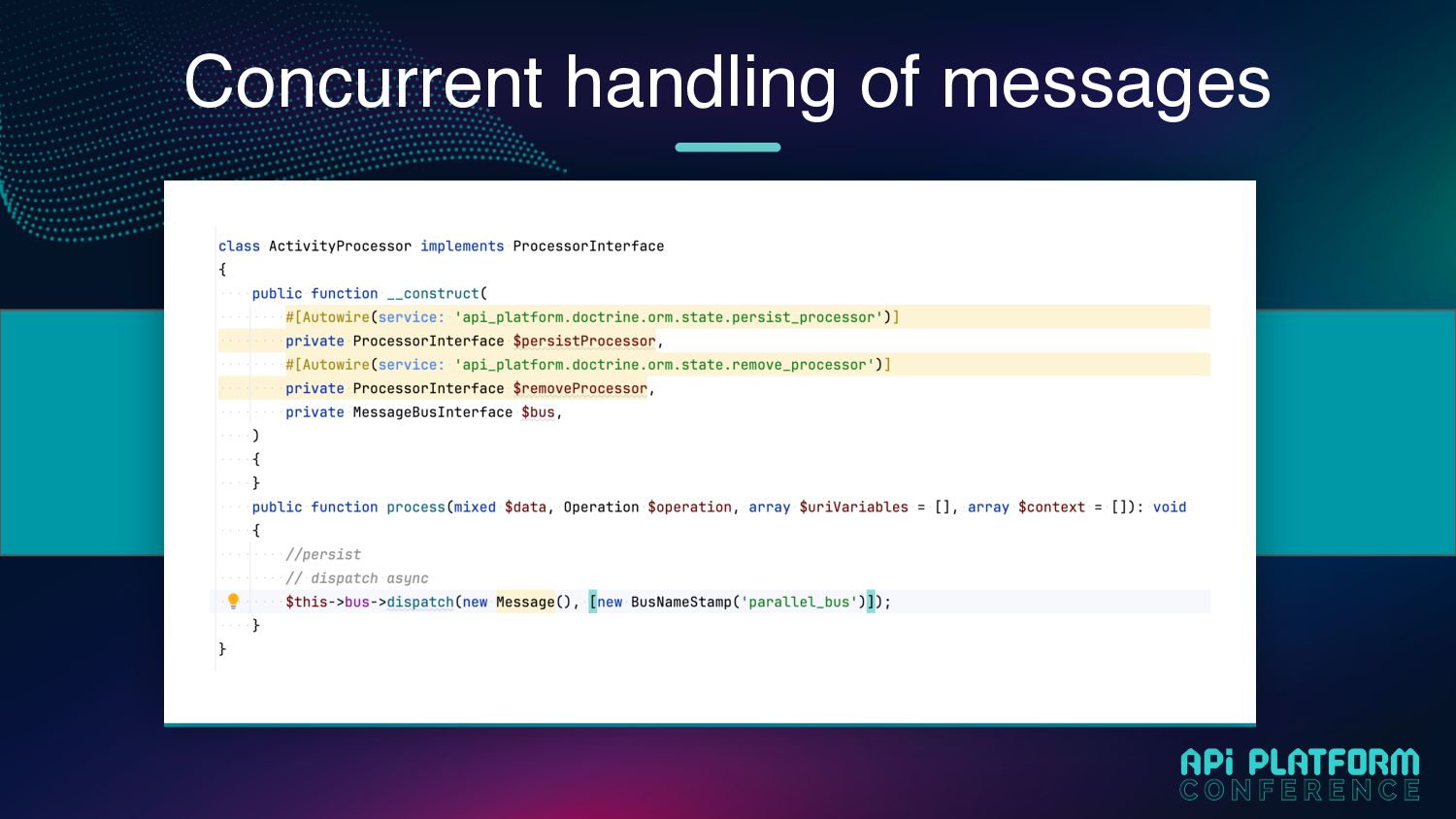
define how many processes should be batched and run concurrently before acknowledging them ✔ For better perf: use ext-parallel extension which depends on ZTS ✔ With FrankenPHP: ZTS is already enabled and parallel has recently become compatible with FrankenPHP ✔ In the child process, a container is cached ✔ Operations are performed concurrently for x number of processes ✔ Target ParallelMessageBus with BusNameStamp(‘parallel_bus’) ✔ php bin/console messenger:consume async_activities -p 20 ✔ Can be 5x times faster and less blocking if heavy operations are needed by some handlers This part might evolve -
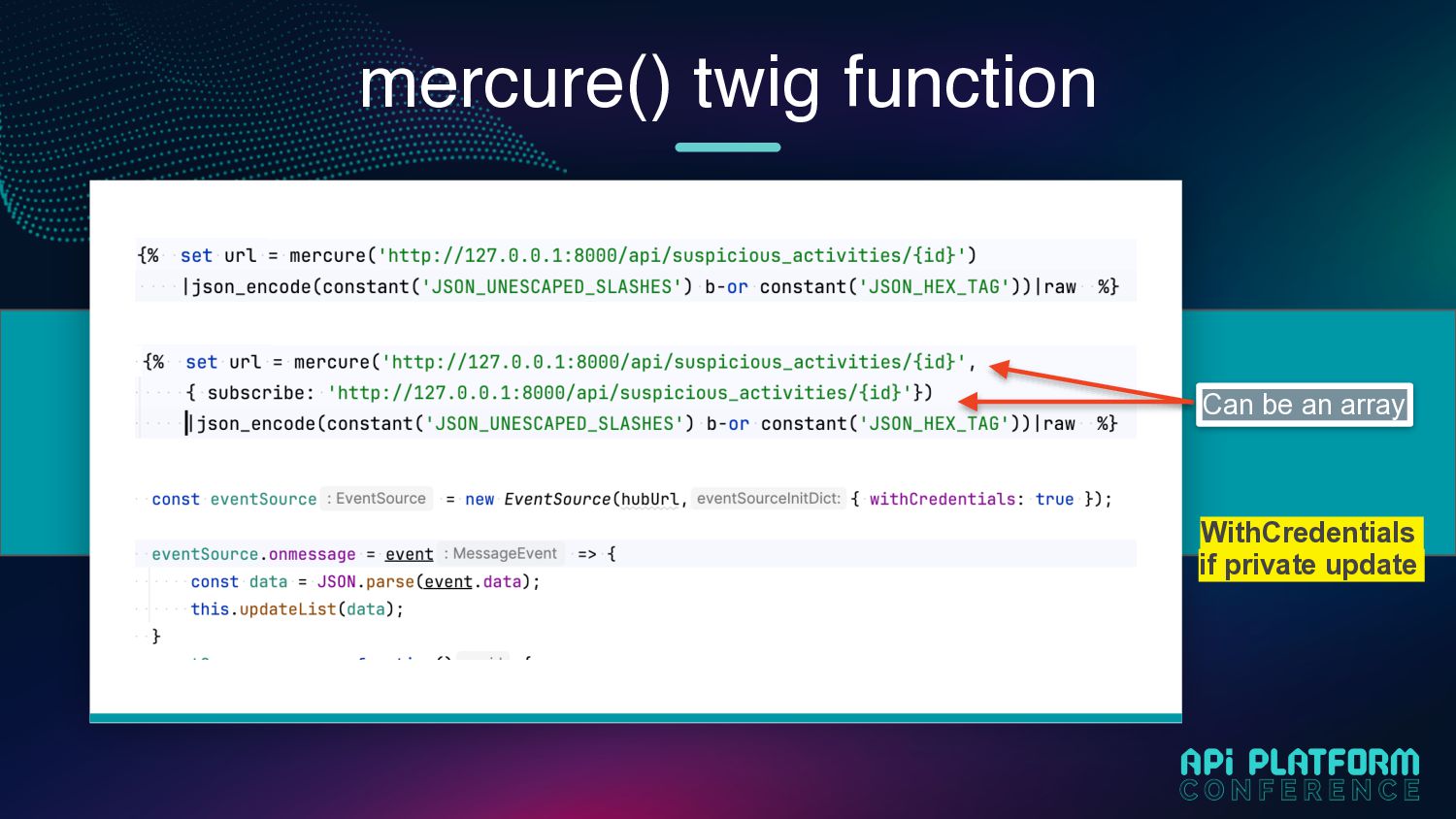
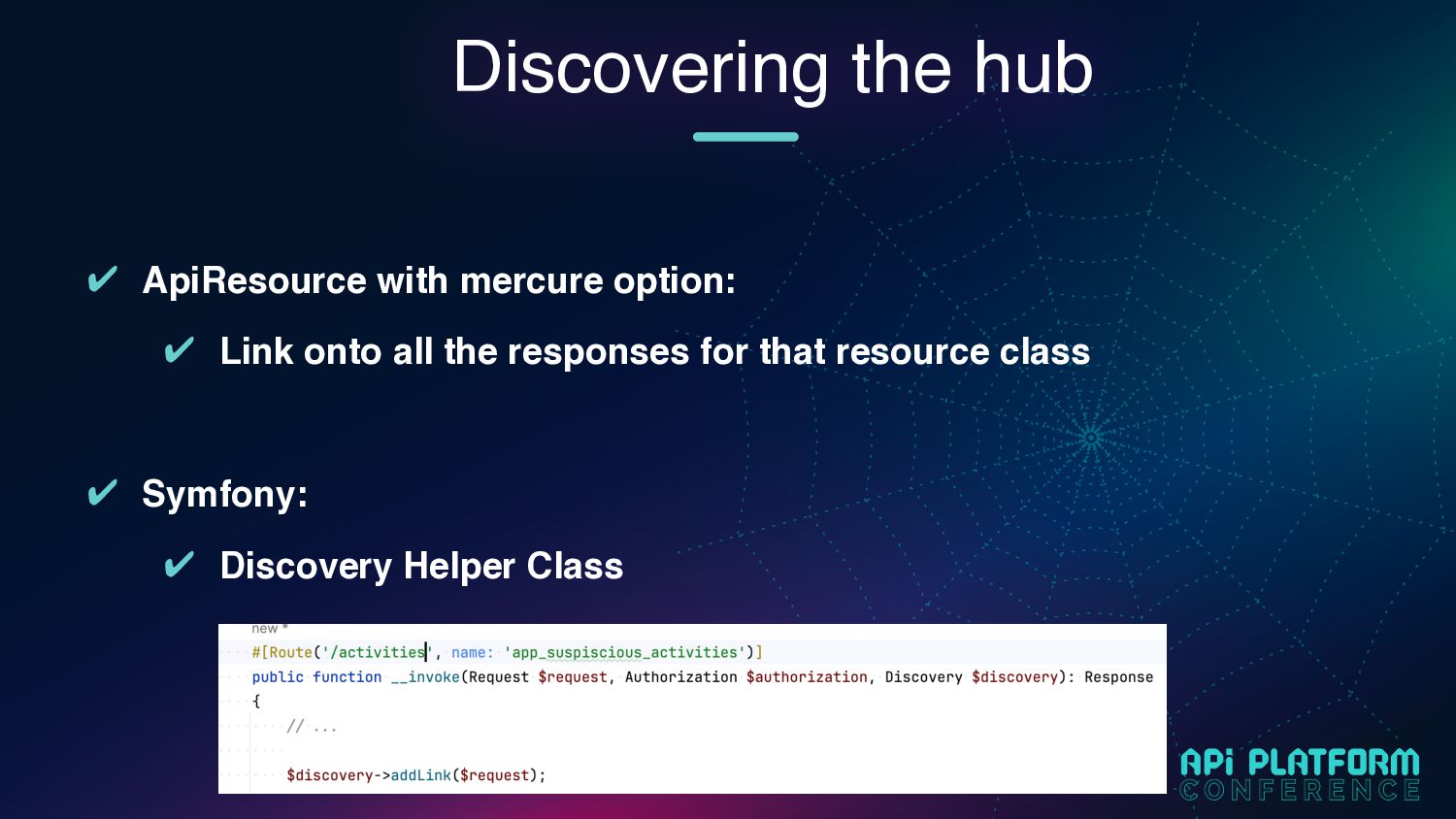
Discovering the hub ✔ ApiResource with mercure option: ✔ Link
onto all the responses for that resource class ✔ Symfony: ✔ Discovery Helper Class -
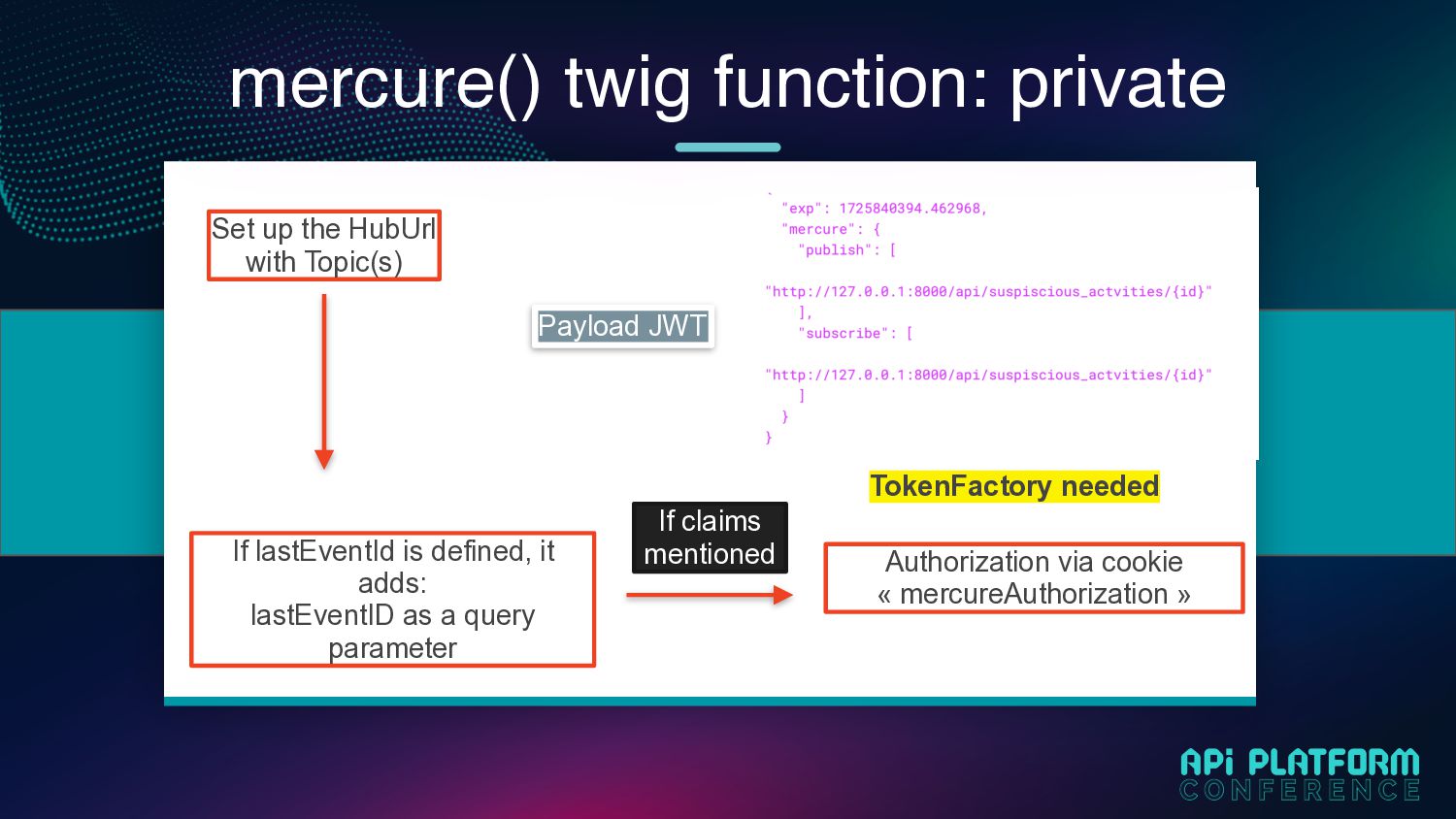
Set up the HubUrl with Topic(s) If lastEventId is defined,
it adds: lastEventID as a query parameter If claims mentioned Authorization via cookie « mercureAuthorization » TokenFactory needed Payload JWT mercure() twig function: private -
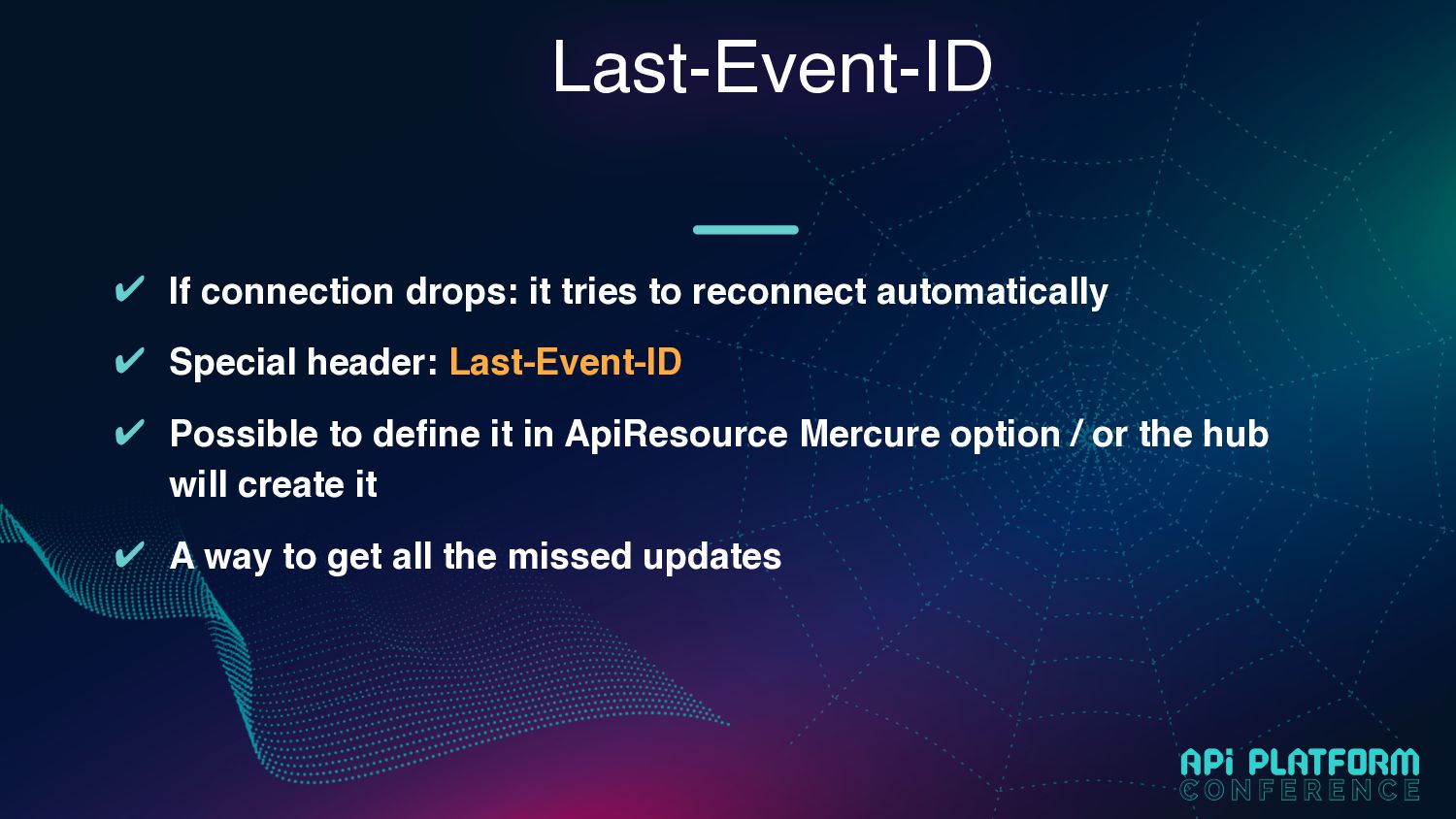
Last-Event-ID ✔ If connection drops: it tries to reconnect automatically
✔ Special header: Last-Event-ID ✔ Possible to define it in ApiResource Mercure option / or the hub will create it ✔ A way to get all the missed updates -
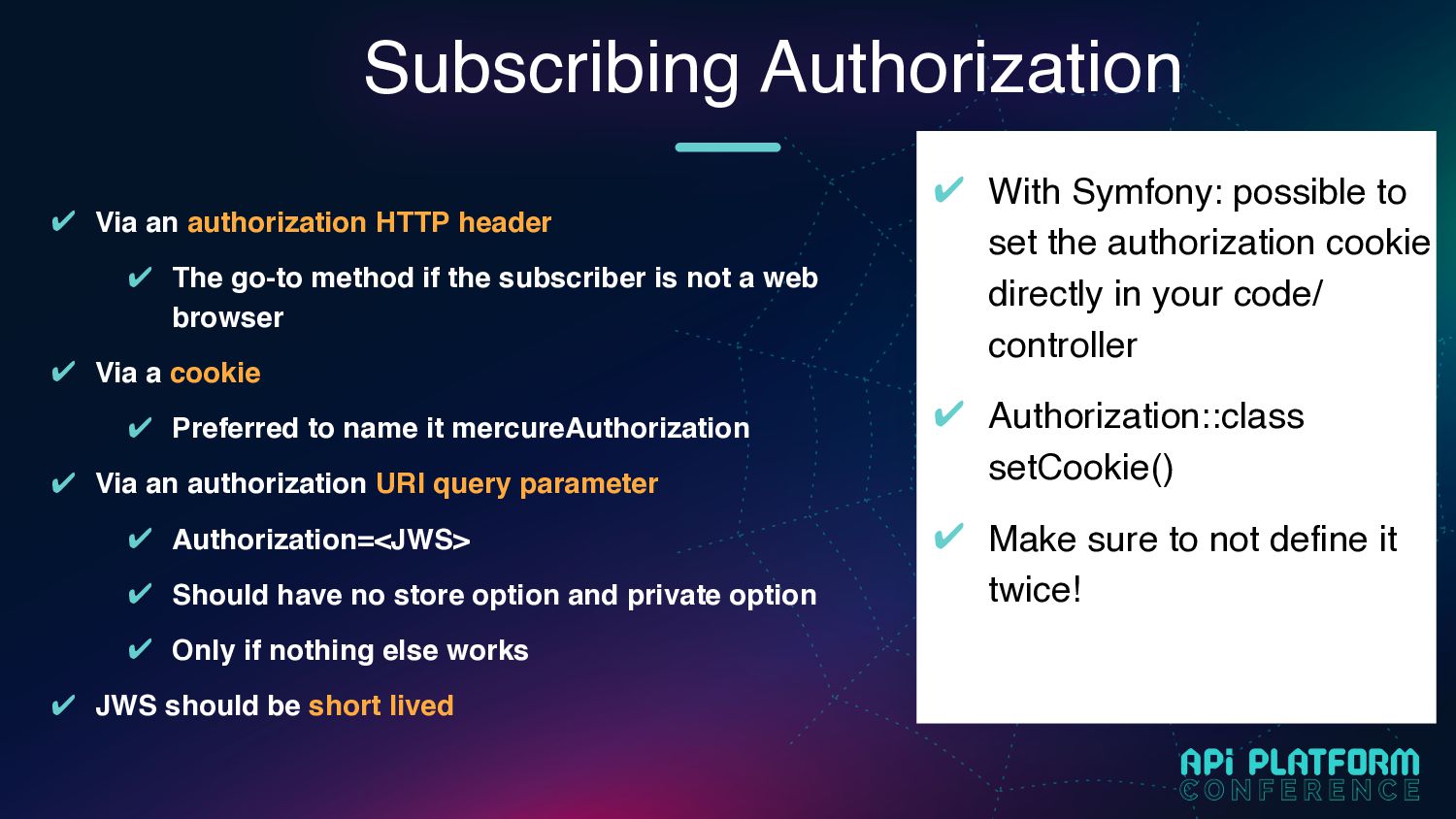
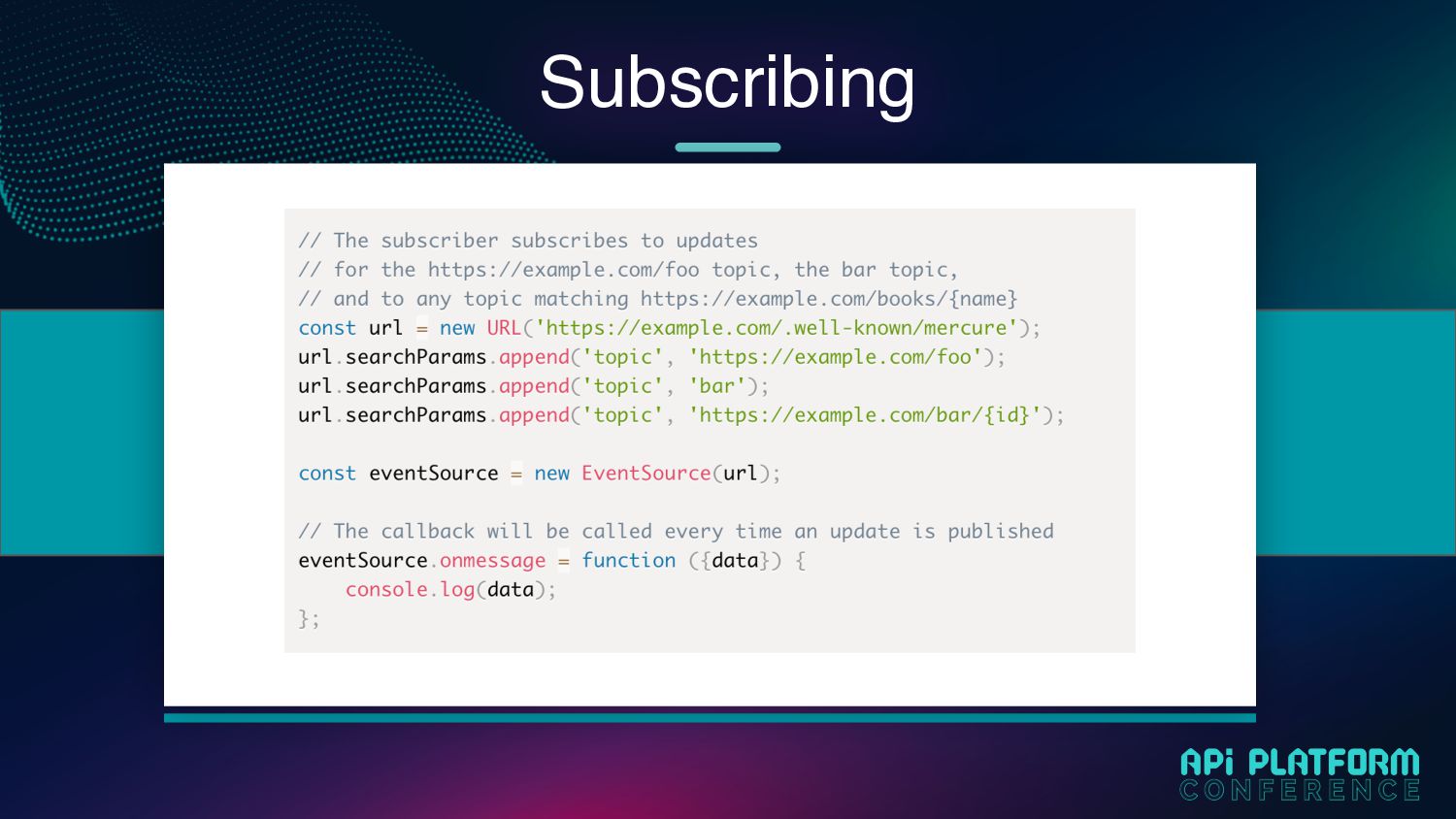
Subscribing Authorization ✔ Via an authorization HTTP header ✔ The
go-to method if the subscriber is not a web browser ✔ Via a cookie ✔ Preferred to name it mercureAuthorization ✔ Via an authorization URI query parameter ✔ Authorization=<JWS> ✔ Should have no store option and private option ✔ Only if nothing else works ✔ JWS should be short lived ✔ With Symfony: possible to set the authorization cookie directly in your code/ controller ✔ Authorization::class setCookie() ✔ Make sure to not define it twice! -
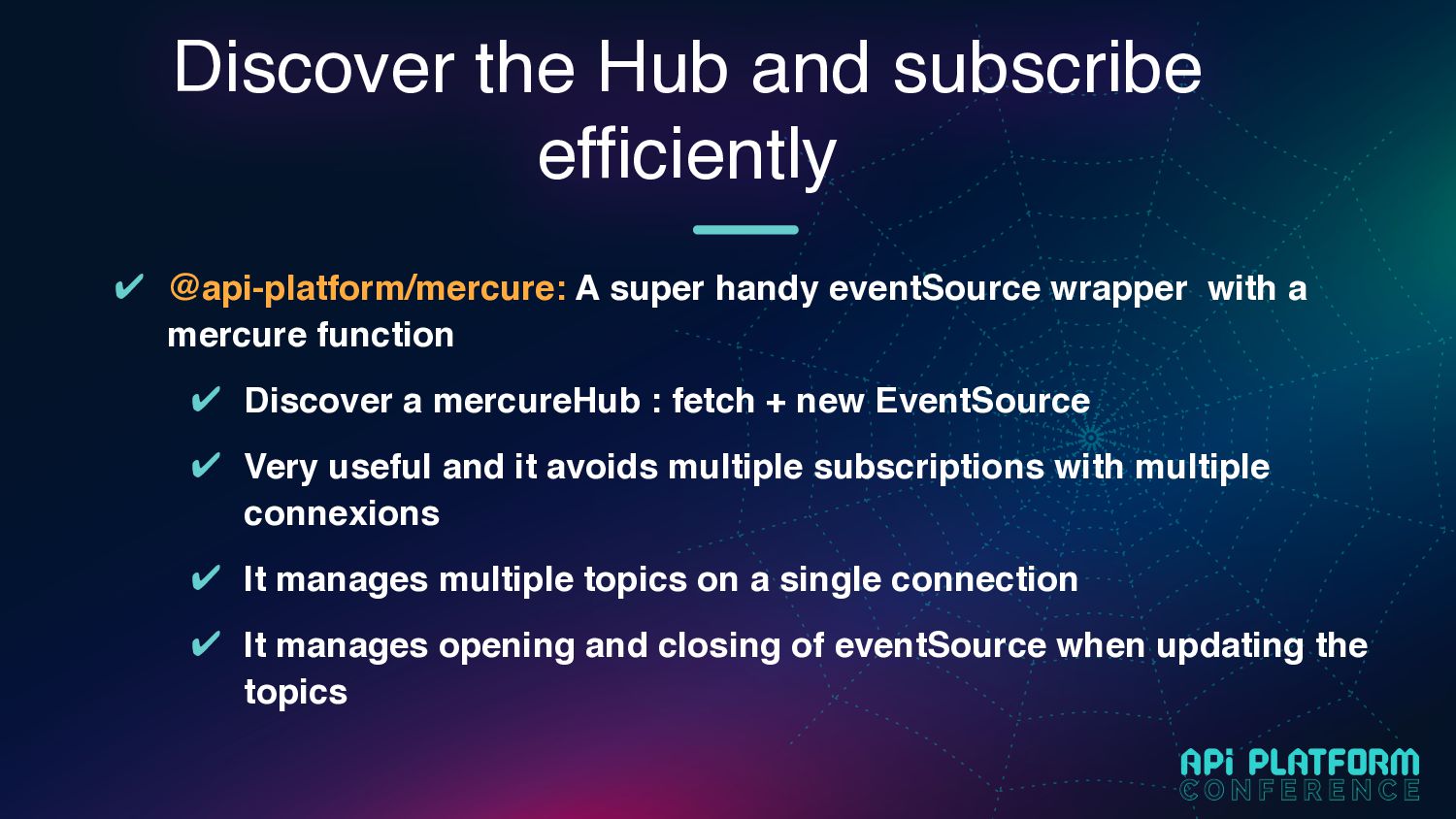
Discover the Hub and subscribe efficiently ✔ @api-platform/mercure: A super
handy eventSource wrapper with a mercure function ✔ Discover a mercureHub : fetch + new EventSource ✔ Very useful and it avoids multiple subscriptions with multiple connexions ✔ It manages multiple topics on a single connection ✔ It manages opening and closing of eventSource when updating the topics -
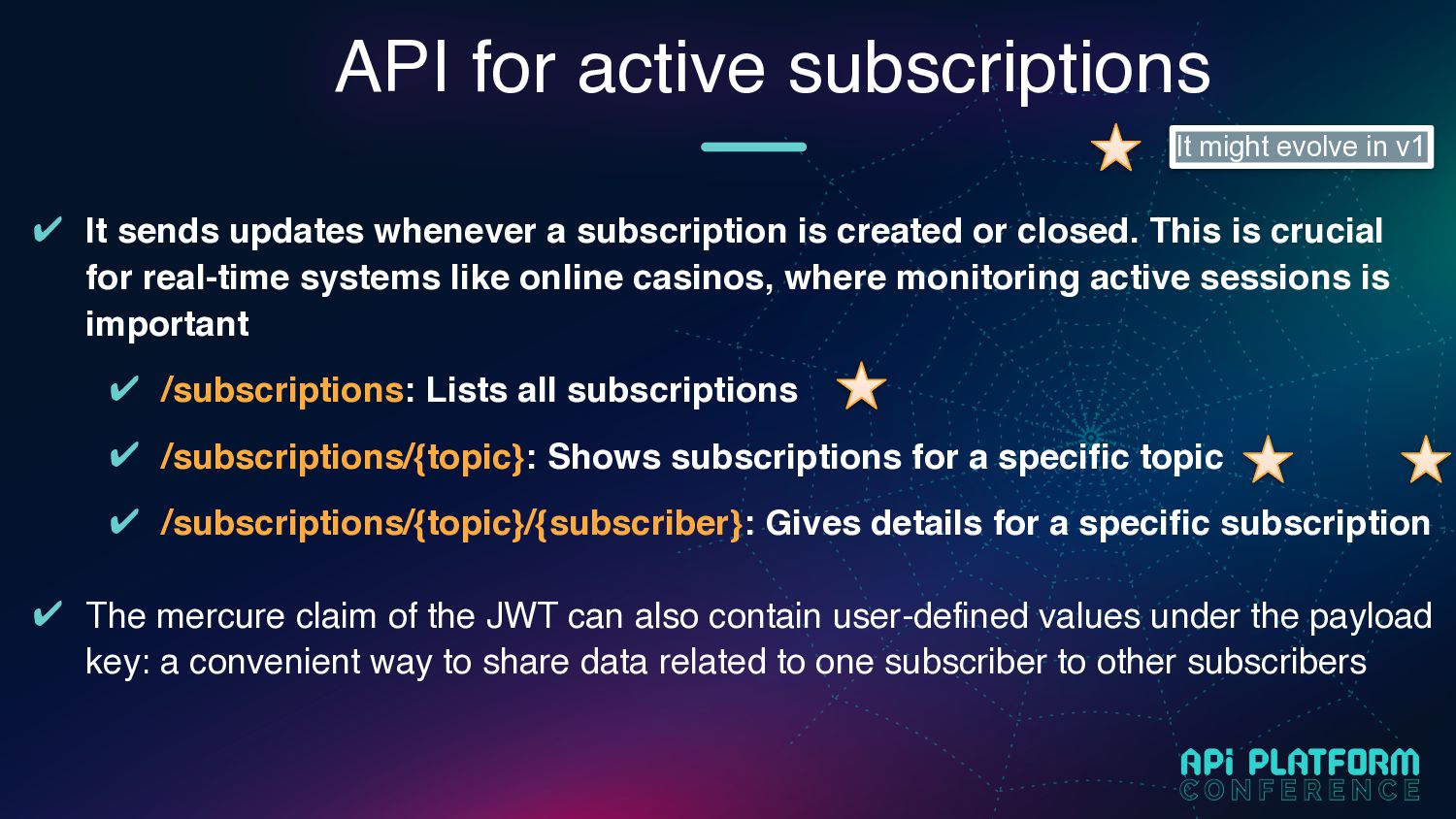
API for active subscriptions ✔ It sends updates whenever a
subscription is created or closed. This is crucial for real-time systems like online casinos, where monitoring active sessions is important ✔ /subscriptions: Lists all subscriptions ✔ /subscriptions/{topic}: Shows subscriptions for a specific topic ✔ /subscriptions/{topic}/{subscriber}: Gives details for a specific subscription ✔ The mercure claim of the JWT can also contain user-defined values under the payload key: a convenient way to share data related to one subscriber to other subscribers It might evolve in v1 -
Mercure ✔ A robust solution for real time communication ✔
Easy to deliver instant notifications ✔ A key protocol for meeting real-time communication demands ✔ Efficient across a variety of different platforms and environments ✔ Laravel community: some exciting developments are on the way for the server and client integration