existed long before computers. ▪ Similar to open standards, researchers with access to Advanced Research Projects Agency Network (ARPANET) used a process called Request for Comments to develop telecommunication network protocols which led to the birth of the INTERNET in 1969 5
modify and share because its design is accessible public wide. ▪ Open Source technology can be defined as Computer Software for which the source code is made available under a copyright License(GPL), enabling anyone from anywhere to copy, modify and redistribute the source code without paying any fees. 7
where the source code of the software is typically made available royalty-free to the users of the software, under terms allowing redistribution, modification and addition, though often with certain restrictions. 8
software to your specific needs – there’s a lot of control and eventually satisfaction . ▪ The availability of the source code and the right to modify it is very important. ▪ Global collaboration with skilled developers. ▪ Core software is free. ▪ Encourages hands on. 10
one year of solid programming education (even if it’s self-taught learning), contributing to an open source project can be one way to learn programming faster. 11
programmers just lose interest with being involved or they become fraught with infighting; arresting further development. ▪ It is sometimes difficult to know that a project exist, and its current status. ▪ Can lack software support and/or resources (documentations, communities, etc.) 13
▪ May lack the manpower to support the software. ▪ Vulnerabilities - Although having an open system means that there are many people identifying bugs and fixing them, it also means that malicious users can potentially view it and exploit any vulnerabilities. 14
▪ Microsoft Public Licenses (Ms-PL) ▪ Berkeley Software Distribution (BSD) ▪ Common Development and Distribution License (CDDL) ▪ Eclipse Public License (EPL) ▪ MIT License 16
This means that any software that is written based on any GPL component must be released as open source. The result is that any software that uses any GPL open source component (regardless of its percentage in the entire code) is required to release its full source code and all of the rights to modify and distribute the entire code. 17
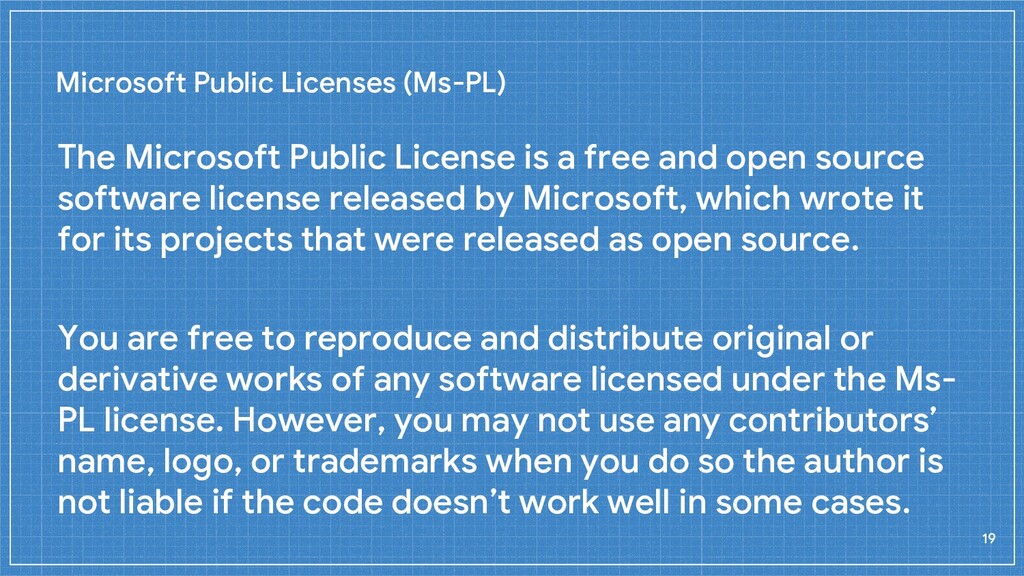
free and open source software license released by Microsoft, which wrote it for its projects that were released as open source. You are free to reproduce and distribute original or derivative works of any software licensed under the Ms- PL license. However, you may not use any contributors’ name, logo, or trademarks when you do so the author is not liable if the code doesn’t work well in some cases. 19
modify and distribute your software’s code in the source or binary format as long as you retain a copy of the copyright notice, list of conditions, and the disclaimer. 20
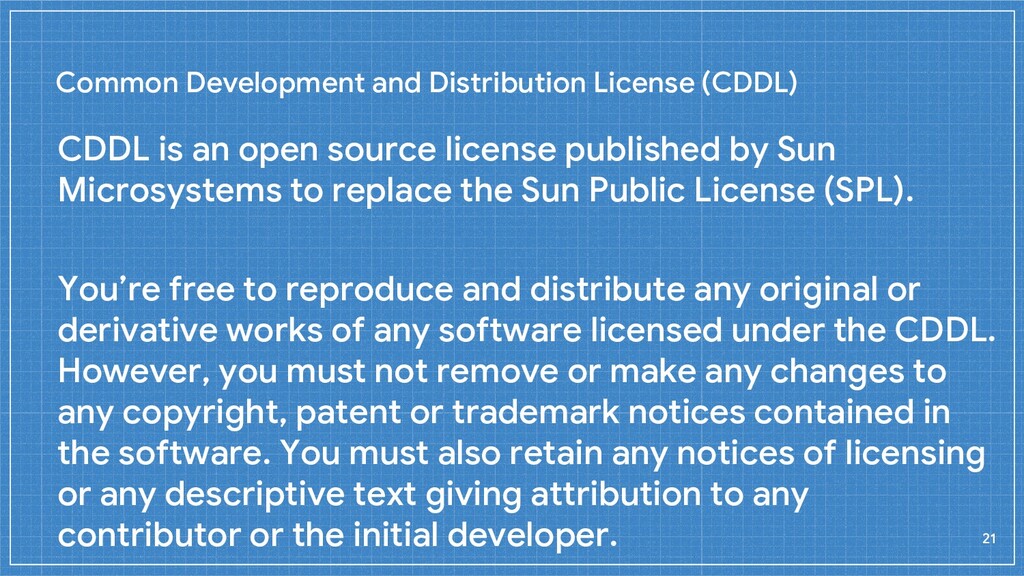
source license published by Sun Microsystems to replace the Sun Public License (SPL). You’re free to reproduce and distribute any original or derivative works of any software licensed under the CDDL. However, you must not remove or make any changes to any copyright, patent or trademark notices contained in the software. You must also retain any notices of licensing or any descriptive text giving attribution to any contributor or the initial developer. 21
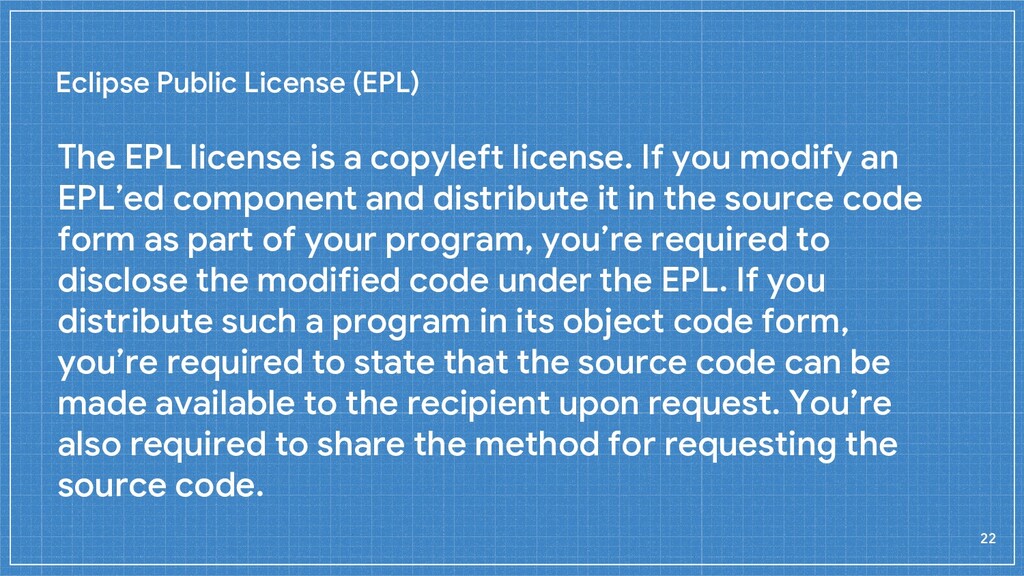
license. If you modify an EPL’ed component and distribute it in the source code form as part of your program, you’re required to disclose the modified code under the EPL. If you distribute such a program in its object code form, you’re required to state that the source code can be made available to the recipient upon request. You’re also required to share the method for requesting the source code. 22
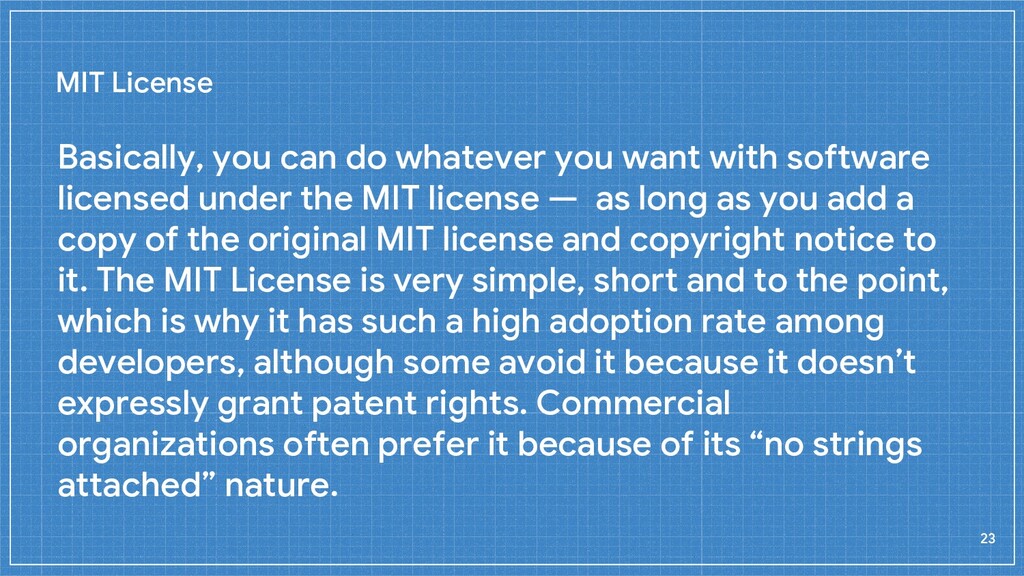
with software licensed under the MIT license — as long as you add a copy of the original MIT license and copyright notice to it. The MIT License is very simple, short and to the point, which is why it has such a high adoption rate among developers, although some avoid it because it doesn’t expressly grant patent rights. Commercial organizations often prefer it because of its “no strings attached” nature.
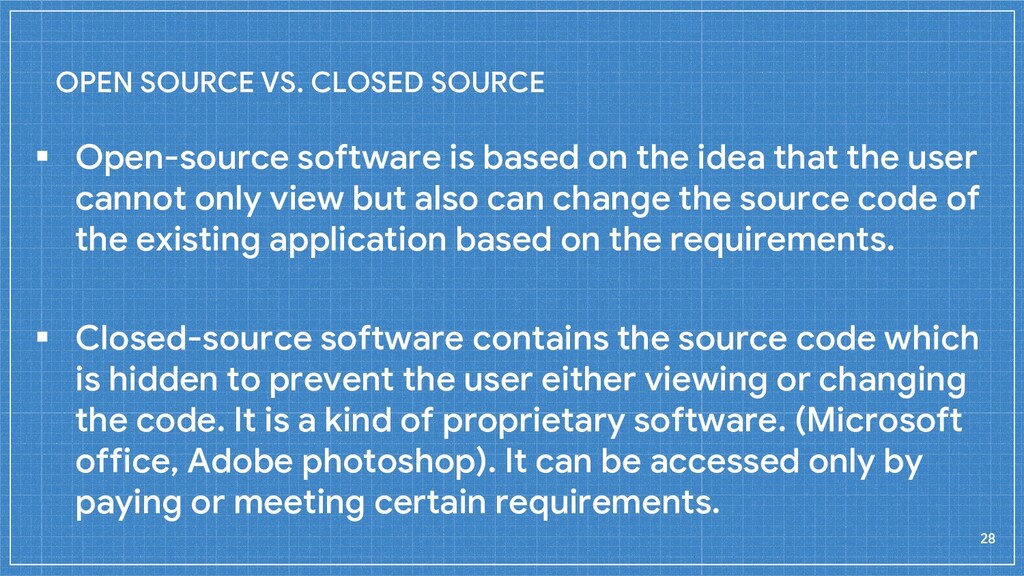
on the idea that the user cannot only view but also can change the source code of the existing application based on the requirements. ▪ Closed-source software contains the source code which is hidden to prevent the user either viewing or changing the code. It is a kind of proprietary software. (Microsoft office, Adobe photoshop). It can be accessed only by paying or meeting certain requirements. 28
, so that You can know how the program works. ▪ This evolves through community cooperation which is composed of individual programmers and companies. Many of these individuals programmers who start an open source project usually end up as large companies with open source programs. 35
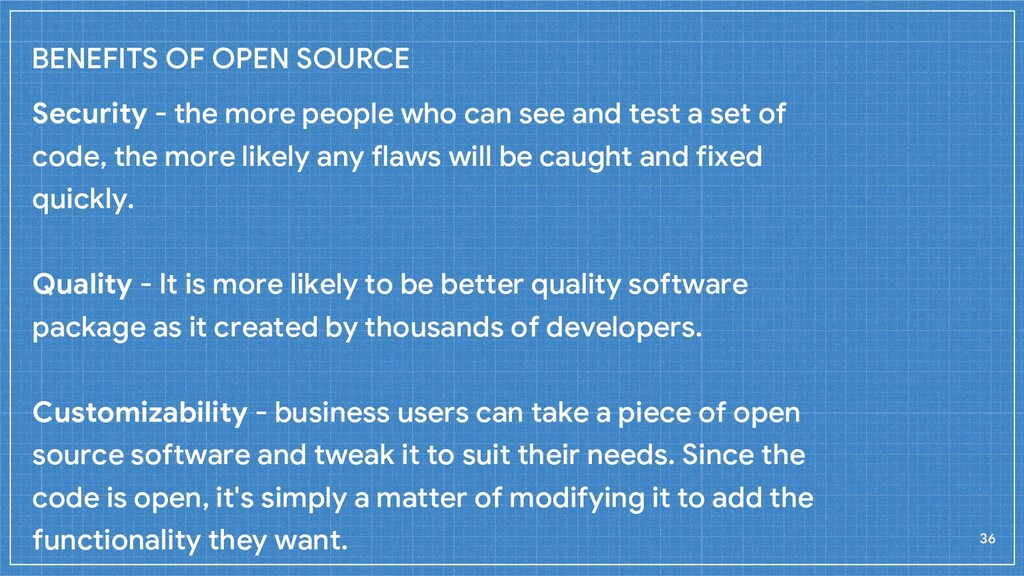
can see and test a set of code, the more likely any flaws will be caught and fixed quickly. Quality - It is more likely to be better quality software package as it created by thousands of developers. Customizability - business users can take a piece of open source software and tweak it to suit their needs. Since the code is open, it's simply a matter of modifying it to add the functionality they want. 36
Code (GSoC) - for schools MLH(Major League Hacking ) Fellowship Google Season of Docs (GSoD) 24pullrequests.com Google Hash Code github.com/trending 37
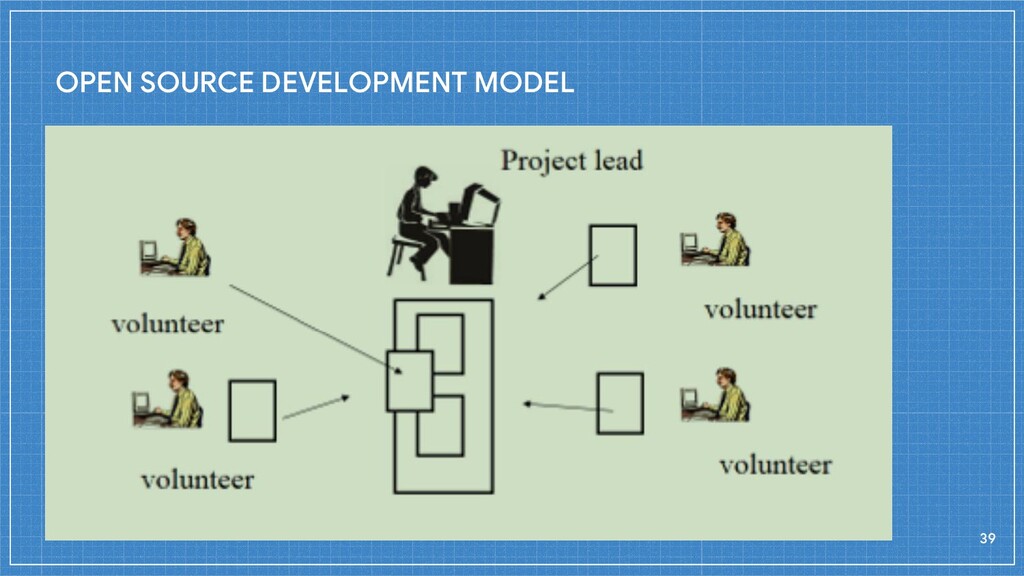
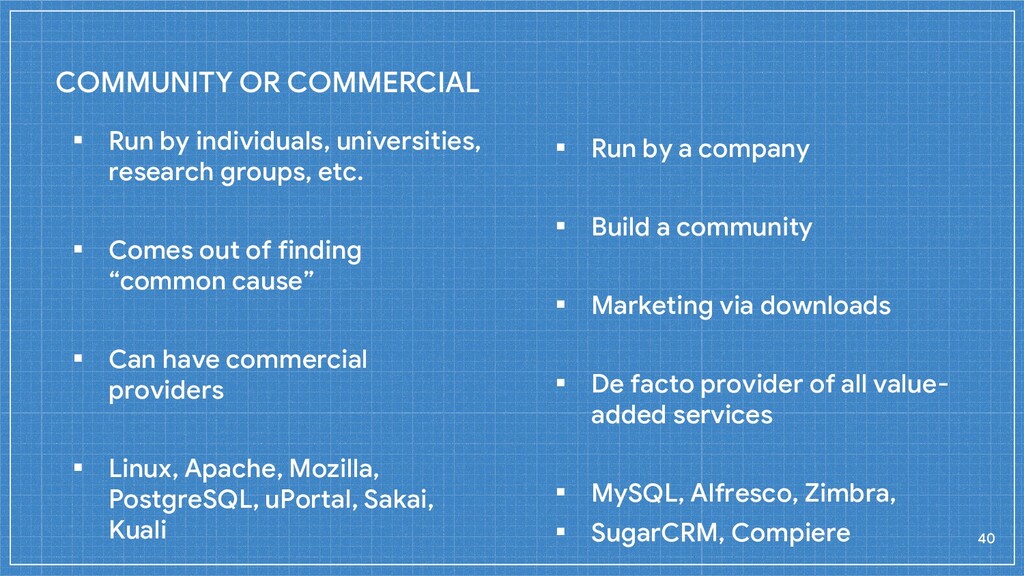
etc. ▪ Comes out of finding “common cause” ▪ Can have commercial providers ▪ Linux, Apache, Mozilla, PostgreSQL, uPortal, Sakai, Kuali ▪ Run by a company ▪ Build a community ▪ Marketing via downloads ▪ De facto provider of all value- added services ▪ MySQL, Alfresco, Zimbra, ▪ SugarCRM, Compiere 40
develop and license computer software, but also a way means expressing a willingness to share, collaborating with others in ways that are transparent. Its committed to play an active role in improving the world. 44
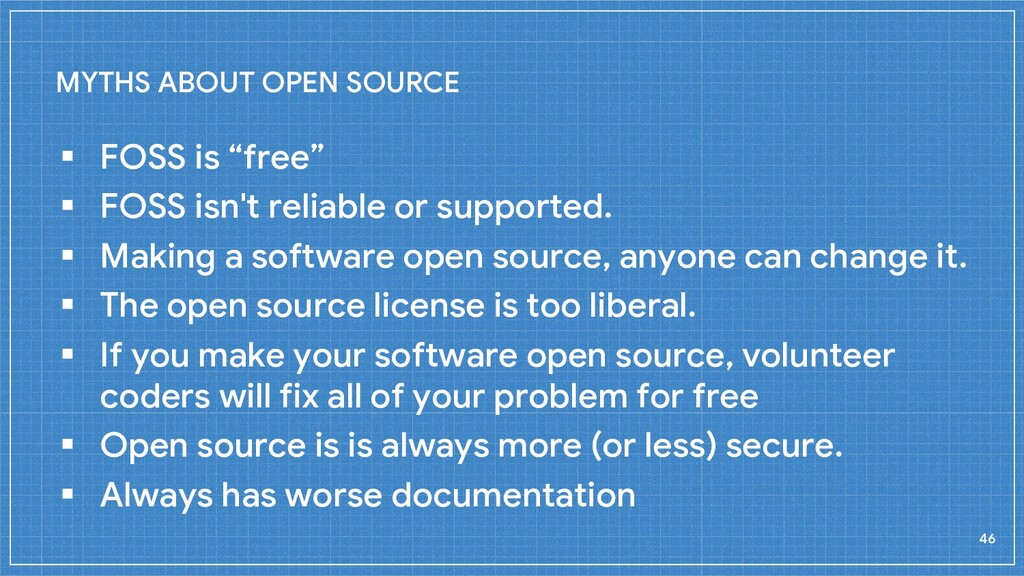
isn't reliable or supported. ▪ Making a software open source, anyone can change it. ▪ The open source license is too liberal. ▪ If you make your software open source, volunteer coders will fix all of your problem for free ▪ Open source is is always more (or less) secure. ▪ Always has worse documentation 46


 auna
auna
 finengine
 jtakeda
 orgachem
 takmin
 revsystem
 bbrbbq
 masasuzu
 tategami
 emiki
emiki
 akizhou
 yukisakai1225
 eluwing
 chriscoyier
 sugarenia
 malarkey
 mongodb
 mayatellez
 rasmusluckow
 jmmastey
 mclloyd
.png) helenjbeal
helenjbeal
 dougneiner
 techseoconnect
 frankvandijk