• (Blind) Source Separation • Fundamental Frequency Estimation • Pitch & Common Amplitude Modulation • Harmonic Selection • Speech and Musical Signal • Result & Future Research
our most important faculties is our ability to listen to, and follow, one speaker in the presence of others. . . we may call it "the cocktail party problem." No machine has yet been constructed to do just that. – Cherry, E. Colin (1953). "Some Experiments on the Recognition of Speech, with One and with Two Ears". The Journal of the Acoustical Society of America 25 (5): 975–79.
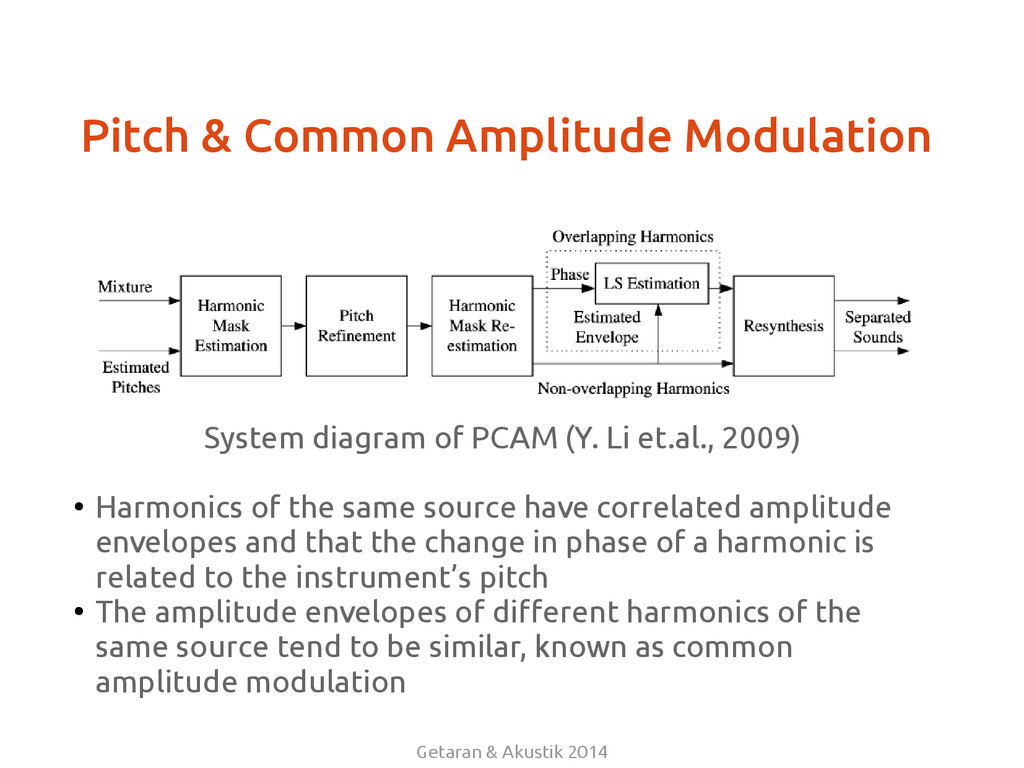
diagram of PCAM (Y. Li et.al., 2009) • Harmonics of the same source have correlated amplitude envelopes and that the change in phase of a harmonic is related to the instrument’s pitch • The amplitude envelopes of different harmonics of the same source tend to be similar, known as common amplitude modulation
Process (T.W. Parsons, 1976) By selecting the harmonics of the desired voice in the Fourier transform of the input, separation of mixed speech can be done
separated into its source components, in this paper we used pitch and commone amplitude modulation (PCAM) and harmonic selection methods, which resulting PCAM gives better result over harmonic selection method. • Music sound (tone/multi tone) is easier to be separated than speech, in this paper best result was achieved by using PCAM method with 0.0002 of mse score.


 bagustris
 xspa2012
 auranightsky
 taniai
 institutdelelevage
 tosseto
 satai
 wataruuuuu
 rfujii
 yukako_nakano
 chriscoyier
 aki_iinuma
 axbom
 gr2m
 holman
 kristinabergwall1
 eileencodes
 akosma
 codingconduct
 reverentgeek
 ryanjones
 katarinadahlin