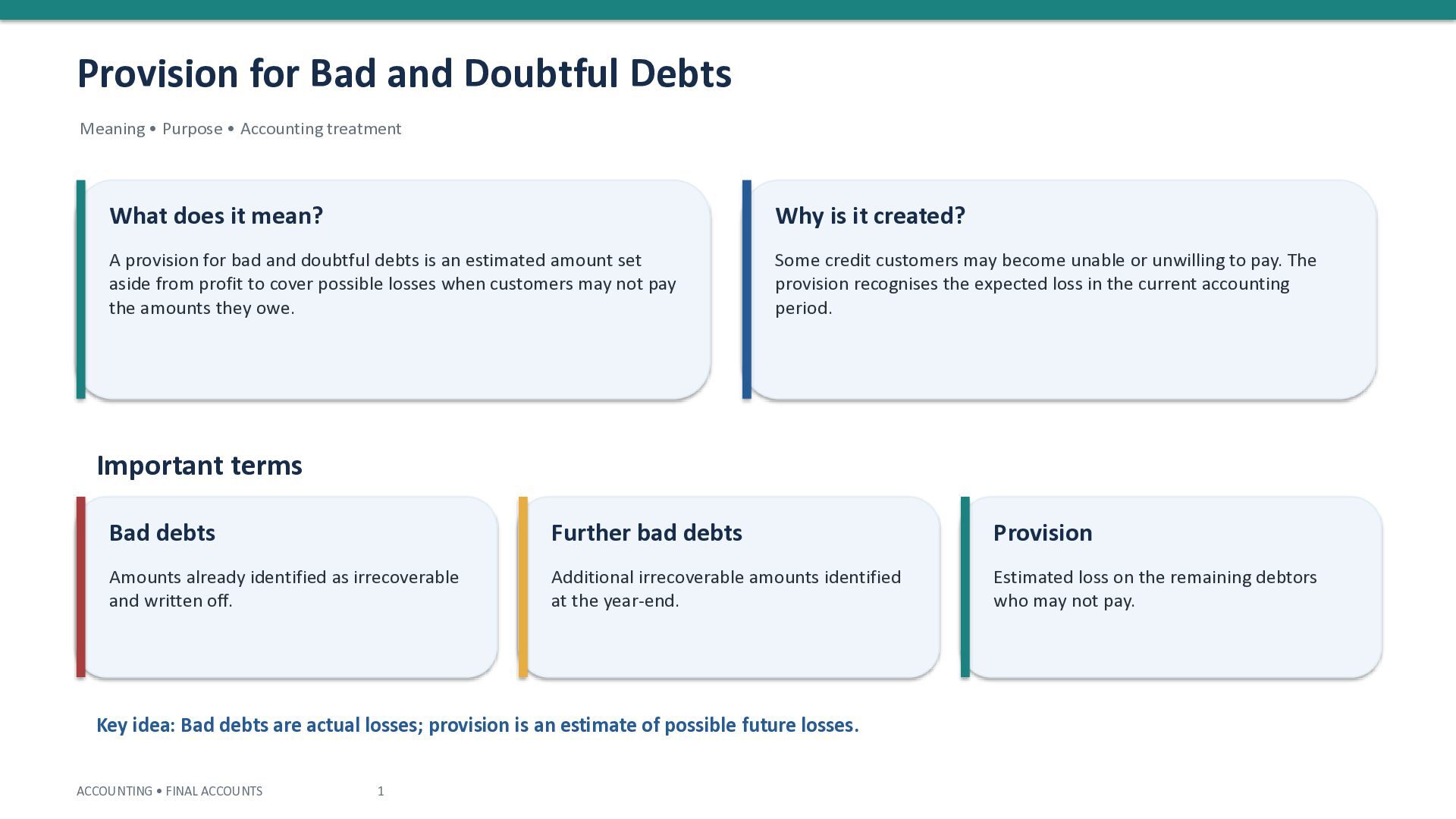
Accounting treatment What does it mean? Why is it created? A provision for bad and doubtful debts is an estimated amount set aside from profit to cover possible losses when customers may not pay the amounts they owe. Some credit customers may become unable or unwilling to pay. The provision recognises the expected loss in the current accounting period. Important terms Bad debts Further bad debts Provision Amounts already identified as irrecoverable and written off. Additional irrecoverable amounts identified at the year-end. Estimated loss on the remaining debtors who may not pay. Key idea: Bad debts are actual losses; provision is an estimate of possible future losses. ACCOUNTING • FINAL ACCOUNTS 1
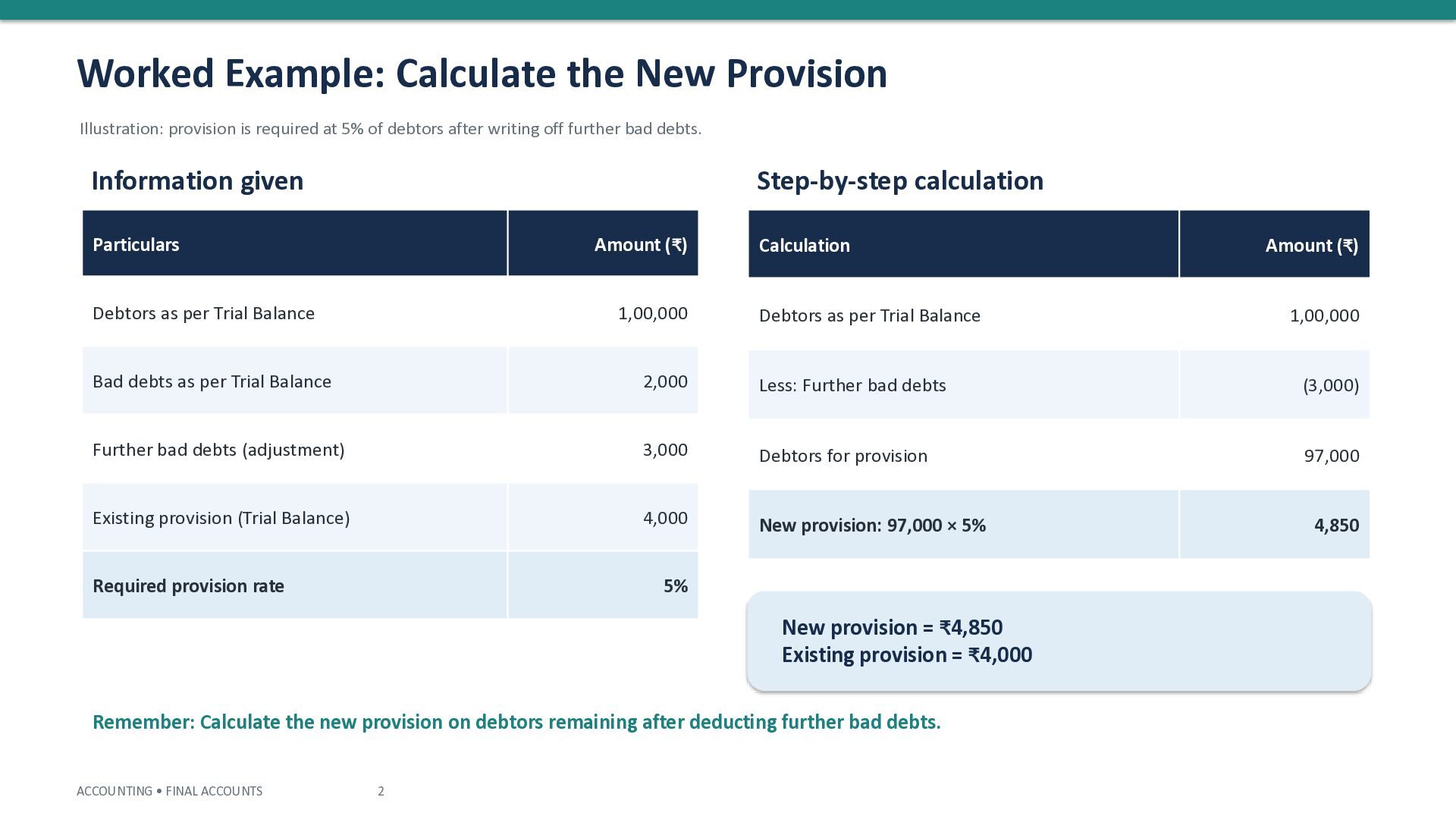
at 5% of debtors after writing off further bad debts. Information given Step-by-step calculation Particulars Amount (₹) Debtors as per Trial Balance 1,00,000 Bad debts as per Trial Balance Calculation Amount (₹) Debtors as per Trial Balance 1,00,000 2,000 Less: Further bad debts (3,000) Further bad debts (adjustment) 3,000 Debtors for provision 97,000 Existing provision (Trial Balance) 4,000 New provision: 97,000 × 5% 4,850 Required provision rate 5% New provision = ₹4,850 Existing provision = ₹4,000 Remember: Calculate the new provision on debtors remaining after deducting further bad debts. ACCOUNTING • FINAL ACCOUNTS 2
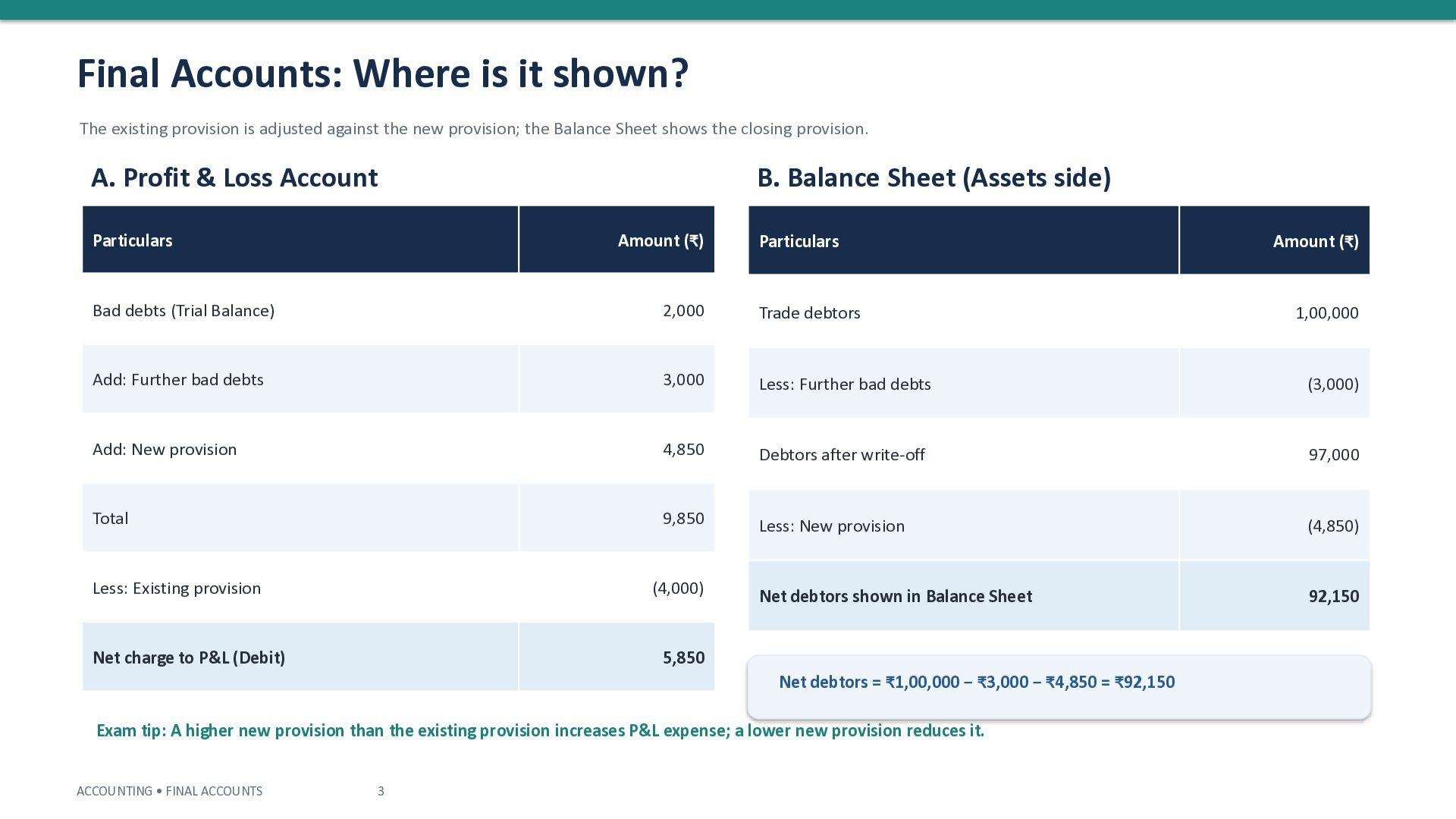
adjusted against the new provision; the Balance Sheet shows the closing provision. A. Profit & Loss Account B. Balance Sheet (Assets side) Particulars Amount (₹) Particulars Amount (₹) Bad debts (Trial Balance) 2,000 Trade debtors 1,00,000 Add: Further bad debts 3,000 Less: Further bad debts (3,000) Add: New provision 4,850 Debtors after write-off 97,000 Total 9,850 Less: New provision (4,850) Less: Existing provision (4,000) Net debtors shown in Balance Sheet 92,150 Net charge to P&L (Debit) 5,850 Net debtors = ₹1,00,000 − ₹3,000 − ₹4,850 = ₹92,150 Exam tip: A higher new provision than the existing provision increases P&L expense; a lower new provision reduces it. ACCOUNTING • FINAL ACCOUNTS 3


 bvr7352
 koheihasebe
 adeputra13
 signer
 pawan_pharm
 rashwhitman
 ak679839
 cbtlibrary
 bernhardsvt
 gmoriki
 sonakv
 hachama
 denniskardys
 reverentgeek
 nonsquared
 retrage
 ipullrank
 zakiyama
 carmenintech
 palkan
 gurzu
 tammyeverts
 afnizarnur