Share
Embed
JS at Urban Airship
Talk given for a "Lunch and Learn" for Engineering at Urban Airship.
Chris Dickinson
September 16, 2013
Transcript
113 slides
-
{ SOME HISTORY: • airship is a bit quirky as
far as Django projects go • but as regards JS, it was totally orthodox Monday, September 16, 13 -
{ SOME HISTORY: • “JS is just another static asset”
• a pretty common attitude at the time Monday, September 16, 13 -
{ SOME HISTORY: • 3 major products were using a
lot of JS • Rich Push Composer • Reports • Push Composer (not to mention various other pages) Monday, September 16, 13 -
{ SOME HISTORY: None of them were sharing code, even
amongst themselves! Monday, September 16, 13 -
{ SOME HISTORY: • But the code worked • The
site worked Monday, September 16, 13 -
{ SOME HISTORY: • I was the only dedicated JS
developer for a long time. • There was no way I could replace all the legacy code in one fell swoop. Monday, September 16, 13 -
{ SOME HISTORY: The solution had to grow with airship.
Monday, September 16, 13 -
{ SOME HISTORY: The solution had gradually replace the legacy
code within airship. Monday, September 16, 13 -
{ SOME HISTORY: The solution had to scale beyond a
single dedicated JS developer on airship. Monday, September 16, 13 -
{We had to Modularize, Organize & Standardize our JS. Monday,
September 16, 13 -
{We had to Modularize, Organize & Standardize our JS. Monday,
September 16, 13 -
{ MODULARIZE: • Modular JavaScript • Based on CommonJS •
One module to a JS file. Monday, September 16, 13 -
{ MODULARIZE: • Modules may export any value • Modules
may import the value exported by any other module Monday, September 16, 13 -
{ MODULARIZE: • Non-exported values cannot be affected by any
other module. • Separation of concerns! Monday, September 16, 13 -
{ // import a value from another file var other
= require('./path/to/file') MODULARIZE: Monday, September 16, 13 -
{ // commonjs: module.exports = 'any js value' // require.js:
return 'any js value' MODULARIZE: Monday, September 16, 13 -
{ // require.js: define(function(require) { var other = require('./path') return
'any js value' }) MODULARIZE: Monday, September 16, 13 -
{ MODULARIZE: • In general: Modules export functions that do
one thing. • Functions should only take the bare minimum of information necessary to do their jobs. Monday, September 16, 13 -
{ MODULARIZE: Which is to say: everything that your app
needs to work should be statically analyzable. Monday, September 16, 13 -
{ MODULARIZE: • Break up big modules into small modules.
Monday, September 16, 13 -
{ MODULARIZE: • Modules are broken up by moving module.js
to module/ index.js • Then slicing discrete logic out into new modules in that directory. Monday, September 16, 13 -
{$ for i in airship/static/js/page/message/*.js; do wc -l $i; done
96 airship/static/js/page/message/build_state.js 202 airship/static/js/page/message/index.js 149 airship/static/js/page/message/is_valid.js 58 airship/static/js/page/message/make_scheduled.js 30 airship/static/js/page/message/send.js 32 airship/static/js/page/message/setup_advanced.js 184 airship/static/js/page/message/setup_audience.js 77 airship/static/js/page/message/setup_draft.js 132 airship/static/js/page/message/setup_message.js 299 airship/static/js/page/message/setup_richpush.js 59 airship/static/js/page/message/setup_schedule.js 41 airship/static/js/page/message/setup_send.js MODULARIZE: Monday, September 16, 13 -
{ MODULARIZE: This system slowly but surely grew to encompass
the entire JS codebase. Monday, September 16, 13 -
{ MODULARIZE: The Web team plans JS features in terms
of what modules we can reuse, and what modules need to be created. Monday, September 16, 13 -
{We had to Modularize, Organize & Standardize our JS. Monday,
September 16, 13 -
{ ORGANIZE: • Modules are split up into directories based
on the scope of the concerns Monday, September 16, 13 -
{ utils/ modules/ widgets/ behaviors/ page/ plugins/ templates/ thirdparty/ TOPIC:
ORGANIZE: Monday, September 16, 13 -
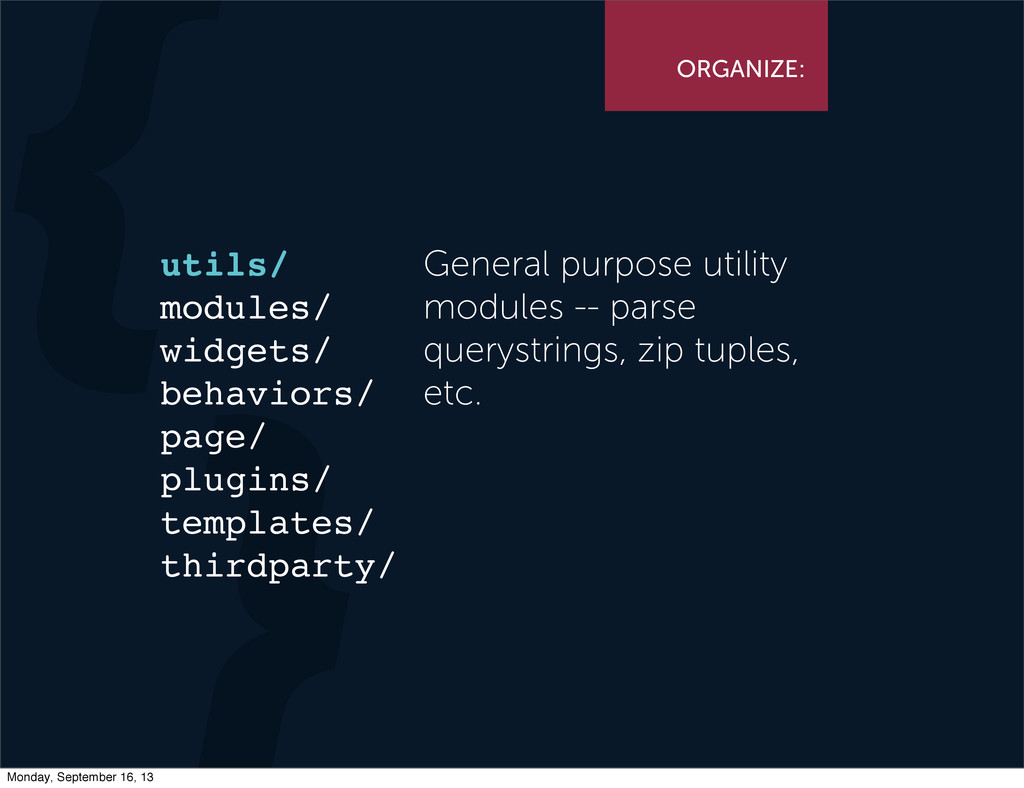
{ utils/ modules/ widgets/ behaviors/ page/ plugins/ templates/ thirdparty/ TOPIC:
ORGANIZE: General purpose utility modules -- parse querystrings, zip tuples, etc. Monday, September 16, 13 -
{ utils/ modules/ widgets/ behaviors/ page/ plugins/ templates/ thirdparty/ TOPIC:
ORGANIZE: More complex modules. These often create objects with multiple methods. Monday, September 16, 13 -
{ utils/ modules/ widgets/ behaviors/ page/ plugins/ templates/ thirdparty/ TOPIC:
ORGANIZE: They’re expected to only deal with native JS objects -- no DOM objects allowed! Monday, September 16, 13 -
{ utils/ modules/ widgets/ behaviors/ page/ plugins/ templates/ thirdparty/ TOPIC:
ORGANIZE: Modules that deal with DOM manipulation. Usually take a single element. Should not touch anything outside of that element. Monday, September 16, 13 -
{ utils/ modules/ widgets/ behaviors/ page/ plugins/ templates/ thirdparty/ TOPIC:
ORGANIZE: These modules are usually concerned with setting initial values, and emitting new user values over time. Monday, September 16, 13 -
{ utils/ modules/ widgets/ behaviors/ page/ plugins/ templates/ thirdparty/ TOPIC:
ORGANIZE: The entry point directories. Monday, September 16, 13 -
{ utils/ modules/ widgets/ behaviors/ page/ plugins/ templates/ thirdparty/ TOPIC:
ORGANIZE: These tie together modules from the widgets/ directory with templates from the templates/ directory. Monday, September 16, 13 -
{ utils/ modules/ widgets/ behaviors/ page/ plugins/ templates/ thirdparty/ TOPIC:
ORGANIZE: Any information that Django should provide is pulled in these modules and provided to submodules. Monday, September 16, 13 -
{ utils/ modules/ widgets/ behaviors/ page/ plugins/ templates/ thirdparty/ TOPIC:
ORGANIZE: This includes: •URLs for XHRs •Available permissions •Model data Monday, September 16, 13 -
{ utils/ modules/ widgets/ behaviors/ page/ plugins/ templates/ thirdparty/ TOPIC:
ORGANIZE: The preferred method to pass data is by HTML5 data-attribute on a named container element. Monday, September 16, 13 -
{ utils/ modules/ widgets/ behaviors/ page/ plugins/ templates/ thirdparty/ TOPIC:
ORGANIZE: Behaviors run on every page of the site. They should be as minimal as possible. Monday, September 16, 13 -
{ utils/ modules/ widgets/ behaviors/ page/ plugins/ templates/ thirdparty/ TOPIC:
ORGANIZE: Page modules run only for a single view and are specified by Django via the @js('module') view decorator. Monday, September 16, 13 -
{ utils/ modules/ widgets/ behaviors/ page/ plugins/ templates/ thirdparty/ TOPIC:
ORGANIZE: Often these modules are split up into subdirectories -- such as Segments and the Push Composer. Monday, September 16, 13 -
{ utils/ modules/ widgets/ behaviors/ page/ plugins/ templates/ thirdparty/ TOPIC:
ORGANIZE: This directory contains everything necessary for Require.JS to load templates. When we switch to browserify, it will be going away. Monday, September 16, 13 -
{ utils/ modules/ widgets/ behaviors/ page/ plugins/ templates/ thirdparty/ TOPIC:
ORGANIZE: Our templates directory -- this is where all of our plate templates live. Monday, September 16, 13 -
{ utils/ modules/ widgets/ behaviors/ page/ plugins/ templates/ thirdparty/ TOPIC:
ORGANIZE: Plate is a Django- template-language-alike in JS. (It can use include, extend, and friends). Monday, September 16, 13 -
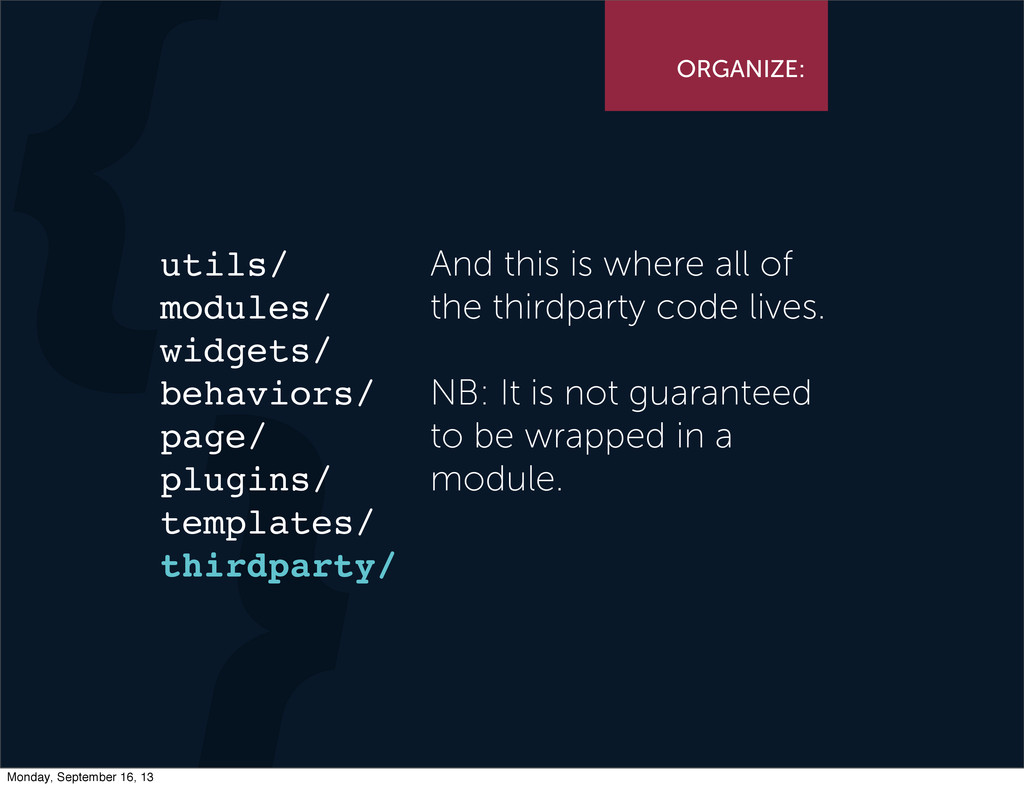
{ utils/ modules/ widgets/ behaviors/ page/ plugins/ templates/ thirdparty/ TOPIC:
ORGANIZE: And this is where all of the thirdparty code lives. NB: It is not guaranteed to be wrapped in a module. Monday, September 16, 13 -
{We had to Modularize, Organize & Standardize our JS. Monday,
September 16, 13 -
{ STANDARDIZE: We created a style guide. Optimized for context
switching between JS and Python. • No semicolons • Comma first • Opinionated http://git.io/h5ADLQ http://git.io/lDyAaA STYLE GUIDE LINTER Monday, September 16, 13 -
{ STANDARDIZE: • Use (a subset of) jQuery • Prefer
ES5 builtins (vs. Lodash, Underscore, & friends) Monday, September 16, 13 -
{ STANDARDIZE: Use Node-style callbacks for async things that happen
once. Monday, September 16, 13 -
{ Segments.get(id, function(err, segment) { if(err) { return ready(err) }
}) STANDARDIZE: A typical API. Monday, September 16, 13 -
{ Segments.get(id, onsegment) function onsegment(err, segment) { if(err) { return
ready(err) } } STANDARDIZE: Most callbacks should be hoisted, named functions. Monday, September 16, 13 -
{ function get_segment_body(id, ready) { return Segments.get(id, onsegment) function onsegment(err,
segment) { if(err) { return ready(err) } return ready(null, segment.criteria) } } STANDARDIZE: You should always delegate the error to your caller’s callback! Monday, September 16, 13 -
{ STANDARDIZE: Use Node-style event emitters for things that repeatedly
happen. Monday, September 16, 13 -
{ var EE = require('./utils/eventemitter') var ee = new EE
ee.on('eventname', function(item) { // fired on each “eventname” }) ee.emit('eventname', <anything>) STANDARDIZE: Monday, September 16, 13 -
{ var EE = require('./utils/eventemitter') var ee = new EE
ee.once('eventname', function(item) { // fired on only // the *first* “eventname” }) ee.emit('eventname', <anything>) STANDARDIZE: Monday, September 16, 13 -
{ var EE = require('./utils/eventemitter') var ee = new EE
ee.on('eventname', function(a, b) { // multiple args! }) ee.emit('eventname', 1, 2) STANDARDIZE: Monday, September 16, 13 -
{ STANDARDIZE: Use Node-style streams for series of information over
time. Monday, September 16, 13 -
{ var through = require('through') , stream = through(write) $('[name=loudify]').stream('keyup')
.pipe(stream) .pipe($('#output')) function write(input) { stream.queue(input.toUpperCase()) } STANDARDIZE: Monday, September 16, 13 -
{ // Streams take a *type* of data // turn
it into a new *type* // -- a function applied over time. var template = require('path/to/html') // for instance, templates take // Object -> String template.stream('context') STANDARDIZE: Monday, September 16, 13 -
{ // ObjectStates are streams that // listen to EE’s
(or other streams) // and produce a stream of distinct // application states var os = new ObjectState os.listen( $('[name=input]').stream() , 'data' // event to listen for , ['attr'] // attribute name to set ) os.pipe(template.stream('context')) STANDARDIZE: Monday, September 16, 13 -
{ // jQuery elements are readable // and writable. //
when written to, their innerHTML is // replaced. os .pipe(template.stream('context')) .pipe($('#target')) STANDARDIZE: Monday, September 16, 13 -
{ // example: autocomplete input_el.stream() .pipe(template('/path/{{ qs(ctxt) }}')) .pipe(debounce()) .pipe(xhr.get())
// <- backpressure .pipe(template('<html>')) .pipe(output_el) STANDARDIZE: Monday, September 16, 13 -
{ // a pattern: function transform() { var stream =
through(write) return stream function write(data) { // EXAMPLE: randomly delay // the outgoing data! setTimeout(function() { stream.queue(data) }, Math.random() * 100 + 100) } } STANDARDIZE: Monday, September 16, 13 -
{ // using the aforementioned pattern, it’s // easy to
write a stream in-situ, then // move it out to another module when // the time comes. STANDARDIZE: Monday, September 16, 13 -
{ STANDARDIZE: •All of these examples use “Popover”’s •Most of
these examples are “Picker”’s Monday, September 16, 13 -
{ STANDARDIZE: •Pickers are reused in different ways by different
products. •But they’re all implemented as streams of data over time. Monday, September 16, 13 -
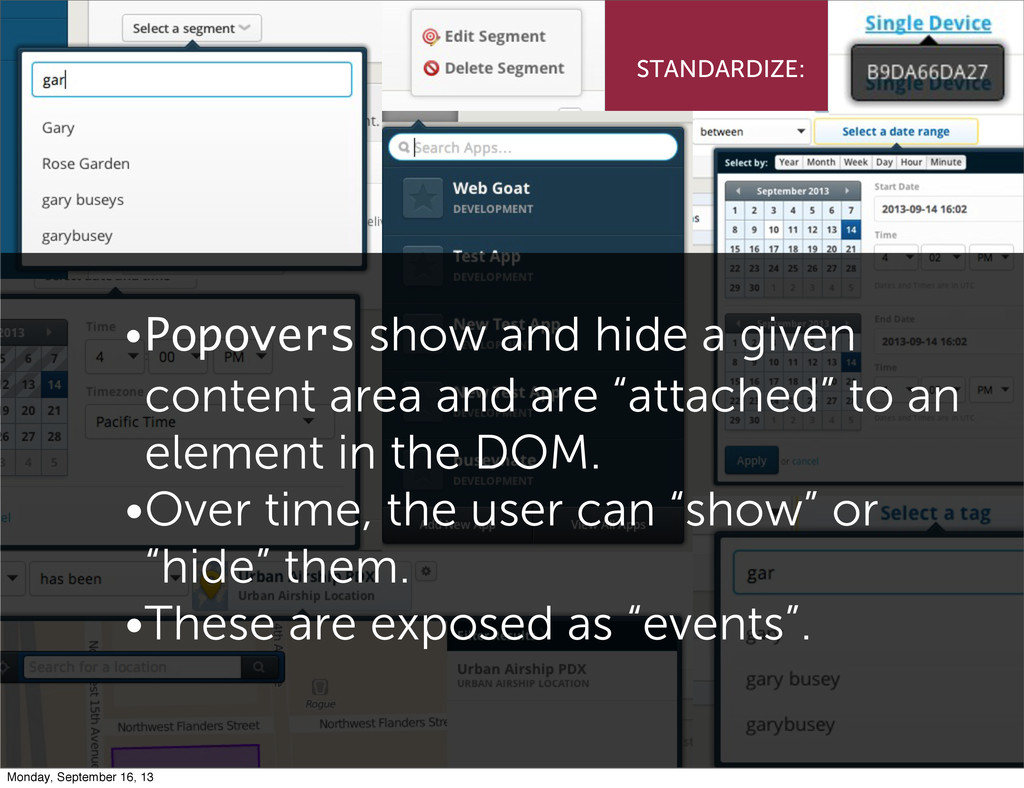
{ STANDARDIZE: •Popovers show and hide a given content area
and are “attached” to an element in the DOM. •Over time, the user can “show” or “hide” them. •These are exposed as “events”. Monday, September 16, 13 -
{ STANDARDIZE: •Some buttons have direct, one-time effects. •“Delete a
Segment” is a good example. •It happens once and either succeeds or fails •“Delete XYZ” is implemented as a callback-accepting function. Monday, September 16, 13 -
{We had to Modularize, Organize & Standardize our JS. Monday,
September 16, 13 -
{We had to Modularize, Organize & Standardize our JS. Oh,
and TEST IT. Monday, September 16, 13 -
{ suite('suite name', function(require) { test('test name', function() { assert.equal(lhs,
rhs) }) }) TESTS: Drive.JS was my first(ish) project after landing at UA. Monday, September 16, 13 -
{ suite('suite name', function(require) { test('test name', function() { assert.equal(lhs,
rhs) }) }) TESTS: Drive.JS was patterned after Mocha’s TDD UI. Monday, September 16, 13 -
{ suite('suite name', function(require) { test('test name', function() { assert.equal(lhs,
rhs) }) }) TESTS: It is both a test driver and a test runner. Monday, September 16, 13 -
{ suite('suite name', function(require) { test('test name', function() { assert.equal(lhs,
rhs) }) }) TESTS: It runs in browser and in a headless JSDOM mode for quick local tests. Monday, September 16, 13 -
{ suite('suite name', function(require) { test('test name', function() { assert.equal(lhs,
rhs) }) }) TESTS: This is just Require.JS’s require. Monday, September 16, 13 -
{ suite('suite name', function(require) { test('test name', function() { assert.equal(lhs,
rhs) }) }) TESTS: This is just the CommonJS assert module. Monday, September 16, 13 -
{ suite('suite name', function(require) { test('test name', function(done) { setTimeout(function()
{ done() }, 100 * Math.random()) }) }) TESTS: Async tests take a “done” function, and have to call it when they’re finished. Monday, September 16, 13 -
{ suite('suite name', function(require) { suite.redirects('/hardcoded', '/test') }) TESTS: Some
(bad) programs hard-code XHR URL paths. Drive lets you redirect all hardcoded paths to a different URL. Monday, September 16, 13 -
{ suite('suite name', function(require) { // yada yada }) html('../path/to/document.html')
TESTS: Point to a different HTML document to serve as the base “HTML” for this test suite. Monday, September 16, 13 -
{ endpoints({ '/test': test_url }) function test_url(req, resp) { resp.end('hey
buddy') } suite('suite name', function(require) { var request = require('./modules/request') test('suite name', function(done) { request.get('/test', function(err, data) { if(err) return done(err) assert.equal(data, 'hey buddy') }) }) }) TESTS: Stub out the server side of XHR interactions. Monday, September 16, 13 -
{ TESTS: We avoid testing direct “entry point” modules directly.
(Those are a job for Selenium!) All other modules should be tested, though. Monday, September 16, 13 -
{ FAQ: So why don’t we use an existing JS
framework? Monday, September 16, 13 -
{ FAQ: •Ember •Backbone •Spine •BatmanJS •Knockout •AngularJS •JavaScriptMVC •Polymer
•... Monday, September 16, 13 -
{ FAQ: We are not precluded from using these frameworks.
Our system only dictates that we use CommonJS modules. Monday, September 16, 13 -
{ FAQ: That said, it’s my opinion that these frameworks
don’t really fit our problem space. Monday, September 16, 13 -
{ FAQ: Nope. We use quite a few popular frameworks
and libraries. Monday, September 16, 13 -
{ FAQ: jQuery, D3, Highcharts, Flot, Polymaps, Require.JS, Browserify, Through,
Duplexer, ES5-shim, AnalyticsJS, Esprima, Falafel, ... Monday, September 16, 13 -
{ FAQ: ...With the potential to use many more as
we move to browserify and NPM. Monday, September 16, 13 -
{ FAQ: npm: 41k packages bower: 4245 repos component: 1263
packages ... (not to mention volo, ender, and friends.) Monday, September 16, 13