Upgrade to Pro — share decks privately, control downloads, hide ads and more …

Swift the Euler Way

Sponsored · Your Podcast. Everywhere. Effortlessly. Share. Educate. Inspire. Entertain. You do you. We'll handle the rest.

Swift the Euler Way

Quick notes on learning functional Swift with Project Euler. Presented at the Brooklyn Swift Meetup in July 28, 2015

http://www.meetup.com/Brooklyn-Swift-Developers/
https://github.com/dbgrandi/EulerKit
https://twitter.com/dbgrandi

Avatar for David Grandinetti

David Grandinetti

July 28, 2015
Tweet

More Decks by David Grandinetti

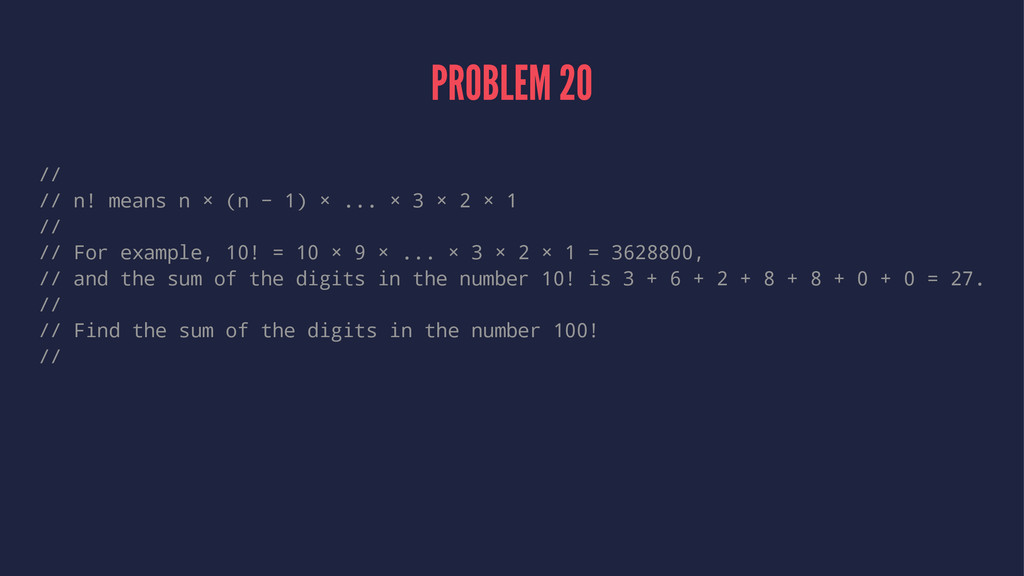
Other Decks in Technology

Transcript

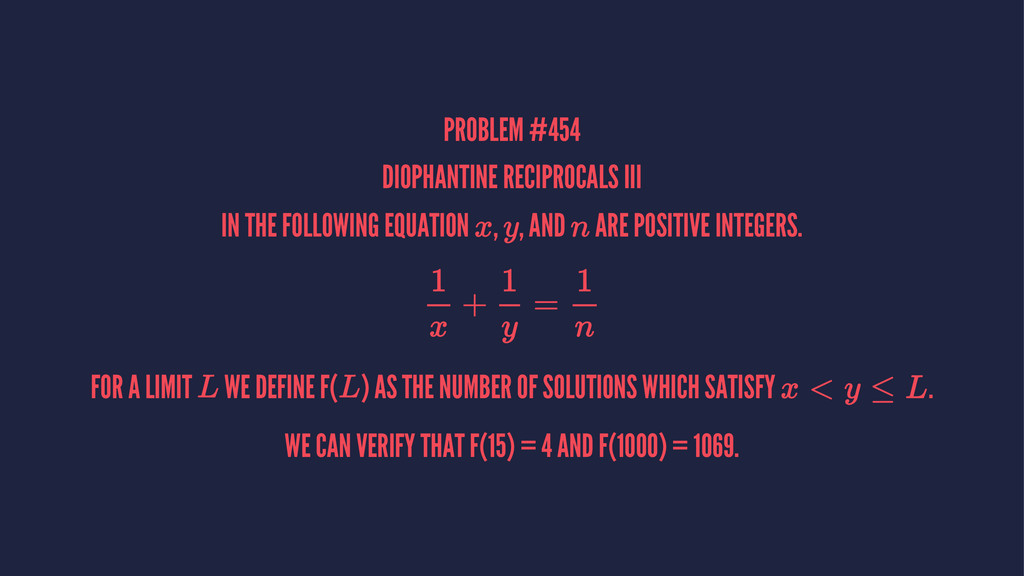
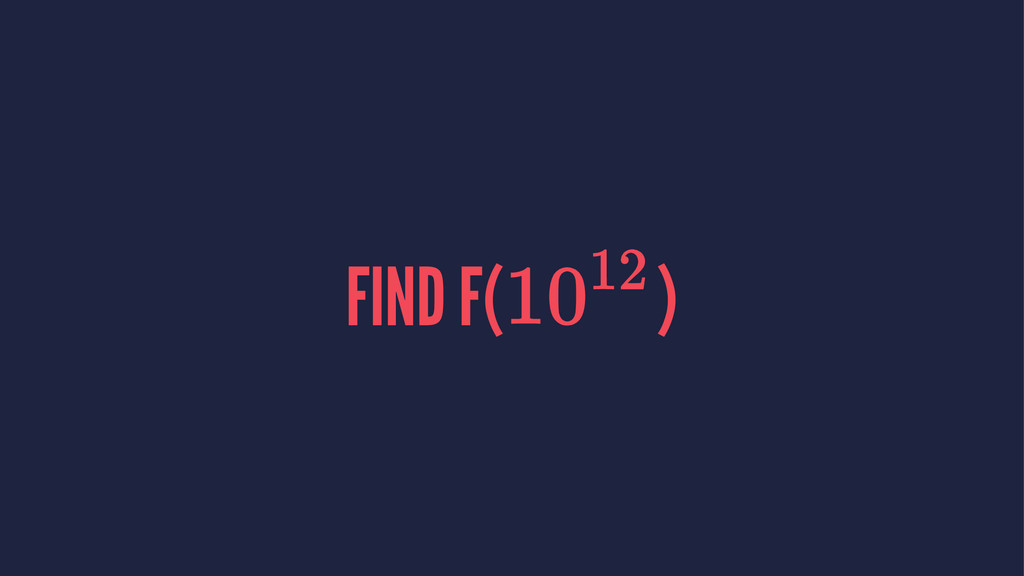
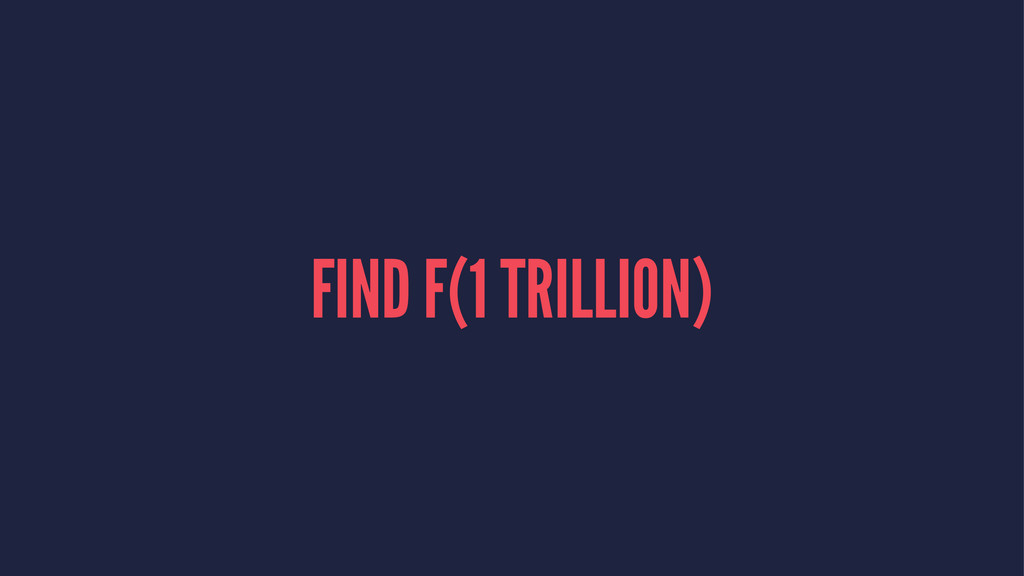
  1. PROBLEM #454 DIOPHANTINE RECIPROCALS III IN THE FOLLOWING EQUATION ,

    , AND ARE POSITIVE INTEGERS. FOR A LIMIT WE DEFINE F( ) AS THE NUMBER OF SOLUTIONS WHICH SATISFY . WE CAN VERIFY THAT F(15) = 4 AND F(1000) = 1069.
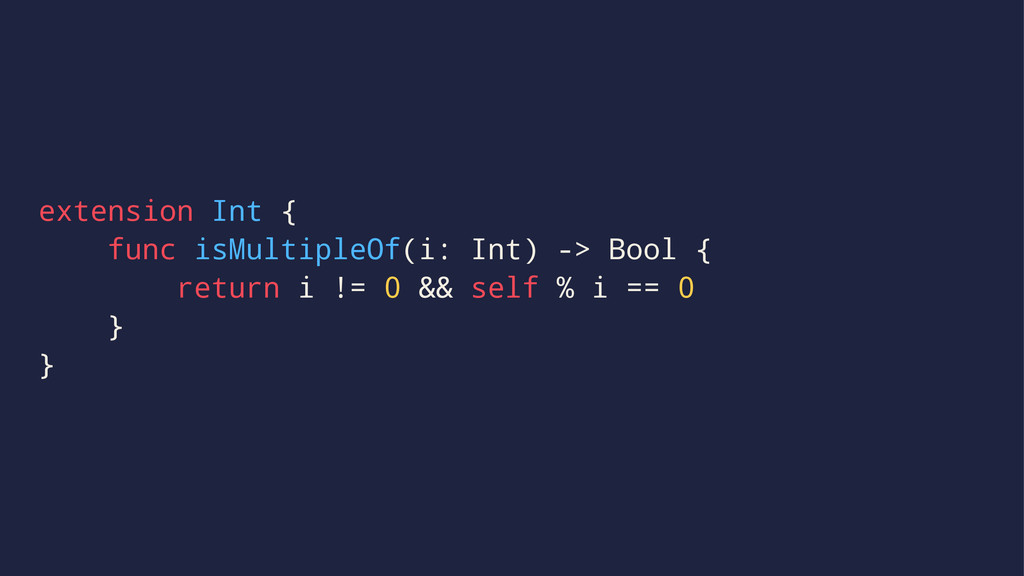
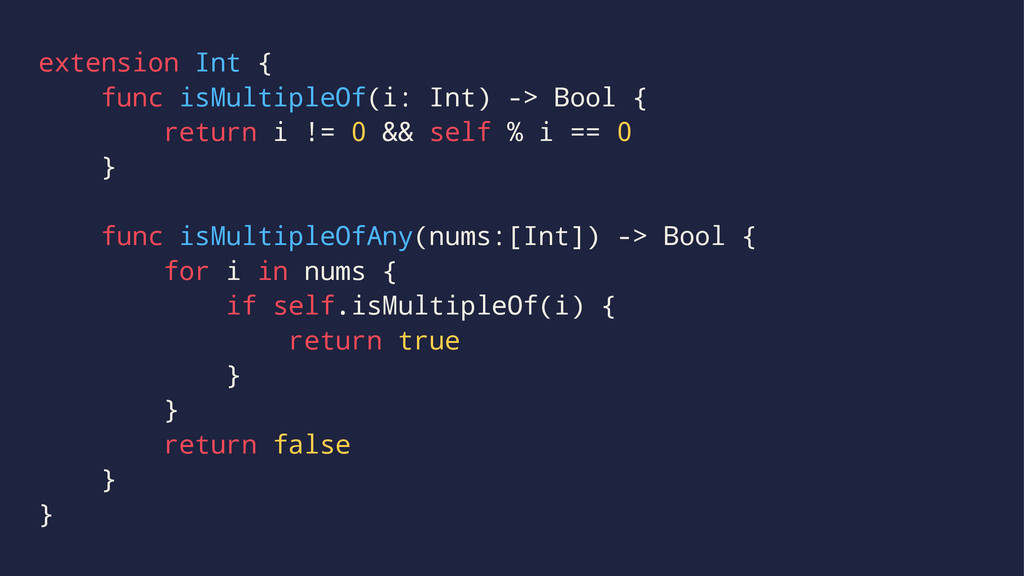
  2. extension Int { func isMultipleOf(i: Int) -> Bool { return

    i != 0 && self % i == 0 } func isMultipleOfAny(nums:[Int]) -> Bool { for i in nums { if self.isMultipleOf(i) { return true } } return false } }
  3. extension Int { func isMultipleOf(i: Int) -> Bool { return

    i != 0 && self % i == 0 } func isMultipleOfAny(nums:[Int]) -> Bool { return nums.map(isMultipleOf).reduce(false) {$0 || $1} } }
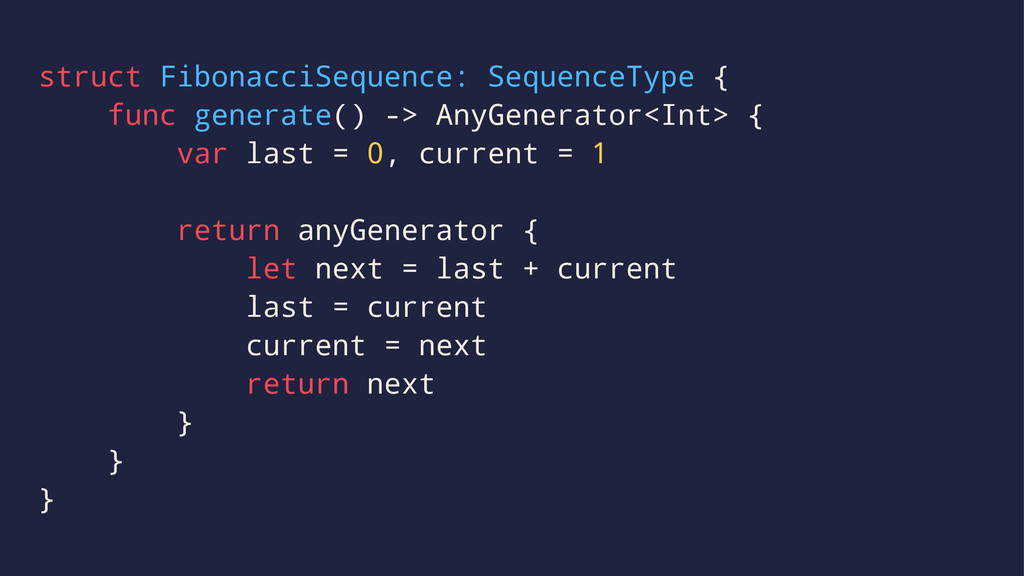
  4. struct FibonacciSequence: SequenceType { func generate() -> AnyGenerator<Int> { var

    last = 0, current = 1 return anyGenerator { let next = last + current last = current current = next return next } } }
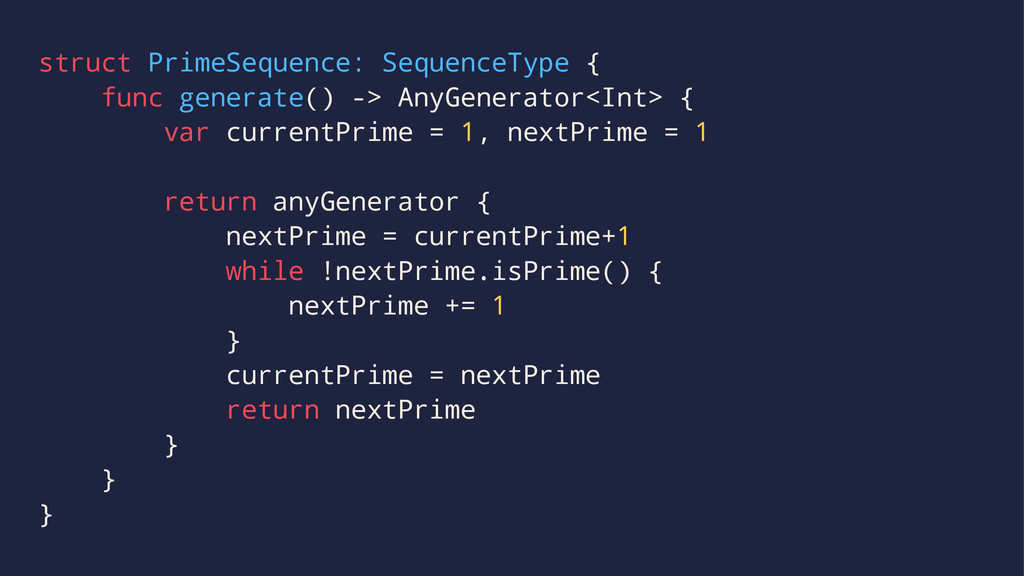
  5. struct PrimeSequence: SequenceType { func generate() -> AnyGenerator<Int> { var

    currentPrime = 1, nextPrime = 1 return anyGenerator { nextPrime = currentPrime+1 while !nextPrime.isPrime() { nextPrime += 1 } currentPrime = nextPrime return nextPrime } } }
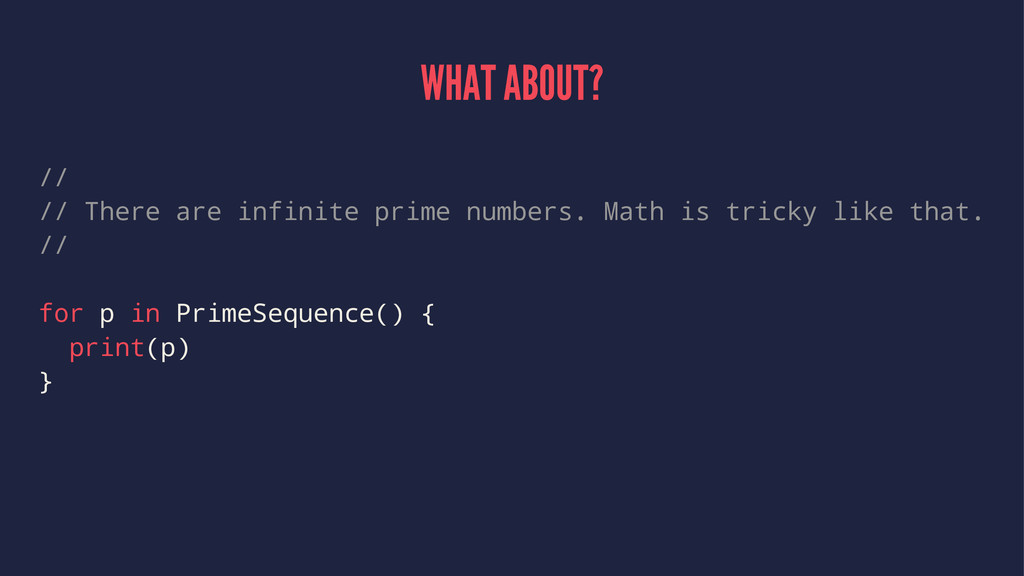
  6. WHAT ABOUT? // // There are infinite prime numbers. Math

    is tricky like that. // for p in PrimeSequence() { print(p) }
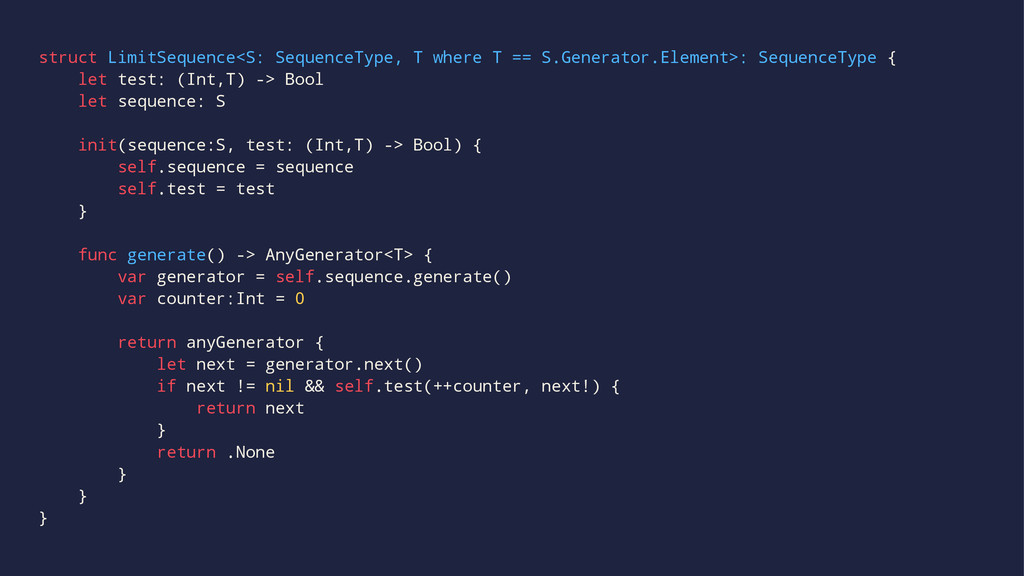
  7. struct LimitSequence<S: SequenceType, T where T == S.Generator.Element>: SequenceType {

    let test: (Int,T) -> Bool let sequence: S init(sequence:S, test: (Int,T) -> Bool) { self.sequence = sequence self.test = test } func generate() -> AnyGenerator<T> { var generator = self.sequence.generate() var counter:Int = 0 return anyGenerator { let next = generator.next() if next != nil && self.test(++counter, next!) { return next } return .None } } }
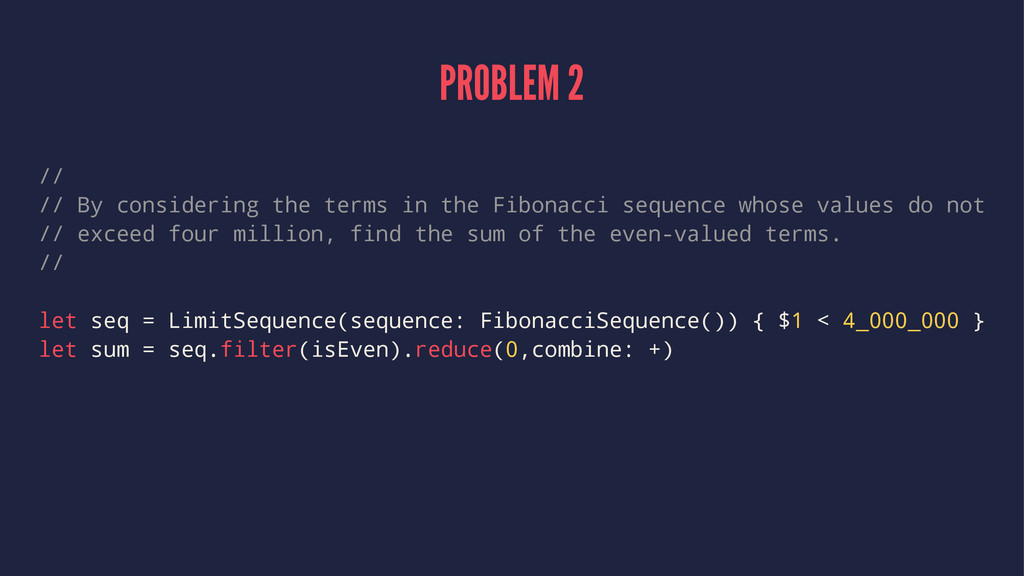
  8. PROBLEM 2 // // By considering the terms in the

    Fibonacci sequence whose values do not // exceed four million, find the sum of the even-valued terms. // let seq = LimitSequence(sequence: FibonacciSequence()) { $1 < 4_000_000 } let sum = seq.filter(isEven).reduce(0,combine: +)
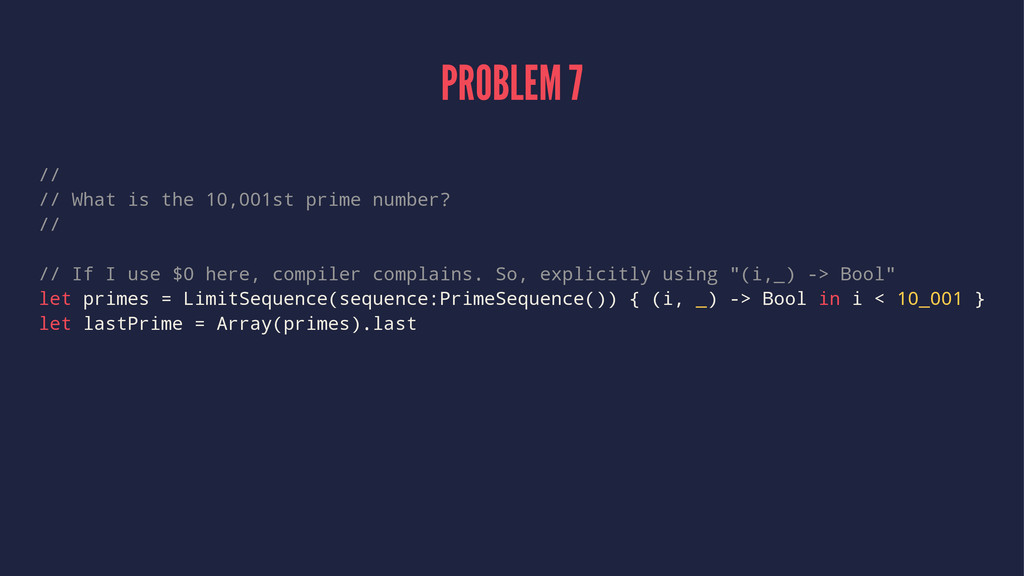
  9. PROBLEM 7 // // What is the 10,001st prime number?

    // // If I use $0 here, compiler complains. So, explicitly using "(i,_) -> Bool" let primes = LimitSequence(sequence:PrimeSequence()) { (i, _) -> Bool in i < 10_001 } let lastPrime = Array(primes).last
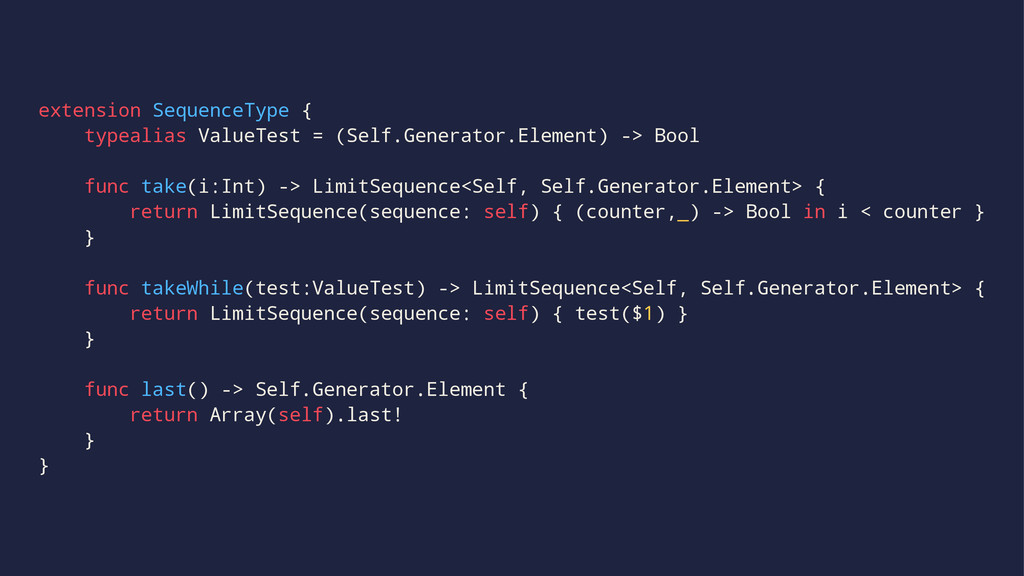
  10. extension SequenceType { typealias ValueTest = (Self.Generator.Element) -> Bool func

    take(i:Int) -> LimitSequence<Self, Self.Generator.Element> { return LimitSequence(sequence: self) { (counter,_) -> Bool in i < counter } } func takeWhile(test:ValueTest) -> LimitSequence<Self, Self.Generator.Element> { return LimitSequence(sequence: self) { test($1) } } func last() -> Self.Generator.Element { return Array(self).last! } }
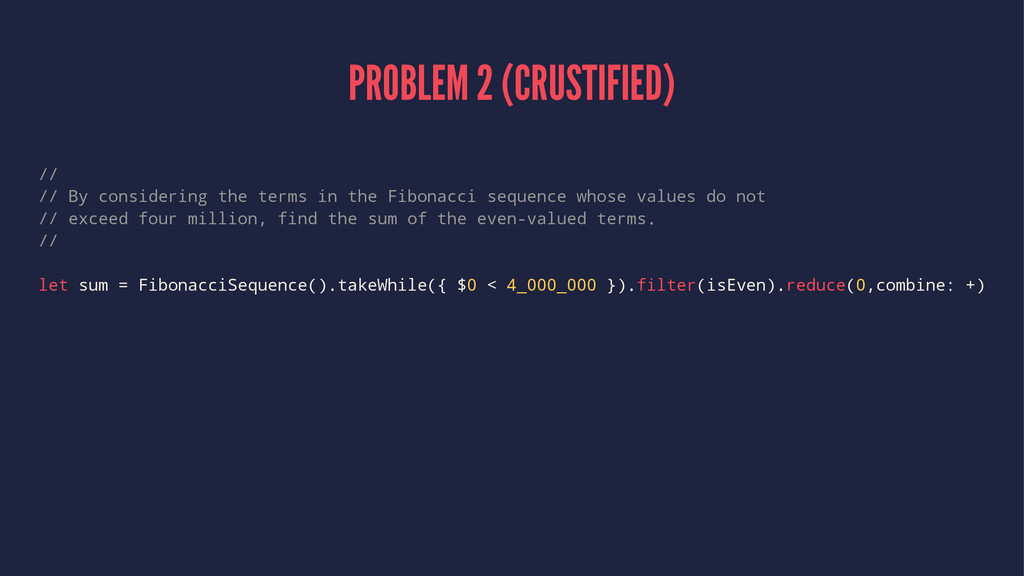
  11. PROBLEM 2 (CRUSTIFIED) // // By considering the terms in

    the Fibonacci sequence whose values do not // exceed four million, find the sum of the even-valued terms. // let sum = FibonacciSequence().takeWhile({ $0 < 4_000_000 }).filter(isEven).reduce(0,combine: +)
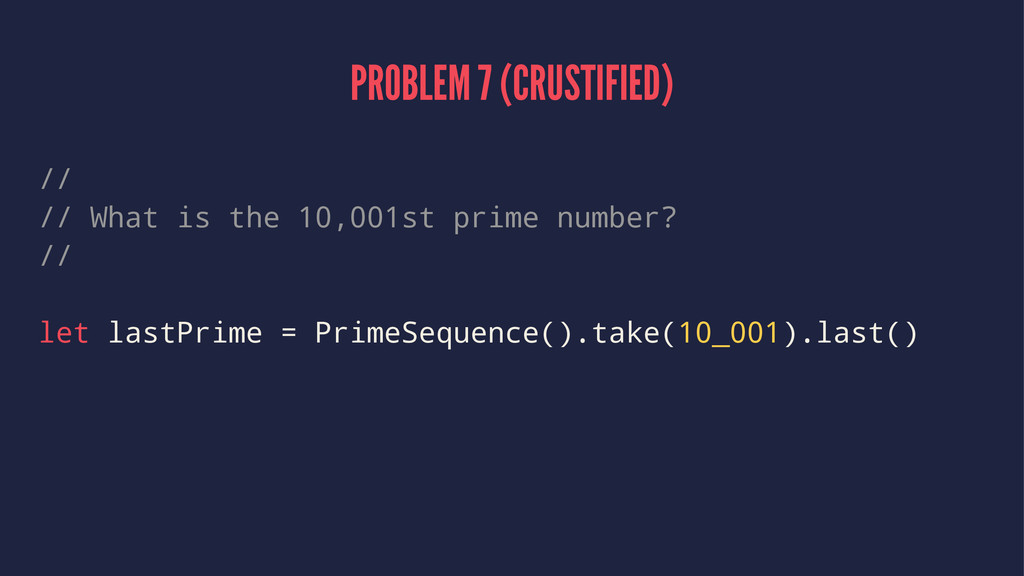
  12. PROBLEM 7 (CRUSTIFIED) // // What is the 10,001st prime

    number? // let lastPrime = PrimeSequence().take(10_001).last()
  13. PROBLEM 20 // // n! means n × (n −

    1) × ... × 3 × 2 × 1 // // For example, 10! = 10 × 9 × ... × 3 × 2 × 1 = 3628800, // and the sum of the digits in the number 10! is 3 + 6 + 2 + 8 + 8 + 0 + 0 = 27. // // Find the sum of the digits in the number 100! //
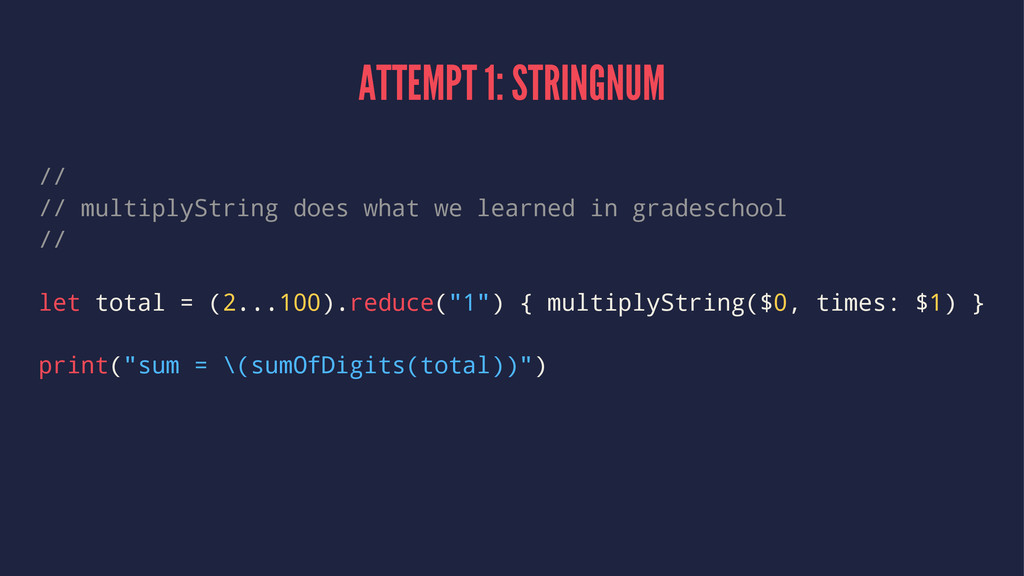
  14. ATTEMPT 1: STRINGNUM // // multiplyString does what we learned

    in gradeschool // let total = (2...100).reduce("1") { multiplyString($0, times: $1) } print("sum = \(sumOfDigits(total))")
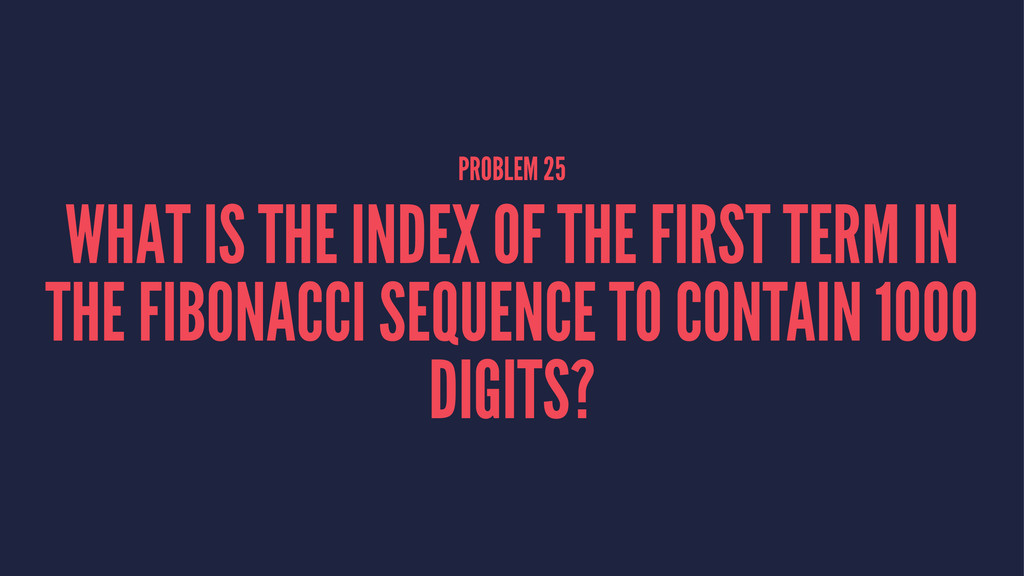
  15. PROBLEM 25 WHAT IS THE INDEX OF THE FIRST TERM

    IN THE FIBONACCI SEQUENCE TO CONTAIN 1000 DIGITS?
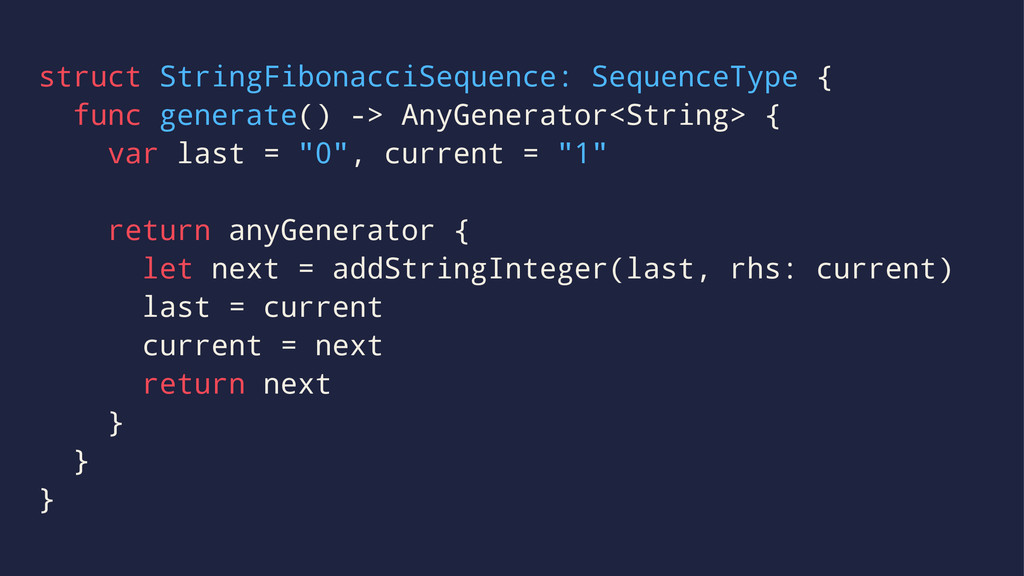
  16. struct StringFibonacciSequence: SequenceType { func generate() -> AnyGenerator<String> { var

    last = "0", current = "1" return anyGenerator { let next = addStringInteger(last, rhs: current) last = current current = next return next } } }
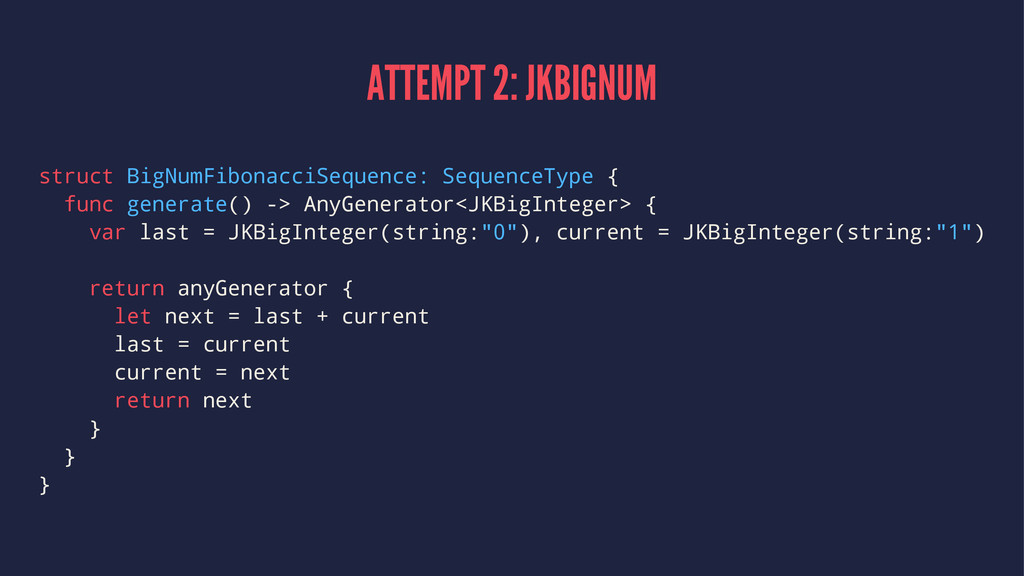
  17. ATTEMPT 2: JKBIGNUM struct BigNumFibonacciSequence: SequenceType { func generate() ->

    AnyGenerator<JKBigInteger> { var last = JKBigInteger(string:"0"), current = JKBigInteger(string:"1") return anyGenerator { let next = last + current last = current current = next return next } } }
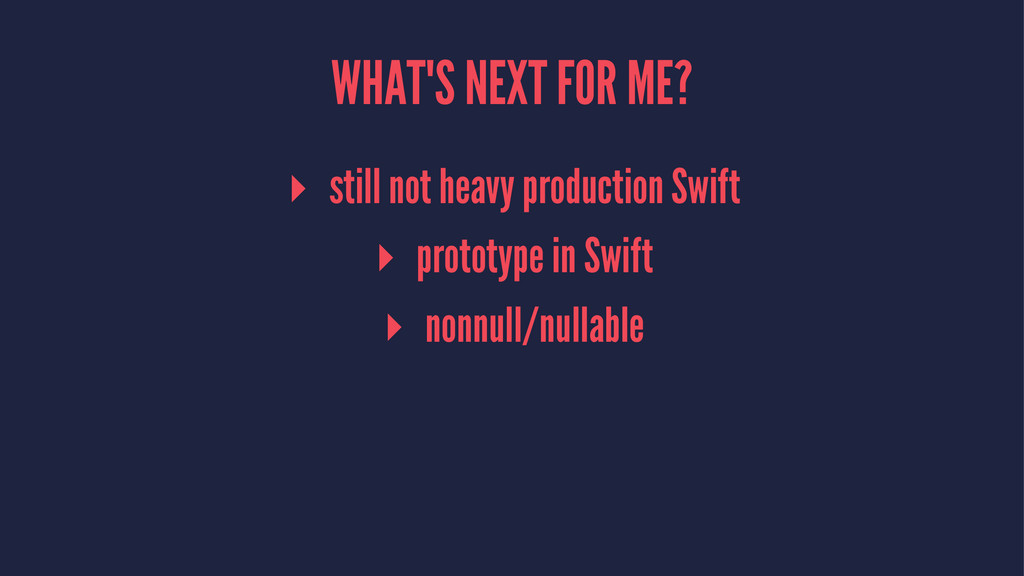
  18. WHAT'S NEXT FOR ME? ▸ still not heavy production Swift

    ▸ prototype in Swift ▸ nonnull/nullable
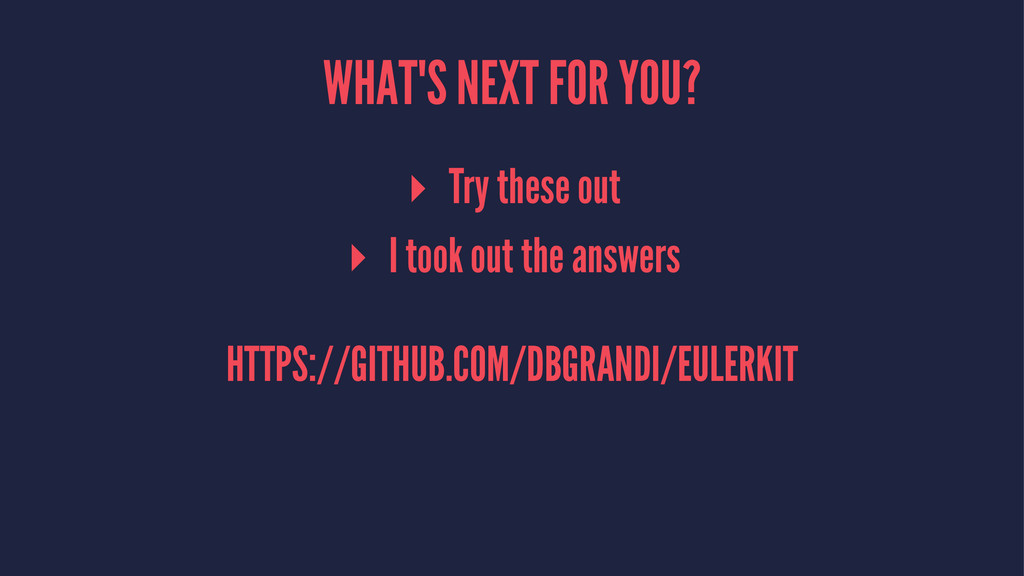
  19. WHAT'S NEXT FOR YOU? ▸ Try these out ▸ I

    took out the answers HTTPS://GITHUB.COM/DBGRANDI/EULERKIT
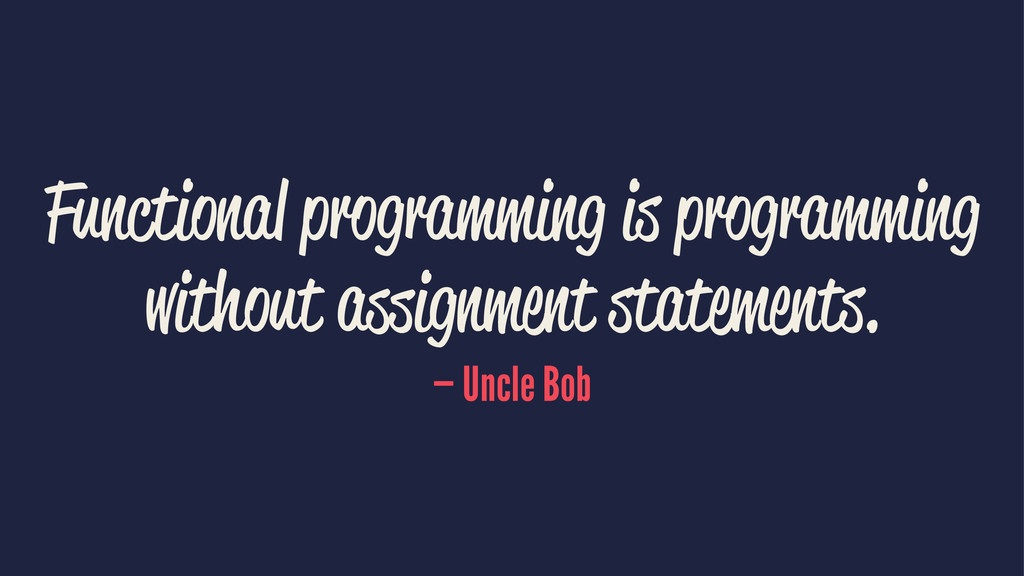
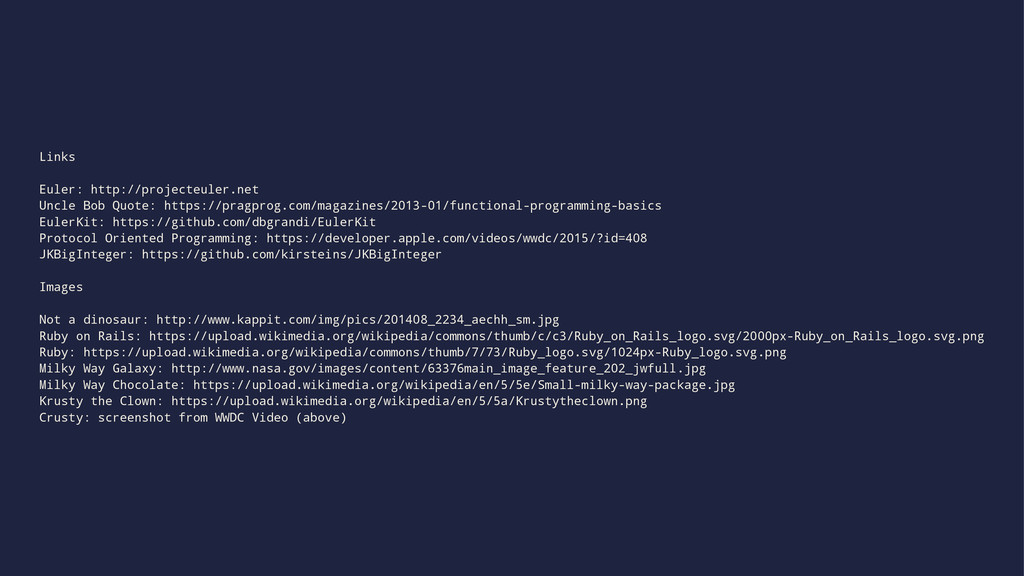
  20. Links Euler: http://projecteuler.net Uncle Bob Quote: https://pragprog.com/magazines/2013-01/functional-programming-basics EulerKit: https://github.com/dbgrandi/EulerKit Protocol

    Oriented Programming: https://developer.apple.com/videos/wwdc/2015/?id=408 JKBigInteger: https://github.com/kirsteins/JKBigInteger Images Not a dinosaur: http://www.kappit.com/img/pics/201408_2234_aechh_sm.jpg Ruby on Rails: https://upload.wikimedia.org/wikipedia/commons/thumb/c/c3/Ruby_on_Rails_logo.svg/2000px-Ruby_on_Rails_logo.svg.png Ruby: https://upload.wikimedia.org/wikipedia/commons/thumb/7/73/Ruby_logo.svg/1024px-Ruby_logo.svg.png Milky Way Galaxy: http://www.nasa.gov/images/content/63376main_image_feature_202_jwfull.jpg Milky Way Chocolate: https://upload.wikimedia.org/wikipedia/en/5/5e/Small-milky-way-package.jpg Krusty the Clown: https://upload.wikimedia.org/wikipedia/en/5/5a/Krustytheclown.png Crusty: screenshot from WWDC Video (above)