Share
Embed
Evolving ftrace on arm64
The Linux kernel’s ftrace mechanism makes it possible to dynamically attach hooks to kernel functions, and can be used for a variety of purposes including tracing, debugging, and live-patching.
The low-level details of ftrace differ by architecture, and recently the arm64’s ftrace implementation has evolved substantially with the implementation of DYNAMIC_FTRACE_WITH_ARGS and DYNAMIC_FTRACE_WITH_CALL_OPS, which enable richer, lower overhead tracing with relatively simple and
maintainable architecture code.
This walk will cover the low-level details of arm64’s ftrace implementation, how it works, and why certain design choices were made.
Mark Rutland
Kernel Recipes PRO
September 29, 2023
Transcript
35 slides
-
© 2023 Arm Mark Rutland <[email protected]> 2023-09-27 Evolving ftrace on
arm64 Kernel Recipes -
2 © 2023 Arm ftrace What is it? A framework
for attaching tracers to kernel functions • … dynamically at runtime • … without explicit calls in source code Tracers aren’t just for tracing! • Used for fault-injection, live-patching, etc Used in production environments • Must be safe and robust • Must have minimal overhead Requires some architecture-specific code # mount -t tracefs none /sys/kernel/tracing/ # echo function_graph > /sys/kernel/tracing/current_tracer # cat /sys/kernel/tracing/trace # tracer: function_graph # # CPU DURATION FUNCTION CALLS # | | | | | | | 0) | do_el0_svc() { 0) | el0_svc_common.constprop.0() { 0) | invoke_syscall() { 0) | __arm64_sys_fcntl() { 0) | __fdget_raw() { 0) 0.250 us | __fget_light(); 0) 0.750 us | } 0) 0.208 us | security_file_fcntl(); 0) | do_fcntl() { 0) 0.208 us | _raw_spin_lock(); 0) 0.250 us | _raw_spin_unlock(); 0) 1.125 us | } 0) 2.917 us | } 0) 3.375 us | } 0) 3.875 us | } 0) 4.334 us | } -
3 © 2023 Arm ftrace In abstract caller(..) { ..
function(); .. } function(..) { .. .. } -
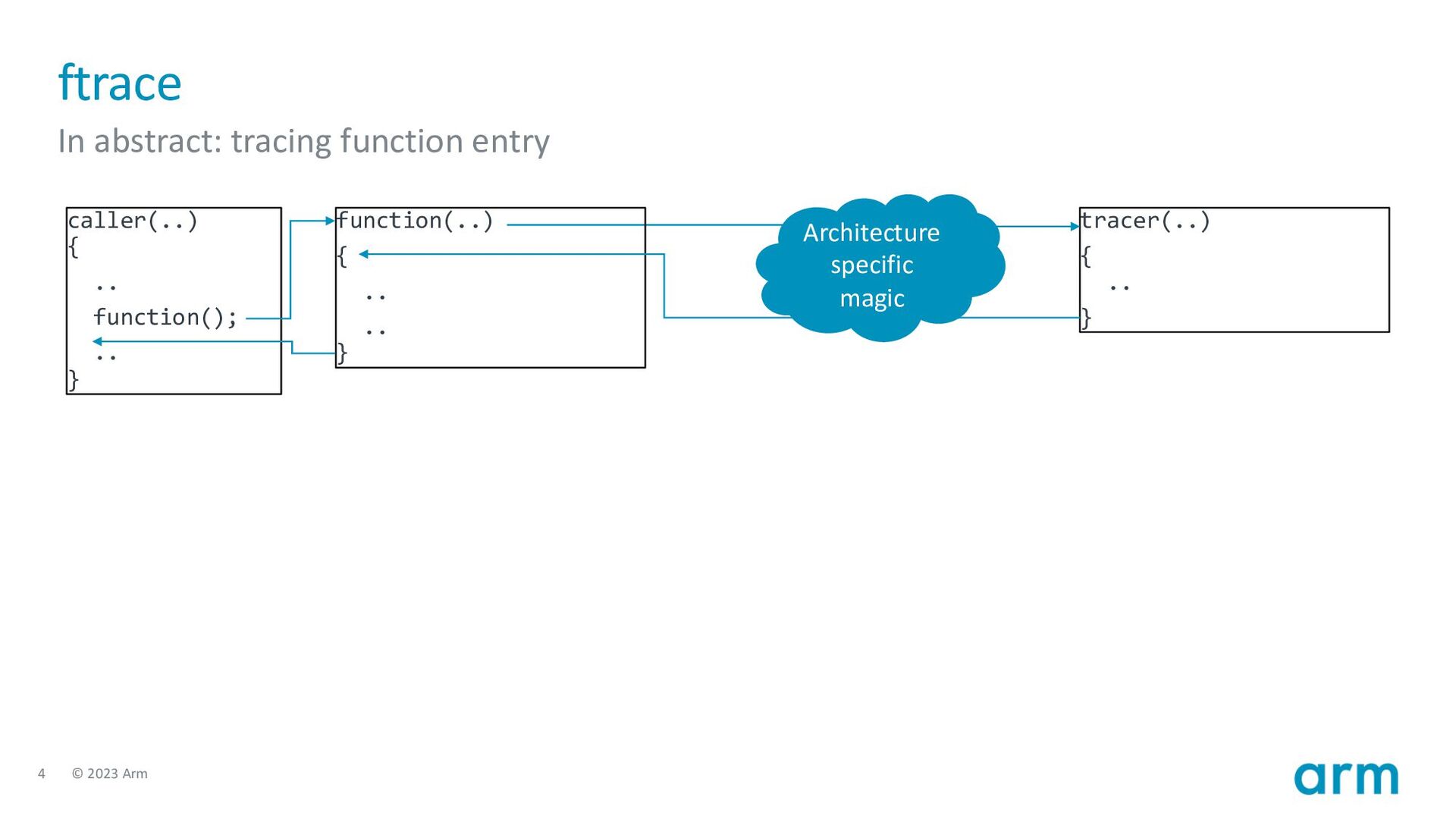
4 © 2023 Arm ftrace In abstract: tracing function entry
caller(..) { .. function(); .. } tracer(..) { .. } Architecture specific magic function(..) { .. .. } -
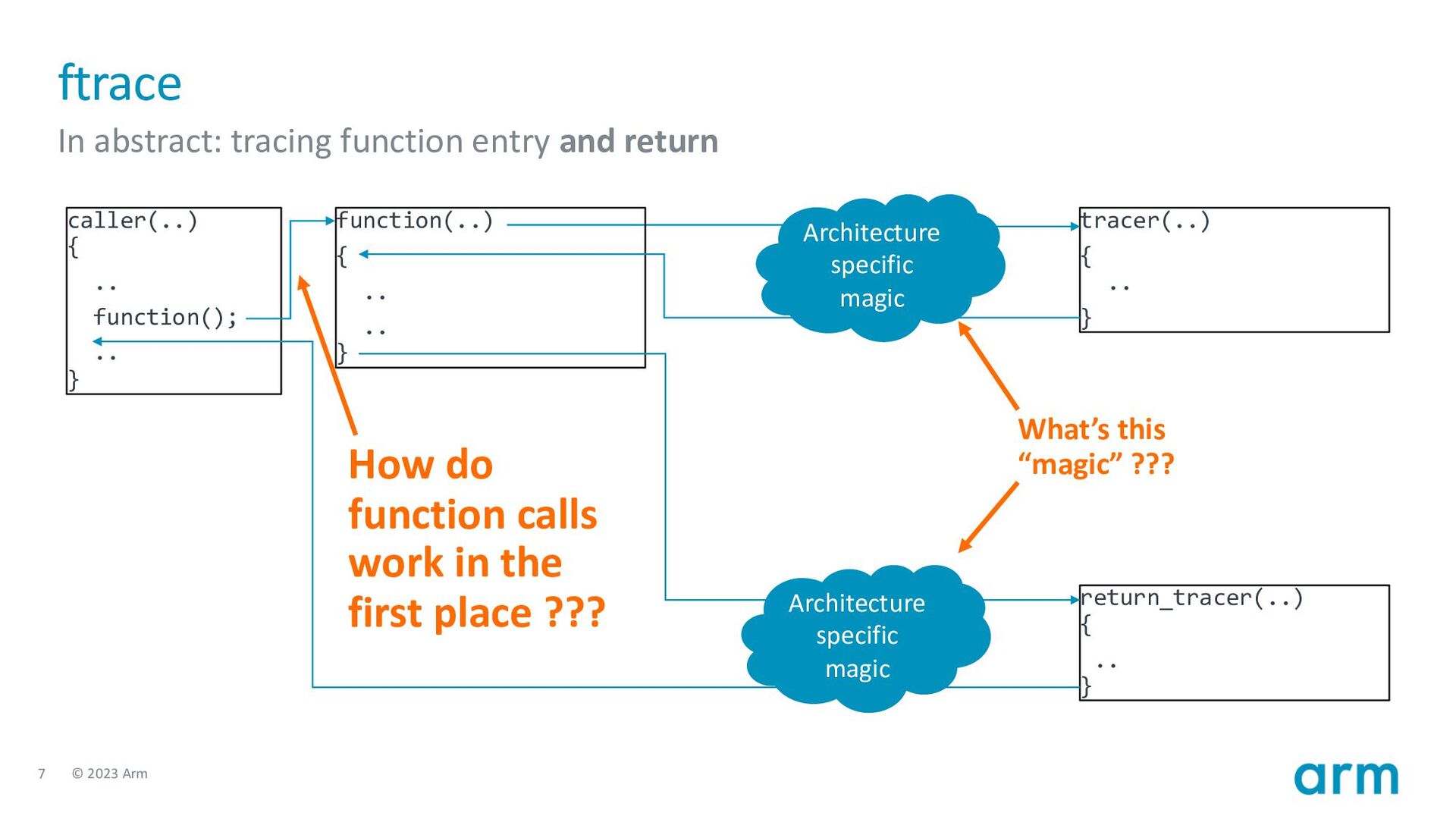
5 © 2023 Arm ftrace In abstract: tracing function entry
and return caller(..) { .. function(); .. } tracer(..) { .. } return_tracer(..) { .. } Architecture specific magic function(..) { .. .. } Architecture specific magic -
6 © 2023 Arm ftrace In abstract: tracing function entry
and return caller(..) { .. function(); .. } tracer(..) { .. } return_tracer(..) { .. } function(..) { .. .. } What’s this “magic” ??? Architecture specific magic Architecture specific magic -
7 © 2023 Arm ftrace In abstract: tracing function entry
and return caller(..) { .. function(); .. } tracer(..) { .. } return_tracer(..) { .. } function(..) { .. .. } What’s this “magic” ??? Architecture specific magic Architecture specific magic How do function calls work in the first place ??? -
8 © 2023 Arm Function calls on arm64 The Link
Register (LR), Frame Pointer (FP), and Frame Records <foo>: stp fp, lr, [sp, #16]! mov fp, sp .. bl <bar> .. ldp fp, lr, [sp], #16! ret <bar>: stp fp, lr, [sp, #-64]! mov fp, sp .. bl <baz> .. ldp fp, lr, [sp], #64! ret <baz>: mov x0, #-EBUSY ret -
9 © 2023 Arm Magic v1: mcount GCC and LLVM
support the gprof profiler with the -pg compiler option • Inserts calls to mcount at function entry • Compiler saves/restores registers, etc Compiler doesn’t provide mcount itself • Usually provided by gprof • We can write our own! We can write our own mcount which calls tracers! <function>: stp fp, lr, [sp, #-16]! mov fp, sp mov x0, lr bl _mcount .. .. // function body here .. ldp fp, lr, [sp], #16 ret -
10 © 2023 Arm Magic v1: mcount Using mcount as
a trampoline caller(..) { .. function(); .. } tracer(..) { .. } function(..) { .. .. } <_mcount>: .. ldr x0, =trace_func ldr x2, x0 .. blr x2 .. .. ret -
11 © 2023 Arm Magic v1: mcount Using mcount as
a trampoline caller(..) { .. function(); .. } tracer(..) { .. } function(..) { .. .. } <_mcount>: .. ldr x0, =trace_func ldr x2, x0 .. blr x2 .. .. ret What about the return??? -
12 © 2023 Arm Magic v1.1: mcount + return Modifying
the frame record The compiler stores the return address to the stack before calling mcount • Placed in a frame record pointed to by the FP When mcount is called, the FP points to the traced function’s frame record • So mcount can read/write the traced function’s LR We can make the traced function return to a tracer by modifying the saved LR! <function>: stp fp, lr, [sp, #-16]! mov fp, sp mov x0, lr bl _mcount .. .. // function body here .. ldp fp, lr, [sp], #16 ret -
13 © 2023 Arm Magic v1.1: mcount + return Modifying
the frame record caller(..) { .. function(); .. } tracer(..) { .. } return_tracer(..) { .. } function(..) { .. .. } <_mcount>: .. ldr x0, =trace_func ldr x2, x0 .. blr x2 // swap saved LR .. ret <return_to_handler>: .. blr <tmp> // restore orig LR ret -
14 © 2023 Arm Magic v1.1: mcount + return Modifying
the frame record caller(..) { .. function(); .. } tracer(..) { .. } return_tracer(..) { .. } function(..) { .. .. } <_mcount>: .. ldr x0, =trace_func ldr x2, x0 .. blr x2 // swap saved LR .. ret <return_to_handler>: .. blr <tmp> // restore orig LR ret Do we always need to call mcount ??? -
15 © 2023 Arm Magic v1.2: disabling mcount Functions aren’t
traced all the time • Tracing usage is generally bursty • Few functions are live-patched Traceable functions always call mcount • Buy one function call, get one free… We can patch the function call to remove the overhead: • Enabled à BL _mcount • Disabled à NOP Bonus: we can patch the tracer call in the trampoline, too <function>: stp fp, lr, [sp, #-16]! mov fp, sp mov x0, lr bl _mcount ⇔ nop .. .. // function body here .. ldp fp, lr, [sp], #16 ret -
16 © 2023 Arm Magic v1.2: mcount + return +
disabling What do we have so far? A mechanism to hook function entry • Compiler instrumentation with mcount • An entry trampoline (the mcount function) A mechanism to hook function returns • Only requires the entry hook to modify the return address • A return trampoline (the return_to_handler function) A mechanism to dynamically enable/disable hooks • Runtime instruction patching -
17 © 2023 Arm Pointer authentication A new challenge Security
feature in ARMv8.3-A (~2017) • Protects against ROP (and JOP) attacks Compiler inserts two new hint instructions • PACIASP signs LR against SP • AUTIASP authenticates LR against same SP • Authentication failure is fatal <function>: paciasp stp fp, lr, [sp, #-16]! mov fp, sp .. .. .. .. ldp fp, lr, [sp], #16 autiasp ret -
18 © 2023 Arm Pointer authentication A new challenge Security
feature in ARMv8.3-A (~2017) • Protects against ROP (and JOP) attacks • i.e. prevents modification of saved LR Compiler inserts two new hint instructions • PACIASP signs LR against SP • AUTIASP authenticates LR against same SP • Authentication failure is fatal The SP changes between function entry and call to mcount! • In mcount we don’t know the offset • mcount cannot safely change the saved LR • Incompatible with return tracing! <function>: paciasp stp fp, lr, [sp, #-16]! mov fp, sp .. mov x0, lr bl _mcount .. ldp fp, lr, [sp], #16 autiasp ret -
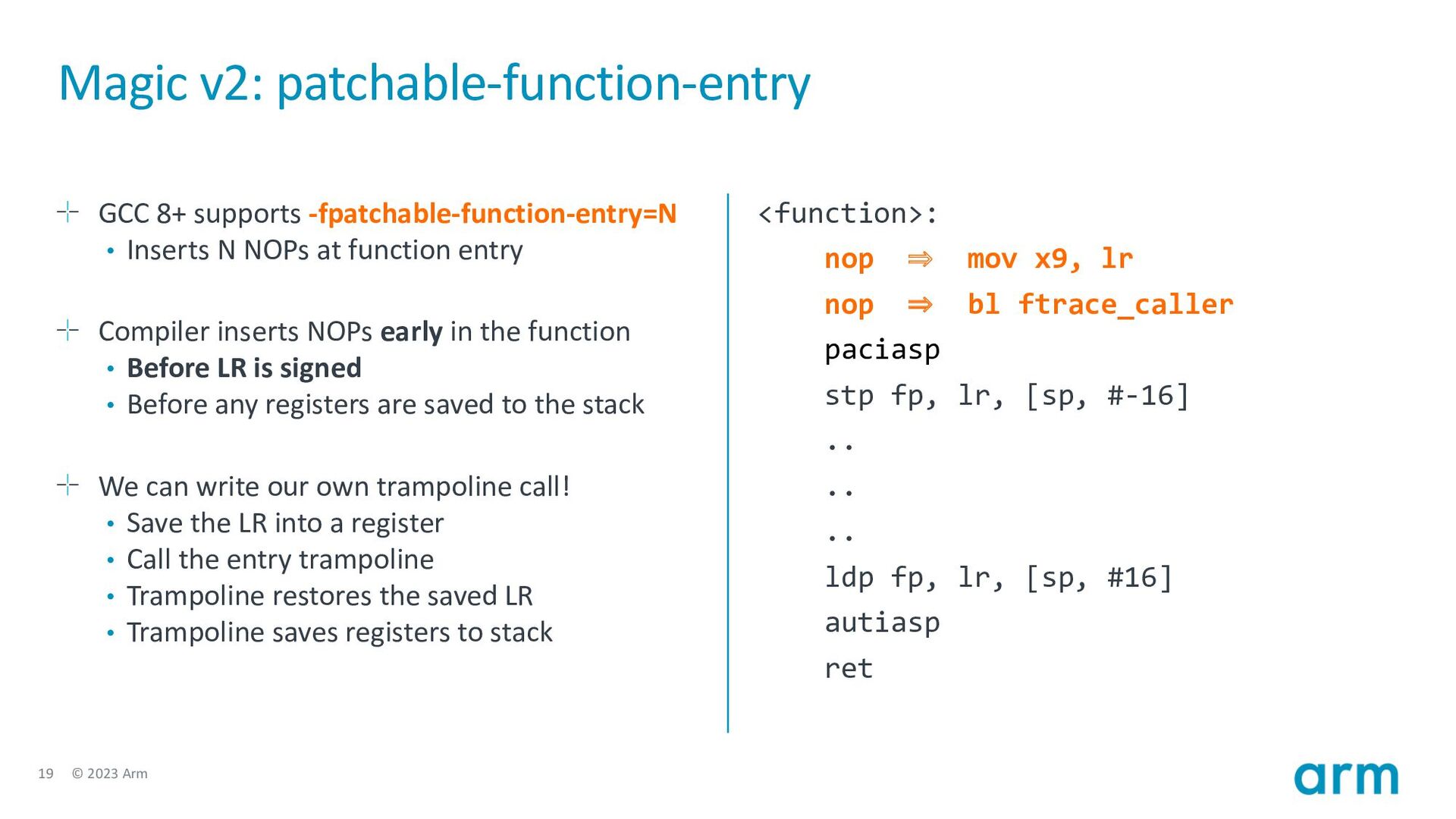
19 © 2023 Arm Magic v2: patchable-function-entry GCC 8+ supports
-fpatchable-function-entry=N • Inserts N NOPs at function entry Compiler inserts NOPs early in the function • Before LR is signed • Before any registers are saved to the stack We can write our own trampoline call! • Save the LR into a register • Call the entry trampoline • Trampoline restores the saved LR • Trampoline saves registers to stack <function>: nop ⇒ mov x9, lr nop ⇒ bl ftrace_caller paciasp stp fp, lr, [sp, #-16] .. .. .. ldp fp, lr, [sp, #16] autiasp ret -
20 © 2023 Arm Magic v2: patchable-function-entry It’s practically the
same! caller(..) { .. function(); .. } tracer(..) { .. } return_tracer(..) { .. } <function>: mov x9, lr bl ftrace_caller paciasp .. autiasp ret <ftrace_caller>: mov x10, lr mov lr, x9 // save registers .. blr x2 // swap saved LR // restore registers ret x10 <return_to_handler>: .. blr <tmp> // restore orig LR ret -
21 © 2023 Arm Magic v2: patchable-function-entry Much better code
generation! <get_cpu_ops>: nop ⇒ mov x9, lr nop ⇒ bl ftrace_caller adrp x1, cpu_ops add x1, x1, #:lo12:cpu_ops ldr x0, [x1, w0, sxtw #3] ret plain mcount patchable-function-entry <get_cpu_ops>: stp fp, lr, [sp, #-32]! mov fp, sp str x19, [sp, #16] mov w19, w0 mov x0, x30 bl _mcount adrp x1, cpu_ops add x1, x1, #:l012:cpu_ops ldr x0, [x1, w19, sxtw #3] ldr x19, [sp, #16] ldp fp, lr, [sp], #32 ret <get_cpu_ops>: adrp x1, cpu_ops add x1, x1, #:lo12:cpu_ops ldr x0, [x1, w0, sxtw #3] ret -
22 © 2023 Arm Magic v2.1: patchable-function-entry + ??? Increasingly
likely that different functions have different tracers attached: • Some functions might have live-patches applied • … and some other functions might be hooked by BPF • … and all functions might be traced by the graph tracer Our ftrace_caller trampoline can only call a single tracer • A special tracer (ftrace_ops_list_func) handles multiplexing tracers • … which iterates over all registered tracers • … which ends up being much more expensive than a single call Some architectures JIT trampolines at runtime • Using distinct trampolines for different functions • … but this isn’t feasible on arm64 -
23 © 2023 Arm Magic v2.1: patchable-function-entry + ??? Why
not JIT trampolines at runtime? Kernels and modules are big: • Kernels are regularly ~60MiB, debug kernels ~200+ MiB, allyesconfig kernels ~900+ MiB • Some people are regularly using 128+ MiB modules (seriously) • VA space reserved for modules is 2GiB B and BL have limited range: +/-128MiB • Need PLTs / veneers with BR to branch further • PLTs need to be generated at (dynamic) link time Can’t use indirect branches to reach trampolines • CMODX + memory ordering + races prevent patching multiple instructions atomically • Live-patching multi-instruction sequences is expensive and very painful • … we need this to be robust -
24 © 2023 Arm Magic v2.1: patchable-function-entry + per-callsite ops
Both GCC and LLVM support -fpatchable-function-entry=N,M • Inserts M NOPs before function entry • Inserts M-N NOPs at function entry GCC and LLVM also support -falign-functions=N • Aligns function entrypoints to N bytes We can reserve 8 bytes before the function • We can use this for data, not instructions • Place a pointer to the tracer here • Patch the pointer atomically • … and have the entry trampoline find this based on the LR <function – 8>: nop ⇒ lower_32_bits(tracer) nop ⇒ upper_32_bits(tracer) <function>: nop ⇒ mov x9, lr nop ⇒ bl ftrace_caller paciasp stp fp, lr, [sp, #-16] .. ldp fp, lr, [sp, #16] autiasp ret -
25 © 2023 Arm Magic v2: patchable-function-entry + per-callsite ops
caller(..) { .. function(); .. } tracer(..) { .. } return_tracer(..) { .. } .quad: tracer <function>: mov x9, lr bl ftrace_caller .. ret <ftrace_caller>: mov x10, lr mov lr, x9 // save registers ldr x2, [x10, #-16] blr x2 // swap saved LR // restore registers ret x10 <return_to_handler>: .. blr <tmp> // restore orig LR ret -
26 © 2023 Arm Magic v2: patchable-function-entry + per-callsite ops
What have we managed to do? Made per-callsite tracers much cheaper • Most callsites never need to walk the list of all tracers Avoided arbitrary limitations • No need to allocate executable memory within branch range • If a function is traceable, any tracer can trace it Kept the logic simple and robust • No need to JIT trampolines • Only need to patch one branch and one pointer per callsite • Changes to entry trampoline are trivial Made future work possible • Simple to extend to support direct calls -
27 © 2023 Arm Finally What have I missed? A
few other changes • Benchmarking with the ftrace-ops module • Replacing regs with args-only Direct calls got implemented! • Used by BPF so far Thanks to various people • Steve Rostedt and Masami HIRAMATSU: ftrace maintainers • AKASHI Takahiro: original arm64 ftrace implementation • Torsten Duwe: patchable-function-entry (GCC & Linux) • Fangrui Song: patchable-function-entry (LLVM) • Xu Kuohai: early attempts at arm64 trampolines & direct calls • Florent Revest: arm64 direct calls -
© 2023 Arm Thank You Danke Gracias Grazie 谢谢 ありがとう
Asante Merci 감사합니다 ध"यवाद Kiitos ﺷ ﻛ ر ً ا ধন#বাদ ת ו ד ה -
© 2023 Arm The Arm trademarks featured in this presentation
are registered trademarks or trademarks of Arm Limited (or its subsidiaries) in the US and/or elsewhere. All rights reserved. All other marks featured may be trademarks of their respective owners. www.arm.com/company/policies/trademarks -
31 © 2023 Arm arm64 Unconditional branch instructions B <label>
Branch to PC +/-128MiB) BR <Xn> Branch to register Xn Branch BL <label> Place PC + 4 into LR Branch to (PC +/-128MiB) BLR <Xn> Place PC + 4 into LR Branch to register Xn RET Return to register LR RET <Xn> Return to register Xn Branch-with-link Return -
32 © 2023 Arm arm64 Registers R0 … R30 •
X0 … X30 – 64-bit aliases • W0 … W30 – 32-bit aliases FP – Frame Pointer (alias of X29) LR – Link Register (alias of X30) General Purpose ZR – Zero register • XZR – 64-bit alias • WZR – 32-bit alias SP – Stack Pointer PC – Program Counter NZCV – Condition flags DAIF – Interrupt masks […] – and many more Fixed Purpose Special -
33 © 2023 Arm arm64 Registers in AAPCS64 Register Alias
Purpose Notes R0 – R7 Arguments & return values Caller-saved R8 Indirect result location Caller-saved R9 – R15 Temporary Caller-saved R16 / R17 IP0 / IP1 Temporary Volatile (clobbered by PLTs) R18 Temporary / Platform (e.g. shadow call stack) Caller-saved / Fixed R19 – R28 Temporary Callee-saved R29 FP Frame Pointer Callee-saved R30 LR Link Register - SP Stack Pointer Callee-saved -
34 © 2023 Arm arm64 CMODX: Concurrent MODification and eXecution
of instructions Arm® Architecture Reference Manual (ARM DDI 0487J.a) Section B2.2.5 -
35 © 2023 Arm Instrumentation comparison Kernel Image size ftrace
Image size Text size Data Size Relocations size <none> 39,707,136 24,509,194 15,043,038 6,854,656 mcount 47,671,808 (+20%) 29,777,838 (+21%) 17,663,080 (+17%) 9,431,040 (+38%) PFE 46,885,376 (+18%) 28,988,138 (+18%) 17,663,260 (+17%) 9,431,040 (+38%) PFE + call-ops 47,475,200 (+19%) 29,626,920 (+21%) 17,664,576 (+17%) 9,431,040 (+38%) GCC 12.2.0, Linux 6.4, defconfig + CONFIG_ARM64_PTR_AUTH_KERNEL=n