Share
Embed
NoScope: Optimizing Neural Network Queries over Video at Scale
VLDB 2017
http://www.vldb.org/pvldb/vol10/p1586-kang.pdf
http://dawn.cs.stanford.edu/2017/06/22/noscope/
Stanford Future Data Systems
August 30, 2017
Transcript
34 slides
-
NoScope: Optimizing Neural Network Queries over Video at Scale Daniel
Kang, John Emmons, Firas Abuzaid, Peter Bailis, Matei Zaharia DAWN Project, Stanford InfoLab http://dawn.cs.stanford.edu/ 30 August 2017 @ VLDB 2017 -
Video is a rapidly growing source of data » London
alone has 500K CCTVs » 300 hours of video are uploaded to YouTube every minute » High quality image sensors are incredibly cheap (<$0.70) -
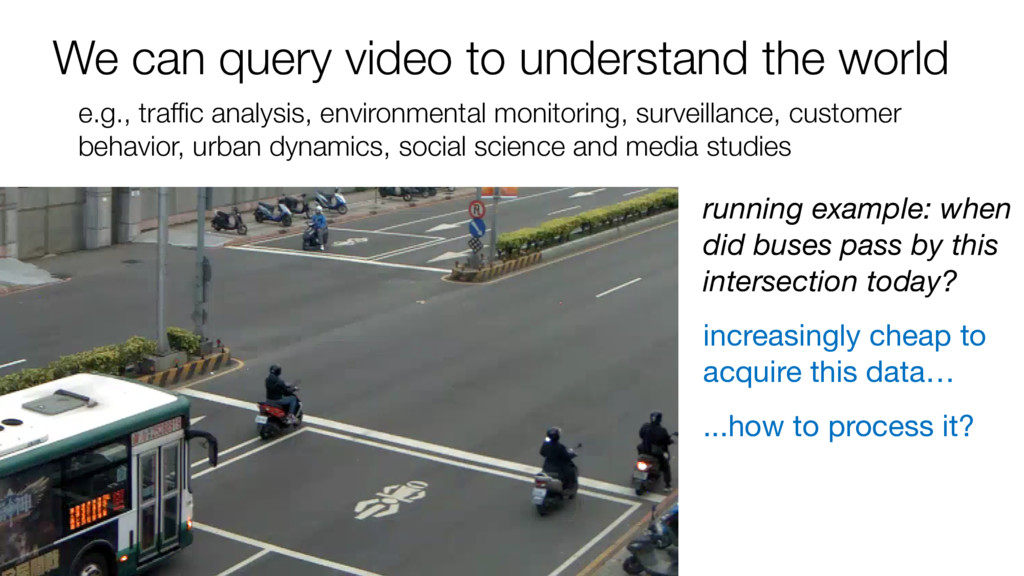
We can query video to understand the world e.g., traffic
analysis, environmental monitoring, surveillance, customer behavior, urban dynamics, social science and media studies running example: when did buses pass by this intersection today? increasingly cheap to acquire this data… ...how to process it? -
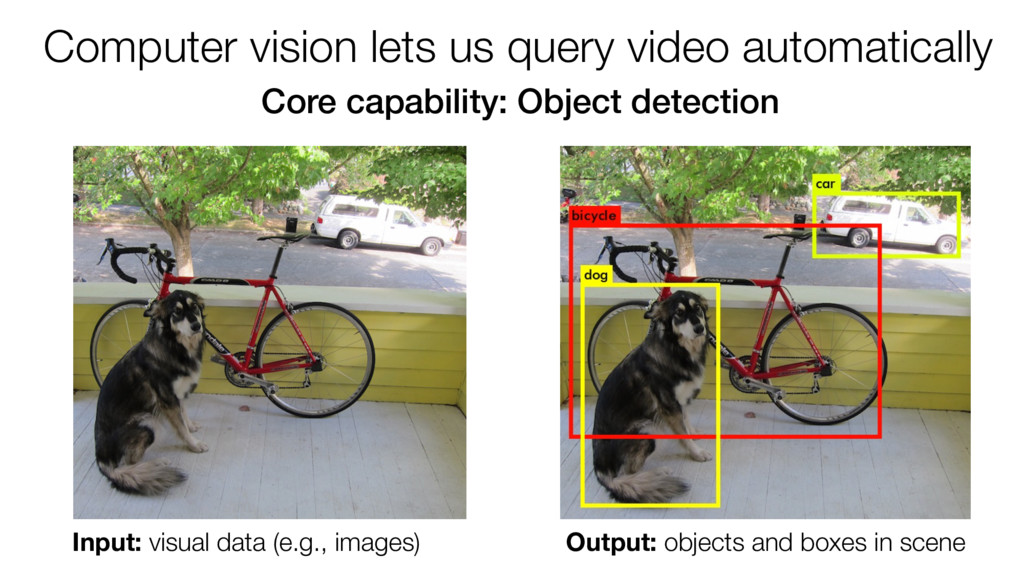
Computer vision lets us query video automatically Core capability: Object
detection Input: visual data (e.g., images) Output: objects and boxes in scene -
Neural networks dominate object detection » Idea: many parameters +
nonlinear functions capture representations » Preferred for image analytics, often better than humans » High-quality models widely available (e.g., open source on GitHub) Enables new kinds of downstream analytics (e.g., use with DBMS) -
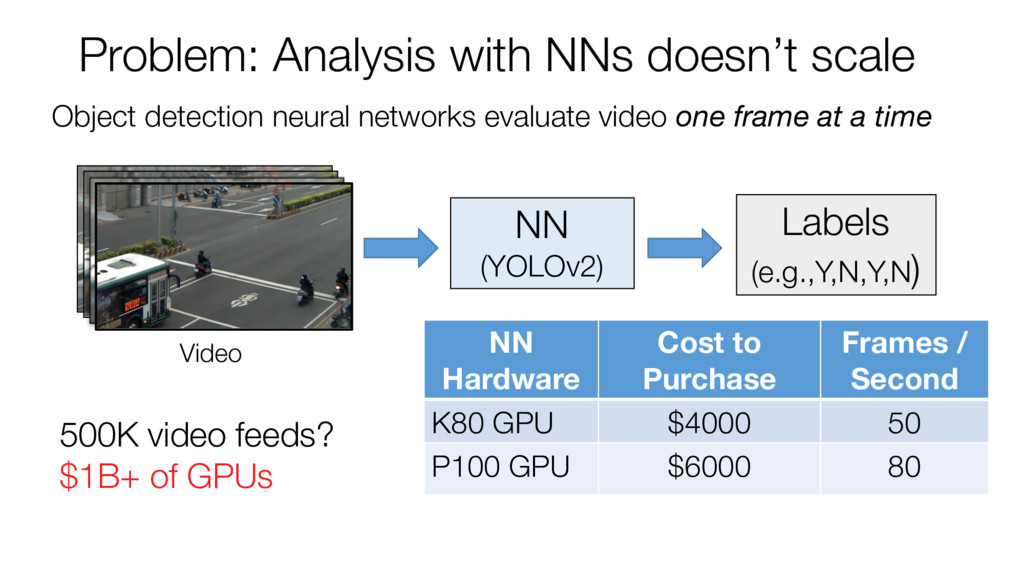
Object detection neural networks evaluate video one frame at a
time NN (YOLOv2) Problem: Analysis with NNs doesn’t scale NN Hardware Cost to Purchase Frames / Second K80 GPU $4000 50 P100 GPU $6000 80 Video Labels (e.g.,Y,N,Y,N) 500K video feeds? $1B+ of GPUs -
This talk: NoScope a system for accelerating neural network video
analysis using model specialization and database-inspired query optimization Our research: Can we make analytics on video scale? -
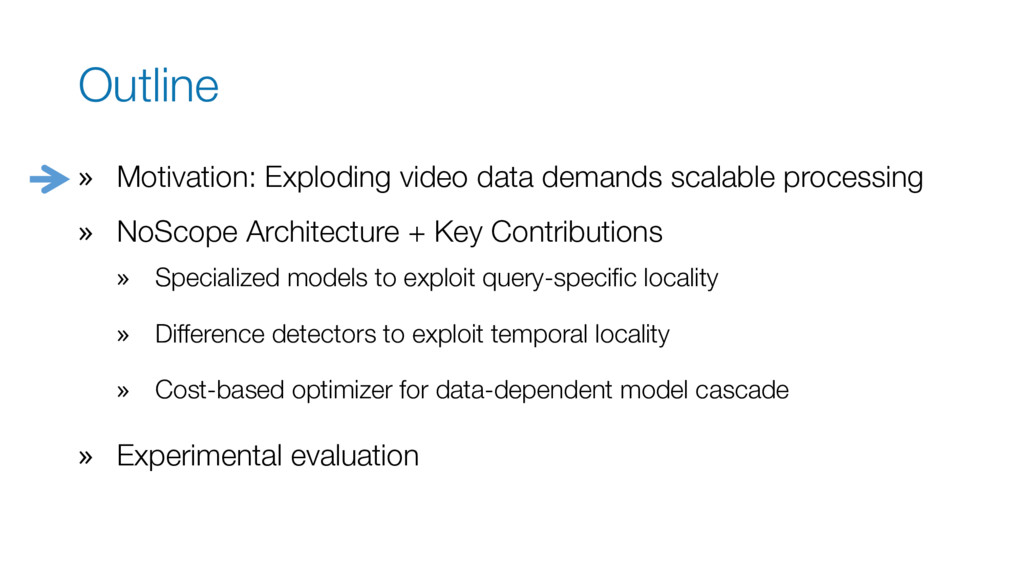
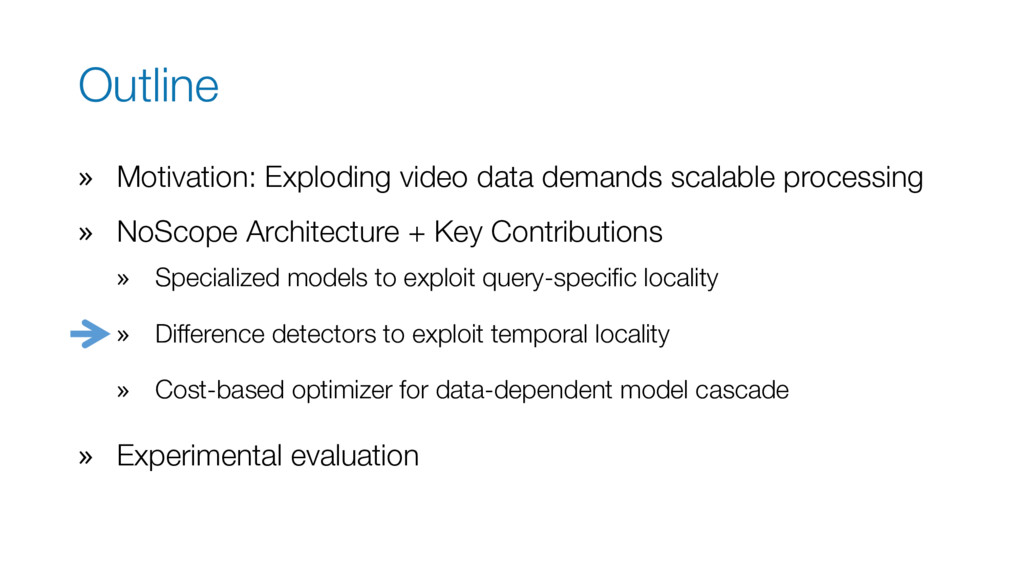
Outline » Motivation: Exploding video data demands scalable processing »
NoScope Architecture + Key Contributions » Specialized models to exploit query-specific locality » Difference detectors to exploit temporal locality » Cost-based optimizer for data-dependent model cascade » Experimental evaluation -
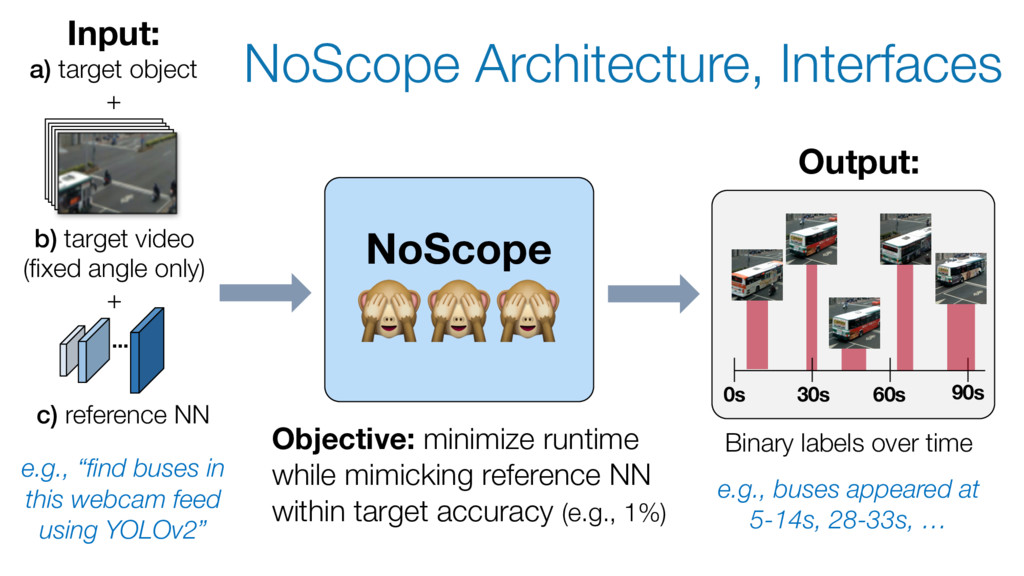
NoScope Architecture, Interfaces Input: a) target object + b) target
video (fixed angle only) + c) reference NN e.g., “find buses in this webcam feed using YOLOv2” ... NoScope Output: 0s 30s 60s 90s Binary labels over time e.g., buses appeared at 5-14s, 28-33s, … Objective: minimize runtime while mimicking reference NN within target accuracy (e.g., 1%) -
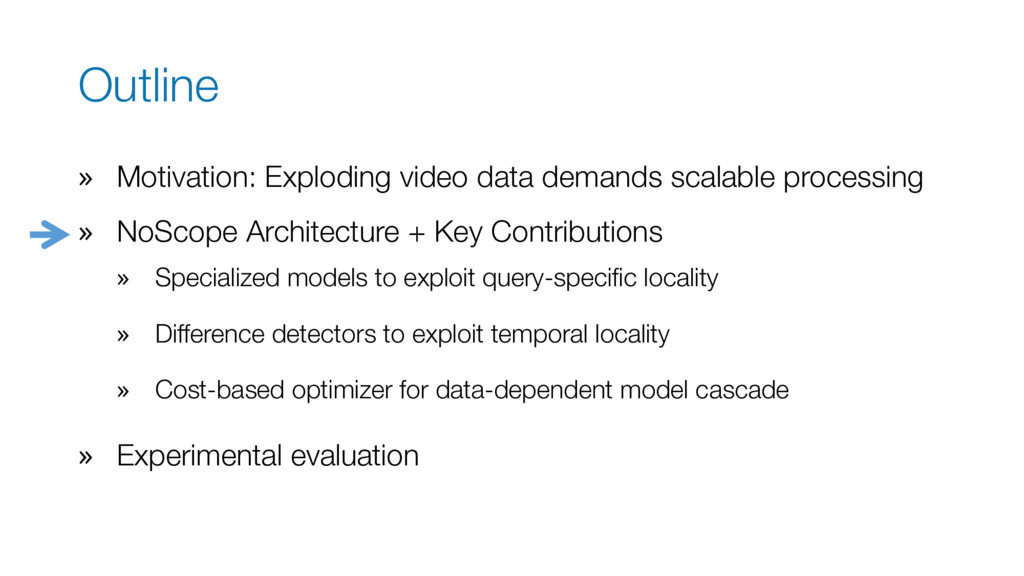
Outline » Motivation: Exploding video data demands scalable processing »
NoScope Architecture + Key Contributions » Specialized models to exploit query-specific locality » Difference detectors to exploit temporal locality » Cost-based optimizer for data-dependent model cascade » Experimental evaluation -
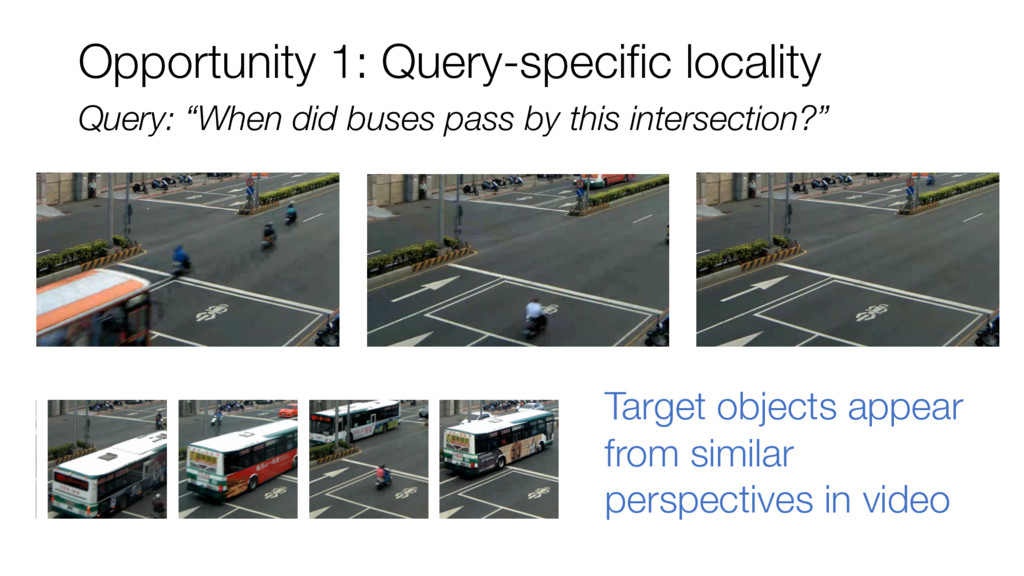
Query: “When did buses pass by this intersection?” Target objects
appear from similar perspectives in video Opportunity 1: Query-specific locality -
NNs are typically trained to detect tens of object categories
in arbitrary scenes and from arbitrary angles images from training set for YOLOv2 Query: “When did buses pass by this intersection?” Opportunity 1: Query-specific locality If we only want to detect buses in a given video, we’re overpaying -
Key idea: specialize for query and video Idea: use big
reference NN to train a smaller, specialized NN The specialized NN: Only works for a given video feed and object Is much, much smaller than the reference NN -
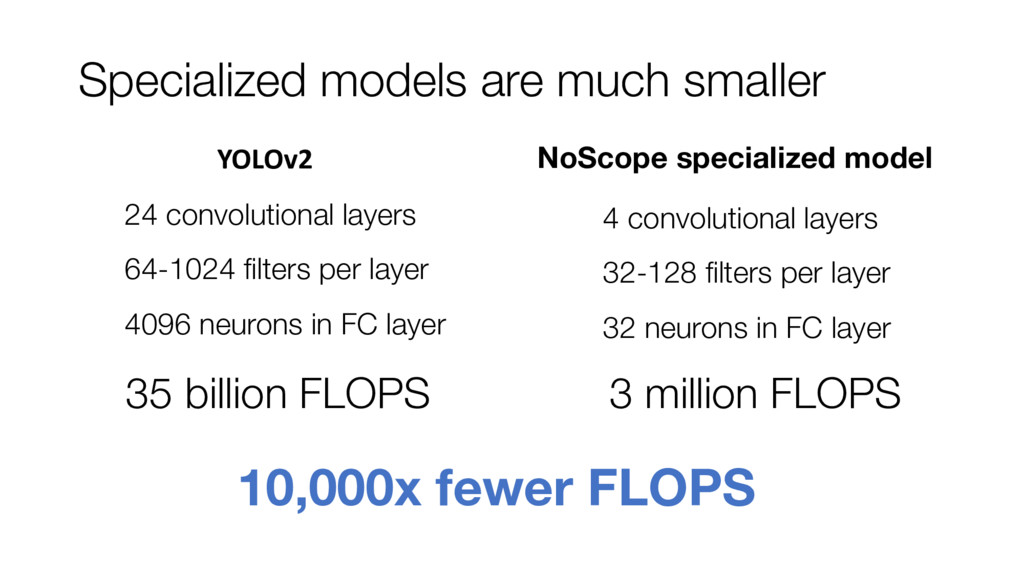
Specialized models are much smaller 24 convolutional layers 64-1024 filters
per layer 4096 neurons in FC layer 4 convolutional layers 32-128 filters per layer 32 neurons in FC layer 35 billion FLOPS 3 million FLOPS 10,000x fewer FLOPS NoScope specialized model YOLOv2 -
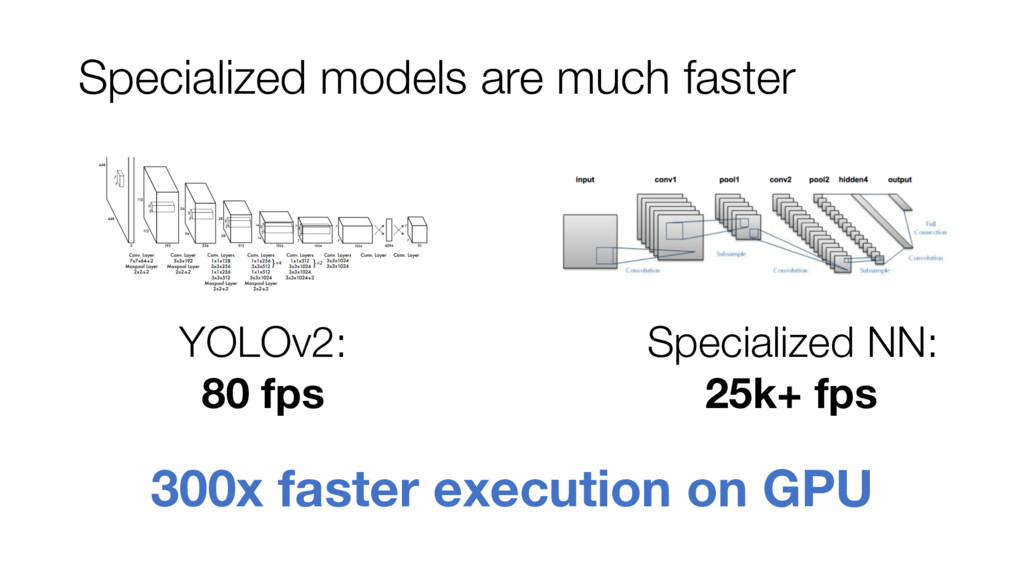
Specialized models are much faster YOLOv2: 80 fps Specialized NN:
25k+ fps 300x faster execution on GPU -
Specialization != Model Compression Model compression/distillation [NIPS14, ICLR16]: lossless models
Goal: smaller model for same task as reference model Result: typically 2-10x faster execution Specialization: perform “lossy” compression of reference model A specialized model does not generalize to other videos… …but is accurate on target video, up to 300x faster -
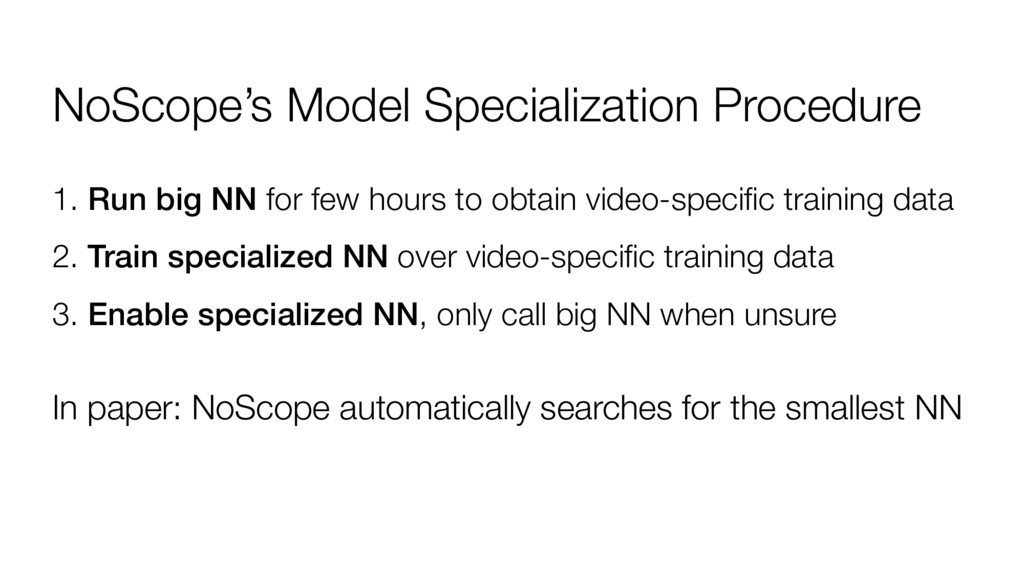
NoScope’s Model Specialization Procedure 1. Run big NN for few
hours to obtain video-specific training data 2. Train specialized NN over video-specific training data 3. Enable specialized NN, only call big NN when unsure In paper: NoScope automatically searches for the smallest NN -
Outline » Motivation: Exploding video data demands scalable processing »
NoScope Architecture + Key Contributions » Specialized models to exploit query-specific locality » Difference detectors to exploit temporal locality » Cost-based optimizer for data-dependent model cascade » Experimental evaluation -
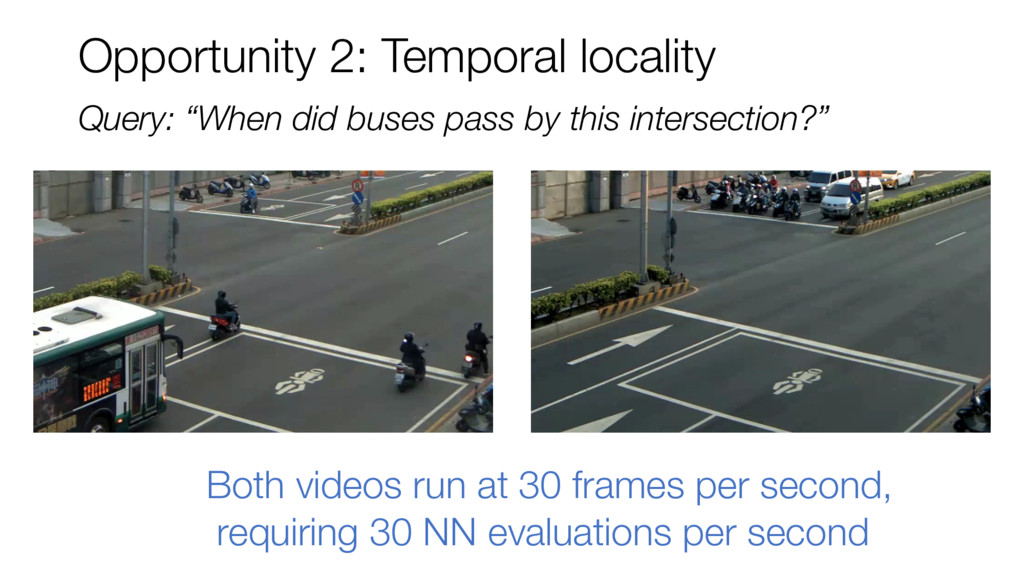
Opportunity 2: Temporal locality Both videos run at 30 frames
per second, requiring 30 NN evaluations per second Query: “When did buses pass by this intersection?” -
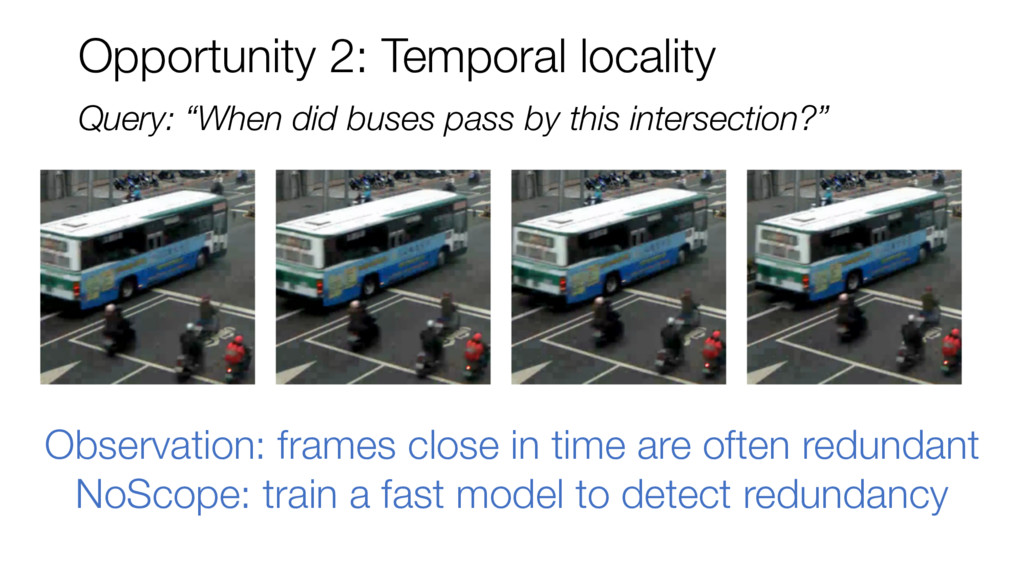
Opportunity 2: Temporal locality Query: “When did buses pass by
this intersection?” Observation: frames close in time are often redundant NoScope: train a fast model to detect redundancy -
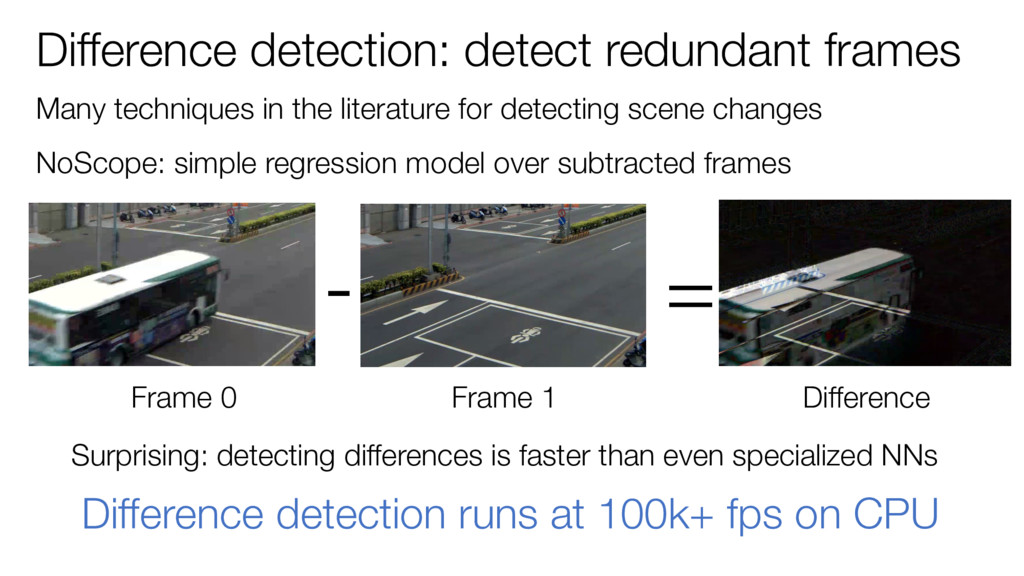
Difference detection: detect redundant frames Many techniques in the literature
for detecting scene changes NoScope: simple regression model over subtracted frames - = Frame 1 Frame 0 Difference Difference detection runs at 100k+ fps on CPU Surprising: detecting differences is faster than even specialized NNs -
Outline » Motivation: Exploding video data demands scalable processing »
NoScope Architecture + Key Contributions » Specialized models to exploit query-specific locality » Difference detectors to exploit temporal locality » Cost-based optimizer for data-dependent model cascade » Experimental evaluation -
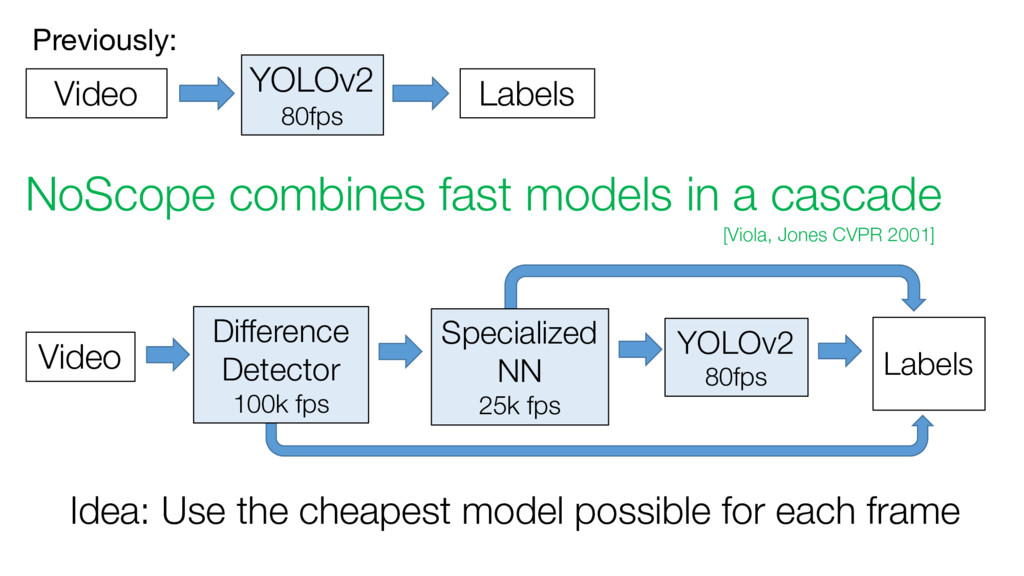
NoScope combines fast models in a cascade YOLOv2 80fps Labels
Video Previously: [Viola, Jones CVPR 2001] YOLOv2 80fps Labels Specialized NN 25k fps Difference Detector 100k fps Idea: Use the cheapest model possible for each frame Video -
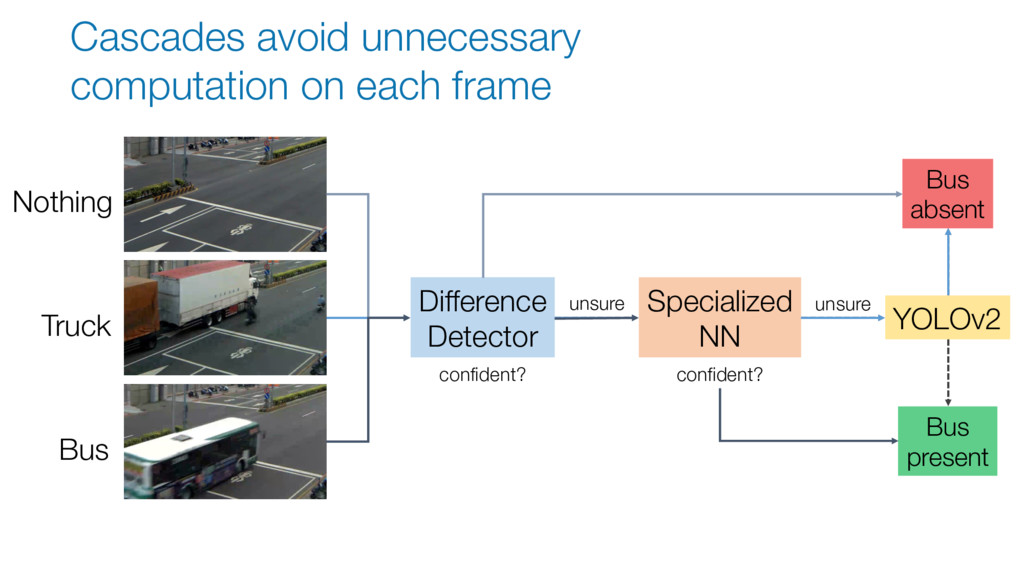
Specialized NN Bus absent YOLOv2 Bus present Nothing confident? unsure
Difference Detector unsure confident? Cascades avoid unnecessary computation on each frame Truck Bus -
NoScope performs cost-based optimization for cascades Given an accuracy target,
NoScope performs: Model search: e.g., how many layers in specialized NN? Cascade search: e.g., how to set the cascade thresholds? Data-dependent process: high-quality choices vary across queries and videos (see paper) -
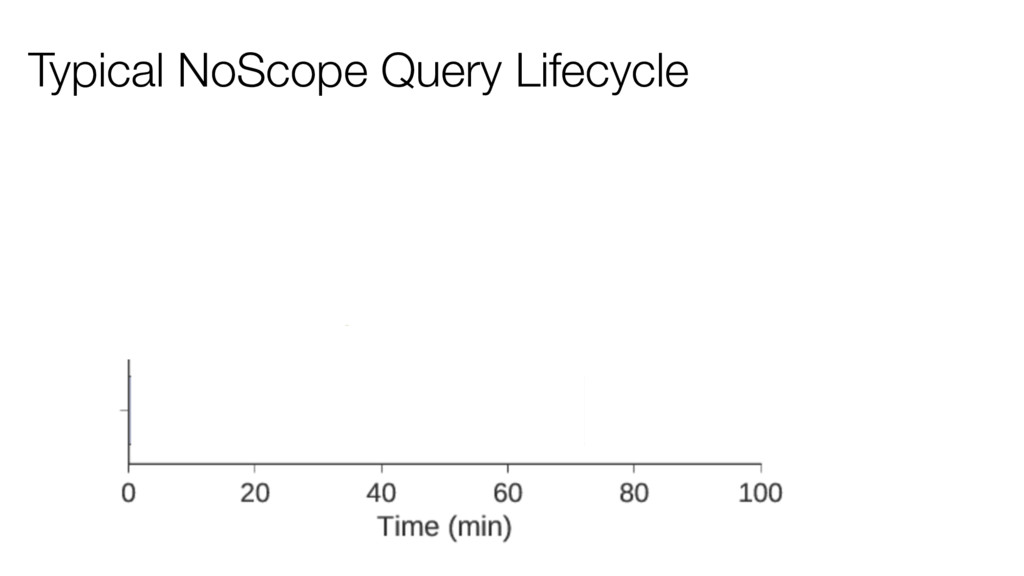
Typical NoScope Query Lifecycle 1. Run big NN over part
of video for training data (~75 minutes) 2. Model search specialized NN, difference detector (15 minutes) 3. Perform cascade firing threshold search (2 minutes) 4. Activate cascade to process rest of video -
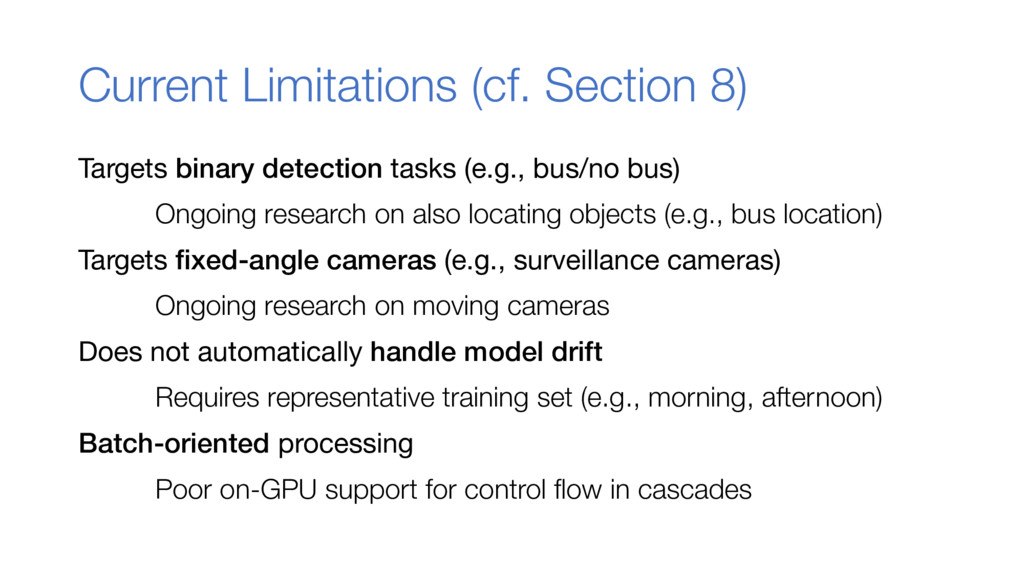
Current Limitations (cf. Section 8) Targets binary detection tasks (e.g.,
bus/no bus) Ongoing research on also locating objects (e.g., bus location) Targets fixed-angle cameras (e.g., surveillance cameras) Ongoing research on moving cameras Does not automatically handle model drift Requires representative training set (e.g., morning, afternoon) Batch-oriented processing Poor on-GPU support for control flow in cascades -
Outline » Motivation: Exploding video data demands scalable processing »
NoScope Architecture + Key Contributions » Specialized models to exploit query-specific locality » Difference detectors to exploit temporal locality » Cost-based optimizer for data-dependent model cascade » Experimental evaluation -
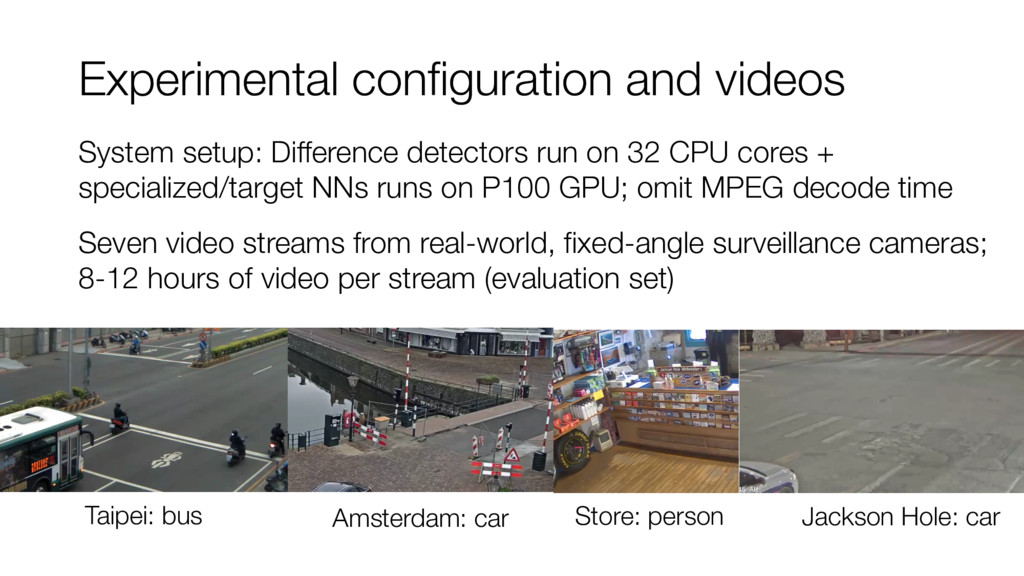
Experimental configuration and videos System setup: Difference detectors run on
32 CPU cores + specialized/target NNs runs on P100 GPU; omit MPEG decode time Seven video streams from real-world, fixed-angle surveillance cameras; 8-12 hours of video per stream (evaluation set) Taipei: bus Amsterdam: car Store: person Jackson Hole: car -
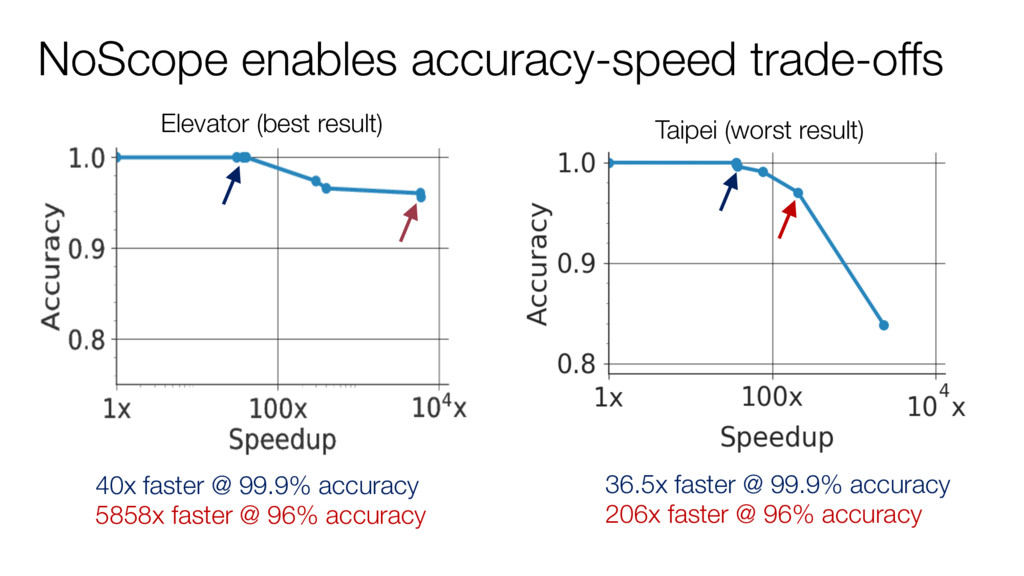
NoScope enables accuracy-speed trade-offs Elevator (best result) Taipei (worst result)
40x faster @ 99.9% accuracy 5858x faster @ 96% accuracy 36.5x faster @ 99.9% accuracy 206x faster @ 96% accuracy -
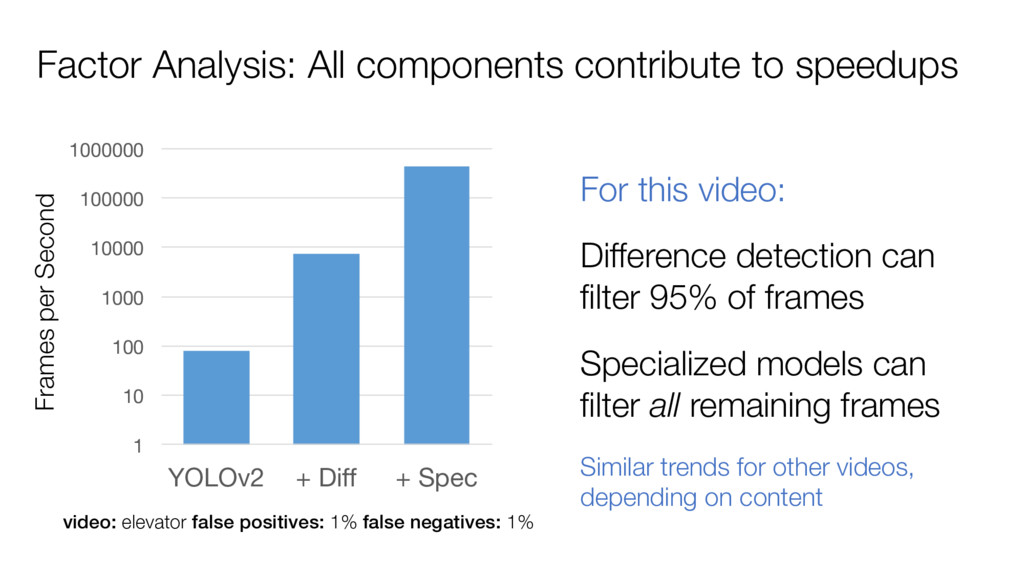
Factor Analysis: All components contribute to speedups Difference detection can
filter 95% of frames Specialized models can filter all remaining frames 1 10 100 1000 10000 100000 1000000 YOLOv2 + Diff + Spec Frames per Second video: elevator false positives: 1% false negatives: 1% For this video: Similar trends for other videos, depending on content -
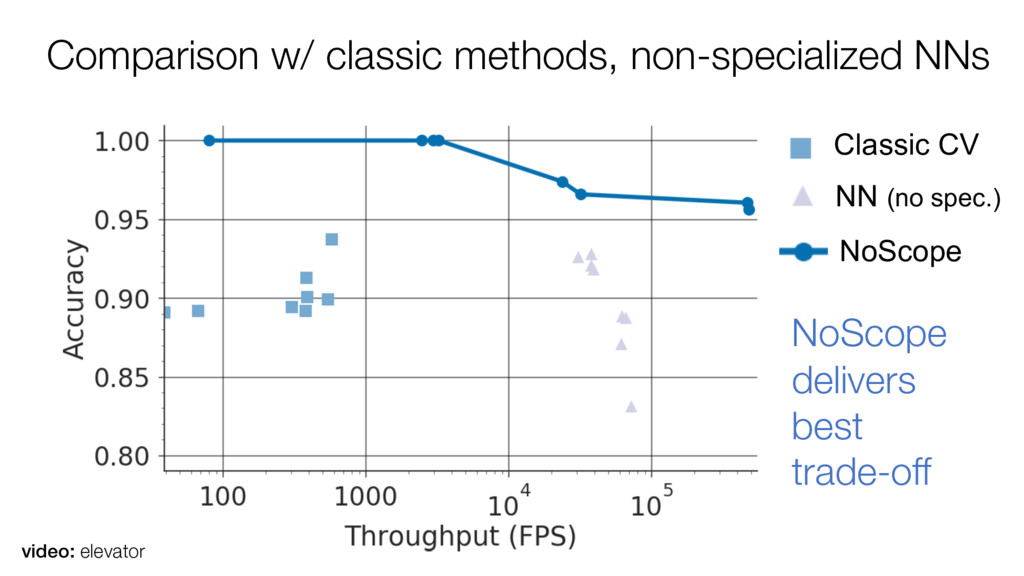
Comparison w/ classic methods, non-specialized NNs NoScope delivers best trade-off
Classic CV NN (no spec.) NoScope video: elevator -
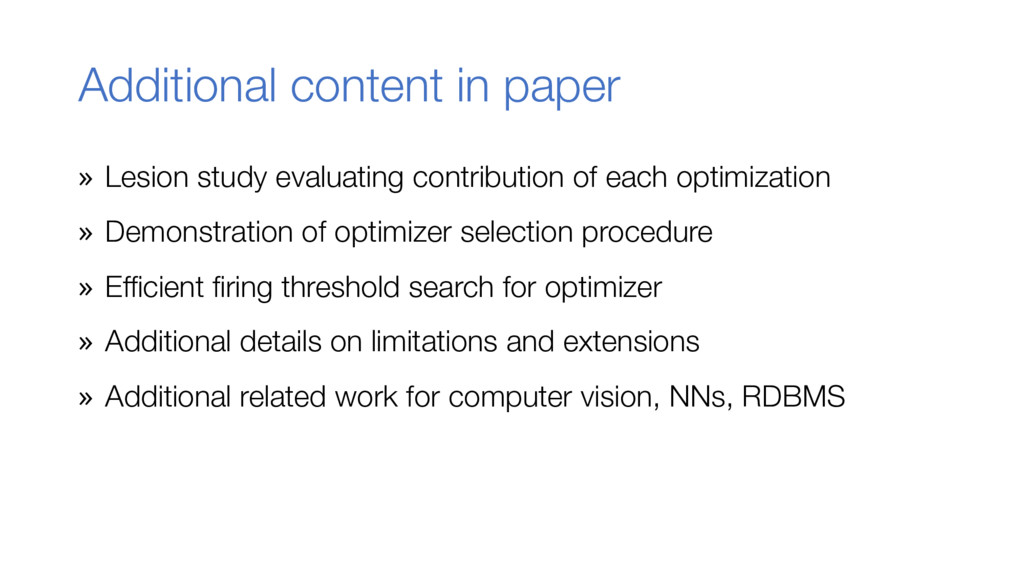
Additional content in paper » Lesion study evaluating contribution of
each optimization » Demonstration of optimizer selection procedure » Efficient firing threshold search for optimizer » Additional details on limitations and extensions » Additional related work for computer vision, NNs, RDBMS -
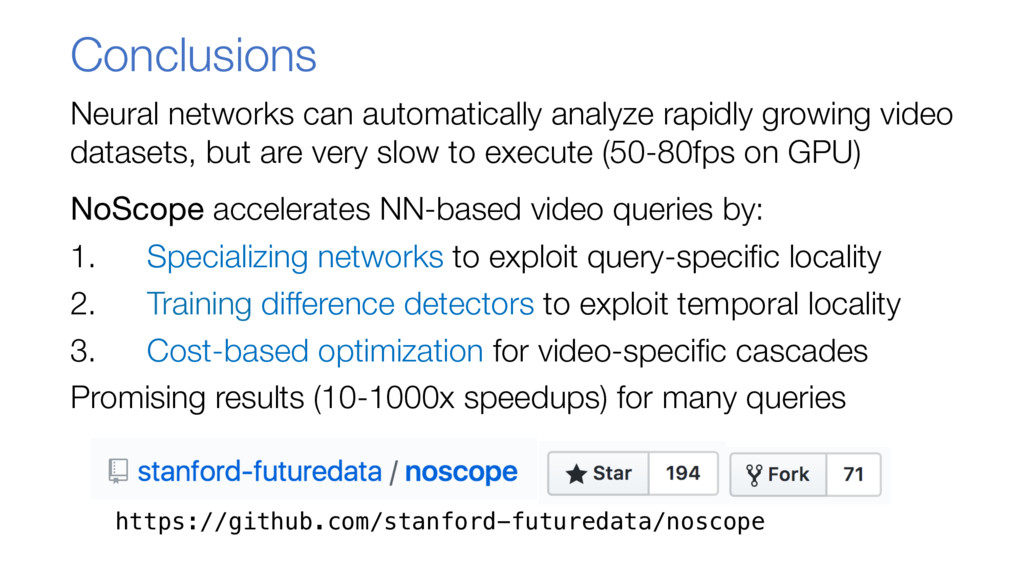
Conclusions Neural networks can automatically analyze rapidly growing video datasets,
but are very slow to execute (50-80fps on GPU) NoScope accelerates NN-based video queries by: 1. Specializing networks to exploit query-specific locality 2. Training difference detectors to exploit temporal locality 3. Cost-based optimization for video-specific cascades Promising results (10-1000x speedups) for many queries https://github.com/stanford-futuredata/noscope