Upgrade to Pro
— share decks privately, control downloads, hide ads and more …
Speaker Deck
Sign up for free
Menu
Search
Features
All features
Private URLs
Password Protection
Custom URLS
Scheduled publishing
Remove Branding
Restrict embedding
Deck Collections
Notes
Features
All features
Private URLs
Password Protection
Custom URLS
Scheduled publishing
Remove Branding
Restrict embedding
Deck Collections
Notes
Explore
Featured decks
Featured speakers
Programming
Technology
Storyboards
Explore
Featured decks
Featured speakers
Programming
Technology
Storyboards
Pricing
Search
Sign in
Sign up for free
Lisp in Huskell
Search
Sponsored
·
Your Podcast. Everywhere. Effortlessly.
Share. Educate. Inspire. Entertain. You do you. We'll handle the rest.
→
αλεx π
December 20, 2013
150
1
Share
Embed
Copy iframe code
Copy JS code
Copy link
Start on current slide
Lisp in Huskell
αλεx π
December 20, 2013
More Decks by αλεx π
See All by αλεx π
Scalable Time Series With Cassandra
ifesdjeen
1
430
Bayesian Inference is known to make machines biased
ifesdjeen
2
420
Cassandra for Data Analytics Backends
ifesdjeen
7
470
Stream Processing and Functional Programming
ifesdjeen
1
800
PolyConf 2015 - Rocking the Time Series boat with C, Haskell and ClojureScript
ifesdjeen
0
540
Clojure - A Sweetspot for Analytics
ifesdjeen
8
2.1k
Going Off Heap
ifesdjeen
3
1.9k
Always be learning
ifesdjeen
1
200
Learn Yourself Emacs For Great Good workshop slides
ifesdjeen
3
360
Featured
See All Featured
How to Grow Your eCommerce with AI & Automation
katarinadahlin
PRO
2
330
Product Roadmaps are Hard
iamctodd
55
13k
What the history of the web can teach us about the future of AI
inesmontani
PRO
2
740
Chasing Engaging Ingredients in Design
codingconduct
0
360
The Curse of the Amulet
leimatthew05
3
15k
How To Speak Unicorn (iThemes Webinar)
marktimemedia
1
600
Understanding Cognitive Biases in Performance Measurement
bluesmoon
32
3.1k
Building a A Zero-Code AI SEO Workflow
portentint
PRO
0
780
HU Berlin: Industrial-Strength Natural Language Processing with spaCy and Prodigy
inesmontani
PRO
0
750
The Illustrated Children's Guide to Kubernetes
chrisshort
51
53k
It's Worth the Effort
3n
188
29k
Performance Is Good for Brains [We Love Speed 2024]
tammyeverts
12
1.9k
Transcript
Lisp in Huskell
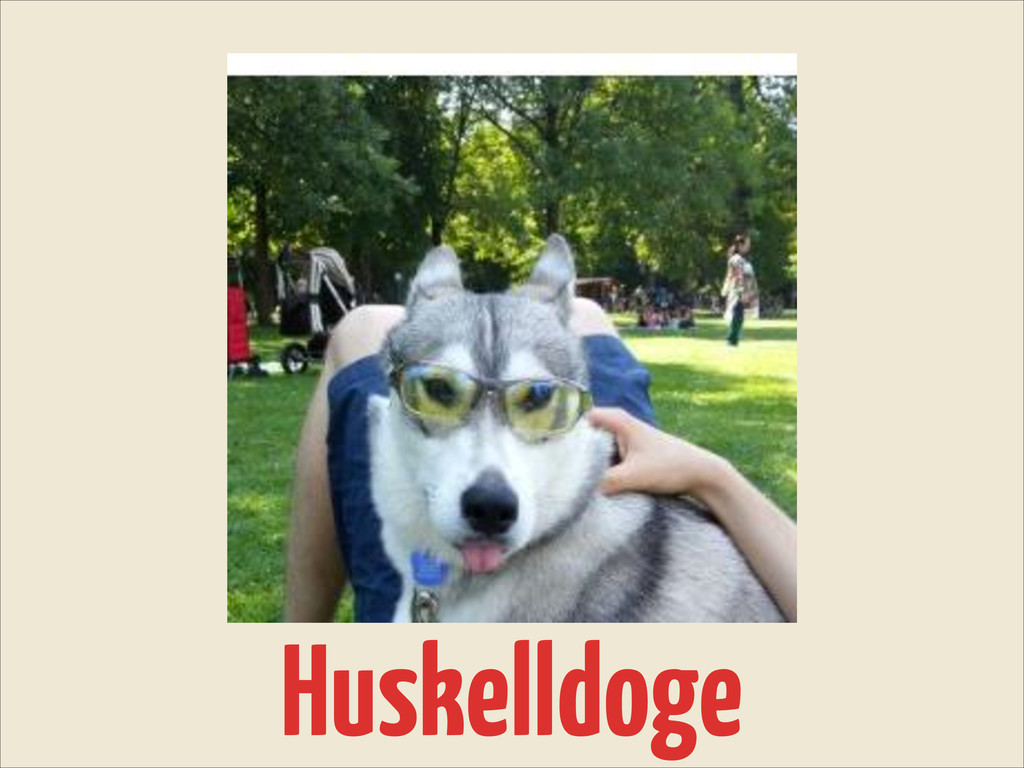
Huskelldoge
By an 100% Haskell dummy
What is Lisp, really?
(def b 100) ;; defining vars! (def a (fn [c]
(+ b c))) ;; defining functions! (a 5 7) ;; executing functions
Easy!
How do we express it?
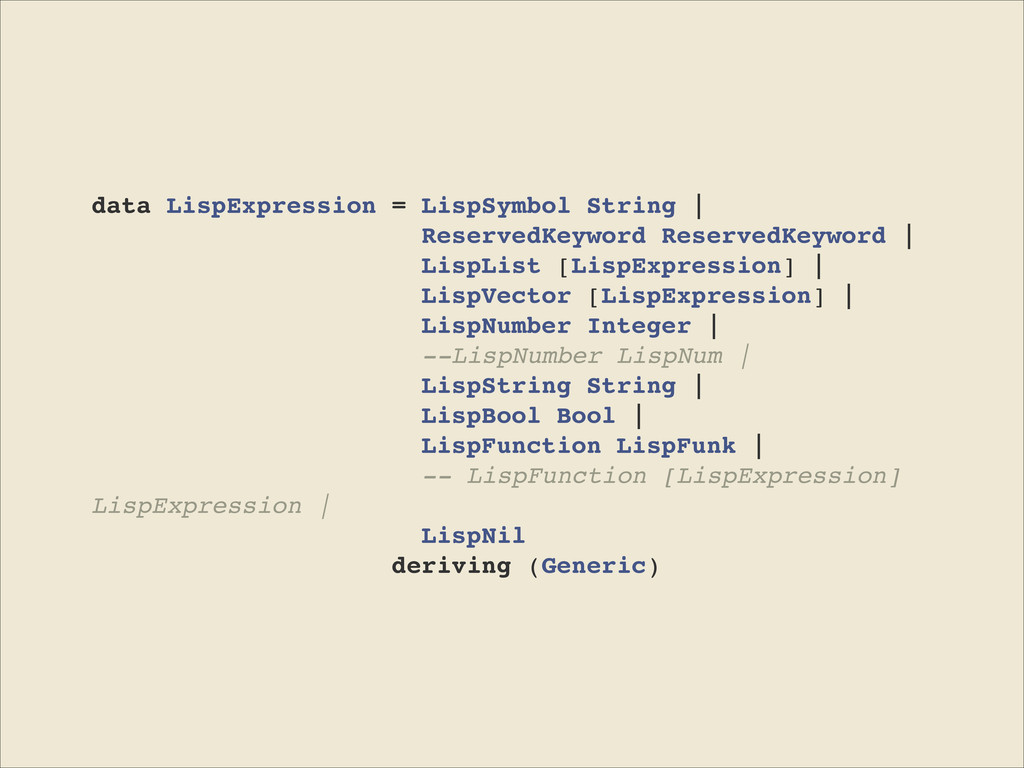
data LispExpression = LispSymbol String |! ReservedKeyword ReservedKeyword |! LispList
[LispExpression] |! LispVector [LispExpression] |! LispNumber Integer |! --LispNumber LispNum |! LispString String |! LispBool Bool |! LispFunction LispFunk |! -- LispFunction [LispExpression] LispExpression |! LispNil! deriving (Generic)
Parsing
Come on bro, really?
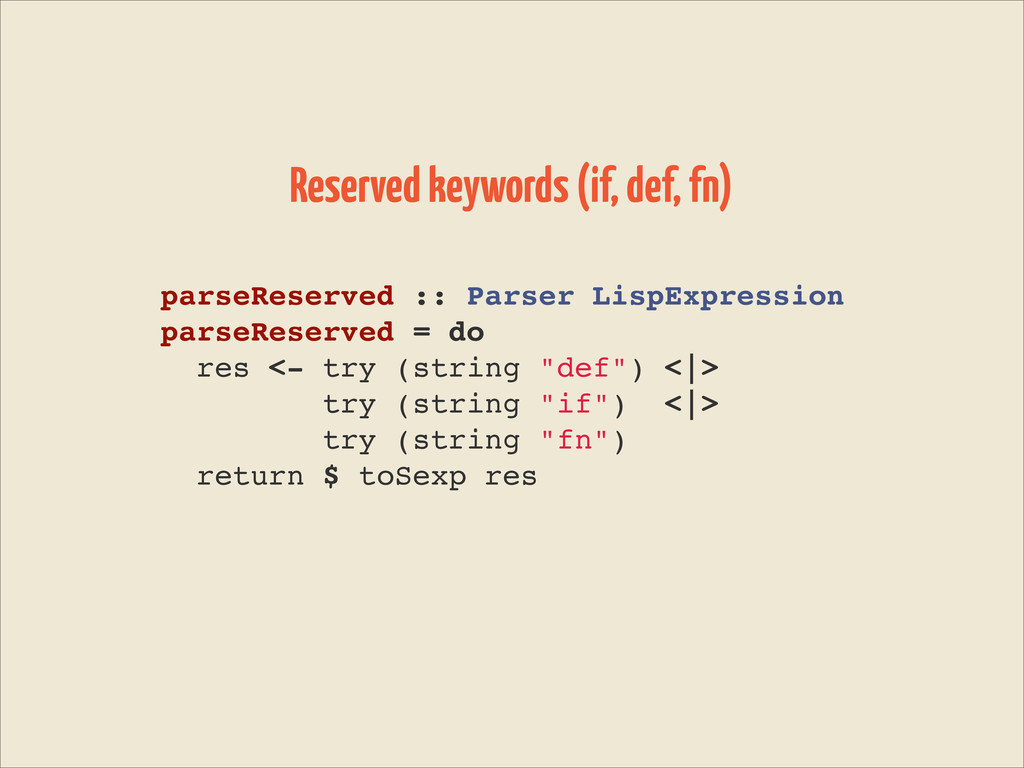
Reserved keywords (if, def, fn) parseReserved :: Parser LispExpression! parseReserved
= do! res <- try (string "def") <|>! try (string "if") <|>! try (string "fn")! return $ toSexp res
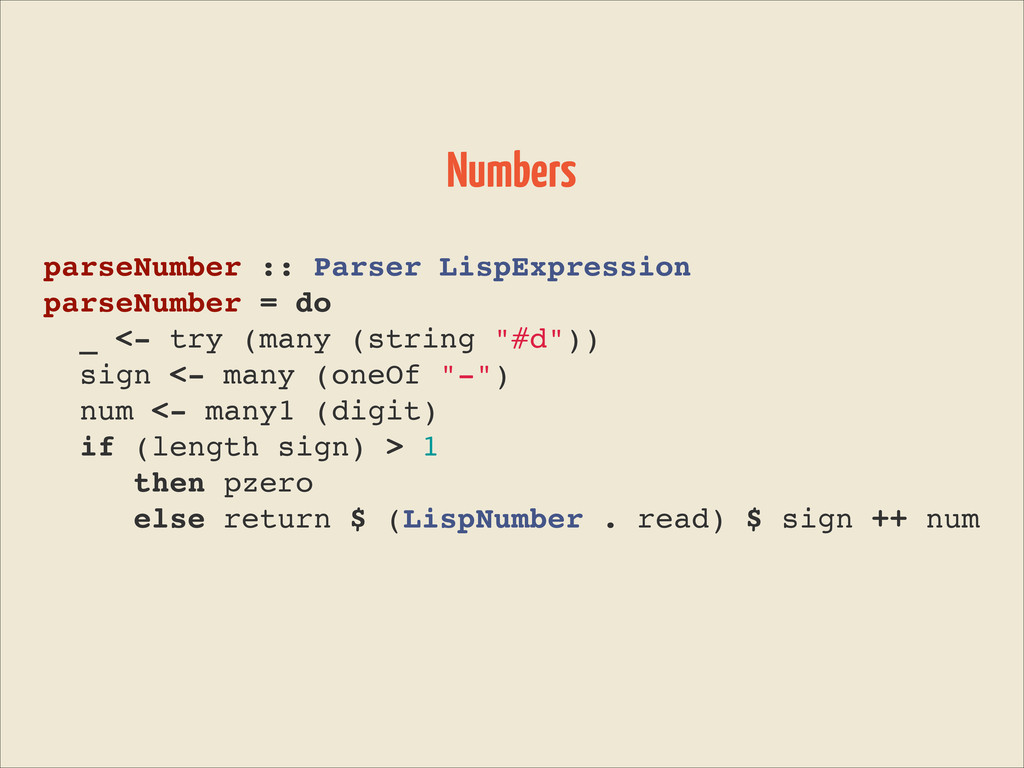
Numbers parseNumber :: Parser LispExpression! parseNumber = do! _ <-
try (many (string "#d"))! sign <- many (oneOf "-")! num <- many1 (digit)! if (length sign) > 1! then pzero! else return $ (LispNumber . read) $ sign ++ num
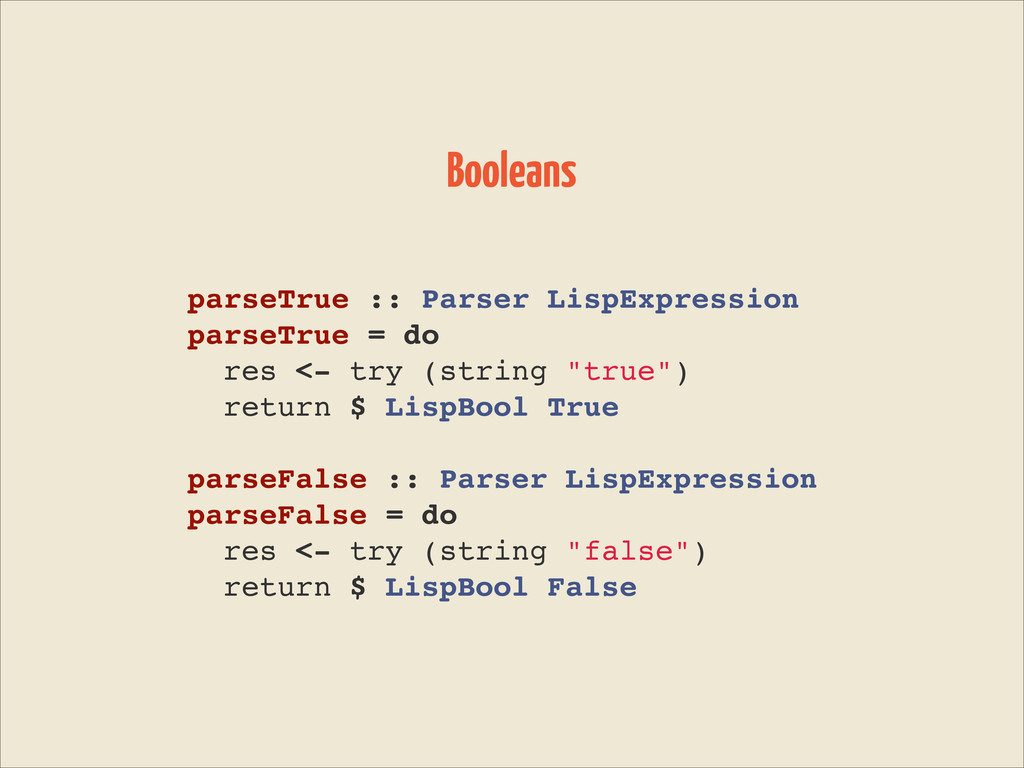
Booleans parseTrue :: Parser LispExpression! parseTrue = do! res <-
try (string "true")! return $ LispBool True! ! parseFalse :: Parser LispExpression! parseFalse = do! res <- try (string "false")! return $ LispBool False
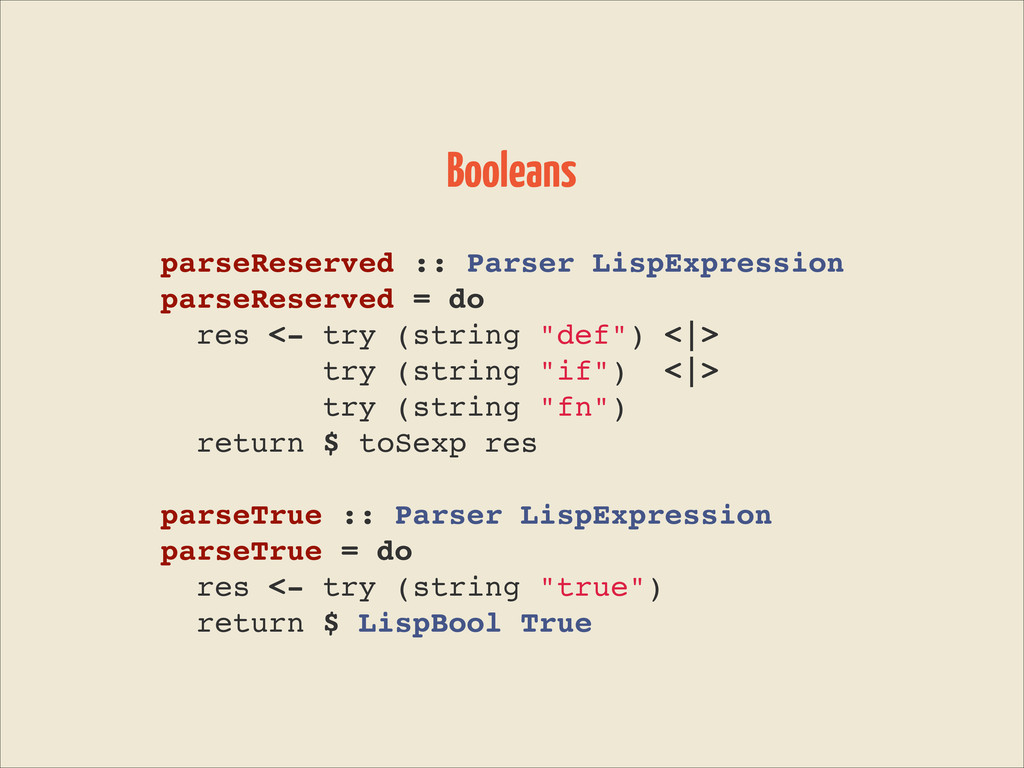
Booleans parseReserved :: Parser LispExpression! parseReserved = do! res <-
try (string "def") <|>! try (string "if") <|>! try (string "fn")! return $ toSexp res! ! parseTrue :: Parser LispExpression! parseTrue = do! res <- try (string "true")! return $ LispBool True
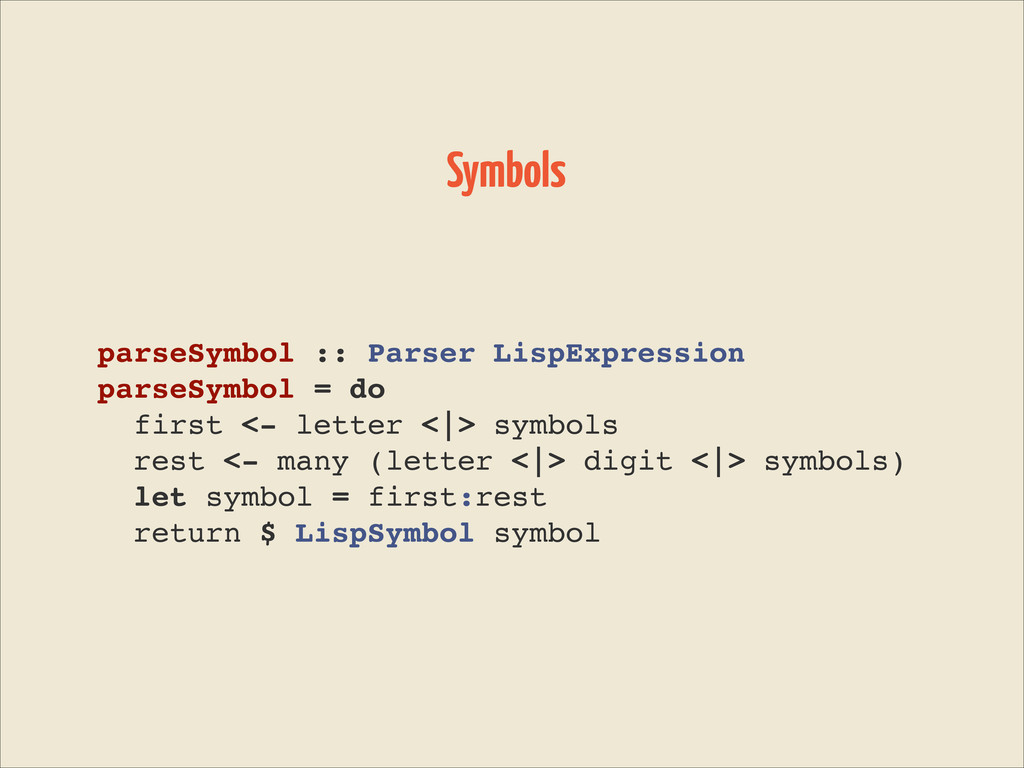
Symbols parseSymbol :: Parser LispExpression! parseSymbol = do! first <-
letter <|> symbols! rest <- many (letter <|> digit <|> symbols)! let symbol = first:rest! return $ LispSymbol symbol
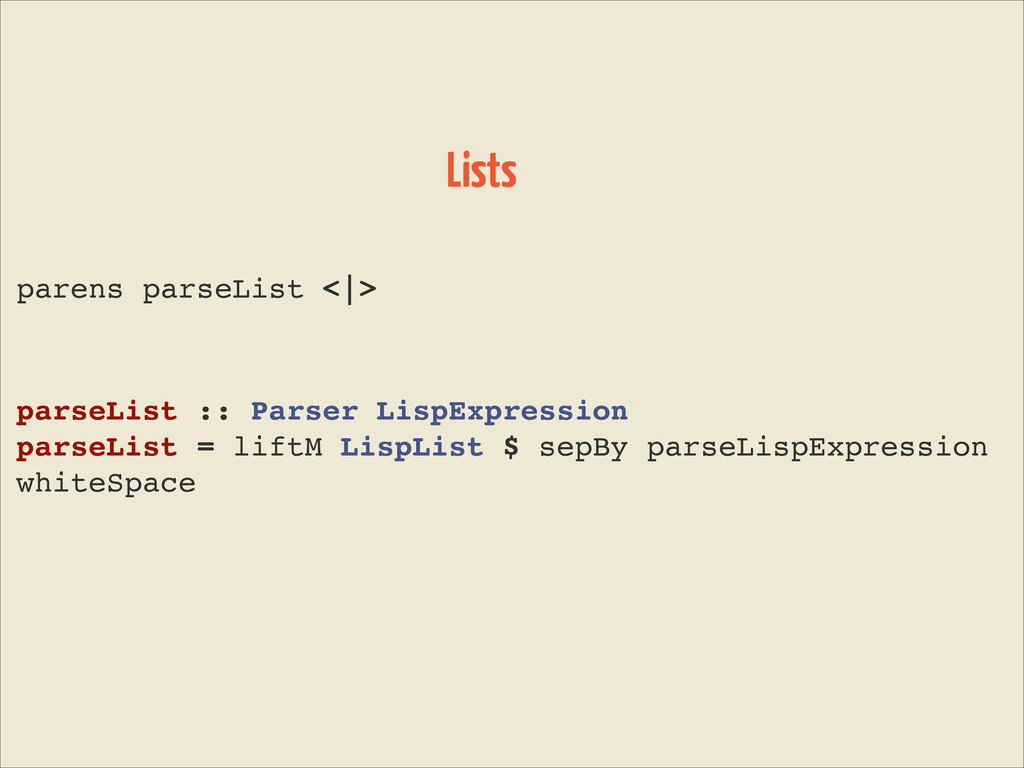
Lists parens parseList <|>! ! ! ! parseList :: Parser
LispExpression! parseList = liftM LispList $ sepBy parseLispExpression whiteSpace
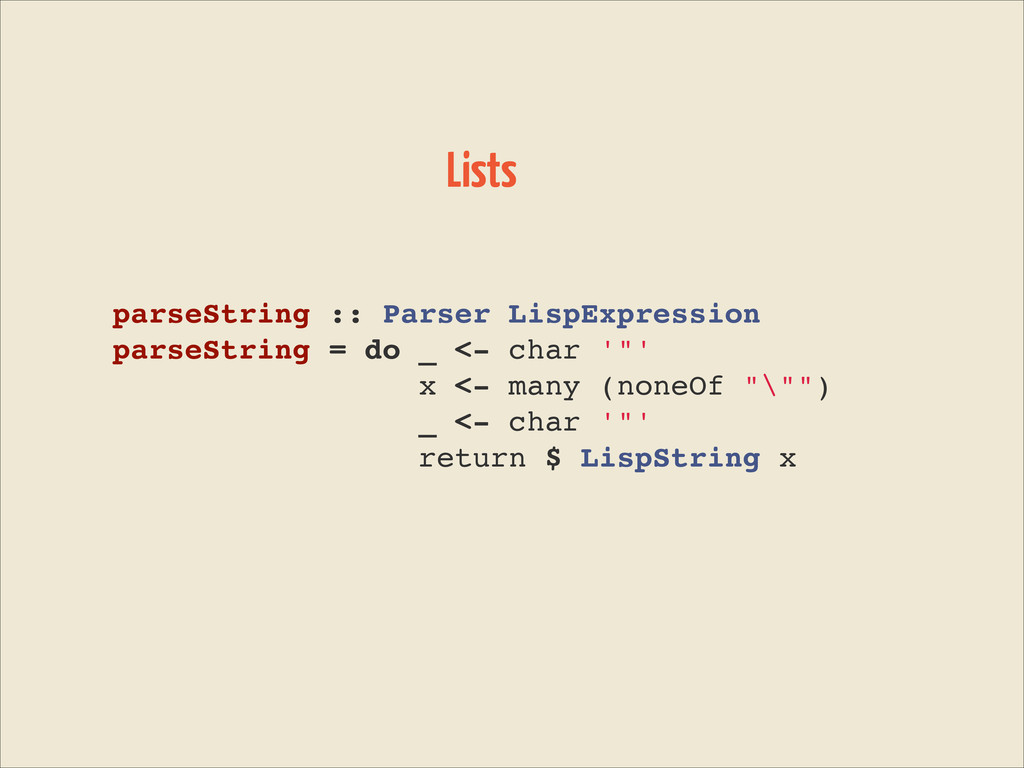
Lists parseString :: Parser LispExpression! parseString = do _ <-
char '"'! x <- many (noneOf "\"")! _ <- char '"'! return $ LispString x
So, let’s see how it werkz
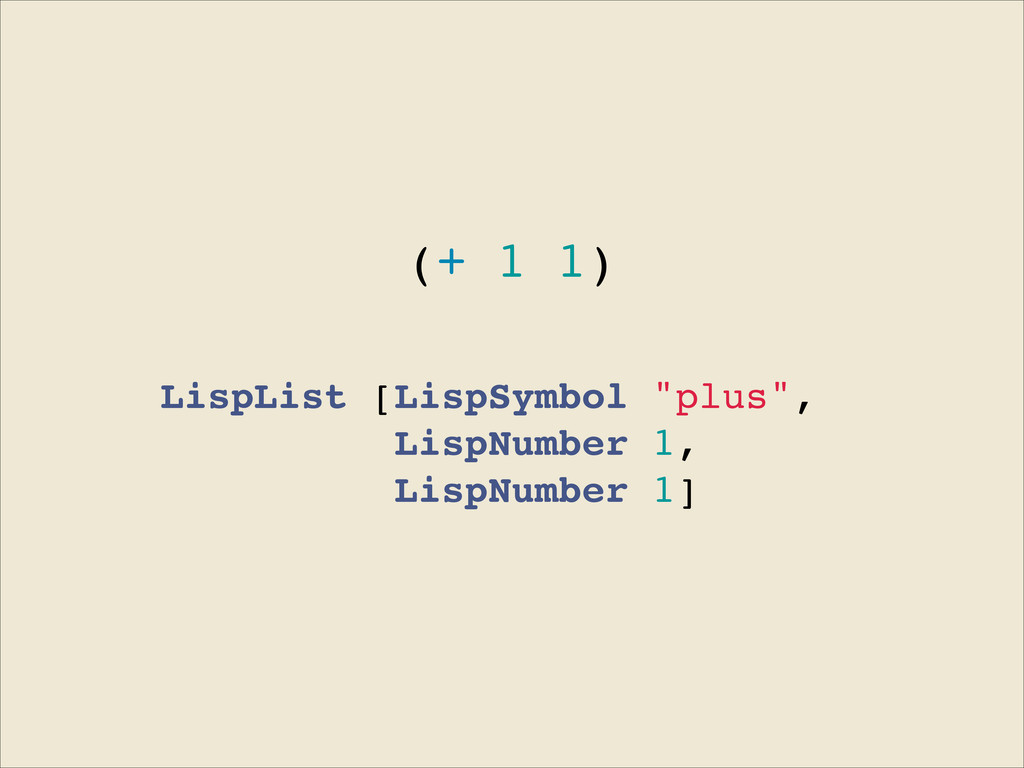
(+ 1 1) LispList [LispSymbol "plus", ! LispNumber 1, !
LispNumber 1]
Evaluation process
Easy-peasy
Literals evaluate to their values
Numbers - to numbers
Strings - to strings
Lists - recursively evaluate their values left to right
Symbols - to…
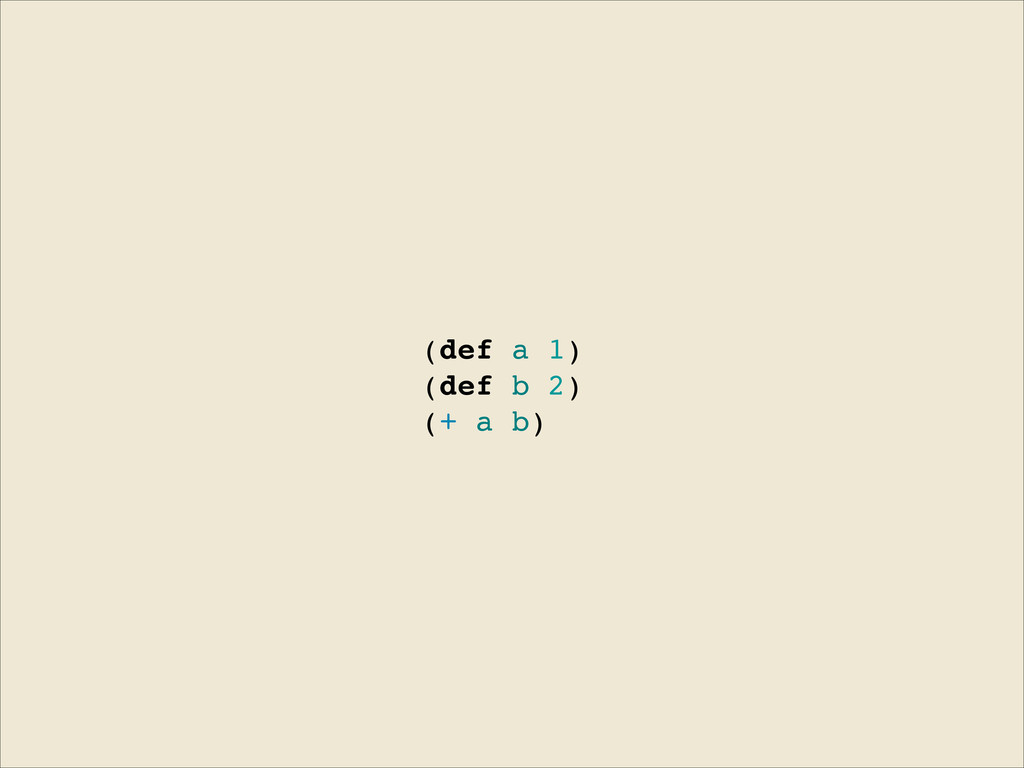
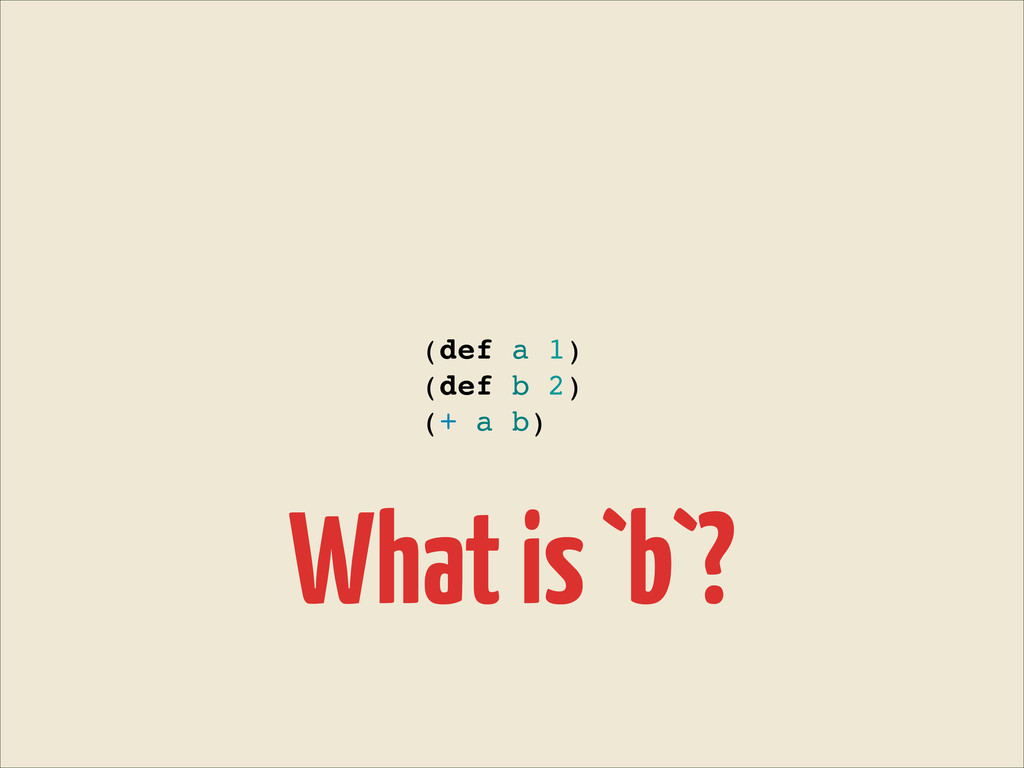
(def a 1)! (def b 2)! (+ a b)
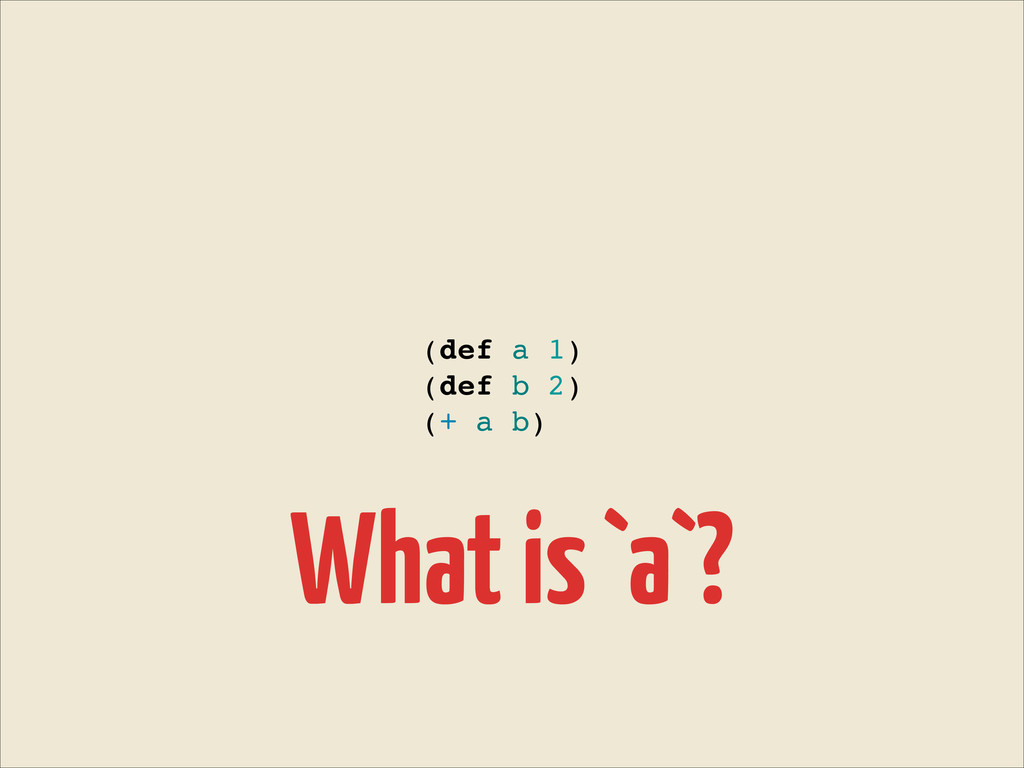
(def a 1)! (def b 2)! (+ a b) What
is `a`?
Let’s check the Environment
Ah ok, a is 1
(def a 1)! (def b 2)! (+ a b) What
is `b`?
Ah ok, b is 1
Substitution β-reduction
None
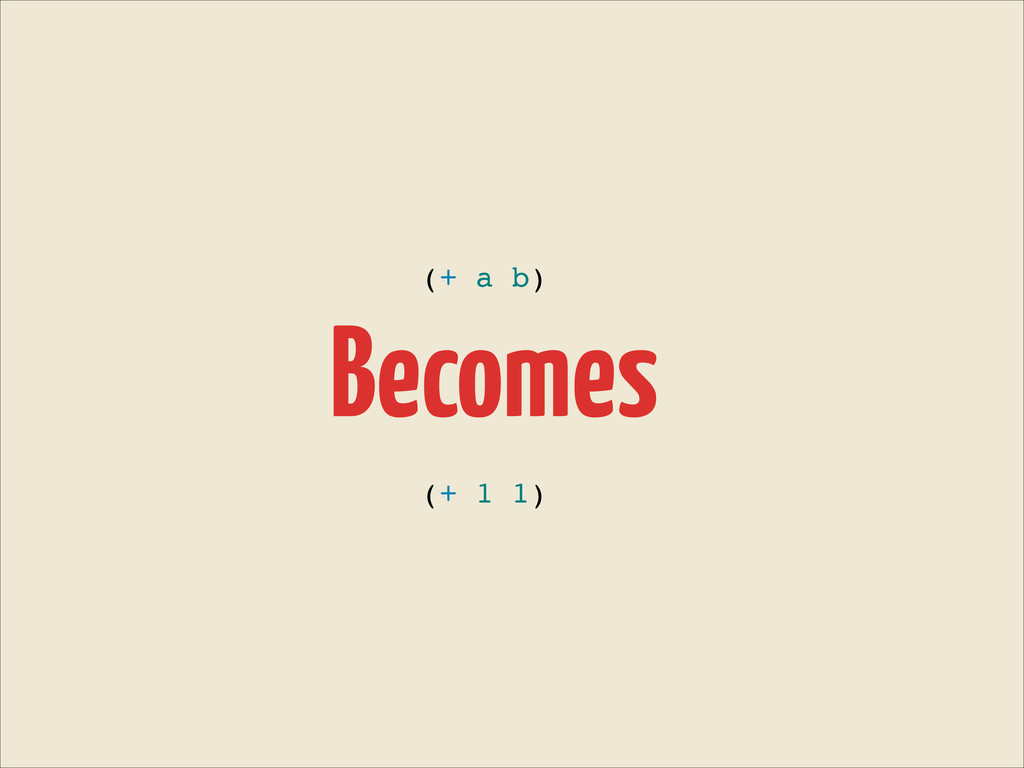
(+ a b)! ! ! ! ! ! (+ 1
1) Becomes
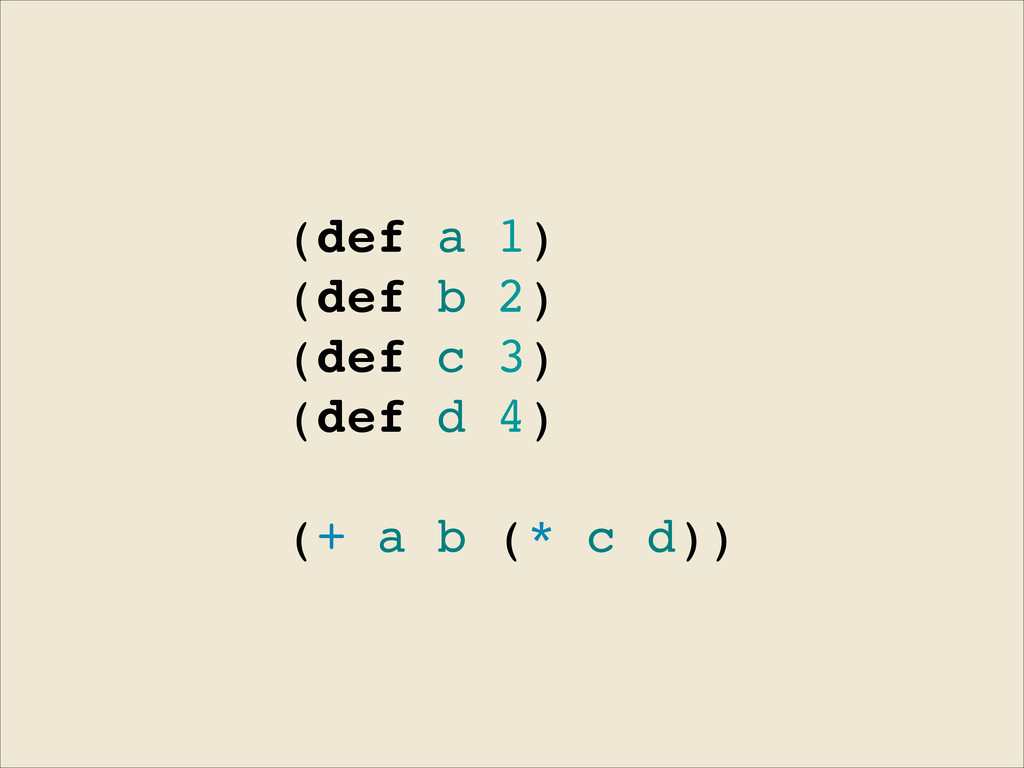
(def a 1)! (def b 2)! (def c 3)! (def
d 4)! ! (+ a b (* c d))
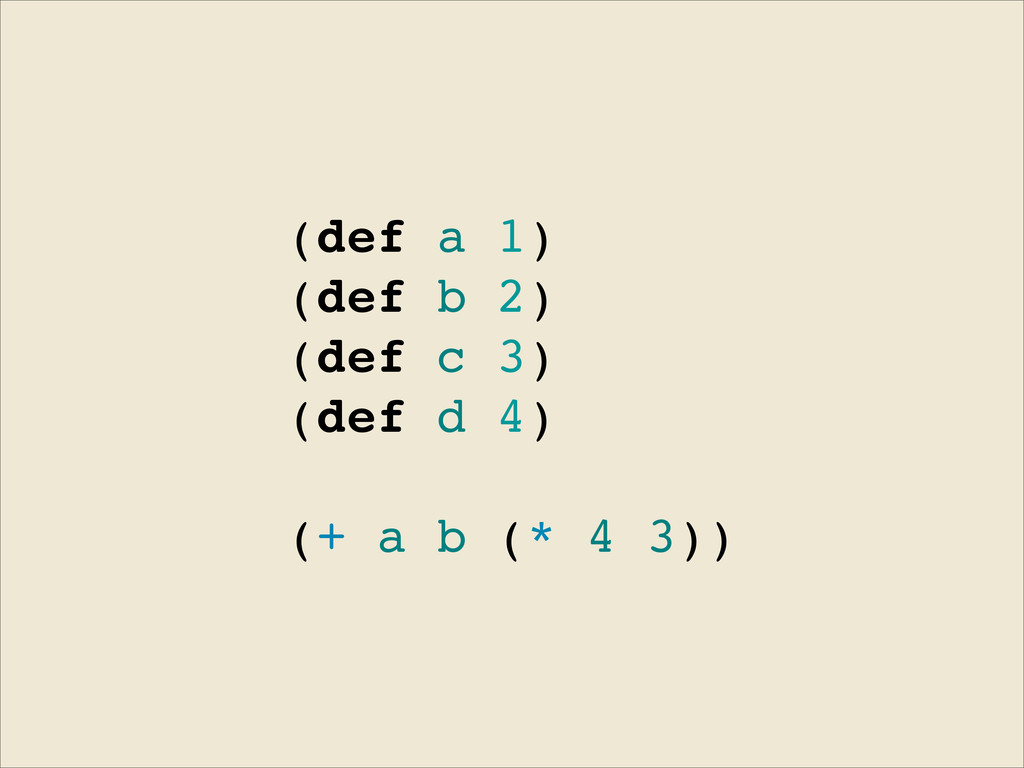
(def a 1)! (def b 2)! (def c 3)! (def
d 4)! ! (+ a b (* 4 3))
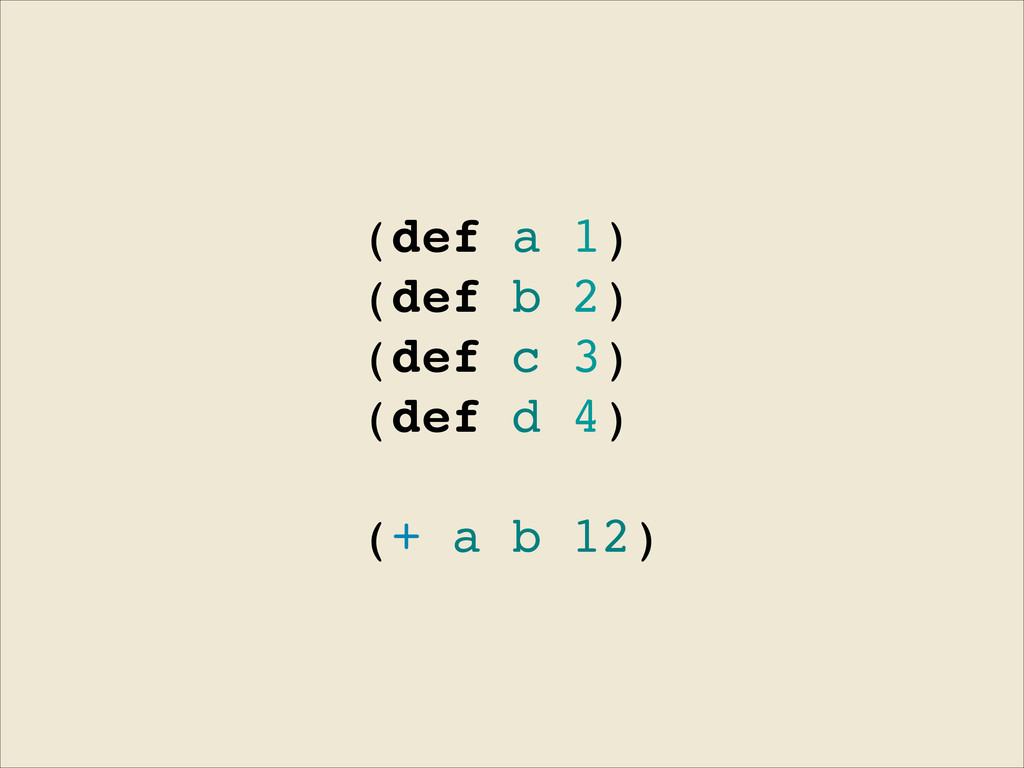
(def a 1)! (def b 2)! (def c 3)! (def
d 4)! ! (+ a b 12)
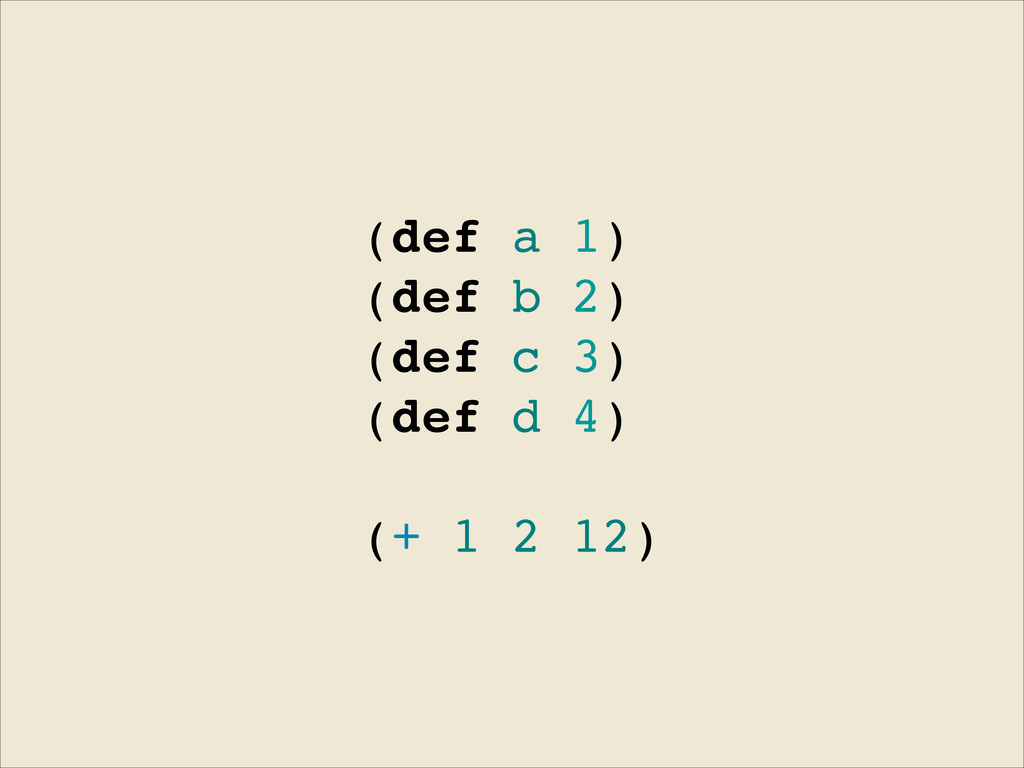
(def a 1)! (def b 2)! (def c 3)! (def
d 4)! ! (+ 1 2 12)
When you see the symbol, look for it in Environment
Environment
Monad is just a box, right?
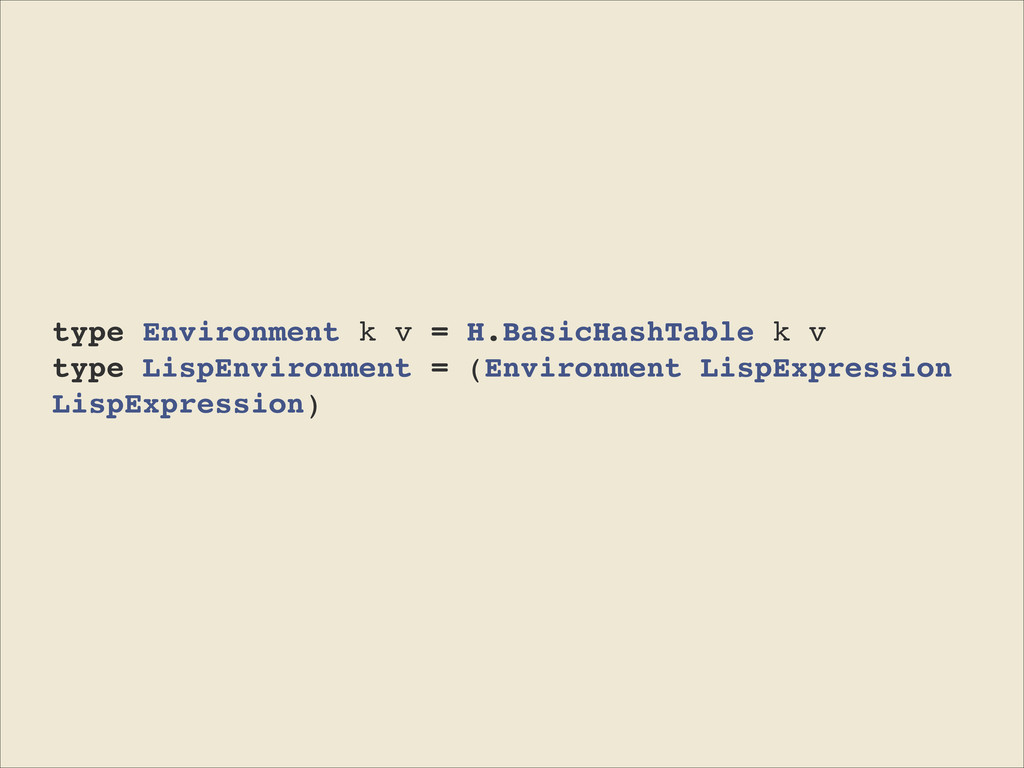
type Environment k v = H.BasicHashTable k v! type LispEnvironment
= (Environment LispExpression LispExpression)!
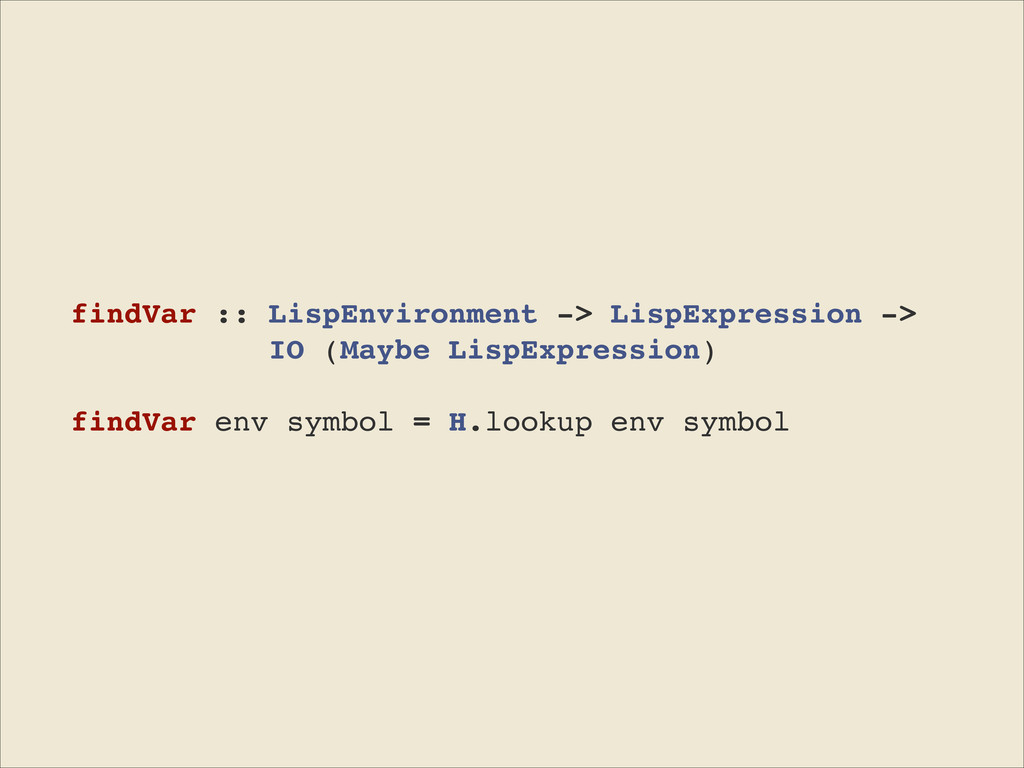
findVar :: LispEnvironment -> LispExpression -> ! ! ! !
! ! IO (Maybe LispExpression)! ! findVar env symbol = H.lookup env symbol!
Closures and polluting Environment
I’m not polluting, I just don’t need it anymore
(def sum ! (fn [a b] ! (fn [c] (+
c a b))))! ! (+ a b) ;; Shouldn't work Creates Closure
Closure is a temporary Environment
Passed only to recursive calls
(def sum ! (fn [a b] ! (fn [c] (+
c a b))))! ! (+ a b) ;; Shouldn't work Limited Visibility
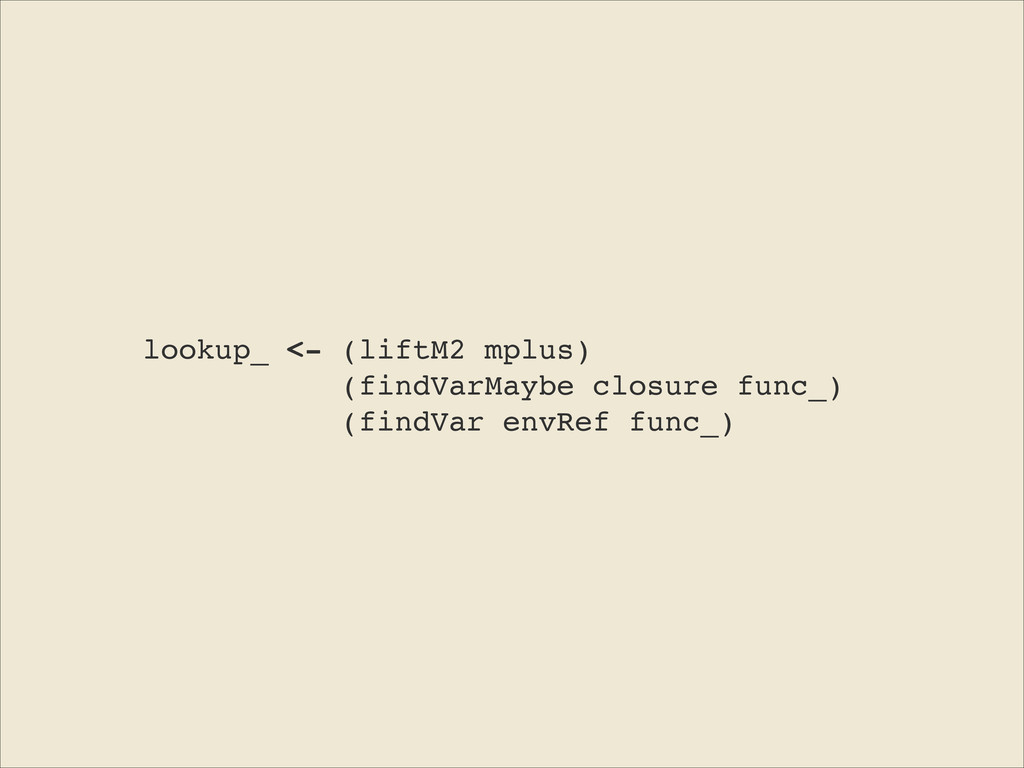
That leads us to two-step lookup (shines in Haskell)
Look up var value in Closure
If there’s no Closure, look up Environment
If there’s Closure, look up in Closure first (shadowing)
If all fails, error
None
lookup_ <- (liftM2 mplus) ! (findVarMaybe closure func_) ! (findVar
envRef func_)
(def sum ! (fn [a b] ! (fn [c] (+
c a b))))! ! (+ a b) ;; Shouldn't work Limited Visibility
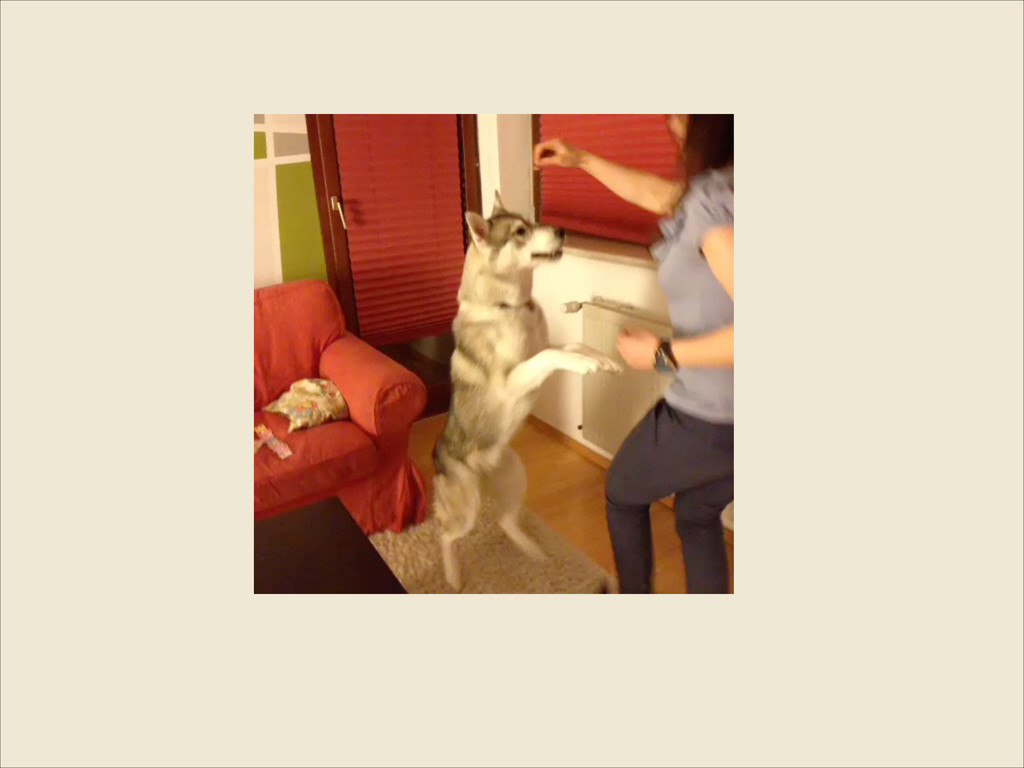
That makes me dance!
None
Built-in Functions
Problem: `+` symbol is a “native” function
None
2 function types
data LispFunk = UserFunction [LispExpression] LispExpression |! LibraryFunction String ([LispExpression]
-> LispExpression)! deriving (Generic)
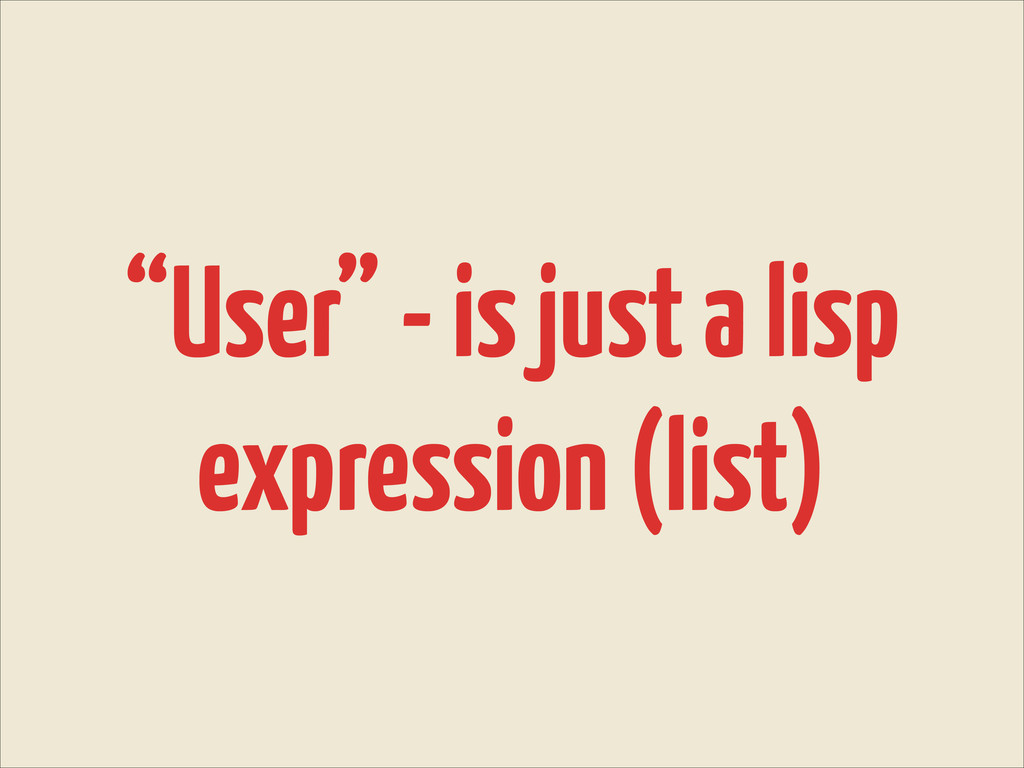
“User” - is just a lisp expression (list)
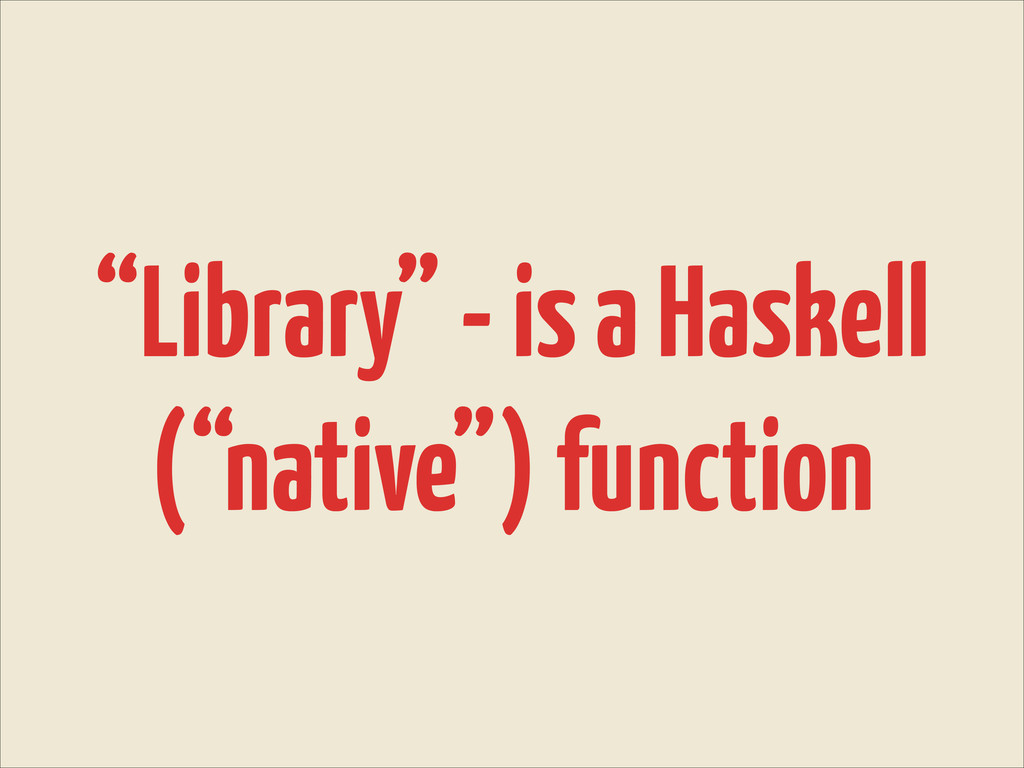
“Library” - is a Haskell (“native”) function
numericOp :: (Integer -> Integer -> Integer) -> ! [LispExpression]
-> LispExpression! ! numericOp op args = LispNumber $ foldl1 op $ ! ! ! ! ! ! ! ! ! map unpackNum args! ! builtInOp :: String -> [LispExpression] -> ! LispExpression! builtInOp "+" args = numericOp (+) args
If statement
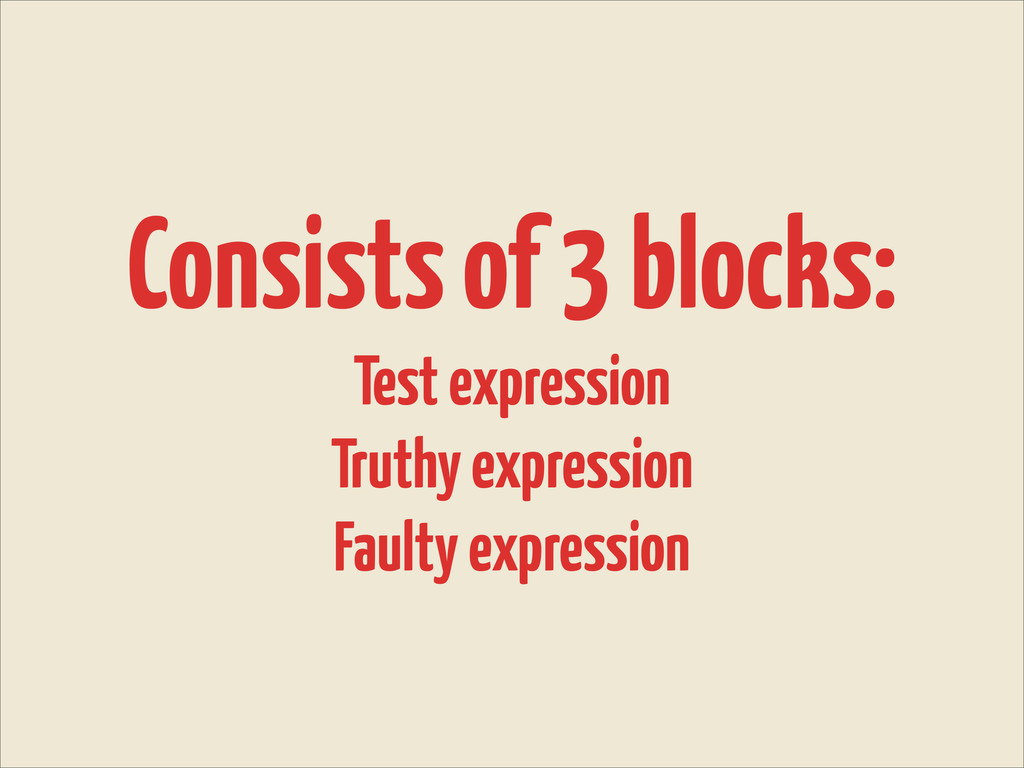
Consists of 3 blocks: Test expression Truthy expression Faulty expression
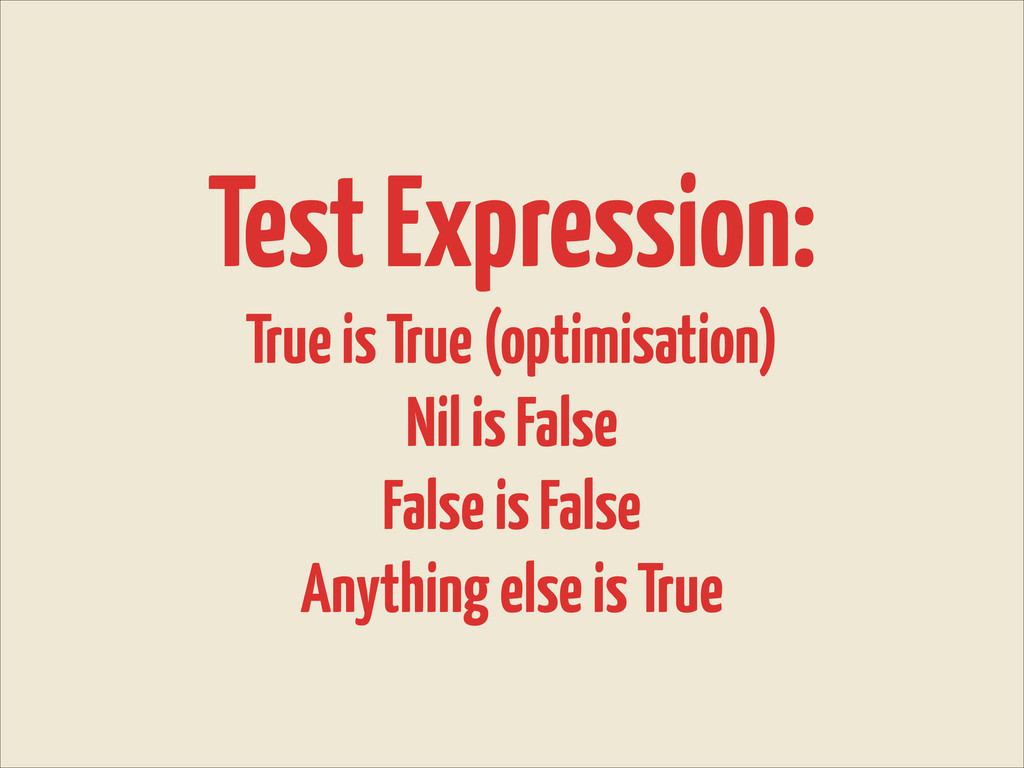
Test Expression: True is True (optimisation) Nil is False False
is False Anything else is True
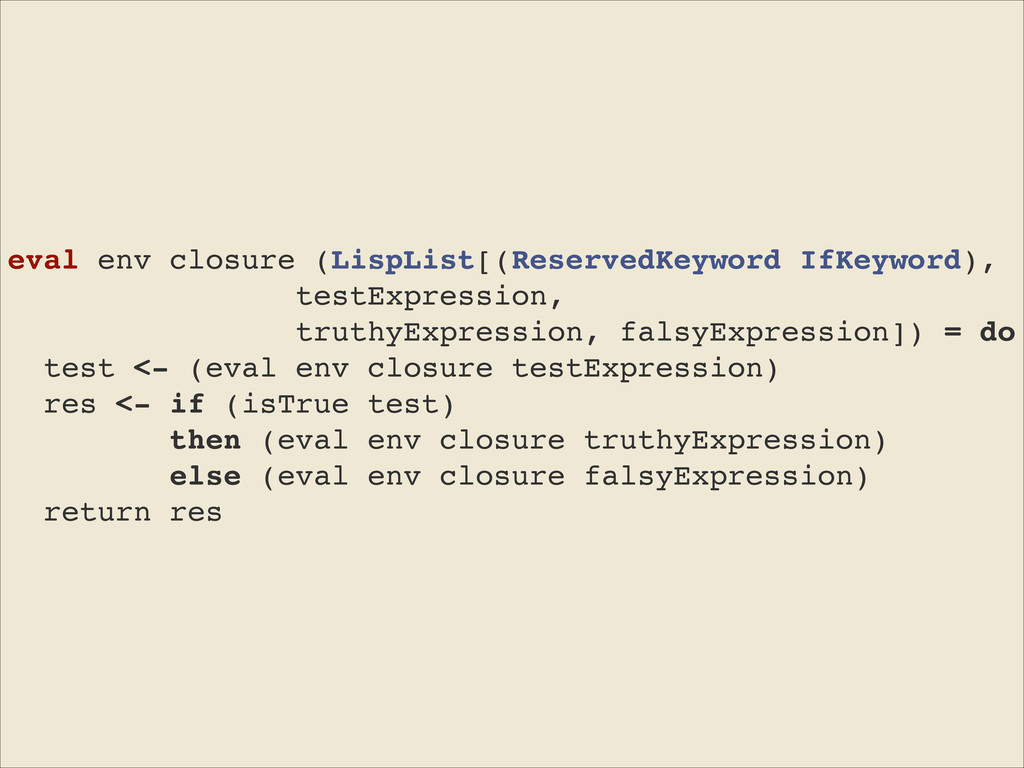
eval env closure (LispList[(ReservedKeyword IfKeyword), ! ! ! ! !
! ! ! ! testExpression,! truthyExpression, falsyExpression]) = do! test <- (eval env closure testExpression)! res <- if (isTrue test)! then (eval env closure truthyExpression)! else (eval env closure falsyExpression)! return res
Map/reduce
Primitives
(def empty?! (fn [a] (= a (quote ()))))
None
(def map! (fn [f coll]! (if (empty? coll)! (quote ())!
(cons (f (first coll))! (map f (next coll)))))) Recur here
(def reduce! (fn [f coll acc]! (if (empty? coll)! acc!
(reduce f (next coll) (f acc (first coll)))))) Recur here
Bottomline
Definition is adding an evaluated expression to hash map
Function (fn) captures an enclosed environment and evaluates to internal
function primitive
If Evaluates only test expression and one of given blocks,
skipping the other one
Recursion Is given basically for free, since it’s just a
var lookup and a function call
Evaluation Evaluate left from right, recursively
Closures Capture the current environment, dismiss when reaching end of
lexical scope
Thanks everyone!
None
@ifesdjeen


 ifesdjeen
 katarinadahlin
 iamctodd
 inesmontani
 codingconduct
 leimatthew05
 marktimemedia
 bluesmoon
 portentint
 chrisshort
 3n
3n
 tammyeverts
![(def b 100) ;; defining vars! (def a (fn [c]](https://files.speakerdeck.com/presentations/e1f40c604b9d0131056822e7fe4eb823/slide_4.jpg)





![(def sum ! (fn [a b] ! (fn [c] (+](https://files.speakerdeck.com/presentations/e1f40c604b9d0131056822e7fe4eb823/slide_46.jpg)
![(def sum ! (fn [a b] ! (fn [c] (+](https://files.speakerdeck.com/presentations/e1f40c604b9d0131056822e7fe4eb823/slide_49.jpg)

![(def sum ! (fn [a b] ! (fn [c] (+](https://files.speakerdeck.com/presentations/e1f40c604b9d0131056822e7fe4eb823/slide_57.jpg)


![data LispFunk = UserFunction [LispExpression] LispExpression |! LibraryFunction String ([LispExpression]](https://files.speakerdeck.com/presentations/e1f40c604b9d0131056822e7fe4eb823/slide_64.jpg)
![numericOp :: (Integer -> Integer -> Integer) -> ! [LispExpression]](https://files.speakerdeck.com/presentations/e1f40c604b9d0131056822e7fe4eb823/slide_67.jpg)
![(def empty?! (fn [a] (= a (quote ()))))](https://files.speakerdeck.com/presentations/e1f40c604b9d0131056822e7fe4eb823/slide_74.jpg)
![(def map! (fn [f coll]! (if (empty? coll)! (quote ())!](https://files.speakerdeck.com/presentations/e1f40c604b9d0131056822e7fe4eb823/slide_76.jpg)
![(def reduce! (fn [f coll acc]! (if (empty? coll)! acc!](https://files.speakerdeck.com/presentations/e1f40c604b9d0131056822e7fe4eb823/slide_77.jpg)