Upgrade to Pro — share decks privately, control downloads, hide ads and more …

An Introduction to Context Ontology Accelerator...

Avatar for Riku INADA Riku INADA PRO
November 08, 2026

An Introduction to Context Ontology Accelerator (teaching AI agents what your data means)

An introduction to Context Ontology Accelerator (COA), an open-source project from AWS (Apache 2.0). In COA, AI proposes an ontology from your databases and documents, people review and accept it, and AI agents use it through three tiers (metrics, structured queries, knowledge retrieval) and MCP. The deck covers ontology fundamentals (IRIs, RDF triples, knowledge graphs, RDFS and OWL, reasoning, SPARQL), the Scan, Model and Serve stages, namespaces and access control on queries, the AWS architecture, how R2RML mappings and the virtual knowledge graph work, and how to deploy COA into your own AWS account, using the public workshop's Northwind data and screens. Based on public information as of v0.3.9 (November 2026).

Avatar for Riku INADA

Riku INADA PRO

November 08, 2026

More Decks by Riku INADA

Other Decks in Technology

Transcript

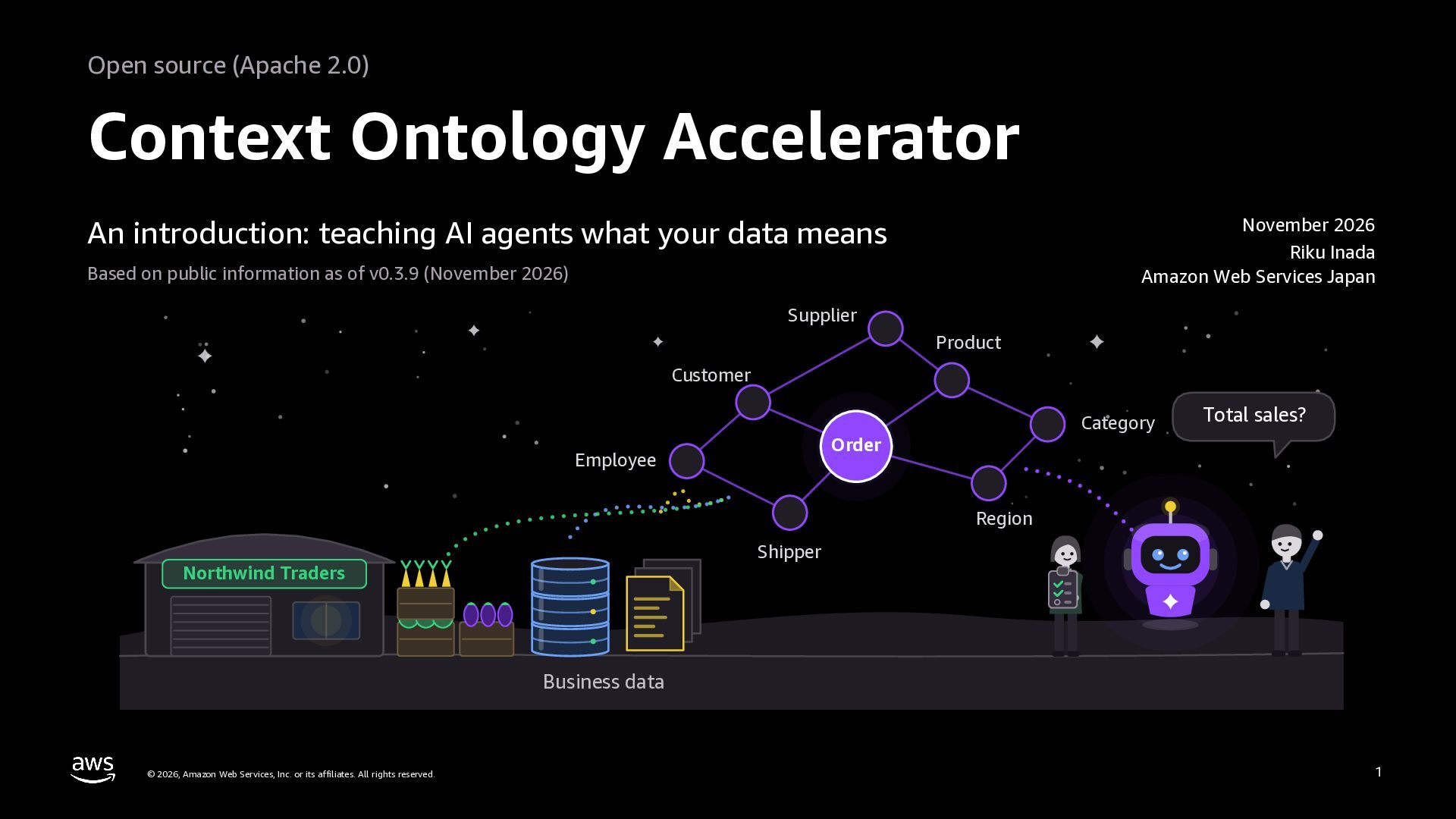
  1. Open source (Apache 2.0) Context Ontology Accelerator November 2026 Riku

    Inada Amazon Web Services Japan An introduction: teaching AI agents what your data means Based on public information as of v0.3.9 (November 2026) Supplier Product Customer Category Order Employee Total sales? Region Shipper Northwind Traders Business data © 2026, Amazon Web Services, Inc. or its affiliates. All rights reserved. 1
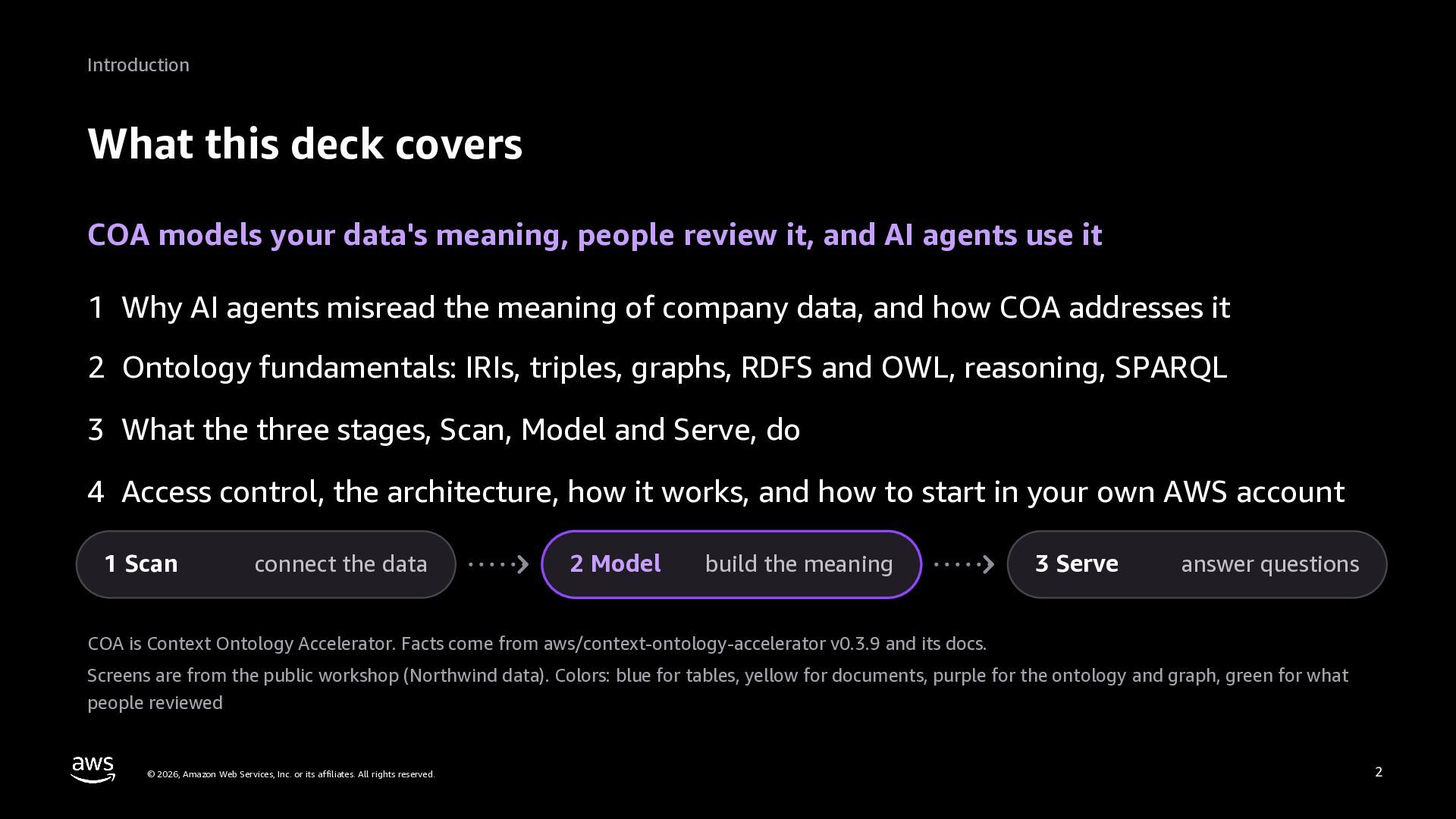
  2. Introduction What this deck covers COA models your data's meaning,

    people review it, and AI agents use it 1 Why AI agents misread the meaning of company data, and how COA addresses it 2 Ontology fundamentals: IRIs, triples, graphs, RDFS and OWL, reasoning, SPARQL 3 What the three stages, Scan, Model and Serve, do 4 Access control, the architecture, how it works, and how to start in your own AWS account 1 Scan connect the data 2 Model build the meaning 3 Serve answer questions COA is Context Ontology Accelerator. Facts come from aws/context-ontology-accelerator v0.3.9 and its docs. Screens are from the public workshop (Northwind data). Colors: blue for tables, yellow for documents, purple for the ontology and graph, green for what people reviewed © 2026, Amazon Web Services, Inc. or its affiliates. All rights reserved. 2
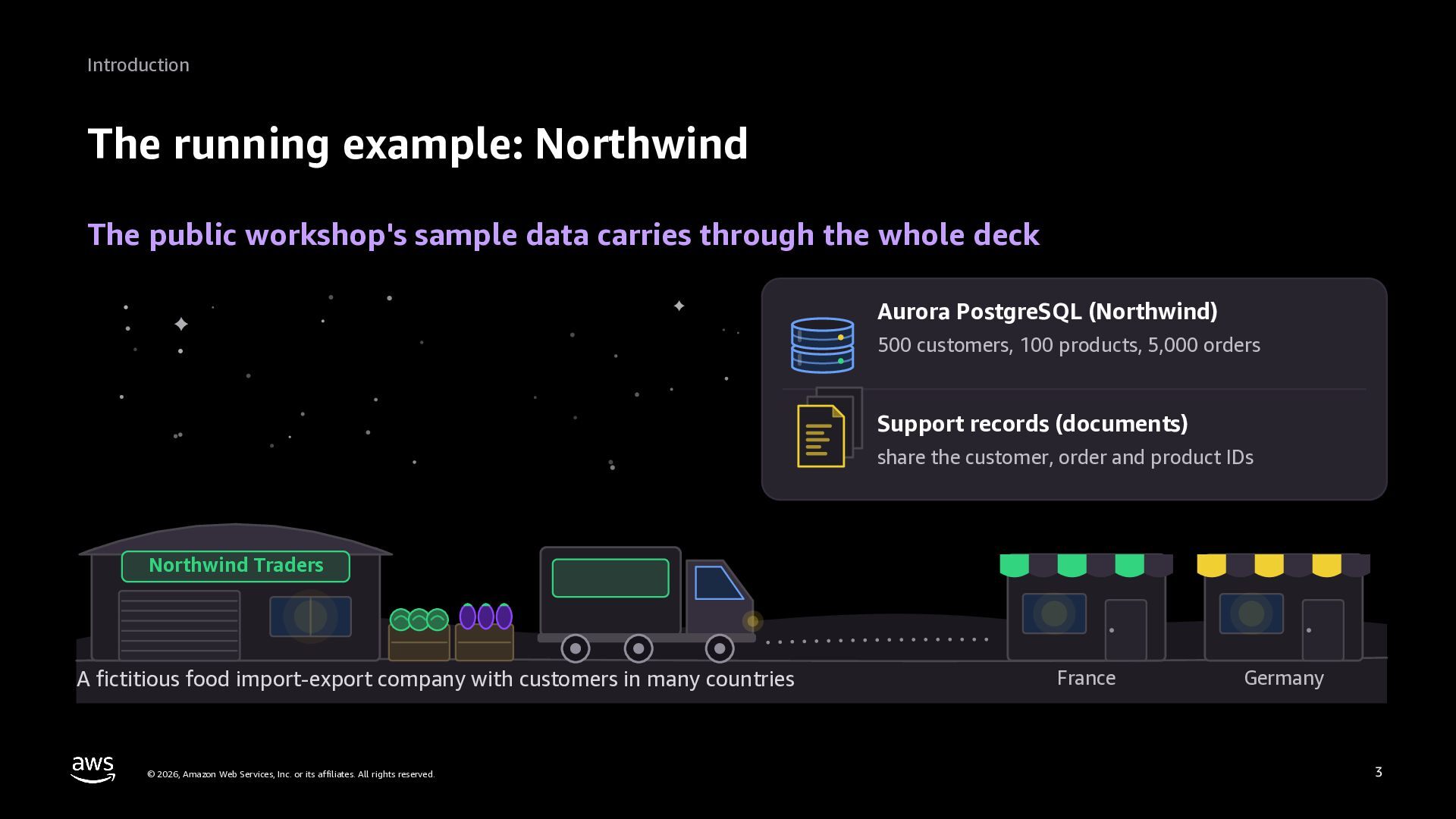
  3. Introduction The running example: Northwind The public workshop's sample data

    carries through the whole deck Aurora PostgreSQL (Northwind) 500 customers, 100 products, 5,000 orders Support records (documents) share the customer, order and product IDs Northwind Traders A fictitious food import-export company with customers in many countries © 2026, Amazon Web Services, Inc. or its affiliates. All rights reserved. France Germany 3
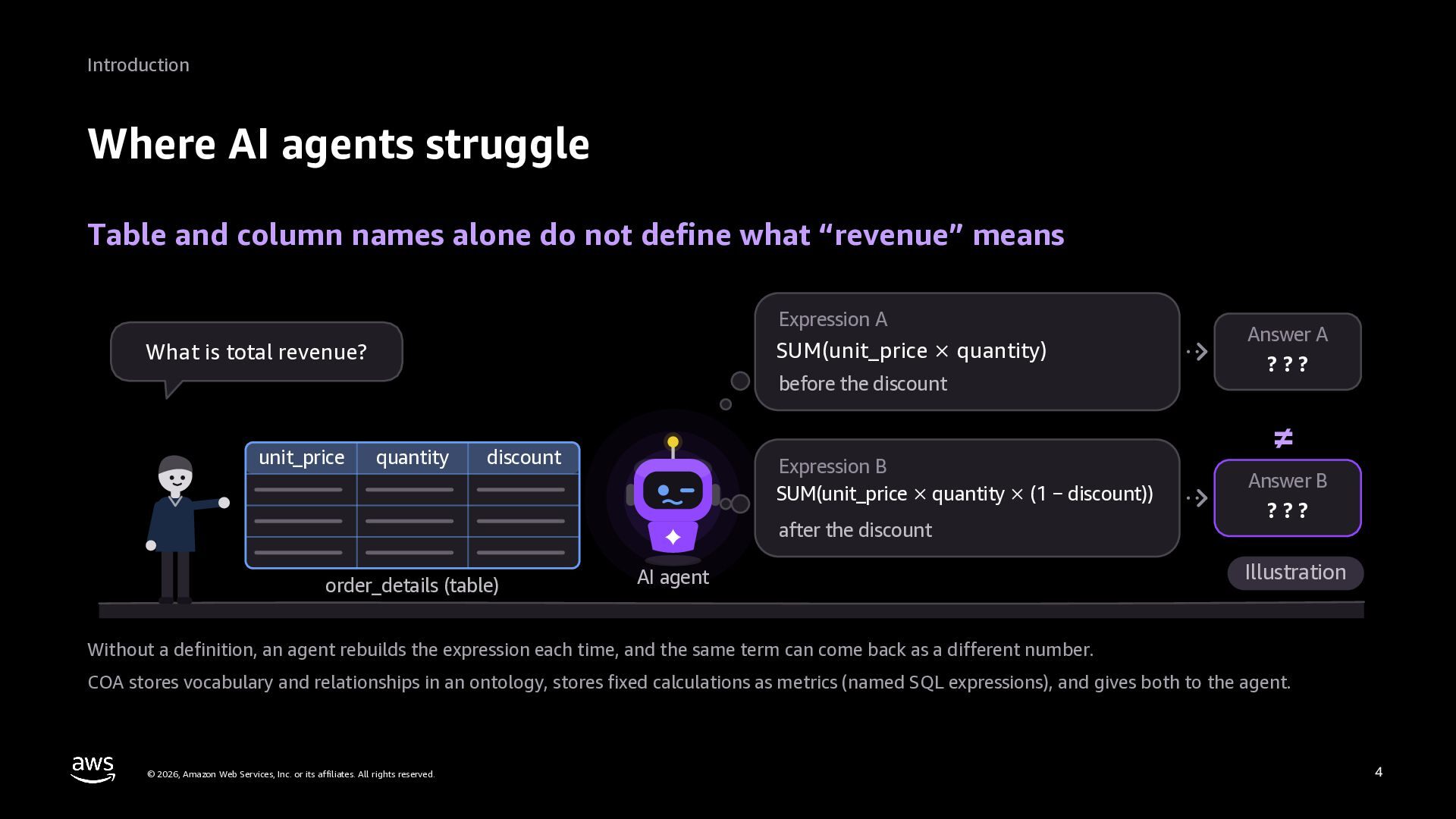
  4. Introduction Where AI agents struggle Table and column names alone

    do not define what “revenue” means Expression A SUM(unit_price × quantity) What is total revenue? before the discount unit_price quantity discount Expression B SUM(unit_price × quantity × (1 − discount)) after the discount order_details (table) AI agent Answer A ??? ≠ Answer B ??? Illustration Without a definition, an agent rebuilds the expression each time, and the same term can come back as a different number. COA stores vocabulary and relationships in an ontology, stores fixed calculations as metrics (named SQL expressions), and gives both to the agent. © 2026, Amazon Web Services, Inc. or its affiliates. All rights reserved. 4
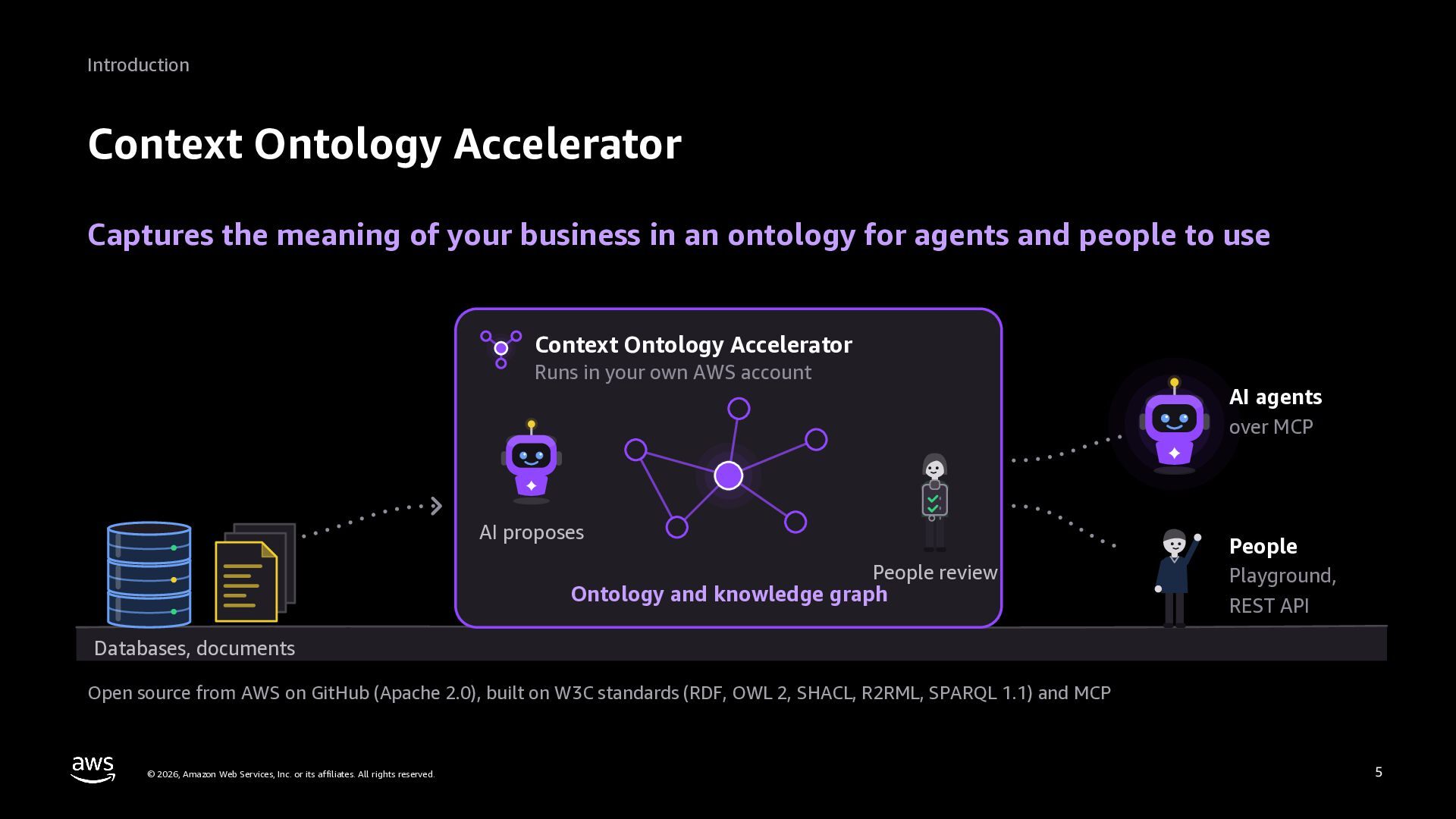
  5. Introduction Context Ontology Accelerator Captures the meaning of your business

    in an ontology for agents and people to use Context Ontology Accelerator Runs in your own AWS account AI agents over MCP AI proposes People People review Ontology and knowledge graph Playground, REST API Databases, documents Open source from AWS on GitHub (Apache 2.0), built on W3C standards (RDF, OWL 2, SHACL, R2RML, SPARQL 1.1) and MCP © 2026, Amazon Web Services, Inc. or its affiliates. All rights reserved. 5
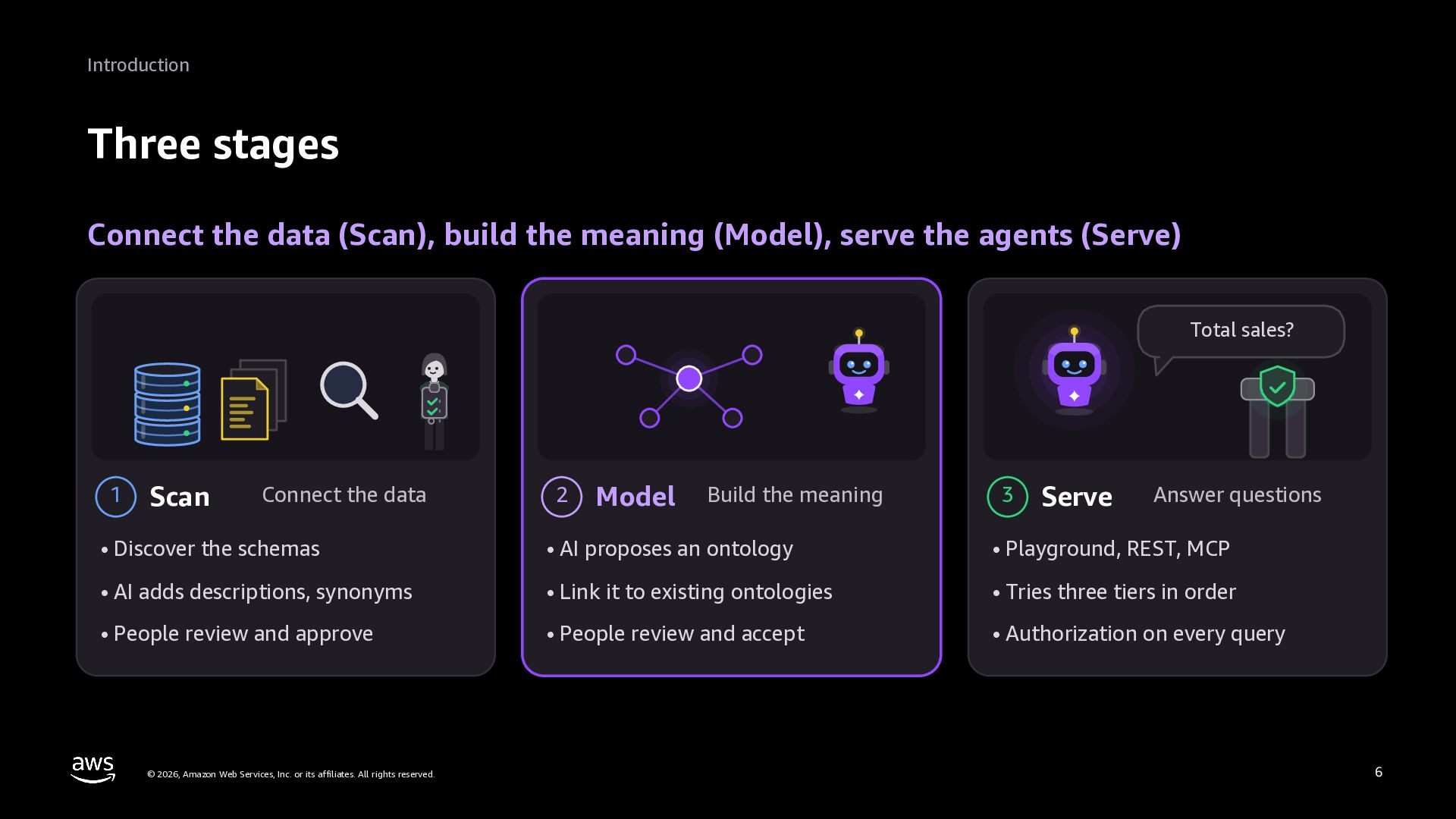
  6. Introduction Three stages Connect the data (Scan), build the meaning

    (Model), serve the agents (Serve) Total sales? 1 Scan Connect the data 2 Model Build the meaning 3 Serve Answer questions • Discover the schemas • AI proposes an ontology • Playground, REST, MCP • AI adds descriptions, synonyms • Link it to existing ontologies • Tries three tiers in order • People review and approve • People review and accept • Authorization on every query © 2026, Amazon Web Services, Inc. or its affiliates. All rights reserved. 6
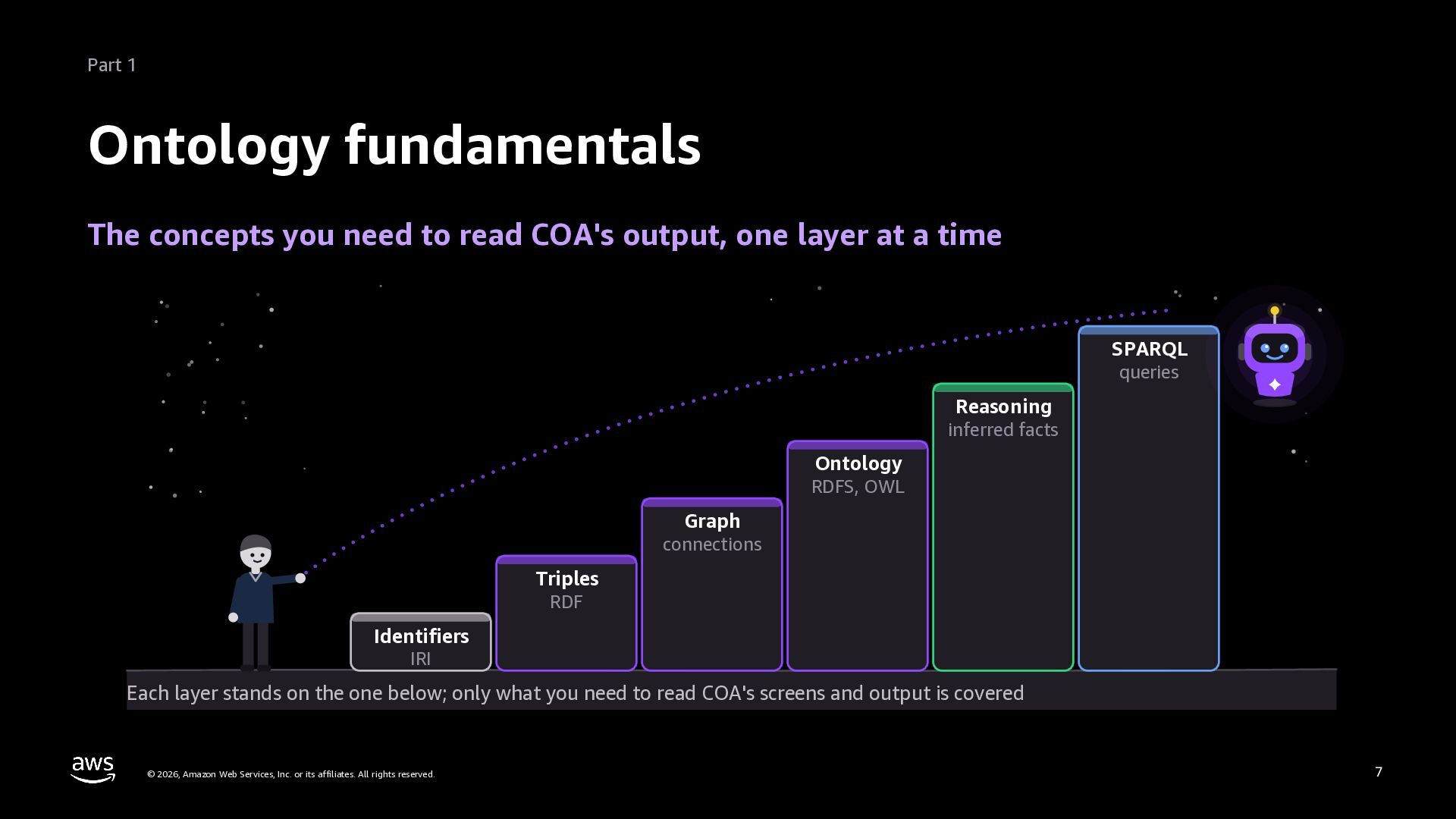
  7. Part 1 Ontology fundamentals The concepts you need to read

    COA's output, one layer at a time SPARQL queries Reasoning inferred facts Ontology RDFS, OWL Graph connections Triples RDF Identifiers IRI Each layer stands on the one below; only what you need to read COA's screens and output is covered © 2026, Amazon Web Services, Inc. or its affiliates. All rights reserved. 7
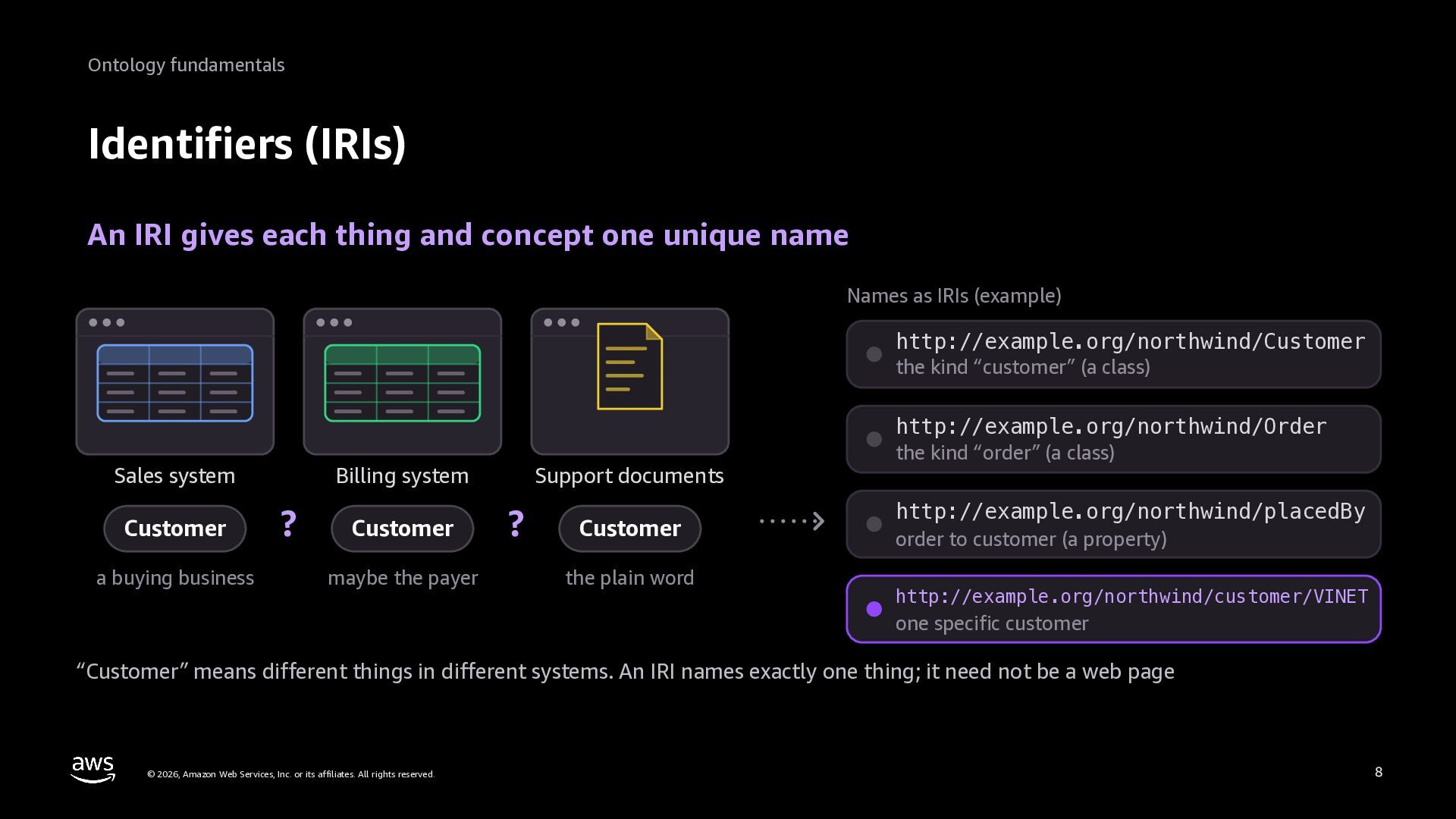
  8. Ontology fundamentals Identifiers (IRIs) An IRI gives each thing and

    concept one unique name Names as IRIs (example) http://example.org/northwind/Customer the kind “customer” (a class) http://example.org/northwind/Order Sales system Customer a buying business Billing system ? Customer maybe the payer Support documents ? Customer the plain word the kind “order” (a class) http://example.org/northwind/placedBy order to customer (a property) http://example.org/northwind/customer/VINET one specific customer “Customer” means different things in different systems. An IRI names exactly one thing; it need not be a web page © 2026, Amazon Web Services, Inc. or its affiliates. All rights reserved. 8
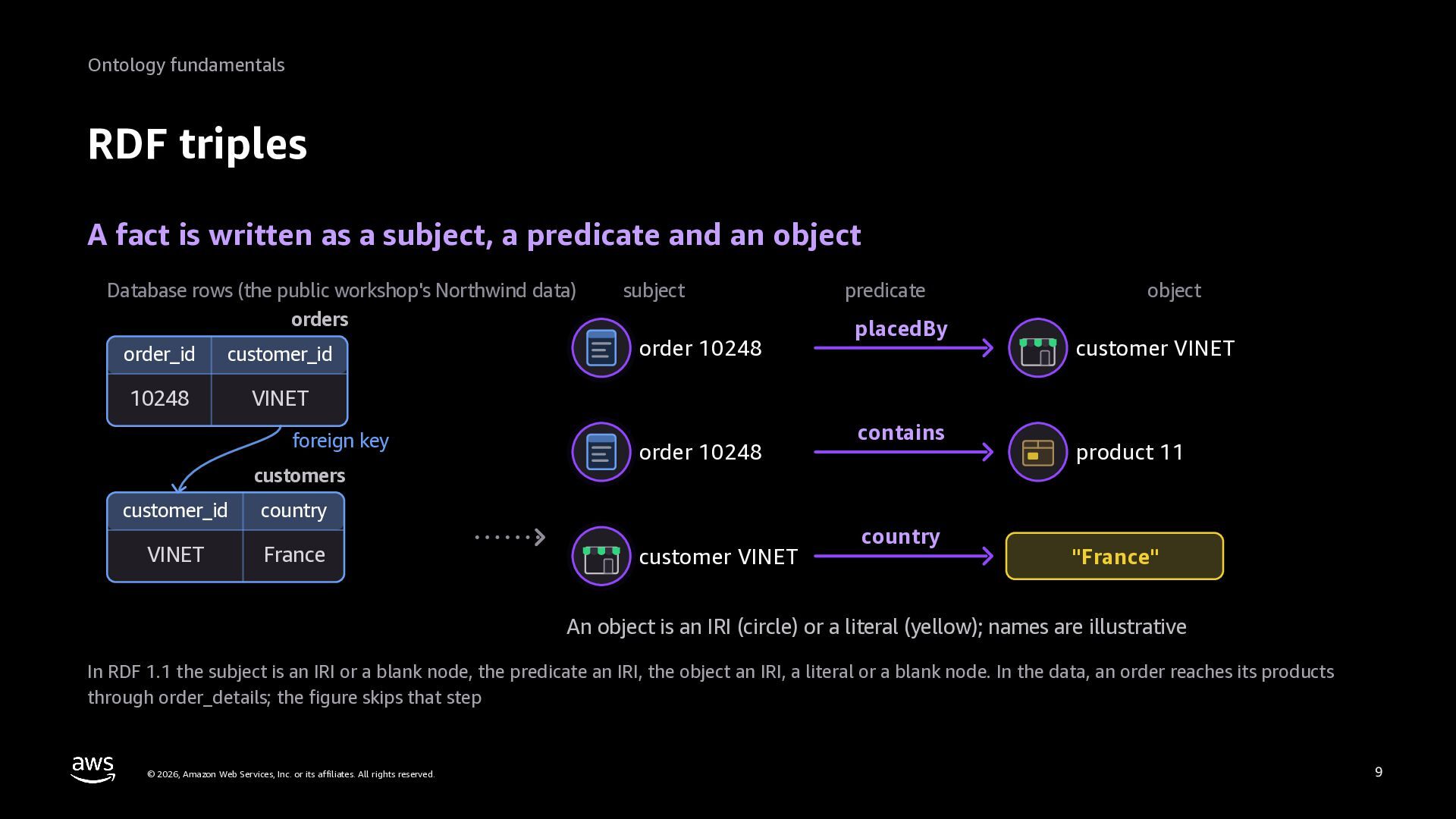
  9. Ontology fundamentals RDF triples A fact is written as a

    subject, a predicate and an object Database rows (the public workshop's Northwind data) orders order_id customer_id 10248 VINET foreign key customers customer_id country VINET France subject order 10248 order 10248 customer VINET predicate placedBy contains country object customer VINET product 11 "France" An object is an IRI (circle) or a literal (yellow); names are illustrative In RDF 1.1 the subject is an IRI or a blank node, the predicate an IRI, the object an IRI, a literal or a blank node. In the data, an order reaches its products through order_details; the figure skips that step © 2026, Amazon Web Services, Inc. or its affiliates. All rights reserved. 9
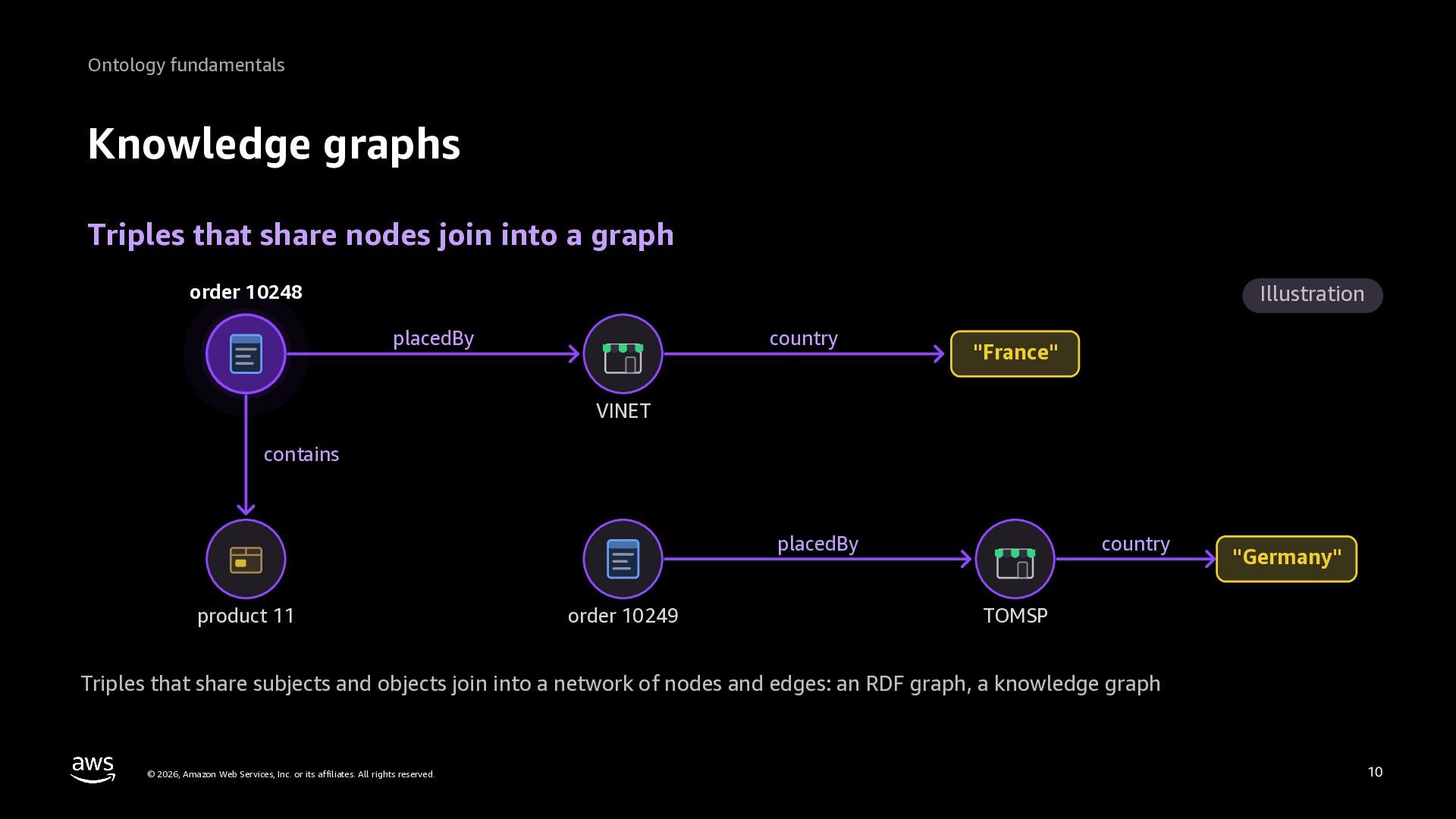
  10. Ontology fundamentals Knowledge graphs Triples that share nodes join into

    a graph order 10248 Illustration placedBy country "France" VINET contains placedBy product 11 order 10249 country "Germany" TOMSP Triples that share subjects and objects join into a network of nodes and edges: an RDF graph, a knowledge graph © 2026, Amazon Web Services, Inc. or its affiliates. All rights reserved. 10
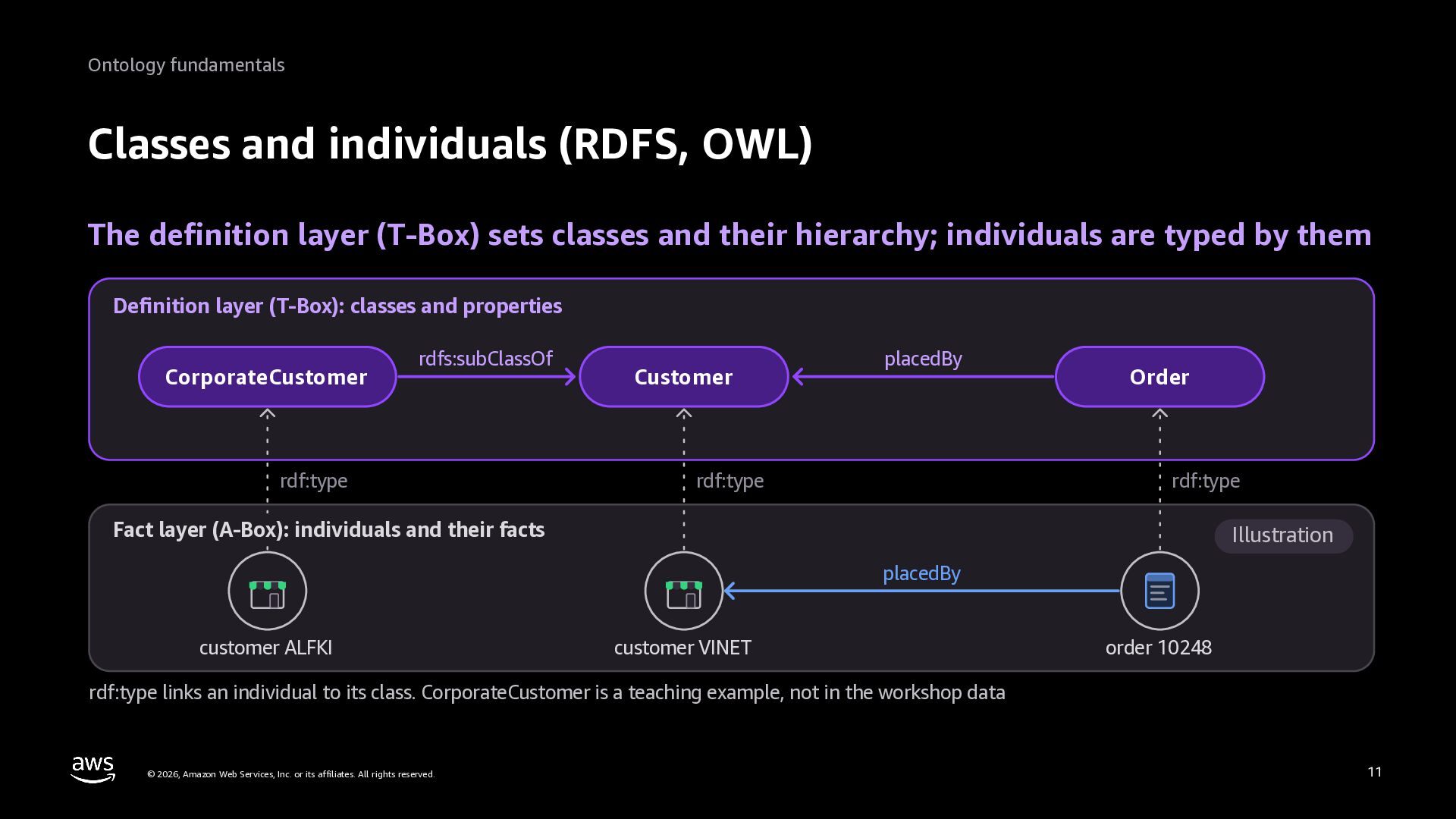
  11. Ontology fundamentals Classes and individuals (RDFS, OWL) The definition layer

    (T-Box) sets classes and their hierarchy; individuals are typed by them Definition layer (T-Box): classes and properties CorporateCustomer rdfs:subClassOf rdf:type Customer placedBy rdf:type Order rdf:type Fact layer (A-Box): individuals and their facts Illustration placedBy customer ALFKI customer VINET order 10248 rdf:type links an individual to its class. CorporateCustomer is a teaching example, not in the workshop data © 2026, Amazon Web Services, Inc. or its affiliates. All rights reserved. 11
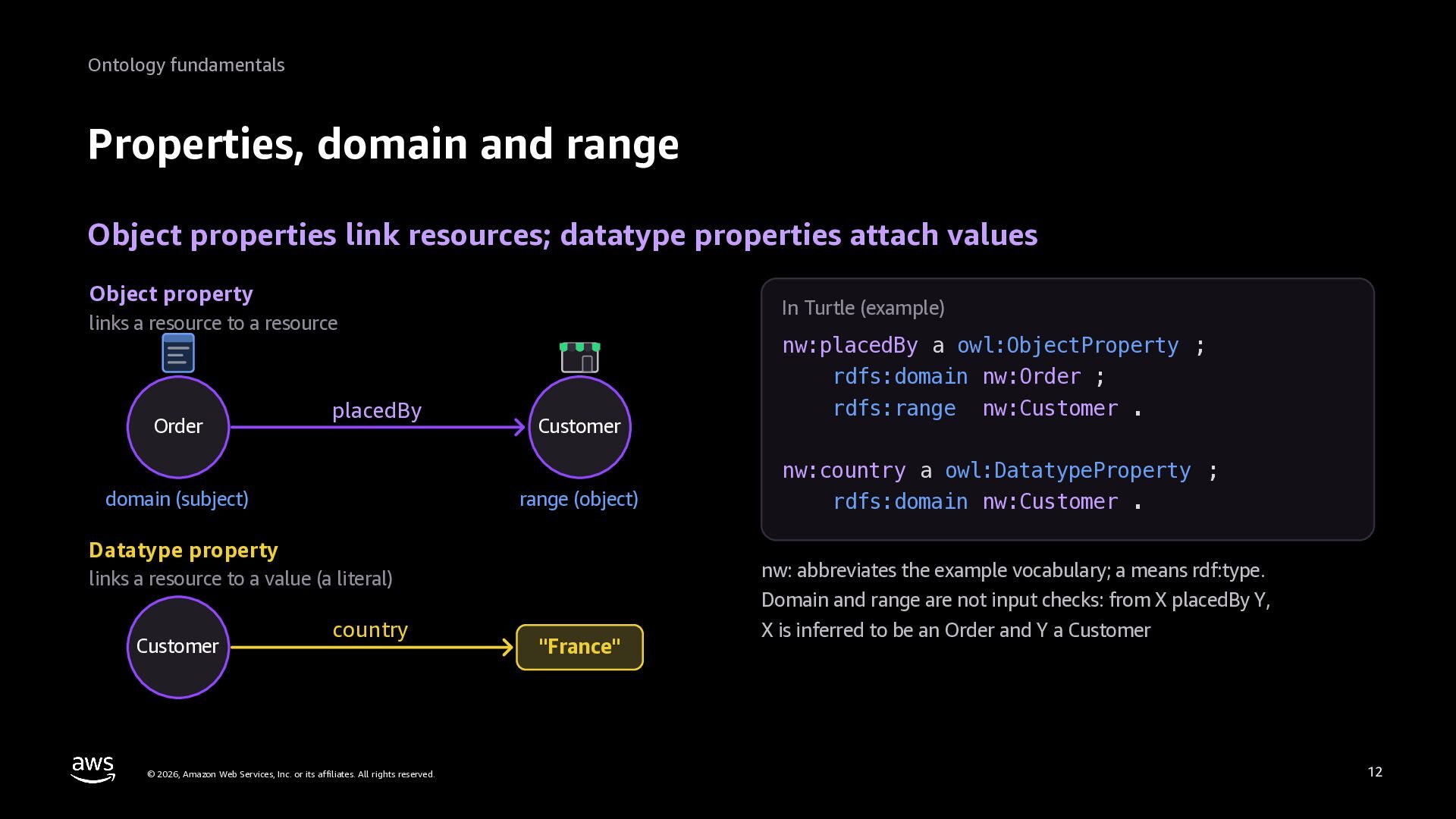
  12. Ontology fundamentals Properties, domain and range Object properties link resources;

    datatype properties attach values Object property In Turtle (example) links a resource to a resource Order placedBy domain (subject) Customer range (object) Datatype property country © 2026, Amazon Web Services, Inc. or its affiliates. All rights reserved. nw:country a owl:DatatypeProperty ; rdfs:domain nw:Customer . nw: abbreviates the example vocabulary; a means rdf:type. links a resource to a value (a literal) Customer nw:placedBy a owl:ObjectProperty ; rdfs:domain nw:Order ; rdfs:range nw:Customer . Domain and range are not input checks: from X placedBy Y, "France" X is inferred to be an Order and Y a Customer 12
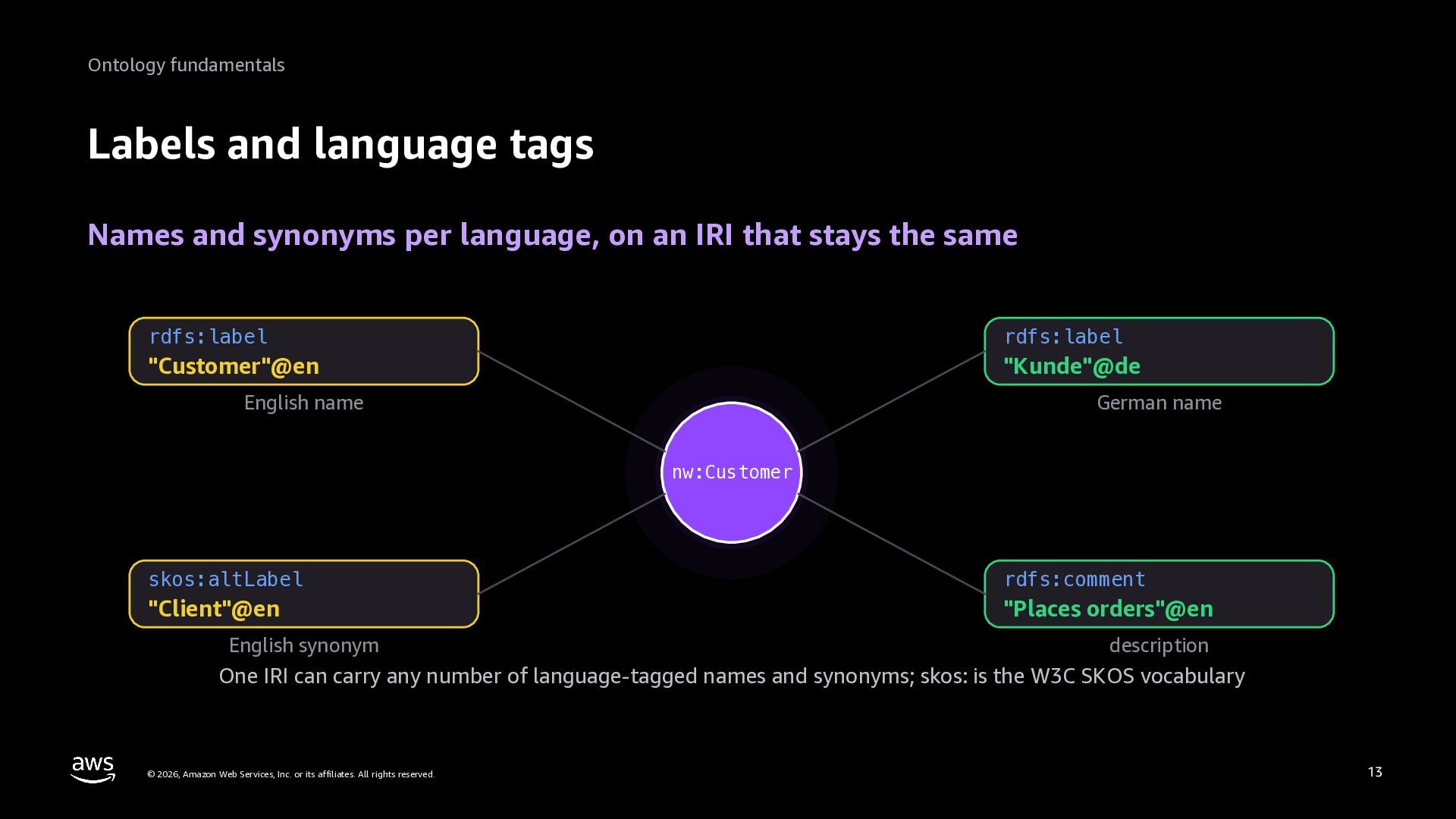
  13. Ontology fundamentals Labels and language tags Names and synonyms per

    language, on an IRI that stays the same rdfs:label rdfs:label "Customer"@en "Kunde"@de English name German name nw:Customer skos:altLabel rdfs:comment "Client"@en "Places orders"@en English synonym description One IRI can carry any number of language-tagged names and synonyms; skos: is the W3C SKOS vocabulary © 2026, Amazon Web Services, Inc. or its affiliates. All rights reserved. 13
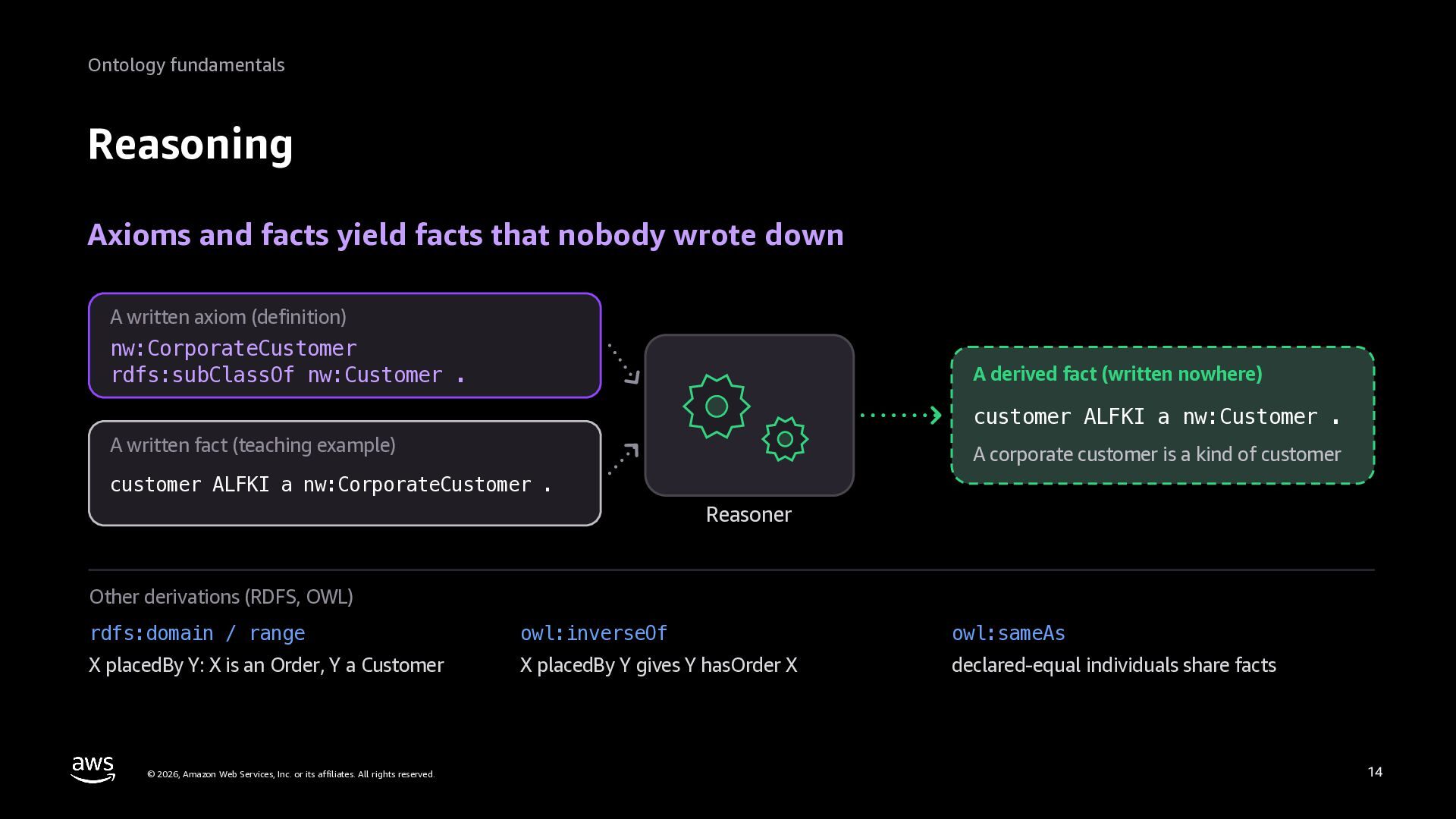
  14. Ontology fundamentals Reasoning Axioms and facts yield facts that nobody

    wrote down A written axiom (definition) nw:CorporateCustomer rdfs:subClassOf nw:Customer . A derived fact (written nowhere) customer ALFKI a nw:Customer . A written fact (teaching example) A corporate customer is a kind of customer customer ALFKI a nw:CorporateCustomer . Reasoner Other derivations (RDFS, OWL) rdfs:domain / range owl:inverseOf owl:sameAs X placedBy Y: X is an Order, Y a Customer X placedBy Y gives Y hasOrder X declared-equal individuals share facts © 2026, Amazon Web Services, Inc. or its affiliates. All rights reserved. 14
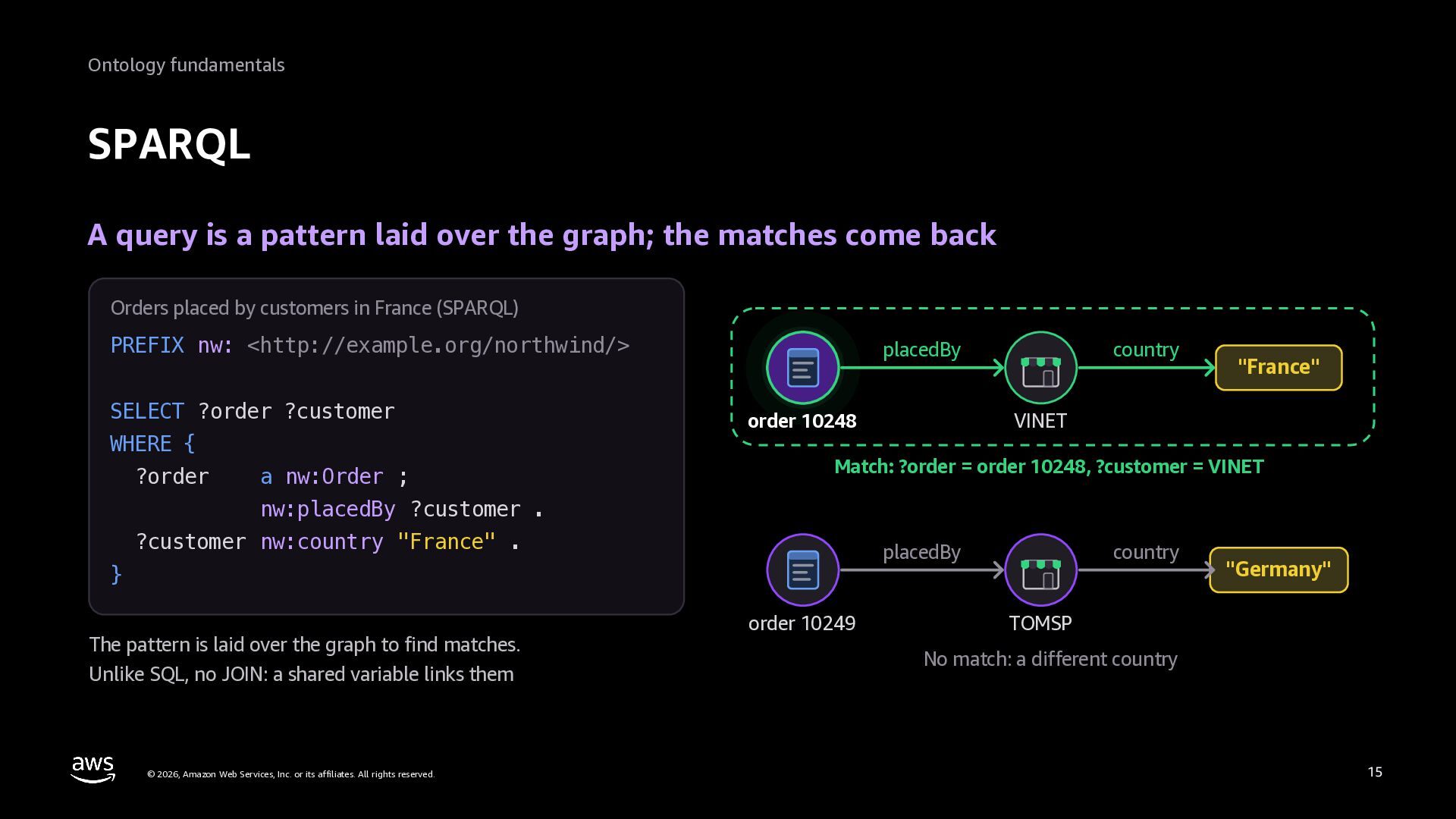
  15. Ontology fundamentals SPARQL A query is a pattern laid over

    the graph; the matches come back Orders placed by customers in France (SPARQL) PREFIX nw: <http://example.org/northwind/> SELECT ?order ?customer WHERE { ?order a nw:Order ; placedBy order 10248 country "France" VINET Match: ?order = order 10248, ?customer = VINET nw:placedBy ?customer . ?customer nw:country "France" . placedBy } The pattern is laid over the graph to find matches. Unlike SQL, no JOIN: a shared variable links them © 2026, Amazon Web Services, Inc. or its affiliates. All rights reserved. order 10249 country "Germany" TOMSP No match: a different country 15
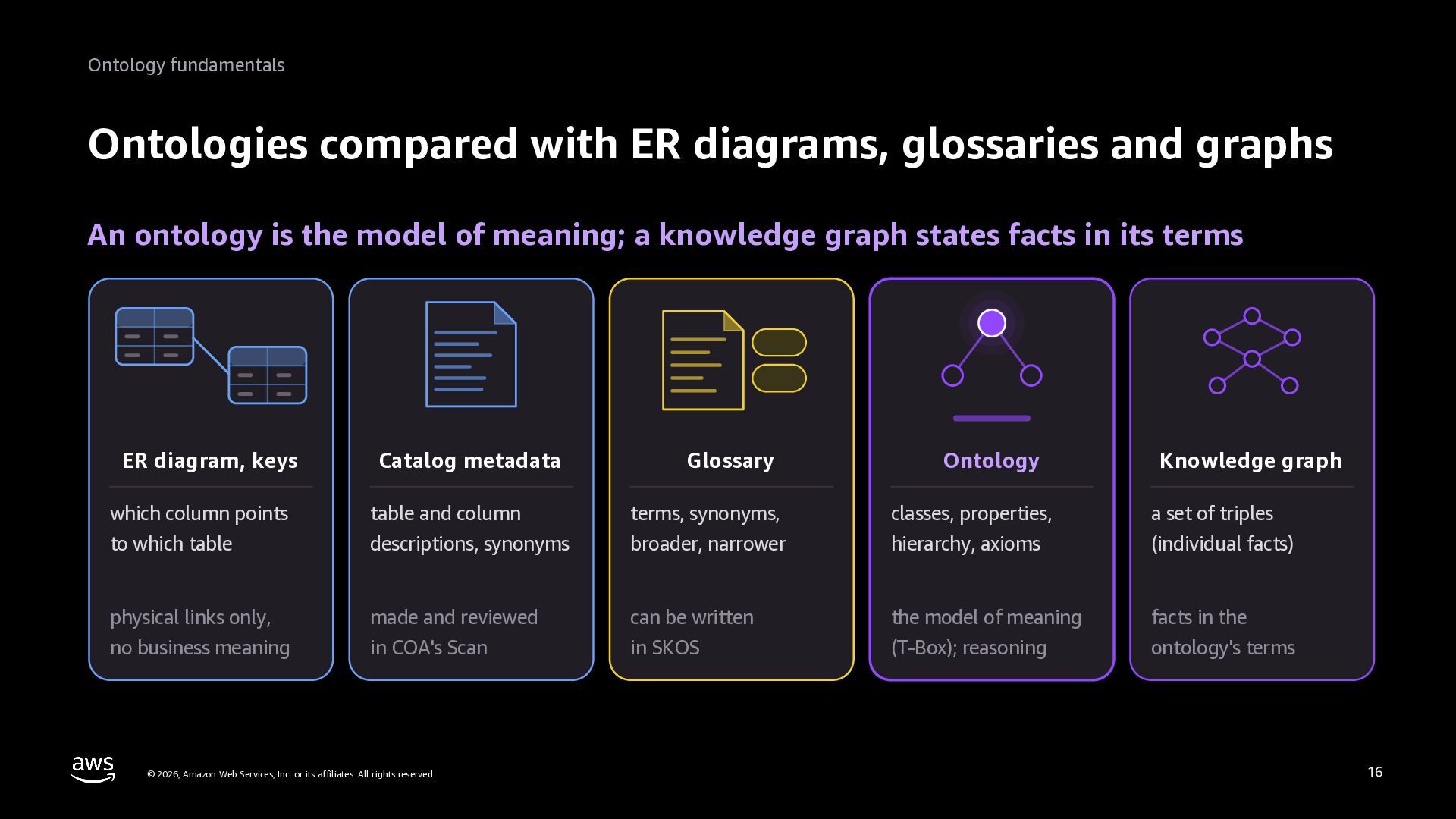
  16. Ontology fundamentals Ontologies compared with ER diagrams, glossaries and graphs

    An ontology is the model of meaning; a knowledge graph states facts in its terms ER diagram, keys Catalog metadata Glossary Ontology which column points table and column terms, synonyms, classes, properties, a set of triples to which table descriptions, synonyms broader, narrower hierarchy, axioms (individual facts) physical links only, made and reviewed can be written the model of meaning facts in the no business meaning in COA's Scan in SKOS (T-Box); reasoning ontology's terms © 2026, Amazon Web Services, Inc. or its affiliates. All rights reserved. Knowledge graph 16
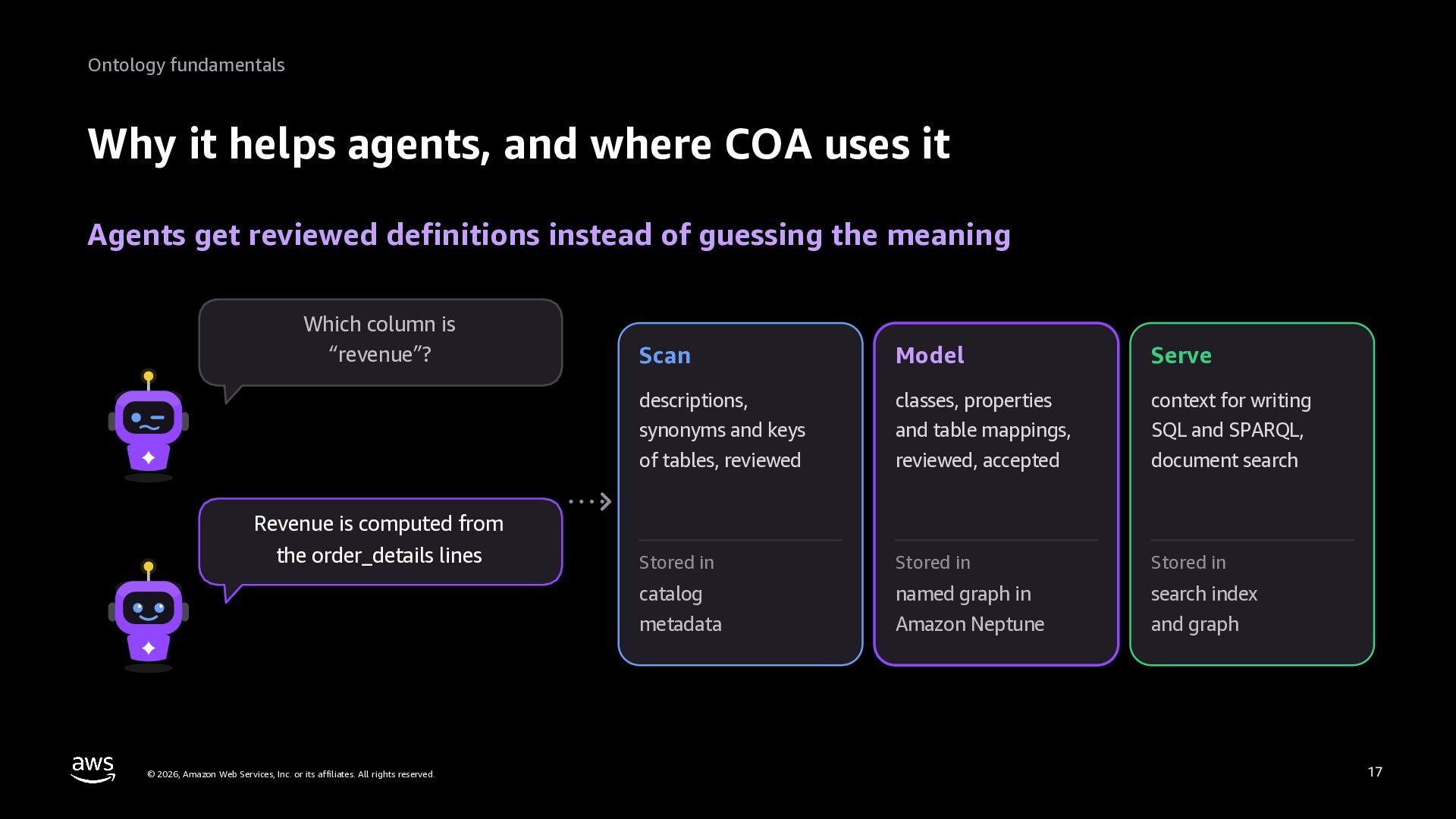
  17. Ontology fundamentals Why it helps agents, and where COA uses

    it Agents get reviewed definitions instead of guessing the meaning Which column is “revenue”? Scan Model Serve descriptions, classes, properties context for writing synonyms and keys and table mappings, SQL and SPARQL, of tables, reviewed reviewed, accepted document search Stored in Stored in Stored in catalog named graph in search index metadata Amazon Neptune and graph Revenue is computed from the order_details lines © 2026, Amazon Web Services, Inc. or its affiliates. All rights reserved. 17
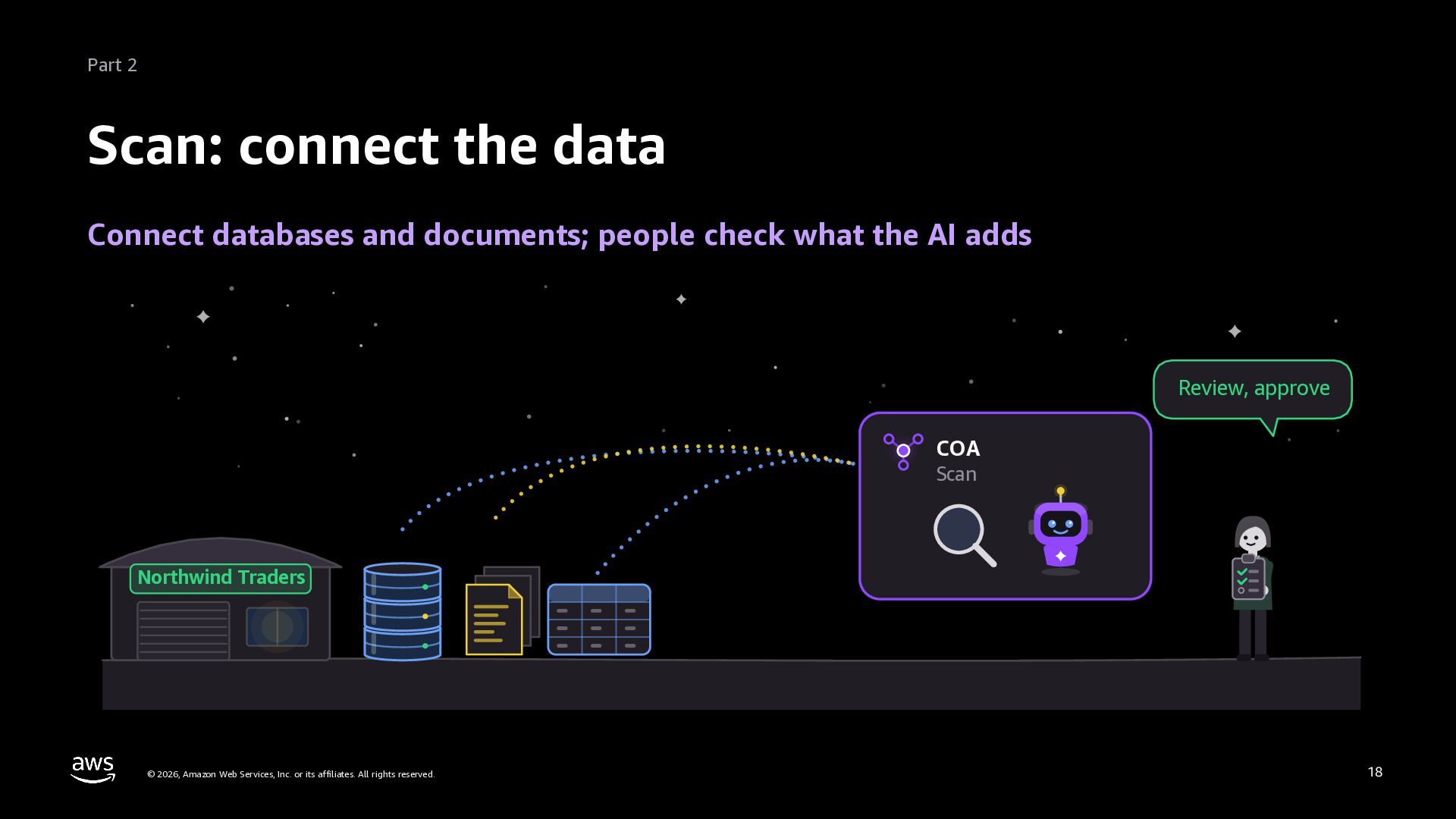
  18. Part 2 Scan: connect the data Connect databases and documents;

    people check what the AI adds Review, approve COA Scan Northwind Traders © 2026, Amazon Web Services, Inc. or its affiliates. All rights reserved. 18
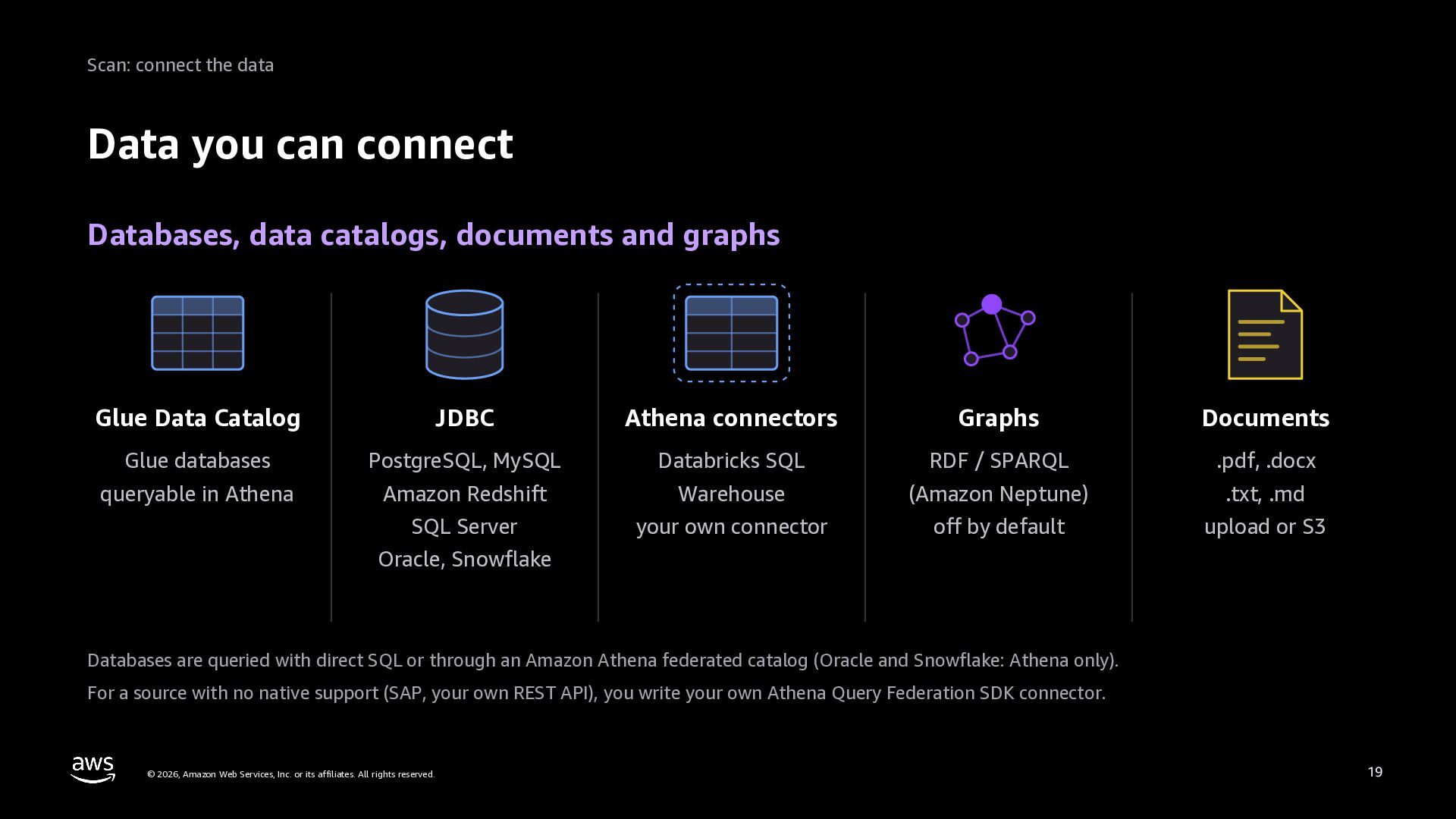
  19. Scan: connect the data Data you can connect Databases, data

    catalogs, documents and graphs Glue Data Catalog JDBC Athena connectors Graphs Documents Glue databases PostgreSQL, MySQL Databricks SQL RDF / SPARQL .pdf, .docx queryable in Athena Amazon Redshift Warehouse (Amazon Neptune) .txt, .md SQL Server your own connector off by default upload or S3 Oracle, Snowflake Databases are queried with direct SQL or through an Amazon Athena federated catalog (Oracle and Snowflake: Athena only). For a source with no native support (SAP, your own REST API), you write your own Athena Query Federation SDK connector. © 2026, Amazon Web Services, Inc. or its affiliates. All rights reserved. 19
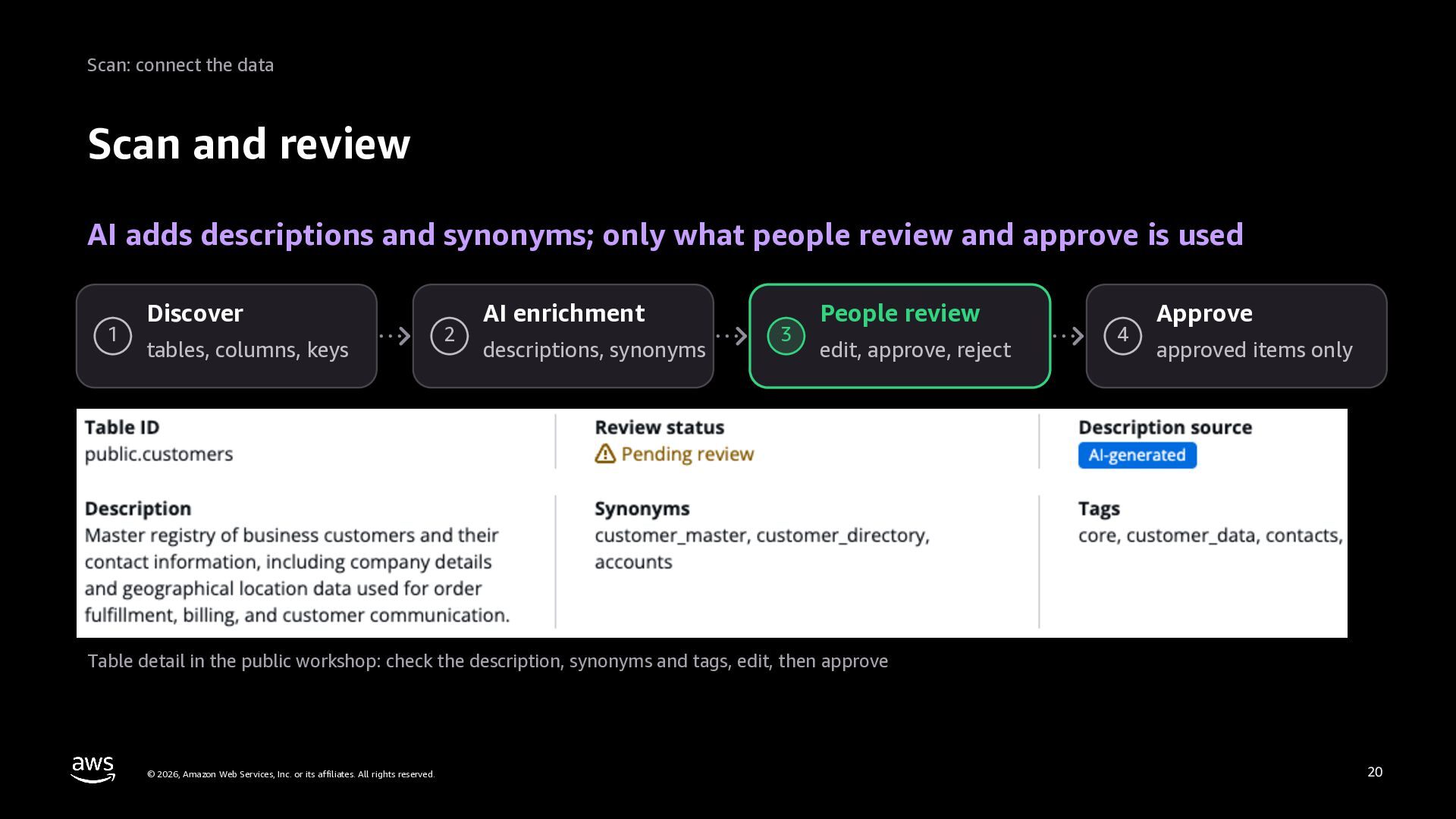
  20. Scan: connect the data Scan and review AI adds descriptions

    and synonyms; only what people review and approve is used 1 Discover tables, columns, keys 2 AI enrichment descriptions, synonyms 3 People review edit, approve, reject 4 Approve approved items only Table detail in the public workshop: check the description, synonyms and tags, edit, then approve © 2026, Amazon Web Services, Inc. or its affiliates. All rights reserved. 20
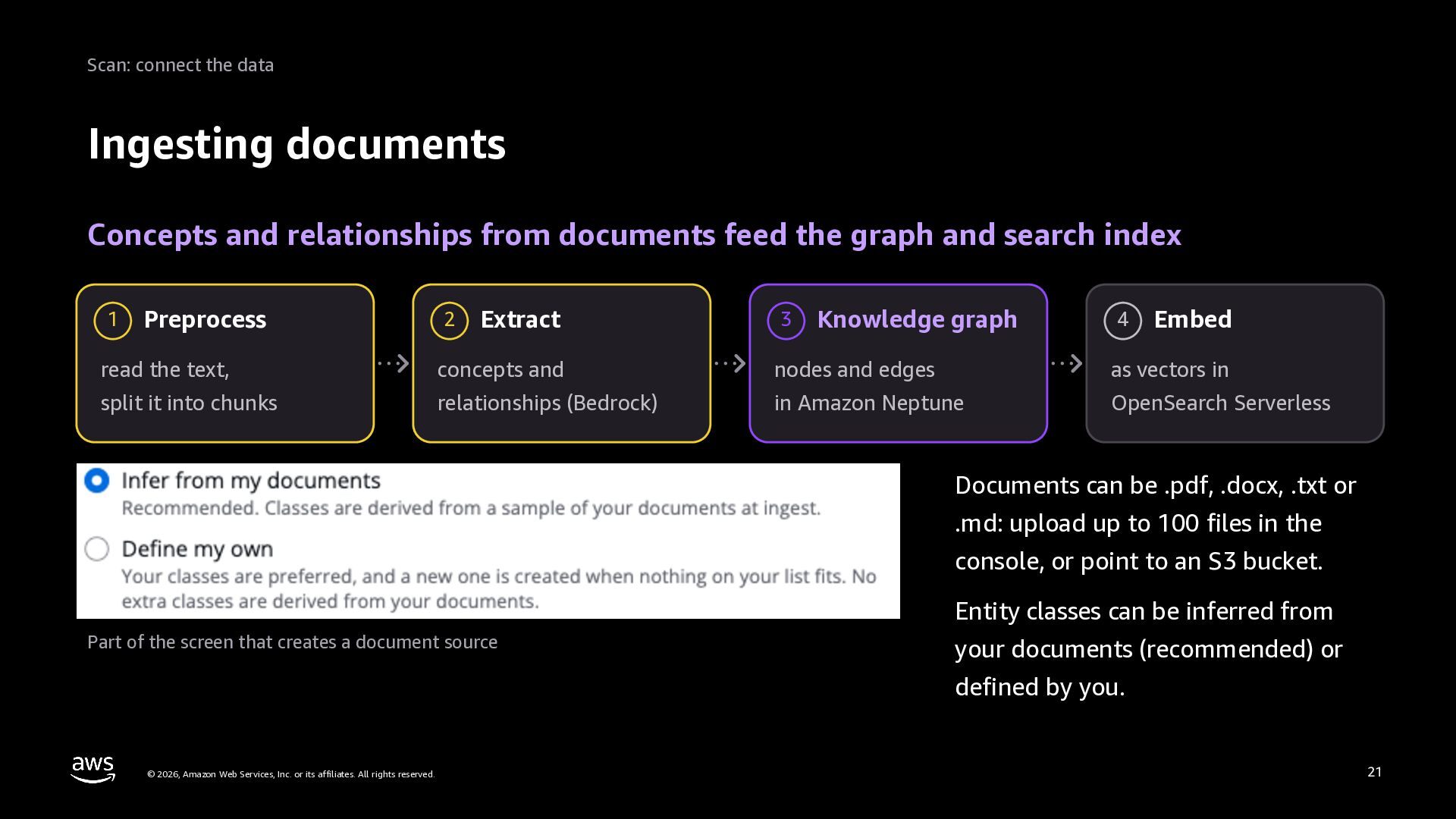
  21. Scan: connect the data Ingesting documents Concepts and relationships from

    documents feed the graph and search index 1 Preprocess 2 Extract 3 Knowledge graph 4 Embed read the text, concepts and nodes and edges as vectors in split it into chunks relationships (Bedrock) in Amazon Neptune OpenSearch Serverless Documents can be .pdf, .docx, .txt or .md: upload up to 100 files in the console, or point to an S3 bucket. Entity classes can be inferred from Part of the screen that creates a document source your documents (recommended) or defined by you. © 2026, Amazon Web Services, Inc. or its affiliates. All rights reserved. 21
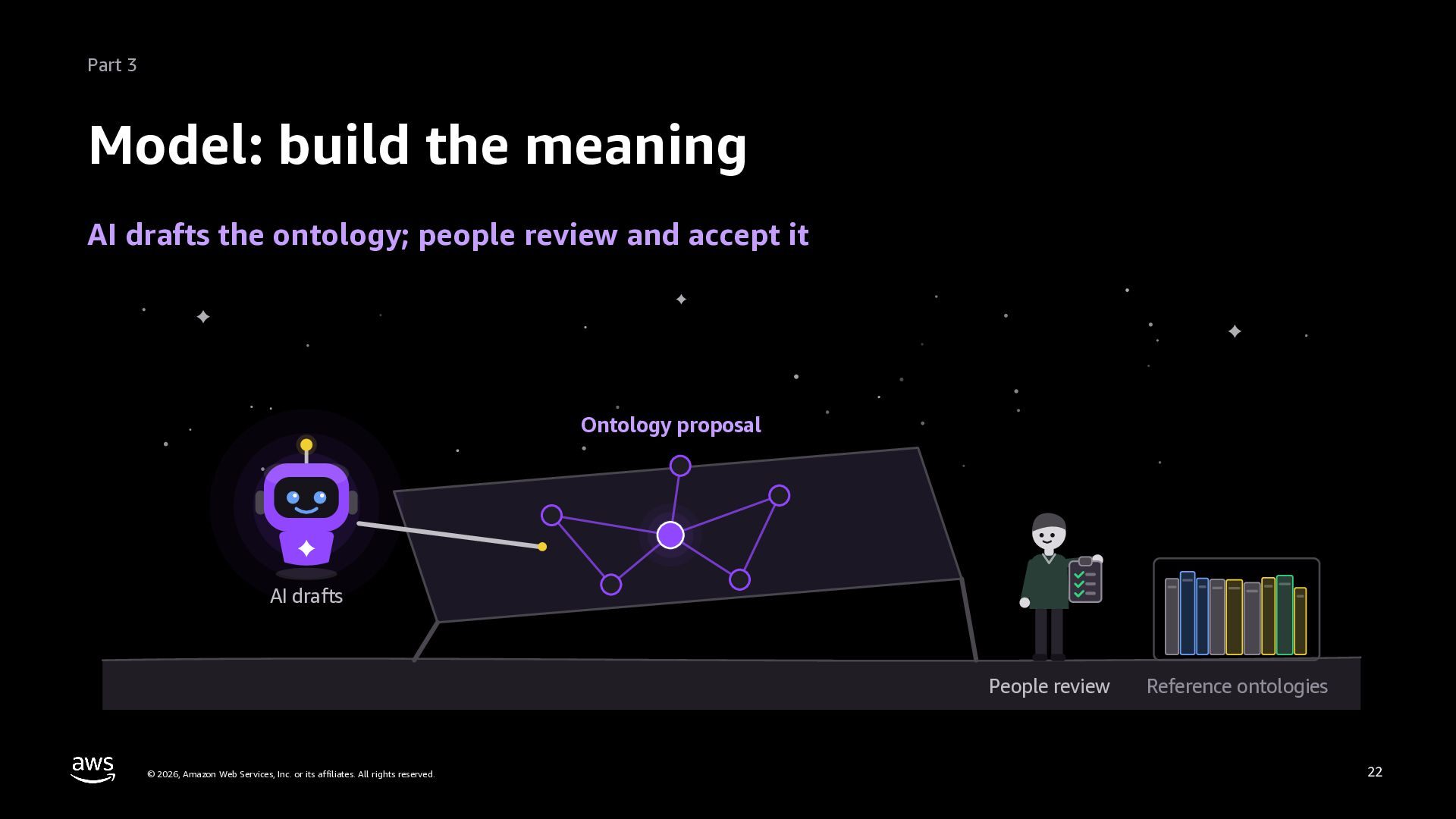
  22. Part 3 Model: build the meaning AI drafts the ontology;

    people review and accept it Ontology proposal AI drafts People review © 2026, Amazon Web Services, Inc. or its affiliates. All rights reserved. Reference ontologies 22
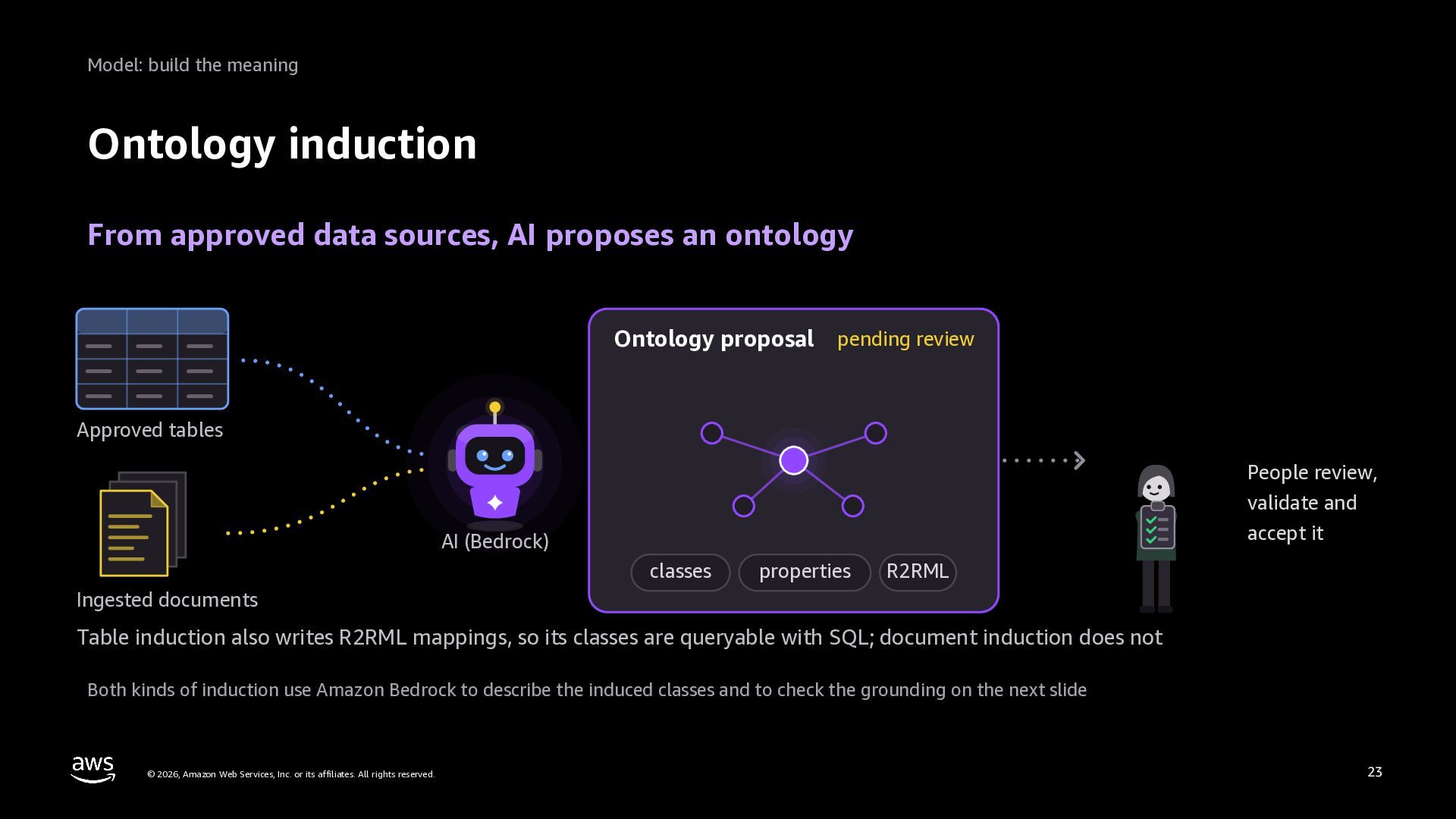
  23. Model: build the meaning Ontology induction From approved data sources,

    AI proposes an ontology Ontology proposal pending review Approved tables People review, validate and accept it AI (Bedrock) classes properties R2RML Ingested documents Table induction also writes R2RML mappings, so its classes are queryable with SQL; document induction does not Both kinds of induction use Amazon Bedrock to describe the induced classes and to check the grounding on the next slide © 2026, Amazon Web Services, Inc. or its affiliates. All rights reserved. 23
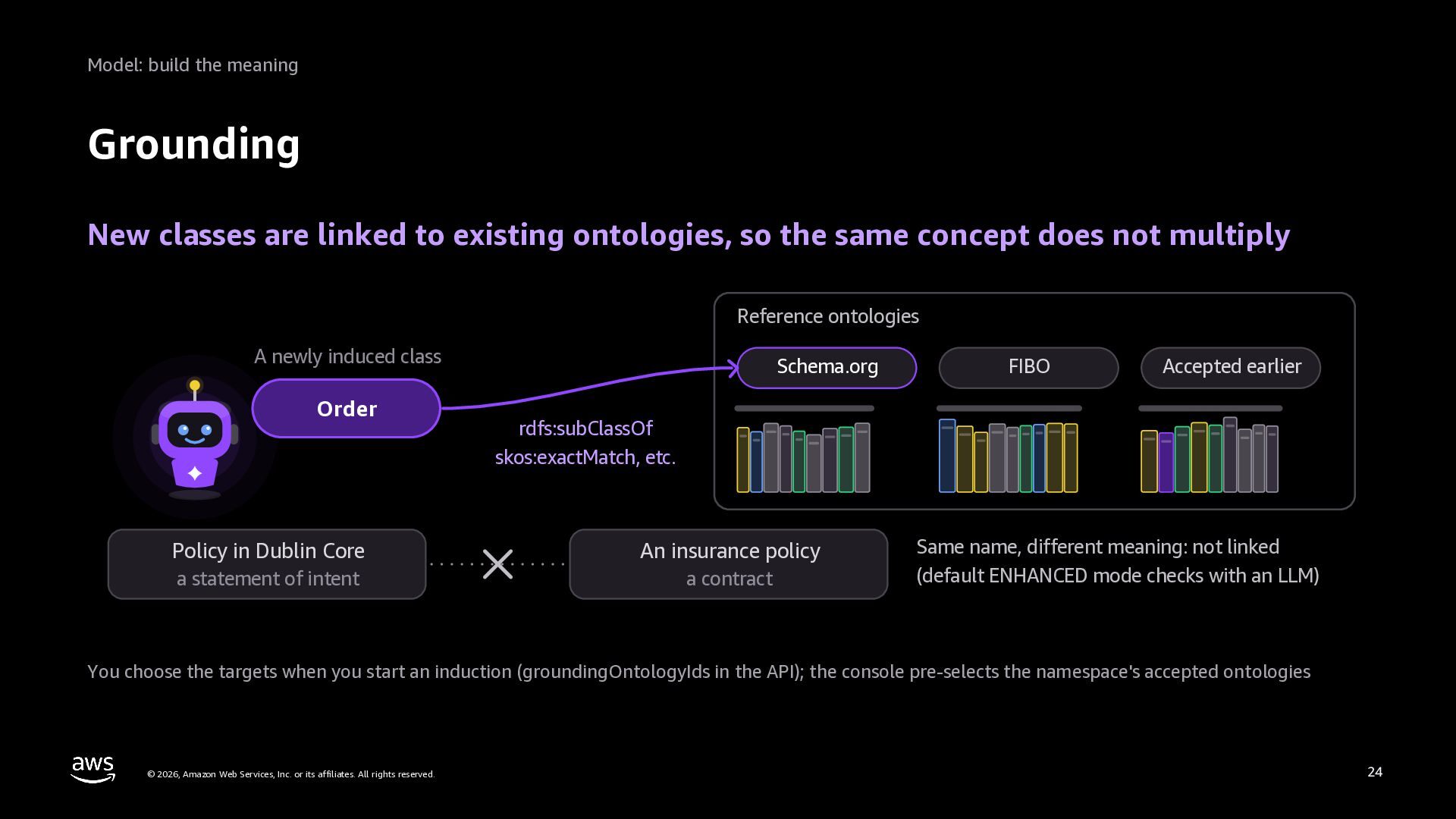
  24. Model: build the meaning Grounding New classes are linked to

    existing ontologies, so the same concept does not multiply Reference ontologies A newly induced class Order Schema.org FIBO Accepted earlier rdfs:subClassOf skos:exactMatch, etc. Policy in Dublin Core An insurance policy a statement of intent a contract Same name, different meaning: not linked (default ENHANCED mode checks with an LLM) You choose the targets when you start an induction (groundingOntologyIds in the API); the console pre-selects the namespace's accepted ontologies © 2026, Amazon Web Services, Inc. or its affiliates. All rights reserved. 24
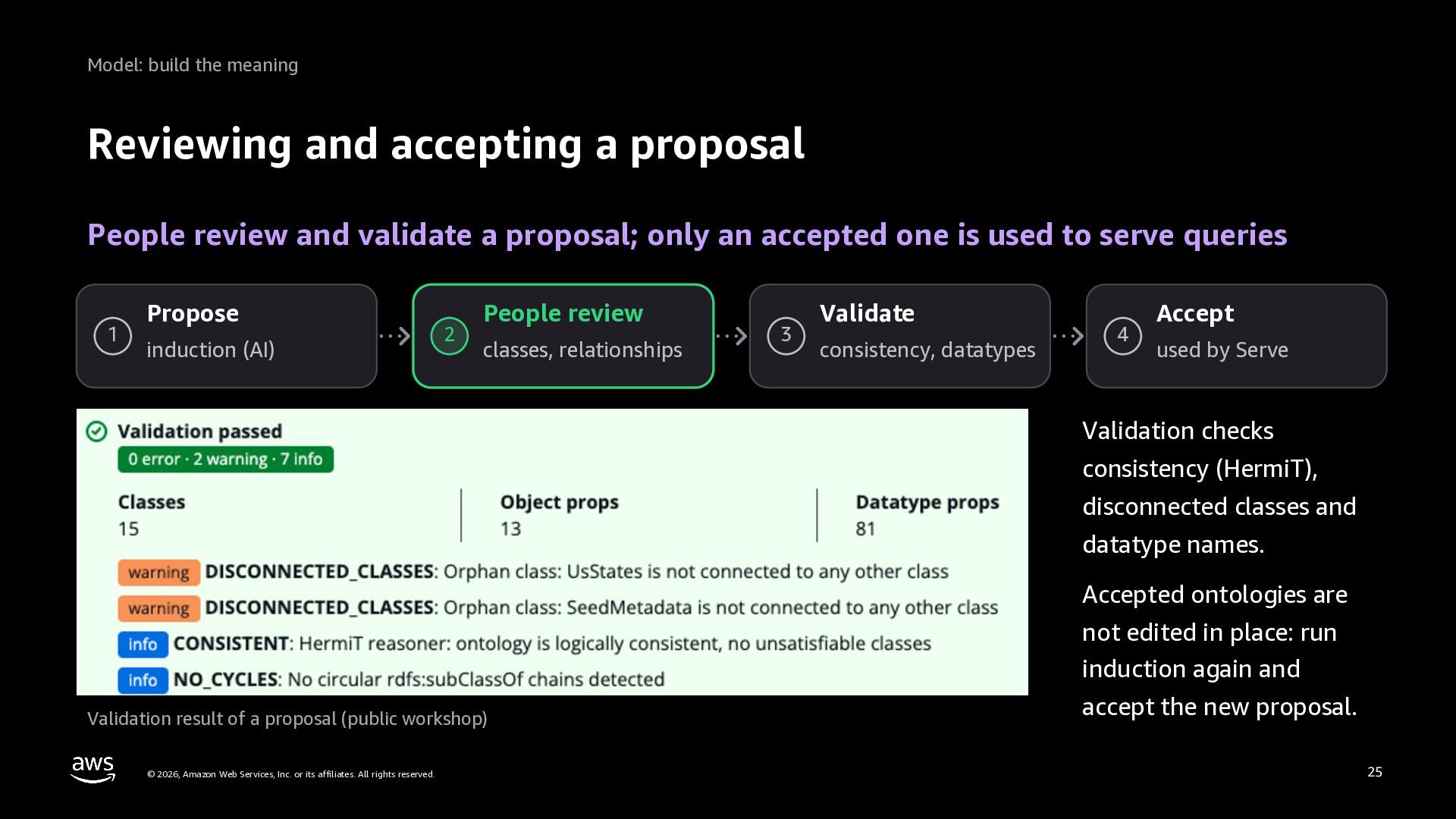
  25. Model: build the meaning Reviewing and accepting a proposal People

    review and validate a proposal; only an accepted one is used to serve queries 1 Propose induction (AI) 2 People review classes, relationships 3 Validate consistency, datatypes 4 Accept used by Serve Validation checks consistency (HermiT), disconnected classes and datatype names. Accepted ontologies are not edited in place: run induction again and Validation result of a proposal (public workshop) © 2026, Amazon Web Services, Inc. or its affiliates. All rights reserved. accept the new proposal. 25
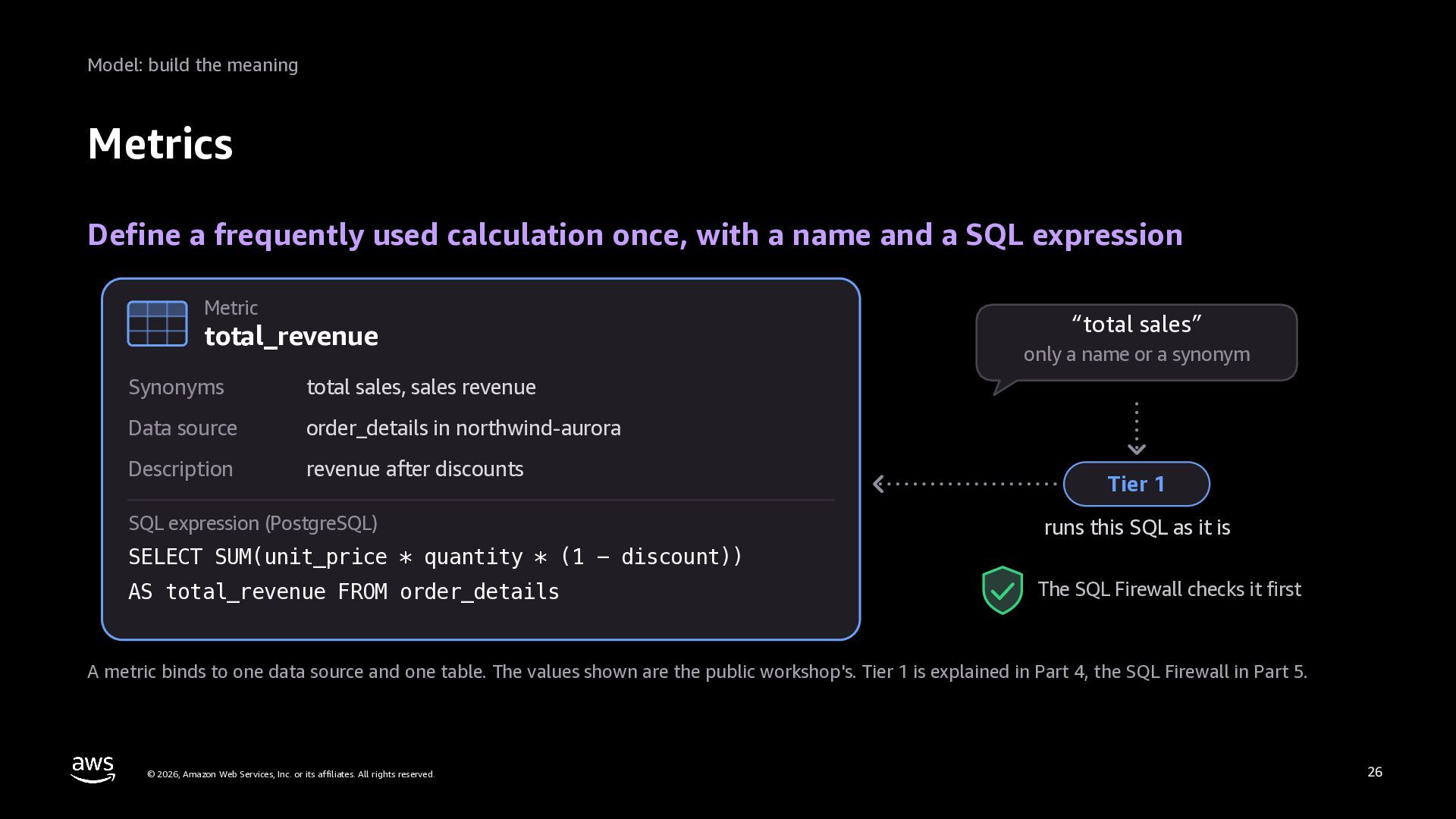
  26. Model: build the meaning Metrics Define a frequently used calculation

    once, with a name and a SQL expression Metric total_revenue Synonyms total sales, sales revenue Data source order_details in northwind-aurora Description revenue after discounts SQL expression (PostgreSQL) “total sales” only a name or a synonym Tier 1 runs this SQL as it is SELECT SUM(unit_price * quantity * (1 - discount)) AS total_revenue FROM order_details The SQL Firewall checks it first A metric binds to one data source and one table. The values shown are the public workshop's. Tier 1 is explained in Part 4, the SQL Firewall in Part 5. © 2026, Amazon Web Services, Inc. or its affiliates. All rights reserved. 26
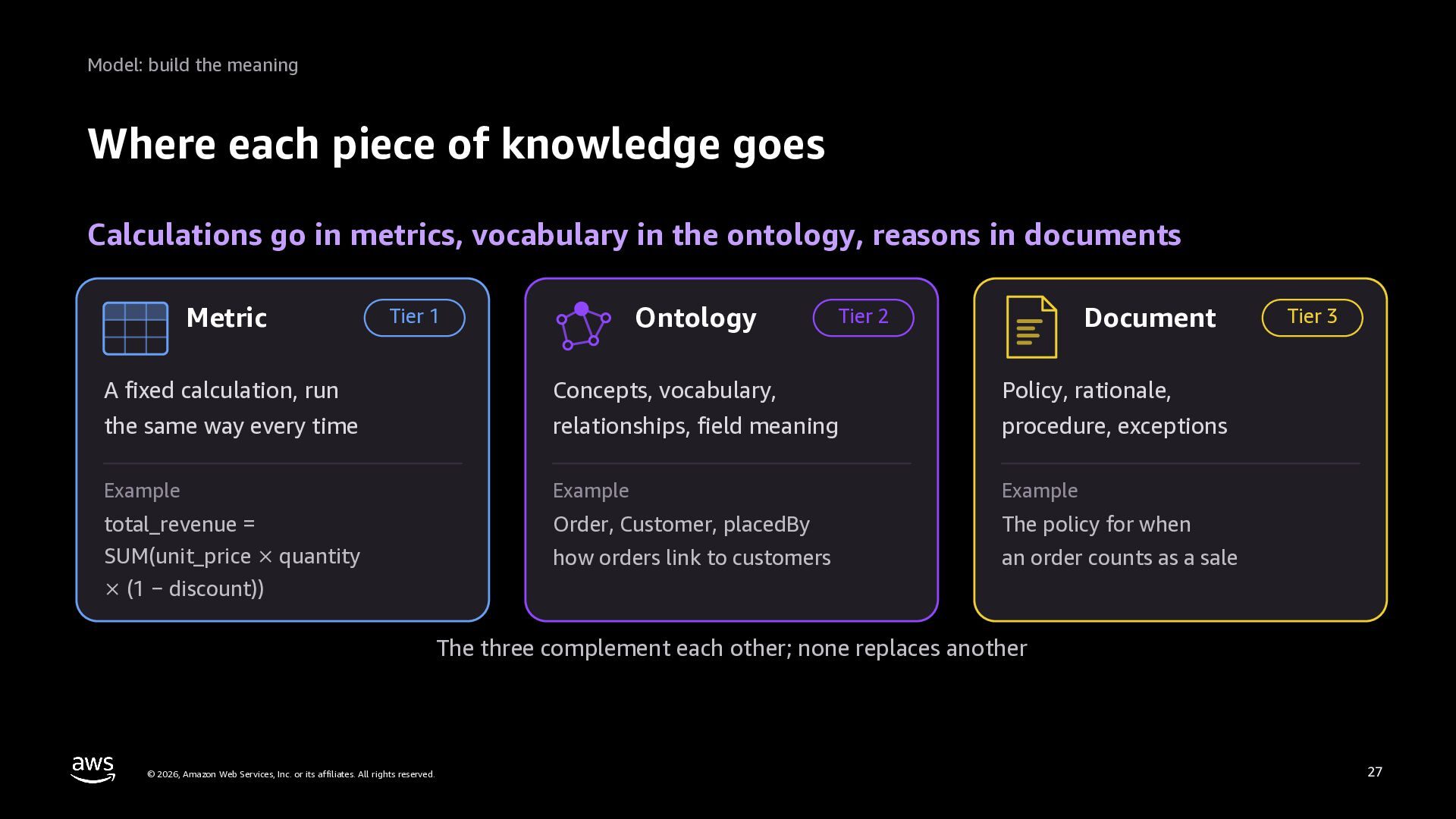
  27. Model: build the meaning Where each piece of knowledge goes

    Calculations go in metrics, vocabulary in the ontology, reasons in documents Metric Ontology Tier 1 Document Tier 2 A fixed calculation, run Concepts, vocabulary, Policy, rationale, the same way every time relationships, field meaning procedure, exceptions Example Example Example total_revenue = SUM(unit_price × quantity Order, Customer, placedBy The policy for when how orders link to customers an order counts as a sale Tier 3 × (1 − discount)) The three complement each other; none replaces another © 2026, Amazon Web Services, Inc. or its affiliates. All rights reserved. 27
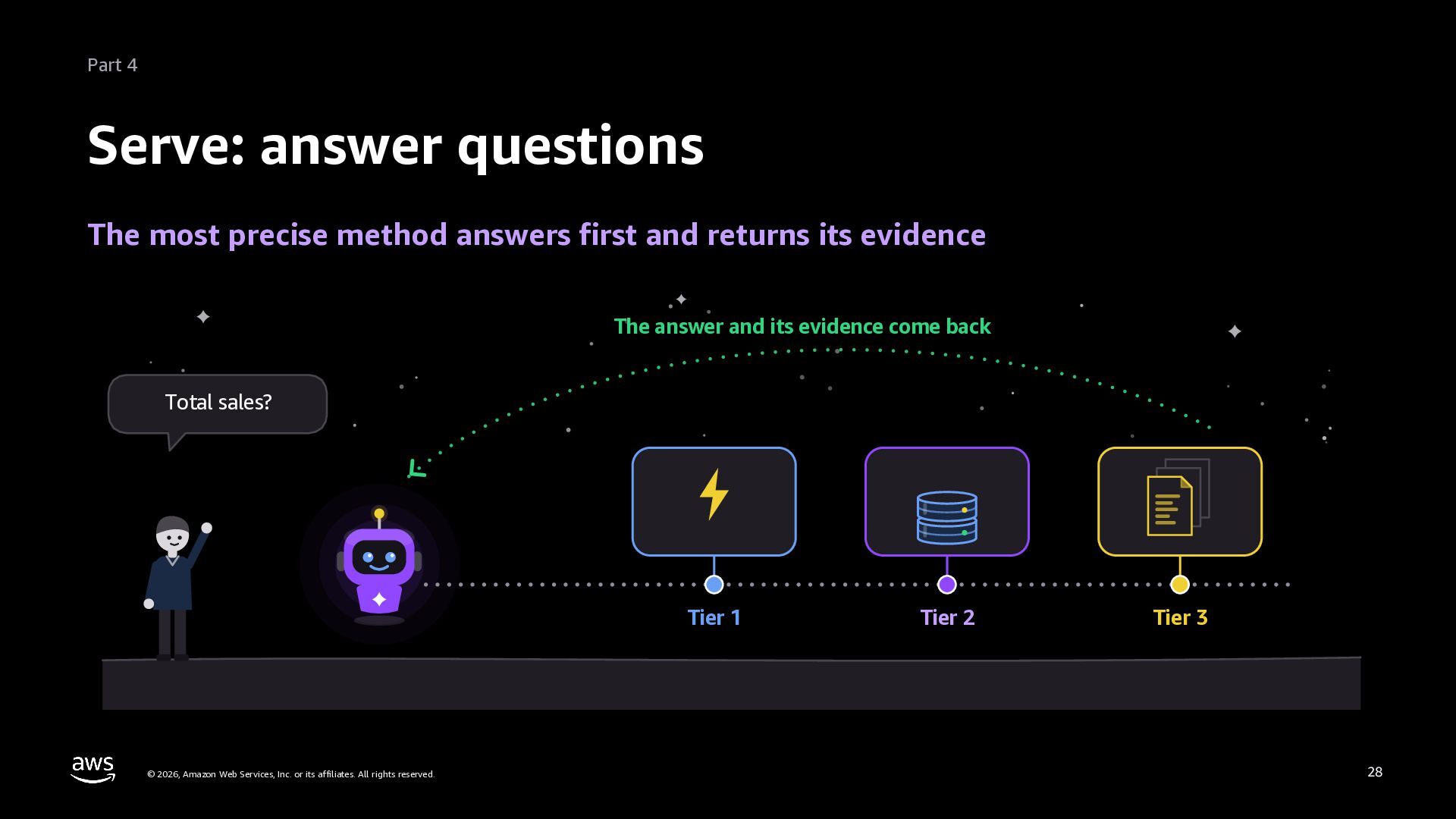
  28. Part 4 Serve: answer questions The most precise method answers

    first and returns its evidence The answer and its evidence come back Total sales? Tier 1 © 2026, Amazon Web Services, Inc. or its affiliates. All rights reserved. Tier 2 Tier 3 28
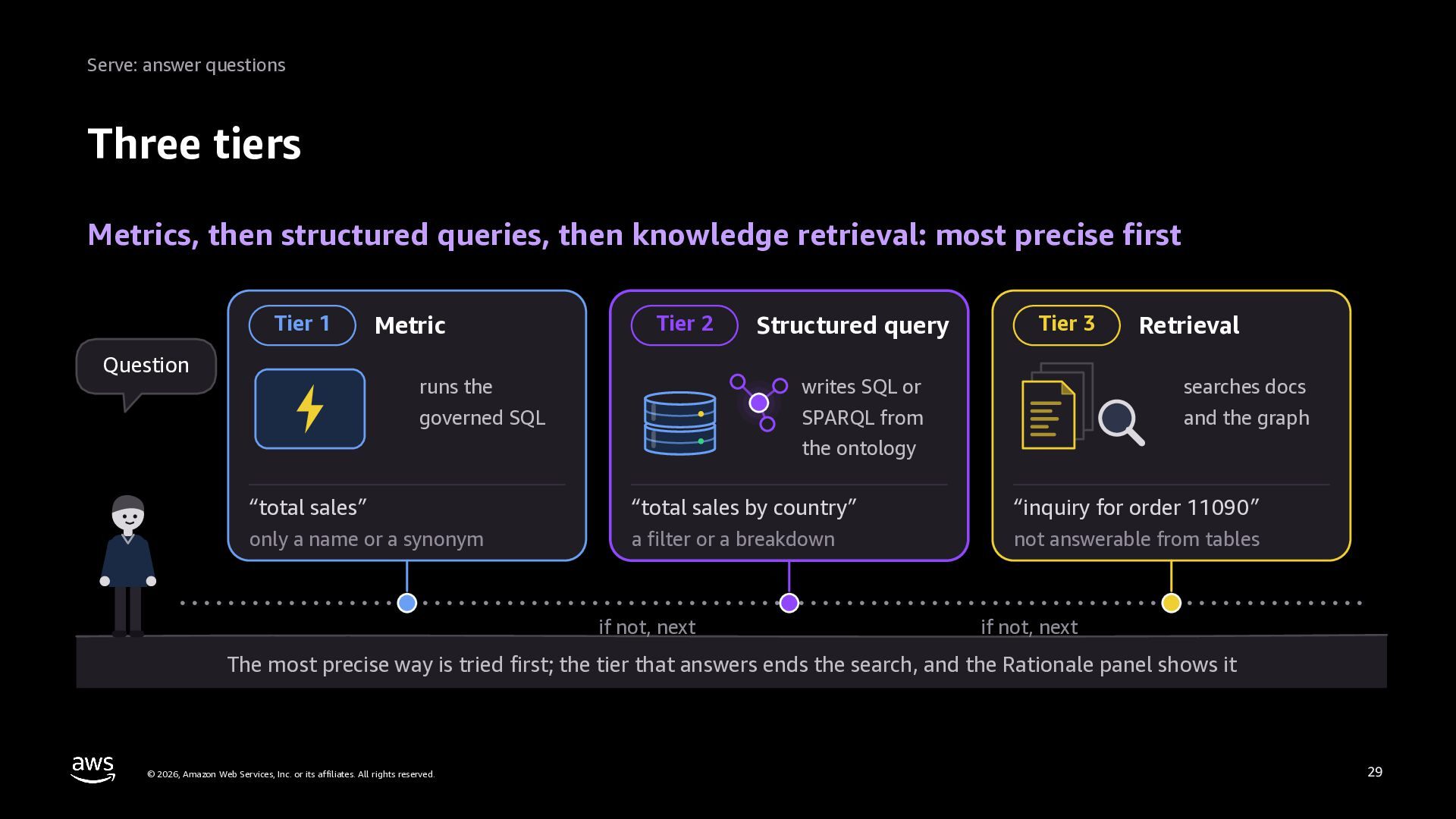
  29. Serve: answer questions Three tiers Metrics, then structured queries, then

    knowledge retrieval: most precise first Tier 1 Question Metric Tier 2 Structured query Tier 3 Retrieval runs the writes SQL or searches docs governed SQL SPARQL from and the graph the ontology “total sales” “total sales by country” “inquiry for order 11090” only a name or a synonym a filter or a breakdown not answerable from tables if not, next if not, next The most precise way is tried first; the tier that answers ends the search, and the Rationale panel shows it © 2026, Amazon Web Services, Inc. or its affiliates. All rights reserved. 29
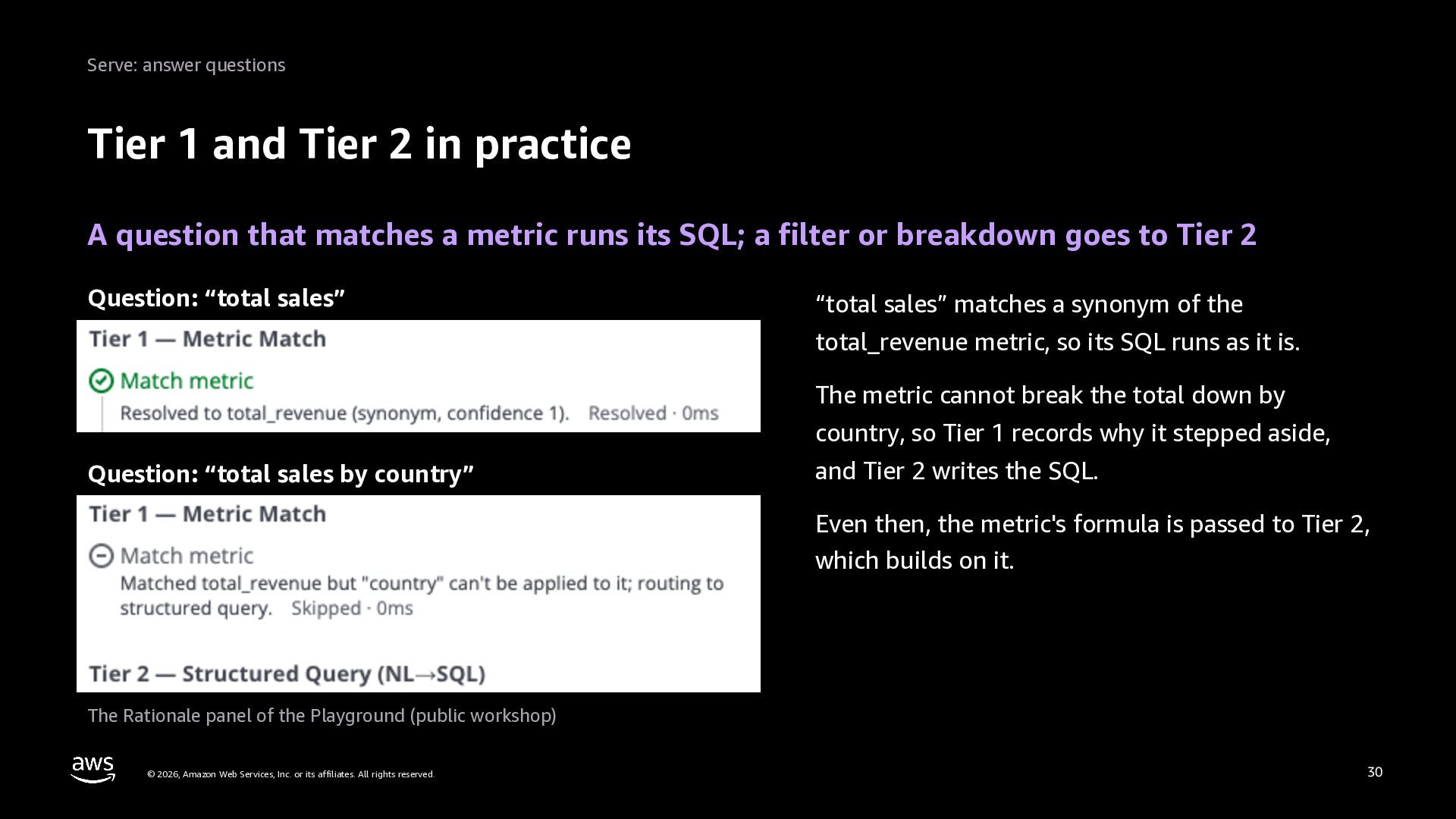
  30. Serve: answer questions Tier 1 and Tier 2 in practice

    A question that matches a metric runs its SQL; a filter or breakdown goes to Tier 2 Question: “total sales” “total sales” matches a synonym of the total_revenue metric, so its SQL runs as it is. The metric cannot break the total down by country, so Tier 1 records why it stepped aside, Question: “total sales by country” and Tier 2 writes the SQL. Even then, the metric's formula is passed to Tier 2, which builds on it. The Rationale panel of the Playground (public workshop) © 2026, Amazon Web Services, Inc. or its affiliates. All rights reserved. 30
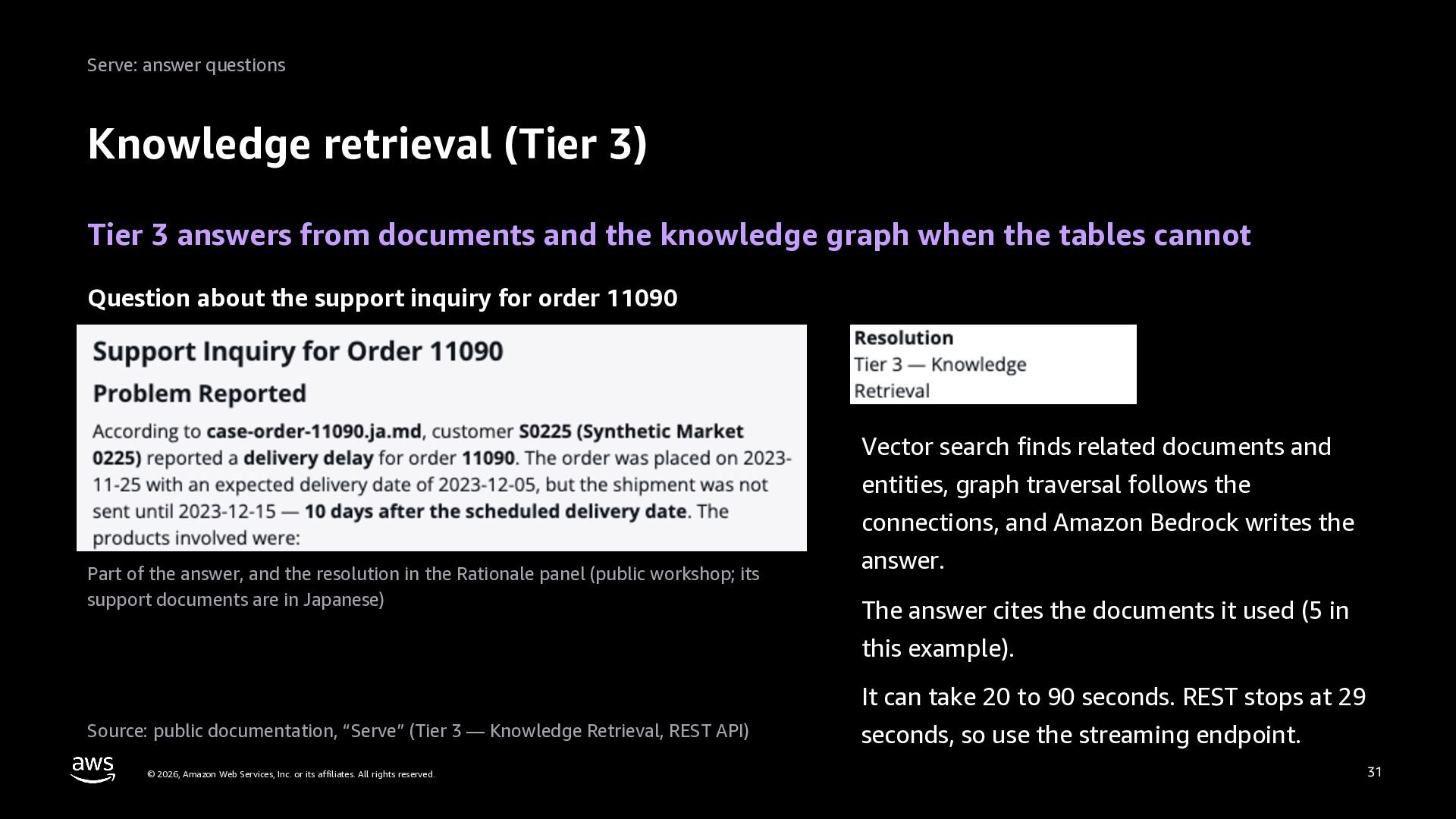
  31. Serve: answer questions Knowledge retrieval (Tier 3) Tier 3 answers

    from documents and the knowledge graph when the tables cannot Question about the support inquiry for order 11090 Vector search finds related documents and entities, graph traversal follows the connections, and Amazon Bedrock writes the Part of the answer, and the resolution in the Rationale panel (public workshop; its support documents are in Japanese) answer. The answer cites the documents it used (5 in this example). It can take 20 to 90 seconds. REST stops at 29 Source: public documentation, “Serve” (Tier 3 — Knowledge Retrieval, REST API) © 2026, Amazon Web Services, Inc. or its affiliates. All rights reserved. seconds, so use the streaming endpoint. 31
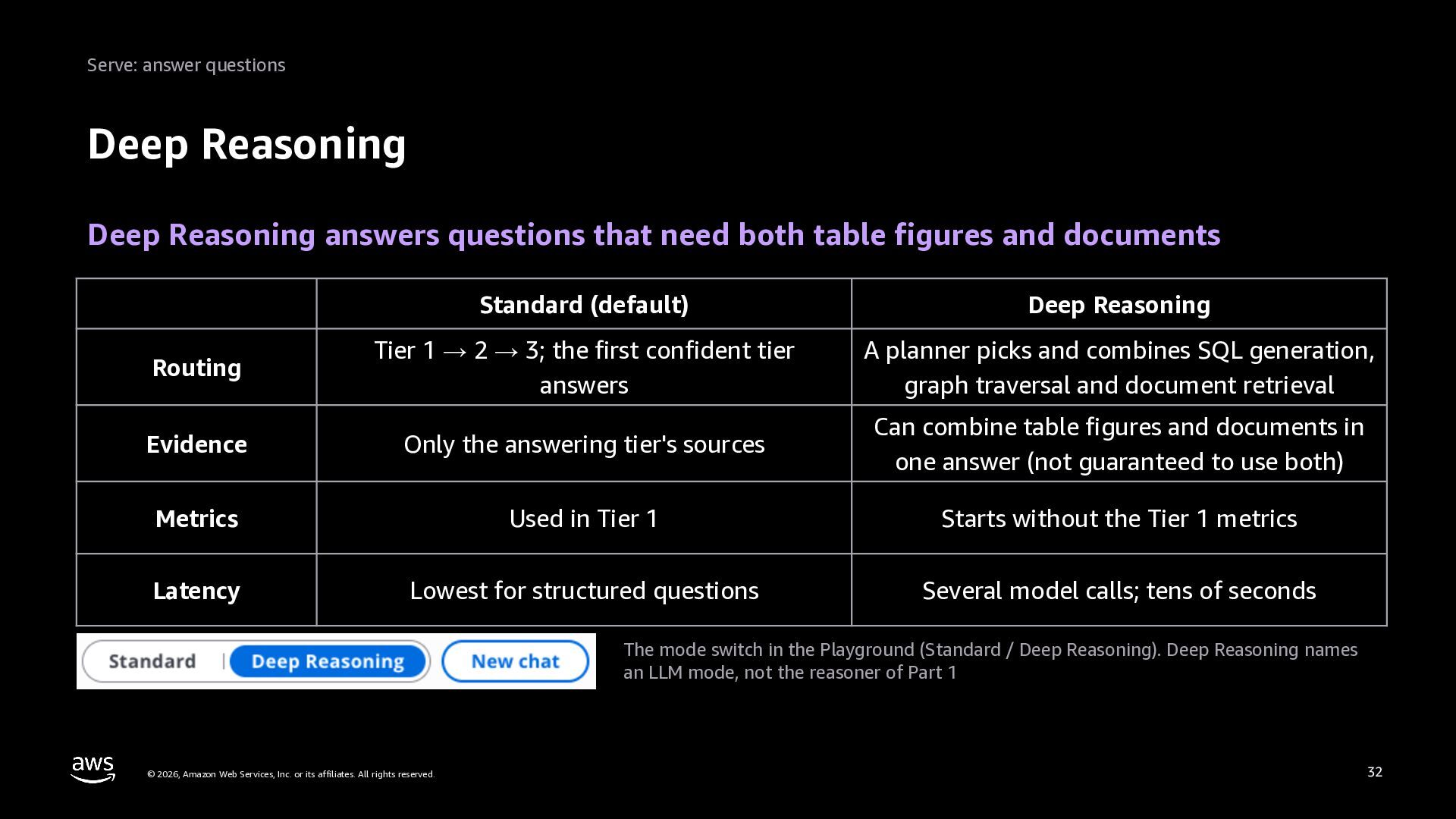
  32. Serve: answer questions Deep Reasoning Deep Reasoning answers questions that

    need both table figures and documents Standard (default) Deep Reasoning Routing Tier 1 → 2 → 3; the first confident tier answers A planner picks and combines SQL generation, graph traversal and document retrieval Evidence Only the answering tier's sources Can combine table figures and documents in one answer (not guaranteed to use both) Metrics Used in Tier 1 Starts without the Tier 1 metrics Latency Lowest for structured questions Several model calls; tens of seconds The mode switch in the Playground (Standard / Deep Reasoning). Deep Reasoning names an LLM mode, not the reasoner of Part 1 © 2026, Amazon Web Services, Inc. or its affiliates. All rights reserved. 32
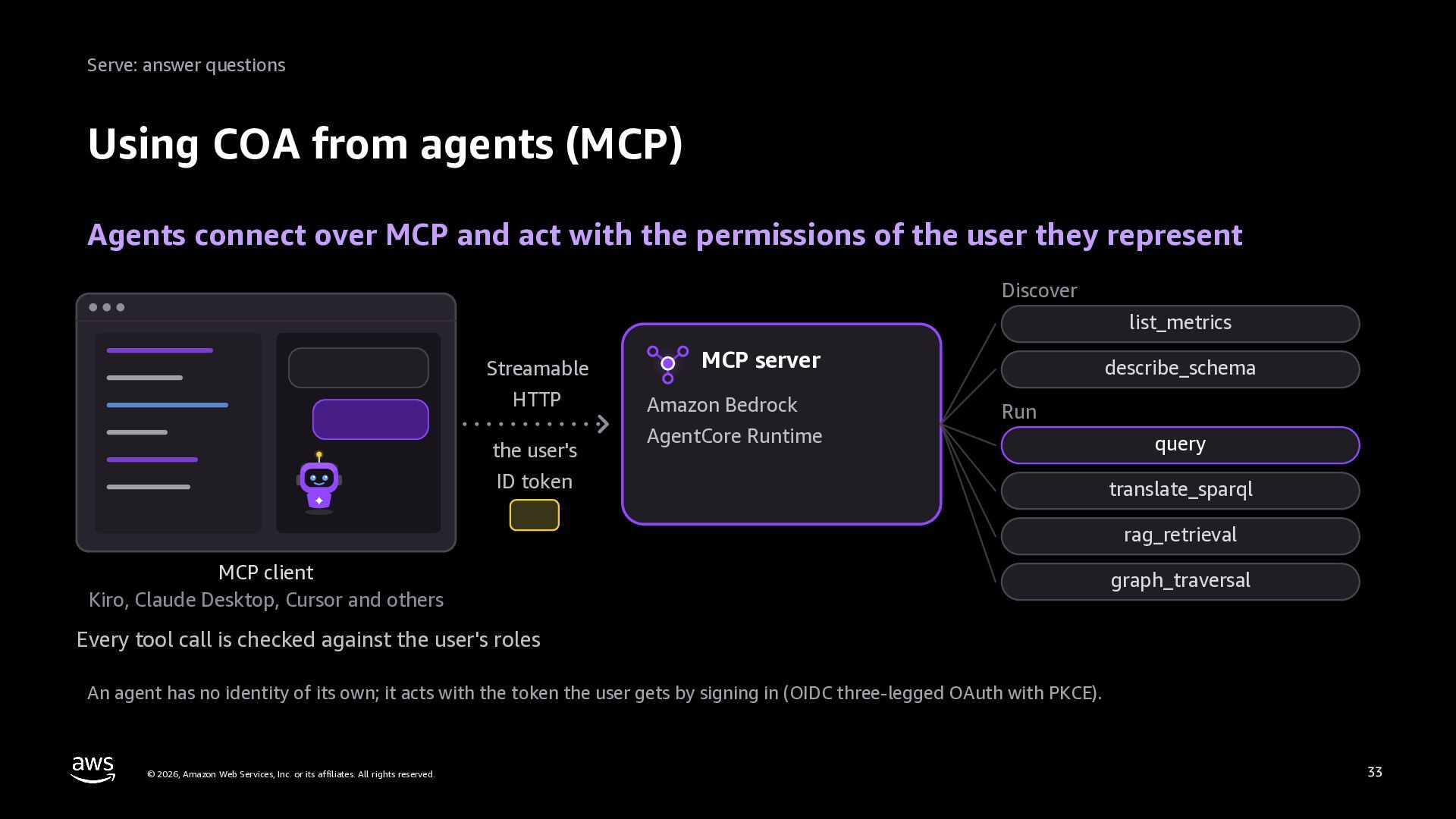
  33. Serve: answer questions Using COA from agents (MCP) Agents connect

    over MCP and act with the permissions of the user they represent Discover list_metrics Streamable HTTP the user's MCP server Amazon Bedrock describe_schema Run AgentCore Runtime ID token query translate_sparql rag_retrieval MCP client Kiro, Claude Desktop, Cursor and others graph_traversal Every tool call is checked against the user's roles An agent has no identity of its own; it acts with the token the user gets by signing in (OIDC three-legged OAuth with PKCE). © 2026, Amazon Web Services, Inc. or its affiliates. All rights reserved. 33
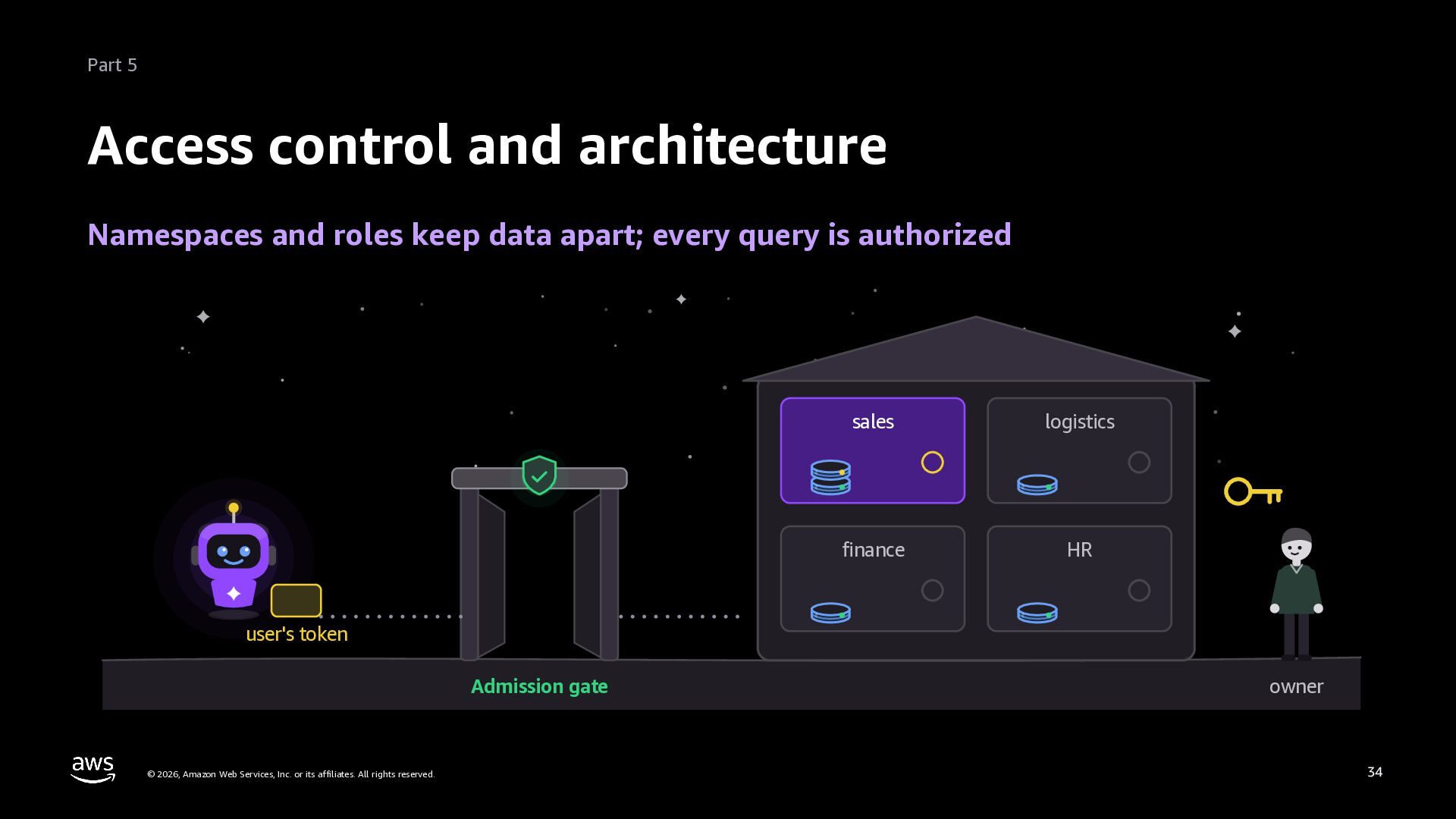
  34. Part 5 Access control and architecture Namespaces and roles keep

    data apart; every query is authorized sales logistics finance HR user's token Admission gate © 2026, Amazon Web Services, Inc. or its affiliates. All rights reserved. owner 34
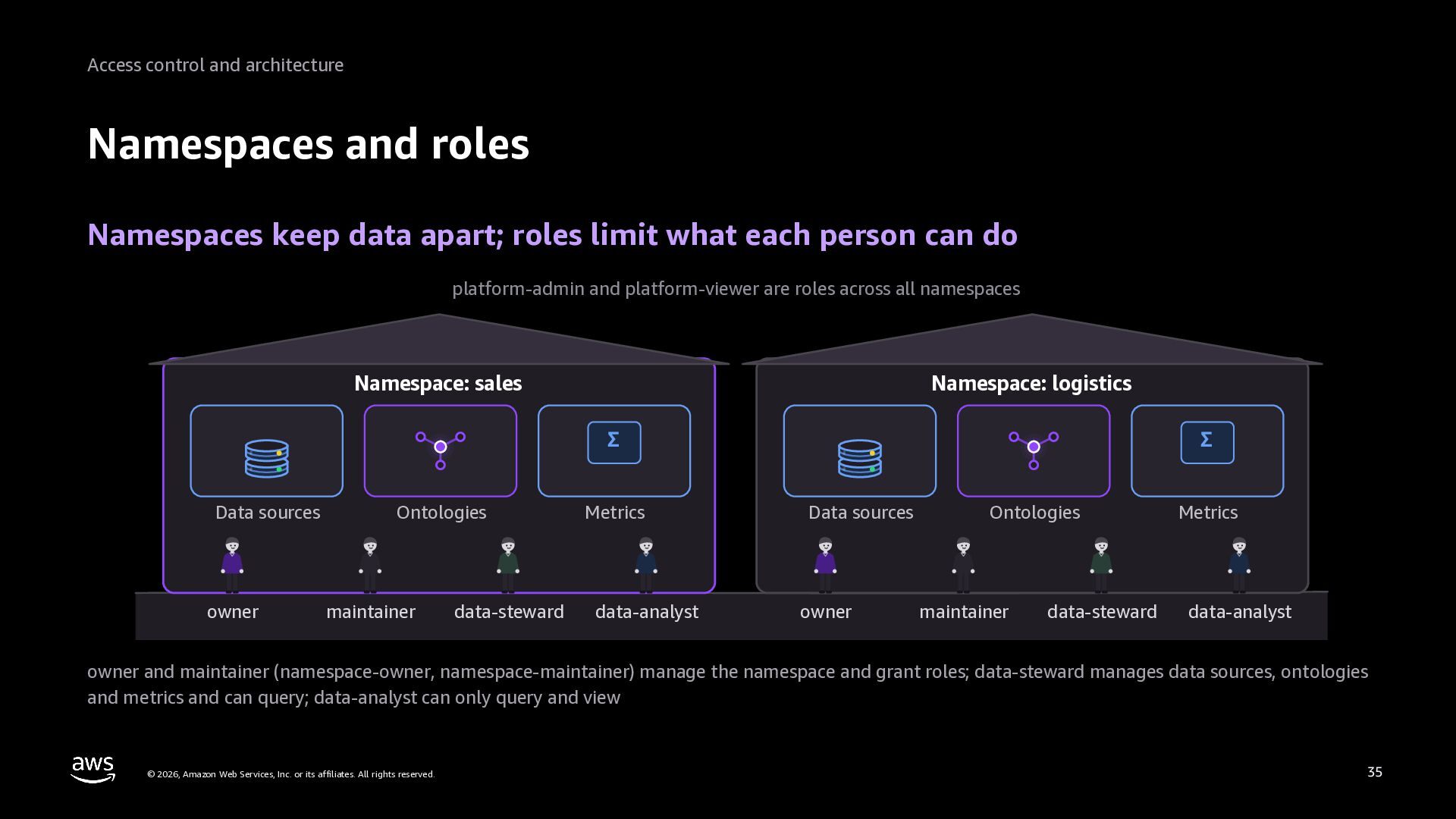
  35. Access control and architecture Namespaces and roles Namespaces keep data

    apart; roles limit what each person can do platform-admin and platform-viewer are roles across all namespaces Namespace: sales Namespace: logistics Σ Data sources owner Ontologies maintainer data-steward Σ Metrics Data sources data-analyst owner Ontologies maintainer data-steward Metrics data-analyst owner and maintainer (namespace-owner, namespace-maintainer) manage the namespace and grant roles; data-steward manages data sources, ontologies and metrics and can query; data-analyst can only query and view © 2026, Amazon Web Services, Inc. or its affiliates. All rights reserved. 35
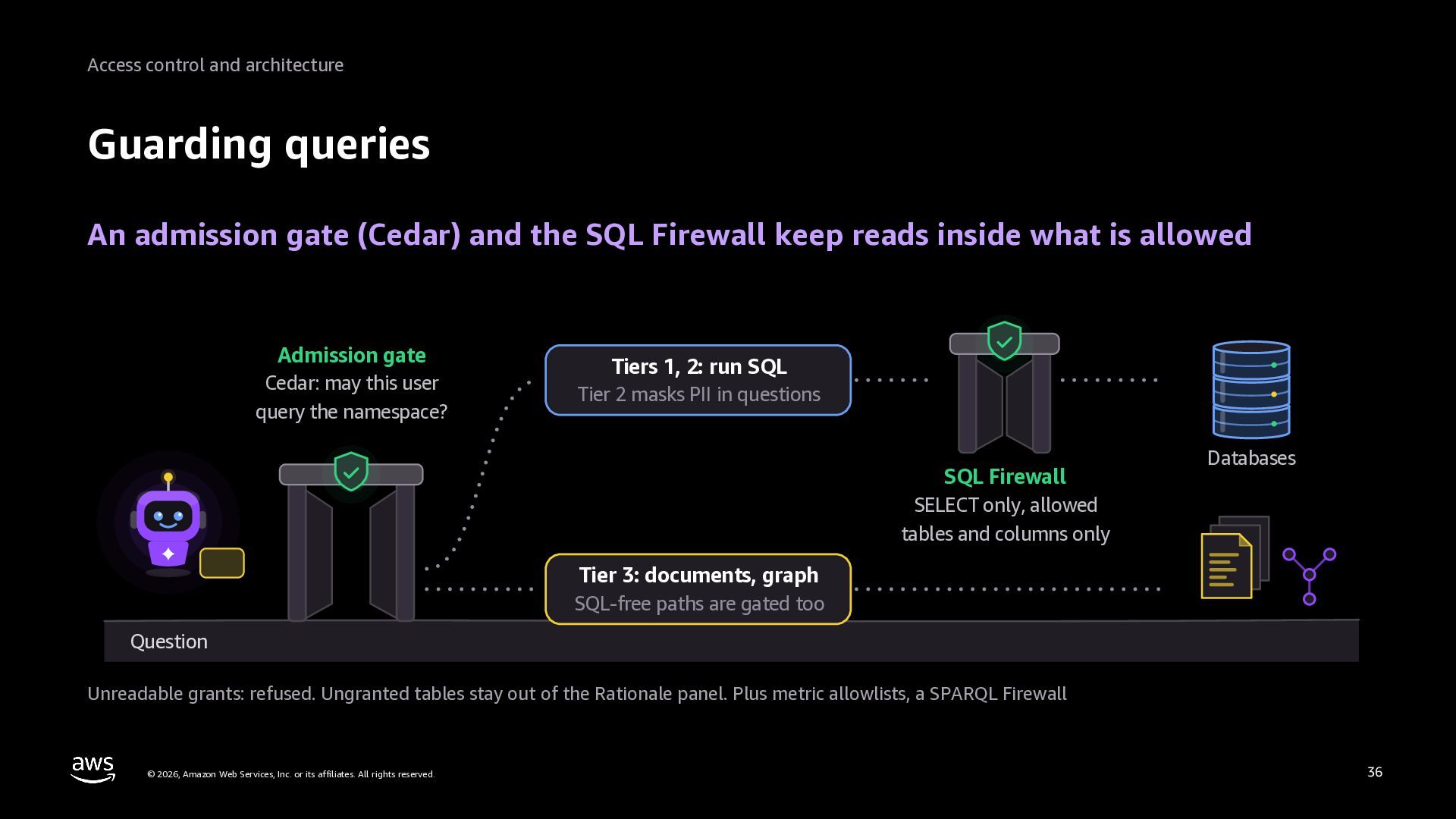
  36. Access control and architecture Guarding queries An admission gate (Cedar)

    and the SQL Firewall keep reads inside what is allowed Admission gate Cedar: may this user query the namespace? Tiers 1, 2: run SQL Tier 2 masks PII in questions SQL Firewall Databases SELECT only, allowed tables and columns only Tier 3: documents, graph SQL-free paths are gated too Question Unreadable grants: refused. Ungranted tables stay out of the Rationale panel. Plus metric allowlists, a SPARQL Firewall © 2026, Amazon Web Services, Inc. or its affiliates. All rights reserved. 36
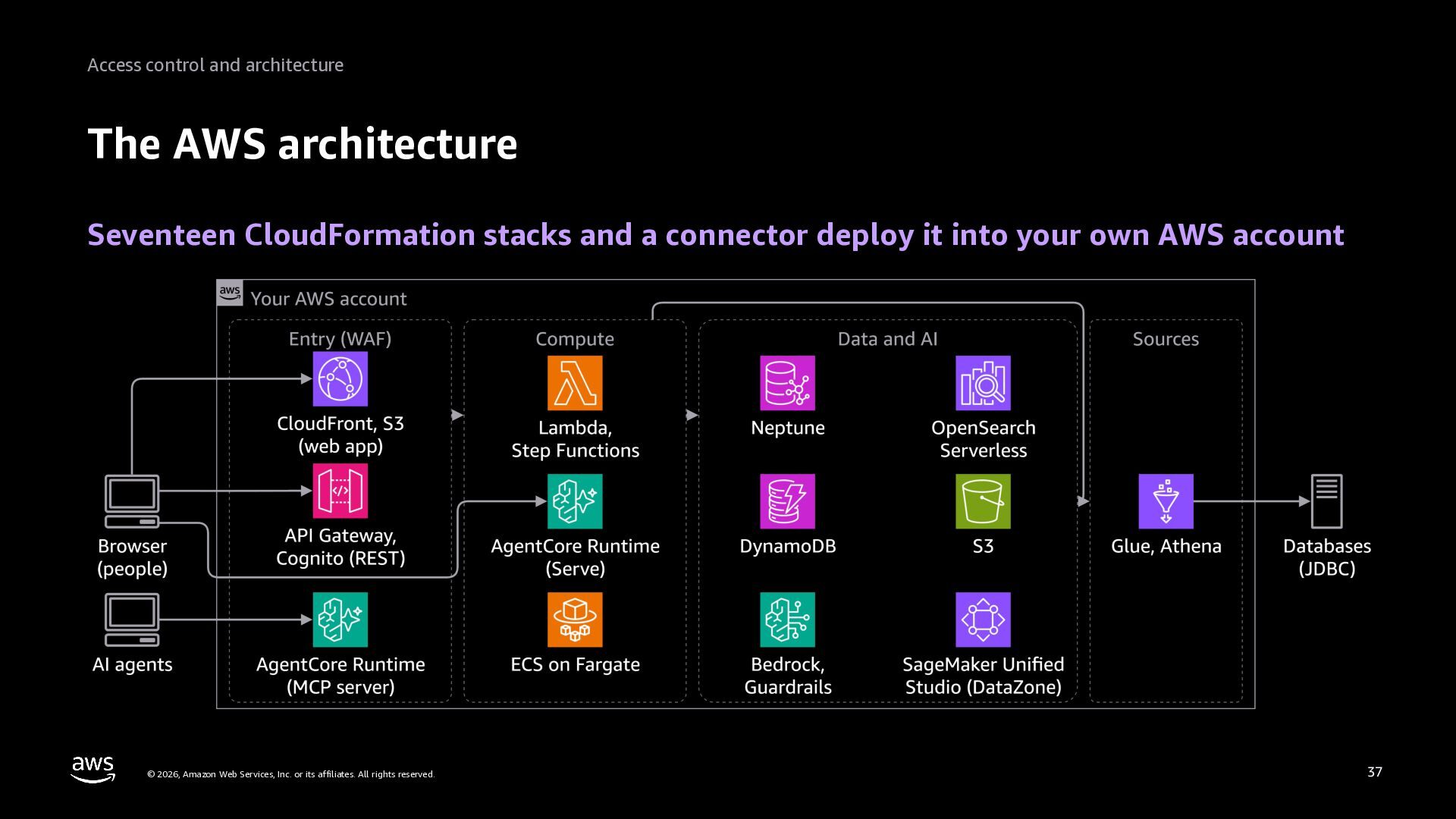
  37. Access control and architecture The AWS architecture Seventeen CloudFormation stacks

    and a connector deploy it into your own AWS account © 2026, Amazon Web Services, Inc. or its affiliates. All rights reserved. 37
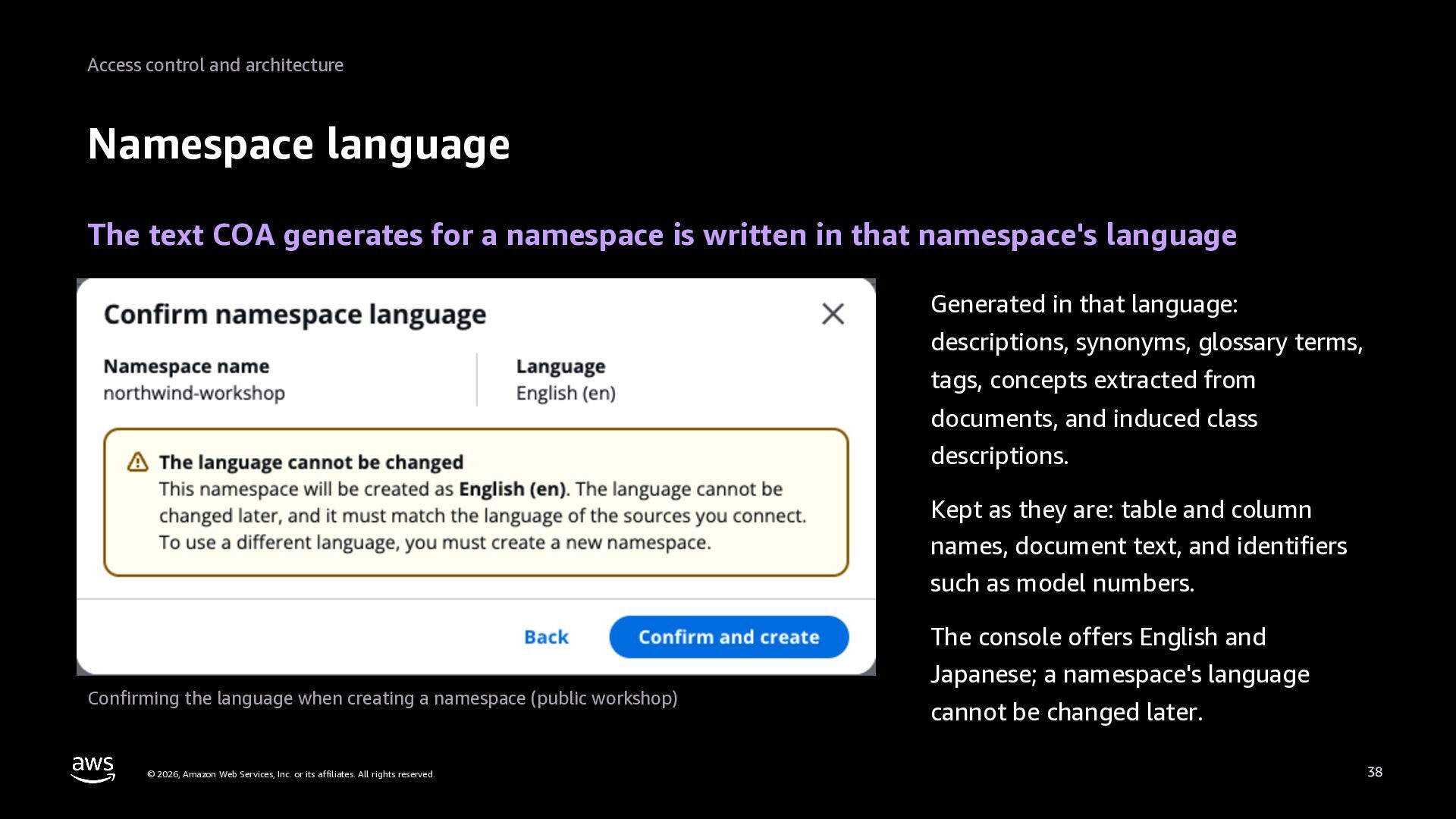
  38. Access control and architecture Namespace language The text COA generates

    for a namespace is written in that namespace's language Generated in that language: descriptions, synonyms, glossary terms, tags, concepts extracted from documents, and induced class descriptions. Kept as they are: table and column names, document text, and identifiers such as model numbers. The console offers English and Confirming the language when creating a namespace (public workshop) © 2026, Amazon Web Services, Inc. or its affiliates. All rights reserved. Japanese; a namespace's language cannot be changed later. 38
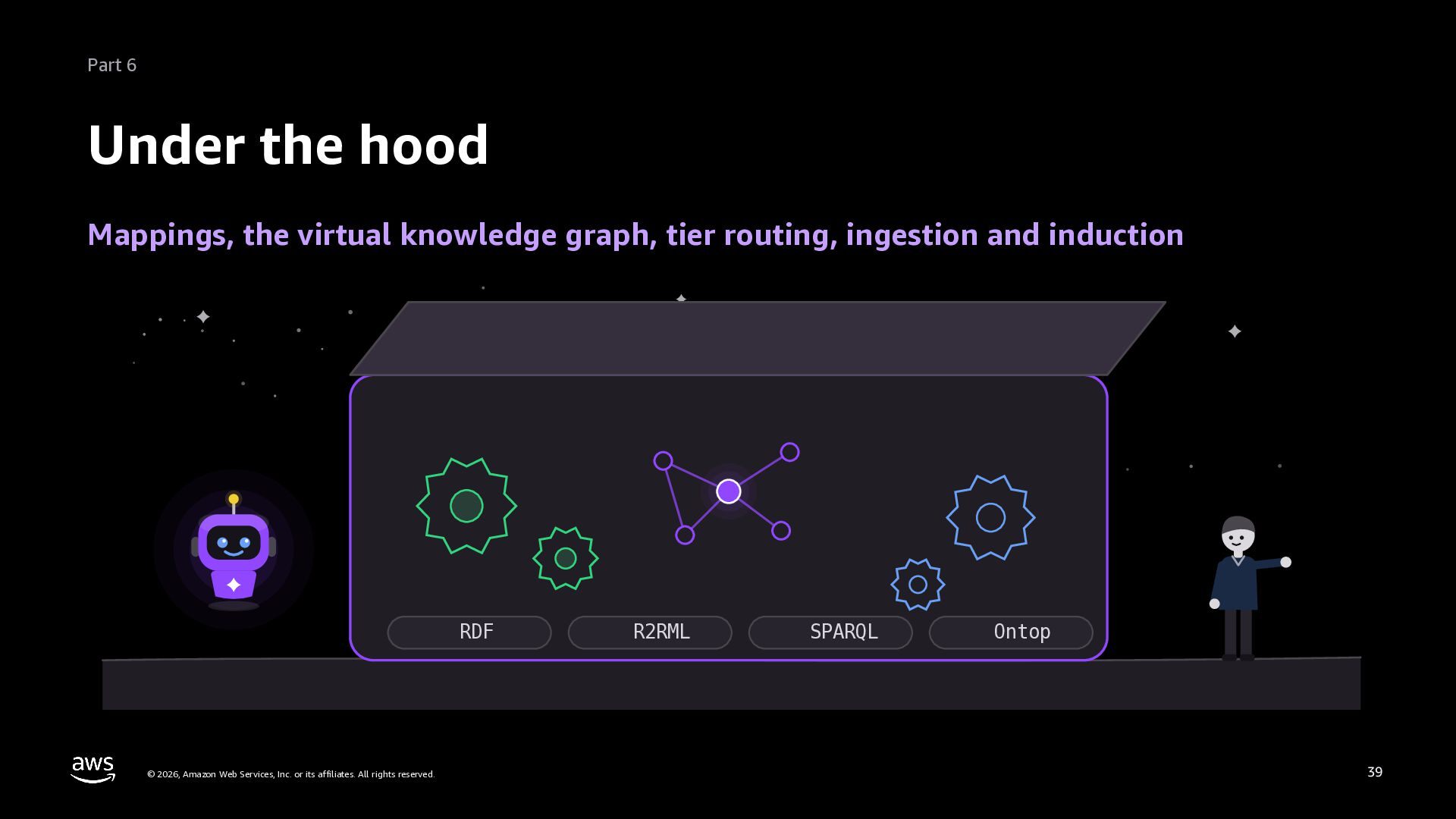
  39. Part 6 Under the hood Mappings, the virtual knowledge graph,

    tier routing, ingestion and induction RDF © 2026, Amazon Web Services, Inc. or its affiliates. All rights reserved. R2RML SPARQL Ontop 39
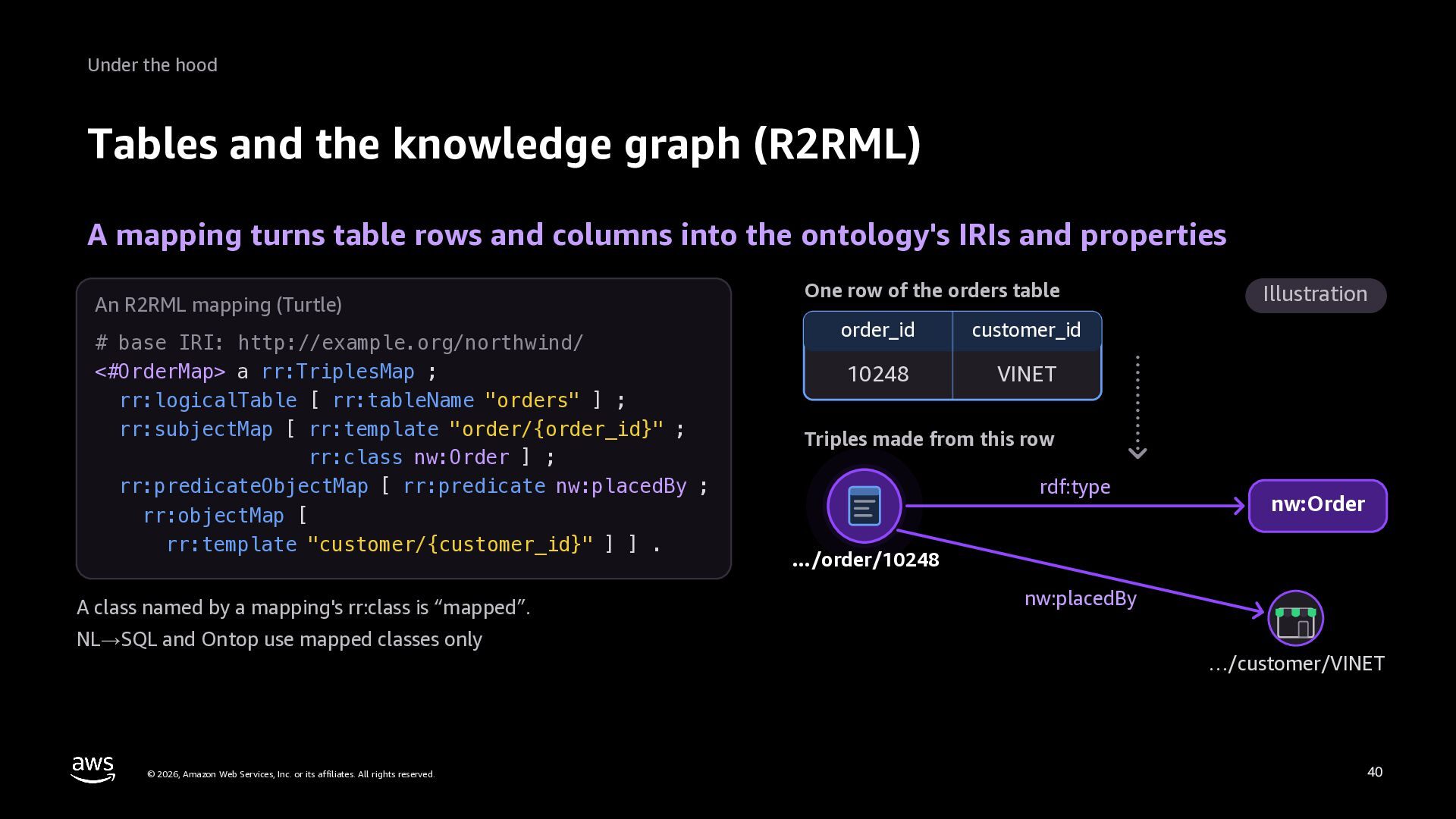
  40. Under the hood Tables and the knowledge graph (R2RML) A

    mapping turns table rows and columns into the ontology's IRIs and properties An R2RML mapping (Turtle) # base IRI: http://example.org/northwind/ <#OrderMap> a rr:TriplesMap ; rr:logicalTable [ rr:tableName "orders" ] ; rr:subjectMap [ rr:template "order/{order_id}" ; rr:class nw:Order ] ; rr:predicateObjectMap [ rr:predicate nw:placedBy ; rr:objectMap [ rr:template "customer/{customer_id}" ] ] . A class named by a mapping's rr:class is “mapped”. One row of the orders table order_id customer_id 10248 VINET Illustration Triples made from this row rdf:type nw:Order …/order/10248 nw:placedBy NL→SQL and Ontop use mapped classes only …/customer/VINET © 2026, Amazon Web Services, Inc. or its affiliates. All rights reserved. 40
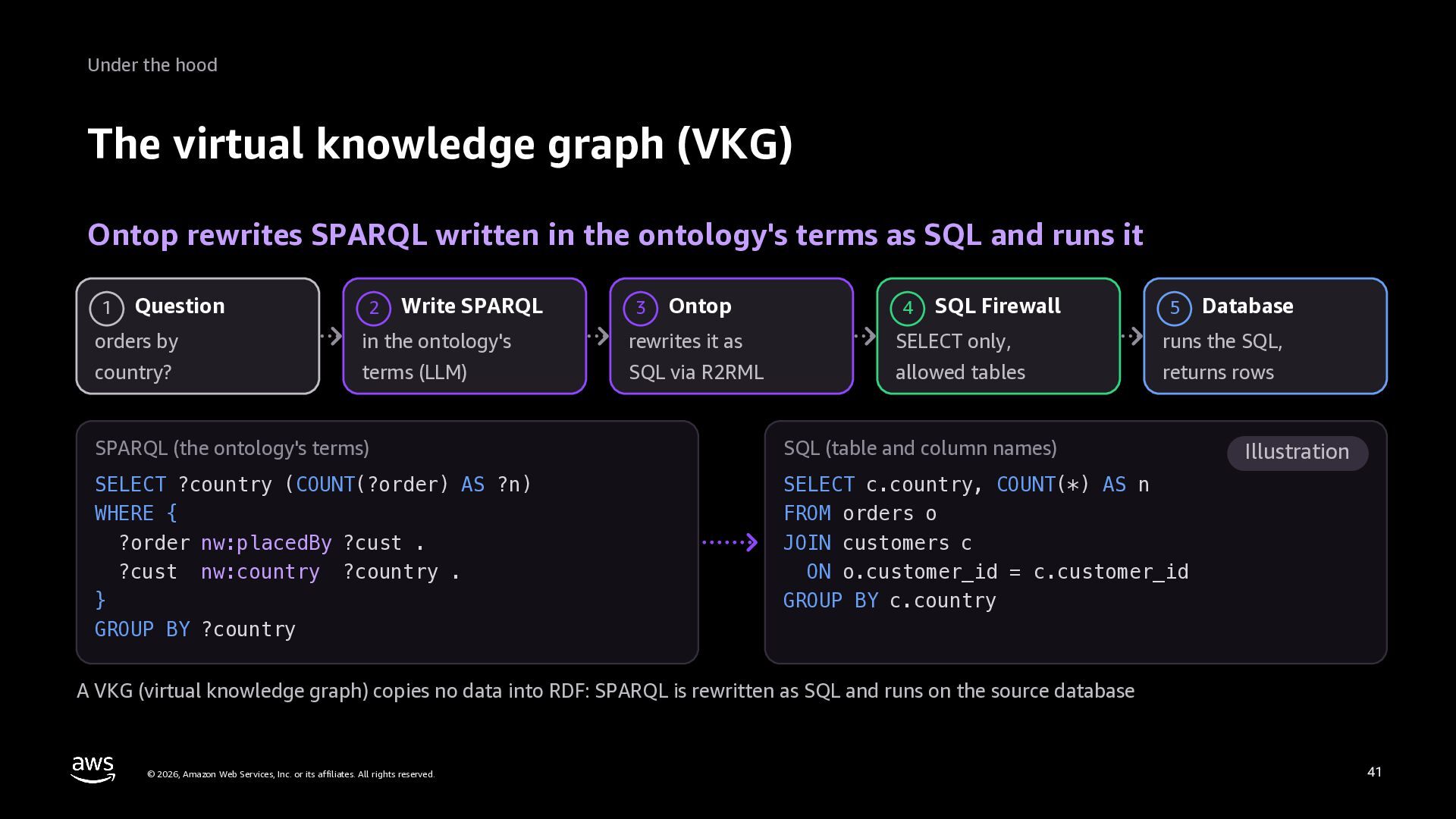
  41. Under the hood The virtual knowledge graph (VKG) Ontop rewrites

    SPARQL written in the ontology's terms as SQL and runs it 1 Question 2 Write SPARQL 3 Ontop 4 SQL Firewall 5 Database orders by in the ontology's rewrites it as SELECT only, runs the SQL, country? terms (LLM) SQL via R2RML allowed tables returns rows SPARQL (the ontology's terms) SQL (table and column names) SELECT ?country (COUNT(?order) AS ?n) WHERE { ?order nw:placedBy ?cust . ?cust nw:country ?country . } GROUP BY ?country SELECT c.country, COUNT(*) AS n FROM orders o JOIN customers c ON o.customer_id = c.customer_id GROUP BY c.country Illustration A VKG (virtual knowledge graph) copies no data into RDF: SPARQL is rewritten as SQL and runs on the source database © 2026, Amazon Web Services, Inc. or its affiliates. All rights reserved. 41
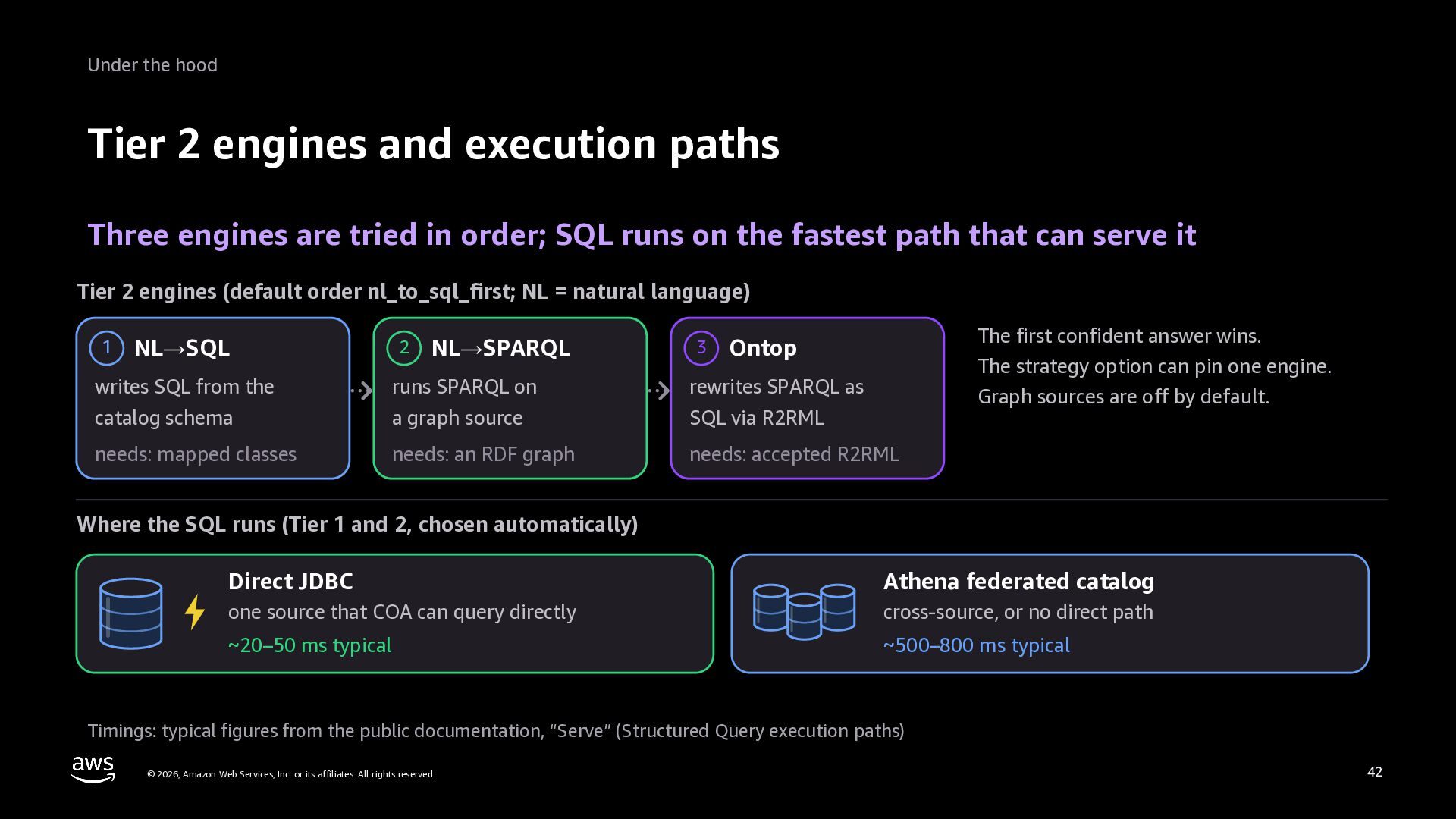
  42. Under the hood Tier 2 engines and execution paths Three

    engines are tried in order; SQL runs on the fastest path that can serve it Tier 2 engines (default order nl_to_sql_first; NL = natural language) 1 NL→SQL 2 NL→SPARQL 3 The first confident answer wins. Ontop The strategy option can pin one engine. writes SQL from the runs SPARQL on rewrites SPARQL as catalog schema a graph source SQL via R2RML needs: mapped classes needs: an RDF graph needs: accepted R2RML Graph sources are off by default. Where the SQL runs (Tier 1 and 2, chosen automatically) Direct JDBC Athena federated catalog one source that COA can query directly cross-source, or no direct path ~20–50 ms typical ~500–800 ms typical Timings: typical figures from the public documentation, “Serve” (Structured Query execution paths) © 2026, Amazon Web Services, Inc. or its affiliates. All rights reserved. 42
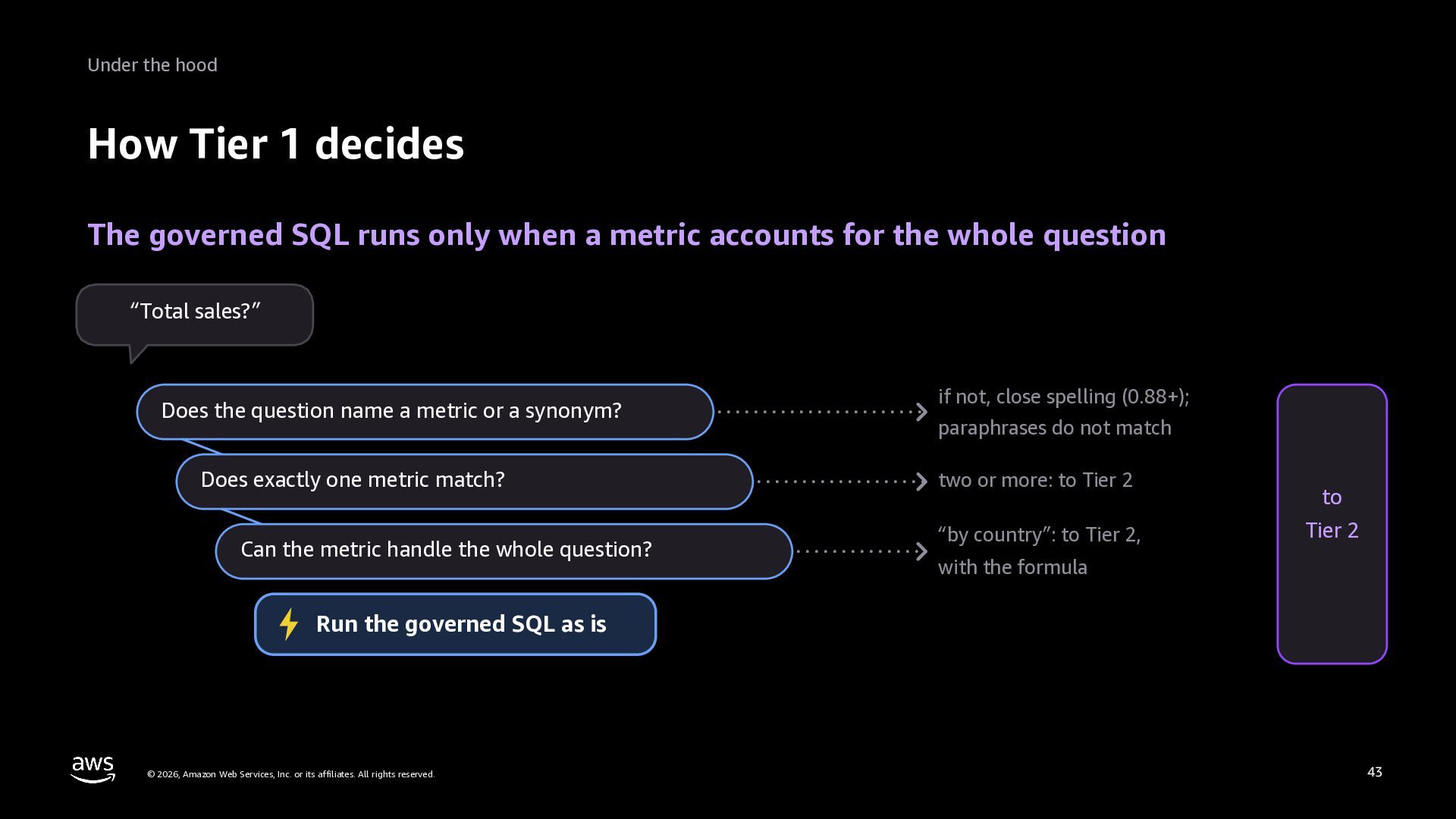
  43. Under the hood How Tier 1 decides The governed SQL

    runs only when a metric accounts for the whole question “Total sales?” Does the question name a metric or a synonym? Does exactly one metric match? Can the metric handle the whole question? if not, close spelling (0.88+); paraphrases do not match two or more: to Tier 2 “by country”: to Tier 2, to Tier 2 with the formula Run the governed SQL as is © 2026, Amazon Web Services, Inc. or its affiliates. All rights reserved. 43
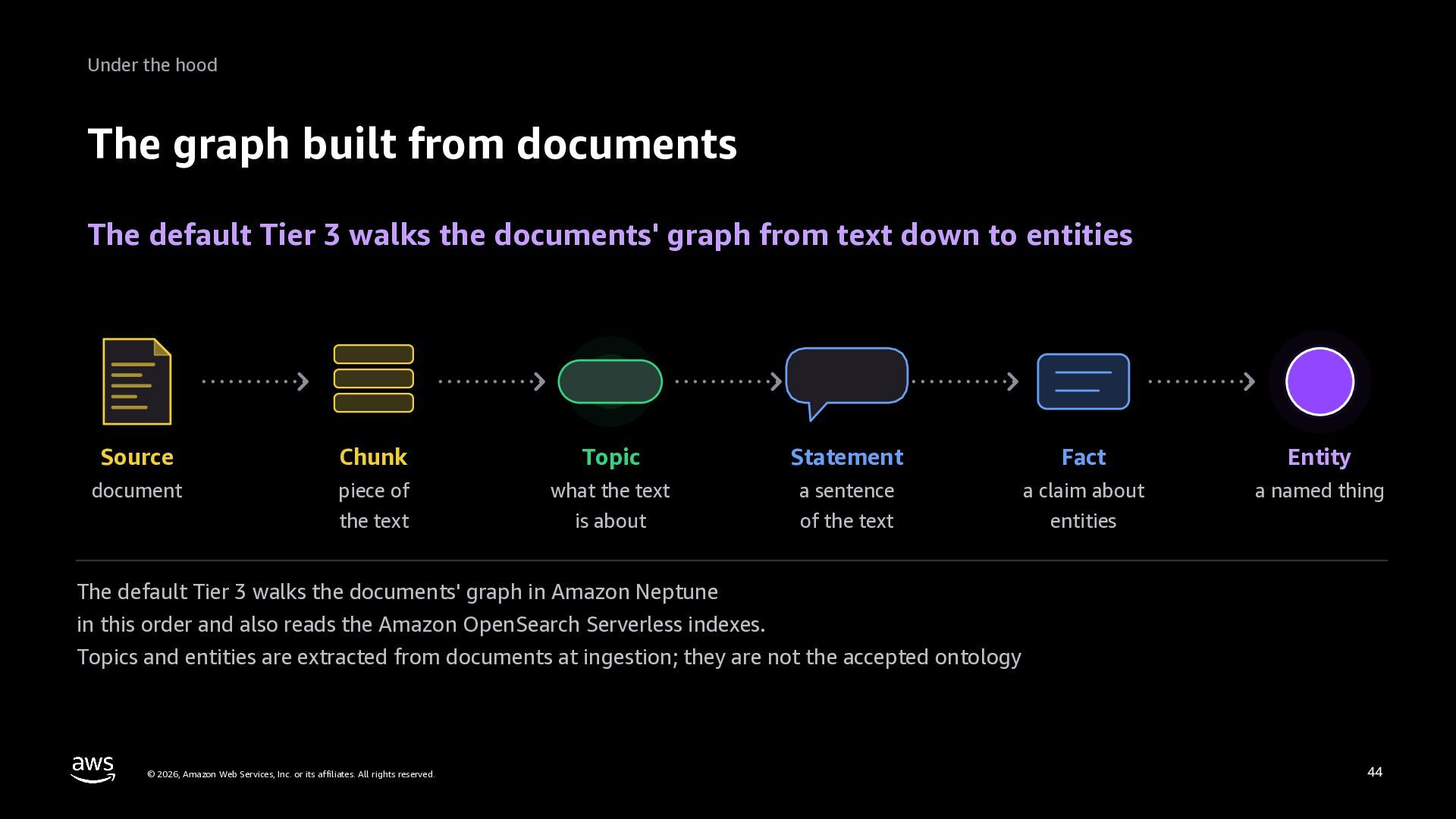
  44. Under the hood The graph built from documents The default

    Tier 3 walks the documents' graph from text down to entities Source Chunk Topic Statement Fact Entity document piece of what the text a sentence a claim about a named thing the text is about of the text entities The default Tier 3 walks the documents' graph in Amazon Neptune in this order and also reads the Amazon OpenSearch Serverless indexes. Topics and entities are extracted from documents at ingestion; they are not the accepted ontology © 2026, Amazon Web Services, Inc. or its affiliates. All rights reserved. 44
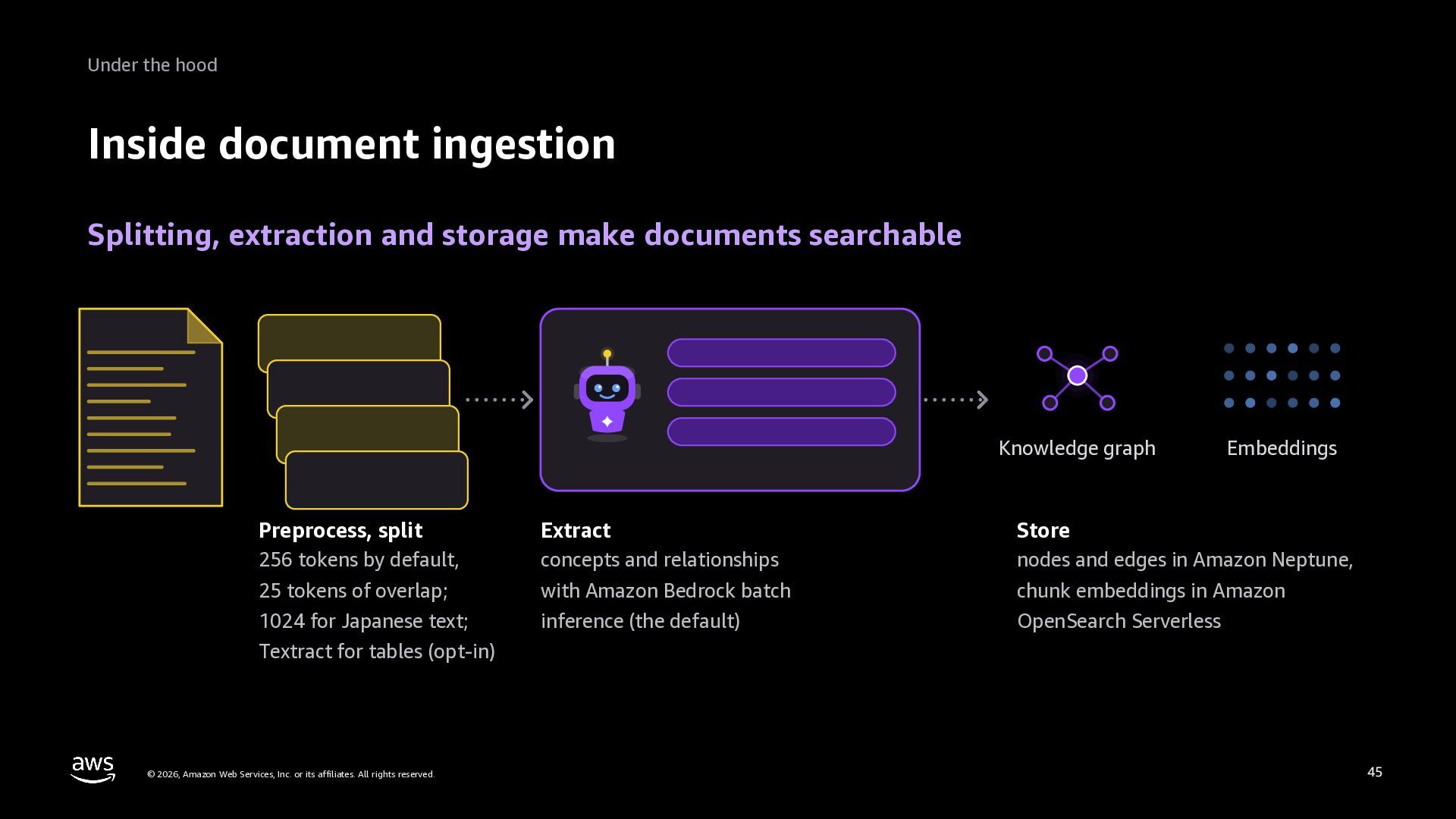
  45. Under the hood Inside document ingestion Splitting, extraction and storage

    make documents searchable Knowledge graph Embeddings Preprocess, split Extract Store 256 tokens by default, concepts and relationships nodes and edges in Amazon Neptune, 25 tokens of overlap; with Amazon Bedrock batch chunk embeddings in Amazon 1024 for Japanese text; inference (the default) OpenSearch Serverless Textract for tables (opt-in) © 2026, Amazon Web Services, Inc. or its affiliates. All rights reserved. 45
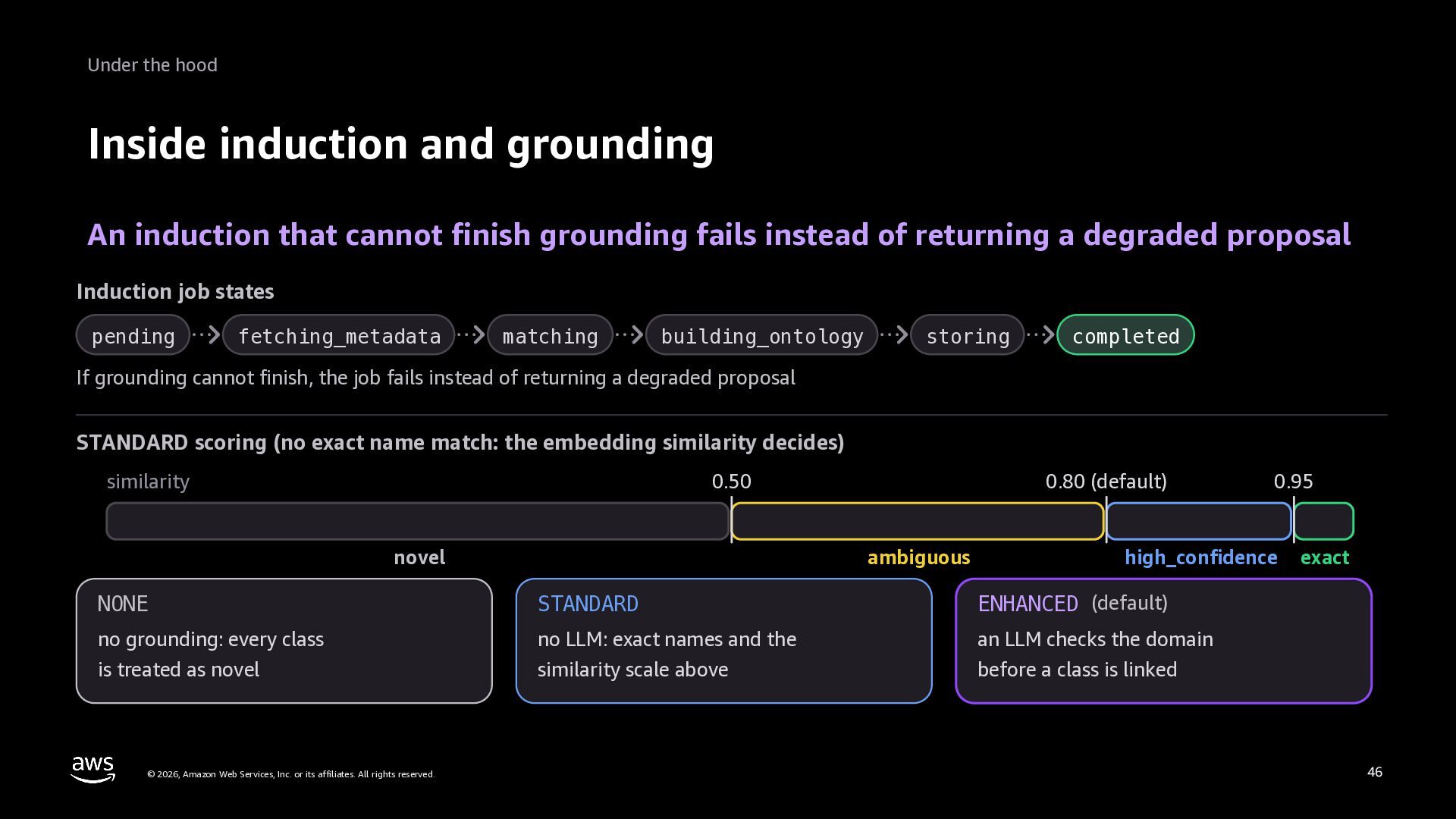
  46. Under the hood Inside induction and grounding An induction that

    cannot finish grounding fails instead of returning a degraded proposal Induction job states pending fetching_metadata matching building_ontology storing completed If grounding cannot finish, the job fails instead of returning a degraded proposal STANDARD scoring (no exact name match: the embedding similarity decides) similarity 0.50 novel 0.80 (default) ambiguous high_confidence NONE STANDARD ENHANCED (default) no grounding: every class no LLM: exact names and the an LLM checks the domain is treated as novel similarity scale above before a class is linked © 2026, Amazon Web Services, Inc. or its affiliates. All rights reserved. 0.95 exact 46
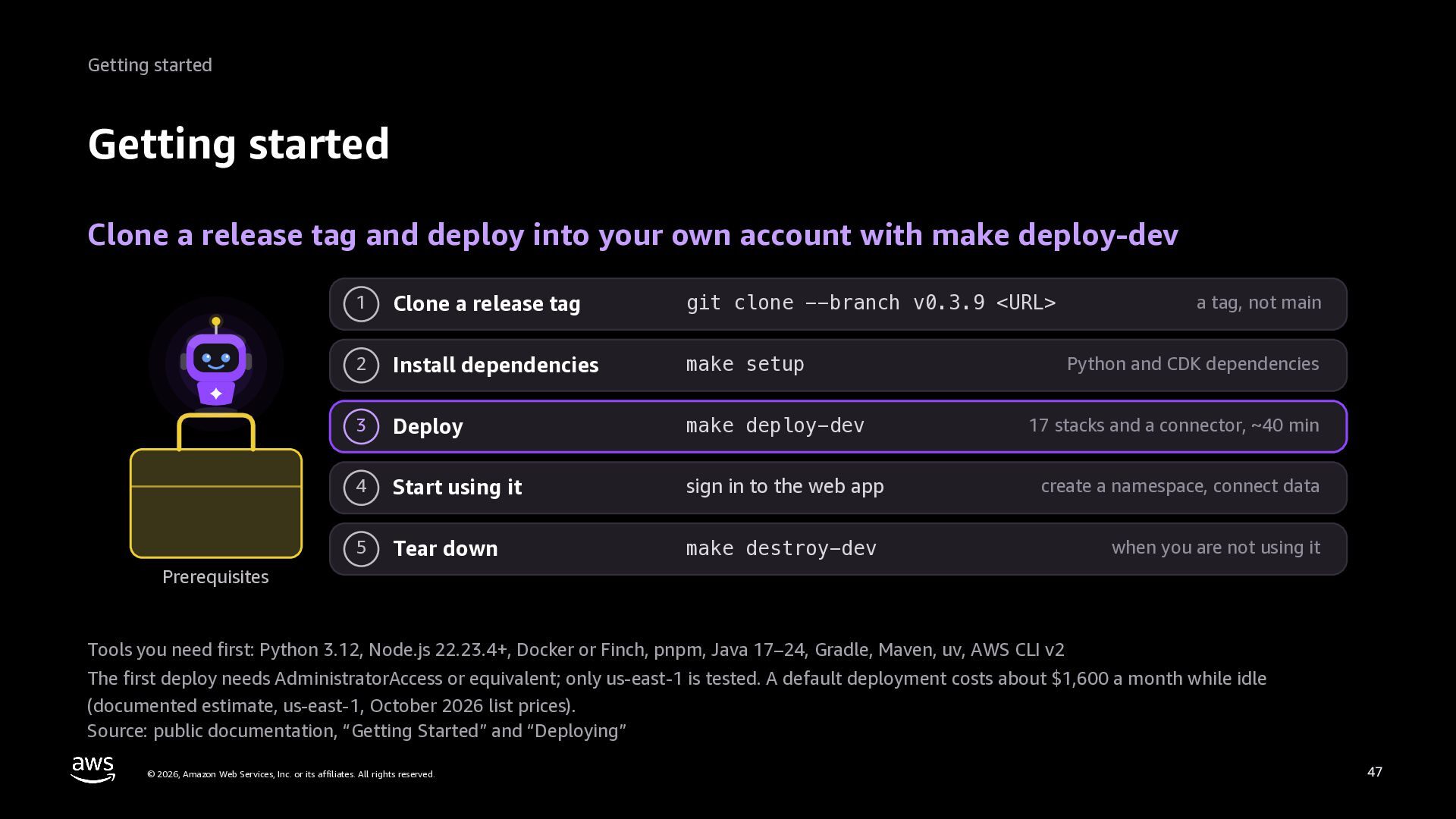
  47. Getting started Getting started Clone a release tag and deploy

    into your own account with make deploy-dev 1 Clone a release tag git clone --branch v0.3.9 <URL> 2 Install dependencies make setup 3 Deploy make deploy-dev 17 stacks and a connector, ~40 min 4 Start using it sign in to the web app create a namespace, connect data 5 Tear down make destroy-dev when you are not using it a tag, not main Python and CDK dependencies Prerequisites Tools you need first: Python 3.12, Node.js 22.23.4+, Docker or Finch, pnpm, Java 17–24, Gradle, Maven, uv, AWS CLI v2 The first deploy needs AdministratorAccess or equivalent; only us-east-1 is tested. A default deployment costs about $1,600 a month while idle (documented estimate, us-east-1, October 2026 list prices). Source: public documentation, “Getting Started” and “Deploying” © 2026, Amazon Web Services, Inc. or its affiliates. All rights reserved. 47
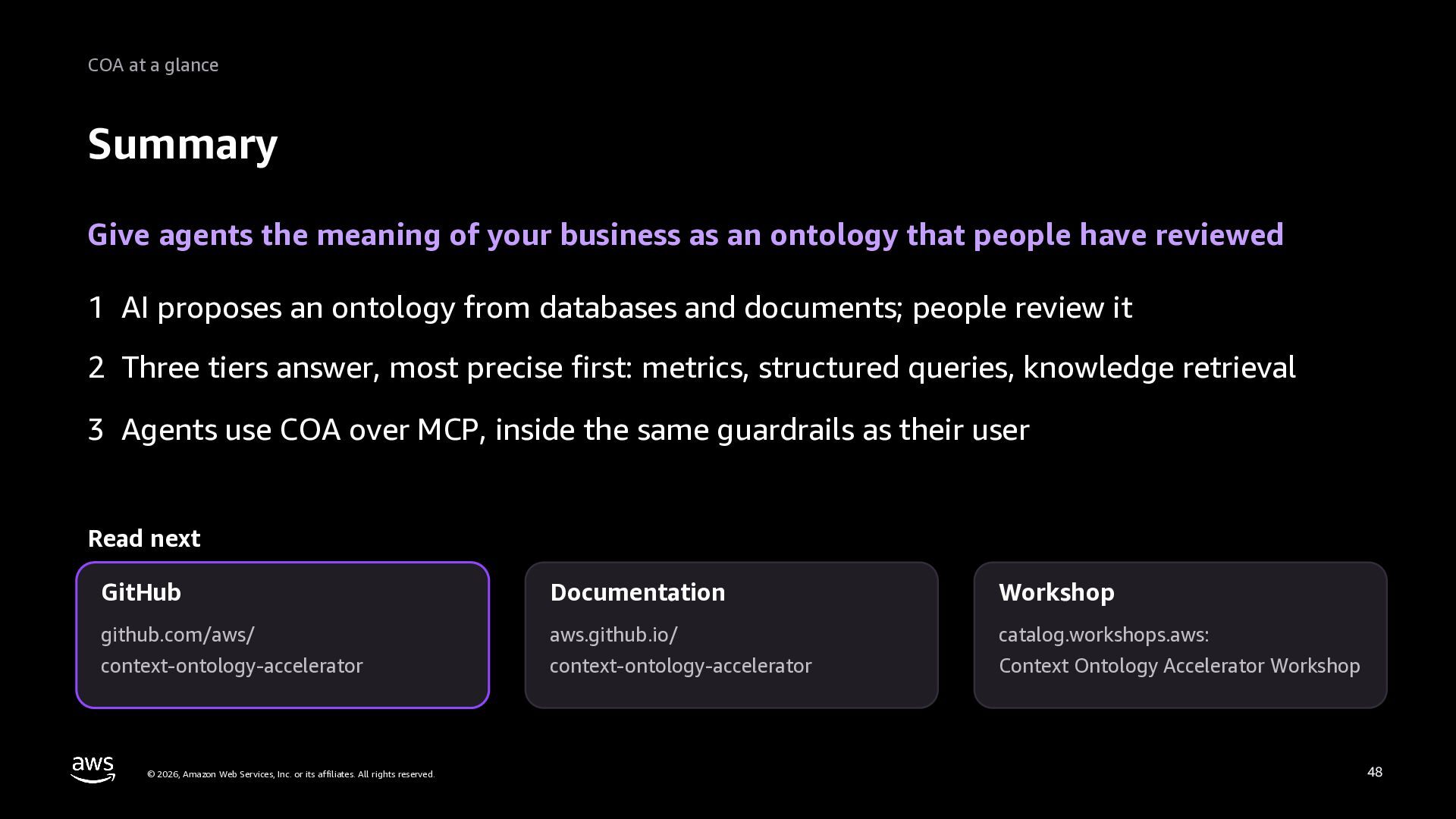
  48. COA at a glance Summary Give agents the meaning of

    your business as an ontology that people have reviewed 1 AI proposes an ontology from databases and documents; people review it 2 Three tiers answer, most precise first: metrics, structured queries, knowledge retrieval 3 Agents use COA over MCP, inside the same guardrails as their user Read next GitHub Documentation Workshop github.com/aws/ aws.github.io/ catalog.workshops.aws: context-ontology-accelerator context-ontology-accelerator Context Ontology Accelerator Workshop © 2026, Amazon Web Services, Inc. or its affiliates. All rights reserved. 48
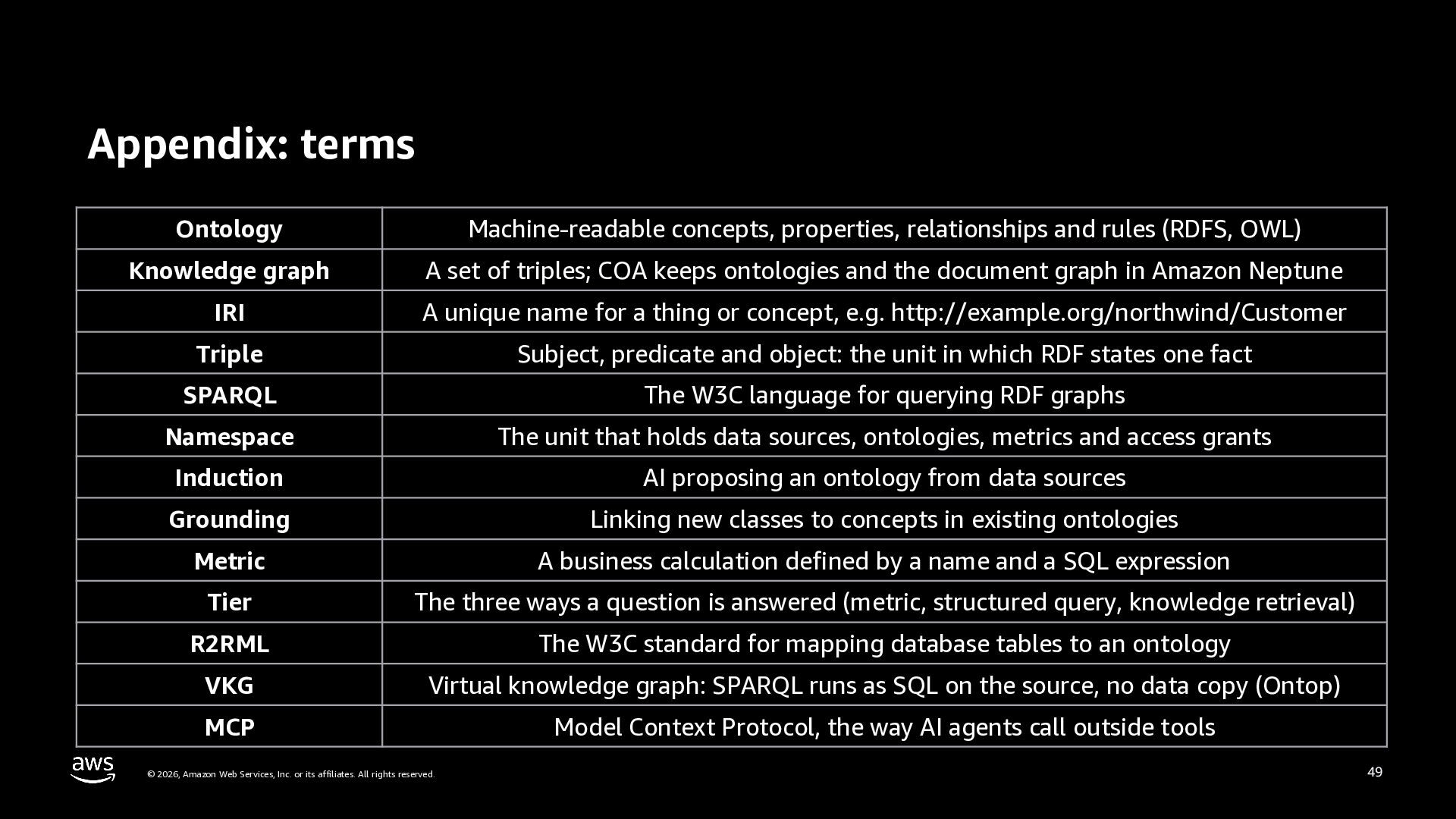
  49. Appendix: terms Ontology Machine-readable concepts, properties, relationships and rules (RDFS,

    OWL) Knowledge graph A set of triples; COA keeps ontologies and the document graph in Amazon Neptune IRI A unique name for a thing or concept, e.g. http://example.org/northwind/Customer Triple Subject, predicate and object: the unit in which RDF states one fact SPARQL The W3C language for querying RDF graphs Namespace The unit that holds data sources, ontologies, metrics and access grants Induction AI proposing an ontology from data sources Grounding Linking new classes to concepts in existing ontologies Metric A business calculation defined by a name and a SQL expression Tier The three ways a question is answered (metric, structured query, knowledge retrieval) R2RML The W3C standard for mapping database tables to an ontology VKG Virtual knowledge graph: SPARQL runs as SQL on the source, no data copy (Ontop) MCP Model Context Protocol, the way AI agents call outside tools © 2026, Amazon Web Services, Inc. or its affiliates. All rights reserved. 49
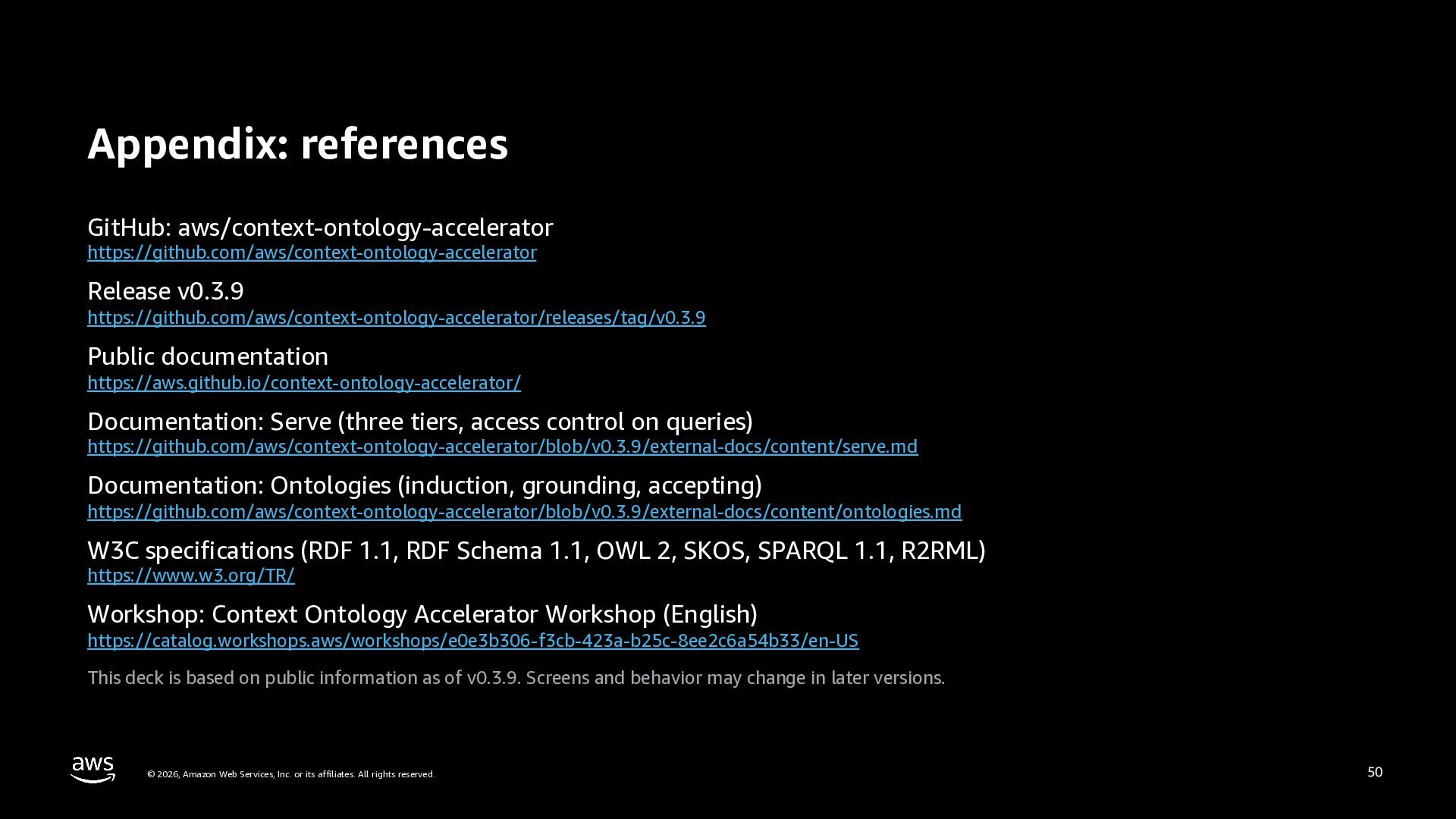
  50. Appendix: references GitHub: aws/context-ontology-accelerator https://github.com/aws/context-ontology-accelerator Release v0.3.9 https://github.com/aws/context-ontology-accelerator/releases/tag/v0.3.9 Public documentation

    https://aws.github.io/context-ontology-accelerator/ Documentation: Serve (three tiers, access control on queries) https://github.com/aws/context-ontology-accelerator/blob/v0.3.9/external-docs/content/serve.md Documentation: Ontologies (induction, grounding, accepting) https://github.com/aws/context-ontology-accelerator/blob/v0.3.9/external-docs/content/ontologies.md W3C specifications (RDF 1.1, RDF Schema 1.1, OWL 2, SKOS, SPARQL 1.1, R2RML) https://www.w3.org/TR/ Workshop: Context Ontology Accelerator Workshop (English) https://catalog.workshops.aws/workshops/e0e3b306-f3cb-423a-b25c-8ee2c6a54b33/en-US This deck is based on public information as of v0.3.9. Screens and behavior may change in later versions. © 2026, Amazon Web Services, Inc. or its affiliates. All rights reserved. 50