Rosen I’m James A Rosen. The “A” is important. James Rosen is a Fox News contributor. I’m not. Sometimes I have a beard, or a mustache, or a pig-nose. Sometimes my avatar is my cat, Whiskey. I’m “jamesarosen” pretty much everywhere on the Internet.
one. Our engineering team worked side-by-side with the product managers to figure out what wasn’t working for our growing customer base. We went out on customer visits, prototyped, and built an entire new UI. We ended up shipping one of the first production Ember.js applications. Today I’ll be telling you what I’ve learned about doing design work in groups from this and other experiences like it.
Learn Starting with Empathy for the User The Importance of Emotional Intelligence Mental Biases in Groups Parallel Thinking Tips to Boost your Creative Team
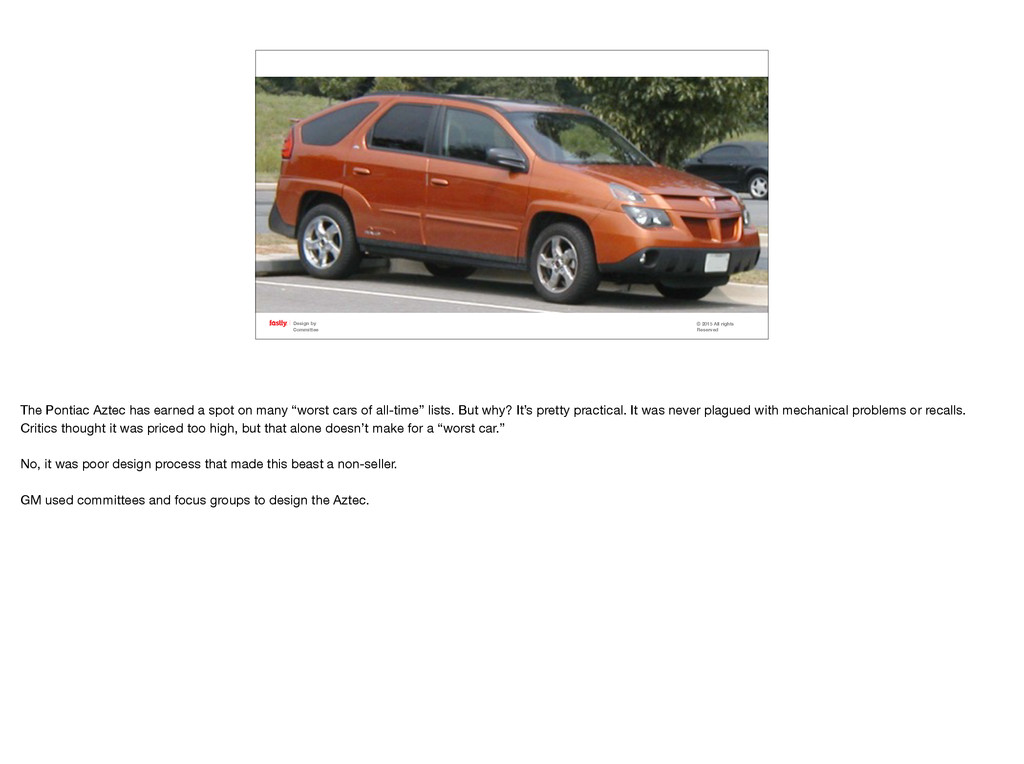
Aztec has earned a spot on many “worst cars of all-time” lists. But why? It’s pretty practical. It was never plagued with mechanical problems or recalls. Critics thought it was priced too high, but that alone doesn’t make for a “worst car.” No, it was poor design process that made this beast a non-seller. GM used committees and focus groups to design the Aztec.
think of Eloqua. It’s chock-full features a marketing team might want. But the app follows few standard patterns, which makes it unintuitive. It doesn’t teach you how to use it as you go.
Custom Templates ✓ ✕ SSL / TLS ✓ ✓ Audit Log ✓ ✕ De-‐Widgetizer Widget ✓ ✕ Frobulators Unlimited 0 Cat Tuesdays ✓ ✕ This sort of software looks great on paper or in a PowerPoint presentation. It’s less nice for the actual users.
Process The cause is simple: the people running the project jumped right into the middle of the process. They failed to empathize with their users. They solved a problem, but they didn’t solve the right problem.
& Gold Owner This is often because of a conflict between the “goal donor” — the person who sets the agenda — and the “gold owner” — the person who pays for the product.
you need to consult the purchasers of enterprise software (say, the CTO), make sure you take time build empathy with the actual users. Visit them. Watch them work. Read — or even solve — support tickets. Build personas.
We Want Emotional Intelligence? “Groups are most creative when their members collaborate unreservedly. People stop holding back when there is mutual trust, rooted in emotionally intelligent interactions.” -Druskat & Wolff
Emotional Intelligence? “The ability to monitor one’s own and other’s feelings and emotions, to discriminate among them, and to use this information to guide one’s thinking and actions.” -Salovey & Mayer
Let’s try a quick meditation now. You can close your eyes if you want. Think about the emotions you’re feeling right now. Maybe you’re feeling anxious about giving a talk later today. Or frustrated with a coworker. Or energized by the conference. One way we can understand our emotions better is to focus on their physical effects. We’re going to do a body scan and simply acknowledge how our bodies feel. Start by bringing your attention to your feet. Are they sore? That’s OK. We’re not trying to change anything — just feel. Now to your calves… your knees… your thighs. How does your stomach feel? Do you notice any tension? Now bring your attention to your chest. Is it tight? Is your heart beating fast? Whatever your body is doing is OK. Your job is simply to notice and acknowledge what is happening. Think about your arms and your hands. Now walk your attention back to your back… your shoulders… your neck. Now your jaw; maybe you, like me, carry stress there. Bring your attention to your eyebrows, then your forehead, and finally your scalp. Well done!
want to learn more, I highly recommend Search Inside Yourself by Google’s Jolly Good Fellow, Meng. He does a wonderful job summarizing recent neuroscience research and showing practical meditations that let you take advantage of that knowledge. Just 100 minutes of meditation — 10 minutes a day for less than two weeks — has been shown to change the way the brain works.
Daniel Kahneman and Amos Tversky wrote a paper on Prospect Theory — how people make decisions under uncertainty. In 2002, they won a Nobel Prize for that work. And ever since, bookshelves have been awash with volumes on behavioral economics.
Egocentric Bias Planning Fallacy Dunning-Kruger Effect Framing Effect Bias blind spot So I wouldn’t be surprised if you’ve come across some of the following cognitive biases: • Egocentric Bias: we think other people are like ourselves • Planning Fallacy: our estimates are bad because we’re bad at combining probabilities • Dunning-Kruger Effect: unskilled people overestimate their ability • Framing Effect: drawing different conclusions from the same data based on how it’s presented, like a 90% success rate vs. a 10% death rate for a surgery • Bias blind spot: the ability to see cognitive biases in others’ behavior, but not in one’s own, resistant to introspection Many people think that working in a group will help them overcome these cognitive biases. “Two heads are better than one,” they say.
Availability “I think most people would prefer the navigation on the left.” “Everybody is switching to native on mobile.” Groups do help mitigate some of these biases. If you have a diverse group, their egocentric biases will tend to cancel out.
& Overconfidence “As soon as I get the requirements from Marketing, it’ll just take a week to design and implement.” “I’d say we have a 95% chance of making our Q3 numbers.” “OK, so Claire will write a spec, then Rakesh will do few designs, then we’ll all meet to discuss, pick an option, and I’ll code it.” But groups exacerbate other biases. People in groups avoid talking about failure cases, making estimation even worse.
groups. Cascade effects can exert tremendous pressure on people’s thinking. For an example, let’s turn to some research that was done with mock trial juries.
In one mock trial, jurors 1, 2, and 3 endorsed a verdict of second-degree murder both privately and in the straw vote. Juror 4 had voted not guilty and indicated the highest level of confidence in his choice on the pre-deliberation private ballot. What did juror 4 do when confronted with three second-degree murder verdicts? He paused for a second and then said, “Second degree.” Juror 7, an undecided vote, suddenly spoke up and asked, “Why second degree?” The researchers saw a deer-in- the-headlights expression flit across juror 4’s face before he replied, “Oh, it’s just obviously second degree.”
Cascade Effects Men self-censor more on stereotypically feminine subjects like fashion. Women self-censor more on stereotypically masculine subjects like sports.
“What Everybody Knows” Group discussions emphasize broadly-shared knowledge. If someone raises a point of contention, the group might deliberate briefly, but will often then put the topic aside. This results in “hidden profiles” — accurate understandings of the world that groups do not uncover.
a process by which “cognitively peripheral” people — people who have some sort of different perspective — share their knowledge. For example, you might invite people from other teams or even customers to design reviews and retrospectives and actively solicit their opinion during the discussion.
There is a well-known problem called Duncker’s Candle Problem. Subjects are given matches, a box of push-pins, and a candle and are asked to attach the candle to the wall. Most subjects focus on pinning the candle to the wall somehow. What they don’t see is that the box is a tool they’ve been given, not just a container for the pins.
A: We need a way to indicate fields that have errors. B: Red border? C: Conflicts with focus B: Red label? A: Well, that’s hard for some users to see. C: (╯°□°)╯︵ ┻━┻ Later, de Bono went on to study how groups solve problems. He was particularly concerned with the sort of Socratic Dialogue that many groups use. It’s a very confrontational way of working. These sorts of back-and-forth discussions often have two significant bad results: 1. people get more annoyed 2. the group loses its focus, digressing on some small detail
— Process State the problem — “Indicate fields with errors” Propose a solution — “Add a red boder” Everyone lists pros Everyone lists cons Everyone lists ways to mitigate cons He suggested a new process, called Parallel Thinking.
a (small) Team Smarter? IQ of members ✖ Group satisfaction ✖ Group cohesion ✖ Group motivation ✖ More women ✓ Likely related to social sensitivity Some recent research published in the Harvard Business Review looked at what makes small teams smarter. They tested groups on brainstorming, decision making, and puzzle solving. Any guesses as to what was correlated with higher performance?
One creativity-priming exercise I really like is called 30 Circles. Everyone takes 60 seconds to use as many of the 30 circles as possible. Draw whatever you like. Art skill doesn’t matter. Just try to use as many as possible.
Line Use My Line is a similar exercise. The goal is to improve your ability to build off of other people’s ideas — to enhance remix. The first person draws a little squiggle…
Atwood, Jeff. The Pontiac Aztec and the Perils of Design by Committee. http://blog.codinghorror.com/the-‐pontiac-‐aztek-‐and-‐the-‐perils-‐of-‐design-‐by-‐ committee/ • Brown, Tim. Tales of Creativity and Play. http://www.ted.com/talks/tim_brown_on_creativity_and_play • Druskat, Vanessa Urch and Steven B. Wolff. Building the Emotional Intelligence of Groups. https://hbr.org/2001/03/building-‐the-‐emotional-‐intelligence-‐of-‐ groups • Friedman, Ronald S, Ayelet Fishbach, Jens Förster, and Lioba Werth. Attentional Priming Effects on Creativity. http://www.tandfonline.com/doi/abs/ 10.1080/10400419.2003.9651420 • Hadjihabib, Amir. Design with Zendesk. https://hadjihabib.exposure.co/design • Kelley, Tom and David Kelley. Three Creativity Challenges from IDEO’s Leaders. https://hbr.org/2013/11/three-‐creativity-‐challenges-‐from-‐ideos-‐leaders/ • Kolko, Jon. A Process for Empathetic Product Design. https://hbr.org/2015/04/a-‐process-‐for-‐empathetic-‐product-‐design • Kolko, Jon. Make Enterprise Software People Actually Love. https://hbr.org/2015/02/make-‐enterprise-‐software-‐people-‐actually-‐love • Miron-‐Spektor, Ella, Miriam Erez, and Eitan Naveh. To Drive Creativity, Add Some Conformity. https://hbr.org/2012/03/to-‐drive-‐creativity-‐add-‐some-‐ conformity • Salovey, Peter and John D. Mayer. Emotional Intelligence. http://www.unh.edu/emotional_intelligence/EIAssets/EmotionalIntelligenceProper/ EI1990%20Emotional%20Intelligence.pdf • Seelig, Tina. Insight Out. http://t.co/aSCBgikQh0 • Sunstein, Cass and Reid Hastie. Making Dumb Groups Smarter. https://hbr.org/2014/11/making-‐dumb-‐groups-‐smarter • Tan, Chade-‐Meng. Search Inside Yourself. https://siyli.org/resources/#book • Wikipedia. Pontiac Aztec. http://en.wikipedia.org/wiki/Pontiac_Aztek • Woolley, Anita and Thomas W. Malone. Defend Your Research: What Makes a Team Smarter? More Women. https://hbr.org/2011/06/defend-‐your-‐ research-‐what-‐makes-‐a-‐team-‐smarter-‐more-‐women • Wu, Michael. The Future of Enterprise Software Will Be Fun and Productive. https://community.lithium.com/t5/Science-‐of-‐Social-‐blog/The-‐Future-‐of-‐ Enterprise-‐Software-‐will-‐be-‐Fun-‐and-‐Productive/ba-‐p/25486


 jamesarosen
 quoitworks999
 ukaoli
 kakukoki
 ottatto
 tsubo52
 uto
uto
 ishii_mit
 yuichi_hara7
 hiromimaeo
 goetter
 baku89
 terencebasart
 aleyda
 paigeccino
 keavy
keavy
 uxyall
 mraible
 joshbly
 holman
 bluesmoon
 tomoyanonymous
 marktimemedia
 akosma
 codingconduct