Upgrade to Pro — share decks privately, control downloads, hide ads and more …

(2026 AmA Keynote) Sociotechnical Architecture ...

Avatar for xinyao xinyao
March 12, 2026

(2026 AmA Keynote) Sociotechnical Architecture - Having your Agile and agility too.pdf

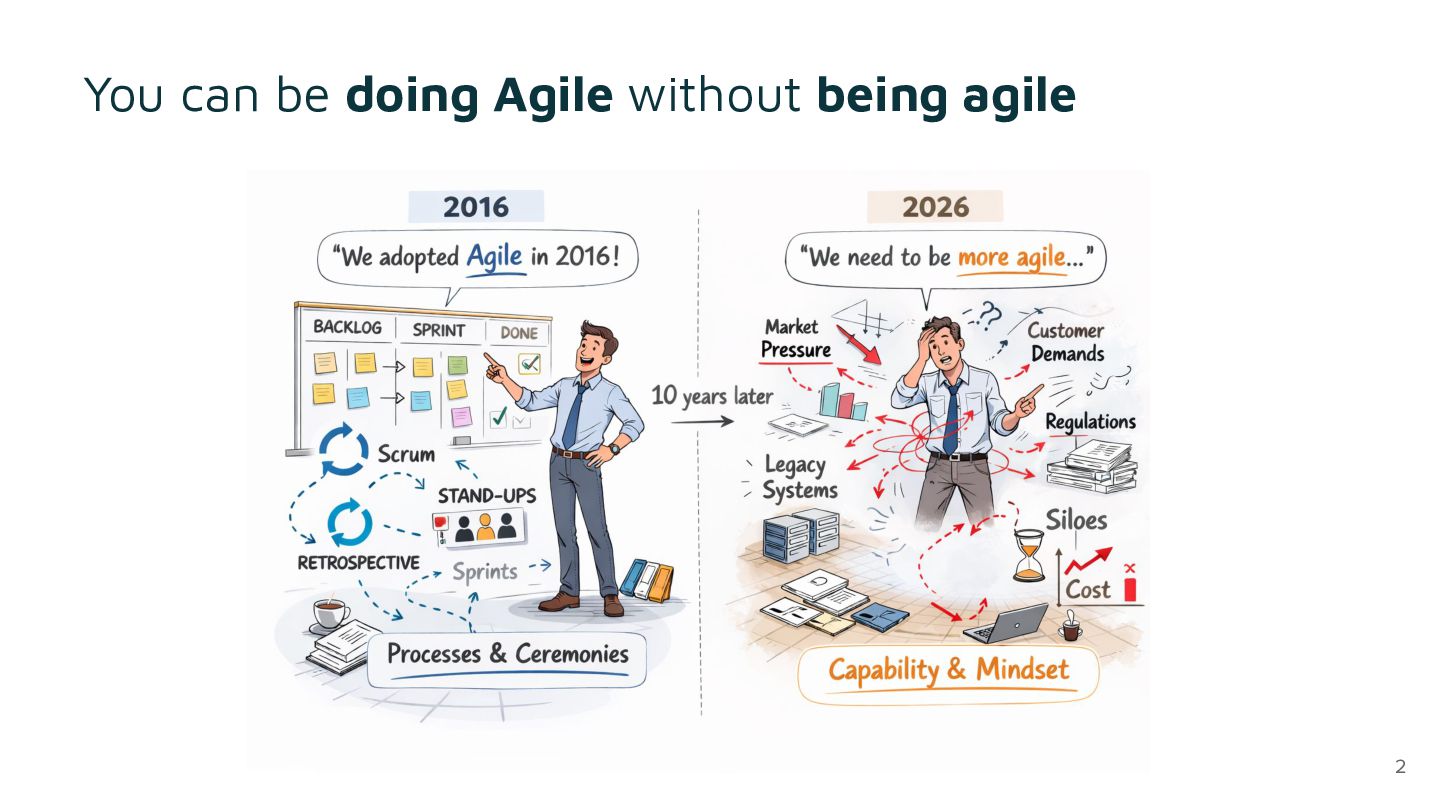
Agile has given us structures, roles, and methods to coordinate work — yet the more we scale it, the further we often drift from the very agility we seek. What will it take to have our Agile discipline and our agility too?

Sociotechnical architecture offers a lens for exploring this question. It invites us to become autopoietic designers in living systems. Through collaborative modeling, we can attend not only to technical quality attributes like modularity and scalability, but also to social ones like aliveness, connection, and wholeness.

What happens when the tidy ideals of technical design — decoupling and separation of concerns — meet the messy realities of human interdependence? How do we hold design conversations where independence and interdependence strengthen each other, where uncertainty becomes a possibility to appreciate rather than a problem to fix?

Today, technical architects and agile coaches often work apart — one shaping systems, the other shaping people. But what if their work could flow together? What if agile rituals became spaces where logic and ambiguity, predictability and emergence, the self and the whole could coalesce — where people feel seen, heard, and free to choose their agency rather than being delegated autonomy?

Perhaps sociotechnical architecture isn’t a new role, but a shared practice — a way of steering the boat while following the stream. Sometimes it means proposing an idea; other times, focusing attention, posing a question, and stepping back to let others shine. Together, we might rediscover agility not as a method to scale, but as a living quality to experience.

Avatar for xinyao

xinyao

March 12, 2026
Tweet

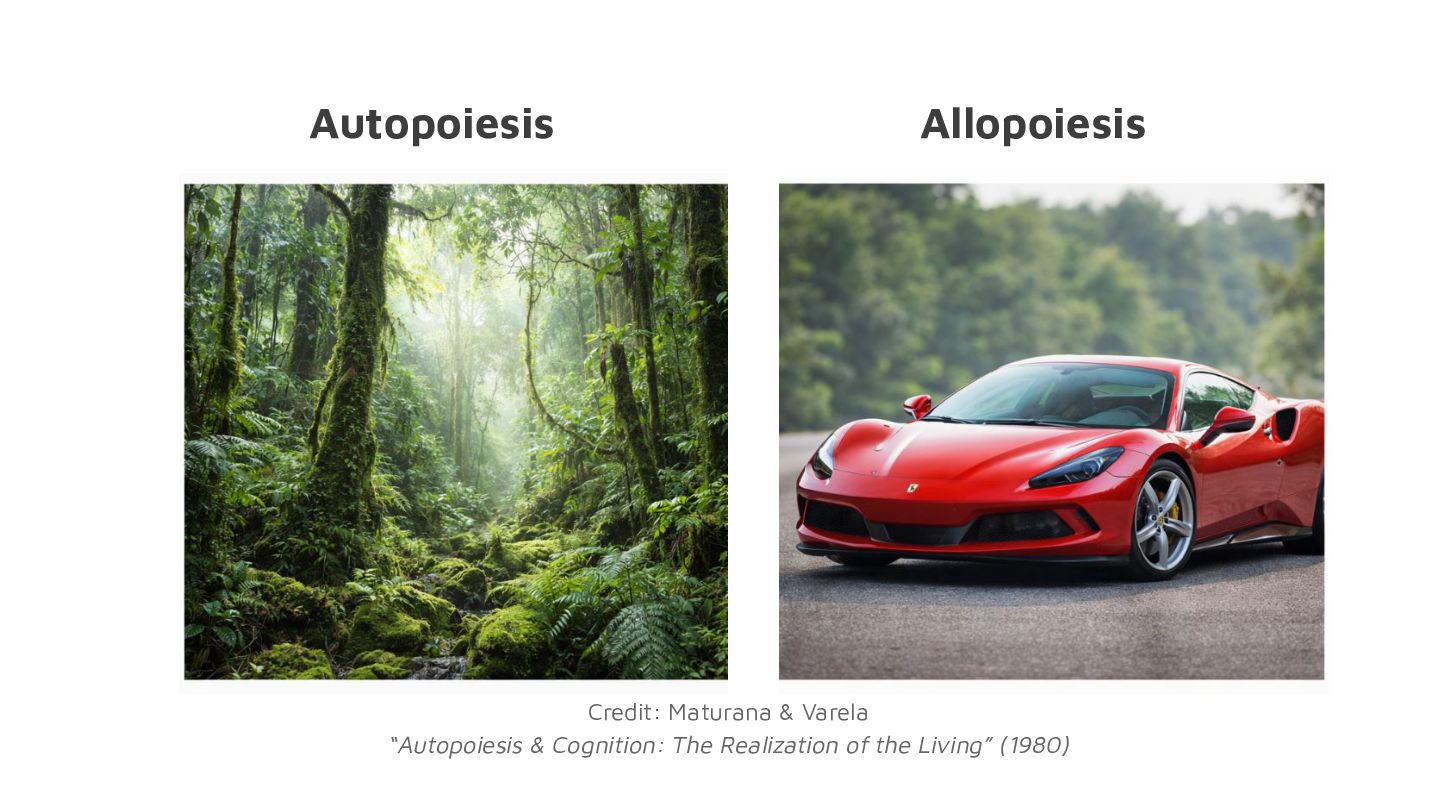
More Decks by xinyao

Other Decks in Design

Transcript

  1. 4 Join me to explore What will it take to

    have our Agile discipline & our agility too? And could sociotechnical architecture help us get there?
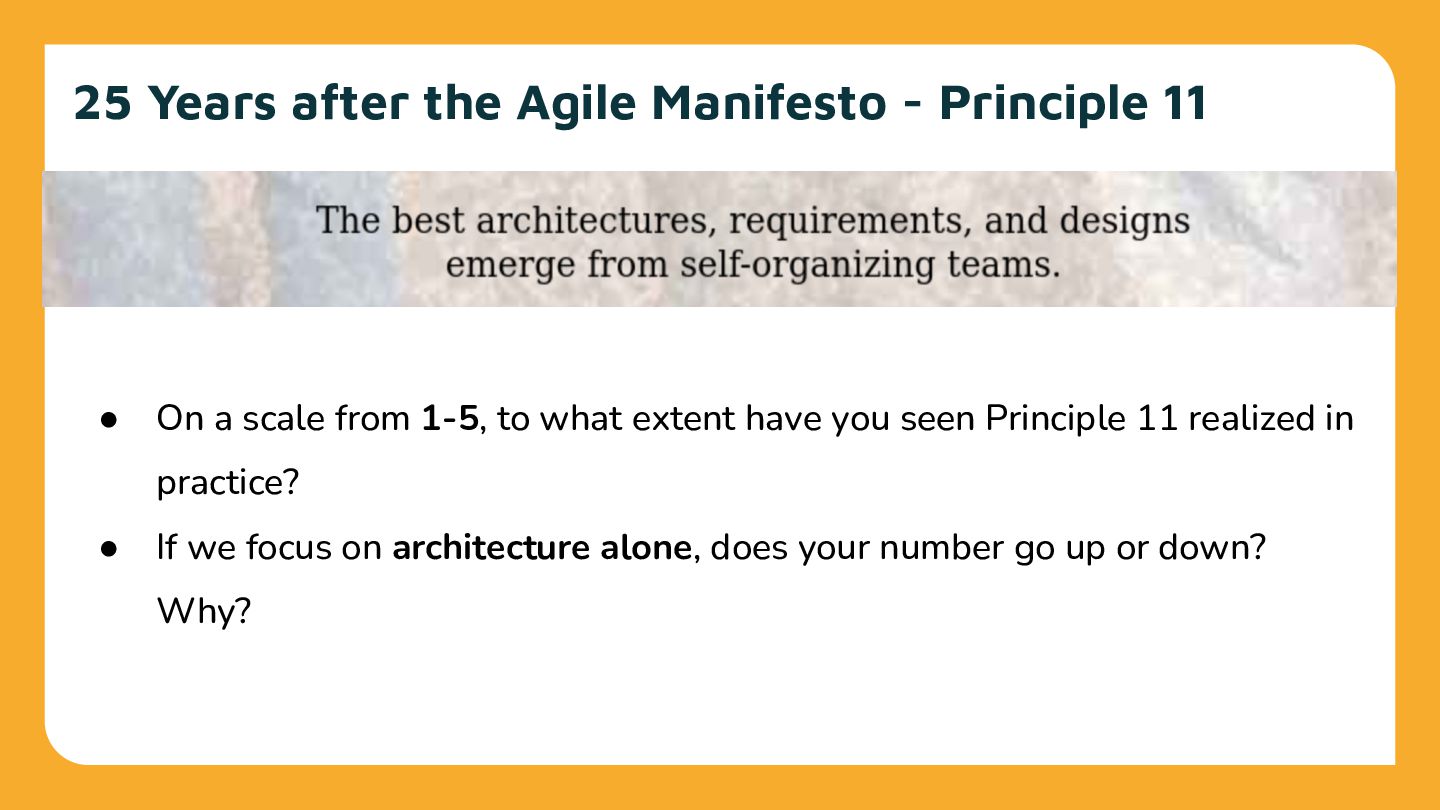
  2. Agile Manifesto | Principle 11 The best architectures, requirements, and

    designs emerge from self-organizing teams. (2001)
  3. • On a scale from 1-5, to what extent have

    you seen Principle 11 realized in practice? • If we focus on architecture alone, does your number go up or down? Why? 25 Years after the Agile Manifesto - Principle 11
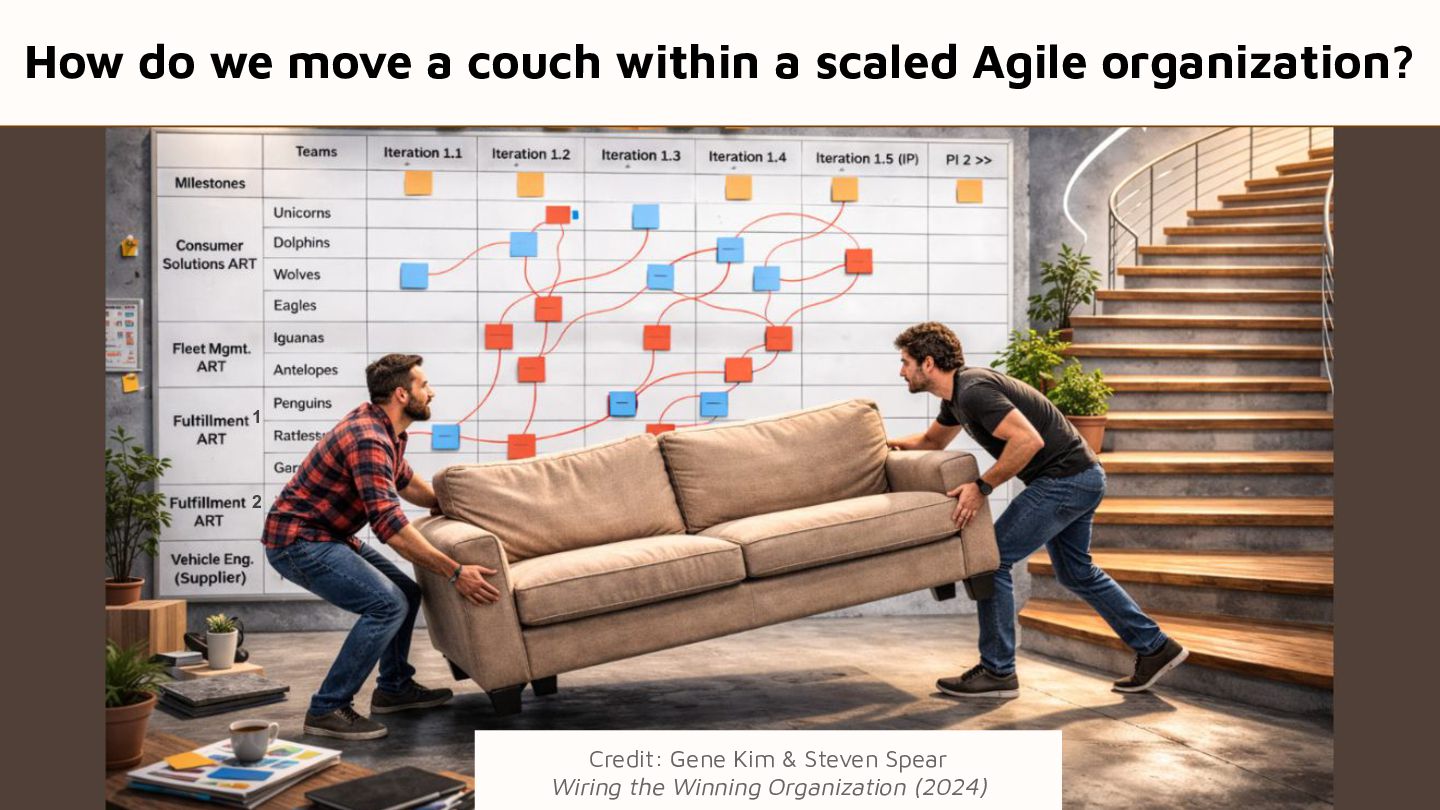
  4. How do we move a couch within a scaled Agile

    organization? Credit: Gene Kim & Steven Spear Wiring the Winning Organization (2024) 1 2
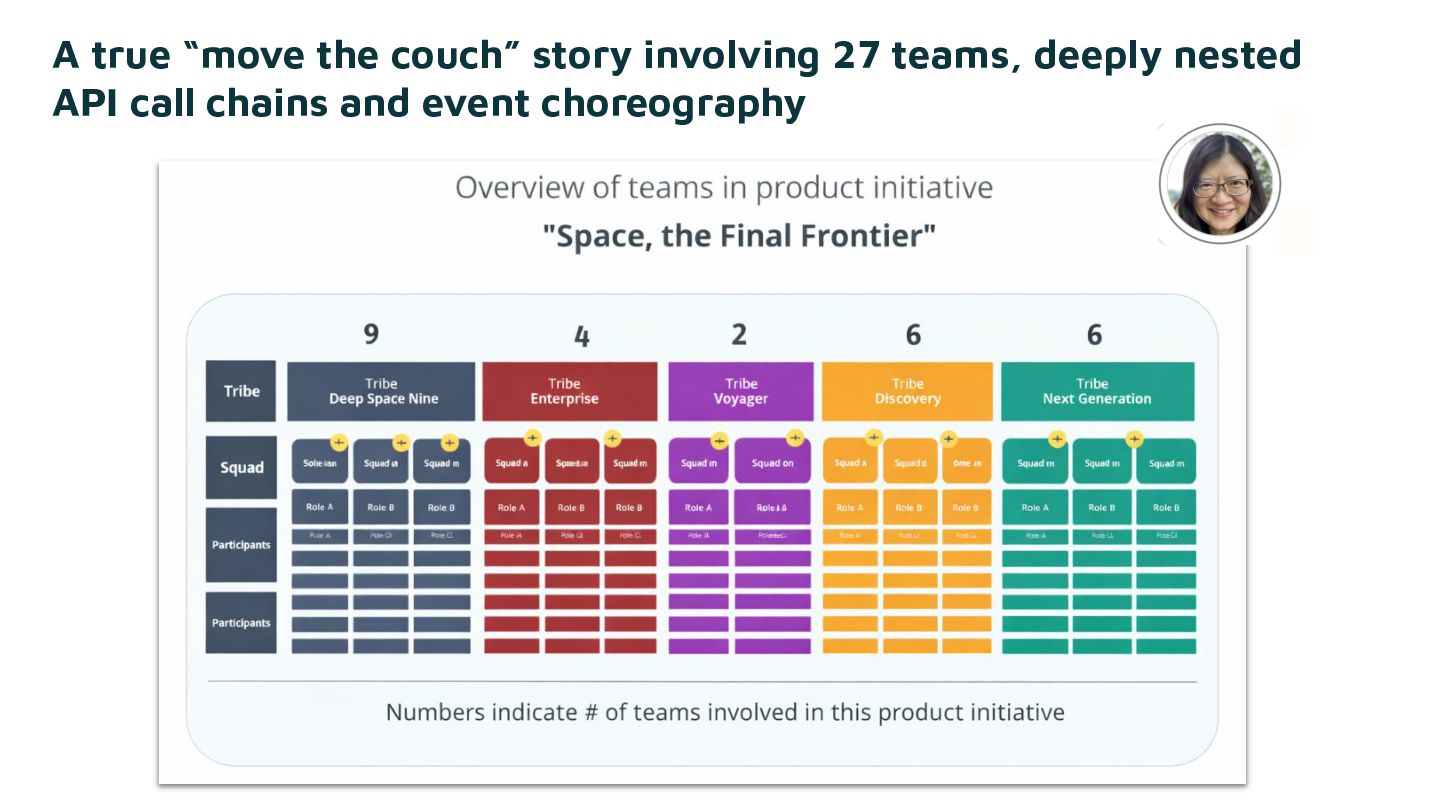
  5. A true “move the couch” story involving 27 teams, deeply

    nested API call chains and event choreography
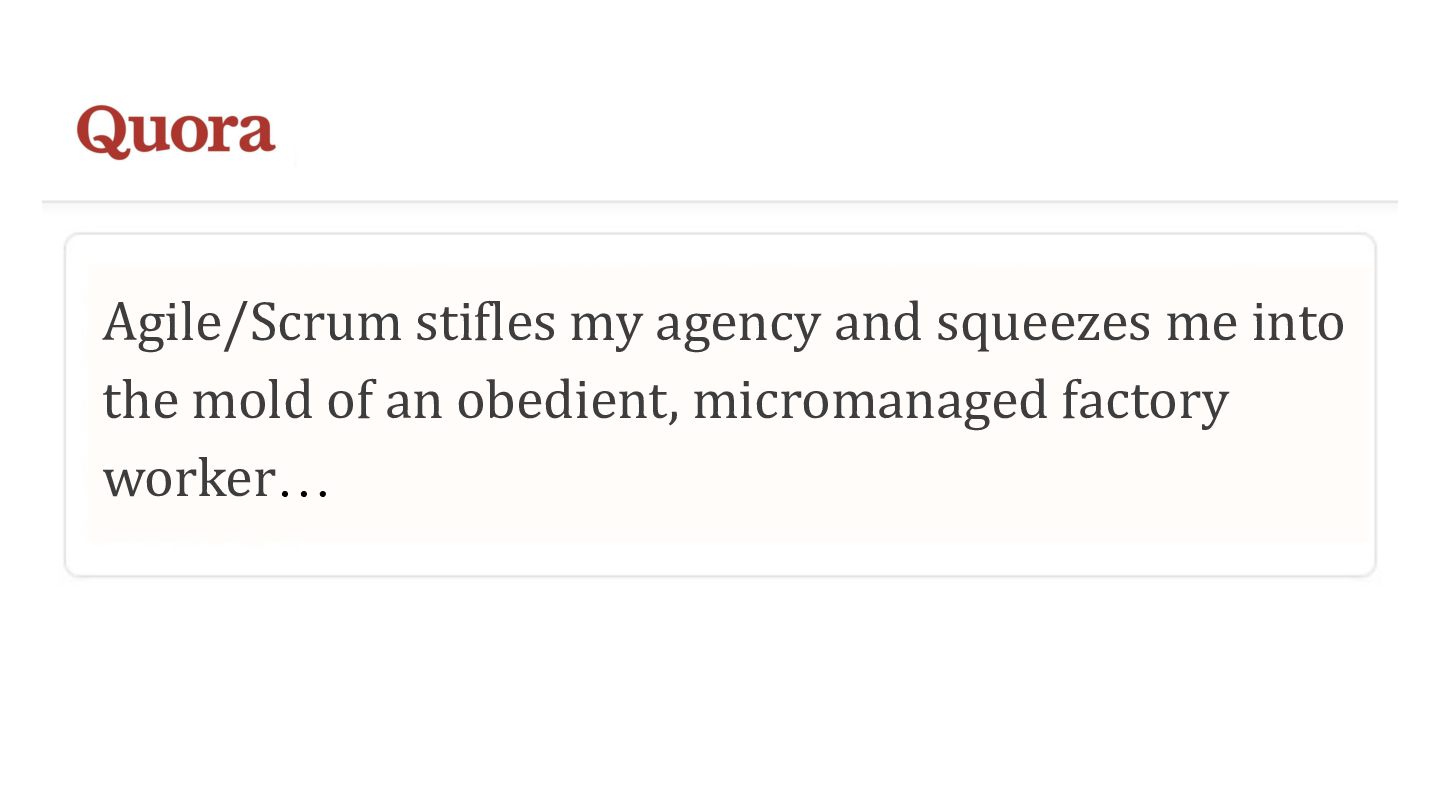
  6. Agile/Scrum stifles my agency and squeezes me into the mold

    of an obedient, micromanaged factory worker…
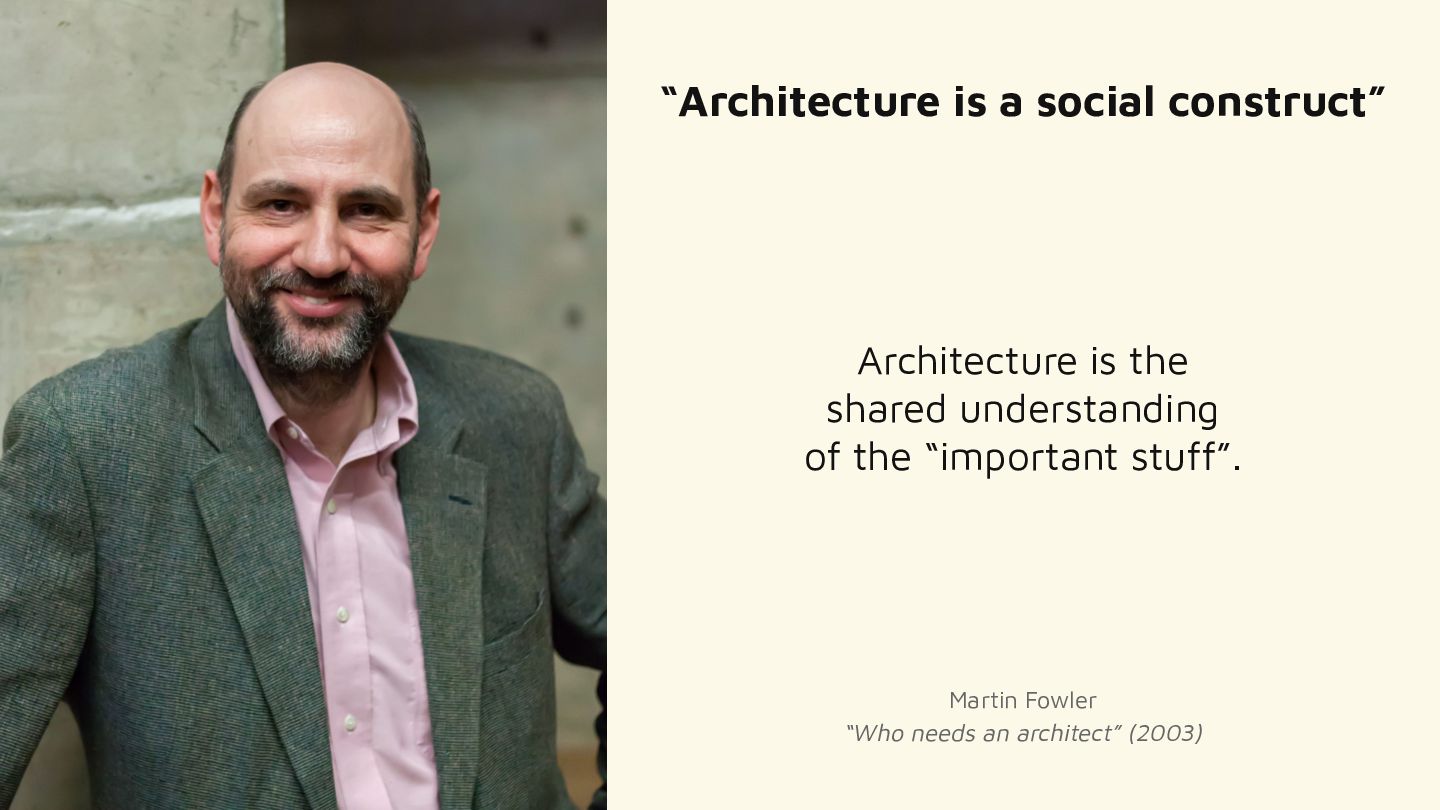
  7. Architecture is the shared understanding of the “important stuff”. Martin

    Fowler “Who needs an architect” (2003) “Architecture is a social construct”
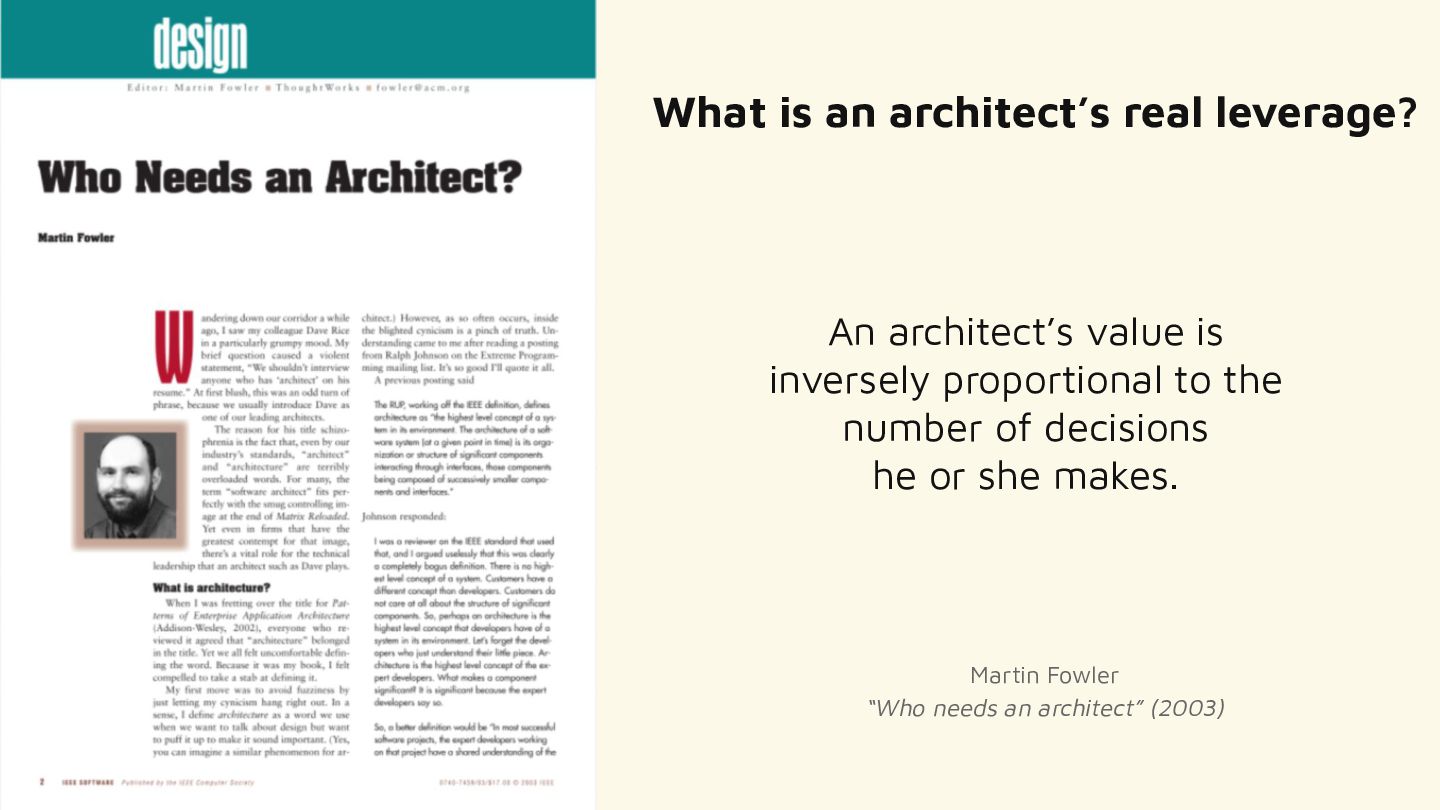
  8. An architect’s value is inversely proportional to the number of

    decisions he or she makes. Martin Fowler “Who needs an architect” (2003) What is an architect’s real leverage?
  9. Architecture is a sociotechnical seesaw Upfront Architecture Hard-to-change decisions Emergent

    Architecture Self-organizing teams Architecture is a social construct Agile Agility Shared understanding of the important stuff
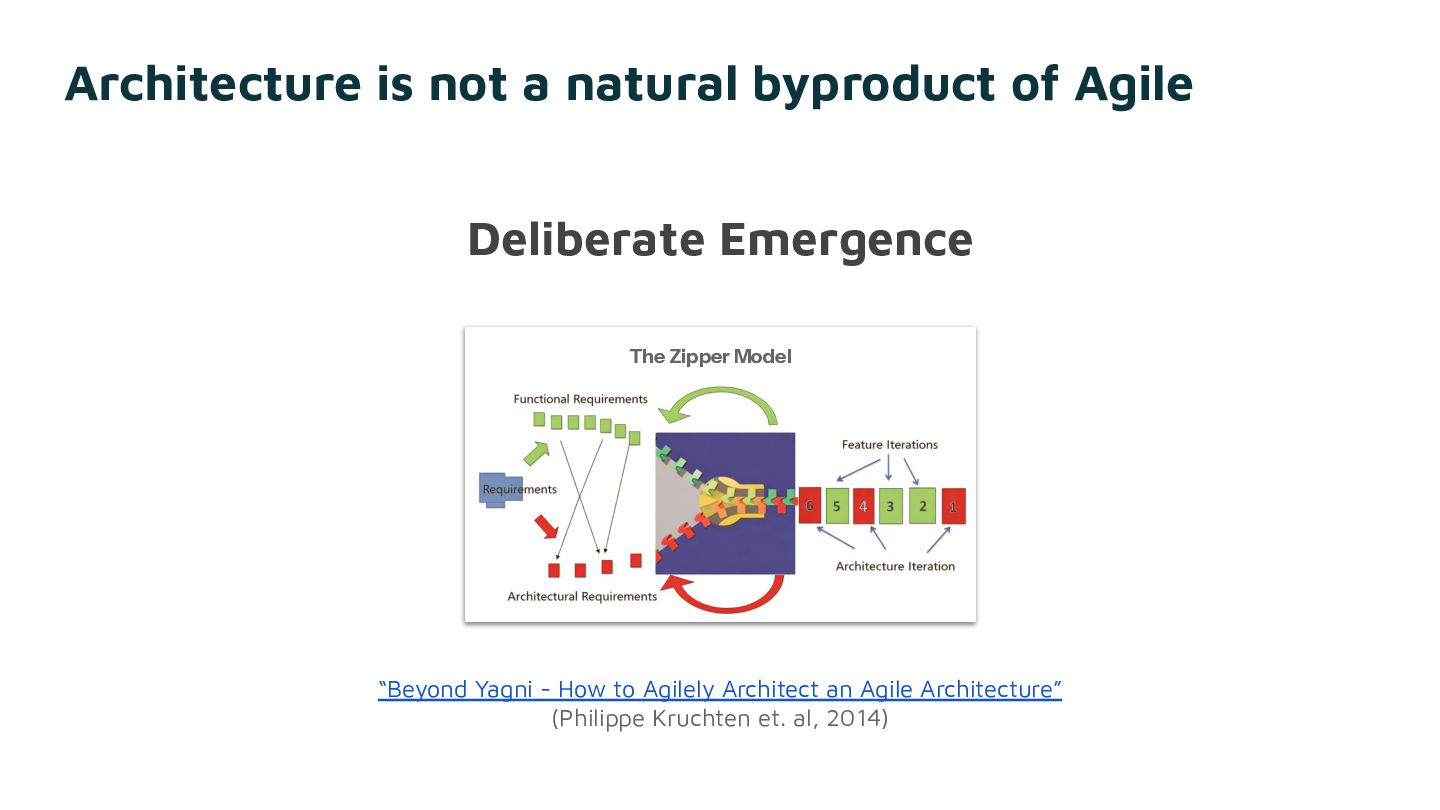
  10. “Beyond Yagni - How to Agilely Architect an Agile Architecture”

    (Philippe Kruchten et. al, 2014) Architecture is not a natural byproduct of Agile The Zipper Model Deliberate Emergence
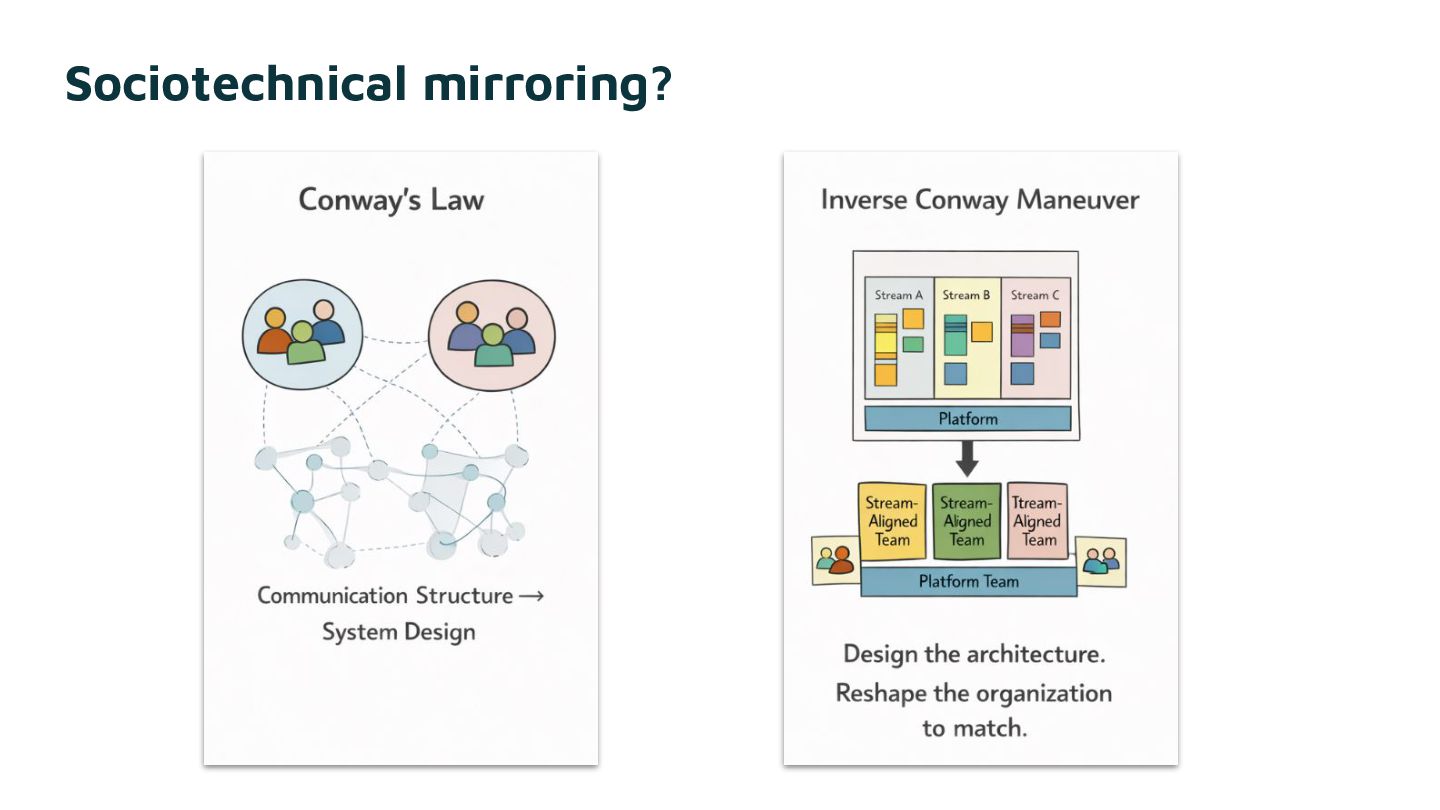
  11. Intention Reality The ‘runtime’ drift of Inverse Conway Architecture reflects

    culture far more reliably than culture obeys architecture.
  12. Every piece of code carries traces of the conversations, compromises,

    constraints, and misunderstandings that shaped it. Technical debt is social debt
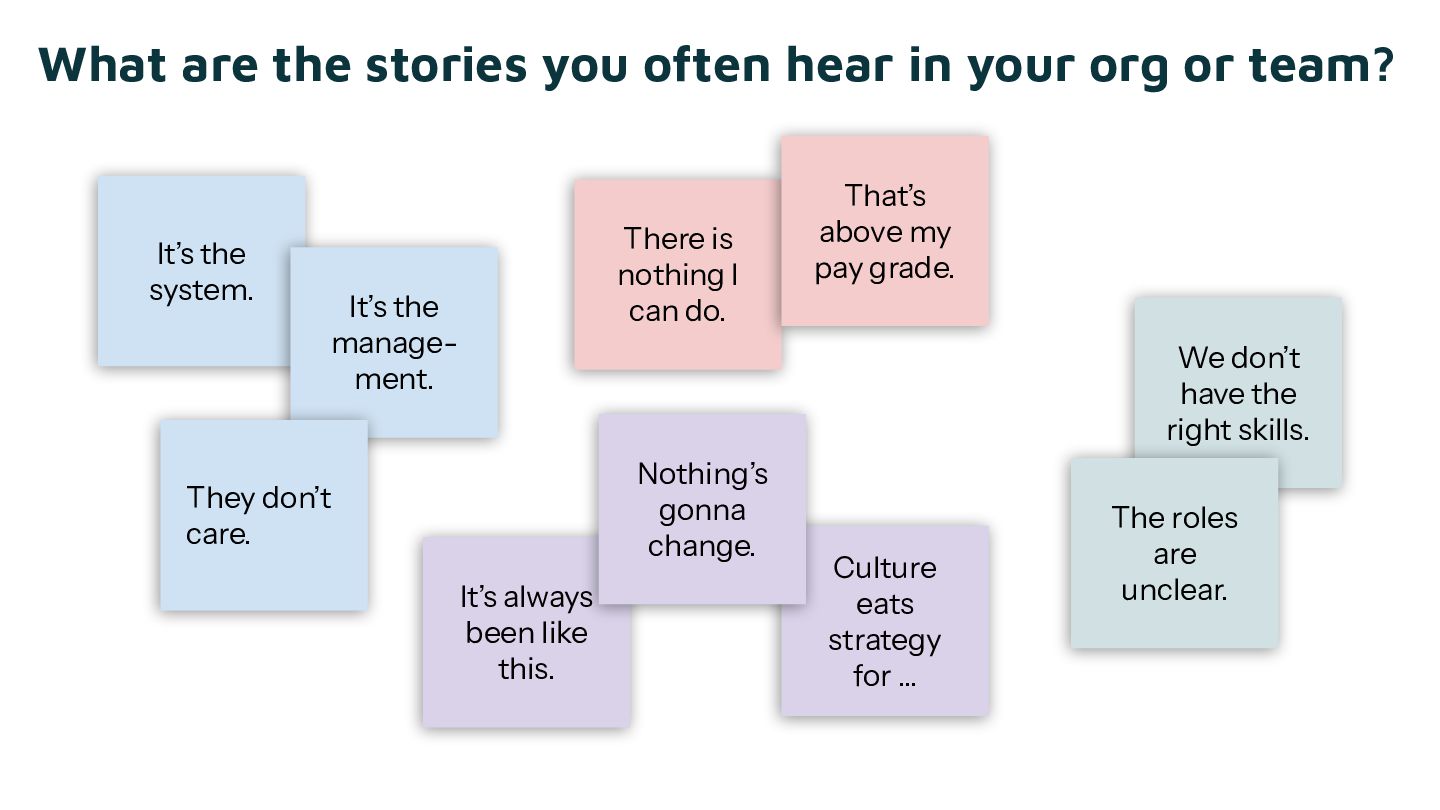
  13. It’s the system. There is nothing I can do. It’s

    the manage- ment. We don’t have the right skills. Culture eats strategy for … They don’t care. The roles are unclear. That’s above my pay grade. It’s always been like this. Nothing’s gonna change. What are the stories you often hear in your org or team?
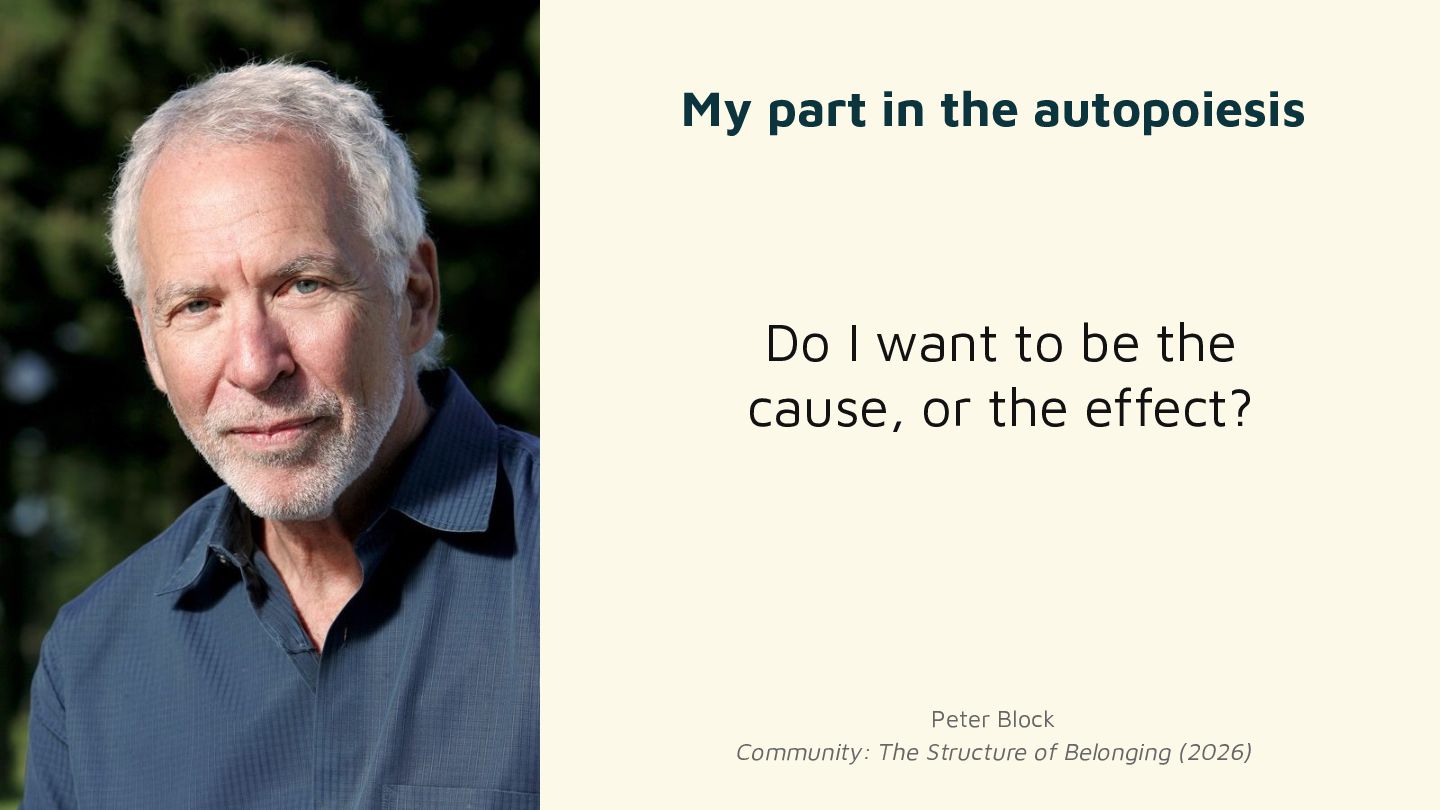
  14. Do I want to be the cause, or the effect?

    Peter Block Community: The Structure of Belonging (2026) My part in the autopoiesis
  15. Credit: Peter Block (“The Six Conversations”) Ownership Conversation: How have

    I contributed to creating or maintaining the current reality?
  16. Quality attributes in sociotechnical architecture Connectedness Aliveness Belonging Freedom Wholeness

    Modularity Scalability Security Maintainability Reliability Social Architecture Technical Architecture Openness Recoverability
  17. Connectedness Aliveness Belonging Freedom Wholeness Modularity Scalability Security Maintainability Reliability

    Social Architecture Technical Architecture Openness Recoverability Decouple Connect Opposing forces: decouple software & connect people Independence Interdependence
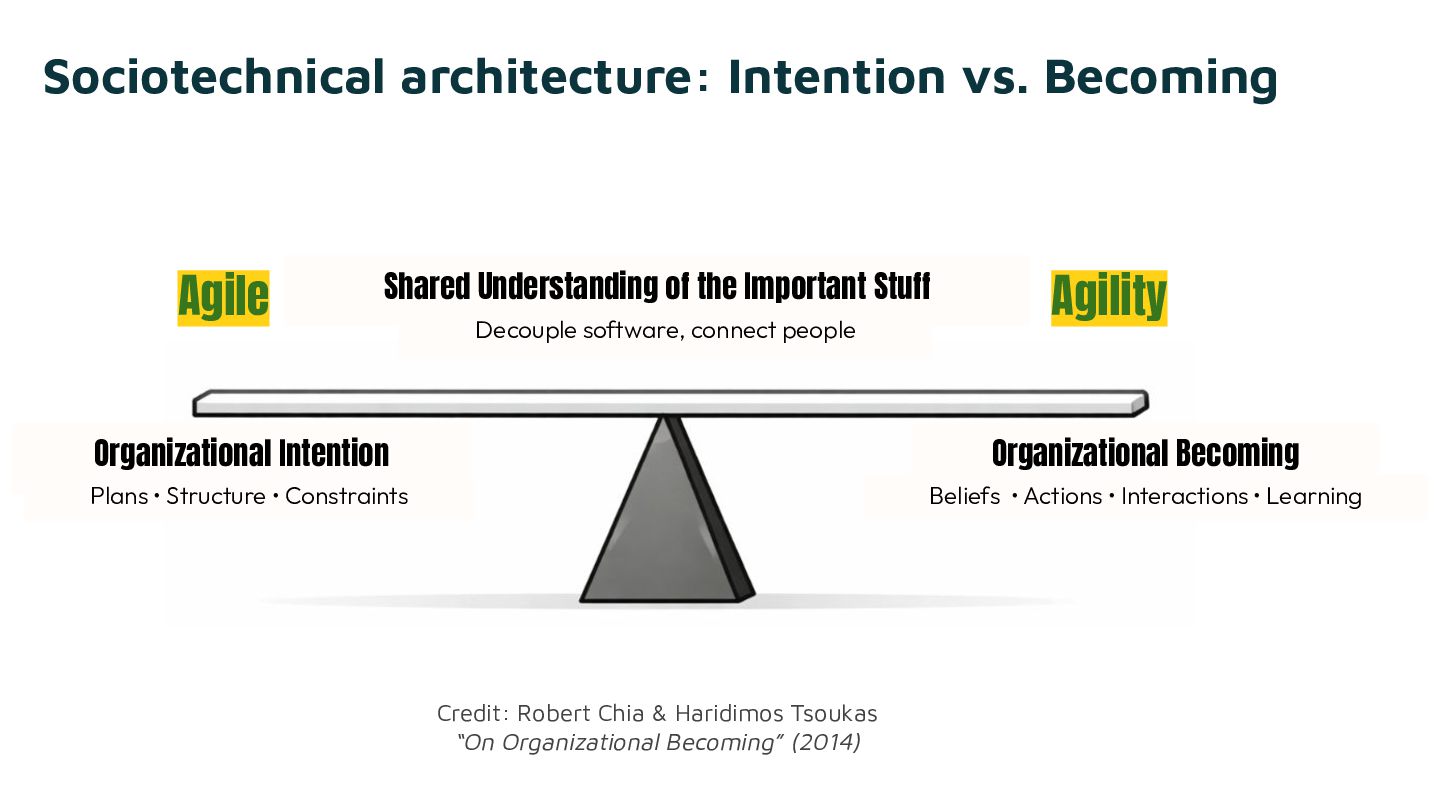
  18. Organizational Intention Organizational Becoming Beliefs • Actions • Interactions •

    Learning Agile Agility Shared Understanding of the Important Stuff Decouple software, connect people Sociotechnical architecture: Intention vs. Becoming Credit: Robert Chia & Haridimos Tsoukas “On Organizational Becoming” (2014) Plans • Structure • Constraints
  19. A Sociotechnical Experiment A story in progress @ an insurance

    company Any similarity to real companies is purely coincidental.
  20. DECISION FRAMING To what extent should FluxCare adopt an Agentic

    AI architecture to support its insurance claims workflow? What about AI-assisted software dev? SETTLEMENT Sociotechnical ADR workshops – Reimagine a future with AI
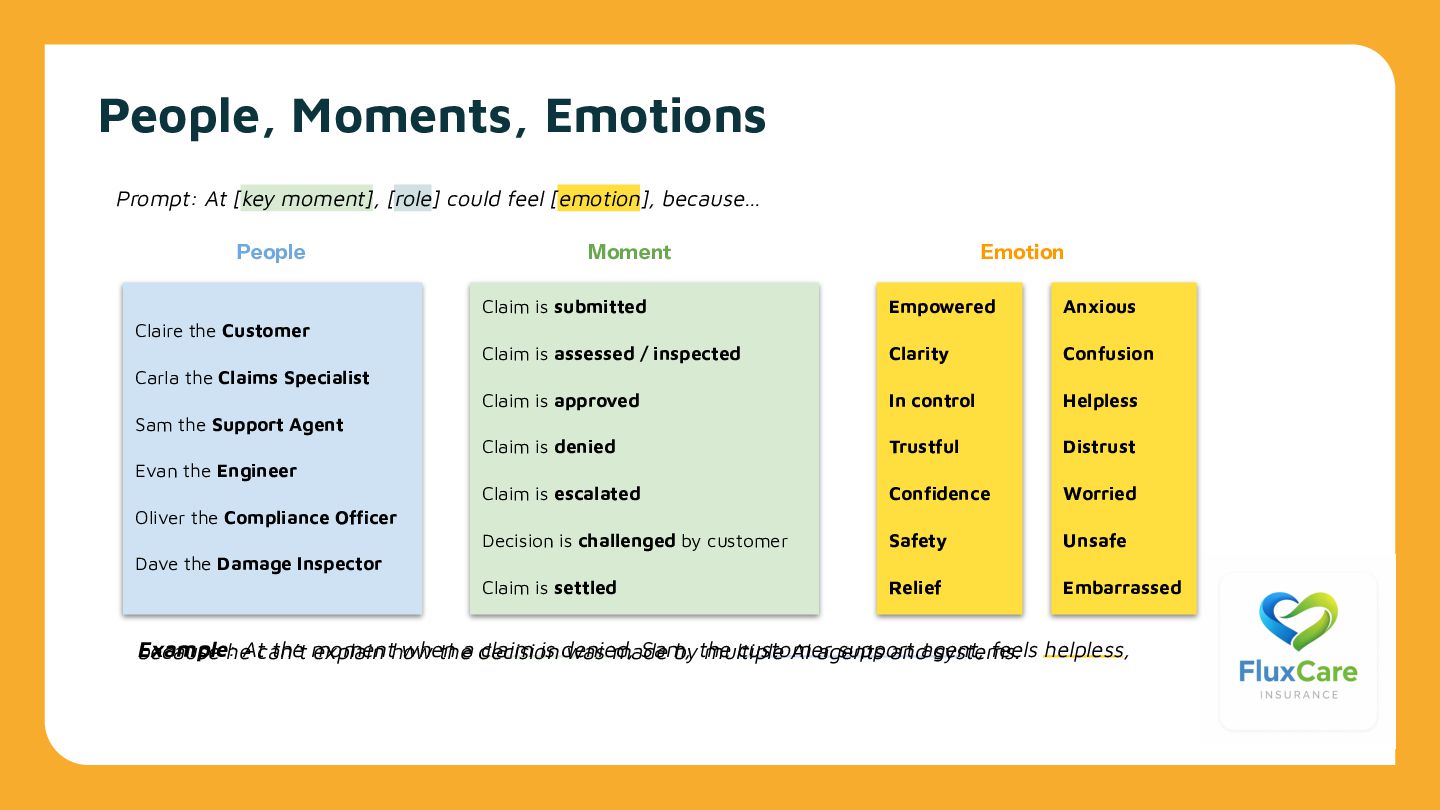
  21. People, Moments, Emotions Claim is submitted Claim is assessed /

    inspected Claim is approved Claim is denied Claim is escalated Decision is challenged by customer Claim is settled Prompt: At [key moment], [role] could feel [emotion], because… Claire the Customer Carla the Claims Specialist Sam the Support Agent Evan the Engineer Oliver the Compliance Officer Dave the Damage Inspector People Moment Empowered Clarity In control Trustful Confidence Safety Relief Emotion Example: At the moment when a claim is denied, Sam, the customer support agent, feels helpless, because he can’t explain how the decision was made by multiple AI agents and systems. Anxious Confusion Helpless Distrust Worried Unsafe Embarrassed
  22. Role → Moment → Emotion → Question → Arch. Characteristic

    [Arch. Question] How might we avoid putting Sam in a position where he feels helpless when ….? [Arch. Requirements] The system should be able to trace decisions across agents and systems. [Arch. Characteristic] Decision traceability / Explanability
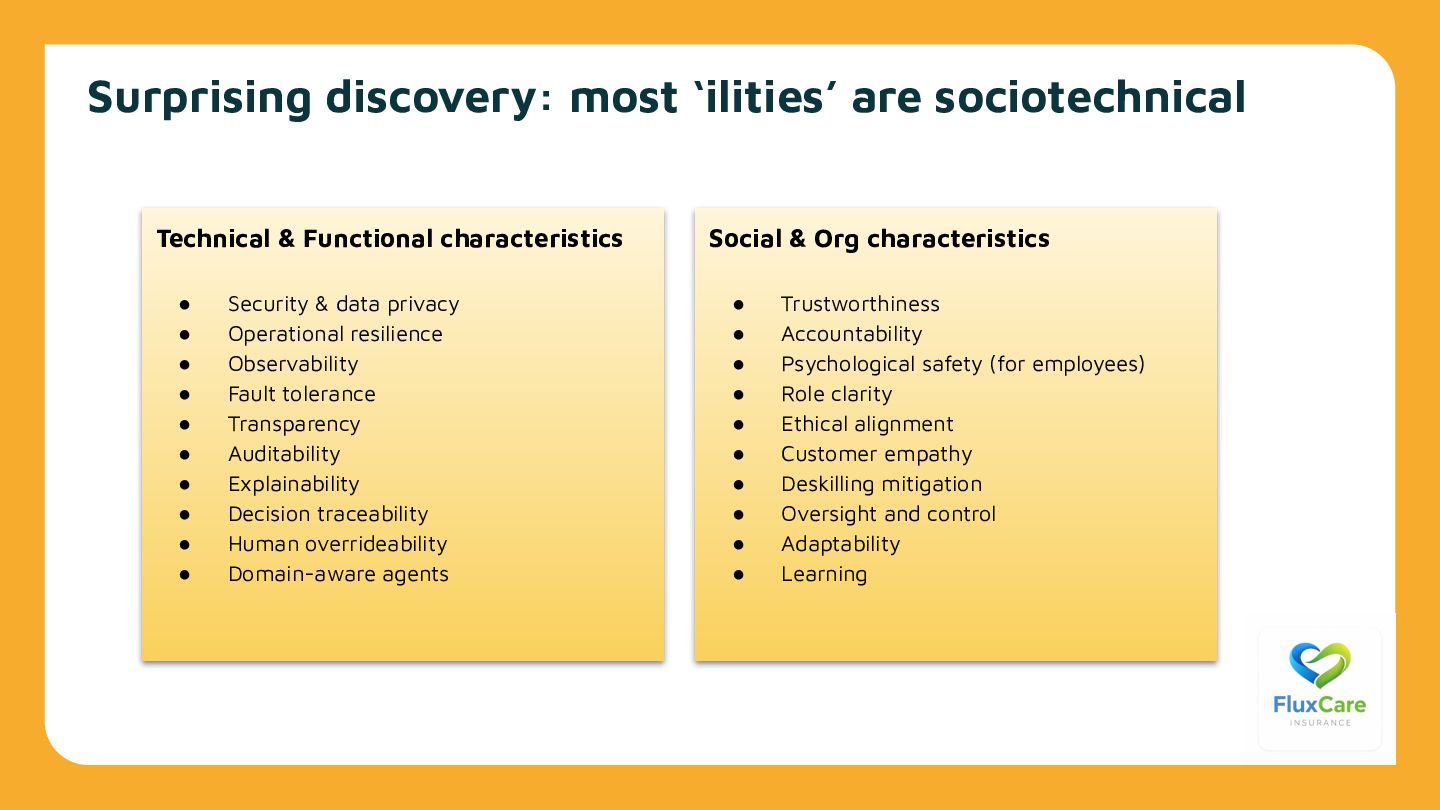
  23. Technical & Functional characteristics • Security & data privacy •

    Operational resilience • Observability • Fault tolerance • Transparency • Auditability • Explainability • Decision traceability • Human overrideability • Domain-aware agents Social & Org characteristics • Trustworthiness • Accountability • Psychological safety (for employees) • Role clarity • Ethical alignment • Customer empathy • Deskilling mitigation • Oversight and control • Adaptability • Learning Surprising discovery: most ‘ilities’ are sociotechnical
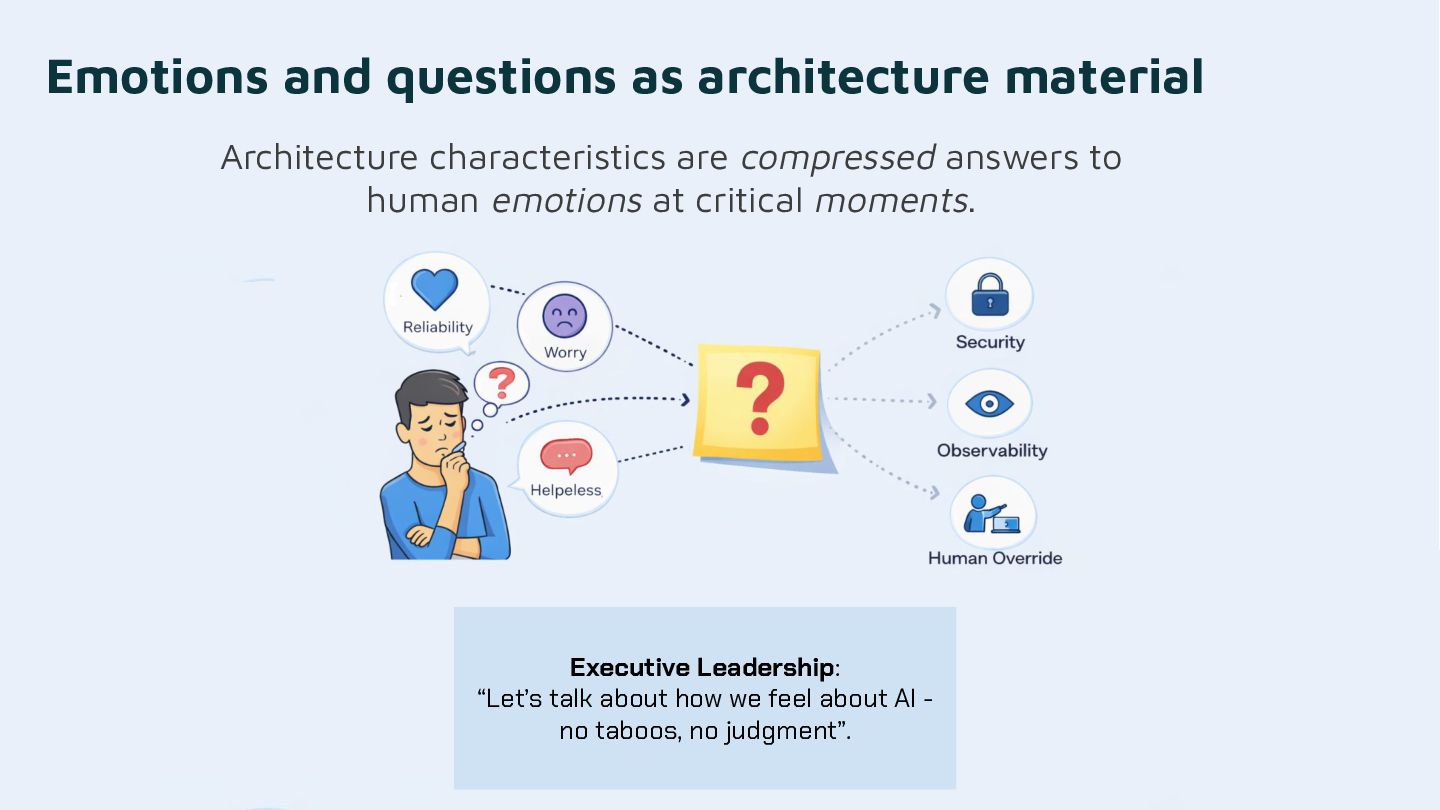
  24. Emotions and questions as architecture material Architecture characteristics are compressed

    answers to human emotions at critical moments. Executive Leadership: “Let’s talk about how we feel about AI - no taboos, no judgment”.
  25. [Systemic focus] Devs need a rich understanding of users Source:

    2025 State of AI Assisted Software Development (DORA report) DORA: AI Capabilities Model
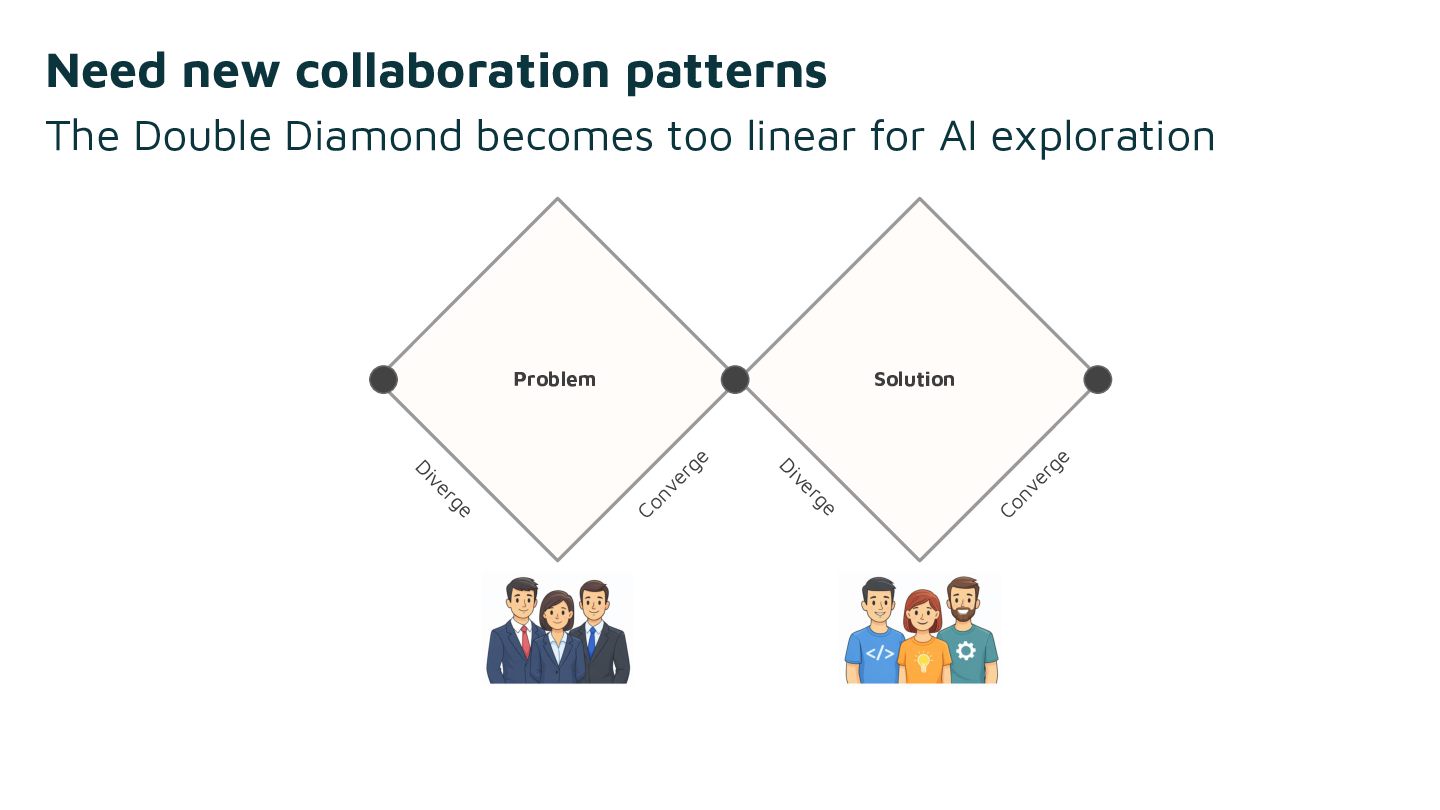
  26. Solution Problem Diverge Diverge Converge Converge Need new collaboration patterns
    The Double Diamond becomes too linear for AI exploration
  27. Deeper convergence and wider divergence How do we grow a

    spec language for non-deterministic LLMs? Solution Problem Diverge Converge Converge Possibility Space Problem Space Solution Space D iverge M ore C onverge M ore Converge
  28. Upfront Architecture Emergent Architecture AI amplifies the need for sociotechnical

    architecture Agile Agility Continuous Comprehension Organizational Intention Organizational Becoming Divergence Rigor Conversation, Collaboration Shared understanding of the important stuff Decouple software, connect people Convergence Rigor Specs, Tests, Ubiquitous Language
  29. Key Points Agile Meets Architecture (AmA) • Complexity forces upfront

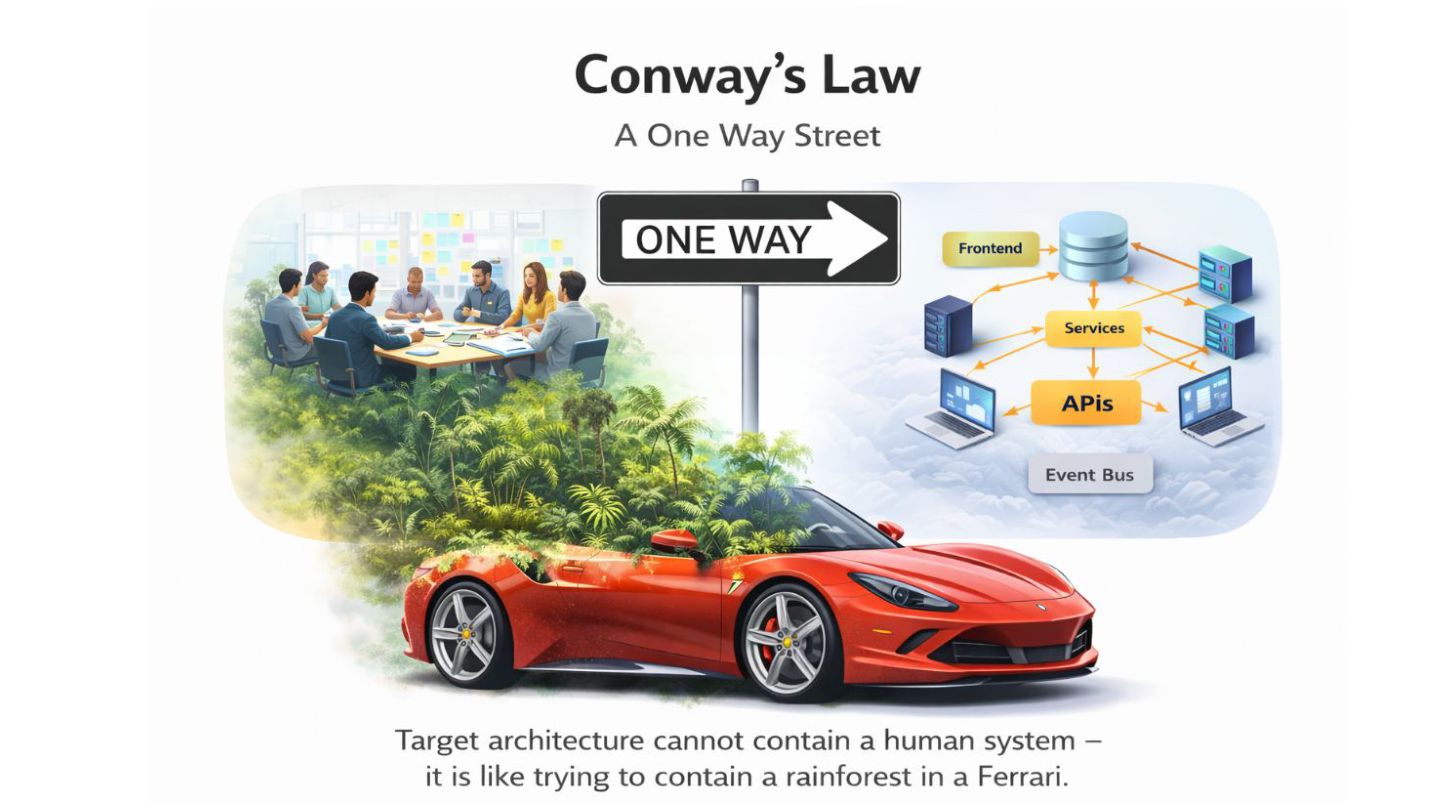
    architecture thinking. • Architecture is not just structure - it’s a social construct. • Architecture is not a natural byproduct of Agile. • We need deliberate emergence. Sociotechnical Architecture (STA) • Conway’s Law is a one-way street. • Technical debt is social debt. • We are the cause, not the effect (autopoiesis). • Architects decouple software, connect people. • Sociotechnical architecture balances intention and becoming. STA in the Age of AI - Continuous Comprehension (CC) • Continuous comprehension (CC) makes or breaks the promise of AI. • Divergence rigor and Convergence rigor. • Keep doing: Domain-Driven Design (DDD), Human-centered Design (HCD). • Start doing: Community Based Design (CBD).
  30. 49 Sociotechnical Architecture Have your Agile and agility too Xin

    Yao @AmA, Berlin 2026 @settling-mud.bsky.social @[email protected] https://www.linkedin.com/in/xinxin Thank you!