Share
Embed
Clean and Useful Android Testing, with Spock, Espresso and UI Automator
Clean up your tests!
Presented at Droidcon Greece on 11th September 2015.

Jon Reeve
September 11, 2015
Transcript
59 slides
-
Clean and Useful Android Testing, with Spock, Espresso and UI
Automator! Jon Reeve, Wasabi Code, @themightyjon -
(Gartner) Hype Cycle Gartner Research's Hype Cycle diagram / Jeremy
Kemp / CC-BY-SA-3.0 -
Testing Enthusiasm Curve Plains of Indifference Peak of Religious Zeal
Trough of Disillusionment Plateau of Productivity ( / Pragmatism) -
• Android testing samples & blueprint https:/ /github.com/googlesamples/android-testing-templates https:/ /github.com/googlesamples/android-testing
• Others https:/ /github.com/AndroidBootstrap/android-bootstrap https:/ /github.com/JakeWharton/u2020 • Many more... Where to Start? Examples... -
• Why? • Challenges • Helpful Architecture • Bad Test
→ Good Tests • Spock Unit Tests -
• Value more obvious to developers → Can suffer under
pressure to do things quickly. • Drive clean code: loose coupling, separation of concerns, etc. • Immediate & clear failure: where and why. Why We Write Unit Tests -
• Can be hard. Has got better: • Real unit
tests vs “Unit Android Tests”, off-device, faster. • Mockable Android JAR. Death to RuntimeException: “Stub!” • But still: • Abstract classes over interfaces • Big classes, combining many concerns • Hidden internals: constants, functions, whole classes. • “final” things Android Unit Testing Challenges -
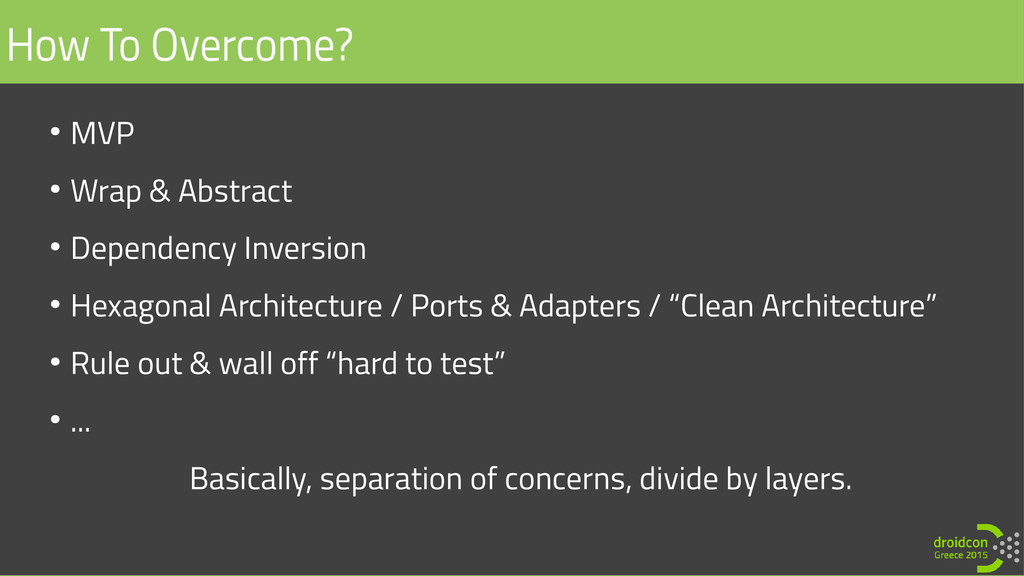
• MVP • Wrap & Abstract • Dependency Inversion •
Hexagonal Architecture / Ports & Adapters / “Clean Architecture” • Rule out & wall off “hard to test” • ... Basically, separation of concerns, divide by layers. How To Overcome? -
• Activity or Fragment is simple, dumb “View”. • Business
logic in Presenter, isolated from platform. Unit testable. • Good examples elsewhere: • Shazam: http:/ /www.infoq.com/presentations/mobile-shazam • Teh Interwebs: http:/ /lmgtfy.com/?q=mvp+android MVP -
• Wrap static function call with Interface + implementation, to
“loosen” coupling. • System.currentTimeMillis() → Clock { long currentTimeMillis() } • Wrap a system class to hide use of Android classes or functions • Bit much? • Mobile device, varying spec (low end devices). • GC, tight loops. • Be aware of context, and use where appropriate. (I ❤ enum) Wrap + Abstract -
• Why? • Challenges • Helpful Architecture • Bad Test
→ Good Tests • Spock Unit Tests -
public void sharedPreferencesHelper_SaveAndReadPersonalInformation() { // Save the personal information to
SharedPreferences boolean success = mMockSharedPreferencesHelper.savePersonalInfo(mSharedPreferenceEntry); assertThat("Checking that SharedPreferenceEntry.save... returns true", success, is(true)); // Read personal information from SharedPreferences SharedPreferenceEntry savedSharedPreferenceEntry = mMockSharedPreferencesHelper.getPersonalInfo(); // Make sure both written and retrieved personal information are equal. assertThat("Checking that SharedPreferenceEntry.name has been persisted and read correctly", mSharedPreferenceEntry.getName(), is(equalTo(savedSharedPreferenceEntry.getName()))); assertThat("Checking that SharedPreferenceEntry.dateOfBirth has been persisted and read " + "correctly", mSharedPreferenceEntry.getDateOfBirth(), is(equalTo(savedSharedPreferenceEntry.getDateOfBirth()))); assertThat("Checking that SharedPreferenceEntry.email has been persisted and read " + "correctly", mSharedPreferenceEntry.getEmail(), is(equalTo(savedSharedPreferenceEntry.getEmail()))); } “Wall of Code” You have to read comments, not code Testing too much at once Failure messages adding noise to test itself -
public boolean savePersonalInfo(SharedPreferenceEntry sharedPreferenceEntry){ // Start a SharedPreferences transaction. SharedPreferences.Editor
editor = mSharedPreferences.edit(); editor.putString(KEY_NAME, sharedPreferenceEntry.getName()); editor.putLong(KEY_DOB, sharedPreferenceEntry.getDateOfBirth().getTimeInMillis()); editor.putString(KEY_EMAIL, sharedPreferenceEntry.getName()); // Commit changes to SharedPreferences. return editor.commit(); } Mistakes... -
# ./gradlew unit:BasicSample:app:testDebug com.example.android.testing.unittesting.BasicSample.SharedPreferencesHelperTest > sharedPreferencesHelper_SavePersonalInformationFailed_ReturnsFalse PASSED com.example.android.testing.unittesting.BasicSample.SharedPreferencesHelperTest > sharedPreferencesHelper_SaveAndReadPersonalInformation
PASSED BUILD SUCCESSFUL Run the Tests! -
If the test fails, and you can't immediately tell why...
The test is bad, unhelpful. If you can mess up the code under test, and the test DOESN'T fail... The test is actively harmful. Unhelpful and Harmful Tests -
private SharedPreferencesHelper createMockSharedPreference() { // Mocking reading the SharedPreferences as
if mMockSharedPreferences was previously written // correctly. when(mMockSharedPreferences.getString(eq(SharedPreferencesHelper.KEY_NAME), anyString())) .thenReturn(mSharedPreferenceEntry.getName()); when(mMockSharedPreferences.getString(eq(SharedPreferencesHelper.KEY_EMAIL), anyString())) .thenReturn(mSharedPreferenceEntry.getEmail()); when(mMockSharedPreferences.getLong(eq(SharedPreferencesHelper.KEY_DOB), anyLong())) .thenReturn(mSharedPreferenceEntry.getDateOfBirth().getTimeInMillis()); // Mocking a successful commit. when(mMockEditor.commit()).thenReturn(true); // Return the MockEditor when requesting it. when(mMockSharedPreferences.edit()).thenReturn(mMockEditor); return new SharedPreferencesHelper(mMockSharedPreferences); } Why Does it Fail? -
@Test public void savesPersonalInformation() { // Given sharedPrefsSaveWillSucceed(); // When
boolean saveSuccess = sharedPreferencesHelper.savePersonalInfo(mSharedPreferenceEntry); // Then verify(mMockEditor).putString(KEY_NAME, mSharedPreferenceEntry.getName()); verify(mMockEditor).putString(KEY_EMAIL, mSharedPreferenceEntry.getEmail()); verify(mMockEditor).putLong(KEY_DOB, mSharedPreferenceEntry.getDateOfBirth().getTimeInMillis()); verify(mMockEditor).commit(); assertThat(saveSuccess, is(true)); } @Test public void readsPersonalInformation() { // Given givenSharedPrefsContains(mSharedPreferenceEntry); // When SharedPreferenceEntry retrievedInfo = sharedPreferencesHelper.getPersonalInfo(); // Then assertThat(retrievedInfo.getName(), is(equalTo(mSharedPreferenceEntry.getName()))); assertThat(retrievedInfo.getDateOfBirth(), is(equalTo(mSharedPreferenceEntry.getDateOfBirth()))); assertThat(retrievedInfo.getEmail(), is(equalTo(mSharedPreferenceEntry.getEmail()))); } Split the Test, Check What Matters -
# ./gradlew unit:BasicSample:app:testDebug com.example.android.testing.unittesting.BasicSample.SharedPreferencesHelperTest > savesPersonalInformation FAILED org.mockito.exceptions.verification.junit.ArgumentsAreDifferent at SharedPreferencesHelperTest.java:94
# ./gradlew unit:BasicSample:app:testDebug --info com.example.android.testing.unittesting.BasicSample.SharedPreferencesHelperTest > savesPersonalInformation FAILED Argument(s) are different! Wanted: mMockEditor.putString( "key_email", "[email protected]" ); -> at com.example.android.testing.unittesting.BasicSample.SharedPreferencesHelperTest.savesPersonalInformation(Sh aredPreferencesHelperTest.java:94) Actual invocation has different arguments: mMockEditor.putString( "key_email", "Test name" ); -> at ... Run the Tests! -
@Test public void savesPersonalInformation() { // Given sharedPrefsSaveWillSucceed(); // When
boolean saveSuccess = sharedPreferencesHelper.savePersonalInfo(mSharedPreferenceEntry); // Then verify(mMockEditor).putString(KEY_NAME, mSharedPreferenceEntry.getName()); verify(mMockEditor).putString(KEY_EMAIL, mSharedPreferenceEntry.getEmail()); verify(mMockEditor).putLong(KEY_DOB, mSharedPreferenceEntry.getDateOfBirth().getTimeInMillis()); verify(mMockEditor).commit(); assertThat(saveSuccess, is(true)); } The Save Test -
@Test public void reportsSuccessSavingPersonalInformation() { // Given sharedPrefsSaveWillSucceed(); // When
boolean saveSuccess = sharedPreferencesHelper.savePersonalInfo(mSharedPreferenceEntry); // Then assertThat(saveSuccess, is(true)); } @Test public void savesPersonalInformation() { // Given sharedPrefsSaveWillSucceed(); // When sharedPreferencesHelper.savePersonalInfo(mSharedPreferenceEntry); // Then verify(mMockEditor).putString(KEY_NAME, mSharedPreferenceEntry.getName()); verify(mMockEditor).putString(KEY_EMAIL, mSharedPreferenceEntry.getEmail()); verify(mMockEditor).putLong(KEY_DOB, mSharedPreferenceEntry.getDateOfBirth().getTimeInMillis()); verify(mMockEditor).commit(); } Split It! -
@Test public void savesName() { // When sharedPreferencesHelper.savePersonalInfo(mSharedPreferenceEntry); // Then
verify(mMockEditor).putString(KEY_NAME, mSharedPreferenceEntry.getName()); verify(mMockEditor).commit(); } @Test public void savesEmail() { // When sharedPreferencesHelper.savePersonalInfo(mSharedPreferenceEntry); // Then verify(mMockEditor).putString(KEY_EMAIL, mSharedPreferenceEntry.getEmail()); verify(mMockEditor).commit(); } @Test public void savesDateOfBirth() { // When sharedPreferencesHelper.savePersonalInfo(mSharedPreferenceEntry); // Then verify(mMockEditor).putLong(KEY_DOB, mSharedPreferenceEntry.getDateOfBirth().getTimeInMillis()); verify(mMockEditor).commit(); } Split... MORE! -
@Test public void savesName() { // When sharedPreferencesHelper.savePersonalInfo(mSharedPreferenceEntry); // Then
verifySavedAndCommitted(KEY_NAME, mSharedPreferenceEntry.getName()); } @Test public void savesEmail() { ... verifySavedAndCommitted(KEY_EMAIL, mSharedPreferenceEntry.getEmail()); } @Test public void savesDateOfBirth() { ... verifySavedAndCommitted(KEY_DOB, mSharedPreferenceEntry.getDateOfBirth().getTimeInMillis()); } private void verifySavedAndCommitted(final String keyName, final String value) { verify(mMockEditor).putString(keyName, value); verify(mMockEditor).commit(); } private void verifySavedAndCommitted(String keyName, long value) { ... } Less Duplication, More Readable -
@Test public void readsPersonalInformation() { // Given givenSharedPrefsContains(mSharedPreferenceEntry); // When
SharedPreferenceEntry retrievedInfo = sharedPreferencesHelper.getPersonalInfo(); // Then assertThat(retrievedInfo.getName(), is(equalTo(mSharedPreferenceEntry.getName()))); assertThat(retrievedInfo.getDateOfBirth(), is(equalTo(mSharedPreferenceEntry.getDateOfBirth()))); assertThat(retrievedInfo.getEmail(), is(equalTo(mSharedPreferenceEntry.getEmail()))); } The Read Test -
@Test public void readsPersonalInformation() { // Given givenSharedPrefsContains(mSharedPreferenceEntry); // When
SharedPreferenceEntry retrievedPersonalInfo = sharedPreferencesHelper.getPersonalInfo(); // Then assertThat(retrievedPersonalInfo, matchesEntry(mSharedPreferenceEntry)); } Single Assertion (Hamcrest Matchers) -
public class SharedPreferenceEntryMatchers { public static Matcher<? super SharedPreferenceEntry> matchesEntry(final
SharedPreferenceEntry entry) { return allOf( matchesNameOf(entry), matchesEmailOf(entry), matchesDateOfBirthOf(entry) ); } private static FeatureMatcher<SharedPreferenceEntry, String> matchesNameOf(final SharedPreferenceEntry entry) { return new FeatureMatcher<SharedPreferenceEntry, String>(equalTo(entry.getName()), "name", "name") { @Override protected String featureValueOf(final SharedPreferenceEntry sharedPreferenceEntry) { return sharedPreferenceEntry.getName(); } }; } ... } Matchers Caveat... -
• Natural, expressive; read many x more than write. •
SNR • Assert / check / test one thing. Matchers can help. • Test boundaries, don't poke internals (package scope included) Should be able to change implementation and tests still pass. Should NOT be able to BREAK implementation and still have tests pass. Recap: Top Testing Tips -
• Code modification >>> creation → save time each time
test fails, is looked at. • Unit tests lowest level → failure must be clear why and where. • Good failures: • test name • message, info given • test one thing Failure -
• Spock Framework • https:/ /github.com/spockframework/spock • http:/ /spockframework.org/ •
No logo yet... • Decent documentation... on Google Code... Going Further... Logically IMAGINE A FANTASTIC LOGO HERE! -
def "subscribers receive published events at least once"() { when:
publisher.send(event) then: (1.._) * subscriber.receive(event) where: event << ["started", "paused", "stopped"] } def "can cope with misbehaving subscribers"() { given: firstSubscriber.receive(_) >> { throw new Exception() } when: publisher.send("event1") publisher.send("event2") then: 1 * latterSubscriber.receive("event1") 1 * latterSubscriber.receive("event2") } Some Examples -
def "reads personal info"() { given: sharedPrefsContains(entry) when: def retrievedEntry
= sharedPreferencesHelper.getPersonalInfo() then: expect retrievedEntry, matchesEntry(entry) } Spock Hamcrest Support -
def "reads personal info"() { given: mockSharedPrefs.has(expectedEntry) // extension method
when: def entry = sharedPreferencesHelper.getPersonalInfo() then: resulting entry matches expectedEntry // resulting(entry).matches(expectedEntry) } Groovy DSL (+ Metaprogramming) Magic -
com.example.android.testing.unittesting.BasicSample.SharedPreferencesHelperSpec > reads personal info FAILED Condition not satisfied: val.email
== expected.email | | | | | | | | | [email protected] | | | com.example.android.testing.unittesting.BasicSample.SharedPreferenceEntry@71ea020a | | false | | 9 differences (62% similarity) | | [email protected](_AN_ERROR) | | [email protected](---------) | [email protected]_AN_ERROR com.example.android.testing.unittesting.BasicSample.SharedPreferenceEntry@1e6abe27 at com.example..SharedPreferencesHelperSpec.resulting_closure2(SharedPreferencesHelperSpec.groovy:122) at com.example..SharedPreferencesHelperSpec.reads personal info(SharedPreferencesHelperSpec.groovy:87) With Amazing Failure Info! -
def "uses spy"() { when: thing.doSomethingWith(collaborator) then: 1 * collaborator.callWeExpect()
} def "uses stub"() { given: stubRandomNumberGenerator.getValue() >> 4 // chosen at random when: def result = thing.doThingWith(stubRandomNumberGenerator) then: result == 42 } Wildcards and ranges: _.receive(event) // receive is called on any mock object 0 * _._ // No more interactions 0 * _ // Same thing 3 * subscriber.receive(event) // exactly 3 times (1.._) * subscriber.receive(event) // at least 1 time (_..2) * subscriber.receive(event) // at most 2 times 0 * _./set.*/(_) // no setter is called on any mock Mocking, Stubbing, Spying -
pickySubscriber.receive(_) >> { Event event -> event.priority > 3 ?
"ok" : "fail" } badSubscriber.receive(_) >> { throw new InternalError("I'm a troublemaker!") } subscriber.receive(_) >>> ["ok", "fail", "ok"] >> { throw new InternalError() } >> "ok" 1 * subscriber.receive(!null) // arg must not be null 1 * subscriber.receive(!unwantedEvent) // arg must not be equal to unwantedEvent 1 * subscriber.receive( { it.priority >= 5 } ) // arg must have priority 5 or above More: https:/ /spockframework.github.io/spock/docs/1.0/interaction_based_testing.html More Fakery, Argument Constraints -
@Unroll def "maximum of #a and #b is #result"() {
expect: Math.max(a, b) == result where: a | b || result 0 | 0 || 0 0 | 9 || 9 -2 | 1 || 3 } ....SharedPreferencesHelperSpec > maximum of -2 and 1 is 3 FAILED Condition not satisfied: Math.max(a, b) == result | | | | | 1 -2 1 | 3 false at com.example..MyClassSpec.maximum of #a and #b is #result(SharedPreferencesHelperSpec.groovy:93) Data Driven Tests -
• Groovy-based • “Kind of Java” • Expressive DSL abilities
(http:/ /docs.groovy-lang.org/docs/latest/html/documentation/core-domain-specific-languages.html) • Freakin' Magic • Built-in expressive mocking • Readable, unrolling, data-driven tests (https:/ /spockframework.github.io/spock/docs/1.0/data_driven_testing.html) Spock Features -
• Similar to unit tests, but wider scope • Test
domain model satisfies business logic • May test interaction of many units. Focused on use cases instead. • Still off-device (fast), isolate domain from platform Domain / “Service” / API Tests -
• Obvious business value, on complete product • Test UI
(shallow) • Test core use cases, main interactions (deep) • Test specific bugs (fix, prevent regressions) • Link to BDD, conversation → spec BUT: • Can end up with too many, taking too long and breaking too often Why We Write UI Tests -
• Speed (lack of) • Synchronisation issues • Unclear failure
causes • Brittleness • Readability UI Test Challenges -
• Avoid Thread.sleep(millis), -> Espresso synch & IdlingResource • Developer
machine: • Genymotion, x86(_64) > ARM • Many emulators & test sharding (e.g. Fork by Shazam) • On CI: • Many devices (also sharding) Fixes – Slow / Synchronisation Issues -
Custom failure handler: BetterFailureHandler failureHandler = new BetterFailureHandler(); Espresso.setFailureHandler(failureHandler); Spoon
screenshot: Spoon.screenshot(activity, sanitise(tag)); UiDevice screenshot: final Instrumentation instrumentation = InstrumentationRegistry.getInstrumentation(); final Context targetContext = InstrumentationRegistry.getTargetContext(); final UiDevice uiDevice = UiDevice.getInstance(instrumentation); final File screenshotFile = new File(testScreenshotsDir, screenshotName); uiDevice.takeScreenshot(screenshotFile); Fixes – Unclear Failure Causes -
• Slow • Synchronisation issues • Unclear failure reason •
Readability • Brittleness • Flakiness / reproducibility UI Test Challenges -
@Test public void changeText() { // Type text and then
press the button. onView(withId(R.id.editTextUserInput)) .perform(typeText(STRING_TO_BE_TYPED), closeSoftKeyboard()); onView(withId(R.id.changeTextBt)).perform(click()); // Check that the text was changed. onView(withId(R.id.textToBeChanged)).check(matches(withText(STRING_TO_BE_TYPED))); } Readability: A Bitter Little Espresso Comments because code isn't readable enough Overly verbose, backward English Could do with a better name -
@Test public void submittingTextChangesTextDisplayed() { type(DUMMY_STRING).into(inputTextField()).then(closeSoftKeyboard()); clickOn(submitButton()); checkThat(displayText(), hasText(STRING_TO_BE_TYPED)); }
Work In Progress, please contribute! https:/ /github.com/jonreeve/espresso-sugar Readability: Adding Some Sugar -
• android-spock • https:/ /github.com/pieces029/android-spock • Runs on device •
Uses Spock, Groovy • Trade-off: • DSL gets better! • Auto-completion gets worse... (at least for now) Readability: Spock, Again! -
@Test public void showsWelcomeOnFirstLogin() { type(USERNAME).into(view(withId(R.id.username_text))); type(PASSWORD).into(view(withId(R.id.password_text))); clickOn(view(withId(R.id.login_button))); checkThat(view(withId(R.id.welcome)), isDisplayed());
} OR... @Test public void showsWelcomeOnFirstLogin() { final MainScreen mainScreen = onLoginScreen().loginAs(FIRST_TIME_USER); checkThat(mainScreen.welcomeMessage(), isDisplayed()) } Readability + Brittleness: Page / Screen Models -
@Test public void showsWelcomeOnFirstLogin() { when(FIRST_TIME_USER).logsIn(); then(welcomeMessage(), isDisplayed()) } Also
see Gwen, by Shazam: https:/ /github.com/shazam/gwen Readability + Brittleness: Actor Models, Other -
"Hermetic" test environment Magical, mystical. Astrology, Alchemy... Completely sealed off
(as if by magic) Identify sources of unpredictability, and Fake them (wrappers, mocking, hexagonal architecture, etc.) Flakiness / Reliability -
No such thing! But... • Is it worth it? •
Is there a better level to test it at? • Is there a better place to introduce a seam and isolate? • Pairing and rubber-ducking helps maintain perspective Untestable? -
• Speed: Espresso, many emulators / devices + sharding (Fork)
• Make tests readable! Page / actor models, DSL, android-spock • Make failures clear, add useful info + screenshots • Flakiness: Define boundaries, fake the unpredictable! • Hard to test? Best way to test? Pairing, rubber-ducking, etc. Recap: UI Testing Tips
 jonreeve
 miu_crescent
 koji_kawamura
 110y
 daitak
 takuyay0ne
 inesmontani
 uhyo
 yama3133
 shotashiratori
 azukiazusa1
 hellosct1
 dynamis
 helenjbeal
 skipperchong
 aleyda
 rocio
 katarinadahlin
 elsirapls
 watany
 mayunak
 keavy
 pauljervisheath