Share
Embed
Multicore OCaml GC
In a mostly functional language like OCaml, it is desirable to have each domain (our unit of parallelism) collect its own local garbage independently. Given that OCaml is commonly used for writing latency sensitive code such as trading systems, UIs, networked unikernels, it is also desirable to minimise the stop-the-world phases in the GC. Although obvious, the difficulty is to make this work in the presence of mutations. In this talk, we will present the overall design of Multicore OCaml GC, but also deep dive into a few of the interesting techniques that make it work.
KC Sivaramakrishnan
June 30, 2017
Transcript
113 slides
-
• Adds native support for concurrency and parallelism in OCaml
Multicore OCaml -
• Adds native support for concurrency and parallelism in OCaml
• Fibers for concurrency, Domains for parallelism ✦ M fibers over N domains ✦ M >>> N Multicore OCaml -
• Adds native support for concurrency and parallelism in OCaml
• Fibers for concurrency, Domains for parallelism ✦ M fibers over N domains ✦ M >>> N • This talk ✦ Overview of multicore GC with a few deep dives. Multicore OCaml -
• Adds native support for concurrency and parallelism in OCaml
• Fibers for concurrency, Domains for parallelism ✦ M fibers over N domains ✦ M >>> N • This talk ✦ Overview of multicore GC with a few deep dives. Multicore OCaml -
Outline • Difficult to appreciate GC choices in isolation •
Begin with a GC for a purely functional language ✦ Gradually add mutations, parallelism and concurrency -
B Purely functional • Stop-the-world mark and sweep • Tri-color
marking ✦ States: White (Unmarked), Grey (Marking), Black (Marked) ✦ Roots = registers + stack stack registers heap A C D E -
B Purely functional • Stop-the-world mark and sweep • Tri-color
marking ✦ States: White (Unmarked), Grey (Marking), Black (Marked) ✦ Roots = registers + stack • White —> Grey (mark stack) —> Black stack registers heap A C B D E B A mark stack -
B Purely functional • Stop-the-world mark and sweep • Tri-color
marking ✦ States: White (Unmarked), Grey (Marking), Black (Marked) ✦ Roots = registers + stack • White —> Grey (mark stack) —> Black • Mark stack is empty => done ✦ White object = garbage stack registers heap A C B D E A mark stack B D -
B Purely functional stack registers heap A C B D
E A mark stack B D -
B Purely functional • Pros ✦ Simple ✦ Can perform
the GC incrementally ✤ …|—mutator—|—mark—|—mutator—|—mark—|—mutator—|—sweep—|… stack registers heap A C B D E A mark stack B D -
B Purely functional • Pros ✦ Simple ✦ Can perform
the GC incrementally ✤ …|—mutator—|—mark—|—mutator—|—mark—|—mutator—|—sweep—|… • Cons ✦ Need to maintain free-list of objects => allocations overheads + fragmentation stack registers heap A C B D E A mark stack B D -
Generational GC • Generational Hypothesis ✦ Young objects are much
more likely to die than old objects -
Generational GC • Generational Hypothesis ✦ Young objects are much
more likely to die than old objects minor heap major heap stack registers -
Generational GC • Generational Hypothesis ✦ Young objects are much
more likely to die than old objects minor heap major heap stack registers frontier -
Generational GC • Generational Hypothesis ✦ Young objects are much
more likely to die than old objects minor heap major heap stack registers frontier • Minor heap collected by copying collection ✦ Survivors promoted to major heap -
Generational GC • Generational Hypothesis ✦ Young objects are much
more likely to die than old objects minor heap major heap stack registers frontier • Minor heap collected by copying collection ✦ Survivors promoted to major heap • Roots are registers and stack ✦ purely functional => no pointers from major to minor -
Mutations — Minor GC • Old objects might point to
young objects minor heap major heap -
Mutations — Minor GC • Old objects might point to
young objects • Must know those pointers for minor GC ✦ (Naively) scan the major GC for such pointers minor heap major heap -
Mutations — Minor GC • Old objects might point to
young objects • Must know those pointers for minor GC ✦ (Naively) scan the major GC for such pointers • Intercept mutations with write barrier (* Before r := x *) let write_barrier (r, x) = if is_major r && is_minor x then remembered_set.add r minor heap major heap -
Mutations — Minor GC • Old objects might point to
young objects • Must know those pointers for minor GC ✦ (Naively) scan the major GC for such pointers • Intercept mutations with write barrier (* Before r := x *) let write_barrier (r, x) = if is_major r && is_minor x then remembered_set.add r • Remembered set ✦ Set of major heap addresses that point to minor heap ✦ Used as root for minor collection ✦ Cleared after minor collection. minor heap major heap -
Mutations — Major GC • Mutations are problematic if both
conditions hold 1. Exists Black —> White 2. All Grey —> White* —> White paths are deleted A C A -
Mutations — Major GC • Mutations are problematic if both
conditions hold 1. Exists Black —> White 2. All Grey —> White* —> White paths are deleted A C A • Insertion/Dijkstra/Incremental barrier prevents 1 -
B Mutations — Major GC • Mutations are problematic if
both conditions hold 1. Exists Black —> White 2. All Grey —> White* —> White paths are deleted A C A • Insertion/Dijkstra/Incremental barrier prevents 1 A C -
B Mutations — Major GC • Mutations are problematic if
both conditions hold 1. Exists Black —> White 2. All Grey —> White* —> White paths are deleted A C A • Insertion/Dijkstra/Incremental barrier prevents 1 A C -
B B Mutations — Major GC • Mutations are problematic
if both conditions hold 1. Exists Black —> White 2. All Grey —> White* —> White paths are deleted A C A • Insertion/Dijkstra/Incremental barrier prevents 1 A C -
B B Mutations — Major GC • Mutations are problematic
if both conditions hold 1. Exists Black —> White 2. All Grey —> White* —> White paths are deleted A C A • Insertion/Dijkstra/Incremental barrier prevents 1 A C • Deletion/Yuasa/snapshot-at-beginning prevents 2 -
B B Mutations — Major GC • Mutations are problematic
if both conditions hold 1. Exists Black —> White 2. All Grey —> White* —> White paths are deleted A C A • Insertion/Dijkstra/Incremental barrier prevents 1 A C B C A • Deletion/Yuasa/snapshot-at-beginning prevents 2 -
B B Mutations — Major GC • Mutations are problematic
if both conditions hold 1. Exists Black —> White 2. All Grey —> White* —> White paths are deleted A C A • Insertion/Dijkstra/Incremental barrier prevents 1 A C B C A • Deletion/Yuasa/snapshot-at-beginning prevents 2 -
B B Mutations — Major GC • Mutations are problematic
if both conditions hold 1. Exists Black —> White 2. All Grey —> White* —> White paths are deleted A C A • Insertion/Dijkstra/Incremental barrier prevents 1 A C B C A B • Deletion/Yuasa/snapshot-at-beginning prevents 2 -
B B Mutations — Major GC • Mutations are problematic
if both conditions hold 1. Exists Black —> White 2. All Grey —> White* —> White paths are deleted A C A • Insertion/Dijkstra/Incremental barrier prevents 1 A C B C A B • Deletion/Yuasa/snapshot-at-beginning prevents 2 (* Before r := x *) let write_barrier (r, x) = if is_major r && is_minor x then remembered_set.add r else if is_major r && is_major x then mark(!r) -
Parallelism — Minor GC • Domain.spawn : (unit -> unit)
-> unit • Collect each domain’s young garbage independently? -
Parallelism — Minor GC • Domain.spawn : (unit -> unit)
-> unit • Collect each domain’s young garbage independently? major heap domain n minor heap(s) domain 0 … -
Parallelism — Minor GC • Domain.spawn : (unit -> unit)
-> unit • Collect each domain’s young garbage independently? • Invariant: Minor heap objects are only accessed by owning domain major heap domain n minor heap(s) domain 0 … -
Parallelism — Minor GC • Domain.spawn : (unit -> unit)
-> unit • Collect each domain’s young garbage independently? • Invariant: Minor heap objects are only accessed by owning domain • Doligez-Leroy POPL’93 ✦ No pointers between minor heaps ✦ No pointers from major to minor heaps major heap domain n minor heap(s) domain 0 … -
Parallelism — Minor GC • Domain.spawn : (unit -> unit)
-> unit • Collect each domain’s young garbage independently? • Invariant: Minor heap objects are only accessed by owning domain • Doligez-Leroy POPL’93 ✦ No pointers between minor heaps ✦ No pointers from major to minor heaps • Before r := x, if is_major(r) && is_minor(x), then promote(x). major heap domain n minor heap(s) domain 0 … -
Parallelism — Minor GC • Domain.spawn : (unit -> unit)
-> unit • Collect each domain’s young garbage independently? • Invariant: Minor heap objects are only accessed by owning domain • Doligez-Leroy POPL’93 ✦ No pointers between minor heaps ✦ No pointers from major to minor heaps • Before r := x, if is_major(r) && is_minor(x), then promote(x). • Too much promotion. Ex: work-stealing queue major heap domain n minor heap(s) domain 0 … -
Parallelism — Minor GC major heap domain n minor heap(s)
• Weaker invariant ✦ No pointers between minor heaps ✦ Objects in foreign minor heap are not accessed directly domain 0 … -
Parallelism — Minor GC major heap domain n minor heap(s)
• Weaker invariant ✦ No pointers between minor heaps ✦ Objects in foreign minor heap are not accessed directly • Read barrier. If the value loaded is ✦ integers, object in shared heap or own minor heap => continue ✦ object in foreign minor heap => Read fault (Interrupt + promote) domain 0 … -
Efficient read barrier check • Given x, is x an
integer1 or in shared heap2 or own minor heap3 -
Efficient read barrier check • Given x, is x an
integer1 or in shared heap2 or own minor heap3 • Careful VM mapping + bit-twiddling -
Efficient read barrier check • Given x, is x an
integer1 or in shared heap2 or own minor heap3 • Careful VM mapping + bit-twiddling • Example: 16-bit address space, 0xPQRS ✦ Minor area 0x4200 — 0x42ff ✦ Domain 0 : 0x4220 — 0x422f ✦ Domain 1 : 0x4250 — 0x425f ✦ Domain 2 : 0x42a0 — 0x42af 0x4200 0x42ff 0 1 2 0x4220 0x422f 0x4250 0x425f 0x42a0 0x42af -
Efficient read barrier check • Given x, is x an
integer1 or in shared heap2 or own minor heap3 • Careful VM mapping + bit-twiddling • Example: 16-bit address space, 0xPQRS ✦ Minor area 0x4200 — 0x42ff ✦ Domain 0 : 0x4220 — 0x422f ✦ Domain 1 : 0x4250 — 0x425f ✦ Domain 2 : 0x42a0 — 0x42af • Integer low_bit(S) = 0x1, Minor PQ = 0x42, R determines domain 0x4200 0x42ff 0 1 2 0x4220 0x422f 0x4250 0x425f 0x42a0 0x42af -
Efficient read barrier check • Given x, is x an
integer1 or in shared heap2 or own minor heap3 • Careful VM mapping + bit-twiddling • Example: 16-bit address space, 0xPQRS ✦ Minor area 0x4200 — 0x42ff ✦ Domain 0 : 0x4220 — 0x422f ✦ Domain 1 : 0x4250 — 0x425f ✦ Domain 2 : 0x42a0 — 0x42af • Integer low_bit(S) = 0x1, Minor PQ = 0x42, R determines domain • Compare with y, where y lies within domain => allocation pointer! ✦ On amd64, allocation pointer is in r15 register 0x4200 0x42ff 0 1 2 0x4220 0x422f 0x4250 0x425f 0x42a0 0x42af -
Efficient read barrier check # %rax holds x (value of
interest) xor %r15, %rax sub 0x0010, %rax test 0xff01, %rax # Any bit set => ZF not set => not foreign minor -
Efficient read barrier check # %rax holds x (value of
interest) xor %r15, %rax sub 0x0010, %rax test 0xff01, %rax # Any bit set => ZF not set => not foreign minor # low_bit(%rax) = 1 xor %r15, %rax # low_bit(%rax) = 1 sub 0x0010, %rax # low_bit(%rax) = 1 test 0xff01, %rax # ZF not set Integer -
Efficient read barrier check # %rax holds x (value of
interest) xor %r15, %rax sub 0x0010, %rax test 0xff01, %rax # Any bit set => ZF not set => not foreign minor # low_bit(%rax) = 1 xor %r15, %rax # low_bit(%rax) = 1 sub 0x0010, %rax # low_bit(%rax) = 1 test 0xff01, %rax # ZF not set # PQ(%r15) != PQ(%rax) xor %r15, %rax # PQ(%rax) is non-zero sub 0x0010, %rax # PQ(%rax) is non-zero test 0xff01, %rax # ZF not set Integer Shared heap -
Efficient read barrier check # %rax holds x (value of
interest) xor %r15, %rax sub 0x0010, %rax test 0xff01, %rax # Any bit set => ZF not set => not foreign minor -
Efficient read barrier check # %rax holds x (value of
interest) xor %r15, %rax sub 0x0010, %rax test 0xff01, %rax # Any bit set => ZF not set => not foreign minor # PQR(%r15) = PQR(%rax) xor %r15, %rax # PQR(%rax) is zero sub 0x0010, %rax # PQ(%rax) is non-zero test 0xff01, %rax # ZF not set Own minor heap -
Efficient read barrier check # %rax holds x (value of
interest) xor %r15, %rax sub 0x0010, %rax test 0xff01, %rax # Any bit set => ZF not set => not foreign minor # PQR(%r15) = PQR(%rax) xor %r15, %rax # PQR(%rax) is zero sub 0x0010, %rax # PQ(%rax) is non-zero test 0xff01, %rax # ZF not set Own minor heap # PQ(%r15) = PQ(%rax) # S(%r15) = S(%rax) = 0 # R(%r15) != R(%rax) xor %r15, %rax # R(%rax) is non-zero, rest 0 sub 0x0010, %rax # rest 0 test 0xff01, %rax # ZF set Foreign minor heap -
• How do you promote objects to the major heap
on read fault? Promotion -
• How do you promote objects to the major heap
on read fault? • Several alternatives 1. Copy the object to major heap. ✤ Mutable objects, Abstract_tag, … 2. Move the object closure + minor GC. ✤ False promotions, latency, … 3. Move the object closure + scan the minor GC ✤ Need to examine all objects on minor GC Promotion -
• How do you promote objects to the major heap
on read fault? • Several alternatives 1. Copy the object to major heap. ✤ Mutable objects, Abstract_tag, … 2. Move the object closure + minor GC. ✤ False promotions, latency, … 3. Move the object closure + scan the minor GC ✤ Need to examine all objects on minor GC • Hypothesis: most objects promoted on read faults are young. ✦ 95% promoted objects among the youngest 5% Promotion -
• How do you promote objects to the major heap
on read fault? • Several alternatives 1. Copy the object to major heap. ✤ Mutable objects, Abstract_tag, … 2. Move the object closure + minor GC. ✤ False promotions, latency, … 3. Move the object closure + scan the minor GC ✤ Need to examine all objects on minor GC • Hypothesis: most objects promoted on read faults are young. ✦ 95% promoted objects among the youngest 5% • Combine 2 & 3 Promotion -
• If promoted object among youngest x%, ✦ move +
fix pointers to promoted object ❖ Scan roots = registers + current stack + remembered set ❖ Younger minor objects ❖ Older minor objects referring to younger objects (mutations!) Promotion -
• If promoted object among youngest x%, ✦ move +
fix pointers to promoted object ❖ Scan roots = registers + current stack + remembered set ❖ Younger minor objects ❖ Older minor objects referring to younger objects (mutations!) Promotion (* r := x *) let write_barrier (r, x) = if is_major r && is_minor x then remembered_set.add r else if is_major r && is_major x then mark(!r) else if is_minor r && is_minor x && addr r > addr x then promotion_set.add r -
• If promoted object among youngest x%, ✦ move +
fix pointers to promoted object ❖ Scan roots = registers + current stack + remembered set ❖ Younger minor objects ❖ Older minor objects referring to younger objects (mutations!) • Otherwise, move + minor GC Promotion (* r := x *) let write_barrier (r, x) = if is_major r && is_minor x then remembered_set.add r else if is_major r && is_major x then mark(!r) else if is_minor r && is_minor x && addr r > addr x then promotion_set.add r -
Parallelism — Major GC • OCaml’s GC is incremental, needs
to be concurrent w/ parallelism -
Parallelism — Major GC • OCaml’s GC is incremental, needs
to be concurrent w/ parallelism • Design based on VCGC from Inferno project (ISMM’98) -
Parallelism — Major GC • OCaml’s GC is incremental, needs
to be concurrent w/ parallelism • Design based on VCGC from Inferno project (ISMM’98) ✦ Allows mutator, marker, sweeper threads to concurrently -
Parallelism — Major GC • OCaml’s GC is incremental, needs
to be concurrent w/ parallelism • Design based on VCGC from Inferno project (ISMM’98) ✦ Allows mutator, marker, sweeper threads to concurrently • Multicore OCaml is MCGC -
Parallelism — Major GC • OCaml’s GC is incremental, needs
to be concurrent w/ parallelism • Design based on VCGC from Inferno project (ISMM’98) ✦ Allows mutator, marker, sweeper threads to concurrently • Multicore OCaml is MCGC ✦ States Garbage Free Unmarked Marked -
Parallelism — Major GC • OCaml’s GC is incremental, needs
to be concurrent w/ parallelism • Design based on VCGC from Inferno project (ISMM’98) ✦ Allows mutator, marker, sweeper threads to concurrently • Multicore OCaml is MCGC ✦ States ✦ Domains alternate between mutator and gc thread Garbage Free Unmarked Marked -
Parallelism — Major GC • OCaml’s GC is incremental, needs
to be concurrent w/ parallelism • Design based on VCGC from Inferno project (ISMM’98) ✦ Allows mutator, marker, sweeper threads to concurrently • Multicore OCaml is MCGC ✦ States ✦ Domains alternate between mutator and gc thread ✦ GC thread Garbage Free Unmarked Marked Garbage Free Unmarked Marked -
Parallelism — Major GC • OCaml’s GC is incremental, needs
to be concurrent w/ parallelism • Design based on VCGC from Inferno project (ISMM’98) ✦ Allows mutator, marker, sweeper threads to concurrently • Multicore OCaml is MCGC ✦ States ✦ Domains alternate between mutator and gc thread ✦ GC thread ✦ Marking is racy but idempotent Garbage Free Unmarked Marked Garbage Free Unmarked Marked -
Parallelism — Major GC • OCaml’s GC is incremental, needs
to be concurrent w/ parallelism • Design based on VCGC from Inferno project (ISMM’98) ✦ Allows mutator, marker, sweeper threads to concurrently • Multicore OCaml is MCGC ✦ States ✦ Domains alternate between mutator and gc thread ✦ GC thread ✦ Marking is racy but idempotent • Stop-the-world Garbage Free Unmarked Marked Garbage Free Unmarked Marked -
Parallelism — Major GC • OCaml’s GC is incremental, needs
to be concurrent w/ parallelism • Design based on VCGC from Inferno project (ISMM’98) ✦ Allows mutator, marker, sweeper threads to concurrently • Multicore OCaml is MCGC ✦ States ✦ Domains alternate between mutator and gc thread ✦ GC thread ✦ Marking is racy but idempotent • Stop-the-world Garbage Free Unmarked Marked Garbage Free Unmarked Marked Garbage Free Unmarked Marked Garbage Free Unmarked Marked -
• Fibers = stack segment on heap Concurrency — Minor
GC minor heap (domain x) major heap current stack registers y x remembered fiber set remembered set -
• Fibers = stack segment on heap Concurrency — Minor
GC minor heap (domain x) major heap current stack registers y x remembered fiber set remembered set • Remembered fiber set ✦ Set of fibers in major heap that were ran in the current cycle of domain x ✦ Cleared after minor GC -
• Fibers transitively reachable are not promoted automatically ✦ Avoids
false promotions Concurrency — Promotions minor heap (domain 0) major heap r x f z -
Concurrency — Promotions minor heap (domain 0) major heap r
x f remembered set z -
• Fibers transitively reachable are not promoted automatically ✦ Avoids
false promotions Concurrency — Promotions minor heap (domain 0) major heap r x f remembered set z -
• Fibers transitively reachable are not promoted automatically ✦ Avoids
false promotions ✦ Promote on continuing foreign fiber Concurrency — Promotions minor heap (domain 0) major heap r x f remembered set continue f v @ domain 1 z -
• Fibers transitively reachable are not promoted automatically ✦ Avoids
false promotions ✦ Promote on continuing foreign fiber Concurrency — Promotions minor heap (domain 0) major heap r x f remembered set continue f v @ domain 1 z -
• Recall, promotion fast path = move + scan and
forward ✦ Do not scan remembered fiber set ✤ Context switches <<< promotions Concurrency — Promotions -
• Recall, promotion fast path = move + scan and
forward ✦ Do not scan remembered fiber set ✤ Context switches <<< promotions • Scan lazily before context switch ✦ Only once per fiber per promotion Concurrency — Promotions -
• (Multicore) OCaml uses deletion barrier • Fiber stack pop
is a deletion ✦ Before switching to unmarked fiber, complete marking fiber Concurrency — Major GC -
• (Multicore) OCaml uses deletion barrier • Fiber stack pop
is a deletion ✦ Before switching to unmarked fiber, complete marking fiber • Marking is racy but idempotent ✦ Race between mutator (context switch) and gc (marking) unsafe Concurrency — Major GC -
• (Multicore) OCaml uses deletion barrier • Fiber stack pop
is a deletion ✦ Before switching to unmarked fiber, complete marking fiber • Marking is racy but idempotent ✦ Race between mutator (context switch) and gc (marking) unsafe Concurrency — Major GC Unmarked Marked Marking Fibers -
Summary • Multicore OCaml GC ✦ Optimize for latency ✦
Independent minor GCs + mostly-concurrent mark-and-sweep Mutations Concurrency Parallelism Minor GC rem set rem fiber set local heaps Promotions o2y rem set lazy scanning read faults Major GC deletion barrier mark & switch MCGC -
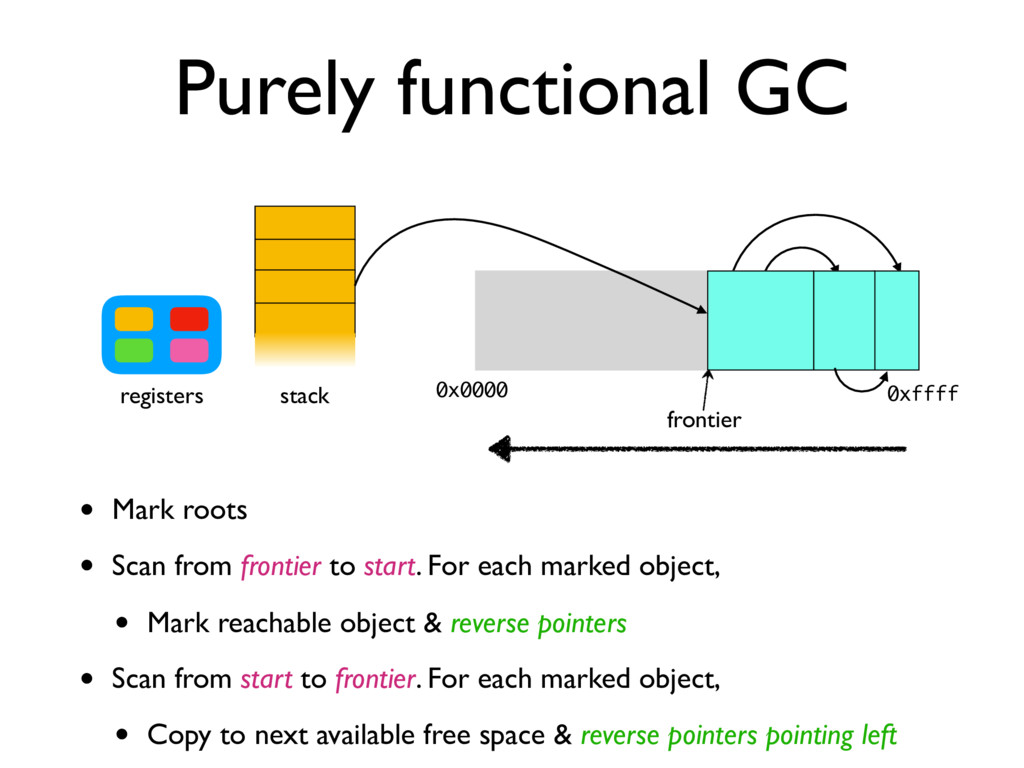
Purely functional GC stack registers heap 0x0000 0xffff frontier •
Stop-the-world mark and sweep -
Purely functional GC stack registers heap 0x0000 0xffff frontier •
Stop-the-world mark and sweep • 2-pass mark compact ✦ Fast allocations by bumping the frontier -
Purely functional GC stack registers heap 0x0000 0xffff frontier •
Stop-the-world mark and sweep • 2-pass mark compact ✦ Fast allocations by bumping the frontier • All heap pointers go right -
Purely functional GC stack registers heap 0x0000 0xffff frontier •
Mark roots • Scan from frontier to start. For each marked object, • Mark reachable object & reverse pointers -
Purely functional GC stack registers 0x0000 0xffff frontier • Mark
roots • Scan from frontier to start. For each marked object, • Mark reachable object & reverse pointers • Scan from start to frontier. For each marked object, • Copy to next available free space & reverse pointers pointing left -
Purely functional GC stack registers 0x0000 0xffff frontier • Pros
✦ Simple & fast allocation ✦ Efficient use of space -
Purely functional GC stack registers 0x0000 0xffff frontier • Pros
✦ Simple & fast allocation ✦ Efficient use of space • Cons ✦ Need to touch all the objects on the heap ✦ Compaction as default is leads to long pause times