State of Multicore OCaml
Sponsored
·
 Your Podcast. Everywhere. Effortlessly.
Share. Educate. Inspire. Entertain. You do you. We'll handle the rest.
→
Your Podcast. Everywhere. Effortlessly.
Share. Educate. Inspire. Entertain. You do you. We'll handle the rest.
→

Share
Embed
State of Multicore OCaml
Status of Multicore OCaml project and future directions.

KC Sivaramakrishnan
June 26, 2018
Transcript
62 slides
-
Outline • Overview of the multicore OCaml project • Multicore
OCaml runtime design • Future directions -
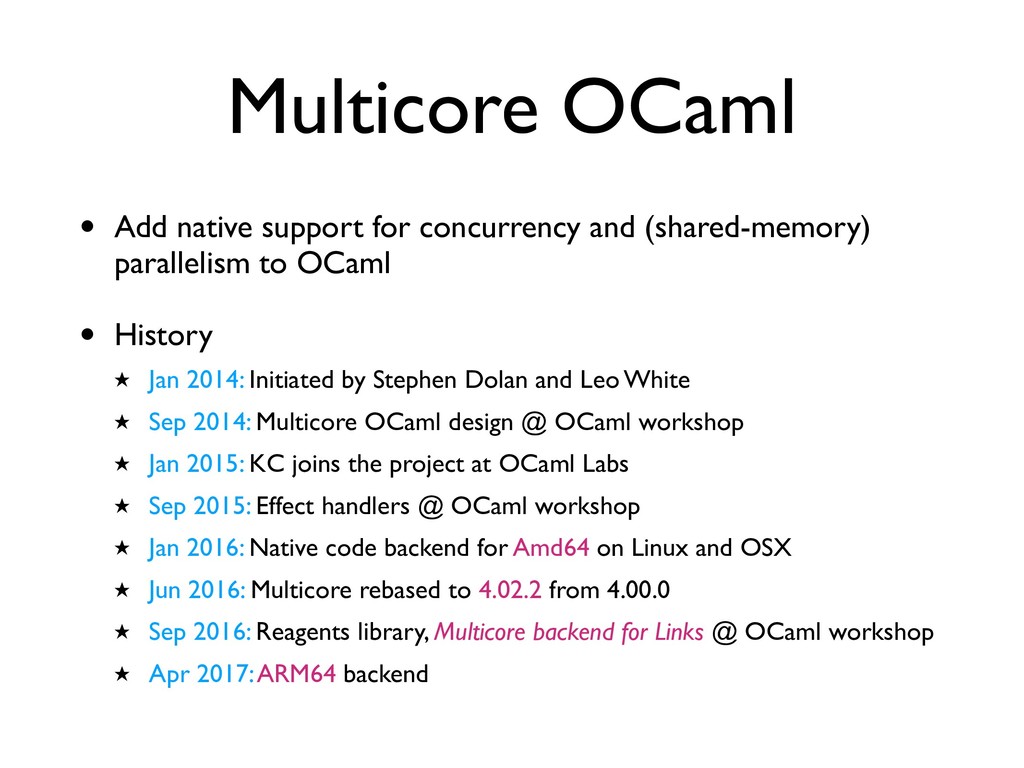
Multicore OCaml • Add native support for concurrency and (shared-memory)
parallelism to OCaml -
Multicore OCaml • Add native support for concurrency and (shared-memory)
parallelism to OCaml • History ★ Jan 2014: Initiated by Stephen Dolan and Leo White ★ Sep 2014: Multicore OCaml design @ OCaml workshop ★ Jan 2015: KC joins the project at OCaml Labs ★ Sep 2015: Effect handlers @ OCaml workshop ★ Jan 2016: Native code backend for Amd64 on Linux and OSX ★ Jun 2016: Multicore rebased to 4.02.2 from 4.00.0 ★ Sep 2016: Reagents library, Multicore backend for Links @ OCaml workshop ★ Apr 2017: ARM64 backend -
Multicore OCaml • History continued… ★ Jun 2017: Handlers for
Concurrent System Programming @ TFP ★ Sep 2017: Memory model proposal @ OCaml workshop ★ Sep 2017: CPS translation for handlers @ FSCD ★ Apr 2018: Multicore rebased to 4.06.1 (will track releases going forward) ★ Jun 2018: Memory model @ PLDI -
Multicore OCaml • History continued… ★ Jun 2017: Handlers for
Concurrent System Programming @ TFP ★ Sep 2017: Memory model proposal @ OCaml workshop ★ Sep 2017: CPS translation for handlers @ FSCD ★ Apr 2018: Multicore rebased to 4.06.1 (will track releases going forward) ★ Jun 2018: Memory model @ PLDI • Looking forward… ★ Q3’18 — Q4’18: Implement missing features, upstream prerequisites to trunk ★ Q1’19 — Q2’19: Submit feature-based PRs to upstream -
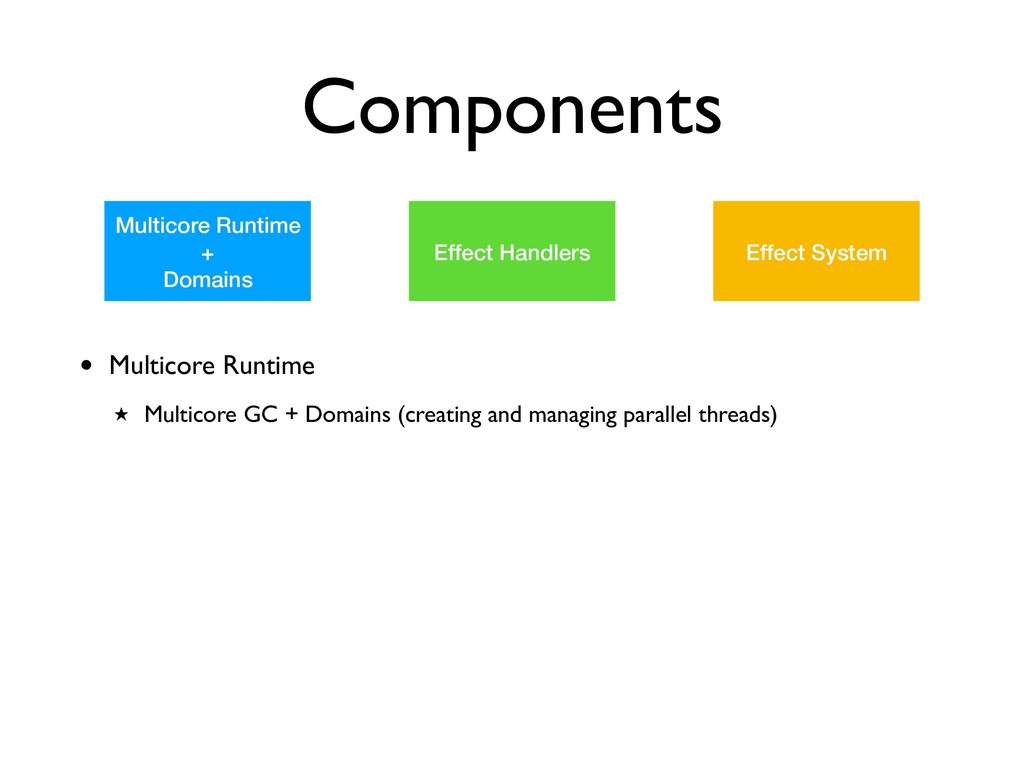
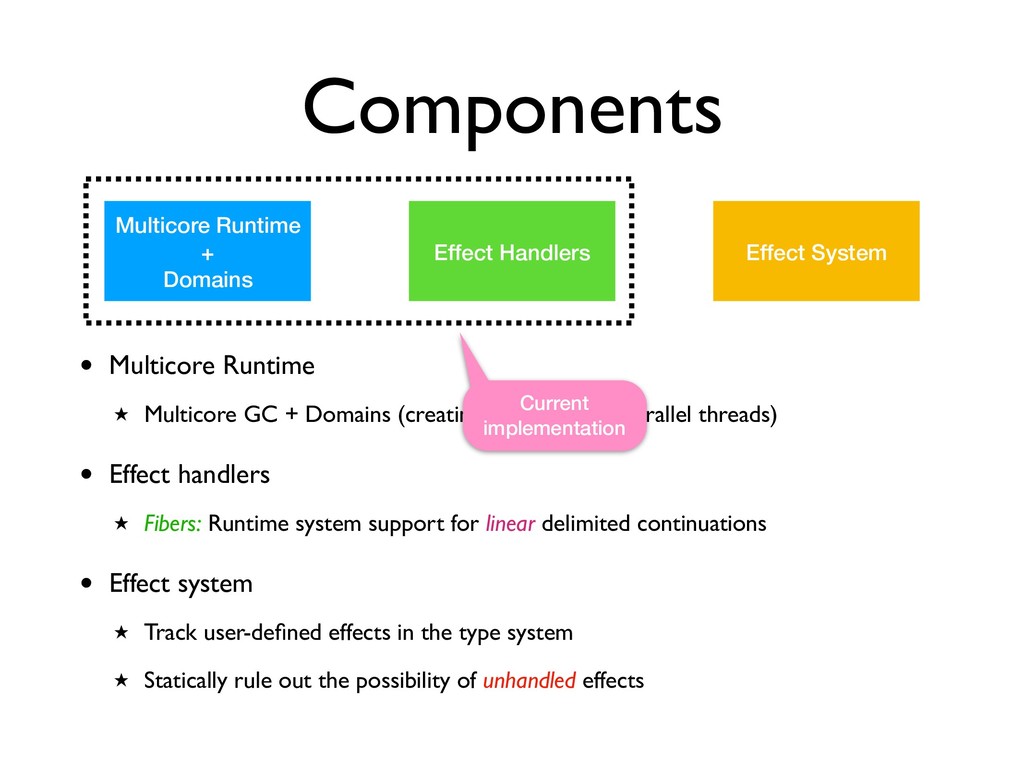
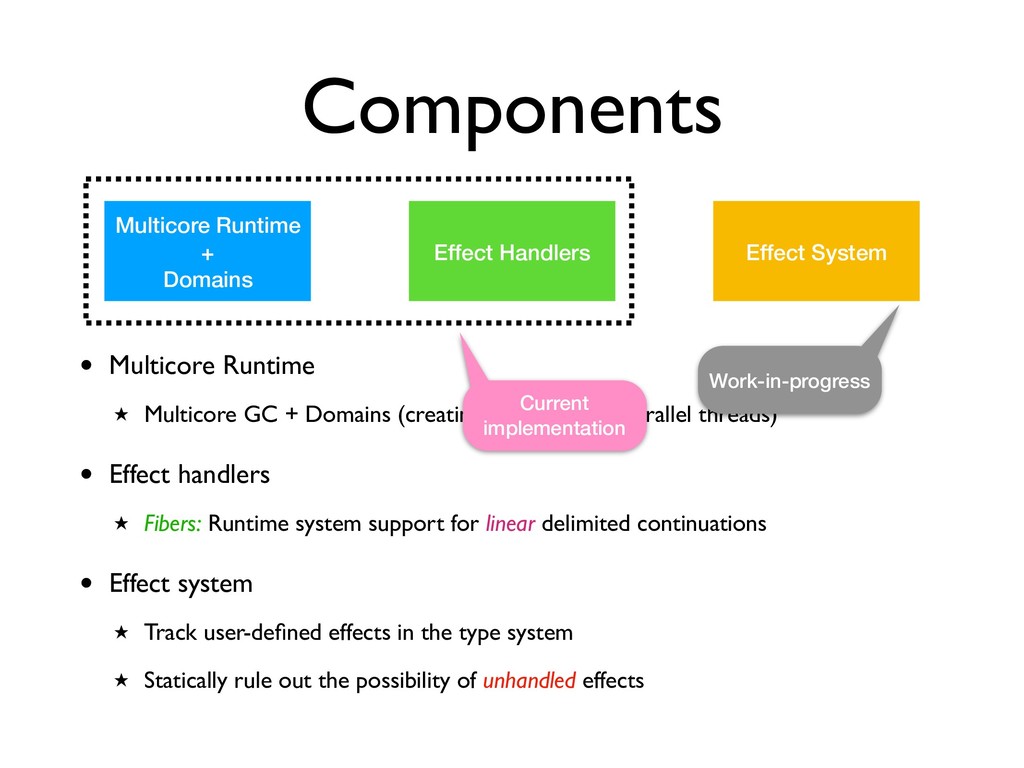
Components Multicore Runtime + Domains Effect Handlers Effect System •
Multicore Runtime ★ Multicore GC + Domains (creating and managing parallel threads) -
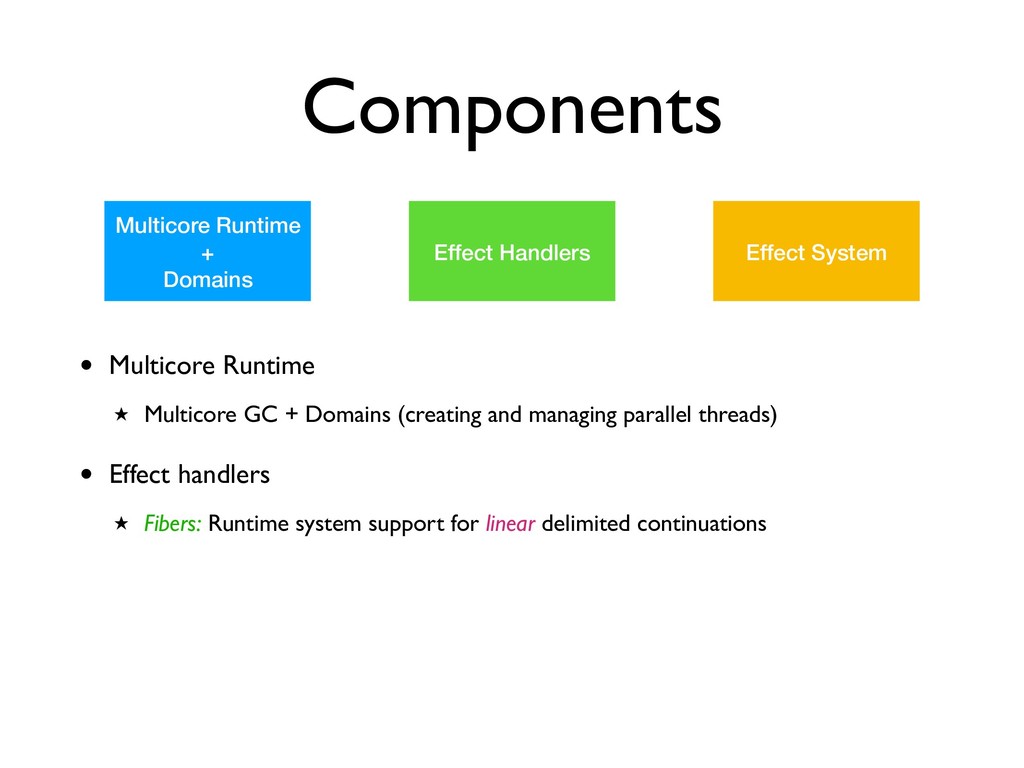
Components Multicore Runtime + Domains Effect Handlers Effect System •
Multicore Runtime ★ Multicore GC + Domains (creating and managing parallel threads) • Effect handlers ★ Fibers: Runtime system support for linear delimited continuations -
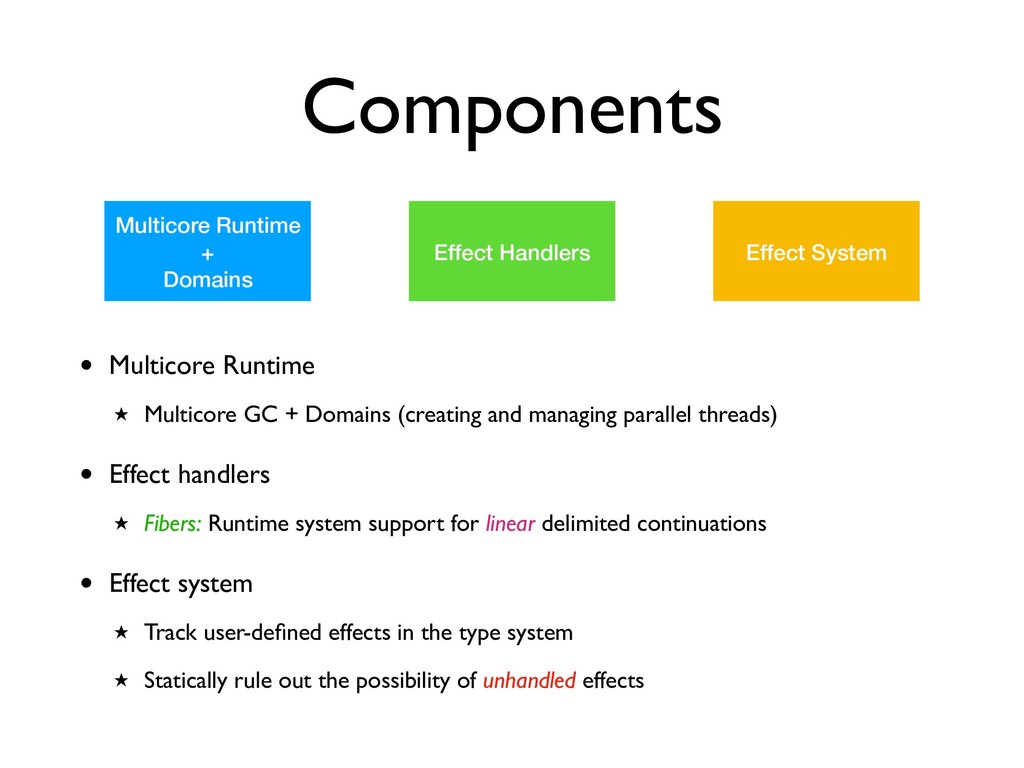
Components Multicore Runtime + Domains Effect Handlers Effect System •
Multicore Runtime ★ Multicore GC + Domains (creating and managing parallel threads) • Effect handlers ★ Fibers: Runtime system support for linear delimited continuations • Effect system ★ Track user-defined effects in the type system ★ Statically rule out the possibility of unhandled effects -
Components Multicore Runtime + Domains Effect Handlers Effect System •
Multicore Runtime ★ Multicore GC + Domains (creating and managing parallel threads) • Effect handlers ★ Fibers: Runtime system support for linear delimited continuations • Effect system ★ Track user-defined effects in the type system ★ Statically rule out the possibility of unhandled effects Current implementation -
Components Multicore Runtime + Domains Effect Handlers Effect System •
Multicore Runtime ★ Multicore GC + Domains (creating and managing parallel threads) • Effect handlers ★ Fibers: Runtime system support for linear delimited continuations • Effect system ★ Track user-defined effects in the type system ★ Statically rule out the possibility of unhandled effects Current implementation Work-in-progress -
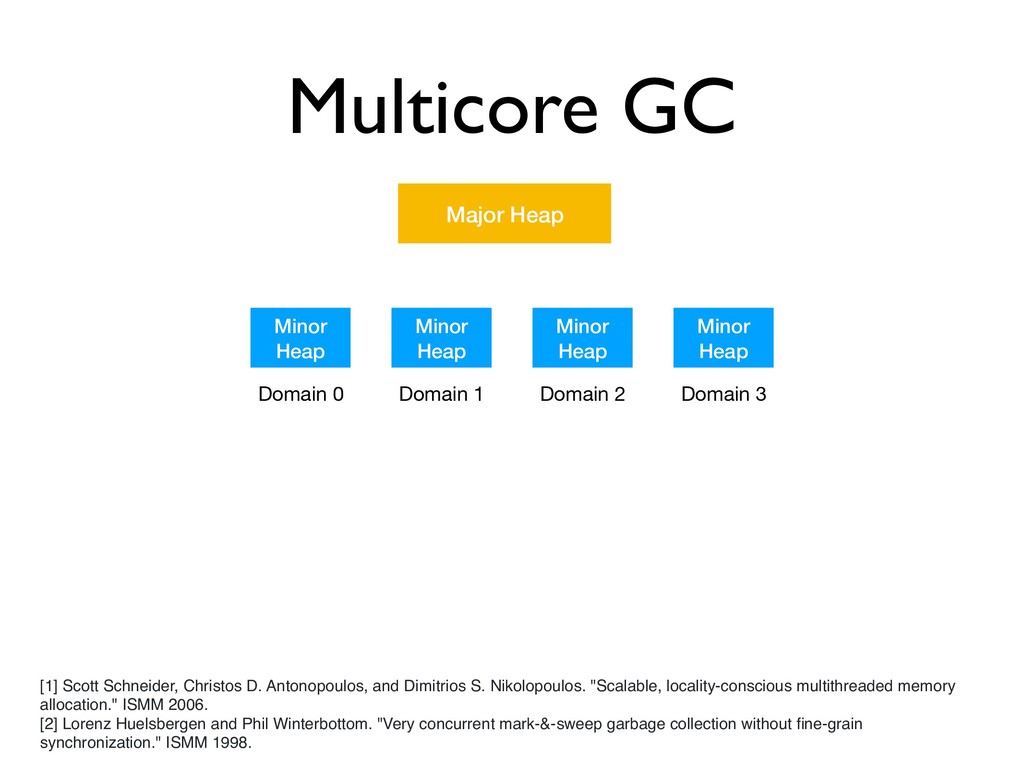
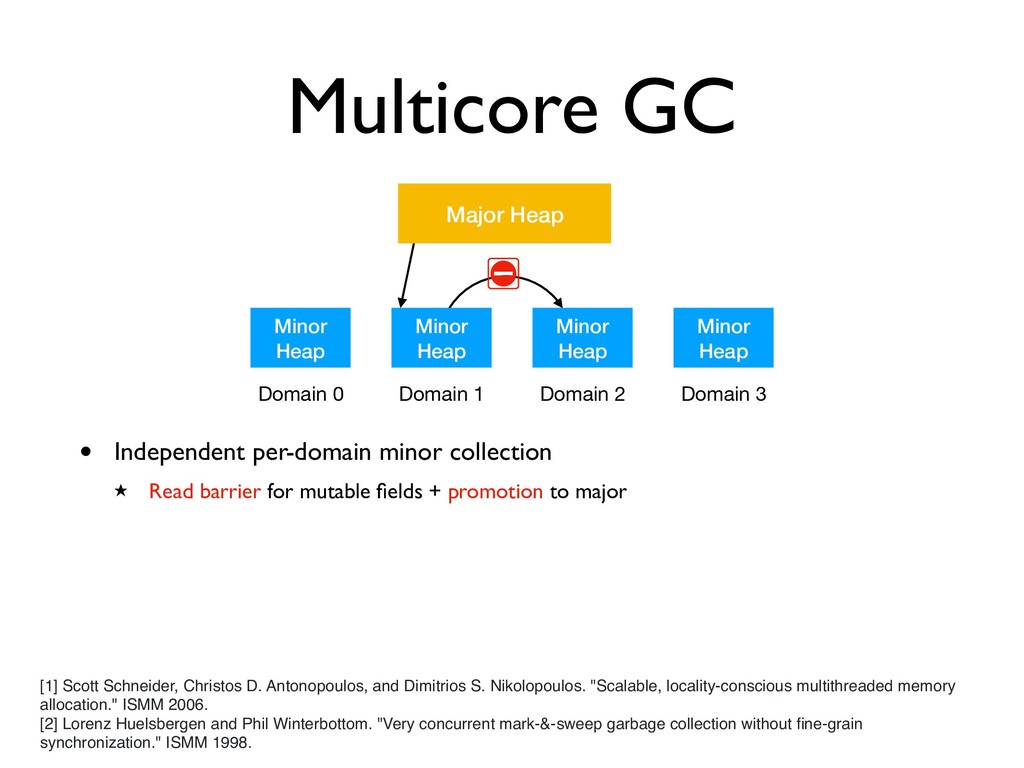
Multicore GC Minor Heap Minor Heap Minor Heap Minor Heap
Major Heap Domain 0 Domain 1 Domain 2 Domain 3 [1] Scott Schneider, Christos D. Antonopoulos, and Dimitrios S. Nikolopoulos. "Scalable, locality-conscious multithreaded memory allocation." ISMM 2006. [2] Lorenz Huelsbergen and Phil Winterbottom. "Very concurrent mark-&-sweep garbage collection without fine-grain synchronization." ISMM 1998. -
Multicore GC Minor Heap Minor Heap Minor Heap Minor Heap
Major Heap Domain 0 Domain 1 Domain 2 Domain 3 [1] Scott Schneider, Christos D. Antonopoulos, and Dimitrios S. Nikolopoulos. "Scalable, locality-conscious multithreaded memory allocation." ISMM 2006. [2] Lorenz Huelsbergen and Phil Winterbottom. "Very concurrent mark-&-sweep garbage collection without fine-grain synchronization." ISMM 1998. -
Multicore GC Minor Heap Minor Heap Minor Heap Minor Heap
Major Heap Domain 0 Domain 1 Domain 2 Domain 3 • Independent per-domain minor collection [1] Scott Schneider, Christos D. Antonopoulos, and Dimitrios S. Nikolopoulos. "Scalable, locality-conscious multithreaded memory allocation." ISMM 2006. [2] Lorenz Huelsbergen and Phil Winterbottom. "Very concurrent mark-&-sweep garbage collection without fine-grain synchronization." ISMM 1998. -
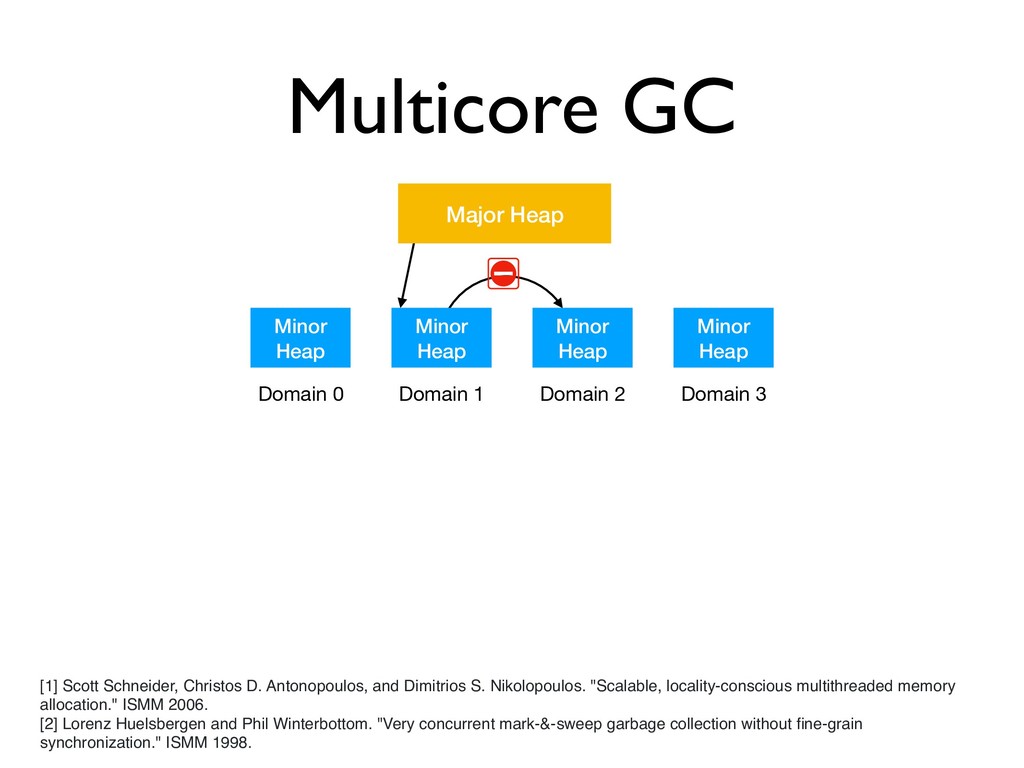
Multicore GC Minor Heap Minor Heap Minor Heap Minor Heap
Major Heap Domain 0 Domain 1 Domain 2 Domain 3 • Independent per-domain minor collection ★ Read barrier for mutable fields + promotion to major [1] Scott Schneider, Christos D. Antonopoulos, and Dimitrios S. Nikolopoulos. "Scalable, locality-conscious multithreaded memory allocation." ISMM 2006. [2] Lorenz Huelsbergen and Phil Winterbottom. "Very concurrent mark-&-sweep garbage collection without fine-grain synchronization." ISMM 1998. -
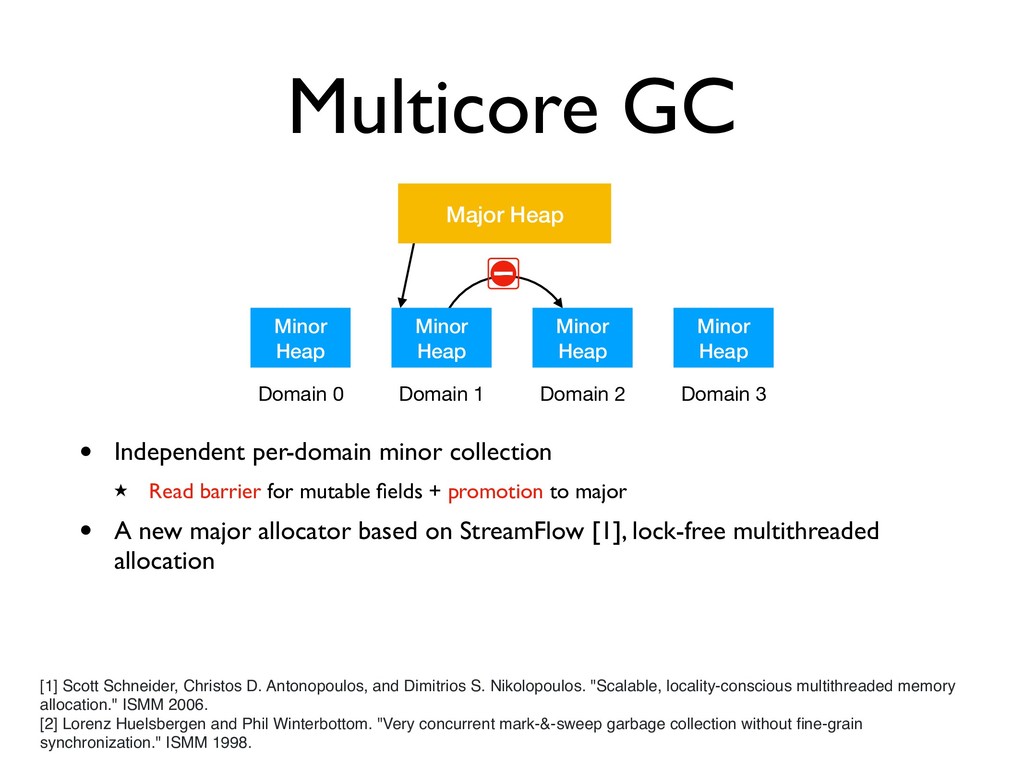
Multicore GC Minor Heap Minor Heap Minor Heap Minor Heap
Major Heap Domain 0 Domain 1 Domain 2 Domain 3 • Independent per-domain minor collection ★ Read barrier for mutable fields + promotion to major • A new major allocator based on StreamFlow [1], lock-free multithreaded allocation [1] Scott Schneider, Christos D. Antonopoulos, and Dimitrios S. Nikolopoulos. "Scalable, locality-conscious multithreaded memory allocation." ISMM 2006. [2] Lorenz Huelsbergen and Phil Winterbottom. "Very concurrent mark-&-sweep garbage collection without fine-grain synchronization." ISMM 1998. -
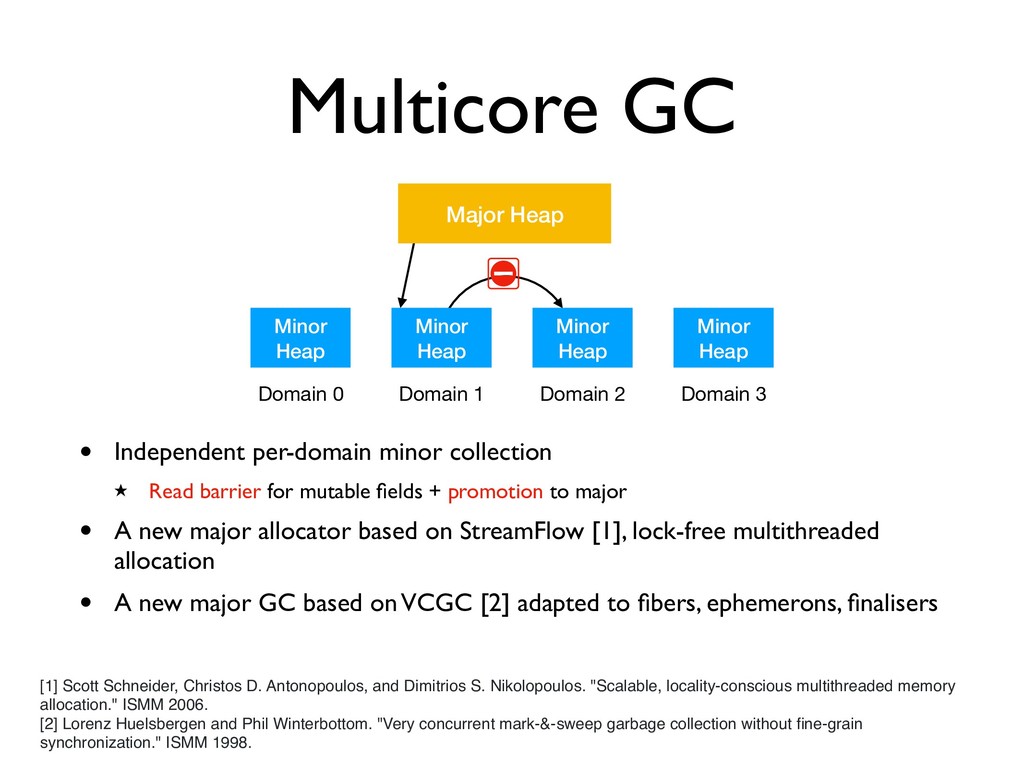
Multicore GC Minor Heap Minor Heap Minor Heap Minor Heap
Major Heap Domain 0 Domain 1 Domain 2 Domain 3 • Independent per-domain minor collection ★ Read barrier for mutable fields + promotion to major • A new major allocator based on StreamFlow [1], lock-free multithreaded allocation • A new major GC based on VCGC [2] adapted to fibers, ephemerons, finalisers [1] Scott Schneider, Christos D. Antonopoulos, and Dimitrios S. Nikolopoulos. "Scalable, locality-conscious multithreaded memory allocation." ISMM 2006. [2] Lorenz Huelsbergen and Phil Winterbottom. "Very concurrent mark-&-sweep garbage collection without fine-grain synchronization." ISMM 1998. -
Major GC • Concurrent, incremental, mark and sweep ★ Uses
deletion/yuasa barrier ★ Upper bound on marking work per cycle (not fixed due to weak refs) • 3 phases: ★ Sweep-and-mark-main ★ Mark-final ★ Sweep-ephe -
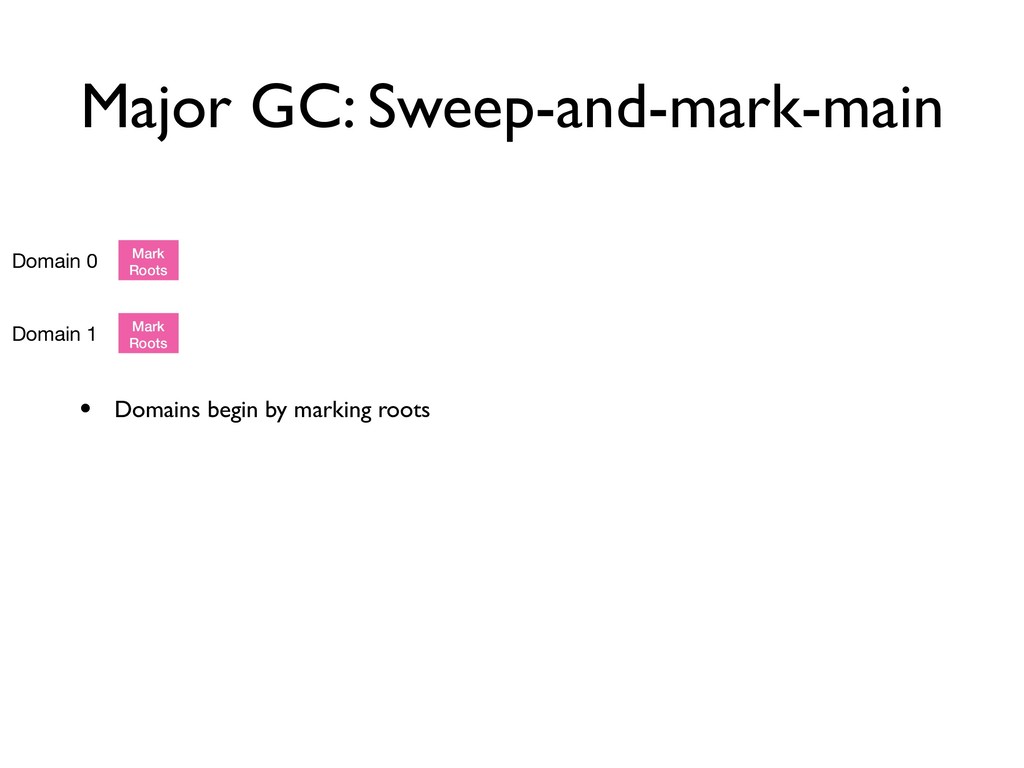
Major GC: Sweep-and-mark-main Domain 0 Mark Roots Domain 1 Mark
Roots • Domains begin by marking roots -
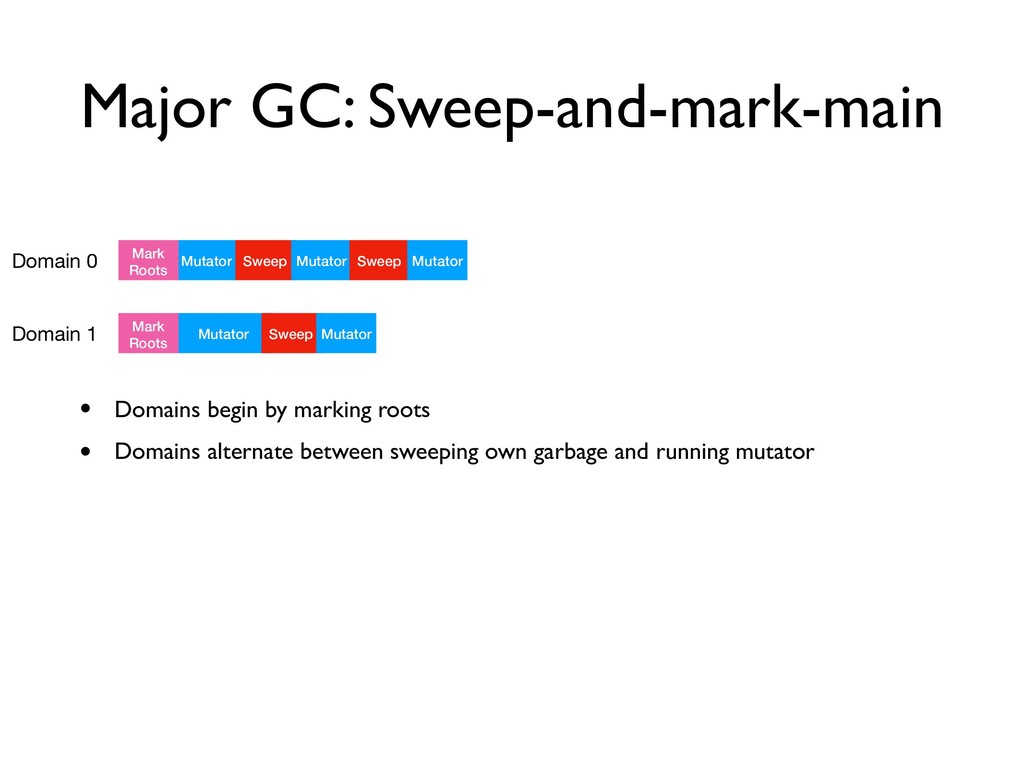
Major GC: Sweep-and-mark-main Mutator Domain 0 Sweep Mark Roots Mutator
Sweep Mutator Domain 1 Mutator Mark Roots Sweep Mutator • Domains begin by marking roots • Domains alternate between sweeping own garbage and running mutator -
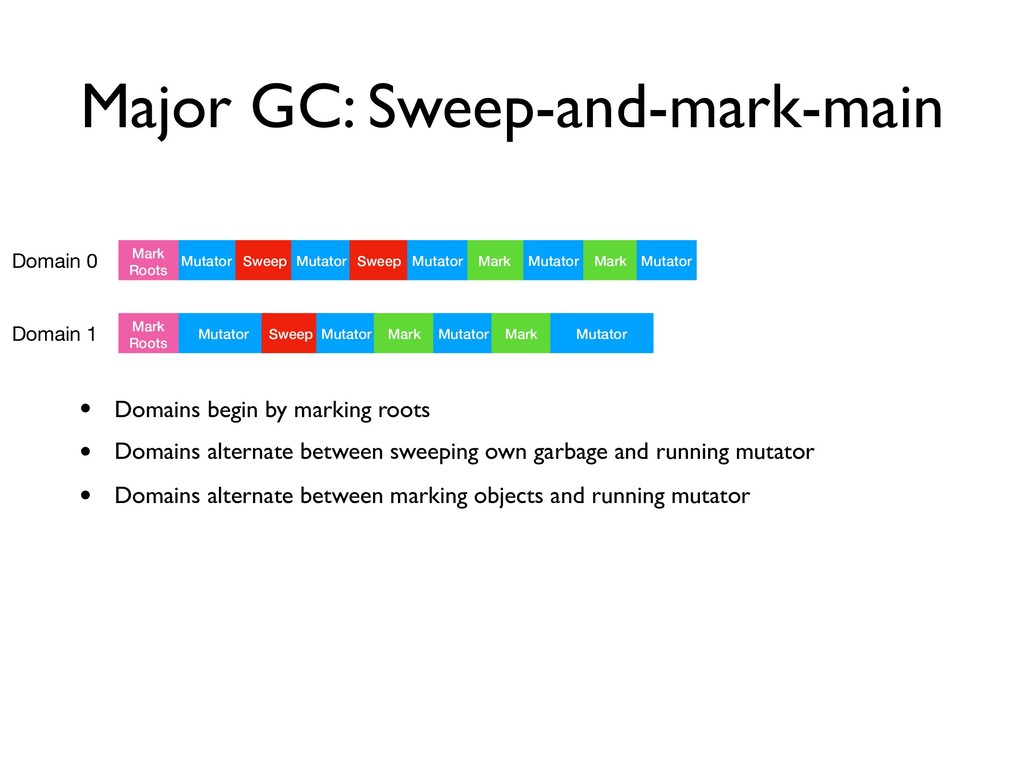
Major GC: Sweep-and-mark-main Mutator Domain 0 Mark Sweep Mark Roots
Mutator Sweep Mutator Mark Mutator Mutator Domain 1 Mutator Mark Roots Sweep Mutator Mark Mutator Mark Mutator • Domains begin by marking roots • Domains alternate between sweeping own garbage and running mutator • Domains alternate between marking objects and running mutator -
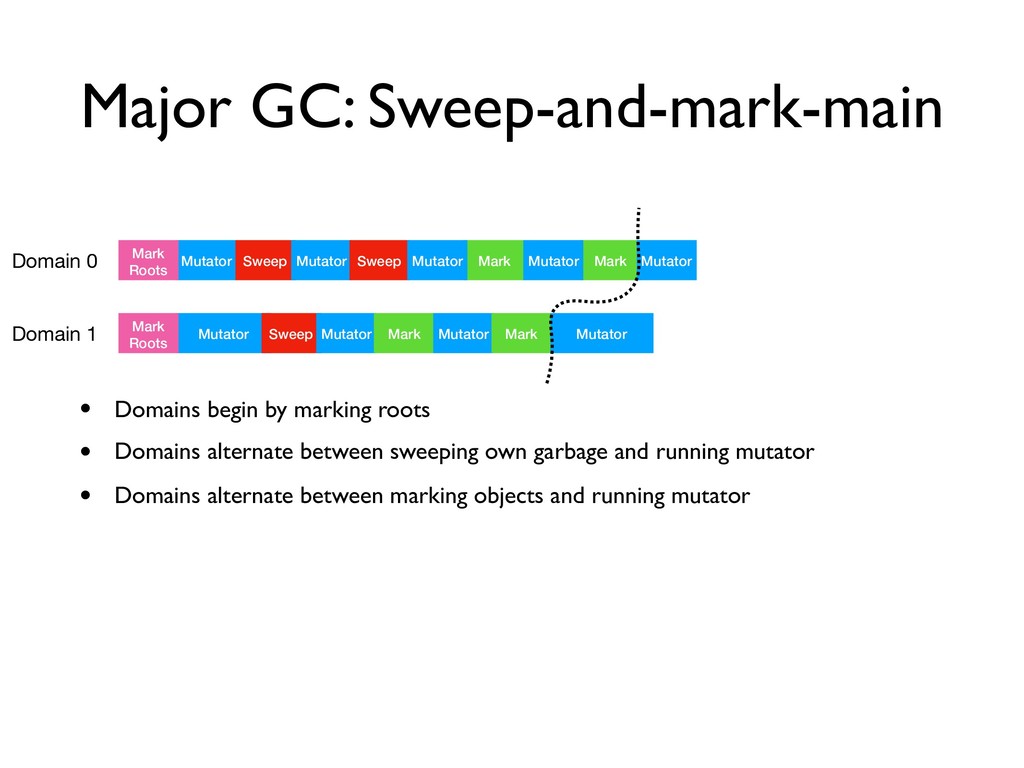
Major GC: Sweep-and-mark-main Mutator Domain 0 Mark Sweep Mark Roots
Mutator Sweep Mutator Mark Mutator Mutator Domain 1 Mutator Mark Roots Sweep Mutator Mark Mutator Mark Mutator • Domains begin by marking roots • Domains alternate between sweeping own garbage and running mutator • Domains alternate between marking objects and running mutator -
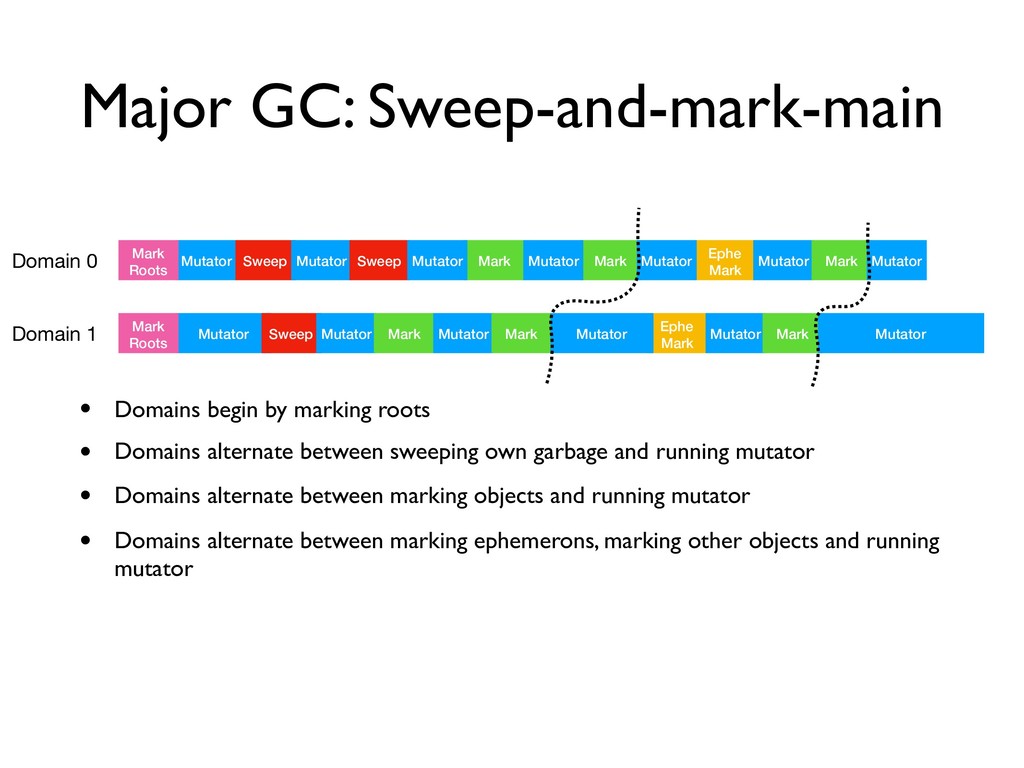
Major GC: Sweep-and-mark-main Mutator Domain 0 Mark Sweep Ephe Mark
Mark Roots Mutator Sweep Mutator Mark Mutator Mutator Mutator Mark Mutator Domain 1 Mutator Mark Roots Sweep Mutator Mark Mutator Mark Ephe Mark Mutator Mutator Mark Mutator • Domains begin by marking roots • Domains alternate between sweeping own garbage and running mutator • Domains alternate between marking objects and running mutator • Domains alternate between marking ephemerons, marking other objects and running mutator -
Major GC: Sweep-and-mark-main Mutator Domain 0 Mark Sweep Ephe Mark
Mark Roots Mutator Sweep Mutator Mark Mutator Mutator Mutator Mark Mutator Domain 1 Mutator Mark Roots Sweep Mutator Mark Mutator Mark Ephe Mark Mutator Mutator Mark Mutator • Domains begin by marking roots • Domains alternate between sweeping own garbage and running mutator • Domains alternate between marking objects and running mutator • Domains alternate between marking ephemerons, marking other objects and running mutator -
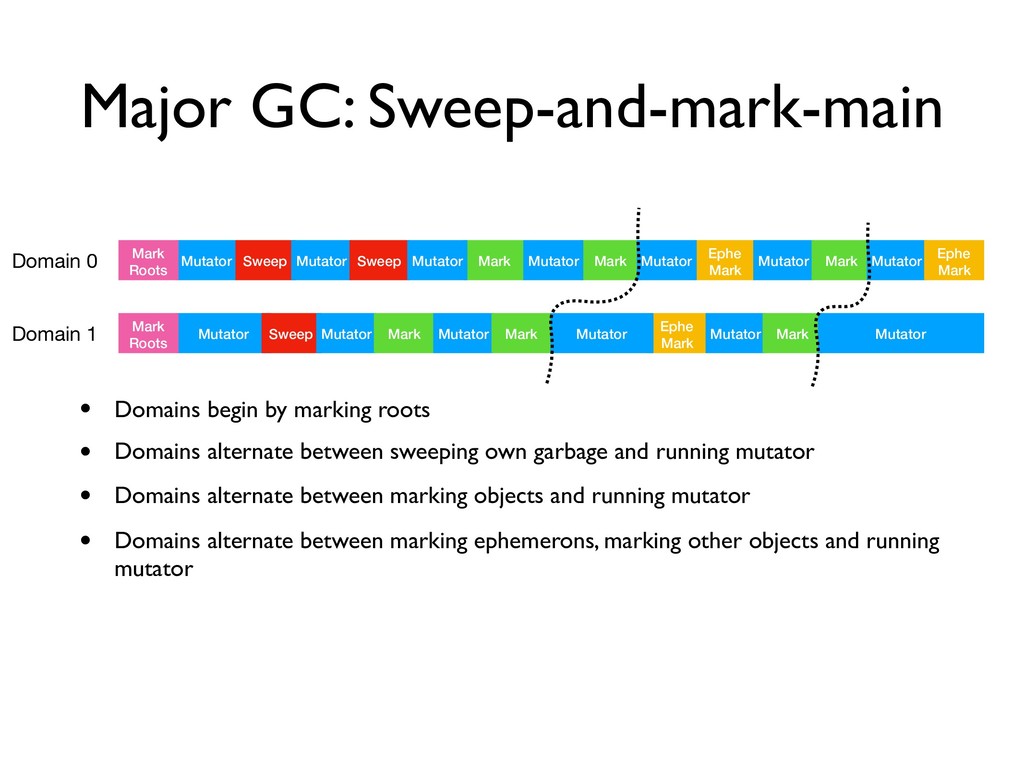
Major GC: Sweep-and-mark-main Mutator Domain 0 Mark Sweep Ephe Mark
Mark Roots Mutator Sweep Mutator Mark Mutator Mutator Mutator Mark Mutator Ephe Mark Domain 1 Mutator Mark Roots Sweep Mutator Mark Mutator Mark Ephe Mark Mutator Mutator Mark Mutator • Domains begin by marking roots • Domains alternate between sweeping own garbage and running mutator • Domains alternate between marking objects and running mutator • Domains alternate between marking ephemerons, marking other objects and running mutator -
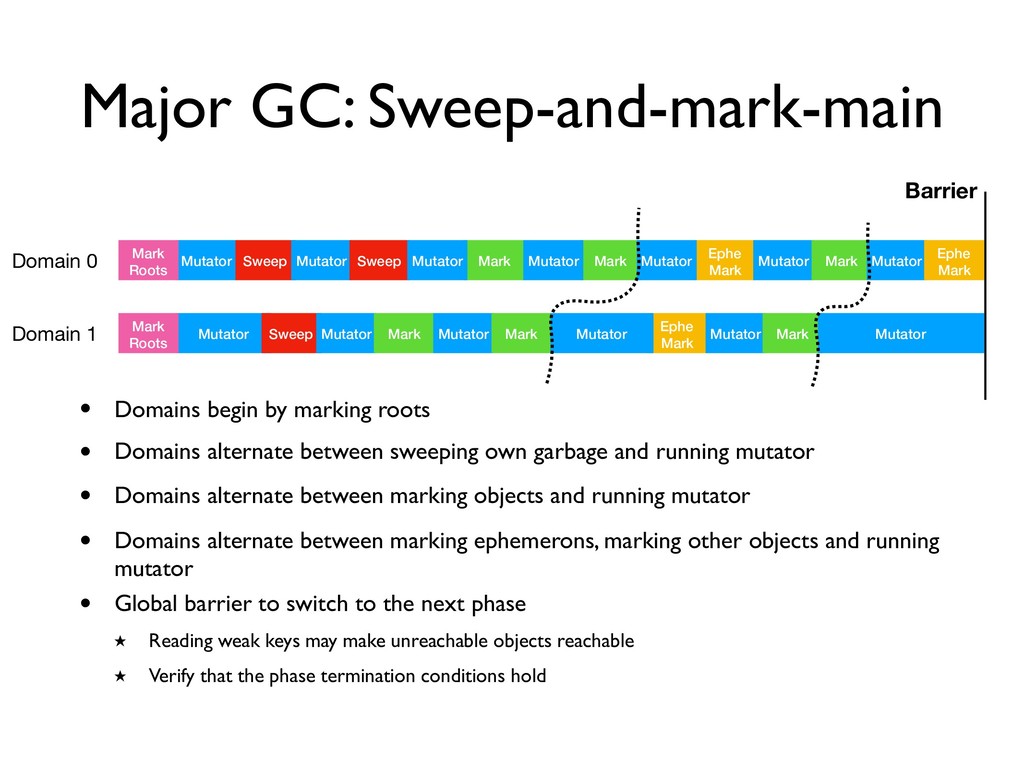
Major GC: Sweep-and-mark-main Mutator Domain 0 Mark Sweep Ephe Mark
Mark Roots Mutator Sweep Mutator Mark Mutator Mutator Mutator Mark Mutator Ephe Mark Domain 1 Mutator Mark Roots Sweep Mutator Mark Mutator Mark Ephe Mark Mutator Mutator Mark Mutator Barrier • Domains begin by marking roots • Domains alternate between sweeping own garbage and running mutator • Domains alternate between marking objects and running mutator • Domains alternate between marking ephemerons, marking other objects and running mutator • Global barrier to switch to the next phase ★ Reading weak keys may make unreachable objects reachable ★ Verify that the phase termination conditions hold -
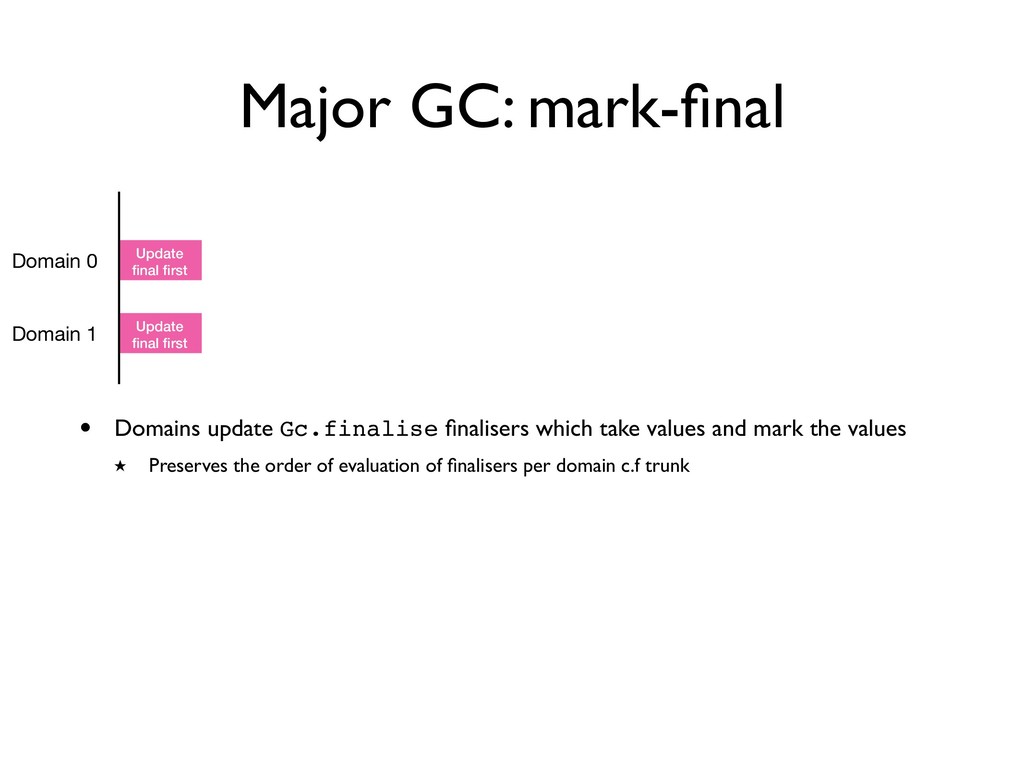
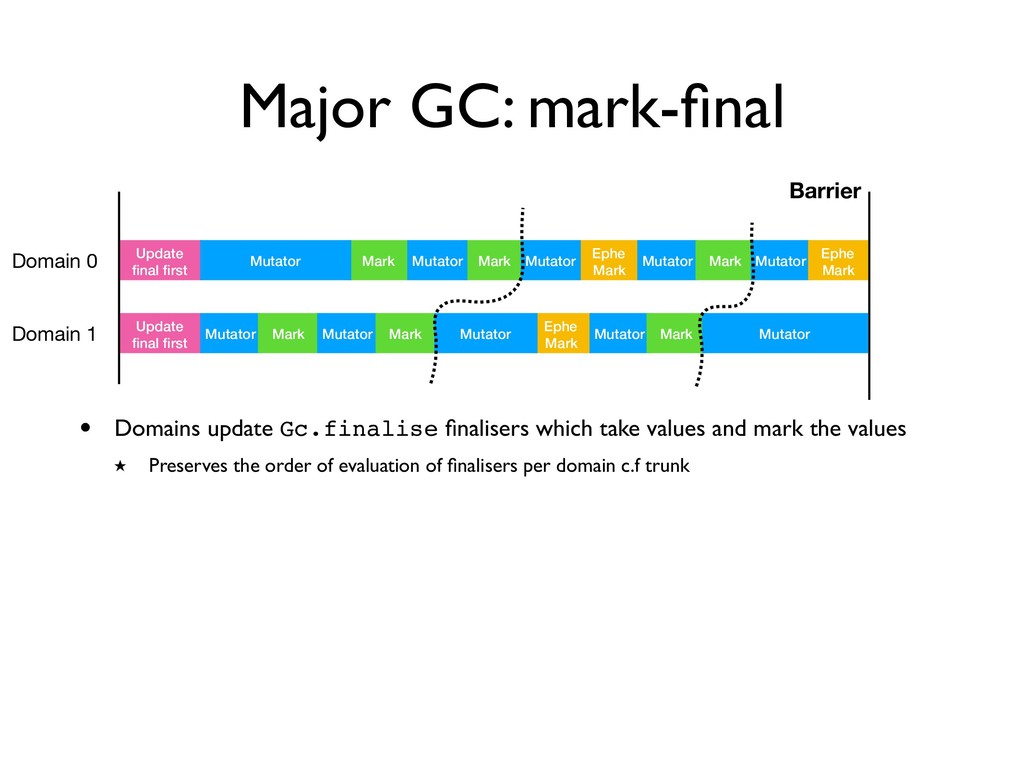
Major GC: mark-final Domain 0 Update final first Domain 1
Update final first • Domains update Gc.finalise finalisers which take values and mark the values ★ Preserves the order of evaluation of finalisers per domain c.f trunk -
Major GC: mark-final Domain 0 Mark Ephe Mark Update final
first Mutator Mark Mutator Mutator Mutator Mark Mutator Ephe Mark Domain 1 Update final first Mutator Mark Mutator Mark Ephe Mark Mutator Mutator Mark Mutator • Domains update Gc.finalise finalisers which take values and mark the values ★ Preserves the order of evaluation of finalisers per domain c.f trunk -
Major GC: mark-final Domain 0 Mark Ephe Mark Update final
first Mutator Mark Mutator Mutator Mutator Mark Mutator Ephe Mark Domain 1 Update final first Mutator Mark Mutator Mark Ephe Mark Mutator Mutator Mark Mutator Barrier • Domains update Gc.finalise finalisers which take values and mark the values ★ Preserves the order of evaluation of finalisers per domain c.f trunk -
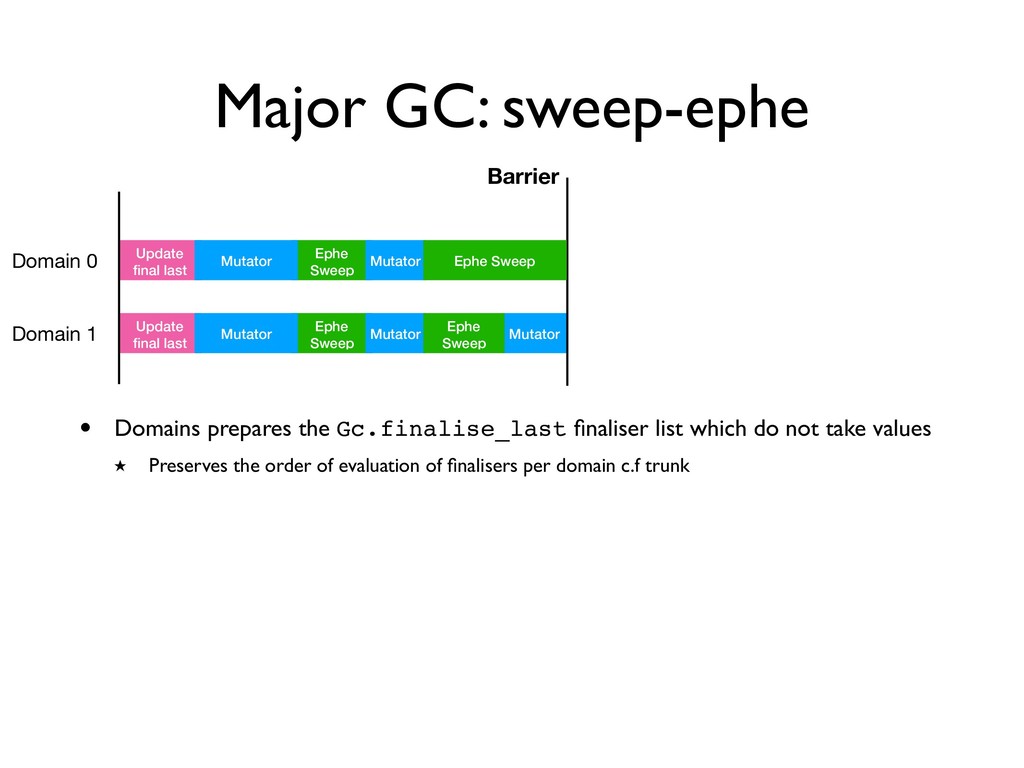
Major GC: sweep-ephe Domain 0 Update final last Domain 1
Update final last • Domains prepares the Gc.finalise_last finaliser list which do not take values ★ Preserves the order of evaluation of finalisers per domain c.f trunk -
Major GC: sweep-ephe Domain 0 Update final last Domain 1
Update final last Ephe Sweep Mutator Mutator Mutator Barrier • Domains prepares the Gc.finalise_last finaliser list which do not take values ★ Preserves the order of evaluation of finalisers per domain c.f trunk Ephe Sweep Ephe Sweep Mutator Mutator Ephe Sweep -
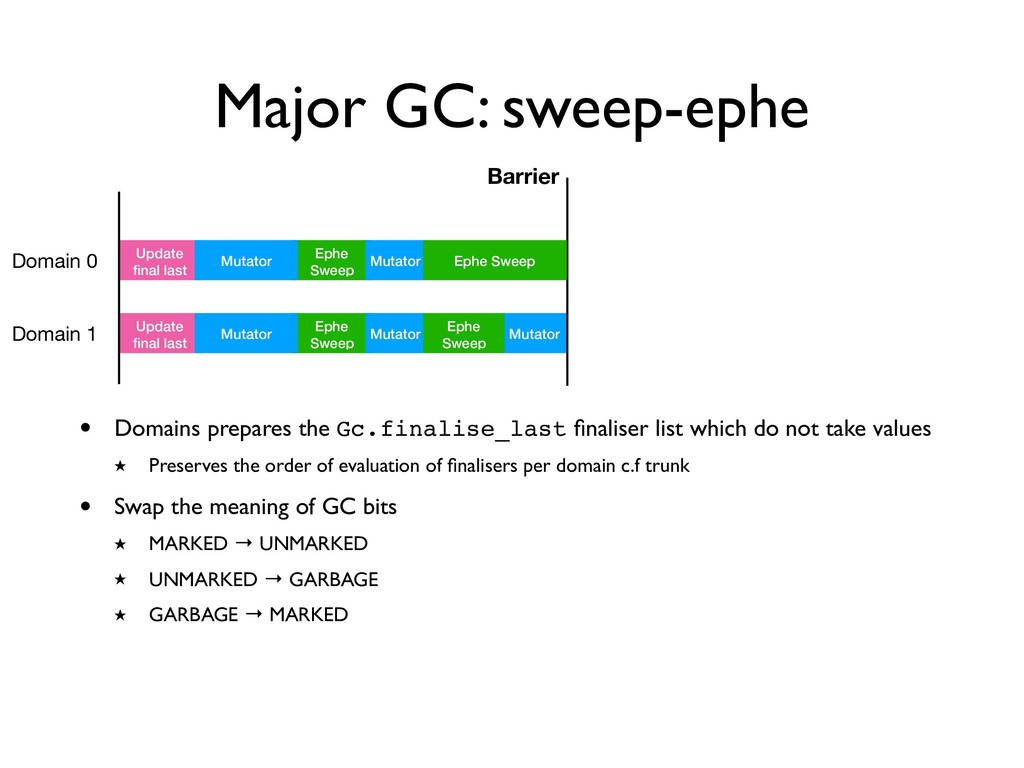
Major GC: sweep-ephe Domain 0 Update final last Domain 1
Update final last Ephe Sweep Mutator Mutator Mutator Barrier • Domains prepares the Gc.finalise_last finaliser list which do not take values ★ Preserves the order of evaluation of finalisers per domain c.f trunk Ephe Sweep Ephe Sweep Mutator Mutator Ephe Sweep • Swap the meaning of GC bits ★ MARKED → UNMARKED ★ UNMARKED → GARBAGE ★ GARBAGE → MARKED -
Major GC: sweep-ephe Domain 0 Update final last Domain 1
Update final last Ephe Sweep Mutator Mutator Mutator Barrier • Domains prepares the Gc.finalise_last finaliser list which do not take values ★ Preserves the order of evaluation of finalisers per domain c.f trunk Ephe Sweep Ephe Sweep Mutator Mutator Ephe Sweep • Swap the meaning of GC bits ★ MARKED → UNMARKED ★ UNMARKED → GARBAGE ★ GARBAGE → MARKED • Major GC algorithm verified in SPIN model checker -
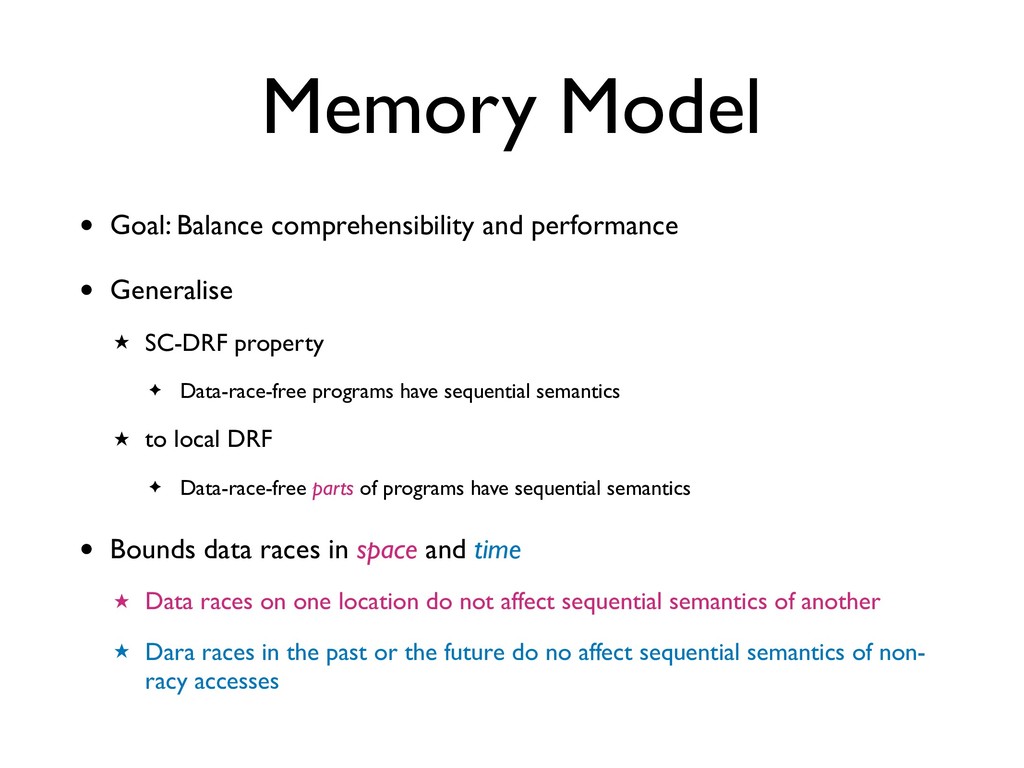
Memory Model • Goal: Balance comprehensibility and performance • Generalise
★ SC-DRF property ✦ Data-race-free programs have sequential semantics ★ to local DRF ✦ Data-race-free parts of programs have sequential semantics -
Memory Model • Goal: Balance comprehensibility and performance • Generalise
★ SC-DRF property ✦ Data-race-free programs have sequential semantics ★ to local DRF ✦ Data-race-free parts of programs have sequential semantics • Bounds data races in space and time ★ Data races on one location do not affect sequential semantics of another ★ Dara races in the past or the future do no affect sequential semantics of non- racy accesses -
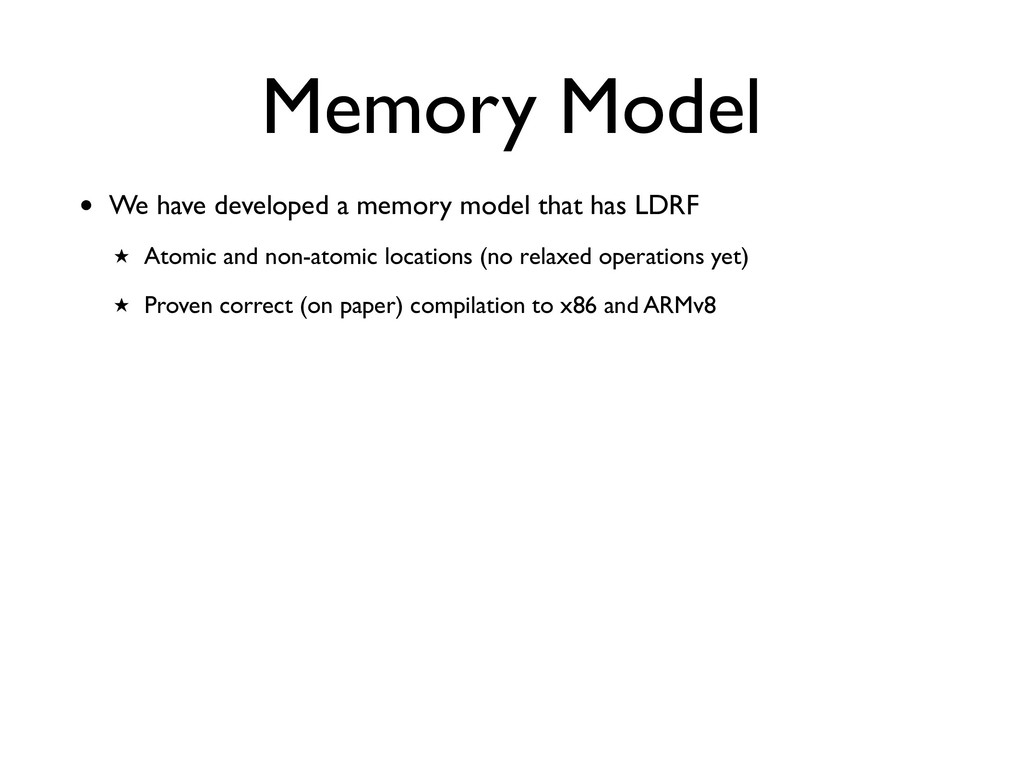
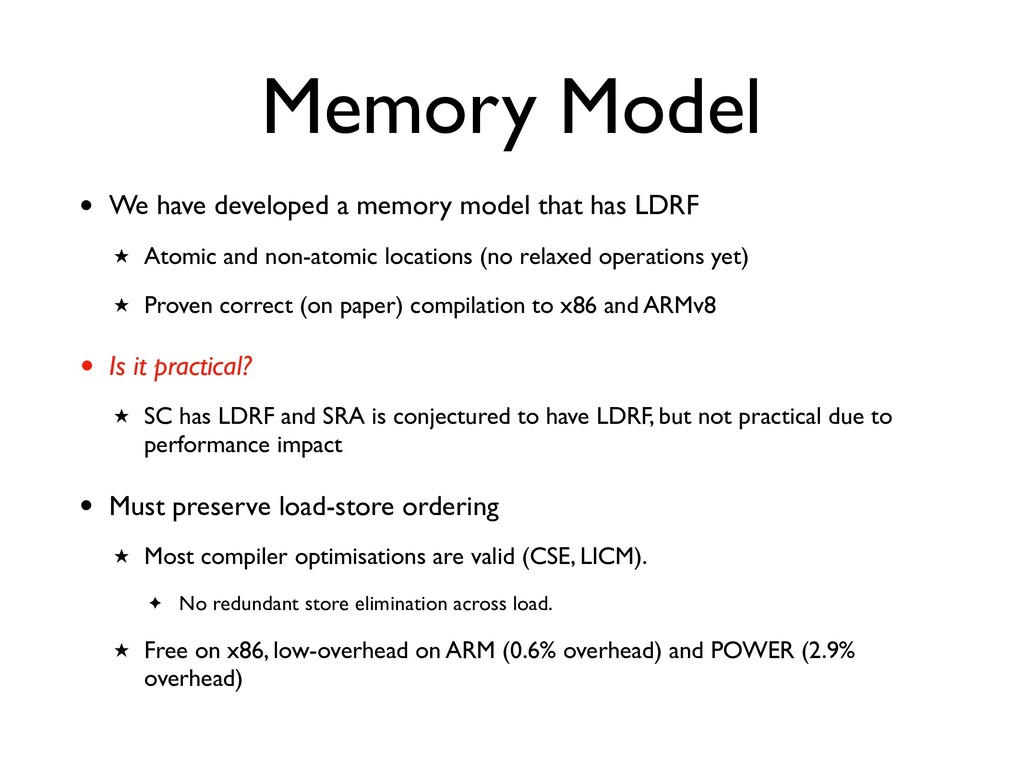
Memory Model • We have developed a memory model that
has LDRF ★ Atomic and non-atomic locations (no relaxed operations yet) ★ Proven correct (on paper) compilation to x86 and ARMv8 -
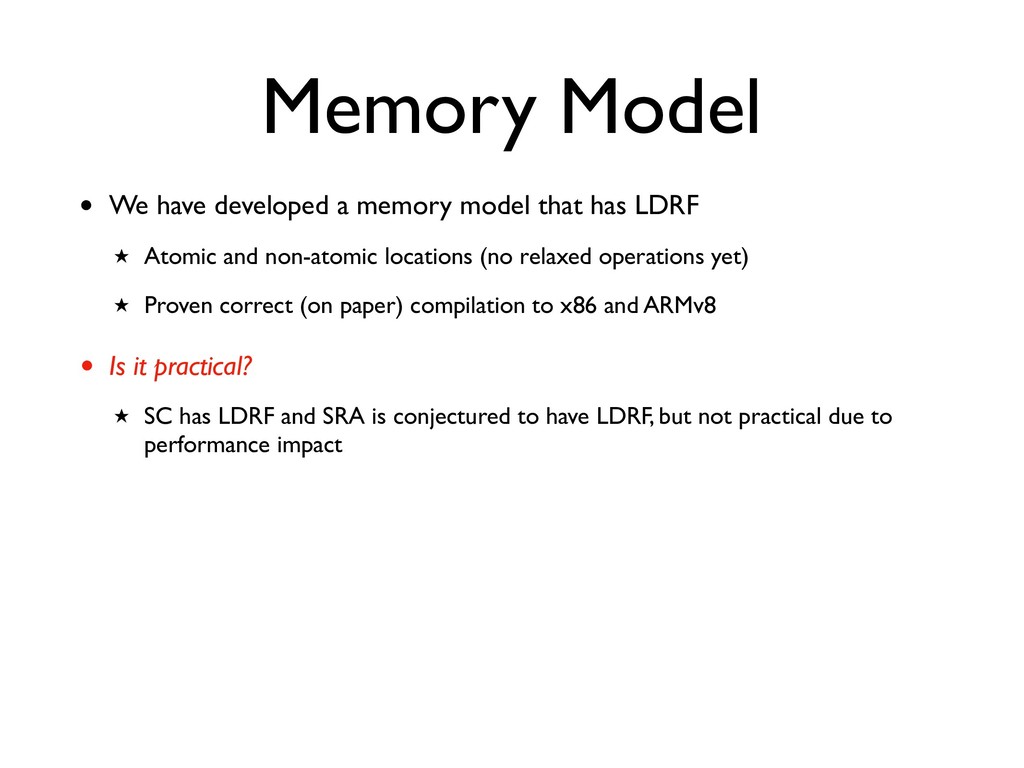
Memory Model • We have developed a memory model that
has LDRF ★ Atomic and non-atomic locations (no relaxed operations yet) ★ Proven correct (on paper) compilation to x86 and ARMv8 • Is it practical? ★ SC has LDRF and SRA is conjectured to have LDRF, but not practical due to performance impact -
Memory Model • We have developed a memory model that
has LDRF ★ Atomic and non-atomic locations (no relaxed operations yet) ★ Proven correct (on paper) compilation to x86 and ARMv8 • Is it practical? ★ SC has LDRF and SRA is conjectured to have LDRF, but not practical due to performance impact • Must preserve load-store ordering ★ Most compiler optimisations are valid (CSE, LICM). ✦ No redundant store elimination across load. ★ Free on x86, low-overhead on ARM (0.6% overhead) and POWER (2.9% overhead) -
Runtime support for Effect handlers • Linear delimited continuations ★
Linearity enforced by the runtime ★ Raise exception when continuation resumed more than once ★ Finaliser discontinues unresumed continuation -
Runtime support for Effect handlers • Linear delimited continuations ★
Linearity enforced by the runtime ★ Raise exception when continuation resumed more than once ★ Finaliser discontinues unresumed continuation • Fibers: Heap managed stack segments ★ Requires stack-overflow checks at function entry ★ Static analysis removes checks in small leaf functions -
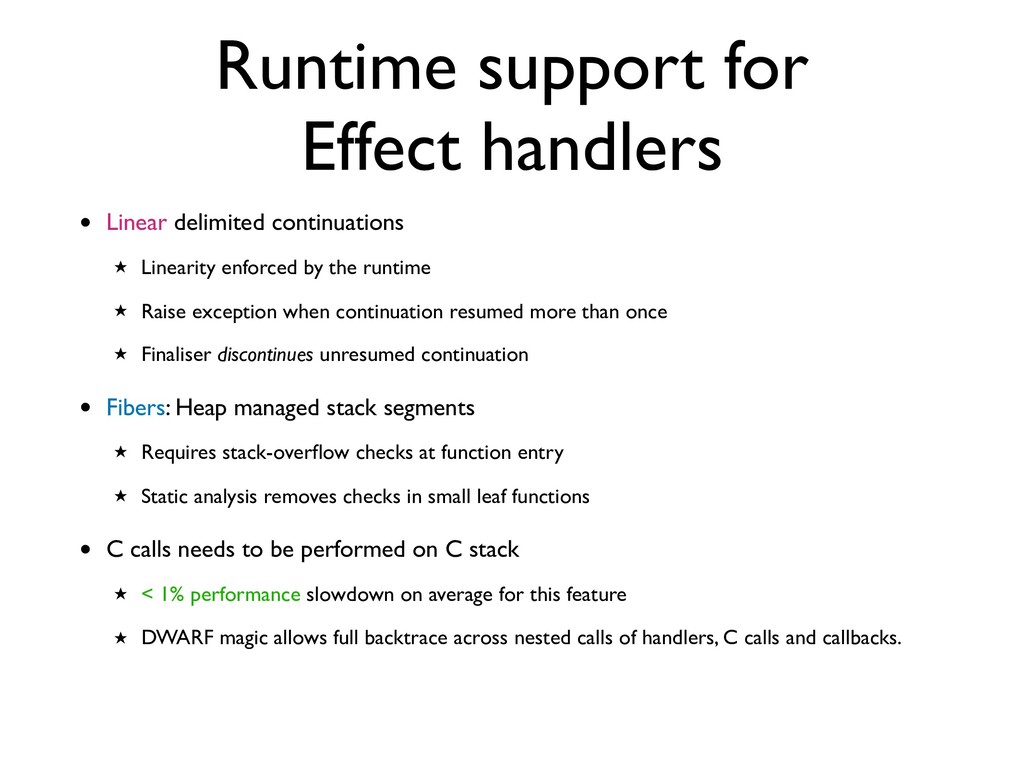
Runtime support for Effect handlers • Linear delimited continuations ★
Linearity enforced by the runtime ★ Raise exception when continuation resumed more than once ★ Finaliser discontinues unresumed continuation • Fibers: Heap managed stack segments ★ Requires stack-overflow checks at function entry ★ Static analysis removes checks in small leaf functions • C calls needs to be performed on C stack ★ < 1% performance slowdown on average for this feature ★ DWARF magic allows full backtrace across nested calls of handlers, C calls and callbacks. -
Runtime support for Effect handlers • Linear delimited continuations ★
Linearity enforced by the runtime ★ Raise exception when continuation resumed more than once ★ Finaliser discontinues unresumed continuation • Fibers: Heap managed stack segments ★ Requires stack-overflow checks at function entry ★ Static analysis removes checks in small leaf functions • C calls needs to be performed on C stack ★ < 1% performance slowdown on average for this feature ★ DWARF magic allows full backtrace across nested calls of handlers, C calls and callbacks. • WIP to support capturing continuations that include C frames c.f “Threads Yield Continuations” -
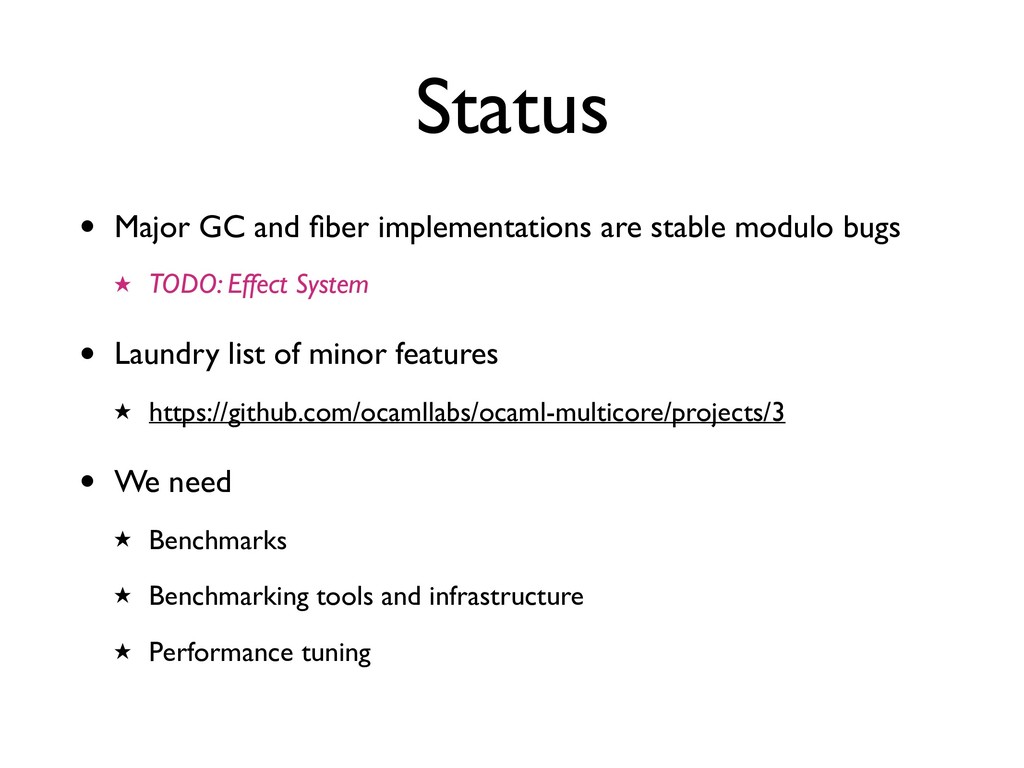
Status • Major GC and fiber implementations are stable modulo
bugs ★ TODO: Effect System • Laundry list of minor features ★ https://github.com/ocamllabs/ocaml-multicore/projects/3 • We need ★ Benchmarks ★ Benchmarking tools and infrastructure ★ Performance tuning -
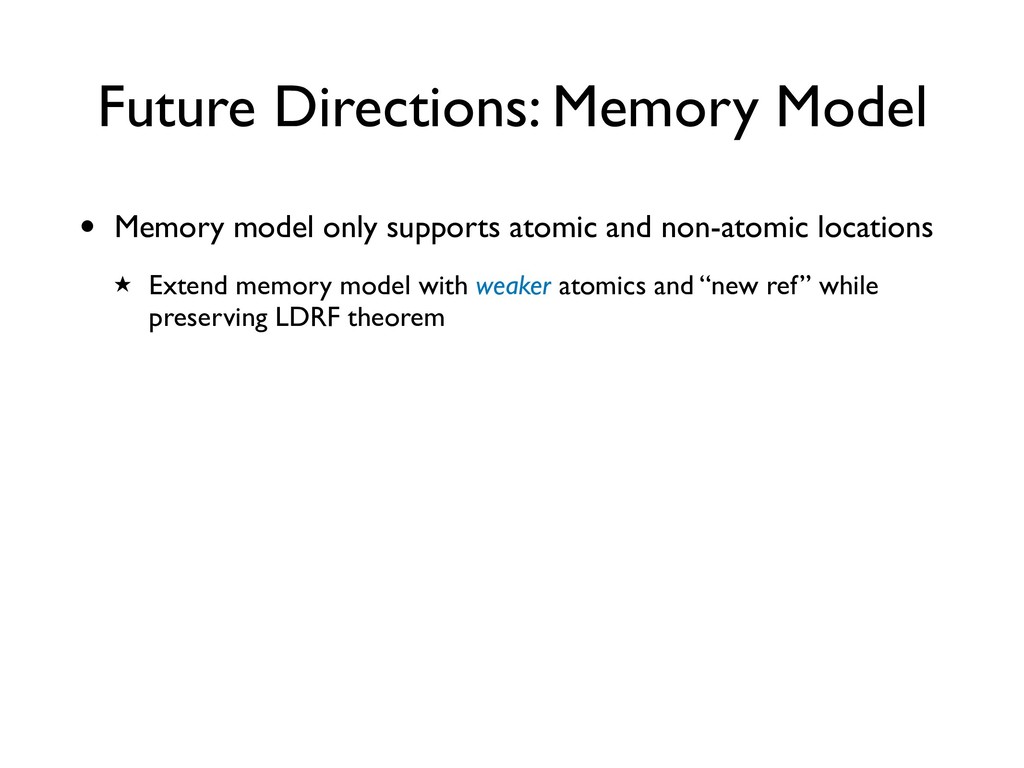
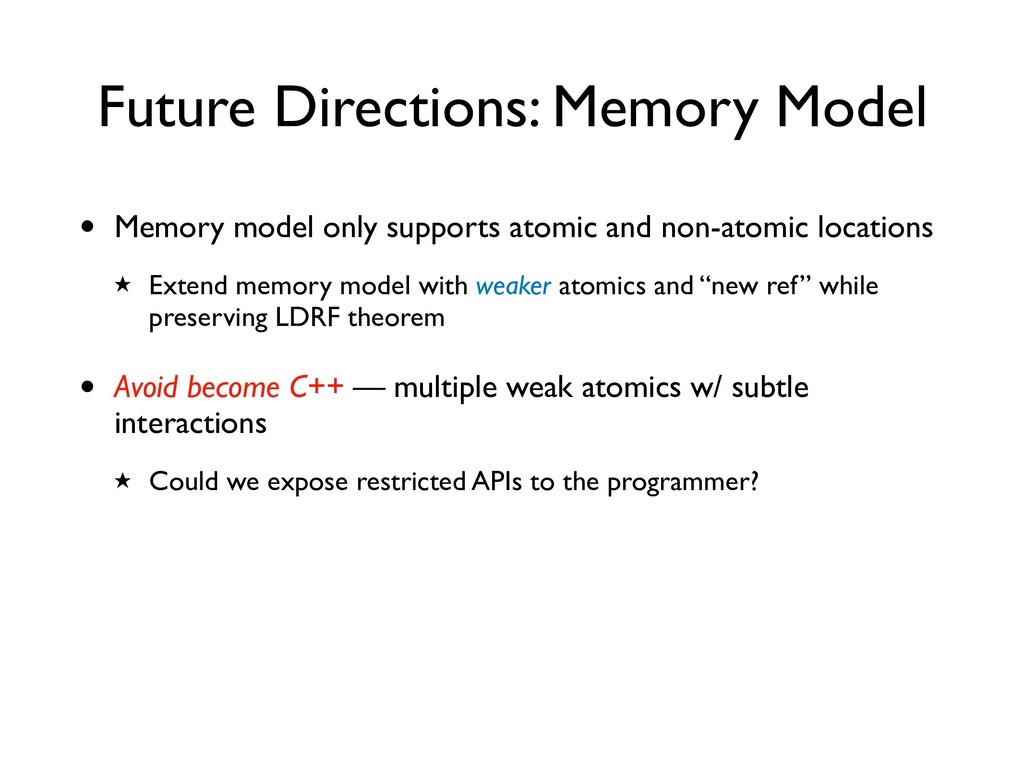
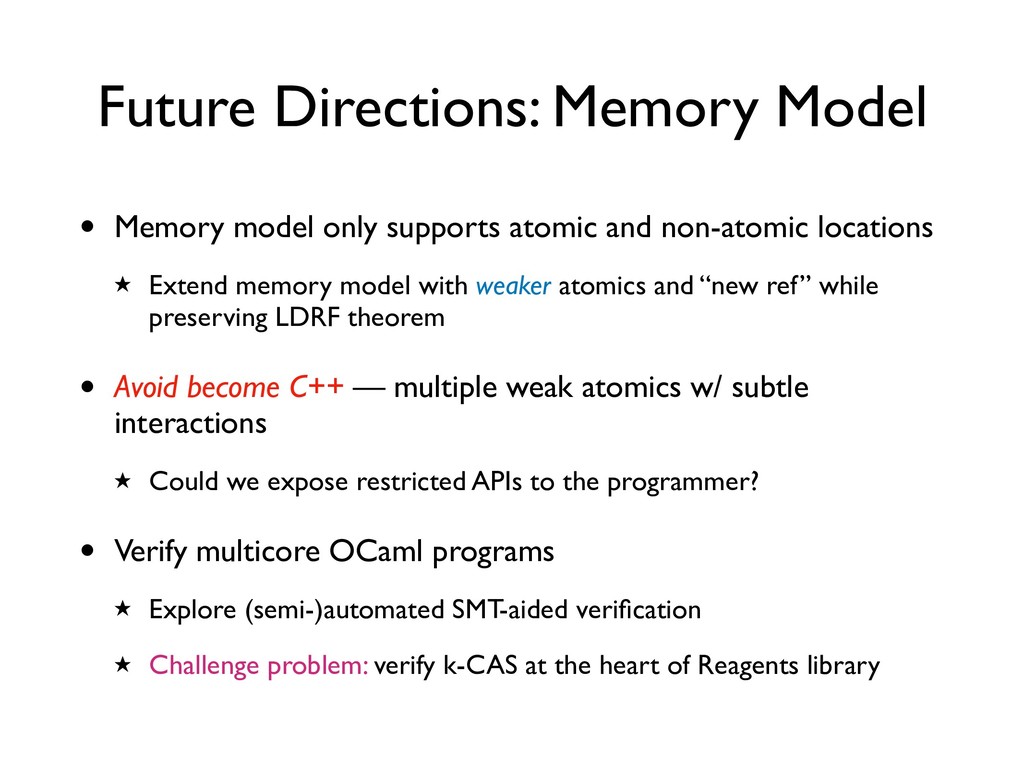
Future Directions: Memory Model • Memory model only supports atomic
and non-atomic locations ★ Extend memory model with weaker atomics and “new ref” while preserving LDRF theorem -
Future Directions: Memory Model • Memory model only supports atomic
and non-atomic locations ★ Extend memory model with weaker atomics and “new ref” while preserving LDRF theorem • Avoid become C++ — multiple weak atomics w/ subtle interactions ★ Could we expose restricted APIs to the programmer? -
Future Directions: Memory Model • Memory model only supports atomic
and non-atomic locations ★ Extend memory model with weaker atomics and “new ref” while preserving LDRF theorem • Avoid become C++ — multiple weak atomics w/ subtle interactions ★ Could we expose restricted APIs to the programmer? • Verify multicore OCaml programs ★ Explore (semi-)automated SMT-aided verification ★ Challenge problem: verify k-CAS at the heart of Reagents library -
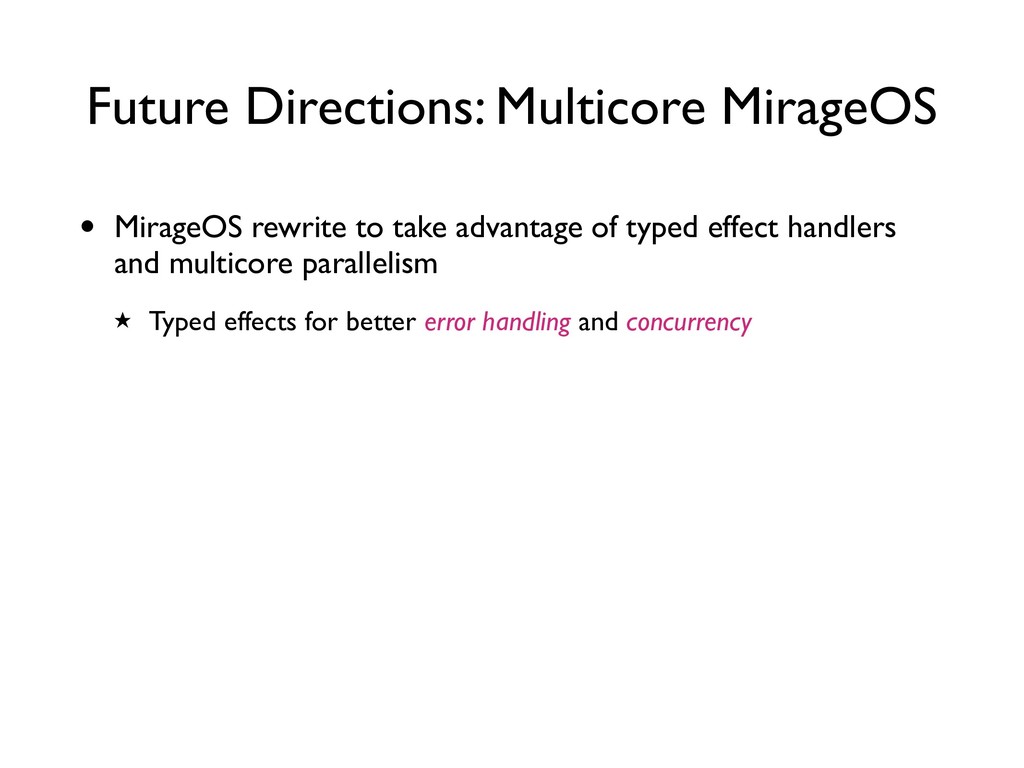
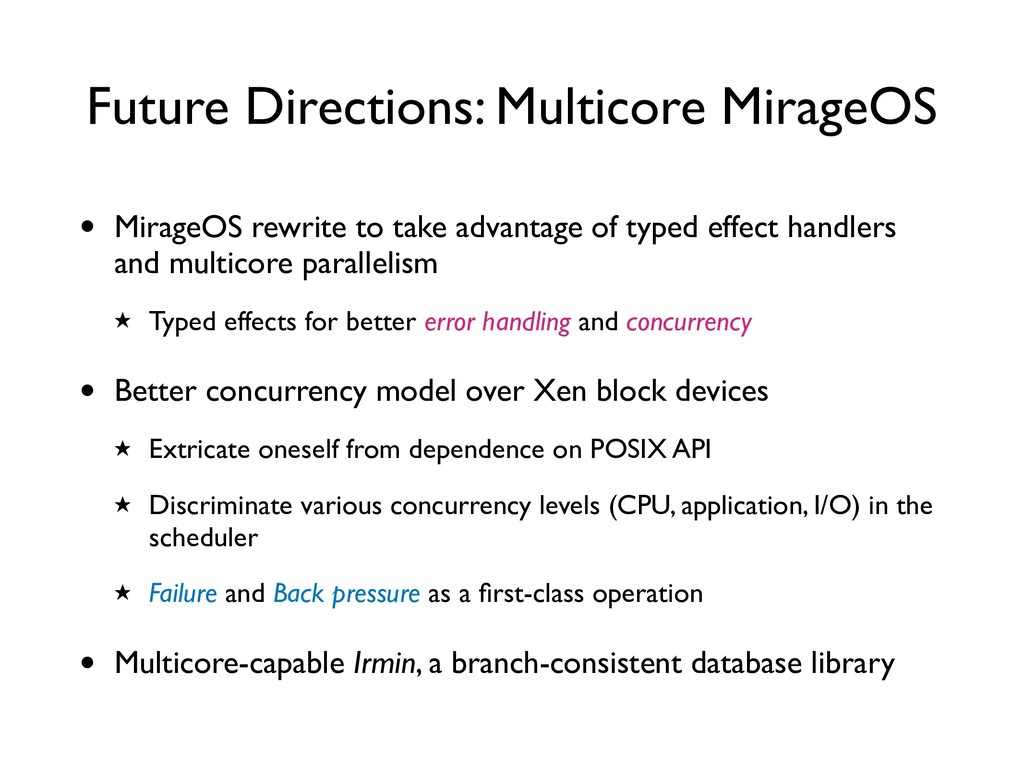
Future Directions: Multicore MirageOS • MirageOS rewrite to take advantage
of typed effect handlers and multicore parallelism ★ Typed effects for better error handling and concurrency -
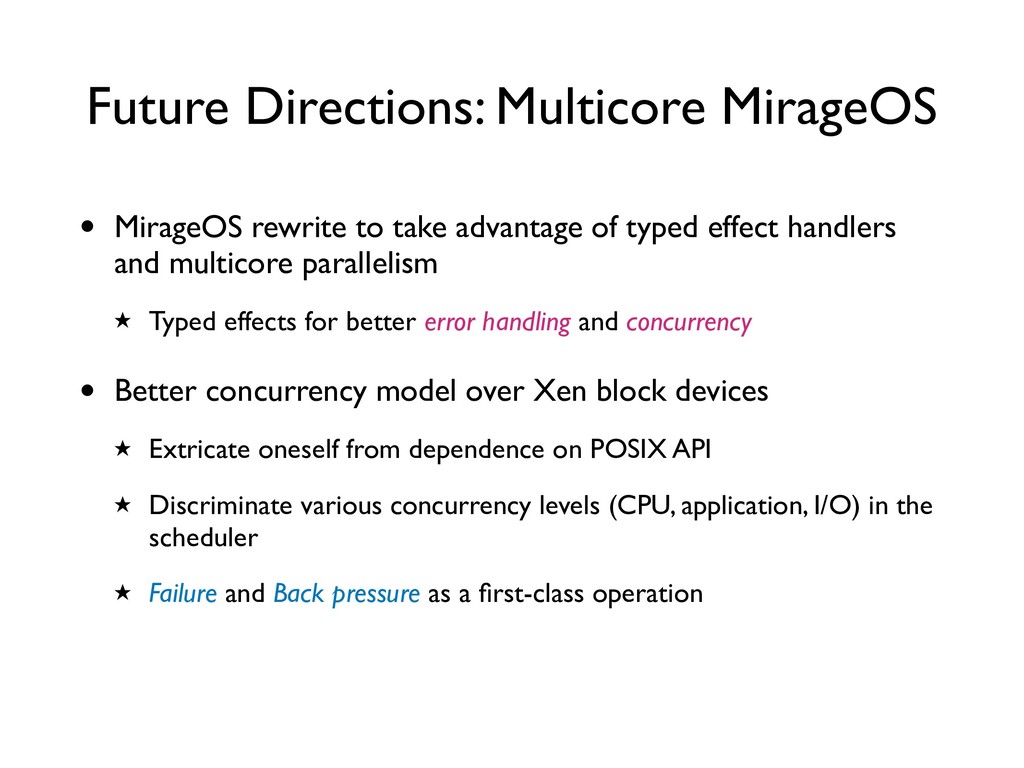
Future Directions: Multicore MirageOS • MirageOS rewrite to take advantage
of typed effect handlers and multicore parallelism ★ Typed effects for better error handling and concurrency • Better concurrency model over Xen block devices ★ Extricate oneself from dependence on POSIX API ★ Discriminate various concurrency levels (CPU, application, I/O) in the scheduler ★ Failure and Back pressure as a first-class operation -
Future Directions: Multicore MirageOS • MirageOS rewrite to take advantage
of typed effect handlers and multicore parallelism ★ Typed effects for better error handling and concurrency • Better concurrency model over Xen block devices ★ Extricate oneself from dependence on POSIX API ★ Discriminate various concurrency levels (CPU, application, I/O) in the scheduler ★ Failure and Back pressure as a first-class operation • Multicore-capable Irmin, a branch-consistent database library -
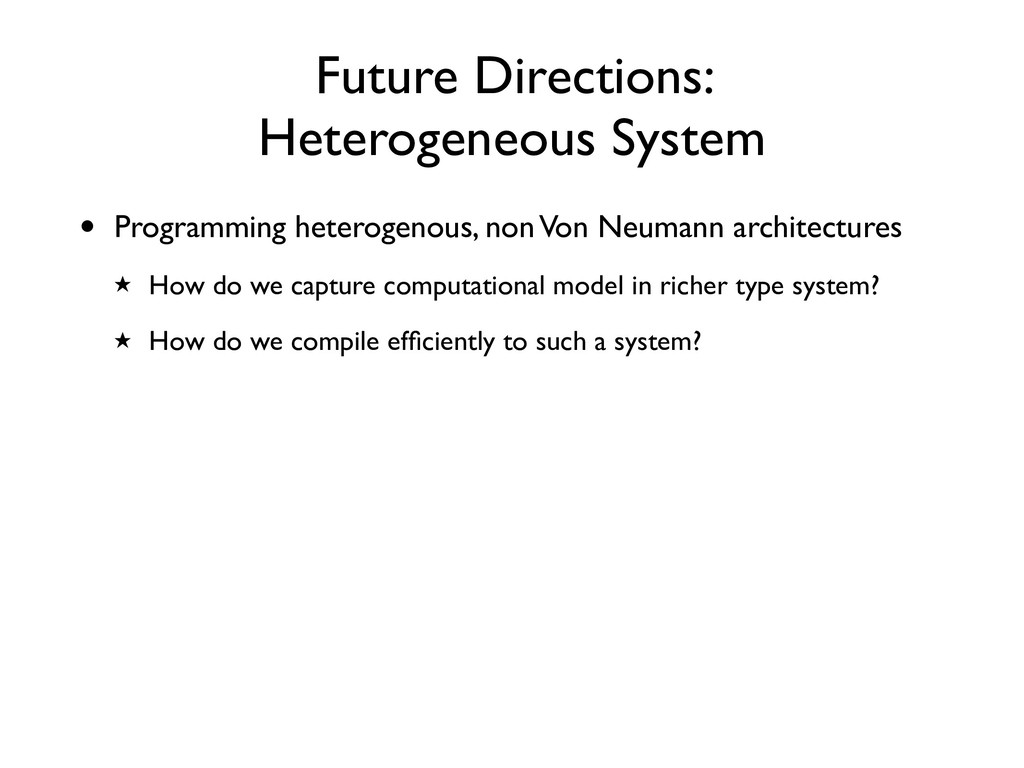
Future Directions: Heterogeneous System • Programming heterogenous, non Von Neumann
architectures ★ How do we capture computational model in richer type system? ★ How do we compile efficiently to such a system?
 kayceesrk
 mtsmfm
 ikura_hamu
 bicstone
 seike460
 simas
 sorah
 l2hyunwoo
 ryunakayama
 sylph01
 sodainc
 quramy
 siroemk
 nmsamuel
 sabderemane
 productmarketing
 geoffreycrofte
 katarinadahlin
 uxyall
 axbom
 akademiya2063
 portentint
 pwiseman
 chrisshort
 jdejongh