Upgrade to Pro — share decks privately, control downloads, hide ads and more …

Beyond_the_Limits_of_eBPF__A_Journey_Through_OS...

 Beyond_the_Limits_of_eBPF__A_Journey_Through_OS_Technologies.pdf

Kenta Tada

June 16, 2025

Transcript

10 slides
  1. Kenta Tada, CNCJ Organizer CNCF End User TAB Beyond the

    Limits of eBPF A Journey Through OS Innovations
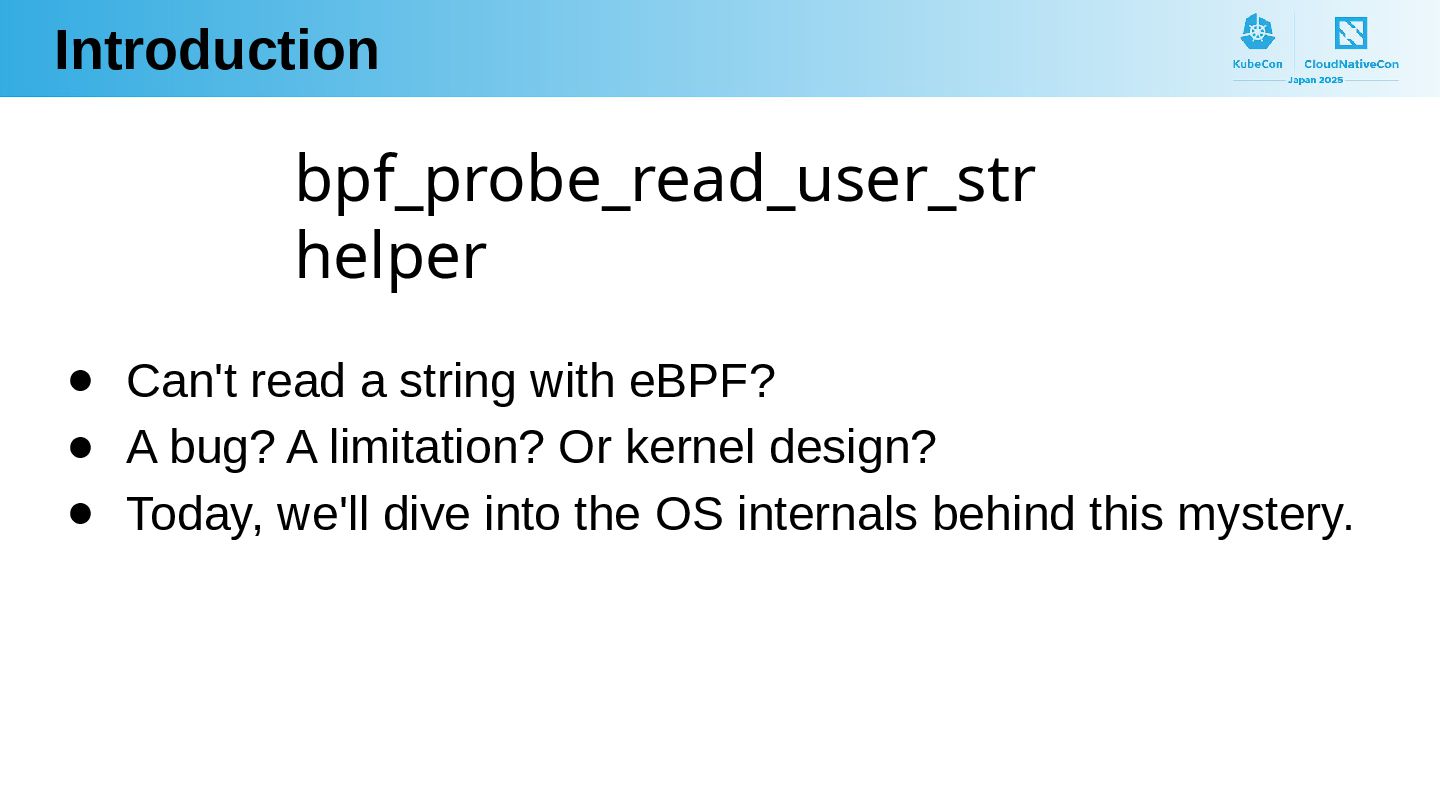
  2. Introduction • Can't read a string with eBPF? • A

    bug? A limitation? Or kernel design? • Today, we'll dive into the OS internals behind this mystery. bpf_probe_read_user_str helper
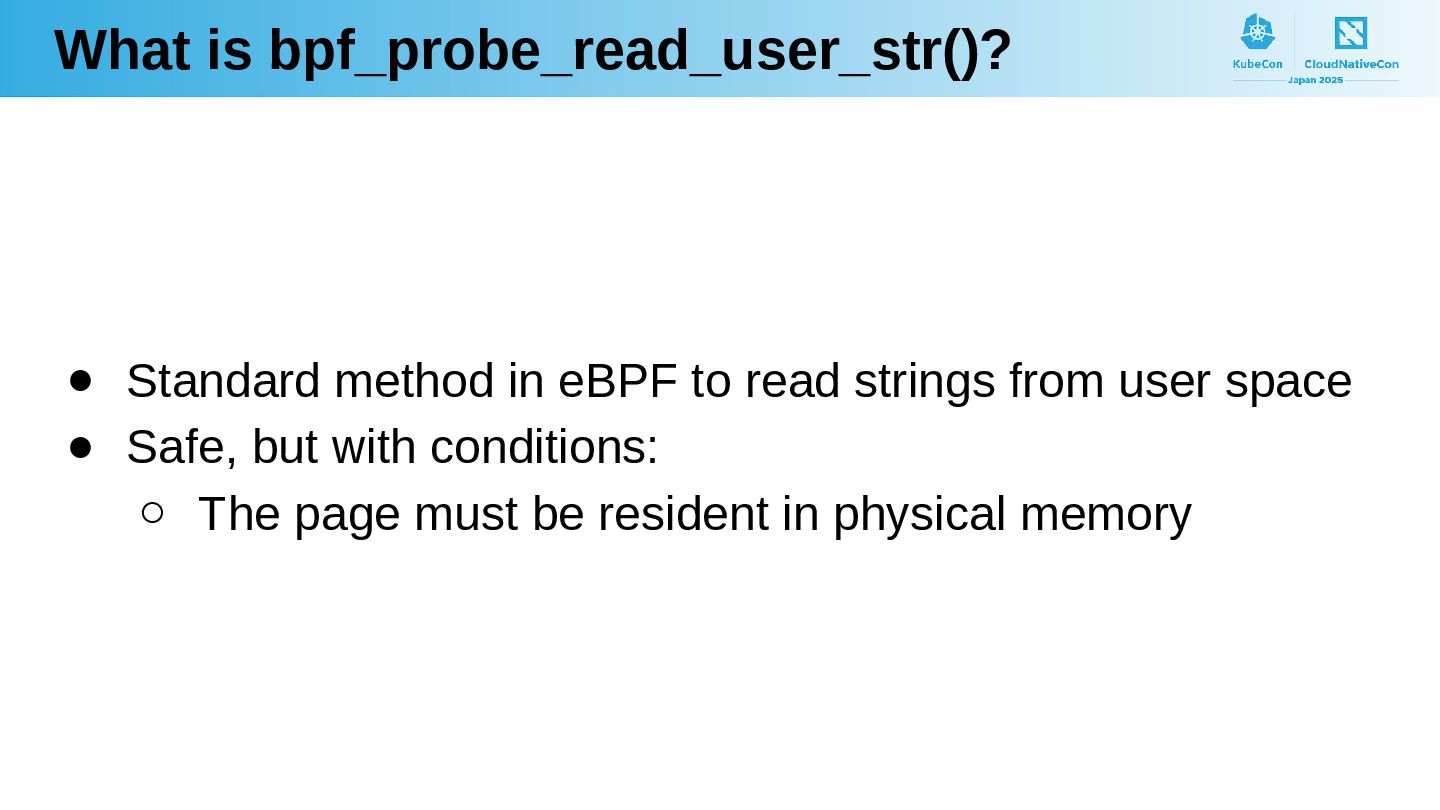
  3. What is bpf_probe_read_user_str()? • Standard method in eBPF to read

    strings from user space • Safe, but with conditions: ◦ The page must be resident in physical memory
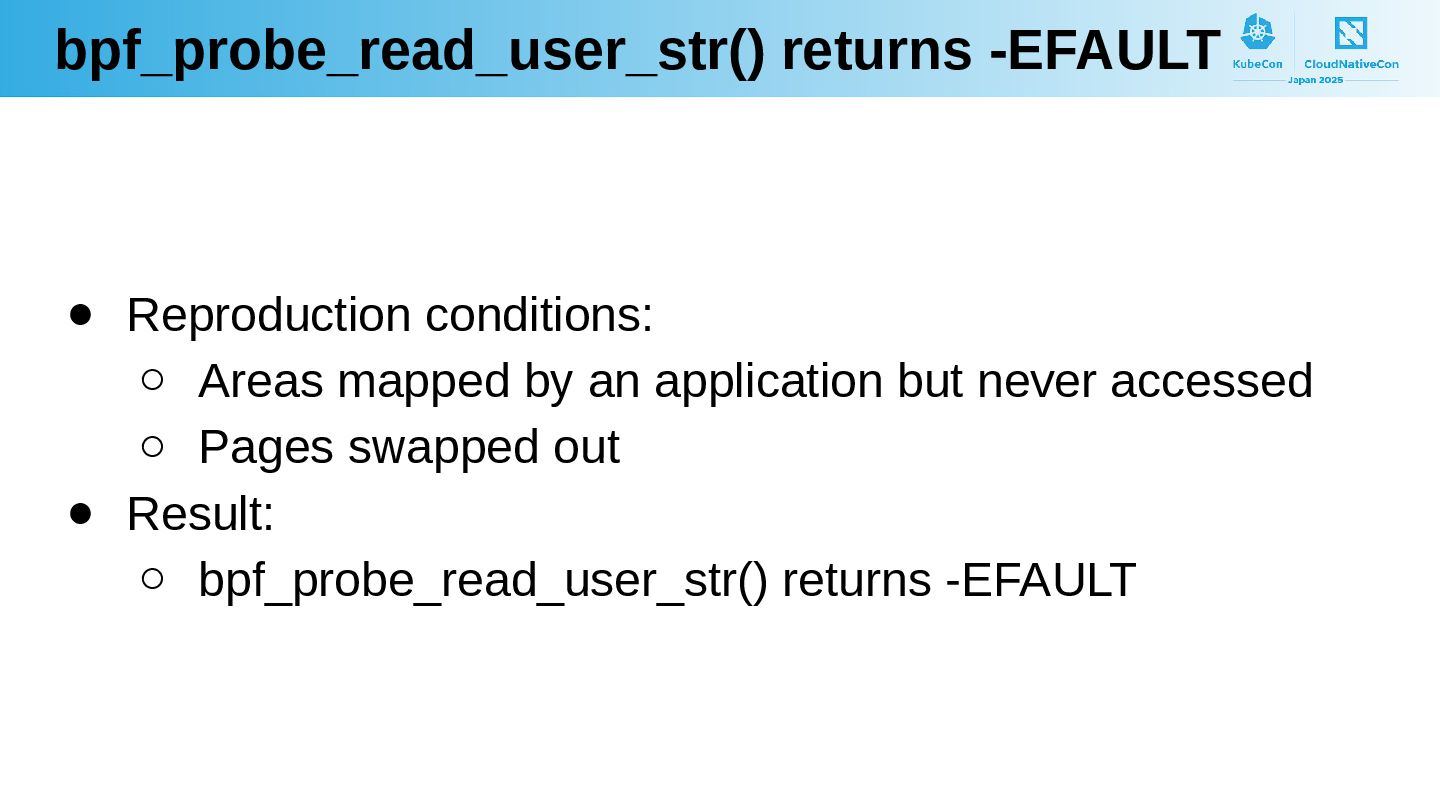
  4. bpf_probe_read_user_str() returns -EFAULT • Reproduction conditions: ◦ Areas mapped by

    an application but never accessed ◦ Pages swapped out • Result: ◦ bpf_probe_read_user_str() returns -EFAULT
  5. What is Page-Out? • Mechanism of virtual memory ◦ Not

    all pages are always in physical memory • Unused pages are evicted to disk (swap) • A user-space pointer might "exist," but its data may not be physically present
  6. Constraints of Non-Sleepable Context • Most BPF hooks (e.g., kprobe,

    tracepoint) run in non- sleepable contexts • Page faults (which require sleeping) are not allowed • Therefore, bpf_probe_read_user_str() cannot fault in a page, resulting in -EFAULT
  7. Leveraging mincore() and madvise() • mincore() ◦ Allows checking whether

    a given virtual memory page is resident in physical memory ◦ In our demo, we use it to visualize “whether the data is here now • madvise() ◦ A way to give hints to the kernel about memory usage patterns ◦ With MADV_DONTNEED, we can explicitly trigger page eviction • These syscalls enable experimental control over page-in and page-out behavior
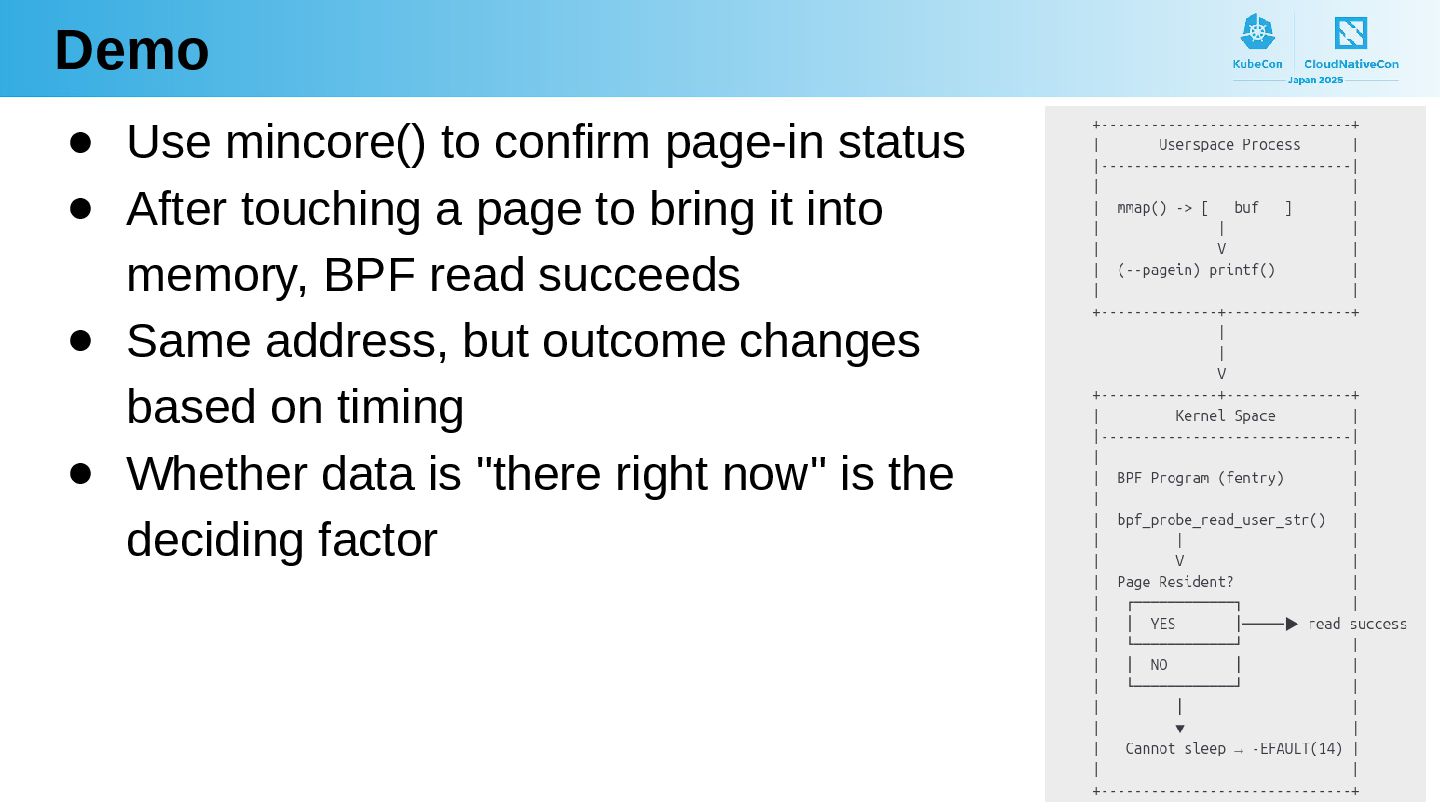
  8. Demo • Use mincore() to confirm page-in status • After

    touching a page to bring it into memory, BPF read succeeds • Same address, but outcome changes based on timing • Whether data is "there right now" is the deciding factor
  9. Summary • Behind strange eBPF errors lie kernel-level mechanisms •

    The true lesson isn't that a read failed, but understanding why it failed

More Decks by Kenta Tada

Other Decks in Programming