Upgrade to Pro — share decks privately, control downloads, hide ads and more …

Staffing and Procurement for Fast Flow

Sponsored · Ship Features Fearlessly Turn features on and off without deploys. Used by thousands of Ruby developers.

Staffing and Procurement for Fast Flow

Organizations striving for adaptive fast flow face a common challenge: how to make staffing and procurement decisions that balance speed, expertise, and cost. While it is often tempting to assume that building everything in-house is the best option, the reality is more complex. Constraints in recruiting, budgets, and available know-how require pragmatic, context-sensitive approaches.

In this talk, I will examine how organizations can develop staffing and procurement strategies that actively support fast flow. The session will begin with the motivation behind addressing this topic, followed by a structured exploration of available options: internal teams, outsourcing (on-location, near-shore, off-shore and also AI), off-the-shelf solutions with or without customization, and Software-as-a-Service.

To support effective decision-making, I will demonstrate how Wardley Maps, Cynefin, and DDD domain classifications can be used as heuristics to evaluate which staffing and procurement approaches are appropriate in a given strategic context. Attendees will learn how to apply these perspectives to design delivery organizations that remain adaptable, resilient, and efficient over time.

Target Audience: Architects, engineering leaders, and decision-makers who are responsible for setting up and evolving delivery organizations.

Key Takeaways:

* A structured understanding of the staffing and procurement landscape
* Decision heuristics to evaluate sourcing strategies in context
* Practical guidance on combining architectural and organizational perspectives to achieve fast flow

Avatar for Michael Plöd

Michael Plöd

March 12, 2026
Tweet

More Decks by Michael Plöd

Other Decks in Business

Transcript

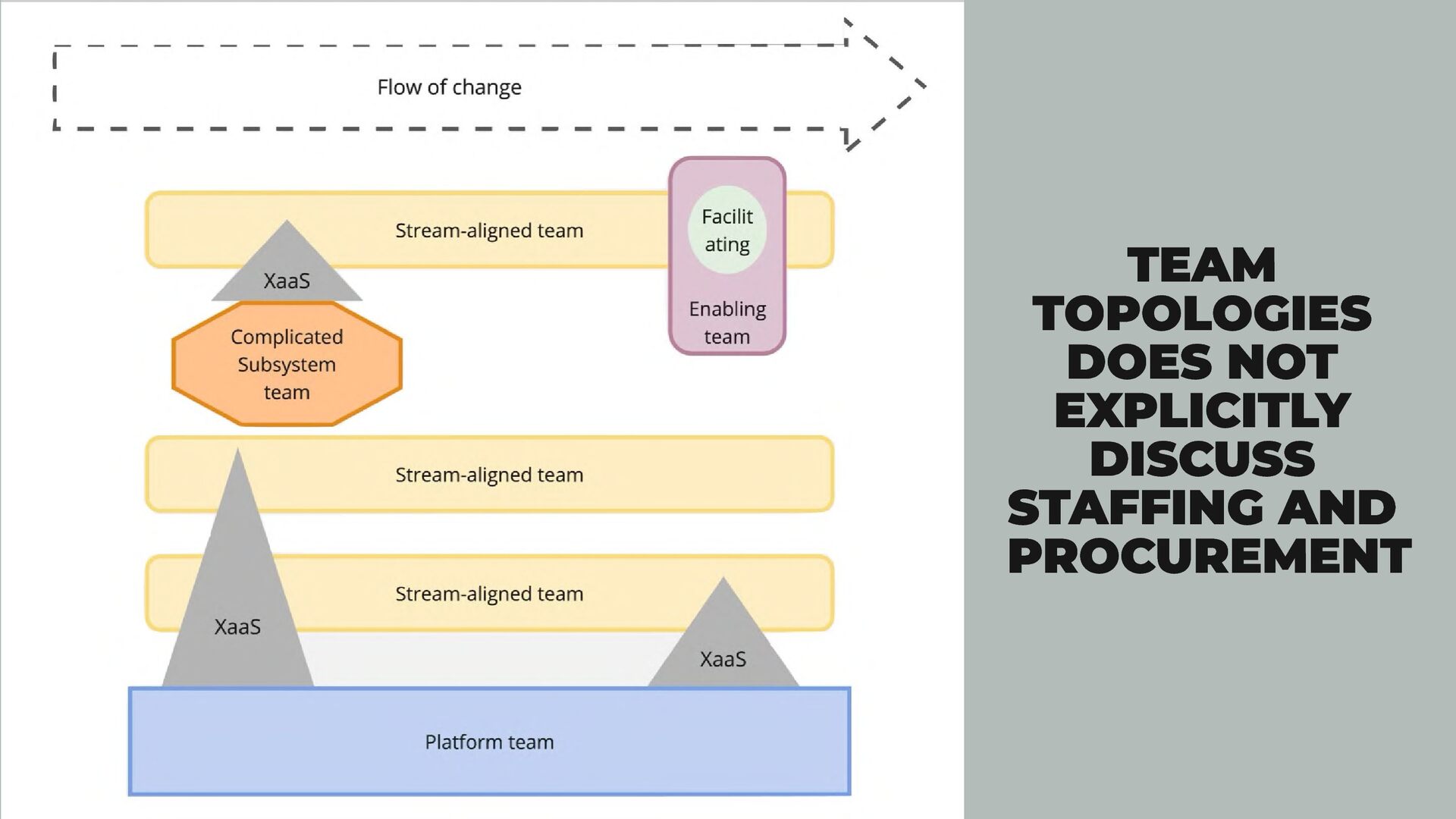
  1. WHY DO WE NEED A TALK ABOUT THIS? ISN’T THIS

    ALREADY ADRESSED BY TEAM TOPOLOGIES?
  2. Domain ownership by stable, long-term teams Internal expertise in core

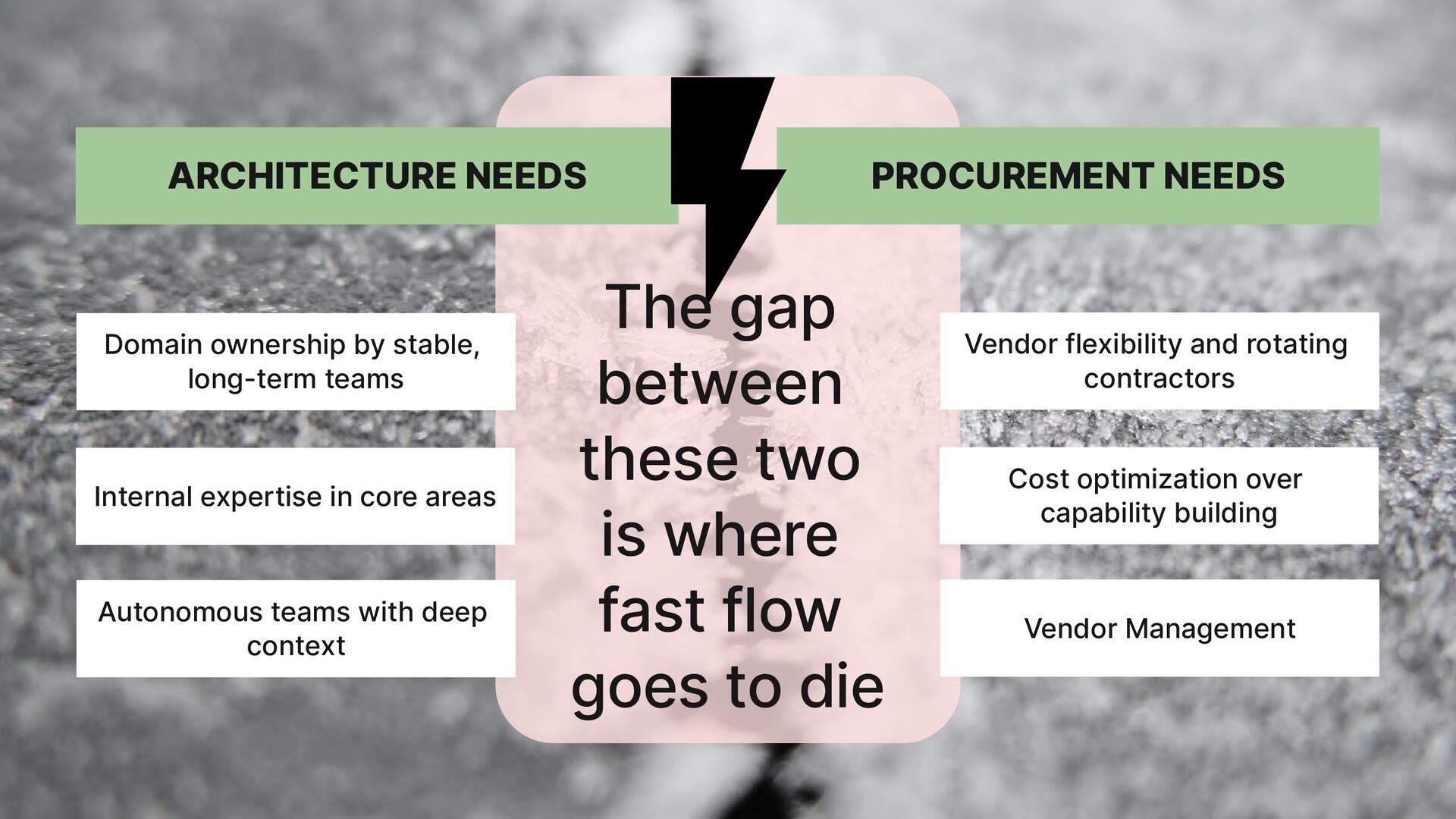
    areas Autonomous teams with deep context ARCHITECTURE NEEDS Vendor flexibility and rotating contractors Cost optimization over capability building Vendor Management PROCUREMENT NEEDS The gap between these two is where fast flow goes to die
  3. “The fact that software delivery performance matters provides a strong

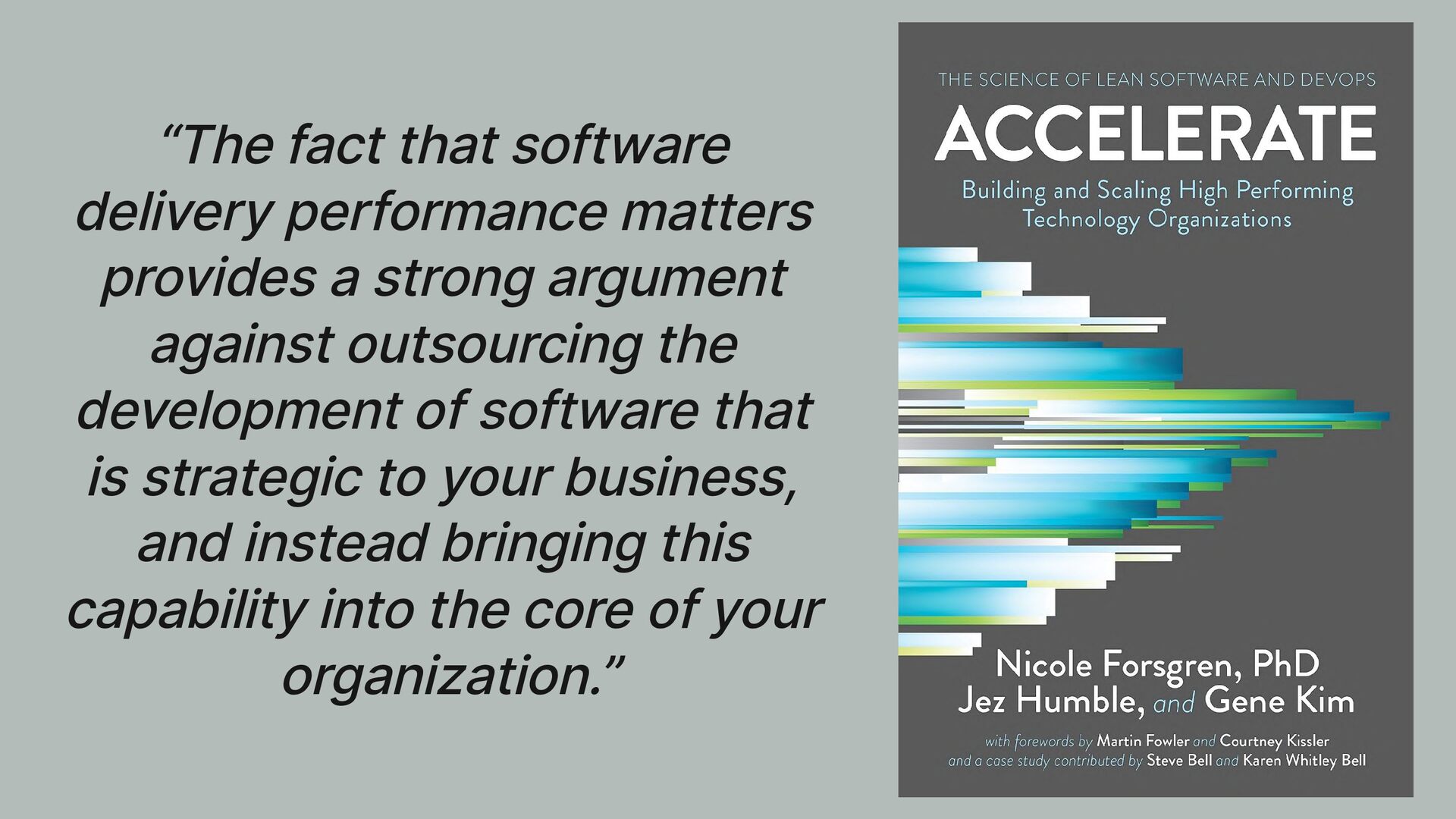
    argument against outsourcing the development of software that is strategic to your business, and instead bringing this capability into the core of your organization.”
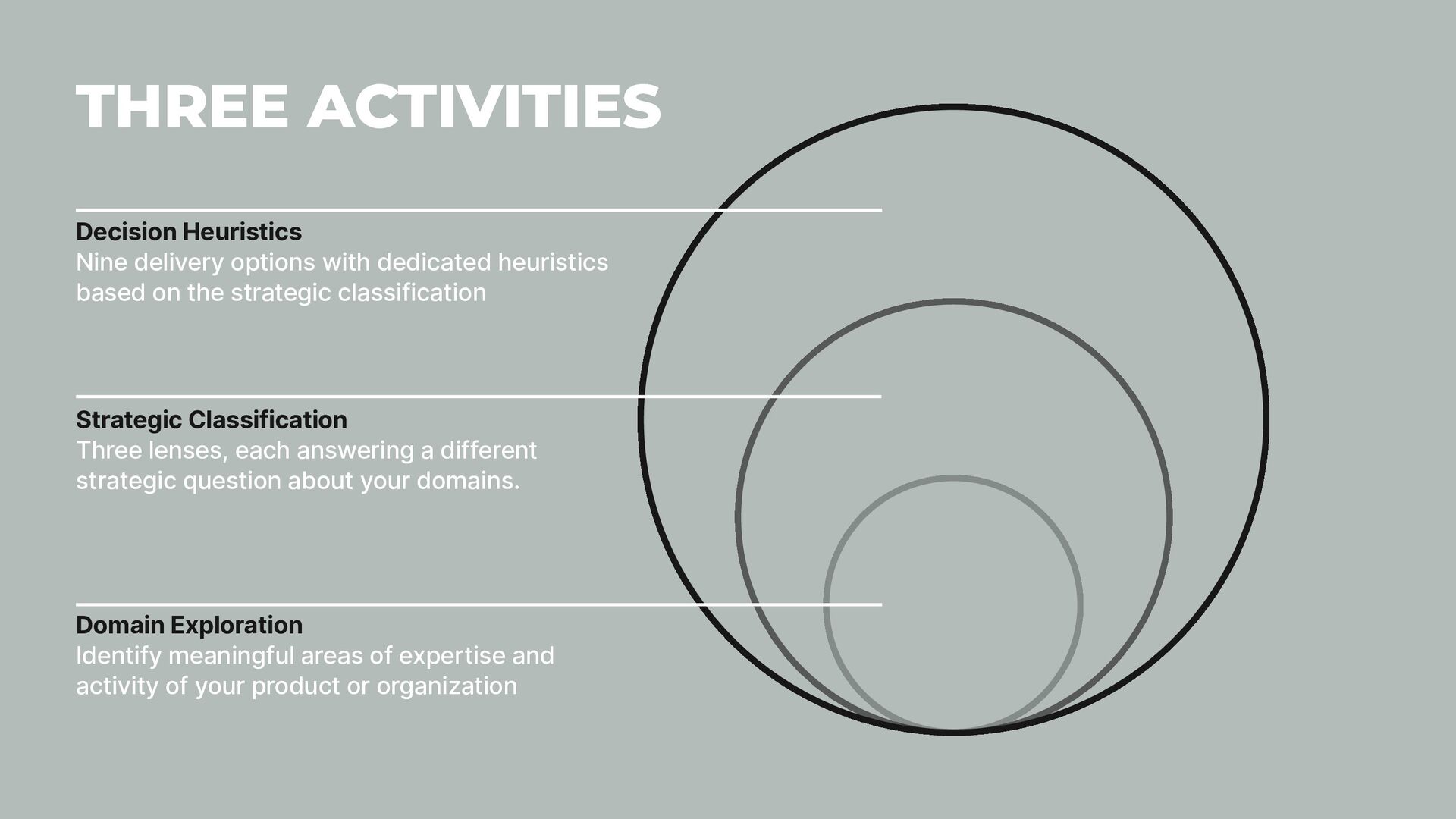
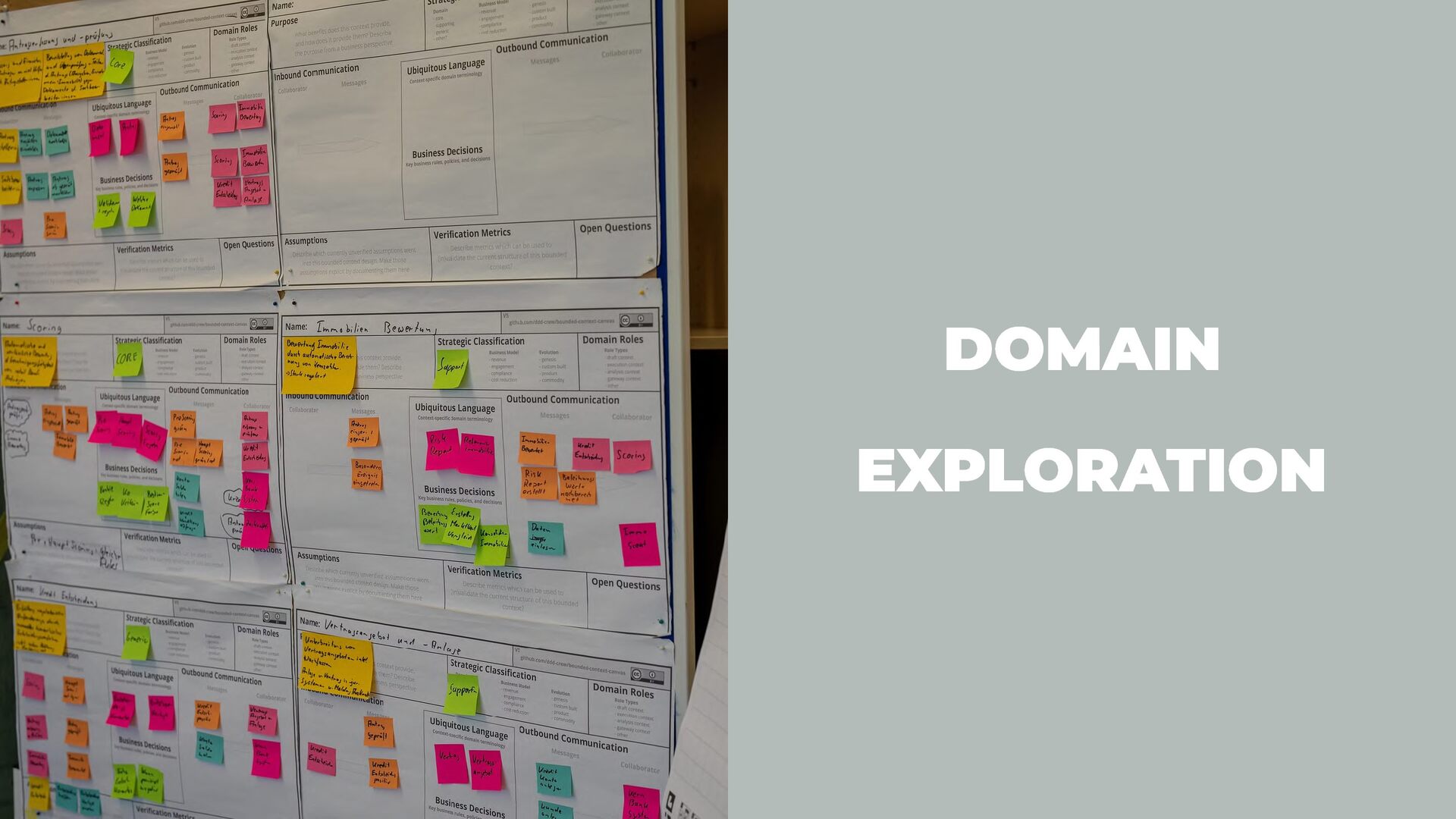
  4. Domain Exploration Identify meaningful areas of expertise and activity of

    your product or organization THREE ACTIVITIES Strategic Classification Three lenses, each answering a different strategic question about your domains. Decision Heuristics Nine delivery options with dedicated heuristics based on the strategic classification
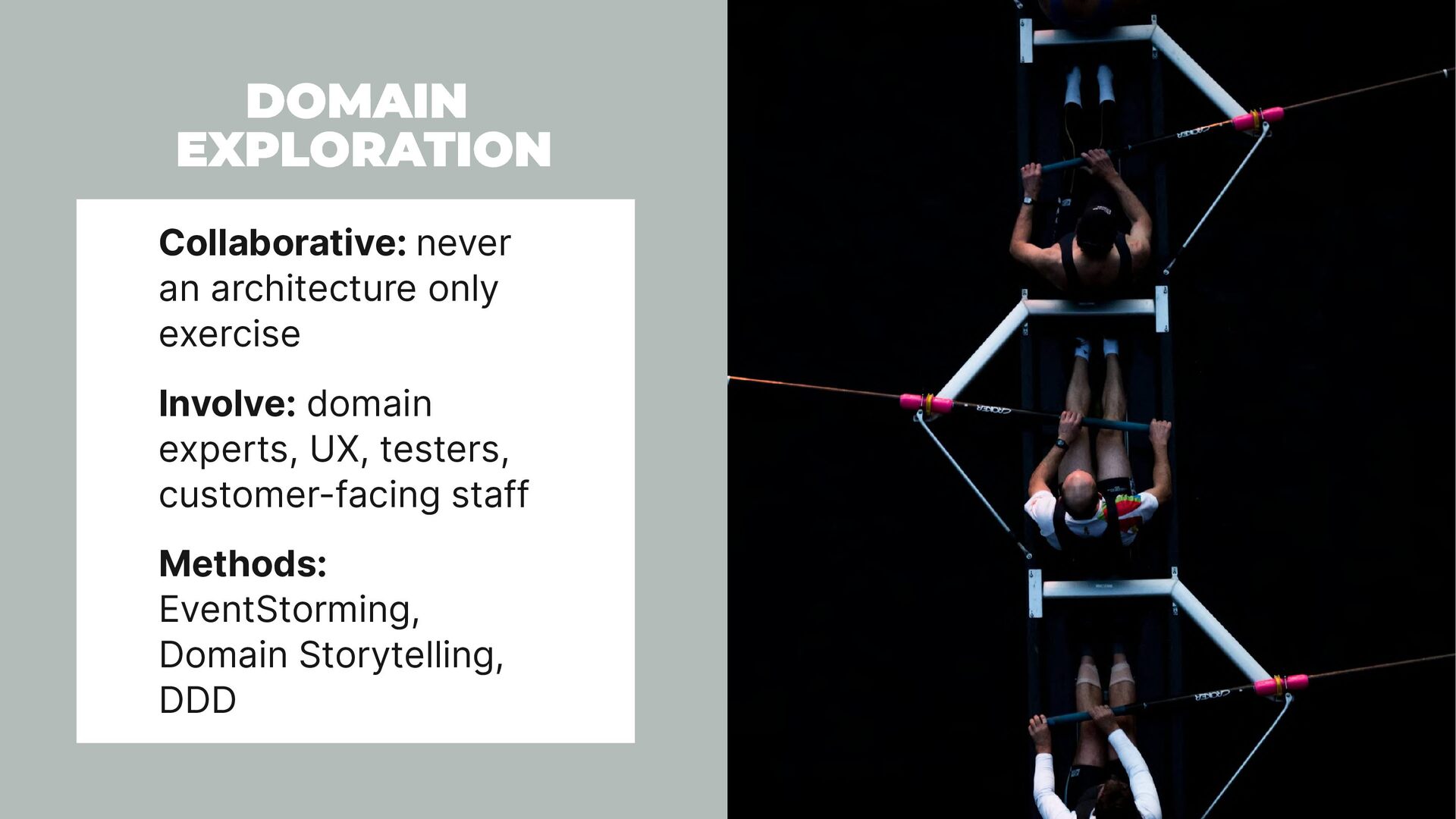
  5. DOMAIN EXPLORATION Collaborative: never an architecture only exercise Involve: domain

    experts, UX, testers, customer-facing staff Methods: EventStorming, Domain Storytelling, DDD
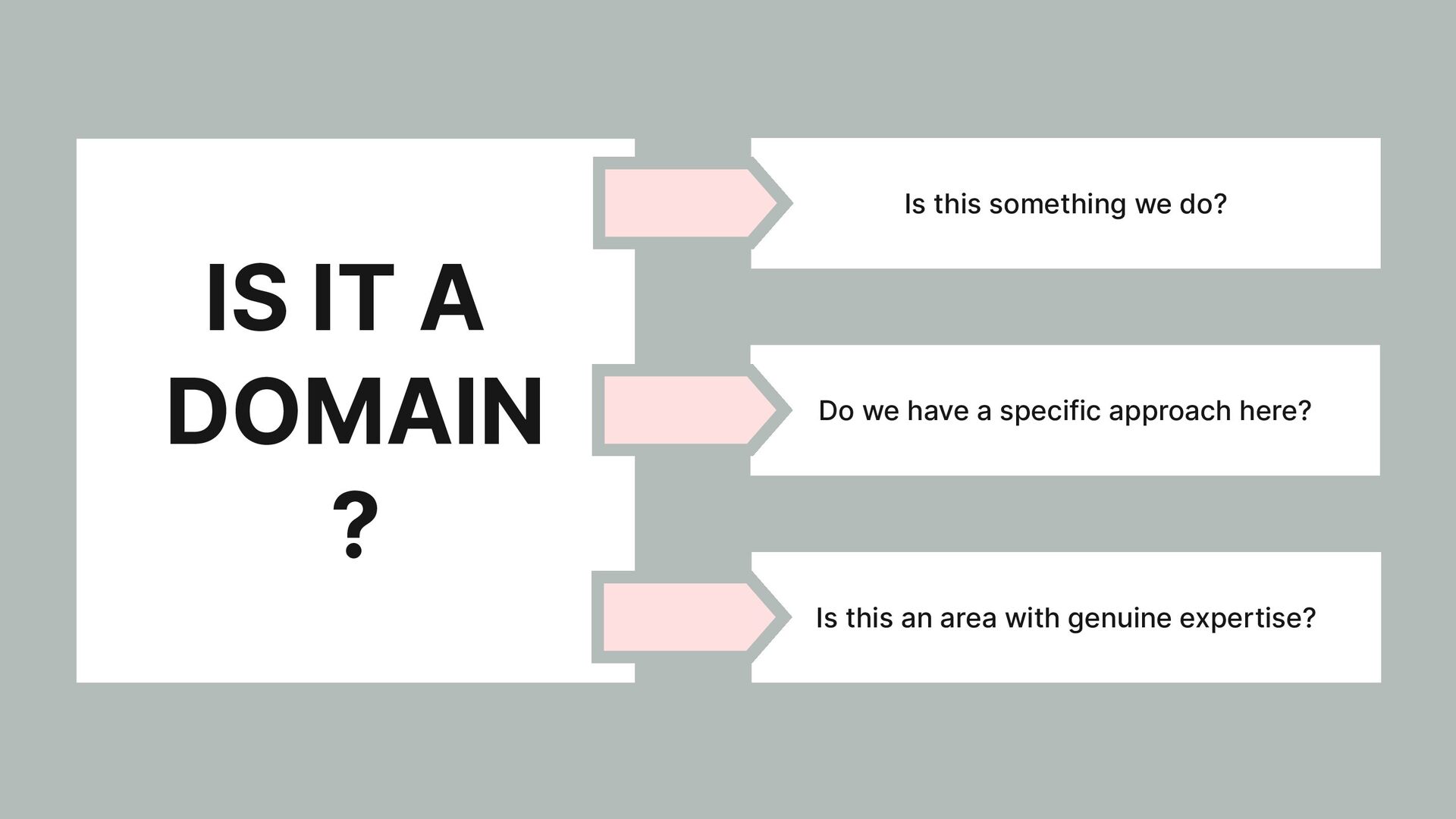
  6. IS IT A DOMAIN ? Is this something we do?

    Do we have a specific approach here? Is this an area with genuine expertise?
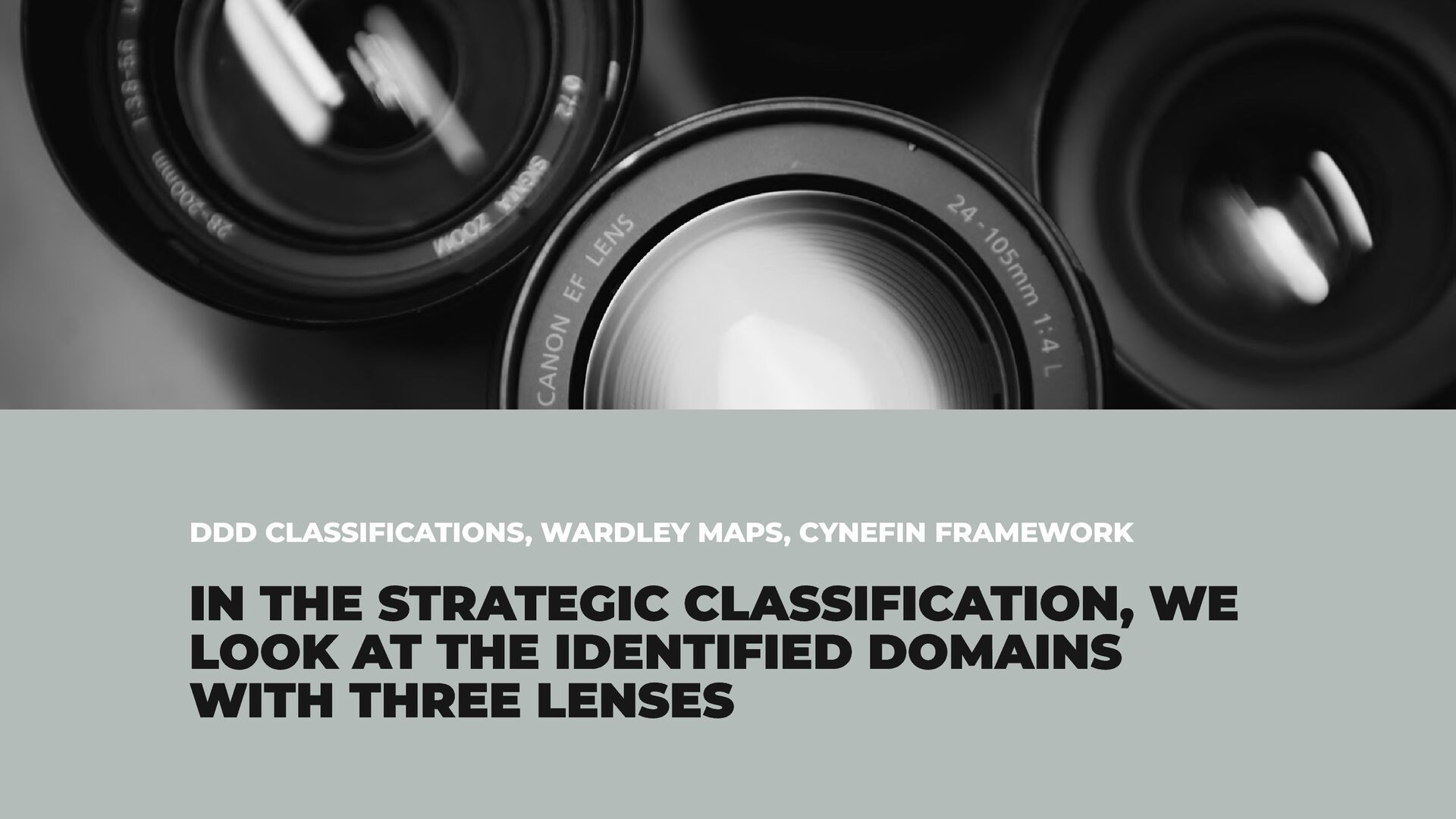
  7. IN THE STRATEGIC CLASSIFICATION, WE LOOK AT THE IDENTIFIED DOMAINS

    WITH THREE LENSES DDD CLASSIFICATIONS, WARDLEY MAPS, CYNEFIN FRAMEWORK
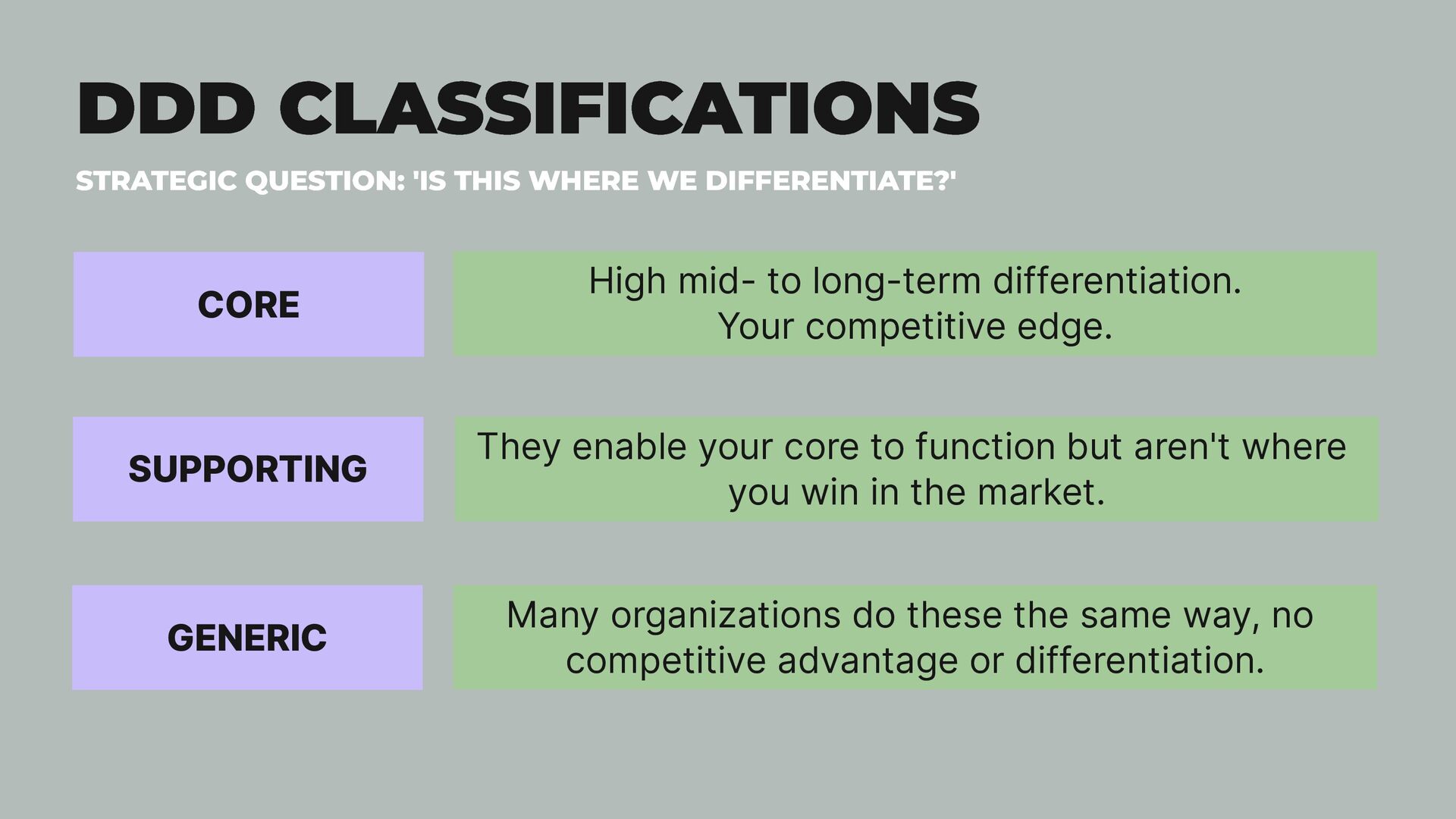
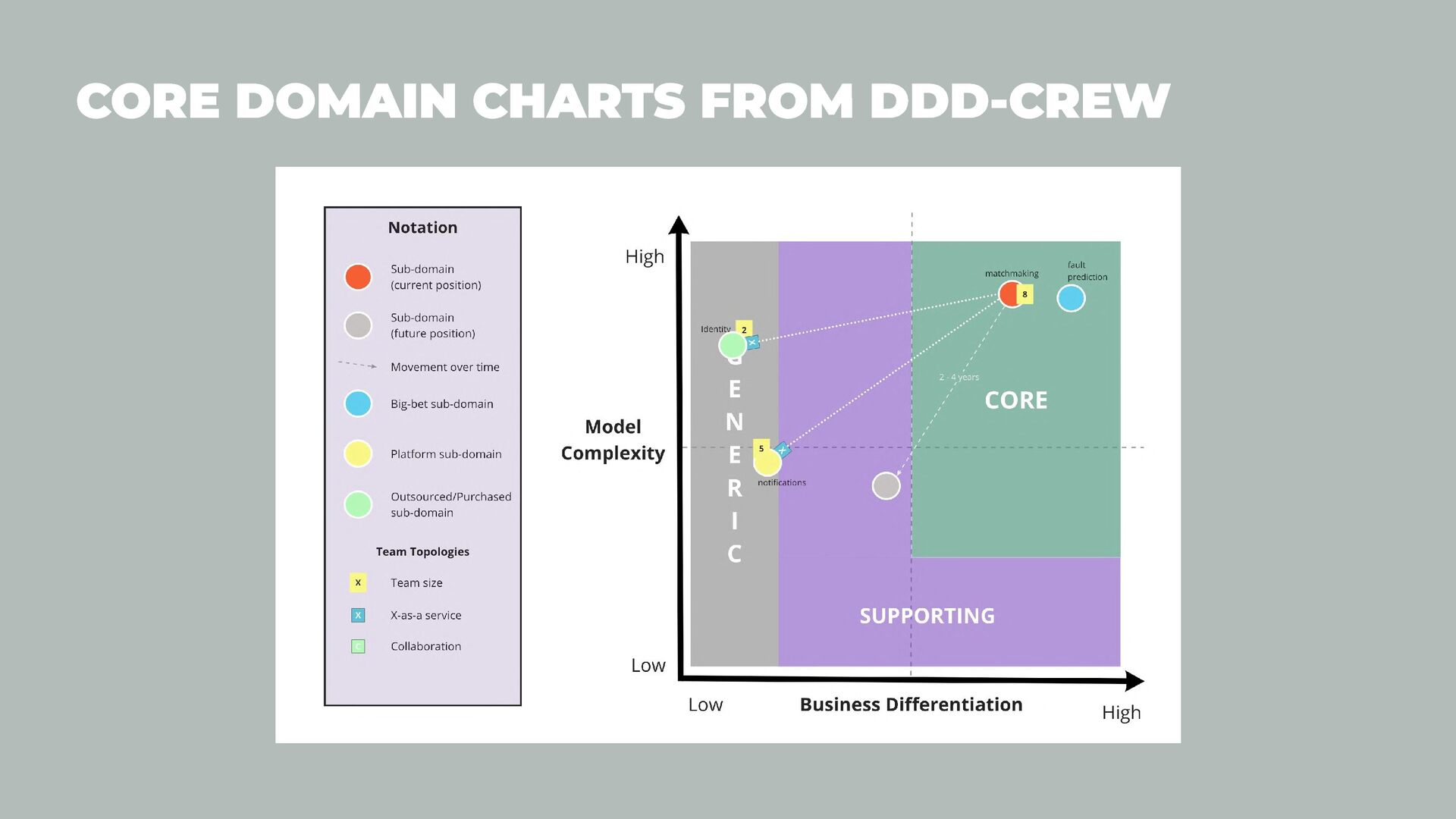
  8. STRATEGIC QUESTION: 'IS THIS WHERE WE DIFFERENTIATE?' DDD CLASSIFICATIONS CORE

    SUPPORTING GENERIC High mid- to long-term differentiation. Your competitive edge. They enable your core to function but aren't where you win in the market. Many organizations do these the same way, no competitive advantage or differentiation.
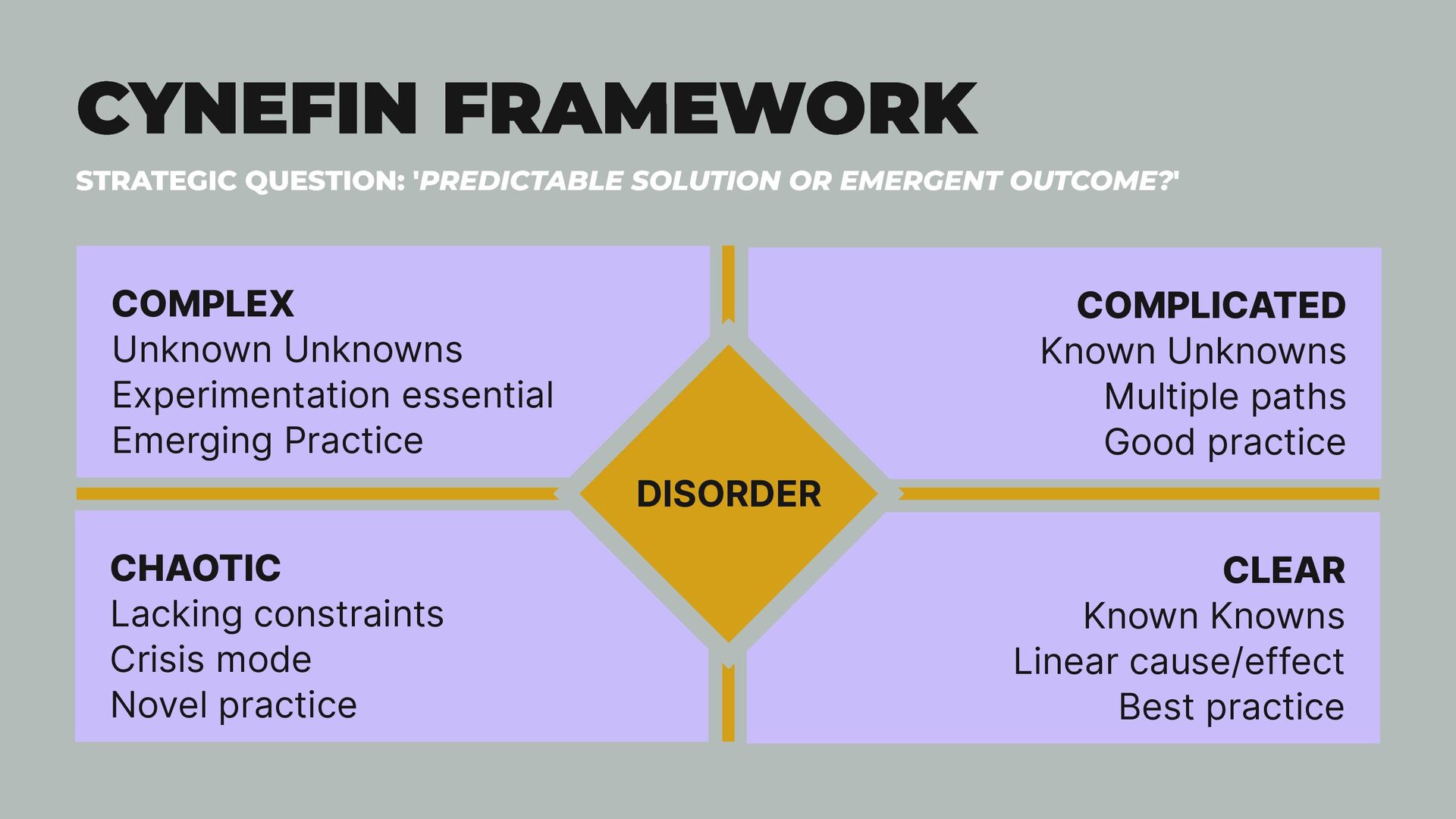
  9. STRATEGIC QUESTION: 'PREDICTABLE SOLUTION OR EMERGENT OUTCOME?' CYNEFIN FRAMEWORK COMPLEX

    Unknown Unknowns Experimentation essential Emerging Practice COMPLICATED Known Unknowns Multiple paths Good practice CHAOTIC Lacking constraints Crisis mode Novel practice CLEAR Known Knowns Linear cause/effect Best practice DISORDER
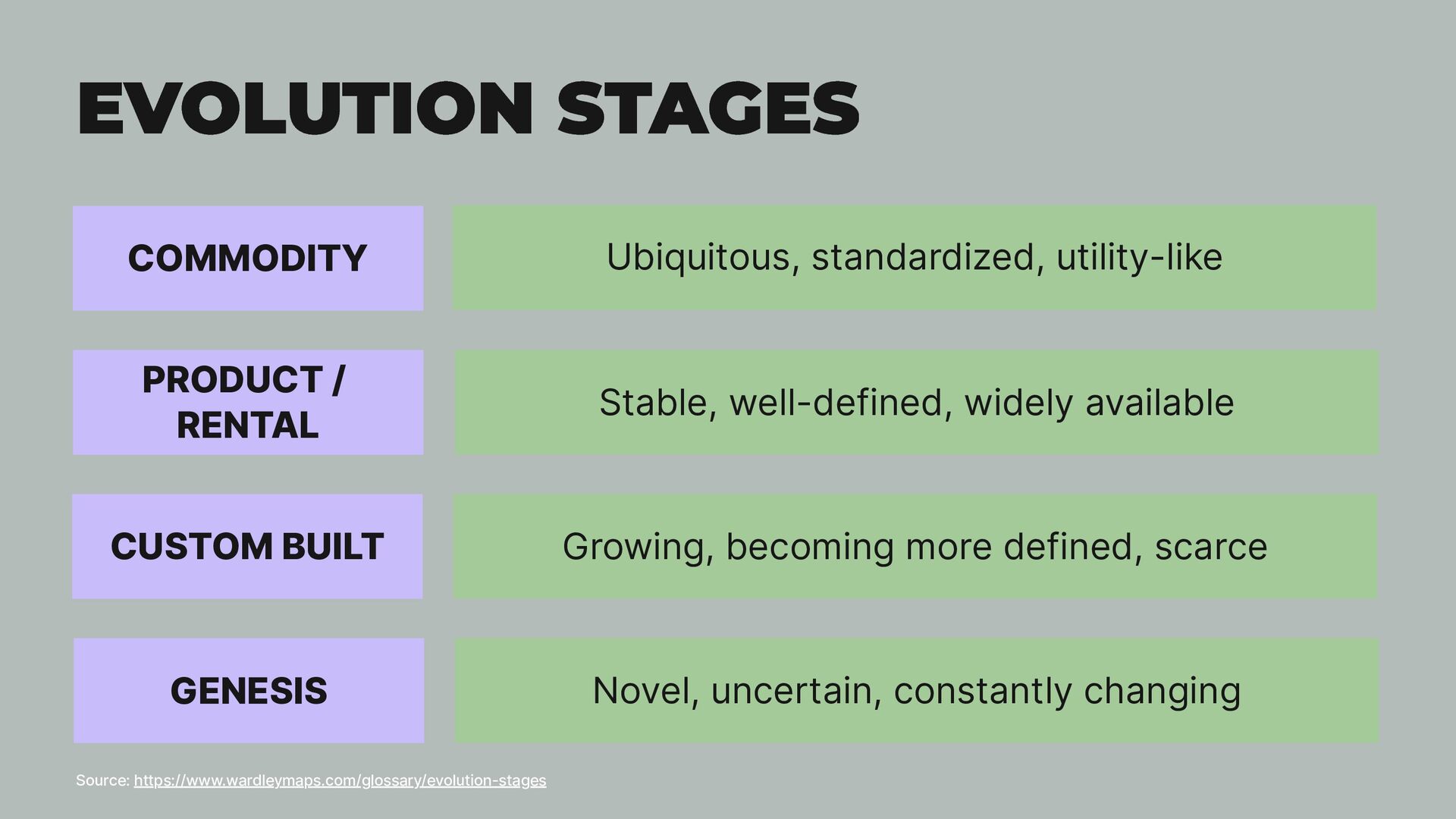
  10. EVOLUTION STAGES COMMODITY Ubiquitous, standardized, utility-like PRODUCT / RENTAL Stable,

    well-defined, widely available CUSTOM BUILT Growing, becoming more defined, scarce GENESIS Novel, uncertain, constantly changing Source: https://www.wardleymaps.com/glossary/evolution-stages
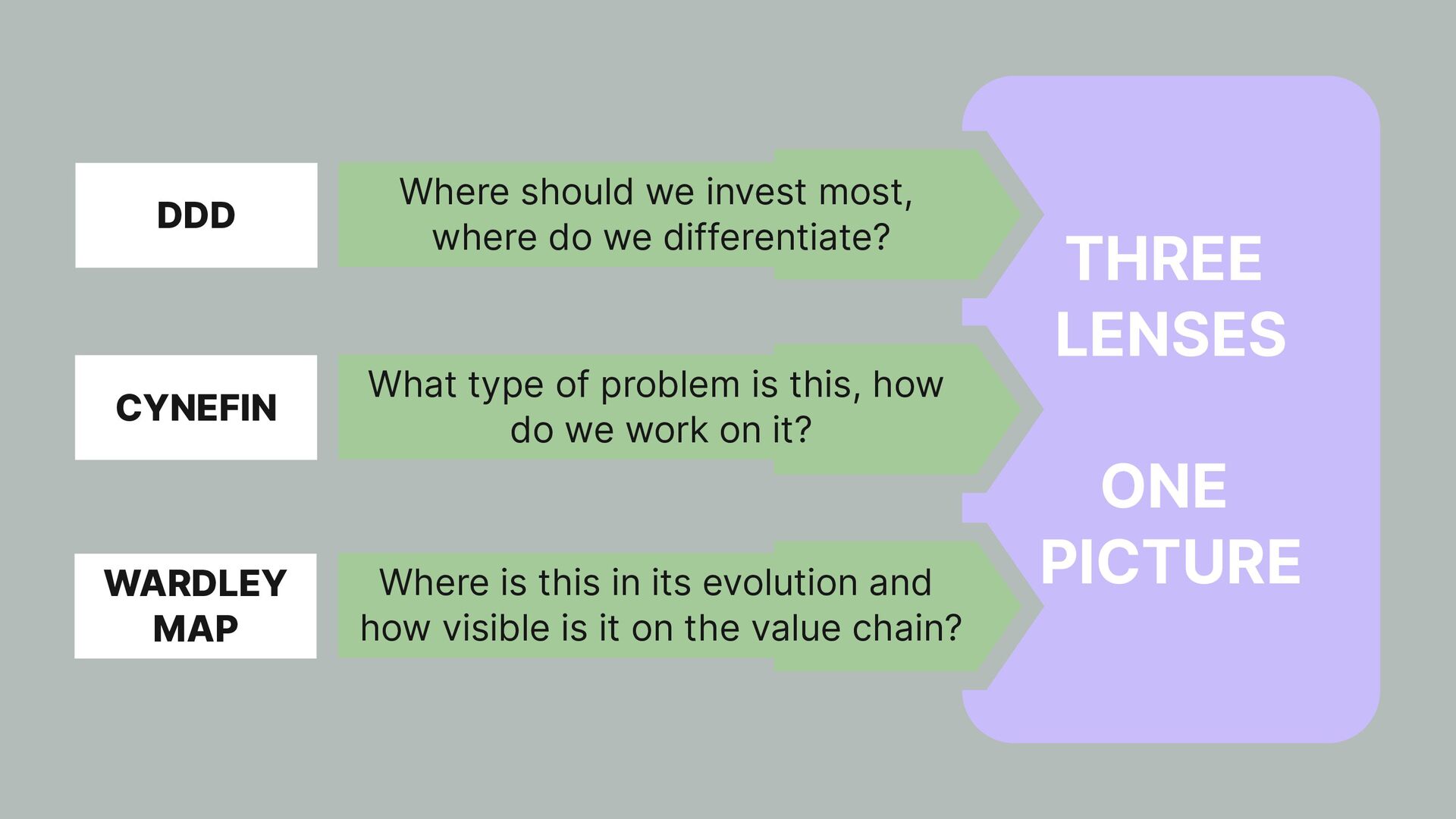
  11. THREE LENSES ONE PICTURE Where should we invest most, where

    do we differentiate? What type of problem is this, how do we work on it? Where is this in its evolution and how visible is it on the value chain? DDD​ CYNEFIN WARDLEY ​ MAP
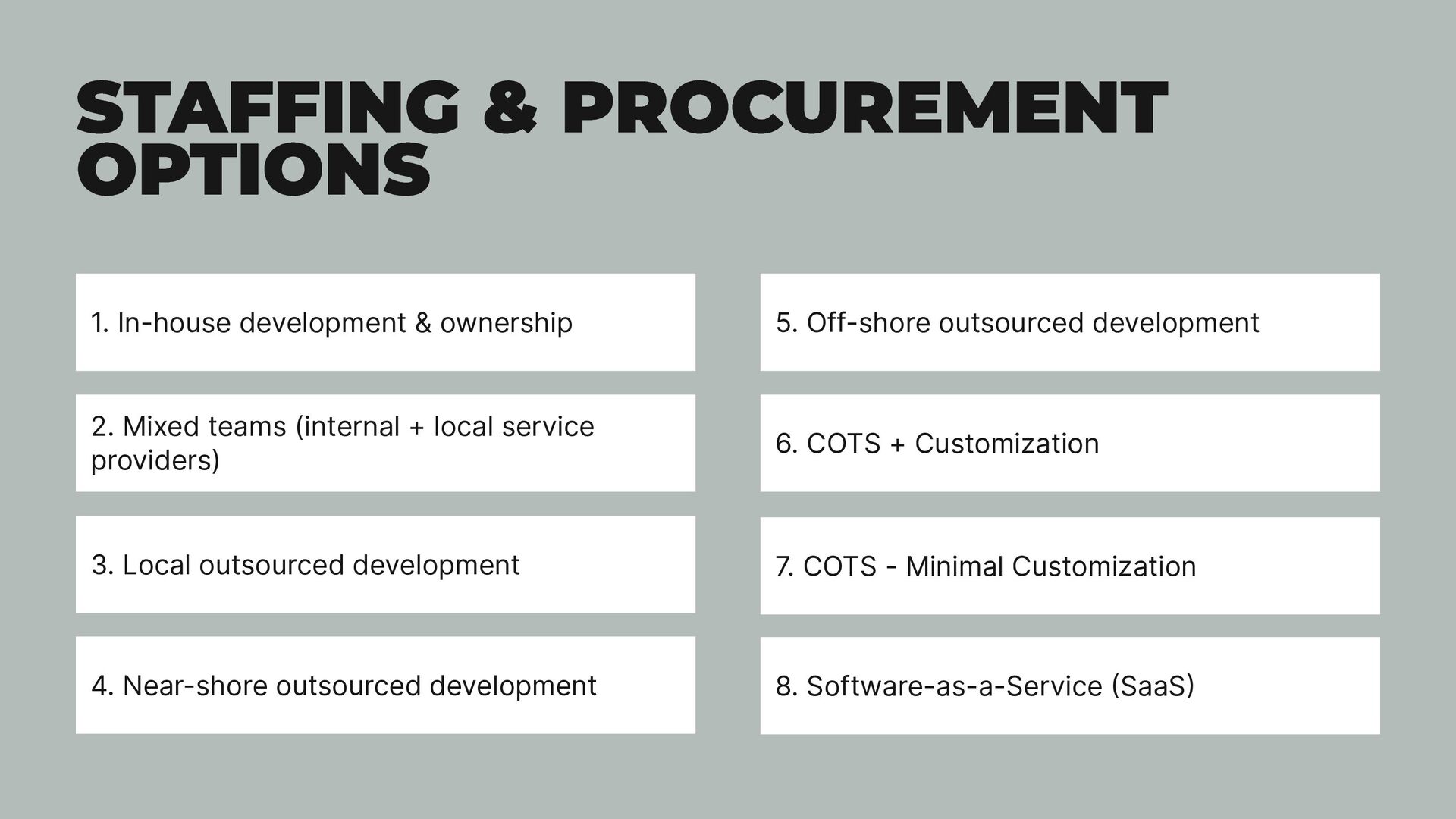
  12. 1. In-house development & ownership 2. Mixed teams (internal +

    local service providers) 3. Local outsourced development 4. Near-shore outsourced development 5. Off-shore outsourced development 6. COTS + Customization 7. COTS - Minimal Customization 8. Software-as-a-Service (SaaS) STAFFING & PROCUREMENT OPTIONS
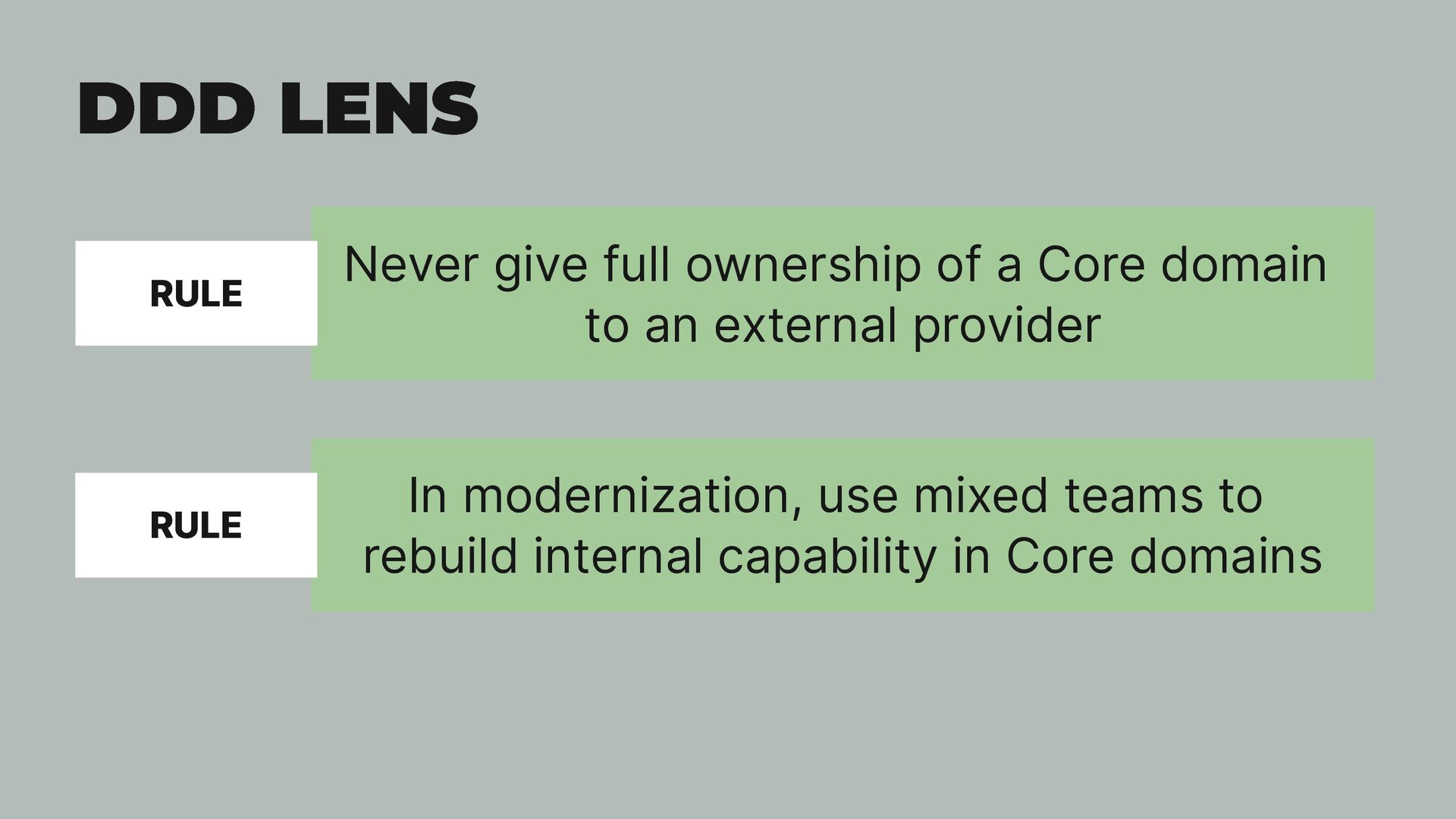
  13. DDD LENS Never give full ownership of a Core domain

    to an external provider RULE​ In modernization, use mixed teams to rebuild internal capability in Core domains RULE​
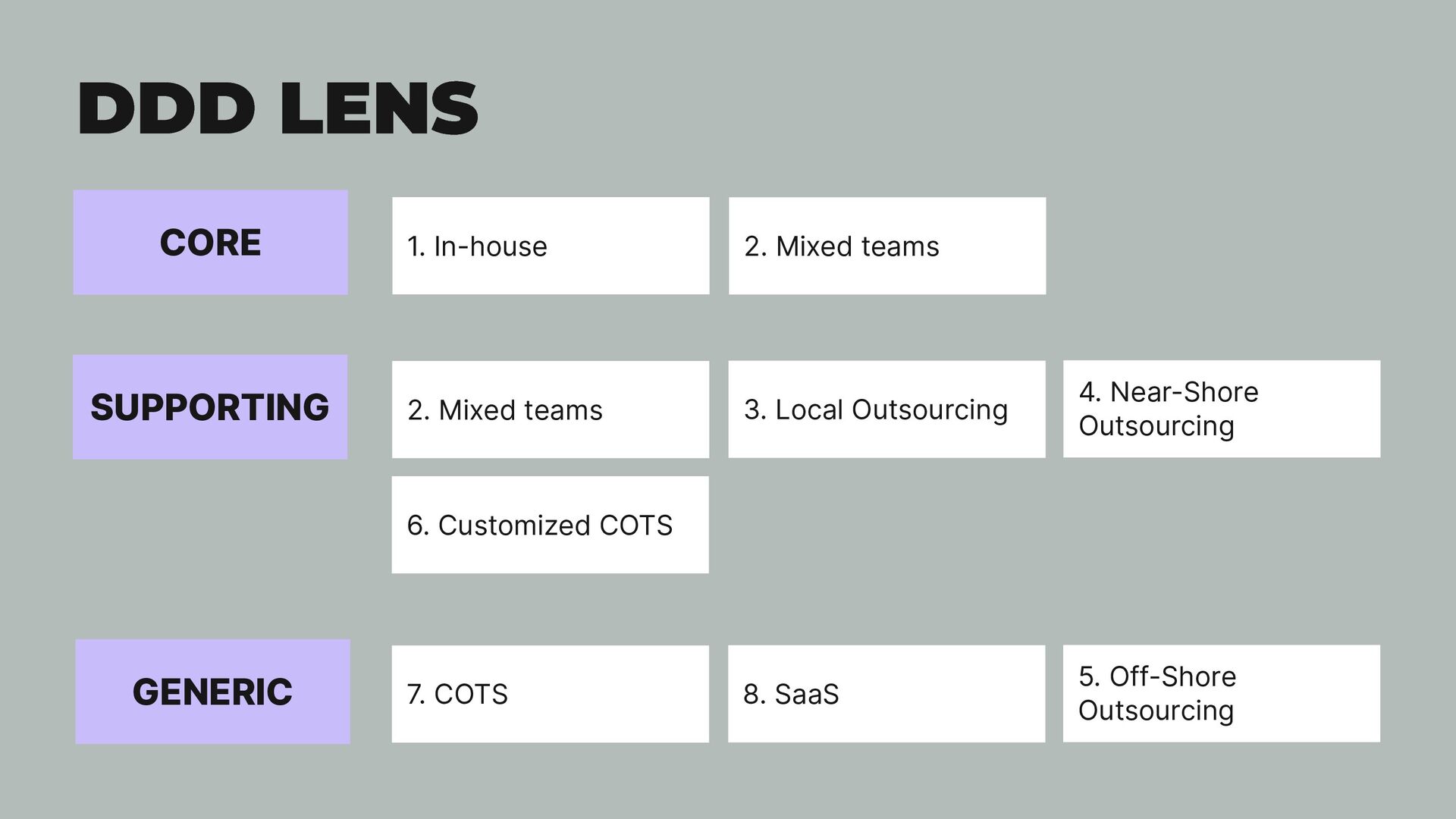
  14. DDD LENS CORE SUPPORTING GENERIC 1. In-house 2. Mixed teams

    2. Mixed teams 3. Local Outsourcing 4. Near-Shore Outsourcing 6. Customized COTS 7. COTS 8. SaaS 5. Off-Shore Outsourcing
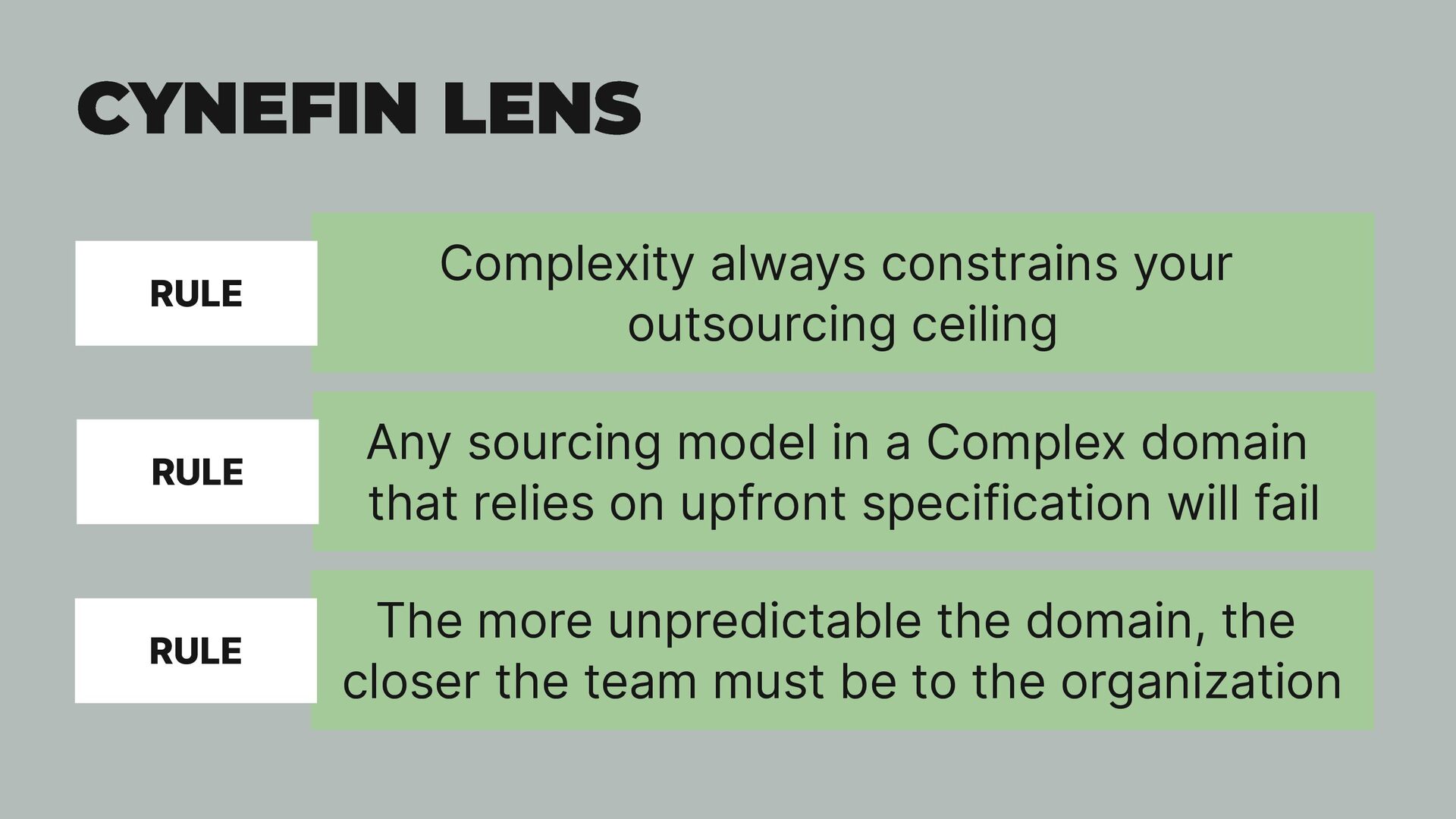
  15. CYNEFIN LENS Complexity always constrains your outsourcing ceiling RULE​ Any

    sourcing model in a Complex domain that relies on upfront specification will fail RULE​ The more unpredictable the domain, the closer the team must be to the organization RULE​
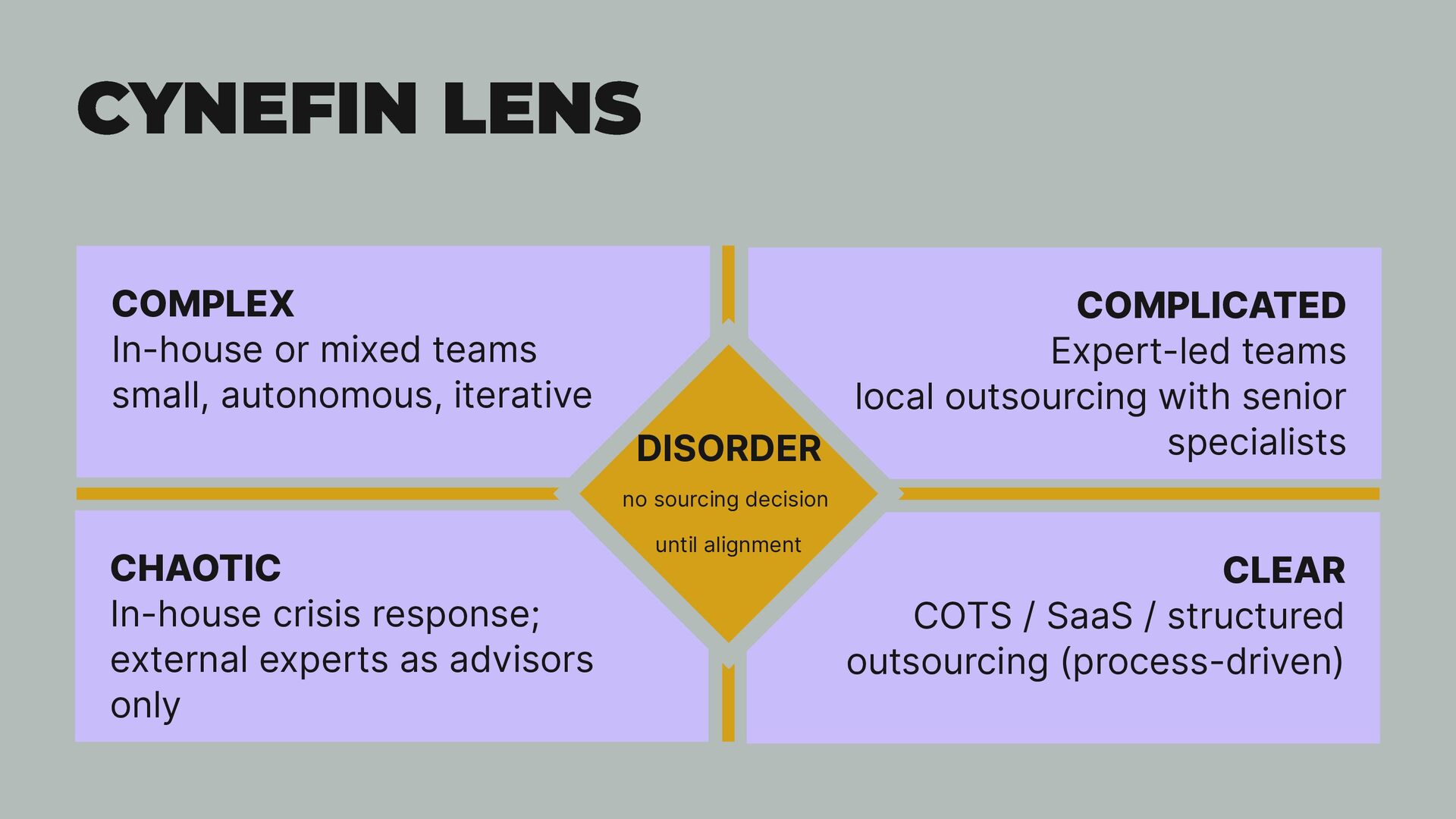
  16. CYNEFIN LENS COMPLEX In-house or mixed teams small, autonomous, iterative

    COMPLICATED Expert-led teams local outsourcing with senior specialists CHAOTIC In-house crisis response; external experts as advisors only CLEAR COTS / SaaS / structured outsourcing (process-driven) DISORDER no sourcing decision until alignment
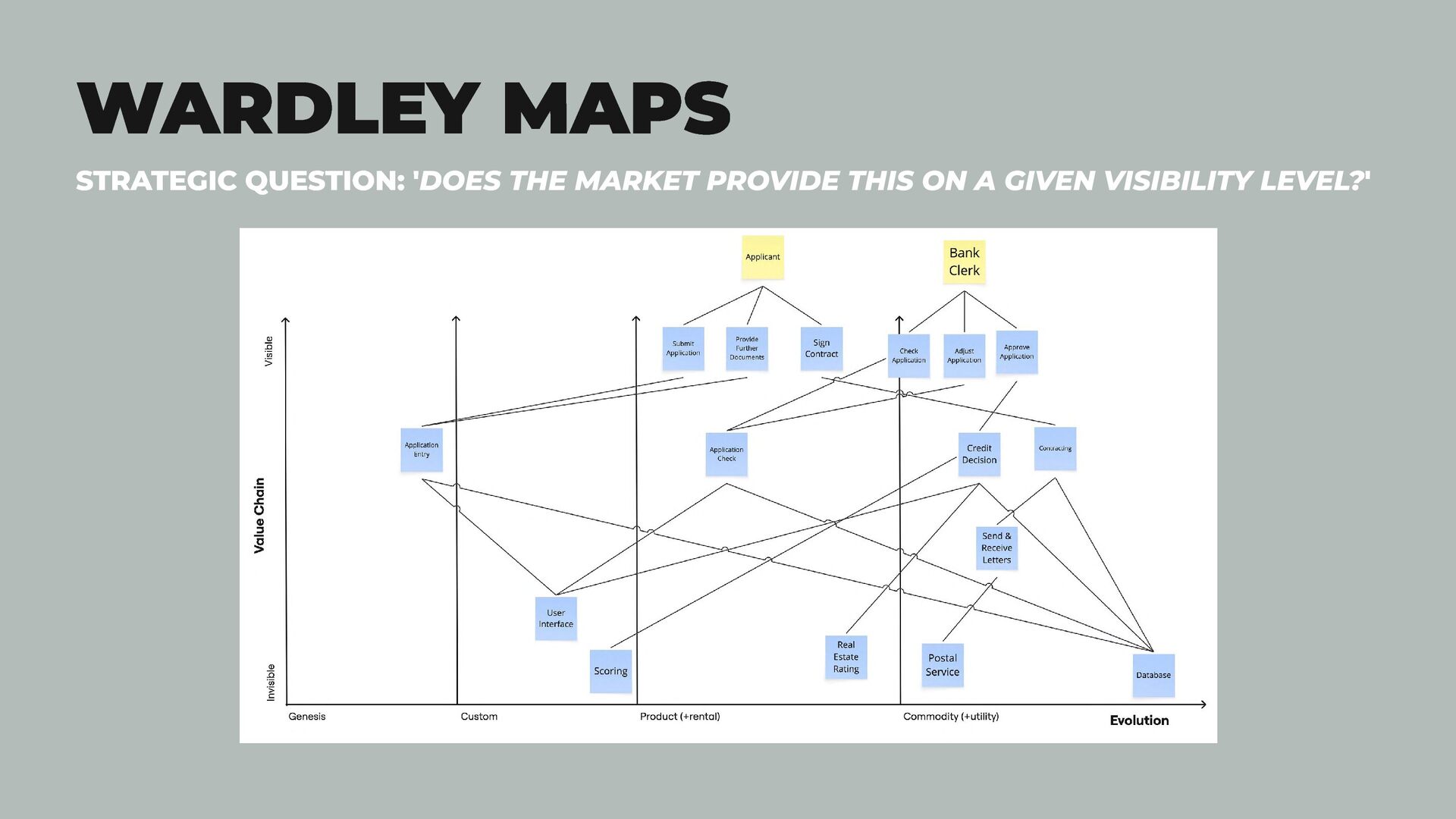
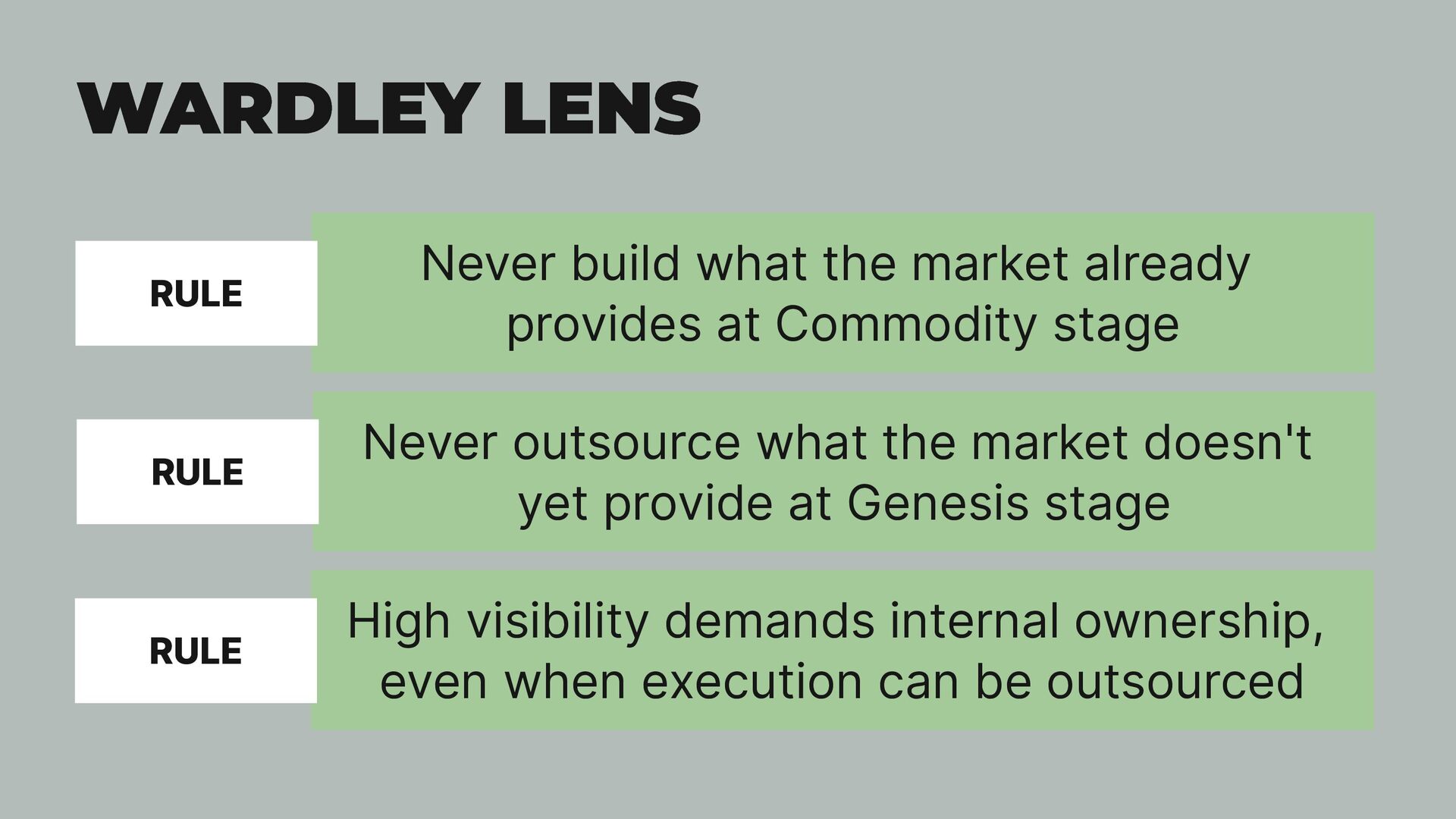
  17. WARDLEY LENS Never build what the market already provides at

    Commodity stage RULE​ Never outsource what the market doesn't yet provide at Genesis stage RULE​ High visibility demands internal ownership, even when execution can be outsourced RULE​
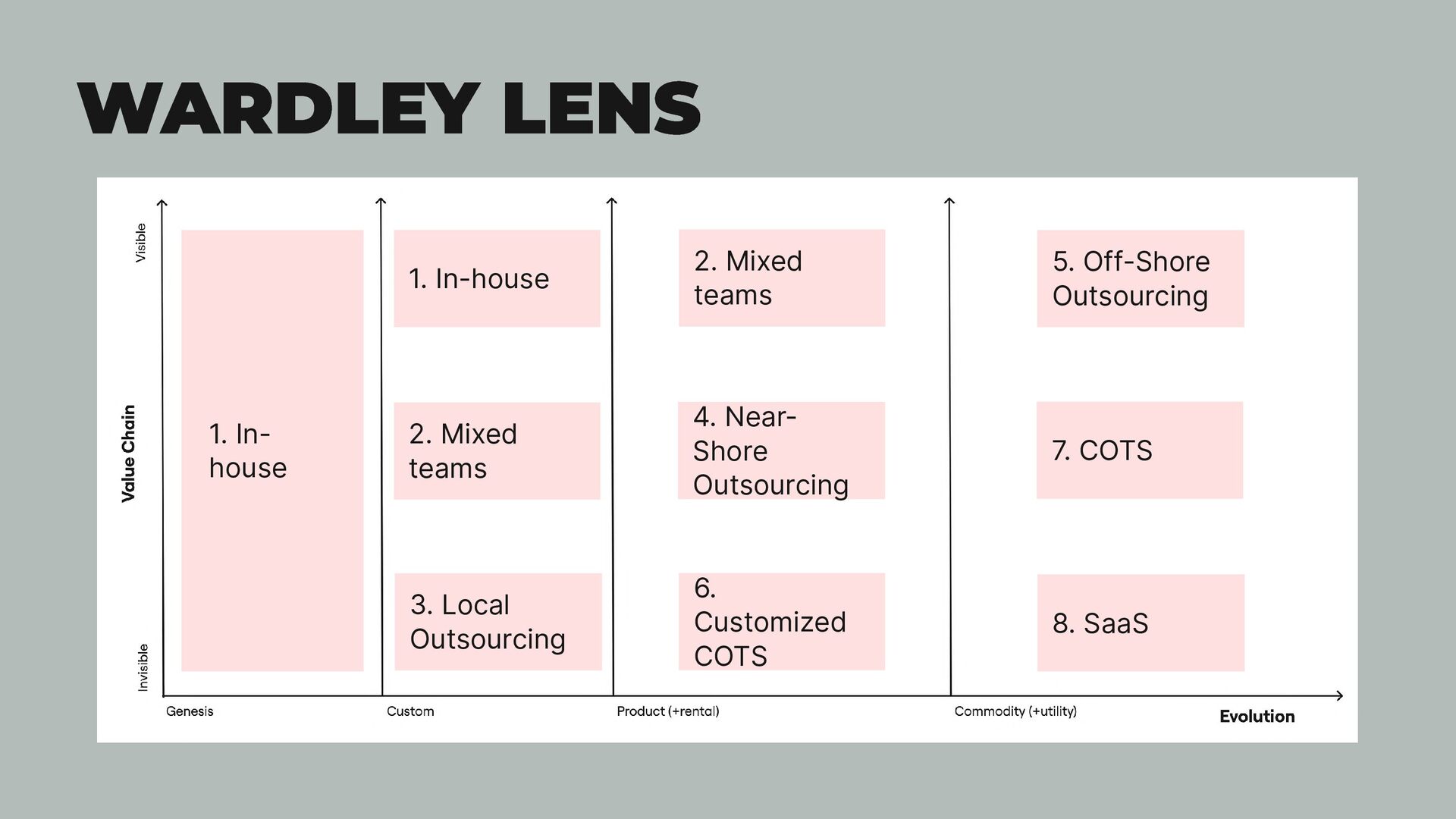
  18. WARDLEY LENS 1. In- house 2. Mixed teams 3. Local

    Outsourcing 4. Near- Shore Outsourcing 6. Customized COTS 7. COTS 8. SaaS 5. Off-Shore Outsourcing 1. In-house 2. Mixed teams
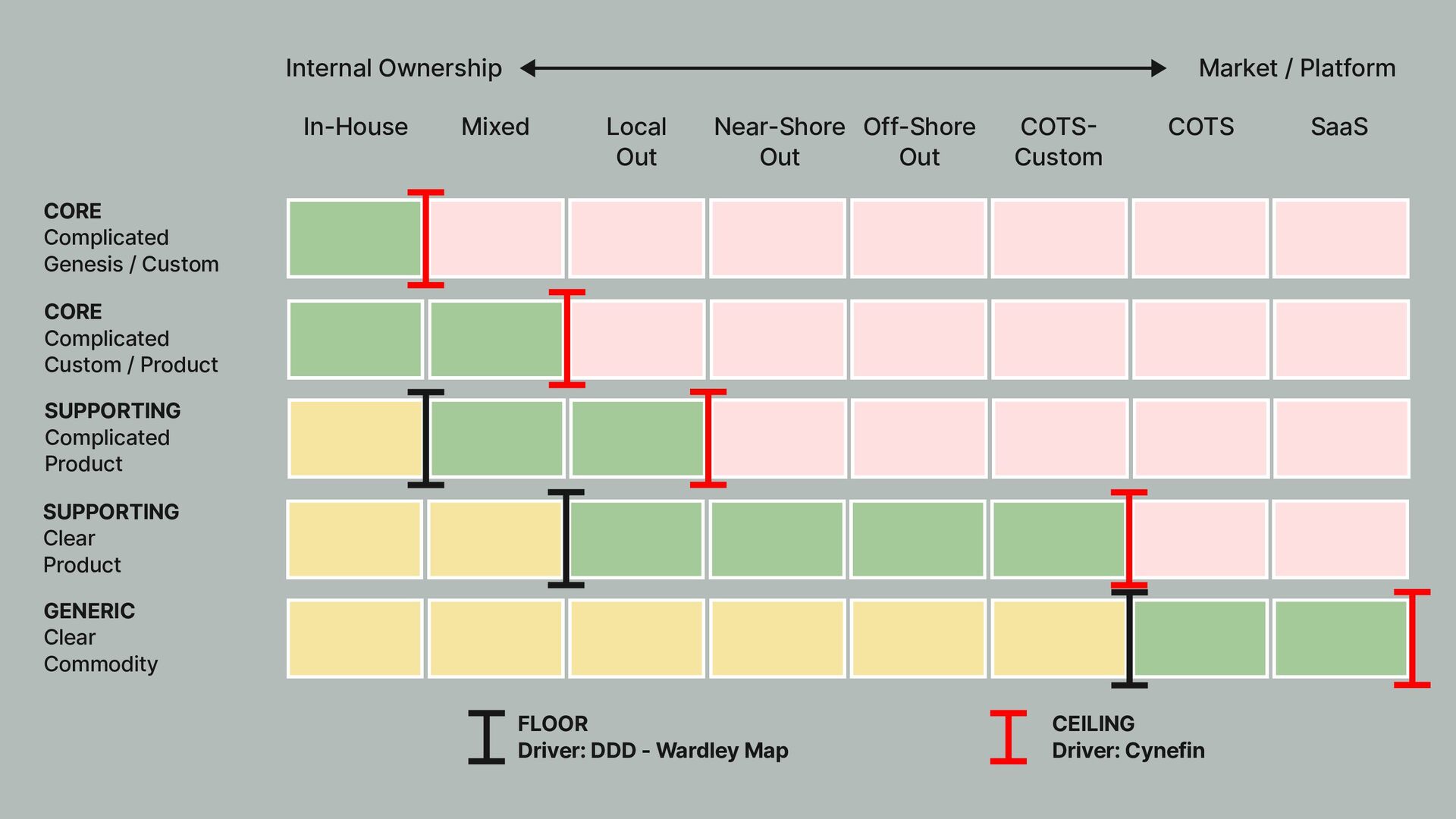
  19. In-House Mixed Local Out Near-Shore Out Off-Shore Out COTS- Custom

    COTS SaaS CORE Complicated Genesis / Custom CORE Complicated Custom / Product SUPPORTING Complicated Product SUPPORTING Clear Product GENERIC Clear Commodity Internal Ownership Market / Platform FLOOR Driver: DDD - Wardley Map CEILING Driver: Cynefin
  20. WARDLEY MAPS LEAVE THE ROOM Wardley already did its job.

    By the time you're asking which AI level is safe, the Wardley decision is already made. Evolution describes the market, not the mind. Wardley's genius is mapping component maturity against market availability. But AI delegation isn't about the component's position in the market. It's about whether the cognitive process of solving the problem can be specified, delegated, or must remain emergent.
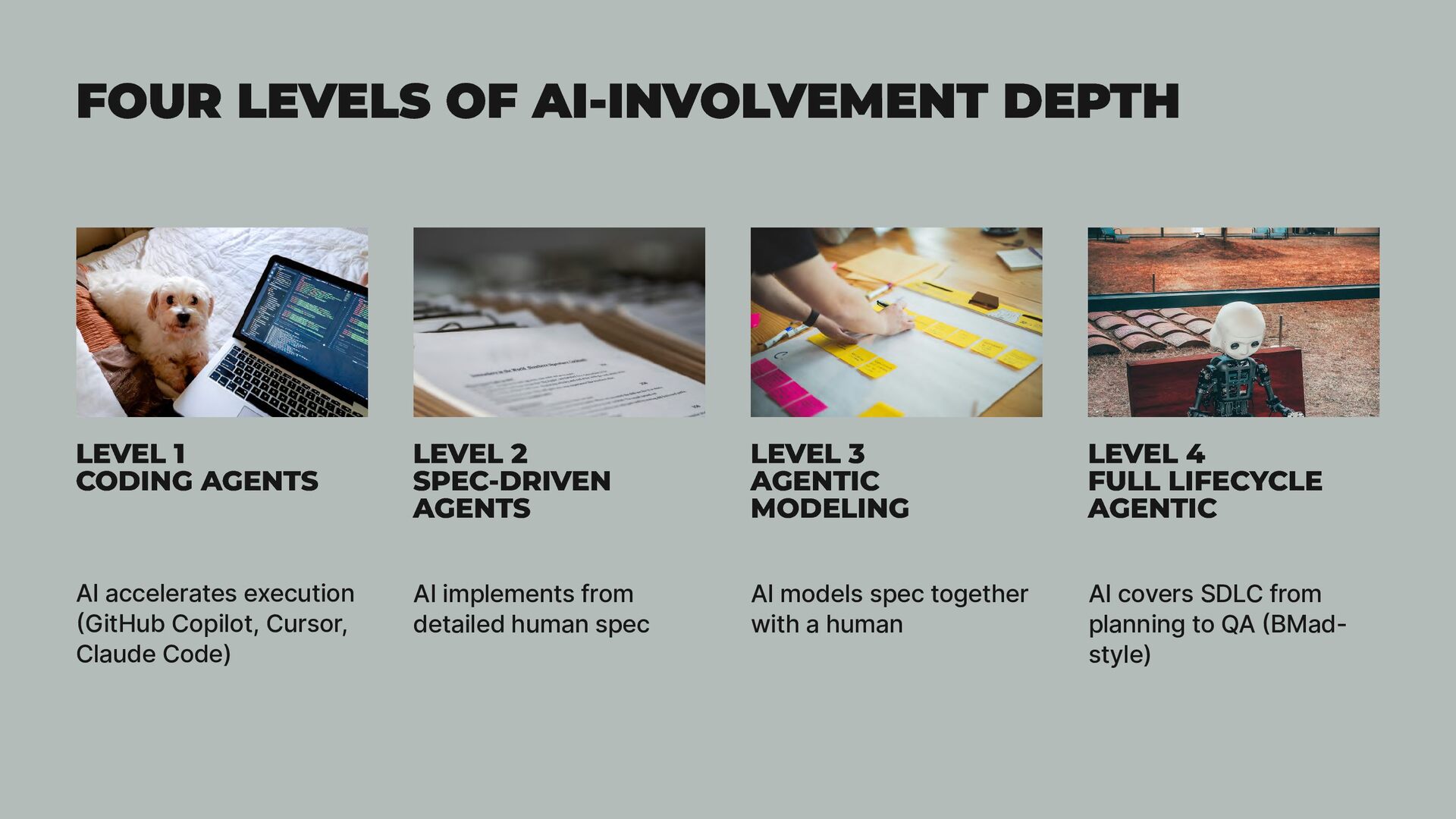
  21. AI accelerates execution (GitHub Copilot, Cursor, Claude Code) AI covers

    SDLC from planning to QA (BMad- style) AI models spec together with a human AI implements from detailed human spec LEVEL 1 CODING AGENTS LEVEL 2 SPEC-DRIVEN AGENTS LEVEL 3 AGENTIC MODELING​ LEVEL 4 FULL LIFECYCLE AGENTIC FOUR LEVELS OF AI-INVOLVEMENT DEPTH
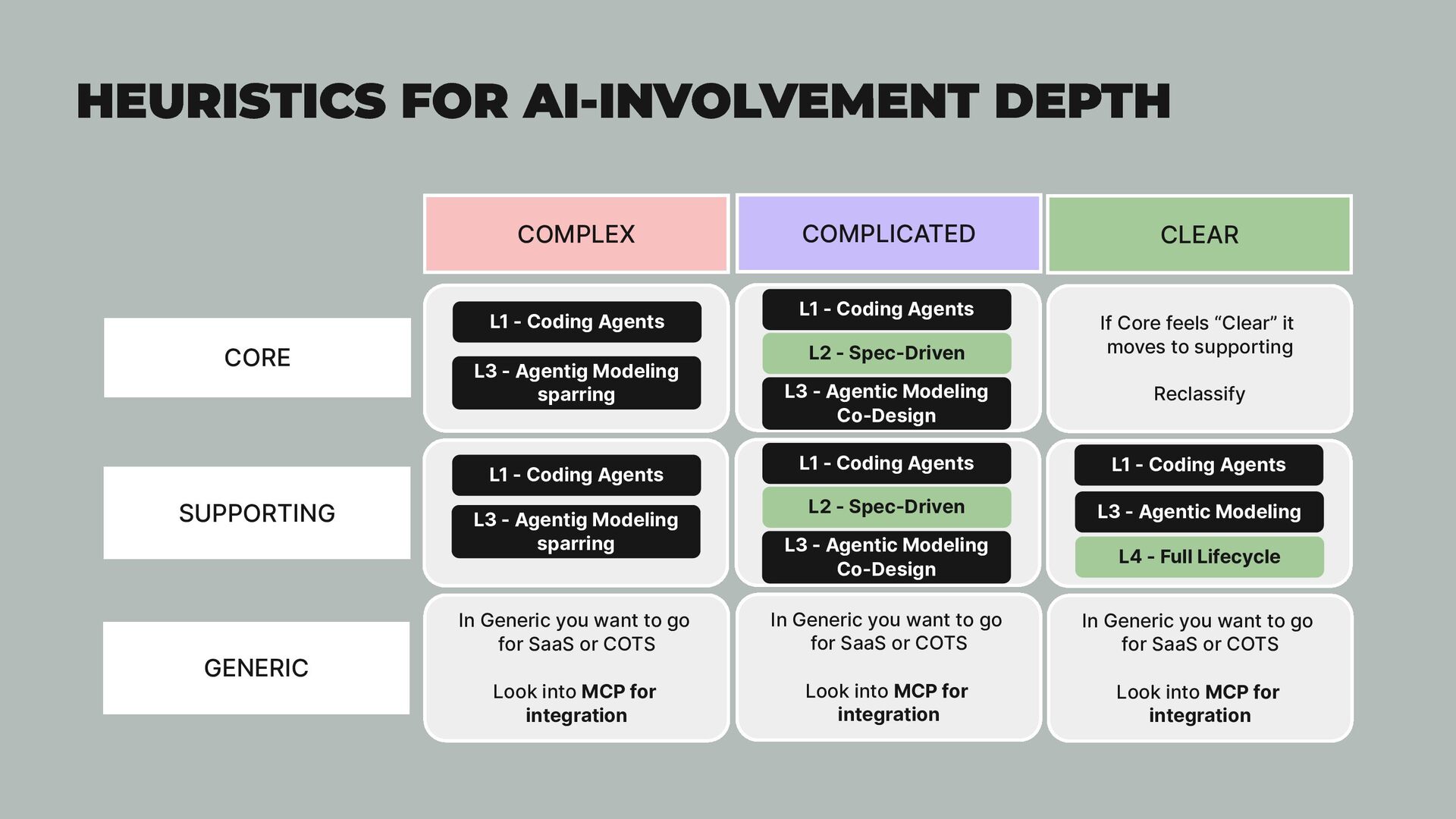
  22. HEURISTICS FOR AI-INVOLVEMENT DEPTH COMPLEX COMPLICATED CLEAR CORE SUPPORTING GENERIC

    If Core feels “Clear” it moves to supporting Reclassify In Generic you want to go for SaaS or COTS Look into MCP for integration In Generic you want to go for SaaS or COTS Look into MCP for integration In Generic you want to go for SaaS or COTS Look into MCP for integration L1 - Coding Agents L1 - Coding Agents L1 - Coding Agents L1 - Coding Agents L3 - Agentig Modeling sparring L3 - Agentig Modeling sparring L2 - Spec-Driven L3 - Agentic Modeling Co-Design L1 - Coding Agents L2 - Spec-Driven L3 - Agentic Modeling Co-Design L4 - Full Lifecycle L3 - Agentic Modeling
  23. FOLLOW ME ON LINKED IN THE BIGGEST BOTTLENECK TO FAST

    FLOW ISN'T YOUR ARCHITECTURE. IT'S THE SOURCING DECISIONS MADE WITHOUT ARCHITECTURAL SENSIBILITY. MICHAEL PLÖD - WWW.MICHAEL-PLOED.COM