Share
Embed
Intro to scikit-learn and what's new in 0.17
Talk given at a meetup at Indeed, Tokyo in November 2015.
Olivier Grisel
November 16, 2015
Transcript
46 slides
-
Intro to scikit-learn and what’s new in 0.17 Indeed -
Tokyo, November 2015 -
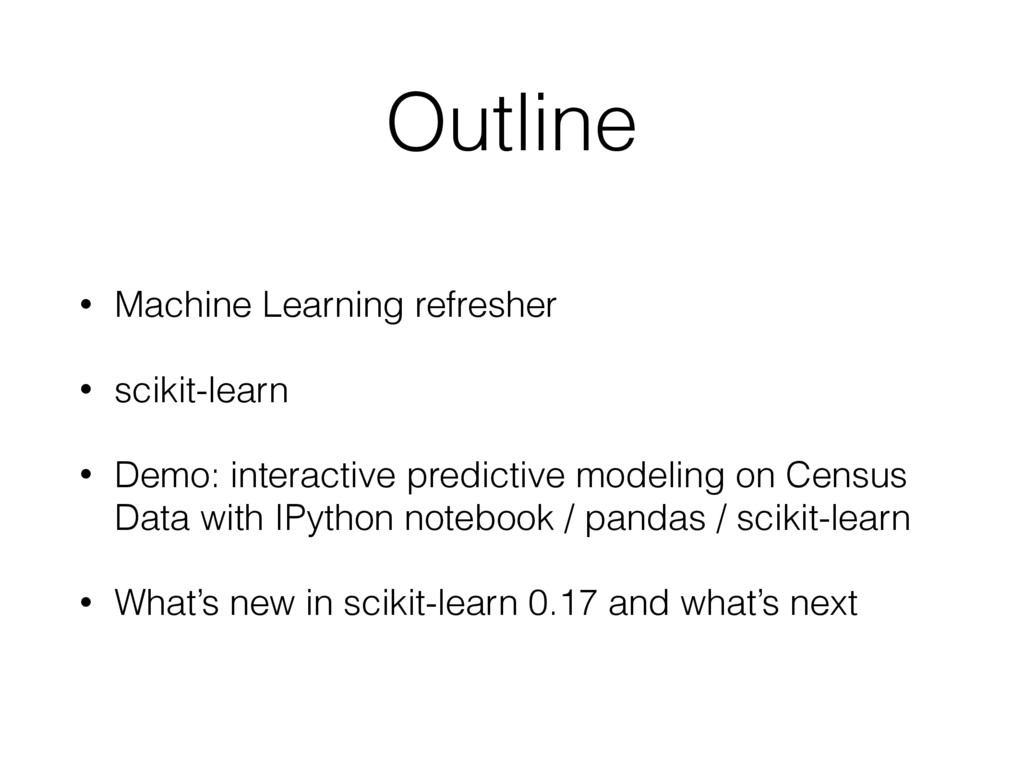
Outline • Machine Learning refresher • scikit-learn • Demo: interactive
predictive modeling on Census Data with IPython notebook / pandas / scikit-learn • What’s new in scikit-learn 0.17 and what’s next -
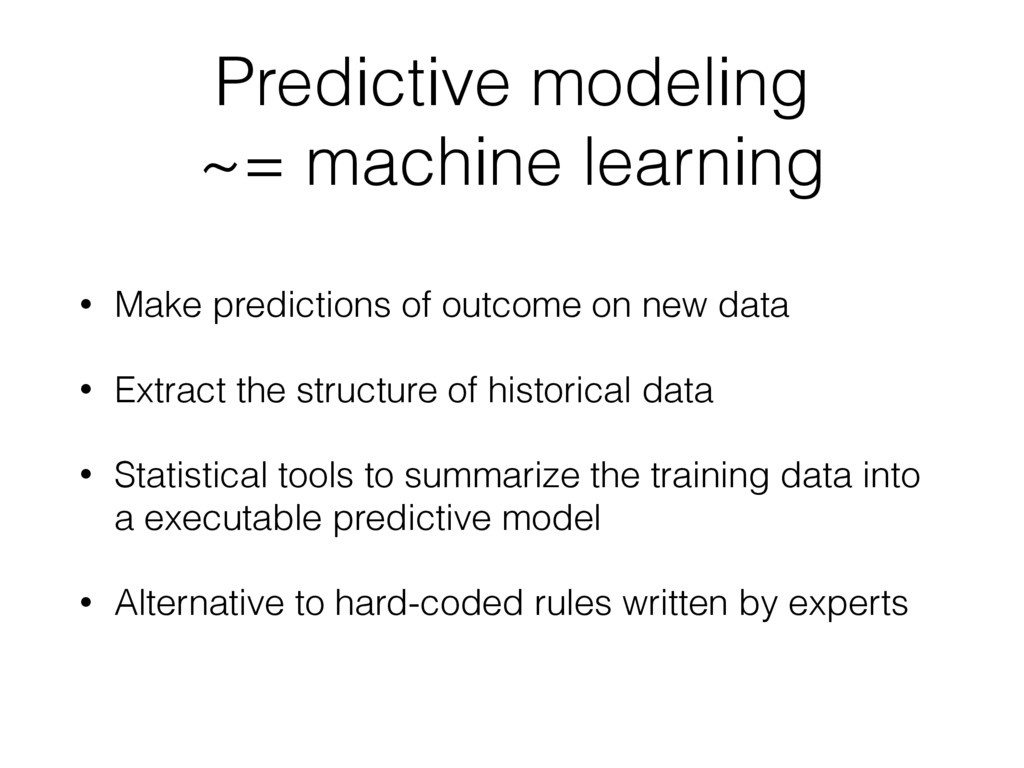
Predictive modeling ~= machine learning • Make predictions of outcome
on new data • Extract the structure of historical data • Statistical tools to summarize the training data into a executable predictive model • Alternative to hard-coded rules written by experts -
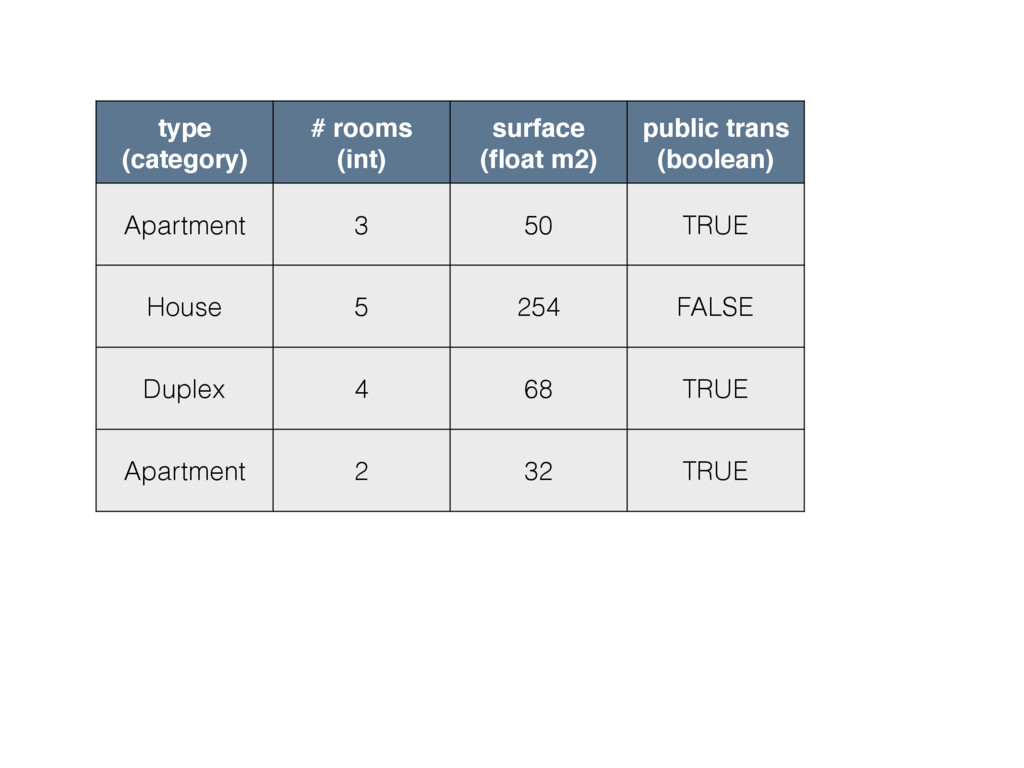
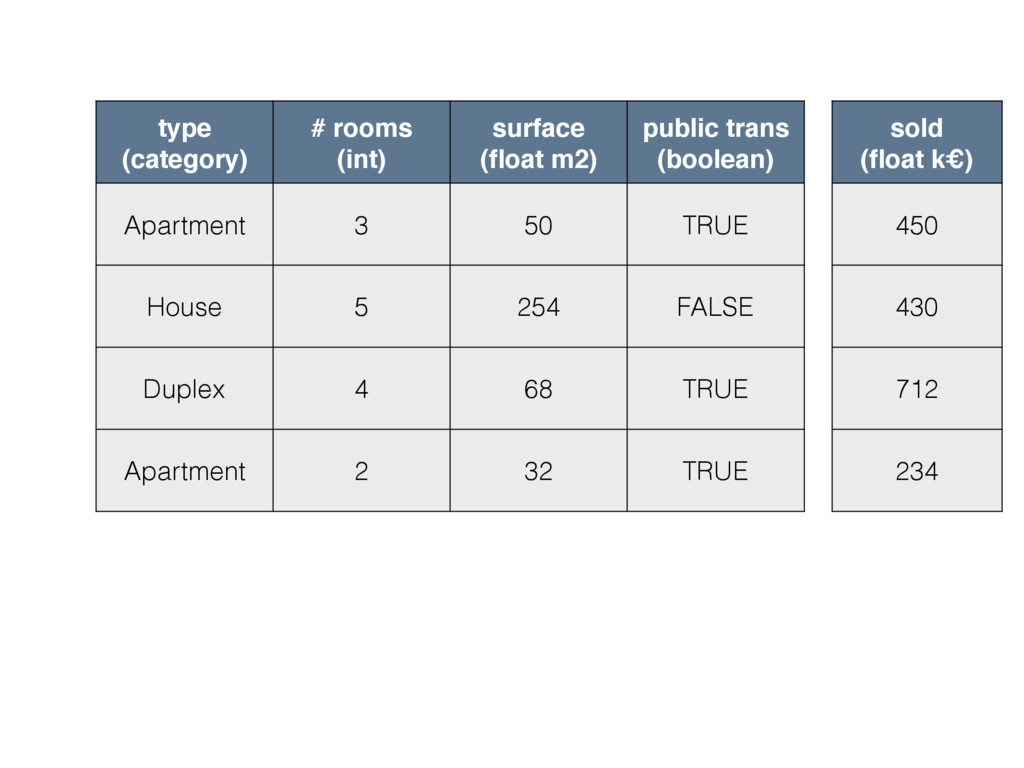
type (category) # rooms (int) surface (float m2) public trans
(boolean) Apartment 3 50 TRUE House 5 254 FALSE Duplex 4 68 TRUE Apartment 2 32 TRUE -
type (category) # rooms (int) surface (float m2) public trans
(boolean) Apartment 3 50 TRUE House 5 254 FALSE Duplex 4 68 TRUE Apartment 2 32 TRUE sold (float k€) 450 430 712 234 -
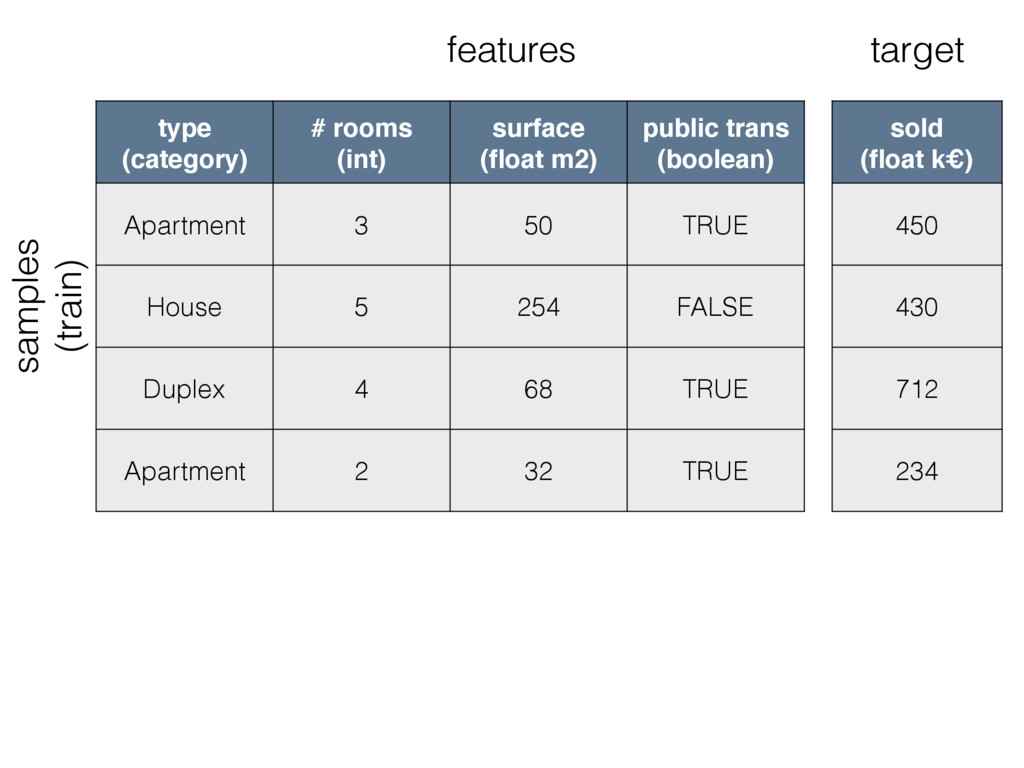
type (category) # rooms (int) surface (float m2) public trans
(boolean) Apartment 3 50 TRUE House 5 254 FALSE Duplex 4 68 TRUE Apartment 2 32 TRUE sold (float k€) 450 430 712 234 features target samples (train) -
type (category) # rooms (int) surface (float m2) public trans
(boolean) Apartment 3 50 TRUE House 5 254 FALSE Duplex 4 68 TRUE Apartment 2 32 TRUE sold (float k€) 450 430 712 234 features target samples (train) Apartment 2 33 TRUE House 4 210 TRUE samples (test) ? ? -
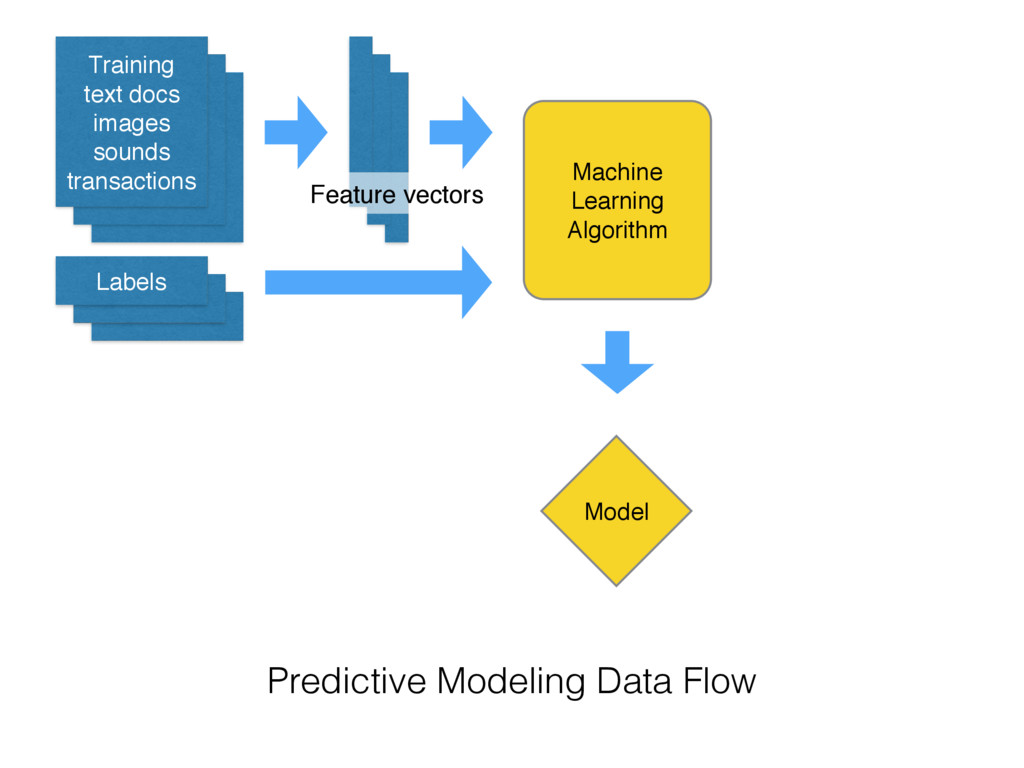
Training text docs images sounds transactions Labels Machine Learning Algorithm
Model Predictive Modeling Data Flow Feature vectors -
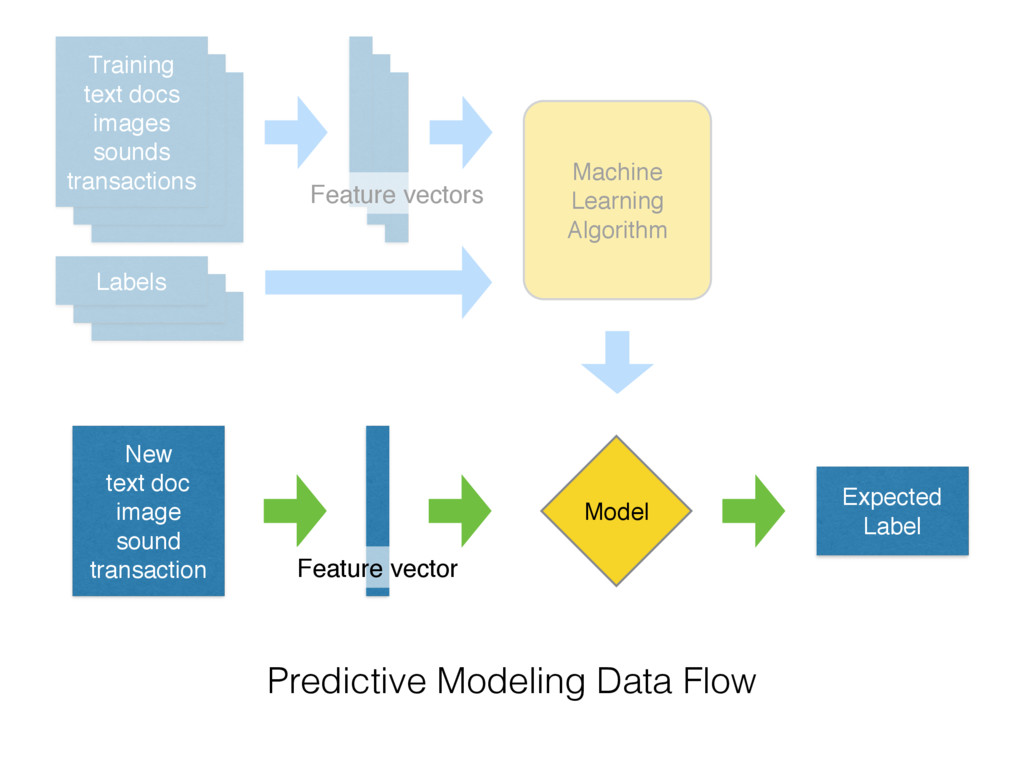
New text doc image sound transaction Model Expected Label Predictive
Modeling Data Flow Feature vector Training text docs images sounds transactions Labels Machine Learning Algorithm Feature vectors -

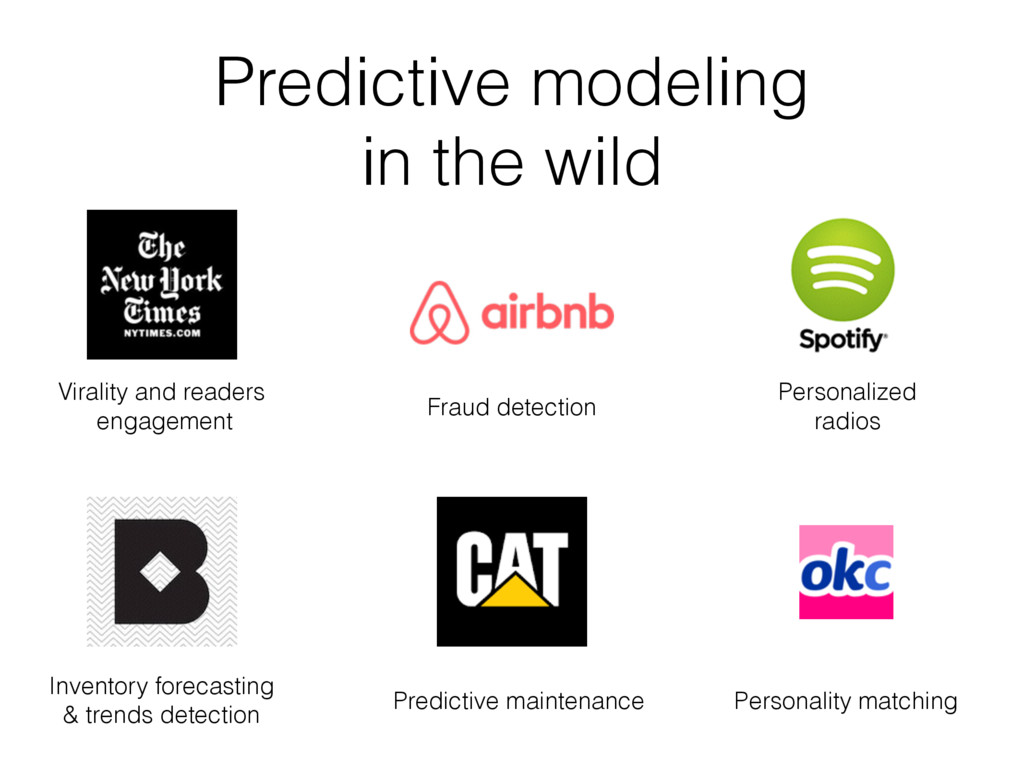
Inventory forecasting & trends detection Predictive modeling in the wild
Personalized radios Fraud detection Virality and readers engagement Predictive maintenance Personality matching -
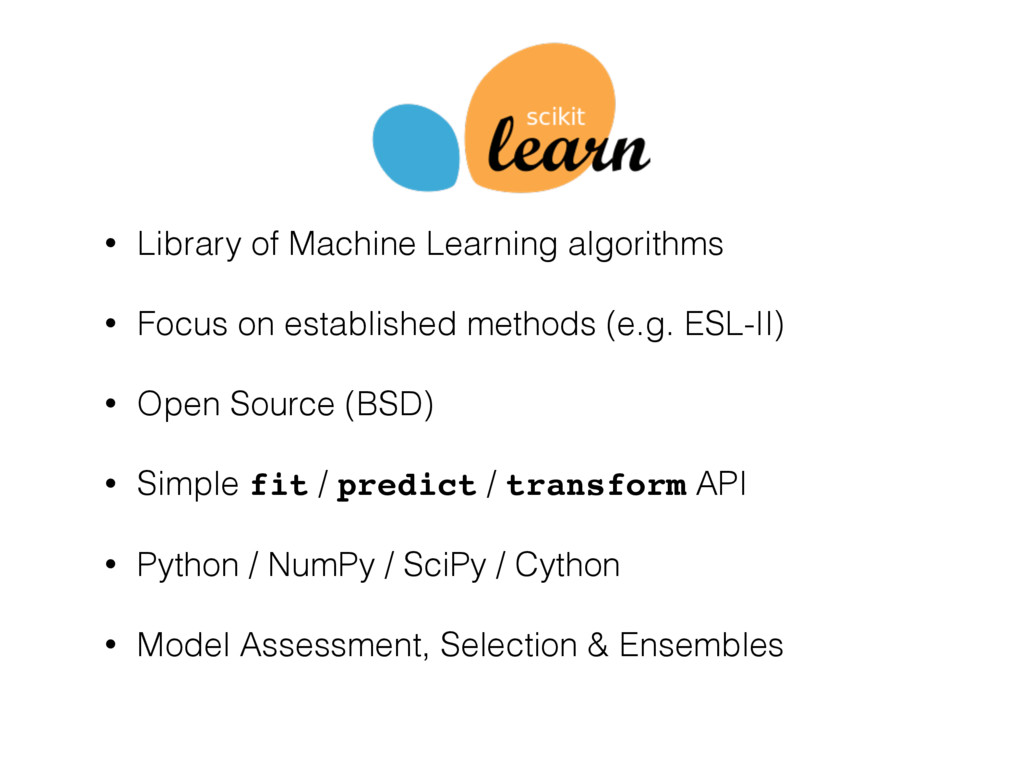
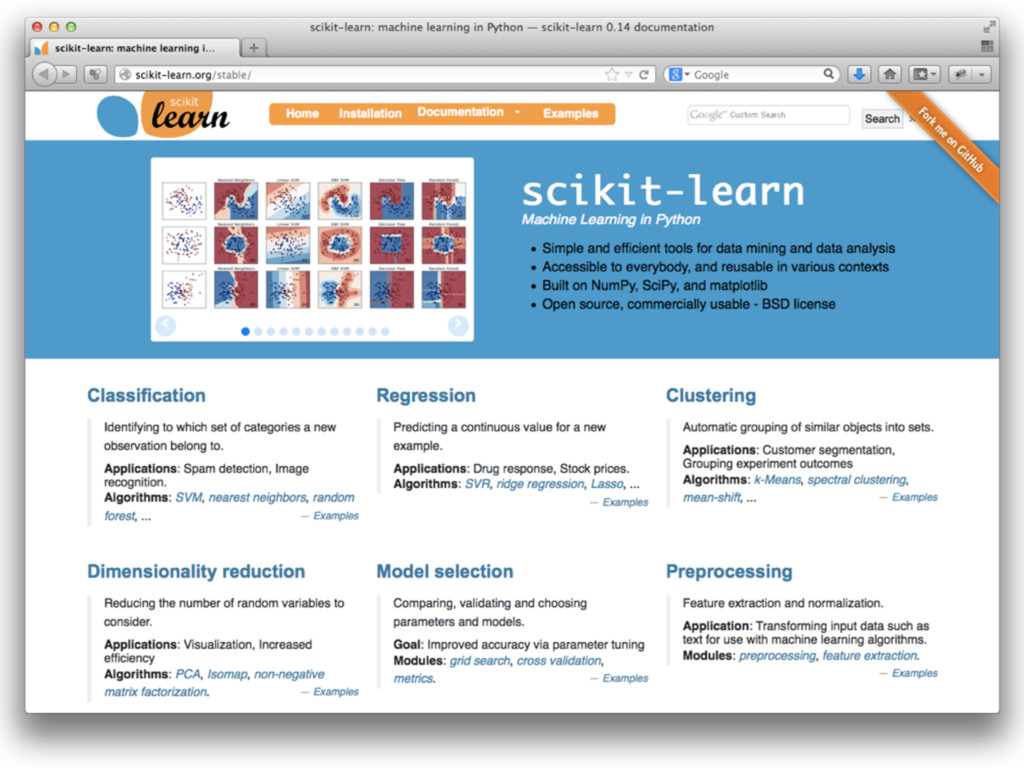
• Library of Machine Learning algorithms • Focus on established
methods (e.g. ESL-II) • Open Source (BSD) • Simple fit / predict / transform API • Python / NumPy / SciPy / Cython • Model Assessment, Selection & Ensembles -
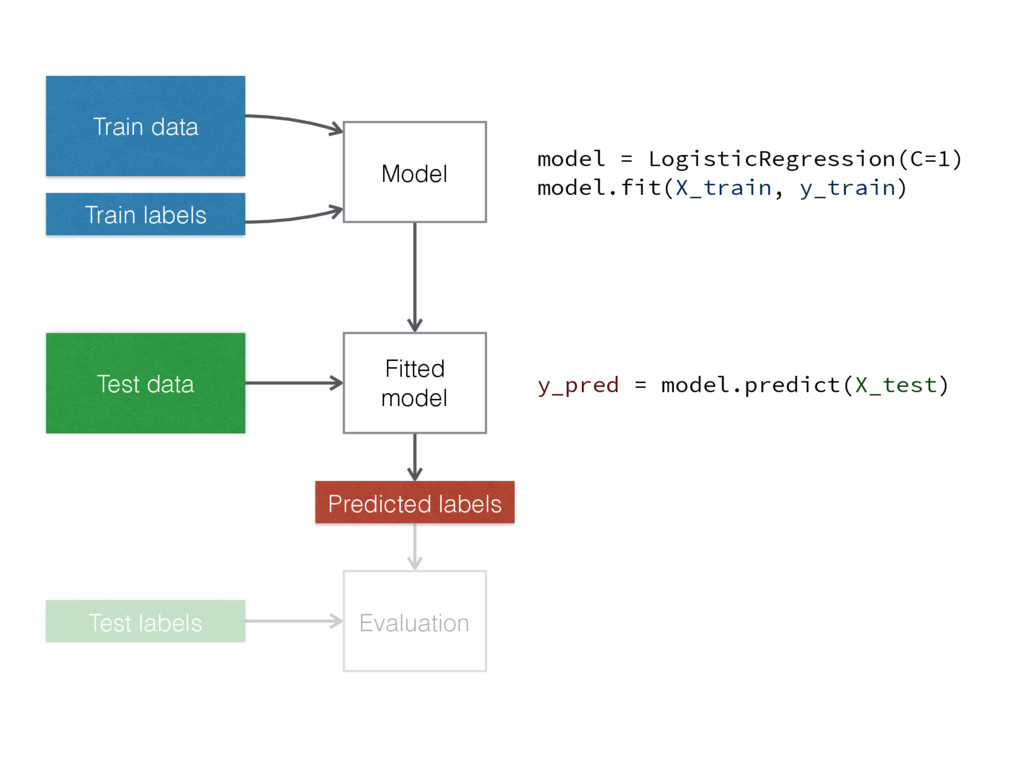
Train data Train labels Model Fitted model Test data Predicted
labels Test labels Evaluation model = LogisticRegression(C=1) model.fit(X_train, y_train) -
Train data Train labels Model Fitted model Test data Predicted
labels Test labels Evaluation model = LogisticRegression(C=1) model.fit(X_train, y_train) y_pred = model.predict(X_test) -
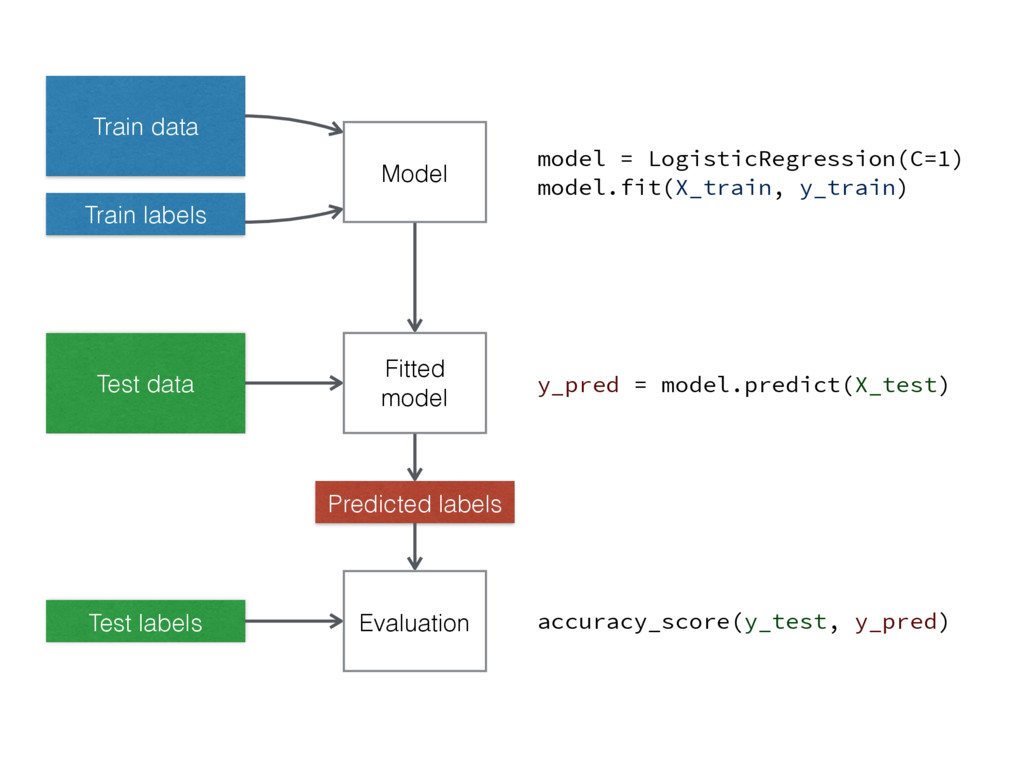
Train data Train labels Model Fitted model Test data Predicted
labels Test labels Evaluation model = LogisticRegression(C=1) model.fit(X_train, y_train) y_pred = model.predict(X_test) accuracy_score(y_test, y_pred) -
Support Vector Machine from sklearn.svm import SVC model = SVC(kernel="rbf",
C=1.0, gamma=1e-4) model.fit(X_train, y_train) y_predicted = model.predict(X_test) from sklearn.metrics import f1_score f1_score(y_test, y_predicted) -
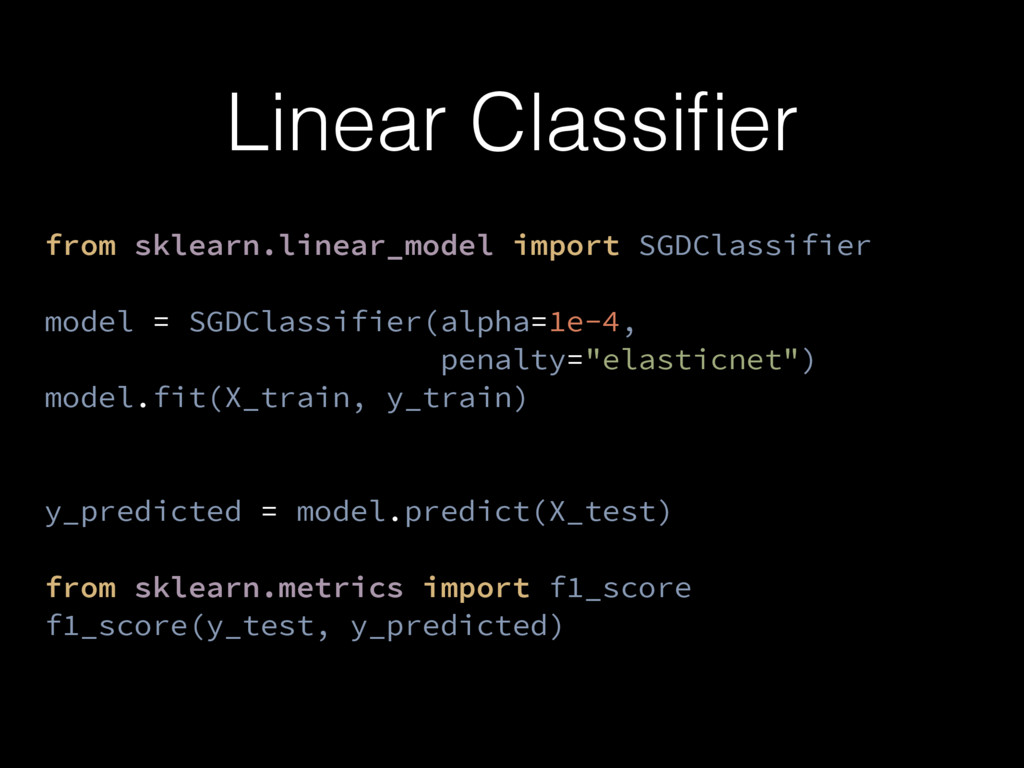
Linear Classifier from sklearn.linear_model import SGDClassifier model = SGDClassifier(alpha=1e-4, penalty="elasticnet")
model.fit(X_train, y_train) y_predicted = model.predict(X_test) from sklearn.metrics import f1_score f1_score(y_test, y_predicted) -
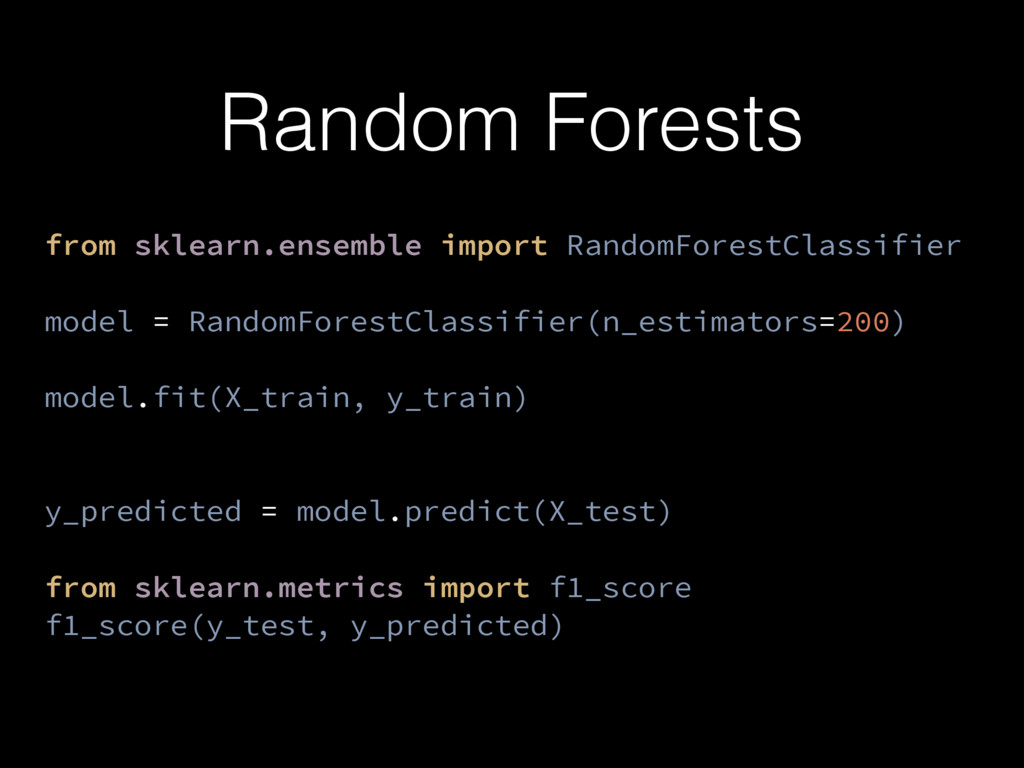
Random Forests from sklearn.ensemble import RandomForestClassifier model = RandomForestClassifier(n_estimators=200) model.fit(X_train,
y_train) y_predicted = model.predict(X_test) from sklearn.metrics import f1_score f1_score(y_test, y_predicted) -
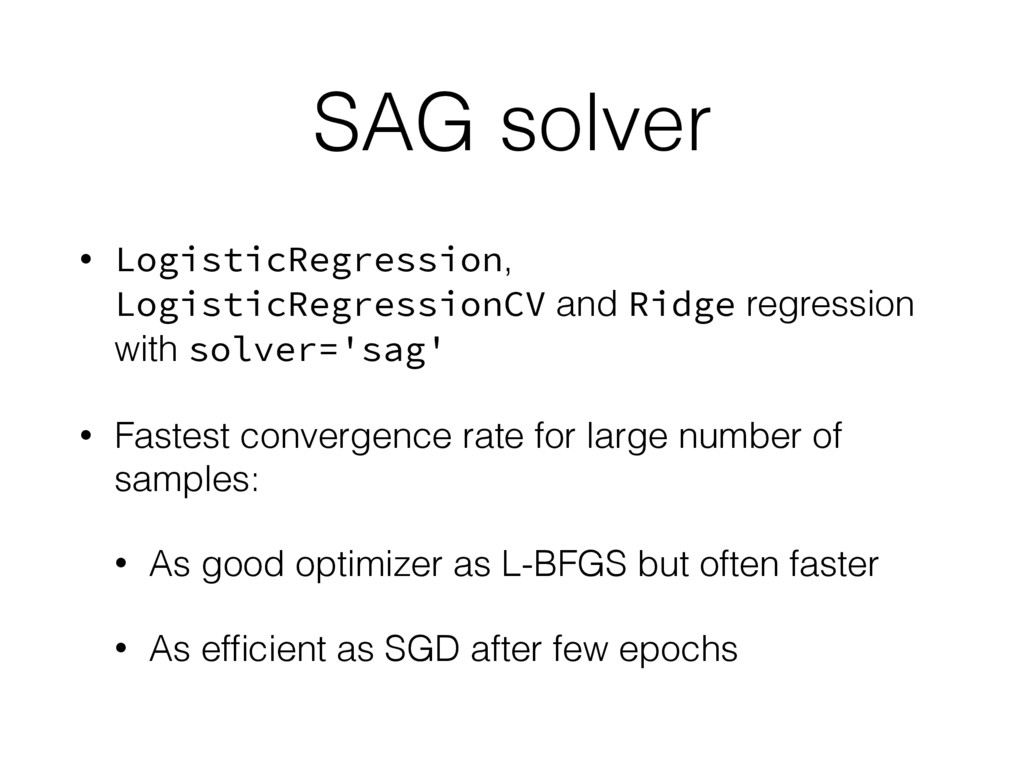
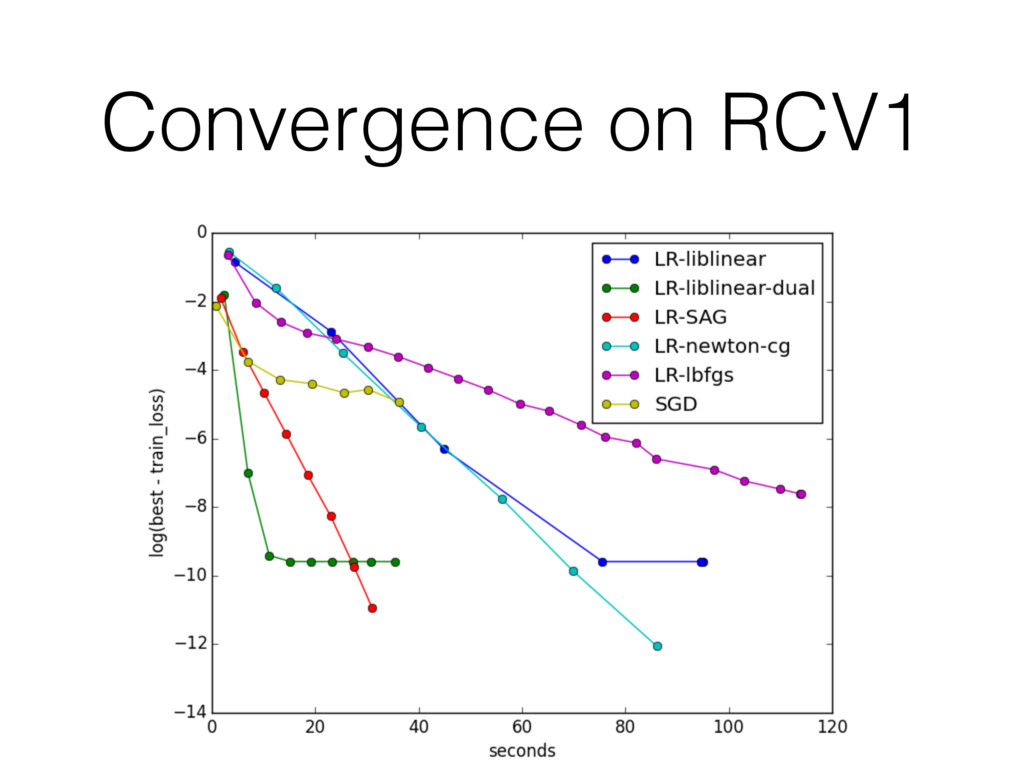
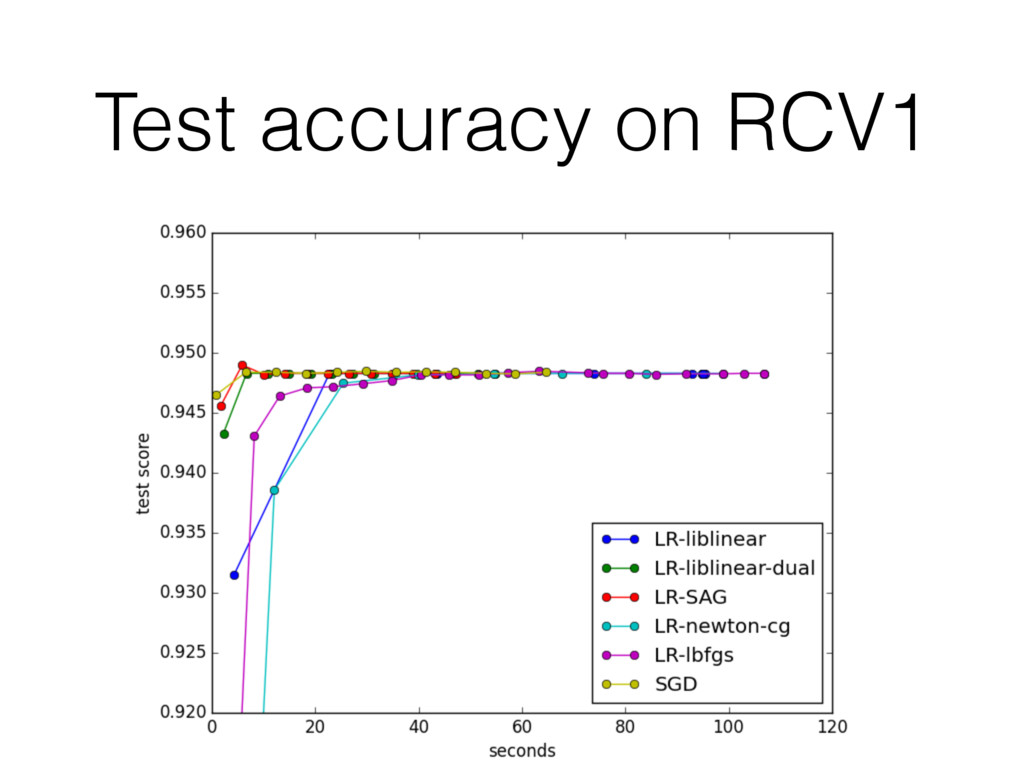
SAG solver • LogisticRegression, LogisticRegressionCV and Ridge regression with solver='sag'
• Fastest convergence rate for large number of samples: • As good optimizer as L-BFGS but often faster • As efficient as SGD after few epochs -
Faster regression trees • Do not compute constant part of
the criterion when searching for the best split value • Speed up between 1.1x and 2x depending on data and CPU architecture • Still not as fast as XGBoost but getting closer -
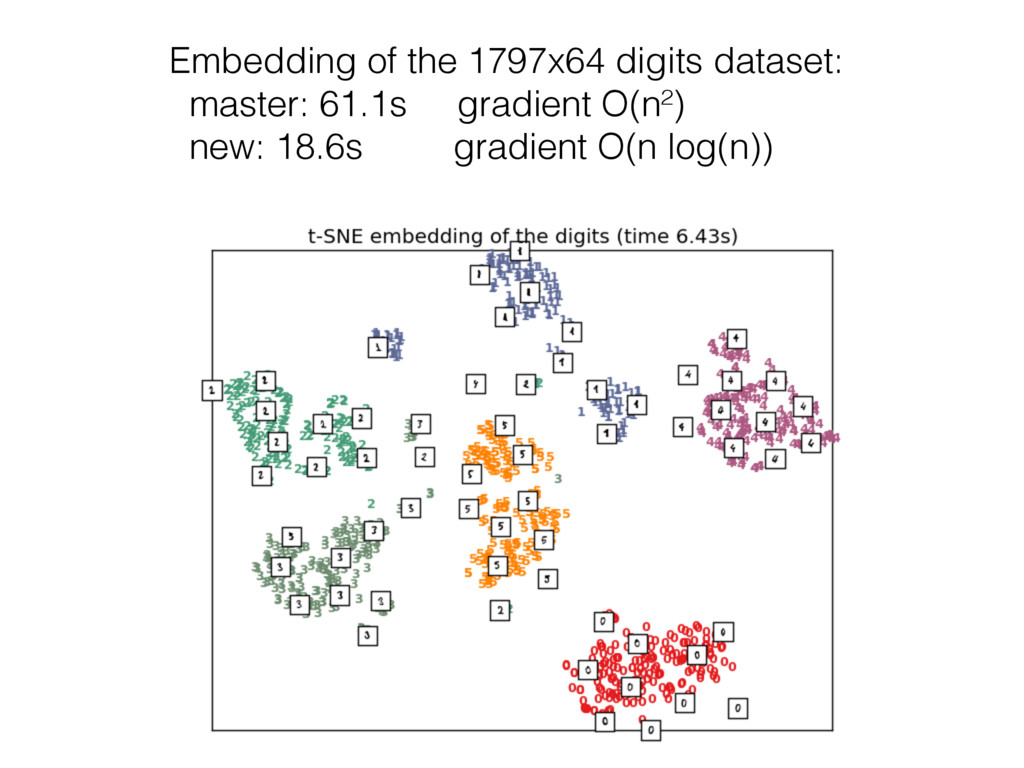
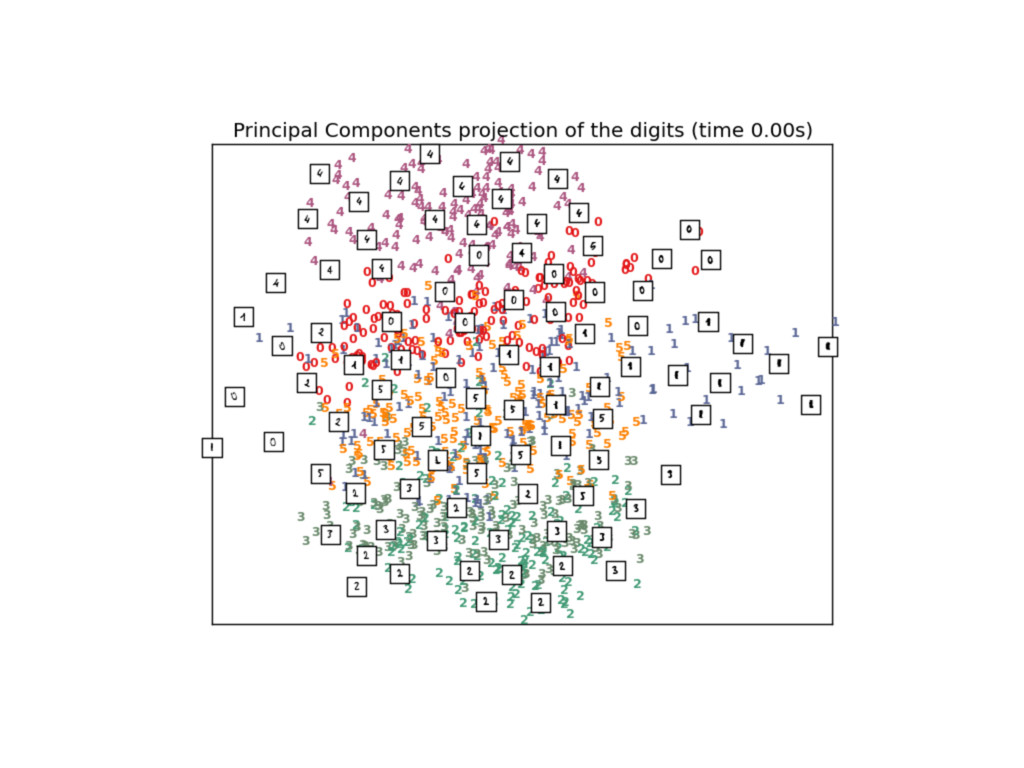
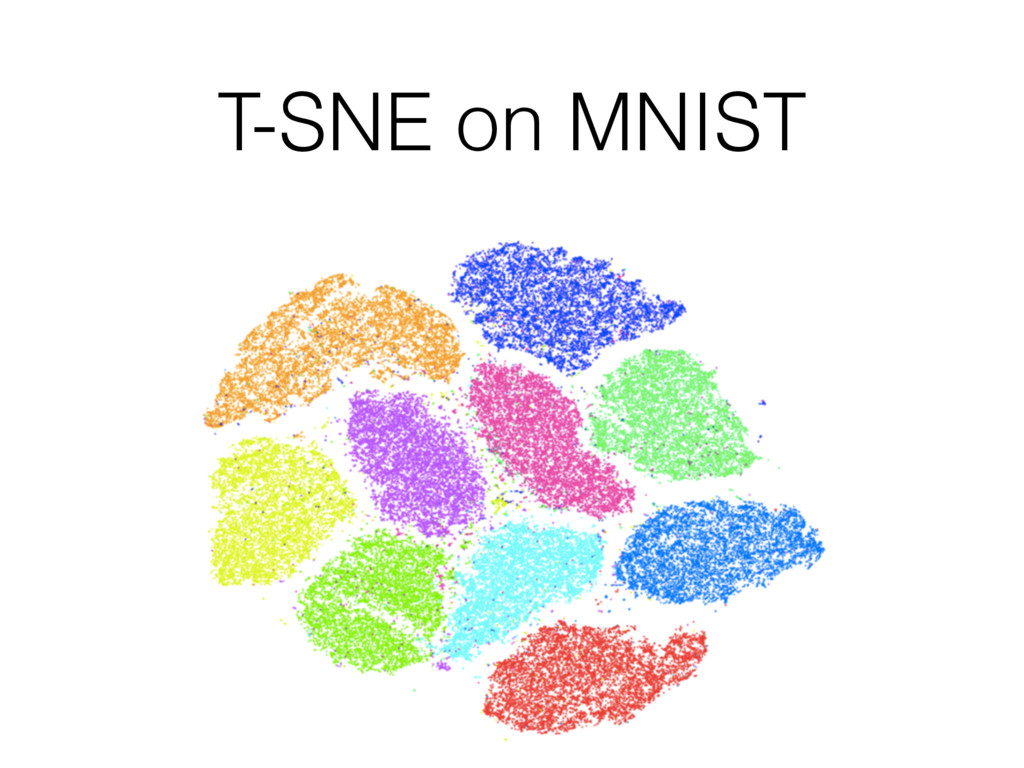
Barnes Hut T-SNE • T-SNE: Dimensionality reduction that preserves small
distances • Very useful for visualization of high dim data when PCA does not work • BH-T-SNE: Approximate methods to skip useless pairwise distance computation • Still work to do to cut memory usage -
Embedding of the 1797x64 digits dataset: master: 61.1s gradient O(n²)
new: 18.6s gradient O(n log(n)) -
Incremental Scalers • Incremental fitting with partial_fit method • Pre-process
data that does not fit in RAM • MaxAbsScaler, MinMaxScaler, StandardScaler -
Latent Dirichlet Allocation • Probabilistic model of word counts in
document based on topics • Online solver: incremental fitting on data that does not fit in RAM • Based on an implementation by Matt Hoffman adapted for the scikit-learn common API -
LDA topics on 20 newsgroups Topic #9: key chip encryption
keys clipper use security public technology bit Topic #11: memory use video bus monitor board ground pc ram need Topic #14: game team games play season hockey league players bike win Topic #19: drive scsi disk mac problem hard card apple drives controller -
New solver for NMF • Coordinate Descent solver to replace
Projected Gradient solver • CD less sensitive to initialization scheme than PG • Change in hyper-parameters to make them more consistent with other scikit-learn models -
NMF topics on 20 newsgroups Topic #15: card video monitor
vga bus cards drivers color driver ram Topic #16: team games players year season hockey play teams nhl league Topic #18: jesus christ christian bible christians faith law sin church christianity Topic #19: encryption chip clipper government privacy law escrow algorithm enforcement secure -
Recently merged in master • Multi-layer perceptrons with Adam /
SGD / L-BFGS solvers (pure numpy, no GPU) • Gaussian Processes big refactoring • Anomaly detection with Isolation Forests • More flexible API for Cross-Validation splitters -
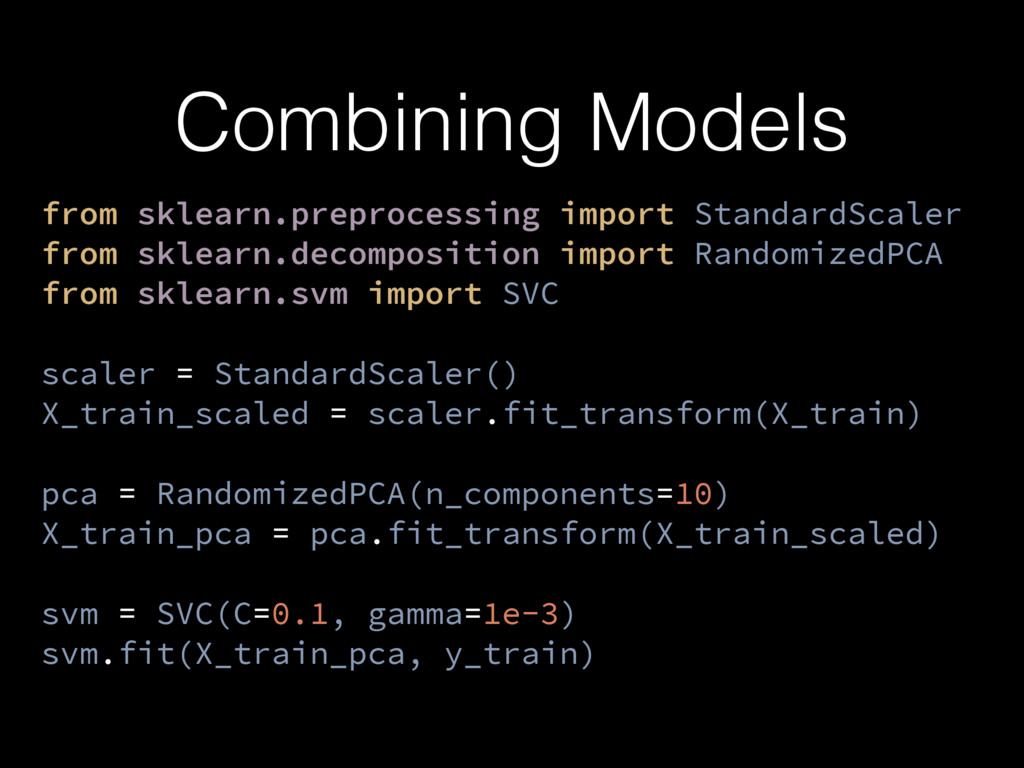
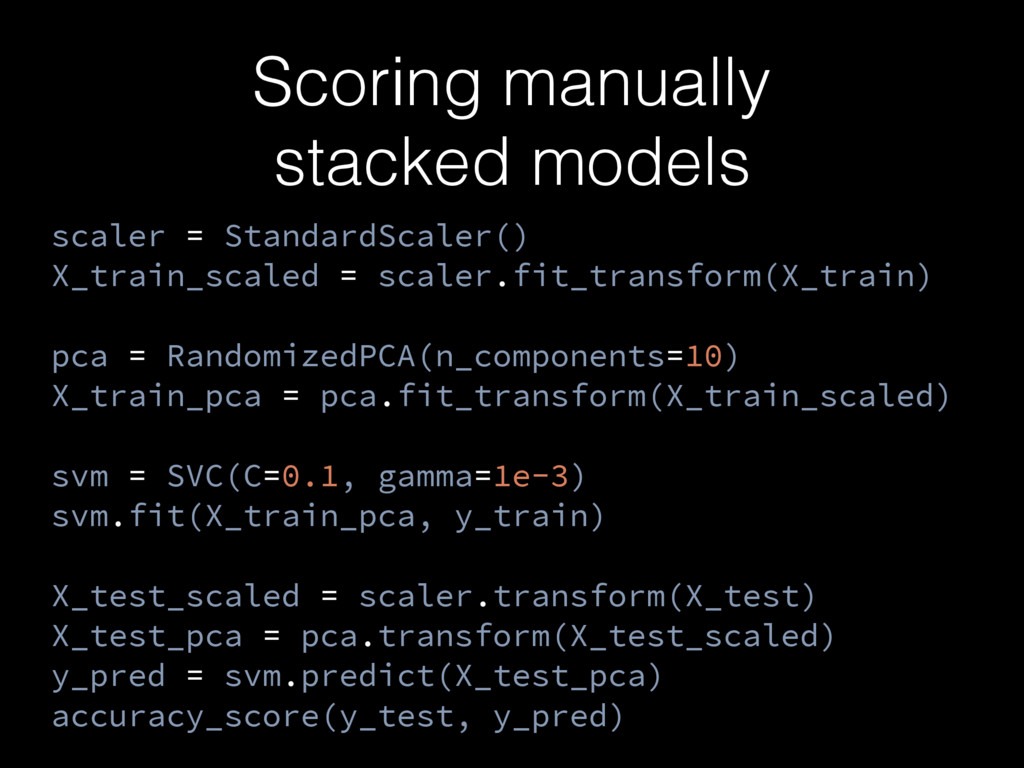
Combining Models from sklearn.preprocessing import StandardScaler from sklearn.decomposition import RandomizedPCA
from sklearn.svm import SVC scaler = StandardScaler() X_train_scaled = scaler.fit_transform(X_train) pca = RandomizedPCA(n_components=10) X_train_pca = pca.fit_transform(X_train_scaled) svm = SVC(C=0.1, gamma=1e-3) svm.fit(X_train_pca, y_train) -
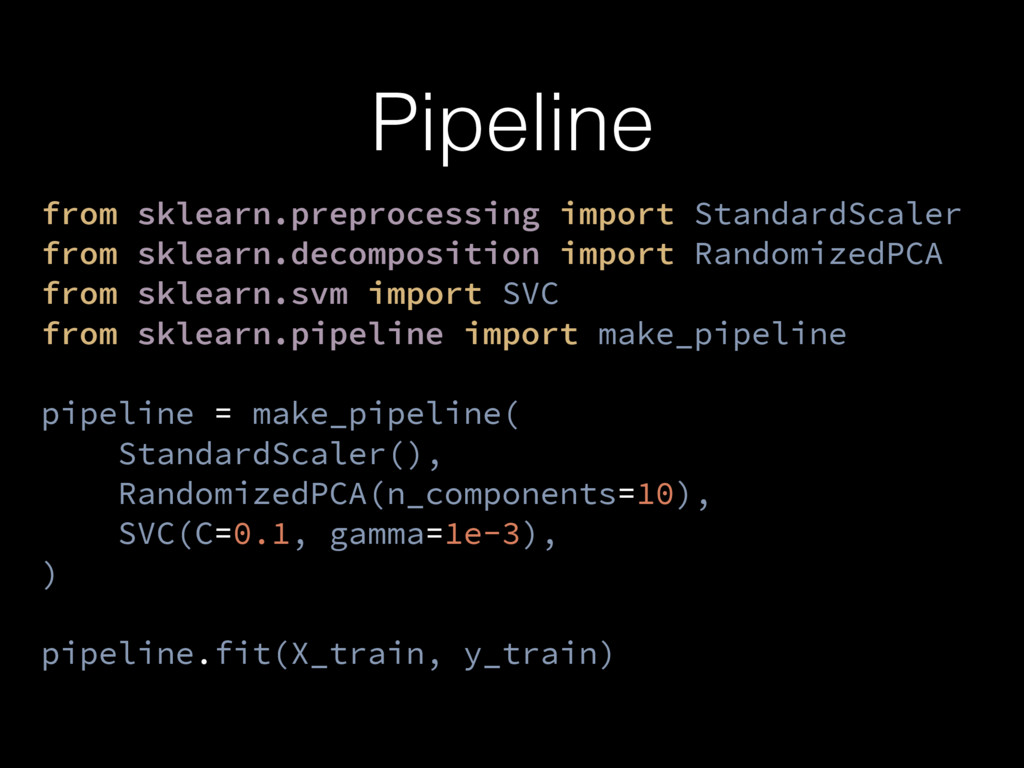
Pipeline from sklearn.preprocessing import StandardScaler from sklearn.decomposition import RandomizedPCA from
sklearn.svm import SVC from sklearn.pipeline import make_pipeline pipeline = make_pipeline( StandardScaler(), RandomizedPCA(n_components=10), SVC(C=0.1, gamma=1e-3), ) pipeline.fit(X_train, y_train) -
Scoring manually stacked models scaler = StandardScaler() X_train_scaled = scaler.fit_transform(X_train)
pca = RandomizedPCA(n_components=10) X_train_pca = pca.fit_transform(X_train_scaled) svm = SVC(C=0.1, gamma=1e-3) svm.fit(X_train_pca, y_train) X_test_scaled = scaler.transform(X_test) X_test_pca = pca.transform(X_test_scaled) y_pred = svm.predict(X_test_pca) accuracy_score(y_test, y_pred) -
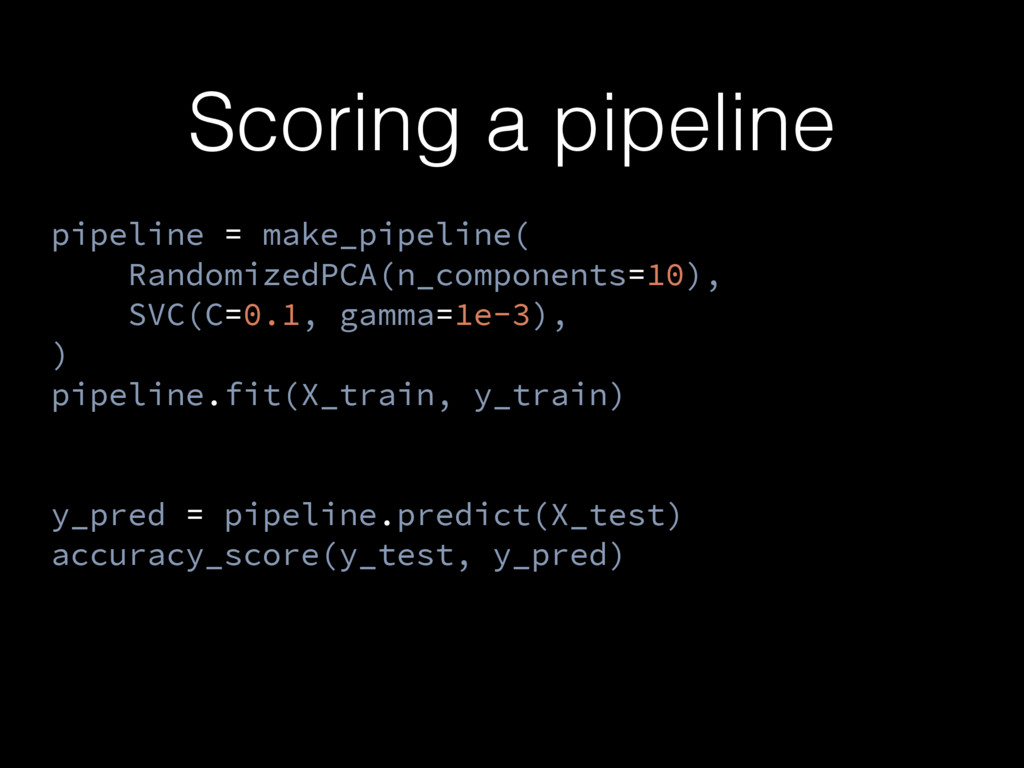
Scoring a pipeline pipeline = make_pipeline( RandomizedPCA(n_components=10), SVC(C=0.1, gamma=1e-3), )
pipeline.fit(X_train, y_train) y_pred = pipeline.predict(X_test) accuracy_score(y_test, y_pred) -
Parameter search import numpy as np from sklearn.grid_search import RandomizedSearchCV
params = { 'randomizedpca__n_components': [5, 10, 20], 'svc__C': np.logspace(-3, 3, 7), 'svc__gamma': np.logspace(-6, 0, 7), } search = RandomizedSearchCV(pipeline, params, n_iter=30, cv=5) search.fit(X_train, y_train) # search.best_params_, search.grid_scores_