Upgrade to Pro — share decks privately, control downloads, hide ads and more …

A new deal for disabled people

Sponsored · Your Podcast. Everywhere. Effortlessly. Share. Educate. Inspire. Entertain. You do you. We'll handle the rest. →

A new deal for disabled people

Disability support and especially Personal Independence Payments (PIP) is failing on two grounds – spiralling costs are putting pressure on the public finances and those that need the benefit have lost faith in the system. But while there is widespread support for reform, that is where the consensus ends – with politicians tending to focus on the potential savings, rather than how a new system could better enable millions of disabled people to flourish. Getting this right is crucial for any reforms to be sustainable.

What types of additional costs do disabled people face, and how does this vary by condition or age? How can disability benefits respond to the sheer breadth of these costs and conditions, and how can it be better matched to people’s actual needs? Who might receive more, or less, under a reformed disability benefit system ? And can reform deliver the savings that politicians are keen to see?

Avatar for Resolution Foundation

Resolution Foundation

October 15, 2026

Other Decks in Research

Transcript

  1. A new deal for disabled people Reconnecting disability support with

    the needs of recipients Louise Murphy, Senior Economist at the Resolution Foundation Edel Harris, Chair of the Independent Review of Adult Disability Payment in Scotland Tom Pollard, Head of Policy, Campaigns and Public Affairs at Mind Chris Smyth, Public Policy Editor at the Financial Times Chair: Ruth Curtice, Wifi 2QAG_Guest Welcome_Guests Chief Executive of the Resolution Foundation #NewDeal @resfoundation October 26
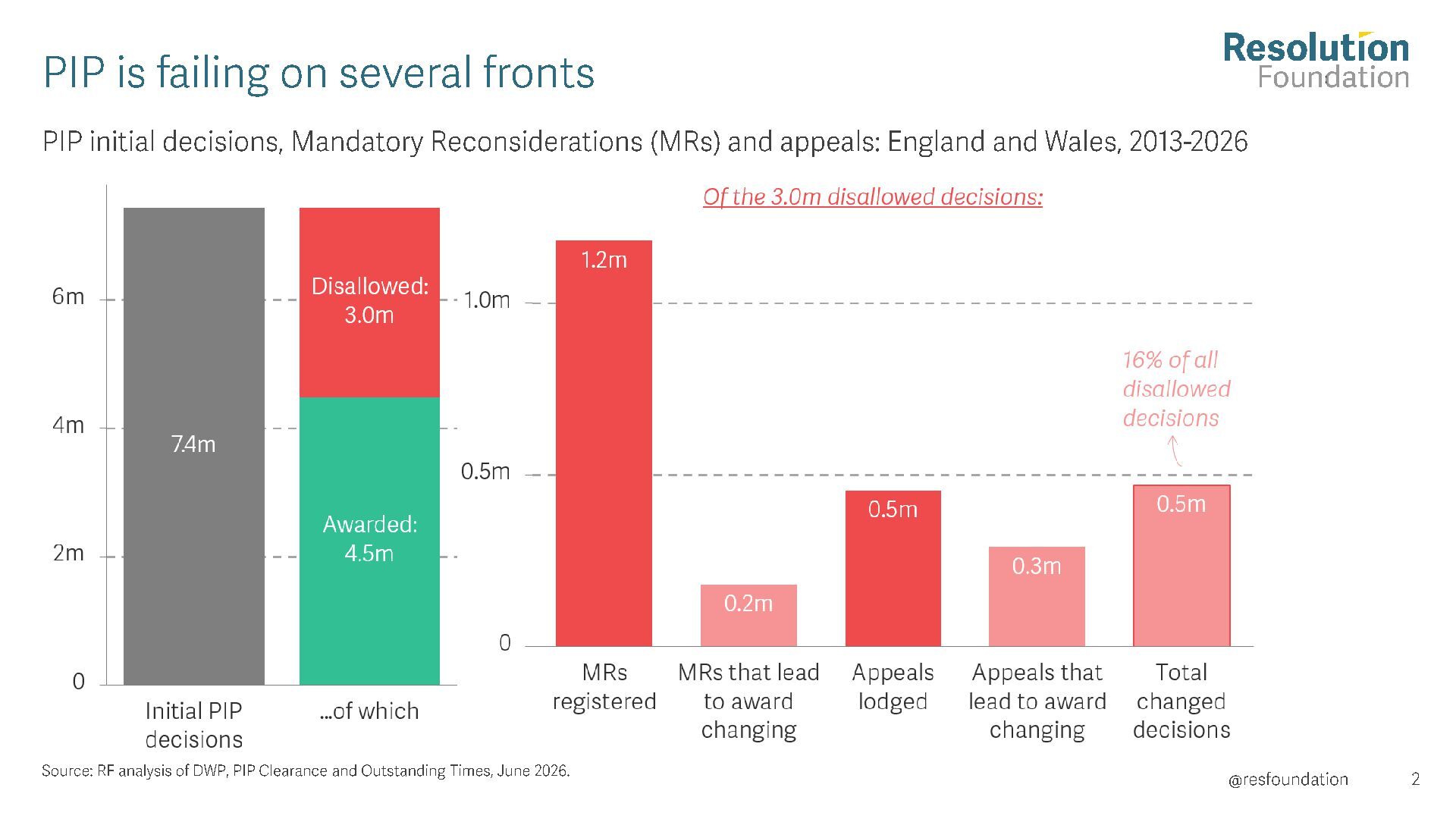
  2. PIP is failing on several fronts PIP initial decisions, Mandatory

    Reconsiderations (MRs) and appeals: England and Wales, 2013 Source: RF analysis of DWP, PIP Clearance and Outstanding Times, June 2026. -2026 @resfoundation 2
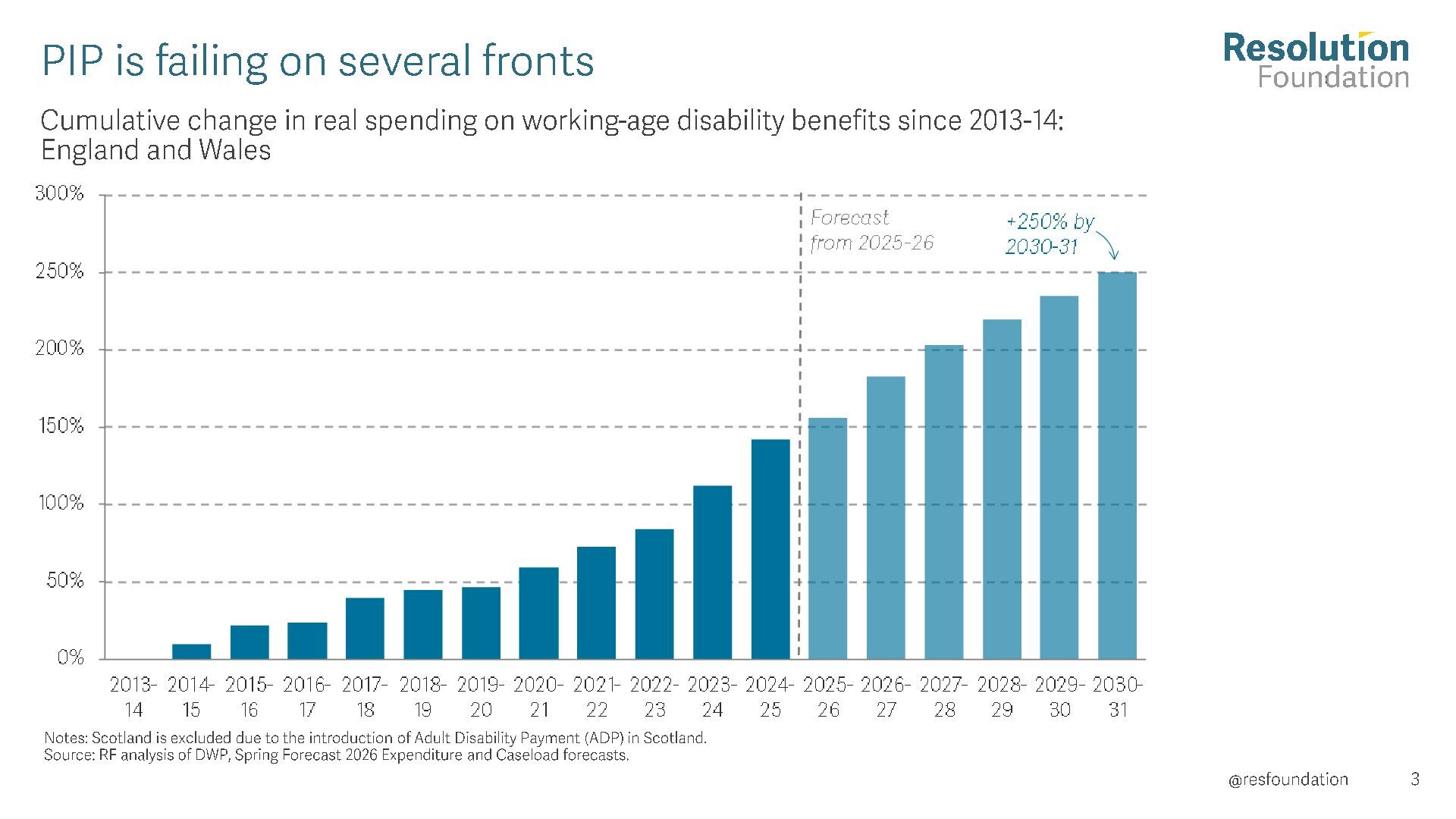
  3. PIP is failing on several fronts Cumulative change in real

    spending on working England and Wales -age disability benefits since 2013 -14: Notes: Scotland is excluded due to the introduction of Adult Disability Payment (ADP) in Scotland. Source: RF analysis of DWP, Spring Forecast 2026 Expenditure and Caseload forecasts. @resfoundation 3
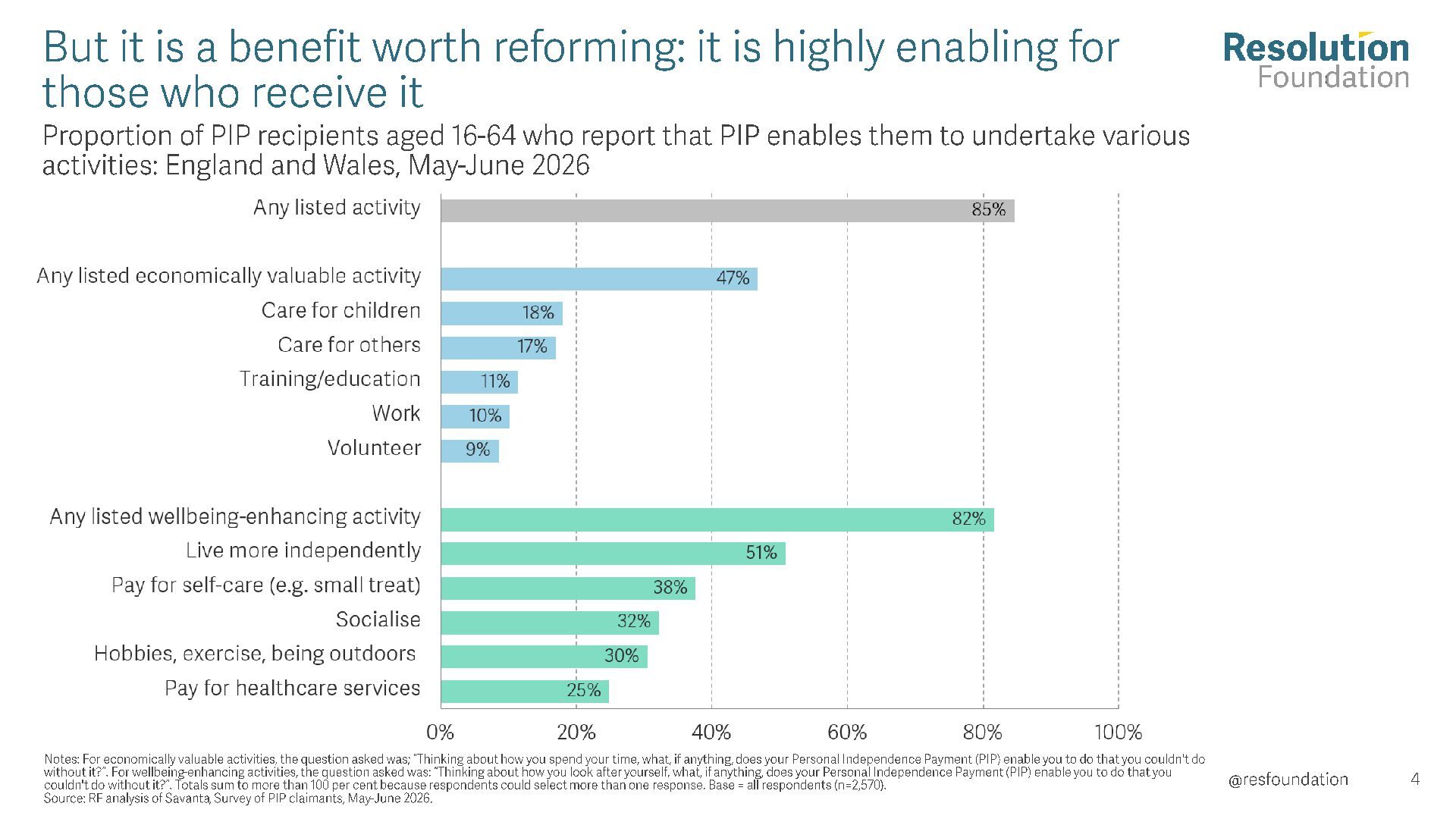
  4. But it is a benefit worth reforming: it is highly

    enabling for those who receive it Proportion of PIP recipients aged 16 -64 who report that PIP enables them to undertake various activities: England and Wales, May -June 2026 Notes: For economically valuable activities, the question asked was; “Thinking about how you spend your time, what, if anythi without it?”. For wellbeing -enhancing activities, the question asked was: “Thinking about how you look after yourself, what, if couldn't do without it?”. Totals sum to more than 100 per cent because respondents could select more than one response. Base Source: RF analysis of Savanta , Survey of PIP claimants, May -June 2026. ng, does your Personal Independence Payment (PIP) enable you to do that you couldn't do anything, does your Personal Independence Payment (PIP) enable you to do that you = a ll respondents (n=2,570). @resfoundation 4
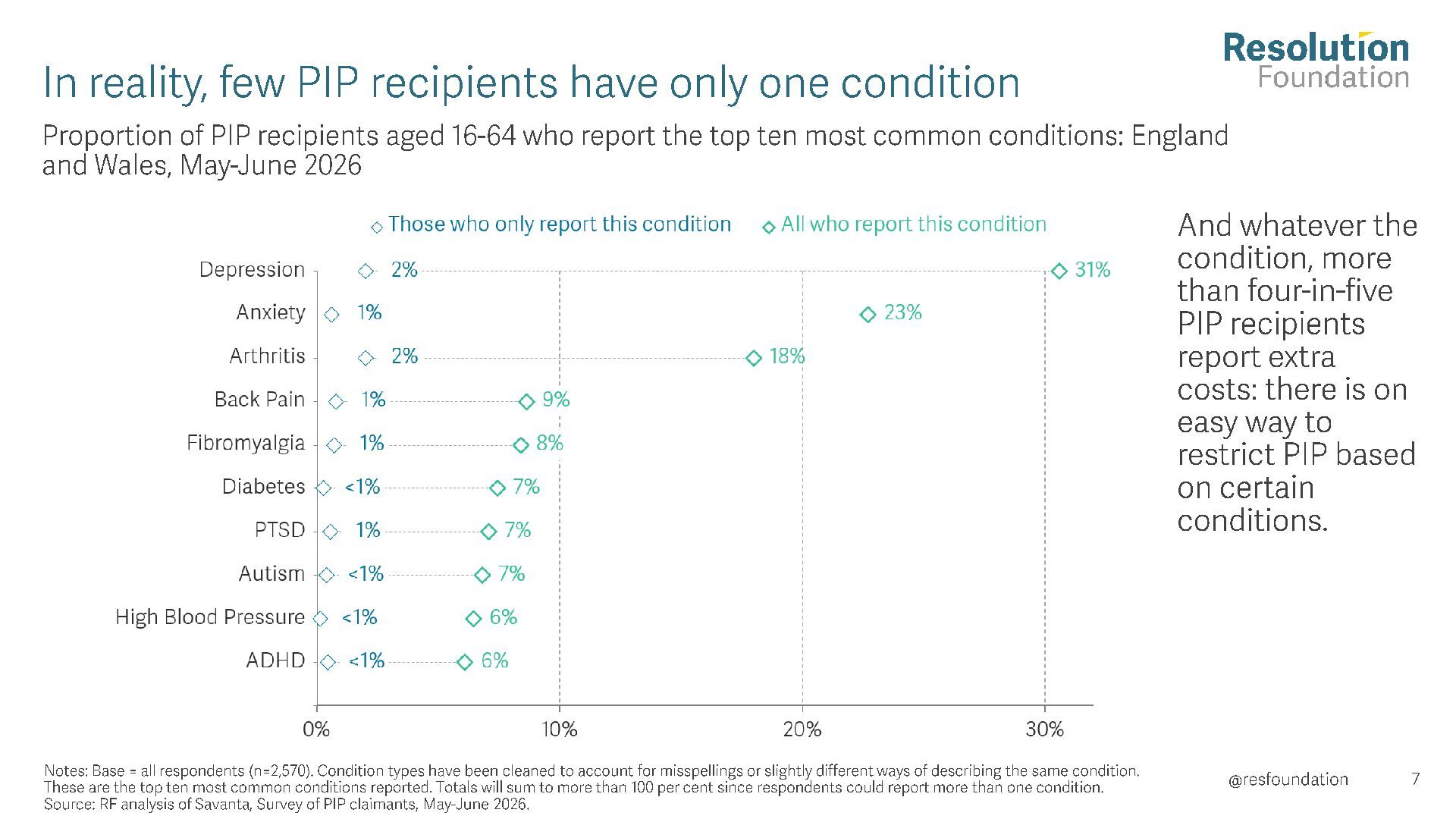
  5. In reality, few PIP recipients have only one condition Proportion

    of PIP recipients aged 16 and Wales, May -June 2026 -64 who report the top ten most common conditions: England And whatever the condition, more than four -in-five PIP recipients report extra costs: there is on easy way to restrict PIP based on certain conditions. Notes: Base = all respondents (n=2,570). Condition types have been cleaned to account for misspellings or slightly different These are the top ten most common conditions reported. Totals will sum to more than 100 per cent since respondents could repo Source: RF analysis of Savanta , Survey of PIP claimants, May -June 2026. ways of describing the same condition. rt more than one condition. @resfoundation 7
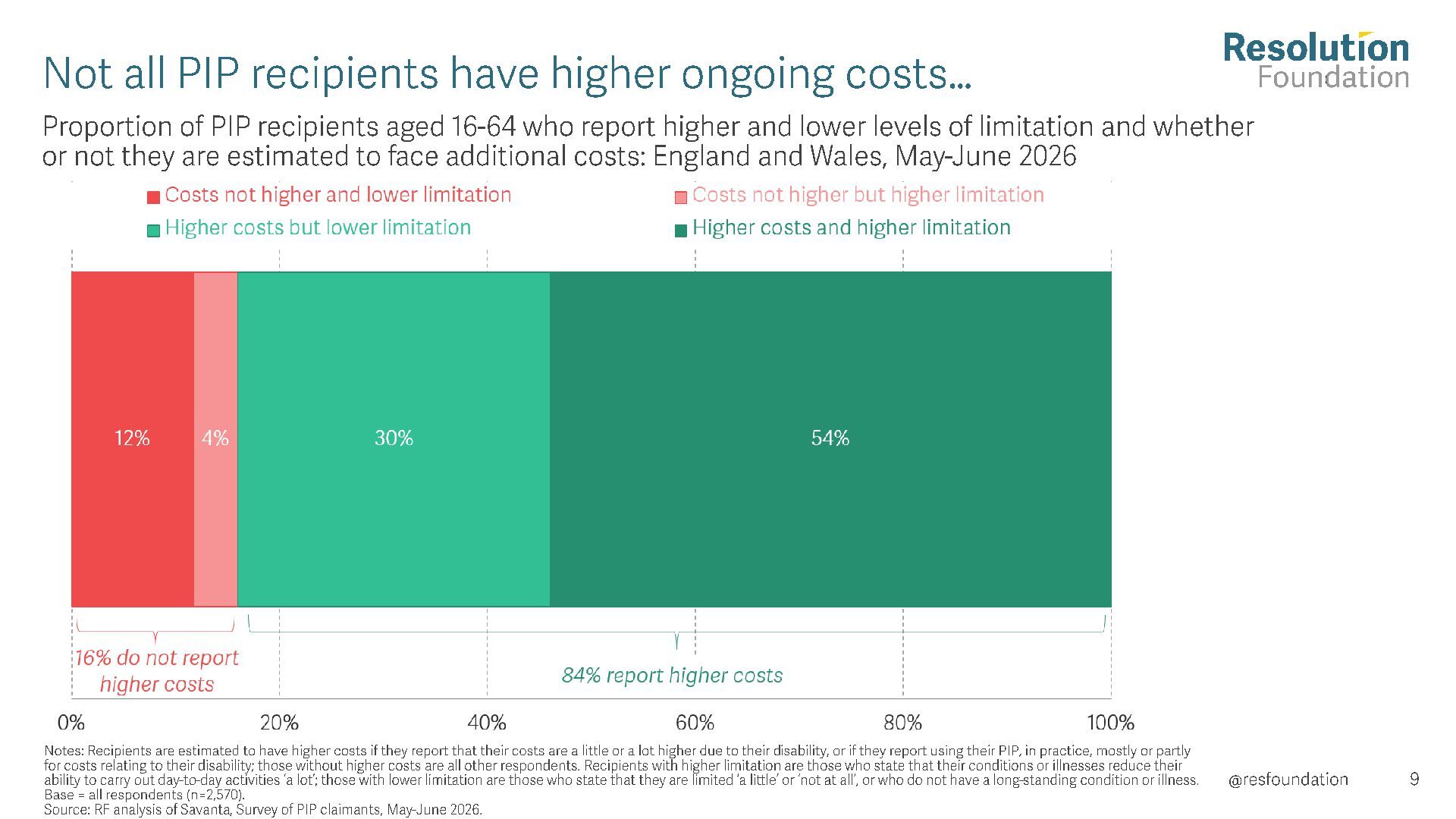
  6. Not all PIP recipients have higher ongoing costs… Proportion of

    PIP recipients aged 16 -64 who report higher and lower levels of limitation and whether or not they are estimated to face additional costs: England and Wales, May -June 2026 Notes: Recipients are estimated to have higher costs if they report that their costs are a little or a lot higher due to thei for costs relating to their disability; those without higher costs are all other respondents. Recipients with higher limitati ability to carry out day -to-day activities ‘a lot’; those with lower limitation are those who state that they are limited ‘a lit Base = all respondents (n=2,570). Source: RF analysis of Savanta , Survey of PIP claimants, May -June 2026. r disability, or if they report using their PIP, in practice, mostly or partly on are those who state that their conditions or illnesses reduce their tle’ or ‘not at all’, or who do not have a long -standing condition or illness. @resfoundation 9
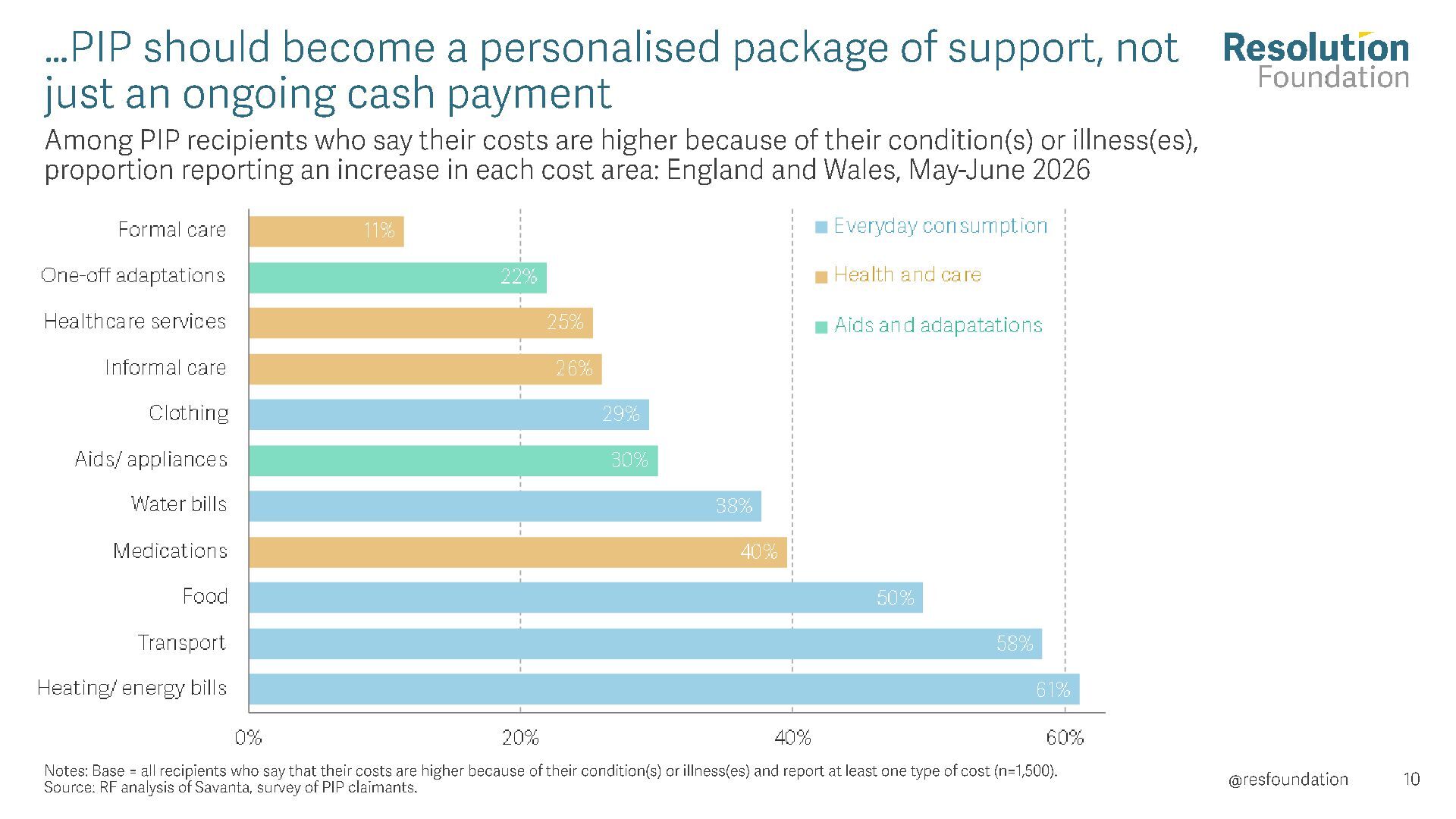
  7. …PIP should become a personalised package of support, not just

    an ongoing cash payment Among PIP recipients who say their costs are higher because of their condition(s) or illness(es), proportion reporting an increase in each cost area: England and Wales, May -June 2026 Notes: Base = all recipients who say that their costs are higher because of their condition(s) or illness(es) and report at l Source: RF analysis of Savanta , survey of PIP claimants. eas t one type of cost (n=1,500). @resfoundation 10
  8. Myth #3: The kindest and cheapest system is one with

    little engagement @resfoundation 11
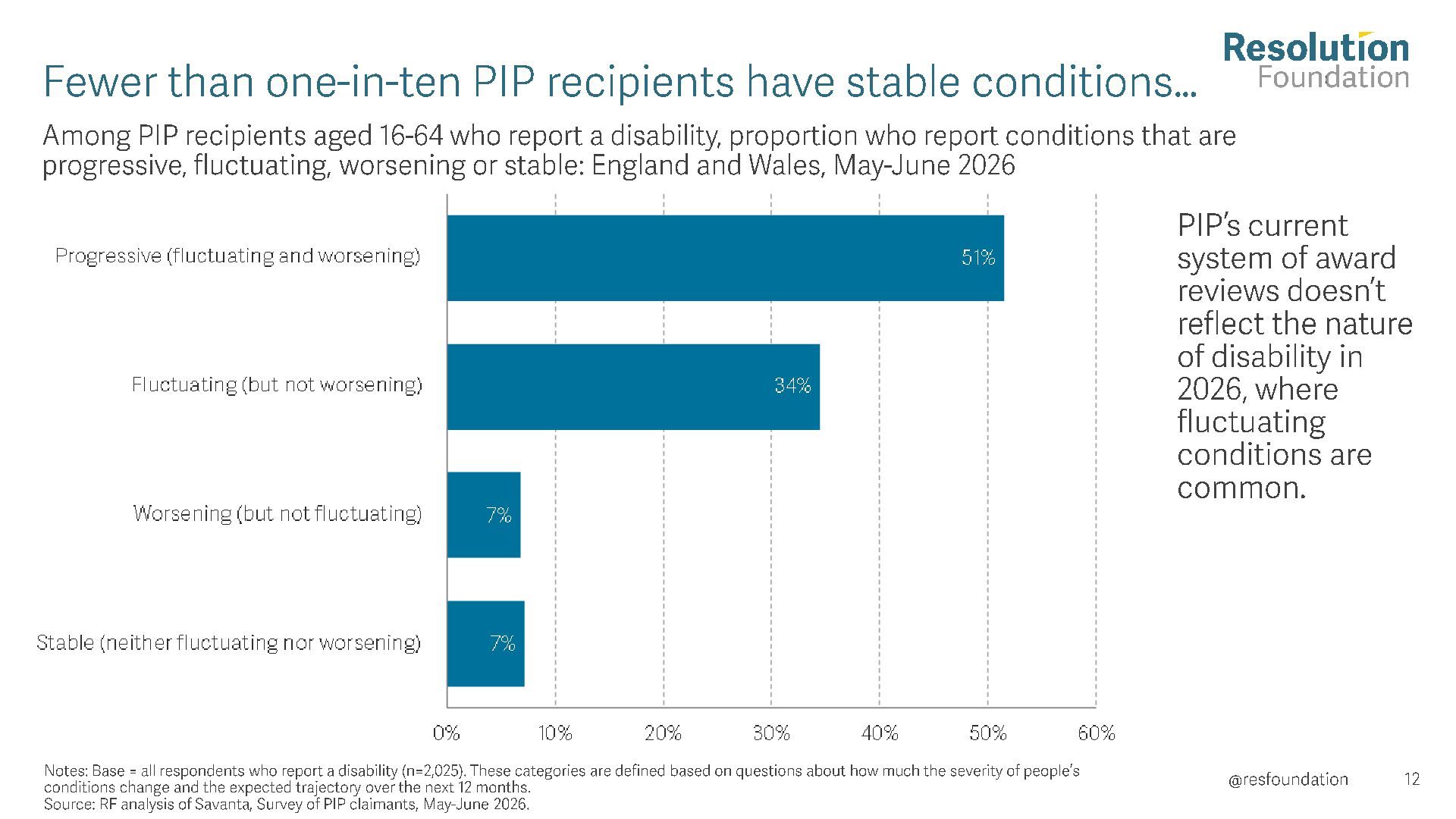
  9. Fewer than one -in-ten PIP recipients have stable conditions… Among

    PIP recipients aged 16 -64 who report a disability, proportion who report conditions that are progressive, fluctuating, worsening or stable: England and Wales, May -June 2026 PIP’s current system of award reviews doesn’t reflect the nature of disability in 2026, where fluctuating conditions are common. Notes: Base = all respondents who report a disability (n=2,025). These categories are defined based on questions about how mu conditions change and the expected trajectory over the next 12 months. Source: RF analysis of Savanta , Survey of PIP claimants, May -June 2026. ch the severity of people’s @resfoundation 12
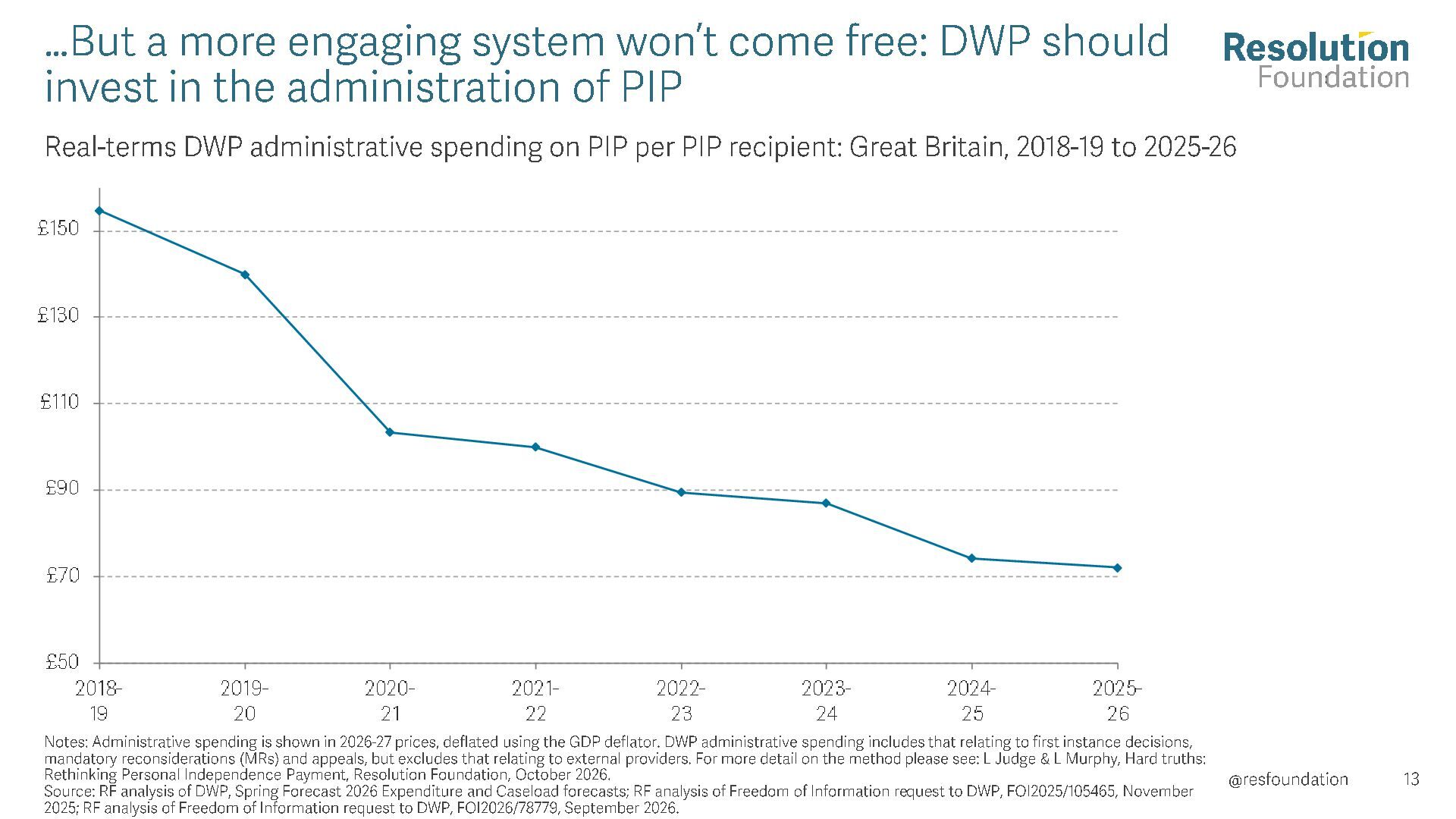
  10. …But a more engaging system won’t come free: DWP should

    invest in the administration of PIP Real -terms DWP administrative spending on PIP per PIP recipient: Great Britain, 2018 Notes: Administrative spending is shown in 2026 -27 prices, deflated using the GDP deflator. DWP administrative spending includes mandatory reconsiderations (MRs) and appeals, but excludes that relating to external providers. For more detail on the method Rethinking Personal Independence Payment, Resolution Foundation, October 2026. Source: RF analysis of DWP, Spring Forecast 2026 Expenditure and Caseload forecasts; RF analysis of Freedom of Information re 2025; RF analysis of Freedom of Information request to DWP, FOI2026/78779, September 2026. -19 to 2025 -26 that relating to first instance decisions, please see: L Judge & L Murphy, Hard truths: que st to DWP, FOI2025/105465, November @resfoundation 13
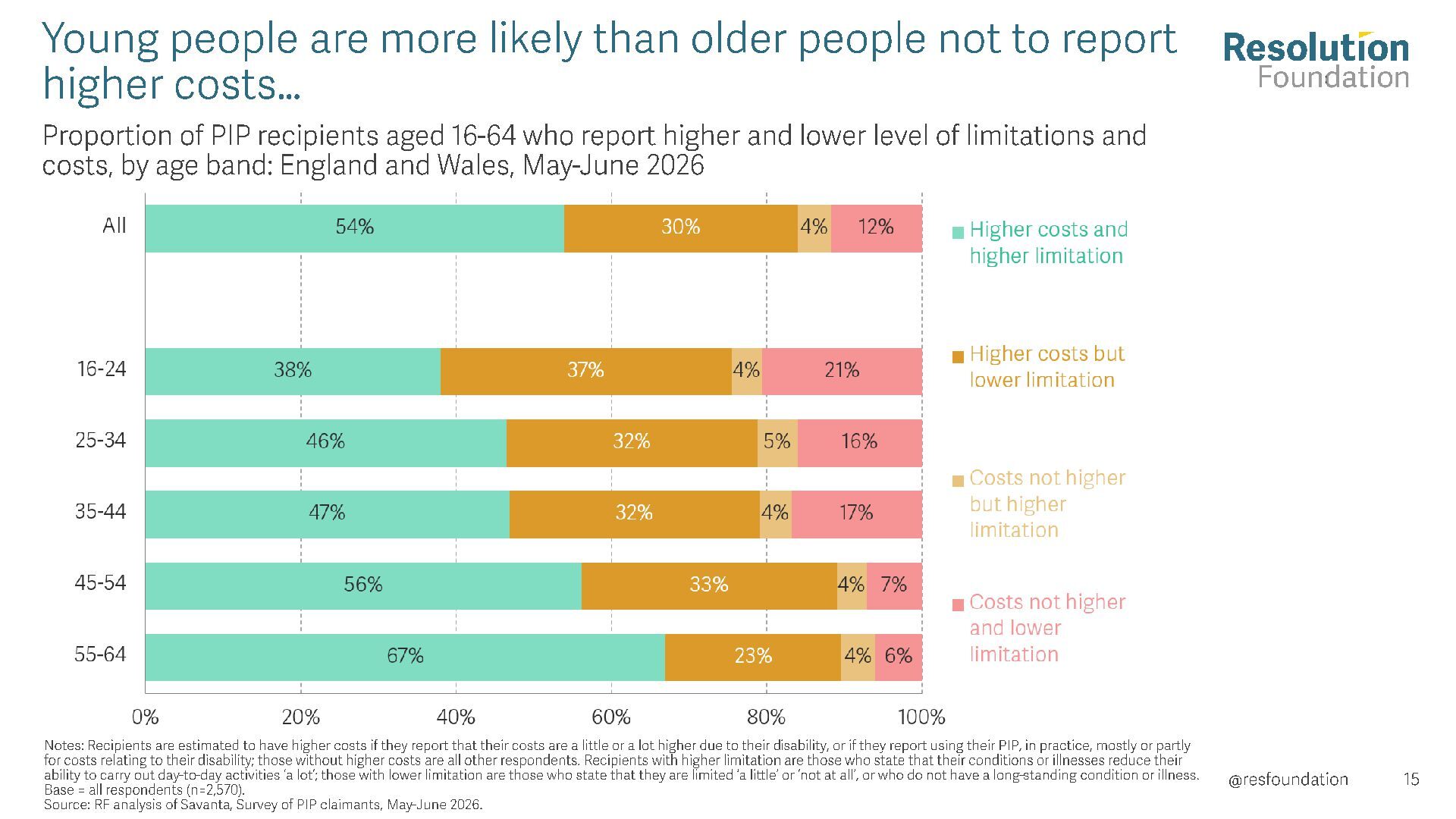
  11. Young people are more likely than older people not to

    report higher costs… Proportion of PIP recipients aged 16 -64 who report higher and lower level of limitations and costs, by age band: England and Wales, May -June 2026 Notes: Recipients are estimated to have higher costs if they report that their costs are a little or a lot higher due to thei for costs relating to their disability; those without higher costs are all other respondents. Recipients with higher limitati ability to carry out day -to-day activities ‘a lot’; those with lower limitation are those who state that they are limited ‘a lit Base = all respondents (n=2,570). Source: RF analysis of Savanta , Survey of PIP claimants, May -June 2026. r disability, or if they report using their PIP, in practice, mostly or partly on are those who state that their conditions or illnesses reduce their tle’ or ‘not at all’, or who do not have a long -standing condition or illness. @resfoundation 15
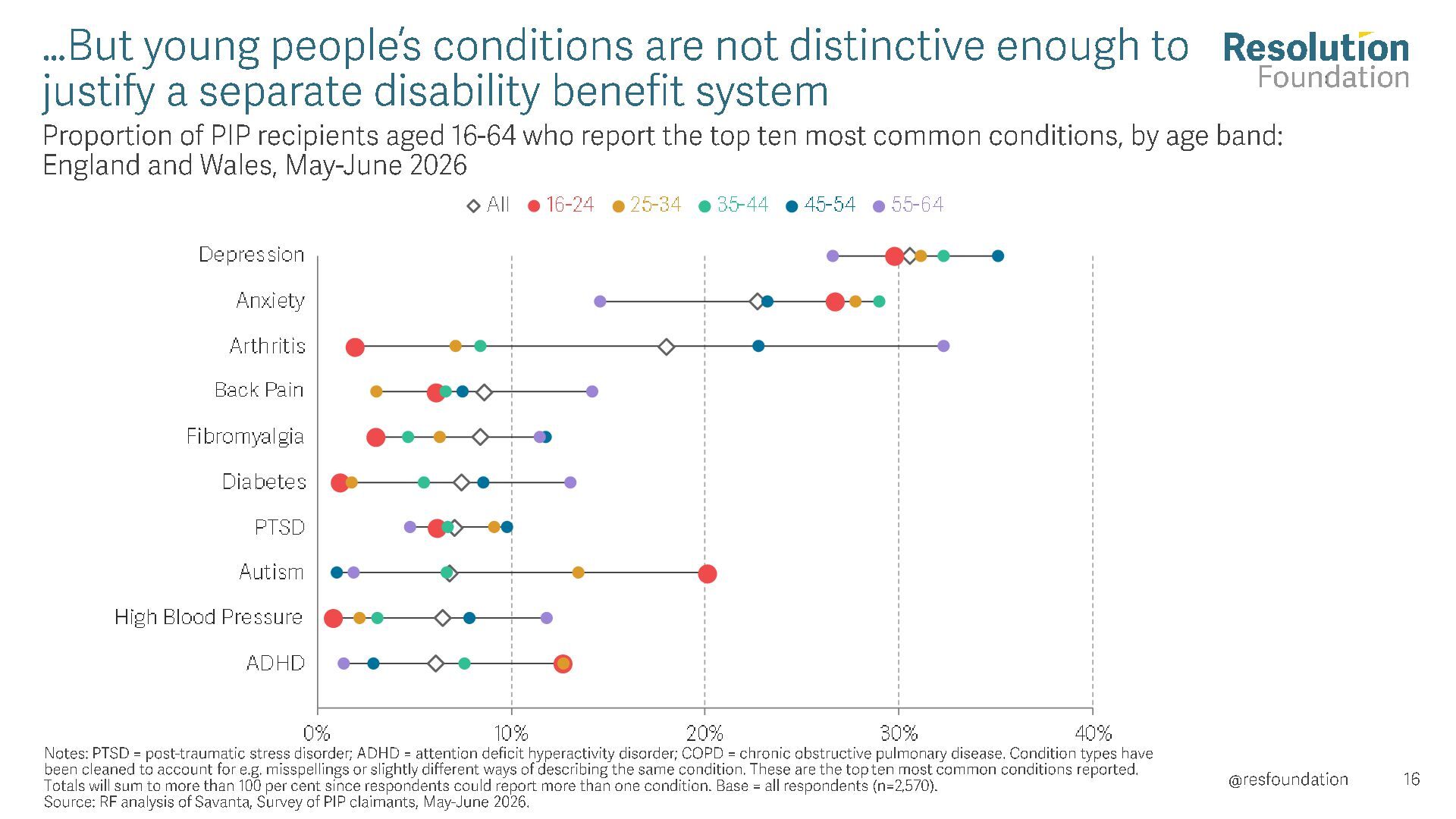
  12. …But young people’s conditions are not distinctive enough to justify

    a separate disability benefit system Proportion of PIP recipients aged 16 -64 who report the top ten most common conditions, by age band: England and Wales, May -June 2026 Notes: PTSD = post -traumatic stress disorder; ADHD = attention deficit hyperactivity disorder; COPD = chronic obstructive pulmon been cleaned to account for e.g. misspellings or slightly different ways of describing the same condition. These are the top Totals will sum to more than 100 per cent since respondents could report more than one condition. Base = all respondents (n=2 Source: RF analysis of Savanta , Survey of PIP claimants, May -June 2026. ary disease. Condition types have ten most common conditions reported. ,570). @resfoundation 16
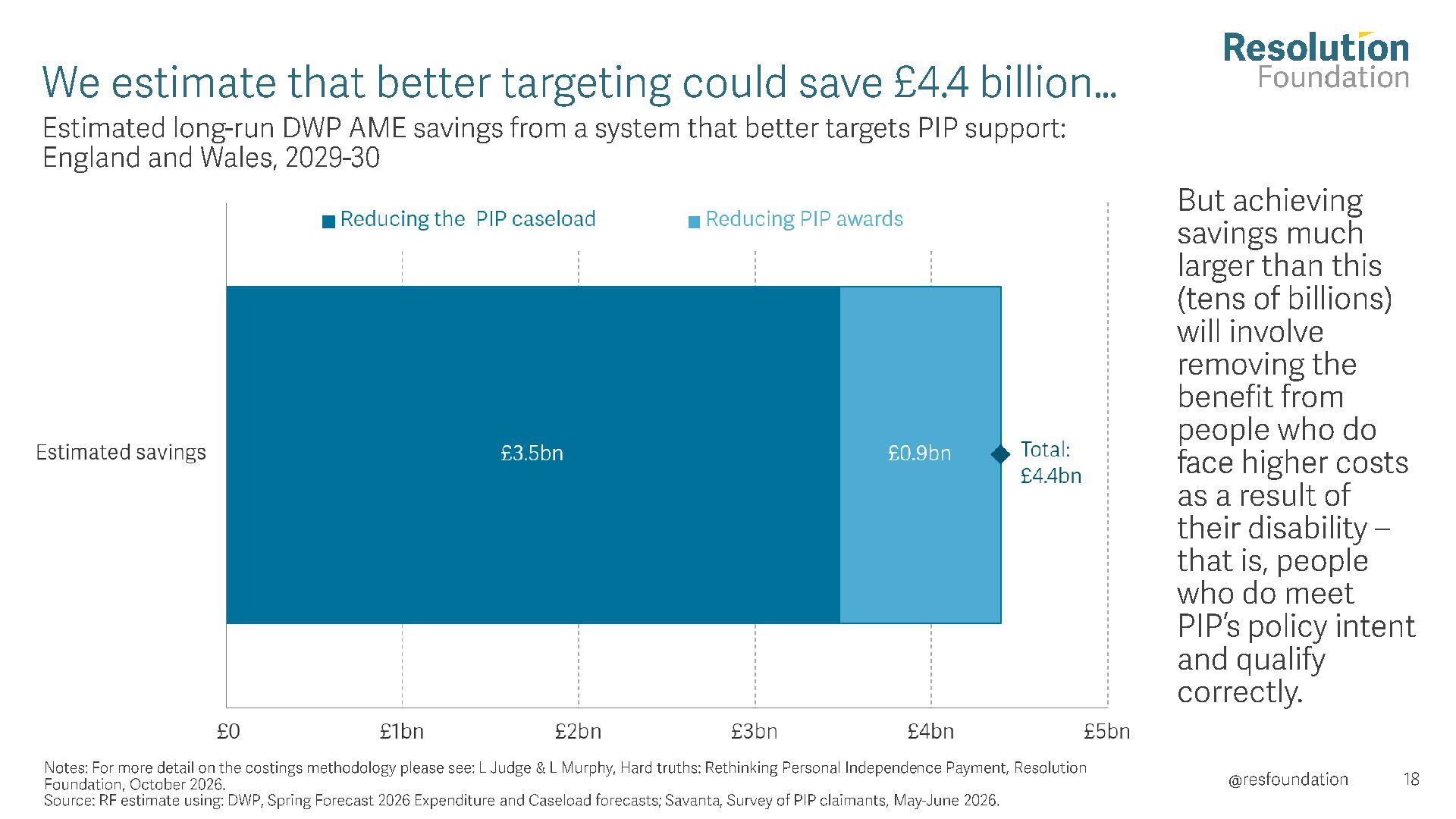
  13. We estimate that better targeting could save £4.4 billion… Estimated

    long -run DWP AME savings from a system that better targets PIP support: England and Wales, 2029 -30 But achieving savings much larger than this (tens of billions) will involve removing the benefit from people who do face higher costs as a result of their disability – that is, people who do meet PIP’s policy intent and qualify correctly. Notes: For more detail on the costings methodology please see: L Judge & L Murphy, Hard truths: Rethinking Personal Independe nce Payment, Resolution Foundation, October 2026. Source: RF estimate using: DWP, Spring Forecast 2026 Expenditure and Caseload forecasts; Savanta , Survey of PIP claimants, May -June 2026. @resfoundation 18
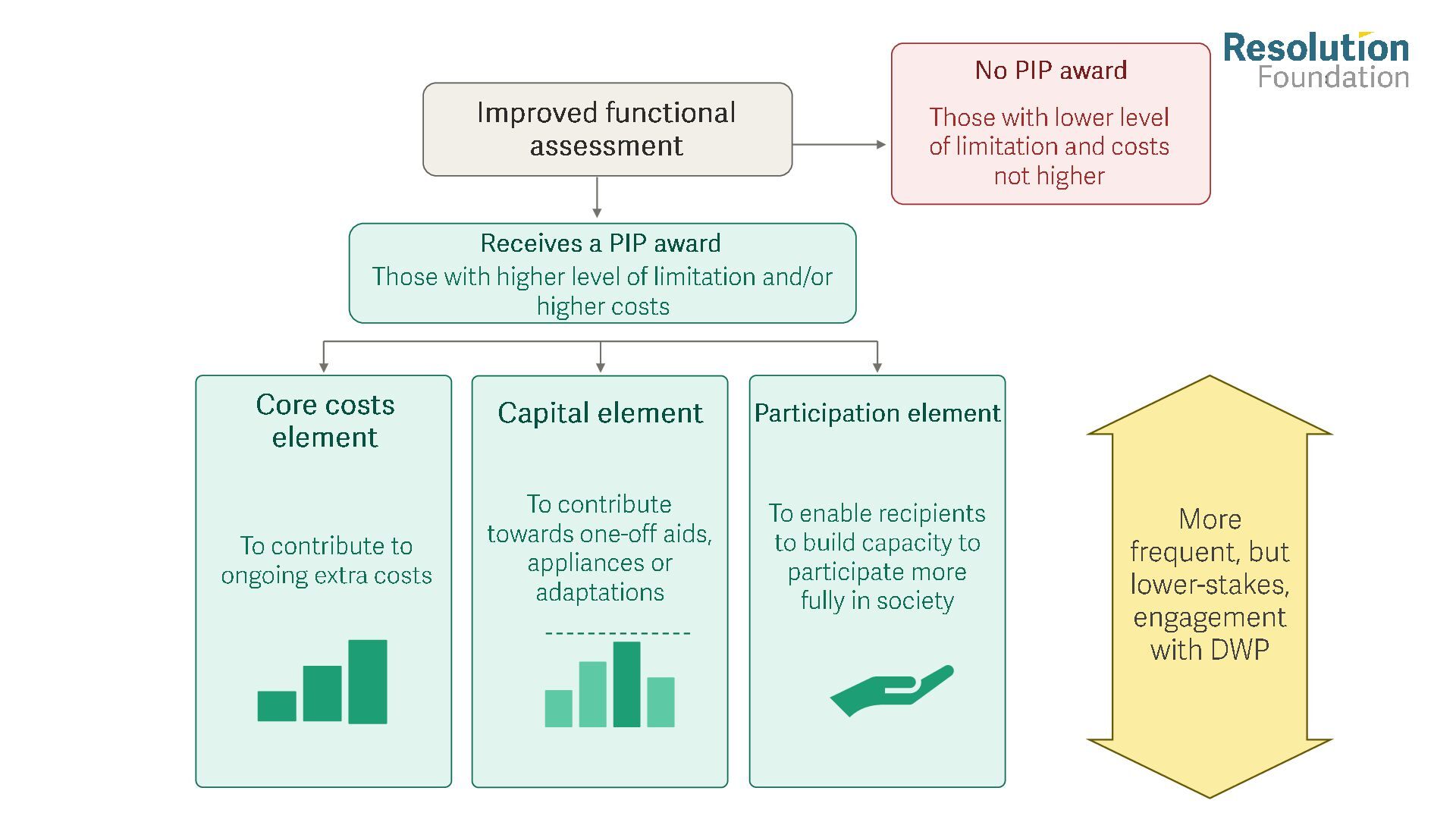
  14. No PIP award Improved functional assessment Those with lower level

    of limitation and costs not higher Receives a PIP award Those with higher level of limitation and/or higher costs Core costs element To contribute to ongoing extra costs Capital element Participation element To contribute towards one -off aids, appliances or adaptations To enable recipients to build capacity to participate more fully in society More frequent, but lower -stakes, engagement with DWP
  15. A new deal for disabled people Reconnecting disability support with

    the needs of recipients Louise Murphy, Senior Economist at the Resolution Foundation Edel Harris, Chair of the Independent Review of Adult Disability Payment in Scotland Tom Pollard, Head of Policy, Campaigns and Public Affairs at Mind Chris Smyth, Public Policy Editor at the Financial Times Chair: Ruth Curtice, Wifi 2QAG_Guest Welcome_Guests Chief Executive of the Resolution Foundation #NewDeal @resfoundation October 26