Upgrade to Pro — share decks privately, control downloads, hide ads and more …

Fixing broken labour markets: What can the UK a...

Sponsored · Your Podcast. Everywhere. Effortlessly. Share. Educate. Inspire. Entertain. You do you. We'll handle the rest. →

Fixing broken labour markets: What can the UK and US learn from each other?

No two labour markets are alike. But in recent years the UK and the US have rhymed. Both have seen decent pay growth for the lowest earners, though by different routes: a rising minimum wage in the UK, and a tight post-pandemic labour market in the US. Both have disappointed in the middle: the US has generated impressive productivity gains but not shared them with typical workers, while, until very recently, the UK hasn’t had any productivity gains to share. And yet they differ sharply on jobs: the US remains an employment laggard among 25-54 year olds, while the UK does far better on prime-age employment, even as unemployment has risen to around 5 per cent.

How should we approach the labour market challenges facing the US and UK? What are the roles of policy makers, labour market instructions and business in building labour markets that benefit everyone? And are there lessons that each country can take from each other, both in terms of policy successes and failures and wider trends to watch out for?

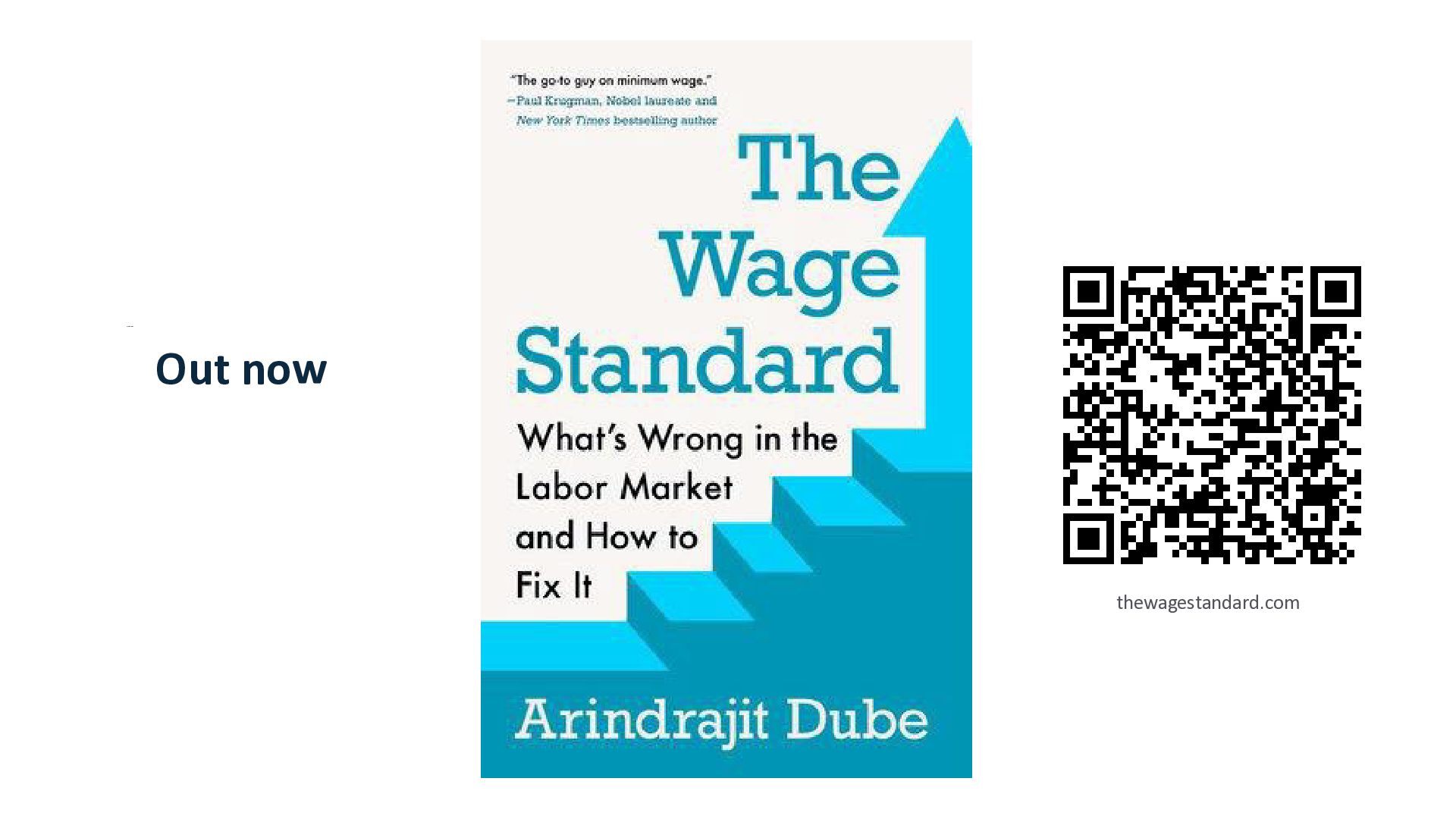
To answer these questions, the Resolution Foundation is hosting an event with leading labour market experts from both sides of the Atlantic. We will be joined by the world-leading minimum wage expert Professor Arin Dube to discuss his new book The Wage Standard, along with Professor Stephen Machin of the LSE. The event, organised with the Centre for Economic Performance at the London School of Economics and Political Science, is part of the ESRC’s Festival of Social Science that is taking place at venues across the country throughout October and November. Further information about the festival can be found here.

Avatar for Resolution Foundation

Resolution Foundation

October 28, 2026

More Decks by Resolution Foundation

Other Decks in Research

Transcript

  1. Fixing broken labour markets What can the UK and US

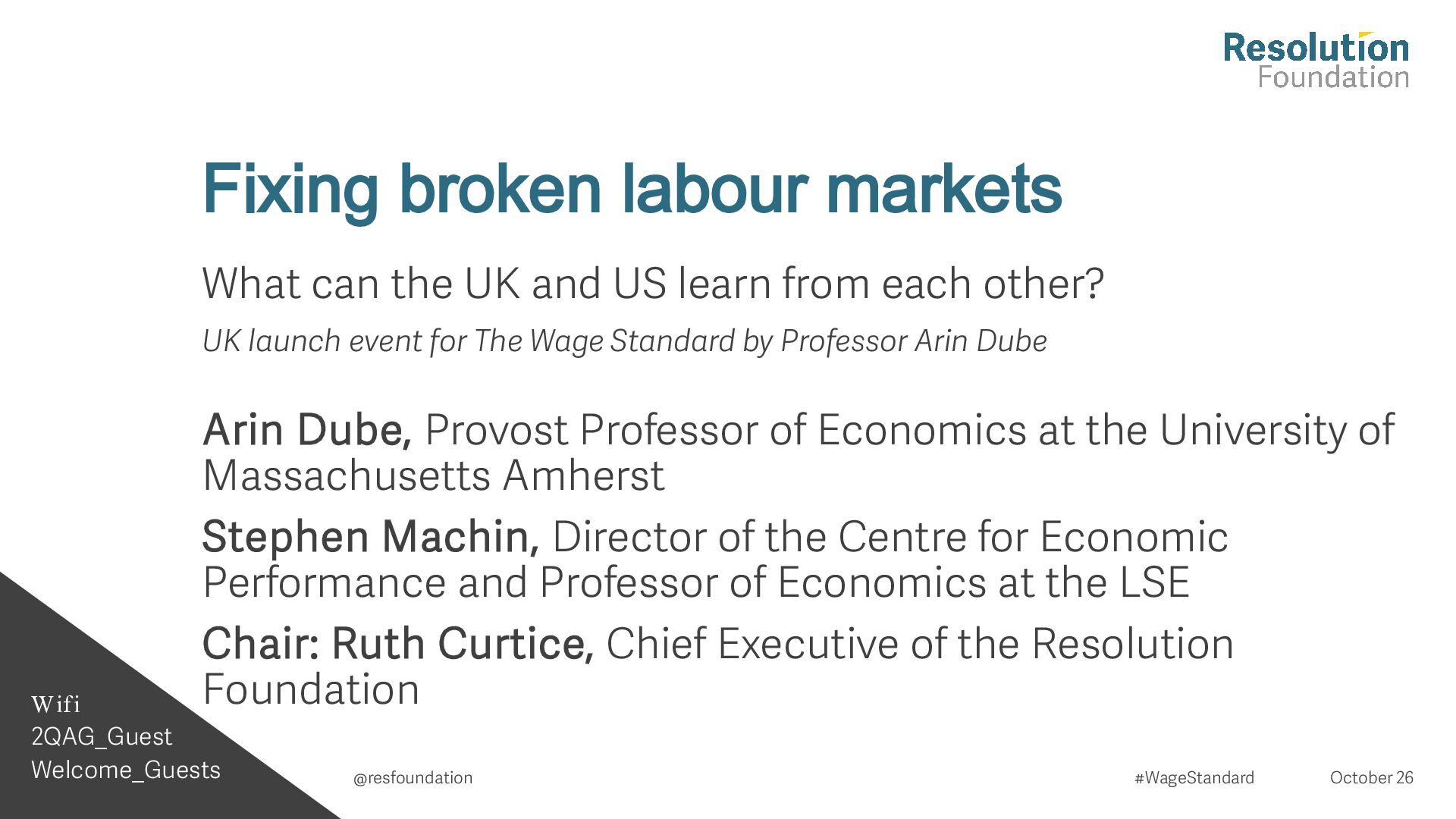
    learn from each other? UK launch event for The Wage Standard by Professor Arin Dube Arin Dube, Provost Professor of Economics at the University of Massachusetts Amherst Stephen Machin, Director of the Centre for Economic Performance and Professor of Economics at the LSE Chair: Ruth Curtice, Chief Executive of the Resolution Foundation Wifi 2QAG_Guest Welcome_Guests @resfoundation #WageStandard October 26
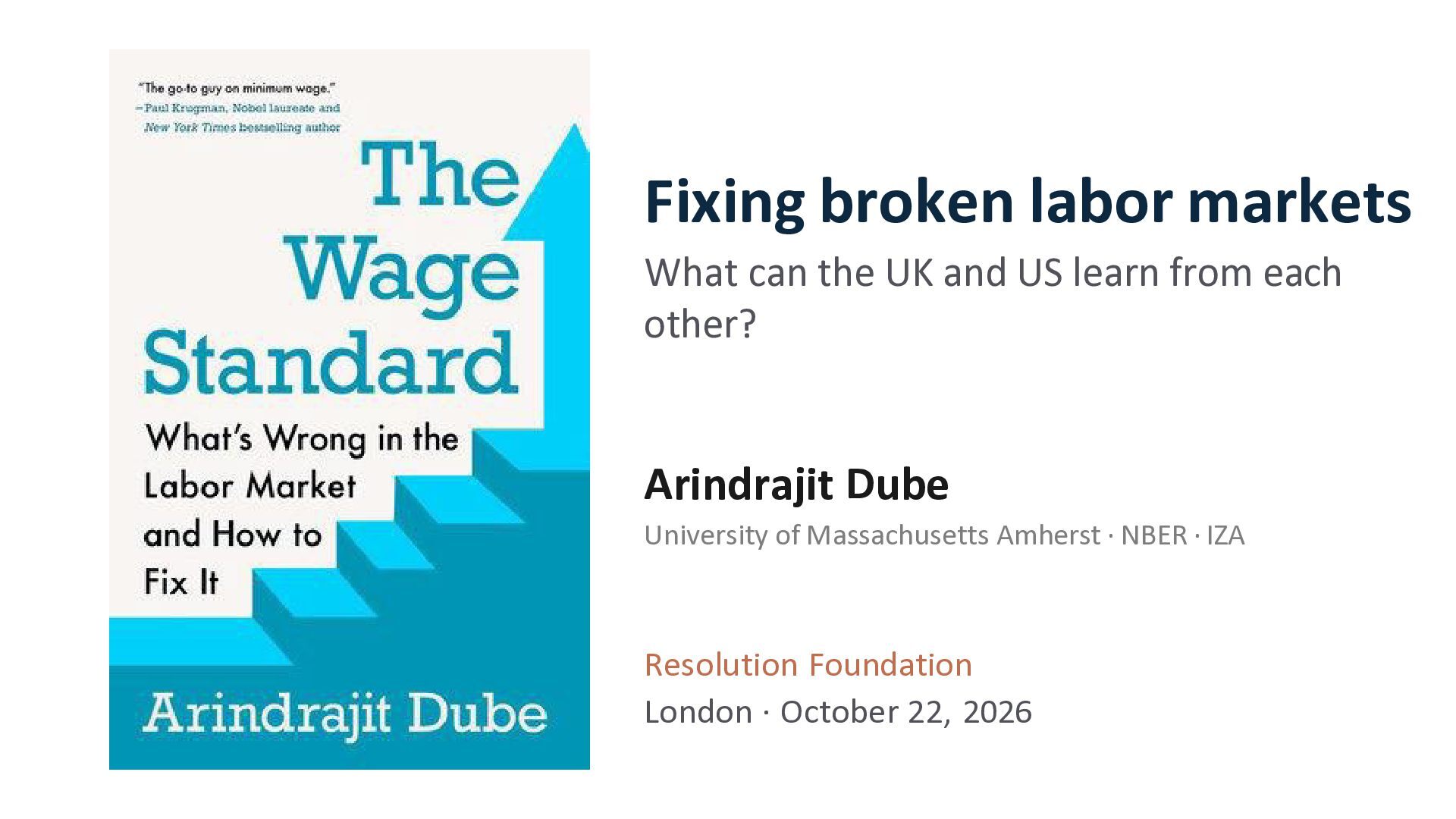
  2. Fixing broken labor markets What can the UK and US

    learn from each other? Arindrajit Dube University of Massachusetts Amherst · NBER · IZA Resolution Foundation London · October 22, 2026
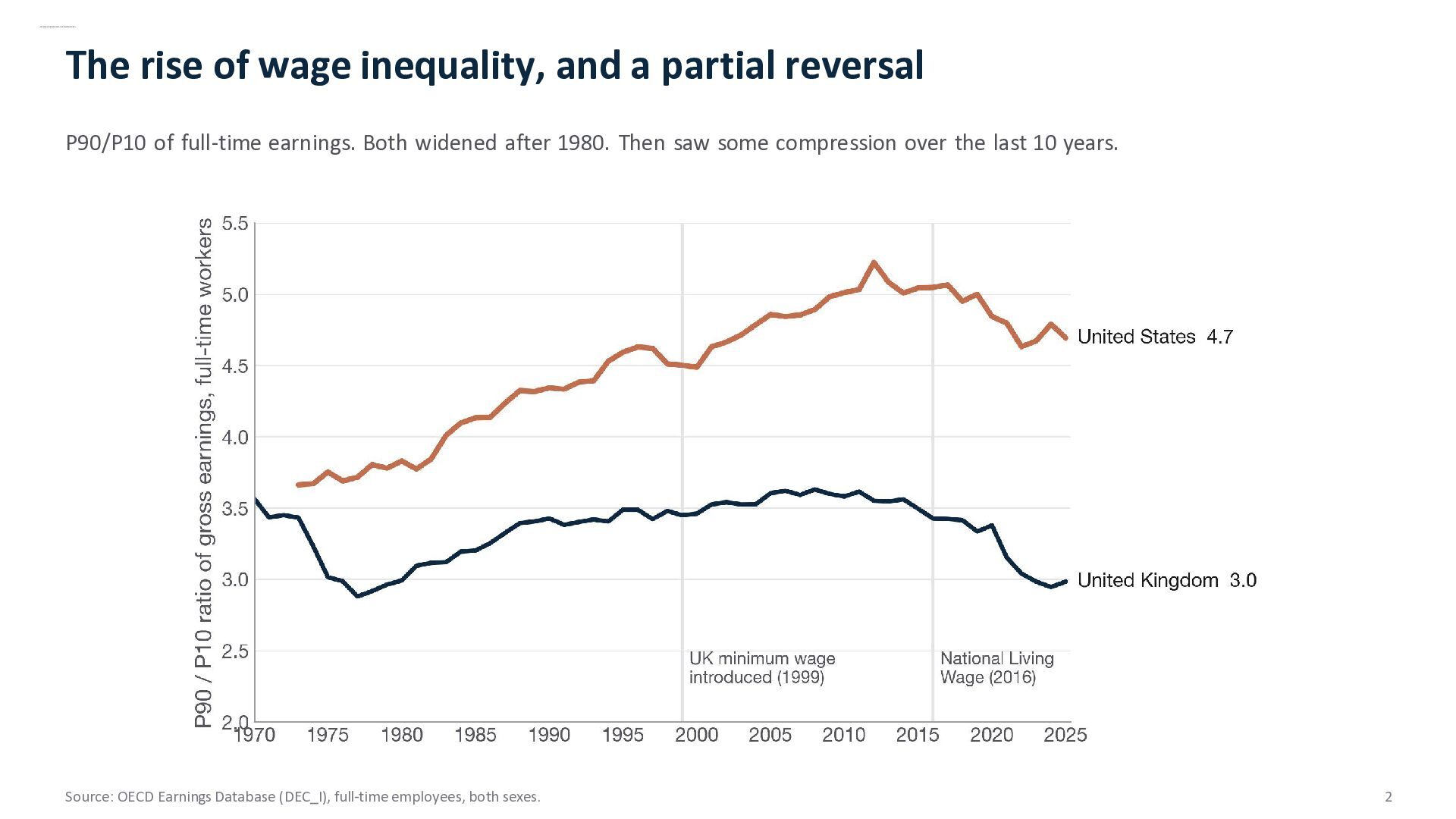
  3. The rise of wage inequality, and a partial reversal The

    rise of wage inequality, and a partial reversal P90/P10 of full-time earnings. Both widened after 1980. Then saw some compression over the last 10 years. Source: OECD Earnings Database (DEC_I), full-time employees, both sexes. 2
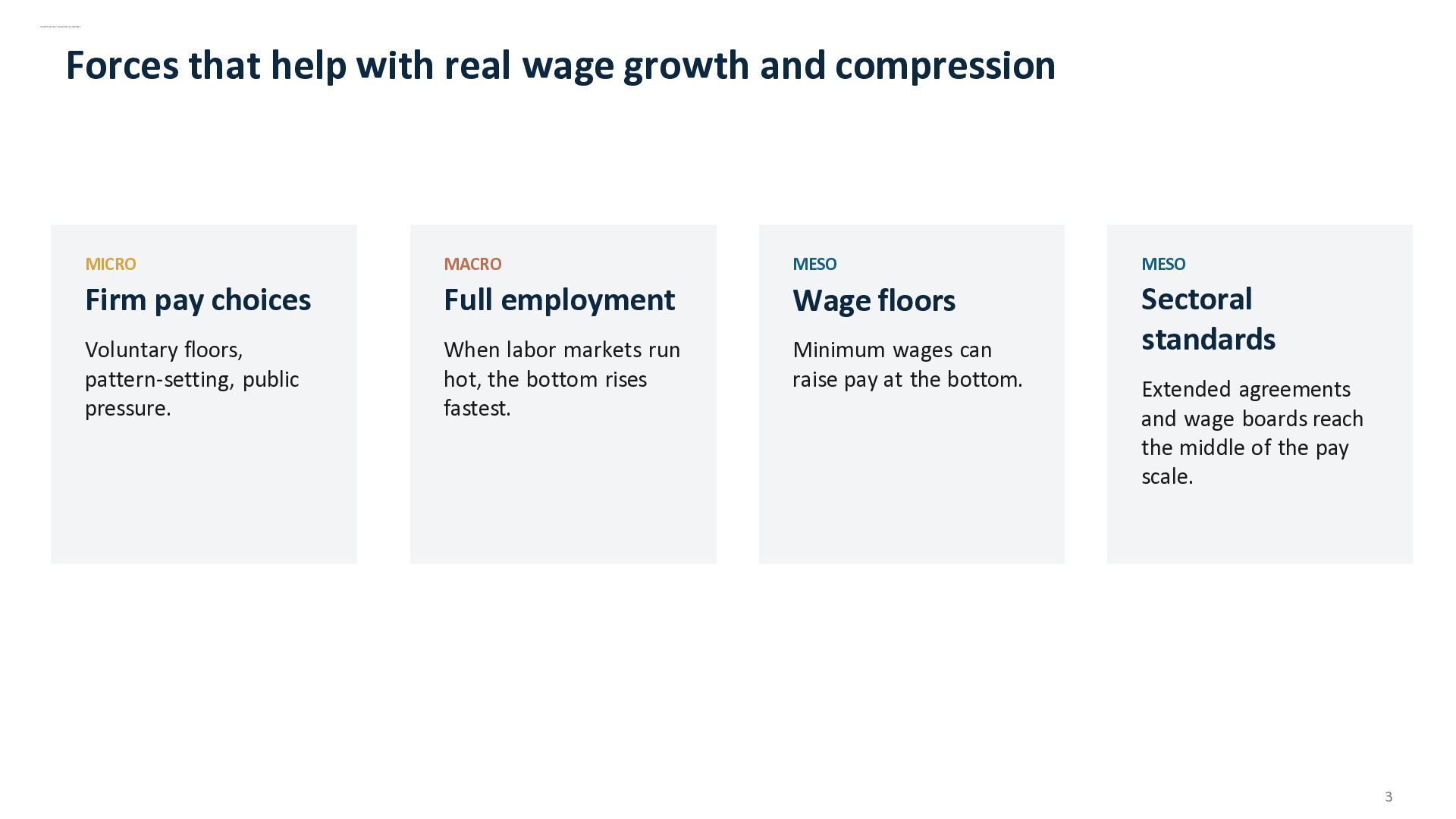
  4. Forces that help with real wage growth and compression Forces

    that help with real wage growth and compression MICRO Firm pay choices Voluntary floors, pattern-setting, public pressure. MACRO Full employment When labor markets run hot, the bottom rises fastest. MESO Wage floors Minimum wages can raise pay at the bottom. MESO Sectoral standards Extended agreements and wage boards reach the middle of the pay scale. 3
  5. Most real-world labor markets exhibit considerable monopsony power Most real-world

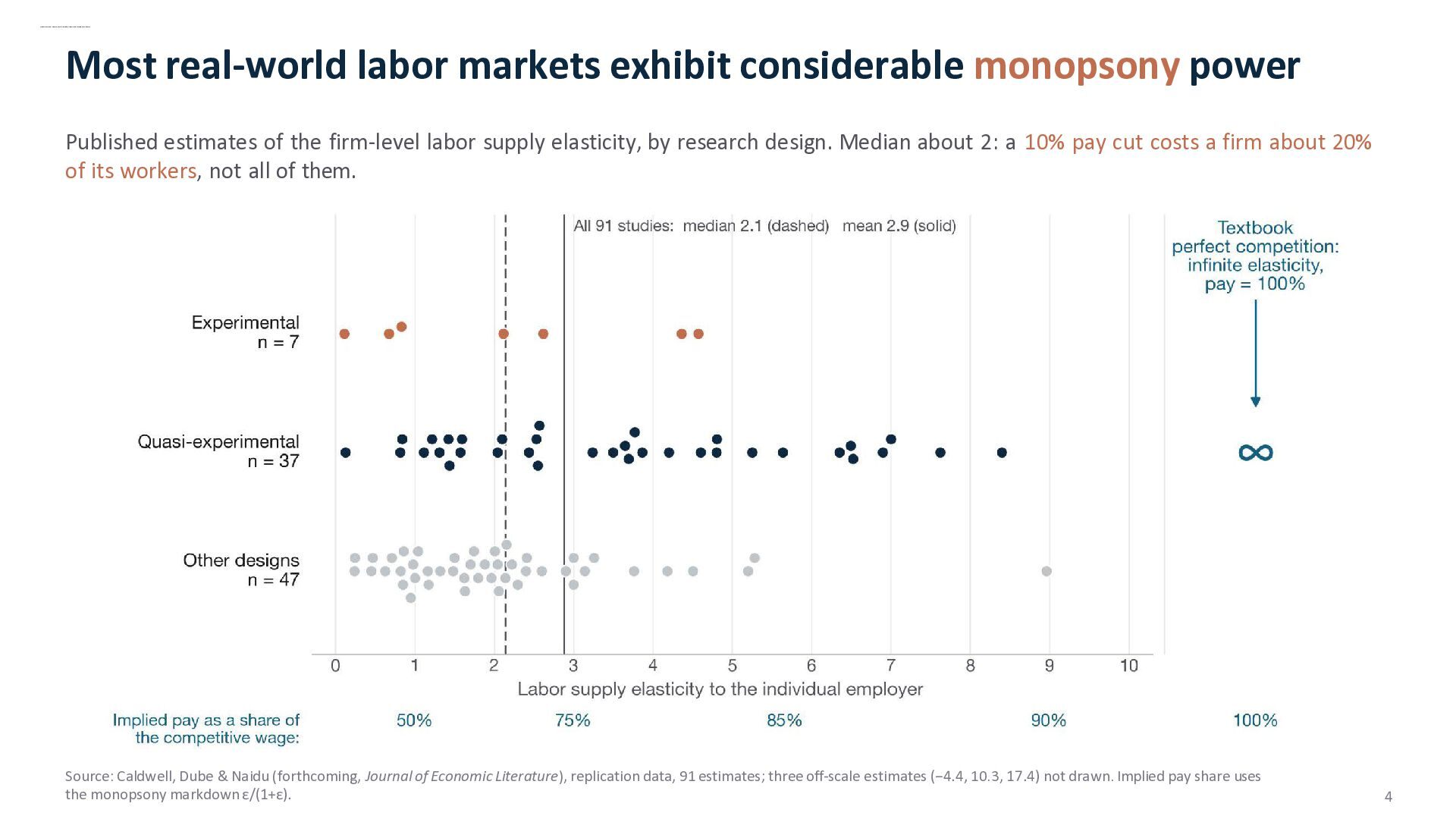
    labor markets exhibit considerable monopsony power Published estimates of the firm-level labor supply elasticity, by research design. Median about 2: a 10% pay cut costs a firm about 20% of its workers, not all of them. Source: Caldwell, Dube & Naidu (forthcoming, Journal of Economic Literature), replication data, 91 estimates; three off-scale estimates (−4.4, 10.3, 17.4) not drawn. Implied pay share uses the monopsony markdown ε/(1+ε). 4
  6. Since early 1980s, many firms chose a low-wage strategy But

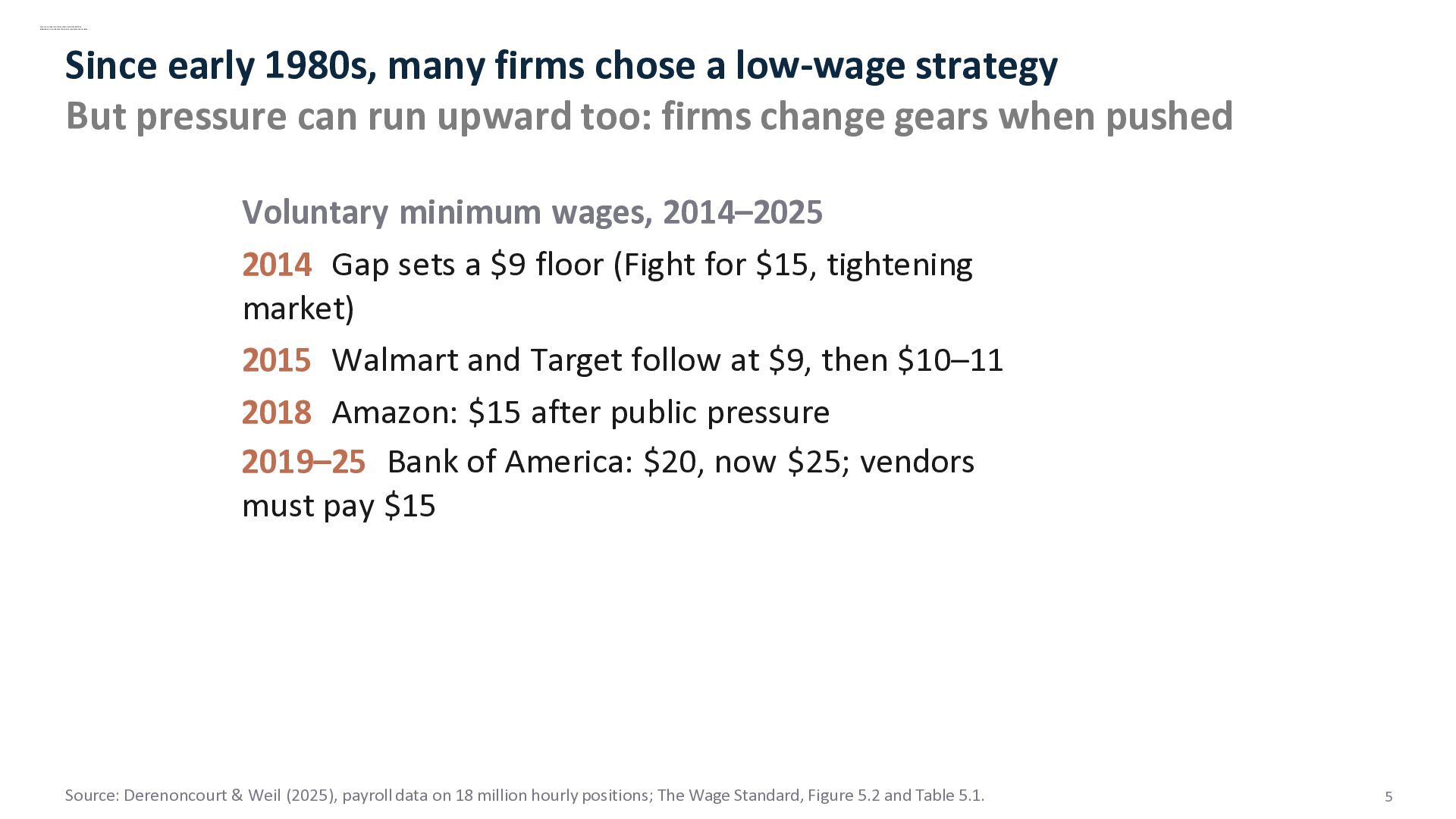
    pressure can run upward too: firms change gears when pushed Since early 1980s, many firms chose a low-wage strategy But pressure can run upward too: firms change gears when pushed Voluntary minimum wages, 2014–2025 2014 Gap sets a $9 floor (Fight for $15, tightening market) 2015 Walmart and Target follow at $9, then $10–11 2018 Amazon: $15 after public pressure 2019–25 Bank of America: $20, now $25; vendors must pay $15 Source: Derenoncourt & Weil (2025), payroll data on 18 million hourly positions; The Wage Standard, Figure 5.2 and Table 5.1. 5
  7. Since early 1980s, many firms chose a low-wage strategy But

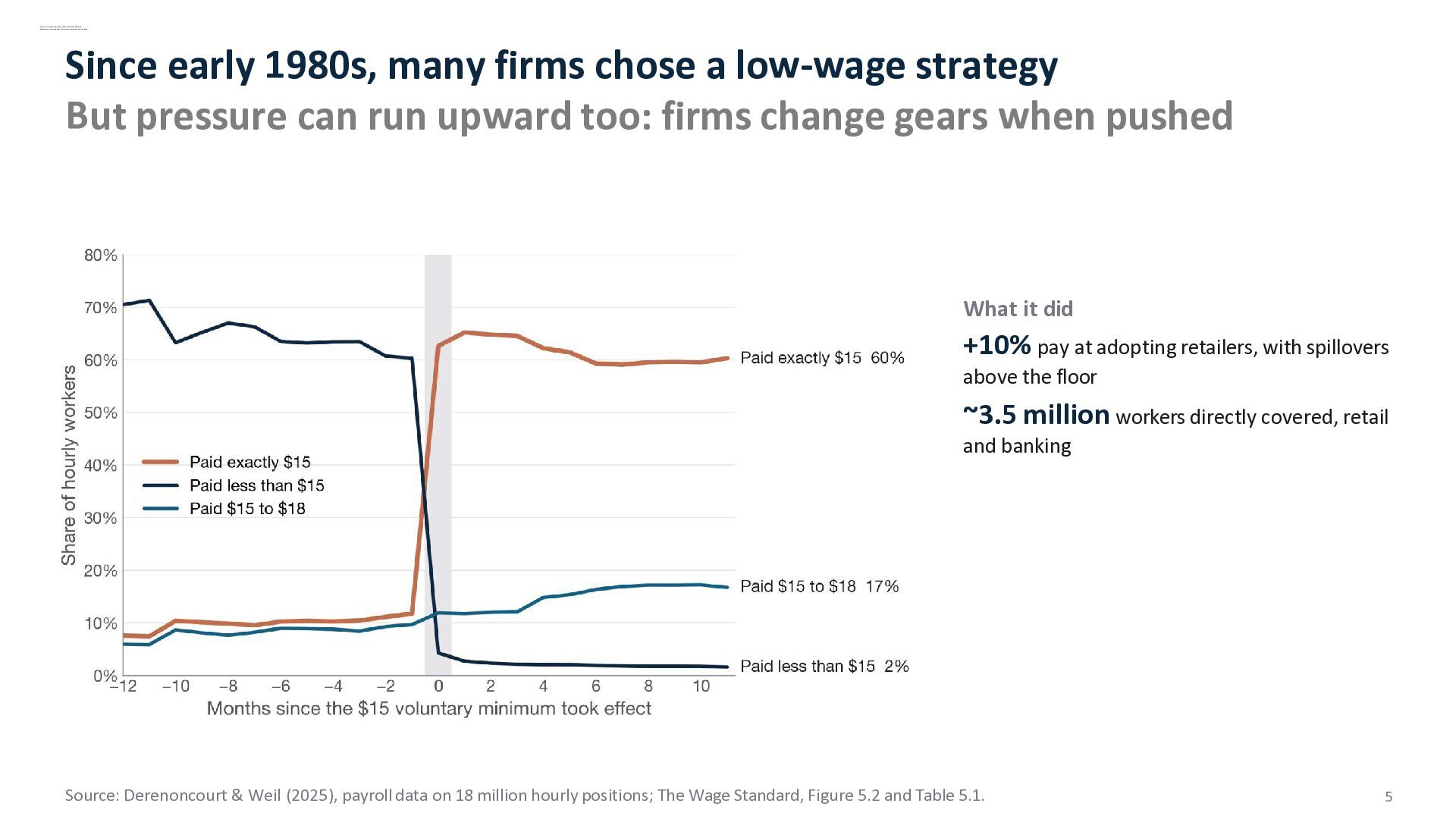
    pressure can run upward too: firms change gears when pushed Since early 1980s, many firms chose a low-wage strategy But pressure can run upward too: firms change gears when pushed What it did +10% pay at adopting retailers, with spillovers above the floor ~3.5 million workers directly covered, retail and banking Source: Derenoncourt & Weil (2025), payroll data on 18 million hourly positions; The Wage Standard, Figure 5.2 and Table 5.1. 5
  8. Return of the large-firm pay premium: retail sector Return of

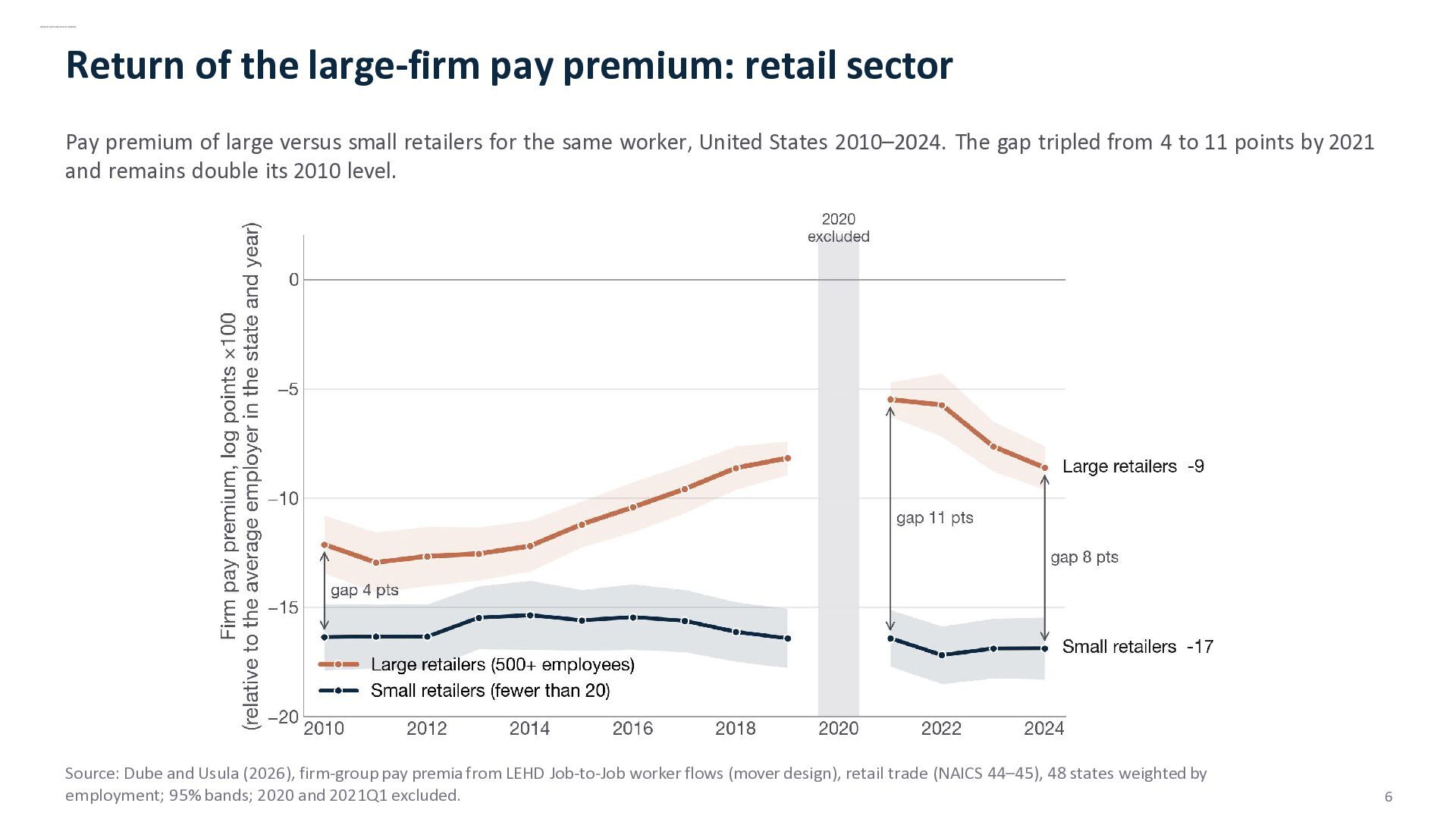
    the large-firm pay premium: retail sector Pay premium of large versus small retailers for the same worker, United States 2010–2024. The gap tripled from 4 to 11 points by 2021 and remains double its 2010 level. Source: Dube and Usula (2026), firm-group pay premia from LEHD Job-to-Job worker flows (mover design), retail trade (NAICS 44–45), 48 states weighted by employment; 95% bands; 2020 and 2021Q1 excluded. 6
  9. Minimum wages: rising across the OECD, bifurcating in America Minimum

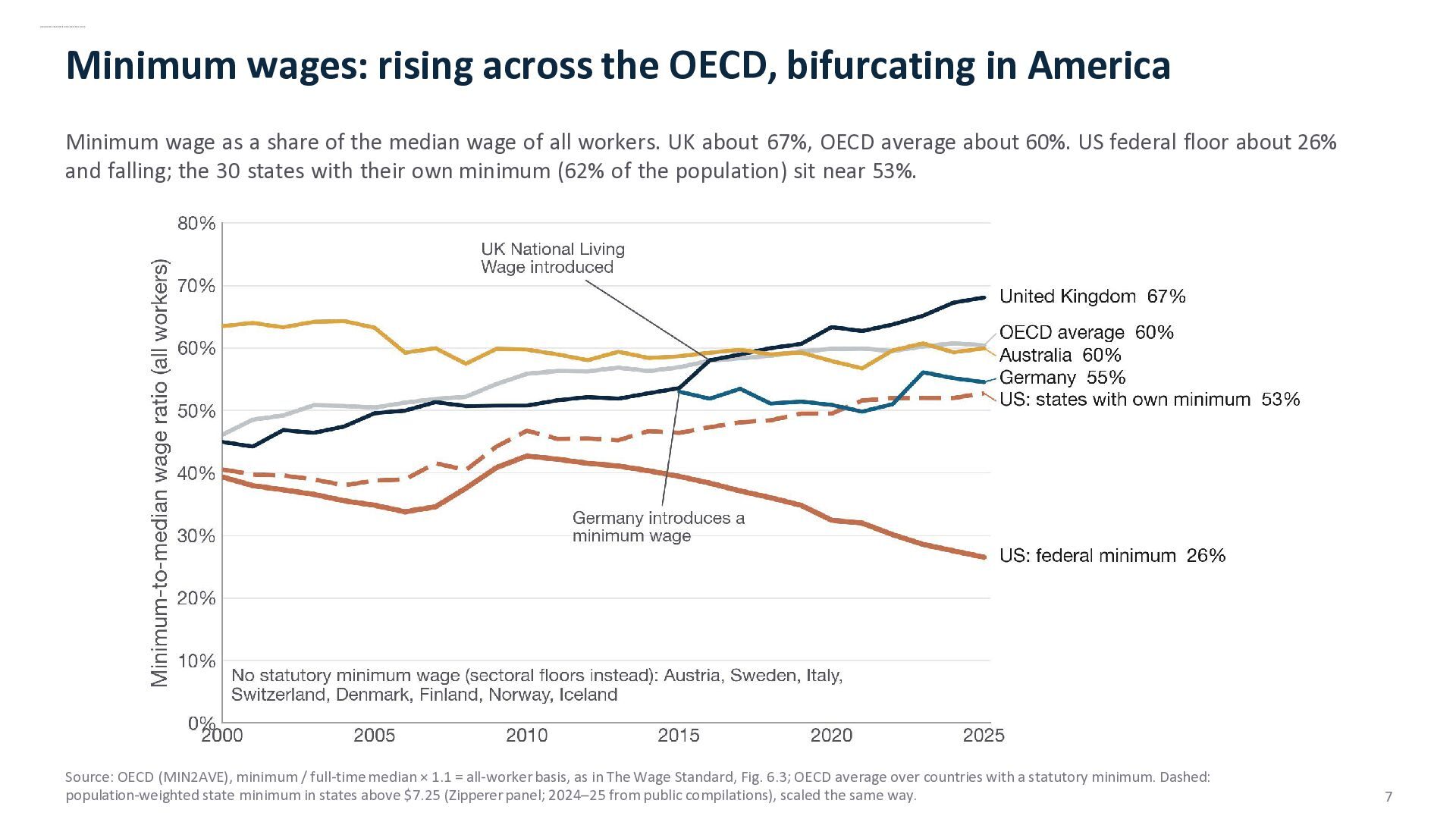
    wages: rising across the OECD, bifurcating in America Minimum wage as a share of the median wage of all workers. UK about 67%, OECD average about 60%. US federal floor about 26% and falling; the 30 states with their own minimum (62% of the population) sit near 53%. Source: OECD (MIN2AVE), minimum / full-time median × 1.1 = all-worker basis, as in The Wage Standard, Fig. 6.3; OECD average over countries with a statutory minimum. Dashed: population-weighted state minimum in states above $7.25 (Zipperer panel; 2024–25 from public compilations), scaled the same way. 7
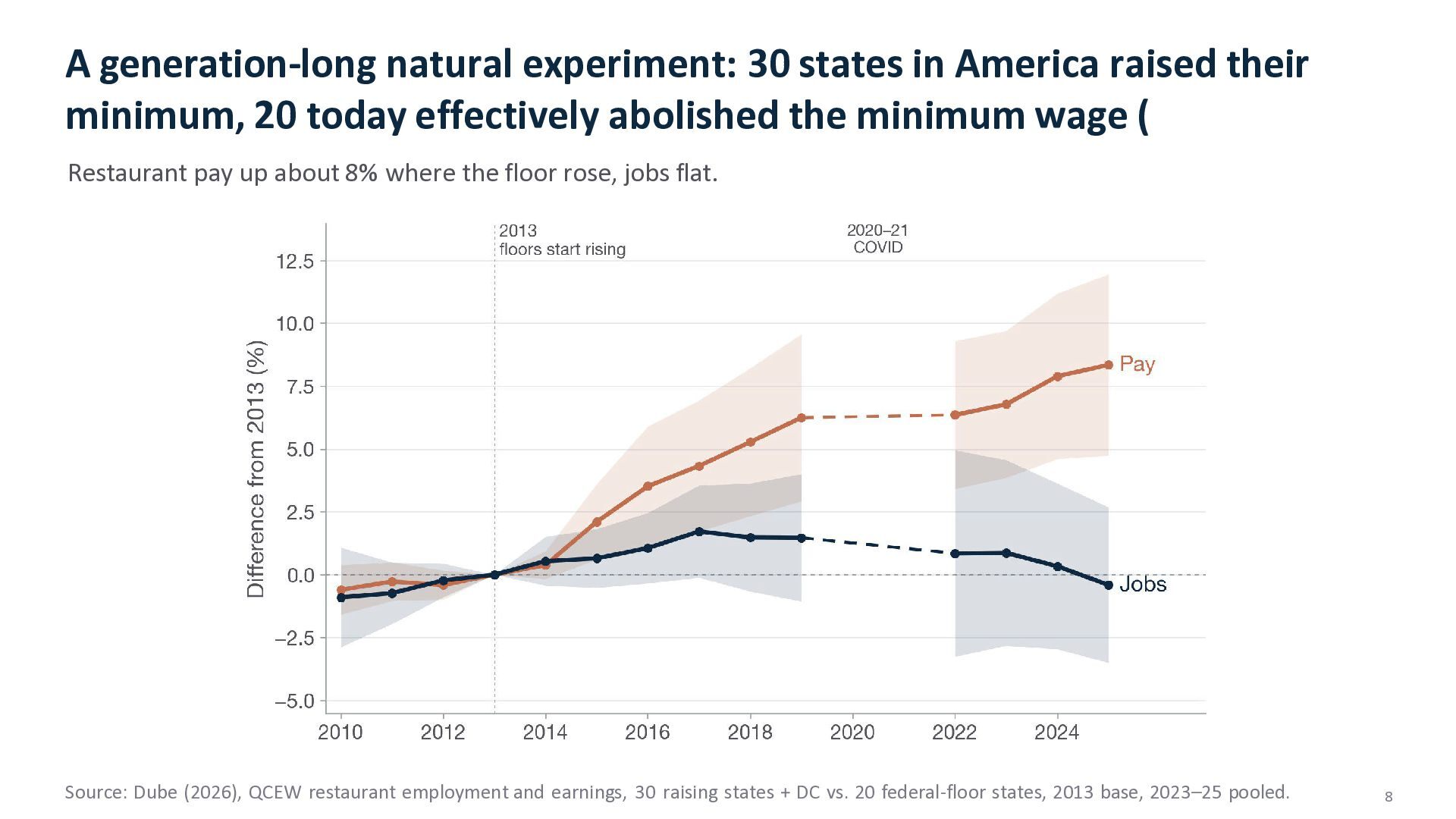
  10. A generation-long natural experiment: 30 states in America raised their

    minimum, 20 today effectively abolished the minimum wage ( Restaurant pay up about 8% where the floor rose, jobs flat. Source: Dube (2026), QCEW restaurant employment and earnings, 30 raising states + DC vs. 20 federal-floor states, 2013 base, 2023–25 pooled. 8
  11. The unexpected compression, 2019–2024 The unexpected compression, 2019–2024 Same chart,

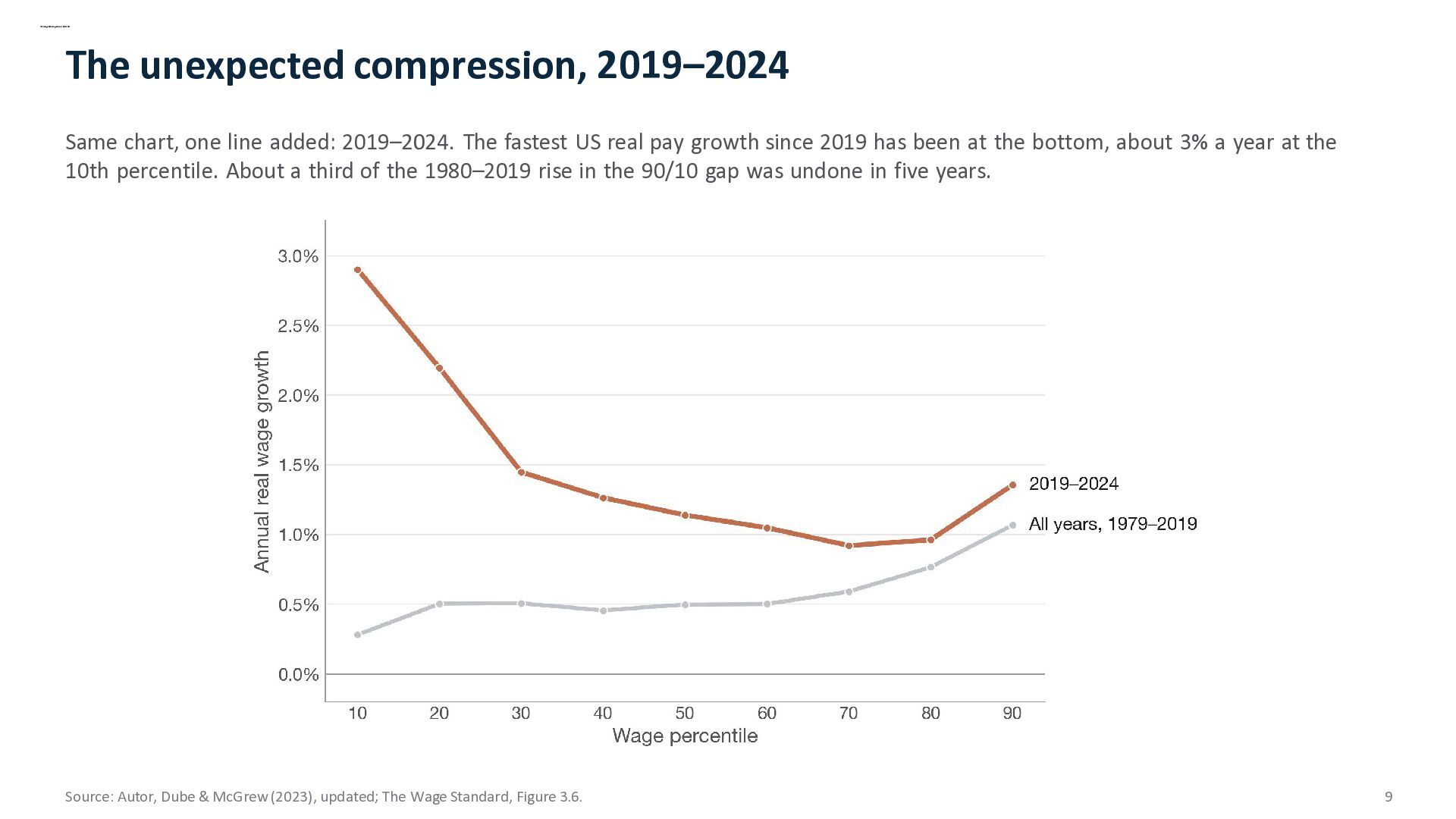
    one line added: 2019–2024. The fastest US real pay growth since 2019 has been at the bottom, about 3% a year at the 10th percentile. About a third of the 1980–2019 rise in the 90/10 gap was undone in five years. Source: Autor, Dube & McGrew (2023), updated; The Wage Standard, Figure 3.6. 9
  12. Where the compression came from: a labor market that worked

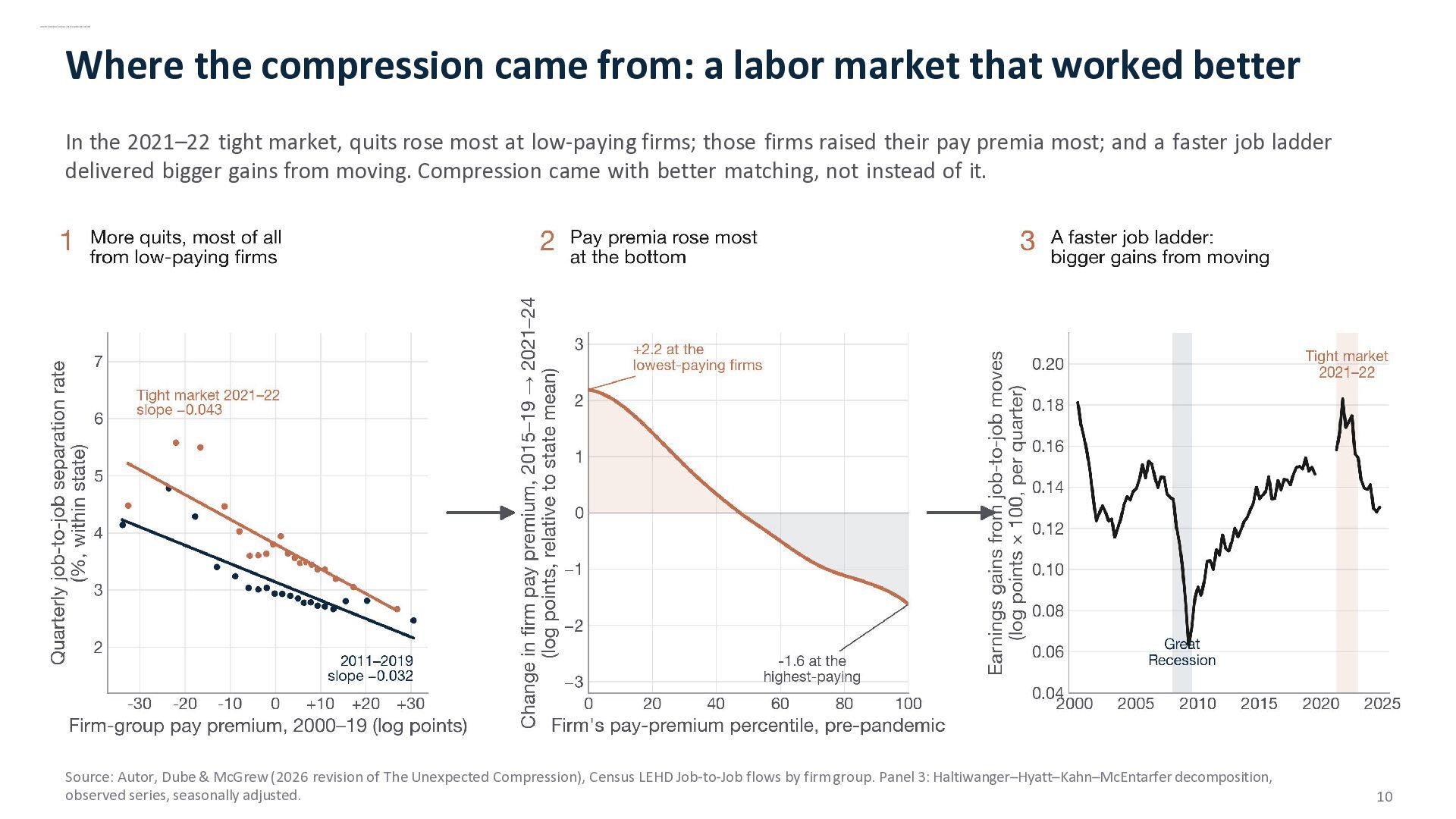
    better Where the compression came from: a labor market that worked better In the 2021–22 tight market, quits rose most at low-paying firms; those firms raised their pay premia most; and a faster job ladder delivered bigger gains from moving. Compression came with better matching, not instead of it. Source: Autor, Dube & McGrew (2026 revision of The Unexpected Compression), Census LEHD Job-to-Job flows by firm group. Panel 3: Haltiwanger–Hyatt–Kahn–McEntarfer decomposition, observed series, seasonally adjusted. 10
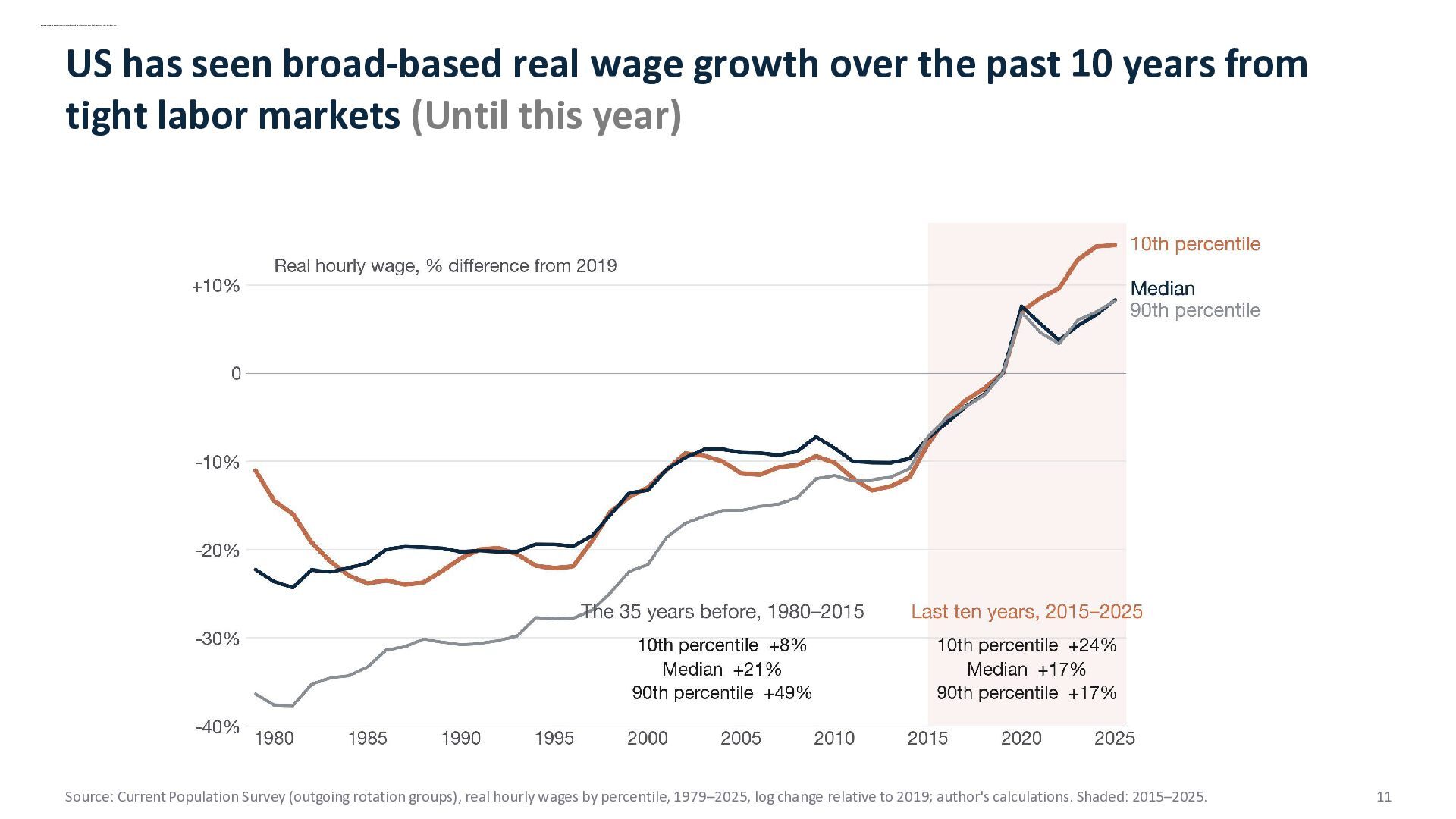
  13. US has seen broad-based real wage growth over the past

    10 years from tight labor markets (Until this year) US has seen broad-based real wage growth over the past 10 years from tight labor markets (Until this year) Source: Current Population Survey (outgoing rotation groups), real hourly wages by percentile, 1979–2025, log change relative to 2019; author's calculations. Shaded: 2015–2025. 11
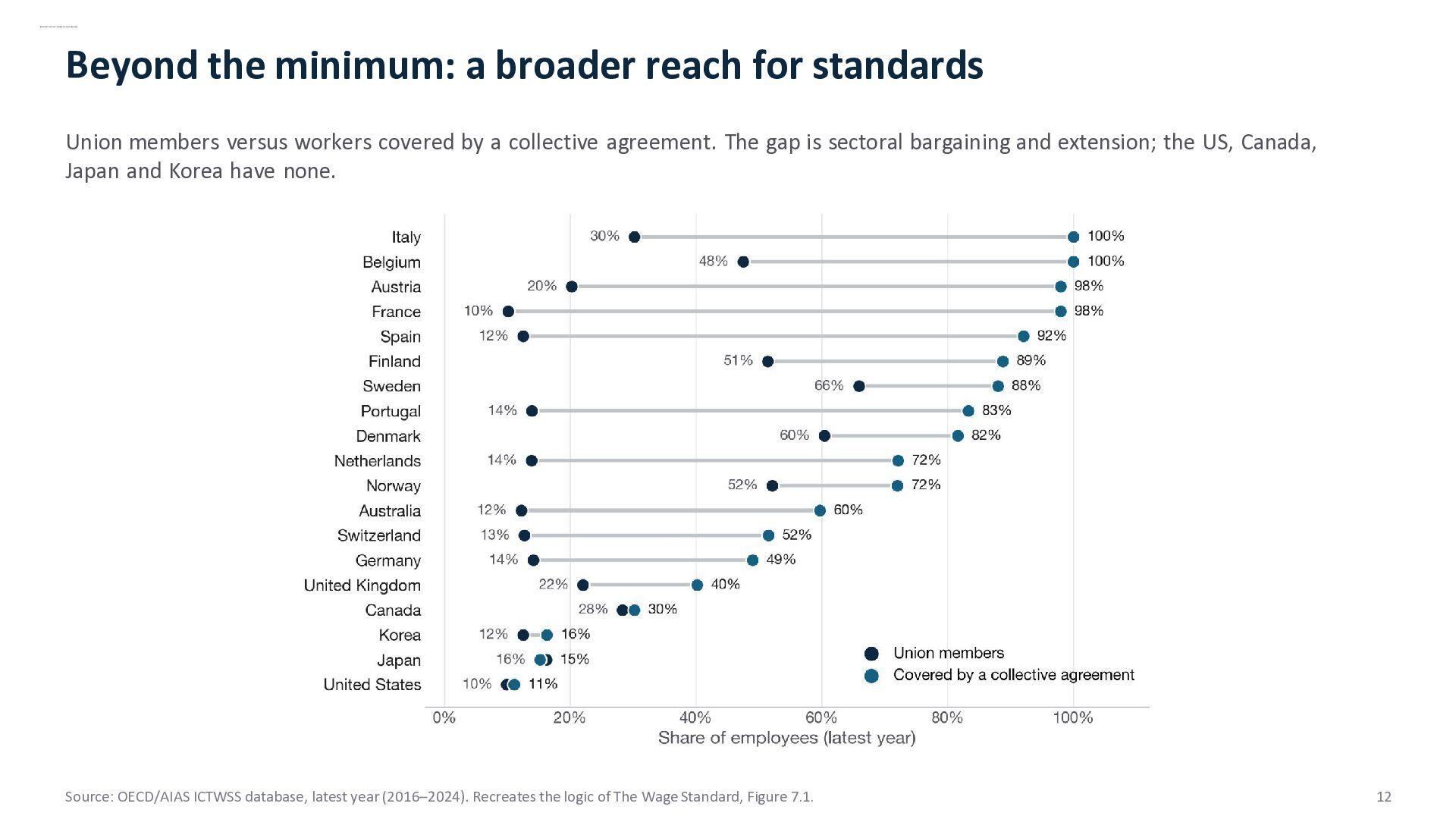
  14. Beyond the minimum: a broader reach for standards Beyond the

    minimum: a broader reach for standards Union members versus workers covered by a collective agreement. The gap is sectoral bargaining and extension; the US, Canada, Japan and Korea have none. Source: OECD/AIAS ICTWSS database, latest year (2016–2024). Recreates the logic of The Wage Standard, Figure 7.1. 12
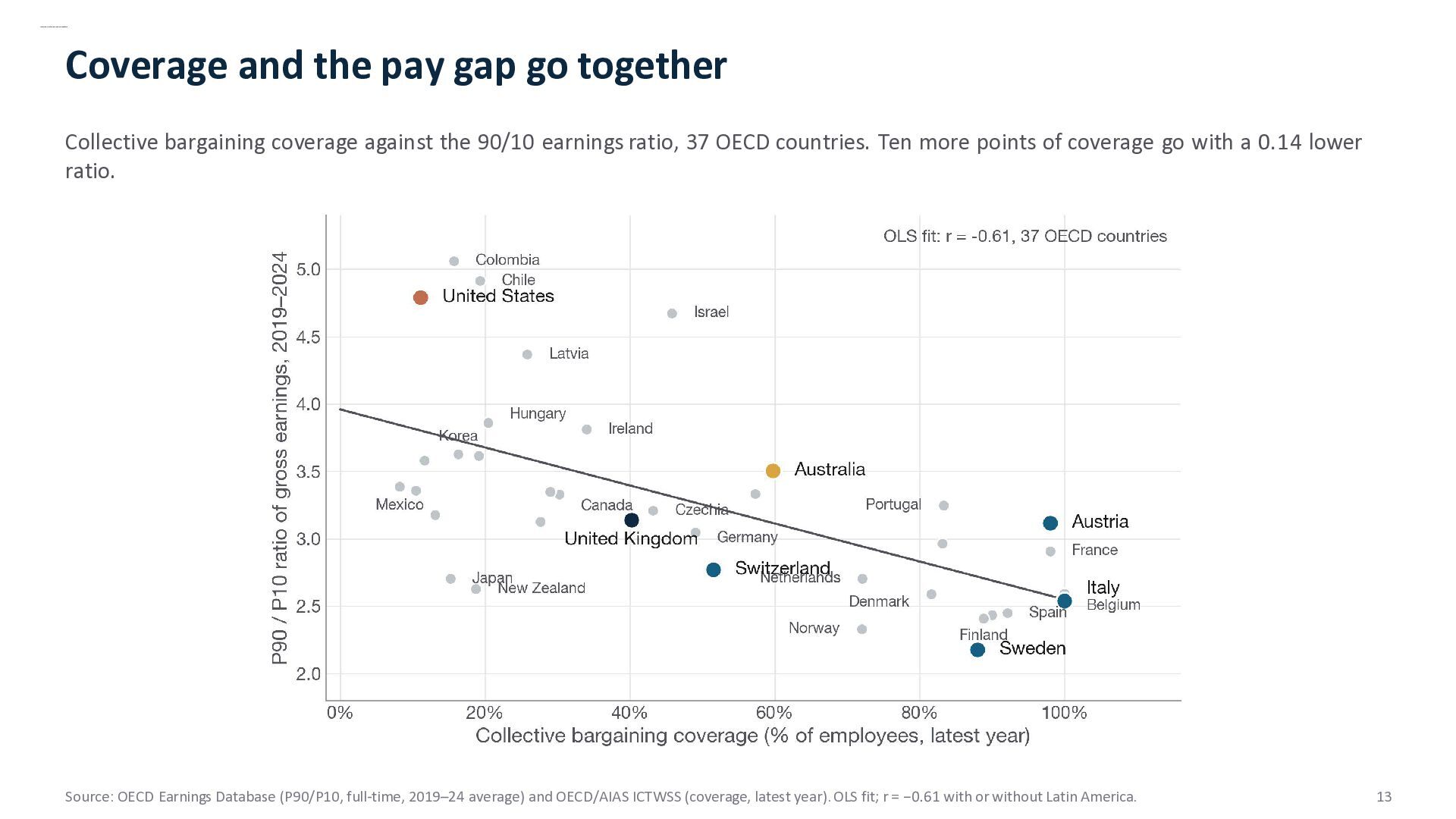
  15. Coverage and the pay gap go together Coverage and the

    pay gap go together Collective bargaining coverage against the 90/10 earnings ratio, 37 OECD countries. Ten more points of coverage go with a 0.14 lower ratio. Source: OECD Earnings Database (P90/P10, full-time, 2019–24 average) and OECD/AIAS ICTWSS (coverage, latest year). OLS fit; r = −0.61 with or without Latin America. 13
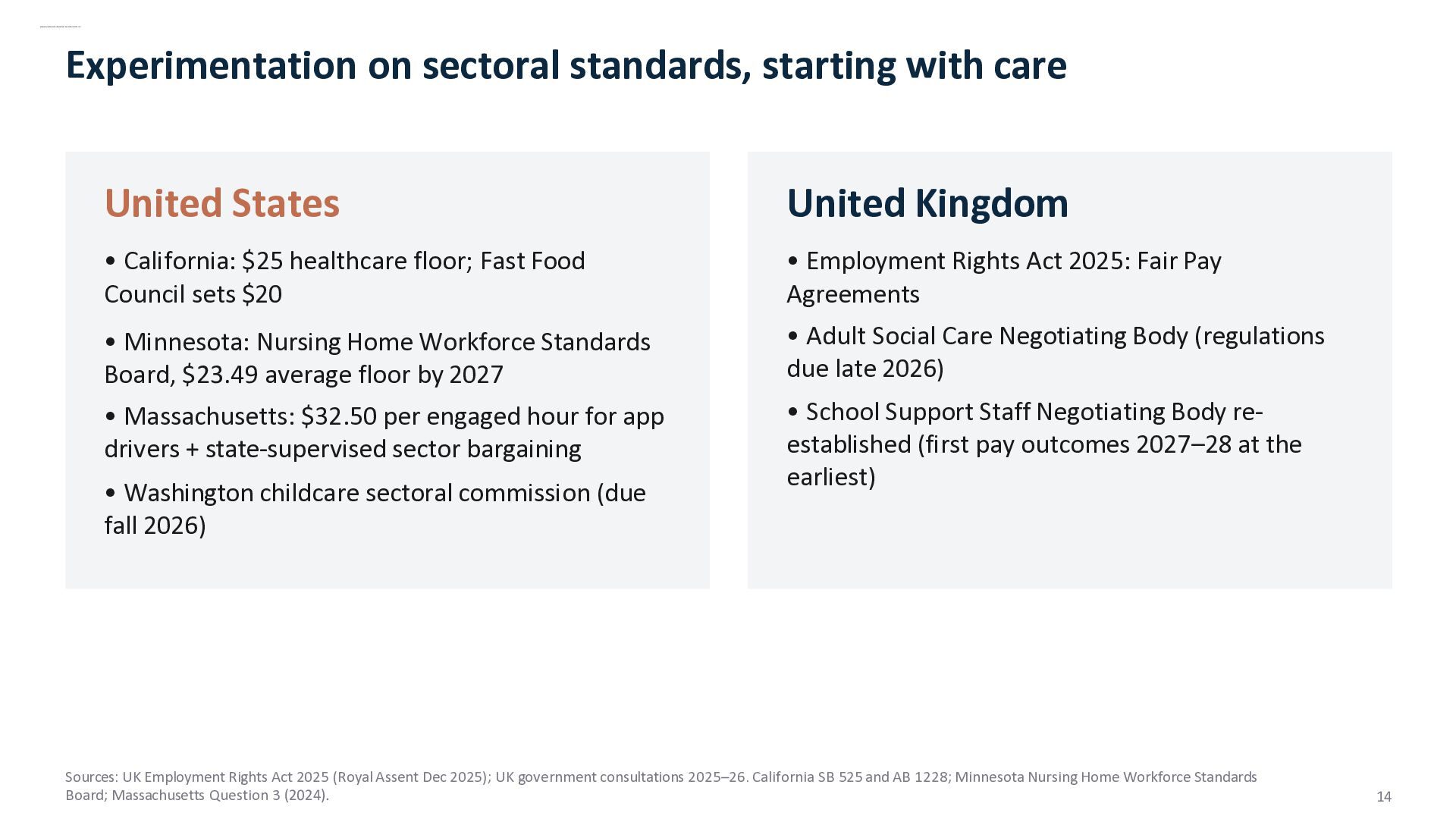
  16. Experimentation on sectoral standards, starting with care Experimentation on sectoral

    standards, starting with care United States United Kingdom • California: $25 healthcare floor; Fast Food Council sets $20 • Employment Rights Act 2025: Fair Pay Agreements • Minnesota: Nursing Home Workforce Standards Board, $23.49 average floor by 2027 • Adult Social Care Negotiating Body (regulations due late 2026) • Massachusetts: $32.50 per engaged hour for app drivers + state-supervised sector bargaining • School Support Staff Negotiating Body reestablished (first pay outcomes 2027–28 at the earliest) • Washington childcare sectoral commission (due fall 2026) Sources: UK Employment Rights Act 2025 (Royal Assent Dec 2025); UK government consultations 2025–26. California SB 525 and AB 1228; Minnesota Nursing Home Workforce Standards Board; Massachusetts Question 3 (2024). 14
  17. Fixing broken labor markets Fixing broken labor markets The US

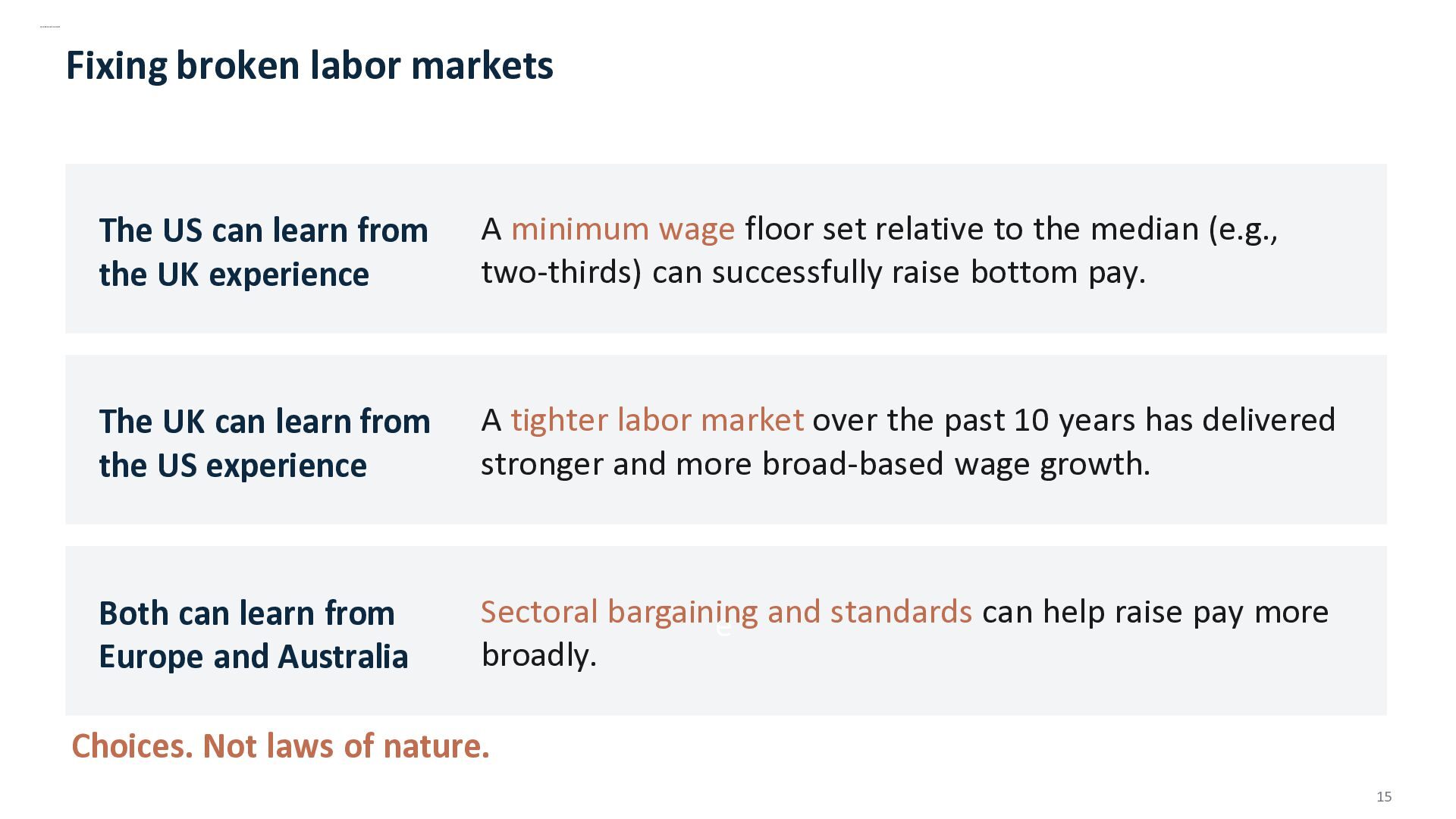
    can learn from the UK experience A minimum wage floor set relative to the median (e.g., two-thirds) can successfully raise bottom pay. The UK can learn from the US experience A tighter labor market over the past 10 years has delivered stronger and more broad-based wage growth. Both can learn from Europe and Australia Sectoral bargainieng and standards can help raise pay more broadly. Choices. Not laws of nature. 15
  18. Fixing broken labour markets What can the UK and US

    learn from each other? UK launch event for The Wage Standard by Professor Arin Dube Arin Dube, Provost Professor of Economics at the University of Massachusetts Amherst Stephen Machin, Director of the Centre for Economic Performance and Professor of Economics at the LSE Chair: Ruth Curtice, Chief Executive of the Resolution Foundation Wifi 2QAG_Guest Welcome_Guests @resfoundation #WageStandard October 26