Share
Embed
Cheat Your Way With UX (Web2Day edition)
A talk I gave at Web2Day, Nantes on using UX tools to help generate better ideas for each product iteration, especially in the case of innovative digital product development.
Steph Troeth
May 31, 2012
Transcript
92 slides
-
Sorry for the funny accent. Born here Grew up here
Lived here Living here -
user brand business Hat tip: David Rollert fun! adventurous! exotic!
useful serious reliable -
user brand business unique Hat tip: David Rollert fun! adventurous!
exotic! useful serious reliable -
user brand unique fun! adventurous! exotic! useful serious reliable technology
how you sustain yourself -
brand unique fun! adventurous! exotic! useful serious reliable technology how
you sustain yourself who you affect -
brand unique fun! adventurous! exotic! useful serious reliable the vehicle
how you sustain yourself who you affect -
who you affect your soul how you sustain yourself unique
fun! adventurous! exotic! useful serious reliable the vehicle -
The great mistake is leaping from facts to solutions, skipping
over the play and exploration at the heart of finding new ideas. — Scott Berkun, “The Myths of Innovation” -
business user What problem are we solving? What impact do
we want to have? How do we measure success? -
brand What are the business constraints, organisational visions & goals
we need to take into account? business -
brand What are the business constraints, organisational visions & goals
we need to take into account? business Tool: Stakeholder interviews (or team conversations) -
Tool: The SWOT/SPOT Strengths Problems or Weaknesses Threats Opportunities Internal
factors External factors -
Tool: The SWOT/SPOT Strengths Problems or Weaknesses Threats Opportunities Internal
factors External factors convert convert -
Tool: The SWOT/SPOT Strengths Problems or Weaknesses Threats Opportunities Internal
factors External factors match convert convert -
Tool: The SWOT/SPOT Strengths Problems or Weaknesses Threats Opportunities Internal
factors External factors match convert convert potential objectives! -
business model canvas What are the most important costs inherent
in our business model? Which Key Resources are most expensive? Which Key Activities are most expensive? ATeT]dTBcaTP\b Through which Channels do our Customer Segments want to be reached? How are we reaching them now? How are our Channels integrated? Which ones work best? Which ones are most cost-efficient? How are we integrating them with customer routines? For what value are our customers really willing to pay? For what do they currently pay? How are they currently paying? How would they prefer to pay? How much does each Revenue Stream contribute to overall revenues? 2WP]]T[b 2dbc^\TaAT[PcX^]bWX_b 2dbc^\TaBTV\T]cb RWP]]T[_WPbTb) 0fPaT]Tbb 7^fS^fTaPXbTPfPaT]TbbPQ^dc^daR^\_P]hzb_a^SdRcbP]SbTaeXRTb. !4eP[dPcX^] 7^fS^fTWT[_Rdbc^\TabTeP[dPcT^da^aVP]XiPcX^]zbEP[dT?a^_^bXcX^]. "?daRWPbT 7^fS^fTP[[^fRdbc^\Tabc^_daRWPbTb_TRX R_a^SdRcbP]SbTaeXRTb. #3T[XeTah 7^fS^fTST[XeTaPEP[dT?a^_^bXcX^]c^Rdbc^\Tab. $0UcTabP[Tb 7^fS^fT_a^eXST_^bc_daRWPbTRdbc^\Tabd__^ac. <Pbb<PaZTc =XRWT<PaZTc BTV\T]cTS 3XeTabX TS <d[cXbXSTS?[PcU^a\ TgP\_[Tb ?Tab^]P[PbbXbcP]RT 3TSXRPcTS?Tab^]P[0bbXbcP]RT BT[UBTaeXRT 0dc^\PcTSBTaeXRTb 2^\\d]XcXTb 2^RaTPcX^] For whom are we creating value? Who are our most important customers? What type of relationship does each of our Customer Segments expect us to establish and maintain with them? Which ones have we established? How are they integrated with the rest of our business model? How costly are they? EP[dT?a^_^bXcX^]b :Th0RcXeXcXTb :Th?Pac]Tab :ThATb^daRTb 2^bcBcadRcdaT What value do we deliver to the customer? Which one of our customer’s problems are we helping to solve? What bundles of products and services are we offering to each Customer Segment? Which customer needs are we satisfying? What Key Activities do our Value Propositions require? Our Distribution Channels? Customer Relationships? Revenue streams? Who are our Key Partners? Who are our key suppliers? Which Key Resources are we acquiring from partners? Which Key Activities do partners perform? What Key Resources do our Value Propositions require? Our Distribution Channels? Customer Relationships? Revenue Streams? RWPaPRcTaXbcXRb =Tf]Tbb ?TaU^a\P]RT 2dbc^\XiPcX^] {6TccX]VcWT9^Q3^]T| 3TbXV] 1aP]SBcPcdb ?aXRT 2^bcATSdRcX^] AXbZATSdRcX^] 0RRTbbXQX[Xch 2^]eT]XT]RTDbPQX[Xch RPcTV^aXTb ?a^SdRcX^] ?a^Q[T\B^[eX]V ?[PcU^a\=Tcf^aZ ch_Tb^UaTb^daRTb ?WhbXRP[ 8]cT[[TRcdP[QaP]S_PcT]cbR^_haXVWcbSPcP 7d\P] 5X]P]RXP[ \^cXePcX^]bU^a_Pac]TabWX_b) >_cX\XiPcX^]P]STR^]^\h ATSdRcX^]^UaXbZP]Sd]RTacPX]ch 0R`dXbXcX^]^U_PacXRd[PaaTb^daRTbP]SPRcXeXcXTb Xbh^daQdbX]Tbb\^aT) 2^bc3aXeT][TP]TbcR^bcbcadRcdaT[^f_aXRTeP[dT_a^_^bXcX^]\PgX\d\Pdc^\PcX^]TgcT]bXeT^dcb^daRX]V EP[dT3aXeT]U^RdbTS^]eP[dTRaTPcX^]_aT\Xd\eP[dT_a^_^bXcX^] bP\_[TRWPaPRcTaXbcXRb) 5XgTS2^bcbbP[PaXTbaT]cbdcX[XcXTb EPaXPQ[TR^bcb 4R^]^\XTb^UbRP[T 4R^]^\XTb^UbR^_T fffQdbX]Tbb\^ST[VT]TaPcX^]R^\ CWT1dbX]Tbb<^ST[2P]ePb >]) 8cTaPcX^]) 3TbXV]TSQh) 3TbXV]TSU^a) Day Month Year No. ch_Tb) 0bbTcbP[T DbPVTUTT BdQbRaX_cX^]5TTb ;T]SX]VAT]cX]V;TPbX]V ;XRT]bX]V 1a^ZTaPVTUTTb 0SeTacXbX]V gTS_aXRX]V ;Xbc?aXRT ?a^SdRcUTPcdaTST_T]ST]c 2dbc^\TabTV\T]cST_T]ST]c E^[d\TST_T]ST]c Sh]P\XR_aXRX]V =TV^cXPcX^]QPaVPX]X]V HXT[S<P]PVT\T]c ATP[cX\T<PaZTc This work is licensed under the Creative Commons Attribution-Share Alike 3.0 Unported License. To view a copy of this license, visit http:/ /creativecommons.org/licenses/by-sa/3.0/ or send a letter to Creative Commons, 171 Second Street, Suite 300, San Francisco, California, 94105, USA. -
What are our core values? Who do we want to
be when we grow up? Who are we, and who are we not? brand -
What are our core values? Who do we want to
be when we grow up? Who are we, and who are we not? Tool: Rational vs Emotional Grid brand -
rational emotional fun psychic (knows exactly what I was looking
for) motivating entertaining magical encouraging surprising allow me to influence — have an impact inspire effective affective (people's choice) facilitate discussion to play missions indication of progress Hat tip: David Rollert, whose original method I adapted -
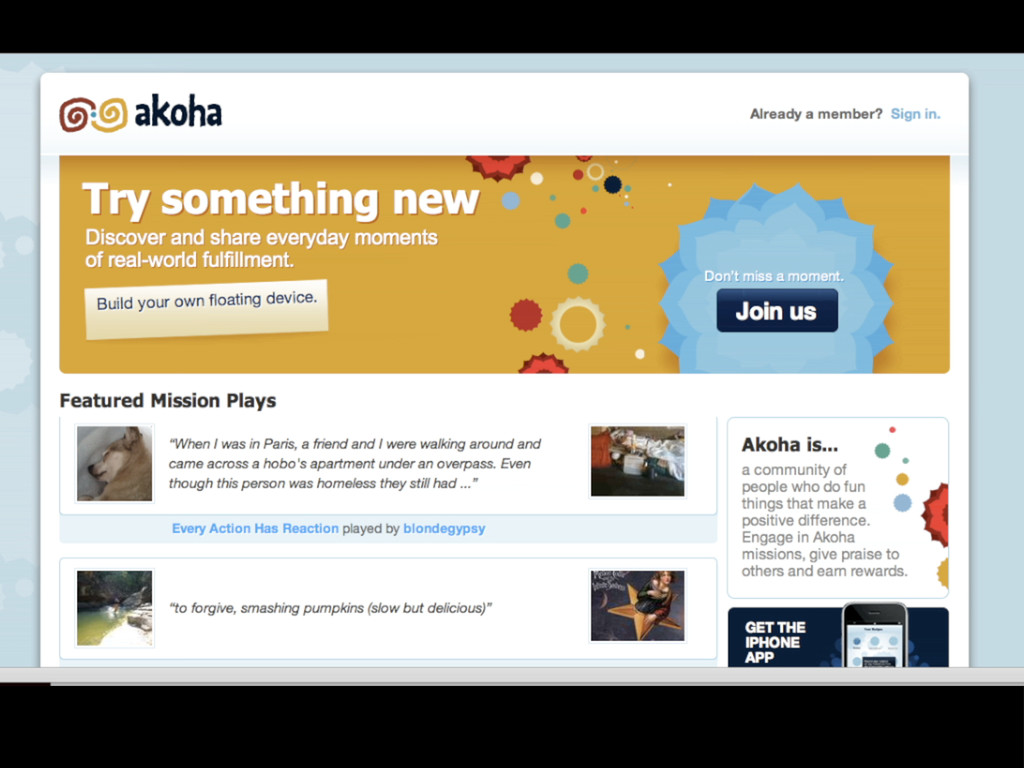
Akoha is a fun way to spice up your life.
logo Already a member? Sign in. Earn rewards for completing “missions” — exciting and simple activities that turn the ordinary into something extraordinary! • Get access to hundreds of real-world missions •Capture those experiences and share them • Earn rewards for trying out new things! Sign up now Signing up is free and takes less than 2 minutes. What’s this all about? ... -
Akoha is a fun way to spice up your life.
logo Already a member? Sign in. Earn rewards for completing “missions” — exciting and simple activities that turn the ordinary into something extraordinary! • Get access to hundreds of real-world missions •Capture those experiences and share them • Earn rewards for trying out new things! Sign up now Signing up is free and takes less than 2 minutes. What’s this all about? ... rational! -
rational emotional fun psychic (knows exactly what I was looking
for) motivating entertaining magical encouraging surprising allow me to influence — have an impact inspire effective affective (people's choice) facilitate discussion to play missions indication of progress -
Bullet points = geek factor = rational quality = think
of all the things we can do with it! -
What are our competitors doing? How are we different to
them? brand business -
What are our competitors doing? How are we different to
them? Tool: Competitive analysis brand, business model, (design) strategy, user base, feature sets brand business -
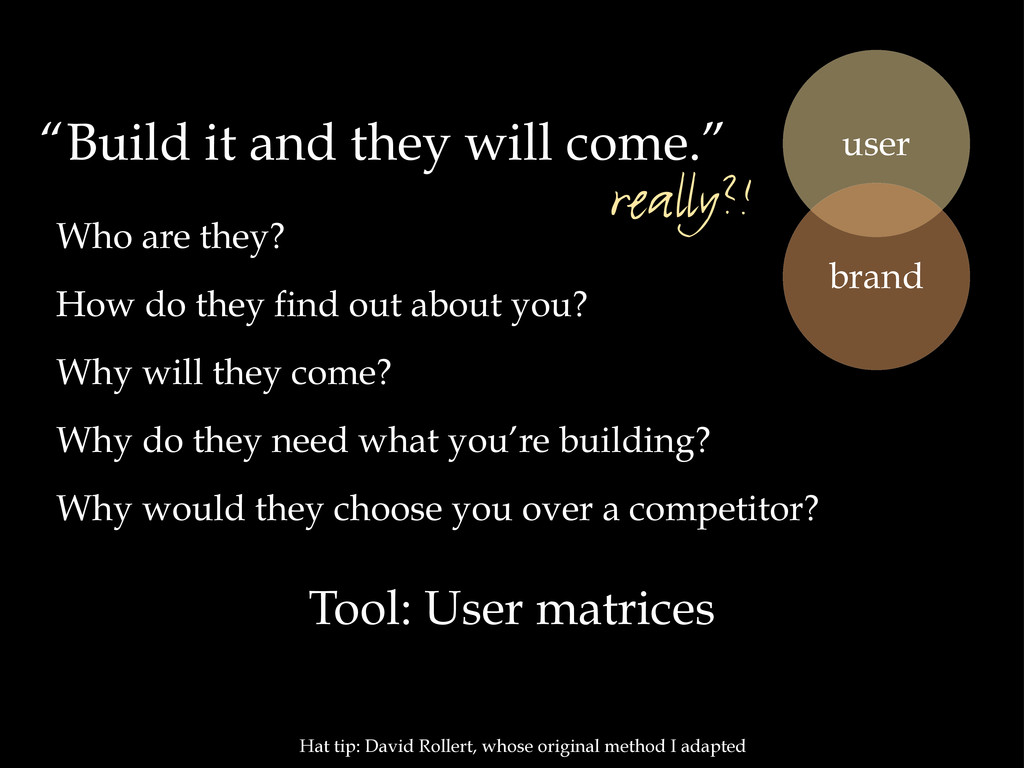
“Build it and they will come.” Who are they? How
do they find out about you? Why will they come? Why do they need what you’re building? Why would they choose you over a competitor? user brand really?! -
“Build it and they will come.” Who are they? How
do they find out about you? Why will they come? Why do they need what you’re building? Why would they choose you over a competitor? user brand Tool: User matrices Hat tip: David Rollert, whose original method I adapted really?! -
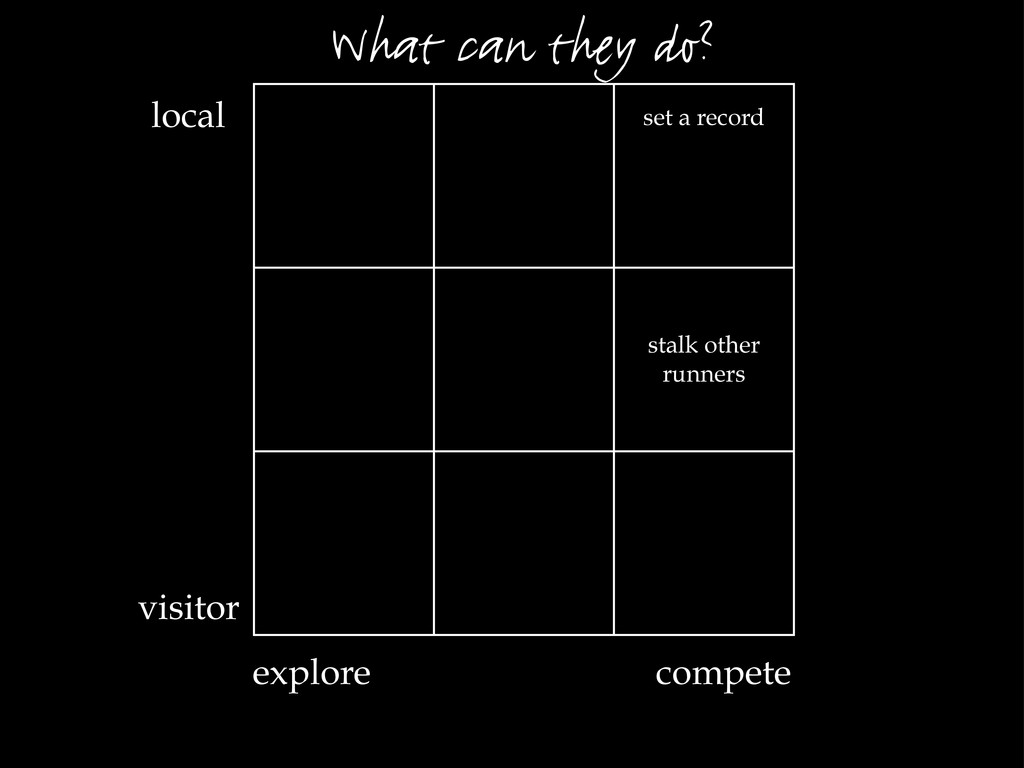
1. Establish your axes social individual explore compete frequent occasional
visitor local curious engaged -
2. Choose two key axes. 3. Identify questions. ✦ What
do they need? ✦ What do they want? ✦ What can they do? -
set a record stalk other runners visitor local explore compete
What can they do? -
find new routes share local insight create most popular route
set a record find new routes set a record stalk other runners find new routes set a record visitor local explore compete What can they do? (acquainted) -
Tool: User modelling with user matrices Uncover your underlying assumptions
Uncover assumptions on behaviour, needs and motivation Establish hypotheses Validate with research, prototypes or MVPs Find out what you know and what you don’t know -
Tool: Design principles (for product or page) Allows people to
“peel the onion” in whatever way is useful for them. They can start at the “core” or the peel and never get lost. They find what they are looking for and are continually seeing more interesting and engaging content. Communicate passion for good food. Inspire people to eat and cook and bring them and the producers closer together. Feel seasonal and vibrant, like touring the store. Stimulate senses through impactful images and text in a way that’s clean and uncluttered. Show people in the images, not just product. -
A sound strategy is informed by research but conceived with
conviction. UX -
Common user research methods open-ended close-ended “listening labs” “contextual enquiry”
interviews scenario testing remote testing tools surveys focus groups card sorting heuristic evaluation personas A/B testing analytics -
Common user research methods open-ended close-ended “listening labs” “contextual enquiry”
interviews scenario testing remote testing tools surveys focus groups card sorting exploring the problem space improve the solution heuristic evaluation personas A/B testing analytics -
Stakeholder interviews user brand business Rational/Emotional grid Competitive analysis User
matrices Design principles SWOT/SPOT Business model canvas -
Stakeholder interviews user brand business Rational/Emotional grid Competitive analysis User
matrices Design principles unique SWOT/SPOT Business model canvas -
Absorb what is useful, Discard what is not, Add what
is essentially your own. — Bruce Lee -
Thank you! (Yes, these slides will be online.) My eternal
gratitude to great shoulders I stand upon: ‘Femi T Adesina, Chris Baum, David Rollert, Johanna Kollmann, Olivier Thereaux Stephanie Troeth @sniffles http://stephanietroeth.com/ http://about.me/stephtroeth funny cat photo “It’s not that I’m smart, it’s just that I stay with problems longer.” — Albert Einstein