Put A Type On It: Idris Type Provider for AWS R...

Share
Embed
Put A Type On It: Idris Type Provider for AWS Resources
Presented at StrangeLoop on September 16, 2016.

Susan Potter
September 16, 2016
Transcript
44 slides
-
Put A Type On It Idris Type Providers for AWS
Resources Strange Loop St. Louis (Sept 16, 2016) @SusanPotter @referentiallabs -
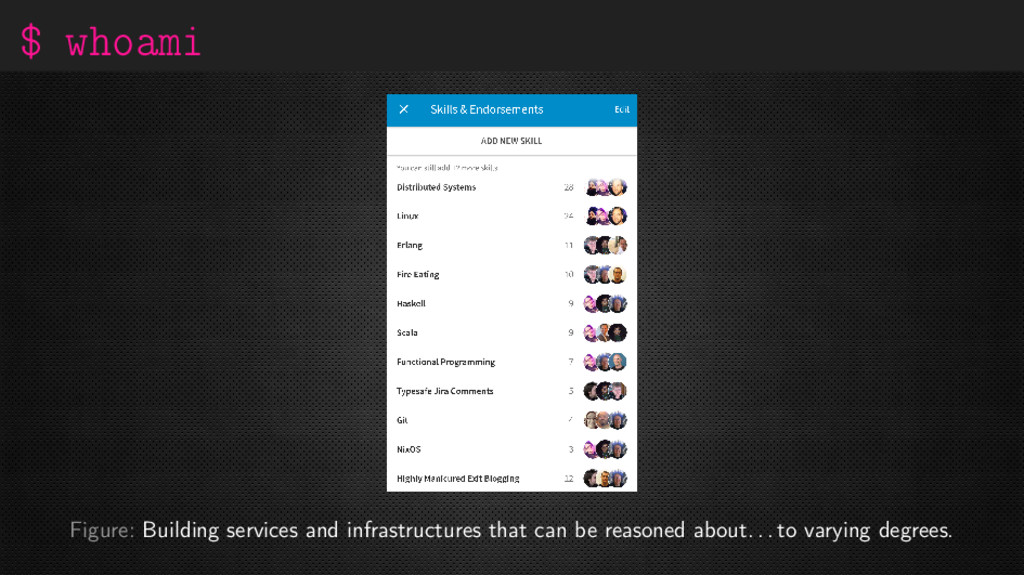
$ whoami Figure: Building services and infrastructures that can be
reasoned about. . . to varying degrees. -
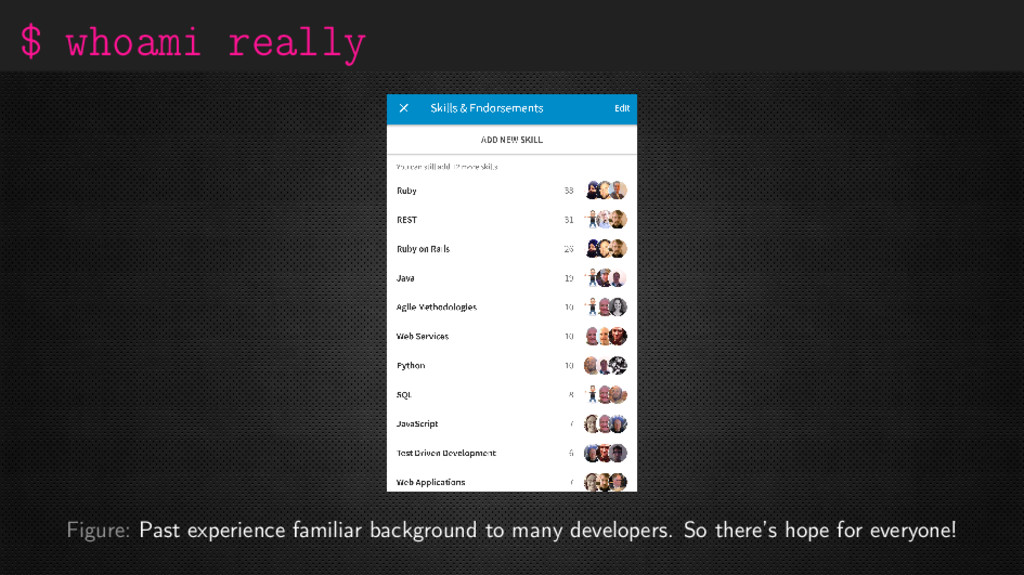
$ whoami really Figure: Past experience familiar background to many
developers. So there’s hope for everyone! -
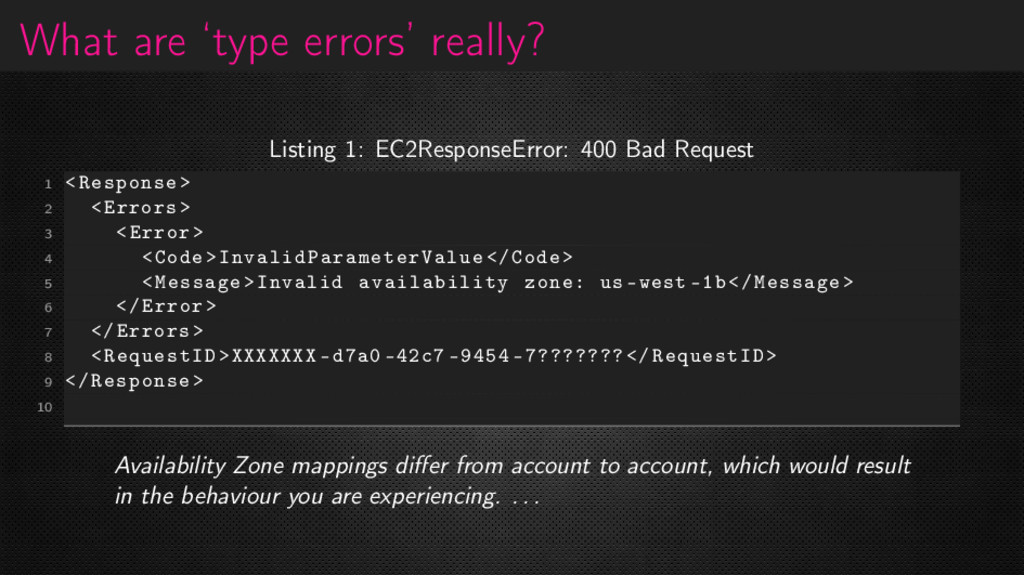
What are ‘type errors’ really? Listing 1: EC2ResponseError: 400 Bad
Request 1 <Response > 2 <Errors > 3 <Error > 4 <Code >InvalidParameterValue </Code > 5 <Message >Invalid availability zone: us -west -1b</Message > 6 </Error > 7 </Errors > 8 <RequestID >XXXXXXX -d7a0 -42c7 -9454 -7??????? </RequestID > 9 </Response > 10 Availability Zone mappings differ from account to account, which would result in the behaviour you are experiencing. . . . -
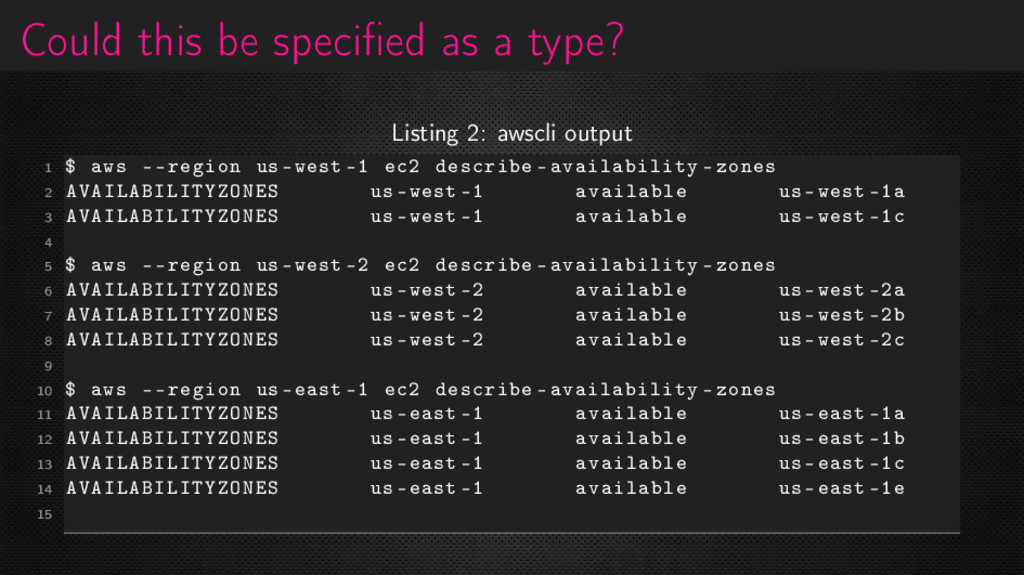
Could this be specified as a type? Listing 2: awscli
output 1 $ aws --region us -west -1 ec2 describe -availability -zones 2 AVAILABILITYZONES us -west -1 available us -west -1a 3 AVAILABILITYZONES us -west -1 available us -west -1c 4 5 $ aws --region us -west -2 ec2 describe -availability -zones 6 AVAILABILITYZONES us -west -2 available us -west -2a 7 AVAILABILITYZONES us -west -2 available us -west -2b 8 AVAILABILITYZONES us -west -2 available us -west -2c 9 10 $ aws --region us -east -1 ec2 describe -availability -zones 11 AVAILABILITYZONES us -east -1 available us -east -1a 12 AVAILABILITYZONES us -east -1 available us -east -1b 13 AVAILABILITYZONES us -east -1 available us -east -1c 14 AVAILABILITYZONES us -east -1 available us -east -1e 15 -
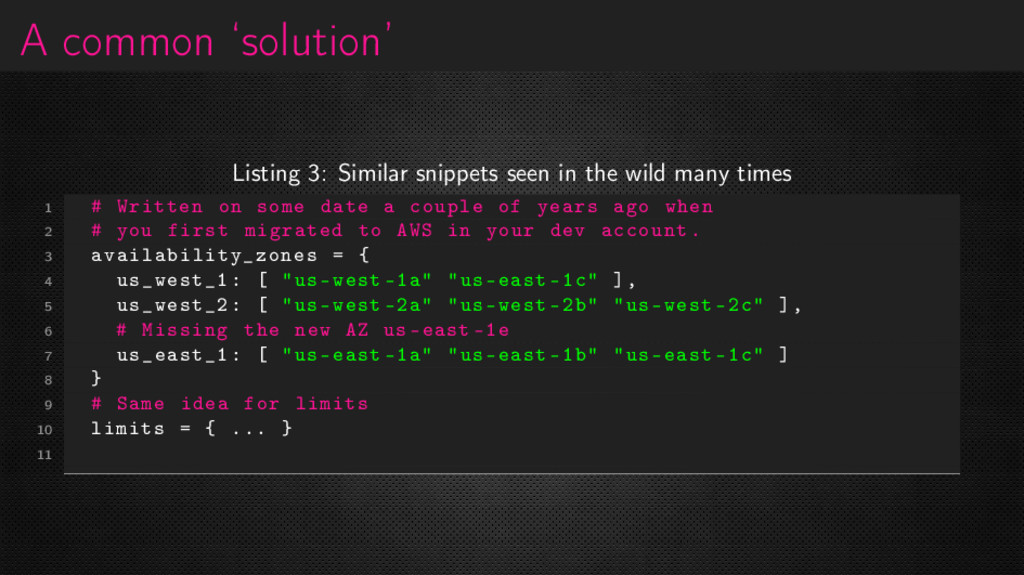
A common ‘solution’ Listing 3: Similar snippets seen in the
wild many times 1 # Written on some date a couple of years ago when 2 # you first migrated to AWS in your dev account. 3 availability_zones = { 4 us_west_1: [ "us -west -1a" "us -east -1c" ], 5 us_west_2: [ "us -west -2a" "us -west -2b" "us -west -2c" ], 6 # Missing the new AZ us -east -1e 7 us_east_1: [ "us -east -1a" "us -east -1b" "us -east -1c" ] 8 } 9 # Same idea for limits 10 limits = { ... } 11 -
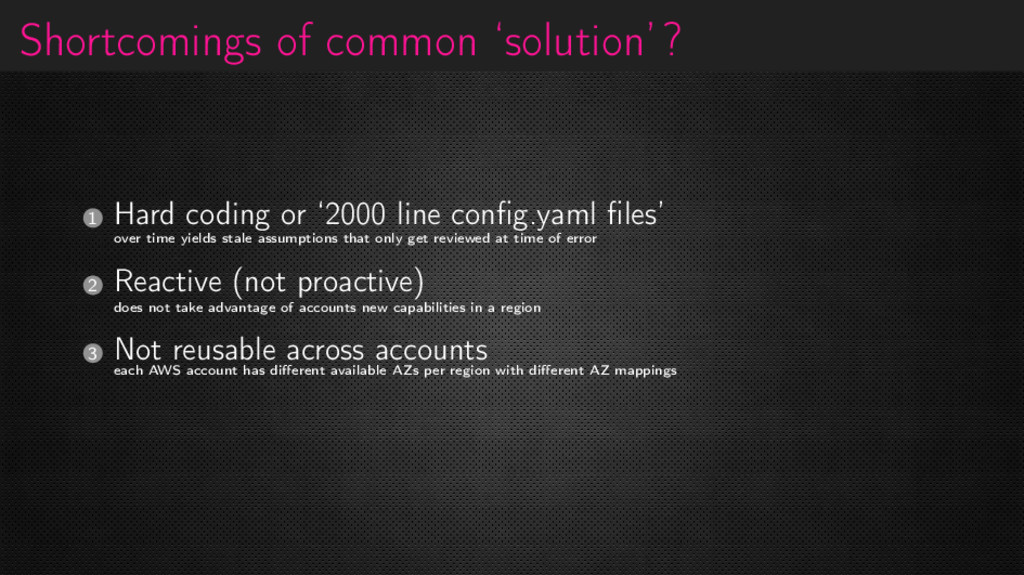
Shortcomings of common ‘solution’? 1 Hard coding or ‘2000 line
config.yaml files’ over time yields stale assumptions that only get reviewed at time of error 2 Reactive (not proactive) does not take advantage of accounts new capabilities in a region 3 Not reusable across accounts each AWS account has different available AZs per region with different AZ mappings -
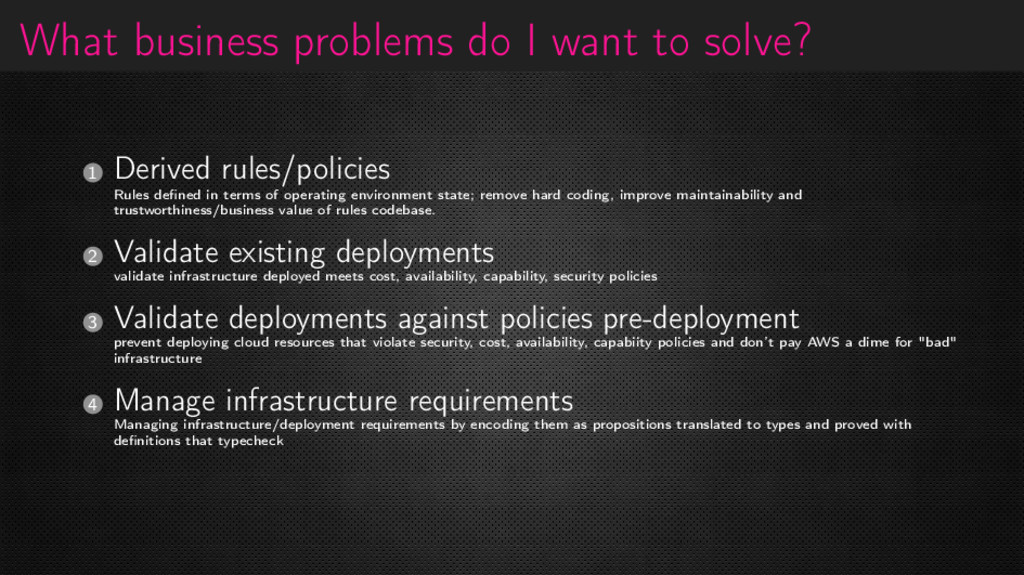
What business problems do I want to solve? 1 Derived
rules/policies Rules defined in terms of operating environment state; remove hard coding, improve maintainability and trustworthiness/business value of rules codebase. 2 Validate existing deployments validate infrastructure deployed meets cost, availability, capability, security policies 3 Validate deployments against policies pre-deployment prevent deploying cloud resources that violate security, cost, availability, capabiity policies and don’t pay AWS a dime for "bad" infrastructure 4 Manage infrastructure requirements Managing infrastructure/deployment requirements by encoding them as propositions translated to types and proved with definitions that typecheck -
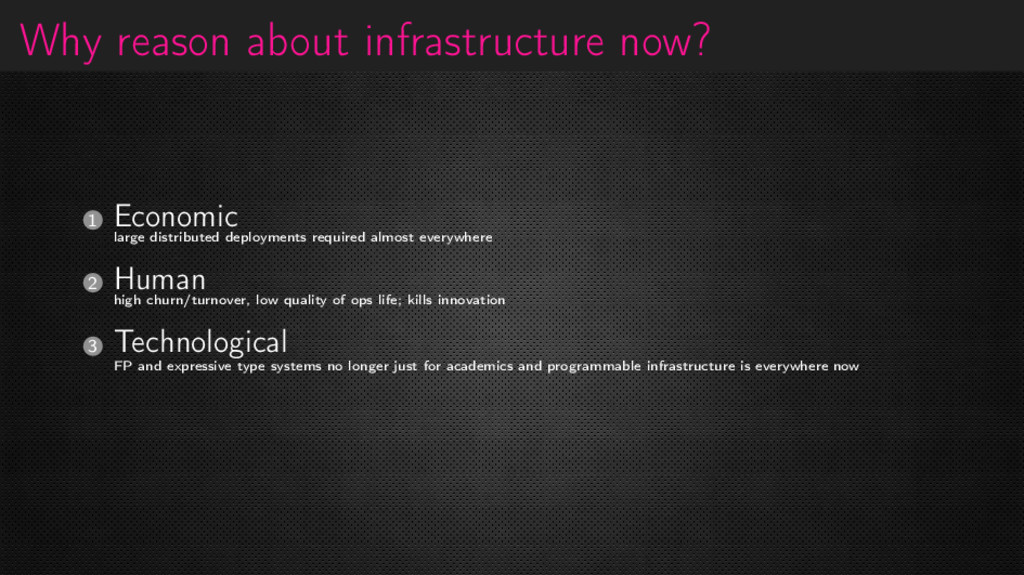
Why reason about infrastructure now? 1 Economic large distributed deployments
required almost everywhere 2 Human high churn/turnover, low quality of ops life; kills innovation 3 Technological FP and expressive type systems no longer just for academics and programmable infrastructure is everywhere now -
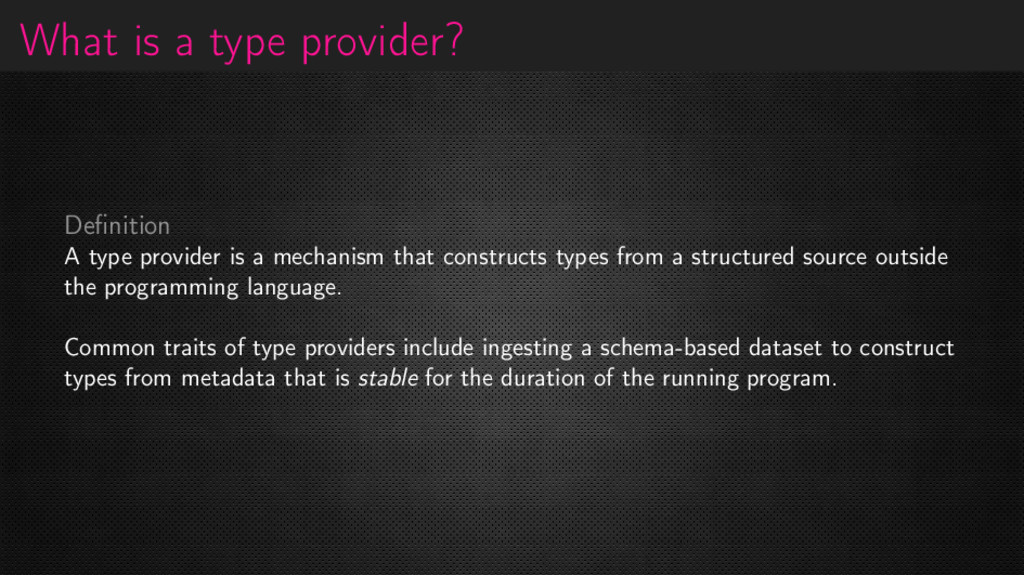
What is a type provider? Definition A type provider is
a mechanism that constructs types from a structured source outside the programming language. Common traits of type providers include ingesting a schema-based dataset to construct types from metadata that is stable for the duration of the running program. -
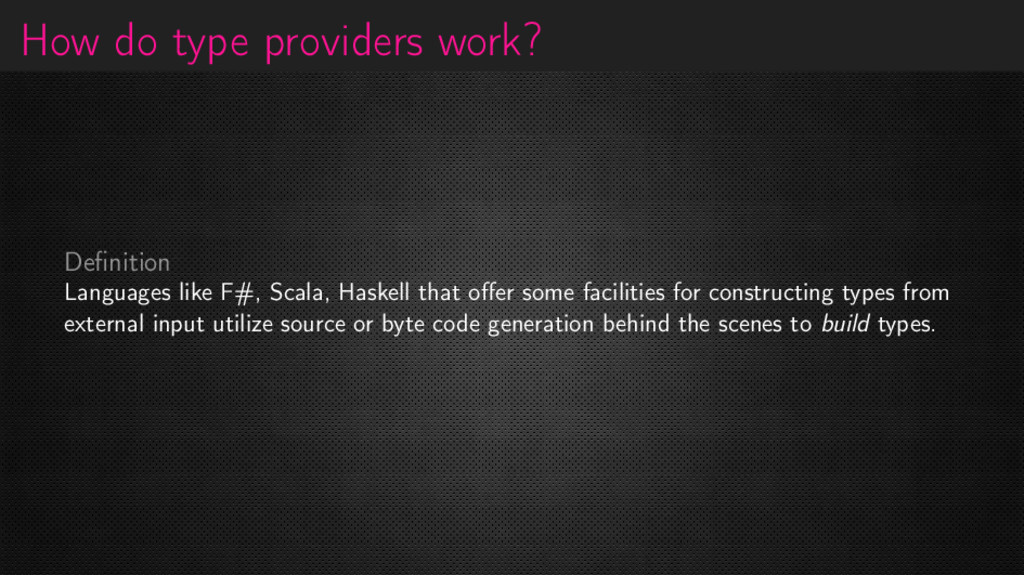
How do type providers work? Definition Languages like F#, Scala,
Haskell that offer some facilities for constructing types from external input utilize source or byte code generation behind the scenes to build types. -
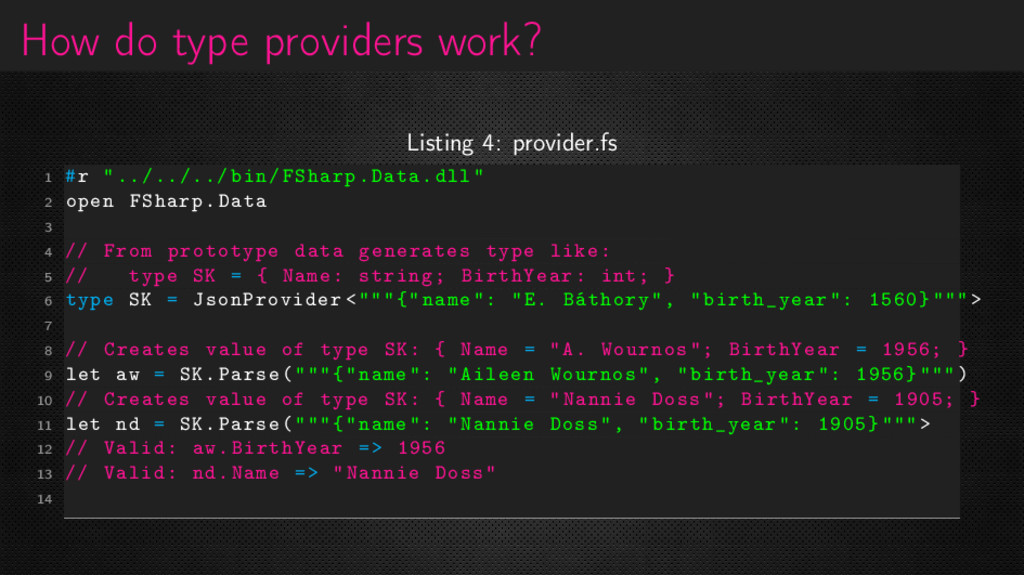
How do type providers work? Listing 4: provider.fs 1 #r
"../../../ bin/FSharp.Data.dll" 2 open FSharp.Data 3 4 // From prototype data generates type like: 5 // type SK = { Name: string; BirthYear: int; } 6 type SK = JsonProvider <"""{" name ": "E. Báthory", "birth_year ": 1560} """> 7 8 // Creates value of type SK: { Name = "A. Wournos "; BirthYear = 1956; } 9 let aw = SK.Parse("""{" name ": "Aileen Wournos", "birth_year ": 1956} """) 10 // Creates value of type SK: { Name = "Nannie Doss "; BirthYear = 1905; } 11 let nd = SK.Parse("""{" name ": "Nannie Doss", "birth_year ": 1905} """> 12 // Valid: aw.BirthYear => 1956 13 // Valid: nd.Name => "Nannie Doss" 14 -
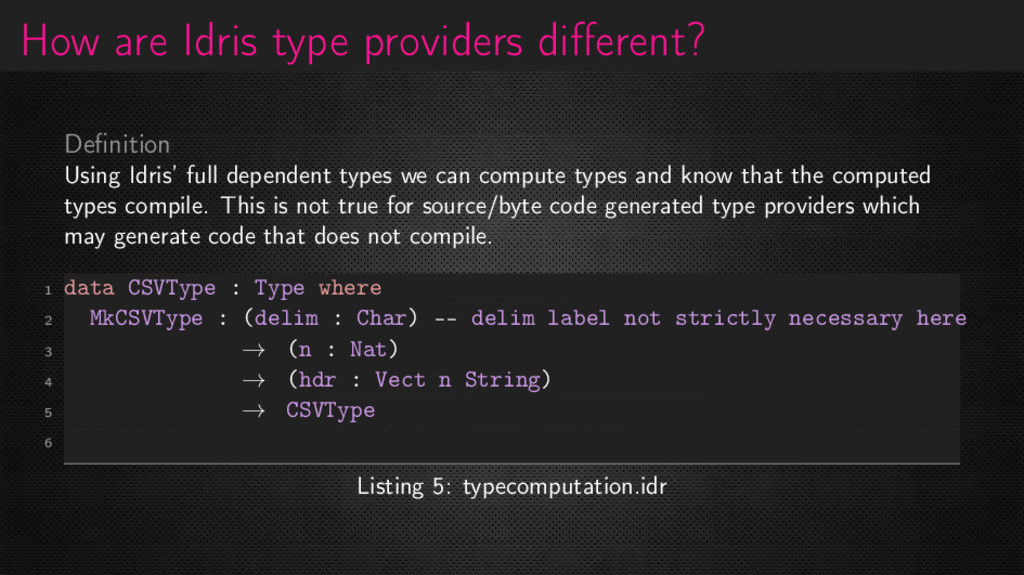
How are Idris type providers different? Definition Using Idris’ full
dependent types we can compute types and know that the computed types compile. This is not true for source/byte code generated type providers which may generate code that does not compile. 1 data CSVType : Type where 2 MkCSVType : (delim : Char) -- delim label not strictly necessary here 3 → (n : Nat) 4 → (hdr : Vect n String) 5 → CSVType 6 Listing 5: typecomputation.idr -
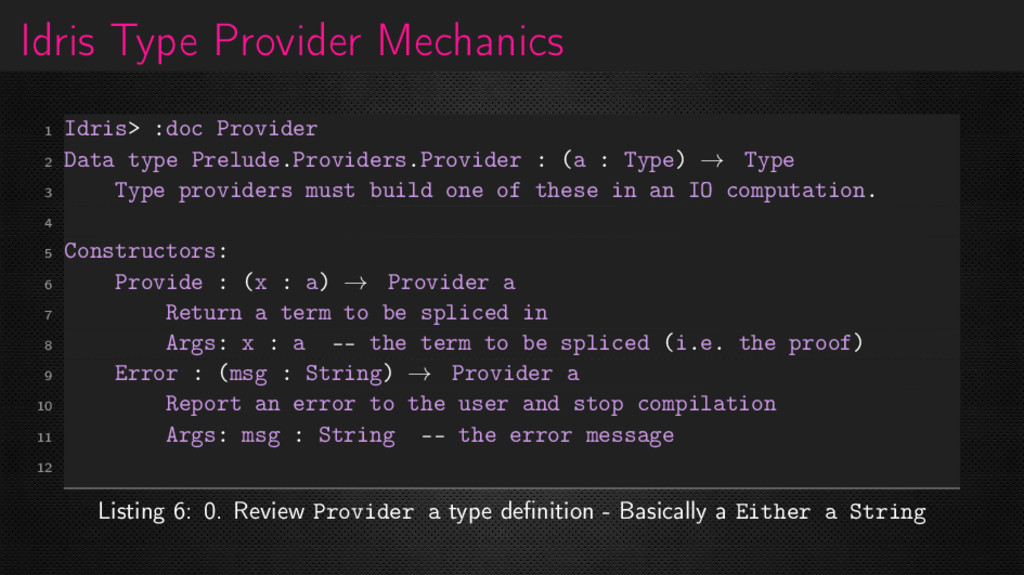
Idris Type Provider Mechanics 1 Idris> :doc Provider 2 Data
type Prelude.Providers.Provider : (a : Type) → Type 3 Type providers must build one of these in an IO computation. 4 5 Constructors: 6 Provide : (x : a) → Provider a 7 Return a term to be spliced in 8 Args: x : a -- the term to be spliced (i.e. the proof) 9 Error : (msg : String) → Provider a 10 Report an error to the user and stop compilation 11 Args: msg : String -- the error message 12 Listing 6: 0. Review Provider a type definition - Basically a Either a String -
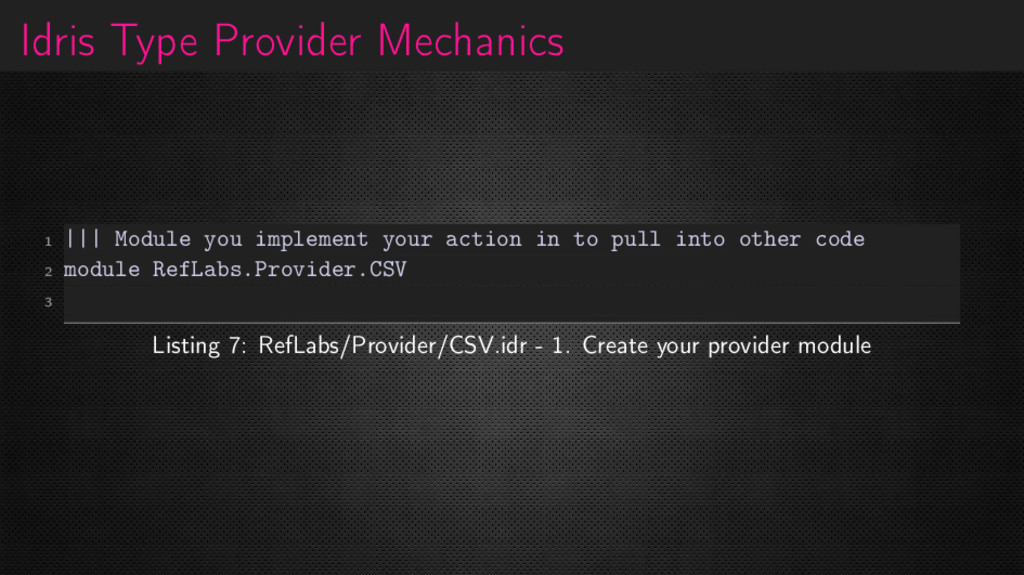
Idris Type Provider Mechanics 1 ||| Module you implement your
action in to pull into other code 2 module RefLabs.Provider.CSV 3 Listing 7: RefLabs/Provider/CSV.idr - 1. Create your provider module -
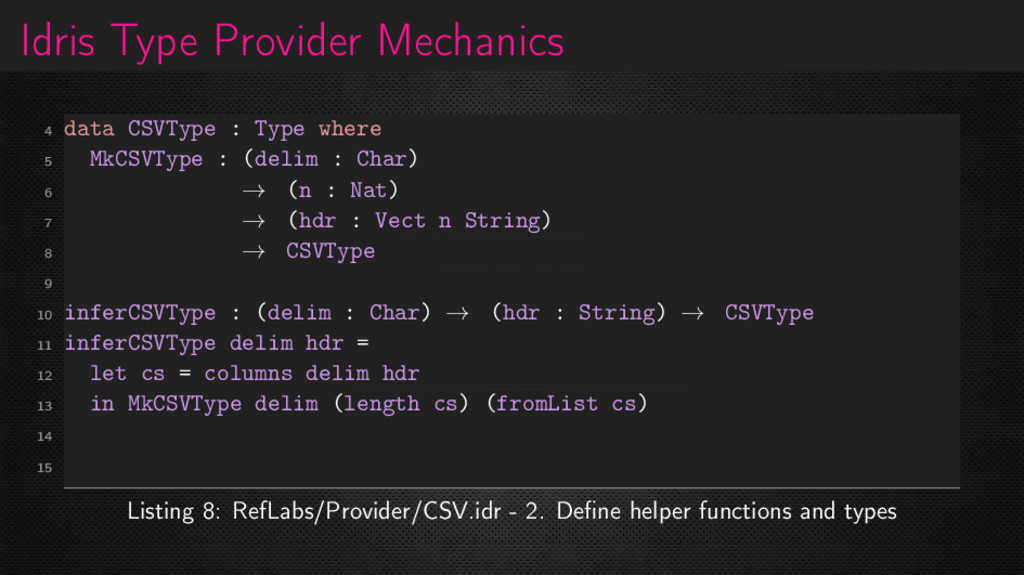
Idris Type Provider Mechanics 4 data CSVType : Type where
5 MkCSVType : (delim : Char) 6 → (n : Nat) 7 → (hdr : Vect n String) 8 → CSVType 9 10 inferCSVType : (delim : Char) → (hdr : String) → CSVType 11 inferCSVType delim hdr = 12 let cs = columns delim hdr 13 in MkCSVType delim (length cs) (fromList cs) 14 15 Listing 8: RefLabs/Provider/CSV.idr - 2. Define helper functions and types -
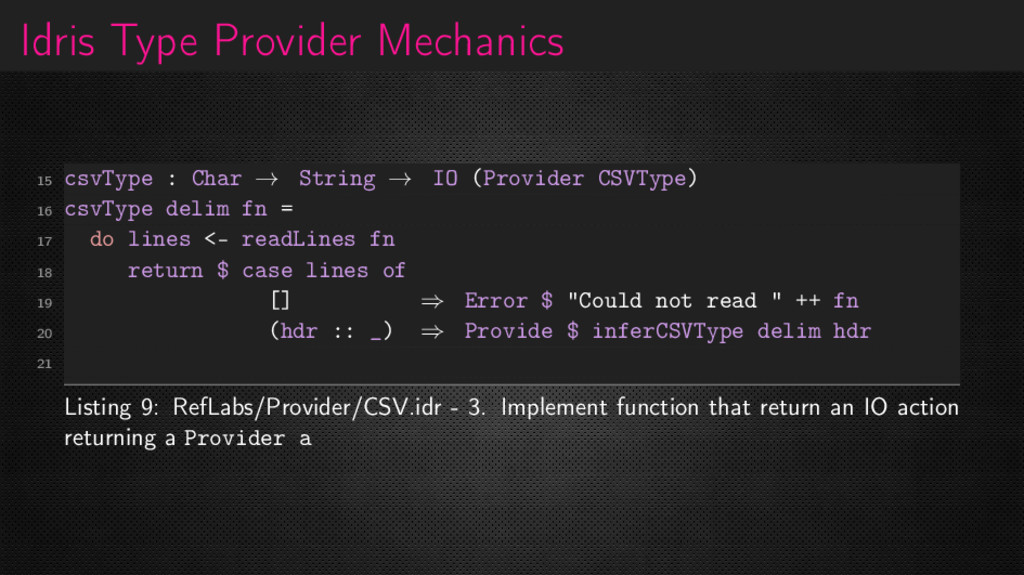
Idris Type Provider Mechanics 15 csvType : Char → String
→ IO (Provider CSVType) 16 csvType delim fn = 17 do lines <- readLines fn 18 return $ case lines of 19 [] ⇒ Error $ "Could not read " ++ fn 20 (hdr :: _) ⇒ Provide $ inferCSVType delim hdr 21 Listing 9: RefLabs/Provider/CSV.idr - 3. Implement function that return an IO action returning a Provider a -
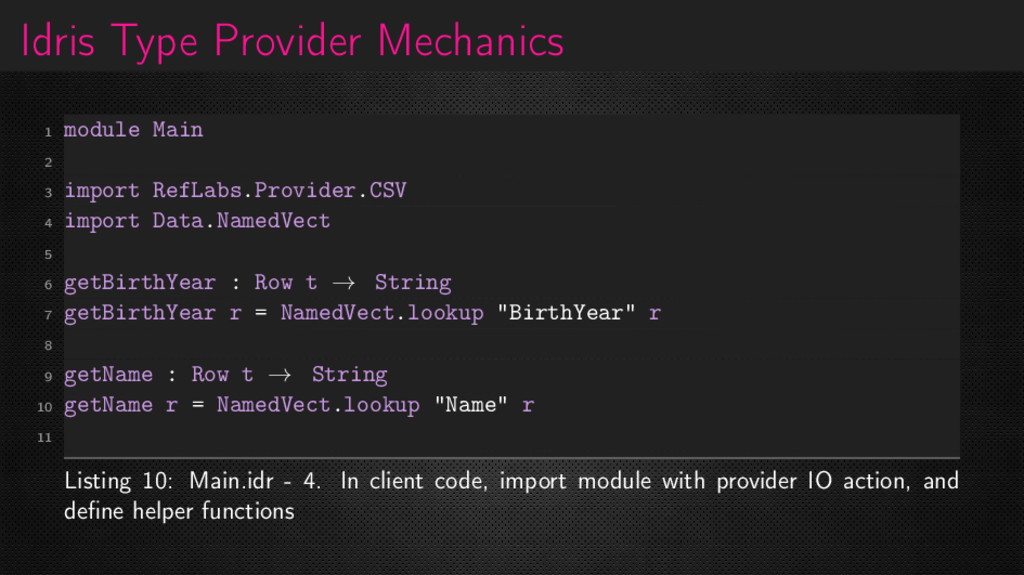
Idris Type Provider Mechanics 1 module Main 2 3 import
RefLabs.Provider.CSV 4 import Data.NamedVect 5 6 getBirthYear : Row t → String 7 getBirthYear r = NamedVect.lookup "BirthYear" r 8 9 getName : Row t → String 10 getName r = NamedVect.lookup "Name" r 11 Listing 10: Main.idr - 4. In client code, import module with provider IO action, and define helper functions -
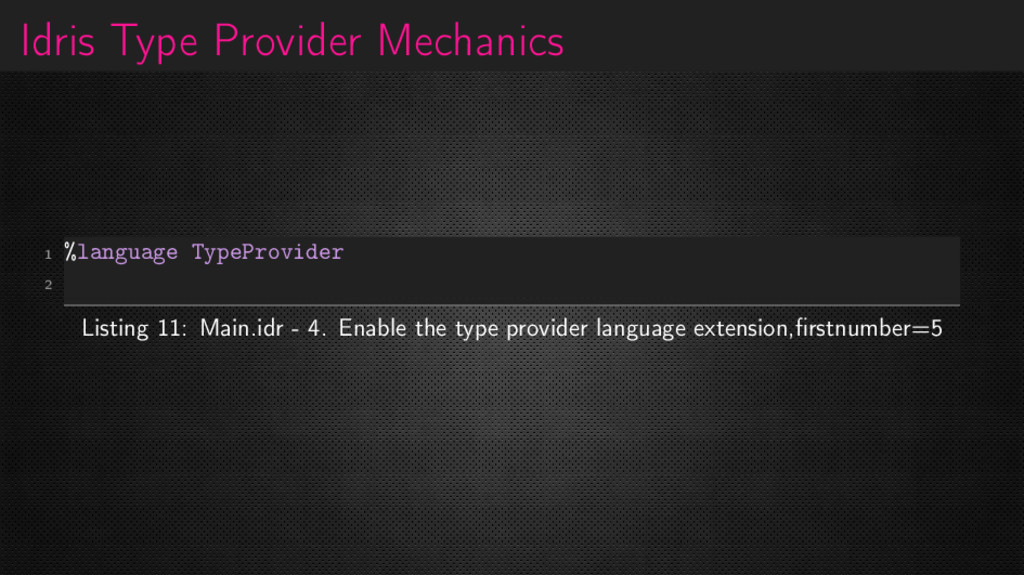
Idris Type Provider Mechanics 1 %language TypeProvider 2 Listing 11:
Main.idr - 4. Enable the type provider language extension,firstnumber=5 -
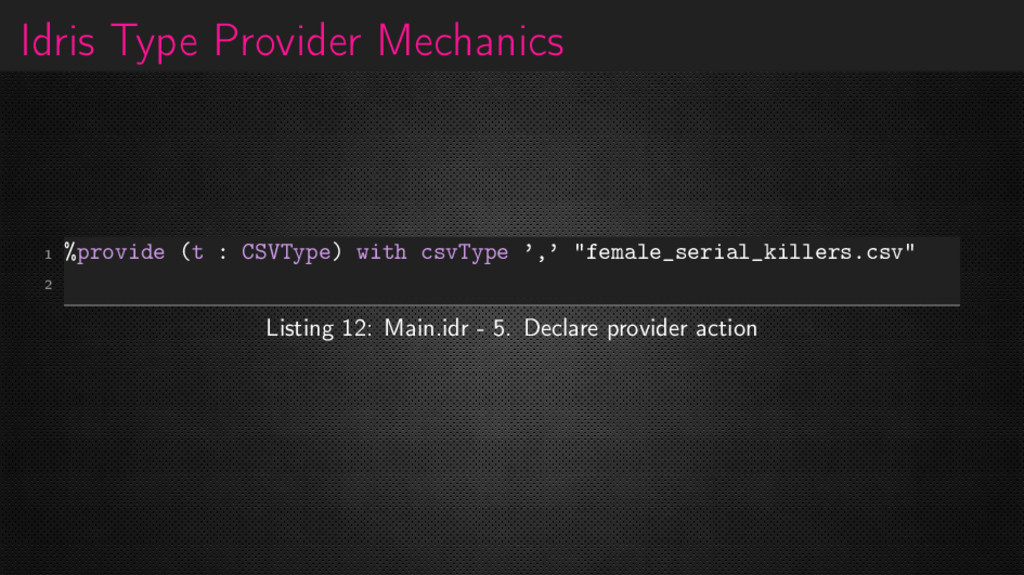
Idris Type Provider Mechanics 1 %provide (t : CSVType) with
csvType ’,’ "female_serial_killers.csv" 2 Listing 12: Main.idr - 5. Declare provider action -
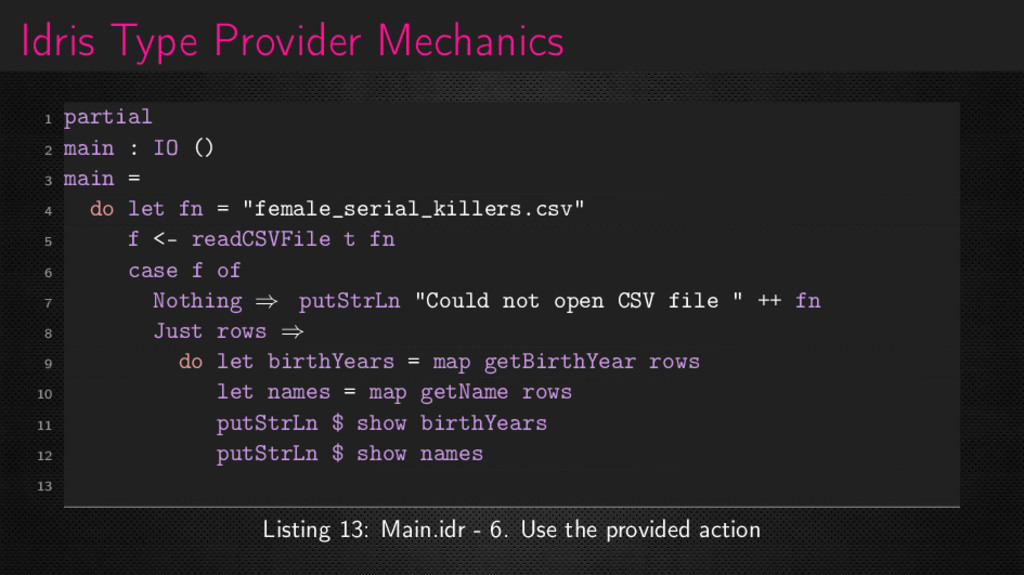
Idris Type Provider Mechanics 1 partial 2 main : IO
() 3 main = 4 do let fn = "female_serial_killers.csv" 5 f <- readCSVFile t fn 6 case f of 7 Nothing ⇒ putStrLn "Could not open CSV file " ++ fn 8 Just rows ⇒ 9 do let birthYears = map getBirthYear rows 10 let names = map getName rows 11 putStrLn $ show birthYears 12 putStrLn $ show names 13 Listing 13: Main.idr - 6. Use the provided action -
Curry-Howard Correspondence Informally: Propositional logic concepts correspond to programming language
features* Propositions as types (Proofs as definitions) * too many implications/assumptions to put here but search for "Curry-Howard constructive logic" or "intuitionistic logic" for further reading -
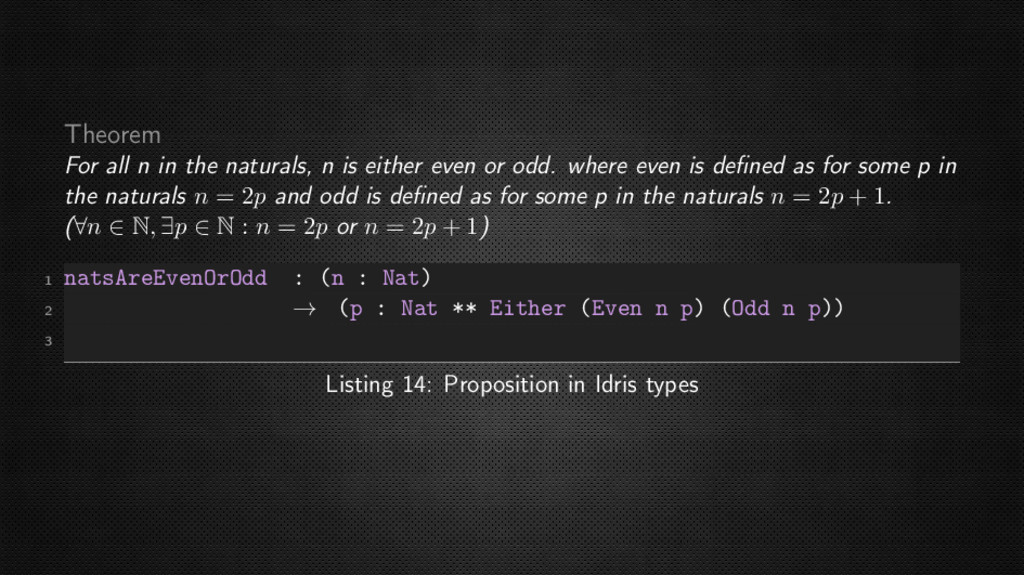
Theorem For all n in the naturals, n is either
even or odd. where even is defined as for some p in the naturals n = 2p and odd is defined as for some p in the naturals n = 2p + 1. (∀n ∈ N, ∃p ∈ N : n = 2p or n = 2p + 1) 1 natsAreEvenOrOdd : (n : Nat) 2 → (p : Nat ** Either (Even n p) (Odd n p)) 3 Listing 14: Proposition in Idris types -
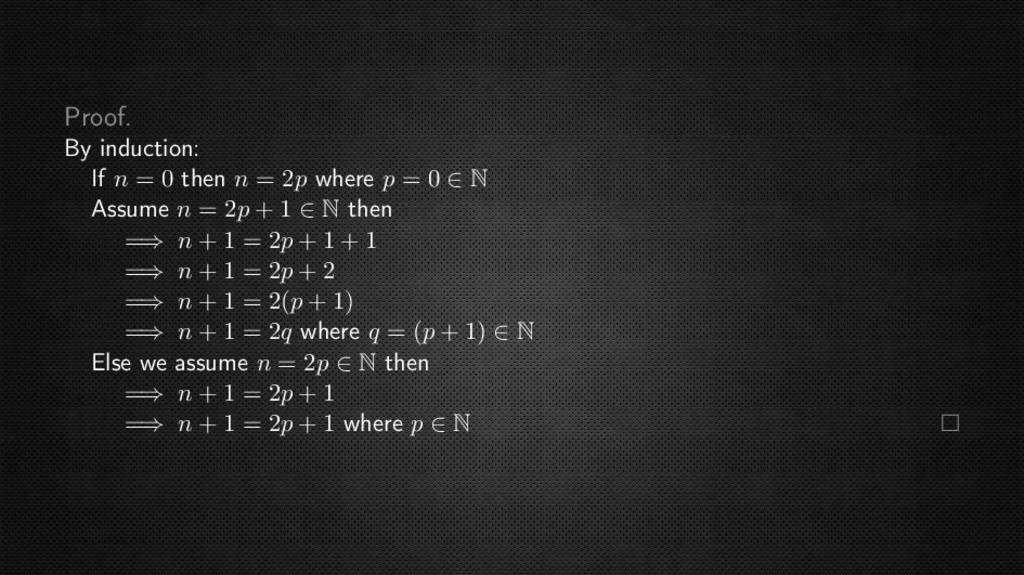
Proof. By induction: If n = 0 then n =
2p where p = 0 ∈ N Assume n = 2p + 1 ∈ N then =⇒ n + 1 = 2p + 1 + 1 =⇒ n + 1 = 2p + 2 =⇒ n + 1 = 2(p + 1) =⇒ n + 1 = 2q where q = (p + 1) ∈ N Else we assume n = 2p ∈ N then =⇒ n + 1 = 2p + 1 =⇒ n + 1 = 2p + 1 where p ∈ N -
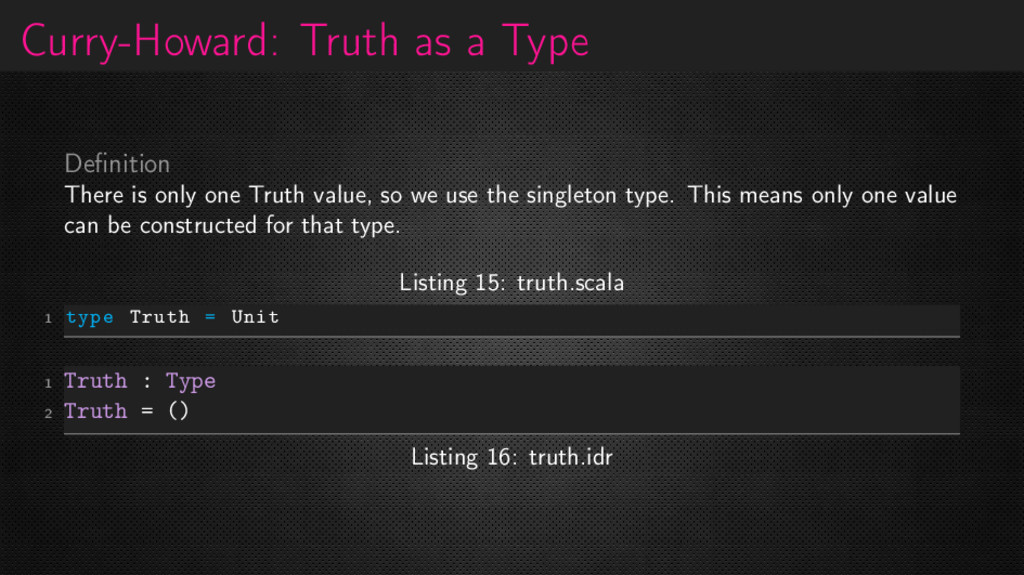
Curry-Howard: Truth as a Type Definition There is only one
Truth value, so we use the singleton type. This means only one value can be constructed for that type. Listing 15: truth.scala 1 type Truth = Unit 1 Truth : Type 2 Truth = () Listing 16: truth.idr -
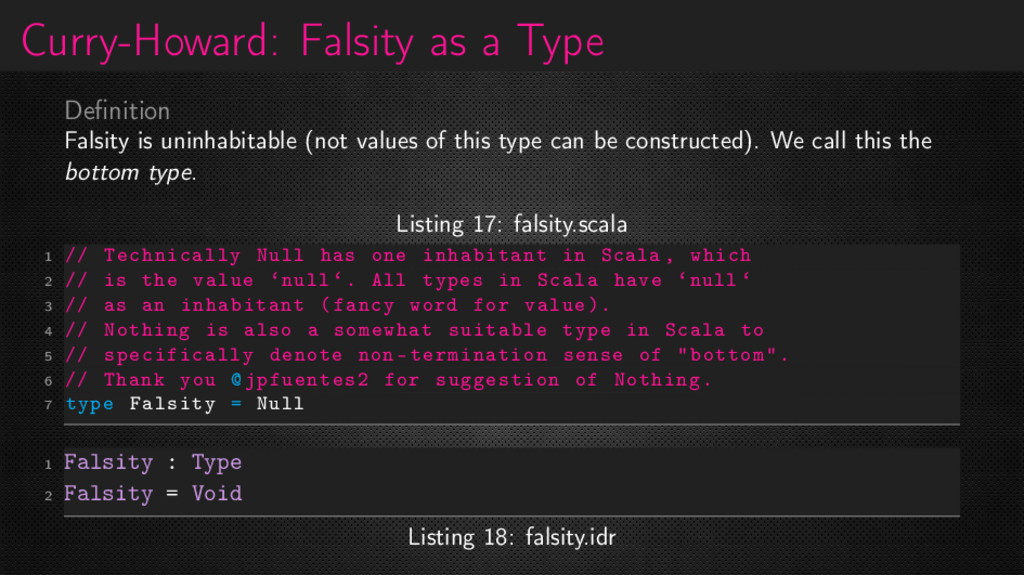
Curry-Howard: Falsity as a Type Definition Falsity is uninhabitable (not
values of this type can be constructed). We call this the bottom type. Listing 17: falsity.scala 1 // Technically Null has one inhabitant in Scala , which 2 // is the value ‘null ‘. All types in Scala have ‘null ‘ 3 // as an inhabitant (fancy word for value ). 4 // Nothing is also a somewhat suitable type in Scala to 5 // specifically denote non -termination sense of "bottom ". 6 // Thank you @jpfuentes2 for suggestion of Nothing. 7 type Falsity = Null 1 Falsity : Type 2 Falsity = Void Listing 18: falsity.idr -
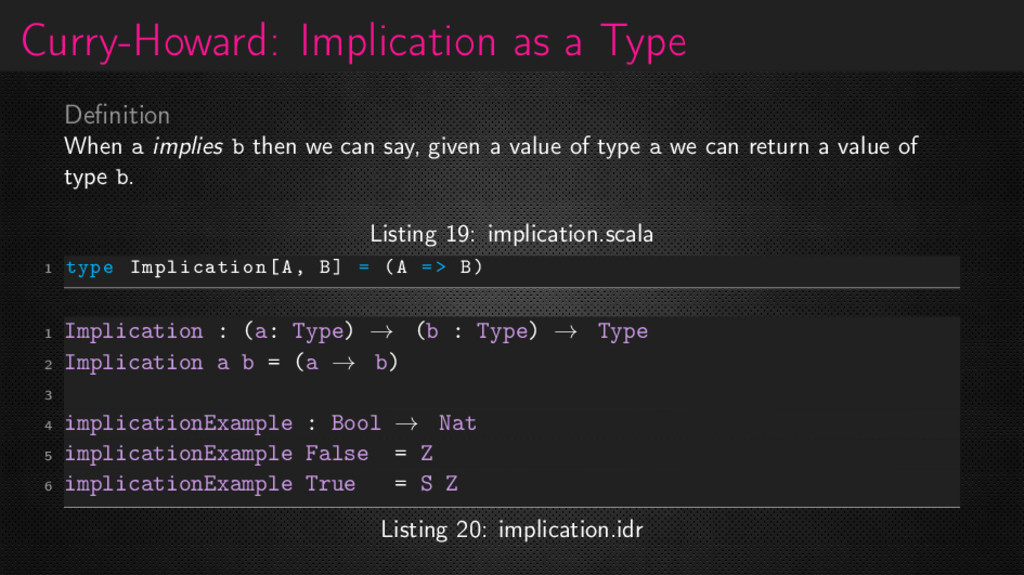
Curry-Howard: Implication as a Type Definition When a implies b
then we can say, given a value of type a we can return a value of type b. Listing 19: implication.scala 1 type Implication[A, B] = (A => B) 1 Implication : (a: Type) → (b : Type) → Type 2 Implication a b = (a → b) 3 4 implicationExample : Bool → Nat 5 implicationExample False = Z 6 implicationExample True = S Z Listing 20: implication.idr -
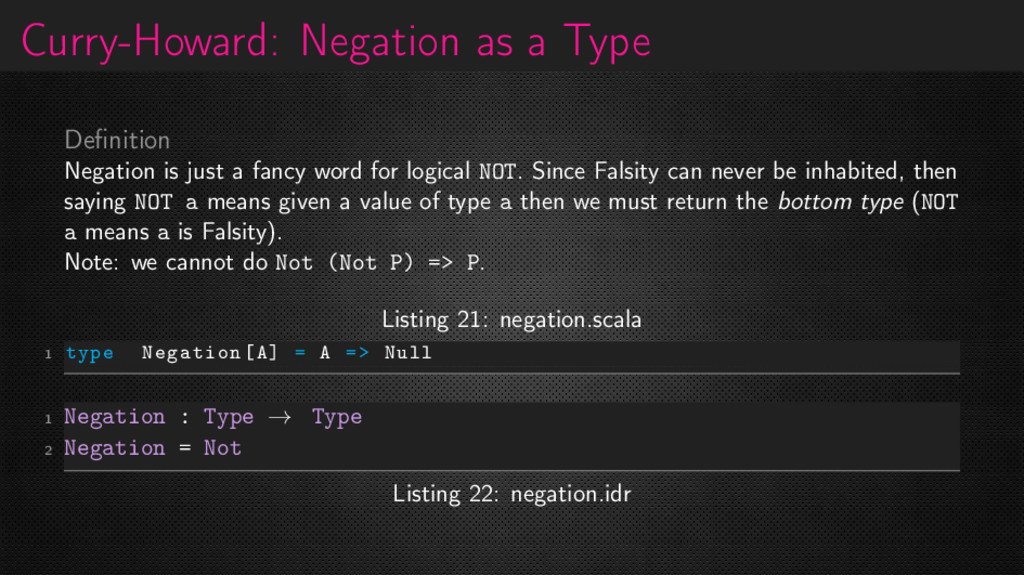
Curry-Howard: Negation as a Type Definition Negation is just a
fancy word for logical NOT. Since Falsity can never be inhabited, then saying NOT a means given a value of type a then we must return the bottom type (NOT a means a is Falsity). Note: we cannot do Not (Not P) => P. Listing 21: negation.scala 1 type Negation[A] = A => Null 1 Negation : Type → Type 2 Negation = Not Listing 22: negation.idr -
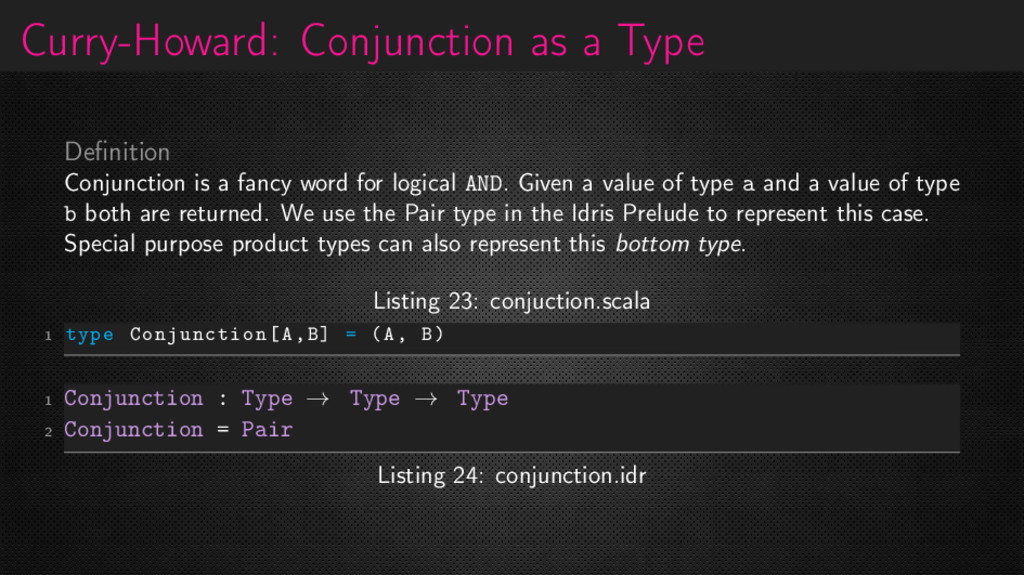
Curry-Howard: Conjunction as a Type Definition Conjunction is a fancy
word for logical AND. Given a value of type a and a value of type b both are returned. We use the Pair type in the Idris Prelude to represent this case. Special purpose product types can also represent this bottom type. Listing 23: conjuction.scala 1 type Conjunction[A,B] = (A, B) 1 Conjunction : Type → Type → Type 2 Conjunction = Pair Listing 24: conjunction.idr -
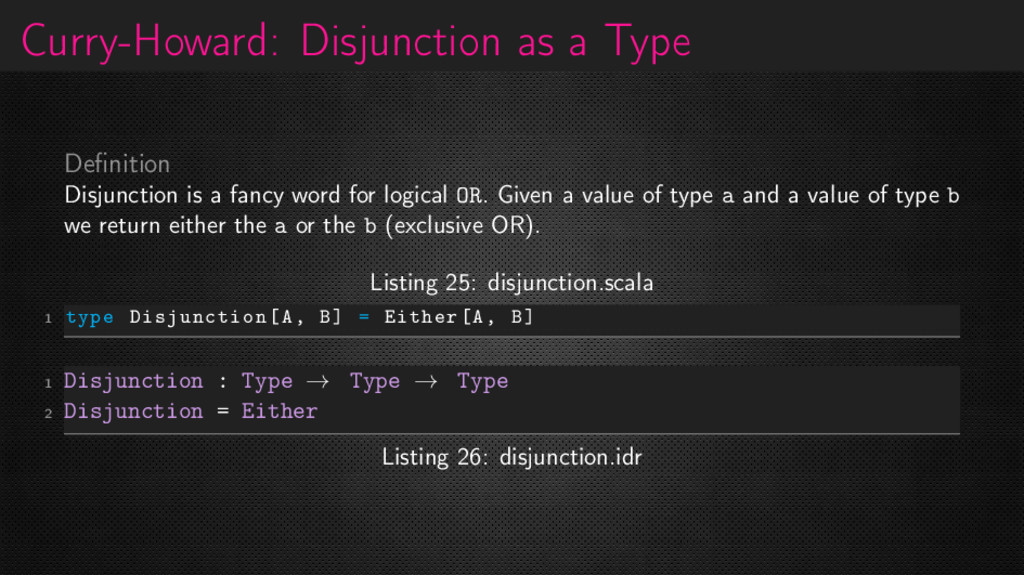
Curry-Howard: Disjunction as a Type Definition Disjunction is a fancy
word for logical OR. Given a value of type a and a value of type b we return either the a or the b (exclusive OR). Listing 25: disjunction.scala 1 type Disjunction[A, B] = Either[A, B] 1 Disjunction : Type → Type → Type 2 Disjunction = Either Listing 26: disjunction.idr -
Curry-Howard: Consistency 1/2 Definition In logic consistency ensures that all
logical propositions make sense when all put together. In programming we can ensure this by checking types/functions are total. A type being total is just a fancy way of saying that for all inhabitants (values) of any inputs to the function/type, we will always be able to terminate with an inhabitant of the return value in some finite time. -
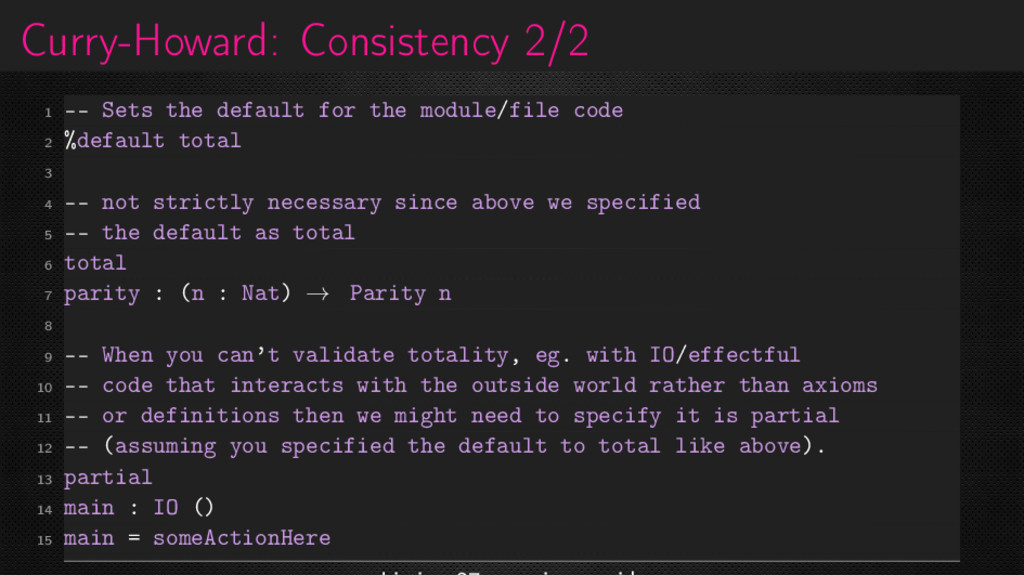
Curry-Howard: Consistency 2/2 1 -- Sets the default for the
module/file code 2 %default total 3 4 -- not strictly necessary since above we specified 5 -- the default as total 6 total 7 parity : (n : Nat) → Parity n 8 9 -- When you can’t validate totality, eg. with IO/effectful 10 -- code that interacts with the outside world rather than axioms 11 -- or definitions then we might need to specify it is partial 12 -- (assuming you specified the default to total like above). 13 partial 14 main : IO () 15 main = someActionHere -
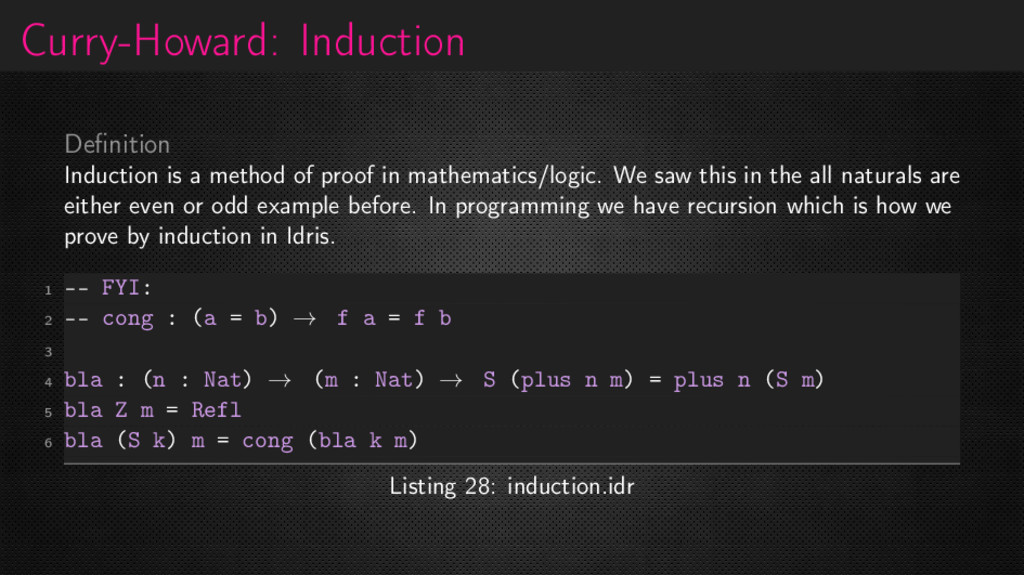
Curry-Howard: Induction Definition Induction is a method of proof in
mathematics/logic. We saw this in the all naturals are either even or odd example before. In programming we have recursion which is how we prove by induction in Idris. 1 -- FYI: 2 -- cong : (a = b) → f a = f b 3 4 bla : (n : Nat) → (m : Nat) → S (plus n m) = plus n (S m) 5 bla Z m = Refl 6 bla (S k) m = cong (bla k m) Listing 28: induction.idr -
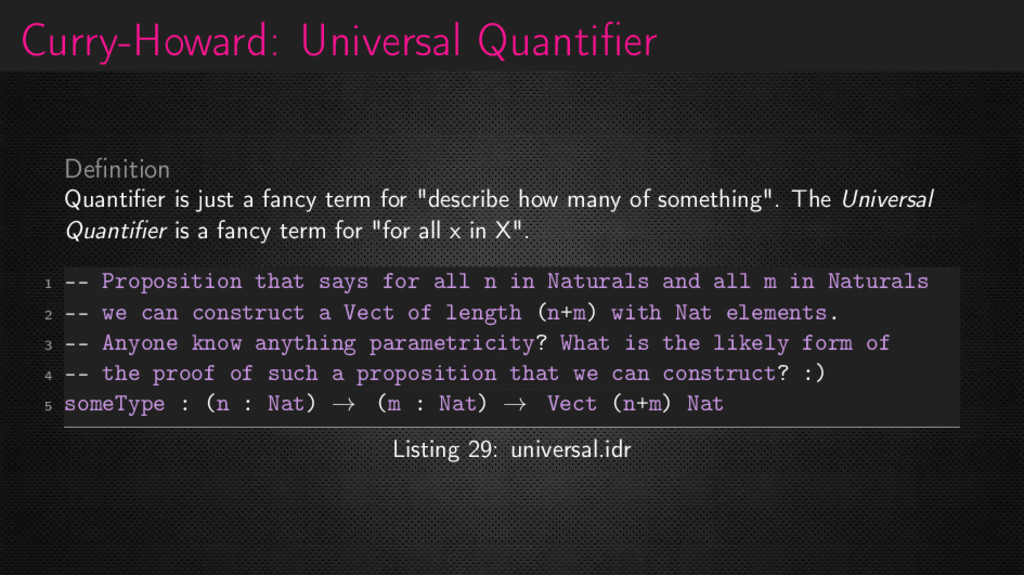
Curry-Howard: Universal Quantifier Definition Quantifier is just a fancy term
for "describe how many of something". The Universal Quantifier is a fancy term for "for all x in X". 1 -- Proposition that says for all n in Naturals and all m in Naturals 2 -- we can construct a Vect of length (n+m) with Nat elements. 3 -- Anyone know anything parametricity? What is the likely form of 4 -- the proof of such a proposition that we can construct? :) 5 someType : (n : Nat) → (m : Nat) → Vect (n+m) Nat Listing 29: universal.idr -
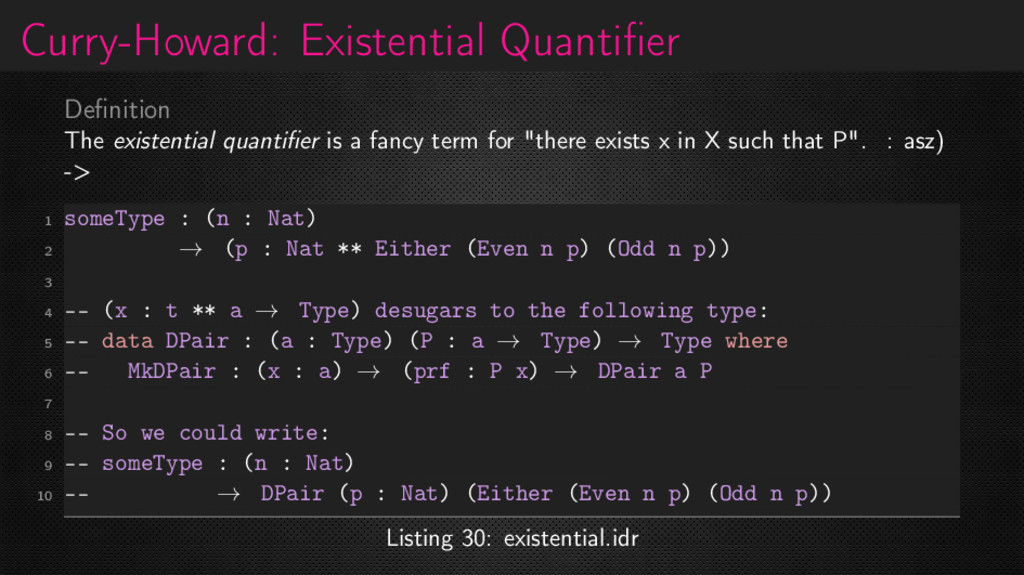
Curry-Howard: Existential Quantifier Definition The existential quantifier is a fancy
term for "there exists x in X such that P". : asz) -> 1 someType : (n : Nat) 2 → (p : Nat ** Either (Even n p) (Odd n p)) 3 4 -- (x : t ** a → Type) desugars to the following type: 5 -- data DPair : (a : Type) (P : a → Type) → Type where 6 -- MkDPair : (x : a) → (prf : P x) → DPair a P 7 8 -- So we could write: 9 -- someType : (n : Nat) 10 -- → DPair (p : Nat) (Either (Even n p) (Odd n p)) Listing 30: existential.idr -
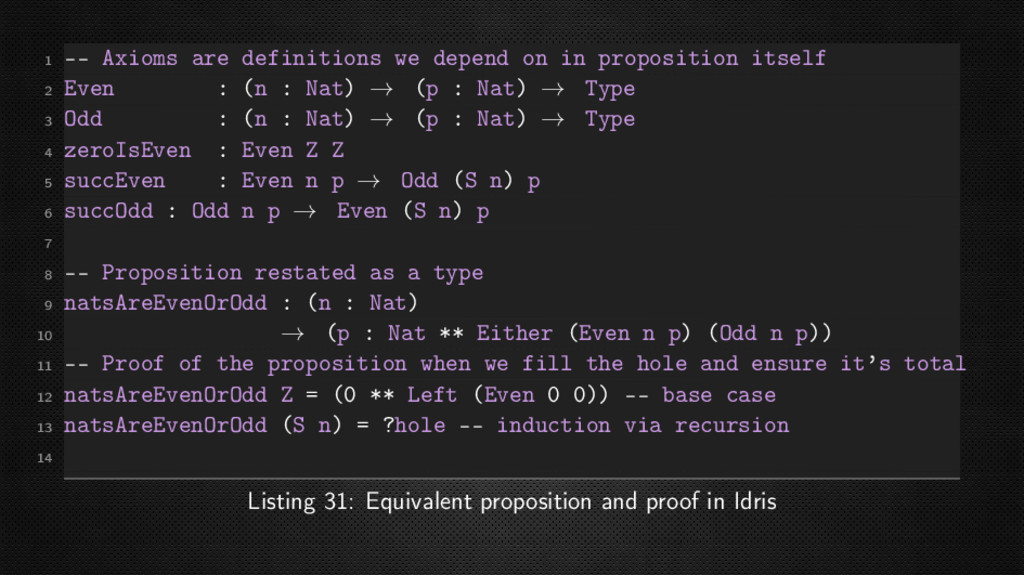
1 -- Axioms are definitions we depend on in proposition
itself 2 Even : (n : Nat) → (p : Nat) → Type 3 Odd : (n : Nat) → (p : Nat) → Type 4 zeroIsEven : Even Z Z 5 succEven : Even n p → Odd (S n) p 6 succOdd : Odd n p → Even (S n) p 7 8 -- Proposition restated as a type 9 natsAreEvenOrOdd : (n : Nat) 10 → (p : Nat ** Either (Even n p) (Odd n p)) 11 -- Proof of the proposition when we fill the hole and ensure it’s total 12 natsAreEvenOrOdd Z = (0 ** Left (Even 0 0)) -- base case 13 natsAreEvenOrOdd (S n) = ?hole -- induction via recursion 14 Listing 31: Equivalent proposition and proof in Idris -
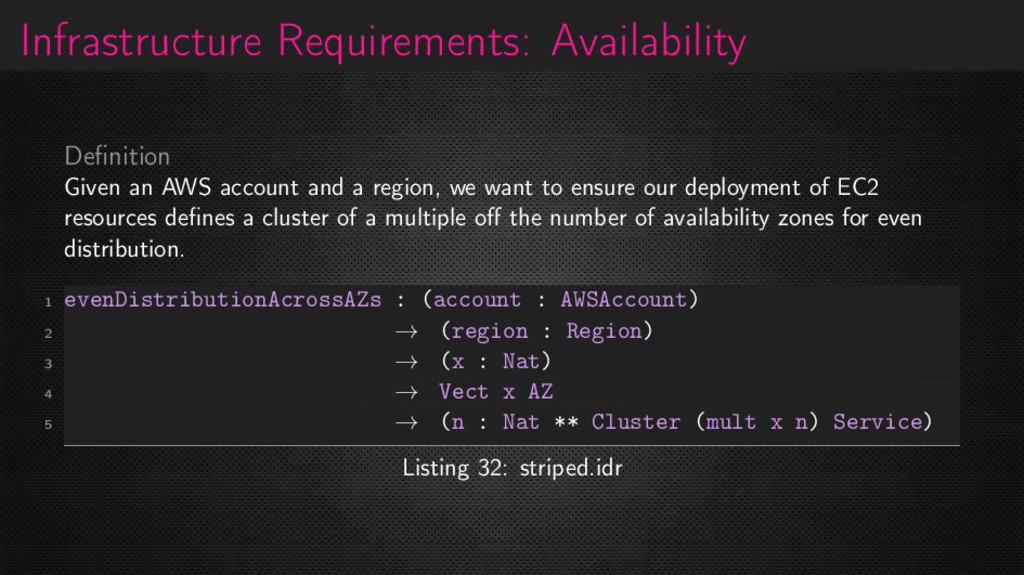
Infrastructure Requirements: Availability Definition Given an AWS account and a
region, we want to ensure our deployment of EC2 resources defines a cluster of a multiple off the number of availability zones for even distribution. 1 evenDistributionAcrossAZs : (account : AWSAccount) 2 → (region : Region) 3 → (x : Nat) 4 → Vect x AZ 5 → (n : Nat ** Cluster (mult x n) Service) Listing 32: striped.idr -
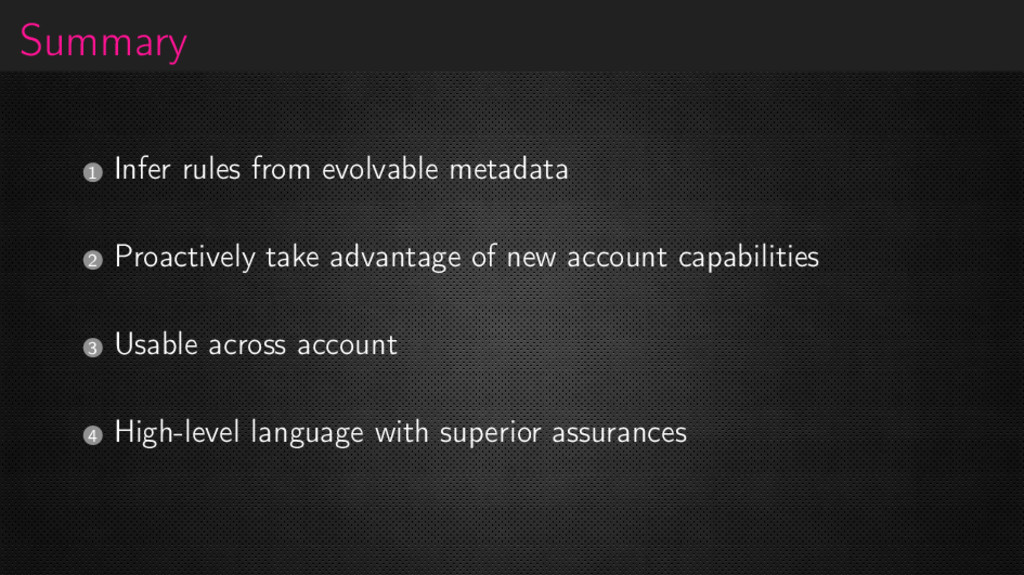
Summary 1 Infer rules from evolvable metadata 2 Proactively take
advantage of new account capabilities 3 Usable across account 4 High-level language with superior assurances
 susanpotter
 pvcresin
 nokonoko1203
 kamina_zzz
 biwakonbu
 chigichan24
 nasa9084
 l2hyunwoo
 dayeon
 simas
 jinroq
 4geru
 nearme_tech
 samanthasiow
 kastner
 addyosmani
 marcoroth
 bryan
 tammielis
 tmiket
 matthewcrist
 jlugia
 techseoconnect
 apolaine
 inesmontani