Share
Embed
Root Cause Analysis for Middleware Issues by Kubernetes Resource Events / KST-2026
Paper Preprint: https://www.koyama.me/assets/KST-2026.pdf
Tomoyuki KOYAMA
February 07, 2026
Transcript
9 slides
-
Tomoyuki Koyama*†, Takayuki Kushida*, Soichiro Ikuno* *Tokyo University of Technology
†Mercari, Inc. January 23, 2026 / KST-2026 @Pattaya, Thailand Root Cause Analysis for Middleware Issues by Kubernetes Resource Events 1 -
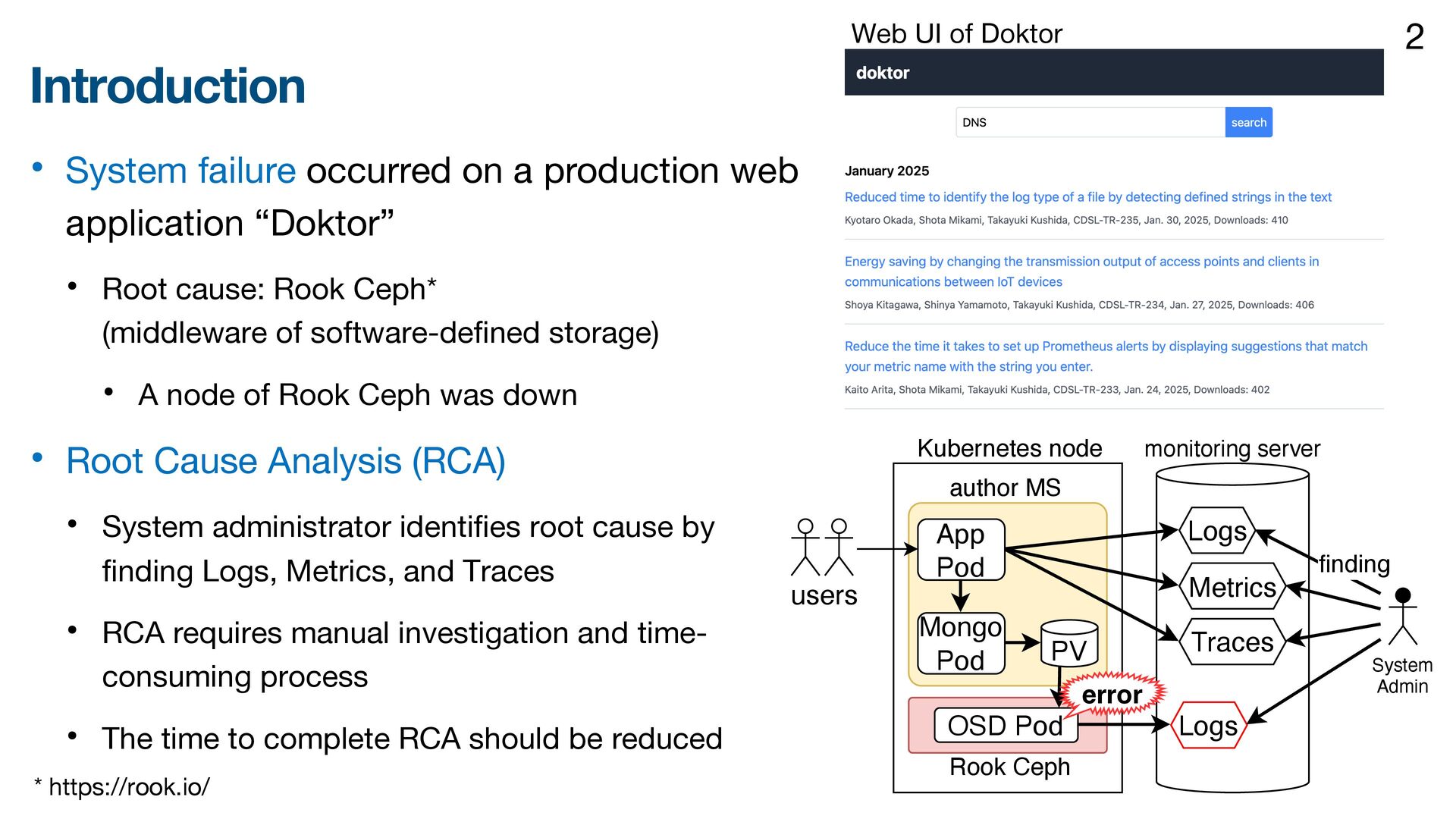
Introduction • System failure occurred on a production web application
“Doktor” • Root cause: Rook Ceph* (middleware of software-defined storage) • A node of Rook Ceph was down • Root Cause Analysis (RCA) • System administrator identifies root cause by finding Logs, Metrics, and Traces • RCA requires manual investigation and time- consuming process • The time to complete RCA should be reduced 2 * https://rook.io/ users Kubernetes node OSD Pod Metrics monitoring server Logs Traces Logs PV Mongo Pod App Pod Rook Ceph author MS error System Admin finding Web UI of Doktor -
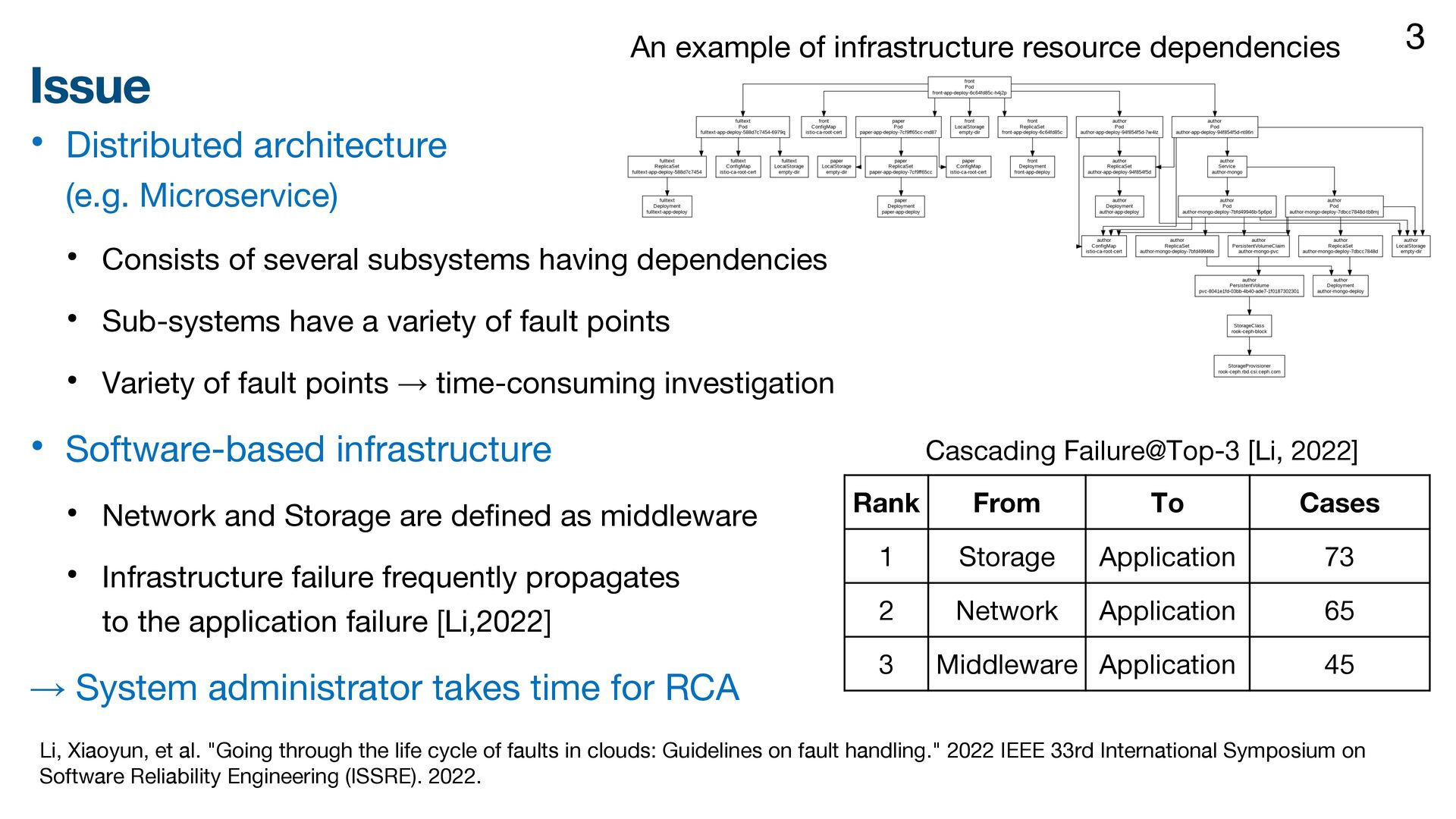
Issue • Distributed architecture (e.g. Microservice) • Consists of several
subsystems having dependencies • Sub-systems have a variety of fault points • Variety of fault points → time-consuming investigation • Software-based infrastructure • Network and Storage are defined as middleware • Infrastructure failure frequently propagates to the application failure [Li,2022] → System administrator takes time for RCA 3 Li, Xiaoyun, et al. "Going through the life cycle of faults in clouds: Guidelines on fault handling." 2022 IEEE 33rd International Symposium on Software Reliability Engineering (ISSRE). 2022. Rank From To Cases 1 Storage Application 73 2 Network Application 65 3 Middleware Application 45 Cascading Failure@Top-3 [Li, 2022] An example of infrastructure resource dependencies -
Related study 4 Single-modal RCA[1,2] Multi-modal RCA[3,4] Metrics Logs Traces
• Single data source is used for RCA • Insufficient information for analyzing middleware status [1] L. Wu, et al., "MicroDiag: Fine-grained Performance Diagnosis for Microservice Systems," 2021 IEEE/ACM International Workshop on Cloud Intelligence, Madrid, Spain, 2021, pp. 31-36 [2] L. Pham, et al., “BARO: Robust Root Cause Analysis for Microservices via Multivariate Bayesian Online Change Point Detection,” Proc. ACM on Software Engineering, vol. 1, no. FSE, pp. 2214-2237, Jul. 2024, [3] H. Wang, et al., "Groot: An Event-graph-based Approach for Root Cause Analysis in Industrial Settings," 2021 36th IEEE/ACM International Conference on Automated Software Engineering, Melbourne, Australia, 2021, pp. 419-429 [4] C. Lee, et al., "Eadro: An End-to-End Troubleshooting Framework for Microservices on Multi-source Data," 2023 IEEE/ACM 45th International Conference on Software Engineering, Melbourne, Australia, 2023, pp. 1750-1762 • Multiple data sources are used for RCA • Lacking analysis of Kubernetes resource dependency Root cause Metrics Logs Root cause Root cause Root cause -
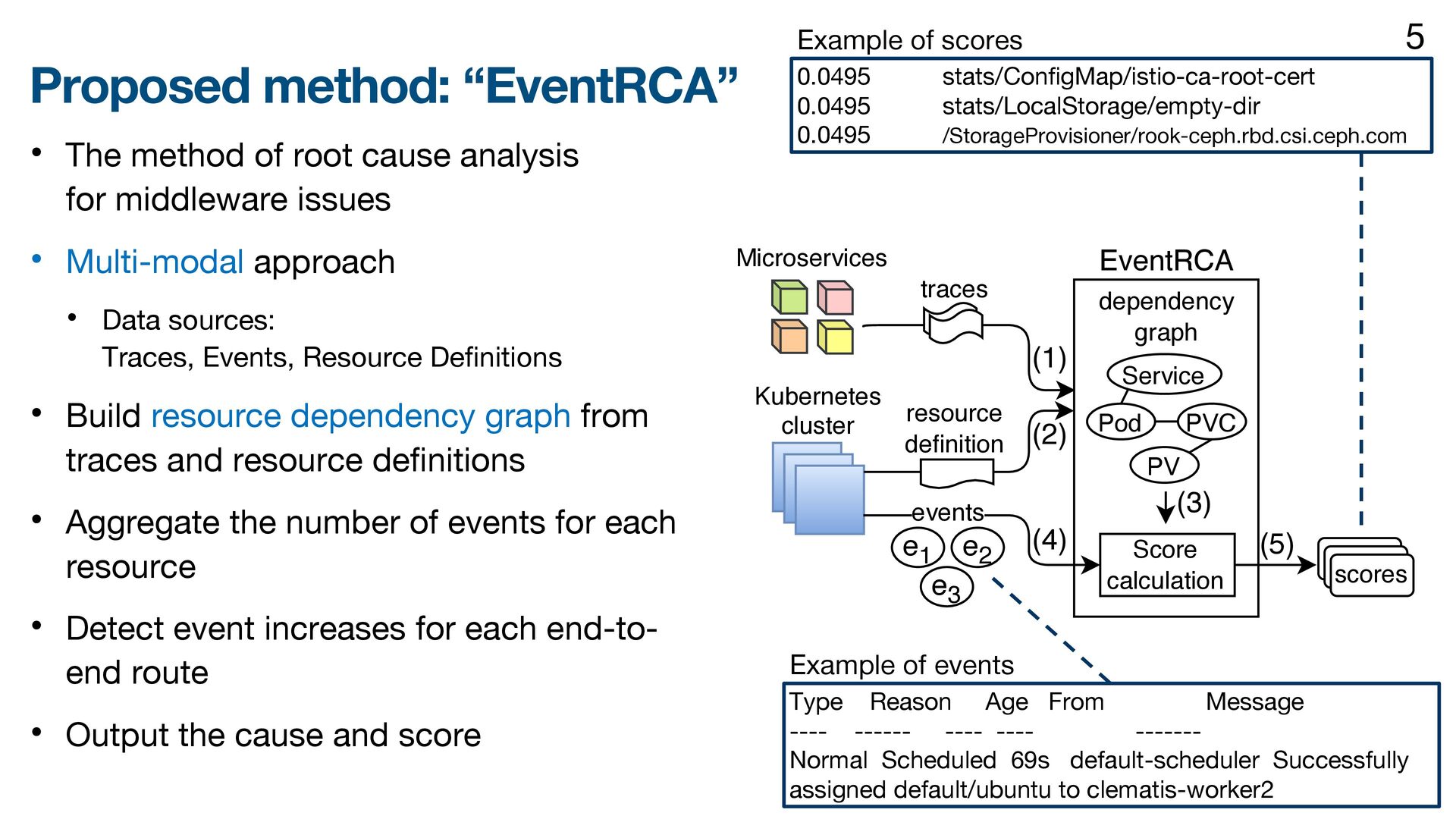
Kubernetes cluster (1) (4) scores Microservices events e1 e2 e3
EventRCA dependency graph traces resource definition (2) (3) Score calculation (5) Service PVC Pod PV Proposed method: “EventRCA” • The method of root cause analysis for middleware issues • Multi-modal approach • Data sources: Traces, Events, Resource Definitions • Build resource dependency graph from traces and resource definitions • Aggregate the number of events for each resource • Detect event increases for each end-to- end route • Output the cause and score 5 0.0495 stats/ConfigMap/istio-ca-root-cert 0.0495 stats/LocalStorage/empty-dir 0.0495 /StorageProvisioner/rook-ceph.rbd.csi.ceph.com Example of scores Type Reason Age From Message ---- ------ ---- ---- ------- Normal Scheduled 69s default-scheduler Successfully assigned default/ubuntu to clematis-worker2 Example of events -
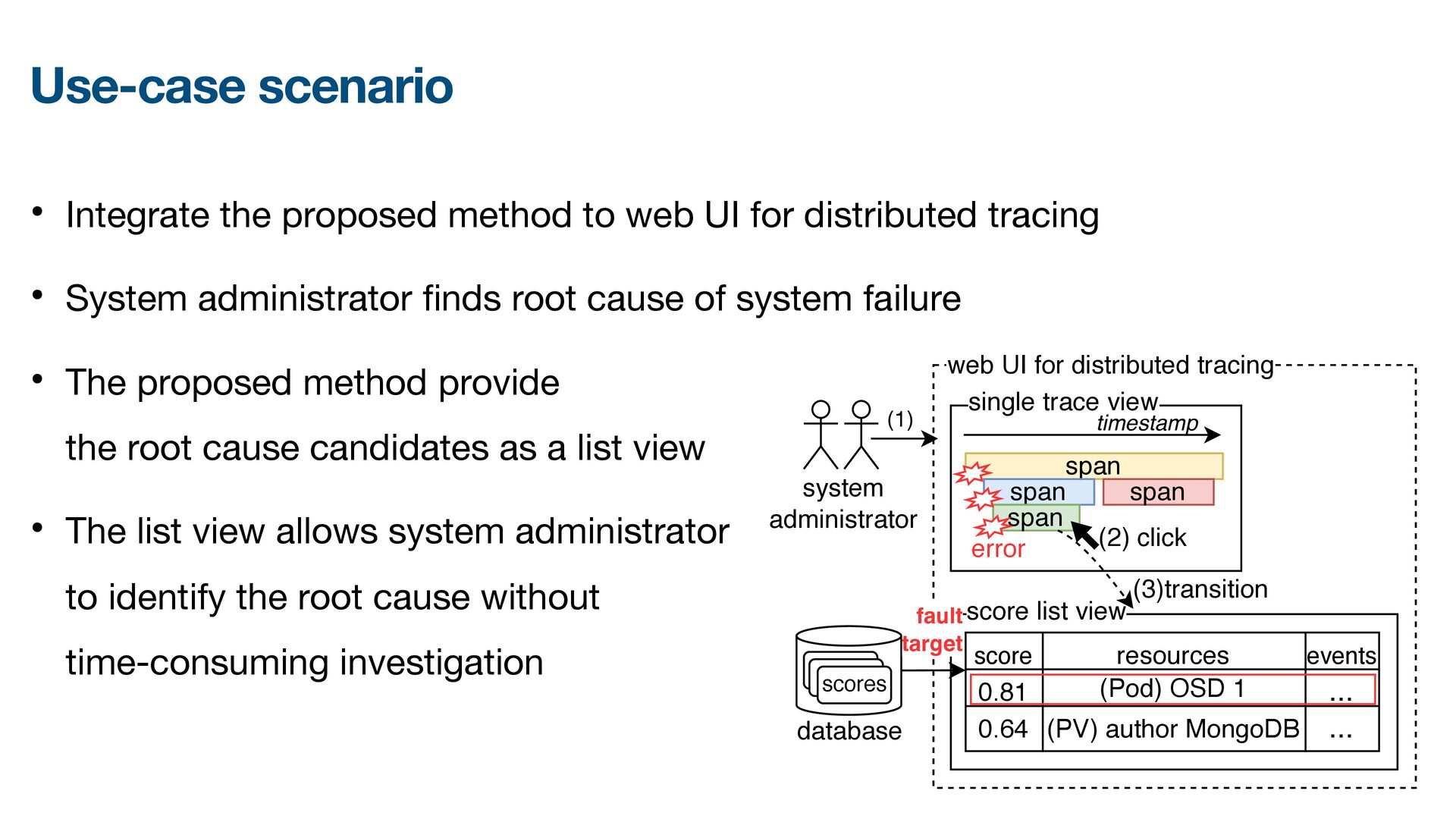
single trace view span span span span score list view
(2) click timestamp error (3)transition web UI for distributed tracing score resources events 0.81 (Pod) OSD 1 ... 0.64 (PV) author MongoDB ... database scores fault target system administrator (1) Use-case scenario • Integrate the proposed method to web UI for distributed tracing • System administrator finds root cause of system failure • The proposed method provide the root cause candidates as a list view • The list view allows system administrator to identify the root cause without time-consuming investigation -
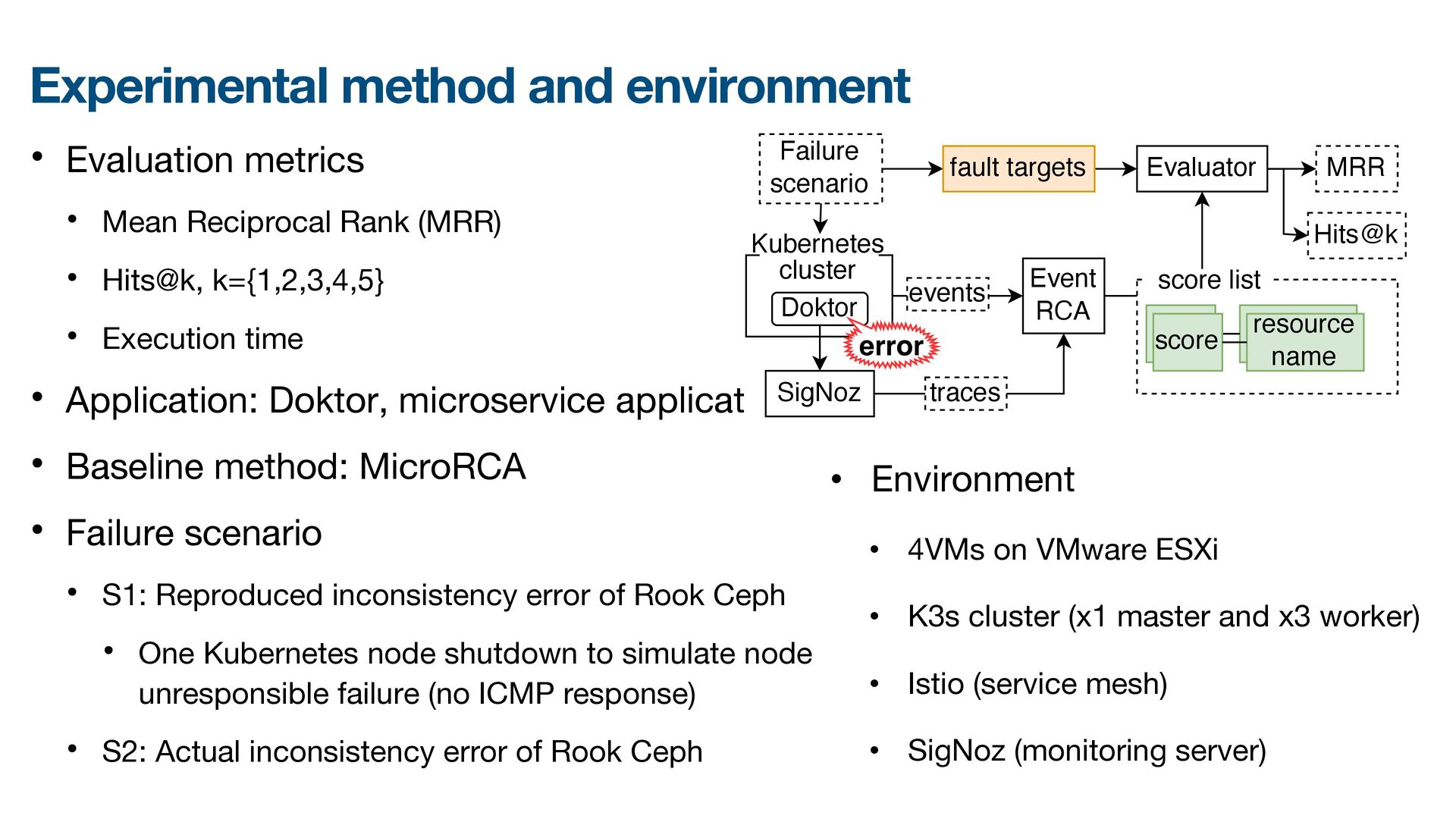
Experimental method and environment • Evaluation metrics • Mean Reciprocal
Rank (MRR) • Hits@k, k={1,2,3,4,5} • Execution time • Application: Doktor, microservice application • Baseline method: MicroRCA • Failure scenario • S1: Reproduced inconsistency error of Rook Ceph • One Kubernetes node shutdown to simulate node unresponsible failure (no ICMP response) • S2: Actual inconsistency error of Rook Ceph Failure scenario Event RCA fault targets Doktor Kubernetes cluster error SigNoz Evaluator traces resource name score score list events MRR Hits@k • Environment • 4VMs on VMware ESXi • K3s cluster (x1 master and x3 worker) • Istio (service mesh) • SigNoz (monitoring server) -
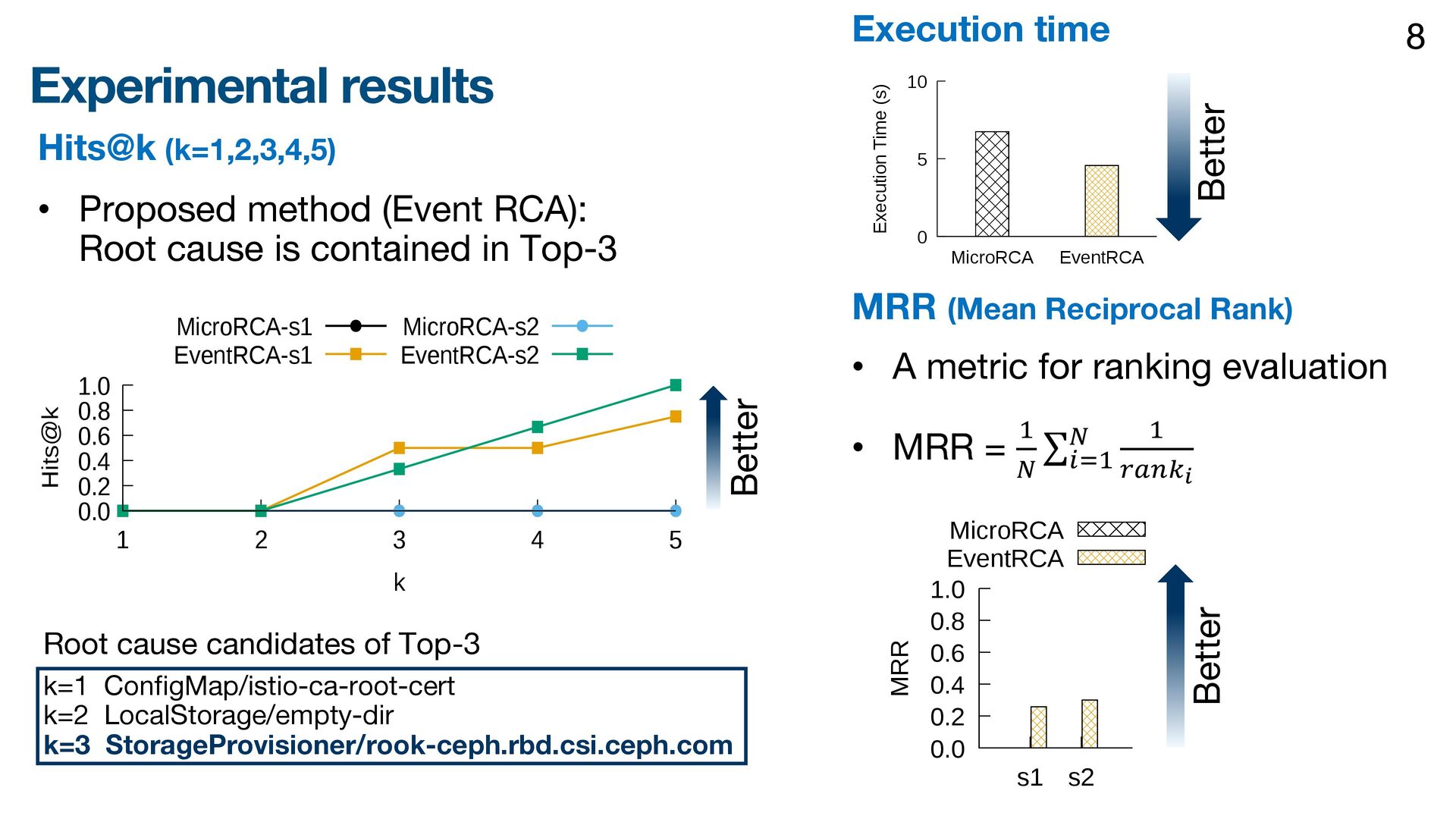
Experimental results 8 0.0 0.2 0.4 0.6 0.8 1.0 s1
s2 MRR MicroRCA EventRCA Hits@k (k=1,2,3,4,5) • Proposed method (Event RCA): Root cause is contained in Top-3 MRR (Mean Reciprocal Rank) • A metric for ranking evaluation • MRR = ! " ∑#$! " ! %&'(! Better 0.0 0.2 0.4 0.6 0.8 1.0 1 2 3 4 5 Hits@k k MicroRCA-s1 EventRCA-s1 MicroRCA-s2 EventRCA-s2 Better 0 5 10 MicroRCA EventRCA Execution Time (s) Better Execution time k=1 ConfigMap/istio-ca-root-cert k=2 LocalStorage/empty-dir k=3 StorageProvisioner/rook-ceph.rbd.csi.ceph.com Root cause candidates of Top-3 -
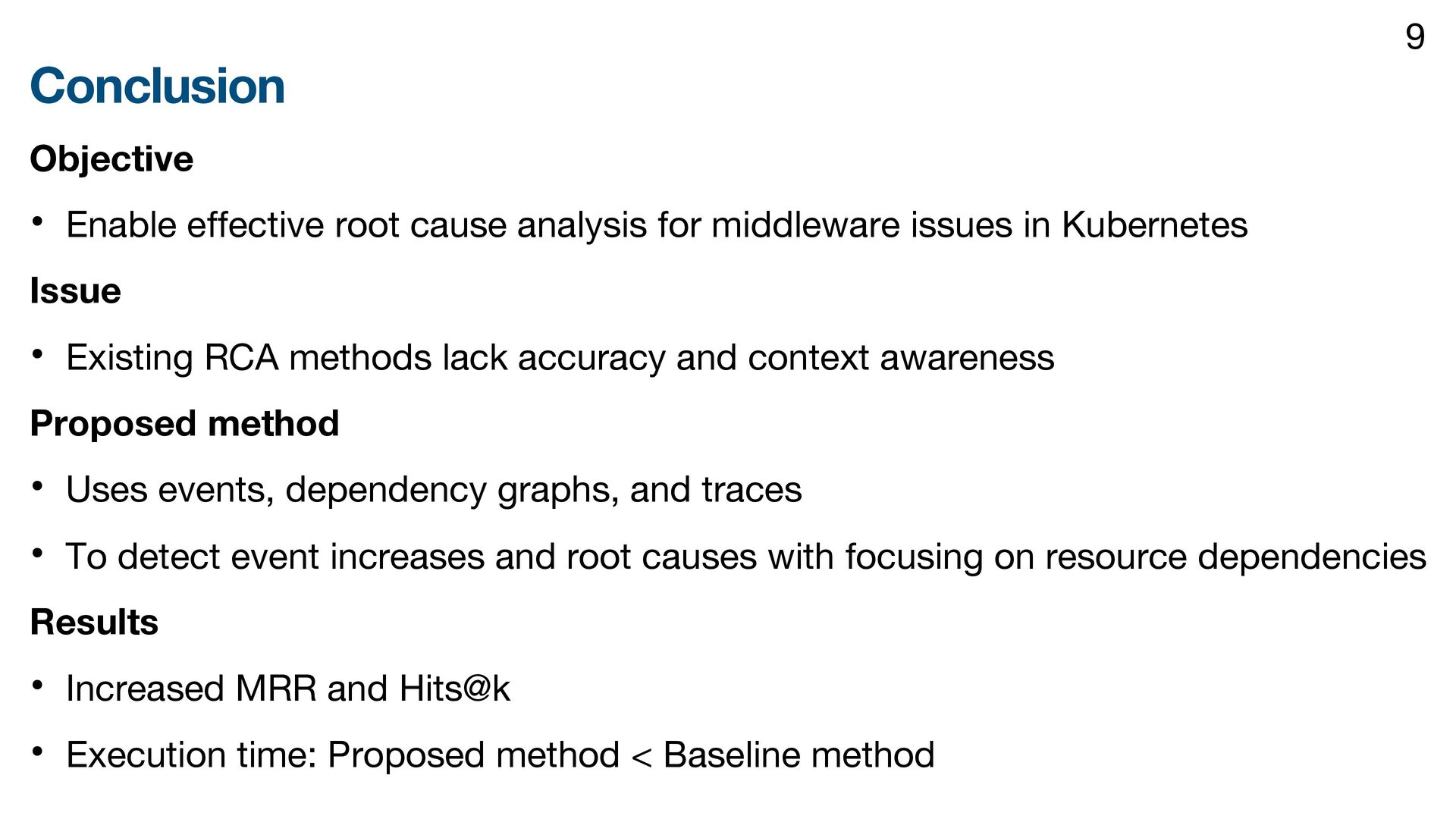
Conclusion Objective • Enable effective root cause analysis for middleware
issues in Kubernetes Issue • Existing RCA methods lack accuracy and context awareness Proposed method • Uses events, dependency graphs, and traces • To detect event increases and root causes with focusing on resource dependencies Results • Increased MRR and Hits@k • Execution time: Proposed method < Baseline method 9