Upgrade to Pro — share decks privately, control downloads, hide ads and more …

2026 Fuji Oil Outside Directors’ Roundtable (En...

Sponsored · Ship Features Fearlessly Turn features on and off without deploys. Used by thousands of Ruby developers. →
Avatar for Tetsuya Sogo Tetsuya Sogo
November 06, 2026

2026 Fuji Oil Outside Directors’ Roundtable (English version) 

The Board’s Role in Creating Long-Term Value

I am pleased to share that the 2026 Integrated Report of Fuji Oil features a roundtable discussion with its Outside Directors.
In the discussion, we reflected on the progress of the “United for Growth 2027” medium-term management plan and the role of the Board in supporting sustainable growth and enhancing corporate value.
I shared my view that the Board should evolve beyond traditional monitoring toward a stronger “steering function” — helping guide business strategy in the right direction by sharing and challenging the assumptions behind strategic decisions.
We also discussed the importance of technology-driven differentiation, productivity improvement, supply chain capabilities, and shortening the Cash Conversion Cycle as key drivers of long-term value creation.
I hope the discussion offers some insight into how we, as Outside Directors, view our role in supporting Fuji Oil’s sustainable growth and long-term value creation.

Avatar for Tetsuya Sogo

Tetsuya Sogo

November 06, 2026

More Decks by Tetsuya Sogo

Other Decks in Business

Transcript

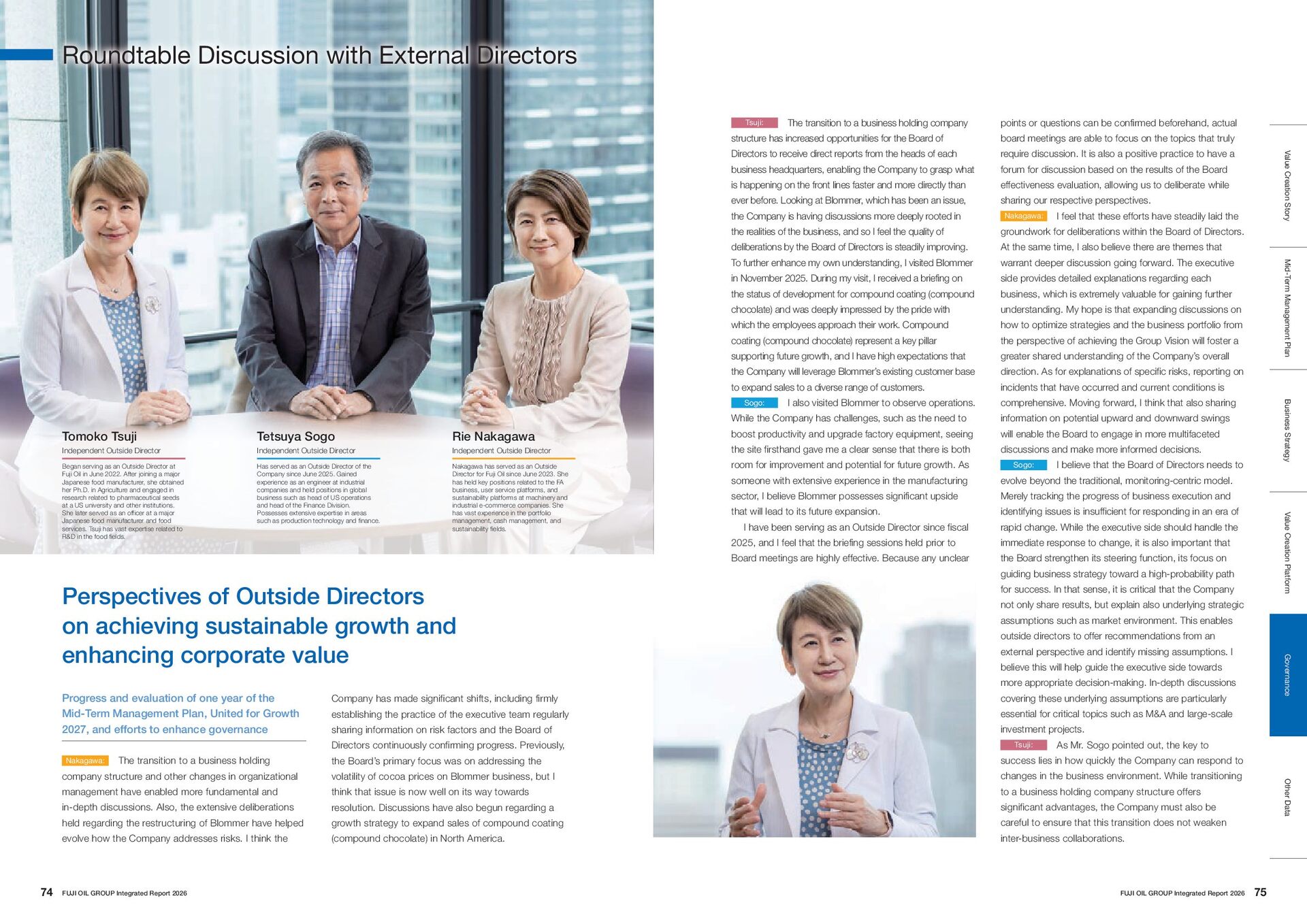
  1. Roundtable Discussion with External Directors    Tsuji:    board meetings are able

    to focus on the topics that truly Directors to receive direct reports from the heads of each require discussion. It is also a positive practice to have a business headquarters, enabling the Company to grasp what forum for discussion based on the results of the Board is happening on the front lines faster and more directly than effectiveness evaluation, allowing us to deliberate while ever before. Looking at Blommer, which has been an issue, sharing our respective perspectives. the Company is having discussions more deeply rooted in Nakagawa: the realities of the business, and so I feel the quality of groundwork for deliberations within the Board of Directors. deliberations by the Board of Directors is steadily improving. At the same time, I also believe there are themes that To further enhance my own understanding, I visited Blommer warrant deeper discussion going forward. The executive in November 2025. During my visit, I received a briefing on side provides detailed explanations regarding each the status of development for compound coating (compound business, which is extremely valuable for gaining further chocolate) and was deeply impressed by the pride with understanding. My hope is that expanding discussions on which the employees approach their work. Compound how to optimize strategies and the business portfolio from coating (compound chocolate) represent a key pillar the perspective of achieving the Group Vision will foster a supporting future growth, and I have high expectations that greater shared understanding of the Company’s overall the Company will leverage Blommer’s existing customer base direction. As for explanations of specific risks, reporting on to expand sales to a diverse range of customers. incidents that have occurred and current conditions is Independent Outside Director Has served as an Outside Director of the Company since June 2025. Gained experience as an engineer at industrial companies and held positions in global business such as head of US operations and head of the Finance Division. Possesses extensive expertise in areas such as production technology and finance. Nakagawa has served as an Outside Director for Fuji Oil since June 2023. She has held key positions related to the FA business, user service platforms, and sustainability platforms at machinery and industrial e-commerce companies. She has vast experience in the portfolio management, cash management, and sustainability fields. While the Company has challenges, such as the need to information on potential upward and downward swings boost productivity and upgrade factory equipment, seeing will enable the Board to engage in more multifaceted the site firsthand gave me a clear sense that there is both discussions and make more informed decisions. room for improvement and potential for future growth. As    Sogo:    someone with extensive experience in the manufacturing evolve beyond the traditional, monitoring-centric model. sector, I believe Blommer possesses significant upside Merely tracking the progress of business execution and that will lead to its future expansion. identifying issues is insufficient for responding in an era of I have been serving as an Outside Director since fiscal I believe that the Board of Directors needs to Value Creation Platform Independent Outside Director Began serving as an Outside Director at Fuji Oil in June 2022. After joining a major Japanese food manufacturer, she obtained her Ph.D. in Agriculture and engaged in research related to pharmaceutical seeds at a US university and other institutions. She later served as an officer at a major Japanese food manufacturer and food services. Tsuji has vast expertise related to R&D in the food fields. comprehensive. Moving forward, I think that also sharing Business Strategy Independent Outside Director I feel that these efforts have steadily laid the Mid-Term Management Plan Rie Nakagawa I also visited Blommer to observe operations. Value Creation Story Tetsuya Sogo points or questions can be confirmed beforehand, actual structure has increased opportunities for the Board of    Sogo:    Tomoko Tsuji The transition to a business holding company rapid change. While the executive side should handle the 2025, and I feel that the briefing sessions held prior to immediate response to change, it is also important that Board meetings are highly effective. Because any unclear the Board strengthen its steering function, its focus on guiding business strategy toward a high-probability path for success. In that sense, it is critical that the Company not only share results, but explain also underlying strategic assumptions such as market environment. This enables outside directors to offer recommendations from an external perspective and identify missing assumptions. I Governance Perspectives of Outside Directors on achieving sustainable growth and enhancing corporate value believe this will help guide the executive side towards more appropriate decision-making. In-depth discussions Progress and evaluation of one year of the Mid-Term Management Plan, United for Growth 2027, and efforts to enhance governance covering these underlying assumptions are particularly establishing the practice of the executive team regularly essential for critical topics such as M&A and large-scale sharing information on risk factors and the Board of investment projects. Directors continuously confirming progress. Previously,    Tsuji:    As Mr. Sogo pointed out, the key to company structure and other changes in organizational volatility of cocoa prices on Blommer business, but I changes in the business environment. While transitioning management have enabled more fundamental and think that issue is now well on its way towards to a business holding company structure offers in-depth discussions. Also, the extensive deliberations resolution. Discussions have also begun regarding a significant advantages, the Company must also be held regarding the restructuring of Blommer have helped growth strategy to expand sales of compound coating careful to ensure that this transition does not weaken evolve how the Company addresses risks. I think the (compound chocolate) in North America. inter-business collaborations. The transition to a business holding FUJI OIL GROUP Integrated Report 2026  FUJI OIL GROUP Integrated Report 2026 Other Data the Board’s primary focus was on addressing the success lies in how quickly the Company can respond to Nakagawa: 74 Company has made significant shifts, including firmly 75
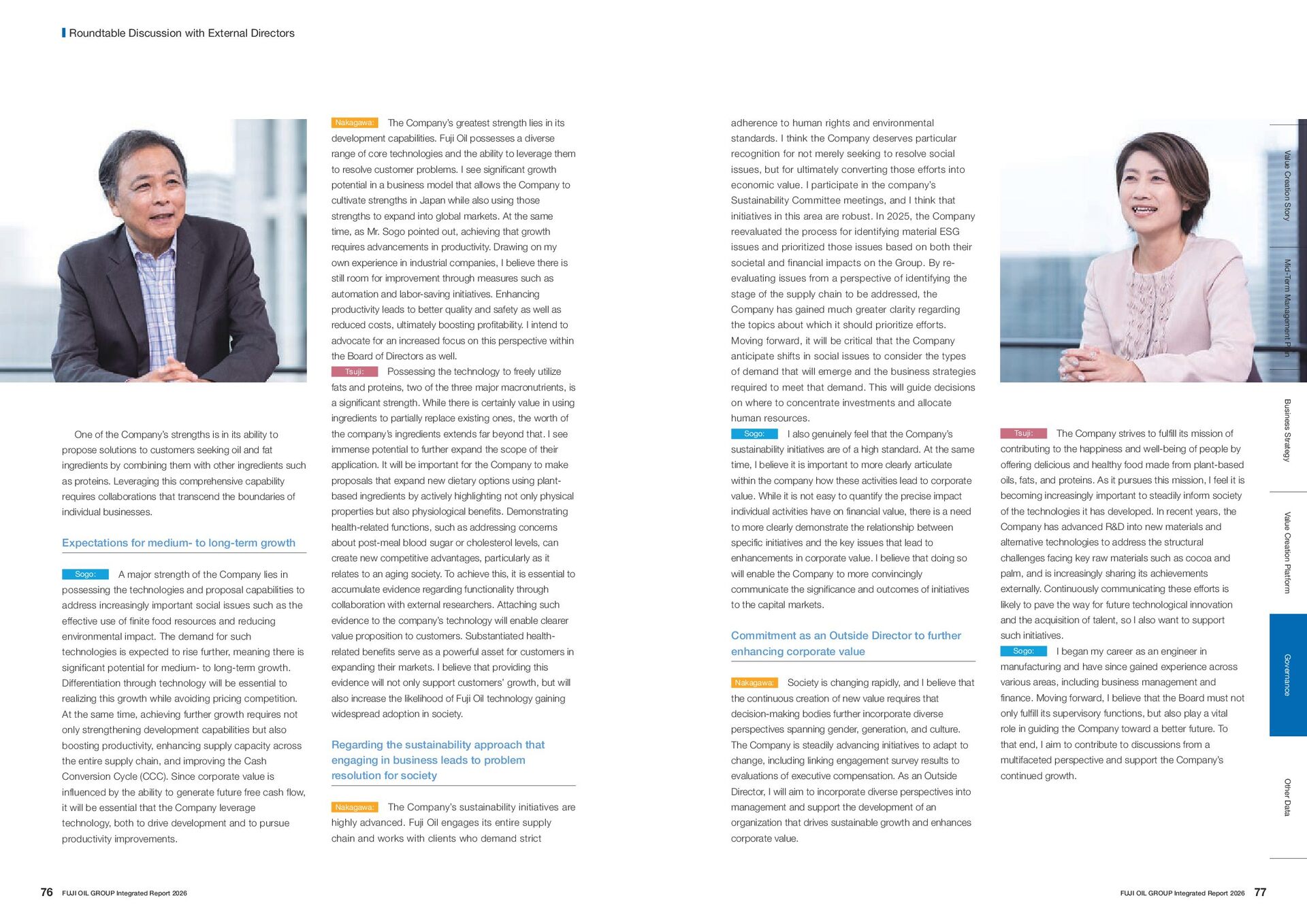
  2. Roundtable Discussion with External Directors Nakagawa: The Company’s greatest strength

    lies in its recognition for not merely seeking to resolve social to resolve customer problems. I see significant growth issues, but for ultimately converting those efforts into potential in a business model that allows the Company to economic value. I participate in the company’s cultivate strengths in Japan while also using those Sustainability Committee meetings, and I think that strengths to expand into global markets. At the same initiatives in this area are robust. In 2025, the Company time, as Mr. Sogo pointed out, achieving that growth reevaluated the process for identifying material ESG requires advancements in productivity. Drawing on my issues and prioritized those issues based on both their own experience in industrial companies, I believe there is societal and financial impacts on the Group. By re- still room for improvement through measures such as evaluating issues from a perspective of identifying the automation and labor-saving initiatives. Enhancing stage of the supply chain to be addressed, the productivity leads to better quality and safety as well as Company has gained much greater clarity regarding reduced costs, ultimately boosting profitability. I intend to the topics about which it should prioritize efforts. advocate for an increased focus on this perspective within Moving forward, it will be critical that the Company the Board of Directors as well. anticipate shifts in social issues to consider the types Possessing the technology to freely utilize Mid-Term Management Plan standards. I think the Company deserves particular range of core technologies and the ability to leverage them Value Creation Story development capabilities. Fuji Oil possesses a diverse    Tsuji:    of demand that will emerge and the business strategies required to meet that demand. This will guide decisions a significant strength. While there is certainly value in using on where to concentrate investments and allocate ingredients to partially replace existing ones, the worth of human resources. the company’s ingredients extends far beyond that. I see    Sogo:    propose solutions to customers seeking oil and fat immense potential to further expand the scope of their sustainability initiatives are of a high standard. At the same contributing to the happiness and well-being of people by ingredients by combining them with other ingredients such application. It will be important for the Company to make time, I believe it is important to more clearly articulate offering delicious and healthy food made from plant-based as proteins. Leveraging this comprehensive capability proposals that expand new dietary options using plant- within the company how these activities lead to corporate oils, fats, and proteins. As it pursues this mission, I feel it is requires collaborations that transcend the boundaries of based ingredients by actively highlighting not only physical value. While it is not easy to quantify the precise impact becoming increasingly important to steadily inform society individual businesses. properties but also physiological benefits. Demonstrating individual activities have on financial value, there is a need of the technologies it has developed. In recent years, the health-related functions, such as addressing concerns to more clearly demonstrate the relationship between Company has advanced R&D into new materials and about post-meal blood sugar or cholesterol levels, can specific initiatives and the key issues that lead to alternative technologies to address the structural create new competitive advantages, particularly as it enhancements in corporate value. I believe that doing so challenges facing key raw materials such as cocoa and relates to an aging society. To achieve this, it is essential to will enable the Company to more convincingly palm, and is increasingly sharing its achievements possessing the technologies and proposal capabilities to accumulate evidence regarding functionality through communicate the significance and outcomes of initiatives externally. Continuously communicating these efforts is address increasingly important social issues such as the collaboration with external researchers. Attaching such to the capital markets. likely to pave the way for future technological innovation effective use of finite food resources and reducing evidence to the company’s technology will enable clearer environmental impact. The demand for such value proposition to customers. Substantiated health- technologies is expected to rise further, meaning there is related benefits serve as a powerful asset for customers in significant potential for medium- to long-term growth. expanding their markets. I believe that providing this Differentiation through technology will be essential to evidence will not only support customers’ growth, but will Nakagawa: realizing this growth while avoiding pricing competition. also increase the likelihood of Fuji Oil technology gaining the continuous creation of new value requires that finance. Moving forward, I believe that the Board must not At the same time, achieving further growth requires not widespread adoption in society. decision-making bodies further incorporate diverse only fulfill its supervisory functions, but also play a vital perspectives spanning gender, generation, and culture. role in guiding the Company toward a better future. To The Company is steadily advancing initiatives to adapt to that end, I aim to contribute to discussions from a change, including linking engagement survey results to multifaceted perspective and support the Company’s evaluations of executive compensation. As an Outside continued growth.    Sogo:    A major strength of the Company lies in boosting productivity, enhancing supply capacity across the entire supply chain, and improving the Cash Commitment as an Outside Director to further enhancing corporate value I began my career as an engineer in    Sogo:    manufacturing and have since gained experience across Society is changing rapidly, and I believe that various areas, including business management and Director, I will aim to incorporate diverse perspectives into influenced by the ability to generate future free cash flow, The Company’s sustainability initiatives are management and support the development of an it will be essential that the Company leverage Nakagawa: technology, both to drive development and to pursue highly advanced. Fuji Oil engages its entire supply organization that drives sustainable growth and enhances productivity improvements. chain and works with clients who demand strict corporate value. FUJI OIL GROUP Integrated Report 2026 such initiatives. Other Data Conversion Cycle (CCC). Since corporate value is Regarding the sustainability approach that engaging in business leads to problem resolution for society and the acquisition of talent, so I also want to support Governance only strengthening development capabilities but also The Company strives to fulfill its mission of    Tsuji:    Value Creation Platform Expectations for medium- to long-term growth I also genuinely feel that the Company’s Business Strategy fats and proteins, two of the three major macronutrients, is One of the Company’s strengths is in its ability to 76 adherence to human rights and environmental  FUJI OIL GROUP Integrated Report 2026 77
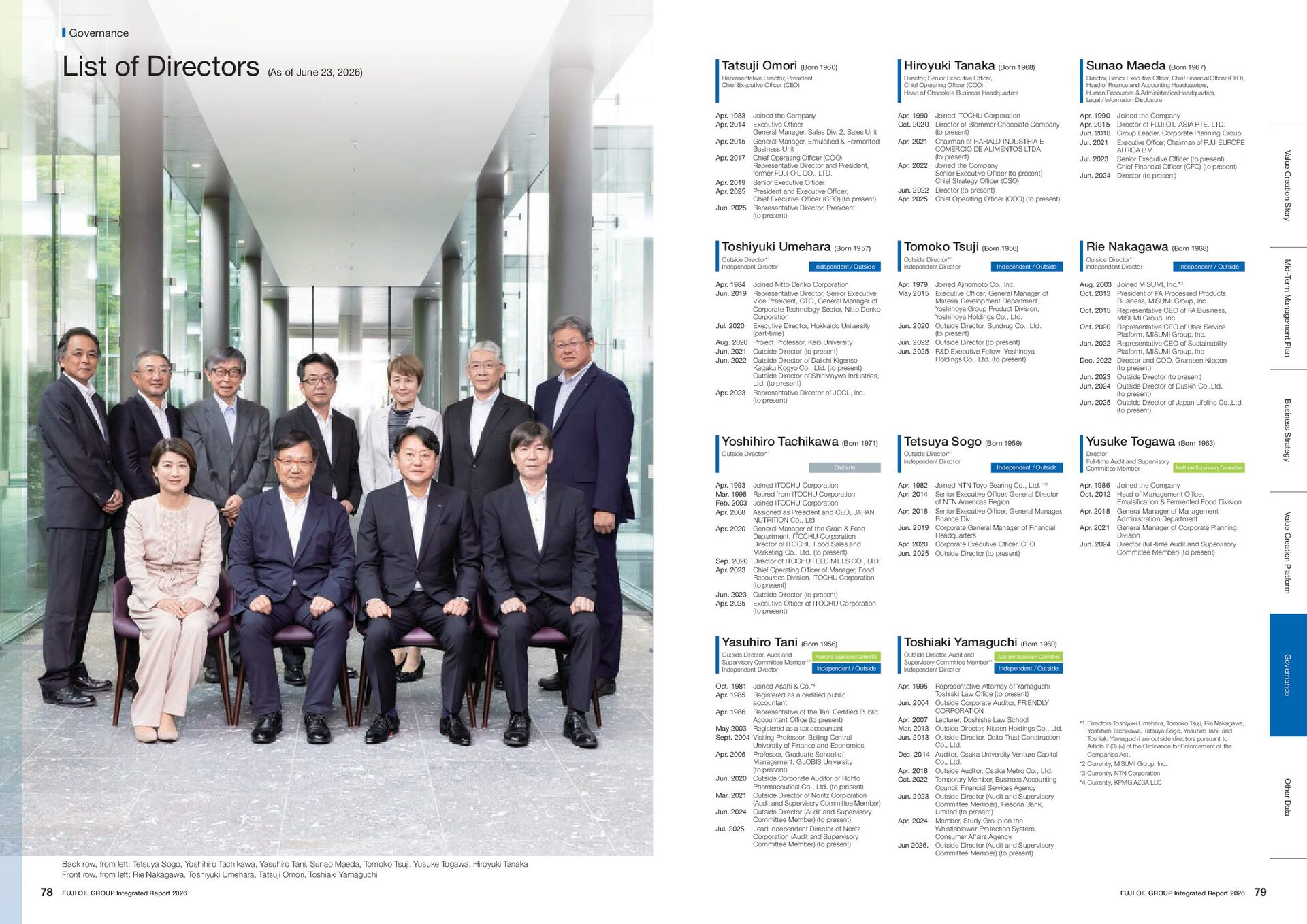
  3. Governance List of Directors (As of June 23, 2026) Tatsuji

    Omori (Born 1960) Hiroyuki Tanaka (Born 1968) Sunao Maeda (Born 1967) Representative Director, President Chief Executive Officer (CEO) Director, Senior Executive Officer, Chief Operating Officer (COO), Head of Chocolate Business Headquarters Director, Senior Executive Officer, Chief Financial Officer (CFO), Head of Finance and Accounting Headquarters, Human Resources & Administration Headquarters, Legal / Information Disclosure Apr. 1990 Joined ITOCHU Corporation Oct. 2020 Director of Blommer Chocolate Company (to present) Apr. 2021 Chairman of HARALD INDUSTRIA E COMERCIO DE ALIMENTOS LTDA (to present) Apr. 2022 Joined the Company Senior Executive Officer (to present) Chief Strategy Officer (CSO) Jun. 2022 Director (to present) Apr. 2025 Chief Operating Officer (COO) (to present) Joined the Company Director of FUJI OIL ASIA PTE. LTD. Group Leader, Corporate Planning Group Executive Officer, Chairman of FUJI EUROPE AFRICA B.V. Jul. 2023 Senior Executive Officer (to present) Chief Financial Officer (CFO) (to present) Jun. 2024 Director (to present) Apr. 1990 Apr. 2015 Jun. 2018 Jul. 2021 Tomoko Tsuji (Born 1956) Rie Nakagawa (Born 1968) Outside Director*1 Independent Director Outside Director*1 Independent Director Outside Director*1 Independent Director Independent / Outside Apr. 1979 Joined Ajinomoto Co., Inc. May 2015 Executive Officer, General Manager of Material Development Department, Yoshinoya Group Product Division, Yoshinoya Holdings Co., Ltd. Jun. 2020 Outside Director, Sundrug Co., Ltd. (to present) Jun. 2022 Outside Director (to present) Jun. 2025 R&D Executive Fellow, Yoshinoya Holdings Co., Ltd. (to present) Independent / Outside Aug. 2003 Joined MISUMI, Inc.*2 Oct. 2013 President of FA Processed Products Business, MISUMI Group, Inc. Oct. 2015 Representative CEO of FA Business, MISUMI Group, Inc. Oct. 2020 Representative CEO of User Service Platform, MISUMI Group, Inc. Jan. 2022 Representative CEO of Sustainability Platform, MISUMI Group, Inc Dec. 2022 Director and COO, Grameen Nippon (to present) Jun. 2023 Outside Director (to present) Jun. 2024 Outside Director of Duskin Co.,Ltd. (to present) Jun. 2025 Outside Director of Japan Lifeline Co.,Ltd. (to present) Yoshihiro Tachikawa (Born 1971) Tetsuya Sogo (Born 1959) Yusuke Togawa (Born 1963) Outside Director*1 Outside Director*1 Independent Director Director Full-time Audit and Supervisory Audit and Supervisory Committee Committee Member Outside Joined NTN Toyo Bearing Co., Ltd. *3 Senior Executive Officer, General Director of NTN Americas Region Apr. 2018 Senior Executive Officer, General Manager, Finance Div. Jun. 2019 Corporate General Manager of Financial Headquarters Apr. 2020 Corporate Executive Officer, CFO Jun. 2025 Outside Director (to present) Apr. 1982 Apr. 2014 Toshiaki Yamaguchi (Born 1960) Outside Director, Audit and Audit and Supervisory Committee Supervisory Committee Member*1 Independent / Outside Independent Director Outside Director, Audit and Audit and Supervisory Committee Supervisory Committee Member*1 Independent / Outside Independent Director Apr. 1995 Jun. 2004 Apr. 2007 Mar. 2013 Jun. 2013 Dec. 2014 Apr. 2018 Oct. 2022 Jun. 2023 Apr. 2024 Jun 2026. Representative Attorney of Yamaguchi Toshiaki Law Office (to present) Outside Corporate Auditor, FRIENDLY CORPORATION Lecturer, Doshisha Law School Outside Director, Nissen Holdings Co., Ltd. Outside Director, Daito Trust Construction Co., Ltd. Auditor, Osaka University Venture Capital Co., Ltd. Outside Auditor, Osaka Metro Co., Ltd. Temporary Member, Business Accounting Council, Financial Services Agency Outside Director (Audit and Supervisory Committee Member), Resona Bank, Limited (to present) Member, Study Group on the Whistleblower Protection System, Consumer Affairs Agency. Outside Director (Audit and Supervisory Committee Member) (to present) *1 Directors Toshiyuki Umehara, Tomoko Tsuji, Rie Nakagawa, Yoshihiro Tachikawa, Tetsuya Sogo, Yasuhiro Tani, and Toshiaki Yamaguchi are outside directors pursuant to Article 2 (3) (v) of the Ordinance for Enforcement of the Companies Act. *2 Currently, MISUMI Group, Inc. *3 Currently, NTN Corporation *4 Currently, KPMG AZSA LLC Other Data Oct. 1981 Joined Asahi & Co.*4 Apr. 1985 Registered as a certified public accountant Apr. 1986 Representative of the Tani Certified Public Accountant Office (to present) May 2003 Registered as a tax accountant Sept. 2004 Visiting Professor, Beijing Central University of Finance and Economics Apr. 2006 Professor, Graduate School of Management, GLOBIS University (to present) Jun. 2020 Outside Corporate Auditor of Rohto Pharmaceutical Co., Ltd. (to present) Mar. 2021 Outside Director of Noritz Corporation (Audit and Supervisory Committee Member) Jun. 2024 Outside Director (Audit and Supervisory Committee Member) (to present) Jul. 2025 Lead Independent Director of Noritz Corporation (Audit and Supervisory Committee Member) (to present) Governance Yasuhiro Tani (Born 1956) Apr. 1986 Joined the Company Oct. 2012 Head of Management Office, Emulsification & Fermented Food Division Apr. 2018 General Manager of Management Administration Department Apr. 2021 General Manager of Corporate Planning Division Jun. 2024 Director (full-time Audit and Supervisory Committee Member) (to present) Value Creation Platform Joined ITOCHU Corporation Retired from ITOCHU Corporation Joined ITOCHU Corporation Assigned as President and CEO, JAPAN NUTRITION Co., Ltd Apr. 2020 General Manager of the Grain & Feed Department, ITOCHU Corporation Director of ITOCHU Food Sales and Marketing Co., Ltd. (to present) Sep. 2020 Director of ITOCHU FEED MILLS CO., LTD. Apr. 2023 Chief Operating Officer of Manager, Food Resources Division, ITOCHU Corporation (to present) Jun. 2023 Outside Director (to present) Apr. 2025 Executive Officer of ITOCHU Corporation (to present) Apr. 1993 Mar. 1998 Feb. 2003 Apr. 2008 Independent / Outside Business Strategy Apr. 1984 Joined Nitto Denko Corporation Jun. 2019 Representative Director, Senior Executive Vice President, CTO, General Manager of Corporate Technology Sector, Nitto Denko Corporation Jul. 2020 Executive Director, Hokkaido University (part-time) Aug. 2020 Project Professor, Keio University Jun. 2021 Outside Director (to present) Jun. 2022 Outside Director of Daiichi Kigenso Kagaku Kogyo Co., Ltd. (to present) Outside Director of ShinMaywa Industries, Ltd. (to present) Apr. 2023 Representative Director of JCCL, Inc. (to present) Independent / Outside Mid-Term Management Plan Toshiyuki Umehara (Born 1957) Value Creation Story Joined the Company Executive Officer General Manager, Sales Div. 2, Sales Unit Apr. 2015 General Manager, Emulsified & Fermented Business Unit Apr. 2017 Chief Operating Officer (COO) Representative Director and President, former FUJI OIL CO., LTD. Apr. 2019 Senior Executive Officer Apr. 2025 President and Executive Officer, Chief Executive Officer (CEO) (to present) Jun. 2025 Representative Director, President (to present) Apr. 1983 Apr. 2014 Back row, from left: Tetsuya Sogo, Yoshihiro Tachikawa, Yasuhiro Tani, Sunao Maeda, Tomoko Tsuji, Yusuke Togawa, Hiroyuki Tanaka Front row, from left: Rie Nakagawa, Toshiyuki Umehara, Tatsuji Omori, Toshiaki Yamaguchi 78 FUJI OIL GROUP Integrated Report 2026  FUJI OIL GROUP Integrated Report 2026 79
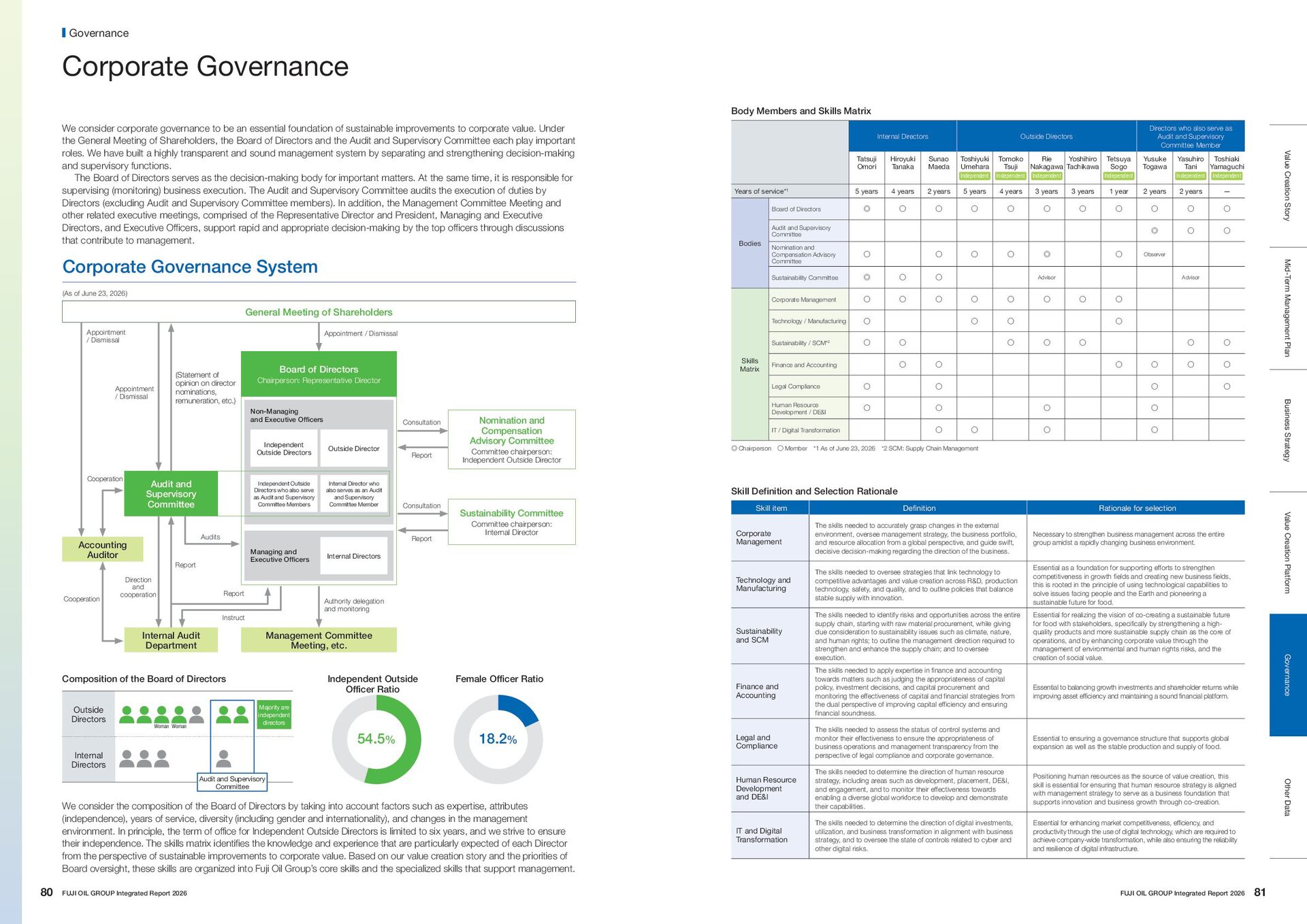
  4. Governance Corporate Governance Body Members and Skills Matrix Internal Directors

    Tatsuji Omori Years of service* 1 Board of Directors Bodies General Meeting of Shareholders Non-Managing and Executive Officers Cooperation Audit and Supervisory Committee Independent Outside Directors Outside Director Independent Outside Directors who also serve as Audit and Supervisory Committee Members Internal Director who also serves as an Audit and Supervisory Committee Member Report Nomination and Compensation Advisory Committee Committee chairperson: Independent Outside Director Woman Woman Sustainability Committee Committee chairperson: Internal Director Independent 4 years 3 years 3 years 1 year 2 years 2 years — ◎ 〇 〇 〇 〇 〇 〇 〇 〇 〇 〇 ◎ 〇 〇 〇 〇 Corporate Management 〇 〇 〇 Technology / Manufacturing 〇 Sustainability / SCM*2 〇 〇 〇 ◎ 〇 〇 〇 〇 〇 〇 Human Resource Development / DE&I 〇 〇 〇 Observer Advisor 〇 〇 〇 〇 〇 〇 〇 Advisor 〇 Legal Compliance IT / Digital Transformation 〇 〇 〇 Finance and Accounting ◎ Chairperson 〇 Member Independent 5 years ◎ Skill item 〇 〇 〇 〇 〇 〇 〇 〇 〇 〇 〇 〇 〇 〇 *1 As of June 23, 2026 *2 SCM: Supply Chain Management Management Committee Meeting, etc. Independent Outside Officer Ratio Female Officer Ratio 54.5% 18.2% Rationale for selection Necessary to strengthen business management across the entire group amidst a rapidly changing business environment. Technology and Manufacturing The skills needed to oversee strategies that link technology to competitive advantages and value creation across R&D, production technology, safety, and quality, and to outline policies that balance stable supply with innovation. Essential as a foundation for supporting efforts to strengthen competitiveness in growth fields and creating new business fields, this is rooted in the principle of using technological capabilities to solve issues facing people and the Earth and pioneering a sustainable future for food. Sustainability and SCM The skills needed to identify risks and opportunities across the entire supply chain, starting with raw material procurement, while giving due consideration to sustainability issues such as climate, nature, and human rights; to outline the management direction required to strengthen and enhance the supply chain; and to oversee execution. Essential for realizing the vision of co-creating a sustainable future for food with stakeholders, specifically by strengthening a highquality products and more sustainable supply chain as the core of operations, and by enhancing corporate value through the management of environmental and human rights risks, and the creation of social value. Finance and Accounting The skills needed to apply expertise in finance and accounting towards matters such as judging the appropriateness of capital policy, investment decisions, and capital procurement and monitoring the effectiveness of capital and financial strategies from the dual perspective of improving capital efficiency and ensuring financial soundness. Essential to balancing growth investments and shareholder returns while improving asset efficiency and maintaining a sound financial platform. Legal and Compliance The skills needed to assess the status of control systems and monitor their effectiveness to ensure the appropriateness of business operations and management transparency from the perspective of legal compliance and corporate governance. Essential to ensuring a governance structure that supports global expansion as well as the stable production and supply of food. Human Resource Development and DE&I The skills needed to determine the direction of human resource strategy, including areas such as development, placement, DE&I, and engagement, and to monitor their effectiveness towards enabling a diverse global workforce to develop and demonstrate their capabilities. Positioning human resources as the source of value creation, this skill is essential for ensuring that human resource strategy is aligned with management strategy to serve as a business foundation that supports innovation and business growth through co-creation. IT and Digital Transformation The skills needed to determine the direction of digital investments, utilization, and business transformation in alignment with business strategy, and to oversee the state of controls related to cyber and other digital risks. Essential for enhancing market competitiveness, efficiency, and productivity through the use of digital technology, which are required to achieve company-wide transformation, while also ensuring the reliability and resilience of digital infrastructure.  FUJI OIL GROUP Integrated Report 2026 Other Data The skills needed to accurately grasp changes in the external environment, oversee management strategy, the business portfolio, and resource allocation from a global perspective, and guide swift, decisive decision-making regarding the direction of the business. Majority are independent directors We consider the composition of the Board of Directors by taking into account factors such as expertise, attributes (independence), years of service, diversity (including gender and internationality), and changes in the management environment. In principle, the term of office for Independent Outside Directors is limited to six years, and we strive to ensure their independence. The skills matrix identifies the knowledge and experience that are particularly expected of each Director from the perspective of sustainable improvements to corporate value. Based on our value creation story and the priorities of Board oversight, these skills are organized into Fuji Oil Group’s core skills and the specialized skills that support management. Definition Corporate Management Internal Directors Audit and Supervisory Committee FUJI OIL GROUP Integrated Report 2026 Independent Skill Definition and Selection Rationale Consultation Internal Directors 80 Independent Governance Outside Directors Independent Yasuhiro Toshiaki Tani Yamaguchi 2 years Sustainability Committee Instruct Composition of the Board of Directors Independent Yusuke Togawa 4 years 〇 Authority delegation and monitoring Internal Audit Department Tetsuya Sogo Value Creation Platform Managing and Executive Officers Direction and cooperation Report Report Report Cooperation Consultation Audits Accounting Auditor Skills Matrix Chairperson: Representative Director Rie Yoshihiro Nakagawa Tachikawa Business Strategy Appointment / Dismissal Tomoko Tsuji 5 years Nomination and Compensation Advisory Committee Appointment / Dismissal Board of Directors Toshiyuki Umehara Mid-Term Management Plan (As of June 23, 2026) (Statement of opinion on director nominations, remuneration, etc.) Sunao Maeda Audit and Supervisory Committee Corporate Governance System Appointment / Dismissal Hiroyuki Tanaka Directors who also serve as Audit and Supervisory Committee Member Outside Directors Value Creation Story We consider corporate governance to be an essential foundation of sustainable improvements to corporate value. Under the General Meeting of Shareholders, the Board of Directors and the Audit and Supervisory Committee each play important roles. We have built a highly transparent and sound management system by separating and strengthening decision-making and supervisory functions. The Board of Directors serves as the decision-making body for important matters. At the same time, it is responsible for supervising (monitoring) business execution. The Audit and Supervisory Committee audits the execution of duties by Directors (excluding Audit and Supervisory Committee members). In addition, the Management Committee Meeting and other related executive meetings, comprised of the Representative Director and President, Managing and Executive Directors, and Executive Officers, support rapid and appropriate decision-making by the top officers through discussions that contribute to management. 81
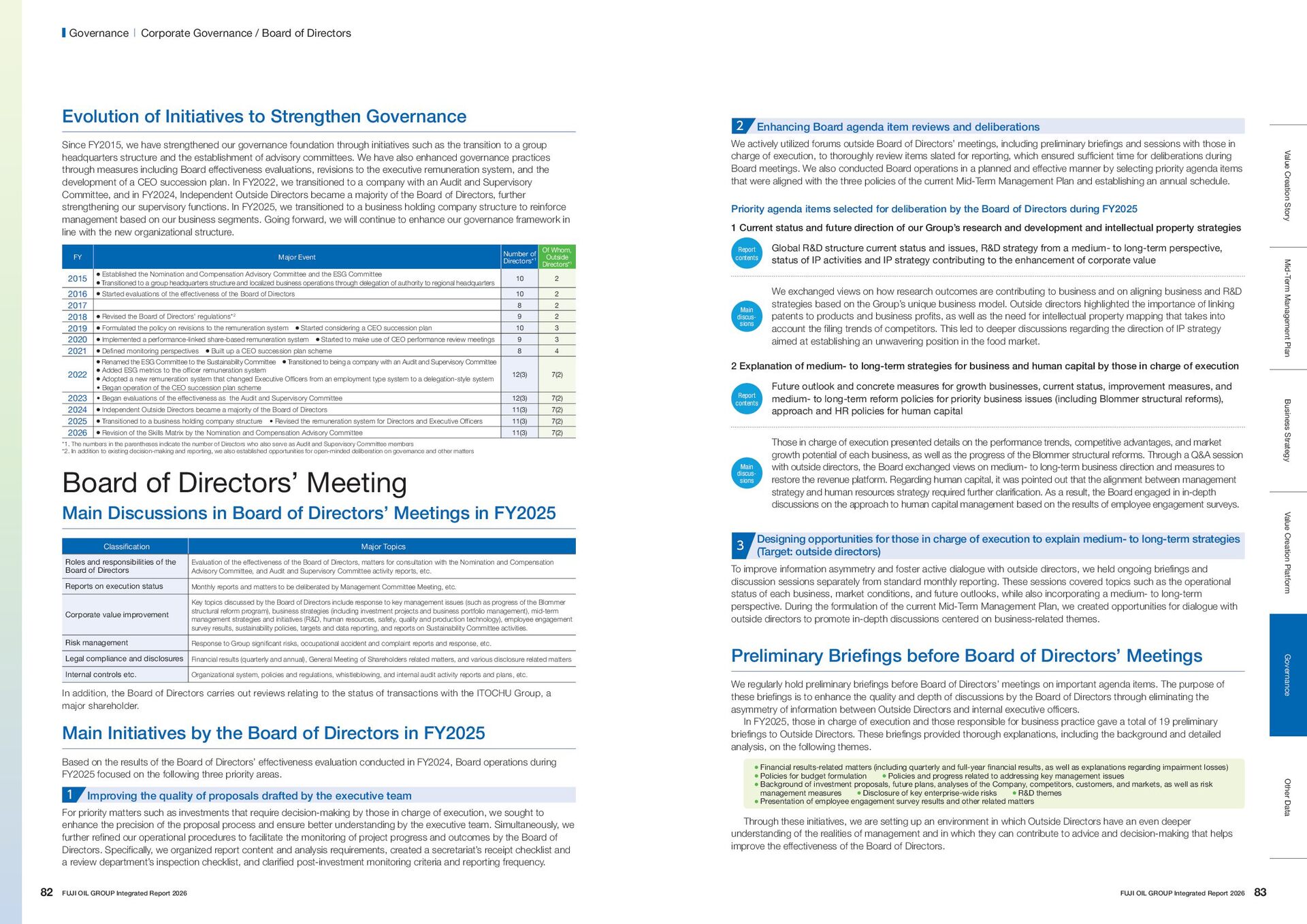
  5. Governance | Corporate Governance / Board of Directors Evolution of

    Initiatives to Strengthen Governance 2 Major Event 2015 • Established the Nomination and Compensation Advisory Committee and the ESG Committee • Transitioned to a group headquarters structure and localized business operations through delegation of authority to regional headquarters 10 • Started evaluations of the effectiveness of the Board of Directors 10 2 8 2 • Revised the Board of Directors’ regulations*2 9 2 • Formulated the policy on revisions to the remuneration system • Started considering a CEO succession plan 10 3 • Implemented a performance-linked share-based remuneration system • Started to make use of CEO performance review meetings 9 3 • Defined monitoring perspectives • Built up a CEO succession plan scheme 2016 2017 2018 2019 2020 2021 2022 1 Current status and future direction of our Group’s research and development and intellectual property strategies Report contents Global R&D structure current status and issues, R&D strategy from a medium- to long-term perspective, status of IP activities and IP strategy contributing to the enhancement of corporate value Main discus­ sions We exchanged views on how research outcomes are contributing to business and on aligning business and R&D strategies based on the Group’s unique business model. Outside directors highlighted the importance of linking patents to products and business profits, as well as the need for intellectual property mapping that takes into account the filing trends of competitors. This led to deeper discussions regarding the direction of IP strategy aimed at establishing an unwavering position in the food market. 2 8 4 • Renamed the ESG Committee to the Sustainability Committee • Transitioned to being a company with an Audit and Supervisory Committee • Added ESG metrics to the officer remuneration system •A  dopted a new remuneration system that changed Executive Officers from an employment type system to a delegation-style system •B  egan operation of the CEO succession plan scheme 12(3) 7(2) • Began evaluations of the effectiveness as the Audit and Supervisory Committee 12(3) 7(2) • Independent Outside Directors became a majority of the Board of Directors 11(3) 7(2) • Transitioned to a business holding company structure • Revised the remuneration system for Directors and Executive Officers 11(3) 7(2) • Revision of the Skills Matrix by the Nomination and Compensation Advisory Committee 11(3) 7(2) 2 Explanation of medium- to long-term strategies for business and human capital by those in charge of execution Report contents Future outlook and concrete measures for growth businesses, current status, improvement measures, and medium- to long-term reform policies for priority business issues (including Blommer structural reforms), approach and HR policies for human capital Main discus­ sions Those in charge of execution presented details on the performance trends, competitive advantages, and market growth potential of each business, as well as the progress of the Blommer structural reforms. Through a Q&A session with outside directors, the Board exchanged views on medium- to long-term business direction and measures to restore the revenue platform. Regarding human capital, it was pointed out that the alignment between management strategy and human resources strategy required further clarification. As a result, the Board engaged in in-depth discussions on the approach to human capital management based on the results of employee engagement surveys. *1. The numbers in the parentheses indicate the number of Directors who also serve as Audit and Supervisory Committee members *2. In addition to existing decision-making and reporting, we also established opportunities for open-minded deliberation on governance and other matters Board of Directors’ Meeting Classification Major Topics Evaluation of the effectiveness of the Board of Directors, matters for consultation with the Nomination and Compensation Advisory Committee, and Audit and Supervisory Committee activity reports, etc. Reports on execution status Monthly reports and matters to be deliberated by Management Committee Meeting, etc. Corporate value improvement Key topics discussed by the Board of Directors include response to key management issues (such as progress of the Blommer structural reform program), business strategies (including investment projects and business portfolio management), mid-term management strategies and initiatives (R&D, human resources, safety, quality and production technology), employee engagement survey results, sustainability policies, targets and data reporting, and reports on Sustainability Committee activities. Risk management Response to Group significant risks, occupational accident and complaint reports and response, etc. Legal compliance and disclosures Financial results (quarterly and annual), General Meeting of Shareholders related matters, and various disclosure related matters Internal controls etc. Organizational system, policies and regulations, whistleblowing, and internal audit activity reports and plans, etc. In addition, the Board of Directors carries out reviews relating to the status of transactions with the ITOCHU Group, a major shareholder. Main Initiatives by the Board of Directors in FY2025 1 Improving the quality of proposals drafted by the executive team For priority matters such as investments that require decision-making by those in charge of execution, we sought to enhance the precision of the proposal process and ensure better understanding by the executive team. Simultaneously, we further refined our operational procedures to facilitate the monitoring of project progress and outcomes by the Board of Directors. Specifically, we organized report content and analysis requirements, created a secretariat’s receipt checklist and a review department’s inspection checklist, and clarified post-investment monitoring criteria and reporting frequency. 82 FUJI OIL GROUP Integrated Report 2026 To improve information asymmetry and foster active dialogue with outside directors, we held ongoing briefings and discussion sessions separately from standard monthly reporting. These sessions covered topics such as the operational status of each business, market conditions, and future outlooks, while also incorporating a medium- to long-term perspective. During the formulation of the current Mid-Term Management Plan, we created opportunities for dialogue with outside directors to promote in-depth discussions centered on business-related themes. Preliminary Briefings before Board of Directors’ Meetings We regularly hold preliminary briefings before Board of Directors’ meetings on important agenda items. The purpose of these briefings is to enhance the quality and depth of discussions by the Board of Directors through eliminating the asymmetry of information between Outside Directors and internal executive officers. In FY2025, those in charge of execution and those responsible for business practice gave a total of 19 preliminary briefings to Outside Directors. These briefings provided thorough explanations, including the background and detailed analysis, on the following themes. • Financial results-related matters (including quarterly and full-year financial results, as well as explanations regarding impairment losses) • Policies for budget formulation   • Policies and progress related to addressing key management issues • Background of investment proposals, future plans, analyses of the Company, competitors, customers, and markets, as well as risk management measures   • Disclosure of key enterprise-wide risks   • R&D themes • Presentation of employee engagement survey results and other related matters Other Data Based on the results of the Board of Directors’ effectiveness evaluation conducted in FY2024, Board operations during FY2025 focused on the following three priority areas. Designing opportunities for those in charge of execution to explain medium- to long-term strategies (Target: outside directors) Governance Roles and responsibilities of the Board of Directors 3 Value Creation Platform Main Discussions in Board of Directors’ Meetings in FY2025 Business Strategy 2023 2024 2025 2026 Priority agenda items selected for deliberation by the Board of Directors during FY2025 Mid-Term Management Plan Of Whom, Number of Outside Directors*1 Directors*1 FY We actively utilized forums outside Board of Directors’ meetings, including preliminary briefings and sessions with those in charge of execution, to thoroughly review items slated for reporting, which ensured sufficient time for deliberations during Board meetings. We also conducted Board operations in a planned and effective manner by selecting priority agenda items that were aligned with the three policies of the current Mid-Term Management Plan and establishing an annual schedule. Value Creation Story Since FY2015, we have strengthened our governance foundation through initiatives such as the transition to a group headquarters structure and the establishment of advisory committees. We have also enhanced governance practices through measures including Board effectiveness evaluations, revisions to the executive remuneration system, and the development of a CEO succession plan. In FY2022, we transitioned to a company with an Audit and Supervisory Committee, and in FY2024, Independent Outside Directors became a majority of the Board of Directors, further strengthening our supervisory functions. In FY2025, we transitioned to a business holding company structure to reinforce management based on our business segments. Going forward, we will continue to enhance our governance framework in line with the new organizational structure. Enhancing Board agenda item reviews and deliberations Through these initiatives, we are setting up an environment in which Outside Directors have an even deeper understanding of the realities of management and in which they can contribute to advice and decision-making that helps improve the effectiveness of the Board of Directors.  FUJI OIL GROUP Integrated Report 2026 83
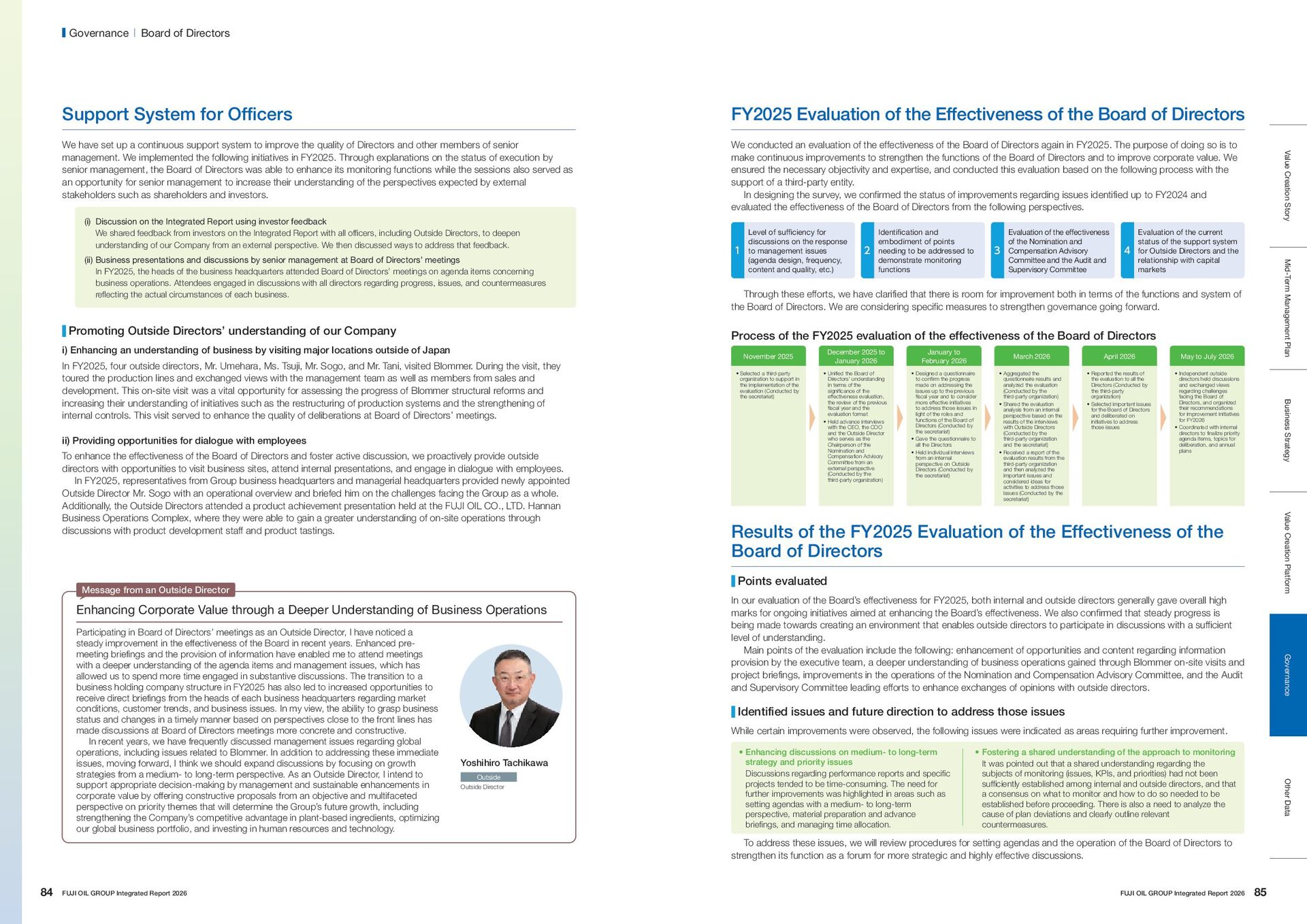
  6. Governance | Board of Directors FY2025 Evaluation of the Effectiveness

    of the Board of Directors We have set up a continuous support system to improve the quality of Directors and other members of senior management. We implemented the following initiatives in FY2025. Through explanations on the status of execution by senior management, the Board of Directors was able to enhance its monitoring functions while the sessions also served as an opportunity for senior management to increase their understanding of the perspectives expected by external stakeholders such as shareholders and investors. We conducted an evaluation of the effectiveness of the Board of Directors again in FY2025. The purpose of doing so is to make continuous improvements to strengthen the functions of the Board of Directors and to improve corporate value. We ensured the necessary objectivity and expertise, and conducted this evaluation based on the following process with the support of a third-party entity. In designing the survey, we confirmed the status of improvements regarding issues identified up to FY2024 and evaluated the effectiveness of the Board of Directors from the following perspectives. (i) Discussion on the Integrated Report using investor feedback We shared feedback from investors on the Integrated Report with all officers, including Outside Directors, to deepen understanding of our Company from an external perspective. We then discussed ways to address that feedback. Promoting Outside Directors’ understanding of our Company 2 3 Evaluation of the effectiveness of the Nomination and Compensation Advisory Committee and the Audit and Supervisory Committee 4 Evaluation of the current status of the support system for Outside Directors and the relationship with capital markets Through these efforts, we have clarified that there is room for improvement both in terms of the functions and system of the Board of Directors. We are considering specific measures to strengthen governance going forward. Process of the FY2025 evaluation of the effectiveness of the Board of Directors i) Enhancing an understanding of business by visiting major locations outside of Japan ii) Providing opportunities for dialogue with employees • Selected a third-party organization to support in the implementation of the evaluation (Conducted by the secretariat) December 2025 to January 2026 January to February 2026 • Unified the Board of Directors’ understanding in terms of the significance of the effectiveness evaluation, the review of the previous fiscal year and the evaluation format • Held advance interviews with the CEO, the COO and the Outside Director who serves as the Chairperson of the Nomination and Compensation Advisory Committee from an external perspective (Conducted by the third-party organization) • Designed a questionnaire to confirm the progress made on addressing the issues up to the previous fiscal year and to consider more effective initiatives to address those issues in light of the roles and functions of the Board of Directors (Conducted by the secretariat) • Gave the questionnaire to all the Directors • Held individual interviews from an internal perspective on Outside Directors (Conducted by the secretariat) March 2026 April 2026 May to July 2026 • Aggregated the questionnaire results and analyzed the evaluation (Conducted by the third-party organization) • Shared the evaluation analysis from an internal perspective based on the results of the interviews with Outside Directors (Conducted by the third-party organization and the secretariat) • Received a report of the evaluation results from the third-party organization and then analyzed the important issues and considered ideas for activities to address those issues (Conducted by the secretariat) • Reported the results of the evaluation to all the Directors (Conducted by the third-party organization) • Selected important issues for the Board of Directors and deliberated on initiatives to address those issues • Independent outside directors held discussions and exchanged views regarding challenges facing the Board of Directors, and organized their recommendations for improvement initiatives for FY2026 • Coordinated with internal directors to finalize priority agenda items, topics for deliberation, and annual plans Value Creation Platform To enhance the effectiveness of the Board of Directors and foster active discussion, we proactively provide outside directors with opportunities to visit business sites, attend internal presentations, and engage in dialogue with employees. In FY2025, representatives from Group business headquarters and managerial headquarters provided newly appointed Outside Director Mr. Sogo with an operational overview and briefed him on the challenges facing the Group as a whole. Additionally, the Outside Directors attended a product achievement presentation held at the FUJI OIL CO., LTD. Hannan Business Operations Complex, where they were able to gain a greater understanding of on-site operations through discussions with product development staff and product tastings. November 2025 Business Strategy In FY2025, four outside directors, Mr. Umehara, Ms. Tsuji, Mr. Sogo, and Mr. Tani, visited Blommer. During the visit, they toured the production lines and exchanged views with the management team as well as members from sales and development. This on-site visit was a vital opportunity for assessing the progress of Blommer structural reforms and increasing their understanding of initiatives such as the restructuring of production systems and the strengthening of internal controls. This visit served to enhance the quality of deliberations at Board of Directors’ meetings. Results of the FY2025 Evaluation of the Effectiveness of the Board of Directors Points evaluated Message from an Outside Director Enhancing Corporate Value through a Deeper Understanding of Business Operations In our evaluation of the Board’s effectiveness for FY2025, both internal and outside directors generally gave overall high marks for ongoing initiatives aimed at enhancing the Board’s effectiveness. We also confirmed that steady progress is being made towards creating an environment that enables outside directors to participate in discussions with a sufficient level of understanding. Main points of the evaluation include the following: enhancement of opportunities and content regarding information provision by the executive team, a deeper understanding of business operations gained through Blommer on-site visits and project briefings, improvements in the operations of the Nomination and Compensation Advisory Committee, and the Audit and Supervisory Committee leading efforts to enhance exchanges of opinions with outside directors. Governance Identified issues and future direction to address those issues While certain improvements were observed, the following issues were indicated as areas requiring further improvement. Yoshihiro Tachikawa Outside Outside Director • Enhancing discussions on medium- to long-term strategy and priority issues Discussions regarding performance reports and specific projects tended to be time-consuming. The need for further improvements was highlighted in areas such as setting agendas with a medium- to long-term perspective, material preparation and advance briefings, and managing time allocation. • Fostering a shared understanding of the approach to monitoring It was pointed out that a shared understanding regarding the subjects of monitoring (issues, KPIs, and priorities) had not been sufficiently established among internal and outside directors, and that a consensus on what to monitor and how to do so needed to be established before proceeding. There is also a need to analyze the cause of plan deviations and clearly outline relevant countermeasures. Other Data Participating in Board of Directors’ meetings as an Outside Director, I have noticed a steady improvement in the effectiveness of the Board in recent years. Enhanced premeeting briefings and the provision of information have enabled me to attend meetings with a deeper understanding of the agenda items and management issues, which has allowed us to spend more time engaged in substantive discussions. The transition to a business holding company structure in FY2025 has also led to increased opportunities to receive direct briefings from the heads of each business headquarters regarding market conditions, customer trends, and business issues. In my view, the ability to grasp business status and changes in a timely manner based on perspectives close to the front lines has made discussions at Board of Directors meetings more concrete and constructive. In recent years, we have frequently discussed management issues regarding global operations, including issues related to Blommer. In addition to addressing these immediate issues, moving forward, I think we should expand discussions by focusing on growth strategies from a medium- to long-term perspective. As an Outside Director, I intend to support appropriate decision-making by management and sustainable enhancements in corporate value by offering constructive proposals from an objective and multifaceted perspective on priority themes that will determine the Group’s future growth, including strengthening the Company’s competitive advantage in plant-based ingredients, optimizing our global business portfolio, and investing in human resources and technology. 1 Identification and embodiment of points needing to be addressed to demonstrate monitoring functions Mid-Term Management Plan (ii) Business presentations and discussions by senior management at Board of Directors’ meetings In FY2025, the heads of the business headquarters attended Board of Directors’ meetings on agenda items concerning business operations. Attendees engaged in discussions with all directors regarding progress, issues, and countermeasures reflecting the actual circumstances of each business. Level of sufficiency for discussions on the response to management issues (agenda design, frequency, content and quality, etc.) Value Creation Story Support System for Officers To address these issues, we will review procedures for setting agendas and the operation of the Board of Directors to strengthen its function as a forum for more strategic and highly effective discussions. 84 FUJI OIL GROUP Integrated Report 2026  FUJI OIL GROUP Integrated Report 2026 85
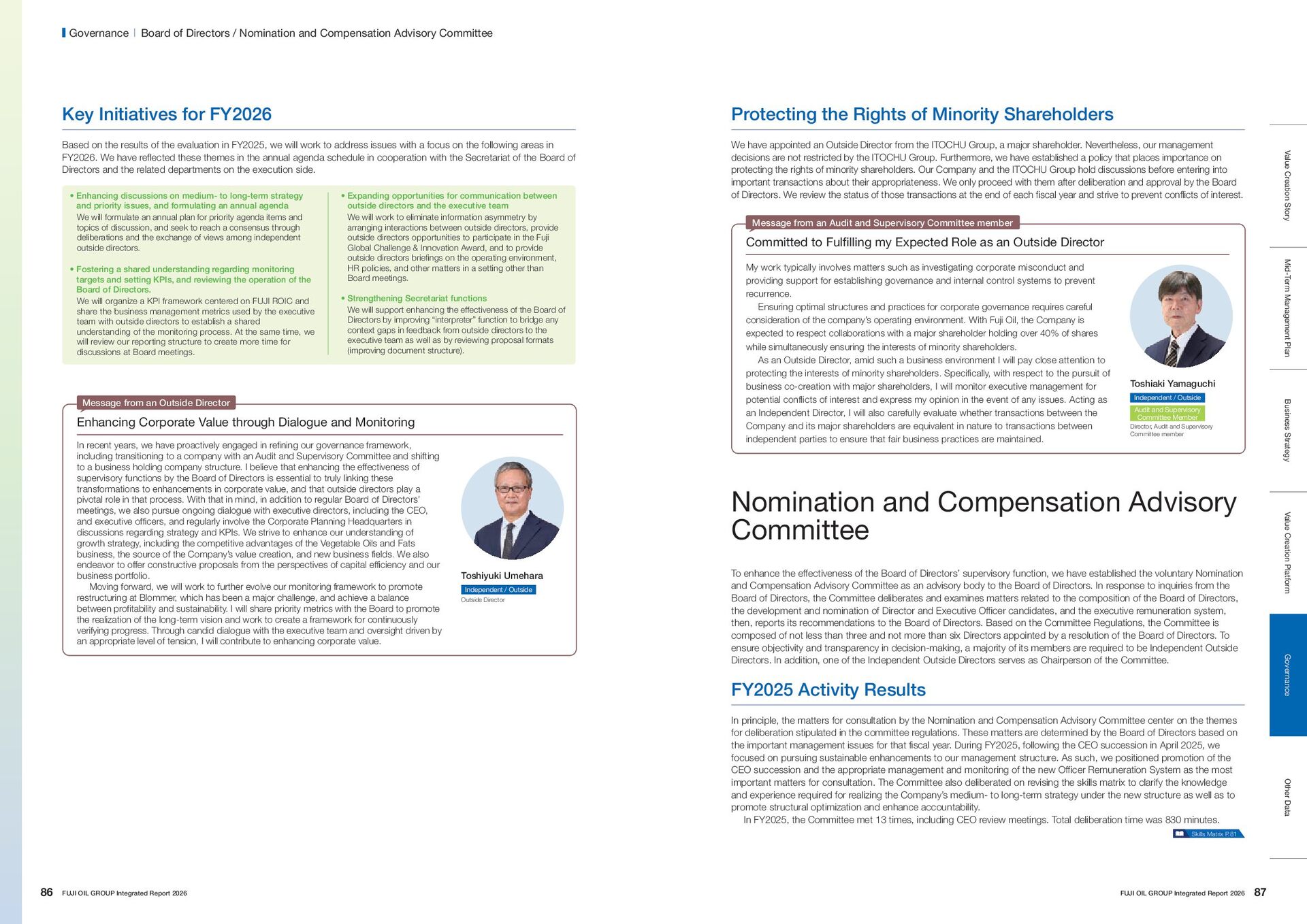
  7. Governance | Board of Directors / Nomination and Compensation Advisory

    Committee Protecting the Rights of Minority Shareholders Based on the results of the evaluation in FY2025, we will work to address issues with a focus on the following areas in FY2026. We have reflected these themes in the annual agenda schedule in cooperation with the Secretariat of the Board of Directors and the related departments on the execution side. We have appointed an Outside Director from the ITOCHU Group, a major shareholder. Nevertheless, our management decisions are not restricted by the ITOCHU Group. Furthermore, we have established a policy that places importance on protecting the rights of minority shareholders. Our Company and the ITOCHU Group hold discussions before entering into important transactions about their appropriateness. We only proceed with them after deliberation and approval by the Board of Directors. We review the status of those transactions at the end of each fiscal year and strive to prevent conflicts of interest. • Enhancing discussions on medium- to long-term strategy and priority issues, and formulating an annual agenda We will formulate an annual plan for priority agenda items and topics of discussion, and seek to reach a consensus through deliberations and the exchange of views among independent outside directors. • Strengthening Secretariat functions We will support enhancing the effectiveness of the Board of Directors by improving “interpreter” function to bridge any context gaps in feedback from outside directors to the executive team as well as by reviewing proposal formats (improving document structure). Enhancing Corporate Value through Dialogue and Monitoring My work typically involves matters such as investigating corporate misconduct and providing support for establishing governance and internal control systems to prevent recurrence. Ensuring optimal structures and practices for corporate governance requires careful consideration of the company’s operating environment. With Fuji Oil, the Company is expected to respect collaborations with a major shareholder holding over 40% of shares while simultaneously ensuring the interests of minority shareholders. As an Outside Director, amid such a business environment I will pay close attention to protecting the interests of minority shareholders. Specifically, with respect to the pursuit of business co-creation with major shareholders, I will monitor executive management for potential conflicts of interest and express my opinion in the event of any issues. Acting as an Independent Director, I will also carefully evaluate whether transactions between the Company and its major shareholders are equivalent in nature to transactions between independent parties to ensure that fair business practices are maintained. Toshiaki Yamaguchi Independent / Outside Audit and Supervisory Committee Member Director, Audit and Supervisory Committee member Nomination and Compensation Advisory Committee Toshiyuki Umehara Independent / Outside Outside Director Value Creation Platform In recent years, we have proactively engaged in refining our governance framework, including transitioning to a company with an Audit and Supervisory Committee and shifting to a business holding company structure. I believe that enhancing the effectiveness of supervisory functions by the Board of Directors is essential to truly linking these transformations to enhancements in corporate value, and that outside directors play a pivotal role in that process. With that in mind, in addition to regular Board of Directors’ meetings, we also pursue ongoing dialogue with executive directors, including the CEO, and executive officers, and regularly involve the Corporate Planning Headquarters in discussions regarding strategy and KPIs. We strive to enhance our understanding of growth strategy, including the competitive advantages of the Vegetable Oils and Fats business, the source of the Company’s value creation, and new business fields. We also endeavor to offer constructive proposals from the perspectives of capital efficiency and our business portfolio. Moving forward, we will work to further evolve our monitoring framework to promote restructuring at Blommer, which has been a major challenge, and achieve a balance between profitability and sustainability. I will share priority metrics with the Board to promote the realization of the long-term vision and work to create a framework for continuously verifying progress. Through candid dialogue with the executive team and oversight driven by an appropriate level of tension, I will contribute to enhancing corporate value. Committed to Fulfilling my Expected Role as an Outside Director Business Strategy Message from an Outside Director Message from an Audit and Supervisory Committee member Mid-Term Management Plan • Fostering a shared understanding regarding monitoring targets and setting KPIs, and reviewing the operation of the Board of Directors. We will organize a KPI framework centered on FUJI ROIC and share the business management metrics used by the executive team with outside directors to establish a shared understanding of the monitoring process. At the same time, we will review our reporting structure to create more time for discussions at Board meetings. • Expanding opportunities for communication between outside directors and the executive team We will work to eliminate information asymmetry by arranging interactions between outside directors, provide outside directors opportunities to participate in the Fuji Global Challenge & Innovation Award, and to provide outside directors briefings on the operating environment, HR policies, and other matters in a setting other than Board meetings. Value Creation Story Key Initiatives for FY2026 Governance To enhance the effectiveness of the Board of Directors’ supervisory function, we have established the voluntary Nomination and Compensation Advisory Committee as an advisory body to the Board of Directors. In response to inquiries from the Board of Directors, the Committee deliberates and examines matters related to the composition of the Board of Directors, the development and nomination of Director and Executive Officer candidates, and the executive remuneration system, then, reports its recommendations to the Board of Directors. Based on the Committee Regulations, the Committee is composed of not less than three and not more than six Directors appointed by a resolution of the Board of Directors. To ensure objectivity and transparency in decision-making, a majority of its members are required to be Independent Outside Directors. In addition, one of the Independent Outside Directors serves as Chairperson of the Committee. FY2025 Activity Results Other Data In principle, the matters for consultation by the Nomination and Compensation Advisory Committee center on the themes for deliberation stipulated in the committee regulations. These matters are determined by the Board of Directors based on the important management issues for that fiscal year. During FY2025, following the CEO succession in April 2025, we focused on pursuing sustainable enhancements to our management structure. As such, we positioned promotion of the CEO succession and the appropriate management and monitoring of the new Officer Remuneration System as the most important matters for consultation. The Committee also deliberated on revising the skills matrix to clarify the knowledge and experience required for realizing the Company’s medium- to long-term strategy under the new structure as well as to promote structural optimization and enhance accountability. In FY2025, the Committee met 13 times, including CEO review meetings. Total deliberation time was 830 minutes. Skills Matrix P.81 86 FUJI OIL GROUP Integrated Report 2026  FUJI OIL GROUP Integrated Report 2026 87
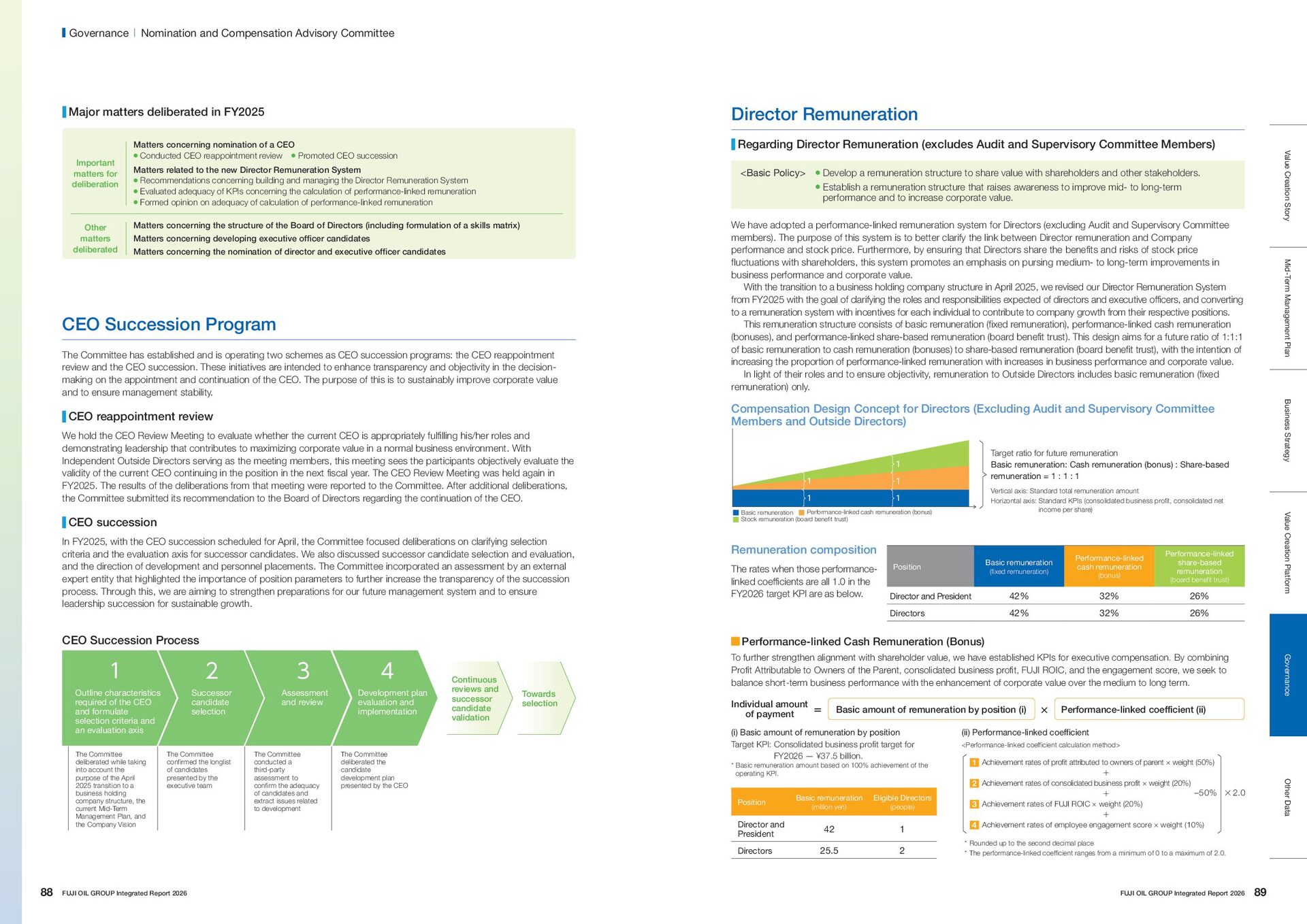
  8. Governance | Nomination and Compensation Advisory Committee Director Remuneration Major

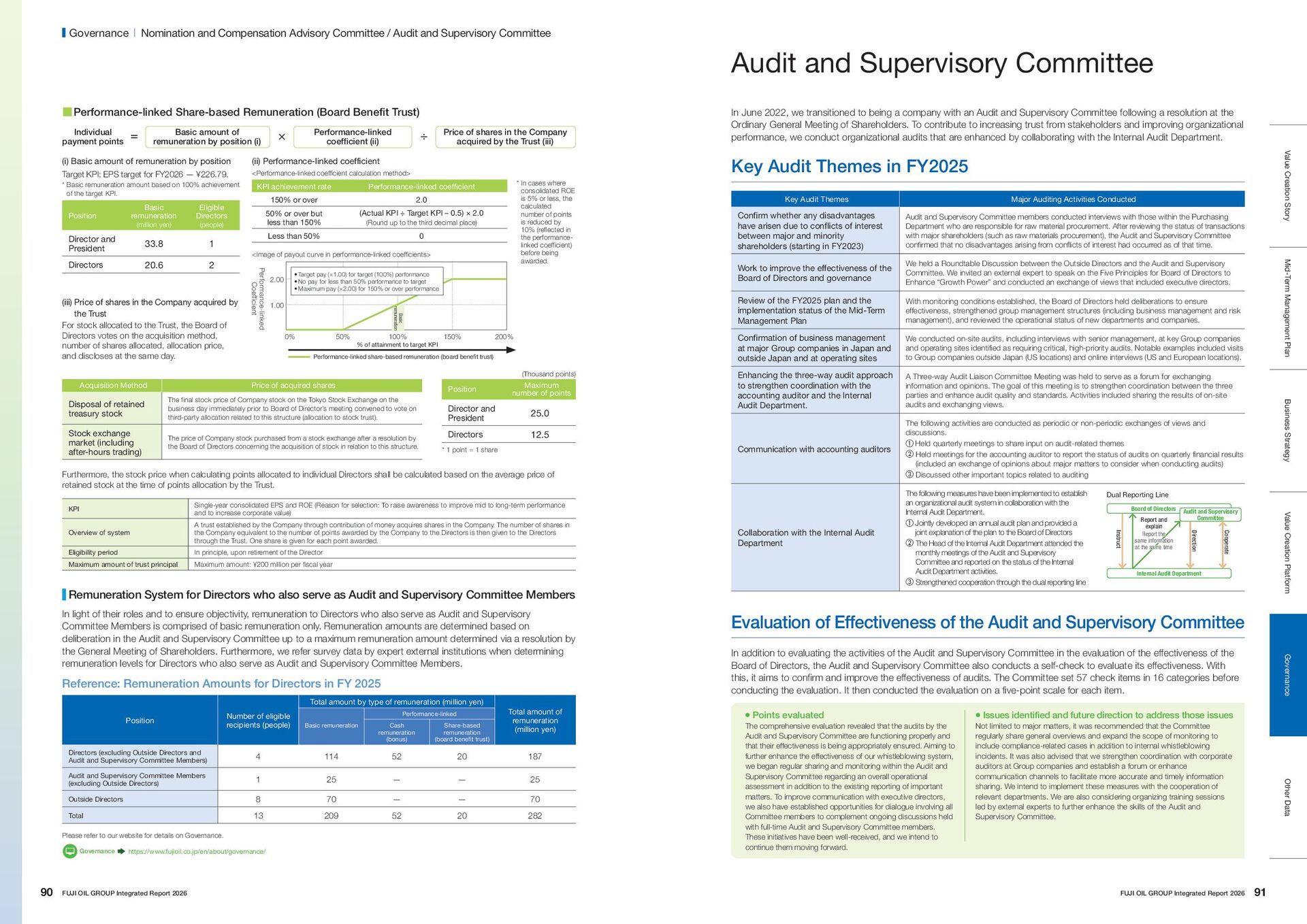
    matters deliberated in FY2025 Other matters deliberated Regarding Director Remuneration (excludes Audit and Supervisory Committee Members) Matters related to the new Director Remuneration System • Recommendations concerning building and managing the Director Remuneration System • Evaluated adequacy of KPIs concerning the calculation of performance-linked remuneration • Formed opinion on adequacy of calculation of performance-linked remuneration <Basic Policy> Matters concerning the structure of the Board of Directors (including formulation of a skills matrix) Matters concerning developing executive officer candidates Matters concerning the nomination of director and executive officer candidates The Committee has established and is operating two schemes as CEO succession programs: the CEO reappointment review and the CEO succession. These initiatives are intended to enhance transparency and objectivity in the decisionmaking on the appointment and continuation of the CEO. The purpose of this is to sustainably improve corporate value and to ensure management stability. We have adopted a performance-linked remuneration system for Directors (excluding Audit and Supervisory Committee members). The purpose of this system is to better clarify the link between Director remuneration and Company performance and stock price. Furthermore, by ensuring that Directors share the benefits and risks of stock price fluctuations with shareholders, this system promotes an emphasis on pursing medium- to long-term improvements in business performance and corporate value. With the transition to a business holding company structure in April 2025, we revised our Director Remuneration System from FY2025 with the goal of clarifying the roles and responsibilities expected of directors and executive officers, and converting to a remuneration system with incentives for each individual to contribute to company growth from their respective positions. This remuneration structure consists of basic remuneration (fixed remuneration), performance-linked cash remuneration (bonuses), and performance-linked share-based remuneration (board benefit trust). This design aims for a future ratio of 1:1:1 of basic remuneration to cash remuneration (bonuses) to share-based remuneration (board benefit trust), with the intention of increasing the proportion of performance-linked remuneration with increases in business performance and corporate value. In light of their roles and to ensure objectivity, remuneration to Outside Directors includes basic remuneration (fixed remuneration) only. We hold the CEO Review Meeting to evaluate whether the current CEO is appropriately fulfilling his/her roles and demonstrating leadership that contributes to maximizing corporate value in a normal business environment. With Independent Outside Directors serving as the meeting members, this meeting sees the participants objectively evaluate the validity of the current CEO continuing in the position in the next fiscal year. The CEO Review Meeting was held again in FY2025. The results of the deliberations from that meeting were reported to the Committee. After additional deliberations, the Committee submitted its recommendation to the Board of Directors regarding the continuation of the CEO. Target ratio for future remuneration Basic remuneration: Cash remuneration (bonus) : Share-based remuneration = 1 : 1 : 1 1 1 1 1 1 In FY2025, with the CEO succession scheduled for April, the Committee focused deliberations on clarifying selection criteria and the evaluation axis for successor candidates. We also discussed successor candidate selection and evaluation, and the direction of development and personnel placements. The Committee incorporated an assessment by an external expert entity that highlighted the importance of position parameters to further increase the transparency of the succession process. Through this, we are aiming to strengthen preparations for our future management system and to ensure leadership succession for sustainable growth. CEO Succession Process The rates when those performancelinked coefficients are all 1.0 in the FY2026 target KPI are as below. Basic remuneration Position (fixed remuneration) Performance-linked cash remuneration (bonus) Performance-linked share-based remuneration (board benefit trust) Director and President 42% 32% 26% Directors 42% 32% 26% ▪ Performance-linked Cash Remuneration (Bonus) 2 3 4 Outline characteristics required of the CEO and formulate selection criteria and an evaluation axis Successor candidate selection Assessment and review Development plan evaluation and implementation The Committee conducted a third-party assessment to confirm the adequacy of candidates and extract issues related to development The Committee deliberated the candidate development plan presented by the CEO Towards selection Individual amount = of payment Basic amount of remuneration by position (i) (i) Basic amount of remuneration by position Target KPI: Consolidated business profit target for FY2026 — ¥37.5 billion. * Basic remuneration amount based on 100% achievement of the operating KPI. × Performance-linked coefficient (ii) (ii) Performance-linked coefficient <Performance-linked coefficient calculation method> 1 Achievement rates of profit attributed to owners of parent × weight (50%) + 2 Achievement rates of consolidated business profit × weight (20%) Basic remuneration Eligible Directors (million yen) (people) Director and President 42 1 Directors 25.5 2 Position + Other Data The Committee confirmed the longlist of candidates presented by the executive team Continuous reviews and successor candidate validation To further strengthen alignment with shareholder value, we have established KPIs for executive compensation. By combining Profit Attributable to Owners of the Parent, consolidated business profit, FUJI ROIC, and the engagement score, we seek to balance short-term business performance with the enhancement of corporate value over the medium to long term. Governance 1 FUJI OIL GROUP Integrated Report 2026 Remuneration composition Value Creation Platform Vertical axis: Standard total remuneration amount Horizontal axis: Standard KPIs (consolidated business profit, consolidated net income per share) Performance-linked cash remuneration (bonus) Basic remuneration Stock remuneration (board benefit trust) CEO succession 88 Business Strategy Compensation Design Concept for Directors (Excluding Audit and Supervisory Committee Members and Outside Directors) CEO reappointment review The Committee deliberated while taking into account the purpose of the April 2025 transition to a business holding company structure, the current Mid-Term Management Plan, and the Company Vision • Develop a remuneration structure to share value with shareholders and other stakeholders. • Establish a remuneration structure that raises awareness to improve mid- to long-term performance and to increase corporate value. Mid-Term Management Plan CEO Succession Program Value Creation Story Important matters for deliberation Matters concerning nomination of a CEO • Conducted CEO reappointment review • Promoted CEO succession –50% ×2.0 3 Achievement rates of FUJI ROIC × weight (20%) + 4 Achievement rates of employee engagement score × weight (10%) * Rounded up to the second decimal place * The performance-linked coefficient ranges from a minimum of 0 to a maximum of 2.0.  FUJI OIL GROUP Integrated Report 2026 89
  9. Governance | Nomination and Compensation Advisory Committee / Audit and

    Supervisory Committee Audit and Supervisory Committee ▪ Performance-linked Share-based Remuneration (Board Benefit Trust) Individual payment points = Basic amount of remuneration by position (i) Performance-linked coefficient (ii) × (ii) Performance-linked coefficient Target KPI: EPS target for FY2026 — ¥226.79. <Performance-linked coefficient calculation method> Position Basic remuneration Eligible Directors (million yen) (people) 33.8 1 Directors 20.6 2 Key Audit Themes in FY2025 * In cases where consolidated ROE is 5% or less, the calculated number of points is reduced by 10% (reflected in the performancelinked coefficient) before being awarded. Performance-linked coefficient 150% or over 2.0 50% or over but less than 150% (Actual KPI ÷ Target KPI – 0.5) × 2.0 Less than 50% 0 (Round up to the third decimal place) <Image of payout curve in performance-linked coefficients> 2.00 1.00 Basic remuneration Performance-linked Coefficient (iii) P  rice of shares in the Company acquired by the Trust For stock allocated to the Trust, the Board of Directors votes on the acquisition method, number of shares allocated, allocation price, and discloses at the same day. • Target pay (×1.00) for target (100%) performance • No pay for less than 50% performance to target • Maximum pay (×2.00) for 150% or over performance 0% 50% 100% 150% 200% % of attainment to target KPI Performance-linked share-based remuneration (board benefit trust) (Thousand points) Acquisition Method Stock exchange market (including after-hours trading) Position The final stock price of Company stock on the Tokyo Stock Exchange on the business day immediately prior to Board of Director’s meeting convened to vote on third-party allocation related to this structure (allocation to stock trust). The price of Company stock purchased from a stock exchange after a resolution by the Board of Directors concerning the acquisition of stock in relation to this structure. Maximum number of points Director and President 25.0 Directors 12.5 * 1 point = 1 share Work to improve the effectiveness of the Board of Directors and governance We held a Roundtable Discussion between the Outside Directors and the Audit and Supervisory Committee. We invited an external expert to speak on the Five Principles for Board of Directors to Enhance “Growth Power” and conducted an exchange of views that included executive directors. Review of the FY2025 plan and the implementation status of the Mid-Term Management Plan With monitoring conditions established, the Board of Directors held deliberations to ensure effectiveness, strengthened group management structures (including business management and risk management), and reviewed the operational status of new departments and companies. Confirmation of business management at major Group companies in Japan and outside Japan and at operating sites We conducted on-site audits, including interviews with senior management, at key Group companies and operating sites identified as requiring critical, high-priority audits. Notable examples included visits to Group companies outside Japan (US locations) and online interviews (US and European locations). Enhancing the three-way audit approach to strengthen coordination with the accounting auditor and the Internal Audit Department. A Three-way Audit Liaison Committee Meeting was held to serve as a forum for exchanging information and opinions. The goal of this meeting is to strengthen coordination between the three parties and enhance audit quality and standards. Activities included sharing the results of on-site audits and exchanging views. Communication with accounting auditors The following activities are conducted as periodic or non-periodic exchanges of views and discussions. ① Held quarterly meetings to share input on audit-related themes ② Held meetings for the accounting auditor to report the status of audits on quarterly financial results (included an exchange of opinions about major matters to consider when conducting audits) ③ Discussed other important topics related to auditing Collaboration with the Internal Audit Department The following measures have been implemented to establish an organizational audit system in collaboration with the Internal Audit Department. ① Jointly developed an annual audit plan and provided a joint explanation of the plan to the Board of Directors ② The Head of the Internal Audit Department attended the monthly meetings of the Audit and Supervisory Committee and reported on the status of the Internal Audit Department activities. ③ Strengthened cooperation through the dual reporting line Furthermore, the stock price when calculating points allocated to individual Directors shall be calculated based on the average price of retained stock at the time of points allocation by the Trust. In principle, upon retirement of the Director Maximum amount of trust principal Maximum amount: ¥200 million per fiscal year Audit and Supervisory Committee Cooperate Eligibility period Report and explain Report the same information at the same time Direction A trust established by the Company through contribution of money acquires shares in the Company. The number of shares in the Company equivalent to the number of points awarded by the Company to the Directors is then given to the Directors through the Trust. One share is given for each point awarded. Board of Directors Instruct Overview of system Dual Reporting Line Value Creation Platform Single-year consolidated EPS and ROE (Reason for selection: To raise awareness to improve mid to long-term performance and to increase corporate value) KPI Major Auditing Activities Conducted Audit and Supervisory Committee members conducted interviews with those within the Purchasing Department who are responsible for raw material procurement. After reviewing the status of transactions with major shareholders (such as raw materials procurement), the Audit and Supervisory Committee confirmed that no disadvantages arising from conflicts of interest had occurred as of that time. Business Strategy Disposal of retained treasury stock Price of acquired shares Key Audit Themes Confirm whether any disadvantages have arisen due to conflicts of interest between major and minority shareholders (starting in FY2023) Mid-Term Management Plan Director and President KPI achievement rate Value Creation Story (i) Basic amount of remuneration by position * Basic remuneration amount based on 100% achievement of the target KPI. Price of shares in the Company acquired by the Trust (iii) ÷ In June 2022, we transitioned to being a company with an Audit and Supervisory Committee following a resolution at the Ordinary General Meeting of Shareholders. To contribute to increasing trust from stakeholders and improving organizational performance, we conduct organizational audits that are enhanced by collaborating with the Internal Audit Department. Internal Audit Department Remuneration System for Directors who also serve as Audit and Supervisory Committee Members Reference: Remuneration Amounts for Directors in FY 2025 Evaluation of Effectiveness of the Audit and Supervisory Committee In addition to evaluating the activities of the Audit and Supervisory Committee in the evaluation of the effectiveness of the Board of Directors, the Audit and Supervisory Committee also conducts a self-check to evaluate its effectiveness. With this, it aims to confirm and improve the effectiveness of audits. The Committee set 57 check items in 16 categories before conducting the evaluation. It then conducted the evaluation on a five-point scale for each item. Governance In light of their roles and to ensure objectivity, remuneration to Directors who also serve as Audit and Supervisory Committee Members is comprised of basic remuneration only. Remuneration amounts are determined based on deliberation in the Audit and Supervisory Committee up to a maximum remuneration amount determined via a resolution by the General Meeting of Shareholders. Furthermore, we refer survey data by expert external institutions when determining remuneration levels for Directors who also serve as Audit and Supervisory Committee Members. Total amount by type of remuneration (million yen) Total amount of remuneration (million yen) Cash remuneration (bonus) Share-based remuneration (board benefit trust) Directors (excluding Outside Directors and Audit and Supervisory Committee Members) 4 114 52 20 187 Audit and Supervisory Committee Members (excluding Outside Directors) 1 25 — — 25 Outside Directors 8 70 — — 70 Total 13 209 52 20 282 Governance https://www.fujioil.co.jp/en/about/governance/ FUJI OIL GROUP Integrated Report 2026 • Points evaluated • Issues identified and future direction to address those issues The comprehensive evaluation revealed that the audits by the Audit and Supervisory Committee are functioning properly and that their effectiveness is being appropriately ensured. Aiming to further enhance the effectiveness of our whistleblowing system, we began regular sharing and monitoring within the Audit and Supervisory Committee regarding an overall operational assessment in addition to the existing reporting of important matters. To improve communication with executive directors, we also have established opportunities for dialogue involving all Committee members to complement ongoing discussions held with full-time Audit and Supervisory Committee members. These initiatives have been well-received, and we intend to continue them moving forward. Not limited to major matters, it was recommended that the Committee regularly share general overviews and expand the scope of monitoring to include compliance-related cases in addition to internal whistleblowing incidents. It was also advised that we strengthen coordination with corporate auditors at Group companies and establish a forum or enhance communication channels to facilitate more accurate and timely information sharing. We intend to implement these measures with the cooperation of relevant departments. We are also considering organizing training sessions led by external experts to further enhance the skills of the Audit and Supervisory Committee.  FUJI OIL GROUP Integrated Report 2026 Other Data Basic remuneration Please refer to our website for details on Governance. 90 Performance-linked Position Number of eligible recipients (people) 91
  10. Governance | Audit and Supervisory Committee · Sustainability Committee Activity

    Plan for FY2026 The function of the Sustainability Committee (FY2026) Key Auditing Items Main Activities Planned Regarding transactions such as raw materials procurement and product sales with major shareholder Itochu Corporation, conduct interviews with relevant internal departments and executives directly involved in the transactions. Share information with and make recommendations to the Board of Directors as necessary. Furthermore, verify the appropriateness of the Board’s deliberation processes for non-routine transactions. Work to improve the effectiveness of the Board of Directors and governance Confirm and make recommendations regarding the clarification and optimization of the scope, methods, and frequency of monitoring by the Board of Directors. Hold communication sessions with Outside Directors, etc. and share results Review the implementation status of the current fiscal year plan and the Mid-Term Management Plan Confirm and make recommendations regarding whether the Board of Directors conducts deliberations that ensure the effectiveness of measures, and whether the group management system (including business management and risk management) is being enhanced Confirmation of the status of business management in major Group companies (in Japan and outside of Japan) While ensuring alignment with the Internal Audit Department’s annual audit plan, conduct on-site audits of operating sites that the Audit and Supervisory Committee deems as requiring priority auditing due to their importance to Group management [Consultation] About identifying the Group’s priority issues in light of social demands and expectations, appointing officers in charge of these issues and reporting on them (Advisory body to the Board of Directors) Sustainability Committee [Recommendation] On identifying material ESG issues and deciding on officers in charge [Report] On actions on material ESG issues and other matters related to sustainability Aims to meet stakeholder expectations related to sustainability and achieve sustainable growth for the Fuji Oil Group Structure CEO COO, CFO, all heads of business headquarters*1 ▪ ESG Advisors: Outside directors*2 ▪ Secretariat: Sustainability Development Dept., Corporate Planning HQ ▪ Chairperson: ▪ Members: Advise ▪ Outside adviser: External Expert* 3 Identify material ESG issues and decide on chief officers in charge Report Chief officers in charge select managing officers Message from an Audit and Supervisory Committee Member Aiming to be an Audit and Supervisory Committee that supports substantive enhancements in governance Advice, monitoring Decide on goals and strategies for priority action on material ESG issues, and take action *1 Head of Corporate Planning HQ, Head of Finance and Accounting HQ and Human Resources & Administration HQ, Head of Safety, Quality and Production Technology HQ, Head of R&D HQ, Head of Oils & Fats Business HQ, Head of Chocolate Business HQ, Head of Emulsified & Fermented Ingredients Business HQ, Head of Soy Ingredients Business HQ *2 Rie Nakagawa, Yasuhiro Tani *3 BSR Associate Director Ogi Kanaya Business Strategy Sustainability Committee: Matters deliberated in FY2025 Date of meeting First April 2025 Yusuke Togawa Audit and Supervisory Committee Member Director, Full-time Audit and Supervisory Committee Member Second October 2025 Third December 2025 Key points of discussion in reports and recommendations to the Board of Directors Matters for deliberation by the Sustainability Committee • Review FY2024 results of ESG initiatives • Approval of FY2024 ESG activity results and the FY2025 ESG activity plan (Targets and KPIs) • Decide FY2025 ESG action plans • Review progress on first half of FY2025 ESG initiatives and identify challenges to overcome • Review issues and policies regarding sustainability promotion Value Creation Platform The structural environment surrounding corporate governance is facing a paradigm shift driven by initiatives such as the Ministry of Economy, Trade and Industry’s formulation of the Five Principles for Board of Directors to Enhance “Growth Power” and the 2026 revision of the Corporate Governance Code. The underlying message is a shift from a focus on formal compliance to a substantive approach that prioritizes substance over form. The Board of Directors is expected to engage in more in-depth discussions, such as reviewing the appropriate allocation of management resources and monitoring medium- to long-term growth strategies. Similarly, the Audit and Supervisory Committee is increasingly expected to play a role that goes beyond merely verifying legal compliance. The Committee is expected to monitor the quality of these discussions and the soundness of decision-making processes while also offering constructive recommendations. As a full-time Audit and Supervisory Committee Member, I will focus on conducting audits and offering recommendations by integrating both internal and external perspectives to ensure that Fuji Oil remains flexible and resilient in responding to drastic changes in its business environment, including climate change, geopolitical risks, and fluctuations in raw material prices and foreign currency rates. Discuss goals and strategies from a multi-stakeholder perspective Mid-Term Management Plan Confirm whether any disadvantages have arisen due to conflicts of interest between major and minority shareholders Board of Directors of Fuji Oil Co., Ltd. Value Creation Story In addition to its primary duties such as monitoring the execution of duties by Directors and the decision-making process for nominating and remunerating Directors, the Audit and Supervisory Committee will focus on the following four items in FY2026. • Presenting the financial impact of sustainabilityrelated risks and opportunities, and their link to corporate value • Approval of FY2026 material ESG issues and chief officers in charge • Determine FY2026 material ESG issues and chief officers in charge • Approach to ESG materiality initiatives and KPIs Message from an Audit and Supervisory Committee Member ESG materiality: Recipe for laying the groundwork for creating corporate value 92 FUJI OIL GROUP Integrated Report 2026  Yasuhiro Tani Other Data We have established a Sustainability Committee as an advisory body to the Board of Directors to continuously deliberate on and monitor sustainability-related risks and opportunities. In accordance with the Sustainability Committee Rules, the Committee meets at least twice a year to submit recommendations and reports on sustainability-related matters to the Board. Based on these recommendations and reports, the Board determines the direction of the Group’s medium- to long-term management. This Committee is chaired by the Representative Director, President and CEO, and also comprises the COO, the CFO, the heads of the business and functional headquarters, and ESG advisors (outside directors). Furthermore, the Committee has established a structure to receive advice not only from participating ESG advisors but also from external experts. This structure works to strengthen the alignment between management strategy and ESG materiality while incorporating external perspectives. Through this process, we take an integrated approach to evaluating medium- to long-term environmental (E) and social (S) factors alongside enhancements in corporate value. At the same time, we deliberate on increasingly diverse and complex sustainability issues from a medium- to long-term perspective to provide advice and monitoring regarding initiatives linked to business operations. Governance Sustainability Committee The UN’s Sustainable Development Goals (SDGs), targeted for achievement by 2030, consist of 17 goals, the first being “No Poverty.” You may even own one of the pin badges, which resembles a Baumkuchen cake sliced into even wedges, with the top surface covered with multicolored chocolate. Beneath the 17 goals are 169 targets and 232 indicators. Where should a company begin? The guide for this is ESG materiality. By plotting each sustainability issue along two axes, financial and impact, companies can determine the specific position of each issue and take action starting with those of the highest importance. Our Sustainability Committee selects 20 priority issues each year from a wide range of topics. For each issue, we appoint a supervising executive and a manager responsible for implementation. We also establish KPIs and subsequently evaluate the degree of achievement and the causes behind any lack of achievement. I monitor this entire process within the Committee. We are committed to sustainability management with unwavering sincerity and passion. An enlightened profit motive. We hold the conviction that ESG materiality is ultimately nothing less than the fundamental recipe for creating medium- to long-term corporate value. Independent / Outside Audit and Supervisory Committee Member Director, Audit and Supervisory Committee Member ESG Advisor to the Sustainability Committee FUJI OIL GROUP Integrated Report 2026 93
  11. Governance Risk Management As a Group that operates four major

    businesses in Japan, Europe and the Americas, and Asia, our value chain is subject to various latent risks that are impacted by social issues and changes in the economic environment. Fuji Oil Co., Ltd. has built a company-wide risk management structure for identifying group significant risks. To identify these risks, the Group headquarters (business and functional basis) uses information sources relevant to our operating environment to oversee comprehensive evaluations of factors such as severity of impact on operations, likelihood of occurrence, and timing of manifestation. We hold Risk Management Committee meetings to deliberate on which group significant risks to prioritize and manage the progress of risk response measures. Group significant risks deliberated by the Risk Management Committee are then submitted for approval to the Management Committee and are subject to monitoring by the Board of Directors. We identified the following significant risks that could have a significant impact on investor judgments and as requiring management, have designated a risk response supervising headquarters/ departments for each risk, and have formulated response policies. Please note that statements regarding future matters are determined to be reasonable by the Company based on information available as of March 31, 2026. Responding organization Main conference bodies Board of Directors Advice Findings Sustainability Committee Management Committee Meeting Report Instruct Subcommittee on Group Significant Risks Supervising Headquarters / Departments Correlation to ESG Materiality Risk of significant deviations from business plans due to rapid changes in the business environment (raw material prices, financial markets, geopolitics, etc.) due to insufficient functioning of governance. To maintain and grow the corporate value of our Group, we will strengthen Group governance by promoting the following: • Promote awareness and reinforce the Group governance structure and rules • Conduct thorough preliminary evaluation of investment projects and post-investment reviews (monitor asset efficiency) • Provide education to human resources responsible for management of Group companies CEO/ Corporate Planning — Risk that Group profitability could decline due to the inability to provide high added value in existing areas in response to changes in the market environment, or delays in new business creation • Build a system to enable the promotion of product development and business strategies that accurately capture market trends • Reevaluate business portfolio based on assumption of future business environment changes, overall optimization of production bases COO/ 4 Businesses*, Domestic Market Management Food Safety and Health Business Risk of delays in the development of competitive products and technologies that transformation respond to changes in market needs and lead to new businesses, which could /reform result in a decline in Group growth potential • Promote new core technology and product development based on needs • Strengthen competitive advantage through accelerating horizontal deployment of R&D technology and developing human resources CEO/ Research and Development Risk that the Group’s competitive advantage could decline due to reliance on individualized business processes caused by delays in digitalization or a failure to make appropriate data-driven management decisions • Adopt an ERP package to build a global integrated management platform • Improve global business management using operational data gained from ERP CFO/ Finance and Accounting — Finance and tax Risk of drastic fluctuations in financial markets (exchange rates, interest rates) (non-operating valuation losses) Risk of higher-than-expected tax burden due to international taxation and divergence of opinions with authorities • Use hedging methods such as foreign exchange contracts and diversified hedging based on specified rules • Adjust long-short debt balance based on interest rate trends • Build a management structure for international tax risk avoidance and appropriate payment of taxes CFO/ Finance and Accounting — Disasters, accidents, and infection diseases Risk of death or injury to employees or damage to the Company or supply chain that results in a suspension of factory operations and product supply due to disasters, accidents, infectious diseases, etc. • Develop a BCP that incorporates a mutually complementary system within the Group to prepare for the occurrence of natural disasters • Develop a response manual in the event of a crisis, risk transferal through insurance • Permeate risk prediction activities on Group level and further strengthen management activities at Group companies with a high risk of accidents CEO/ Safety, Quality and Production Technology Human Capital and Occupational Safety Group management Important matters to be managed ESG Materiality Operational Risks (Headquarters, group companies) Mutual recognition Interlocking response Group Significant Risks Medium/long term Social/environmental issues Short/medium term Individual company/ business risks Short/ medium/ long term Enterprise risk Group Significant Risk Geopolitical risks in regions related to operations Risk of business activities being restricted due to the outbreak of war or conflict, economic security issues, political, economic, or social turmoil resulting in a temporary suspension of business or supply chain disruption • Have Fuji Oil Headquarters take a lead role in risk assessment, response measure development, and the reevaluation of business portfolios • Promote risk management PDCA activities by Group companies CEO/ Corporate Planning Risk of death or injury to employees due to war, terrorism, riots, kidnapping, strikes, etc. • Gather information on Group company locations and strengthen overseas safety education for employees CFO/ HR and Administration Food safety Risk of health damage, major losses, and loss of market and customer trust due to serious safety or quality issues • Adopt global quality control standards and outline safety standards and promote this • Establish a safe and secure production site where quality issues do not occur • Establish a system for providing global technical support • Establish procedures for initial response in the event of a violation, establish a global support structure, and use insurance to mitigate risks CEO/ Safety, Quality and Production Technology • Promote activities to reduce environmental impacts in order to achieve the internal environmental numerical targets (Environmental Vision 2030/2050) CEO/ Safety, Quality and Production Technology Identifying Group significant risks Responding to and monitoring Group significant risks • Promote biodiversity measures and information disclosure based on the TNFD approach CEO/ Corporate Planning Environmentally Responsible MONOZUKURI Sustainable Procurement CEO/ Research and Development • Reduce food loss and practice upcycling Human rights Risk that business activities could be restricted or that the Group could suffer a loss of social trust due to insufficient or delayed responses to human rights issues • Promote human rights accountability based on the Fuji Oil Group Human Rights Policy (formulated in 2017) in accordance with the United Nations Guiding Principles on Business and Human Rights • Conduct human rights due diligence, strengthen efforts to resolve issues based on the results, conduct appropriate information disclosure • Formulate and promote human rights guidelines that take into consideration various social issues related to human rights issues for Group employees Raw material prices Risk of damage to profits due to cost increases for main raw material caused by market fluctuations • Build a Group management structure for raw material balance, including mutual complementing (accommodation) between sites • Manage hedge transactions appropriately based on Group policies regarding raw material purchasing and hedging COO/ 4 Businesses*, Domestic Market Management — Risk of disruption to securing key raw materials (palm, cacao, shea, soybeans, etc.) due to climate change, environmental and human rights issues that occur along the supply chain • Maintain collaborative relationships with suppliers, industry partners, and NGOs, and strengthen supply sources by promoting in-house programs • Prevent and reduce environmental and human rights risks along the supply chain by establishing sourcing policies • Cooperate with customers, suppliers, and industry organizations to comply with laws and regulations COO/ 4 Businesses*, Domestic Market Management Human Capital and Occupational Safety Sustainable Procurement Risk that it could be difficult to procure raw materials or the use of existing manufacturing methods could be restricted due to reduced production volume, changes in regulations and social trends in each country, thus making it impossible to supply products desired by markets and customers • Research into alternative raw materials • Provide alternative raw materials • Research environmentally friendly products and technologies CEO/ Research and Development Food Safety and Health Environmentally Responsible MONOZUKURI Legal and compliance Risk of violation of laws and regulations in each country • Strengthen the global management structure of the Legal Affairs Division • Ensure thorough compliance management on a company-wide level CFO/ Legal Fair Business Conduct Information/ security Risk of information leaks or damage due to insufficient IT governance/security • Strengthen information security measures by bringing in external experts • Provide education and awareness activities to improve information management awareness • Secure advanced IT security personnel (internal and external) CFO/ Finance and Accounting Information Security Securing and developing human resources Risks that could hinder business continuity due to the occurrence of the following: • Lack of human resources to support the global management structure • Lack of innovative human resources capable to adapting to diverse perspectives • Difficulty securing personnel necessary for plant operations • Create global human resource development and utilization programs • Promote DE&I and utilize senior human resources • Create an environment for securing human resources for the plants of each Group company CFO/ HR and Administration Human Capital and Occupational Safety Supply chain CFO/ HR and Administration Human Capital and Occupational Safety Other Data Designated Group significant risks are assigned to supervising headquarters/departments and we outline risk mitigation measures and set target KPIs. Progress on these measures and KPIs are managed by the Risk Management Committee. As activities conducted during FY2025, the Risk Management Committee convened three times to confirm the status of progress for and issues related to individual Group significant risks (12 items). The results of these deliberations were appropriately reported to the Management Committee and the Board of Directors, which confirmed risk occurrence factors that had materialized and the adequacy and timeliness of response measures. • Promote climate change response and information disclosure through scenario analysis based on TCFD recommendations Food Safety and Health Governance Under this group risk management structure, we comprehensively identify Group risks based on the evaluation of strategic, financial, disaster and accident, and operational risks as well as ESG materiality. After evaluation by the Subcommittee on Group Significant Risks and deliberations by the Risk Management Committee, significant risks that should be recognized and addressed on a company-wide level are designated as Group significant risks. Additionally, for risks specific to each Group company, we conduct risk assessments of each company and create a risk map, which the Group headquarters uses to identify and respond to various risks. Environment Risk that business activities could be restricted or that the Group could suffer a loss of social trust due to insufficient or delayed responses to environmental issues — Value Creation Platform Fuji Oil Group Significant Risks Management Process Environmentally Responsible MONOZUKURI Business Strategy Risk Management Committee Direction of Risk Response Risk Category Mid-Term Management Plan Fuji Oil Group significant risks Value Creation Story Fuji Oil Group Risk Management * 4 Businesses: Vegetable Oils and Fats, Industrial Chocolate, Emulsified and Fermented Ingredients, and Soy-based Ingredients 94 FUJI OIL GROUP Integrated Report 2026  FUJI OIL GROUP Integrated Report 2026 95
  12. Governance Other Data Group Governance Data Highlights Group Governance System

    Net Sales Financial Highlights https://www.fujioil.co.jp/en/ir/finance/highlight/ Principal Financial Indicators https://www.fujioil.co.jp/en/ir/finance/chart/ (¥ billion) 800 Chocolate Business Headquarters Emulsified and Fermented Ingredients Business Headquarters Soy-based Ingredients Business Headquarters Corporate planning Safety, quality and production technology Research and development Group companies Group companies Group companies Group companies 600 Finance and accounting 414.7 400 Internal Audit Department 292.5 307.6 300.8 2016 2017 2018 557.4 564.1 2022 2023 671.2 2024 2024 433.8 364.8 200 HR and administration 0 2019 2020 2021 J-GAAP First line: Business operations of operating companies Internal control framework Third line: Internal audits 2025 IFRS The Company’s net sales are affected by fluctuations in the prices of raw materials such as palm oil, shifts in sales volume, the establishment of new plants and capital investment, and changes in the number of subsidiaries due to M&A and other factors. Notable Past Events  FY2021: Net sales improved significantly due to a recovery in demand from the effects of COVID-19 and the impact of sales price revisions in response to higher prices of raw materials. FY2022: Net sales increased significantly due to the full-year operation of Fuji Oil New Orleans, LLC, as well as to the impact of continued sales price revisions in response to the sharp rise in raw material prices that has persisted since the previous fiscal year. FY2023: Net sales increased despite the sale of the fixed assets of Fuji Oil New Orleans, due to higher raw material prices and yen depreciation. FY2024: Net sales increased due to the growth in sales of vegetable fats for chocolate (CBE), amid soaring cocoa prices, rising raw material prices, and yen depreciation. FY2025: Net sales increased, supported by sales price revisions implemented to offset rising prices of key raw materials, including palm oil and cocoa. Group Management Philosophy, Group policies, various business regulations and whistleblowing system, etc. In April 2025, FUJI OIL CO., LTD. transitioned to being a business holding company and established a new governance system to oversee Group companies in Japan and outside Japan. This system is comprised of the following three lines. Operating Profit ∙ Business Profit / Operating Profit Margin (J-GAAP) ∙ Business Profit Margin (IFRS) 40 Second line Supports and supervises the appropriate operation of Group companies and formulates and promotes frameworks and policies for risk management and management decisions Third line Evaluates and audits business operations and oversight status from a standpoint independent of the first and second lines to ensure soundness of governance (%) (¥ billion) 10 36.0 32 8 6.7 6.7 19.7 20.5 24 16 6.2 18.5 6 23.6 5.7 4.9 17.9 18.2 15.0 3.5 8 3.2 10.9 2.0 2017 2018 2019 2020 2021 2022 2023 4 13.3 9.9 1.5 0 2016 4.7 2024 J-GAAP Operating Profit 2 Value Creation Platform Furthermore, we are looking to instill the Fuji Oil Group Management Philosophy as our internal control framework. Through this, we ensure that officers and employees share the same values and use the philosophy as the priority basis for their decisions and actions. In line with the structural changes, we have reviewed major group regulations, including the Regulations on Approval Authority, Regulations on the Division of Duties, Regulations on Risk Management, and Regulations on Group Management. With this review, we have been working to improve the control and efficiency of organizational operations and to strengthen risk management. Business Strategy Takes responsibility for decision-making and business management based on the on-site realities of affiliated Group companies and promotes business-focused operations First line (FY) Mid-Term Management Plan Legal affairs Second line: Group management functions Value Creation Story Oils and Fats Business Headquarters 772.3 671.2 2.0 0 2024 2025 (FY) IFRS Business Profit Operating Profit · Business Profit (left scale)   — Operating Profit Margin (J-GAAP) · Business Profit Margin (IFRS) (right scale) Internal Audits Operating profit and business profit are influenced by factors such as fluctuations in raw material prices, including palm oil and cocoa, changes in sales volumes, increases in fixed costs associated with capital investments, and non-recurring expenses, including acquisition-related costs. Notable Past Events  FY2025 Record Internal audit record 96 ROE / ROA / ROIC • Conducted operation audits of three companies in Japan and outside Japan. Provided support for building internal control systems at two companies outside Japan. • Assessment of internal controls related to financial reporting: Conducted company-wide internal control assessments for 21 companies, Fuji Oil and 20 consolidated subsidiaries. Of those, we also conducted internal control assessments of administrative processes at five companies designated as important sites. • Promoted improvements in the internal control system by providing reports to the Board of Directors, Management Committee meetings, the Audit and Supervisory Committee, and departments in charge of Group internal control functions (each business headquarters, compliance departments, accounting departments, safety, quality and environment departments, etc.). We also directly poited out issues and provided improvement proposals. • Strengthened mutual cooperation with the accounting auditor KPMG AZSA LLC and the Audit and Supervisory Committee Members Internal Audit Department system • Department members: 7 • Encouraged department members to obtain international qualifications related to auditing and accounting with the aim of increasing the sophistication of audits (one CIA and one CFE) (as of April 2026) * CIA: Certified Internal Auditor / CFE: Certified Fraud Examiner FUJI OIL GROUP Integrated Report 2026 (%) 12 10.5 9 6 8.3 7.3 6.3 8.8 7.4 7.3 6.6 5.5 7.0 5.9 5.4 5.0 4.8 4.3 4.1 3 6.6 3.7 3.1 3.6 3.1 2.2 2.0 2017 2018 2019 2020 2021 2022 J-GAAP 4.1 3.8 3.5 3.0 1.4 1.0 1.0 1.8 1.6 1.3 2023 2024 2024 0 2016 Other Data Internal audit results Governance FY2021: Profit declined due to lower profitability stemming from the increase in raw material prices as well as higher fixed costs associated with new plant operations and inflation. FY2022: Operating profit decreased due to lower profitability caused by the continued sharp rise in raw material prices from the previous fiscal year as well as cocoa processing facility problems at Blommer and higher fixed costs due to inflation. FY2023: Profit increased on improved profitability for the Vegetable Oils and Fats business. FY2024: Profit decreased due to an increase in cocoa-related special factors at Blommer, despite higher sales of vegetable fats for chocolate (CBE) and compound chocolate. FY2025: Profit increased, primarily driven by solid sales of oils and fats for chocolate (CBE) and lower expenses associated with cocoa-related special factors at Blommer. The Internal Audit Department audits the appropriateness of operations by our Company and our Group’s companies based on the Internal Audit Regulations. Together with this, the Department audits the status of the establishment and operation of internal control systems and processes, including internal controls on financial reporting. With the transition to a business holding company structure, we integrated the internal audit functions in Japan and outside Japan and began operating a more efficient audit framework. 2025 (FY) IFRS ー ROE ー ROA ー ROIC  FUJI OIL GROUP Integrated Report 2026 97