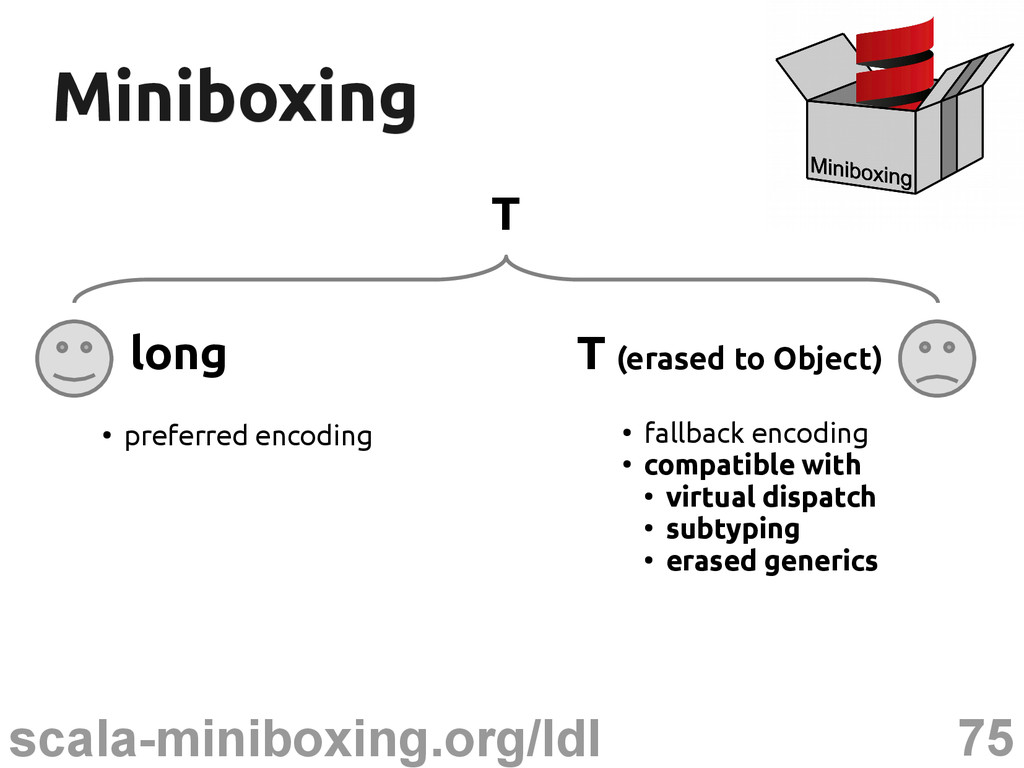
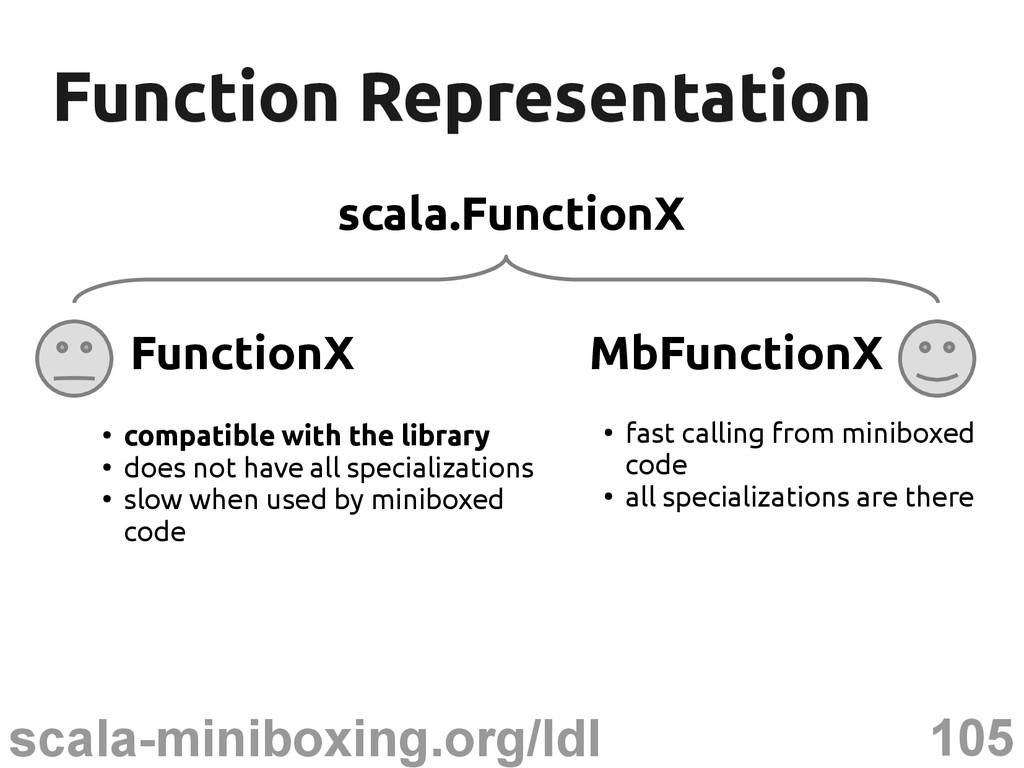
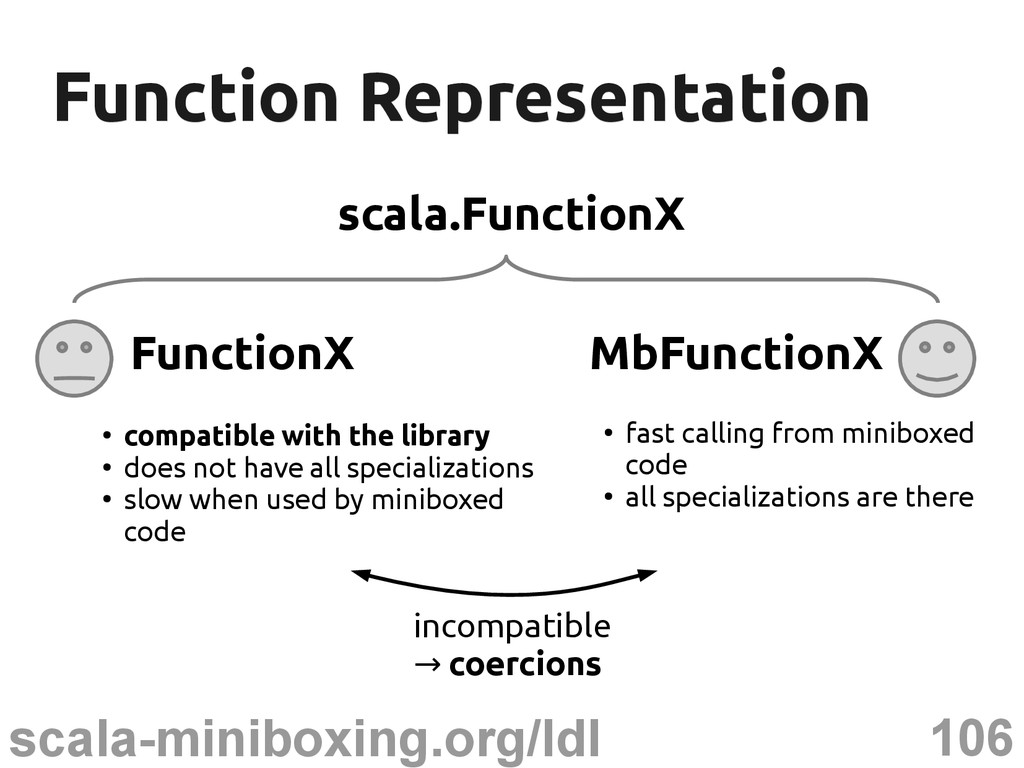
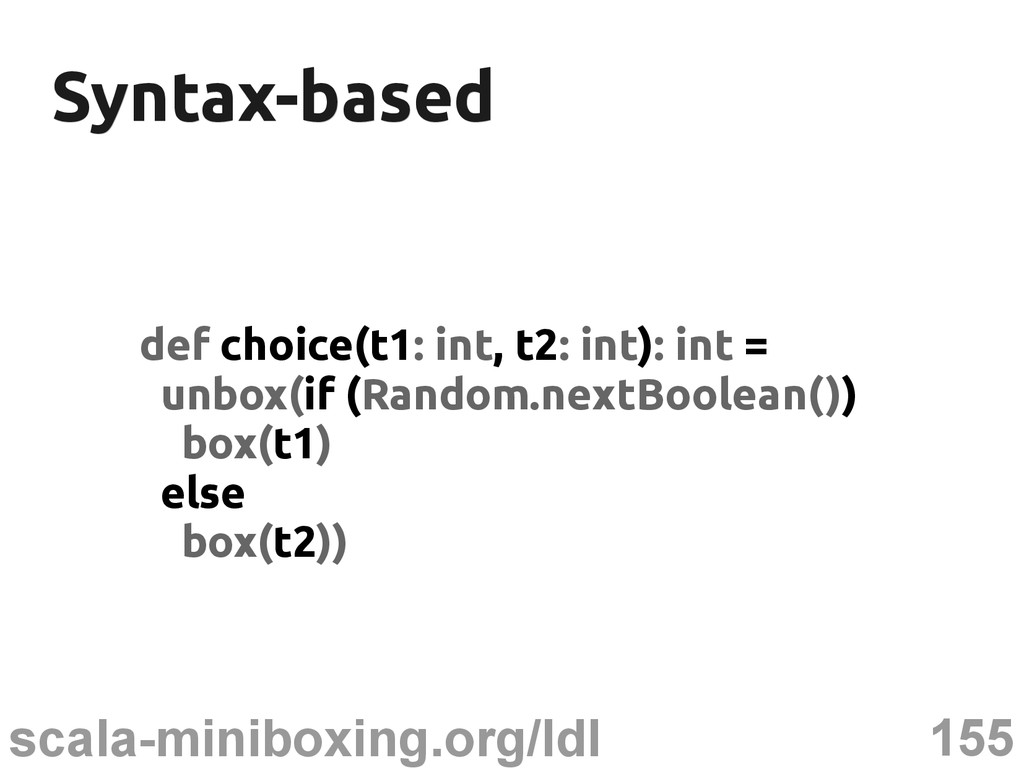
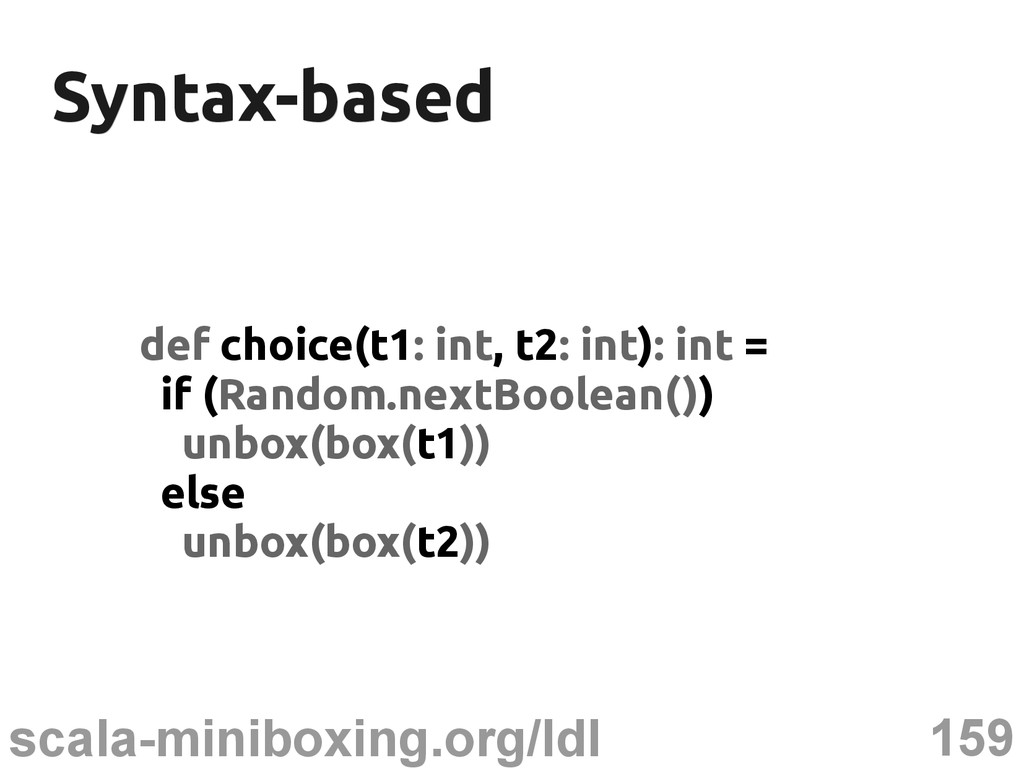
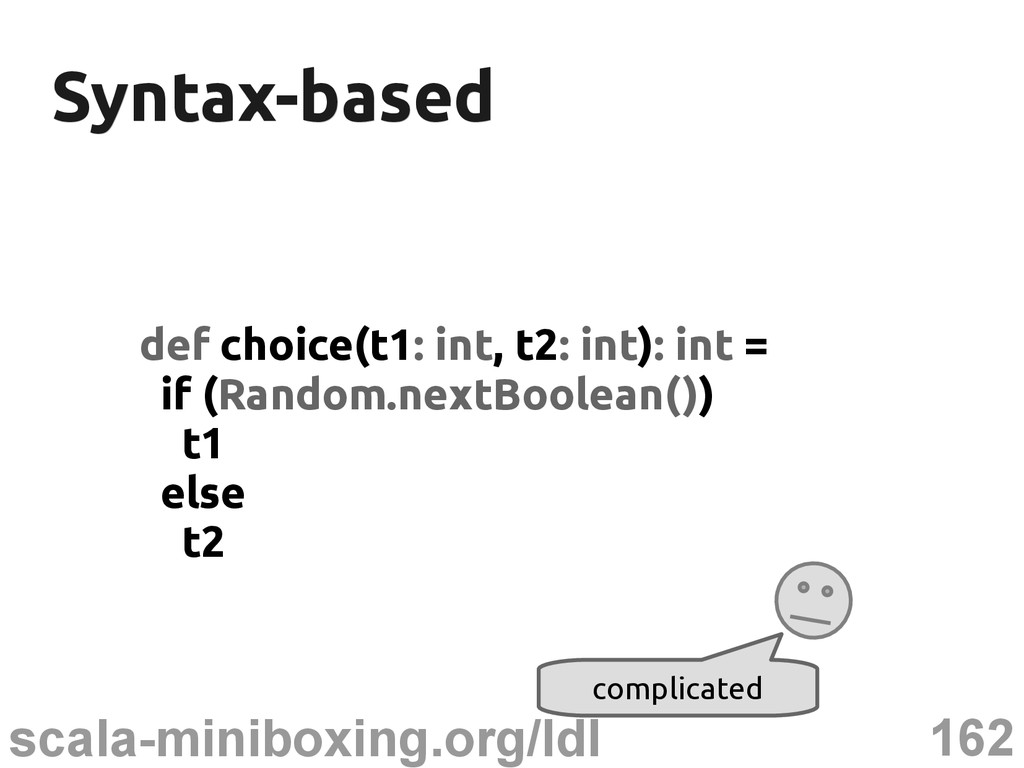
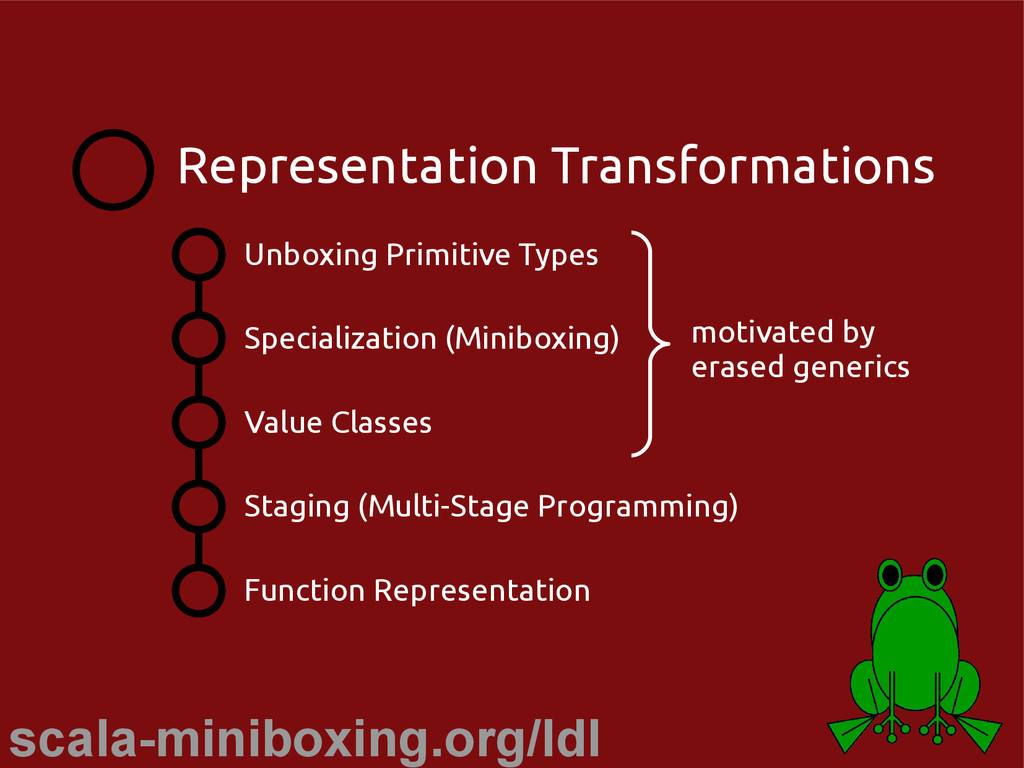
with the library • does not have all specializations • slow when used by miniboxed code • fast calling from miniboxed code • all specializations are there MbFunctionX
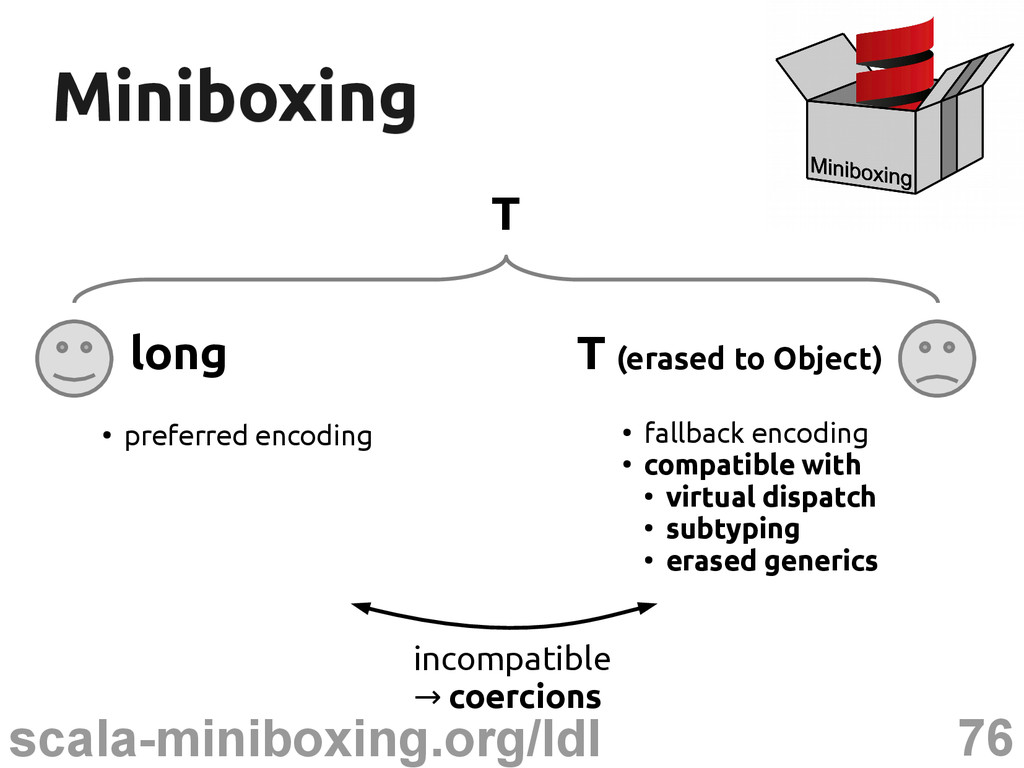
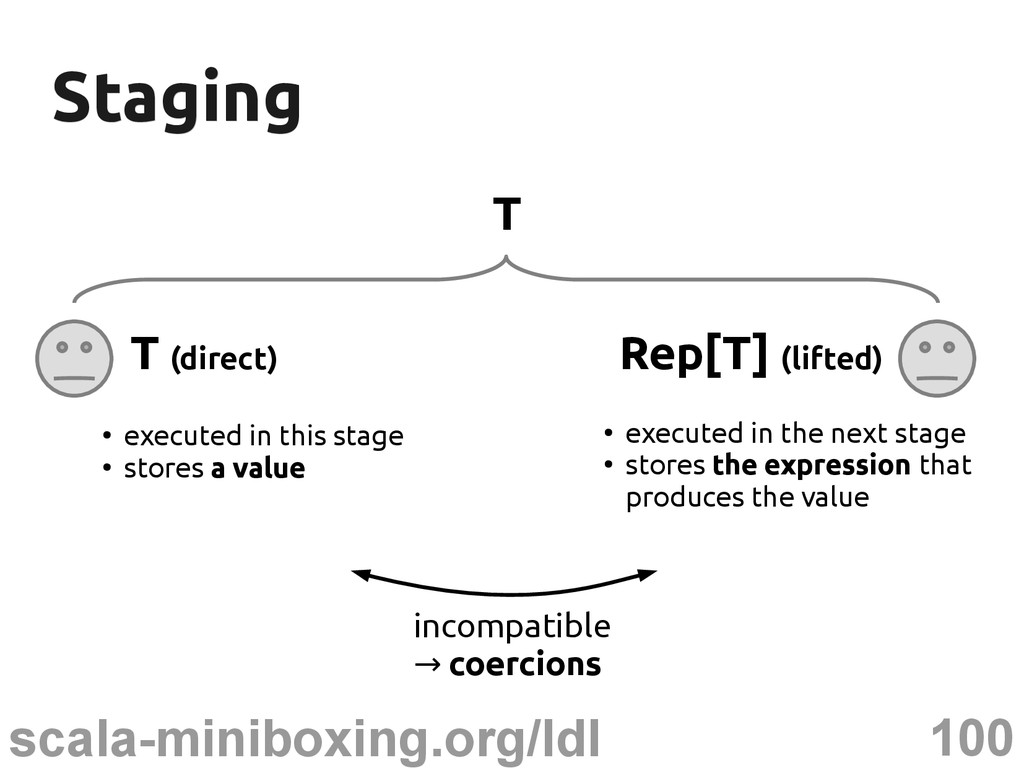
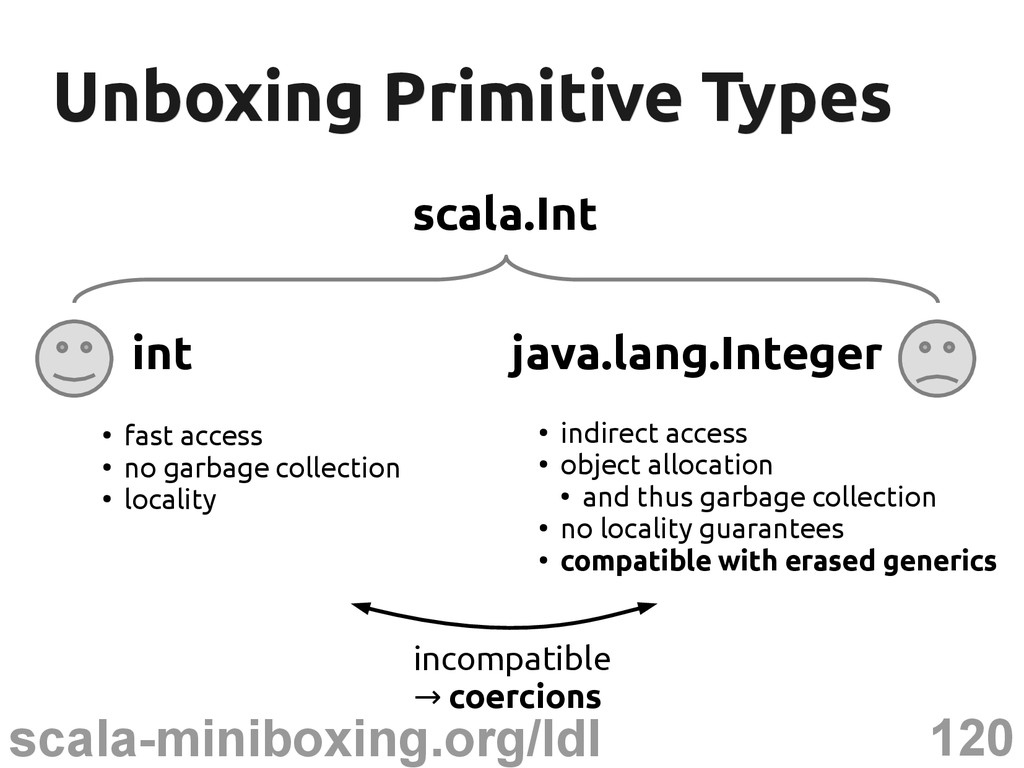
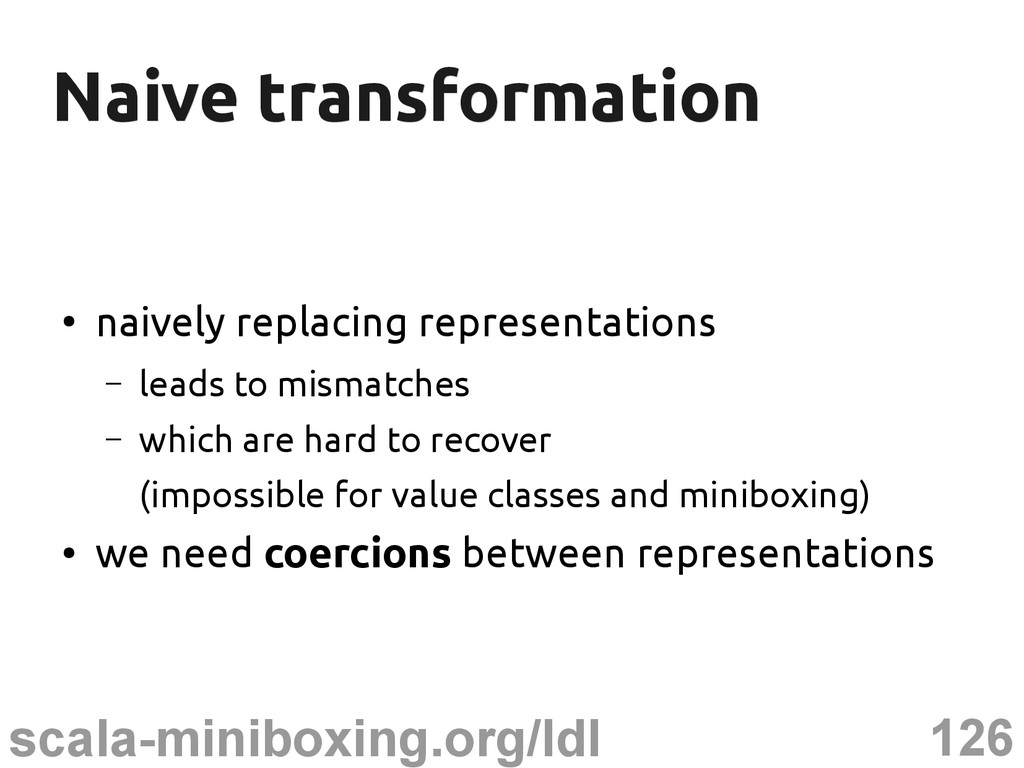
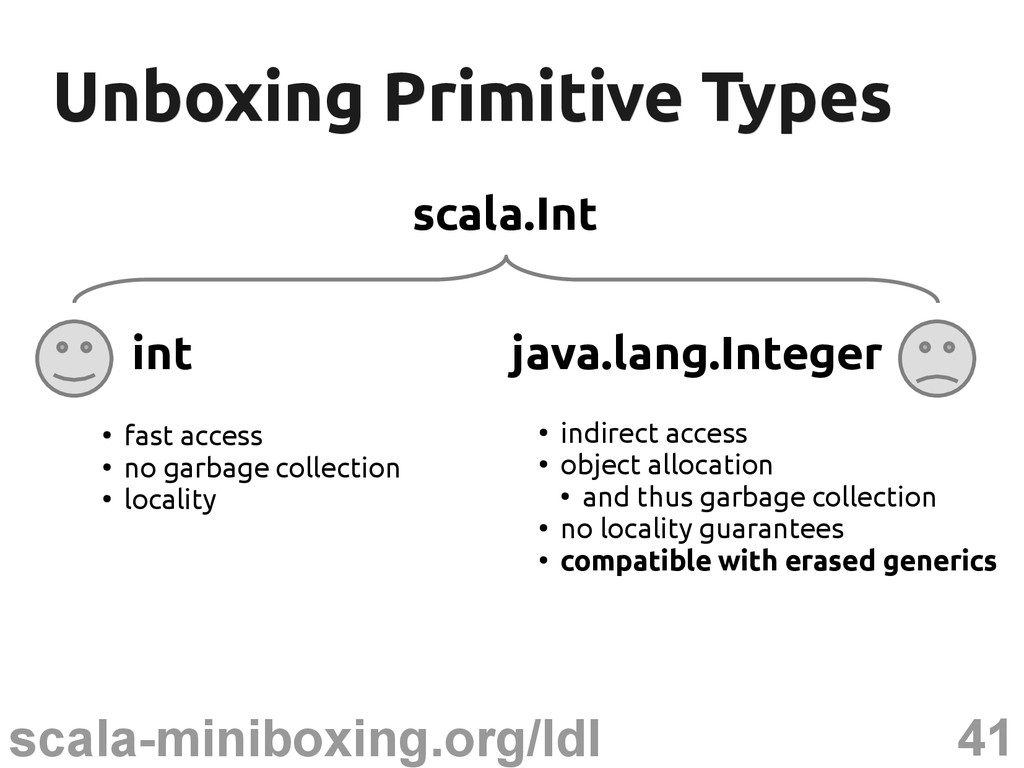
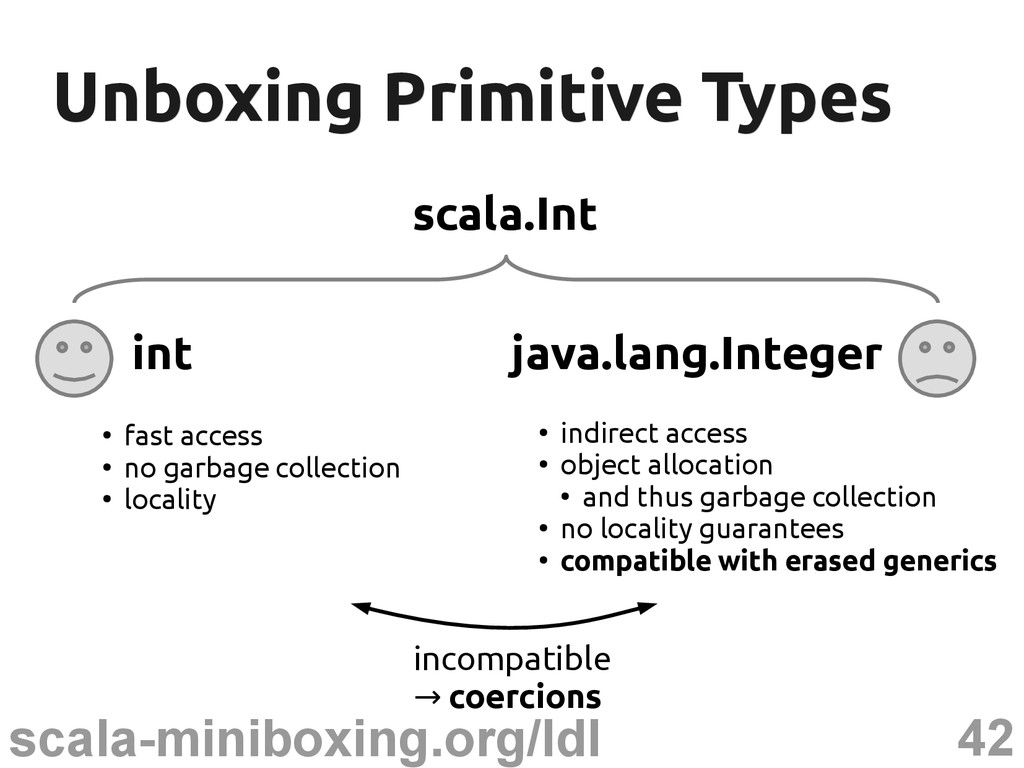
with the library • does not have all specializations • slow when used by miniboxed code • fast calling from miniboxed code • all specializations are there MbFunctionX incompatible → coercions
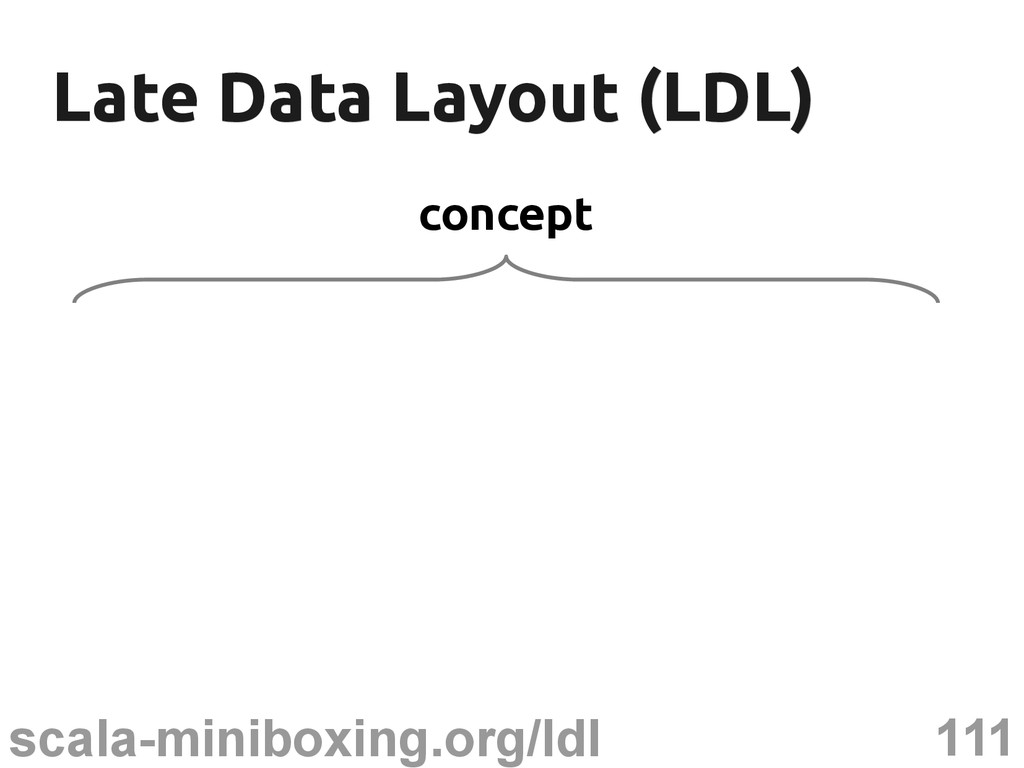
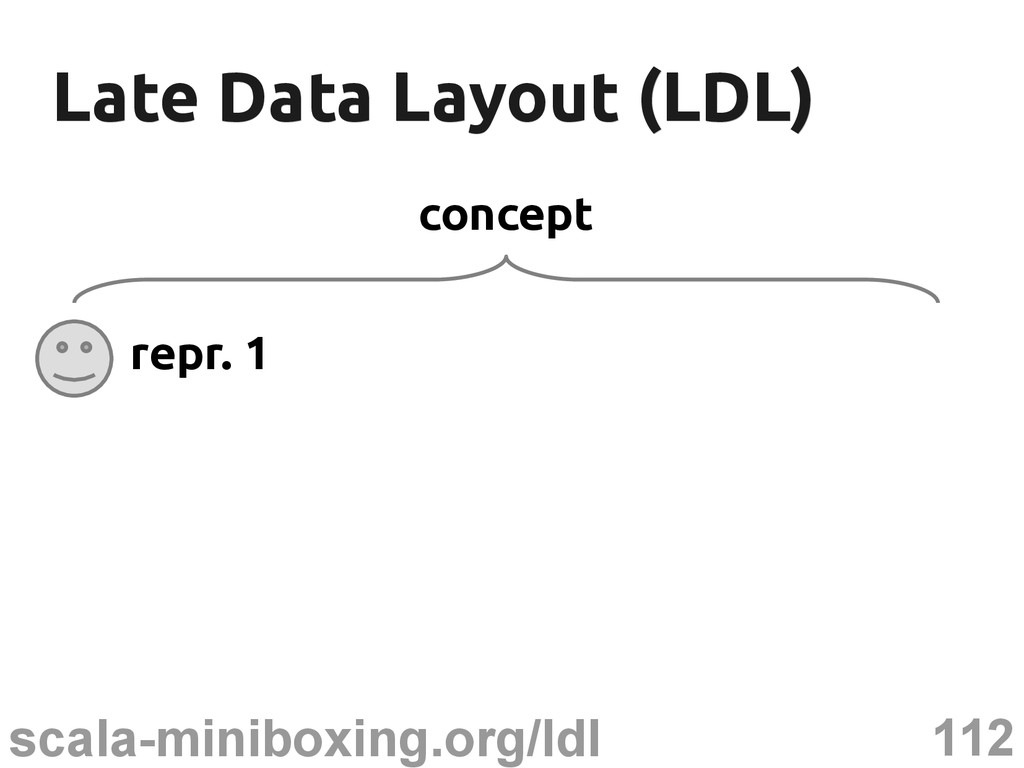
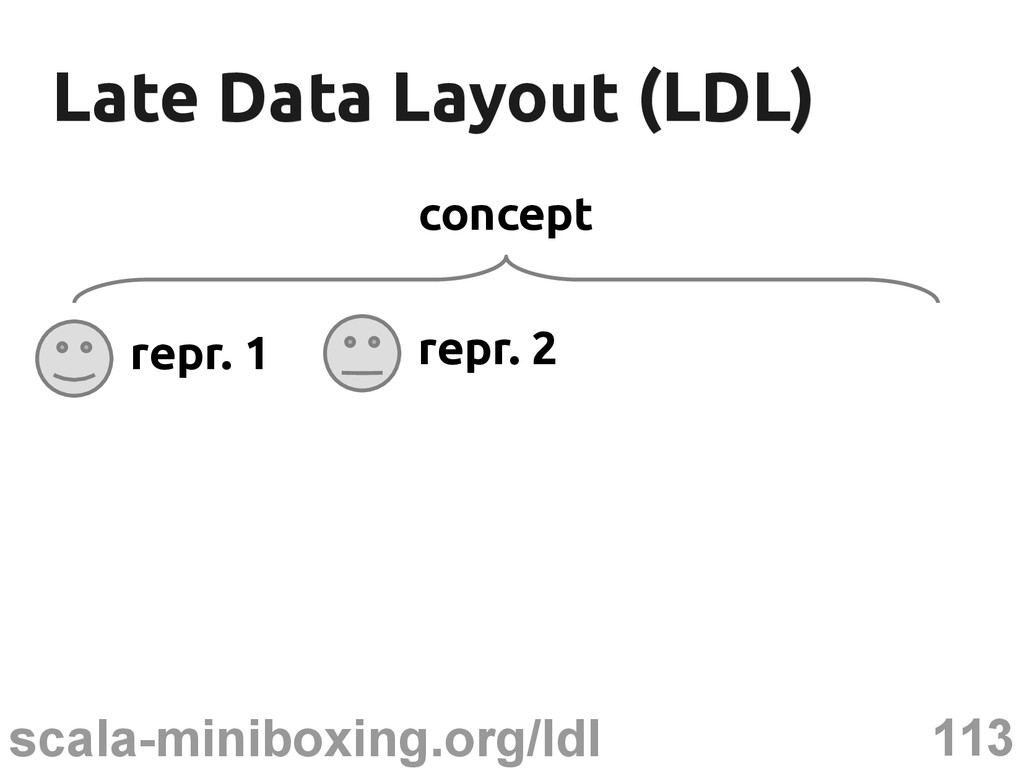
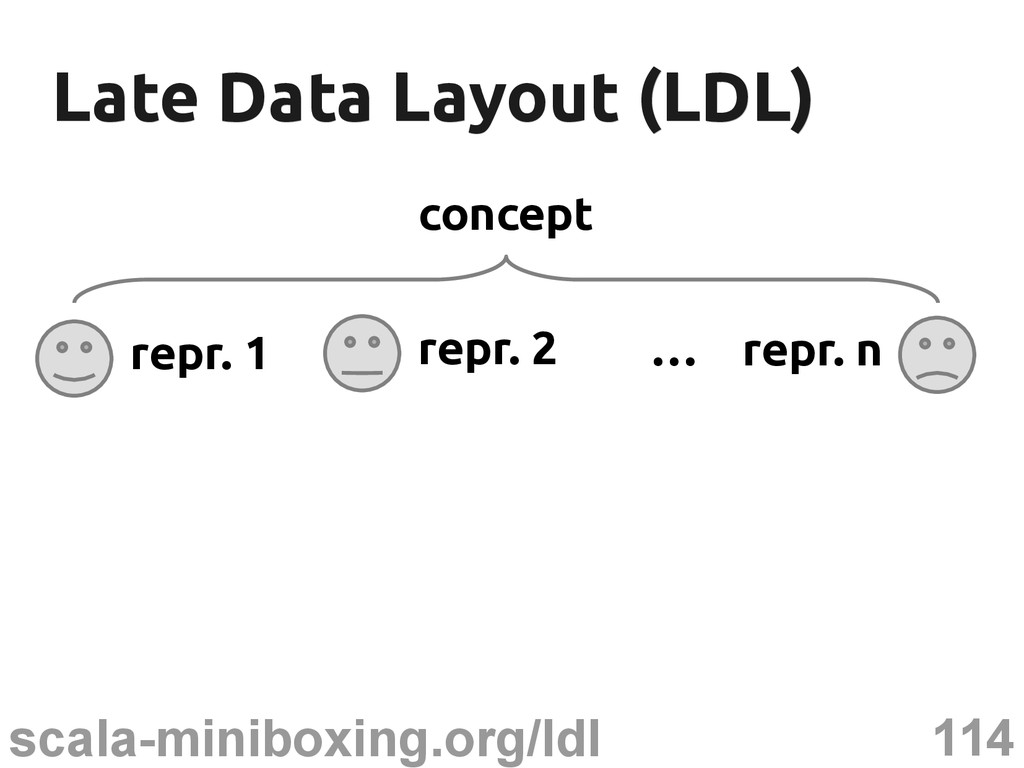
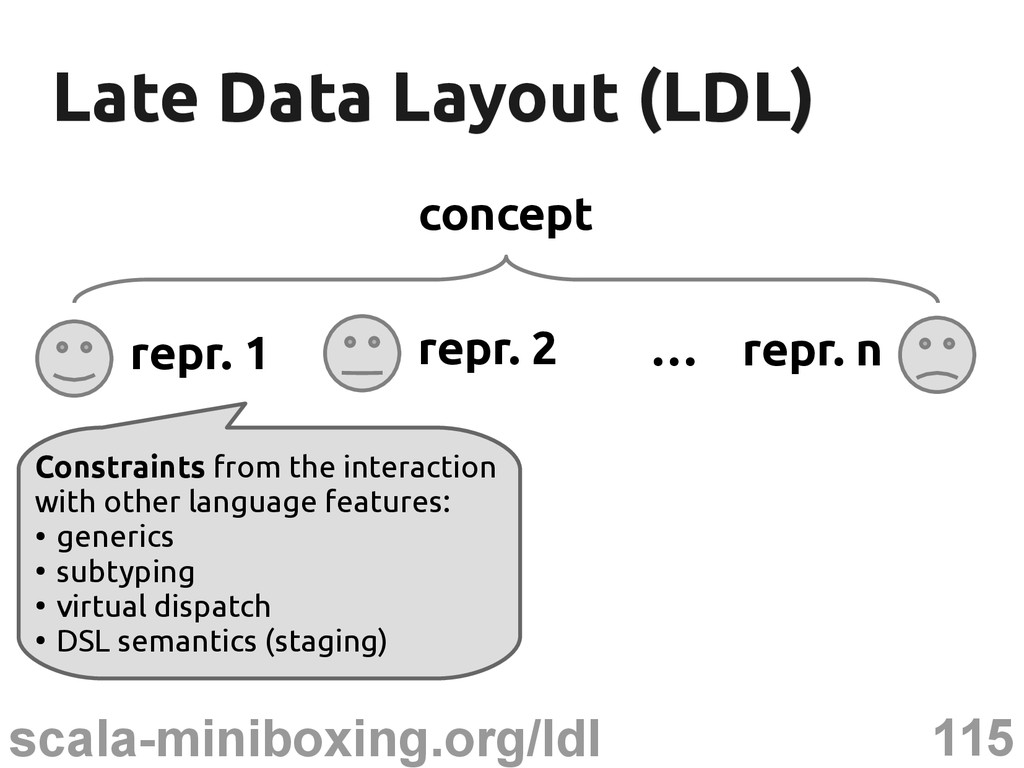
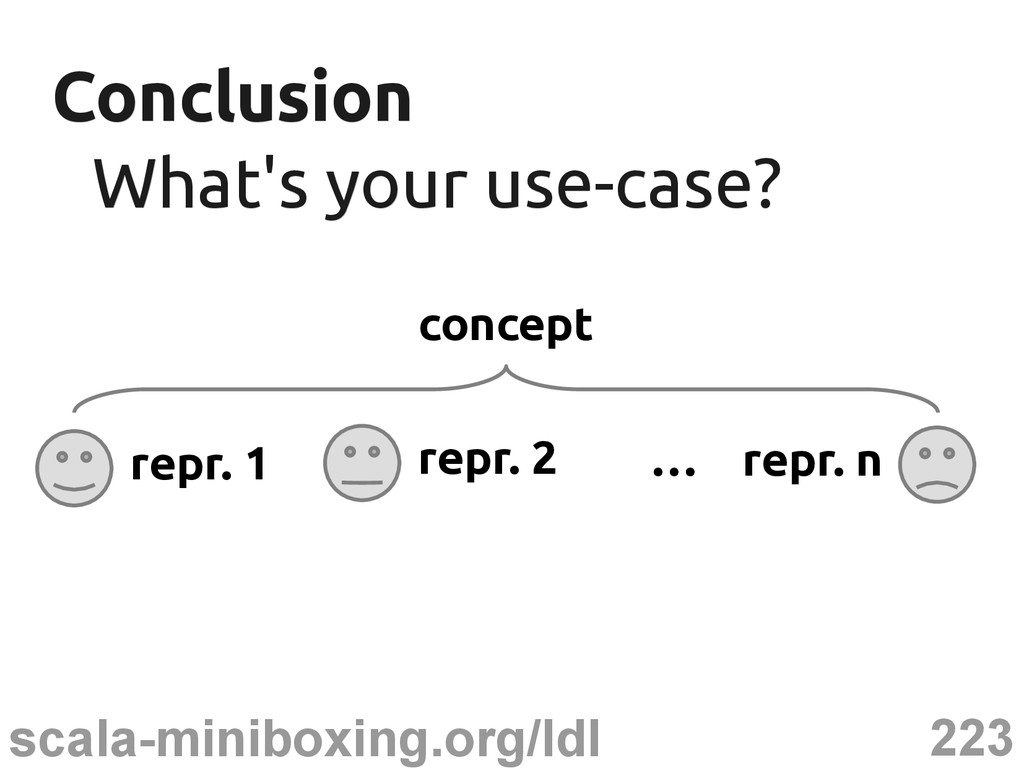
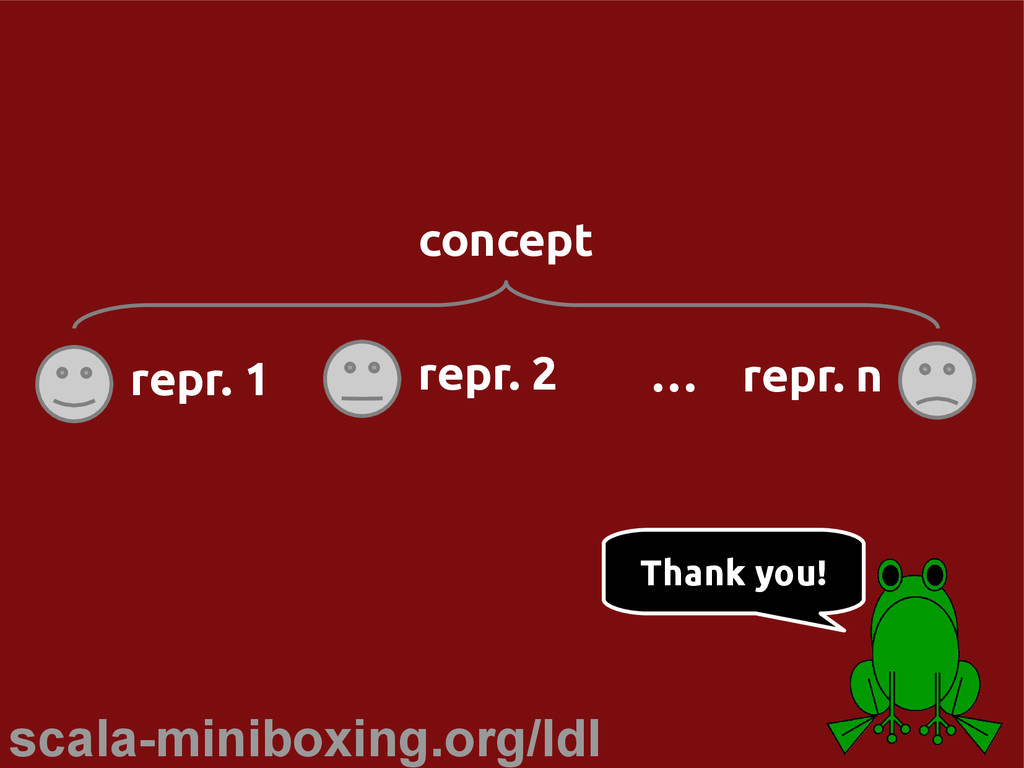
concept repr. 1 … repr. n repr. 2 Constraints from the interaction with other language features: • generics • subtyping • virtual dispatch • DSL semantics (staging)
concept repr. 1 … repr. n repr. 2 Constraints from the interaction with other language features: • generics • subtyping • virtual dispatch • DSL semantics (staging) incompatible → coercions
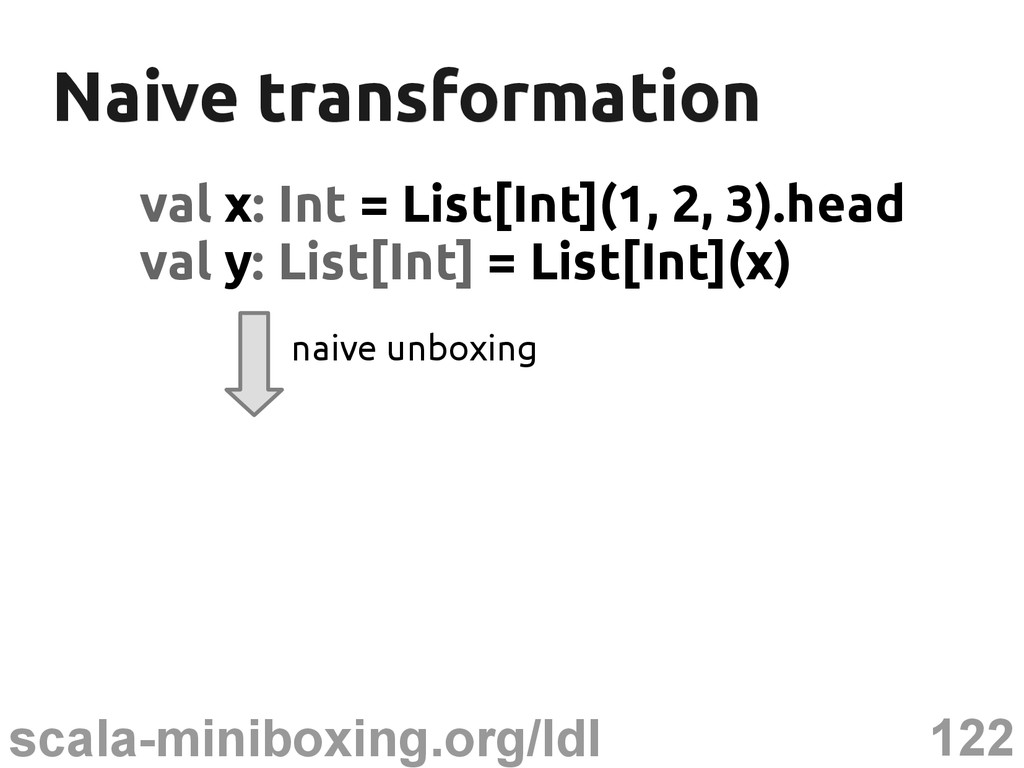
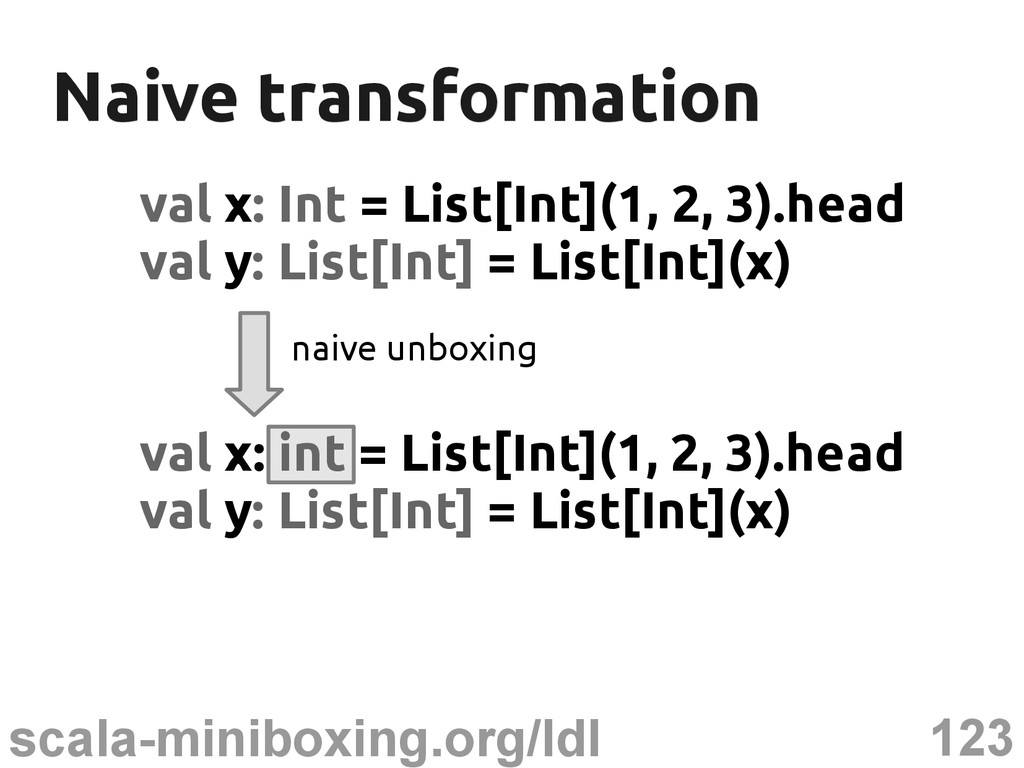
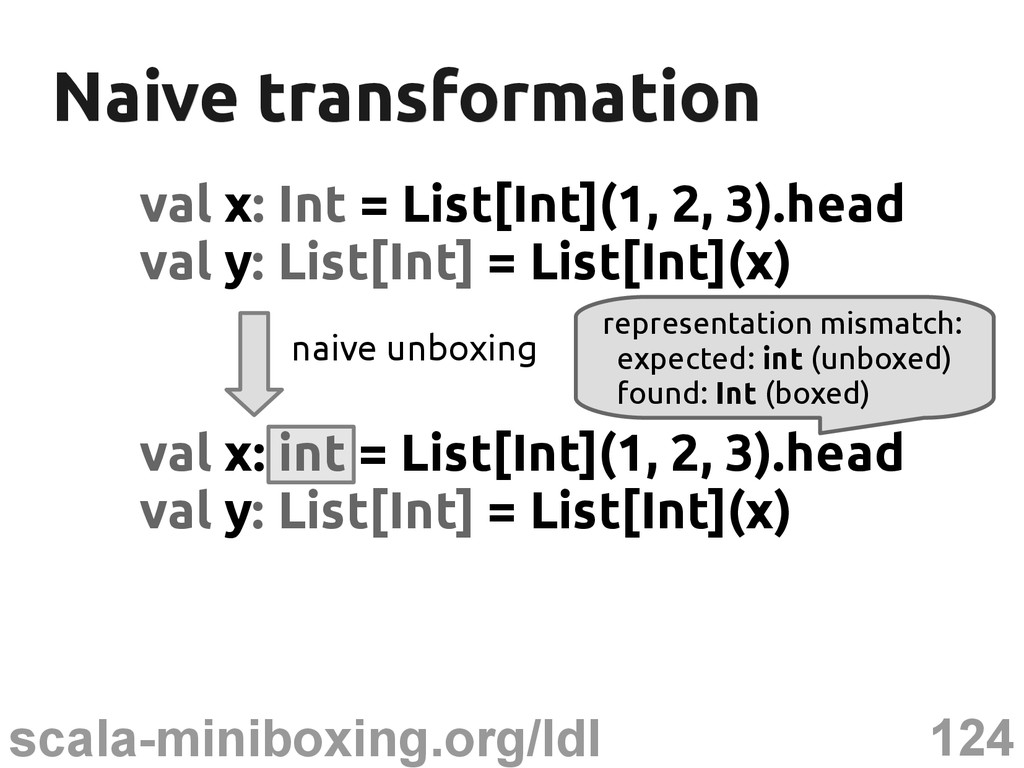
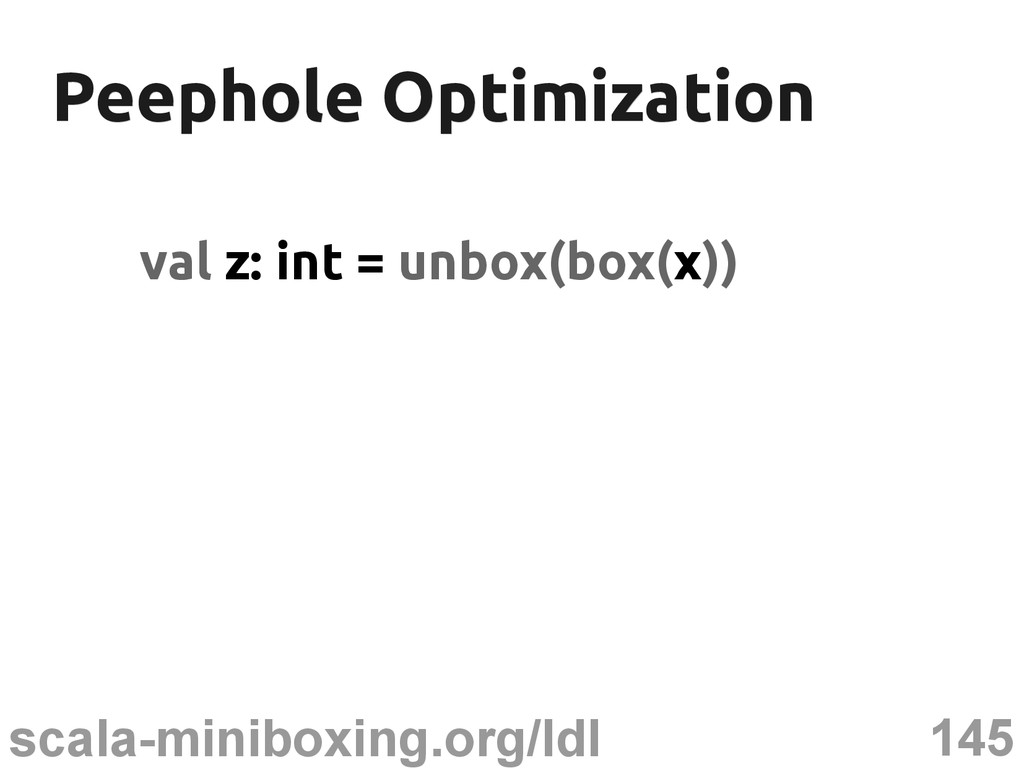
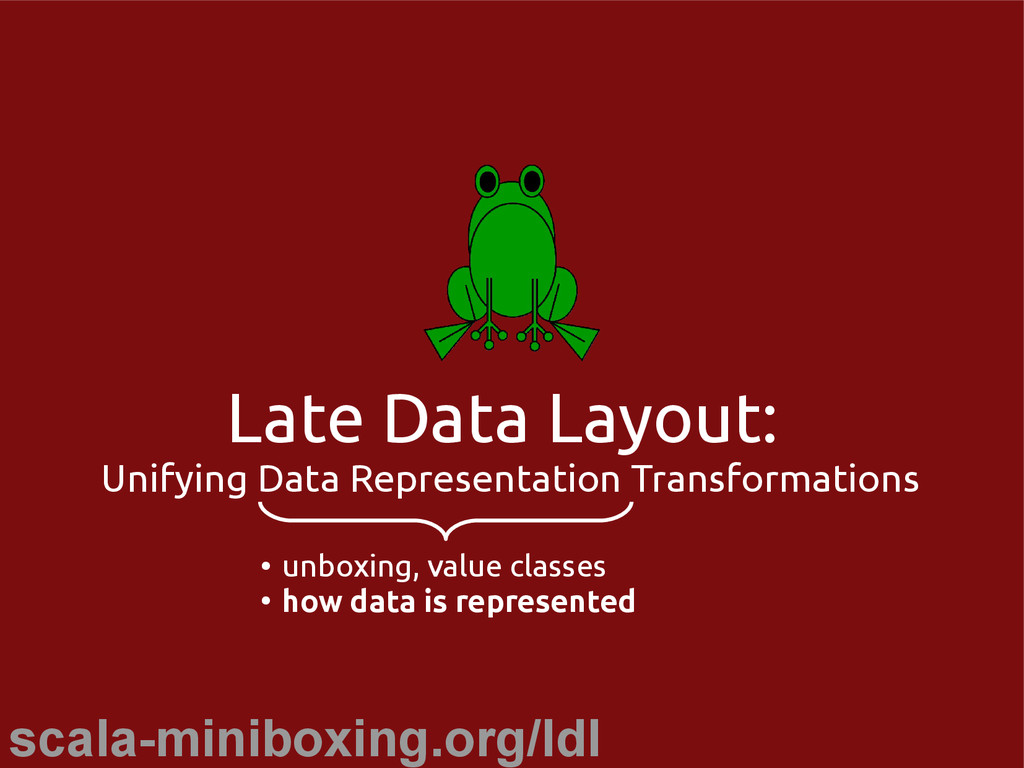
List[Int](1, 2, 3).head val y: List[Int] = List[Int](x) val x: int = List[Int](1, 2, 3).head val y: List[Int] = List[Int](x) naive unboxing representation mismatch: expected: int (unboxed) found: Int (boxed)
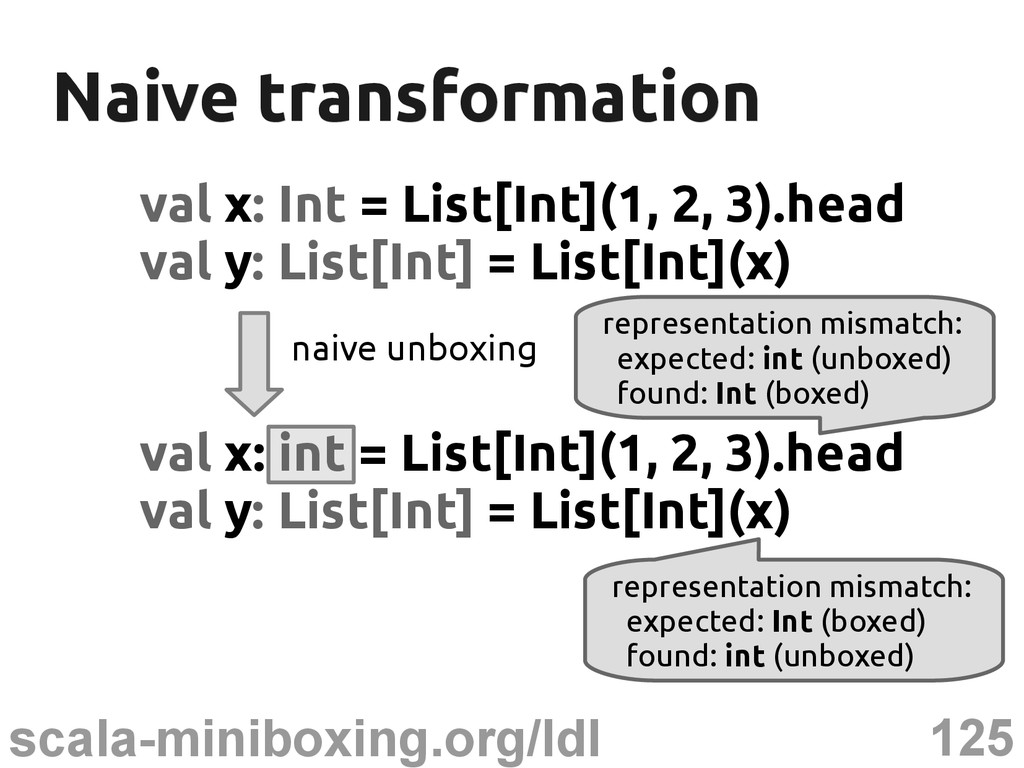
List[Int](1, 2, 3).head val y: List[Int] = List[Int](x) val x: int = List[Int](1, 2, 3).head val y: List[Int] = List[Int](x) naive unboxing representation mismatch: expected: int (unboxed) found: Int (boxed) representation mismatch: expected: Int (boxed) found: int (unboxed)
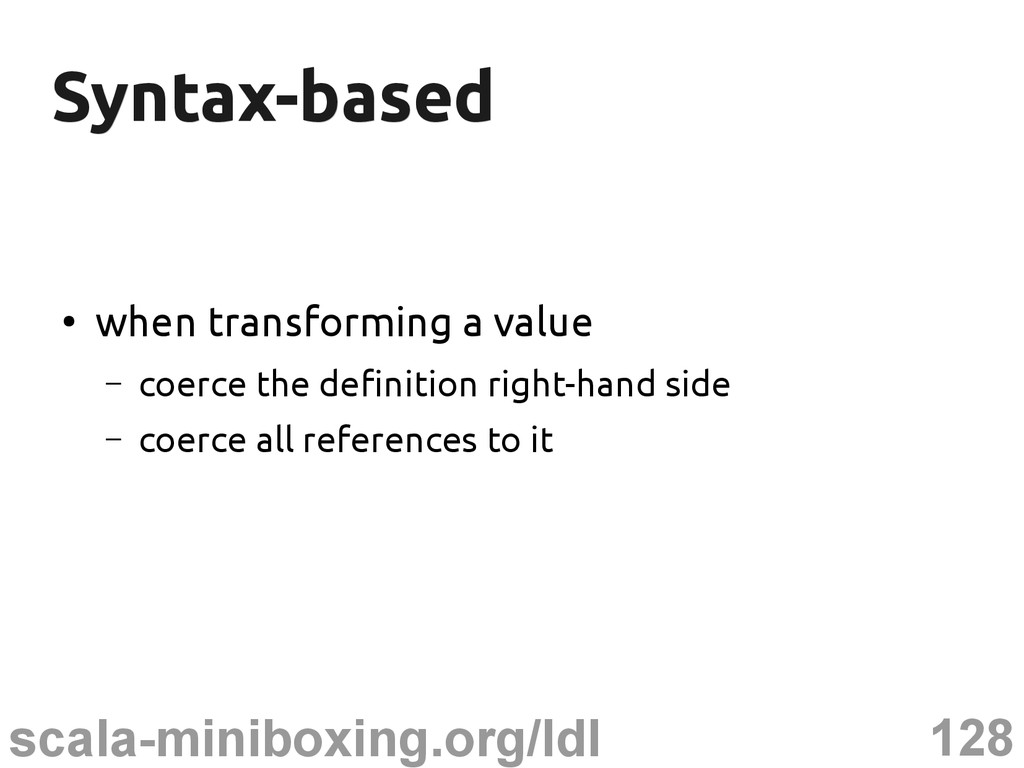
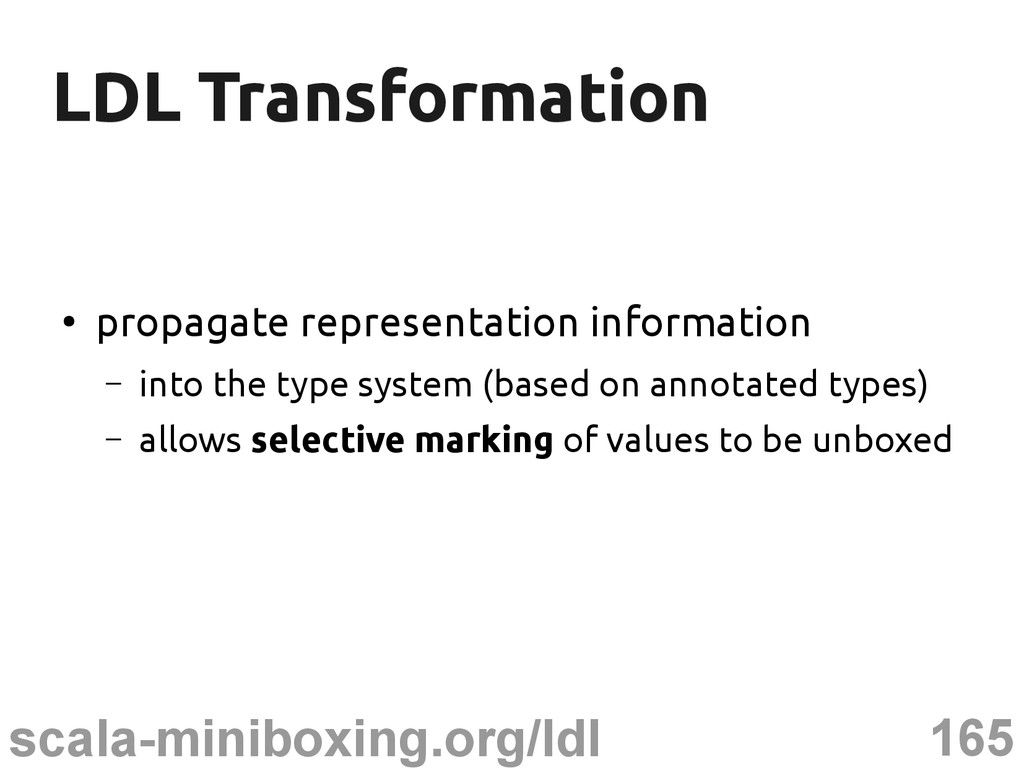
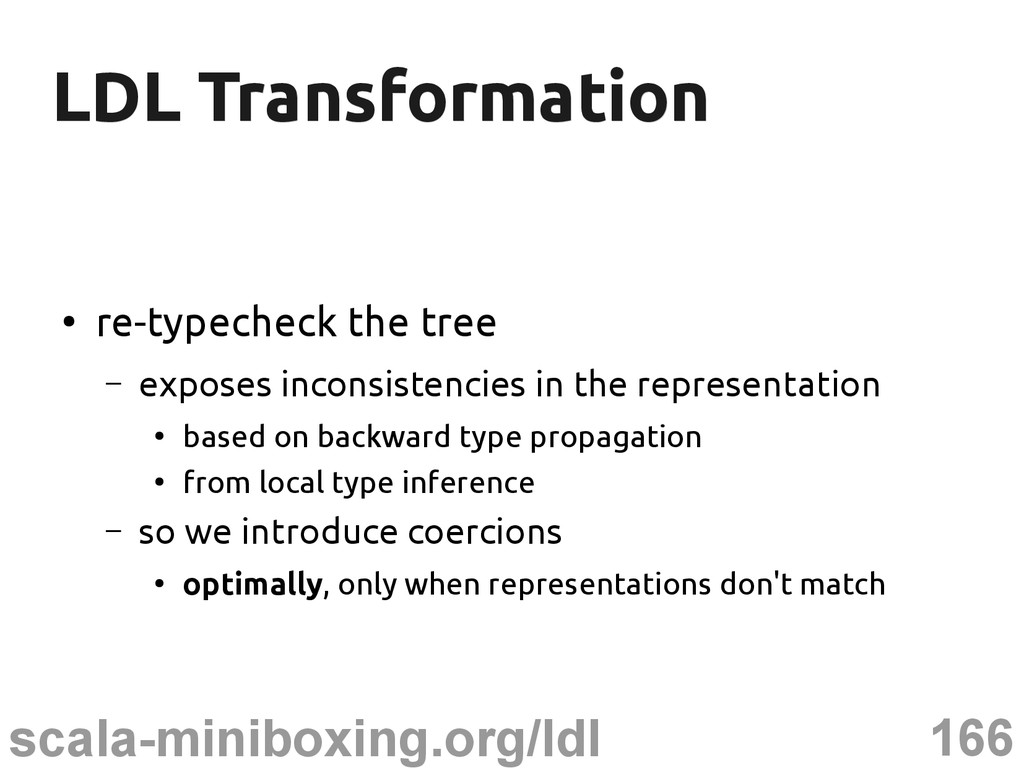
– exposes inconsistencies in the representation • based on backward type propagation • from local type inference – so we introduce coercions • optimally, only when representations don't match
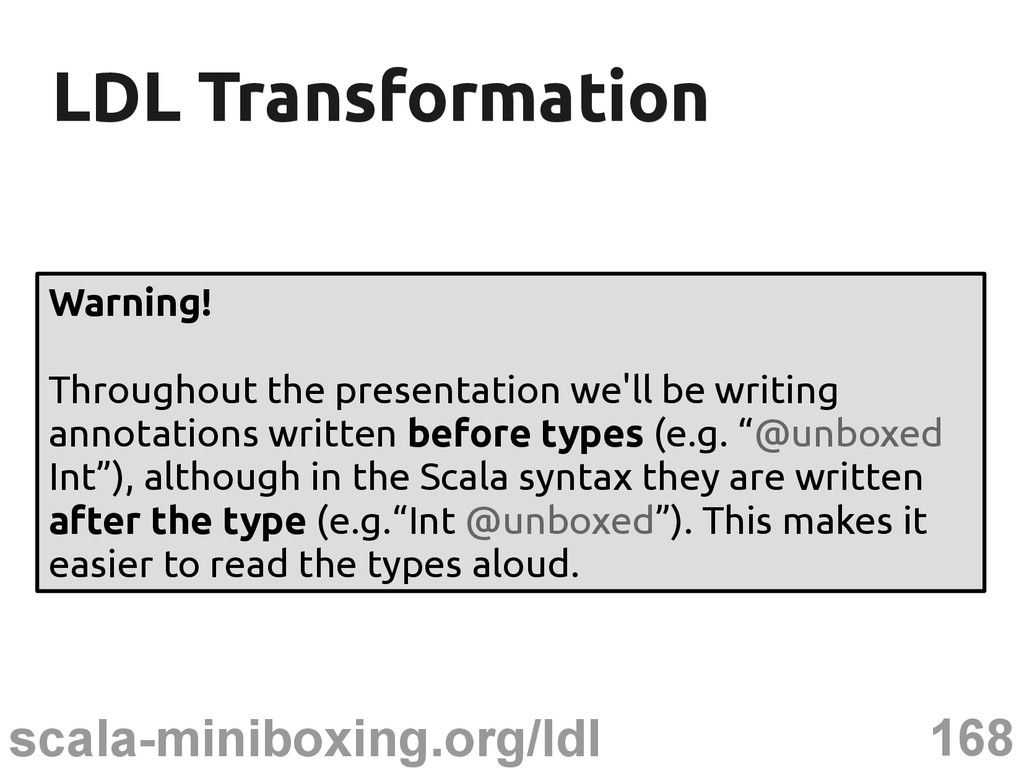
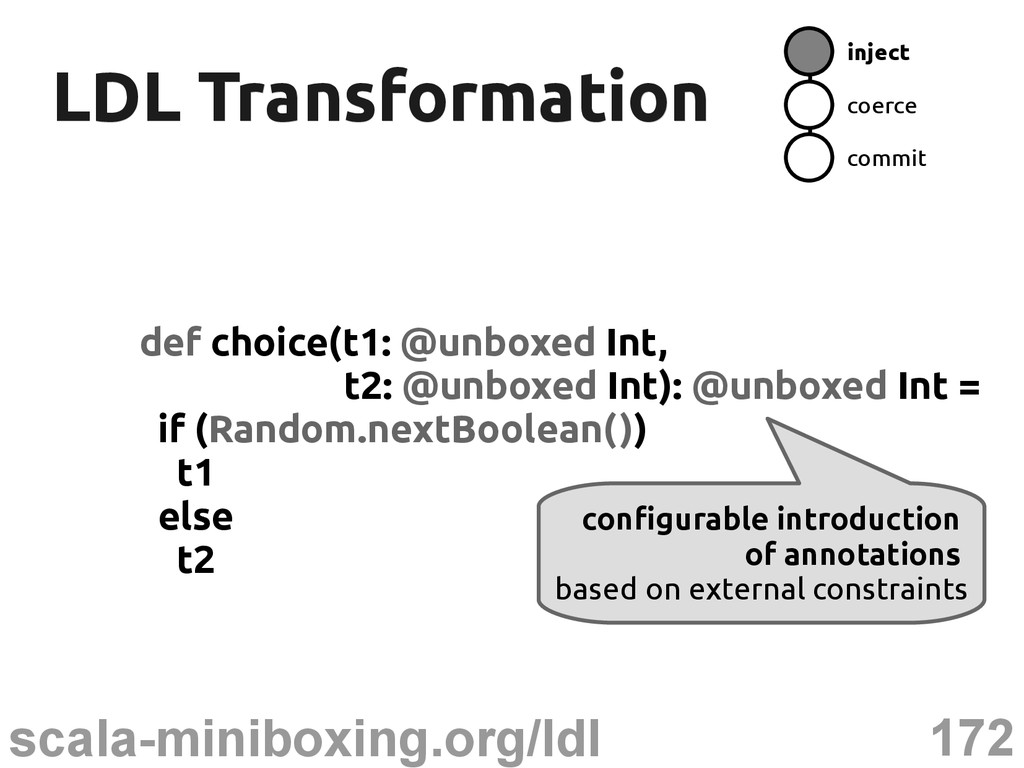
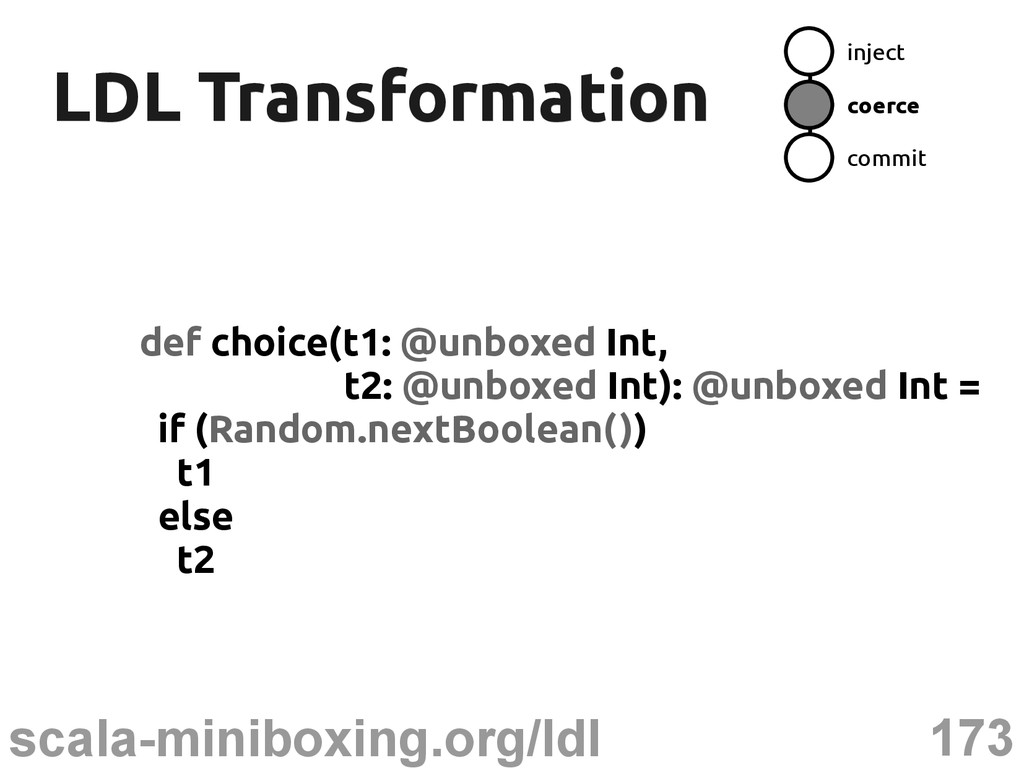
we'll be writing annotations written before types (e.g. “@unboxed Int”), although in the Scala syntax they are written after the type (e.g.“Int @unboxed”). This makes it easier to read the types aloud.
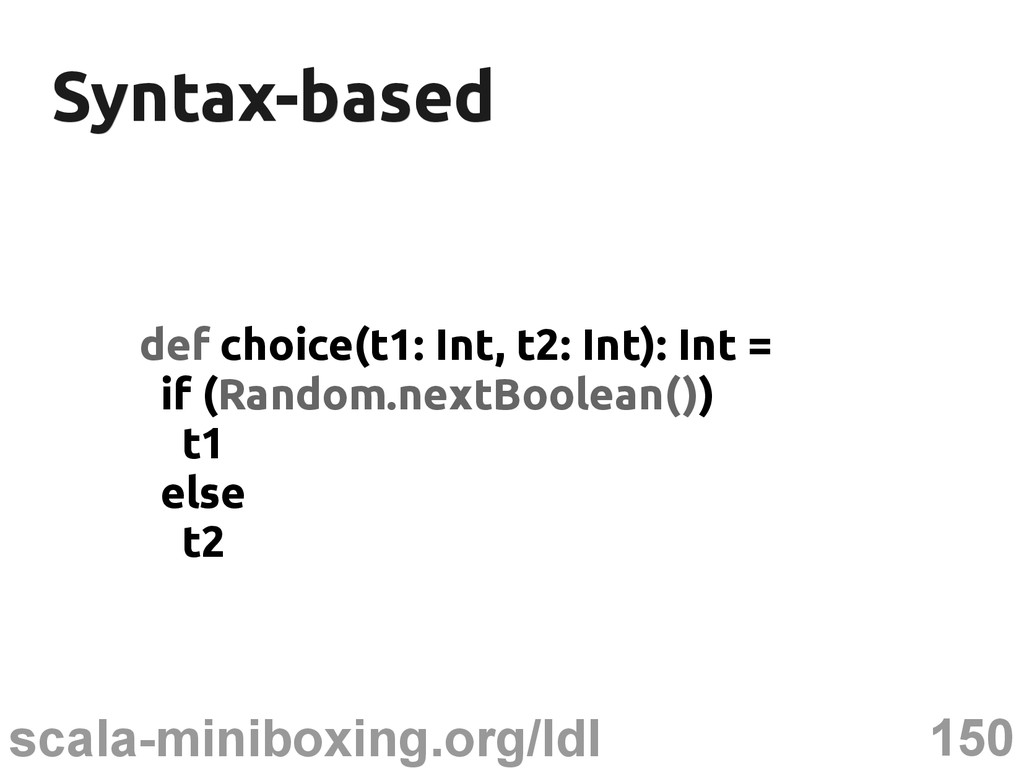
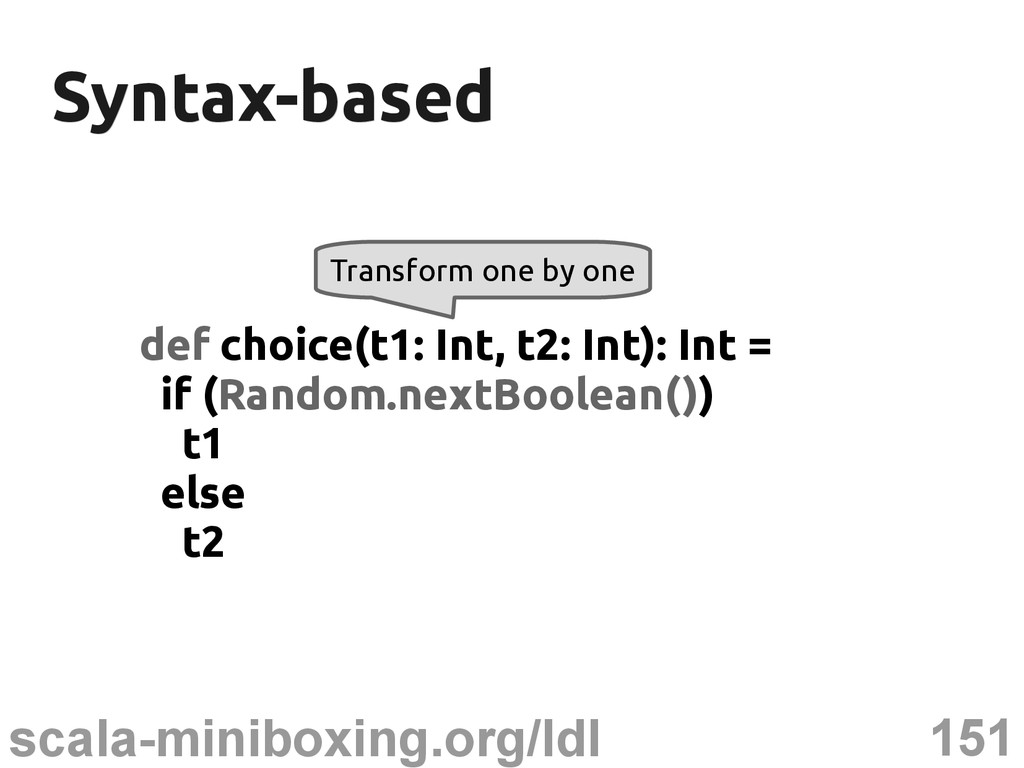
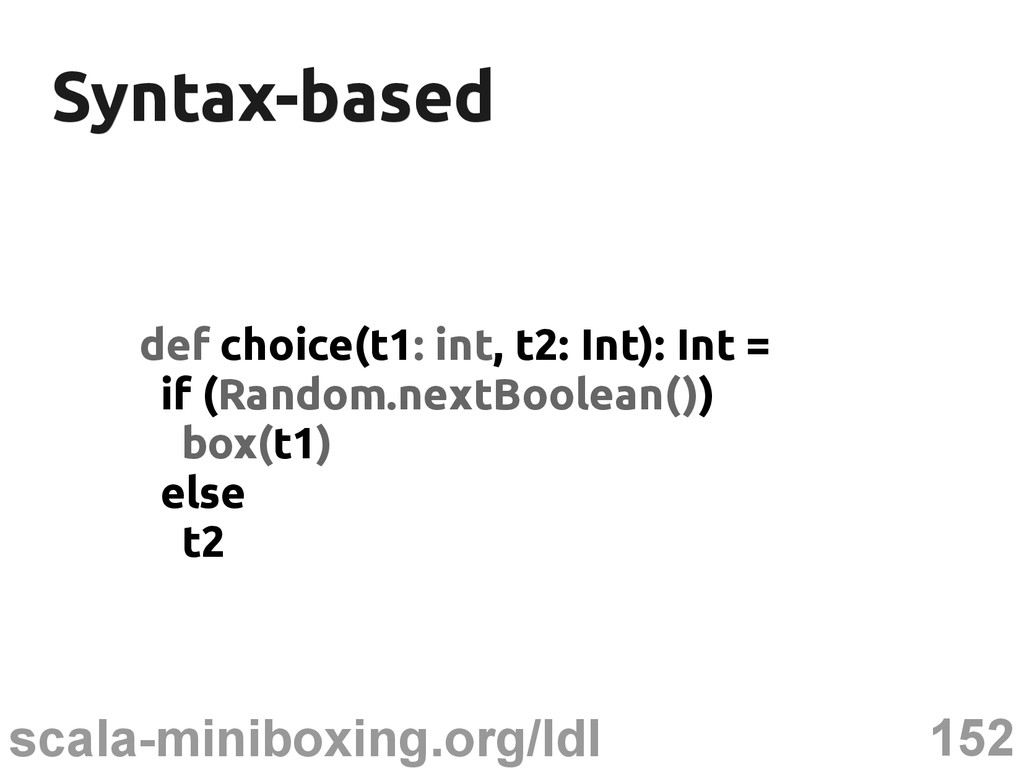
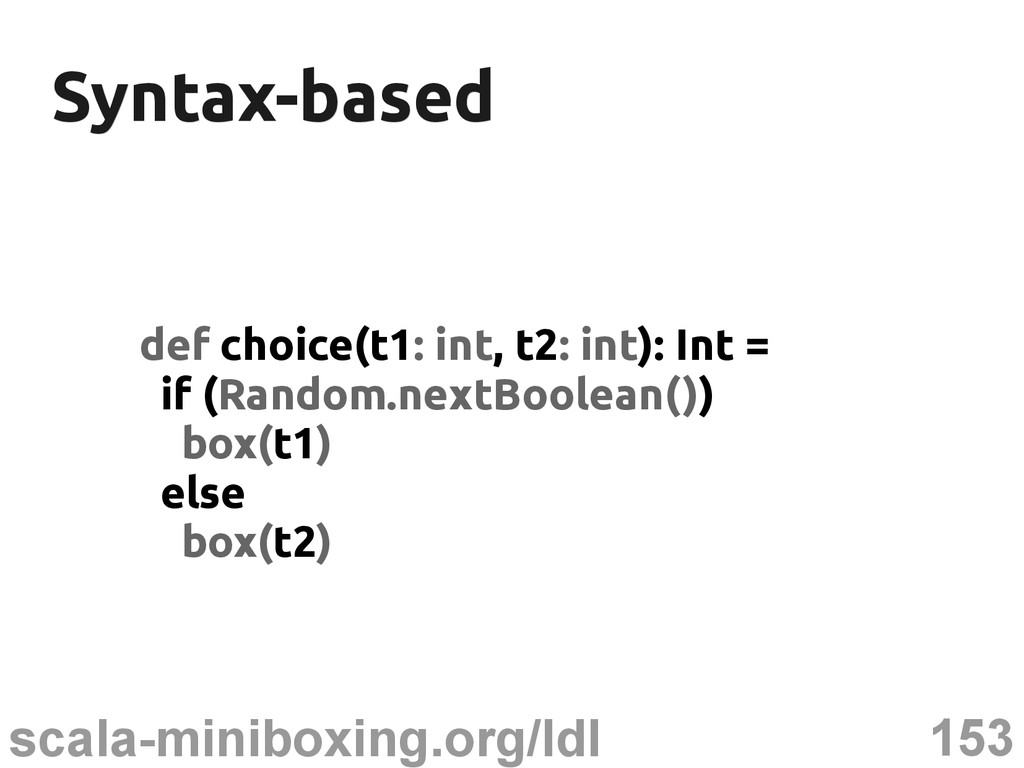
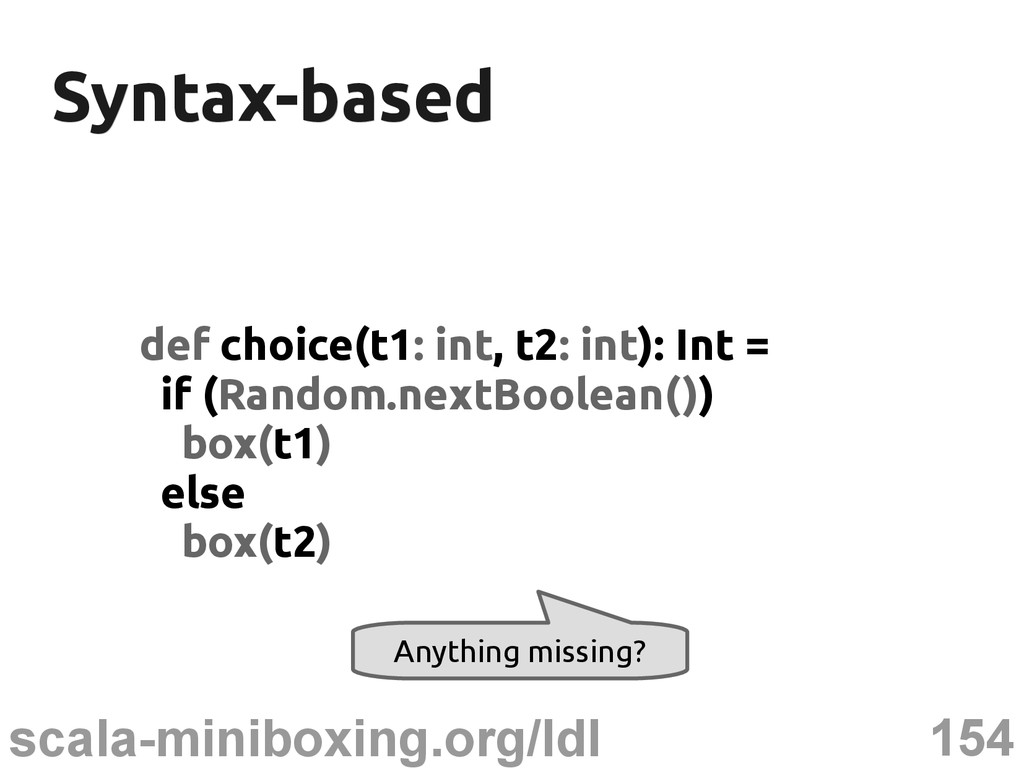
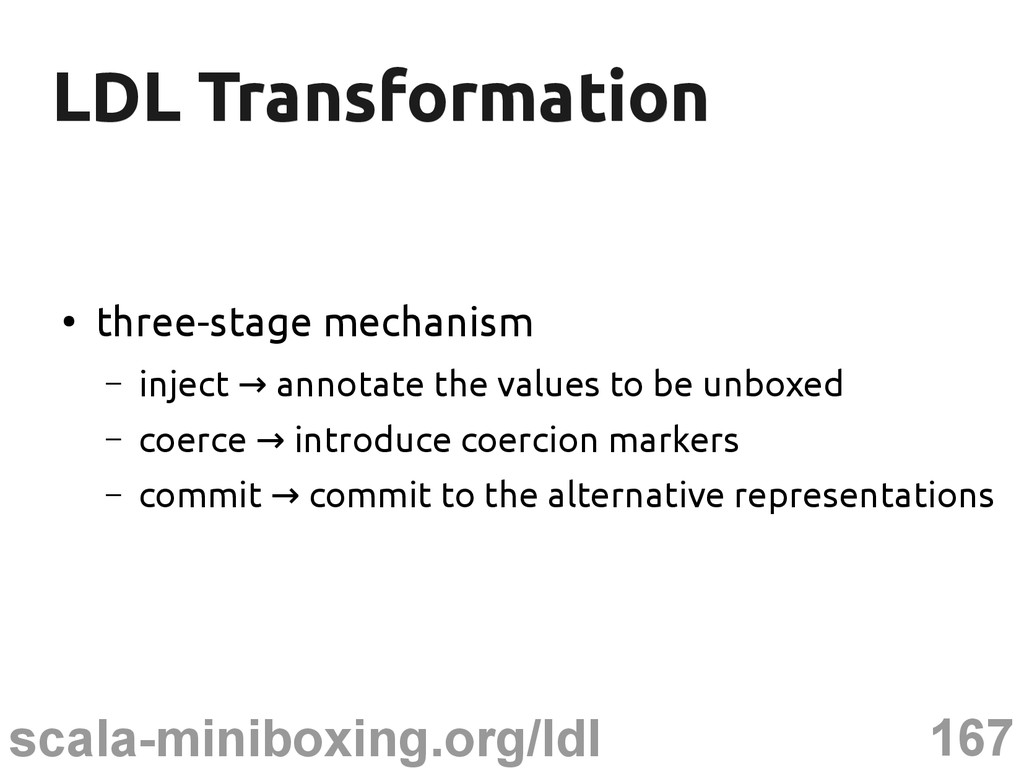
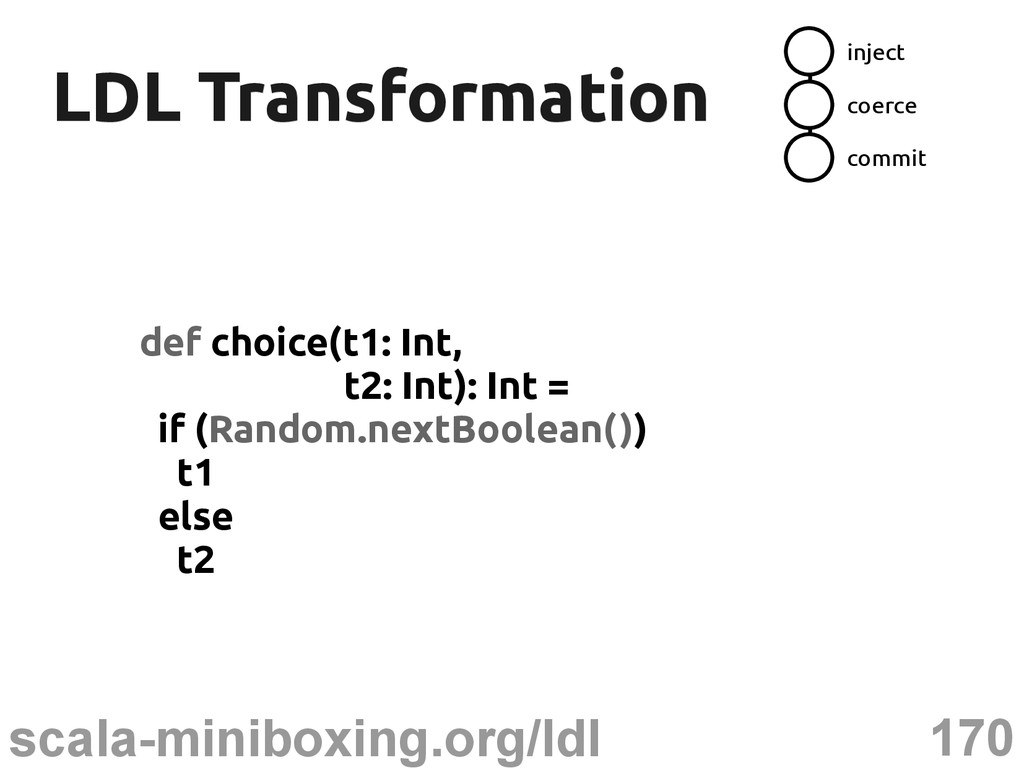
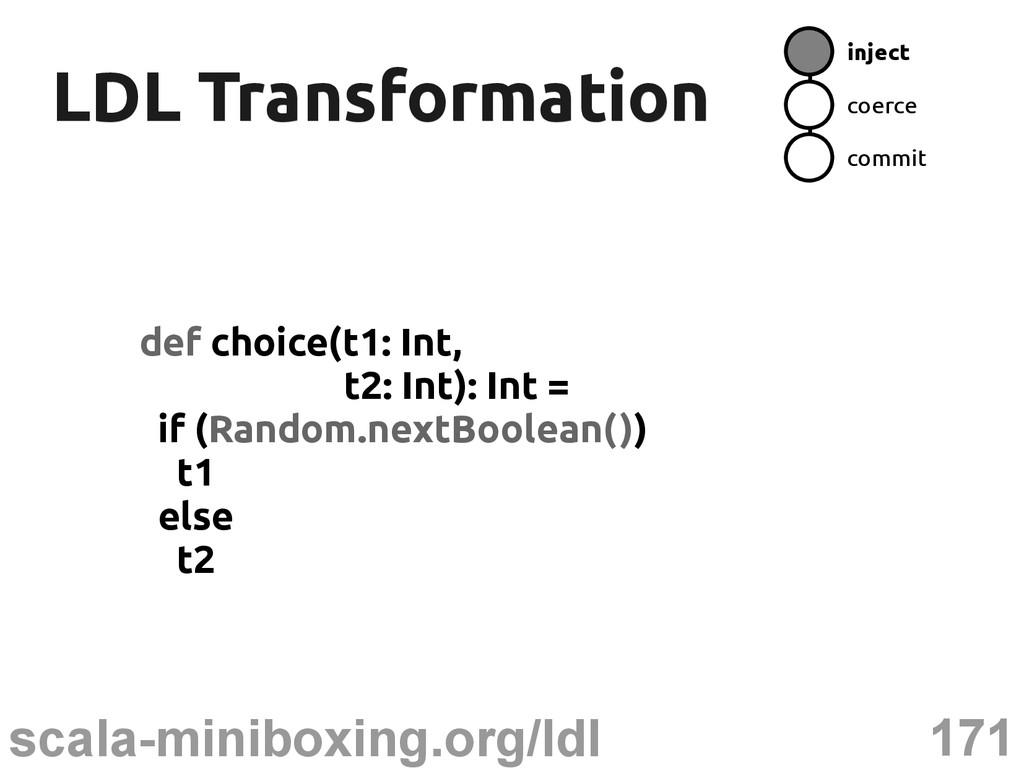
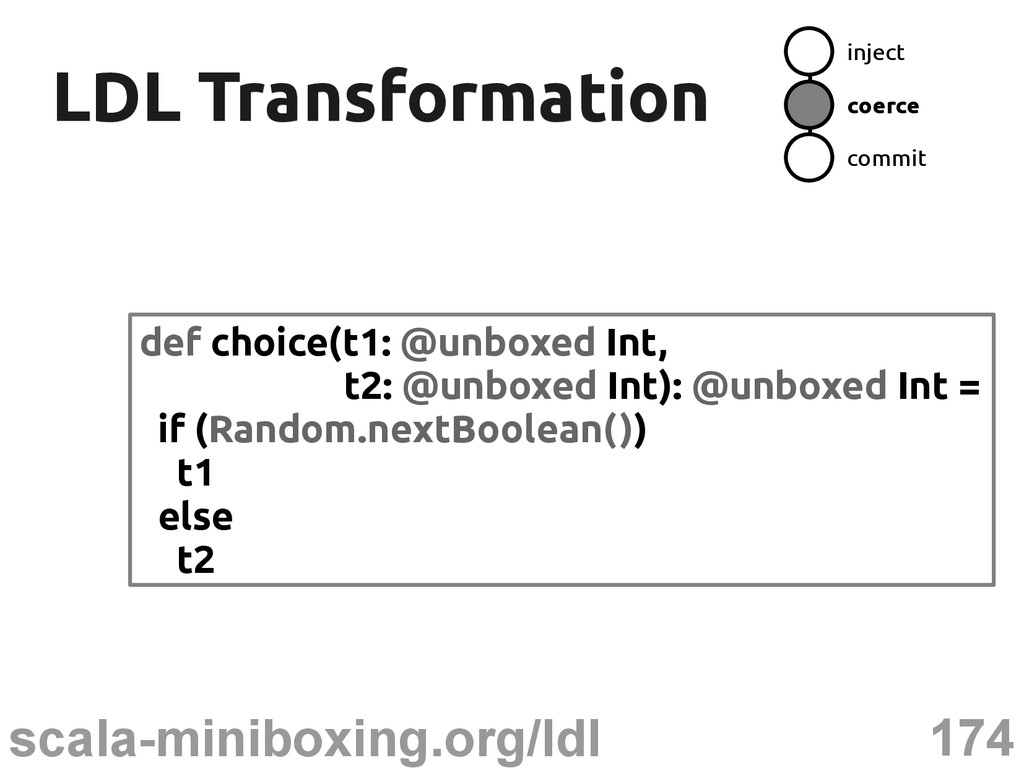
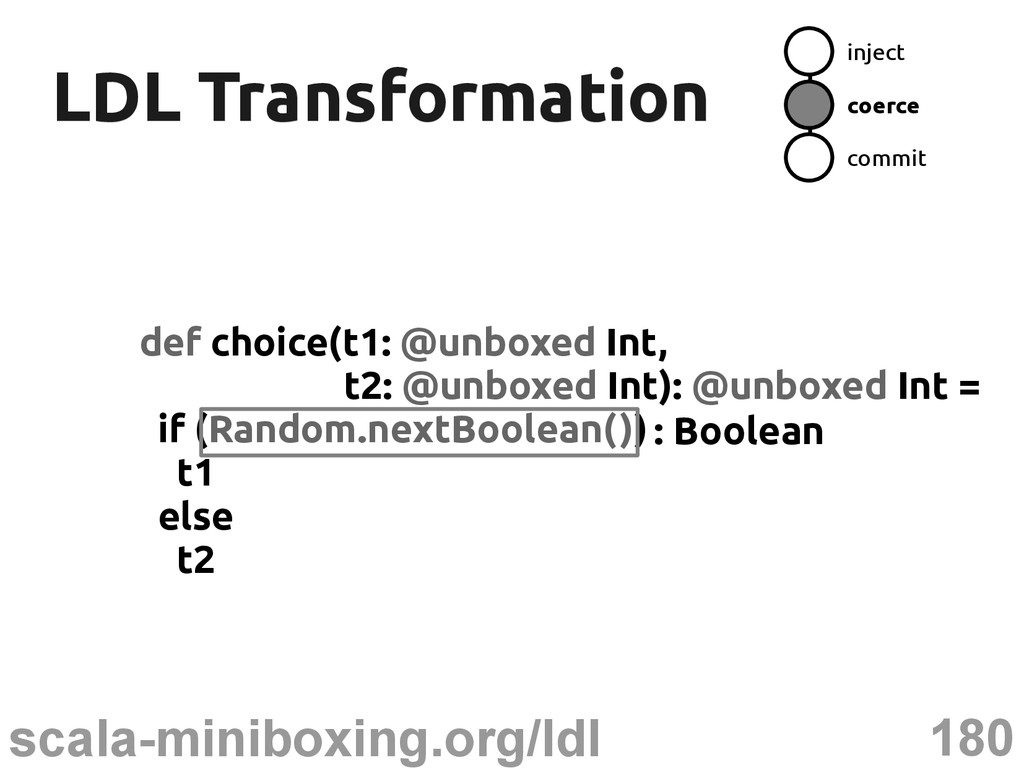
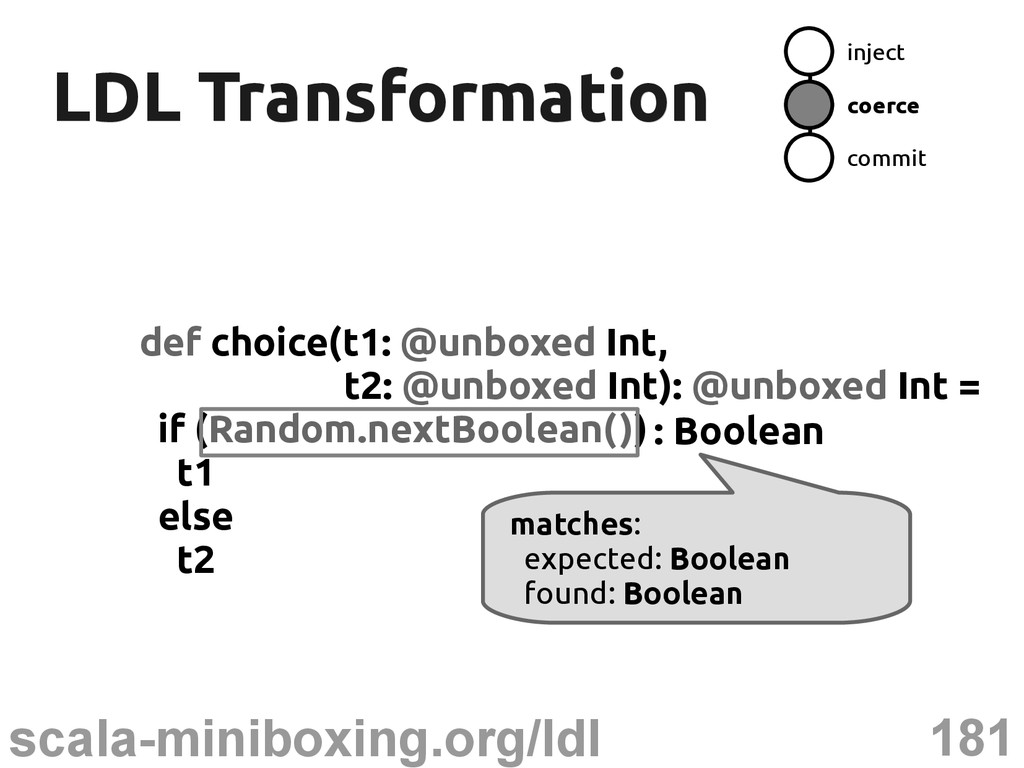
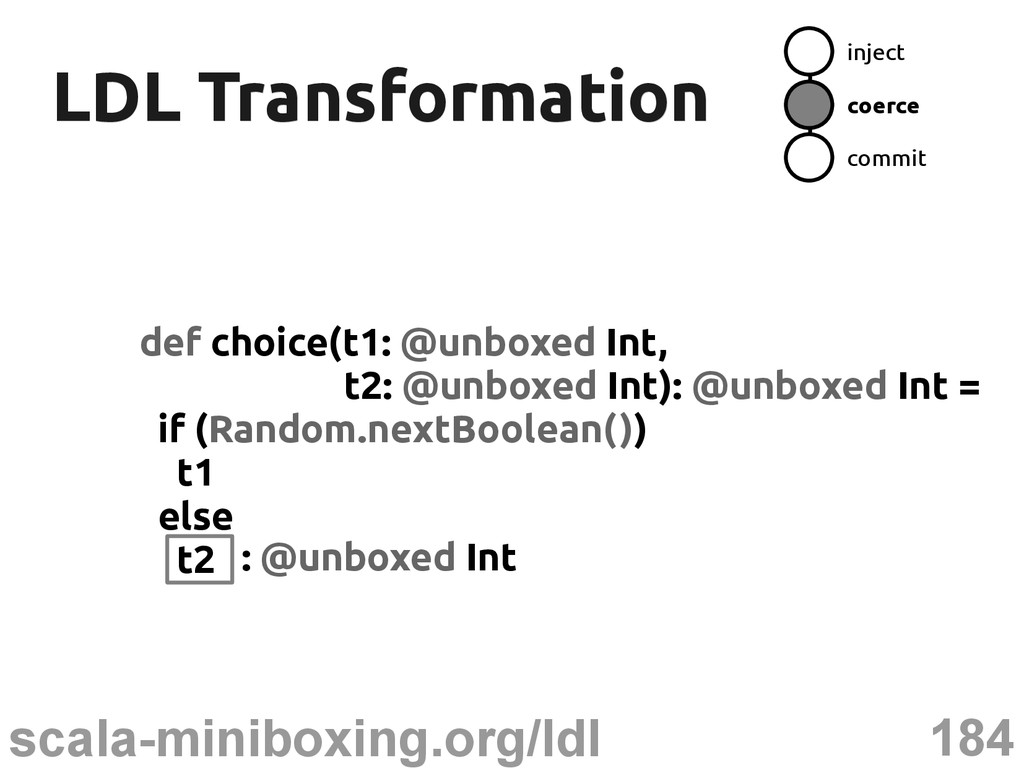
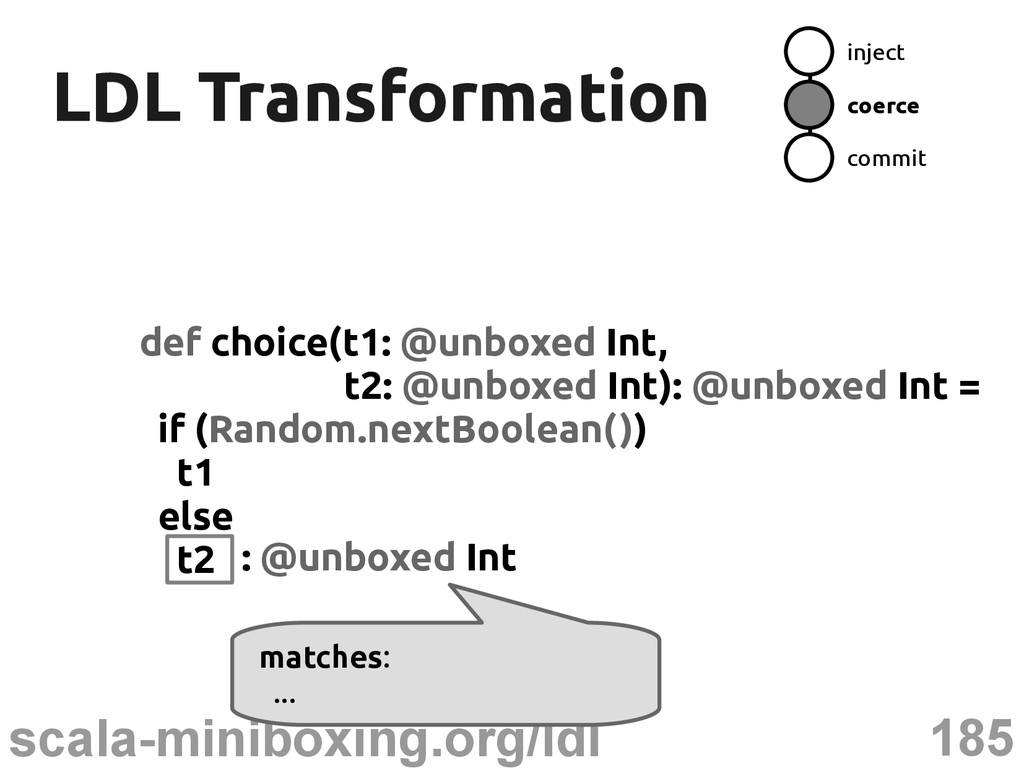
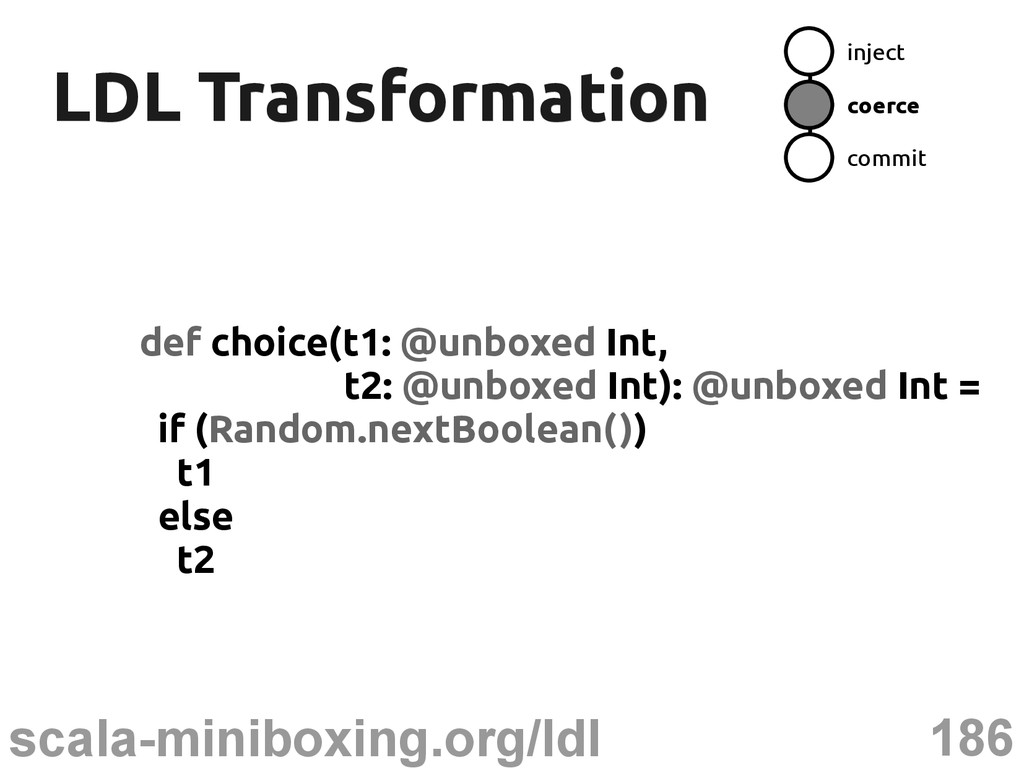
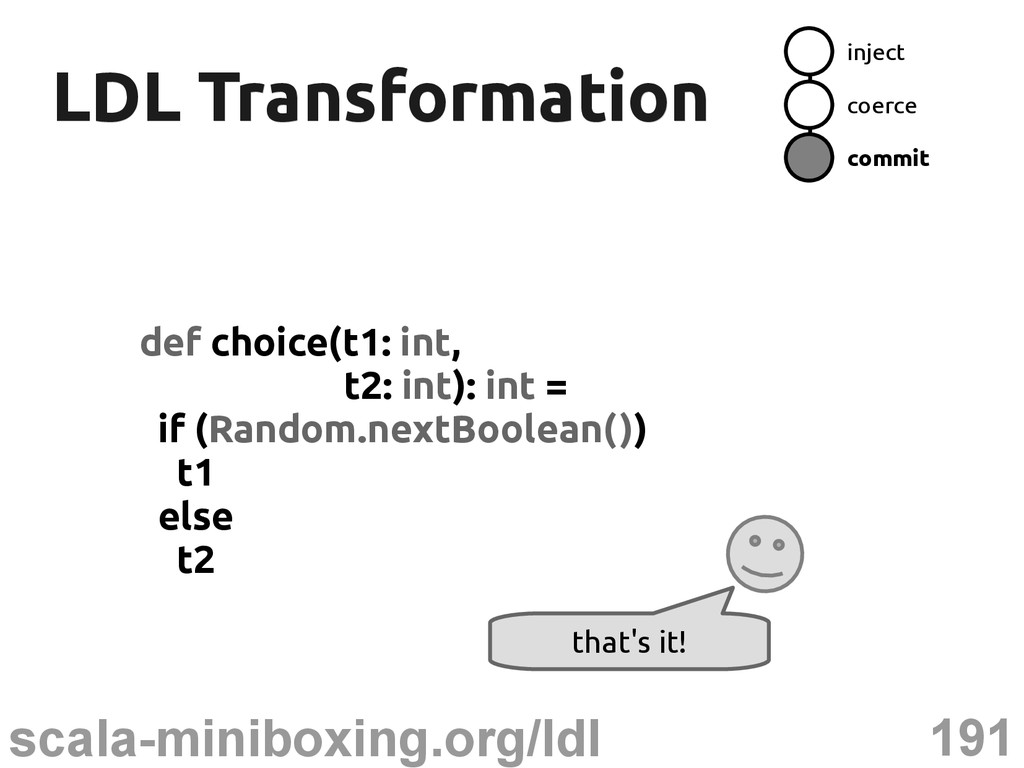
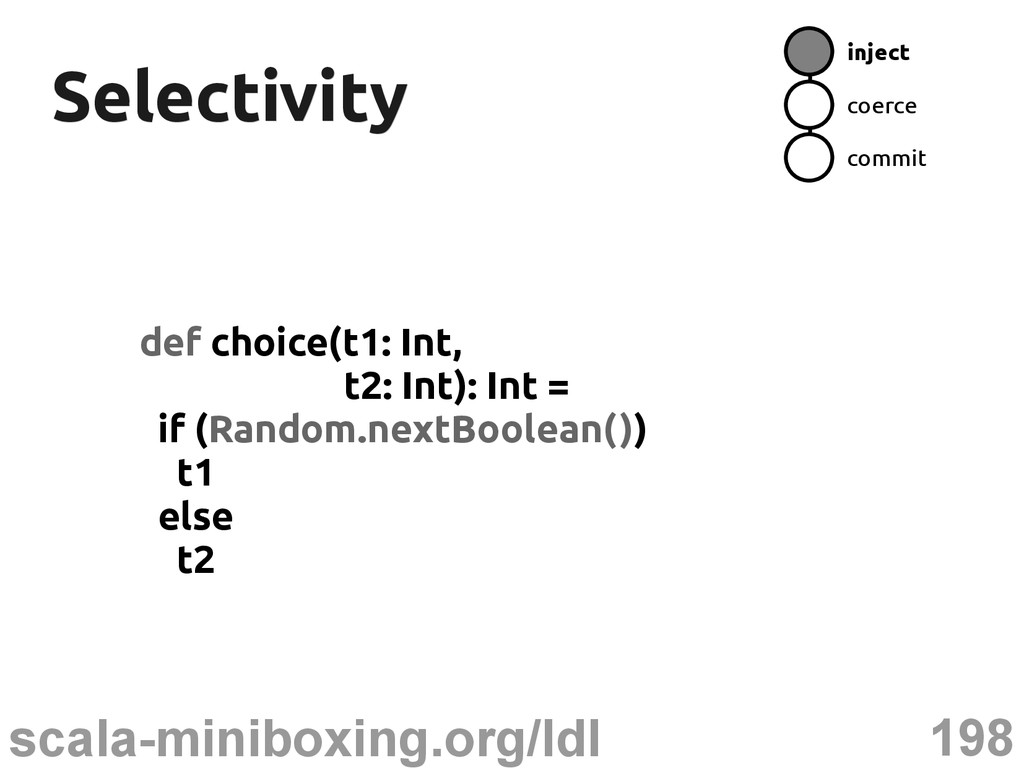
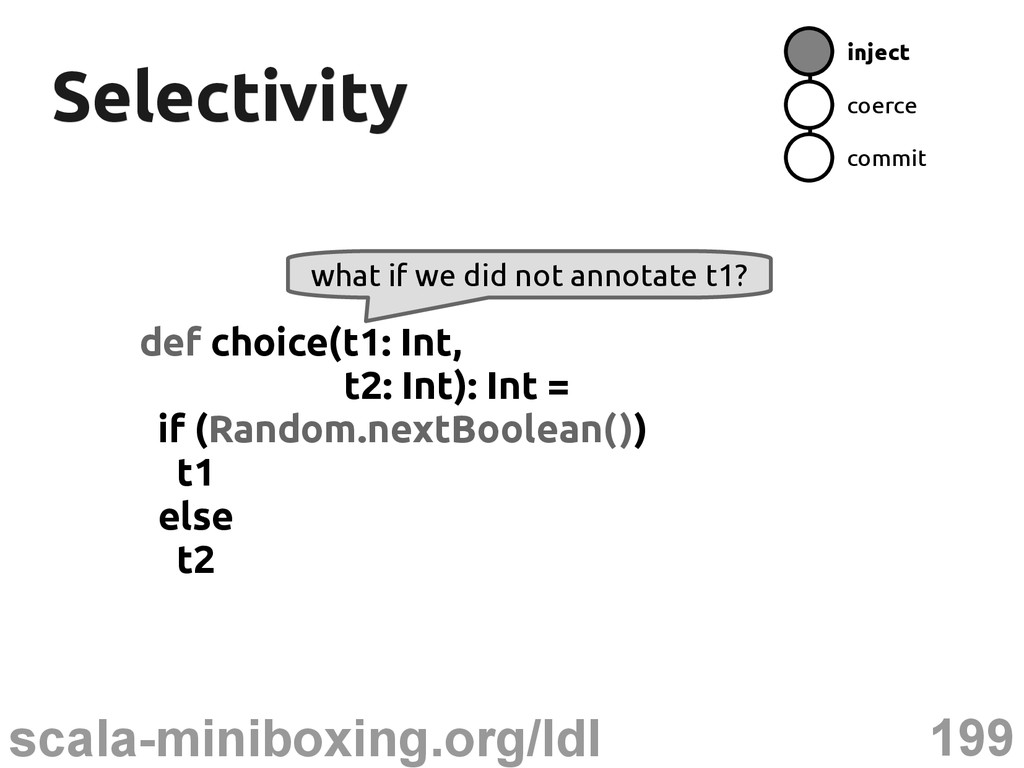
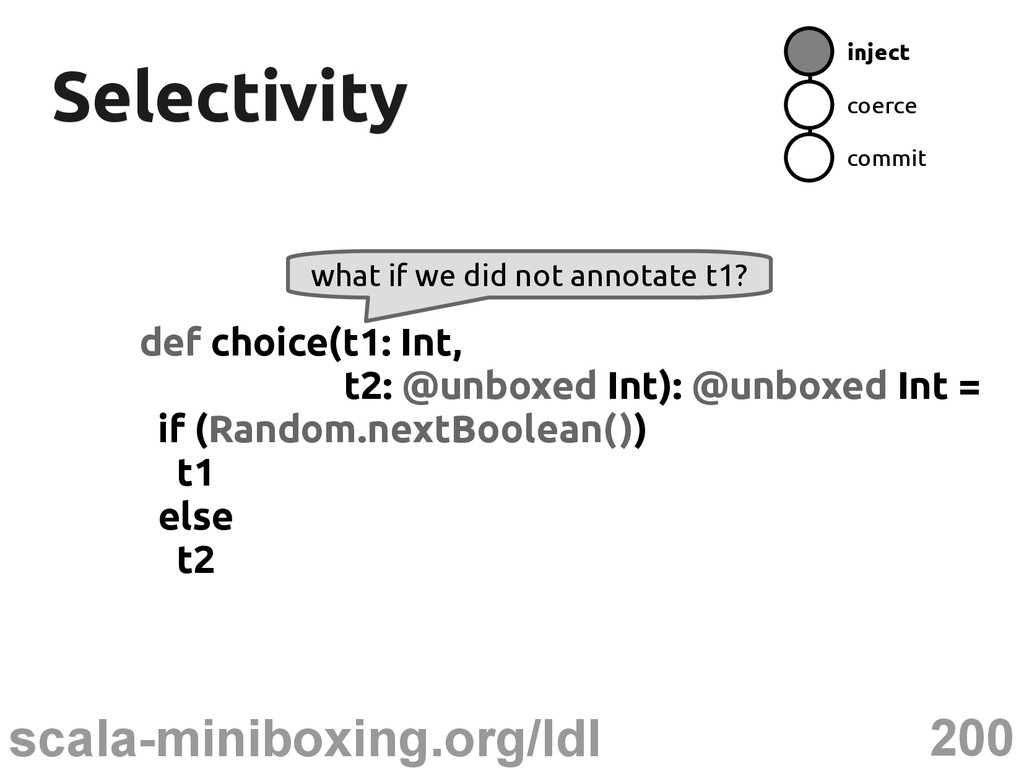
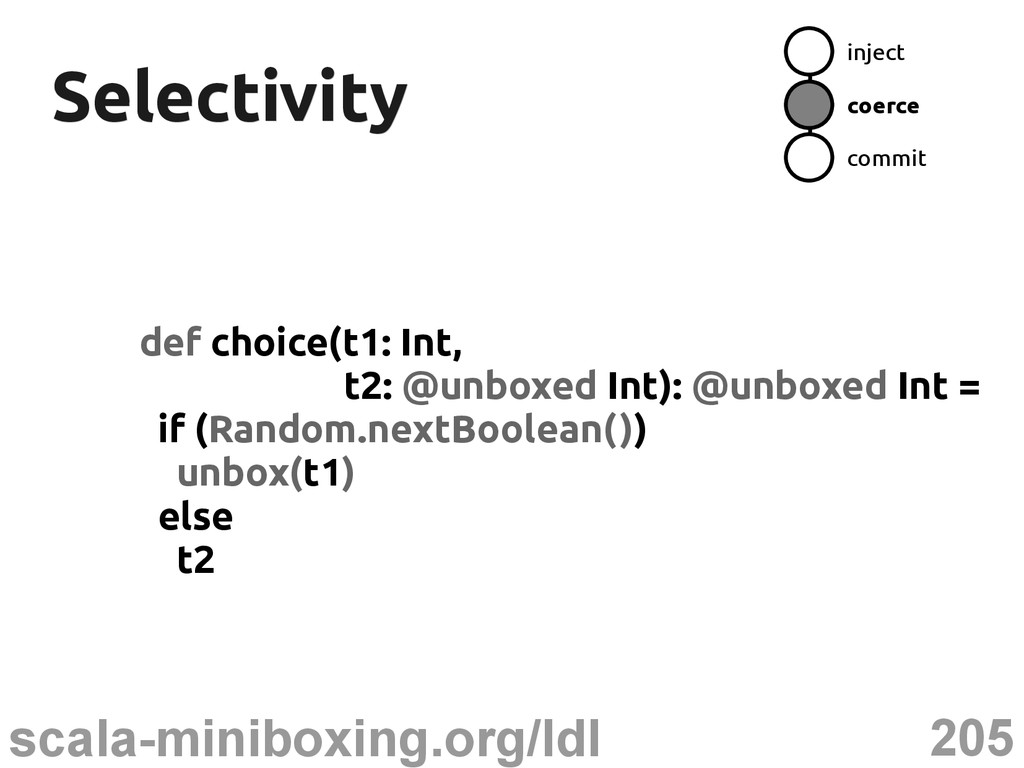
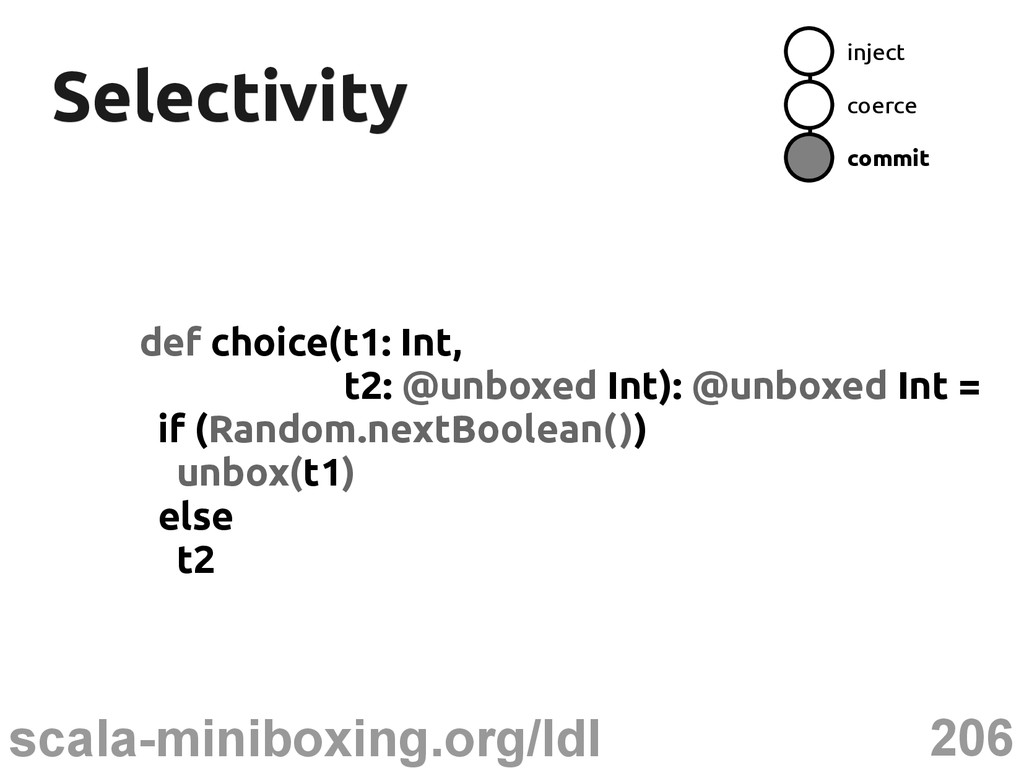
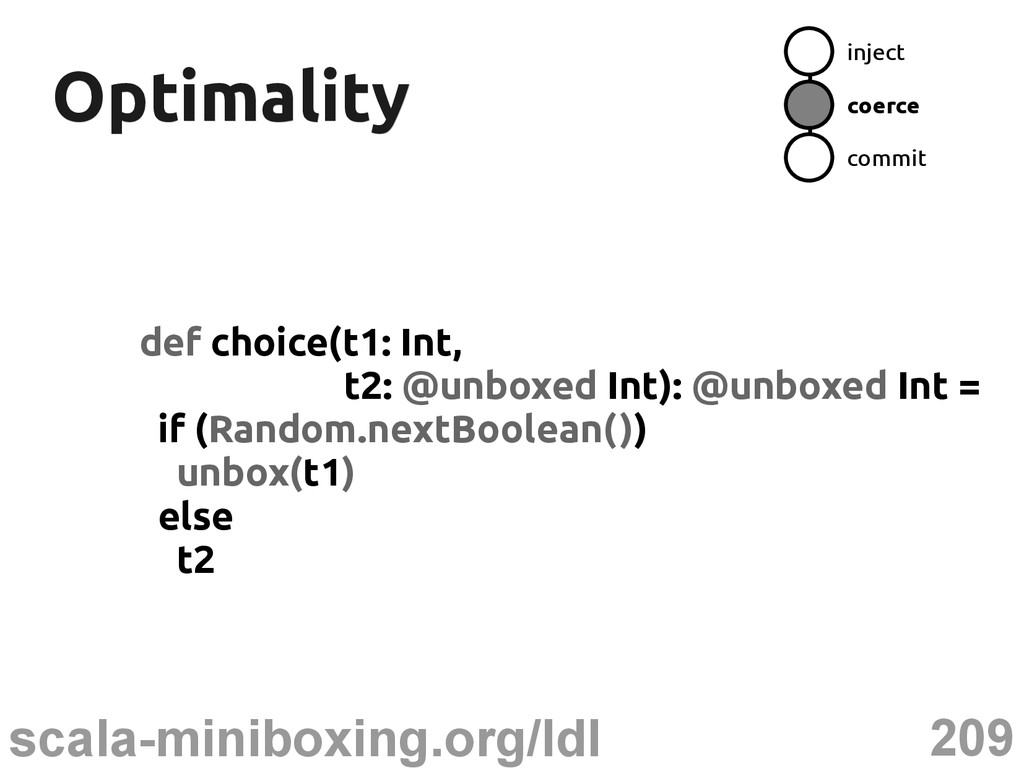
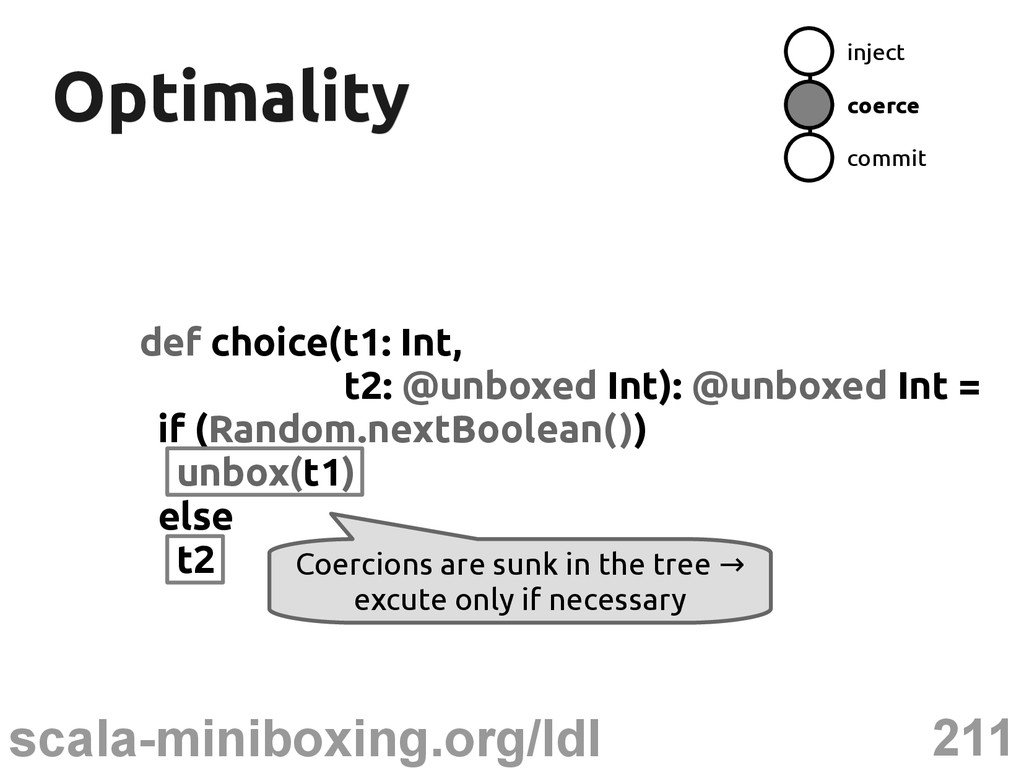
t2: @unboxed Int): @unboxed Int = if (Random.nextBoolean()) t1 else t2 inject coerce commit configurable introduction of annotations based on external constraints
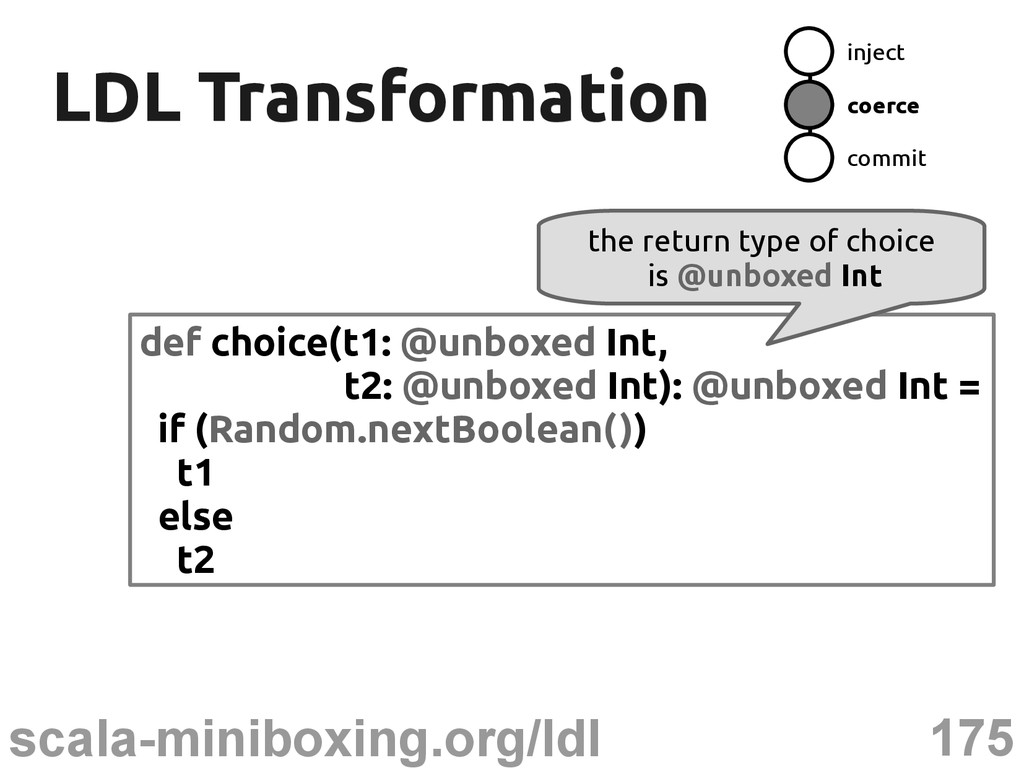
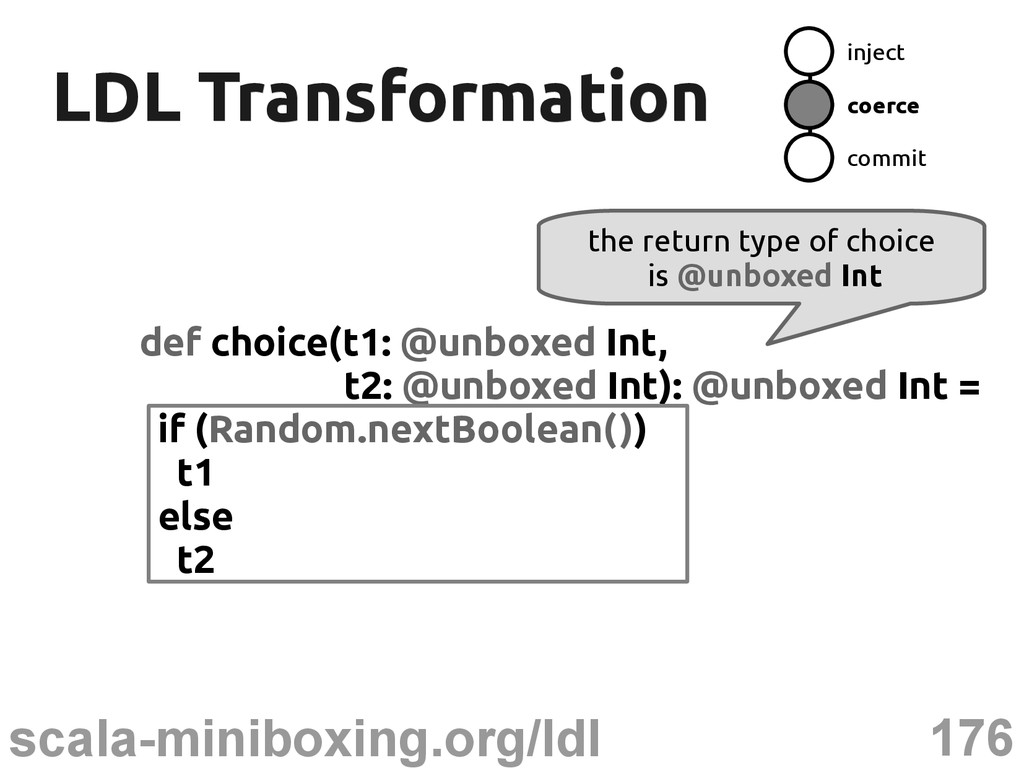
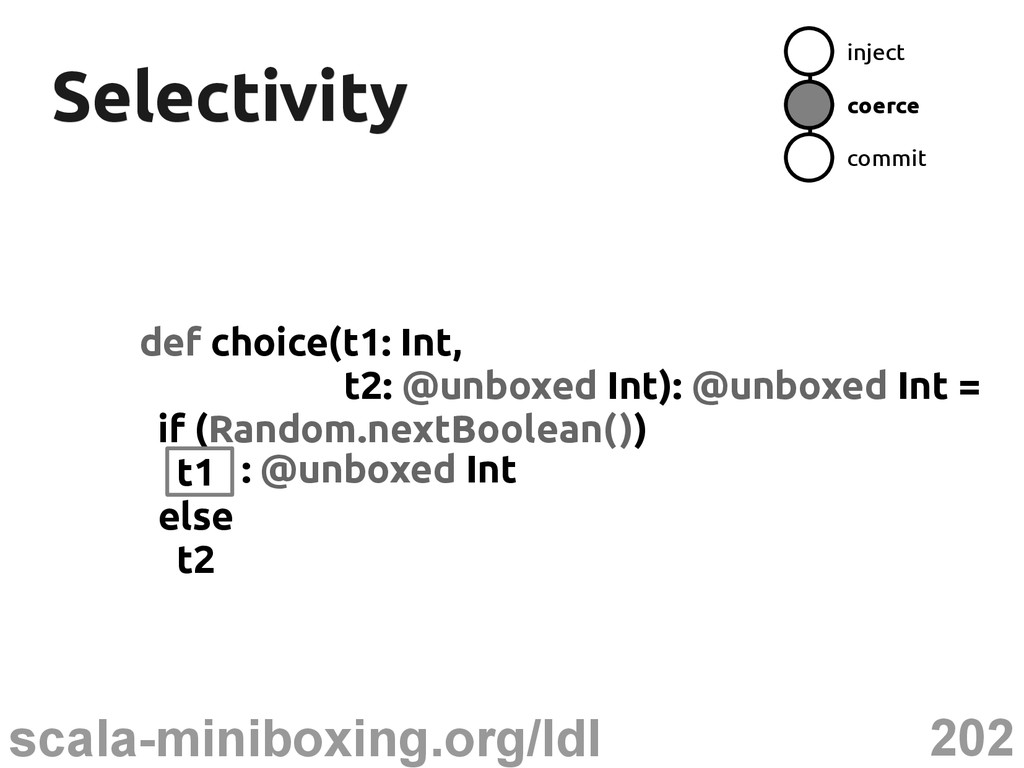
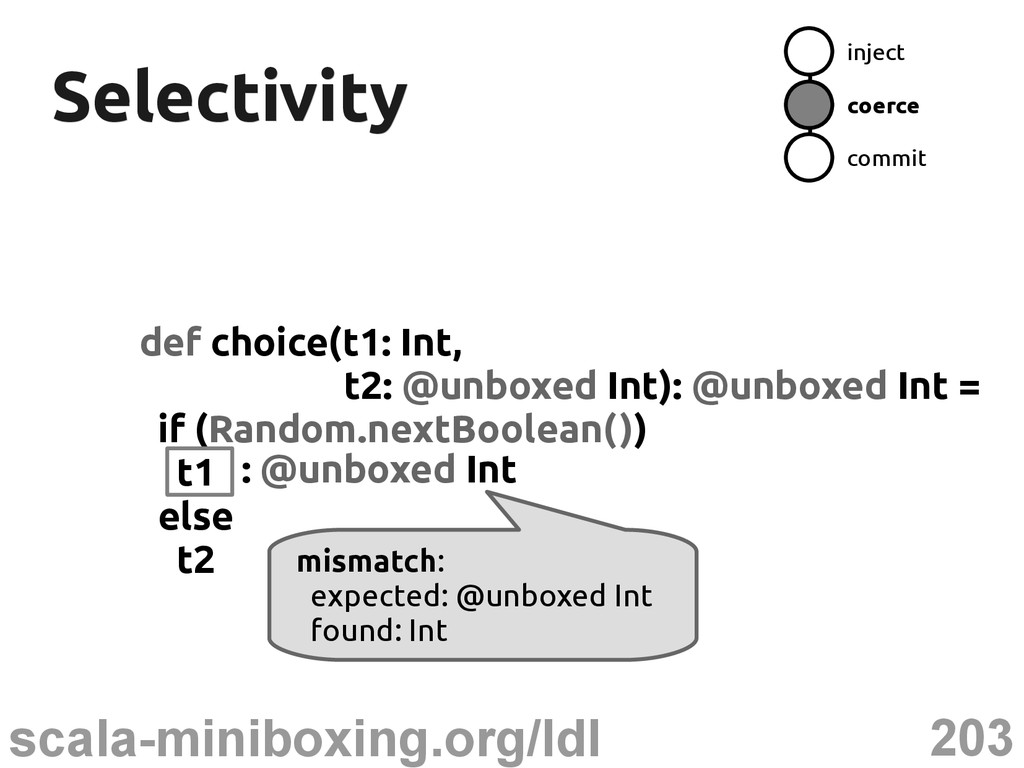
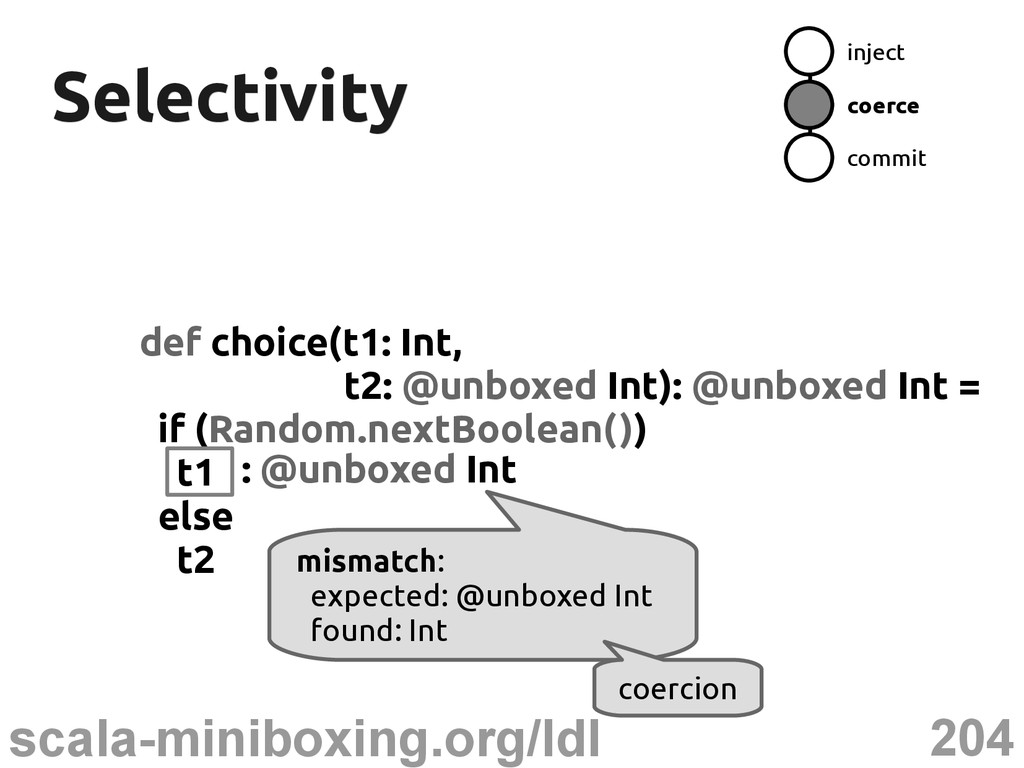
t2: @unboxed Int): @unboxed Int = if (Random.nextBoolean()) t1 else t2 inject coerce commit : @unboxed Int expected type (part of local type inference) the return type of choice is @unboxed Int
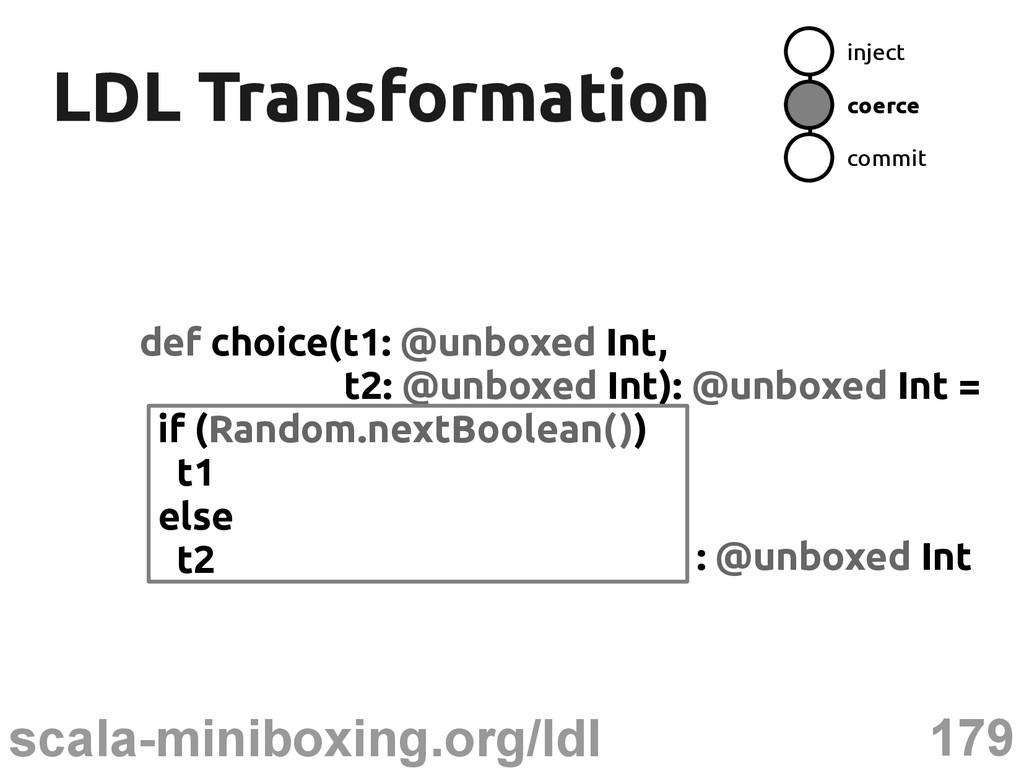
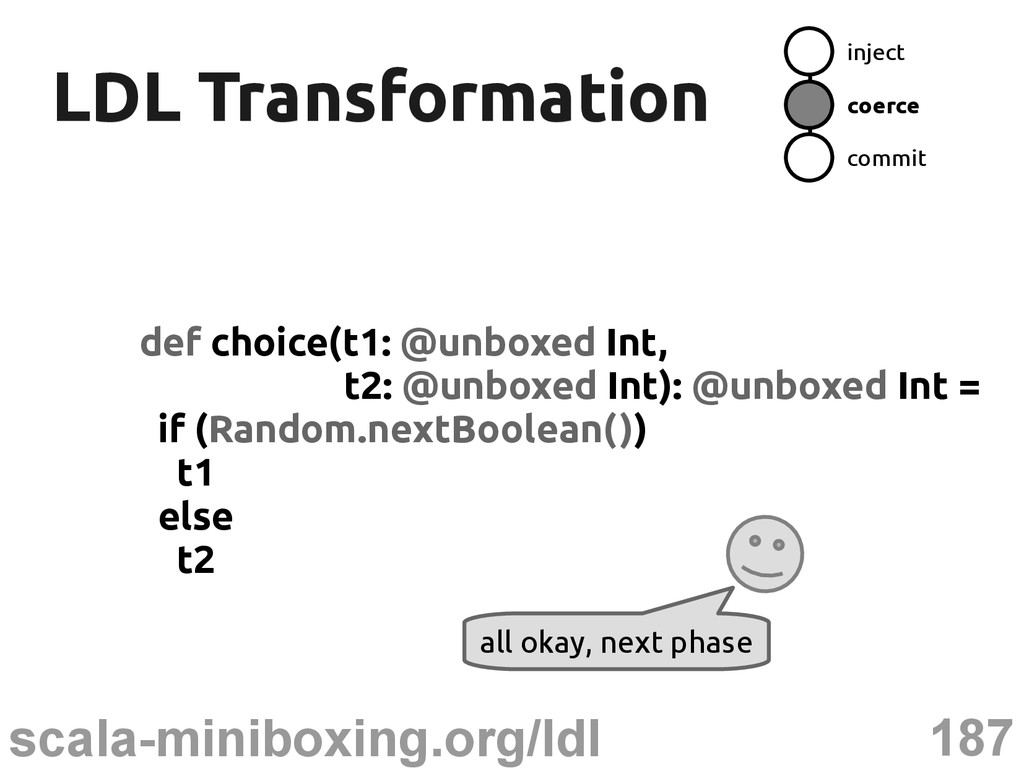
t2: @unboxed Int): @unboxed Int = if (Random.nextBoolean()) t1 else t2 inject coerce commit : @unboxed Int matches: expected: @unboxed Int found: @unboxed Int
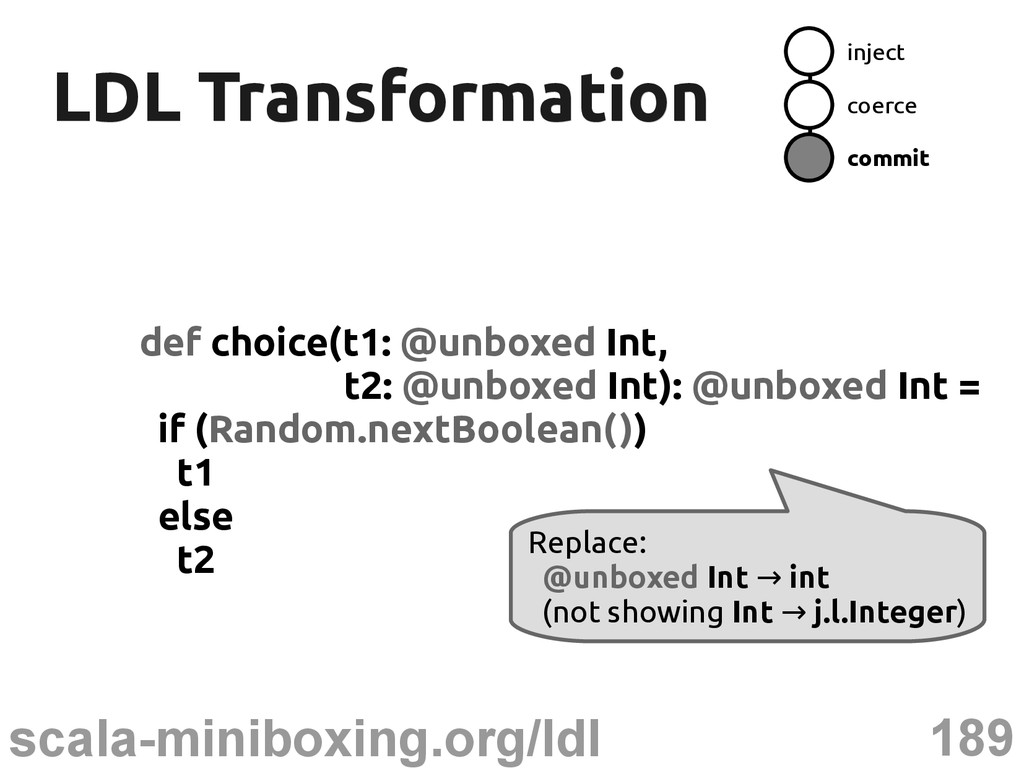
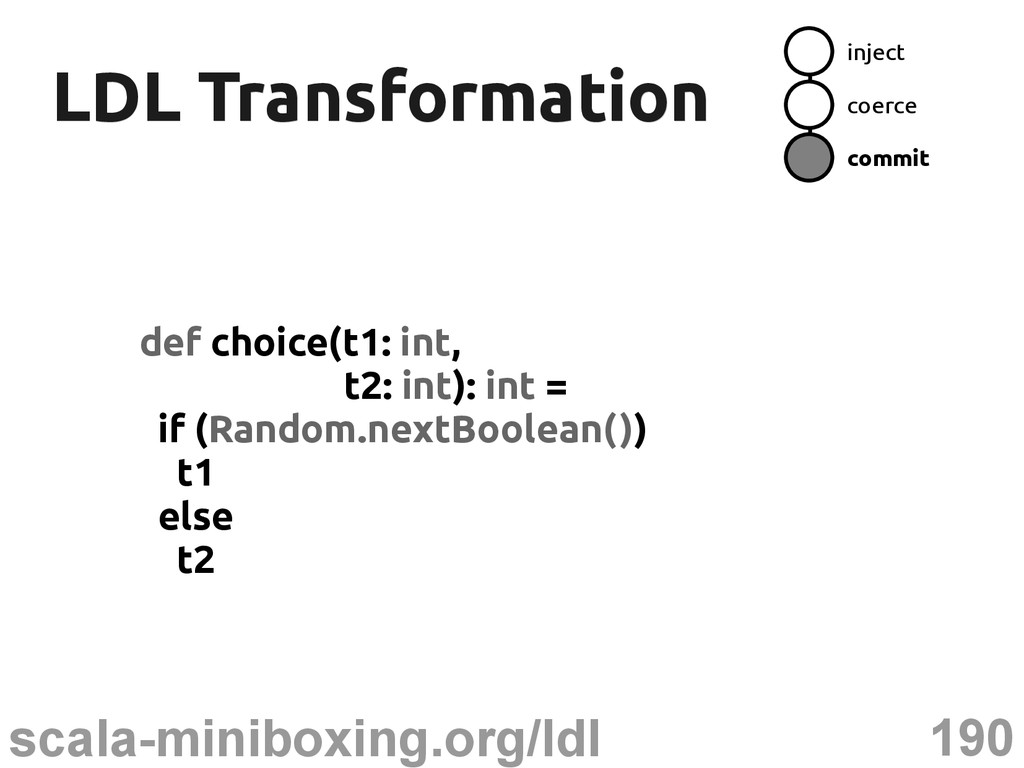
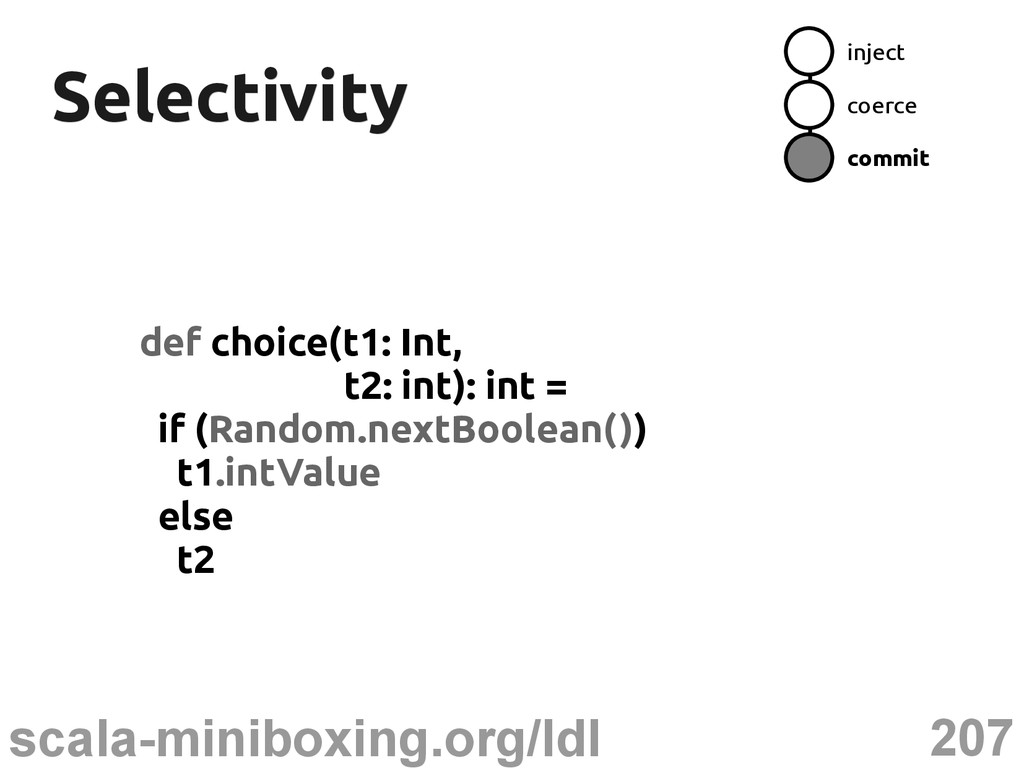
t2: @unboxed Int): @unboxed Int = if (Random.nextBoolean()) t1 else t2 inject coerce commit Replace: @unboxed Int → int (not showing Int → j.l.Integer)
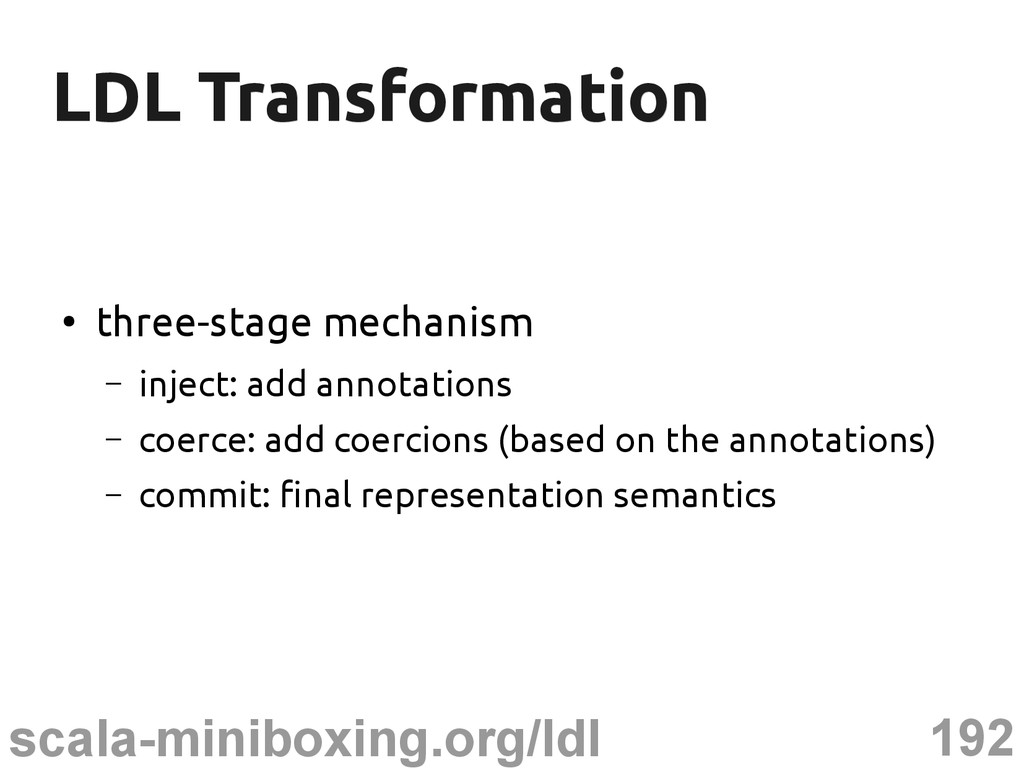
similar transformation – less flexible (no annotations) – entangled with other transformations • we took what's good – and allowed the transformation to work on other use cases as well
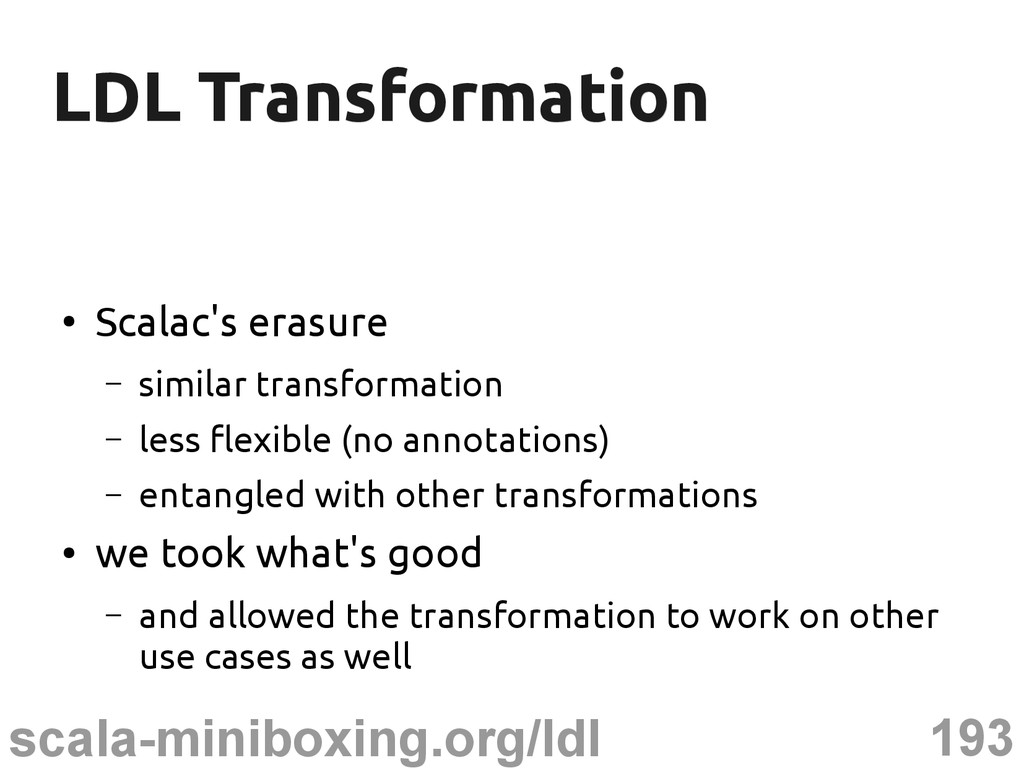
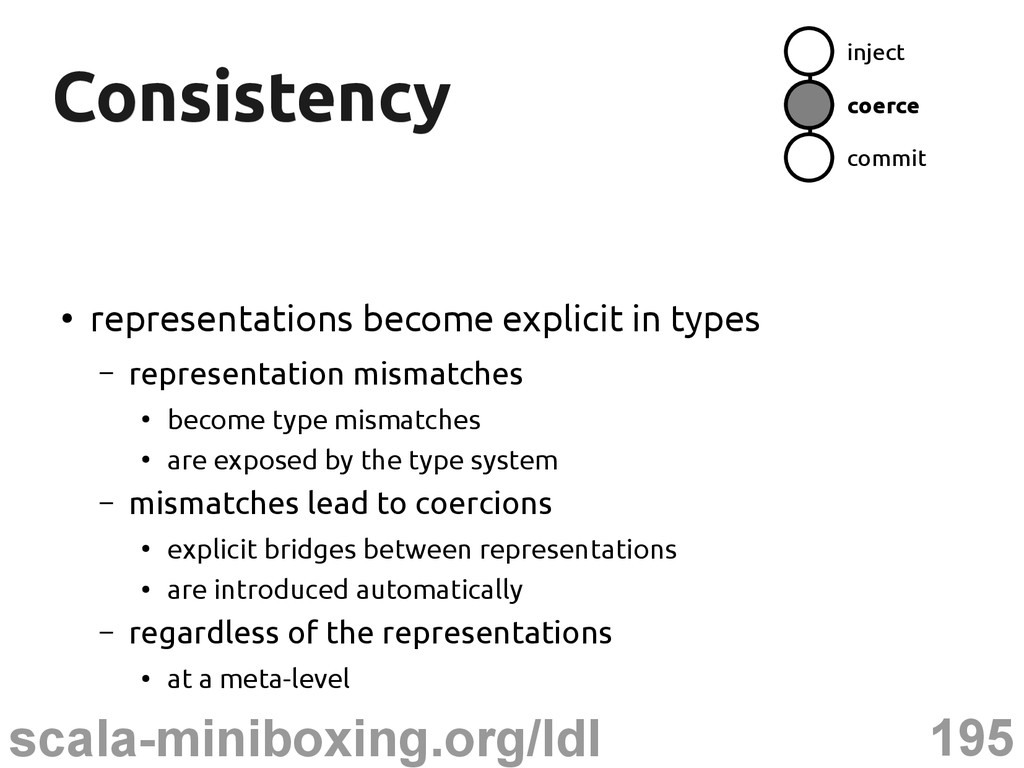
explicit in types – representation mismatches • become type mismatches • are exposed by the type system – mismatches lead to coercions • explicit bridges between representations • are introduced automatically – regardless of the representations • at a meta-level
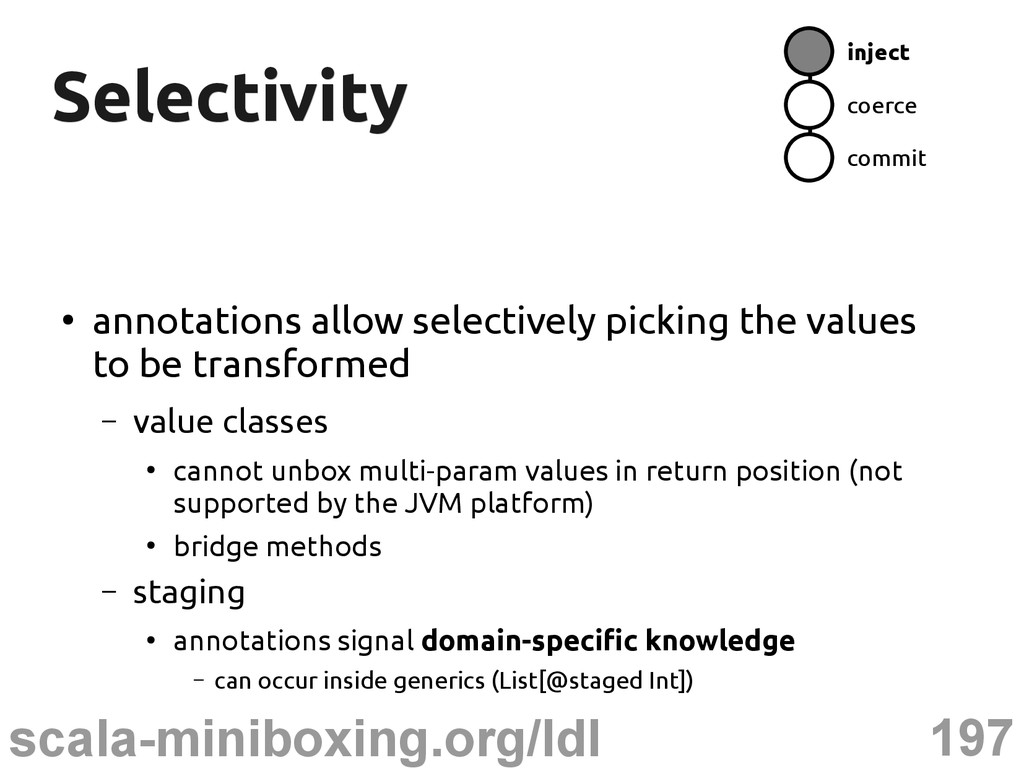
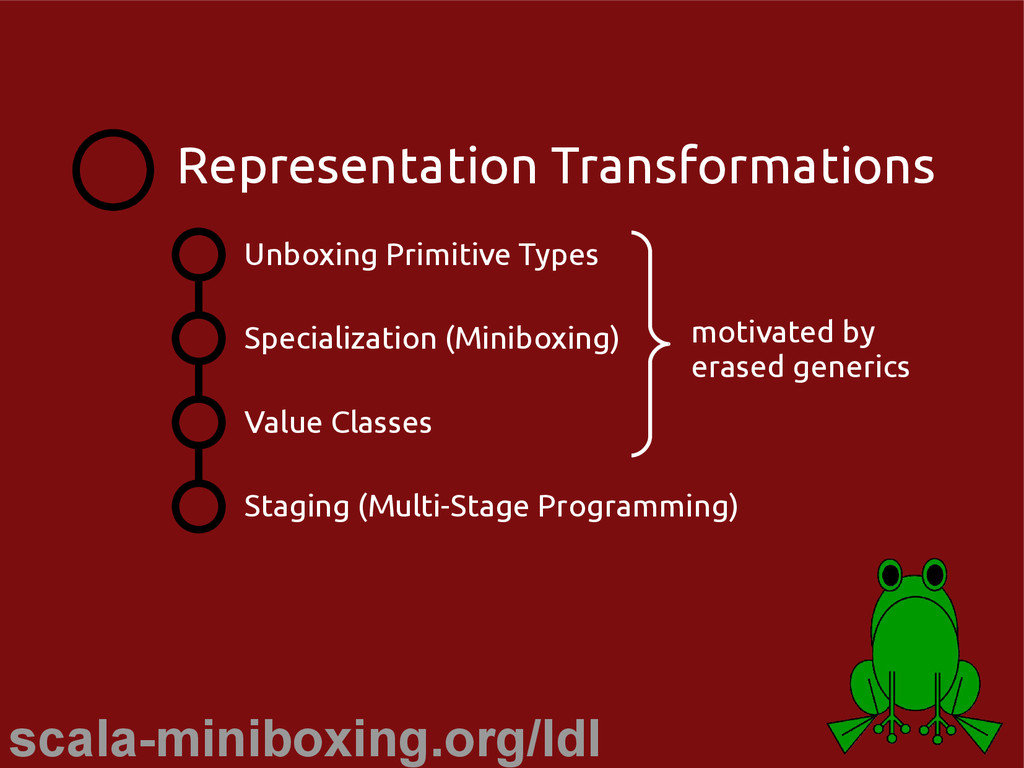
selectively picking the values to be transformed – value classes • cannot unbox multi-param values in return position (not supported by the JVM platform) • bridge methods – staging • annotations signal domain-specific knowledge – can occur inside generics (List[@staged Int])
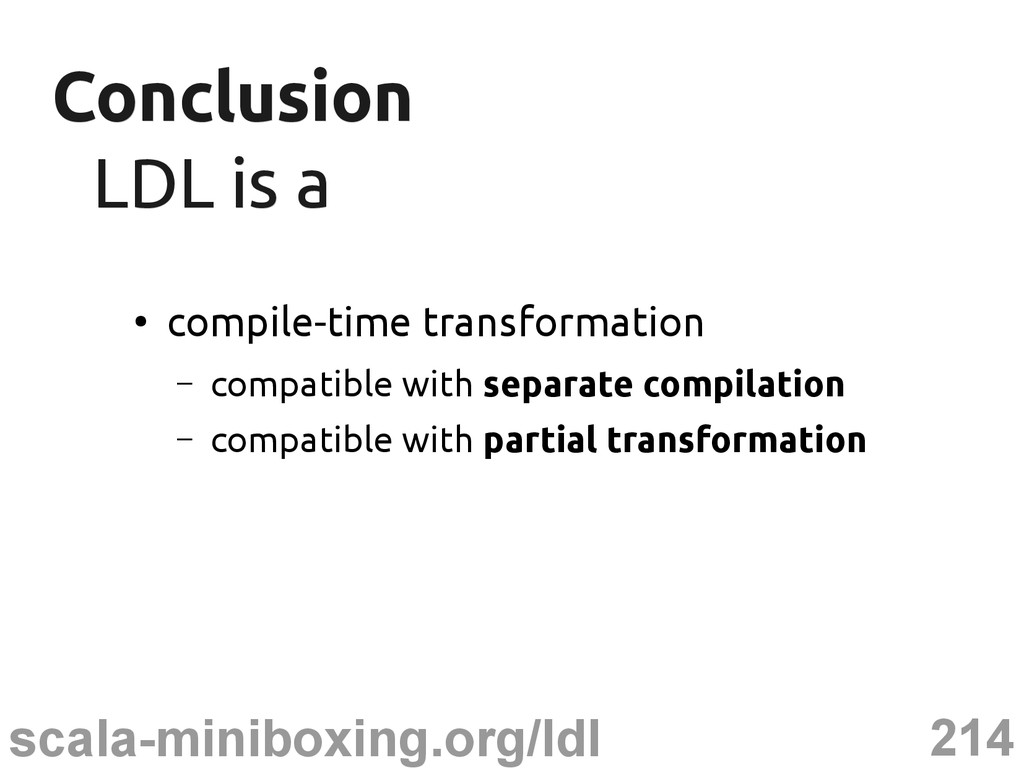
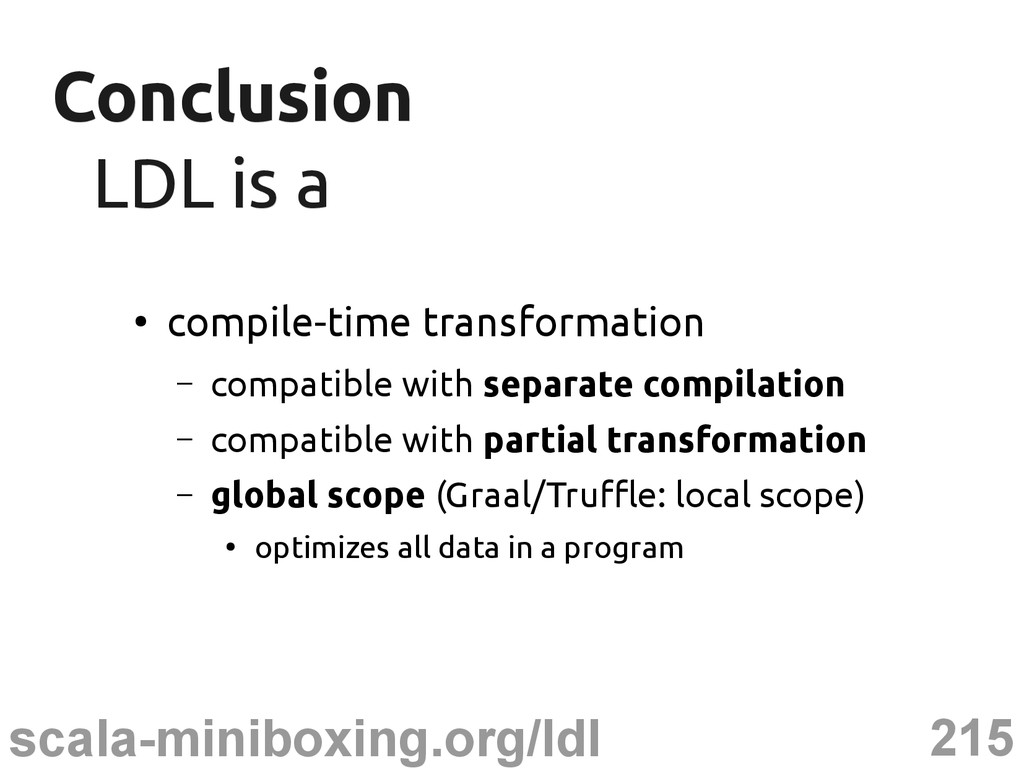
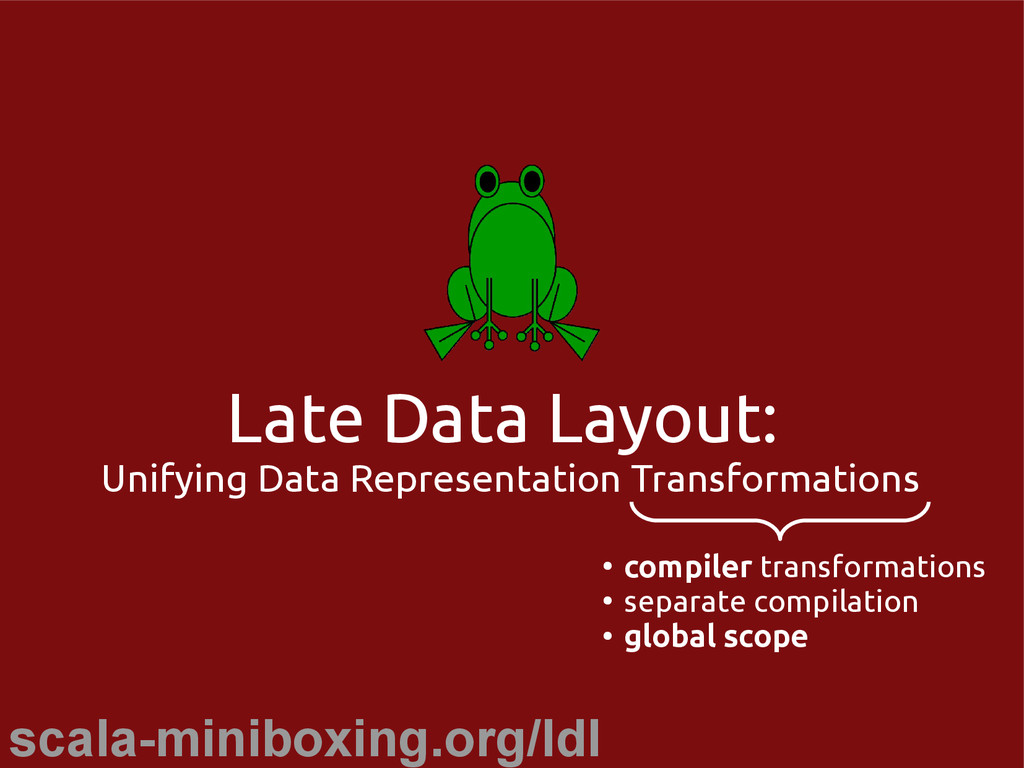
• compile-time transformation – compatible with separate compilation – compatible with partial transformation – global scope (Graal/Truffle: local scope) • optimizes all data in a program
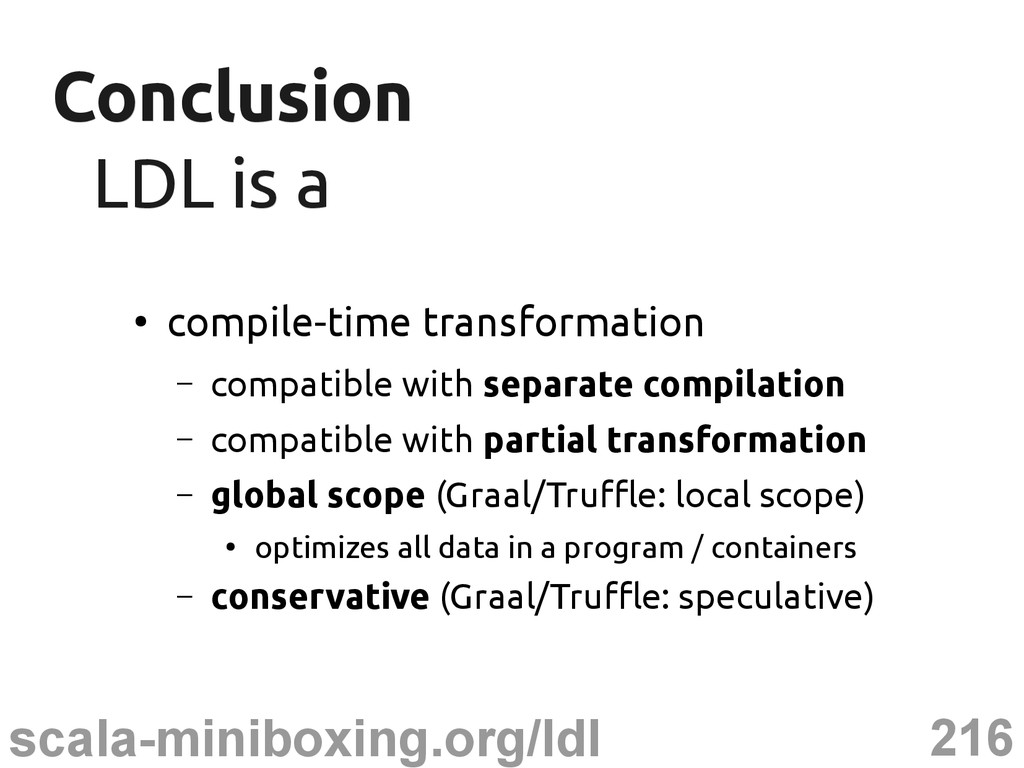
• compile-time transformation – compatible with separate compilation – compatible with partial transformation – global scope (Graal/Truffle: local scope) • optimizes all data in a program / containers – conservative (Graal/Truffle: speculative)
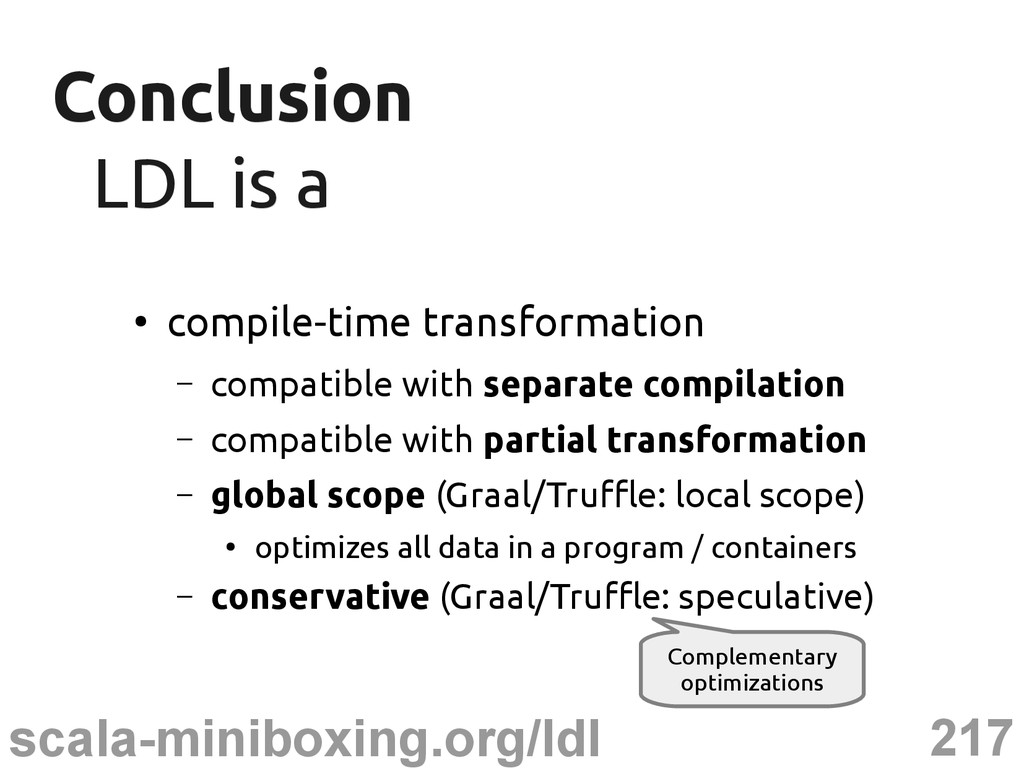
• compile-time transformation – compatible with separate compilation – compatible with partial transformation – global scope (Graal/Truffle: local scope) • optimizes all data in a program / containers – conservative (Graal/Truffle: speculative) Complementary optimizations
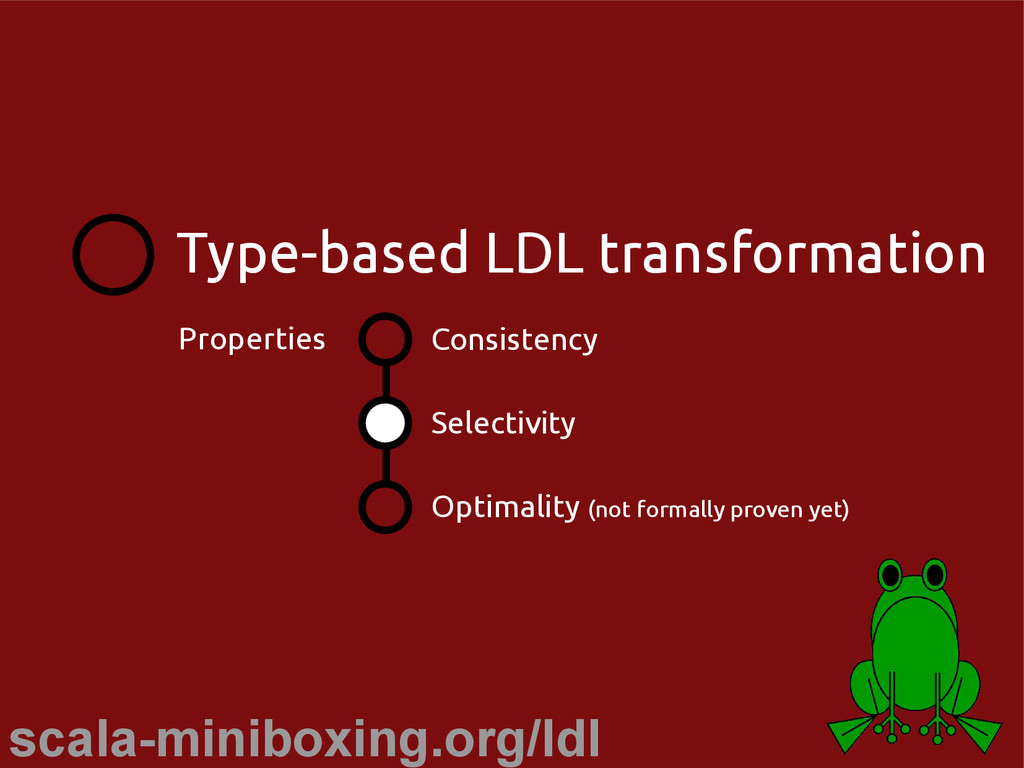
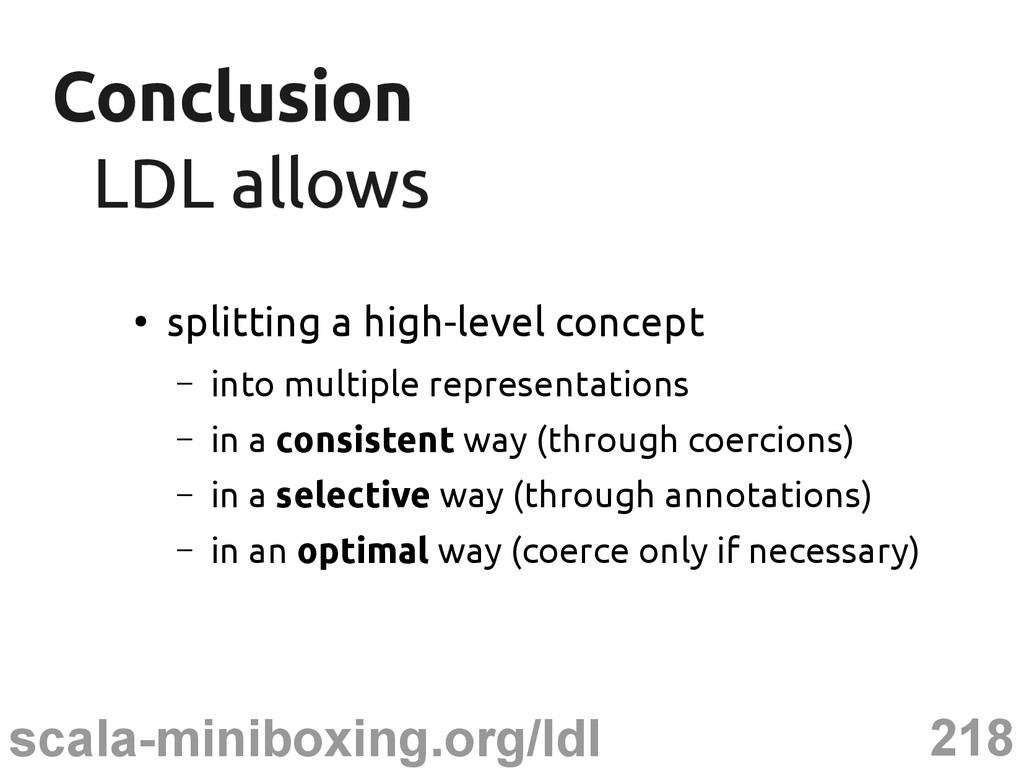
a high-level concept – into multiple representations – in a consistent way (through coercions) – in a selective way (through annotations) – in an optimal way (coerce only if necessary)
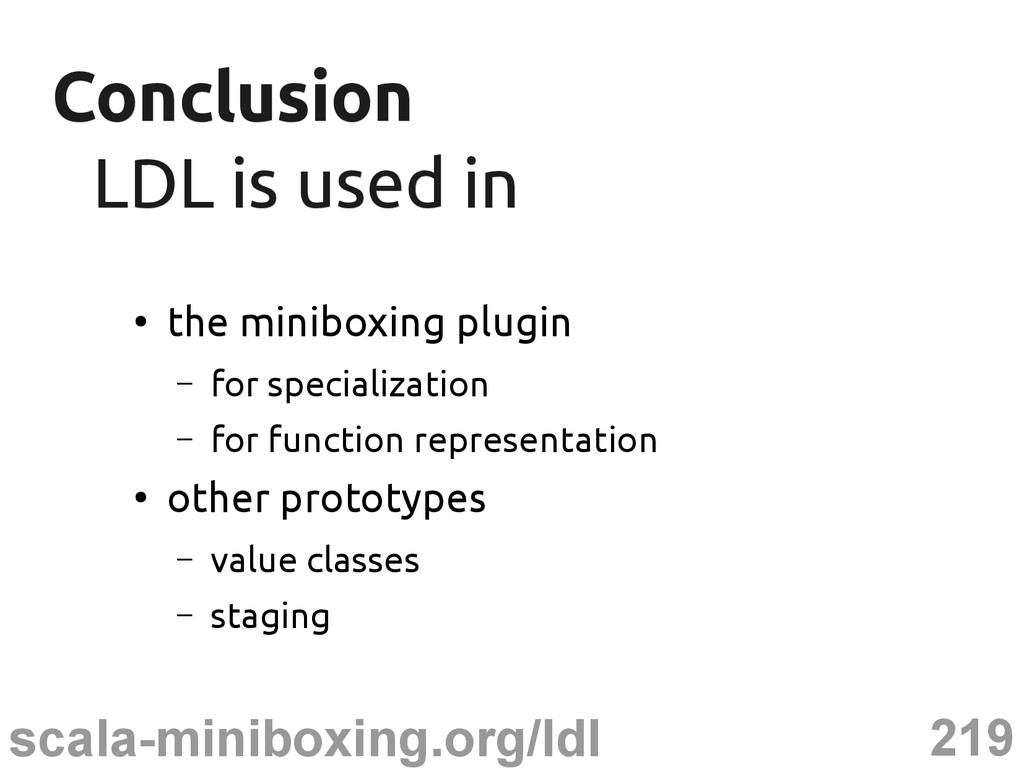
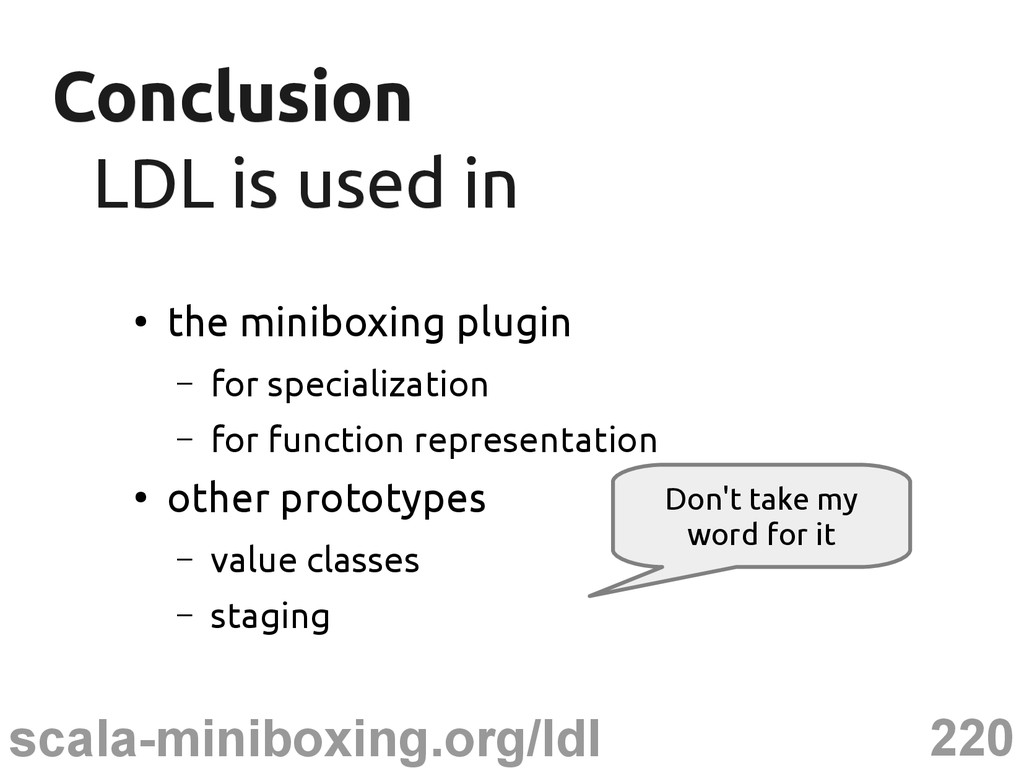
used in • the miniboxing plugin – for specialization – for function representation • other prototypes – value classes – staging Don't take my word for it
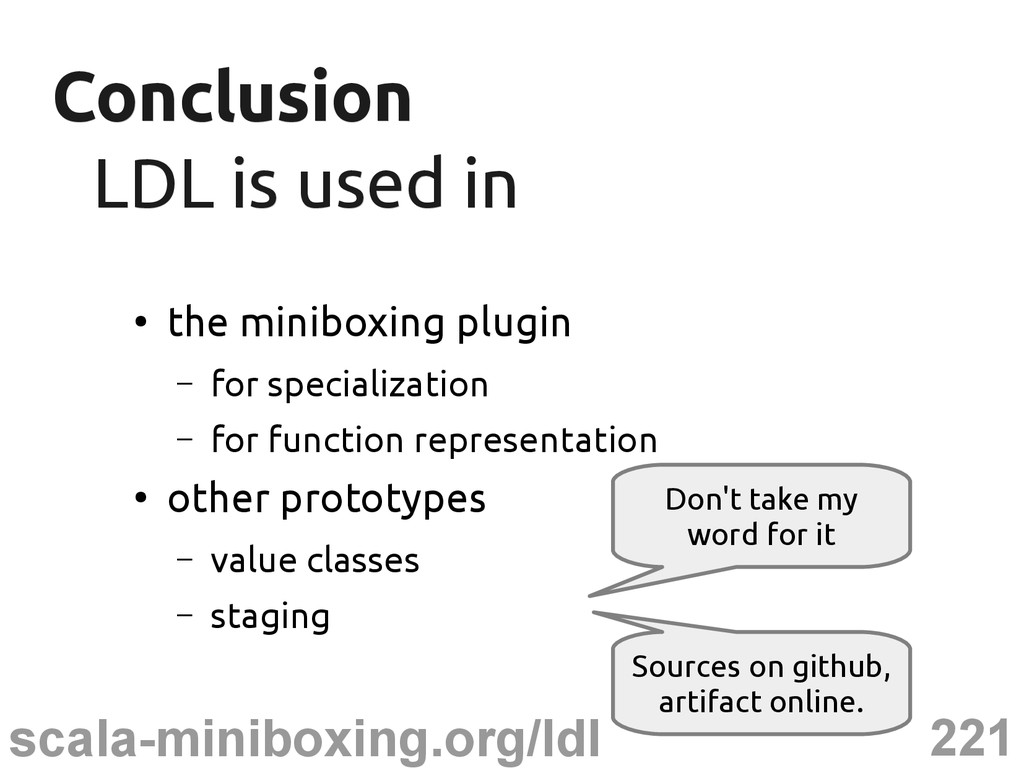
used in • the miniboxing plugin – for specialization – for function representation • other prototypes – value classes – staging Don't take my word for it Sources on github, artifact online.
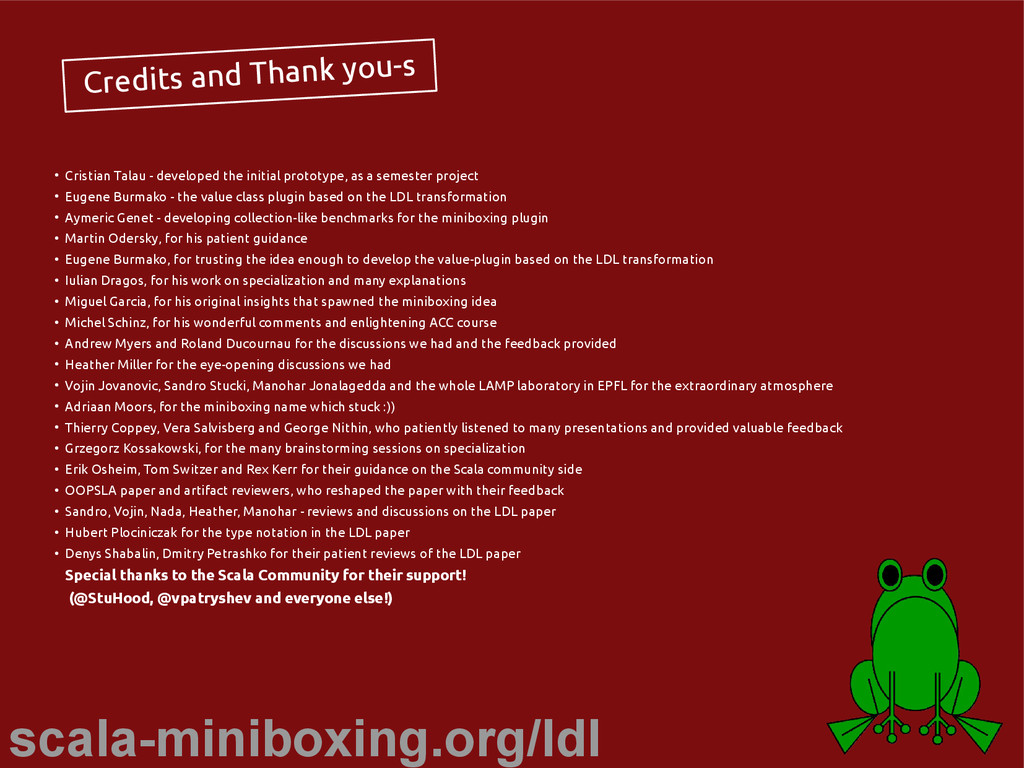
the initial prototype, as a semester project • Eugene Burmako - the value class plugin based on the LDL transformation • Aymeric Genet - developing collection-like benchmarks for the miniboxing plugin • Martin Odersky, for his patient guidance • Eugene Burmako, for trusting the idea enough to develop the value-plugin based on the LDL transformation • Iulian Dragos, for his work on specialization and many explanations • Miguel Garcia, for his original insights that spawned the miniboxing idea • Michel Schinz, for his wonderful comments and enlightening ACC course • Andrew Myers and Roland Ducournau for the discussions we had and the feedback provided • Heather Miller for the eye-opening discussions we had • Vojin Jovanovic, Sandro Stucki, Manohar Jonalagedda and the whole LAMP laboratory in EPFL for the extraordinary atmosphere • Adriaan Moors, for the miniboxing name which stuck :)) • Thierry Coppey, Vera Salvisberg and George Nithin, who patiently listened to many presentations and provided valuable feedback • Grzegorz Kossakowski, for the many brainstorming sessions on specialization • Erik Osheim, Tom Switzer and Rex Kerr for their guidance on the Scala community side • OOPSLA paper and artifact reviewers, who reshaped the paper with their feedback • Sandro, Vojin, Nada, Heather, Manohar - reviews and discussions on the LDL paper • Hubert Plociniczak for the type notation in the LDL paper • Denys Shabalin, Dmitry Petrashko for their patient reviews of the LDL paper Special thanks to the Scala Community for their support! (@StuHood, @vpatryshev and everyone else!)


 vladureche
 hollycummins
 o0h
o0h
 satoshi256kbyte
 rkaga
rkaga
 tosite
 moro
moro
 dske104
 kinopeee
 kishida
 taiseiue
 ivargrimstad
 bluesmoon
 baasie
 jcasabona
 addyosmani
 lara
lara
 morganepeng
 cassininazir
 jnunemaker
 jeffersonlam
 sergeychernyshev
 oripsolob
 chriscoyier










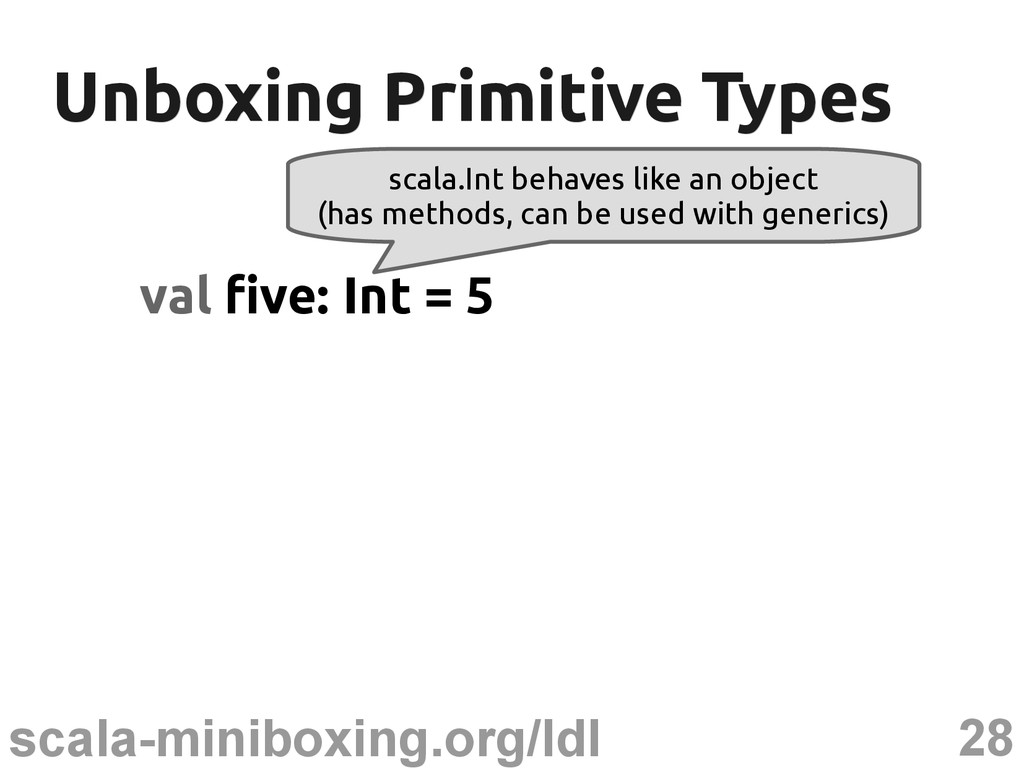
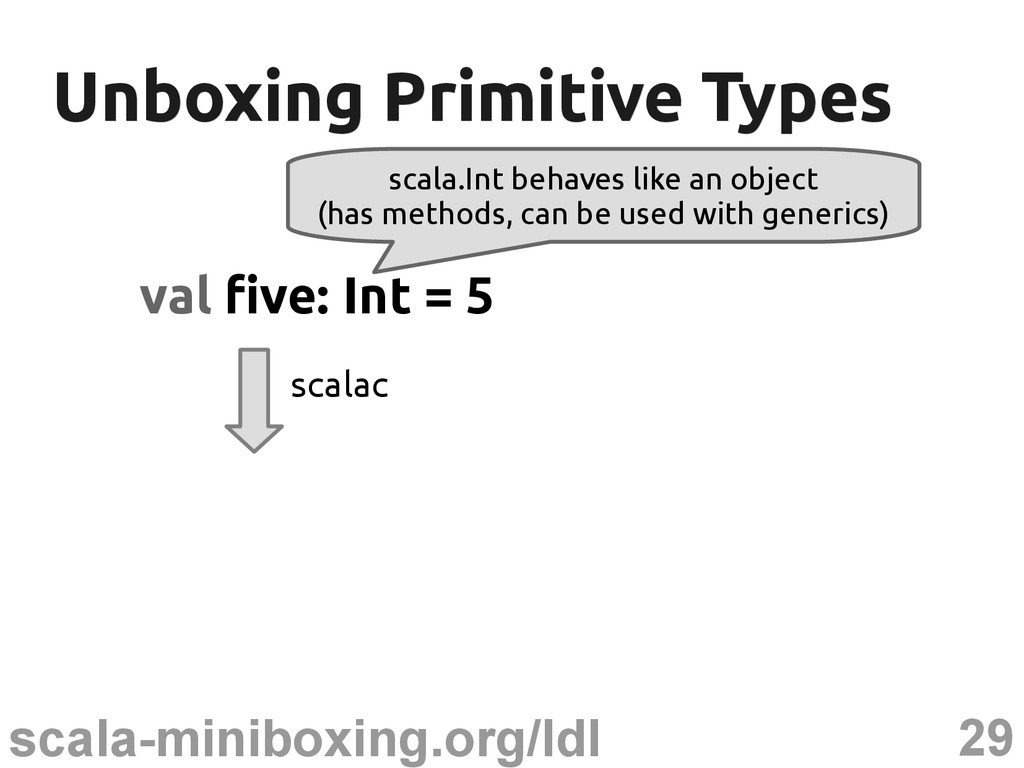
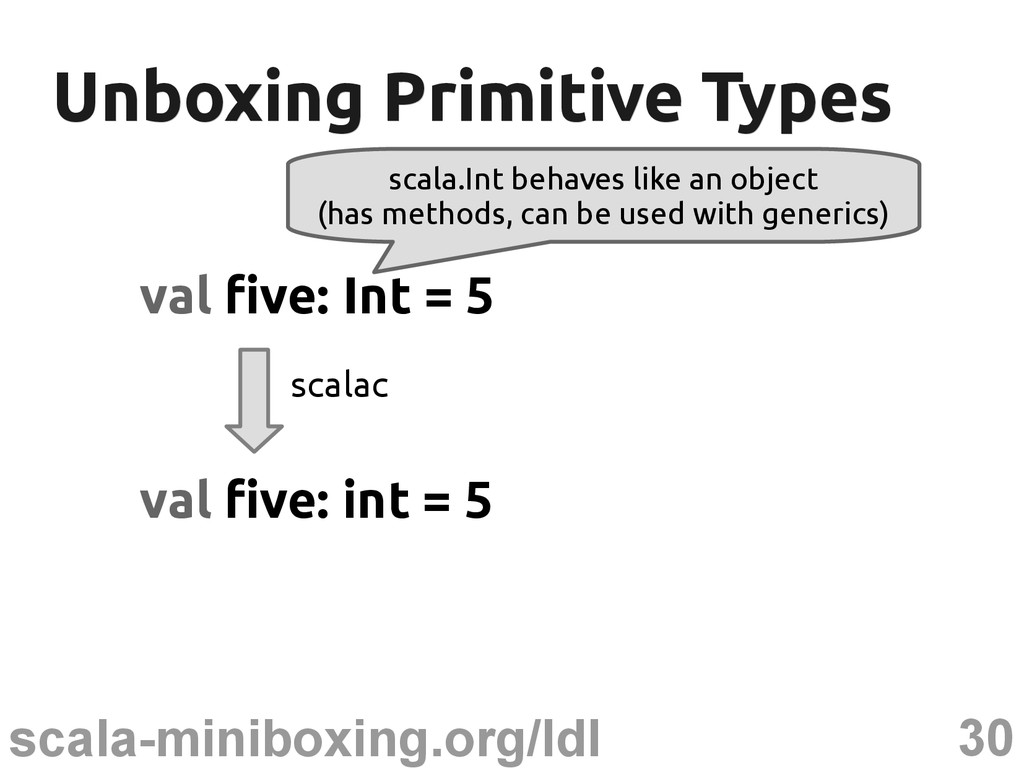
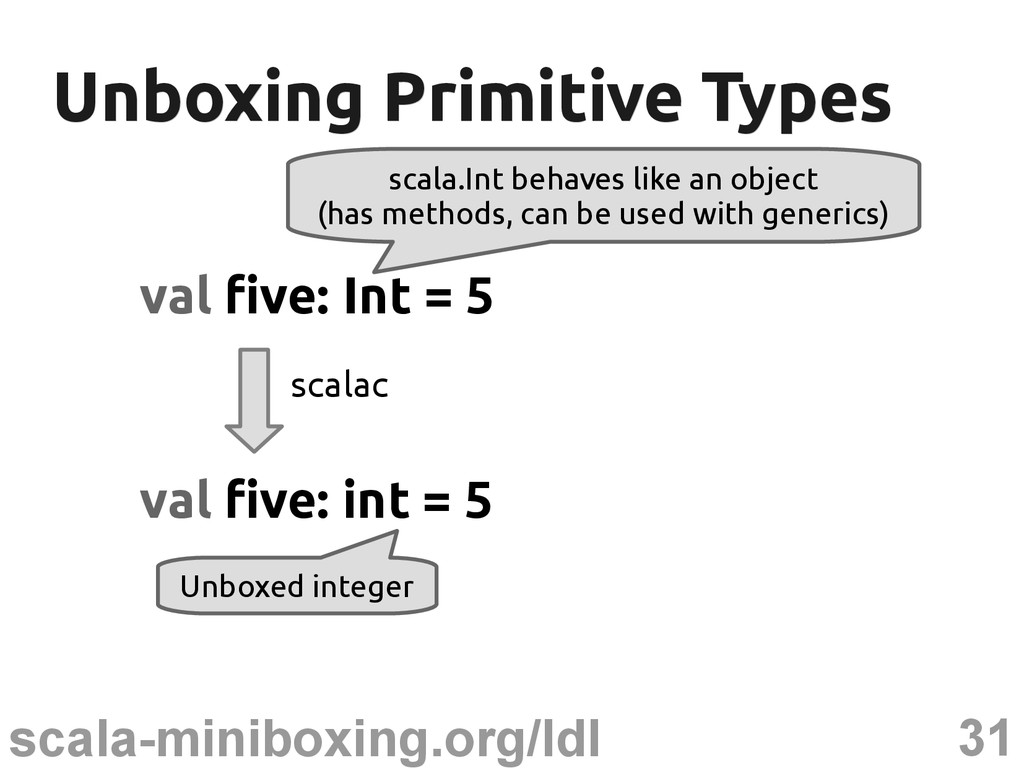

: T = t](https://files.speakerdeck.com/presentations/763ddc501bbd0132a3400ec9c33cef64/slide_43.jpg)
: T = t](https://files.speakerdeck.com/presentations/763ddc501bbd0132a3400ec9c33cef64/slide_44.jpg)
: T = t](https://files.speakerdeck.com/presentations/763ddc501bbd0132a3400ec9c33cef64/slide_45.jpg)
: T = t](https://files.speakerdeck.com/presentations/763ddc501bbd0132a3400ec9c33cef64/slide_46.jpg)
: T = t](https://files.speakerdeck.com/presentations/763ddc501bbd0132a3400ec9c33cef64/slide_47.jpg)
: T = t](https://files.speakerdeck.com/presentations/763ddc501bbd0132a3400ec9c33cef64/slide_48.jpg)
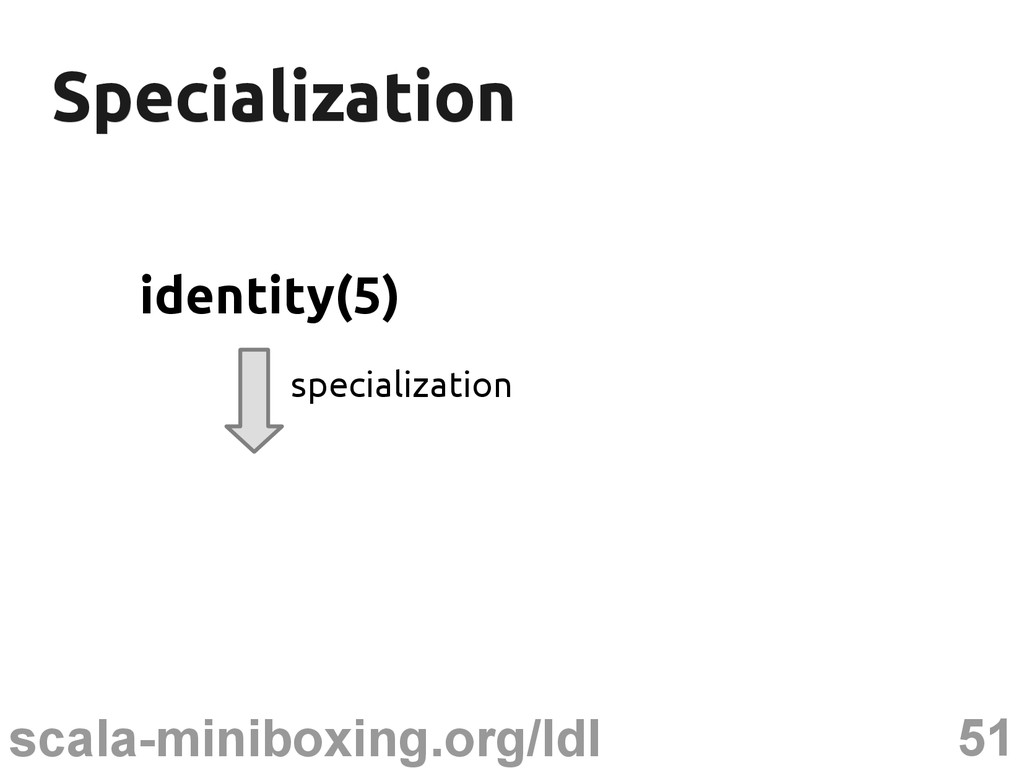

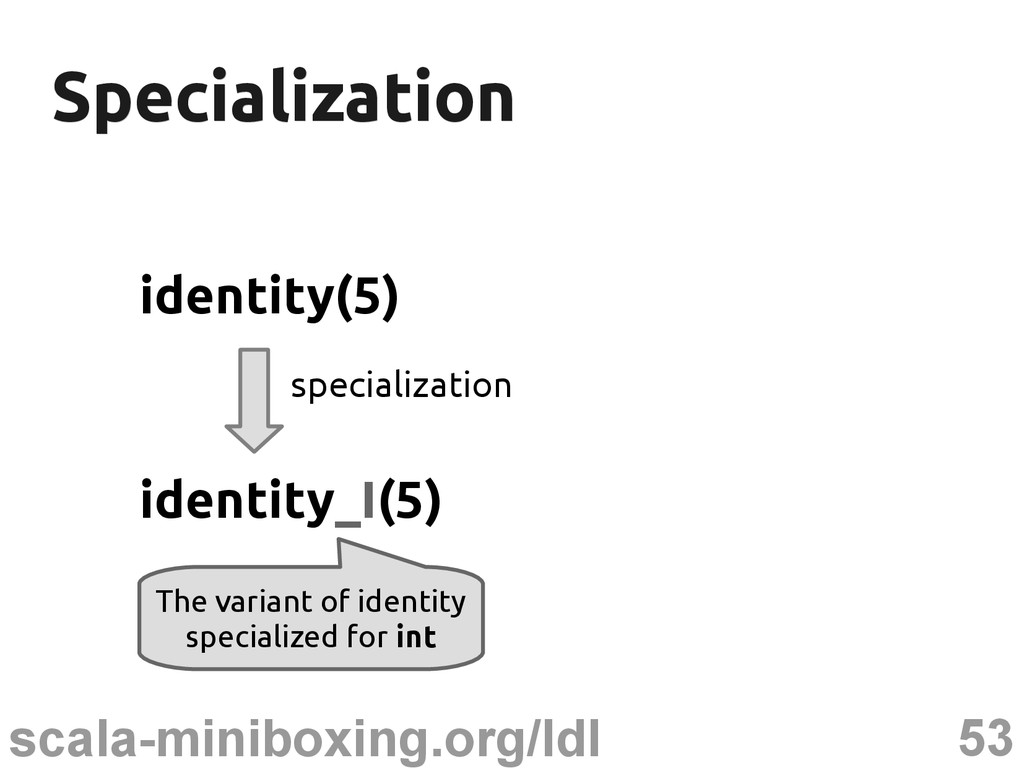

](https://files.speakerdeck.com/presentations/763ddc501bbd0132a3400ec9c33cef64/slide_54.jpg)
](https://files.speakerdeck.com/presentations/763ddc501bbd0132a3400ec9c33cef64/slide_55.jpg)
](https://files.speakerdeck.com/presentations/763ddc501bbd0132a3400ec9c33cef64/slide_56.jpg)
](https://files.speakerdeck.com/presentations/763ddc501bbd0132a3400ec9c33cef64/slide_57.jpg)
](https://files.speakerdeck.com/presentations/763ddc501bbd0132a3400ec9c33cef64/slide_58.jpg)
](https://files.speakerdeck.com/presentations/763ddc501bbd0132a3400ec9c33cef64/slide_59.jpg)
: T = t](https://files.speakerdeck.com/presentations/763ddc501bbd0132a3400ec9c33cef64/slide_60.jpg)
: T = t](https://files.speakerdeck.com/presentations/763ddc501bbd0132a3400ec9c33cef64/slide_61.jpg)
: T = t](https://files.speakerdeck.com/presentations/763ddc501bbd0132a3400ec9c33cef64/slide_62.jpg)
: T = t](https://files.speakerdeck.com/presentations/763ddc501bbd0132a3400ec9c33cef64/slide_63.jpg)
: T = t](https://files.speakerdeck.com/presentations/763ddc501bbd0132a3400ec9c33cef64/slide_64.jpg)
: T = t](https://files.speakerdeck.com/presentations/763ddc501bbd0132a3400ec9c33cef64/slide_65.jpg)