Upgrade to Pro
— share decks privately, control downloads, hide ads and more …
Speaker Deck
Sign up for free
Menu
Search
Features
All features
Private URLs
Password Protection
Custom URLS
Scheduled publishing
Remove Branding
Restrict embedding
Deck Collections
Notes
Features
All features
Private URLs
Password Protection
Custom URLS
Scheduled publishing
Remove Branding
Restrict embedding
Deck Collections
Notes
Explore
Featured decks
Featured speakers
Programming
Technology
Storyboards
Explore
Featured decks
Featured speakers
Programming
Technology
Storyboards
Pricing
Search
Sign in
Sign up for free
Creative Movement in the Classroom - Handout
Search
Sponsored
·
Your Podcast. Everywhere. Effortlessly.
Share. Educate. Inspire. Entertain. You do you. We'll handle the rest.
→
Susie Davies-Splitter
June 21, 2022
210
0
Share
Embed
Copy iframe code
Copy JS code
Copy link
Start on current slide
Creative Movement in the Classroom - Handout
Susie Davies-Splitter
June 21, 2022
More Decks by Susie Davies-Splitter
See All by Susie Davies-Splitter
Boom Chicka Boom
welcometomusic
0
170
Let's Clap Our Hands
welcometomusic
0
290
Sesere Eeye
welcometomusic
1
2.9k
Feel the Joy
welcometomusic
1
350
Doudlevska Polka
welcometomusic
0
340
Ocean Song
welcometomusic
0
280
Oh in the Woods
welcometomusic
0
150
Goldilocks and 3 Bears Rap
welcometomusic
0
970
Let's Clap Our Hands
welcometomusic
0
190
Featured
See All Featured
Building Experiences: Design Systems, User Experience, and Full Site Editing
marktimemedia
1
620
Conquering PDFs: document understanding beyond plain text
inesmontani
PRO
4
3.2k
The AI Search Optimization Roadmap by Aleyda Solis
aleyda
2
6.3k
AI in Enterprises - Java and Open Source to the Rescue
ivargrimstad
0
1.5k
Product Roadmaps are Hard
iamctodd
55
13k
It's Worth the Effort
3n
188
29k
Taking LLMs out of the black box: A practical guide to human-in-the-loop distillation
inesmontani
PRO
3
2.4k
Fight the Zombie Pattern Library - RWD Summit 2016
marcelosomers
234
18k
Making the Leap to Tech Lead
cromwellryan
135
10k
State of Search Keynote: SEO is Dead Long Live SEO
ryanjones
0
310
Keith and Marios Guide to Fast Websites
keithpitt
413
23k
Side Projects
sachag
456
43k
Transcript
© Welcome to Music - Susie Davies-Splitter & Phil Splitter
www.welcometomusic.net pg. 1 Website: Facebook: YouTube: 'Creative Movement in Webinar notes Presented by Audrey Klein (B.Ed.) 'Take Orff' Webinar Series Using classic Orff techniques to facilitate creative movement exploration in the Classroom'
Using classic Orff techniques to facilitate creative movement exploration Learning
a movement vocabulary How to extend movement into other areas such as the voice, body percussion and instruments How to easily integrate creative movement into your classrooms and make it super fun and engaging We use a multi modal, multi-sensory and Orff based approach to help make the learning stick! © Welcome to Music - Susie Davies-Splitter & Phil Splitter www.welcometomusic.net pg. 2 Website: Facebook: YouTube: Webinar Goals
Know that they are in a safe space in which
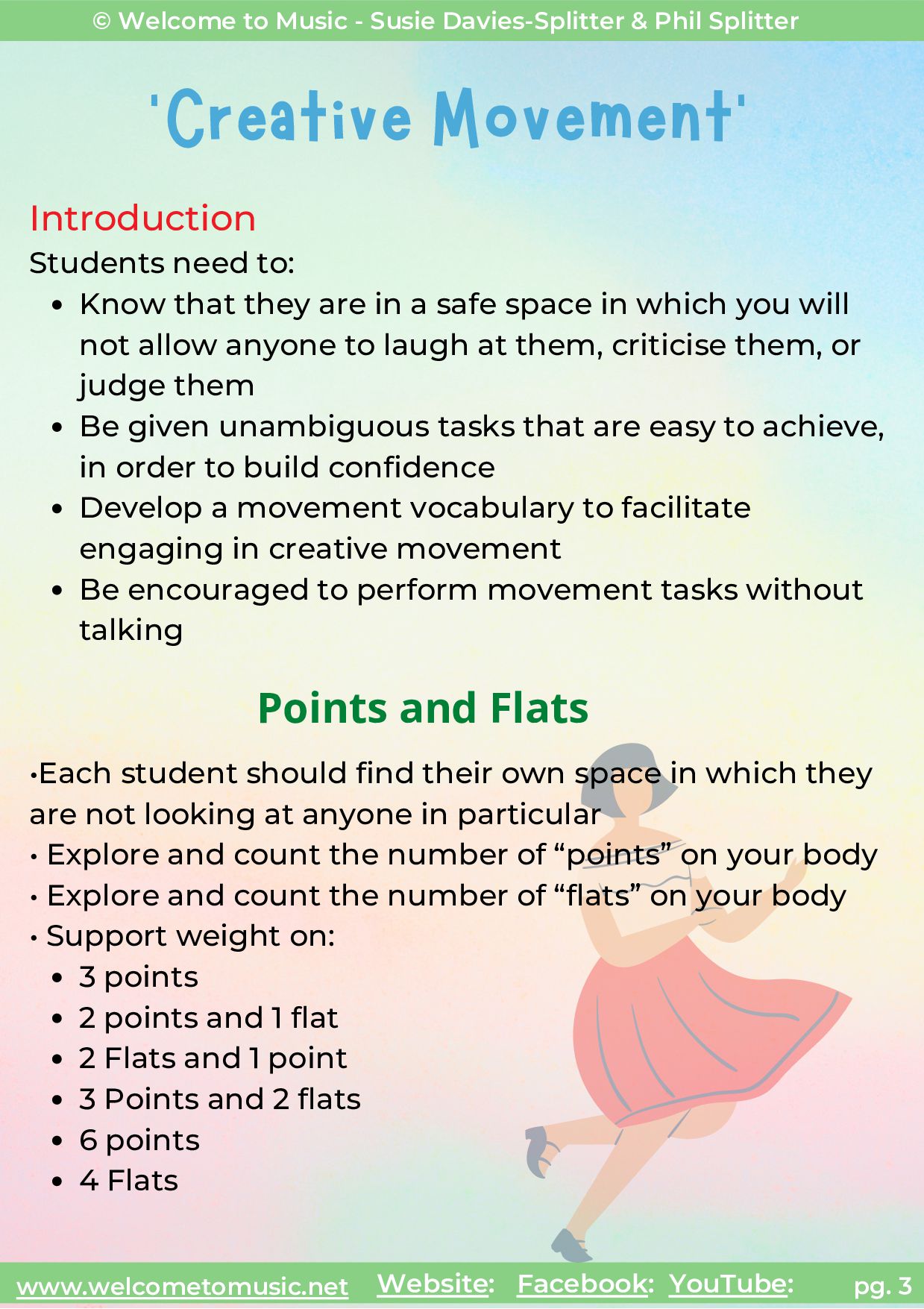
you will not allow anyone to laugh at them, criticise them, or judge them Be given unambiguous tasks that are easy to achieve, in order to build confidence Develop a movement vocabulary to facilitate engaging in creative movement Be encouraged to perform movement tasks without talking Introduction Students need to: 'Creative Movement' Points and Flats Website: Facebook: YouTube: www.welcometomusic.net © Welcome to Music - Susie Davies-Splitter & Phil Splitter pg. 3 3 points 2 points and 1 flat 2 Flats and 1 point 3 Points and 2 flats 6 points 4 Flats •Each student should find their own space in which they are not looking at anyone in particular • Explore and count the number of “points” on your body • Explore and count the number of “flats” on your body • Support weight on:
Instruments - Game Now, introduce one instrument to represent points
and another to represent flats – eg a skin instrument like a djembe for flats and a crisp sound like a wood block for points. © Welcome to Music - Susie Davies-Splitter & Phil Splitter Website: Facebook: YouTube: www.welcometomusic.net pg. 4 'Creative Movement' Play the same game again, but this time, listening to the instruments. So, If I was to play 3 sounds on a djembe, I am asking for the student to balance on 3 flats; if I played 2 sounds on a wood block, it would be 2 points; 2 on a djembe and 2 on a woodblock would be 2 flats and 2 points… Instrument Ostinati with Movement Once this has been done a few times, with different combinations of points and flats, introduce the idea of incorporating an ostinato into their choreography like this: While you play the djembe and wood block to represent the relevant number of points and flats, students should balance appropriately. Then include an ostinato on a prepared melodic percussion instrument. When students hear that, they can release the balance and find a way to move to a different part of the room, that has a repetitive aspect – ie is an ostinato. When you stop playing your ostinato and return to djembe and wood block, students must listen to how you want them to balance and create the relevant shape. This can be done several times, moving to different parts of the room each time.
Choose one way of balancing (eg 2 points and 2
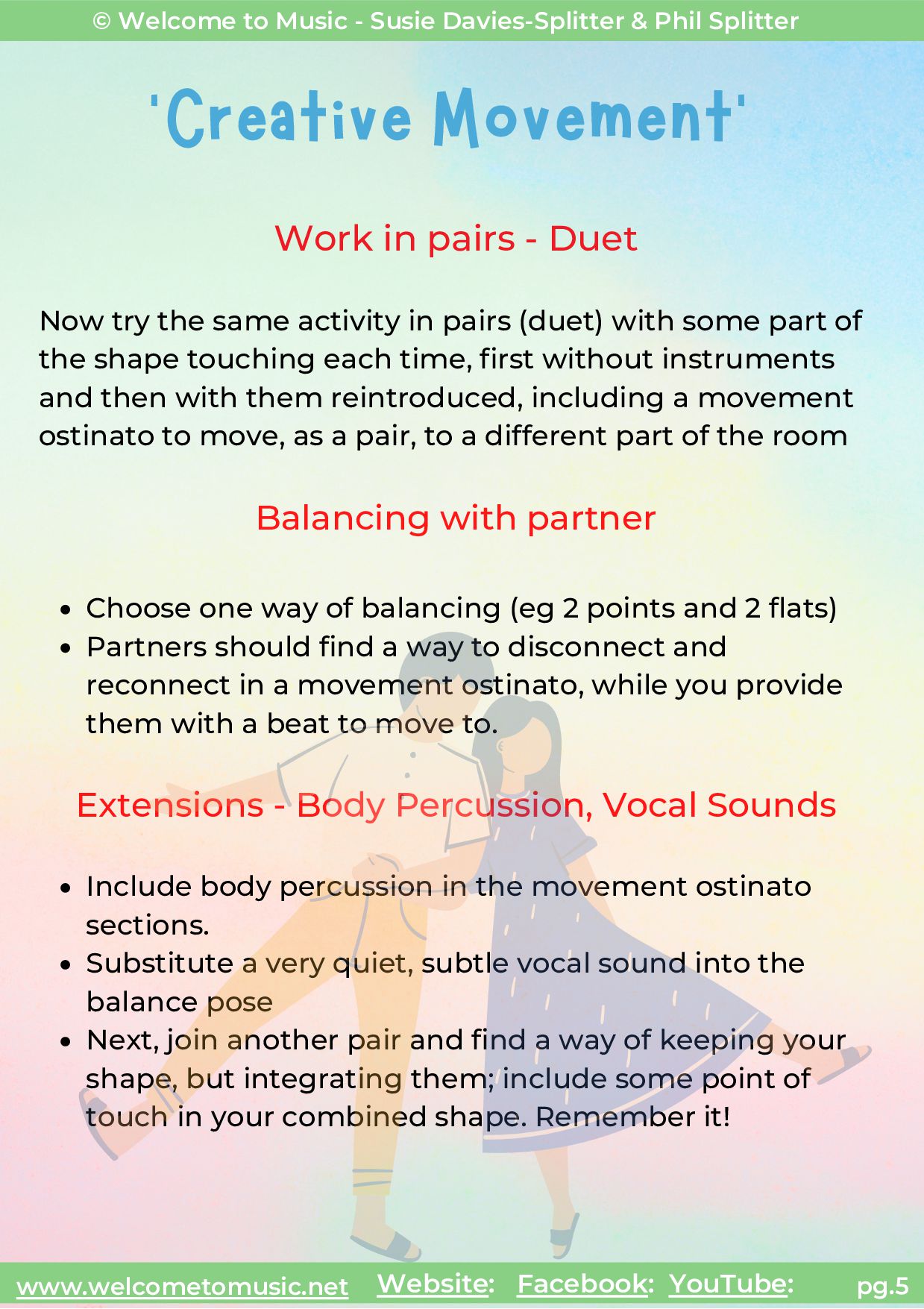
flats) Partners should find a way to disconnect and reconnect in a movement ostinato, while you provide them with a beat to move to. Include body percussion in the movement ostinato sections. Substitute a very quiet, subtle vocal sound into the balance pose Next, join another pair and find a way of keeping your shape, but integrating them; include some point of touch in your combined shape. Remember it! Work in pairs - Duet Now try the same activity in pairs (duet) with some part of the shape touching each time, first without instruments and then with them reintroduced, including a movement ostinato to move, as a pair, to a different part of the room Balancing with partner Extensions - Body Percussion, Vocal Sounds © Welcome to Music - Susie Davies-Splitter & Phil Splitter Website: Facebook: YouTube: www.welcometomusic.net pg.5 'Creative Movement'
In pairs, make a shape supported by your choice of
numbers of points and flats, incorporating your subtle vocal sound. Remember it. Rehearse how your pair will join the other pair in a movement ostinato that incorporates body percussion. Remember it. Composition – all to be done without talking! Now perform your choreography, using this structure (NO TALKING!): A – Duet (from a beginning performance position, each pair move into their own shape of points and flats that you designed at the start) B – Quartet (move into the group shape) A – Duet (move from the quartet to duets again) Let students rehearse this a few times and then show each other. I suggest half of the class at a time sits to watch the other half perform and then swap over. © Welcome to Music - Susie Davies-Splitter & Phil Splitter Website: Facebook: YouTube: www.welcometomusic.net pg. 6 'Creative Movement'
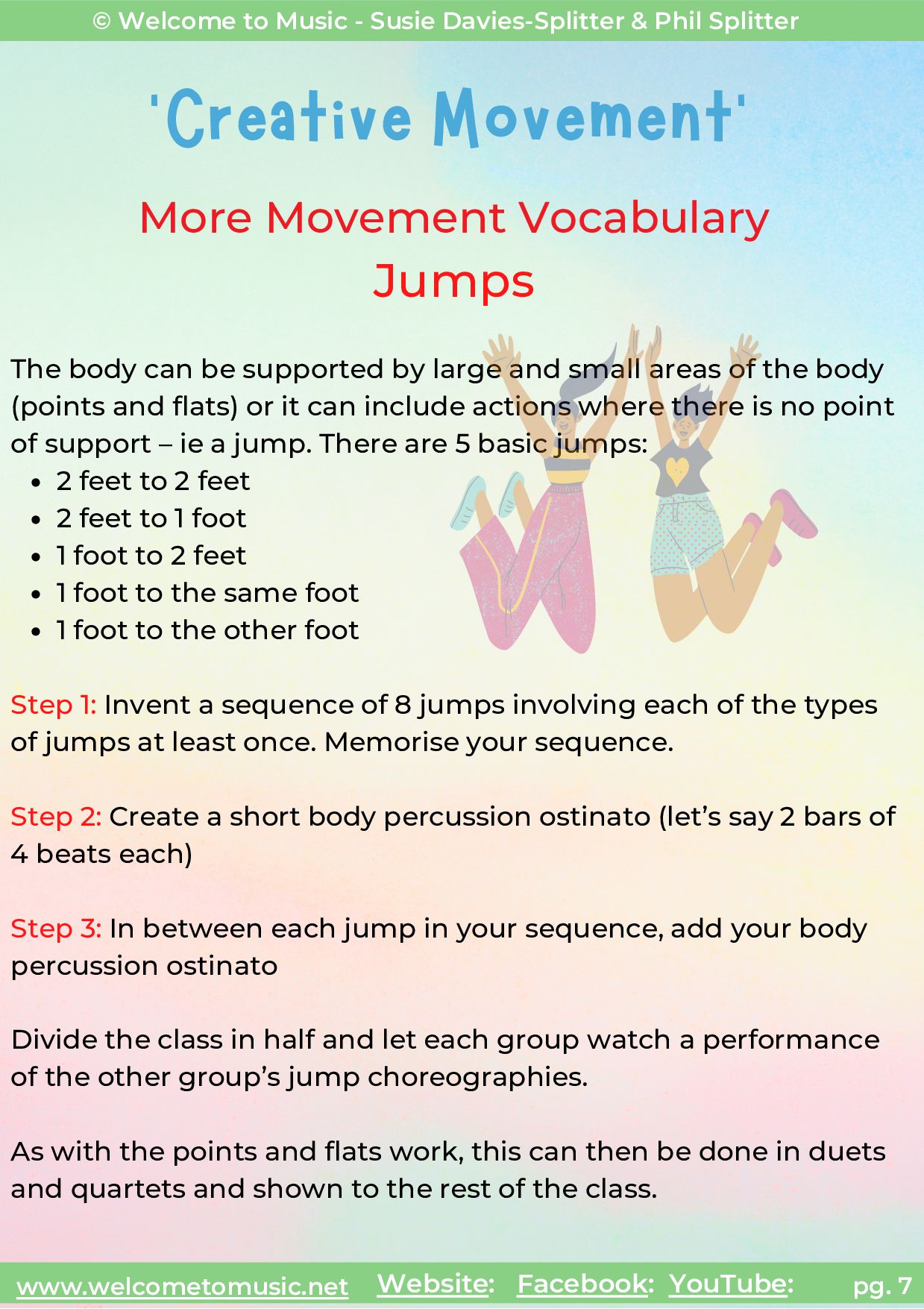
2 feet to 2 feet 2 feet to 1 foot
1 foot to 2 feet 1 foot to the same foot 1 foot to the other foot More Movement Vocabulary Jumps The body can be supported by large and small areas of the body (points and flats) or it can include actions where there is no point of support – ie a jump. There are 5 basic jumps: Step 1: Invent a sequence of 8 jumps involving each of the types of jumps at least once. Memorise your sequence. Step 2: Create a short body percussion ostinato (let’s say 2 bars of 4 beats each) Step 3: In between each jump in your sequence, add your body percussion ostinato Divide the class in half and let each group watch a performance of the other group’s jump choreographies. As with the points and flats work, this can then be done in duets and quartets and shown to the rest of the class. © Welcome to Music - Susie Davies-Splitter & Phil Splitter Website: Facebook: YouTube: www.welcometomusic.net pg. 7 'Creative Movement'
Extension: In duets, jumps with ideas from points and flats
work, into a new choreography. Note: All of this can be done with or without music. You may choose to play the djembe while they perform (with the aim, primarily, of providing a solid beat to move to) or have some atmospheric, beat-free music of your own choice in the background. It would be important, though, to allow time for students to rehearse their choreographies with the music you choose to use so that everything blends well together. © Welcome to Music - Susie Davies-Splitter & Phil Splitter Website: Facebook: YouTube: www.welcometomusic.net pg.8 'Creative Movement'
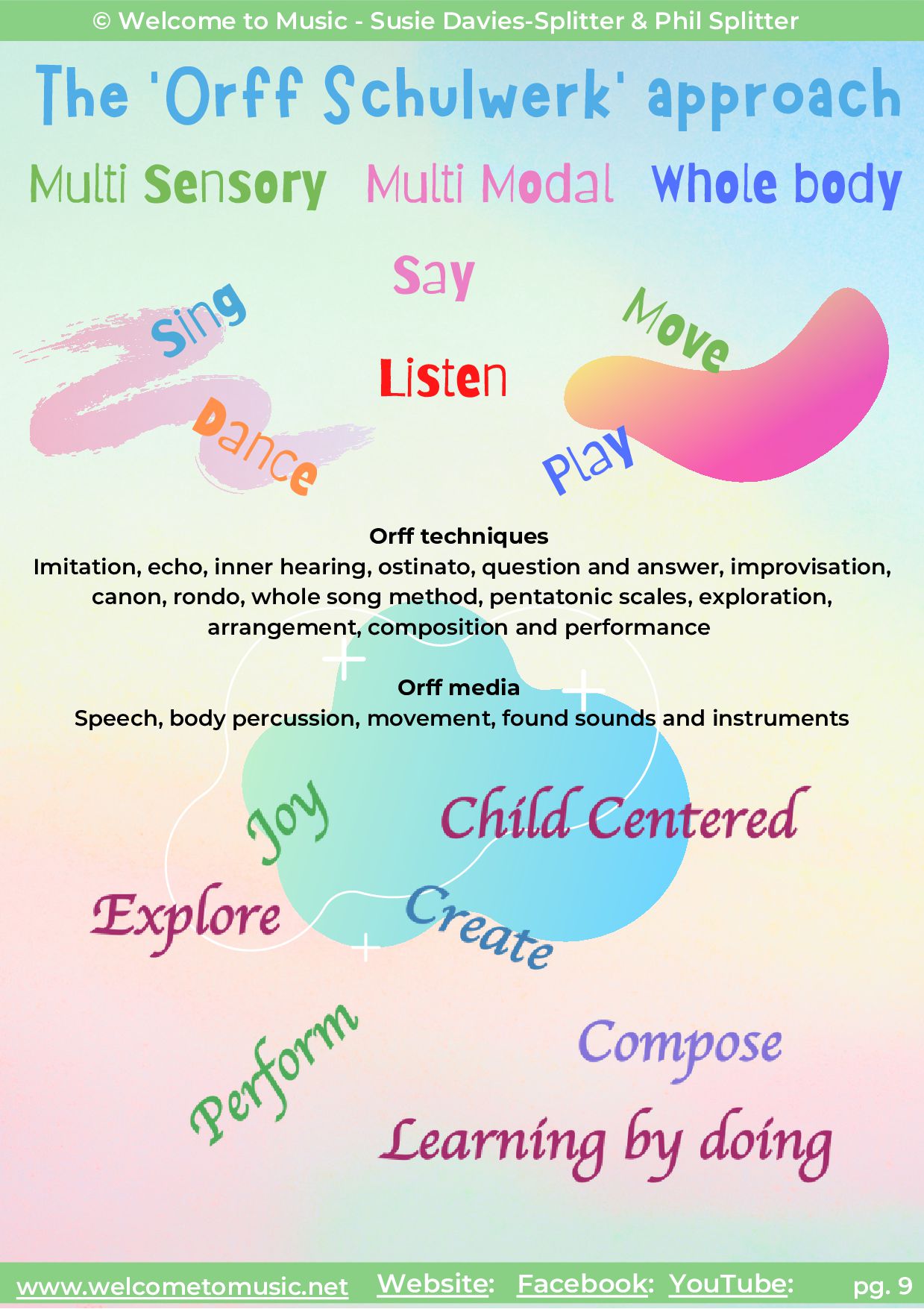
Orff techniques Imitation, echo, inner hearing, ostinato, question and answer,
improvisation, canon, rondo, whole song method, pentatonic scales, exploration, arrangement, composition and performance Orff media Speech, body percussion, movement, found sounds and instruments © Welcome to Music - Susie Davies-Splitter & Phil Splitter Website: Facebook: YouTube: www.welcometomusic.net pg. 9 The 'Orff Schulwerk' approach Whole body Multi Modal Multi Sensory Sing Say Move Dance Play Listen


 welcometomusic
 marktimemedia
 inesmontani
 aleyda
 ivargrimstad
 iamctodd
 3n
3n
 marcelosomers
 cromwellryan
 ryanjones
 keithpitt
 sachag