Share
Embed
Transcript
91 slides
-
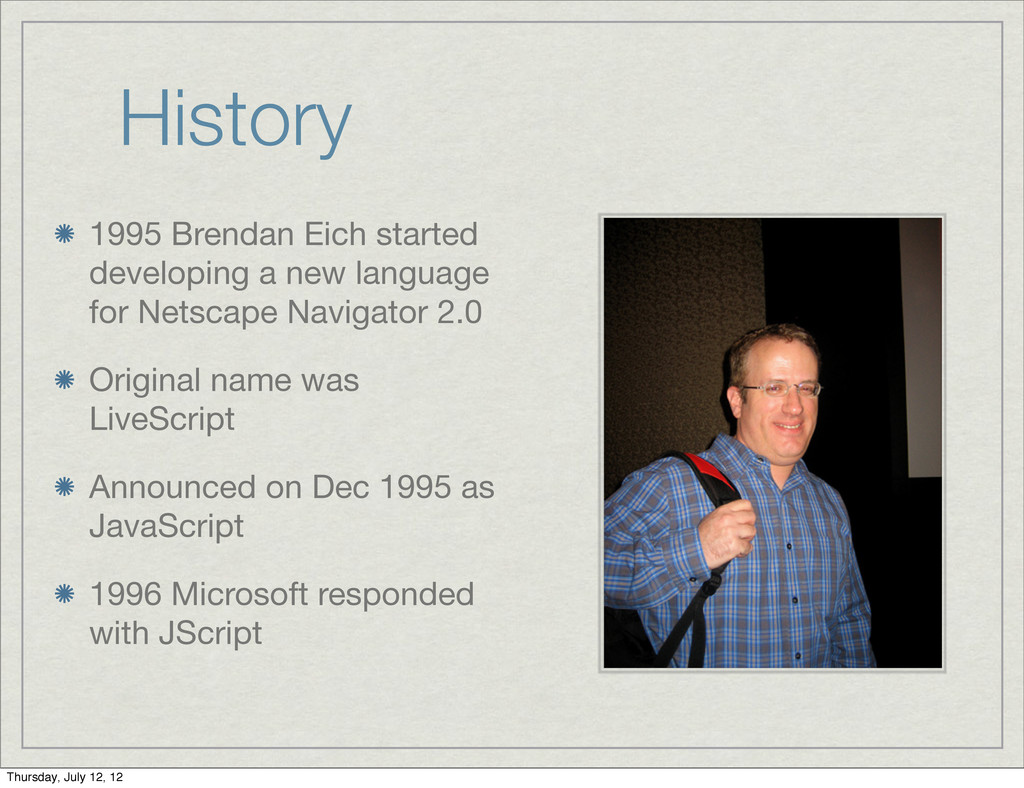
History 1995 Brendan Eich started developing a new language for
Netscape Navigator 2.0 Original name was LiveScript Announced on Dec 1995 as JavaScript 1996 Microsoft responded with JScript Thursday, July 12, 12 -
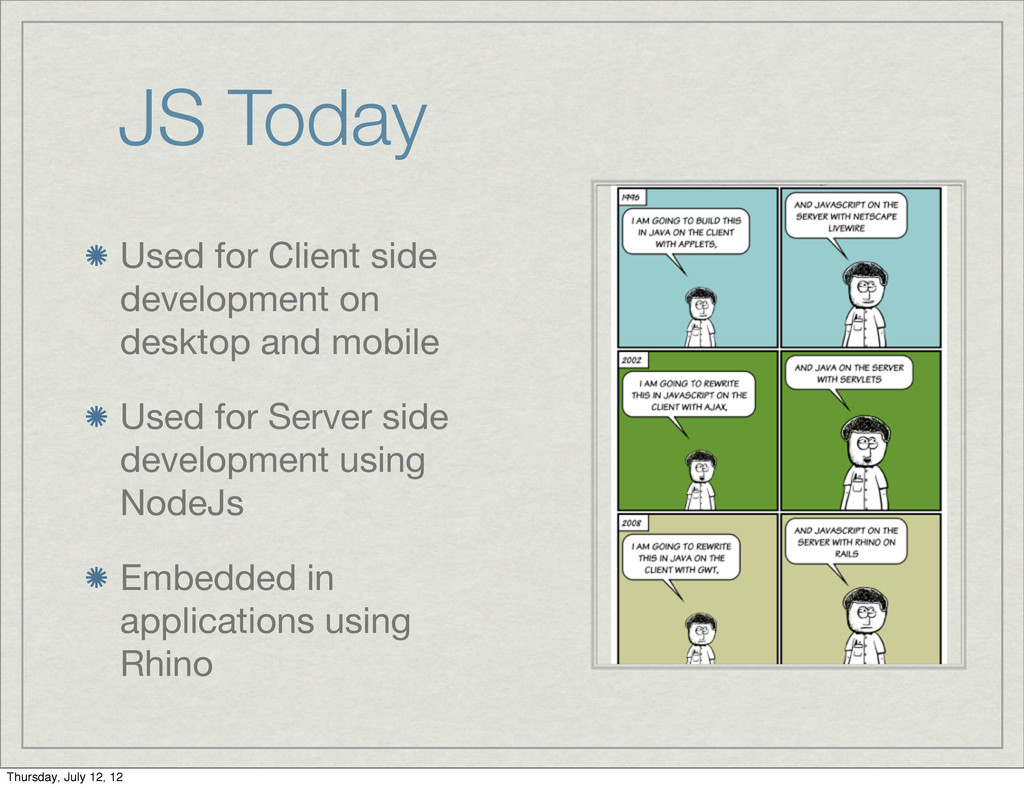
JS Today Used for Client side development on desktop and
mobile Used for Server side development using NodeJs Embedded in applications using Rhino Thursday, July 12, 12 -
Language Overview JavaScript is not a toy JavaScript has nothing
to do with Java JavaScript is a powerful programming language on its own Thursday, July 12, 12 -
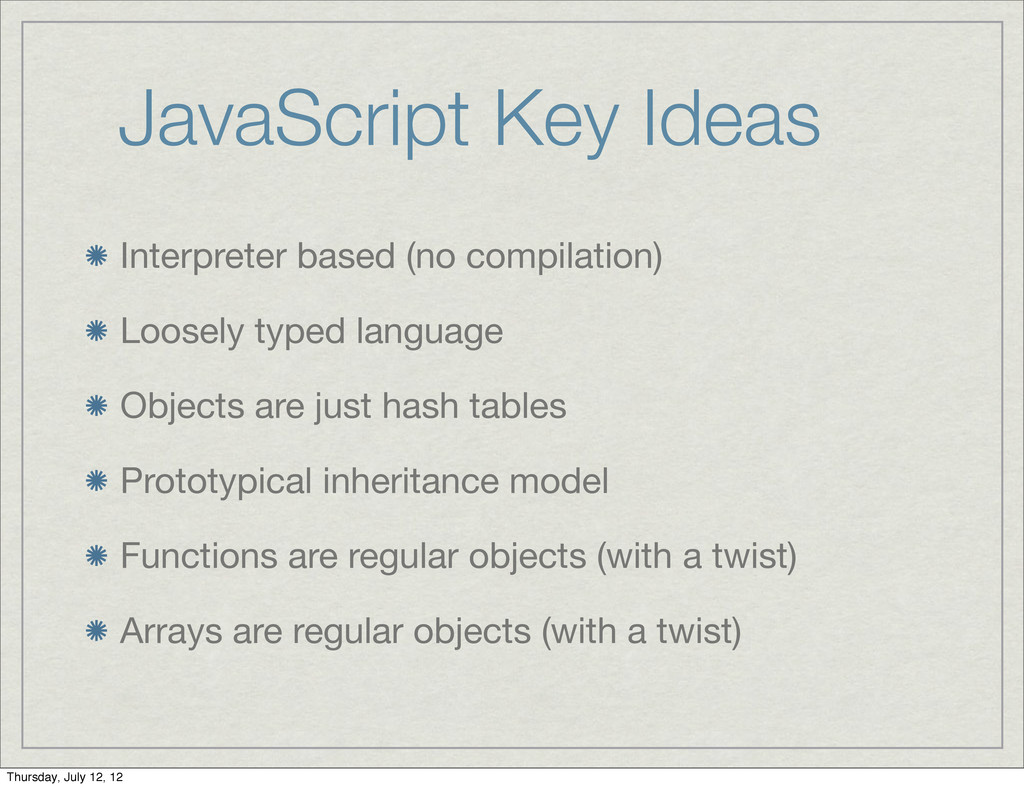
JavaScript Key Ideas Interpreter based (no compilation) Loosely typed language
Objects are just hash tables Prototypical inheritance model Functions are regular objects (with a twist) Arrays are regular objects (with a twist) Thursday, July 12, 12 -
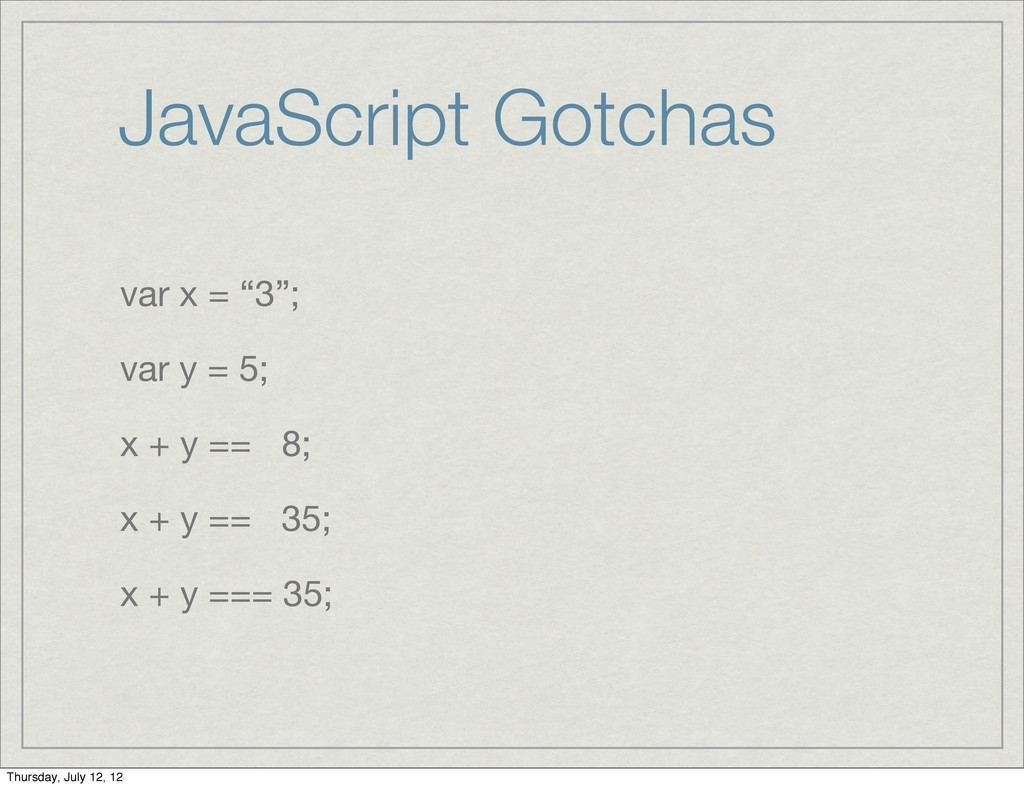
JavaScript Gotchas var x = “3”; var y = 5;
x + y == 8; x + y == 35; x + y === 35; Thursday, July 12, 12 -
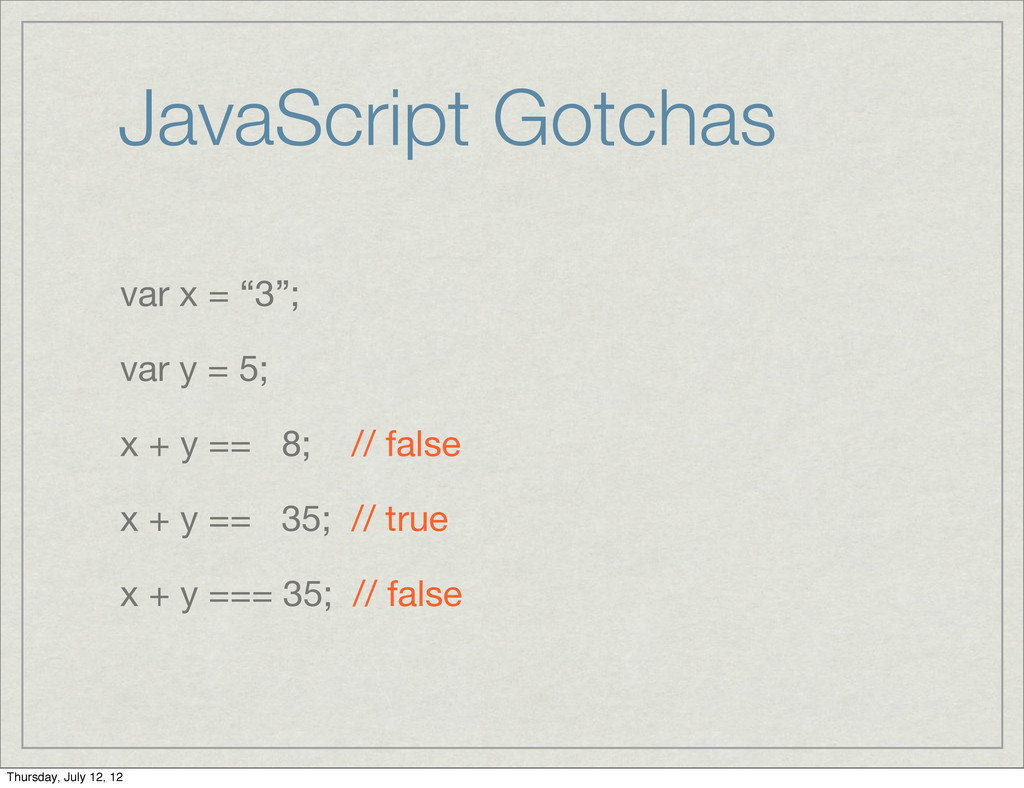
JavaScript Gotchas var x = “3”; var y = 5;
x + y == 8; // false x + y == 35; // true x + y === 35; // false Thursday, July 12, 12 -
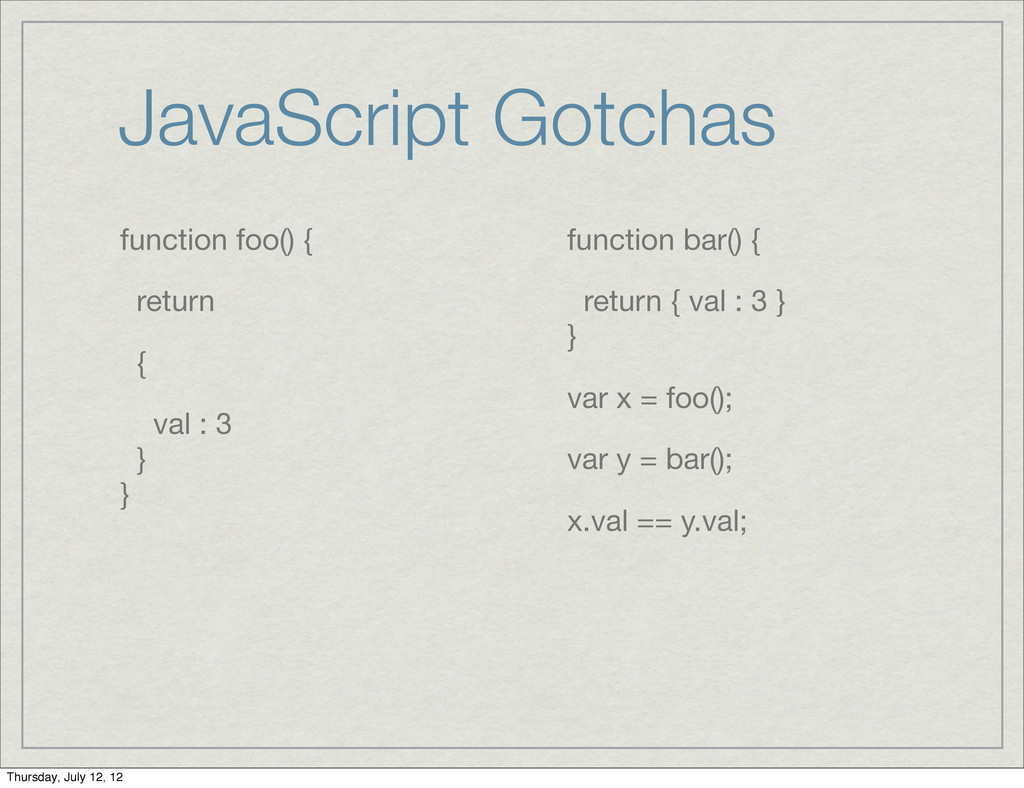
JavaScript Gotchas function foo() { return { val : 3
} } function bar() { return { val : 3 } } var x = foo(); var y = bar(); x.val == y.val; Thursday, July 12, 12 -
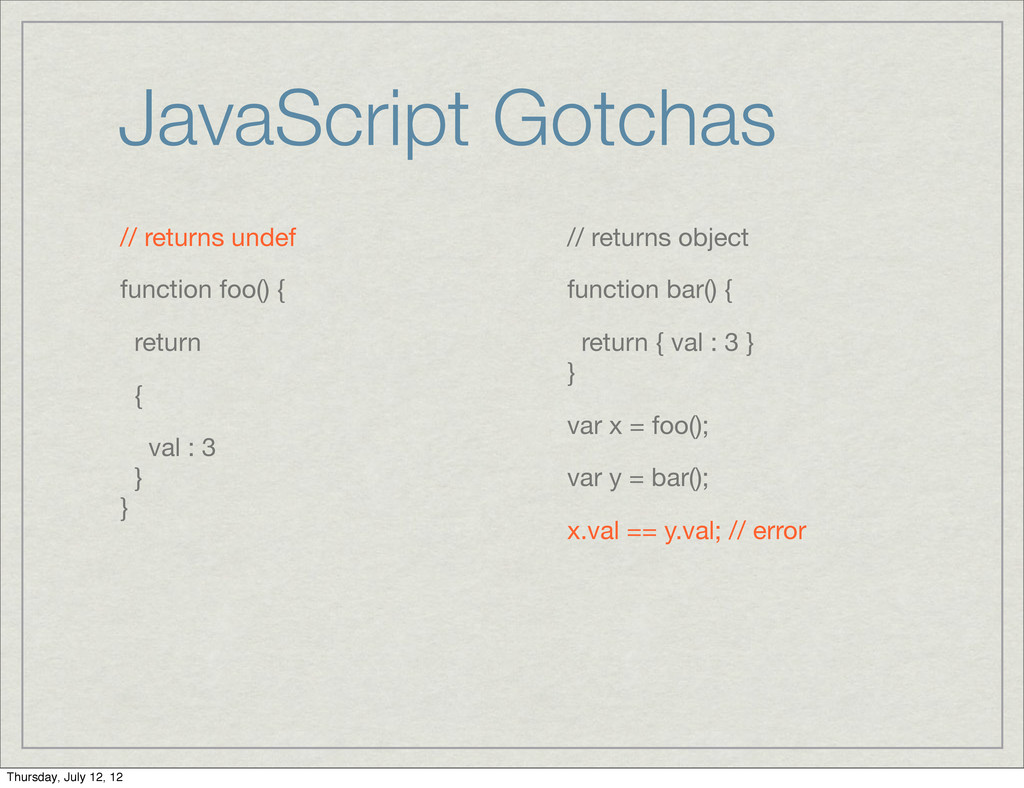
JavaScript Gotchas // returns undef function foo() { return {
val : 3 } } // returns object function bar() { return { val : 3 } } var x = foo(); var y = bar(); x.val == y.val; // error Thursday, July 12, 12 -
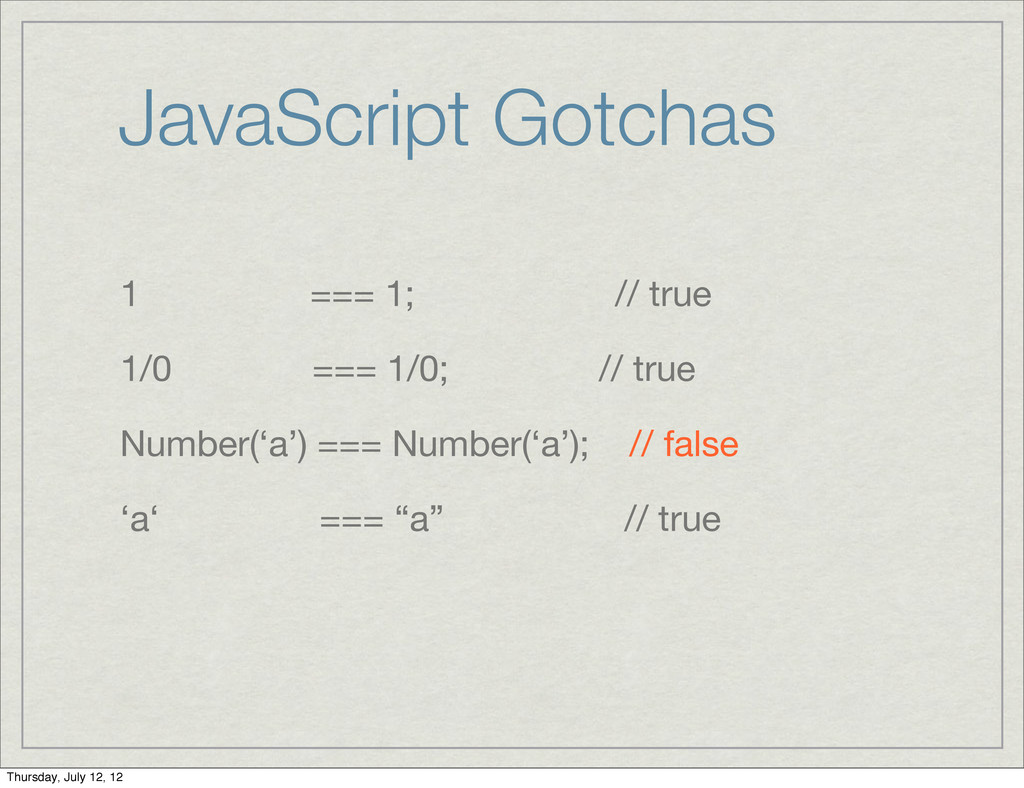
JavaScript Gotchas 1 === 1; 1/0 === 1/0; Number(‘a’) ===
Number(‘a’); ‘a‘ === “a” Thursday, July 12, 12 -
JavaScript Gotchas 1 === 1; // true 1/0 === 1/0;
// true Number(‘a’) === Number(‘a’); // false ‘a‘ === “a” // true Thursday, July 12, 12 -
Q & A JavaScript History Language Overview Arrays & Objects
Functions Thursday, July 12, 12 -
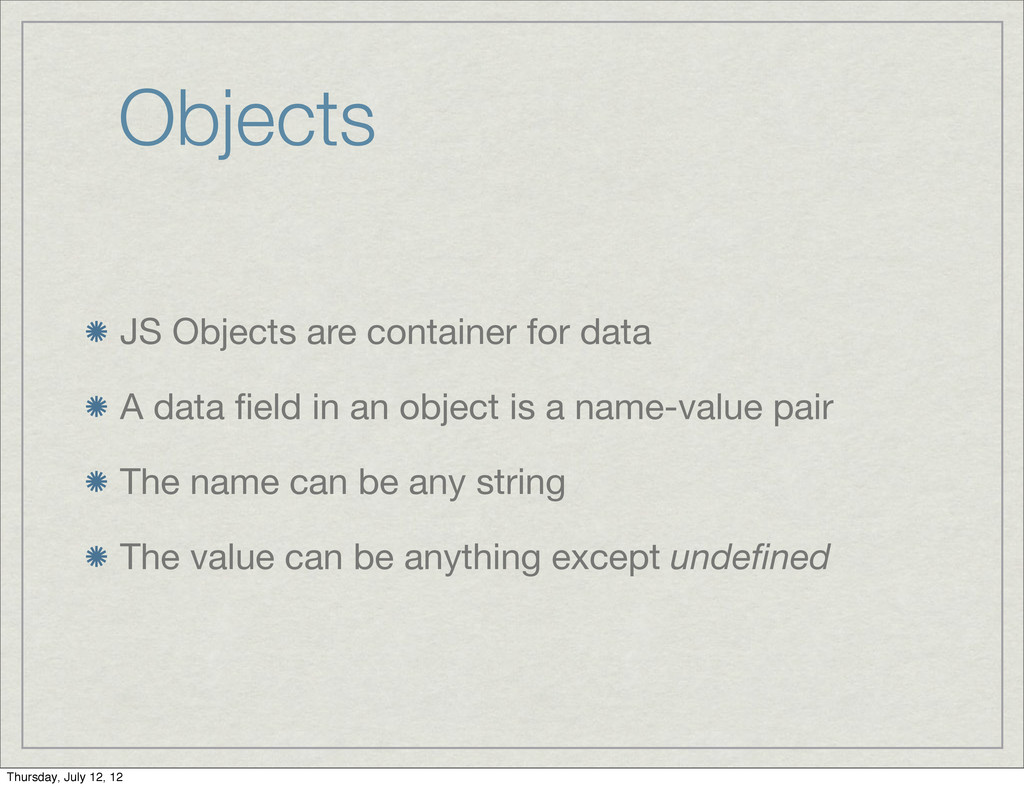
Objects JS Objects are container for data A data field
in an object is a name-value pair The name can be any string The value can be anything except undefined Thursday, July 12, 12 -
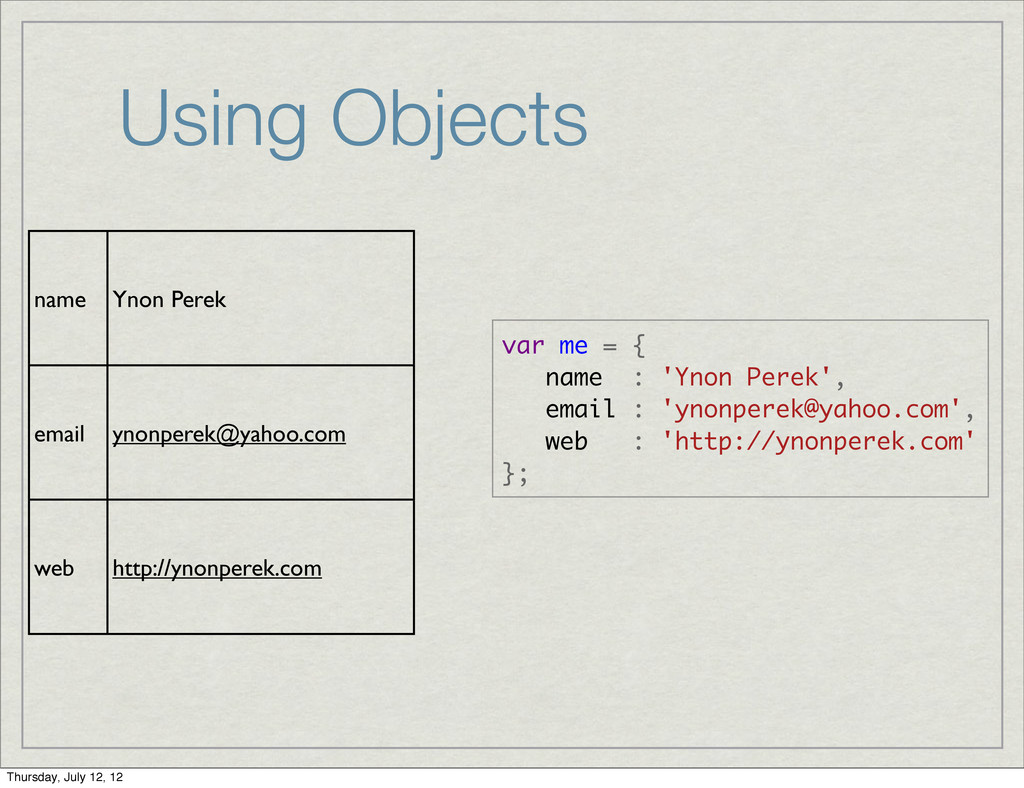
Using Objects var me = { name : 'Ynon Perek',
email : '[email protected]', web : 'http://ynonperek.com' }; name Ynon Perek email [email protected] web http://ynonperek.com Thursday, July 12, 12 -
Using Objects console.dir(myObject); // prints all the fields myObject.name ===
“Ynon Perek” myObject[‘website’] === http://www.ynonperek.com Thursday, July 12, 12 -
Object Patterns Object Literals vs. Object Ctor Maker functions Object
Prototypes Thursday, July 12, 12 -
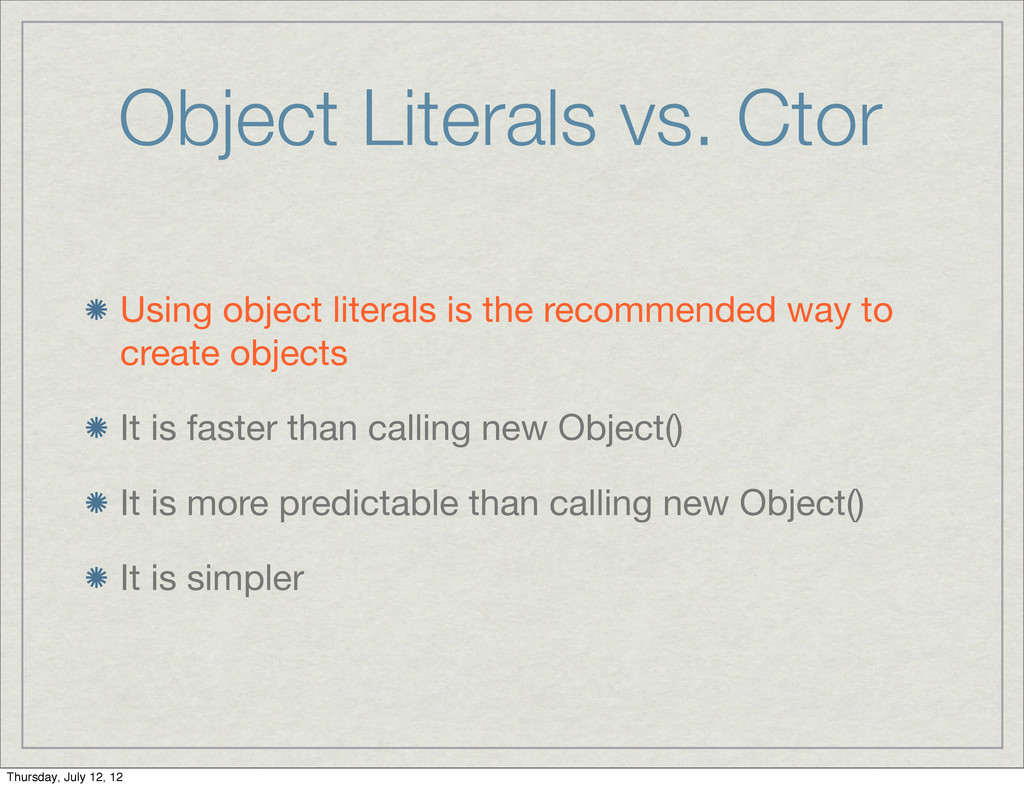
Object Literals vs. Ctor Using object literals is the recommended
way to create objects It is faster than calling new Object() It is more predictable than calling new Object() It is simpler Thursday, July 12, 12 -
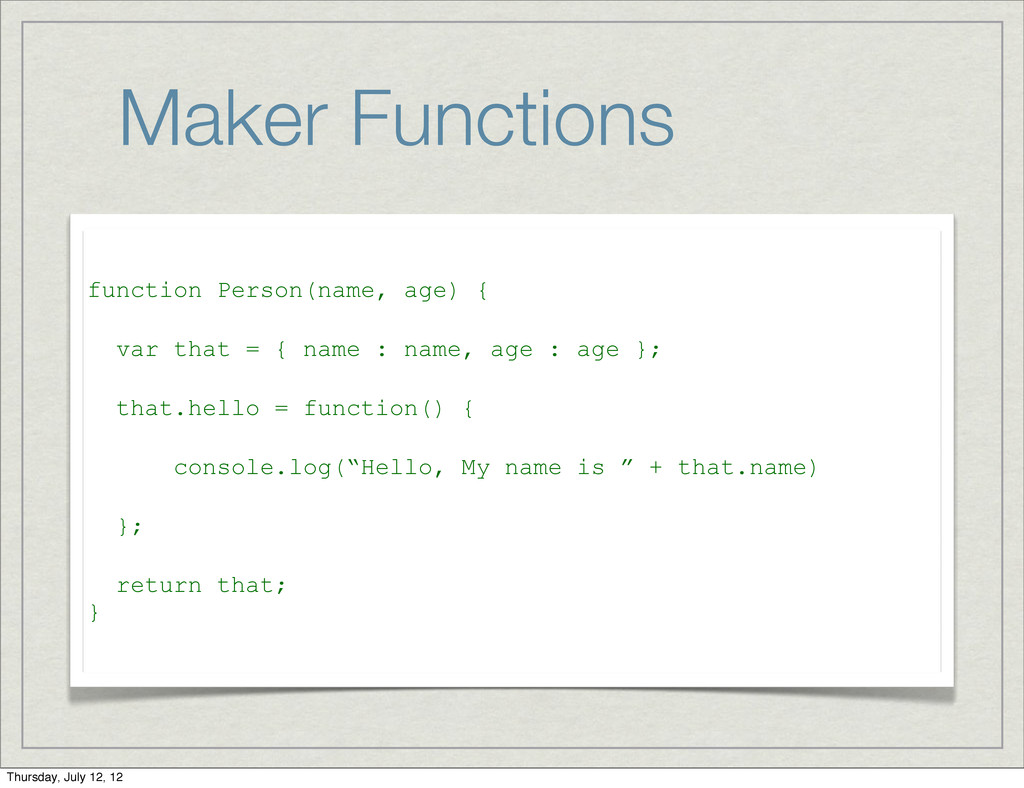
Maker Functions function Person(name, age) { var that = {
name : name, age : age }; that.hello = function() { console.log(“Hello, My name is ” + that.name) }; return that; } Thursday, July 12, 12 -
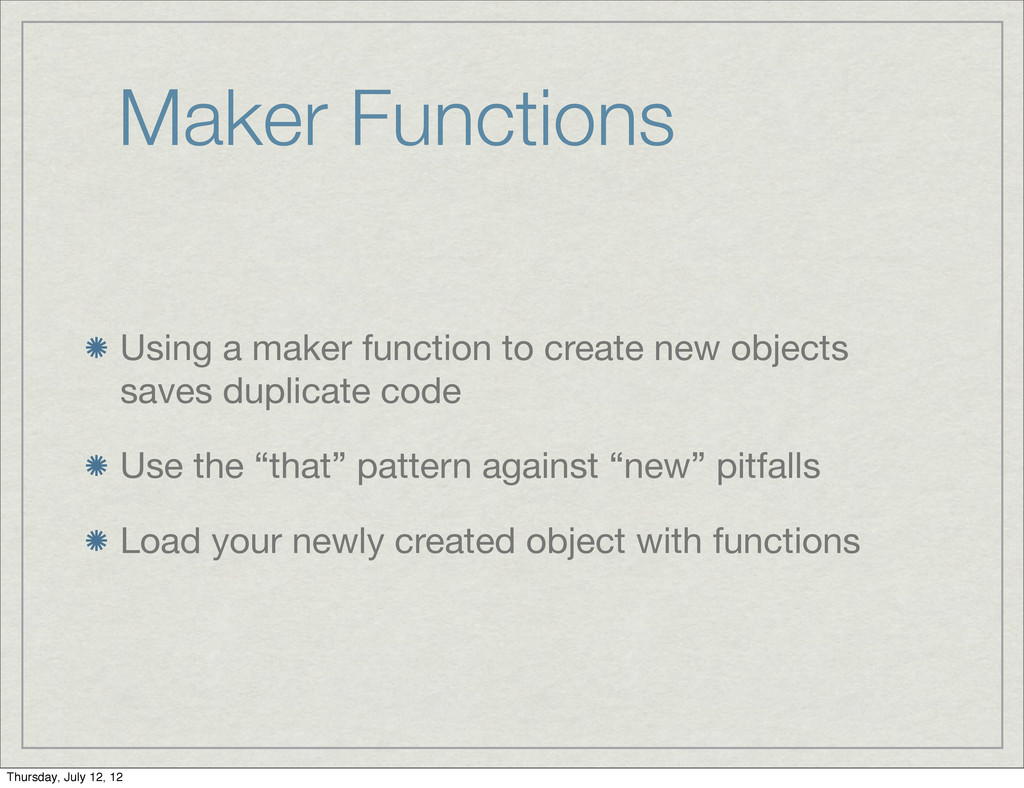
Maker Functions Using a maker function to create new objects
saves duplicate code Use the “that” pattern against “new” pitfalls Load your newly created object with functions Thursday, July 12, 12 -
Example Implement a Quiz JavaScript system Use “Question” class with
four possible answers and on correct answer Use “Quiz” class to hold an array of questions Thursday, July 12, 12 -
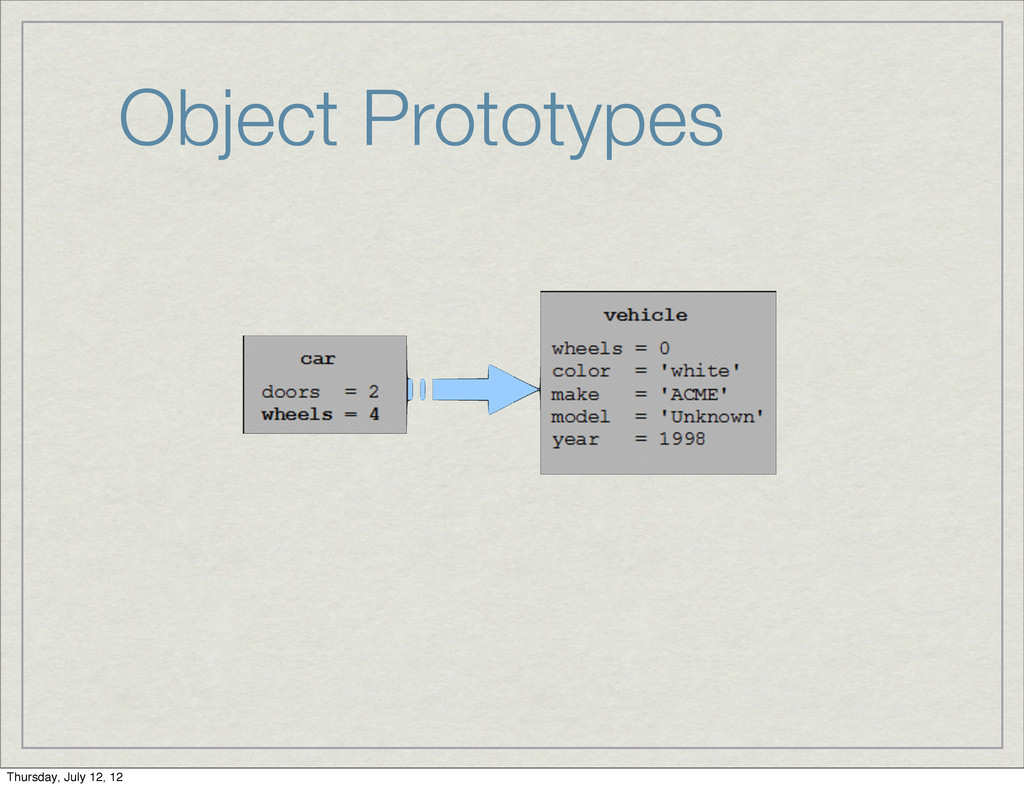
Object Prototypes In JavaScript, every object has a “prototype” object.
When JS interpreter fails to find an attribute in an object, it searches the prototype. Thursday, July 12, 12 -
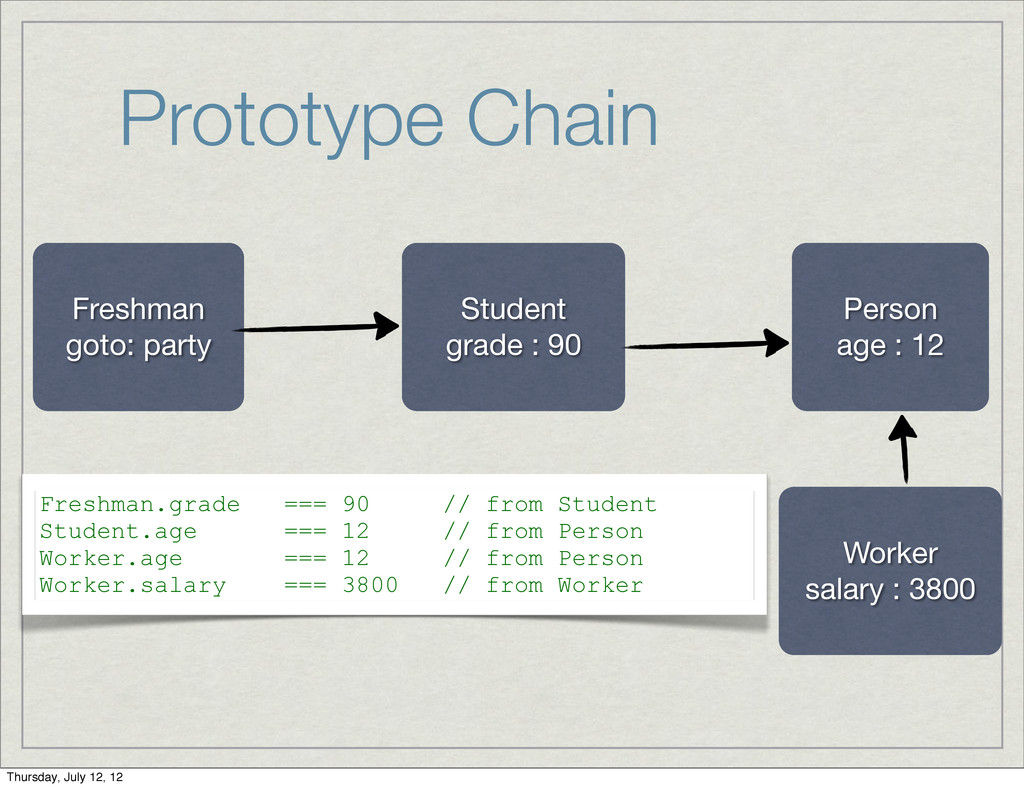
Prototype Chain Person age : 12 Student grade : 90
Freshman goto: party Worker salary : 3800 Freshman.grade === 90 // from Student Student.age === 12 // from Person Worker.age === 12 // from Person Worker.salary === 3800 // from Worker Thursday, July 12, 12 -
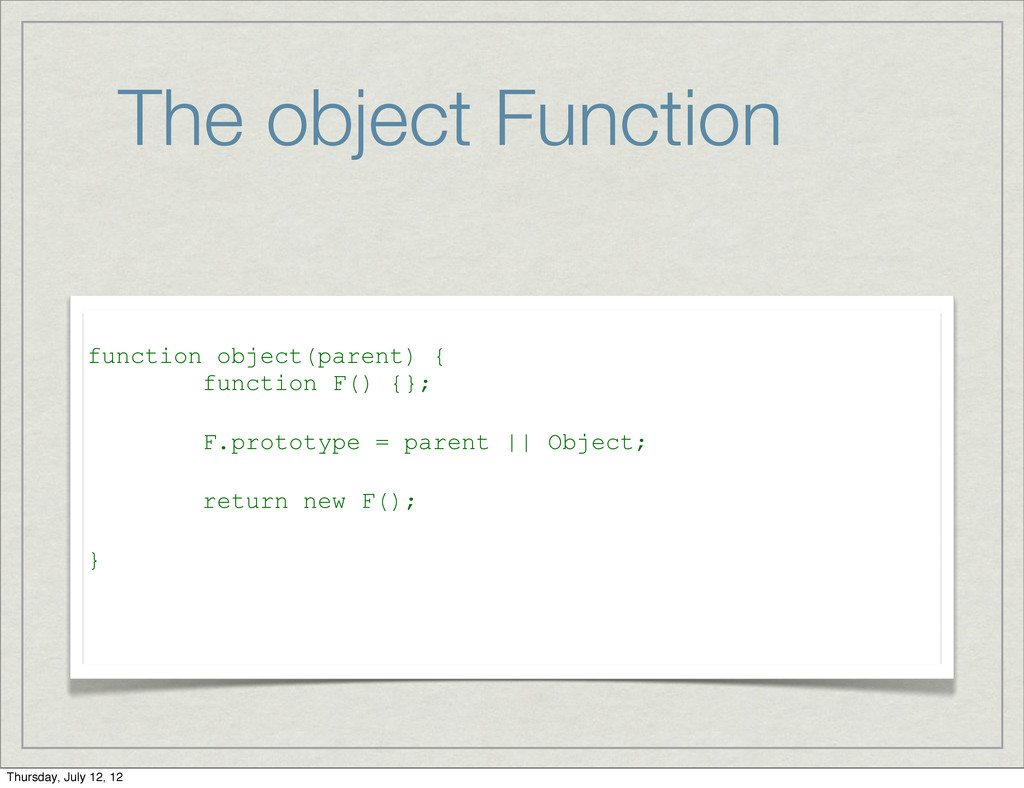
The object Function function object(parent) { function F() {}; F.prototype
= parent || Object; return new F(); } Thursday, July 12, 12 -
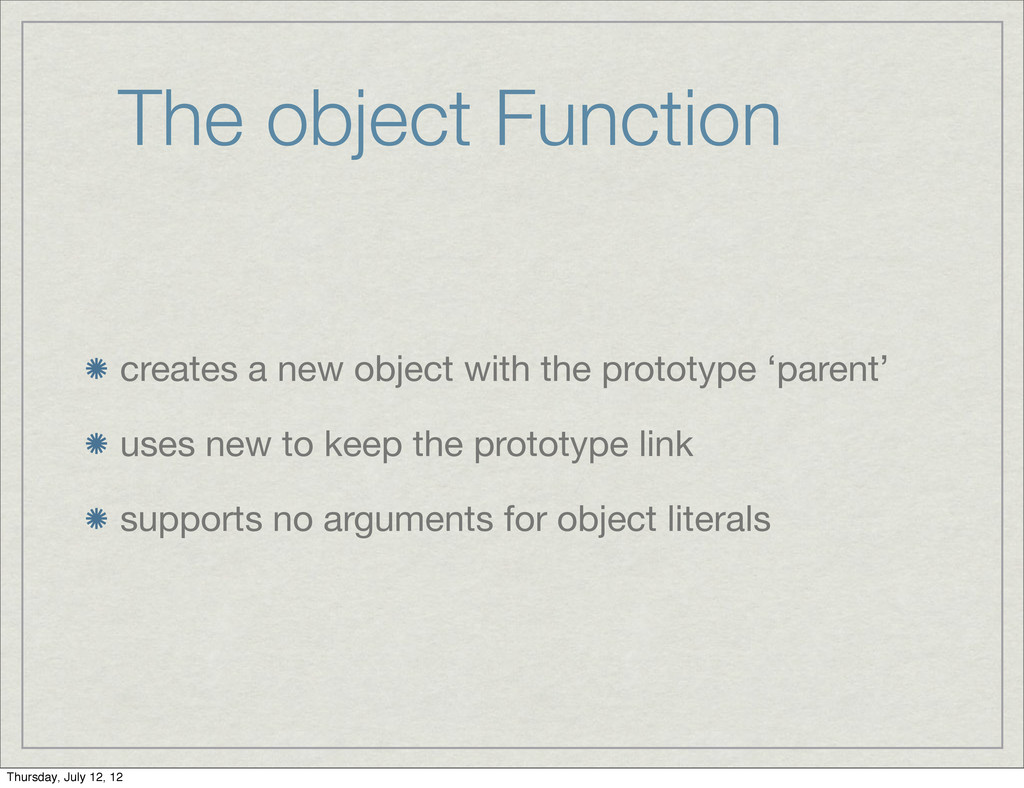
The object Function creates a new object with the prototype
‘parent’ uses new to keep the prototype link supports no arguments for object literals Thursday, July 12, 12 -
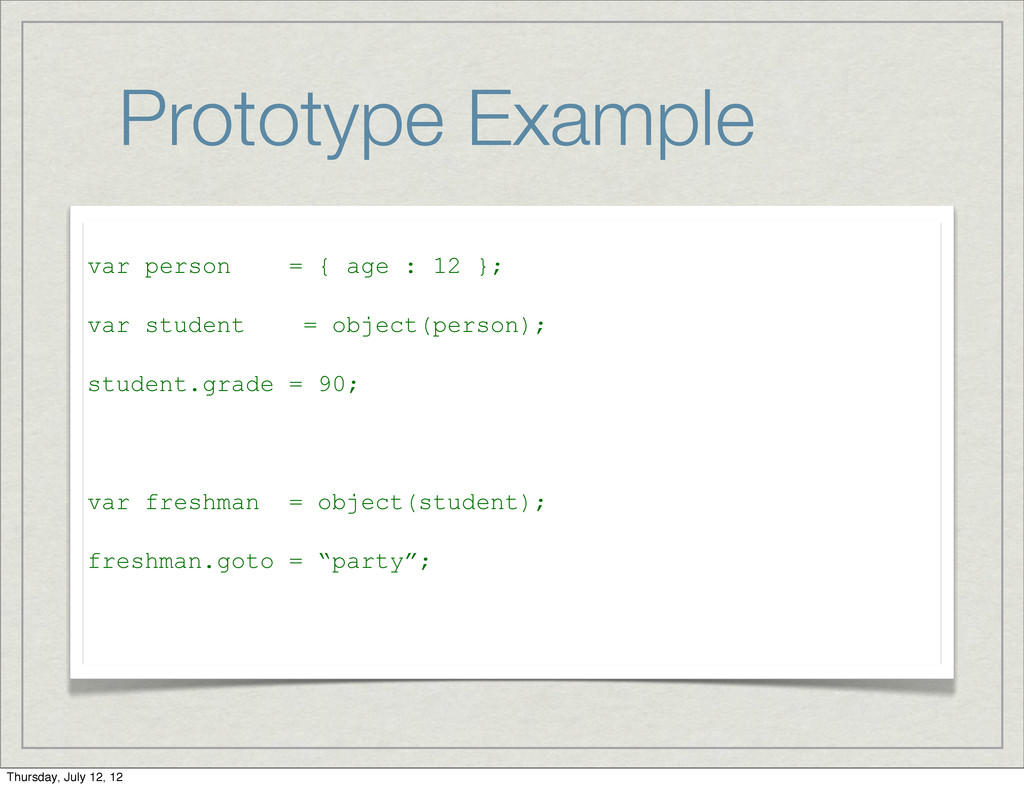
Prototype Example var person = { age : 12 };
var student = object(person); student.grade = 90; var freshman = object(student); freshman.goto = “party”; Thursday, July 12, 12 -
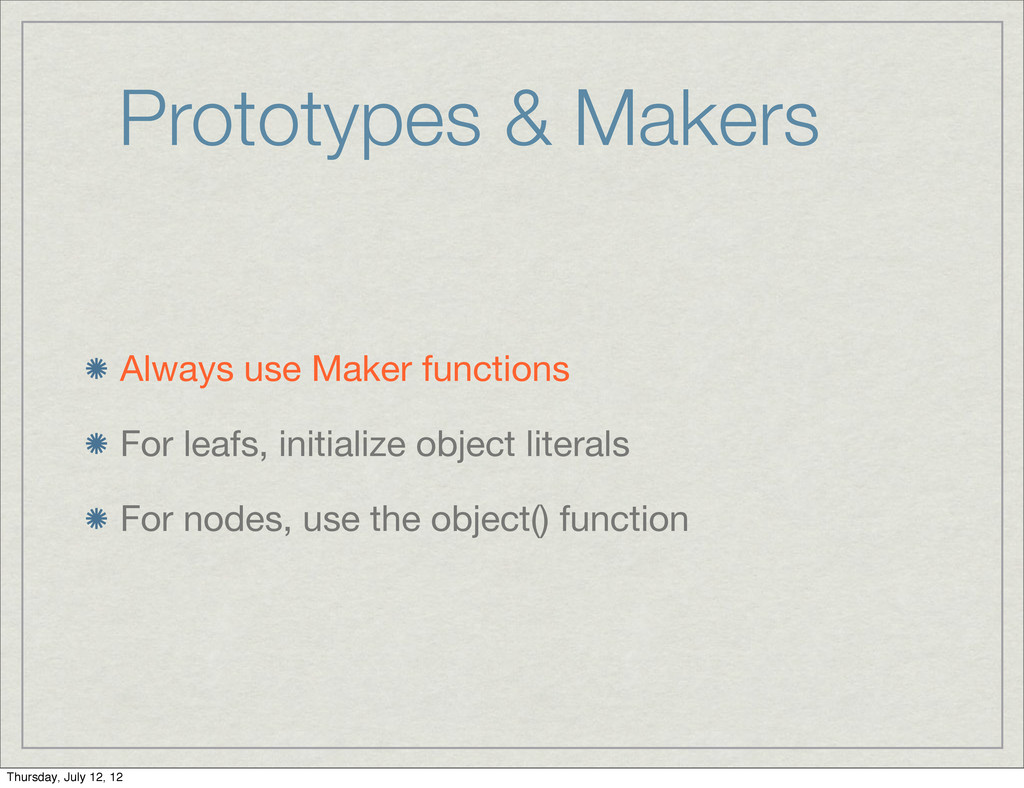
Prototypes & Makers Always use Maker functions For leafs, initialize
object literals For nodes, use the object() function Thursday, July 12, 12 -
Exercise Write a maker function for a Car object, using
an object literal. Car should provide members: max_speed and drive() Write maker functions for 3 car models using the object() function. Implement a function on a car model which uses data from Car Thursday, July 12, 12 -
Arrays Arrays are objects with numeric keys. A length attribute
is maintained automatically by JS to mean last_index + 1 Thursday, July 12, 12 -
Array Functions join pop, push shift, unshift reverse, sort -
changes original array a.slice(0, a.length).reverse() - Does not modify original array a Thursday, July 12, 12 -
Exercise Implement a Phonebook object that maintains an array of
Contact objects. Each Contact should have a name field and a phone field. Test by creating 5 contacts in the Phonebook and print them to the console. Thursday, July 12, 12 -
Q & A JavaScript History Language Overview Arrays & Objects
Functions Thursday, July 12, 12 -
Functions The word ‘function’ Followed by an optional name Followed
by a set of parameters Followed by the function body Thursday, July 12, 12 -
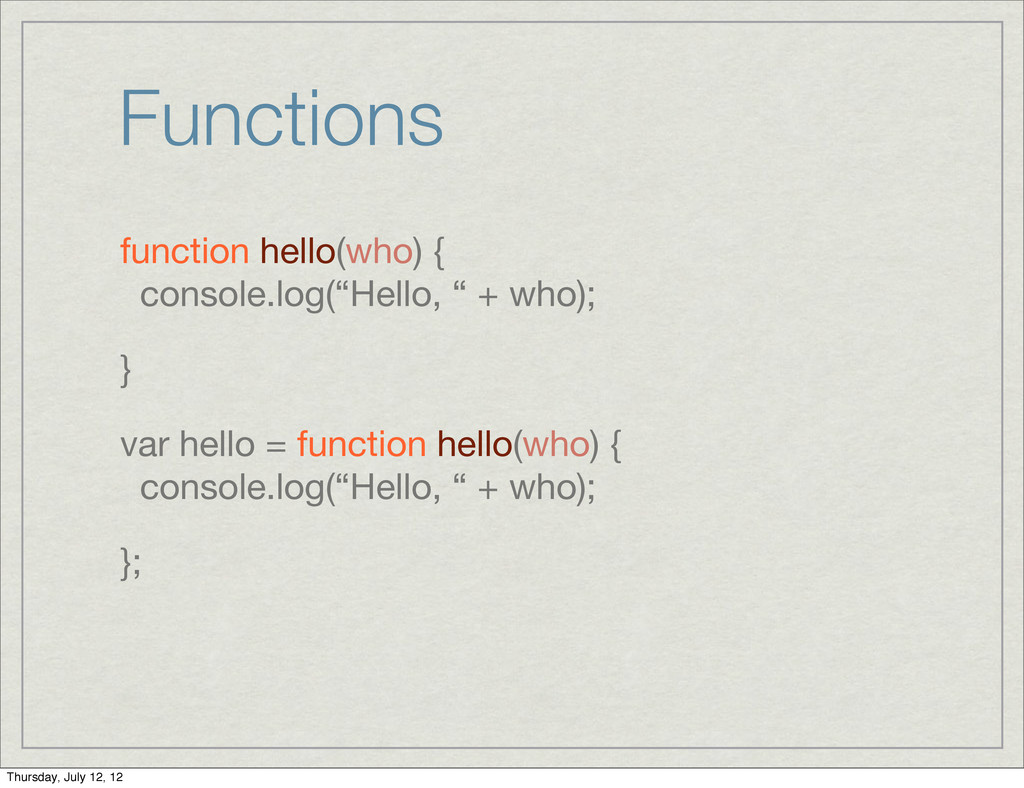
Functions function hello(who) { console.log(“Hello, “ + who); } var
hello = function hello(who) { console.log(“Hello, “ + who); }; Thursday, July 12, 12 -
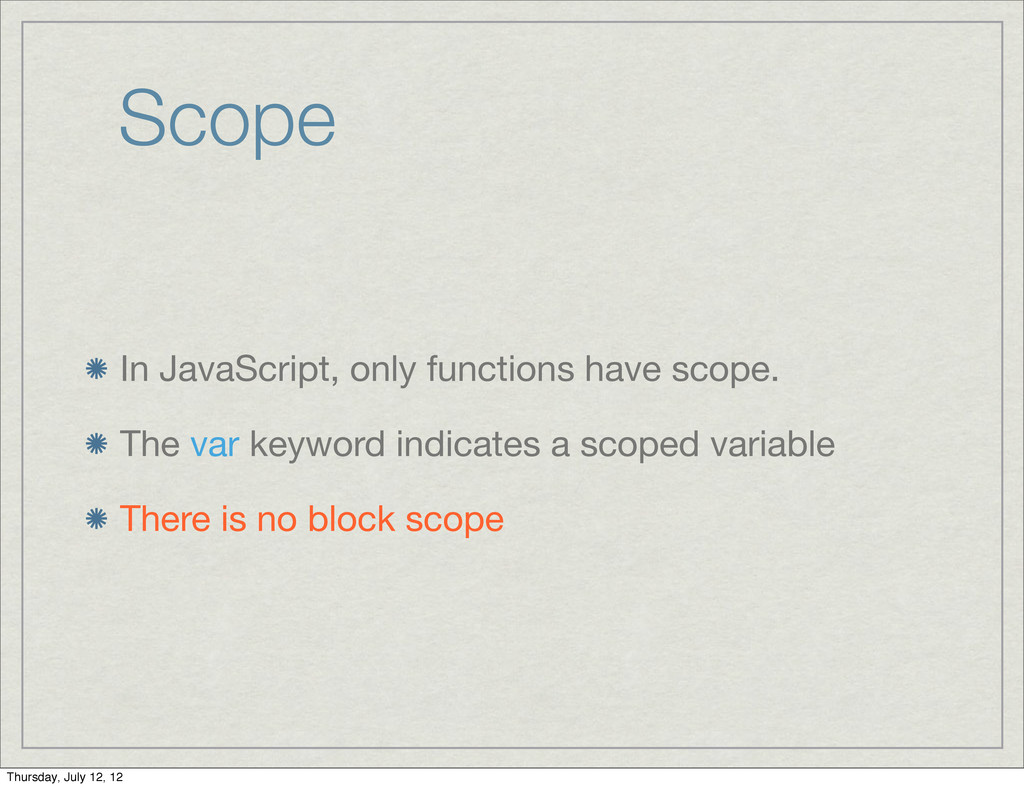
Scope In JavaScript, only functions have scope. The var keyword
indicates a scoped variable There is no block scope Thursday, July 12, 12 -
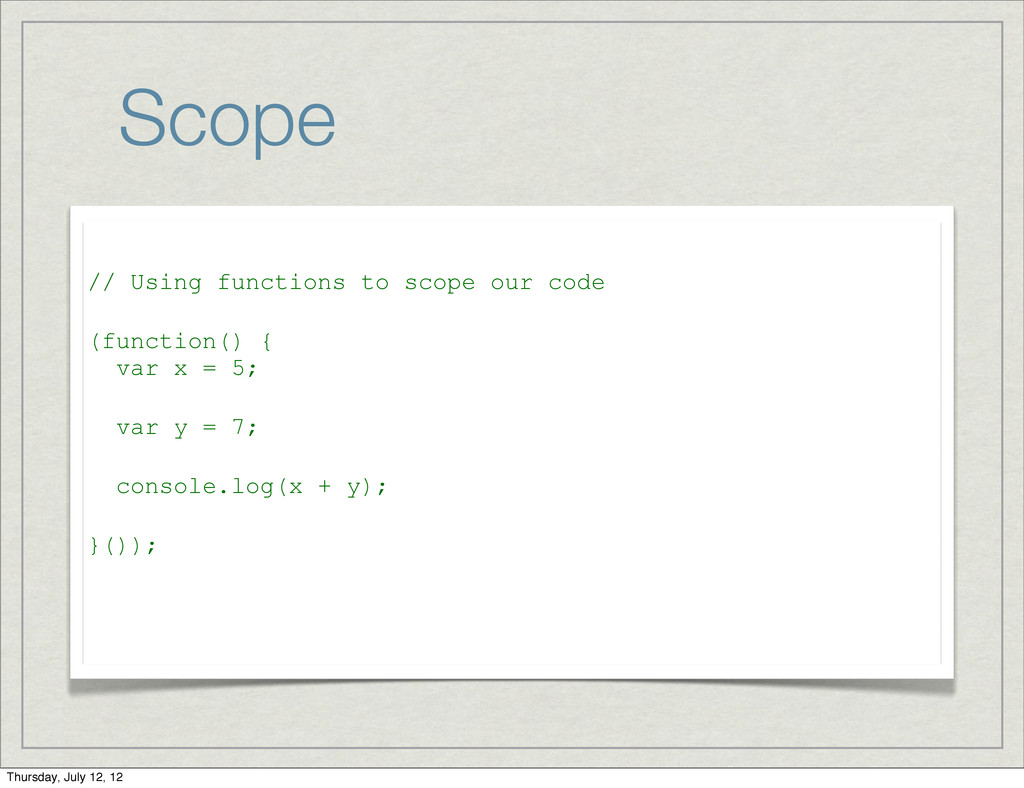
Scope // Using functions to scope our code (function() {
var x = 5; var y = 7; console.log(x + y); }()); Thursday, July 12, 12 -
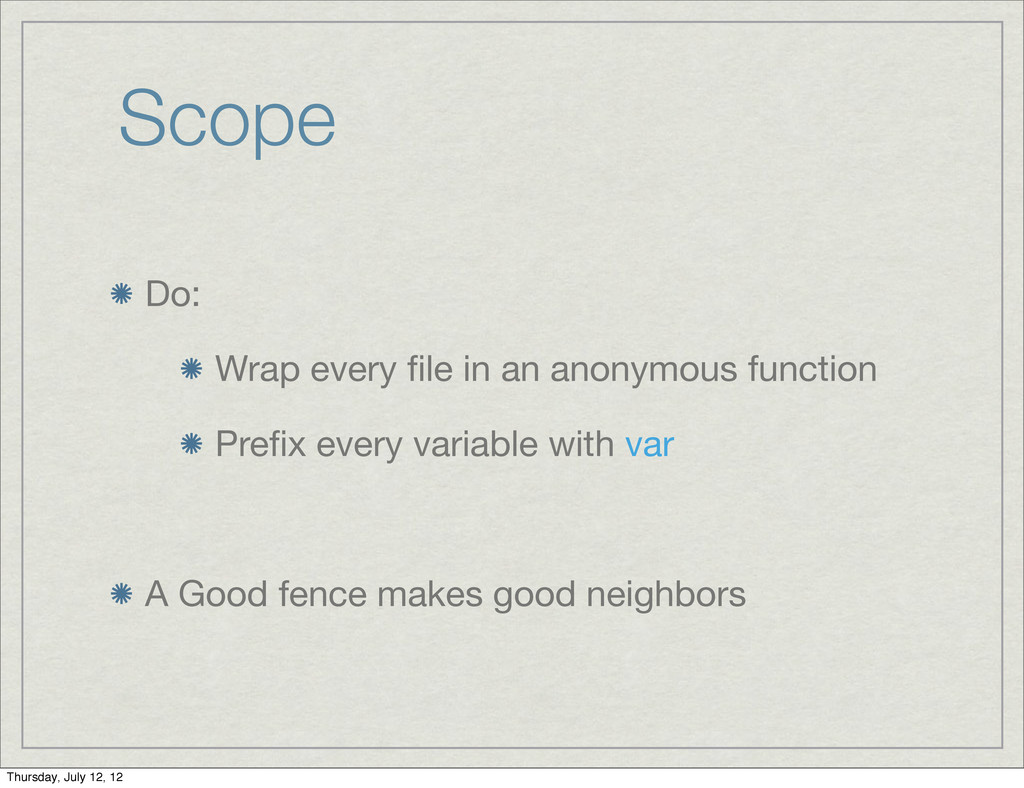
Scope Do: Wrap every file in an anonymous function Prefix
every variable with var A Good fence makes good neighbors Thursday, July 12, 12 -
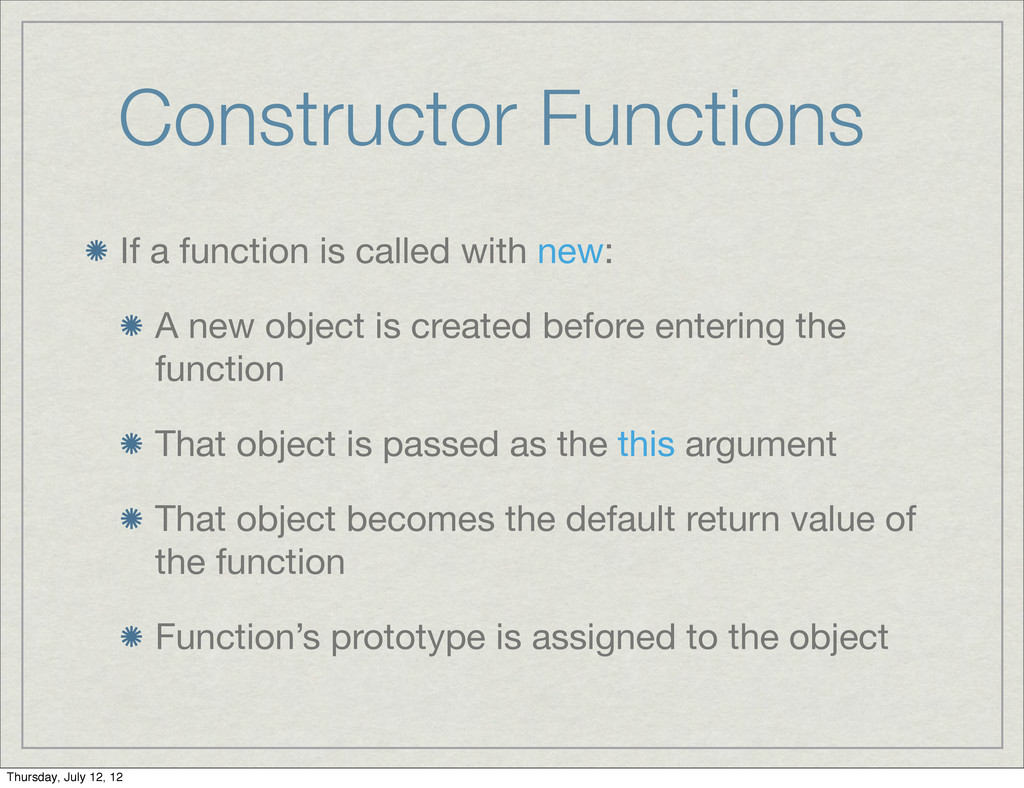
Constructor Functions If a function is called with new: A
new object is created before entering the function That object is passed as the this argument That object becomes the default return value of the function Function’s prototype is assigned to the object Thursday, July 12, 12 -
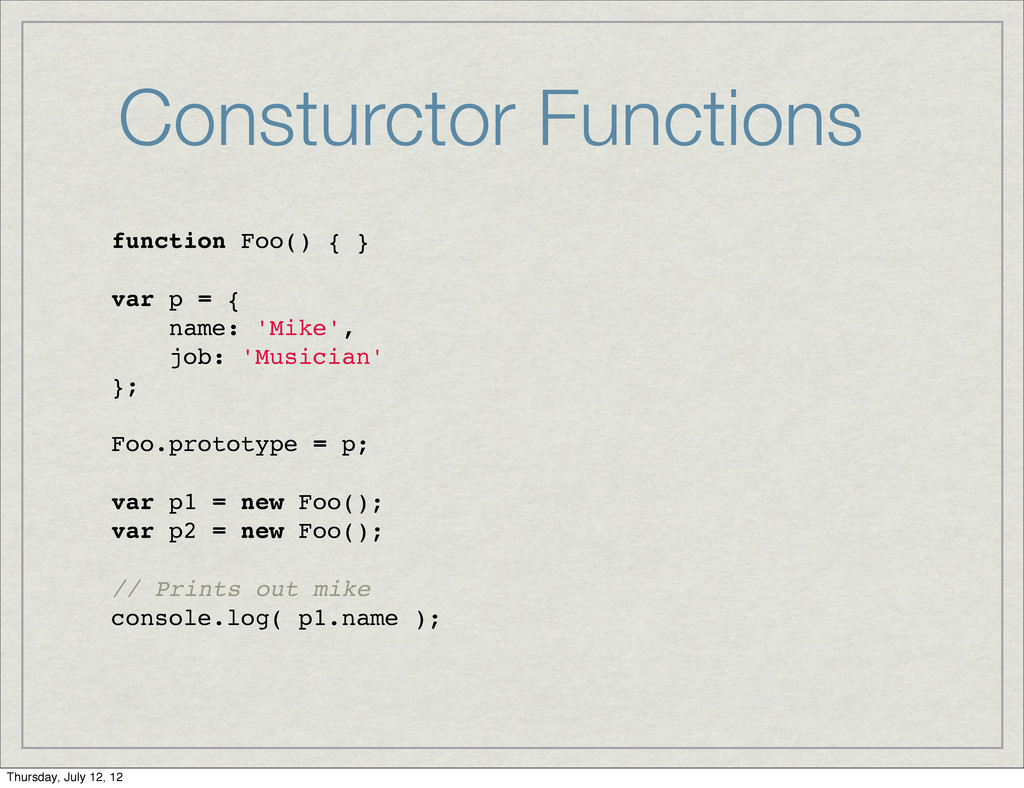
Consturctor Functions function Foo() { } var p = {
name: 'Mike', job: 'Musician' }; Foo.prototype = p; var p1 = new Foo(); var p2 = new Foo(); // Prints out mike console.log( p1.name ); Thursday, July 12, 12 -
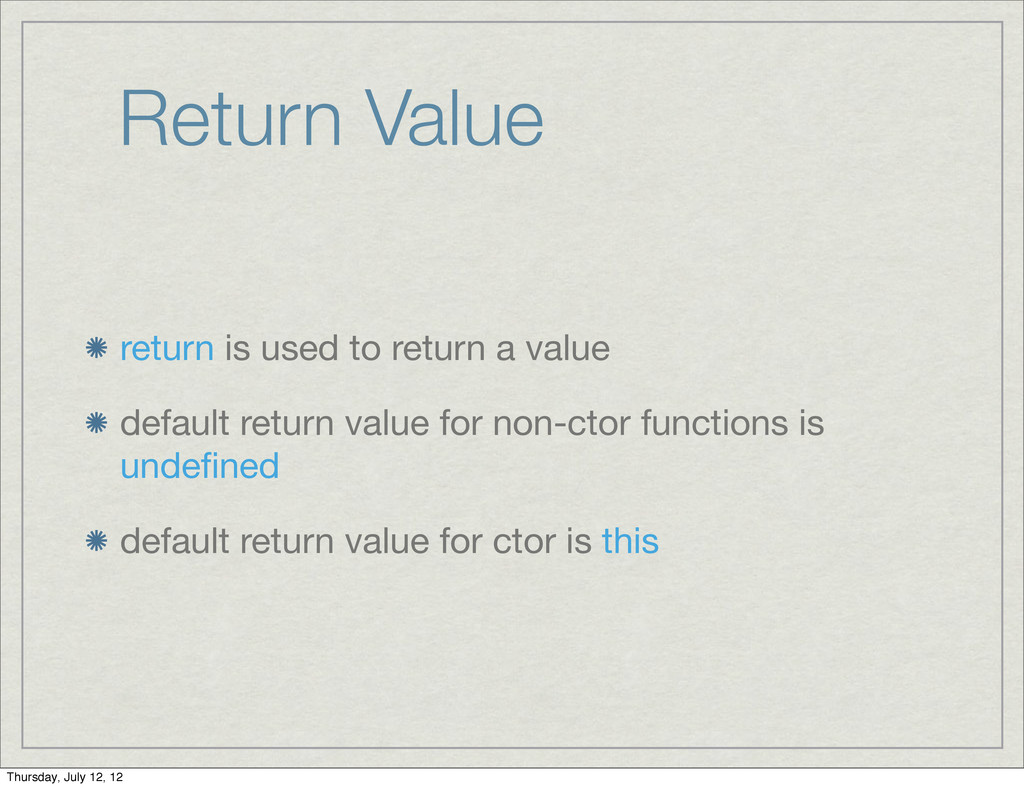
Return Value return is used to return a value default
return value for non-ctor functions is undefined default return value for ctor is this Thursday, July 12, 12 -
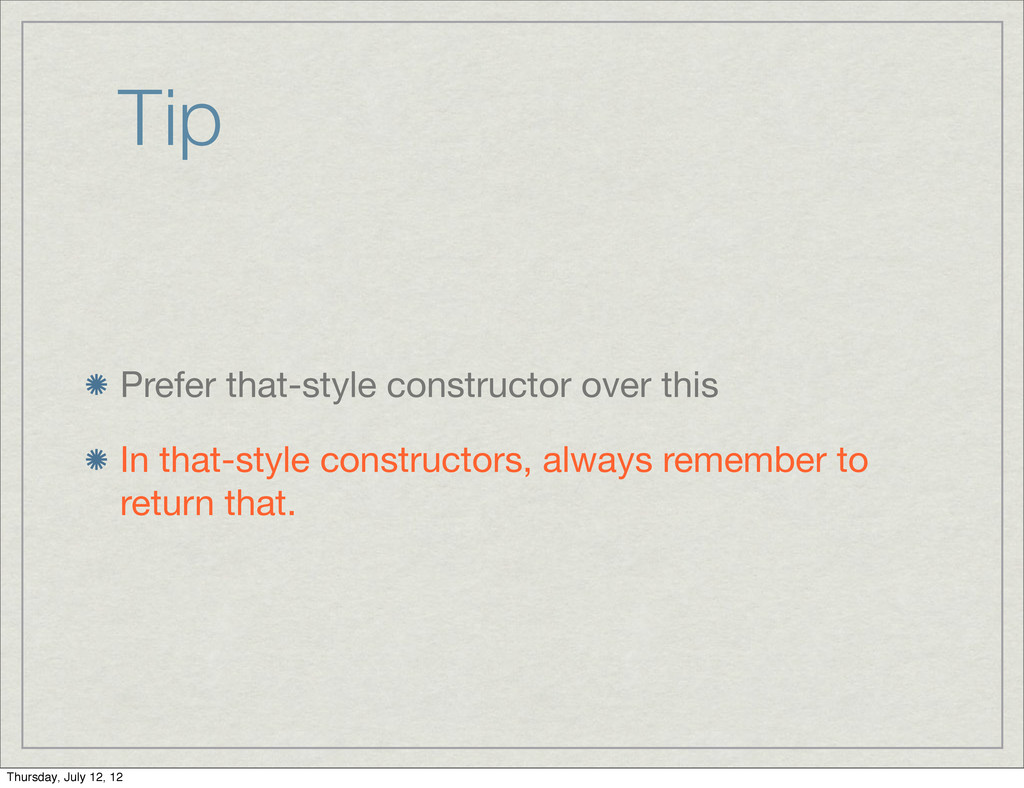
Tip Prefer that-style constructor over this In that-style constructors, always
remember to return that. Thursday, July 12, 12 -
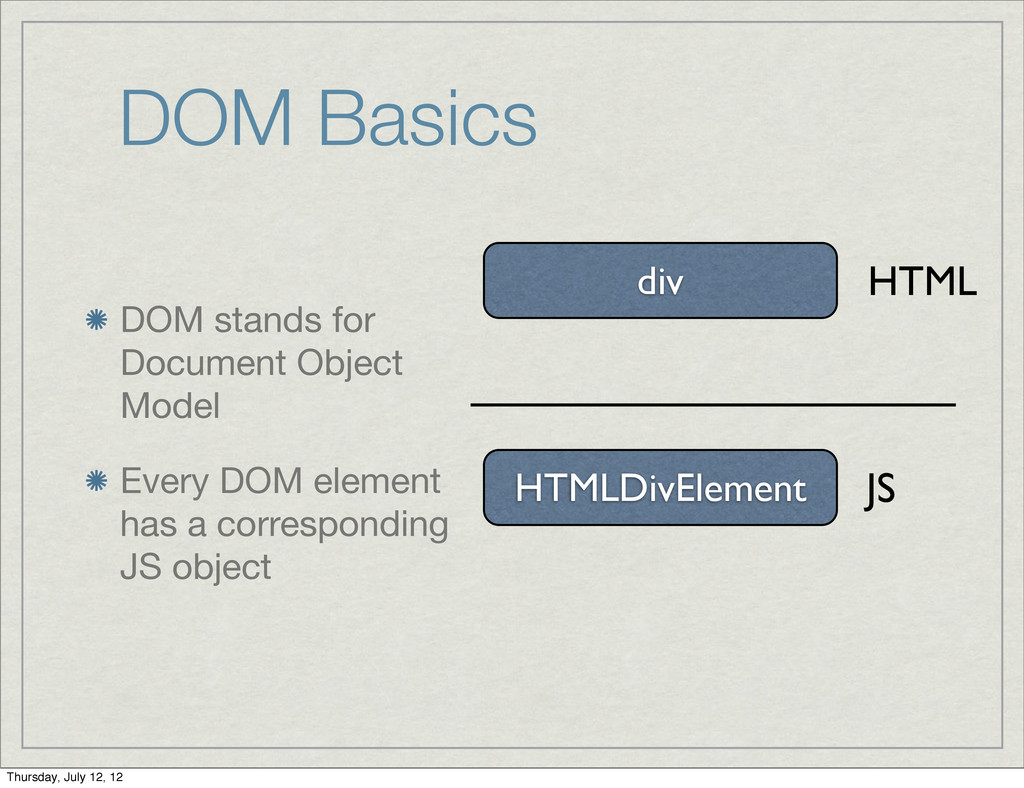
DOM Basics DOM stands for Document Object Model Every DOM
element has a corresponding JS object HTMLDivElement HTML div JS Thursday, July 12, 12 -
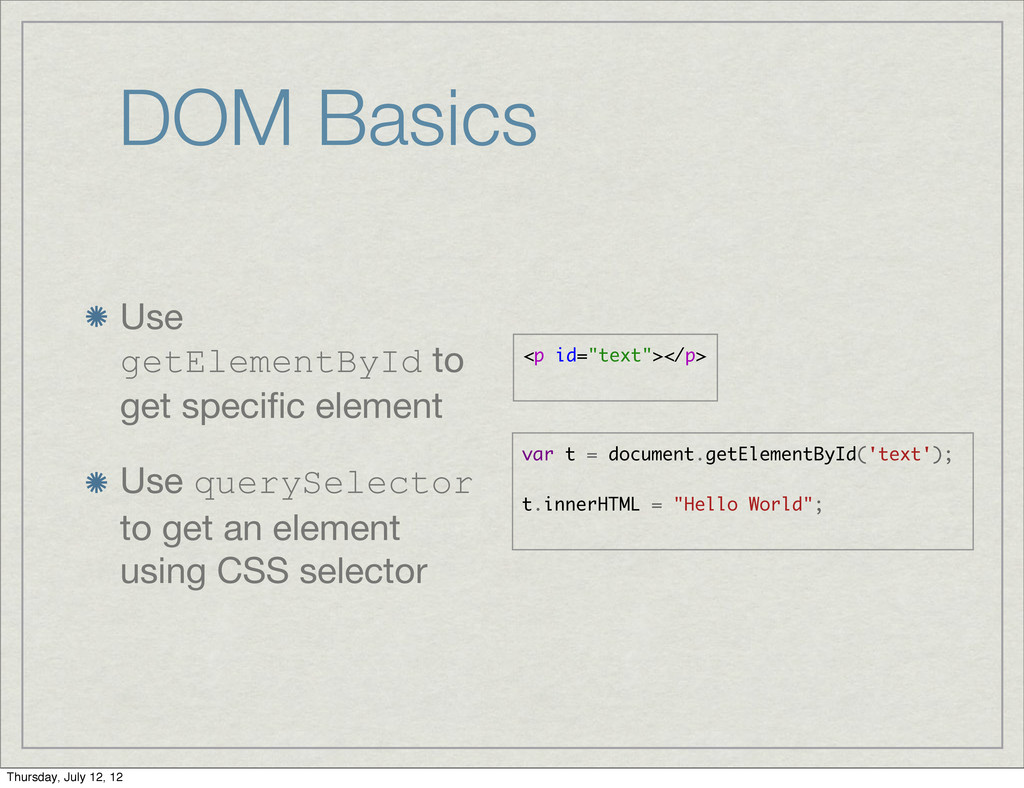
DOM Basics Use getElementById to get specific element Use querySelector
to get an element using CSS selector <p id="text"></p> var t = document.getElementById('text'); t.innerHTML = "Hello World"; Thursday, July 12, 12 -
AJAX Libraries Developer tools to cover bad stuff from developers
jQuery, YUI, Dojo, ExtJS, ... Thursday, July 12, 12 -
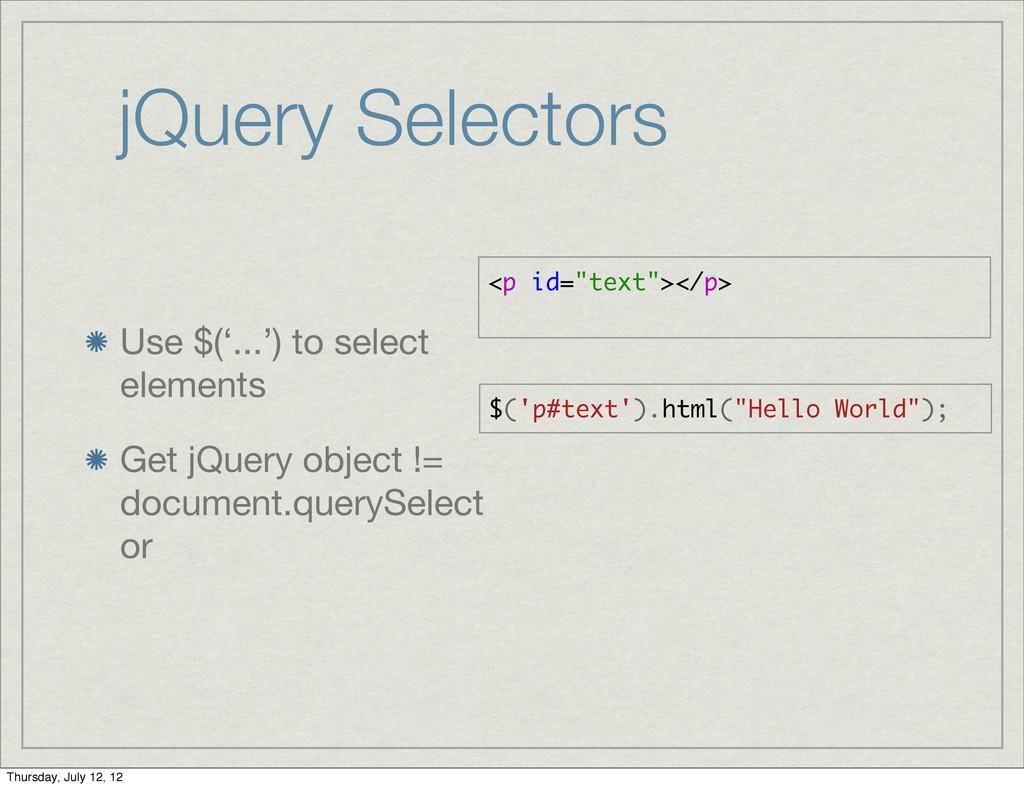
jQuery Selectors Use $(‘...’) to select elements Get jQuery object
!= document.querySelect or <p id="text"></p> $('p#text').html("Hello World"); Thursday, July 12, 12 -
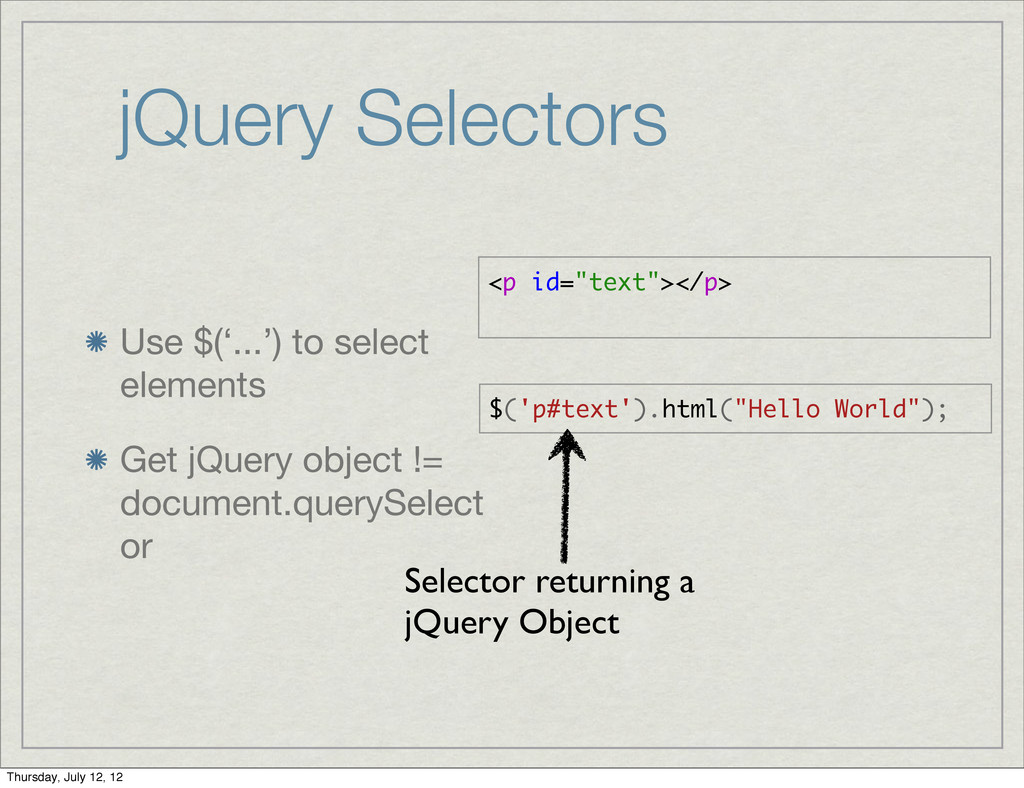
jQuery Selectors Use $(‘...’) to select elements Get jQuery object
!= document.querySelect or <p id="text"></p> $('p#text').html("Hello World"); Selector returning a jQuery Object Thursday, July 12, 12 -
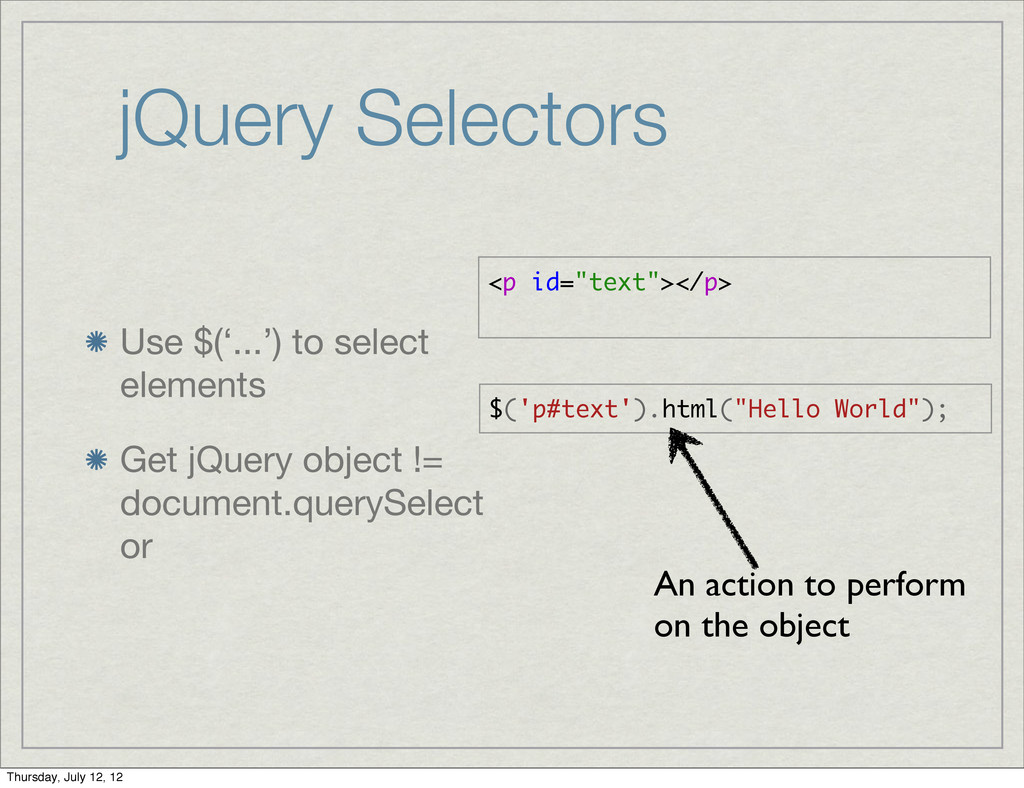
jQuery Selectors Use $(‘...’) to select elements Get jQuery object
!= document.querySelect or <p id="text"></p> $('p#text').html("Hello World"); An action to perform on the object Thursday, July 12, 12 -
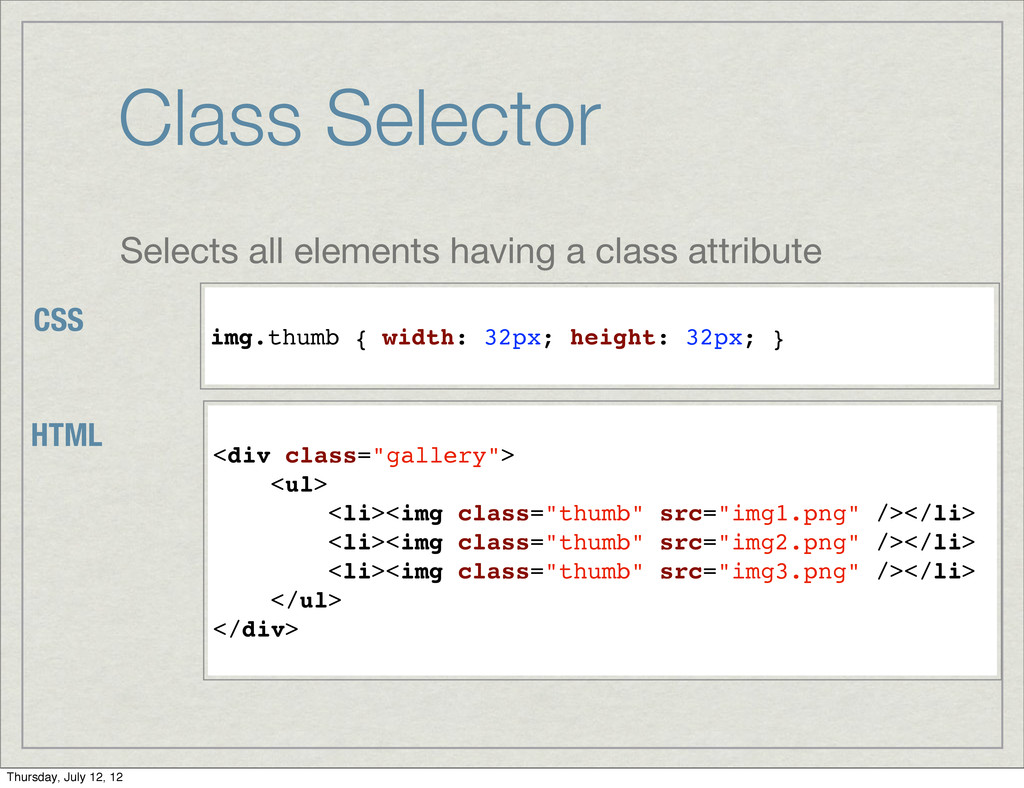
Class Selector Selects all elements having a class attribute img.thumb
{ width: 32px; height: 32px; } <div class="gallery"> <ul> <li><img class="thumb" src="img1.png" /></li> <li><img class="thumb" src="img2.png" /></li> <li><img class="thumb" src="img3.png" /></li> </ul> </div> CSS HTML Thursday, July 12, 12 -
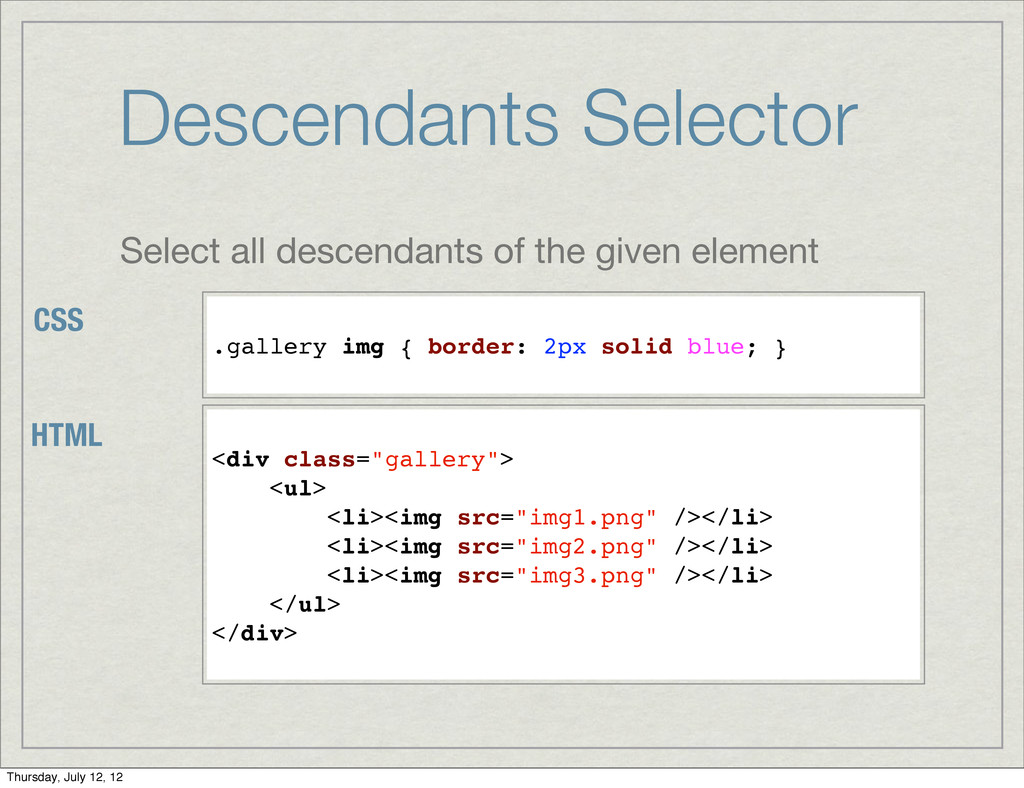
Descendants Selector Select all descendants of the given element .gallery
img { border: 2px solid blue; } <div class="gallery"> <ul> <li><img src="img1.png" /></li> <li><img src="img2.png" /></li> <li><img src="img3.png" /></li> </ul> </div> CSS HTML Thursday, July 12, 12 -
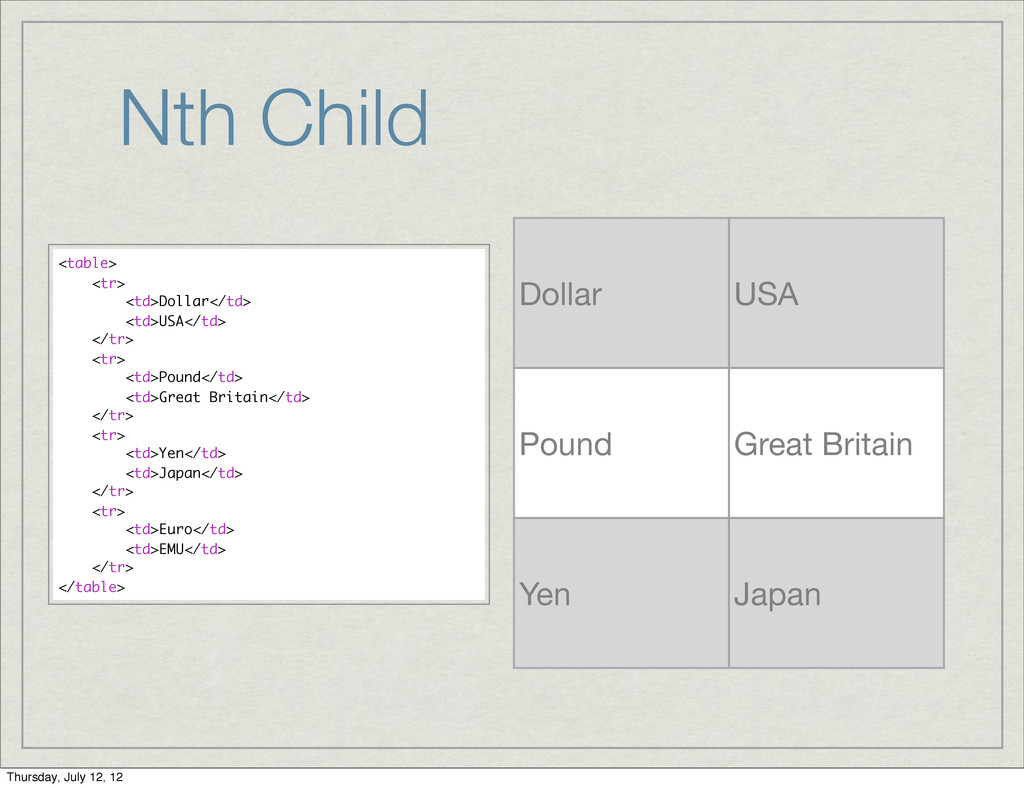
Nth Child <table> <tr> <td>Dollar</td> <td>USA</td> </tr> <tr> <td>Pound</td> <td>Great
Britain</td> </tr> <tr> <td>Yen</td> <td>Japan</td> </tr> <tr> <td>Euro</td> <td>EMU</td> </tr> </table> Dollar USA Pound Great Britain Yen Japan Thursday, July 12, 12 -
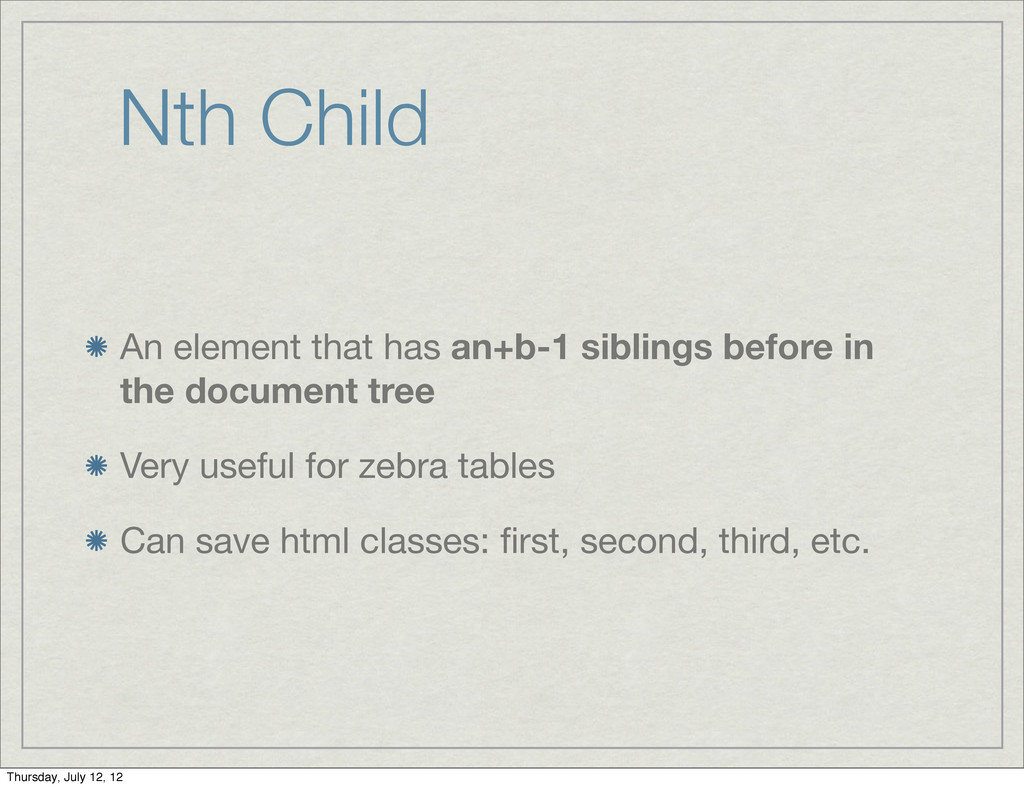
Nth Child An element that has an+b-1 siblings before in
the document tree Very useful for zebra tables Can save html classes: first, second, third, etc. Thursday, July 12, 12 -
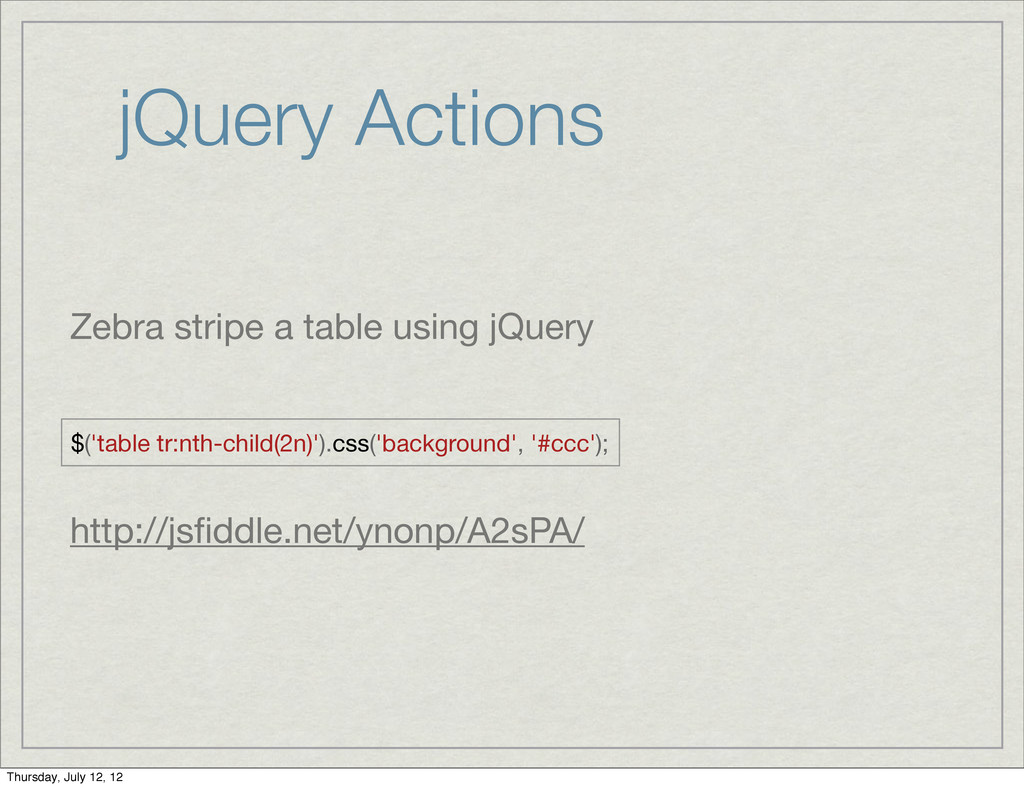
jQuery Actions Zebra stripe a table using jQuery http://jsfiddle.net/ynonp/A2sPA/ $('table
tr:nth-child(2n)').css('background', '#ccc'); Thursday, July 12, 12 -
jQuery Events Define what to do when something happens in
jQuery, “bind” a function to an action Thursday, July 12, 12 -
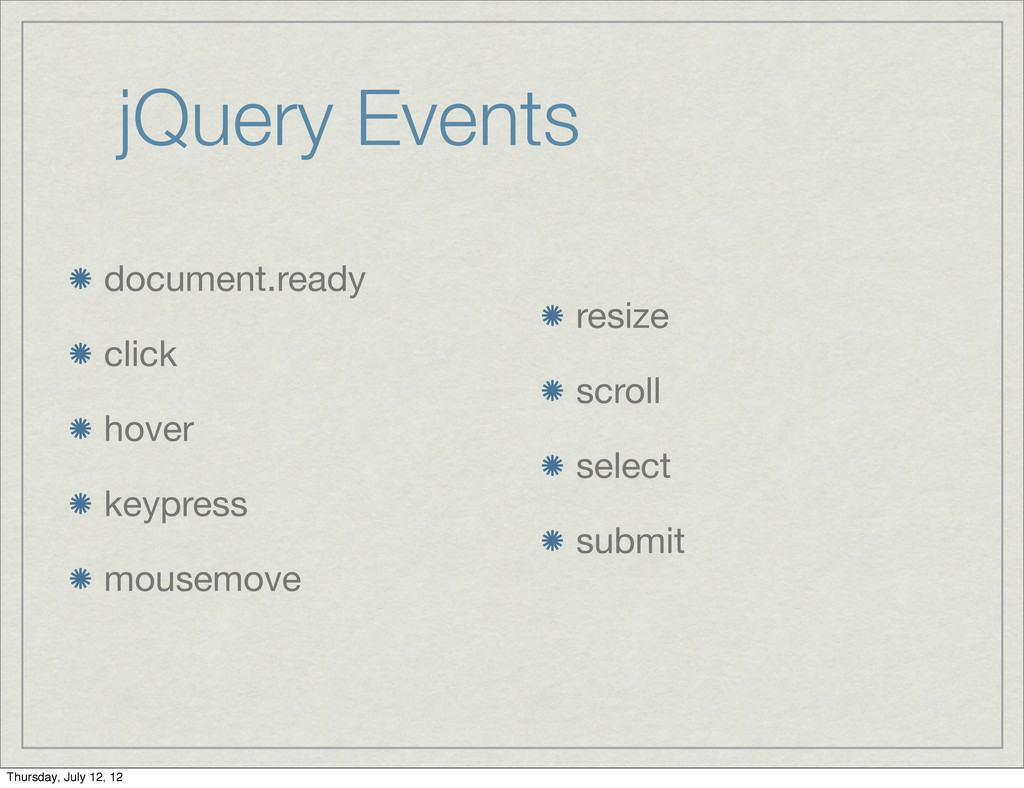
jQuery Events document.ready click hover keypress mousemove resize scroll select
submit Thursday, July 12, 12 -
DEMO Grid of four boxes Click on the red to
win Thursday, July 12, 12 -
jQuery Lab Write a web application that splits the screen
into four sections. Each click on a section should display a sentence inside the clicked section Write a web app to convert time units. User should enter time in seconds, minutes or hours, and convert to all the others Thursday, July 12, 12 -
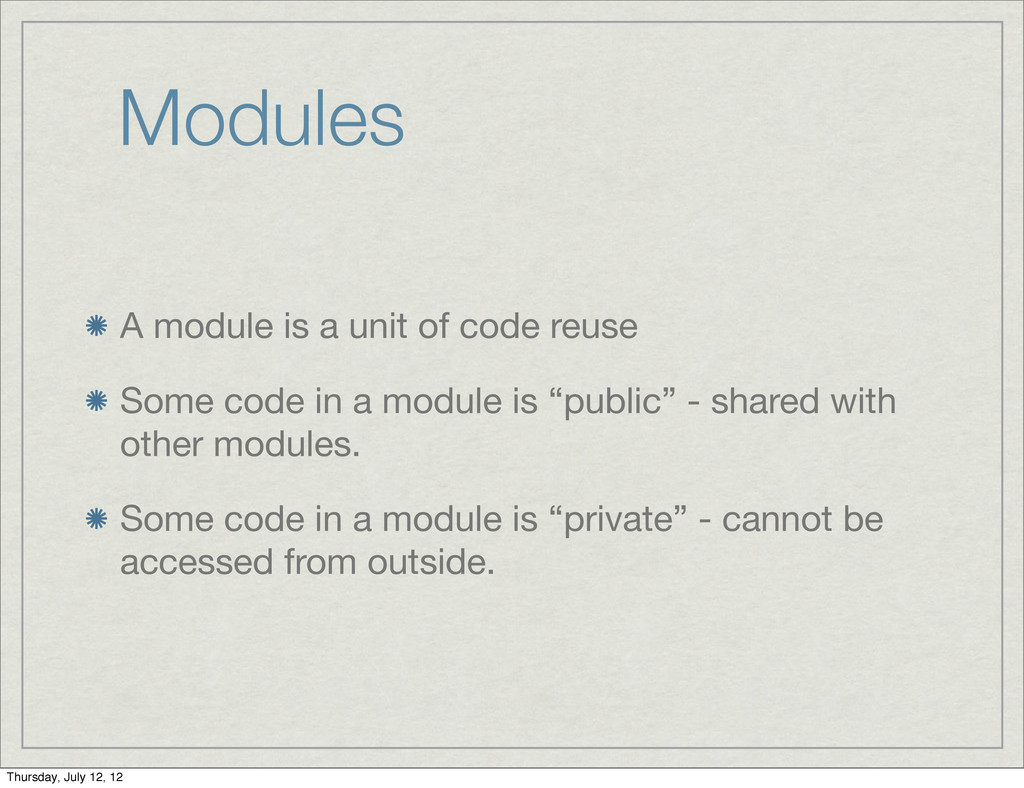
Modules A module is a unit of code reuse Some
code in a module is “public” - shared with other modules. Some code in a module is “private” - cannot be accessed from outside. Thursday, July 12, 12 -
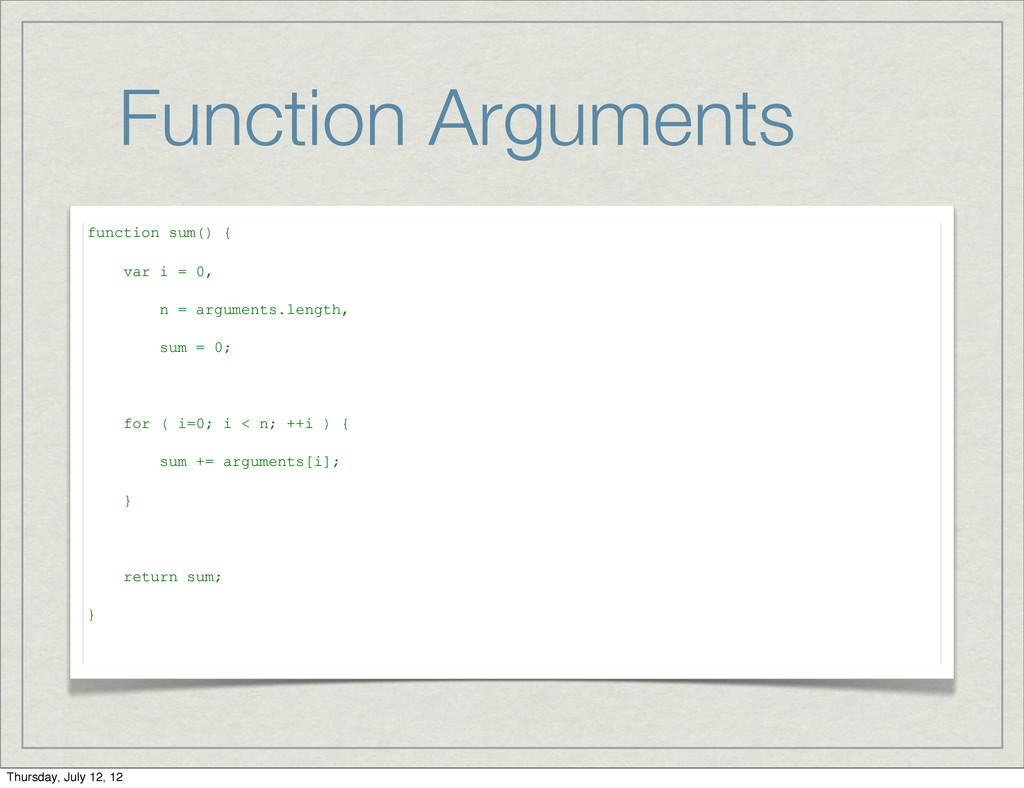
Function Arguments function sum() { var i = 0, n
= arguments.length, sum = 0; for ( i=0; i < n; ++i ) { sum += arguments[i]; } return sum; } Thursday, July 12, 12 -
Example - Calculator Public code: add_to_register sub_from_register read_register zero_register http://ynonperek.com/course/web/javascript-
functions.html#modules Thursday, July 12, 12 -
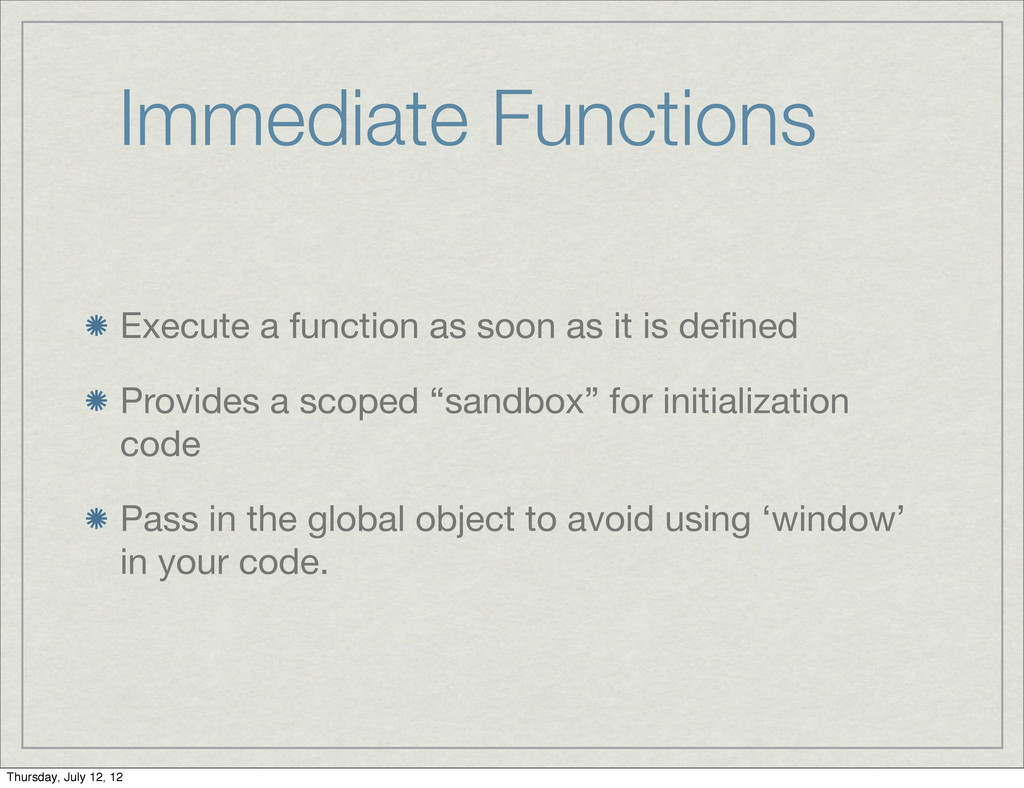
Immediate Functions Execute a function as soon as it is
defined Provides a scoped “sandbox” for initialization code Pass in the global object to avoid using ‘window’ in your code. Thursday, July 12, 12 -
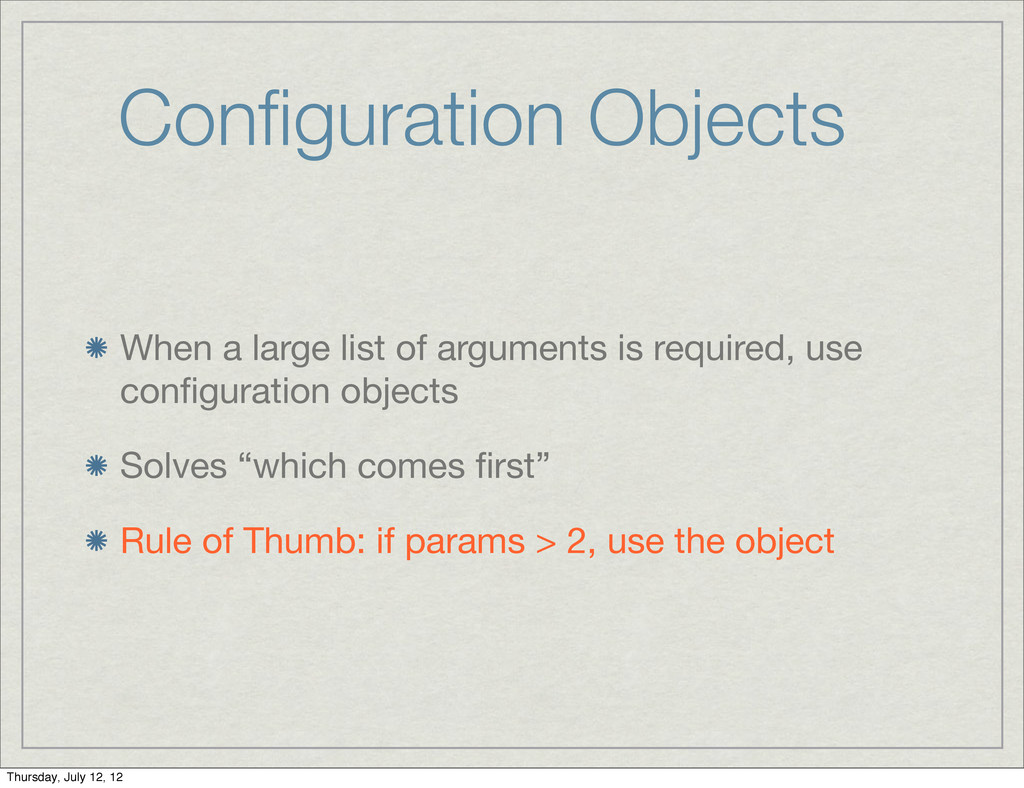
Configuration Objects When a large list of arguments is required,
use configuration objects Solves “which comes first” Rule of Thumb: if params > 2, use the object Thursday, July 12, 12 -
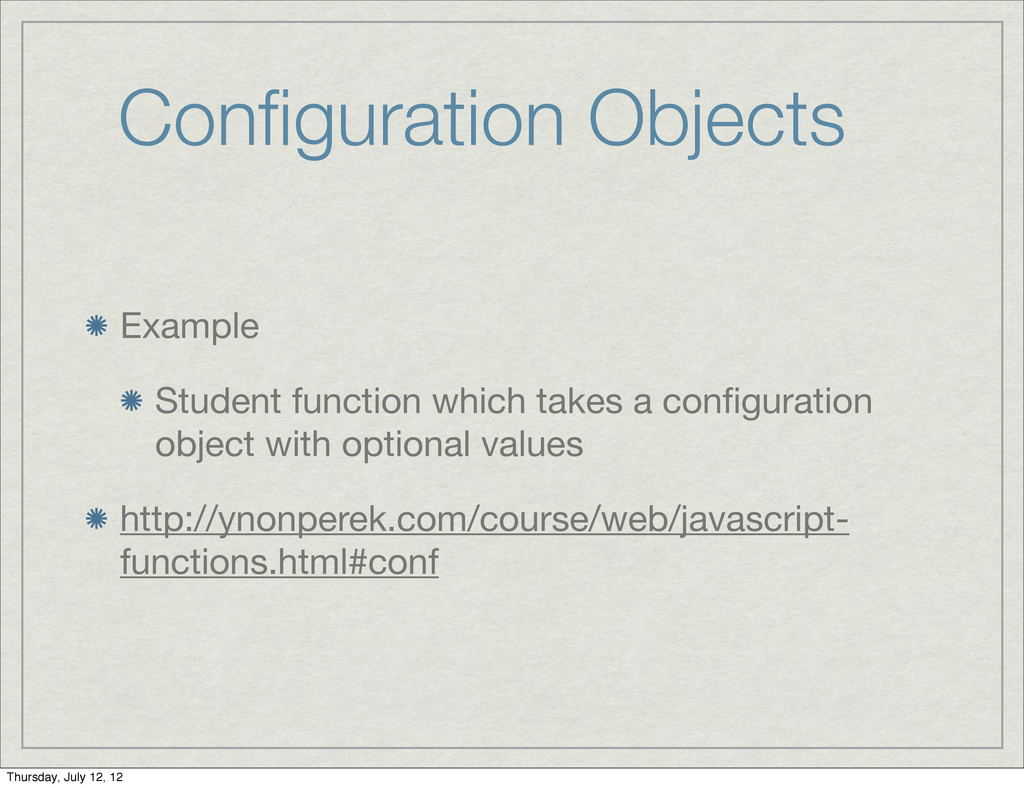
Configuration Objects Example Student function which takes a configuration object
with optional values http://ynonperek.com/course/web/javascript- functions.html#conf Thursday, July 12, 12 -
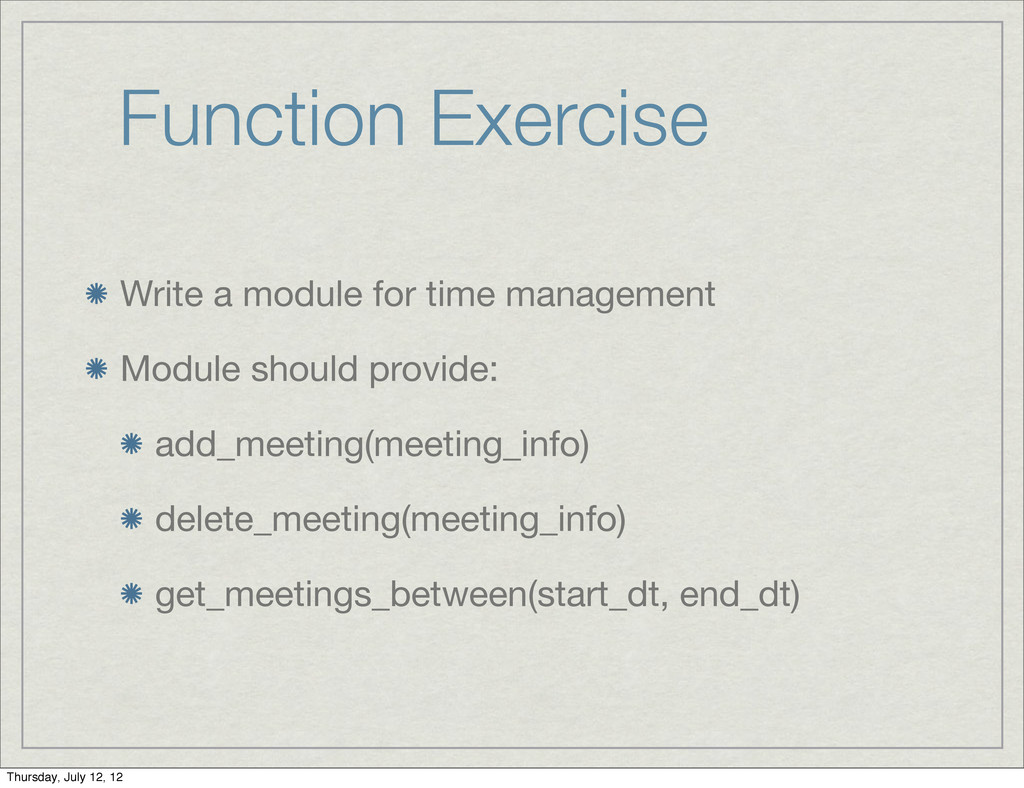
Function Exercise Write a module for time management Module should
provide: add_meeting(meeting_info) delete_meeting(meeting_info) get_meetings_between(start_dt, end_dt) Thursday, July 12, 12 -
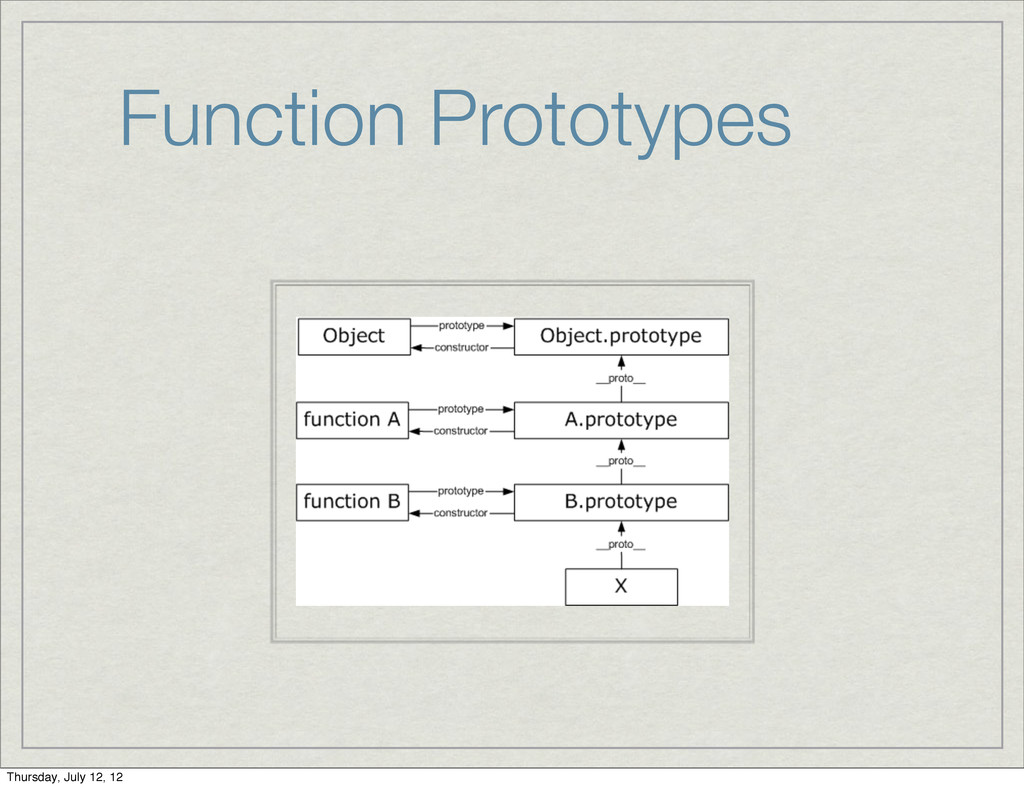
Function Prototypes functions have a special attribute: prototype When an
object’s attribute lookup is performed, the interpreter checks its constructor.prototype Thursday, July 12, 12 -
Function Prototypes We implement inheritance using prototypes - this is
called prototypical inheritance Example: http://ynonperek.com/course/fed/ javascript-oo.html Thursday, July 12, 12 -
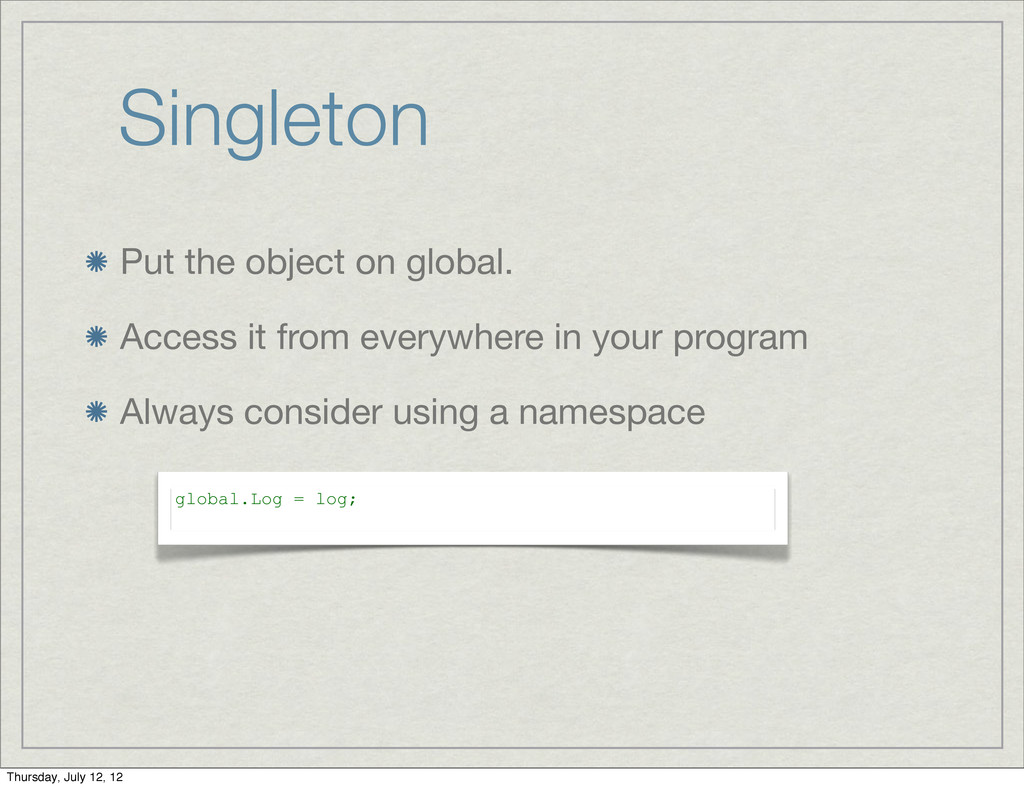
Singleton Put the object on global. Access it from everywhere
in your program Always consider using a namespace global.Log = log; Thursday, July 12, 12 -
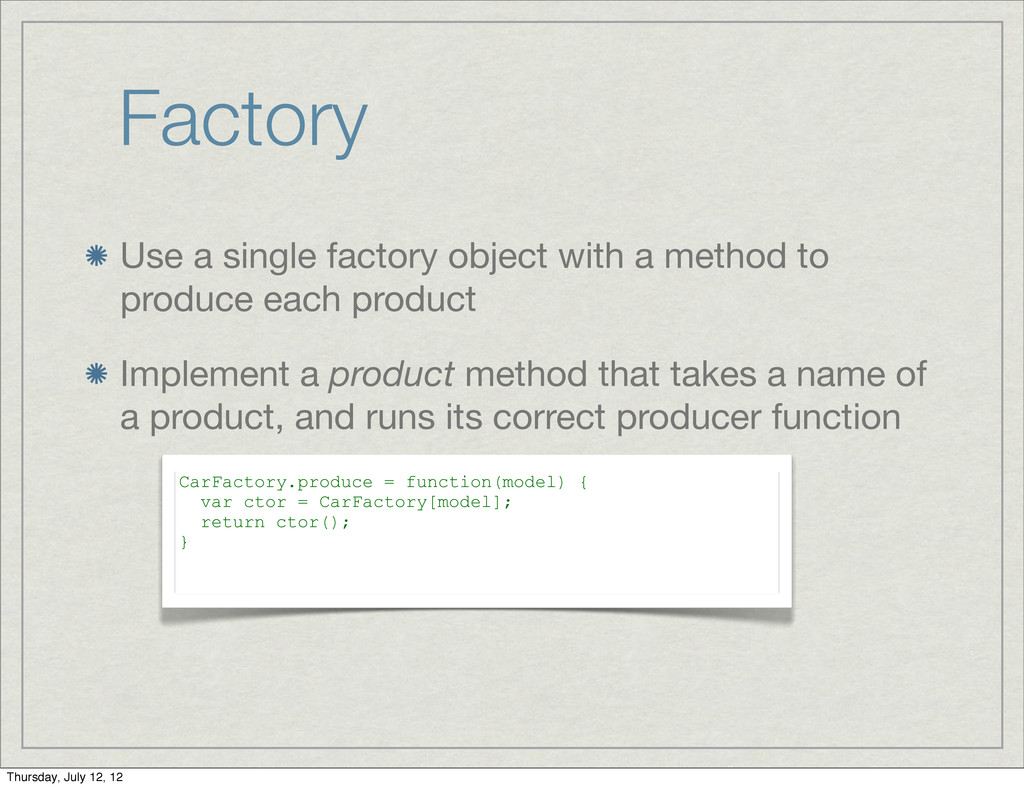
Factory Use a single factory object with a method to
produce each product Implement a product method that takes a name of a product, and runs its correct producer function CarFactory.produce = function(model) { var ctor = CarFactory[model]; return ctor(); } Thursday, July 12, 12 -
Using Super JavaScript has no native ‘super’ call To use
the superclass in the inheritance chain, we must work something out ourselves Let’s modify our object function to allow super Thursday, July 12, 12 -
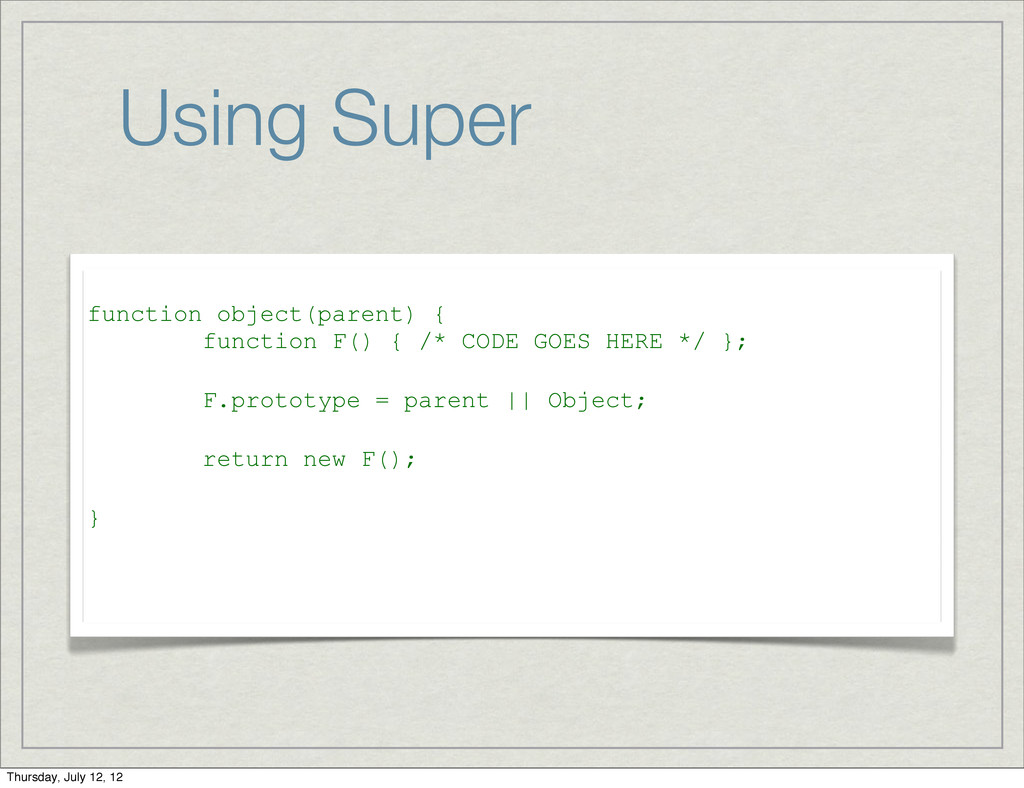
Using Super function object(parent) { function F() { /* CODE
GOES HERE */ }; F.prototype = parent || Object; return new F(); } Thursday, July 12, 12 -
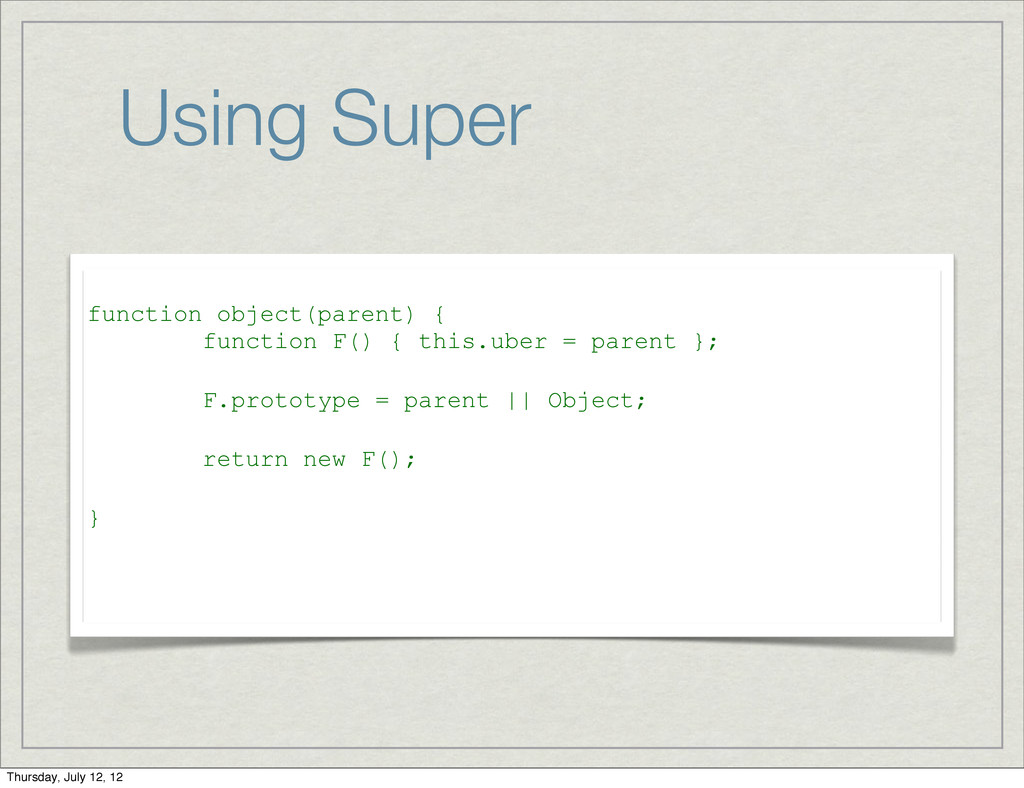
Using Super function object(parent) { function F() { this.uber =
parent }; F.prototype = parent || Object; return new F(); } Thursday, July 12, 12 -
Using Super Now each object has an ‘uber’ property that
points to its prototype object Can use student.uber.age to get the person’s age Thursday, July 12, 12 -
JS App Tips App is made of components. On mobile,
only one visible component at a time; on Desktop, can have more than one. Each component has its own JS file Different components can communicate using a global object in a private namespace A single controller object moves components in/ out of view Thursday, July 12, 12