Upgrade to Pro — share decks privately, control downloads, hide ads and more …

Scaling the World's Largest Django App - Django...

Sponsored · Ship Features Fearlessly Turn features on and off without deploys. Used by thousands of Ruby developers.
Avatar for David Cramer David Cramer
September 26, 2011

Scaling the World's Largest Django App - DjangoCon 2010

Avatar for David Cramer

David Cramer

September 26, 2011
Tweet

More Decks by David Cramer

Other Decks in Technology

Transcript

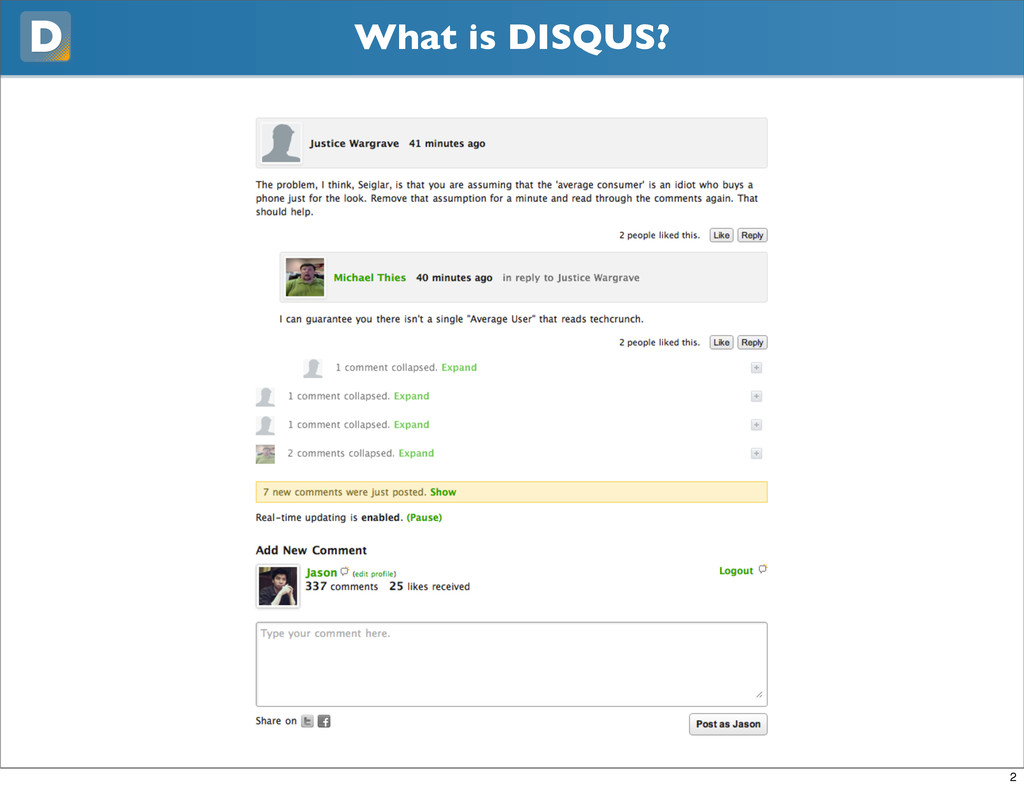
  1. What is DISQUS? We are a comment system with an

    emphasis on connecting communities http://disqus.com/about/ dis·cuss • dĭ-skŭs' 3
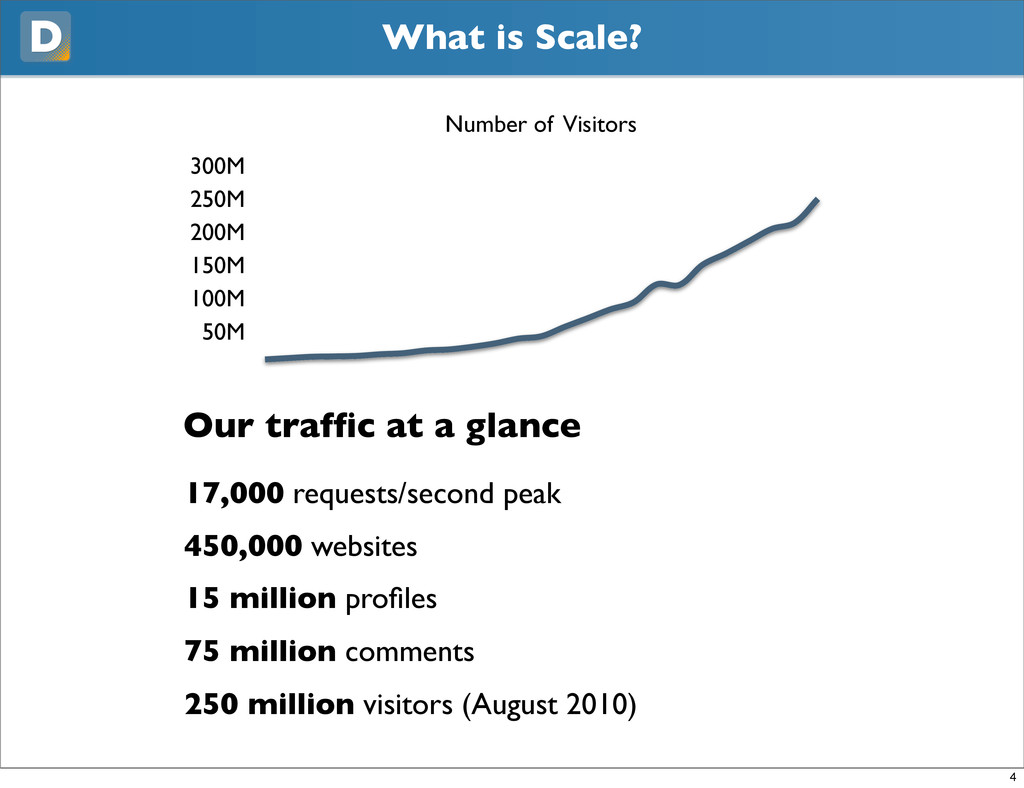
  2. What is Scale? 17,000 requests/second peak 450,000 websites 15 million

    profiles 75 million comments 250 million visitors (August 2010) 50M 100M 150M 200M 250M 300M Number of Visitors Our traffic at a glance 4
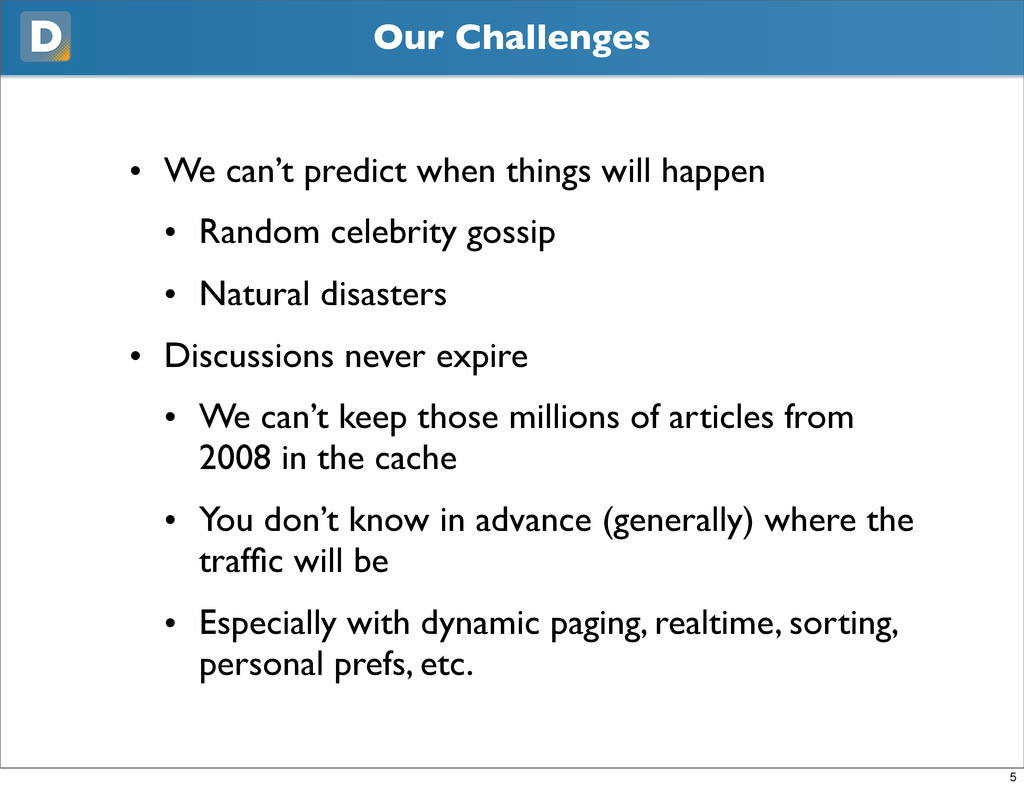
  3. Our Challenges • We can’t predict when things will happen

    • Random celebrity gossip • Natural disasters • Discussions never expire • We can’t keep those millions of articles from 2008 in the cache • You don’t know in advance (generally) where the traffic will be • Especially with dynamic paging, realtime, sorting, personal prefs, etc. 5
  4. Our Challenges (cont’d) • High availability • Not a destination

    site • Difficult to schedule maintenance 6
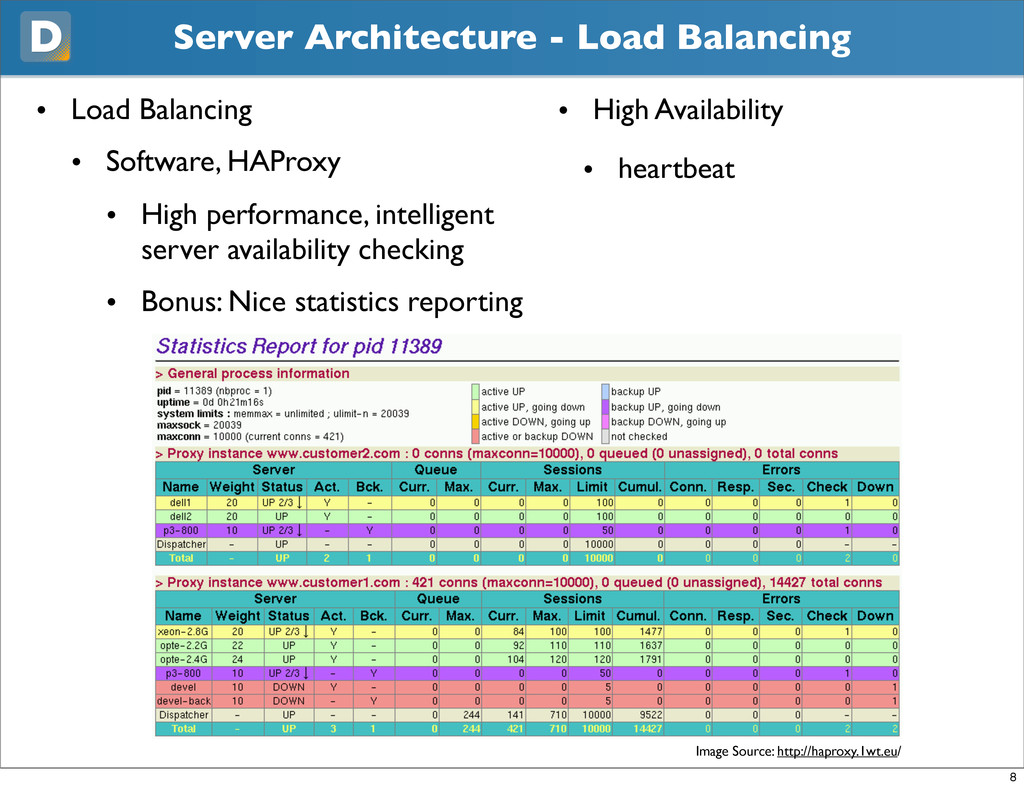
  5. Server Architecture - Load Balancing • Load Balancing • Software,

    HAProxy • High performance, intelligent server availability checking • Bonus: Nice statistics reporting • High Availability • heartbeat Image Source: http://haproxy.1wt.eu/ 8
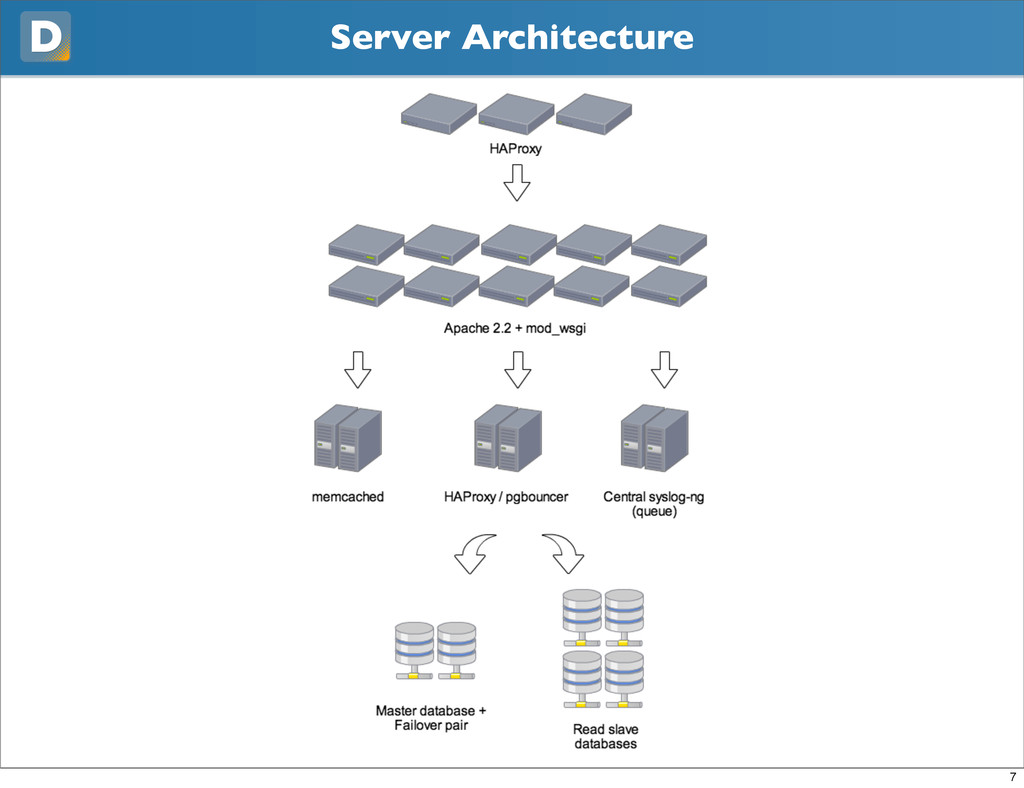
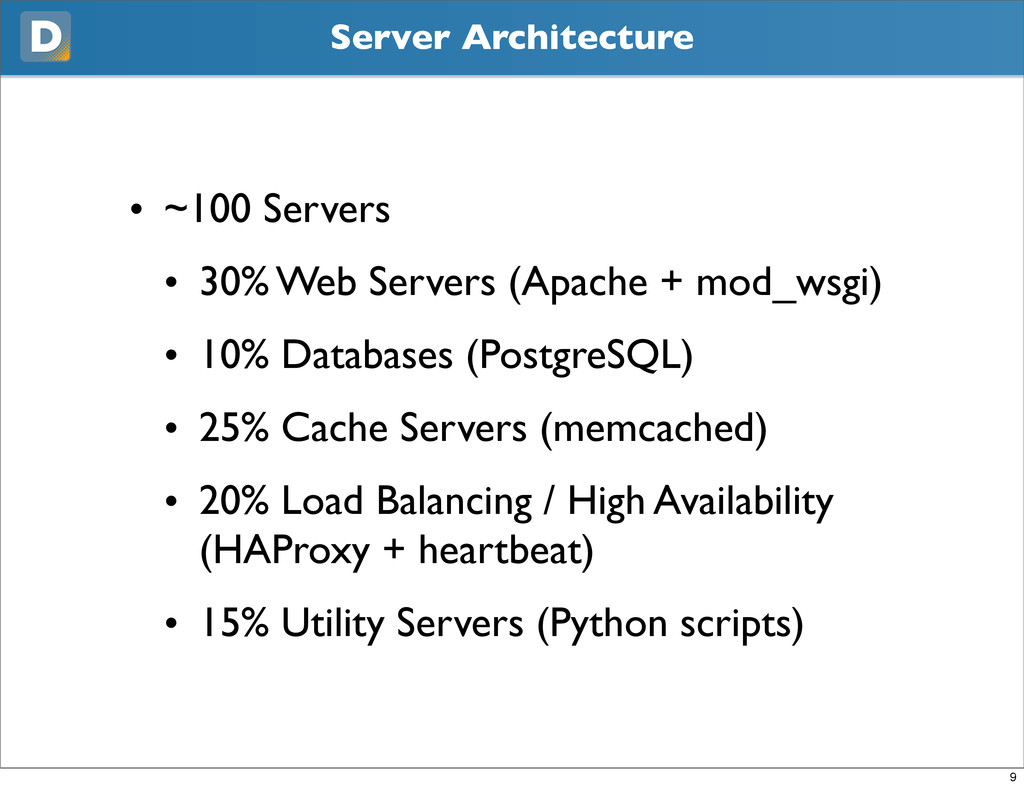
  6. Server Architecture • ~100 Servers • 30% Web Servers (Apache

    + mod_wsgi) • 10% Databases (PostgreSQL) • 25% Cache Servers (memcached) • 20% Load Balancing / High Availability (HAProxy + heartbeat) • 15% Utility Servers (Python scripts) 9
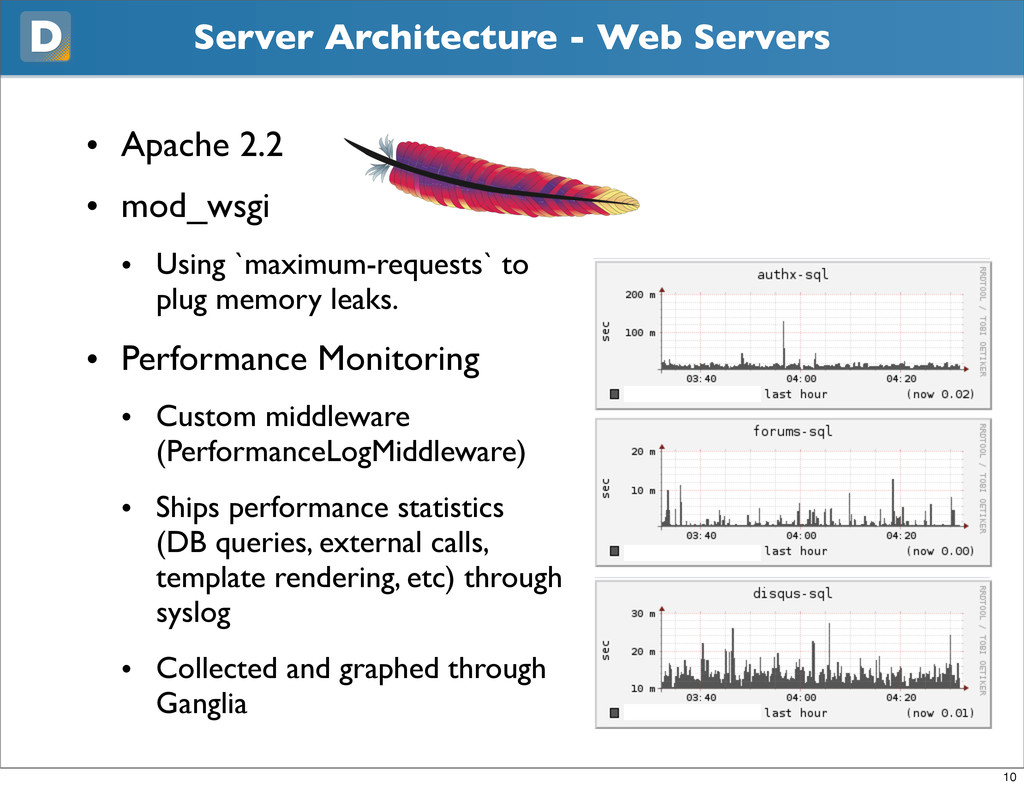
  7. Server Architecture - Web Servers • Apache 2.2 • mod_wsgi

    • Using `maximum-requests` to plug memory leaks. • Performance Monitoring • Custom middleware (PerformanceLogMiddleware) • Ships performance statistics (DB queries, external calls, template rendering, etc) through syslog • Collected and graphed through Ganglia 10
  8. Server Architecture - Database • PostgreSQL • Slony-I for Replication

    • Trigger-based • Read slaves for extra read capacity • Failover master database for high availability 11
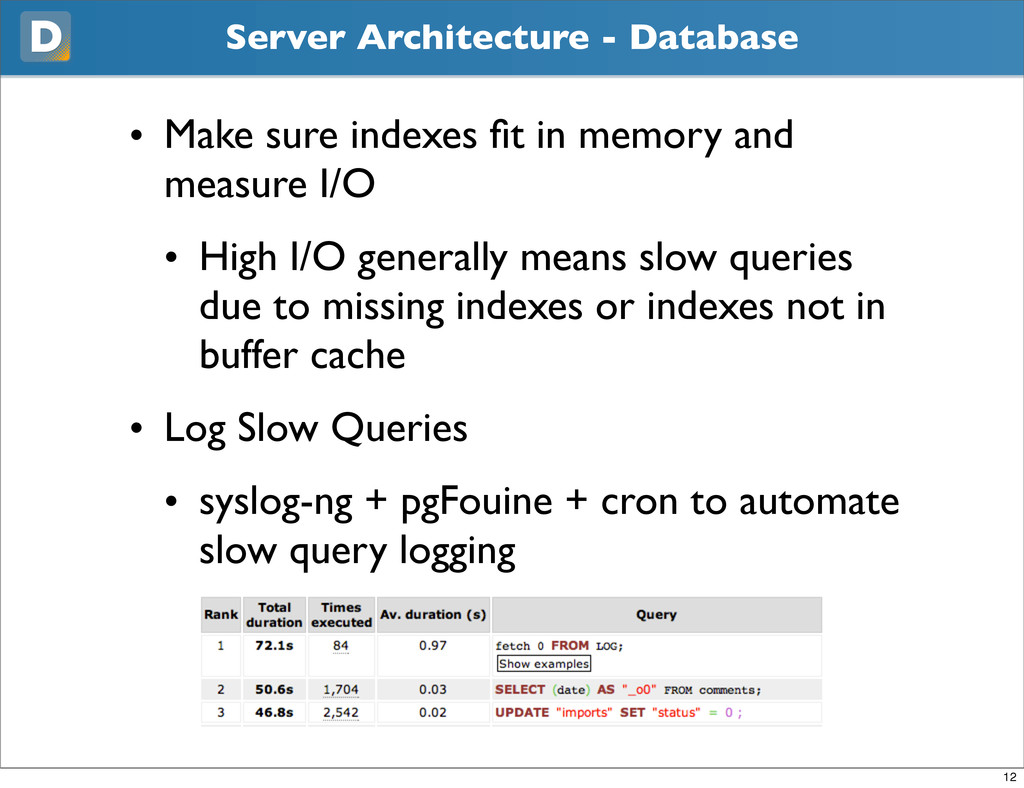
  9. Server Architecture - Database • Make sure indexes fit in

    memory and measure I/O • High I/O generally means slow queries due to missing indexes or indexes not in buffer cache • Log Slow Queries • syslog-ng + pgFouine + cron to automate slow query logging 12
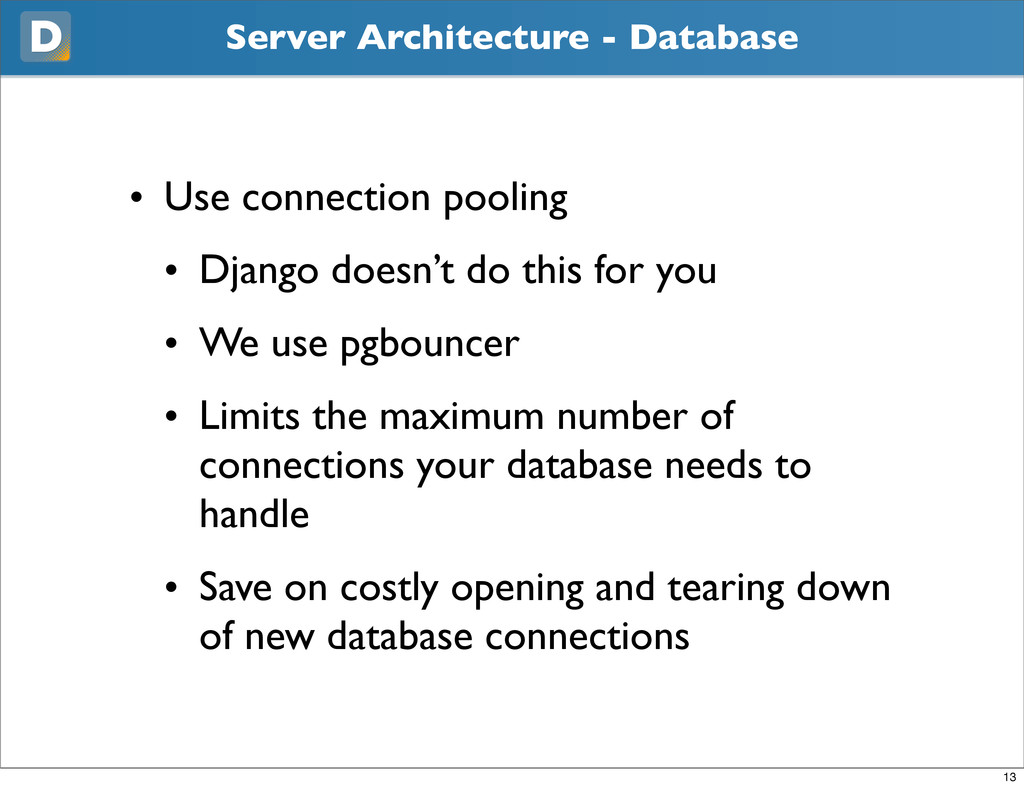
  10. Server Architecture - Database • Use connection pooling • Django

    doesn’t do this for you • We use pgbouncer • Limits the maximum number of connections your database needs to handle • Save on costly opening and tearing down of new database connections 13
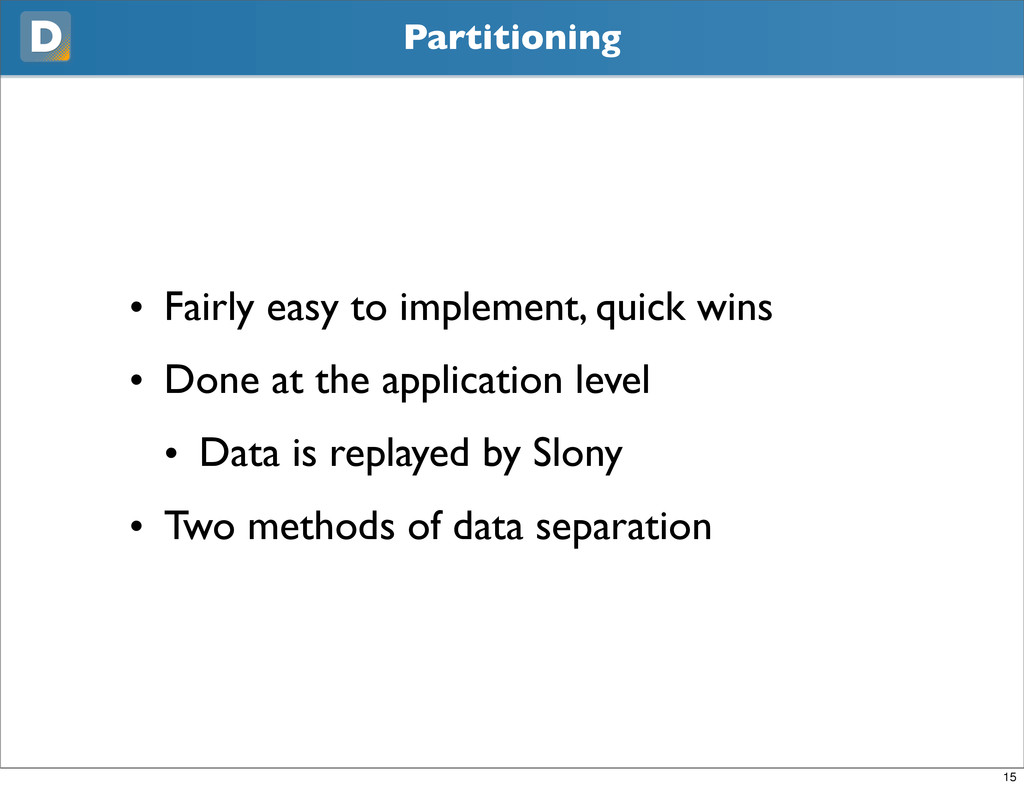
  11. Partitioning • Fairly easy to implement, quick wins • Done

    at the application level • Data is replayed by Slony • Two methods of data separation 15
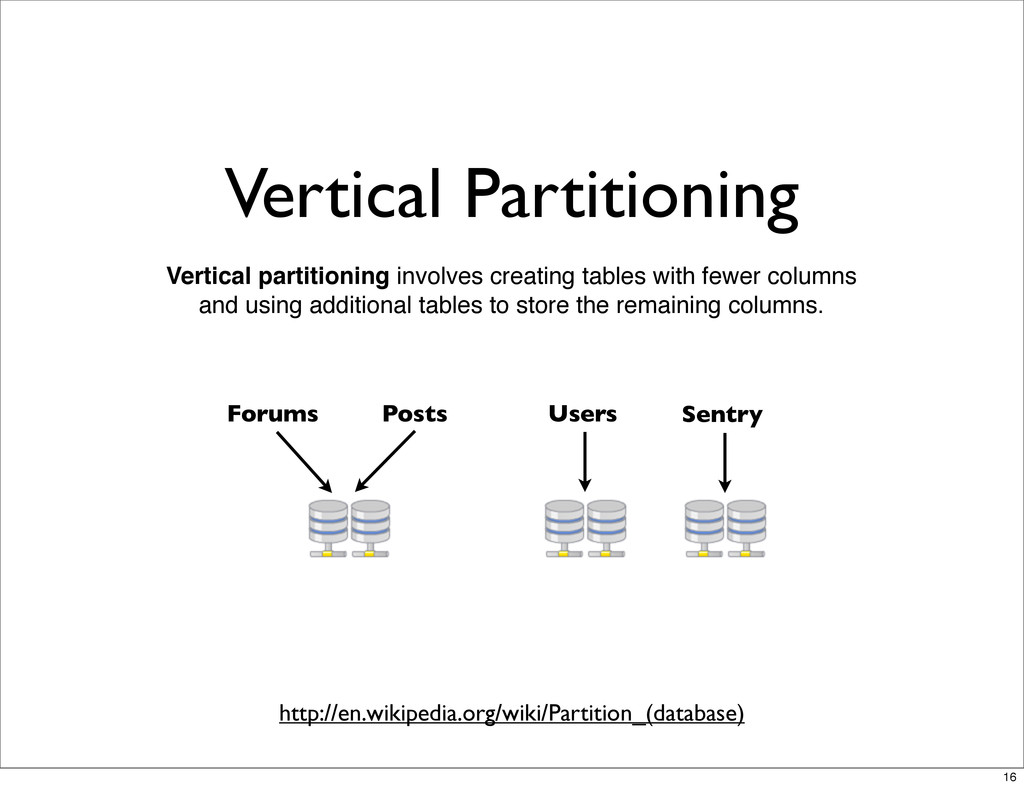
  12. Vertical Partitioning Vertical partitioning involves creating tables with fewer columns

    and using additional tables to store the remaining columns. http://en.wikipedia.org/wiki/Partition_(database) Posts Users Forums Sentry 16
  13. Pythonic Joins posts = Post.objects.all()[0:25] # store users in a

    dictionary based on primary key users = dict( (u.pk, u) for u in \ User.objects.filter(pk__in=set(p.user_id for p in posts)) ) # map users to their posts for p in posts: p._user_cache = users.get(p.user_id) Allows us to separate datasets 17
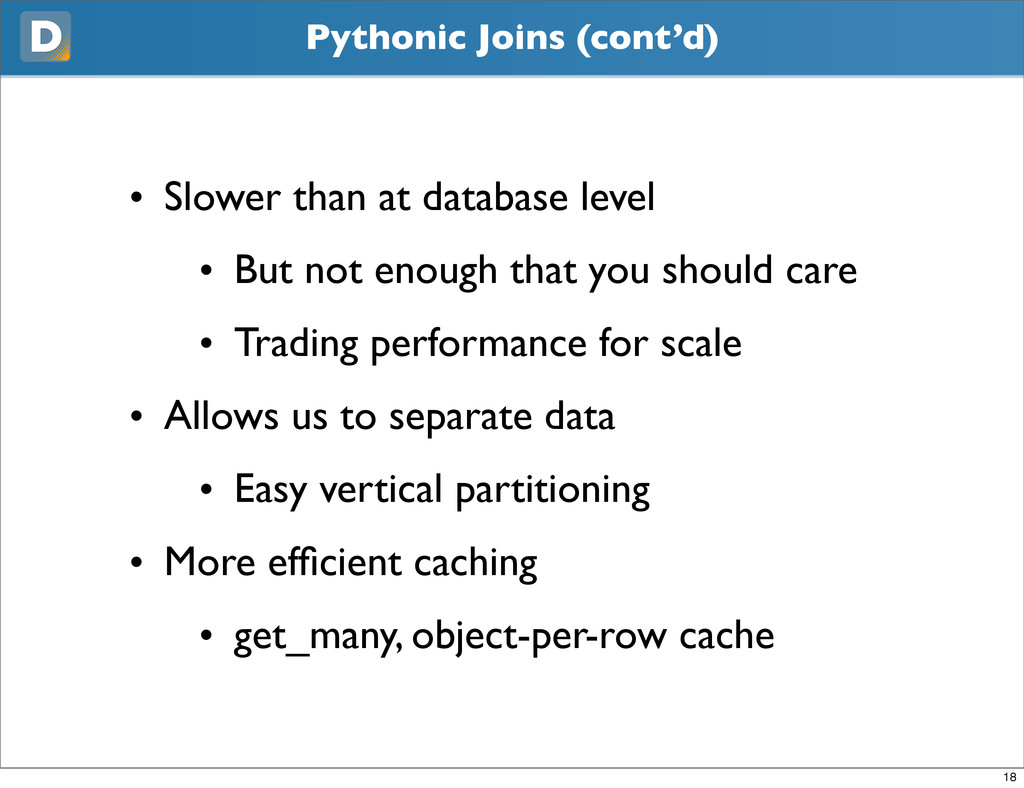
  14. Pythonic Joins (cont’d) • Slower than at database level •

    But not enough that you should care • Trading performance for scale • Allows us to separate data • Easy vertical partitioning • More efficient caching • get_many, object-per-row cache 18
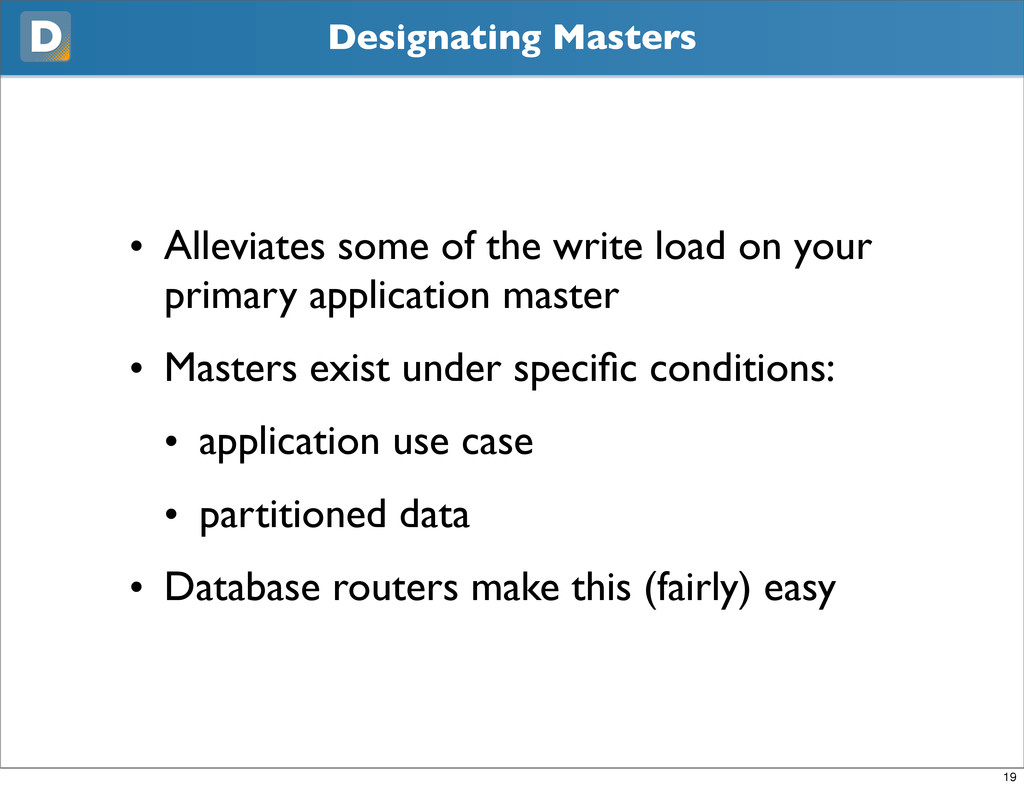
  15. Designating Masters • Alleviates some of the write load on

    your primary application master • Masters exist under specific conditions: • application use case • partitioned data • Database routers make this (fairly) easy 19
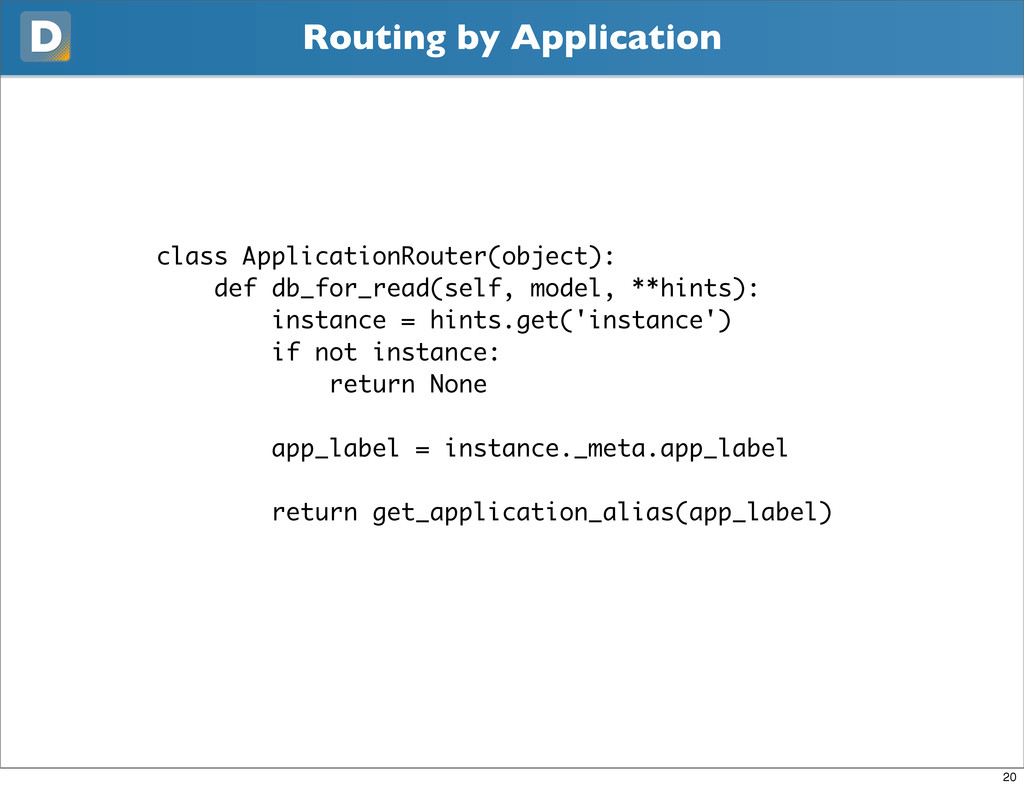
  16. Routing by Application class ApplicationRouter(object): def db_for_read(self, model, **hints): instance

    = hints.get('instance') if not instance: return None app_label = instance._meta.app_label return get_application_alias(app_label) 20
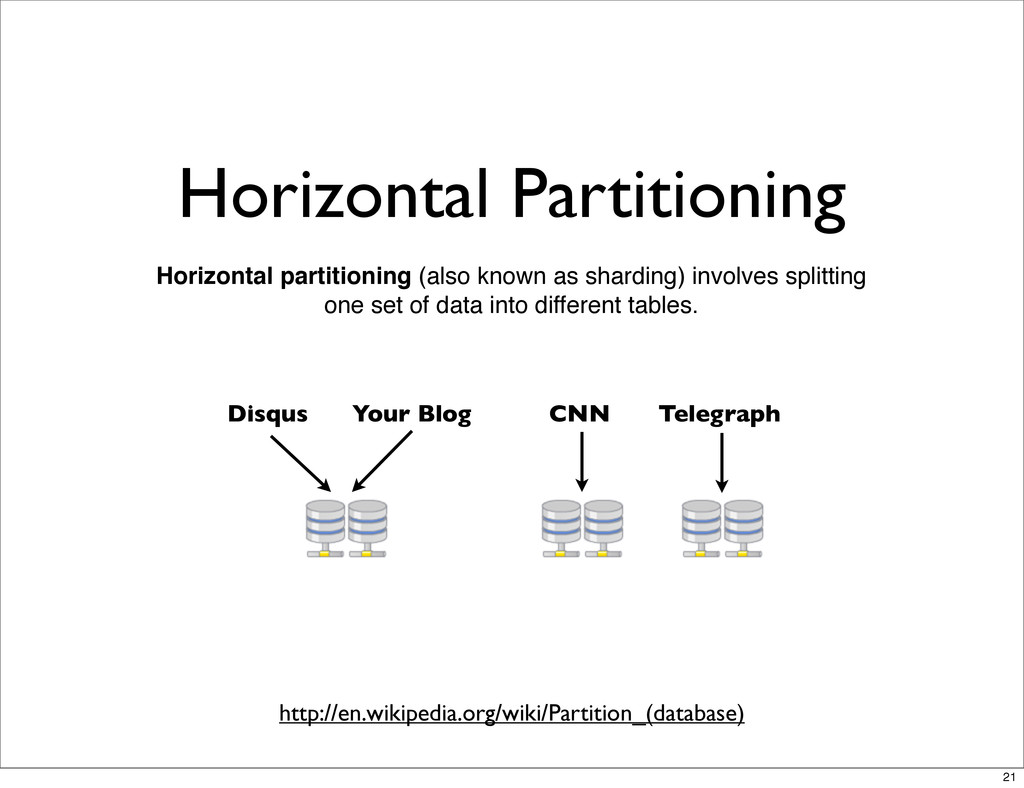
  17. Horizontal Partitioning Horizontal partitioning (also known as sharding) involves splitting

    one set of data into different tables. http://en.wikipedia.org/wiki/Partition_(database) Your Blog CNN Disqus Telegraph 21
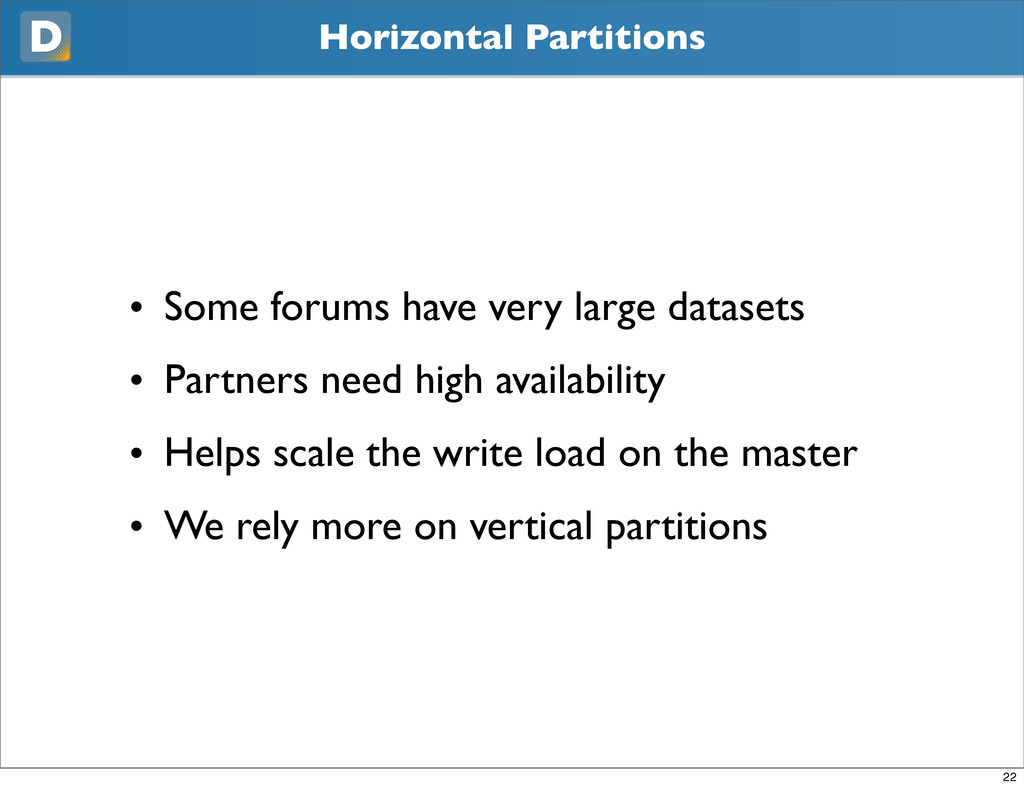
  18. Horizontal Partitions • Some forums have very large datasets •

    Partners need high availability • Helps scale the write load on the master • We rely more on vertical partitions 22
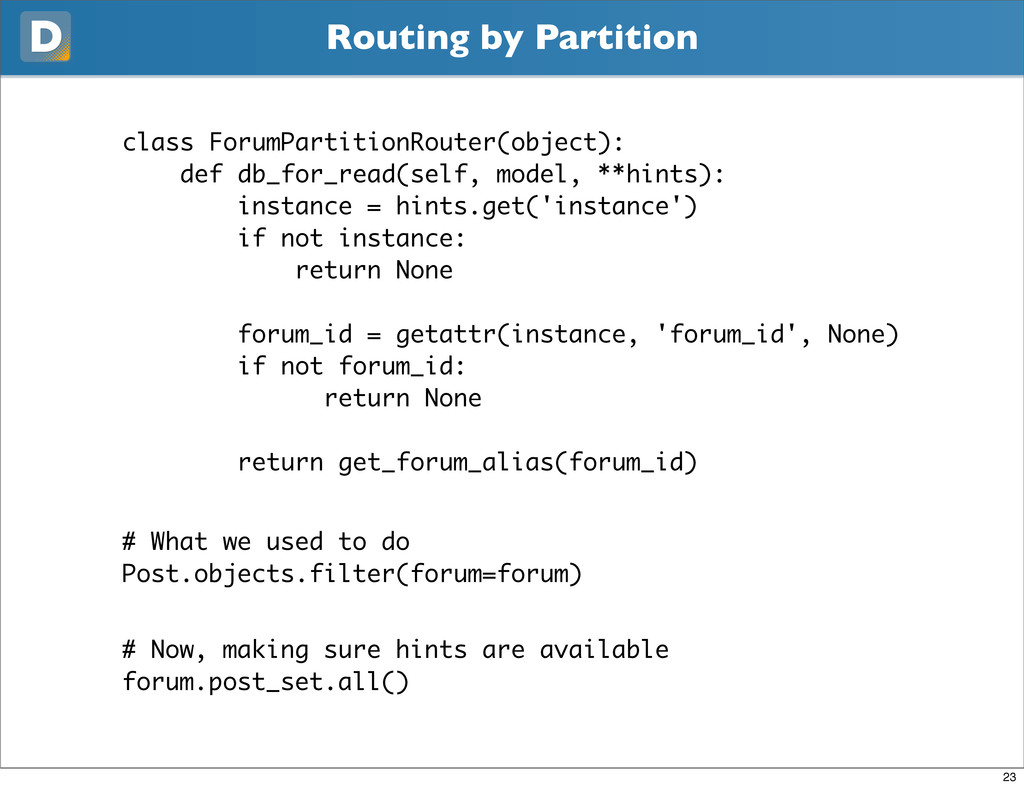
  19. Routing by Partition class ForumPartitionRouter(object): def db_for_read(self, model, **hints): instance

    = hints.get('instance') if not instance: return None forum_id = getattr(instance, 'forum_id', None) if not forum_id: return None return get_forum_alias(forum_id) # Now, making sure hints are available forum.post_set.all() # What we used to do Post.objects.filter(forum=forum) 23
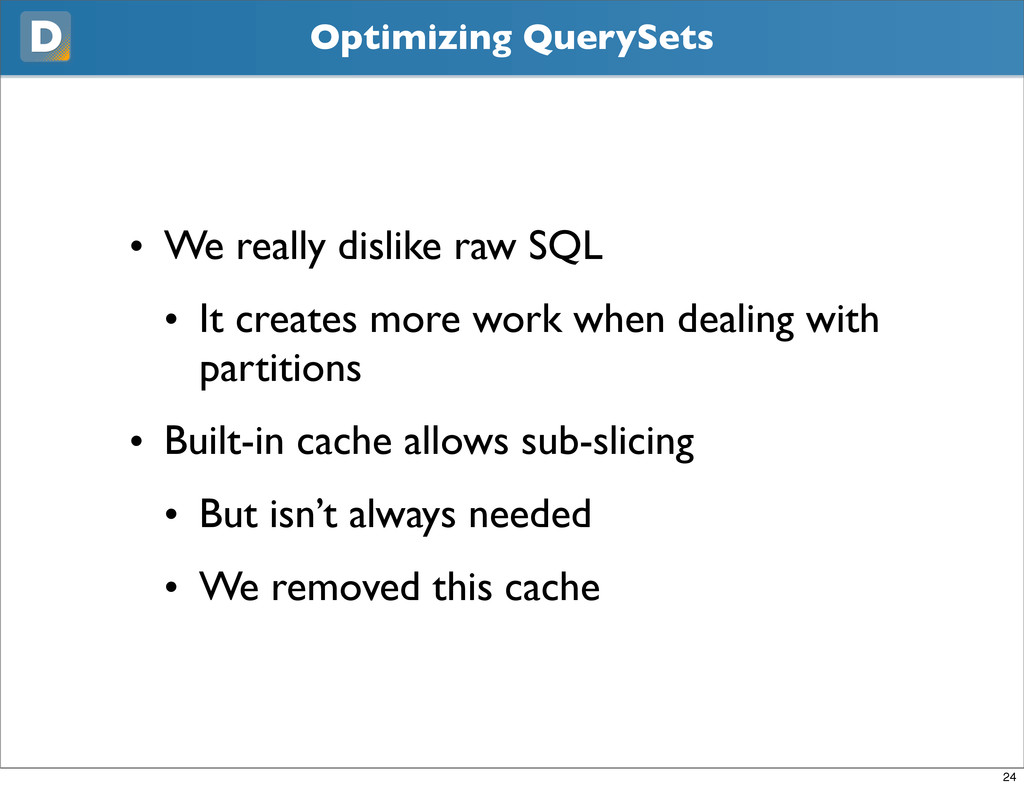
  20. Optimizing QuerySets • We really dislike raw SQL • It

    creates more work when dealing with partitions • Built-in cache allows sub-slicing • But isn’t always needed • We removed this cache 24
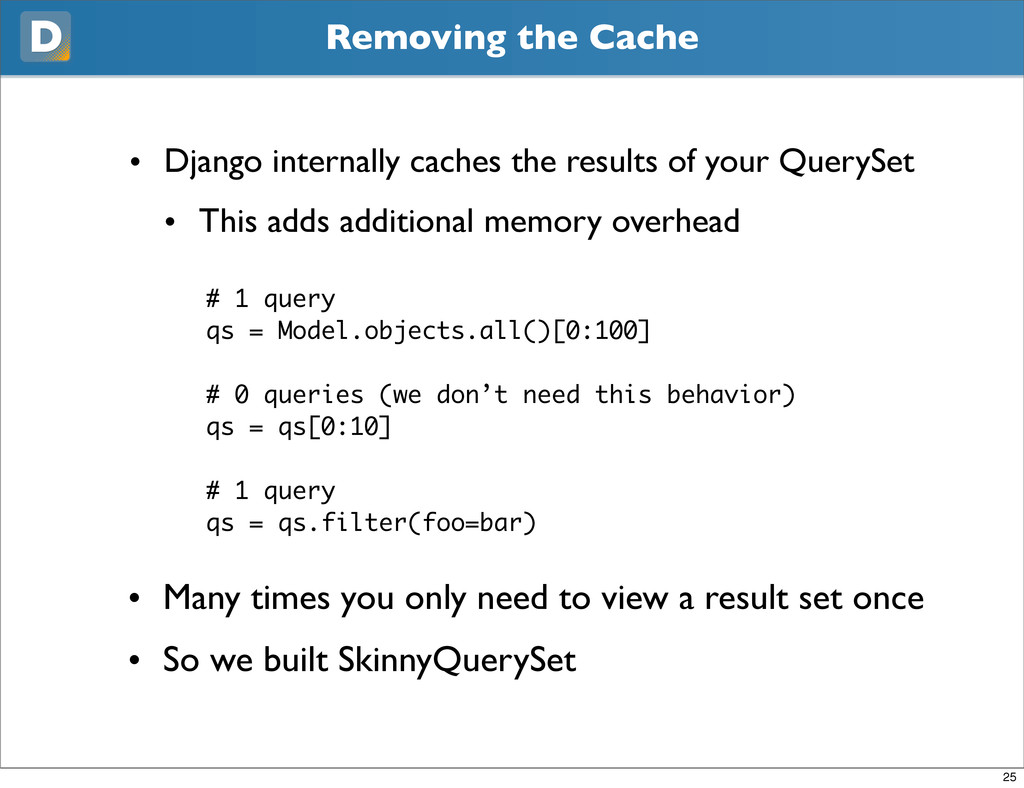
  21. Removing the Cache • Django internally caches the results of

    your QuerySet • This adds additional memory overhead • Many times you only need to view a result set once • So we built SkinnyQuerySet # 1 query qs = Model.objects.all()[0:100] # 0 queries (we don’t need this behavior) qs = qs[0:10] # 1 query qs = qs.filter(foo=bar) 25
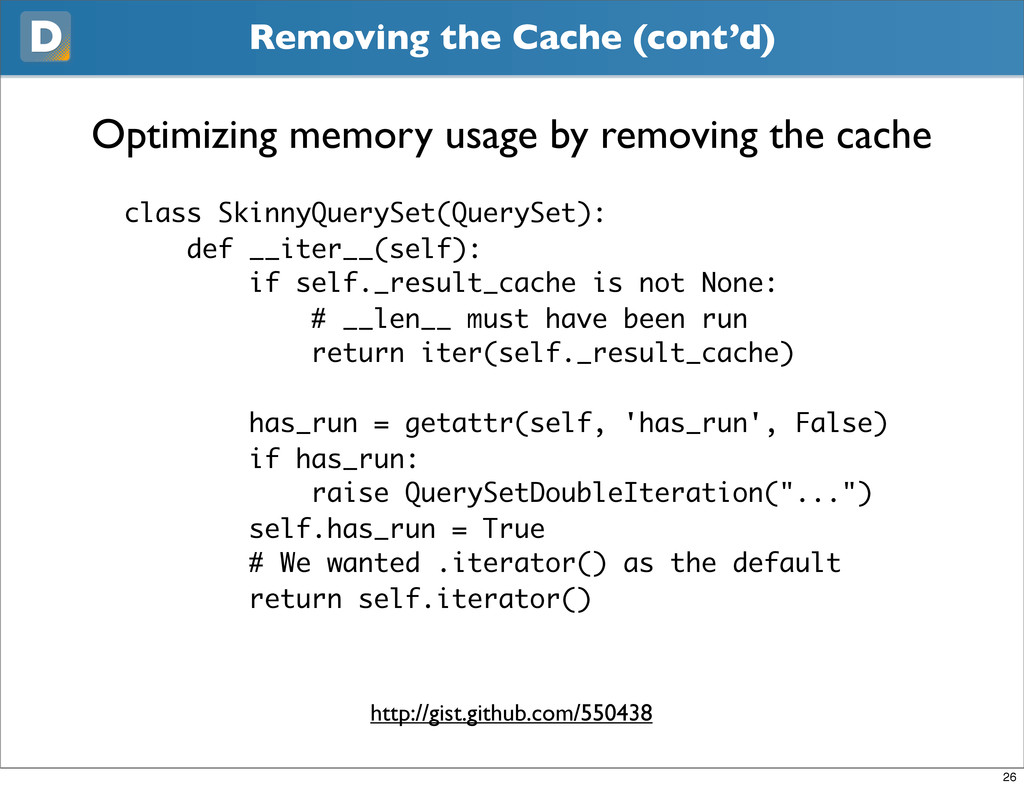
  22. Removing the Cache (cont’d) class SkinnyQuerySet(QuerySet): def __iter__(self): if self._result_cache

    is not None: # __len__ must have been run return iter(self._result_cache) has_run = getattr(self, 'has_run', False) if has_run: raise QuerySetDoubleIteration("...") self.has_run = True # We wanted .iterator() as the default return self.iterator() Optimizing memory usage by removing the cache http://gist.github.com/550438 26
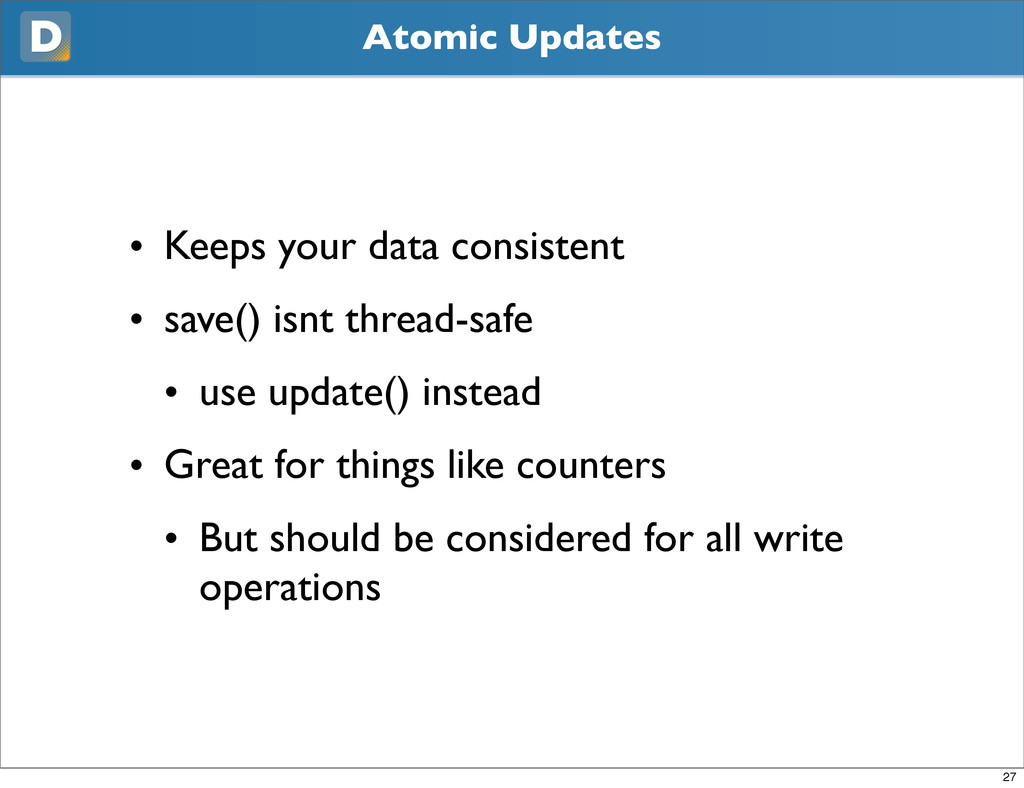
  23. Atomic Updates • Keeps your data consistent • save() isnt

    thread-safe • use update() instead • Great for things like counters • But should be considered for all write operations 27
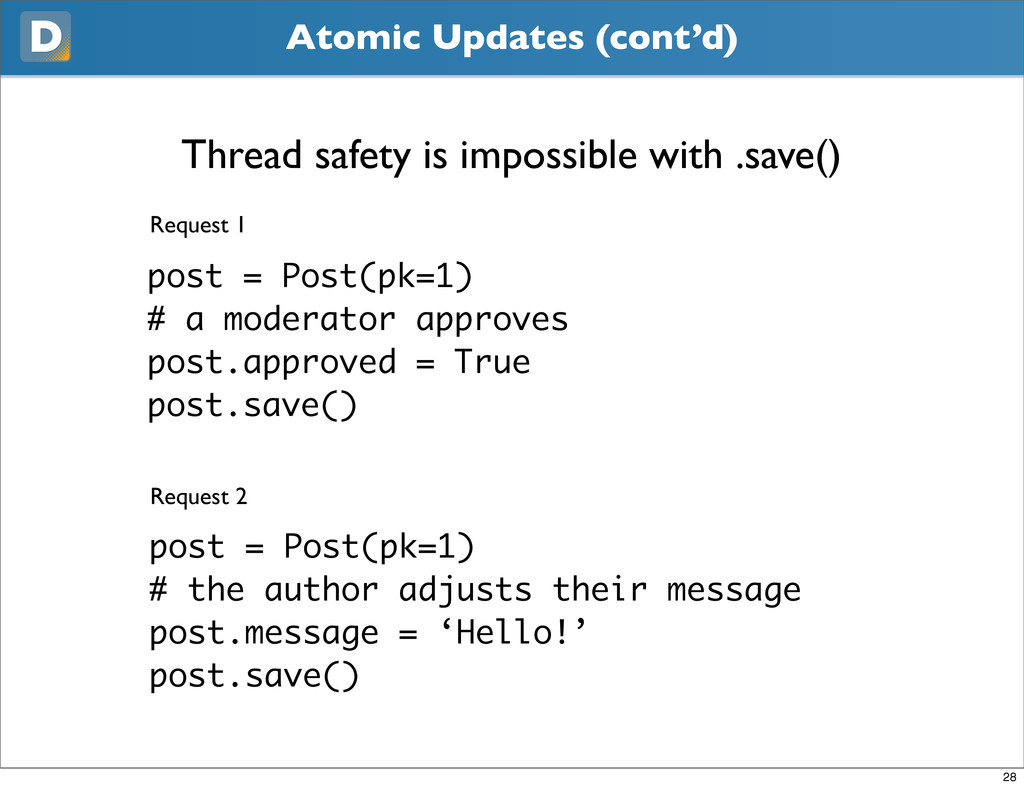
  24. Atomic Updates (cont’d) post = Post(pk=1) # a moderator approves

    post.approved = True post.save() Thread safety is impossible with .save() Request 1 post = Post(pk=1) # the author adjusts their message post.message = ‘Hello!’ post.save() Request 2 28
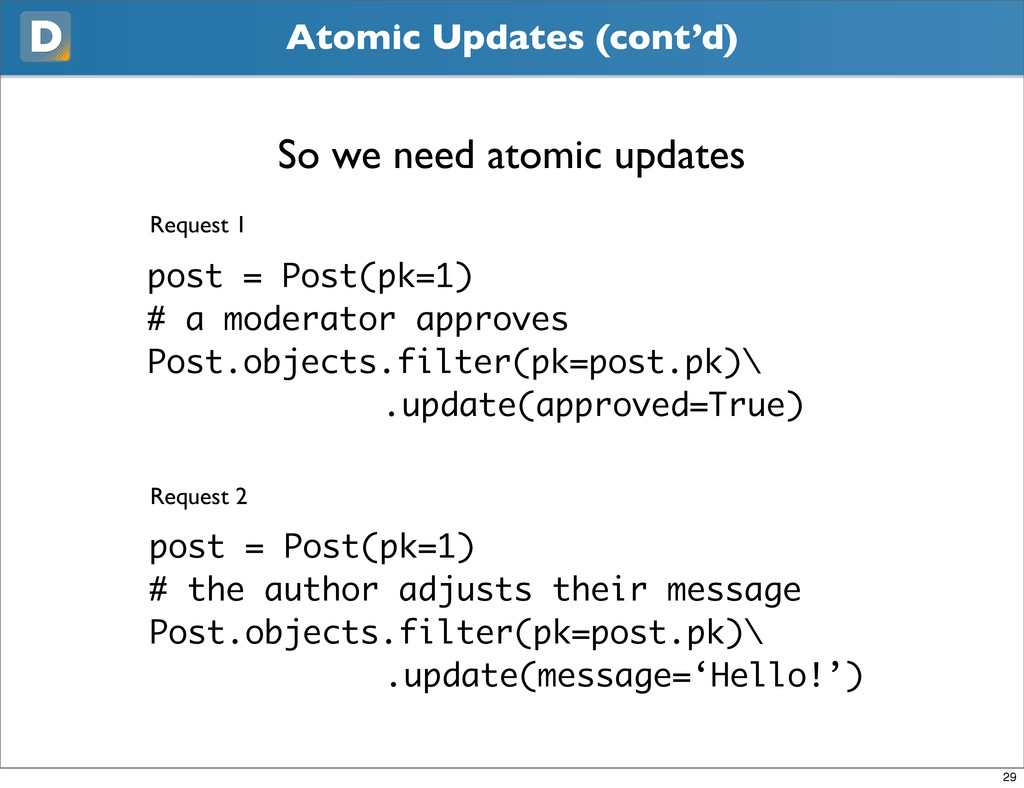
  25. Atomic Updates (cont’d) post = Post(pk=1) # a moderator approves

    Post.objects.filter(pk=post.pk)\ .update(approved=True) So we need atomic updates Request 1 post = Post(pk=1) # the author adjusts their message Post.objects.filter(pk=post.pk)\ .update(message=‘Hello!’) Request 2 29
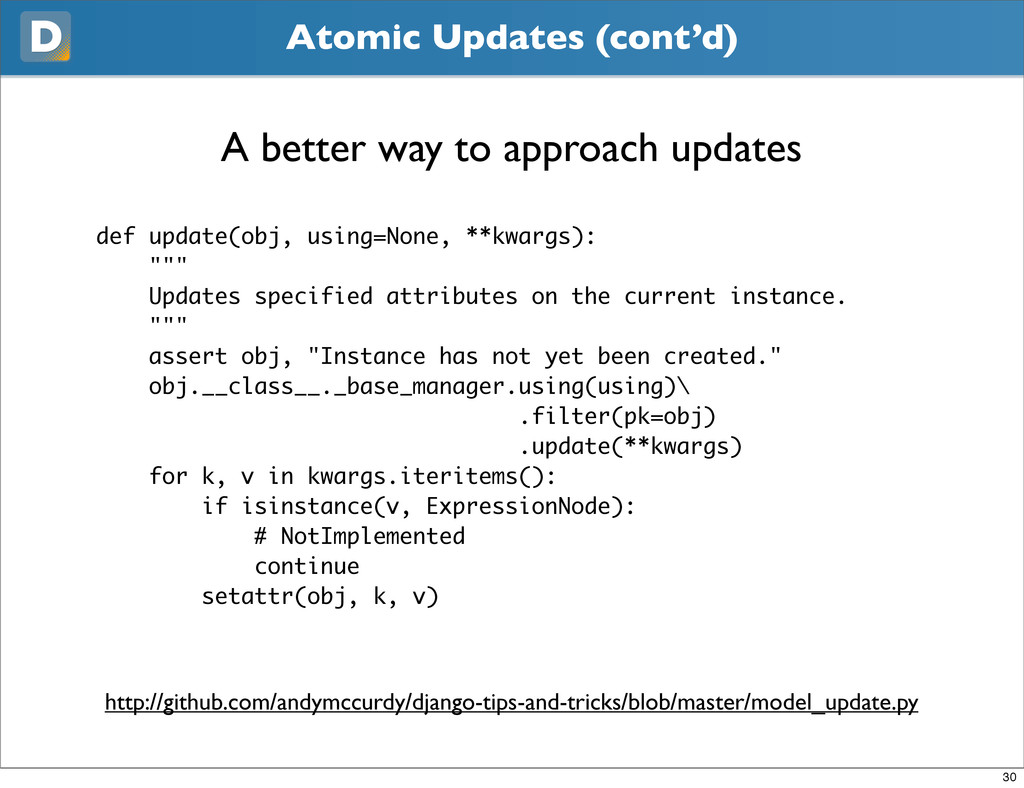
  26. Atomic Updates (cont’d) def update(obj, using=None, **kwargs): """ Updates specified

    attributes on the current instance. """ assert obj, "Instance has not yet been created." obj.__class__._base_manager.using(using)\ .filter(pk=obj) .update(**kwargs) for k, v in kwargs.iteritems(): if isinstance(v, ExpressionNode): # NotImplemented continue setattr(obj, k, v) A better way to approach updates http://github.com/andymccurdy/django-tips-and-tricks/blob/master/model_update.py 30
  27. Delayed Signals • Queueing low priority tasks • even if

    they’re fast • Asynchronous (Delayed) signals • very friendly to the developer • ..but not as friendly as real signals 31
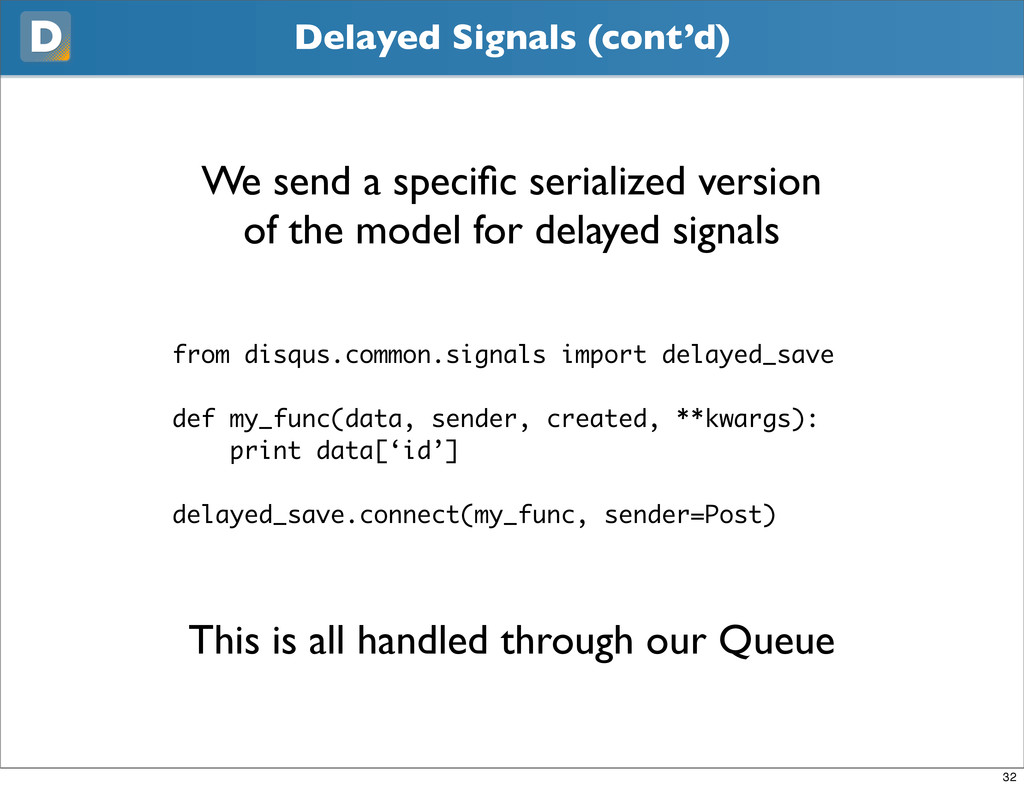
  28. Delayed Signals (cont’d) from disqus.common.signals import delayed_save def my_func(data, sender,

    created, **kwargs): print data[‘id’] delayed_save.connect(my_func, sender=Post) We send a specific serialized version of the model for delayed signals This is all handled through our Queue 32
  29. Caching • Memcached • Use pylibmc (newer libMemcached-based) • Ticket

    #11675 (add pylibmc support) • Third party applications: • django-newcache, django-pylibmc 33
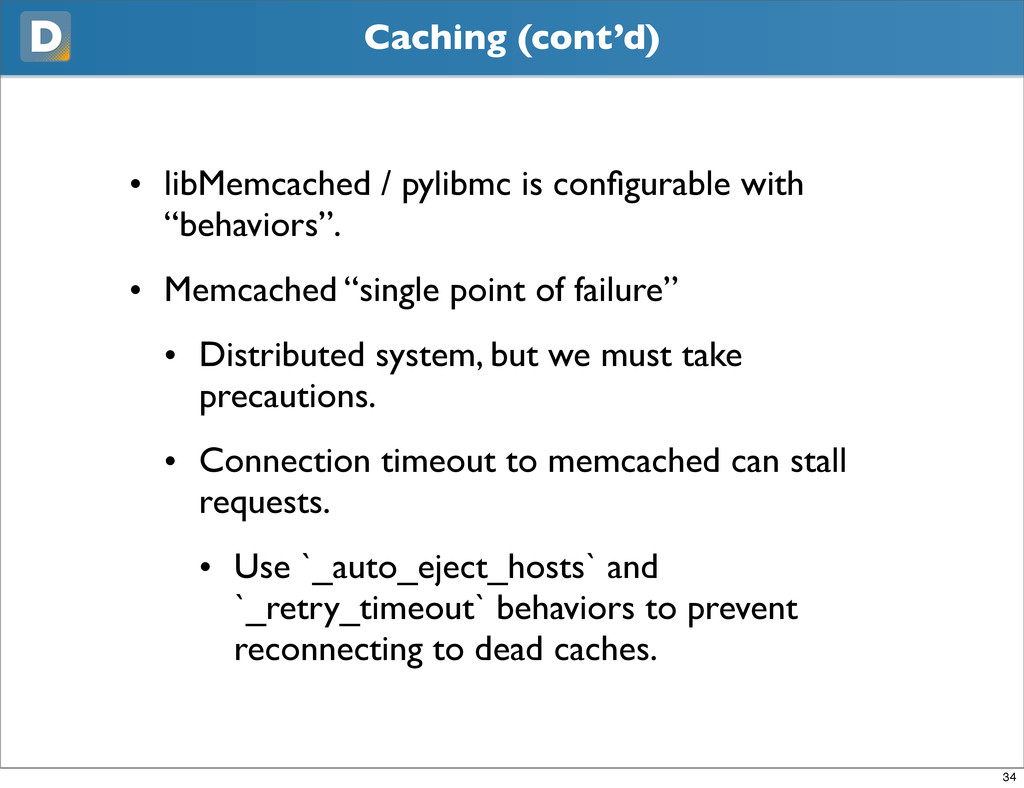
  30. Caching (cont’d) • libMemcached / pylibmc is configurable with “behaviors”.

    • Memcached “single point of failure” • Distributed system, but we must take precautions. • Connection timeout to memcached can stall requests. • Use `_auto_eject_hosts` and `_retry_timeout` behaviors to prevent reconnecting to dead caches. 34
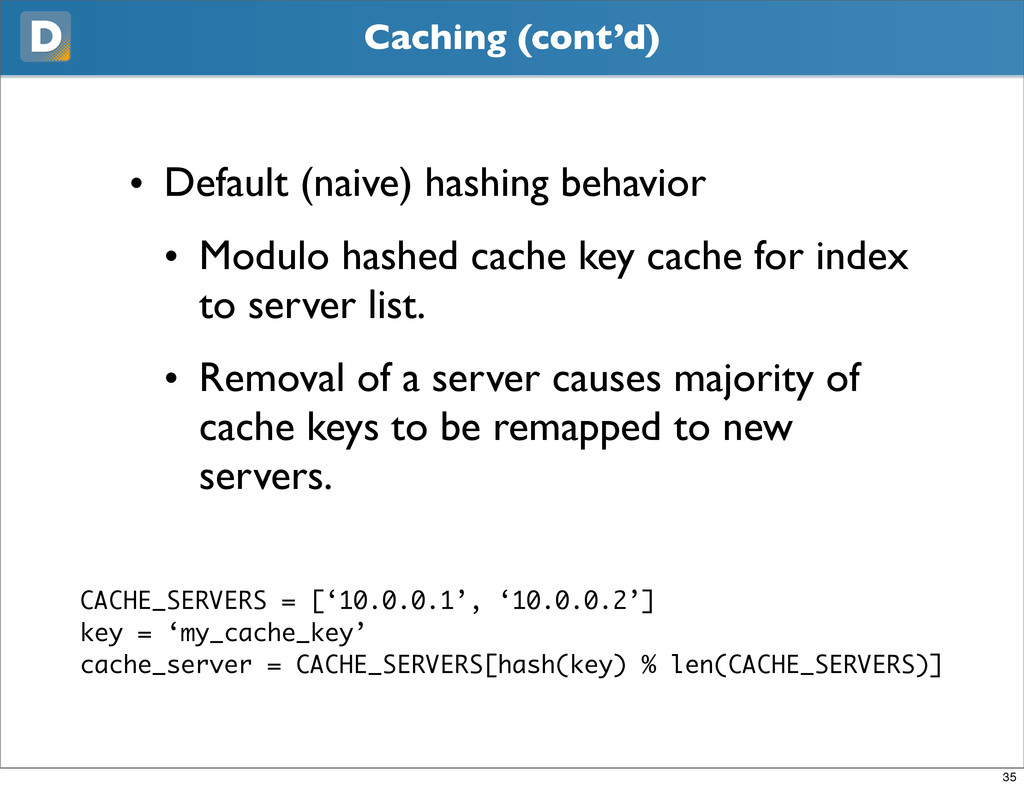
  31. Caching (cont’d) • Default (naive) hashing behavior • Modulo hashed

    cache key cache for index to server list. • Removal of a server causes majority of cache keys to be remapped to new servers. CACHE_SERVERS = [‘10.0.0.1’, ‘10.0.0.2’] key = ‘my_cache_key’ cache_server = CACHE_SERVERS[hash(key) % len(CACHE_SERVERS)] 35
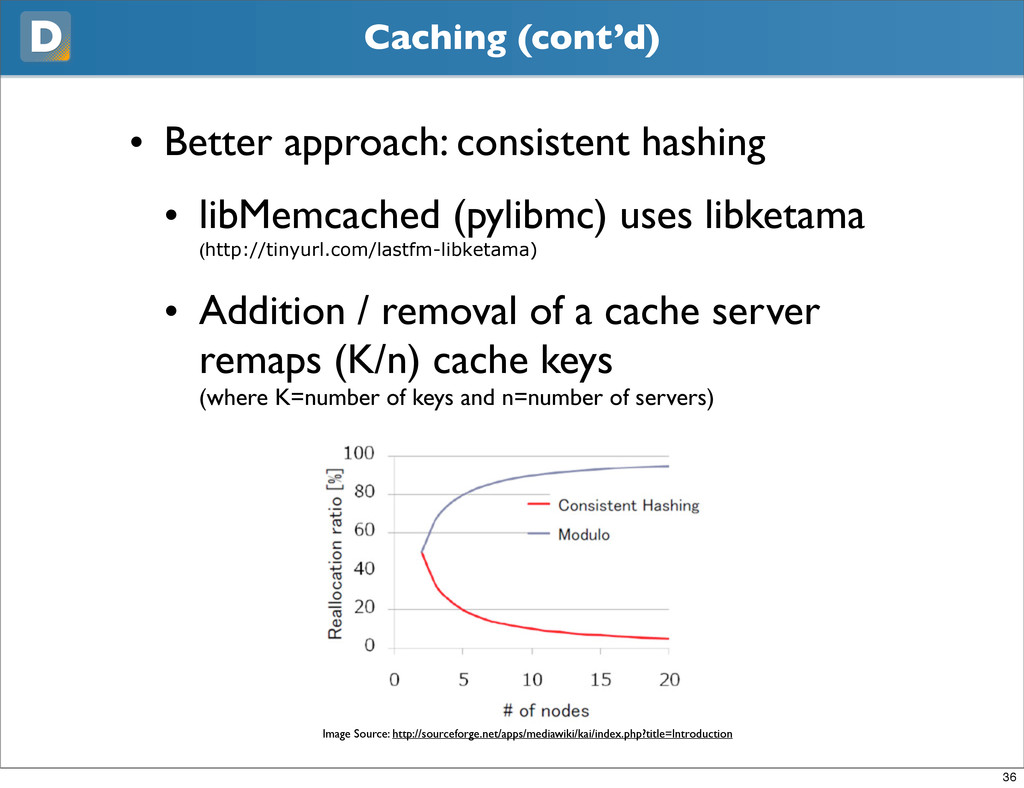
  32. Caching (cont’d) • Better approach: consistent hashing • libMemcached (pylibmc)

    uses libketama (http://tinyurl.com/lastfm-libketama) • Addition / removal of a cache server remaps (K/n) cache keys (where K=number of keys and n=number of servers) Image Source: http://sourceforge.net/apps/mediawiki/kai/index.php?title=Introduction 36
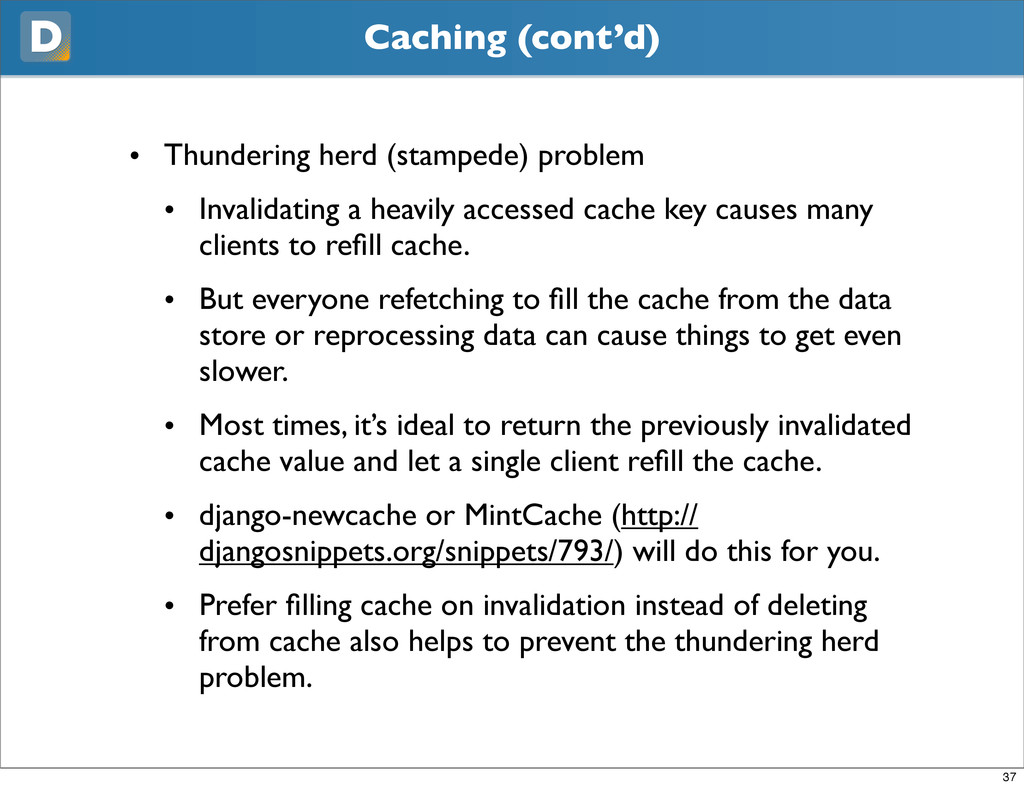
  33. Caching (cont’d) • Thundering herd (stampede) problem • Invalidating a

    heavily accessed cache key causes many clients to refill cache. • But everyone refetching to fill the cache from the data store or reprocessing data can cause things to get even slower. • Most times, it’s ideal to return the previously invalidated cache value and let a single client refill the cache. • django-newcache or MintCache (http:// djangosnippets.org/snippets/793/) will do this for you. • Prefer filling cache on invalidation instead of deleting from cache also helps to prevent the thundering herd problem. 37
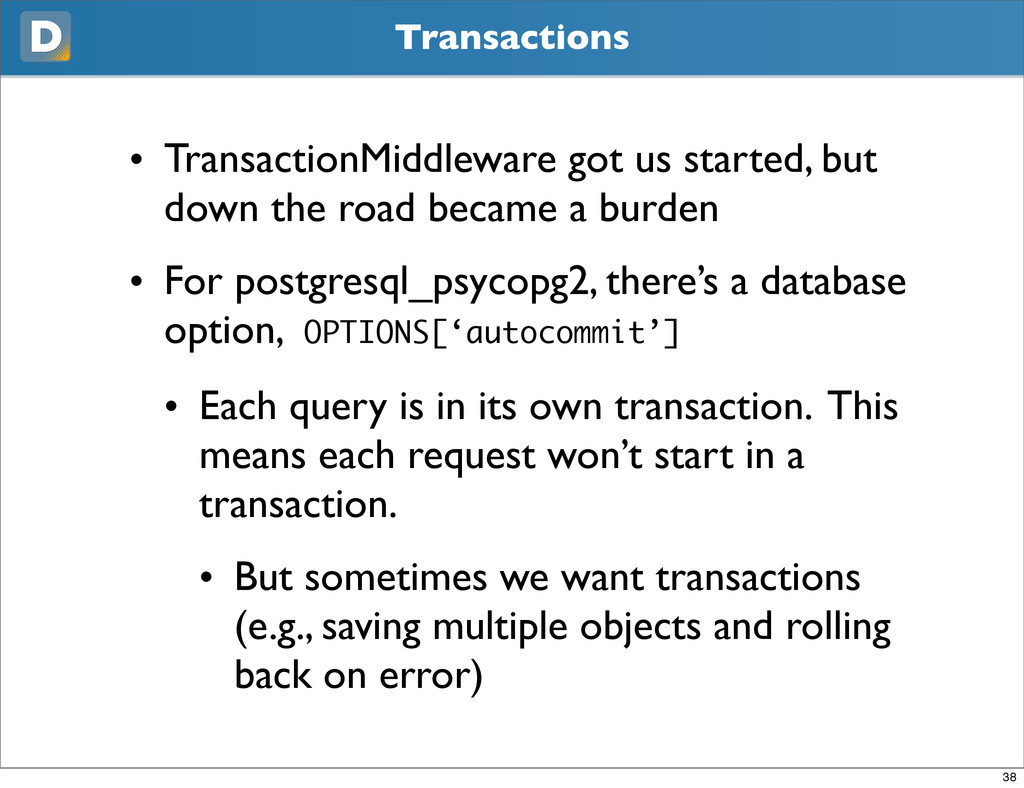
  34. Transactions • TransactionMiddleware got us started, but down the road

    became a burden • For postgresql_psycopg2, there’s a database option, OPTIONS[‘autocommit’] • Each query is in its own transaction. This means each request won’t start in a transaction. • But sometimes we want transactions (e.g., saving multiple objects and rolling back on error) 38
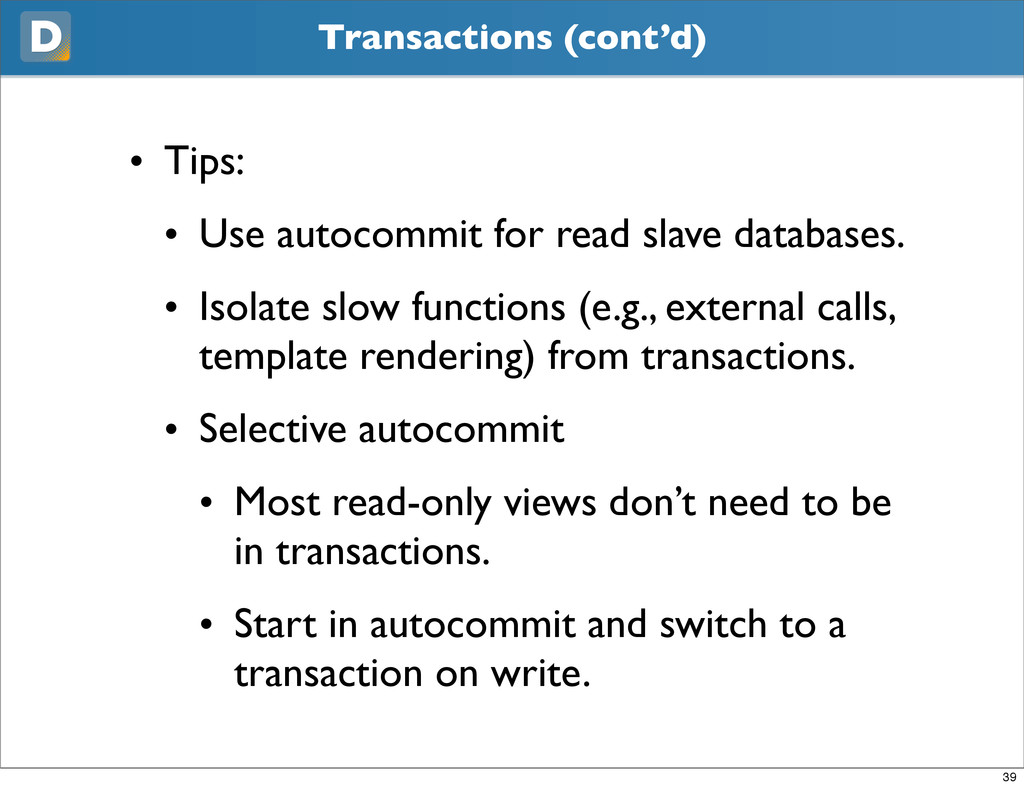
  35. Transactions (cont’d) • Tips: • Use autocommit for read slave

    databases. • Isolate slow functions (e.g., external calls, template rendering) from transactions. • Selective autocommit • Most read-only views don’t need to be in transactions. • Start in autocommit and switch to a transaction on write. 39
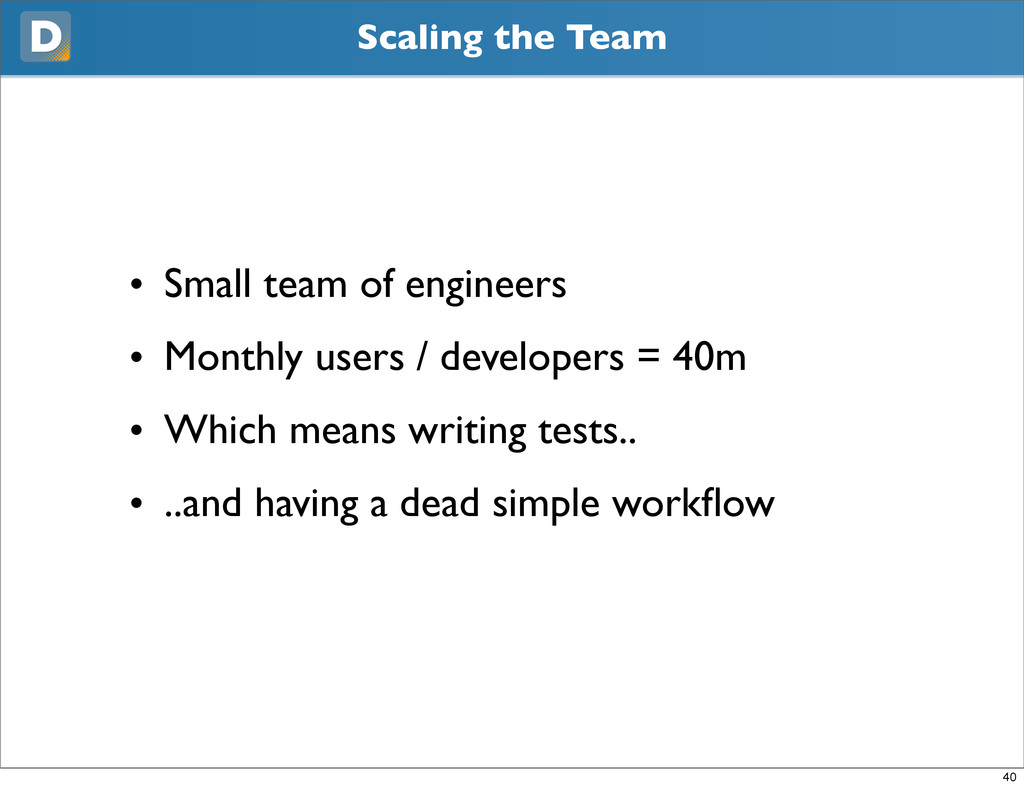
  36. Scaling the Team • Small team of engineers • Monthly

    users / developers = 40m • Which means writing tests.. • ..and having a dead simple workflow 40
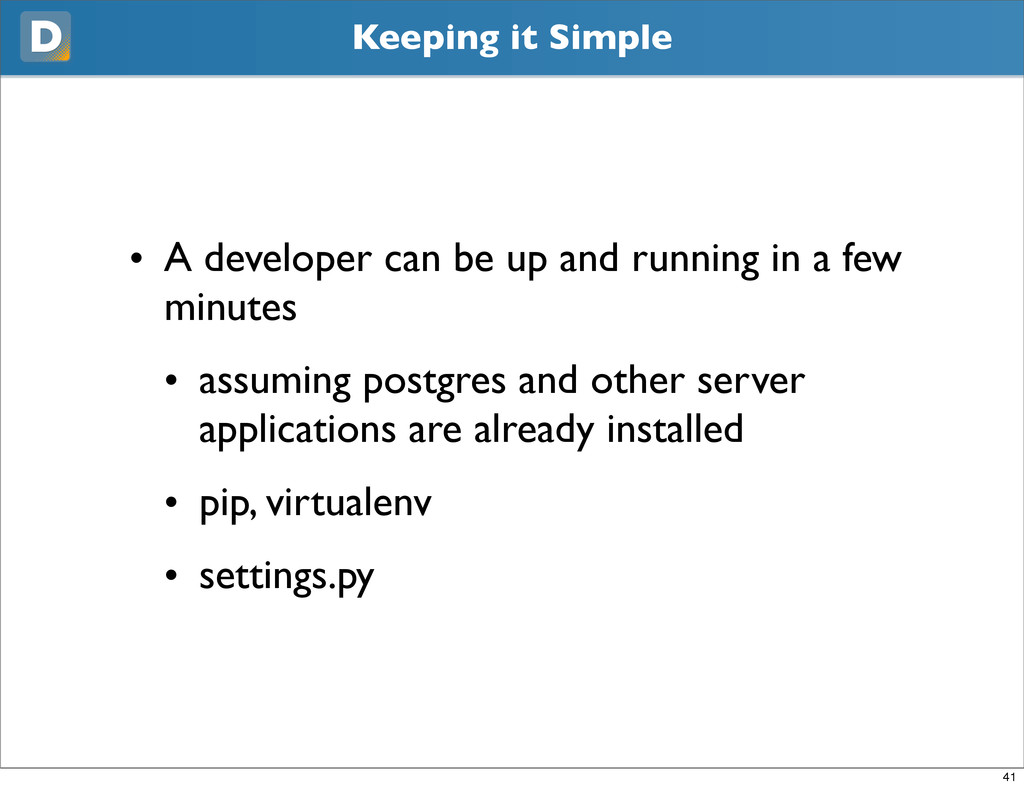
  37. Keeping it Simple • A developer can be up and

    running in a few minutes • assuming postgres and other server applications are already installed • pip, virtualenv • settings.py 41
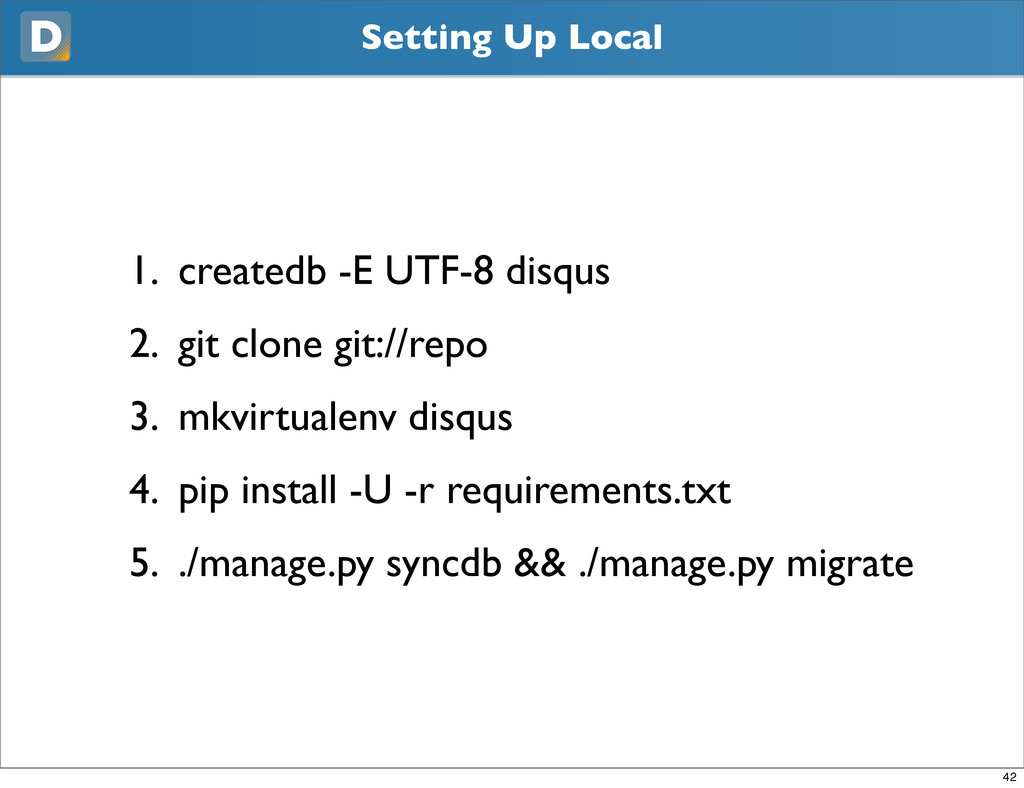
  38. Setting Up Local 1. createdb -E UTF-8 disqus 2. git

    clone git://repo 3. mkvirtualenv disqus 4. pip install -U -r requirements.txt 5. ./manage.py syncdb && ./manage.py migrate 42
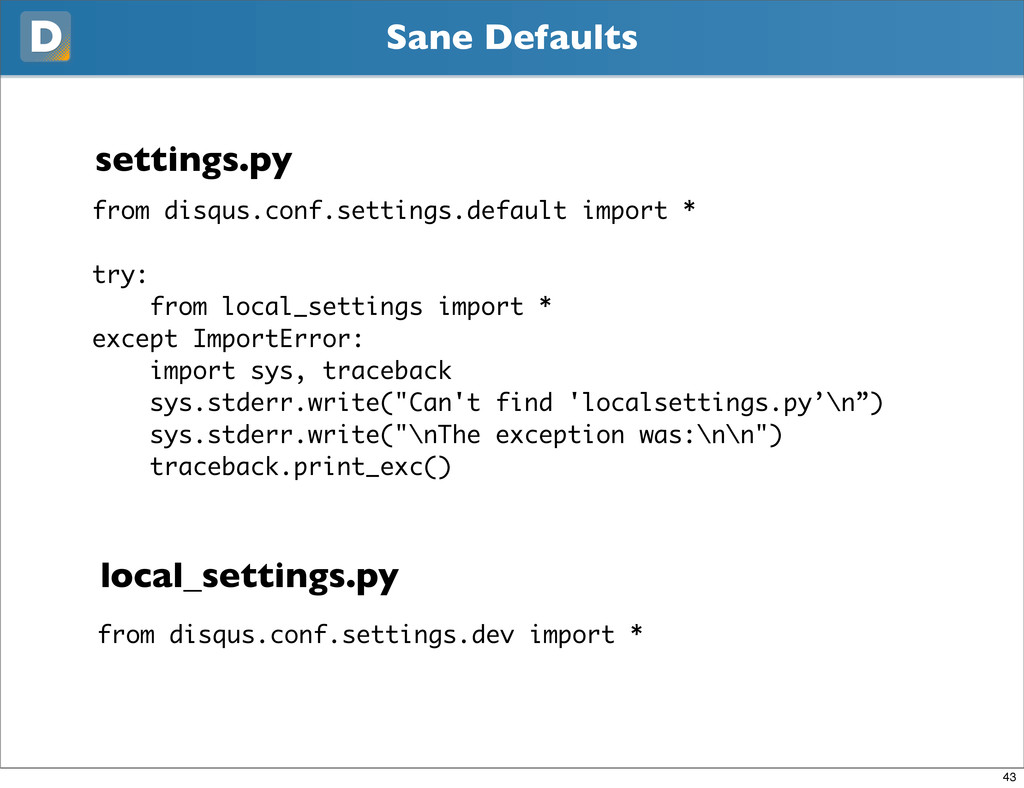
  39. Sane Defaults from disqus.conf.settings.default import * try: from local_settings import

    * except ImportError: import sys, traceback sys.stderr.write("Can't find 'localsettings.py’\n”) sys.stderr.write("\nThe exception was:\n\n") traceback.print_exc() settings.py from disqus.conf.settings.dev import * local_settings.py 43
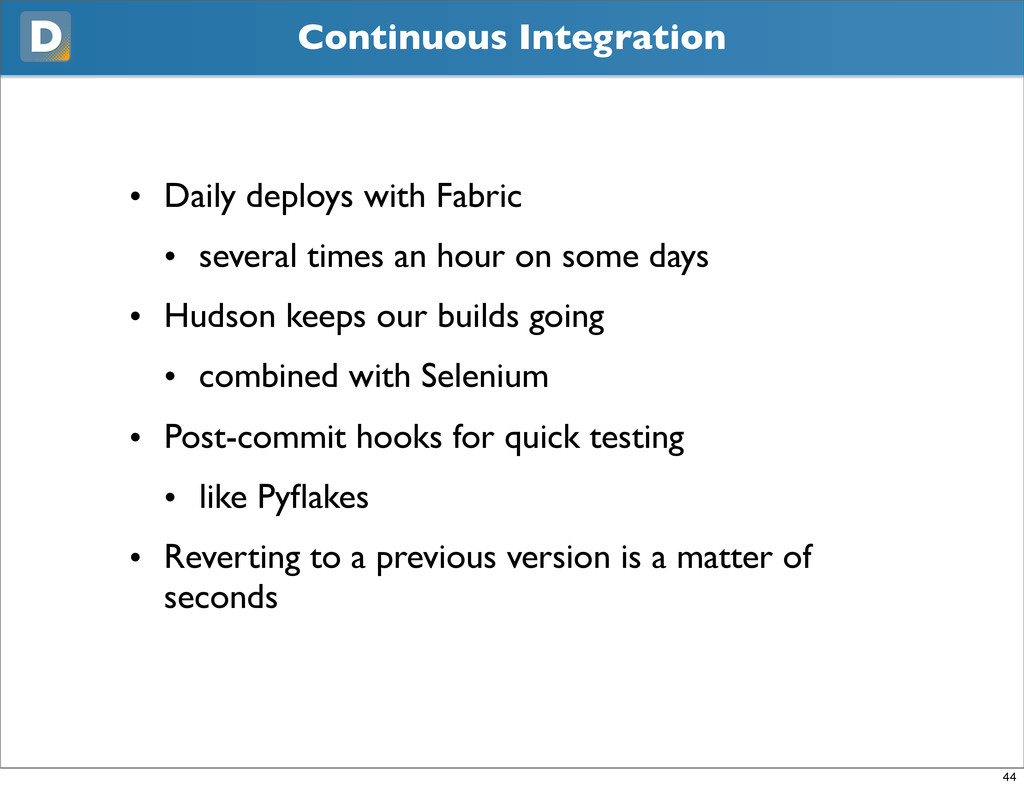
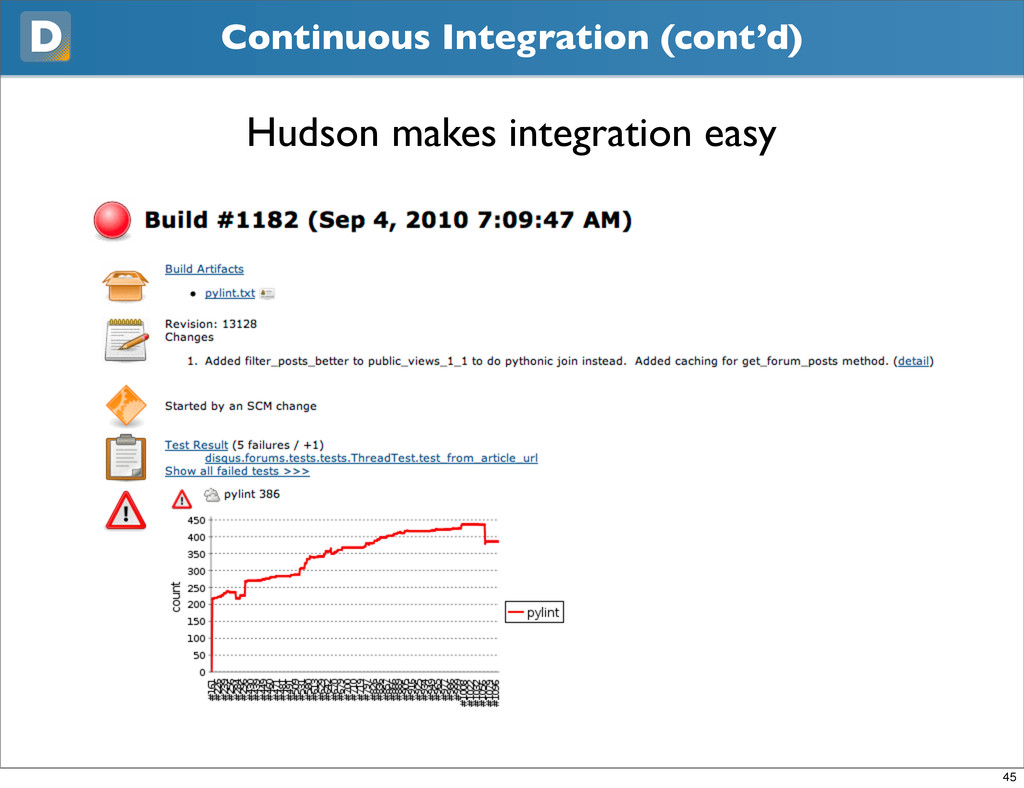
  40. Continuous Integration • Daily deploys with Fabric • several times

    an hour on some days • Hudson keeps our builds going • combined with Selenium • Post-commit hooks for quick testing • like Pyflakes • Reverting to a previous version is a matter of seconds 44
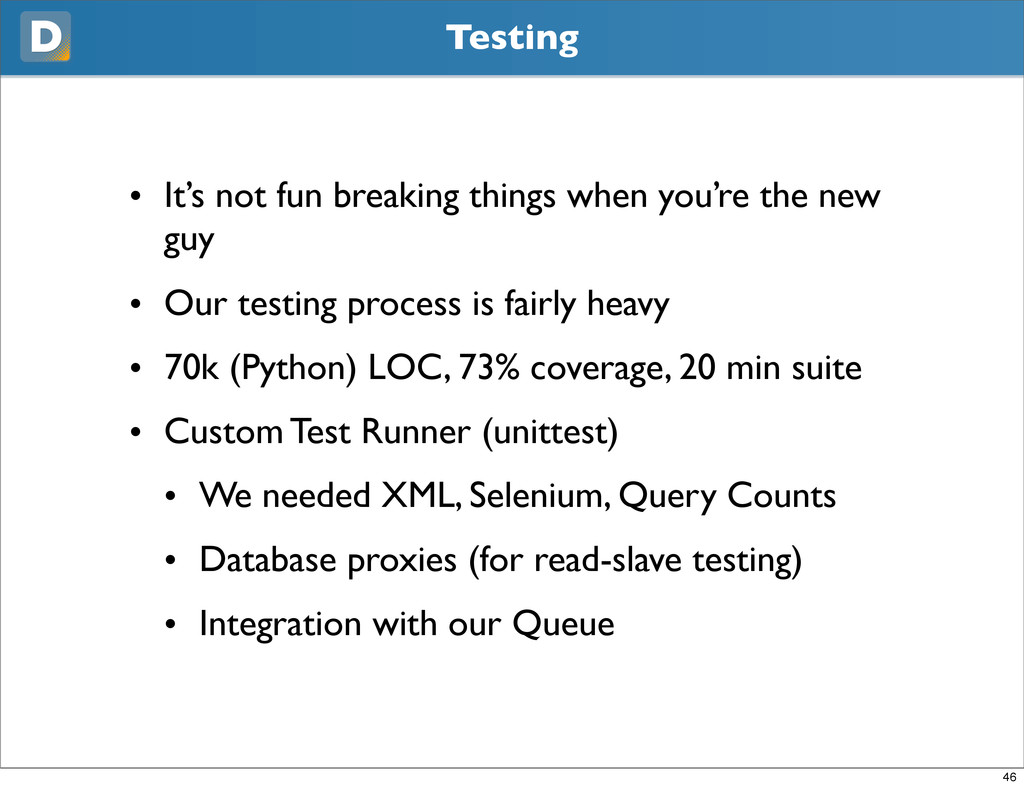
  41. Testing • It’s not fun breaking things when you’re the

    new guy • Our testing process is fairly heavy • 70k (Python) LOC, 73% coverage, 20 min suite • Custom Test Runner (unittest) • We needed XML, Selenium, Query Counts • Database proxies (for read-slave testing) • Integration with our Queue 46
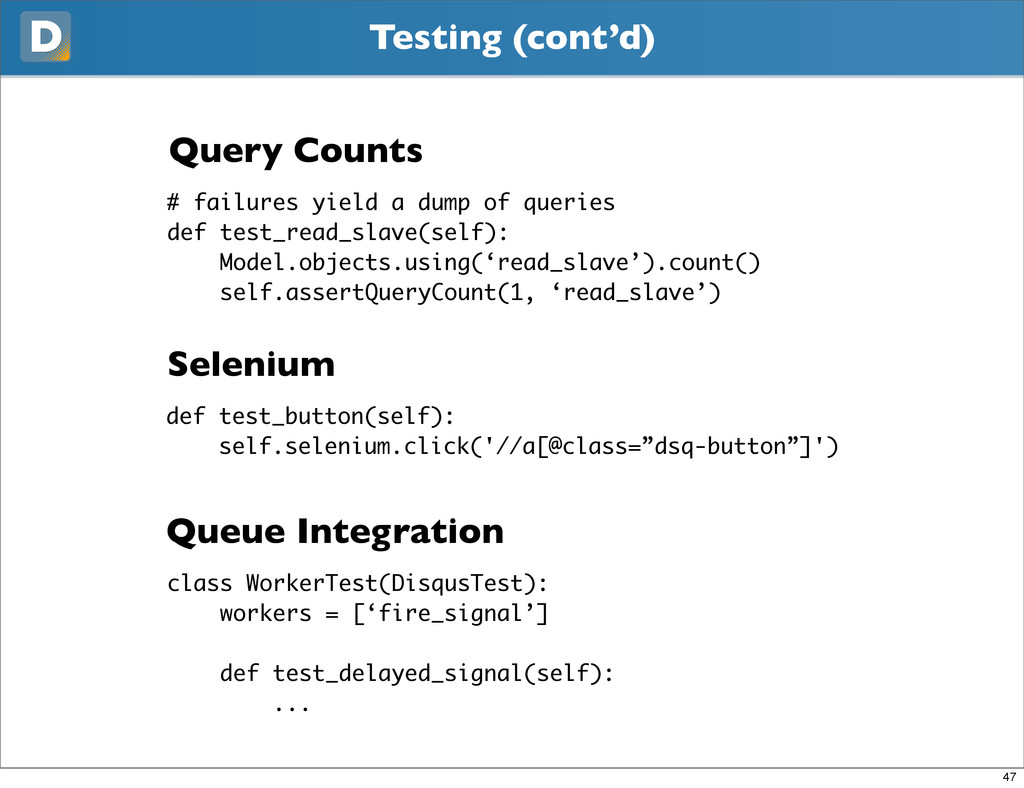
  42. Testing (cont’d) # failures yield a dump of queries def

    test_read_slave(self): Model.objects.using(‘read_slave’).count() self.assertQueryCount(1, ‘read_slave’) def test_button(self): self.selenium.click('//a[@class=”dsq-button”]') Query Counts Selenium Queue Integration class WorkerTest(DisqusTest): workers = [‘fire_signal’] def test_delayed_signal(self): ... 47
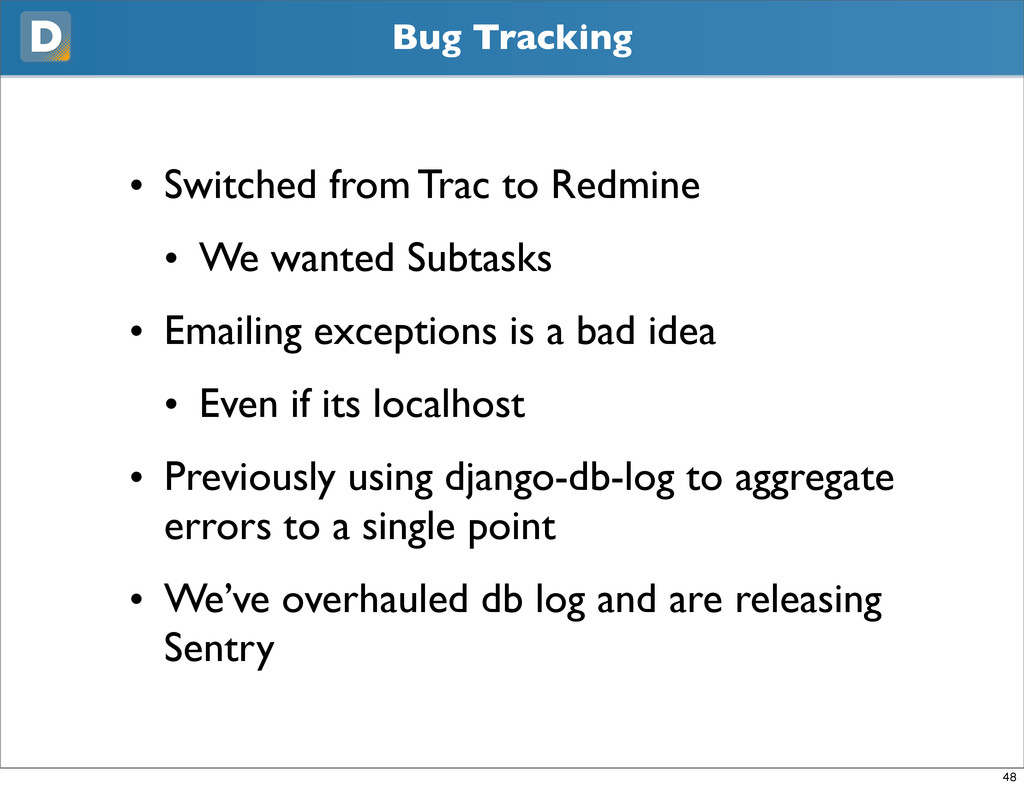
  43. Bug Tracking • Switched from Trac to Redmine • We

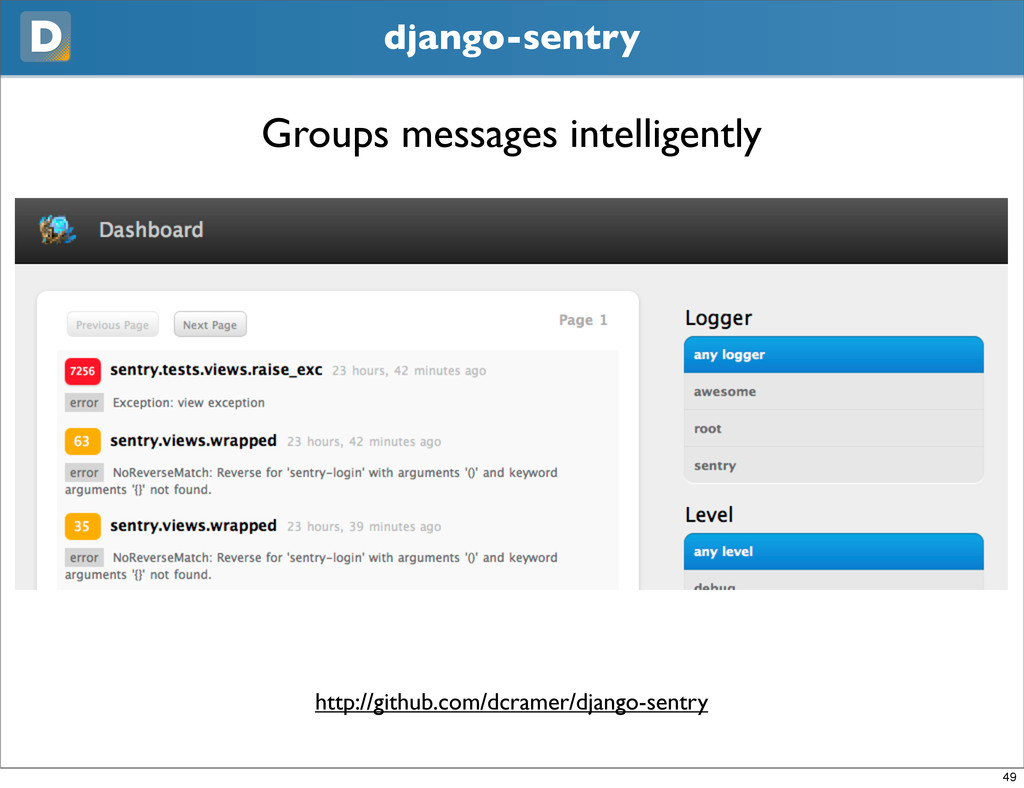
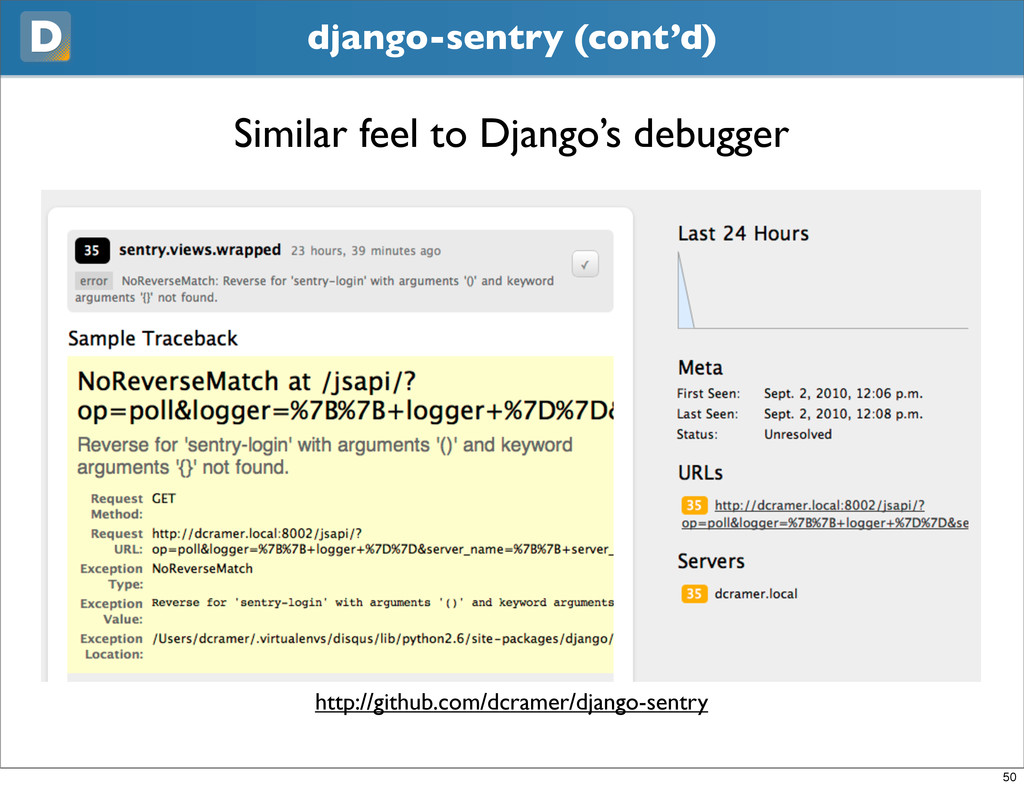
    wanted Subtasks • Emailing exceptions is a bad idea • Even if its localhost • Previously using django-db-log to aggregate errors to a single point • We’ve overhauled db log and are releasing Sentry 48
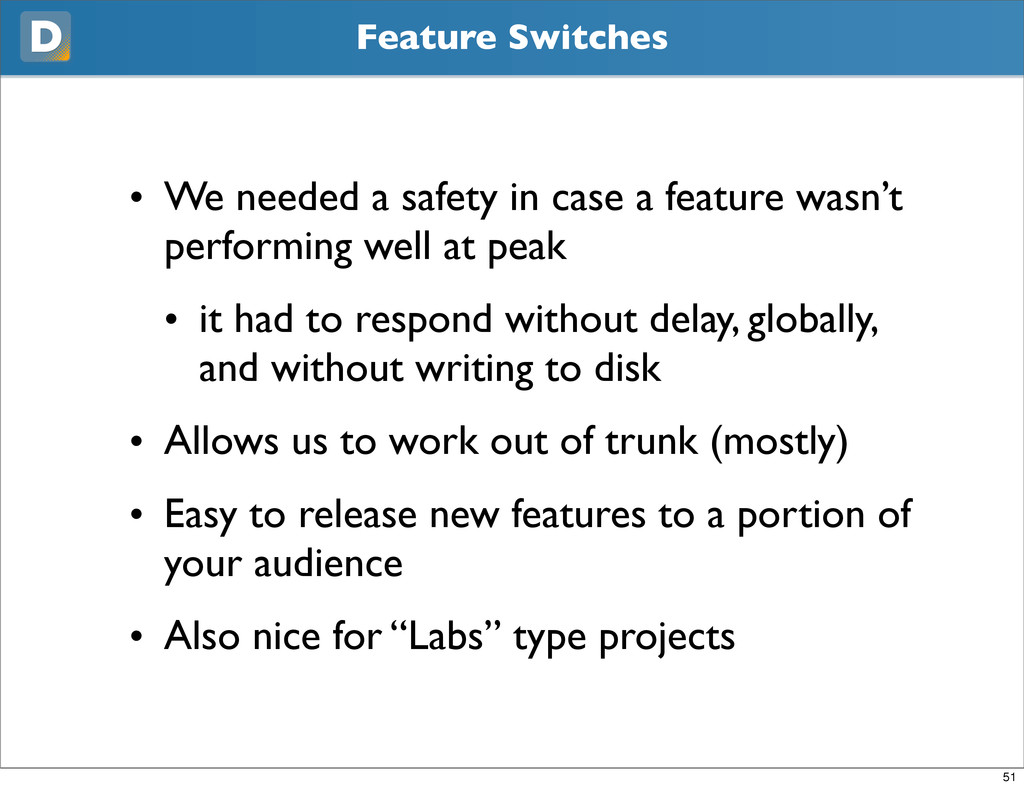
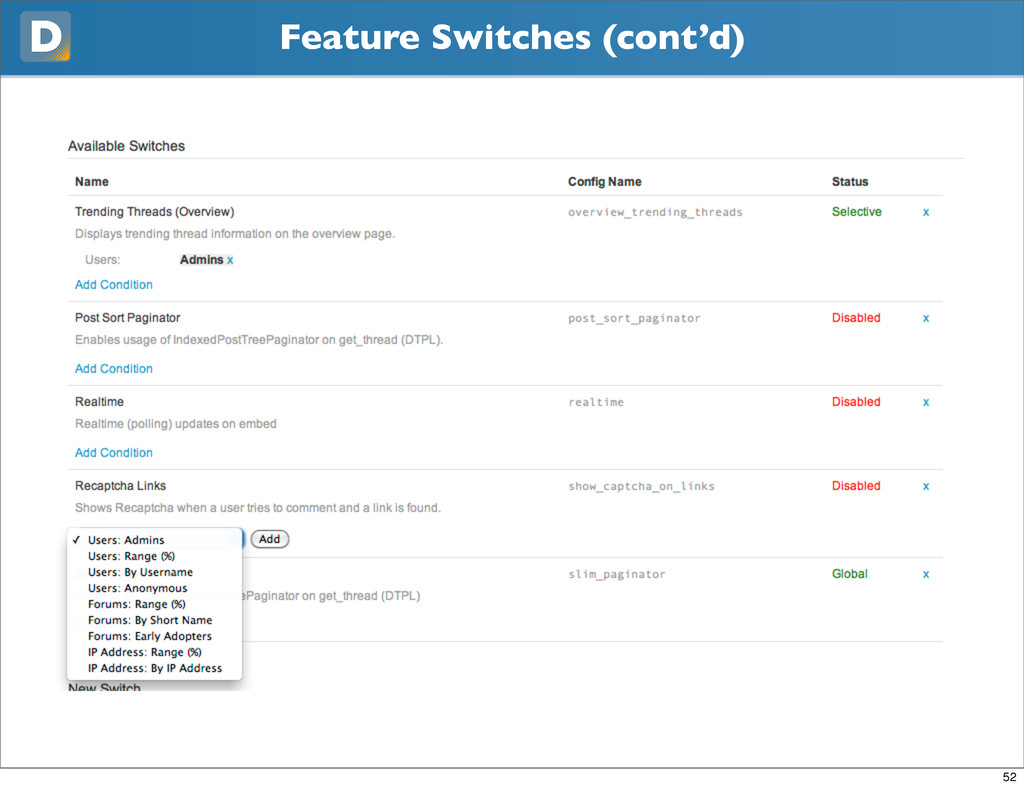
  44. Feature Switches • We needed a safety in case a

    feature wasn’t performing well at peak • it had to respond without delay, globally, and without writing to disk • Allows us to work out of trunk (mostly) • Easy to release new features to a portion of your audience • Also nice for “Labs” type projects 51
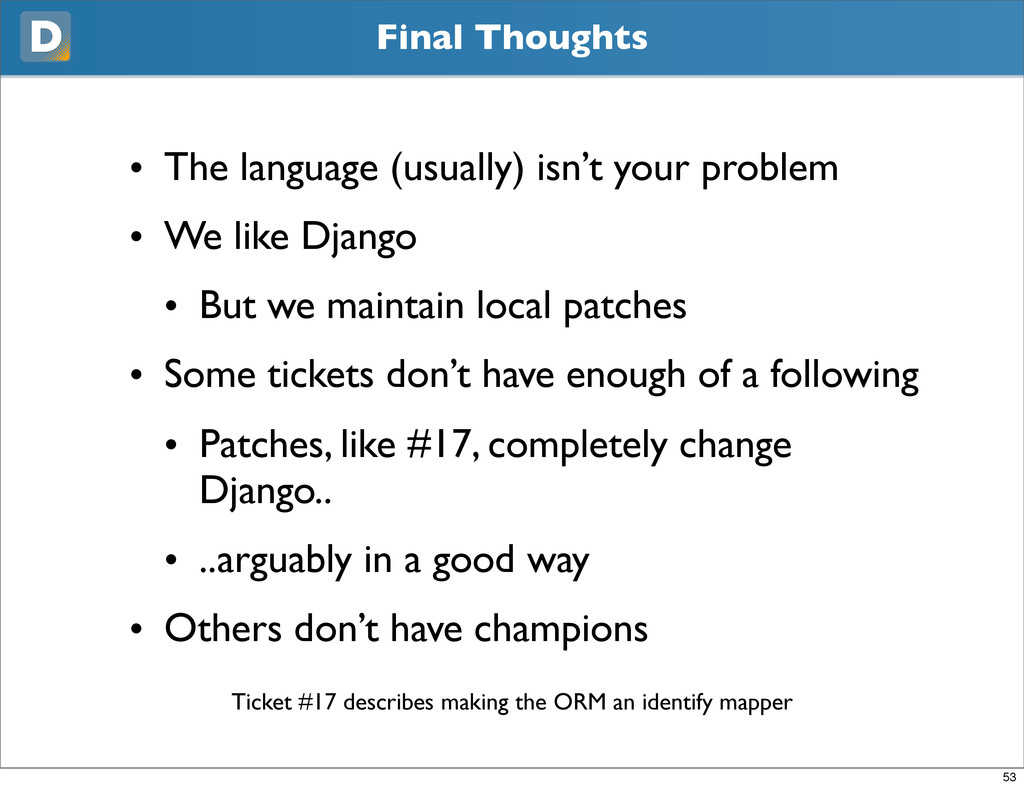
  45. Final Thoughts • The language (usually) isn’t your problem •

    We like Django • But we maintain local patches • Some tickets don’t have enough of a following • Patches, like #17, completely change Django.. • ..arguably in a good way • Others don’t have champions Ticket #17 describes making the ORM an identify mapper 53
  46. Housekeeping Want to learn from others about performance and scaling

    problems? Birds of a Feather We’re Hiring! DISQUS is looking for amazing engineers Or play some StarCraft 2? 54
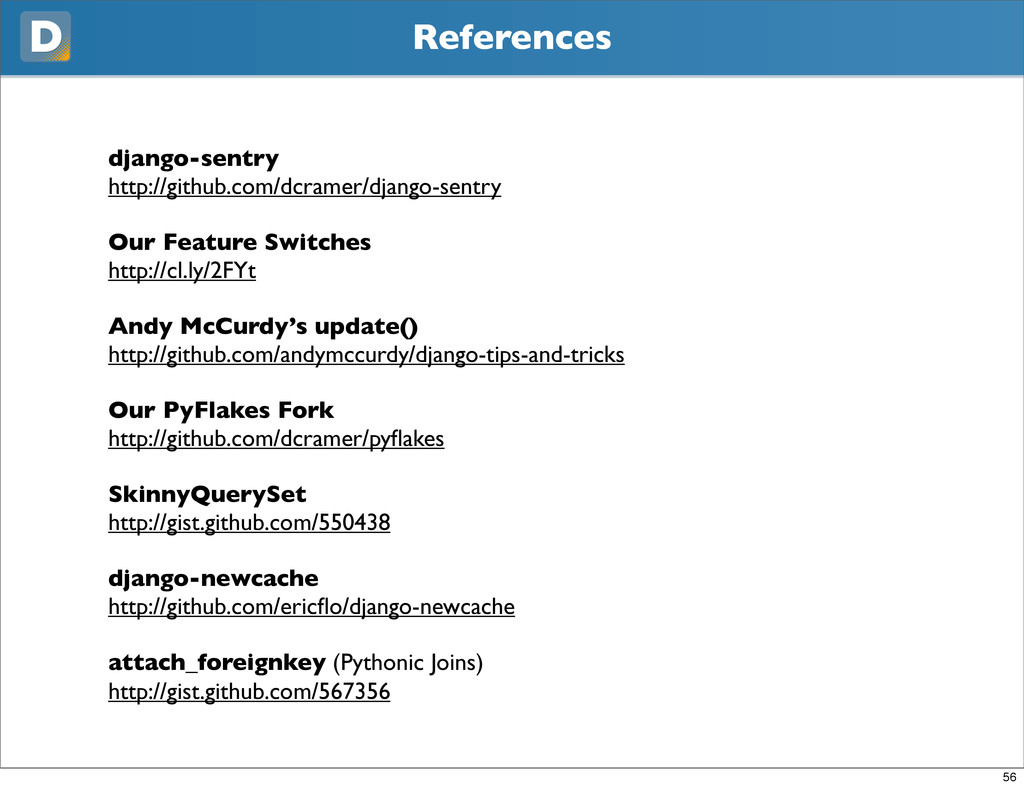
  47. References django-sentry http://github.com/dcramer/django-sentry Our Feature Switches http://cl.ly/2FYt Andy McCurdy’s update()

    http://github.com/andymccurdy/django-tips-and-tricks Our PyFlakes Fork http://github.com/dcramer/pyflakes SkinnyQuerySet http://gist.github.com/550438 django-newcache http://github.com/ericflo/django-newcache attach_foreignkey (Pythonic Joins) http://gist.github.com/567356 56