Share
Embed
Transcript
28 slides
-
Aaron Parecki • October 2025 oauth2simpli fi ed.com OAuth for
MCP Internet Identity Workshop -
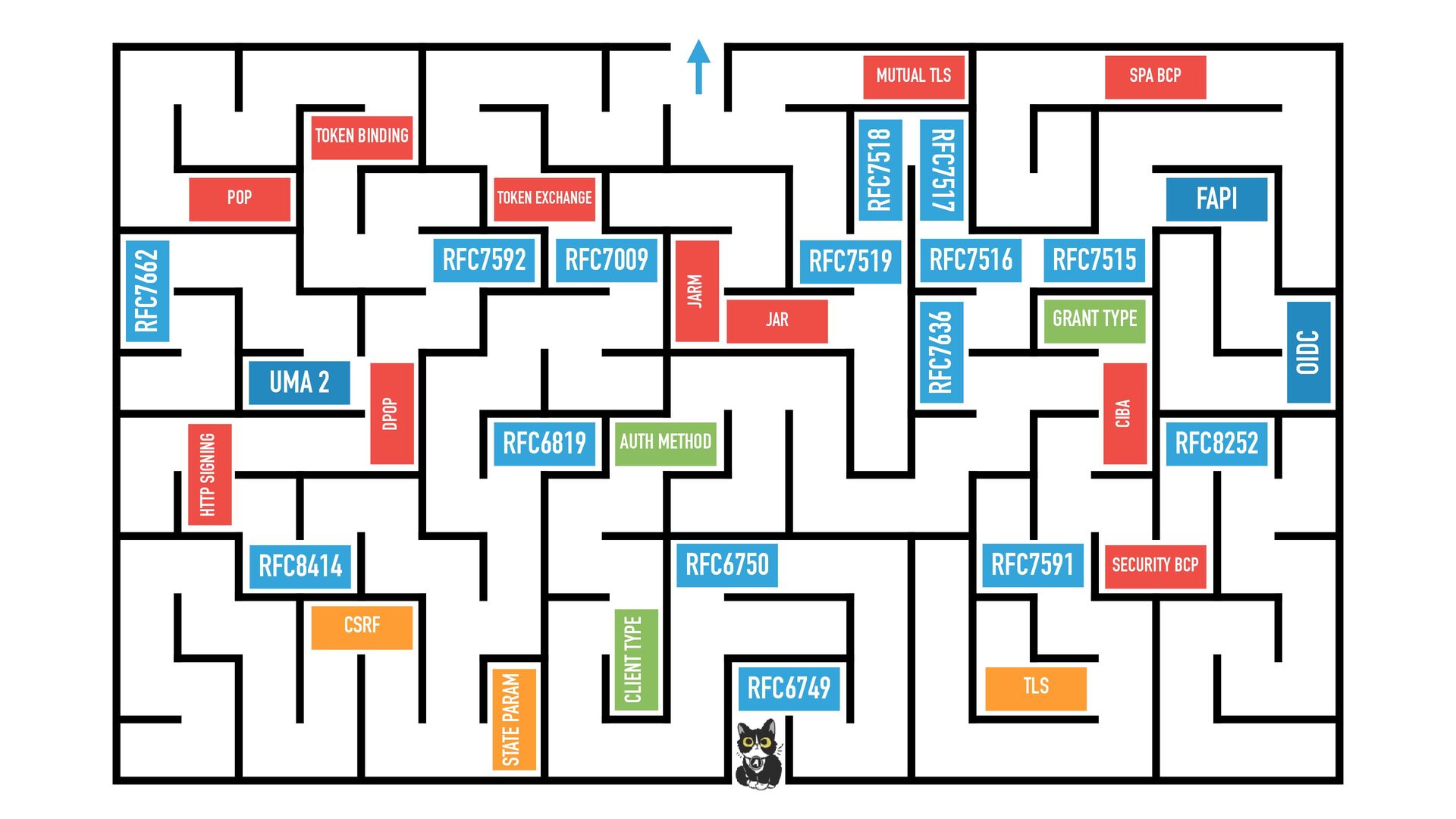
RFC6749 RFC6750 CLIENT TYPE AUTH METHOD GRANT TYPE RFC6819 RFC7009
RFC7592 RFC7662 RFC7636 RFC7591 RFC7519 RFC8252 OIDC RFC8414 STATE PARAM TLS CSRF UMA 2 FAPI RFC7515 RFC7516 RFC7517 RFC7518 TOKEN BINDING POP SECURITY BCP CIBA HTTP SIGNING MUTUAL TLS SPA BCP JARM JAR TOKEN EXCHANGE DPOP -
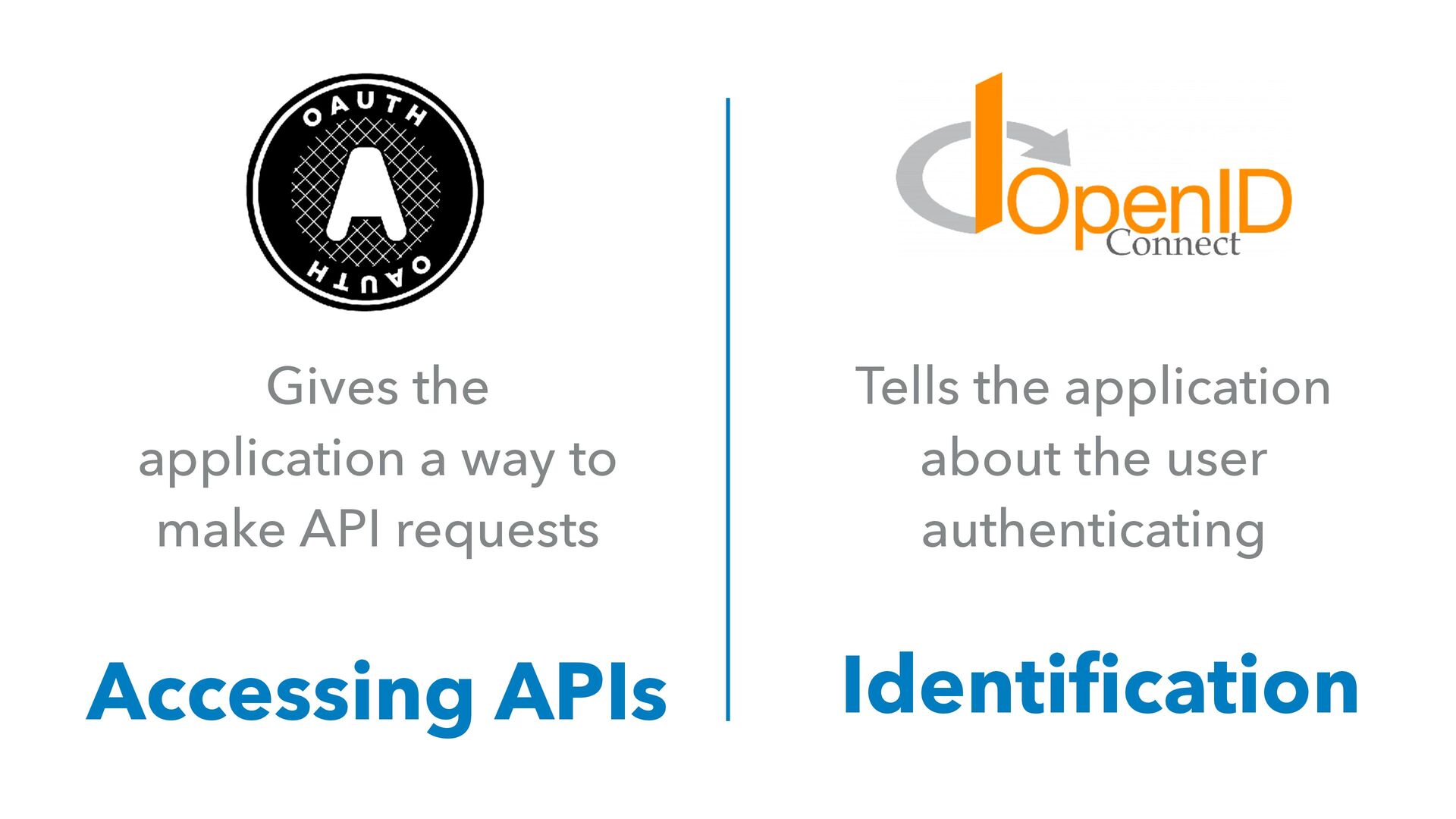
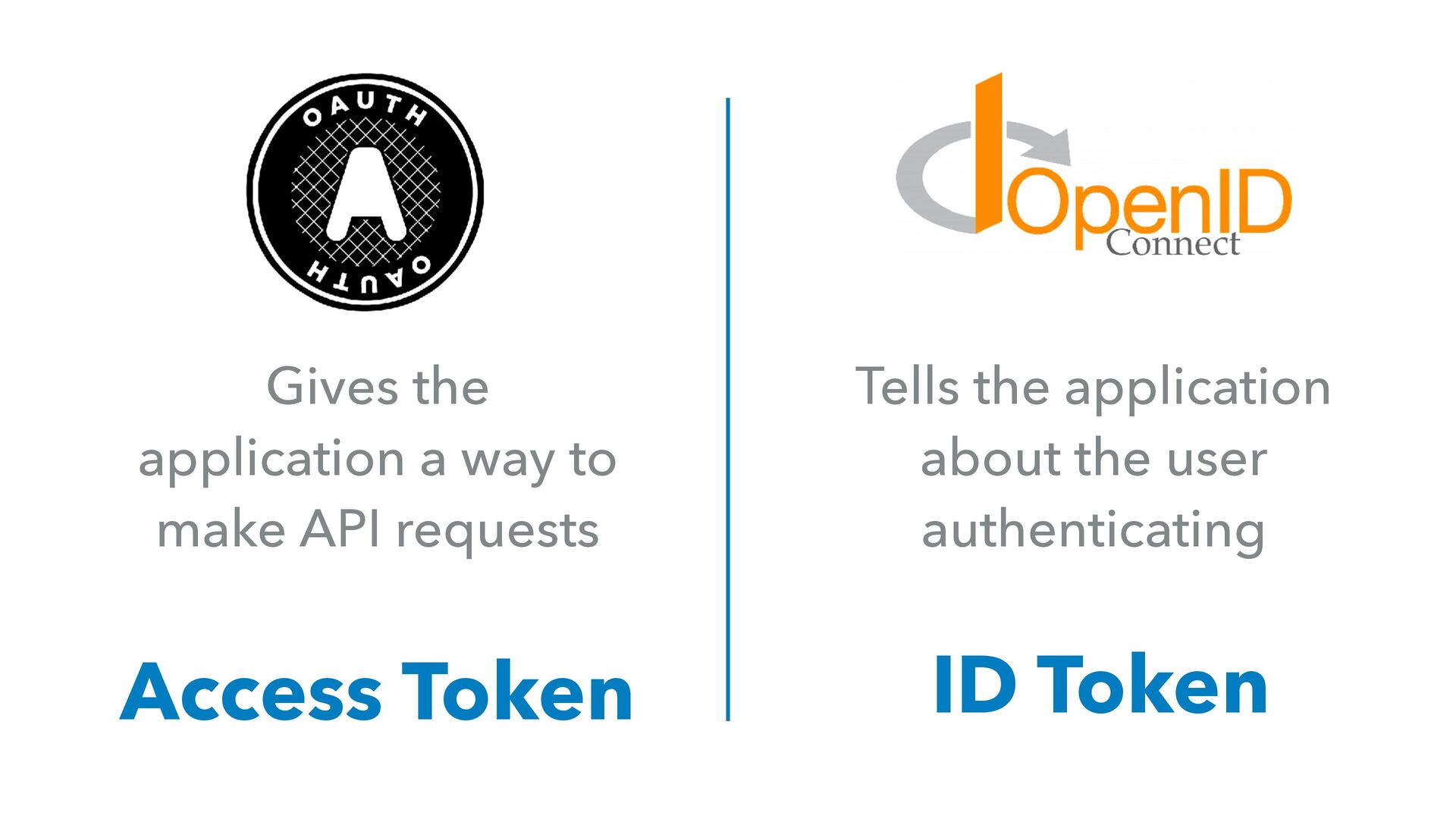
Identification Accessing APIs Tells the application about the user authenticating
Gives the application a way to make API requests -
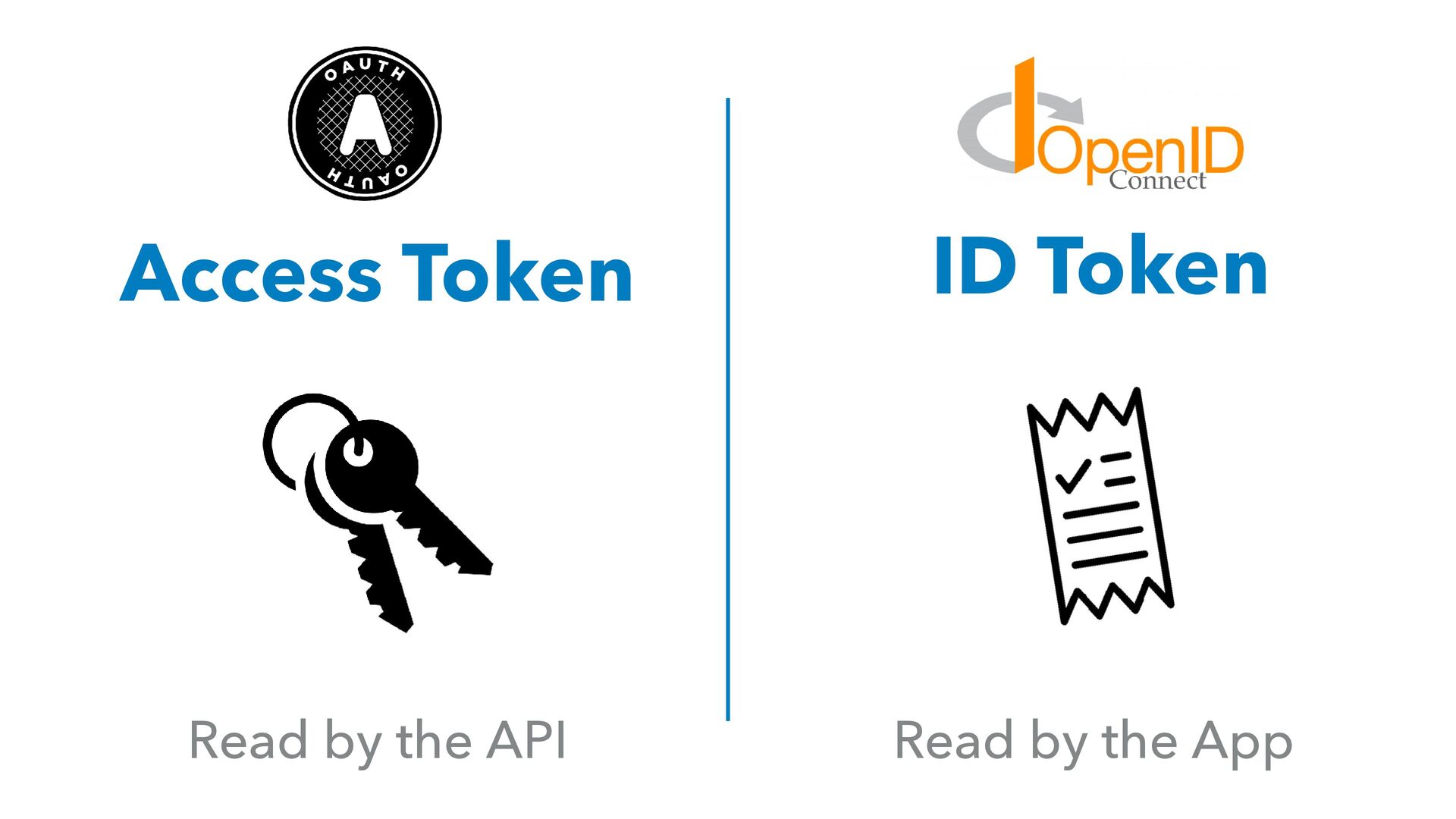
Tells the application about the user authenticating Gives the application
a way to make API requests ID Token Access Token -
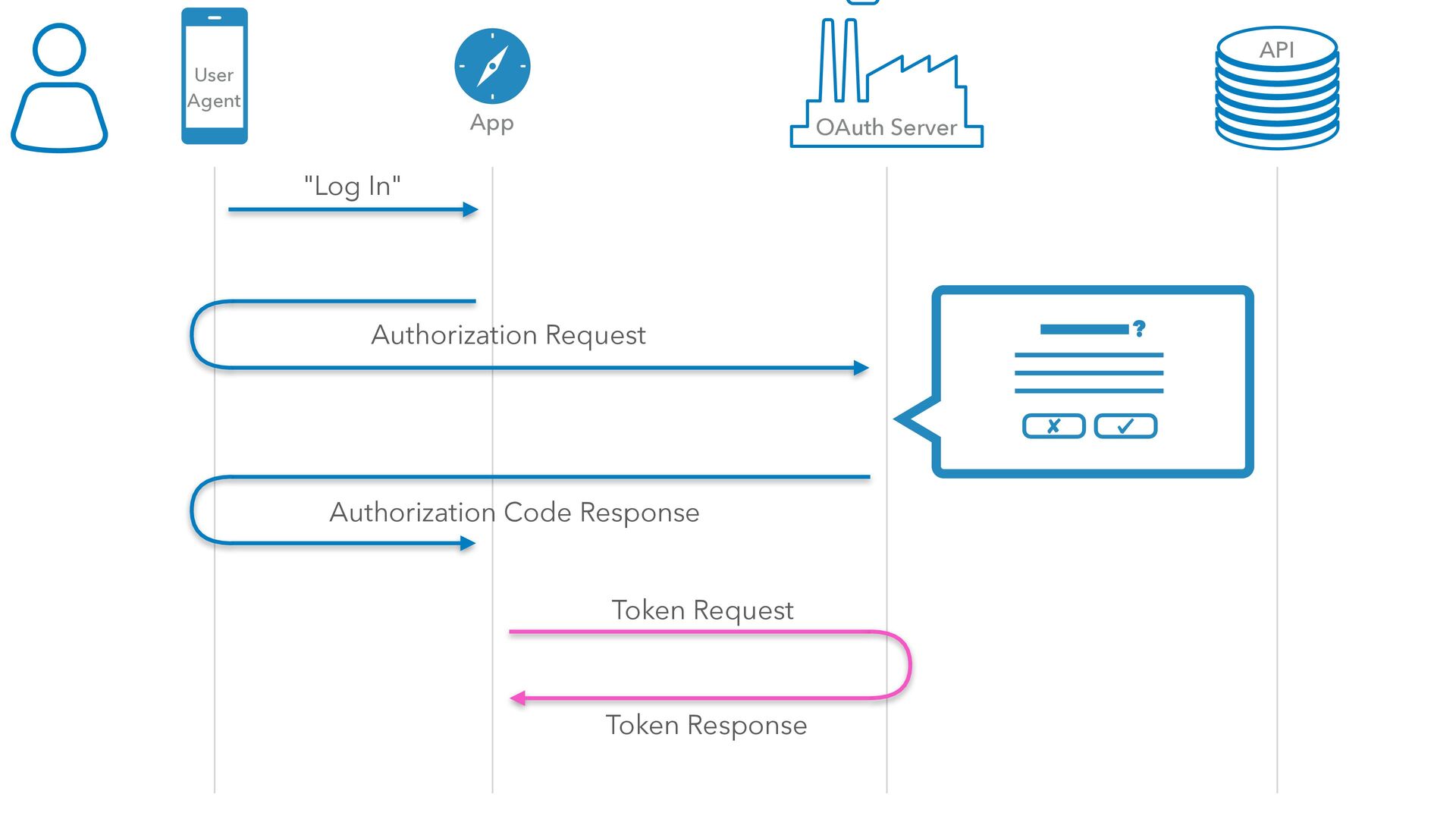
User Agent App OAuth Server API ? Authorization Request Authorization
Code Response Token Request Token Response "Log In" -
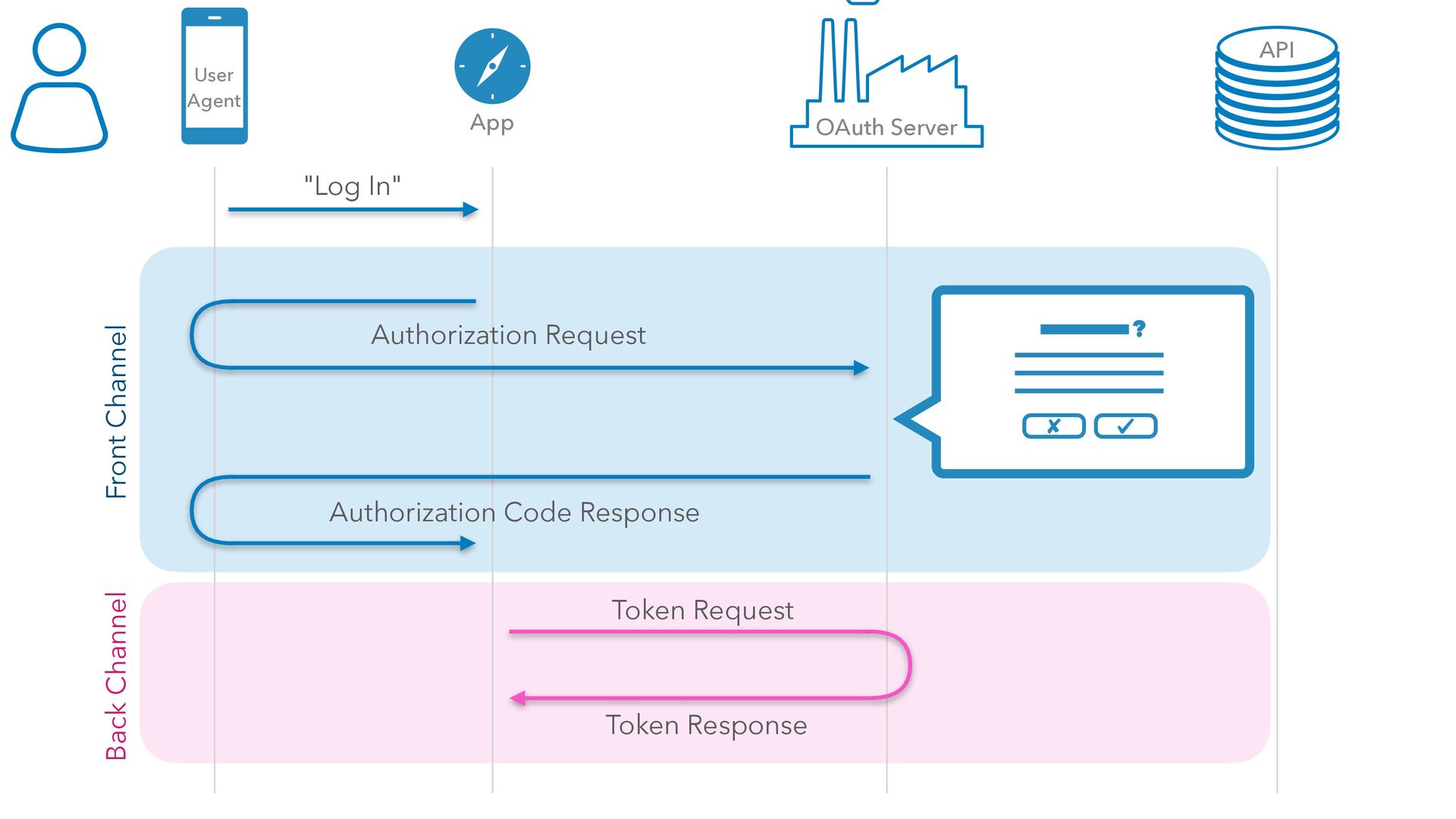
User Agent App OAuth Server API Authorization Request Authorization Code
Response Token Request Token Response "Log In" Front Channel Back Channel ? -
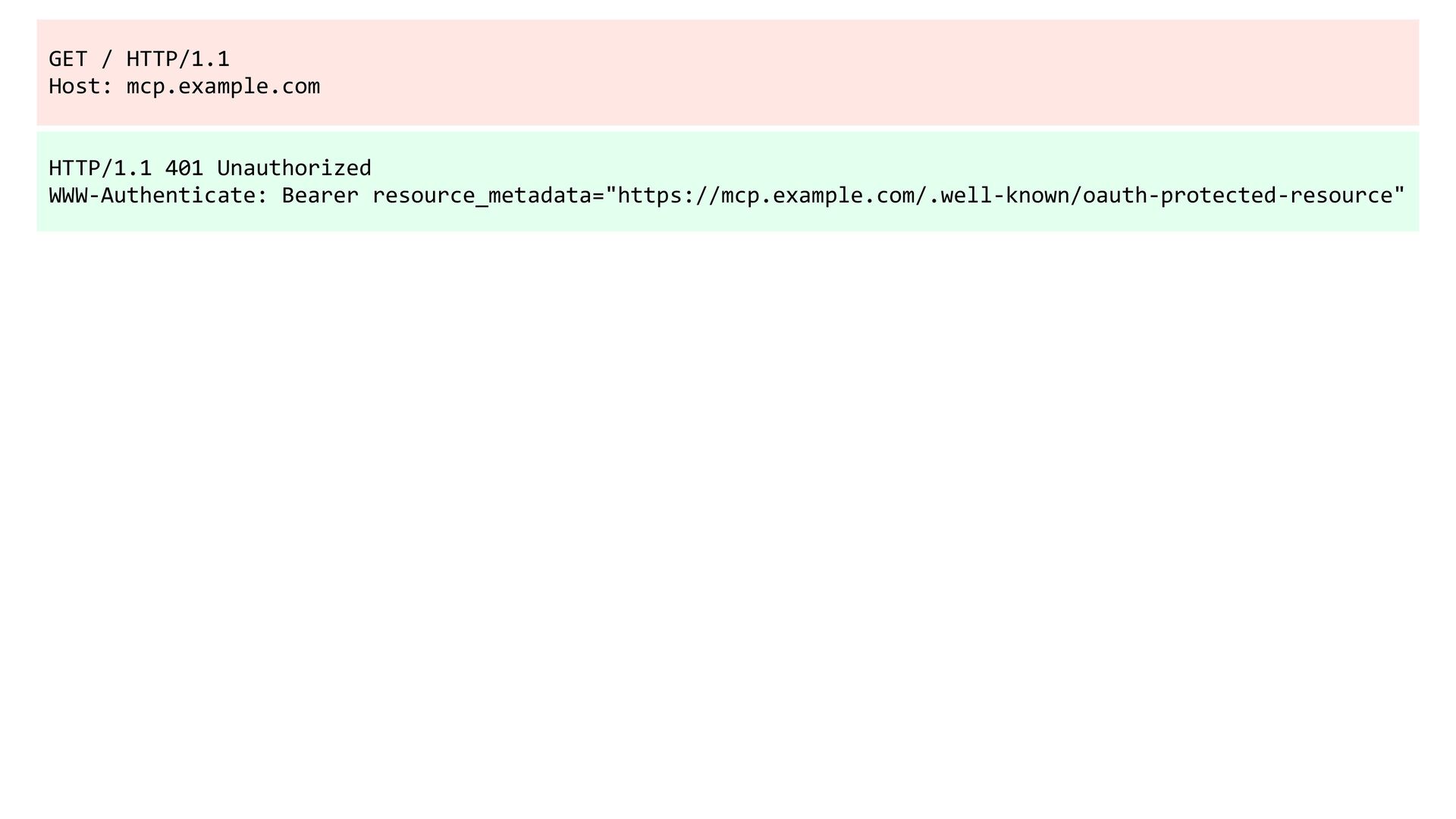
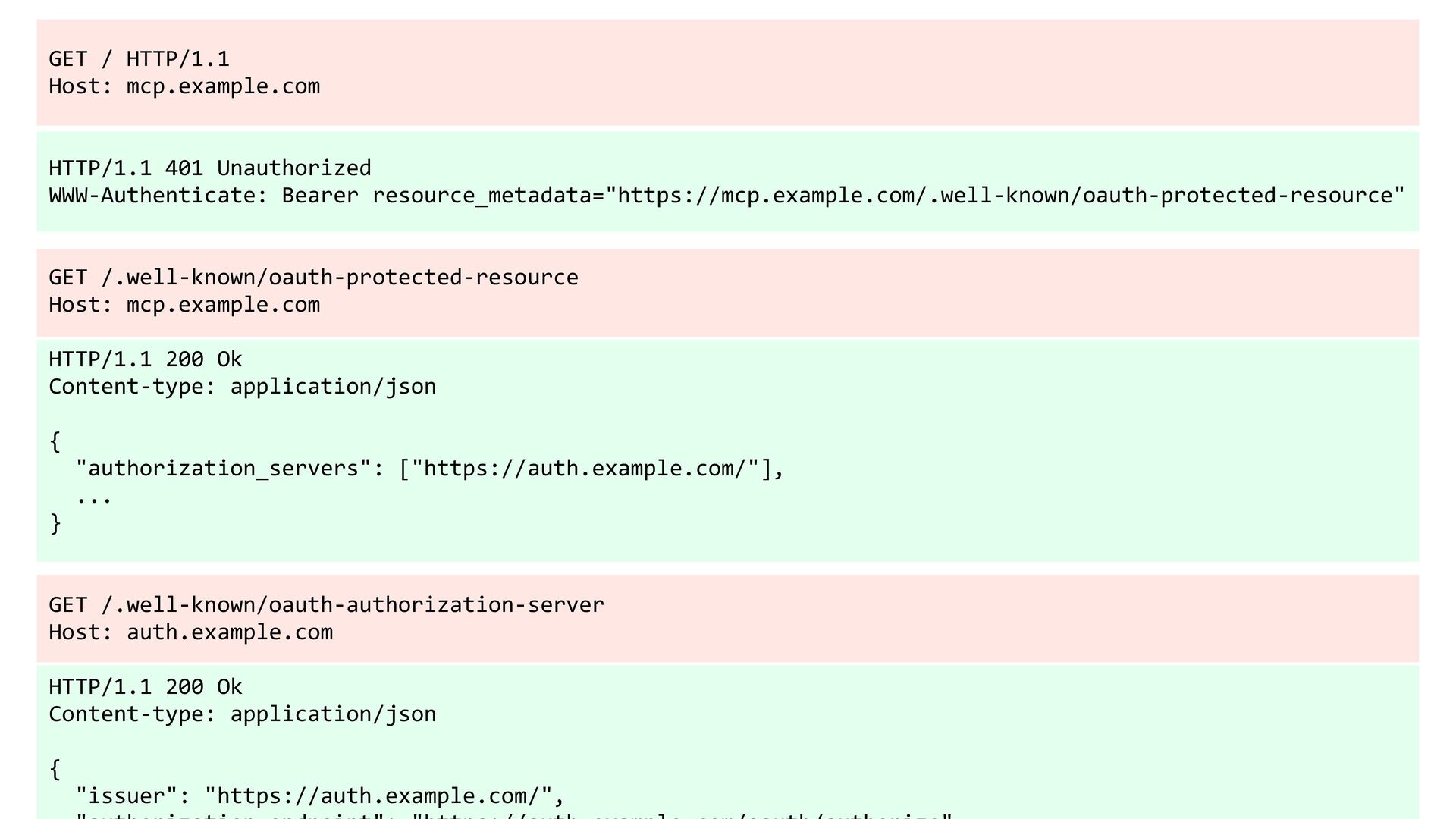
GET / HTTP/1.1 Host: mcp.example.com HTTP/1.1 401 Unauthorized WWW-Authenticate: Bearer
resource_metadata="https://mcp.example.com/.well-known/oauth-protected-resource" -
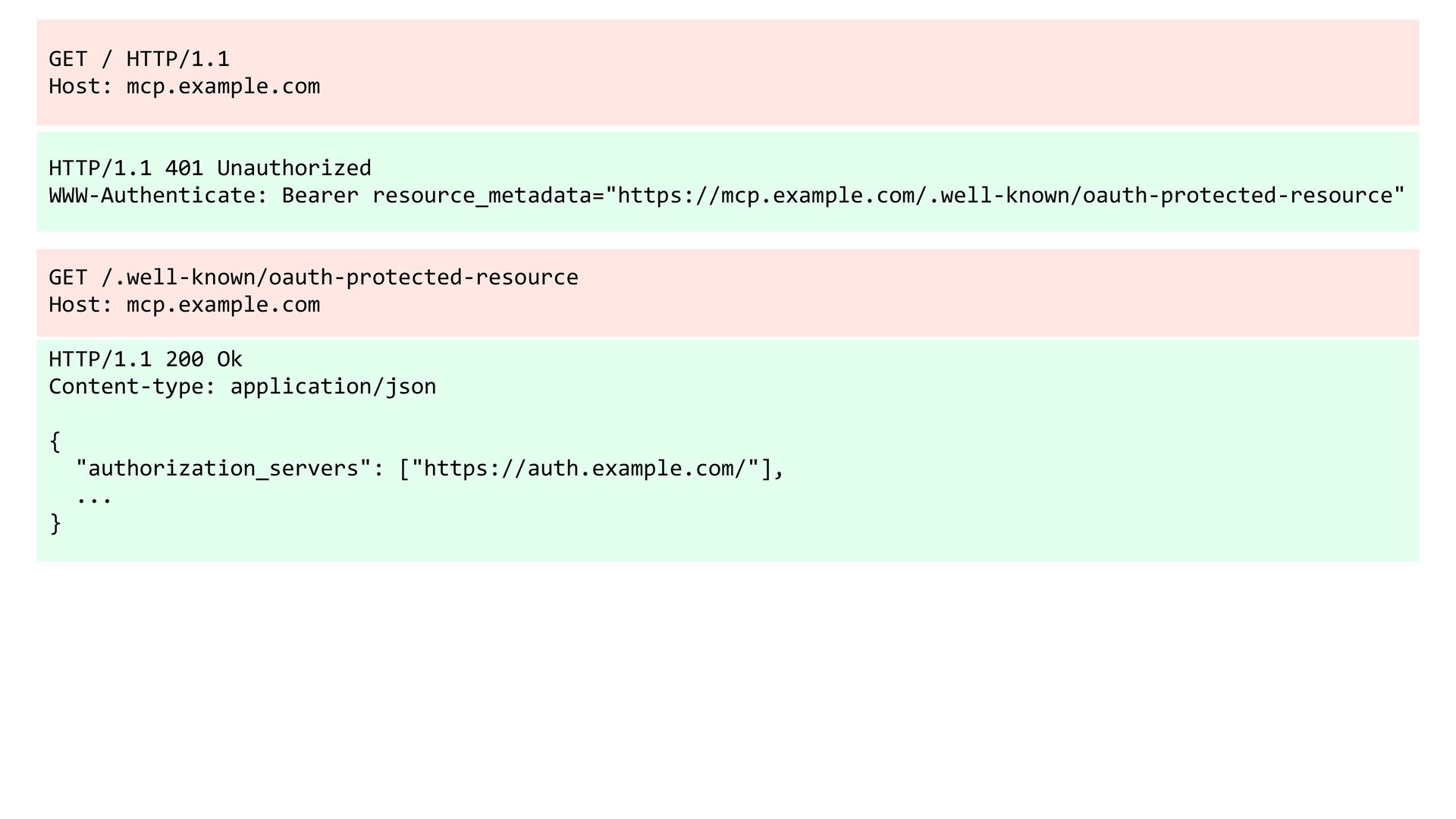
GET / HTTP/1.1 Host: mcp.example.com HTTP/1.1 401 Unauthorized WWW-Authenticate: Bearer
resource_metadata="https://mcp.example.com/.well-known/oauth-protected-resource" GET /.well-known/oauth-protected-resource Host: mcp.example.com HTTP/1.1 200 Ok Content-type: application/json { "authorization_servers": ["https://auth.example.com/"], ... } -
GET / HTTP/1.1 Host: mcp.example.com HTTP/1.1 401 Unauthorized WWW-Authenticate: Bearer
resource_metadata="https://mcp.example.com/.well-known/oauth-protected-resource" GET /.well-known/oauth-protected-resource Host: mcp.example.com HTTP/1.1 200 Ok Content-type: application/json { "authorization_servers": ["https://auth.example.com/"], ... } GET /.well-known/oauth-authorization-server Host: auth.example.com HTTP/1.1 200 Ok Content-type: application/json { "issuer": "https://auth.example.com/", -
POST /oauth/register HTTP/1.1 Host: auth.example.com Content-Type: application/json { "client_name": "Claude",
"logo_uri": "https://claude.ai/logo.png", "redirect_uris": ["https://auth.example.com/redirect"] ... } HTTP/1.1 201 Created Content-Type: application/json { "client_id": "ad2669221ba94de0ee0", "client_secret": "6a58a307937e98c459be3bfe8e19af3a", ... } -
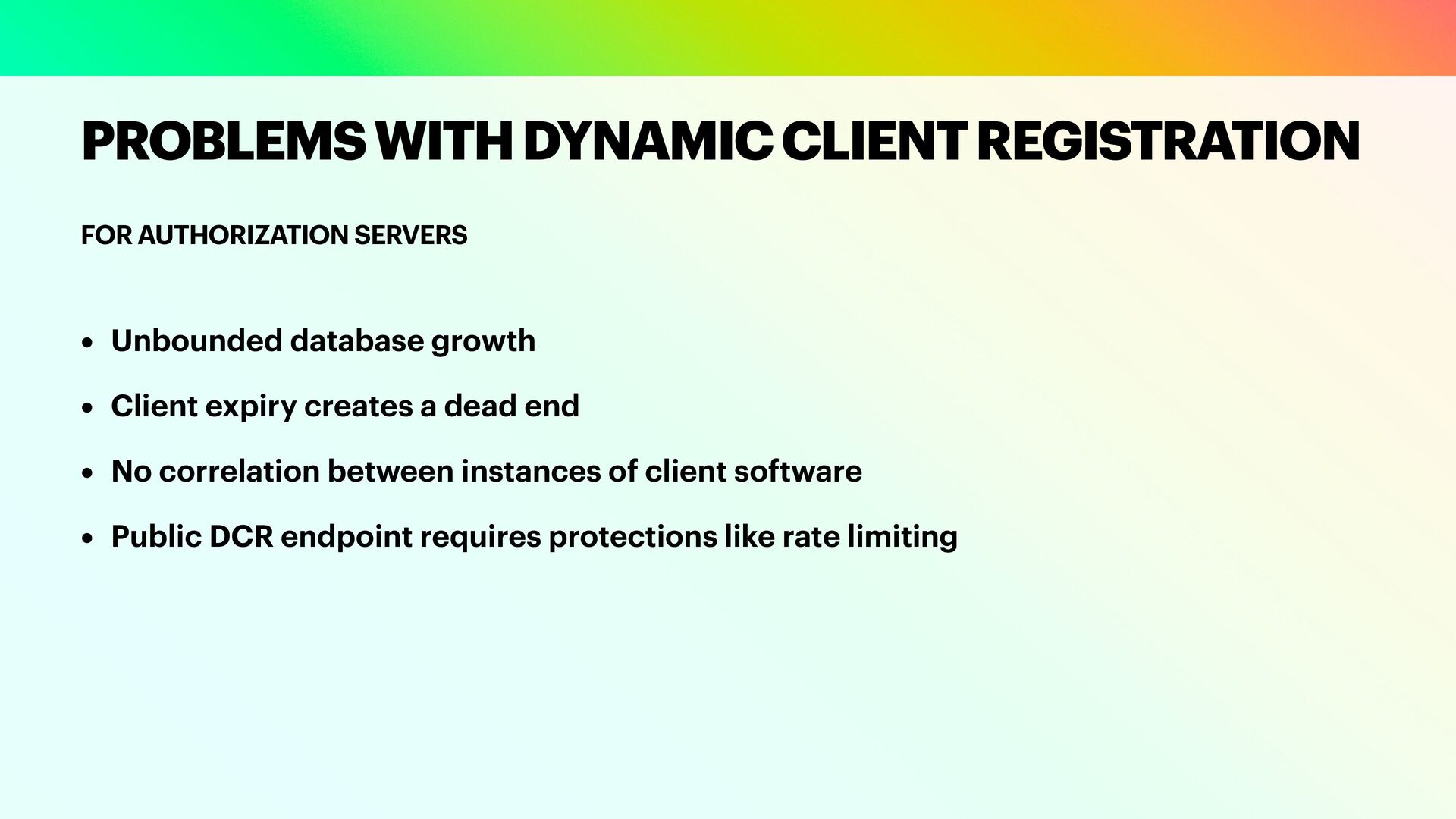
FOR AUTHORIZATION SERVERS PROBLEMS WITH DYNAMIC CLIENT REGISTRATION • Unbounded
database growth • Client expiry creates a dead end • No correlation between instances of client software • Public DCR endpoint requires protections like rate limiting -
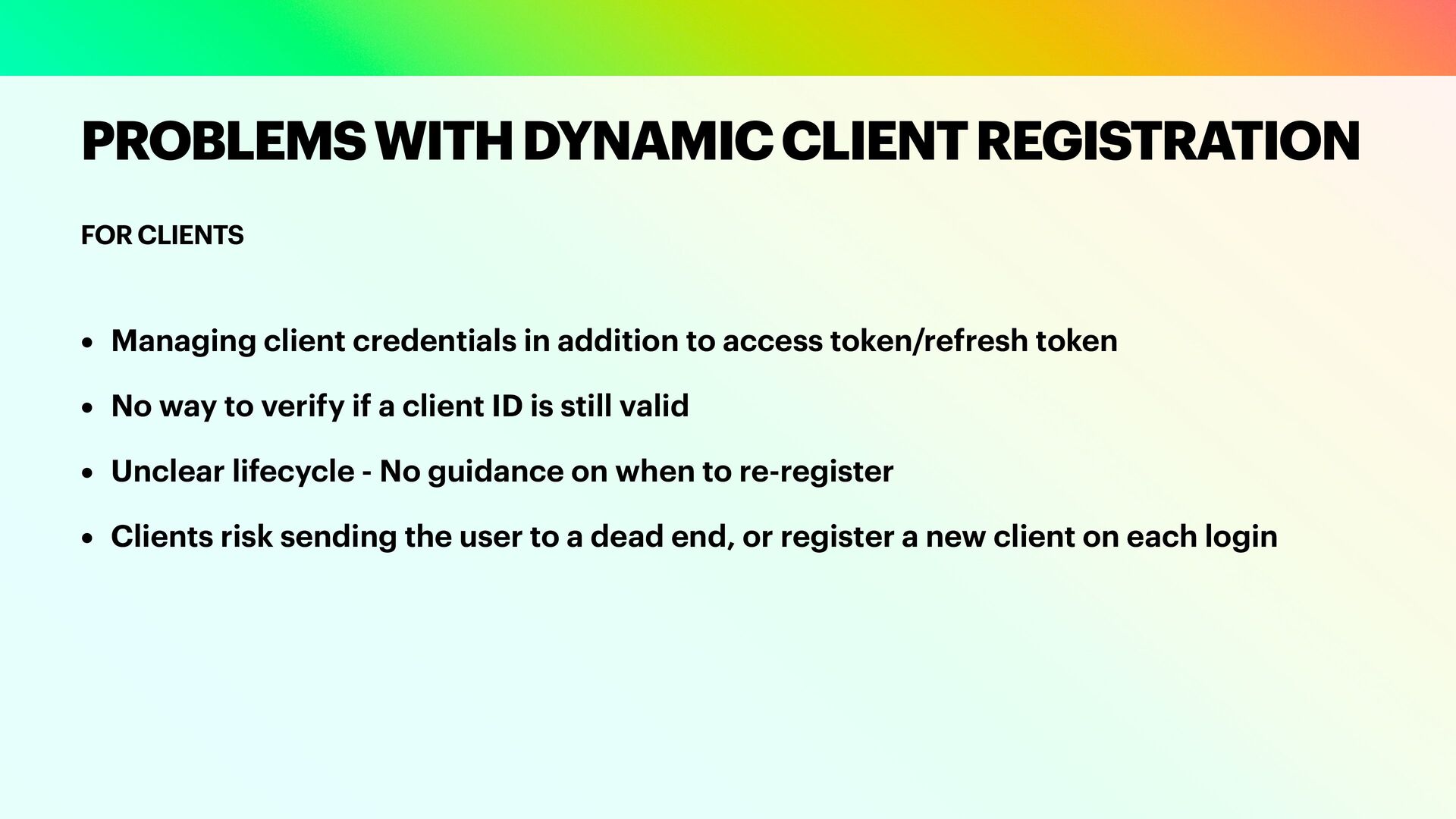
FOR CLIENTS PROBLEMS WITH DYNAMIC CLIENT REGISTRATION • Managing client
credentials in addition to access token/refresh token • No way to verify if a client ID is still valid • Unclear lifecycle - No guidance on when to re-register • Clients risk sending the user to a dead end, or register a new client on each login -
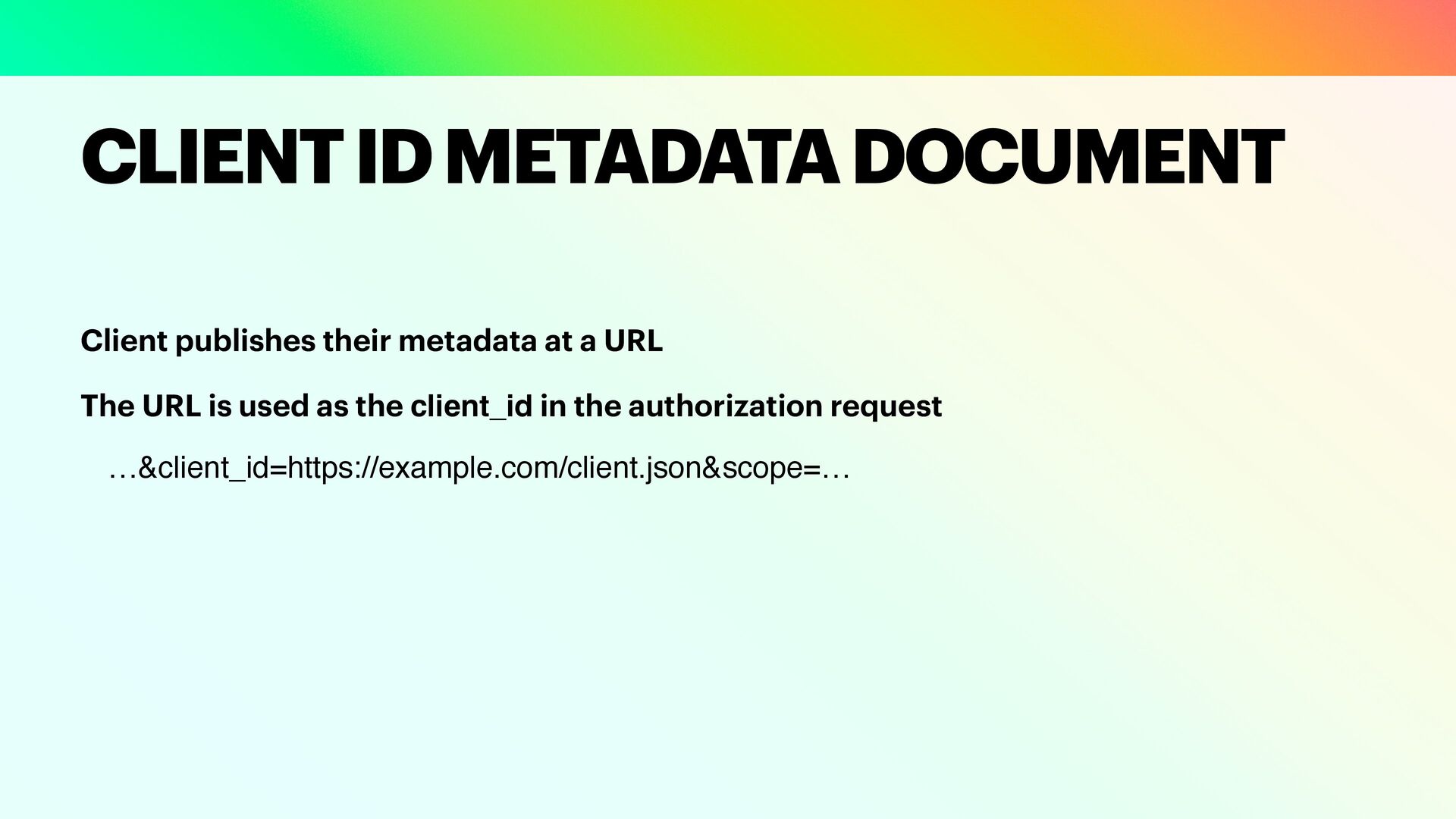
CLIENT ID METADATA DOCUMENT Client publishes their metadata at a
URL The URL is used as the client_id in the authorization request …&client_id=https://example.com/client.json&scope=… -
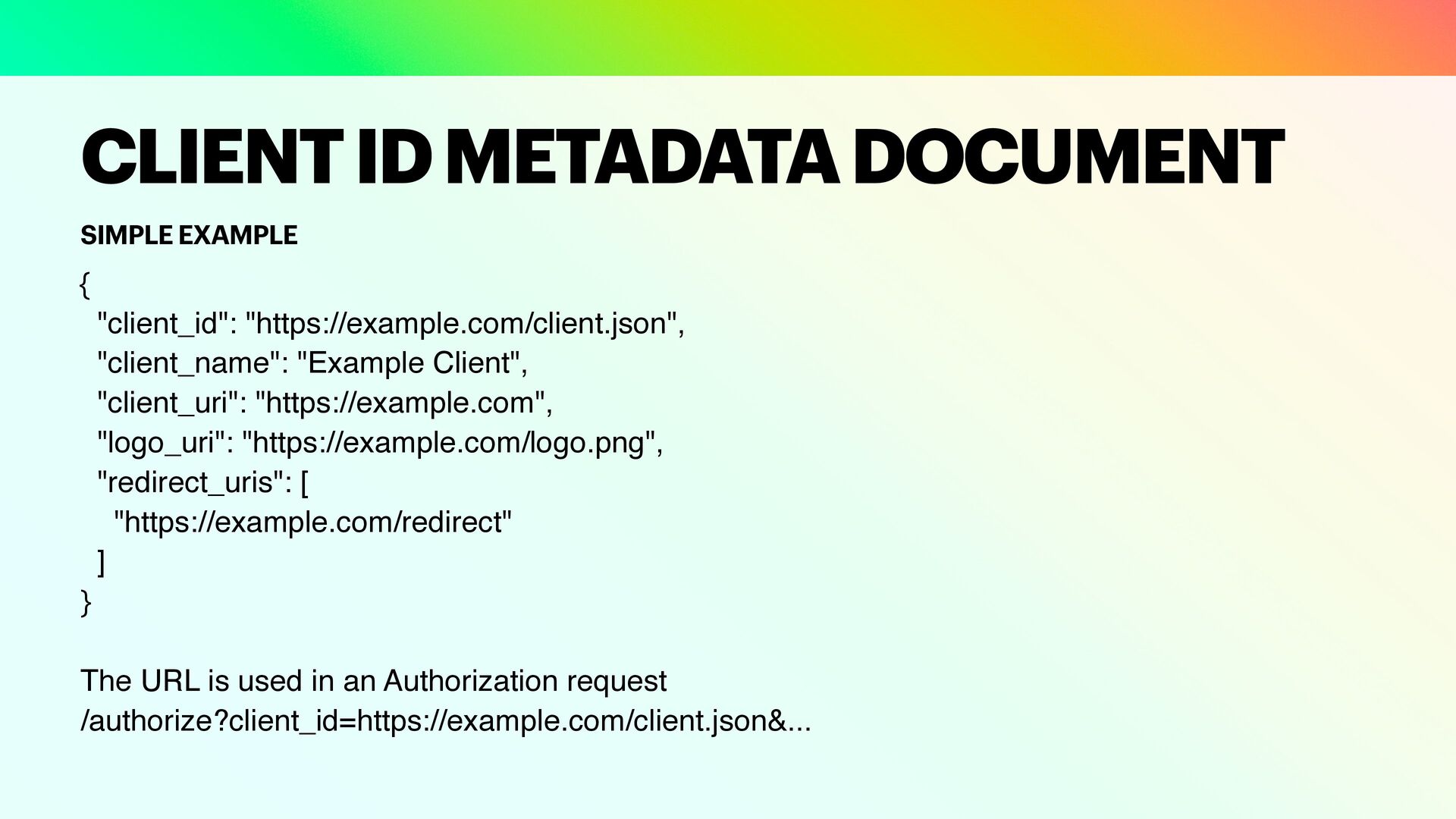
SIMPLE EXAMPLE CLIENT ID METADATA DOCUMENT { "client_id": "https://example.com/client.json", "client_name":
"Example Client", "client_uri": "https://example.com", "logo_uri": "https://example.com/logo.png", "redirect_uris": [ "https://example.com/redirect" ] } The URL is used in an Authorization request /authorize?client_id=https://example.com/client.json&... -
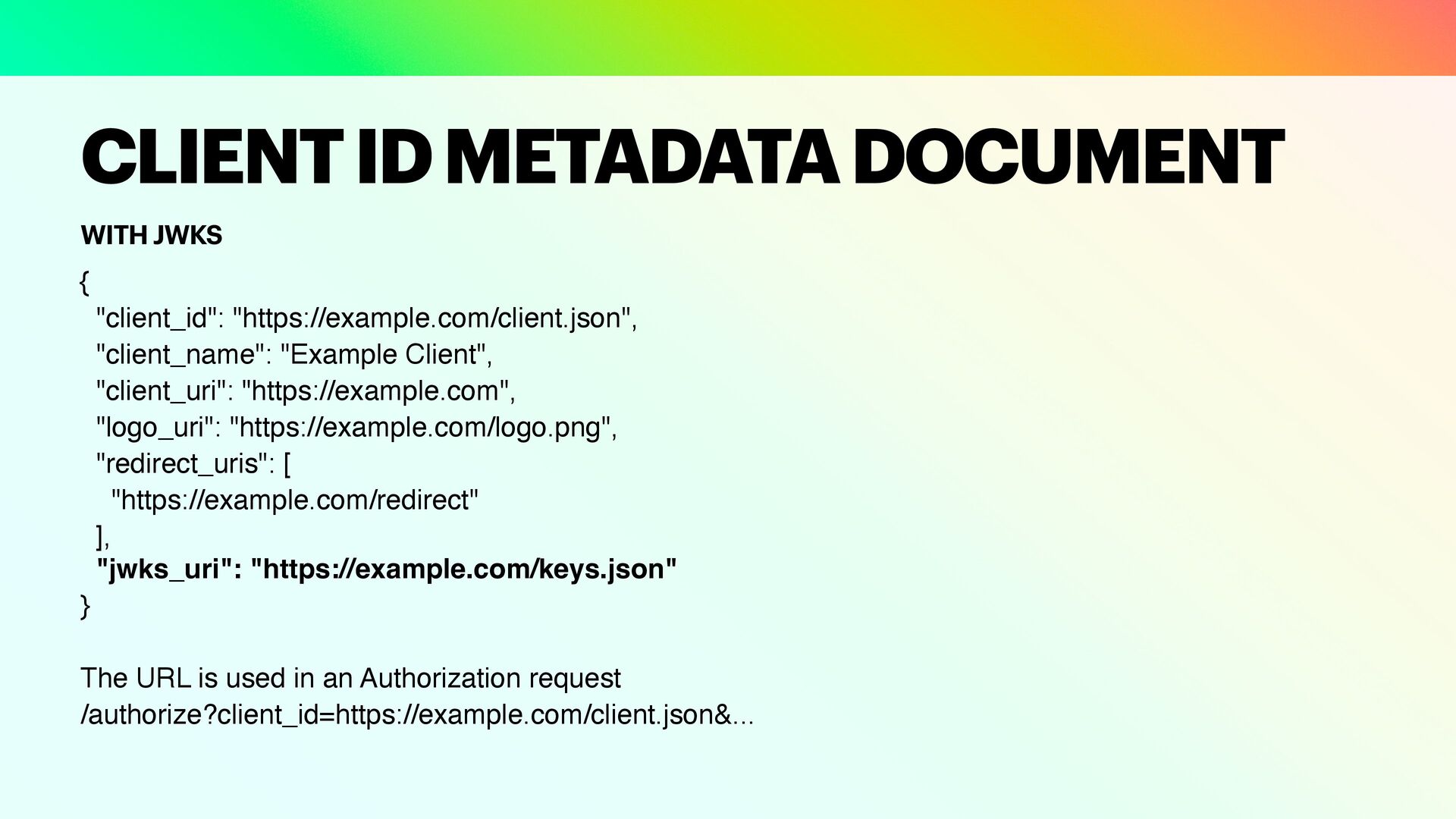
WITH JWKS CLIENT ID METADATA DOCUMENT { "client_id": "https://example.com/client.json", "client_name":
"Example Client", "client_uri": "https://example.com", "logo_uri": "https://example.com/logo.png", "redirect_uris": [ "https://example.com/redirect" ], "jwks_uri": "https://example.com/keys.json" } The URL is used in an Authorization request /authorize?client_id=https://example.com/client.json&... -
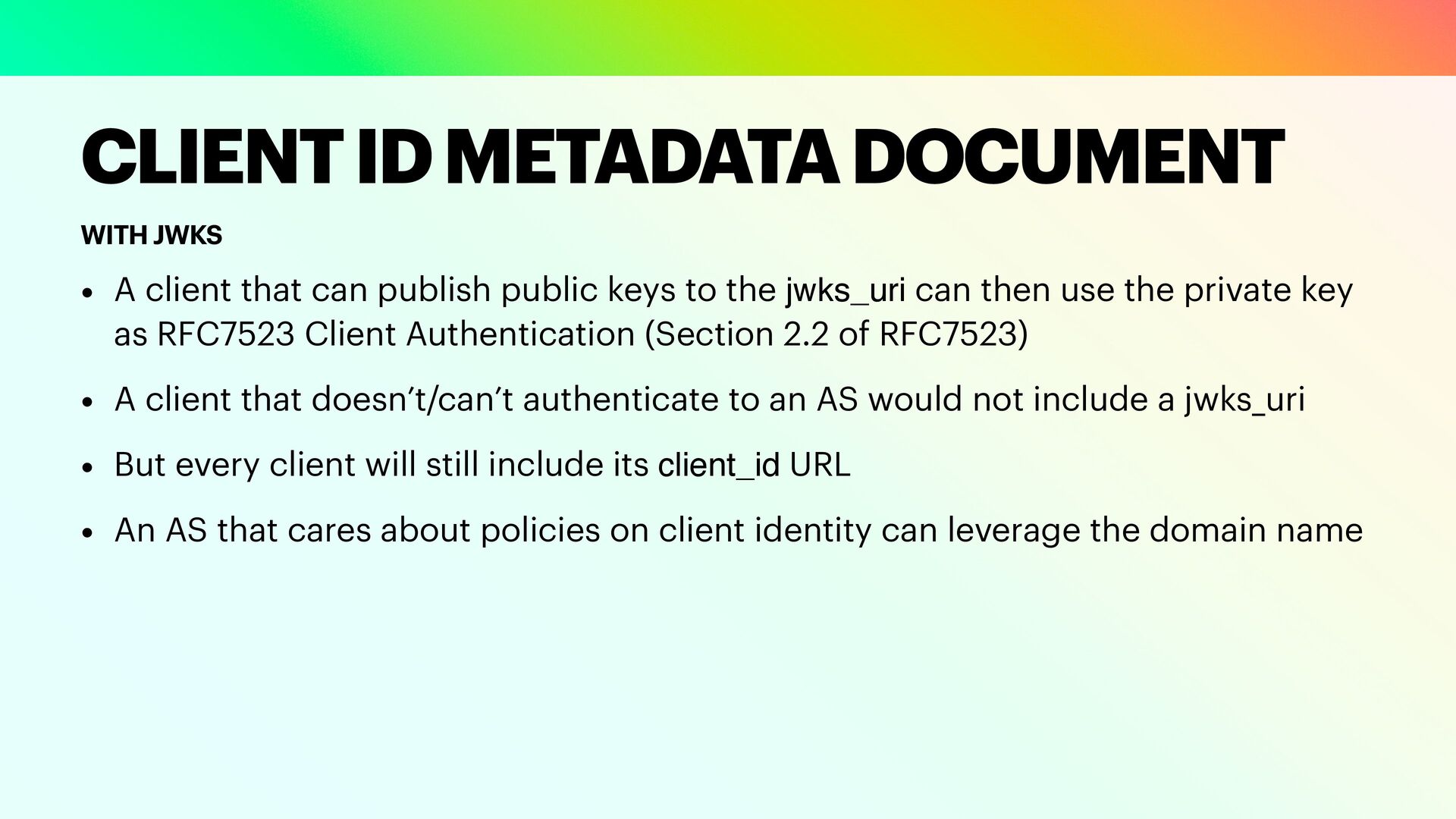
WITH JWKS CLIENT ID METADATA DOCUMENT • A client that
can publish public keys to the jwks_uri can then use the private key as RFC7523 Client Authentication (Section 2.2 of RFC7523) • A client that doesn’t/can’t authenticate to an AS would not include a jwks_uri • But every client will still include its client_id URL • An AS that cares about policies on client identity can leverage the domain name -
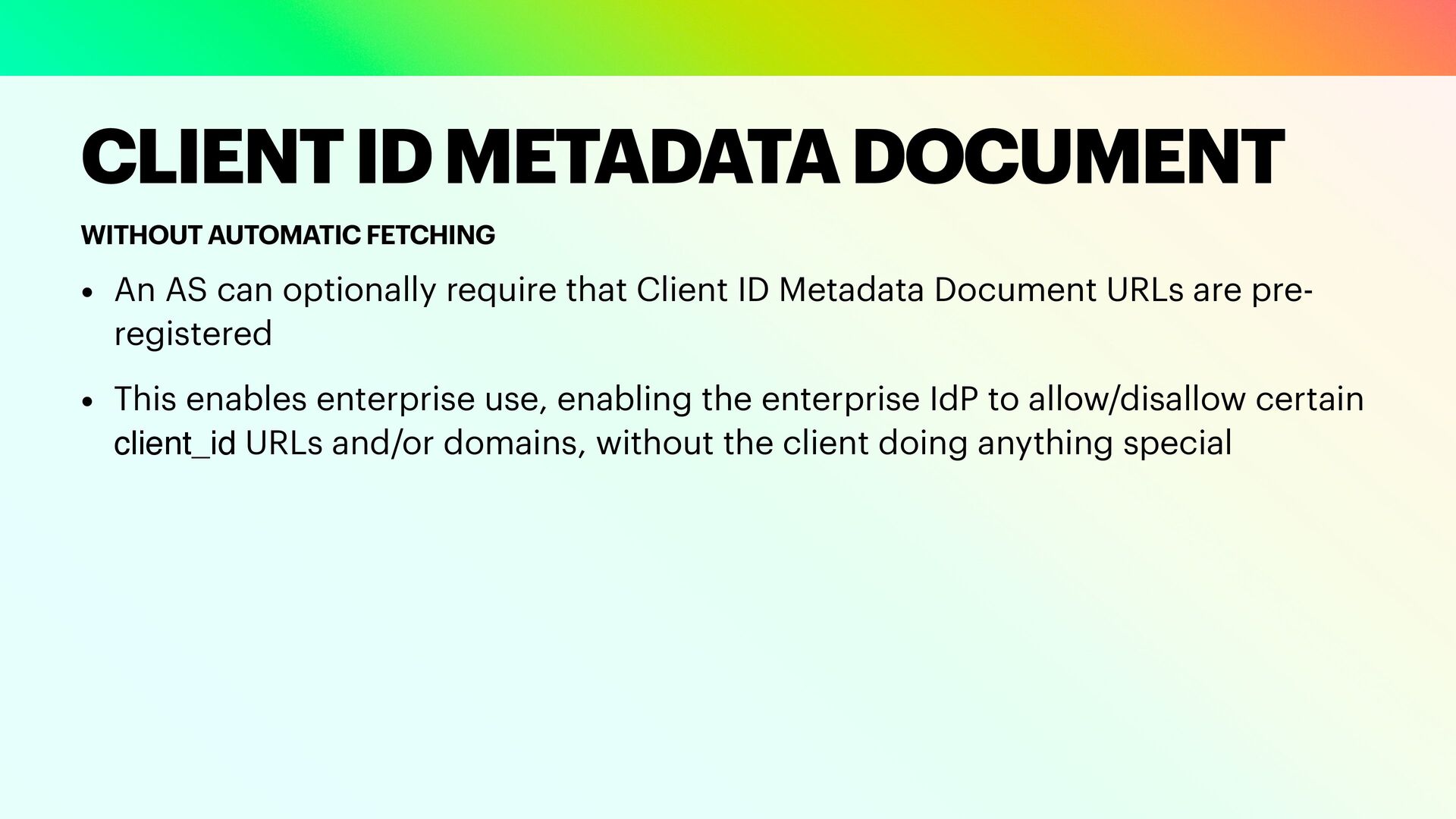
WITHOUT AUTOMATIC FETCHING CLIENT ID METADATA DOCUMENT • An AS
can optionally require that Client ID Metadata Document URLs are pre- registered • This enables enterprise use, enabling the enterprise IdP to allow/disallow certain client_id URLs and/or domains, without the client doing anything special -
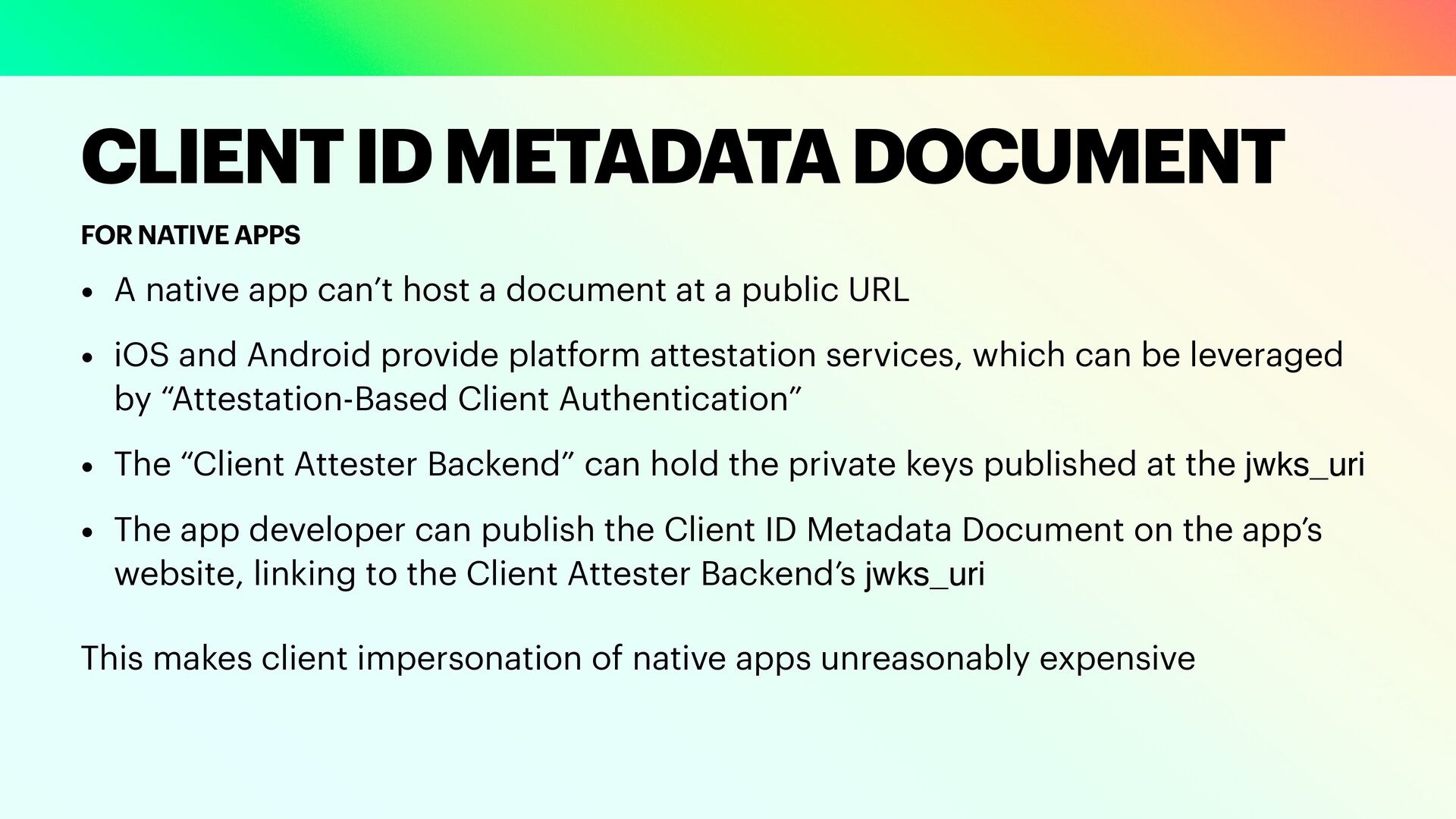
FOR NATIVE APPS CLIENT ID METADATA DOCUMENT • A native
app can’t host a document at a public URL • iOS and Android provide platform attestation services, which can be leveraged by “Attestation-Based Client Authentication” • The “Client Attester Backend” can hold the private keys published at the jwks_uri • The app developer can publish the Client ID Metadata Document on the app’s website, linking to the Client Attester Backend’s jwks_uri This makes client impersonation of native apps unreasonably expensive