Share
Embed
Esoteric Web Application Vulnerabilities
A summary of the strangest vulnerabilities I've found during last year

andresriancho
April 19, 2016
Transcript
50 slides
-
@w3af /me ▪ Application security expert (web|API) ▪ Developer (Python!)
▪ Open Source evangelist ▪ w3af project leader ▪ Founder of Bonsai Information Security -
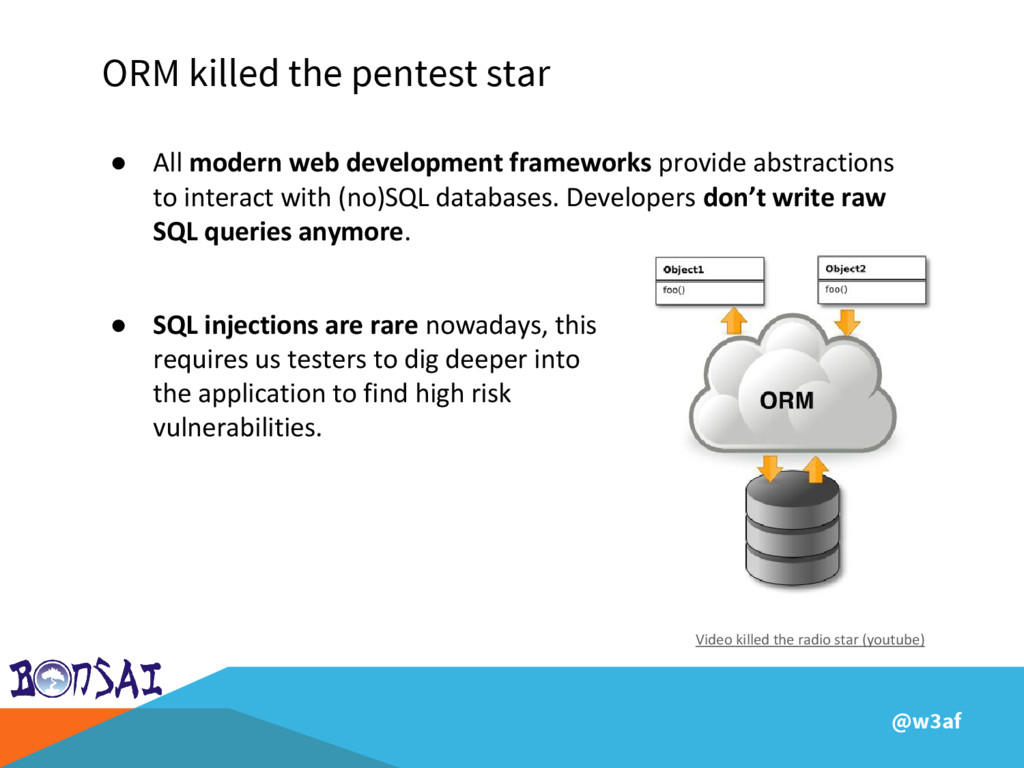
@w3af ORM killed the pentest star • All modern web
development frameworks provide abstractions to interact with (no)SQL databases. Developers don’t write raw SQL queries anymore. Video killed the radio star (youtube) • SQL injections are rare nowadays, this requires us testers to dig deeper into the application to find high risk vulnerabilities. -
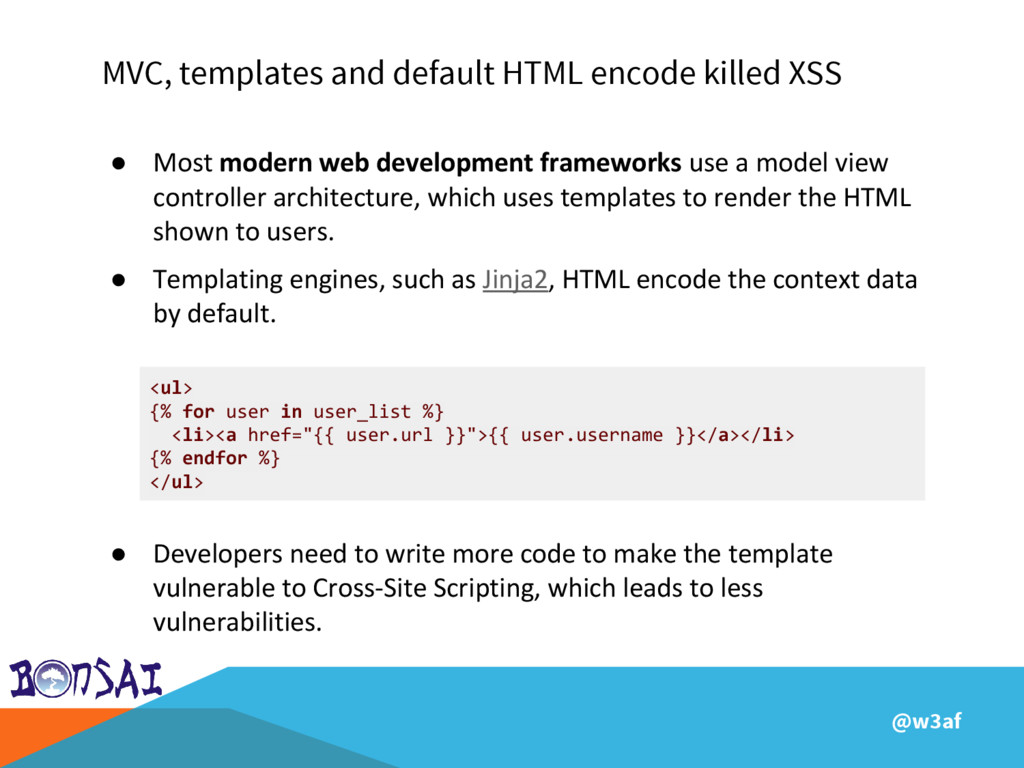
@w3af MVC, templates and default HTML encode killed XSS •
Most modern web development frameworks use a model view controller architecture, which uses templates to render the HTML shown to users. • Templating engines, such as Jinja2, HTML encode the context data by default. • Developers need to write more code to make the template vulnerable to Cross-Site Scripting, which leads to less vulnerabilities. <ul> {% for user in user_list %} <li><a href="{{ user.url }}">{{ user.username }}</a></li> {% endfor %} </ul> -
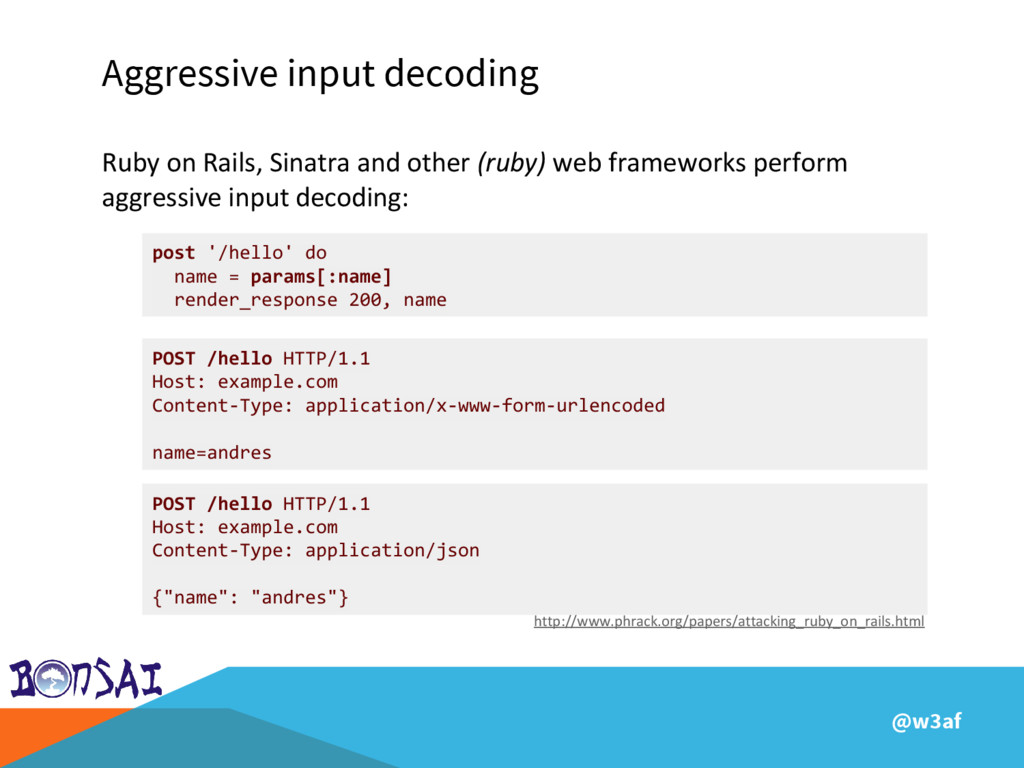
@w3af Aggressive input decoding Ruby on Rails, Sinatra and other
(ruby) web frameworks perform aggressive input decoding: http://www.phrack.org/papers/attacking_ruby_on_rails.html post '/hello' do name = params[:name] render_response 200, name POST /hello HTTP/1.1 Host: example.com Content-Type: application/x-www-form-urlencoded name=andres POST /hello HTTP/1.1 Host: example.com Content-Type: application/json {"name": "andres"} -
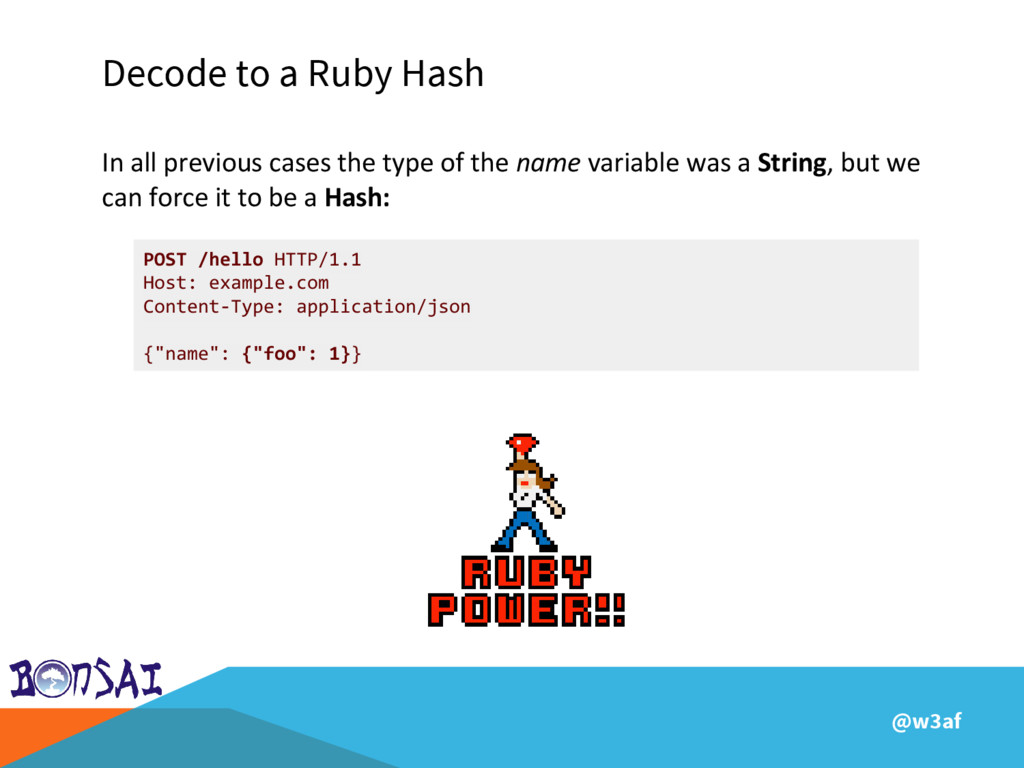
@w3af Decode to a Ruby Hash POST /hello HTTP/1.1 Host:
example.com Content-Type: application/json {"name": {"foo": 1}} In all previous cases the type of the name variable was a String, but we can force it to be a Hash: -
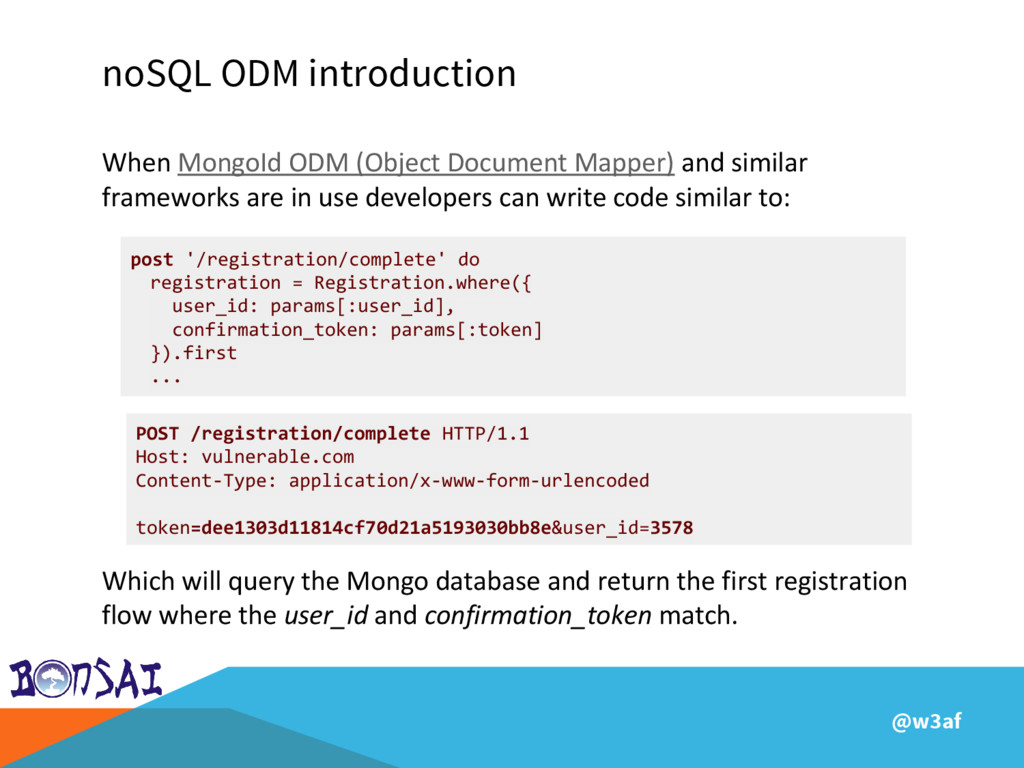
@w3af noSQL ODM introduction When MongoId ODM (Object Document Mapper)
and similar frameworks are in use developers can write code similar to: Which will query the Mongo database and return the first registration flow where the user_id and confirmation_token match. post '/registration/complete' do registration = Registration.where({ user_id: params[:user_id], confirmation_token: params[:token] }).first ... POST /registration/complete HTTP/1.1 Host: vulnerable.com Content-Type: application/x-www-form-urlencoded token=dee1303d11814cf70d21a5193030bb8e&user_id=3578 -
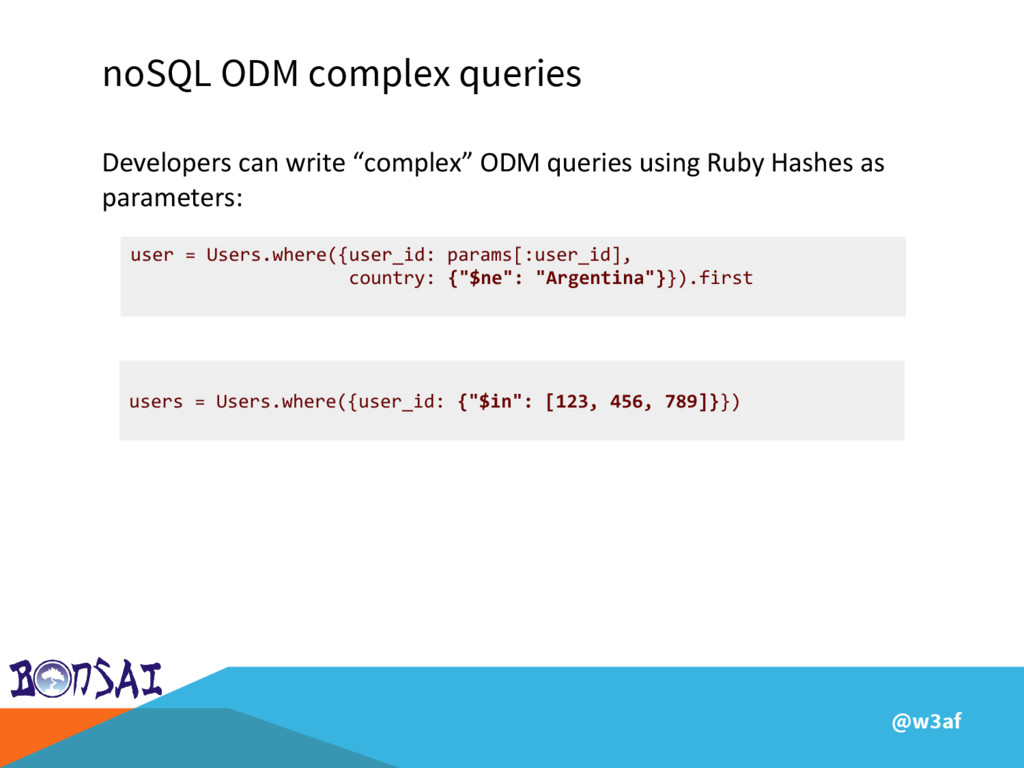
@w3af noSQL ODM complex queries Developers can write “complex” ODM
queries using Ruby Hashes as parameters: user = Users.where({user_id: params[:user_id], country: {"$ne": "Argentina"}}).first users = Users.where({user_id: {"$in": [123, 456, 789]}}) -
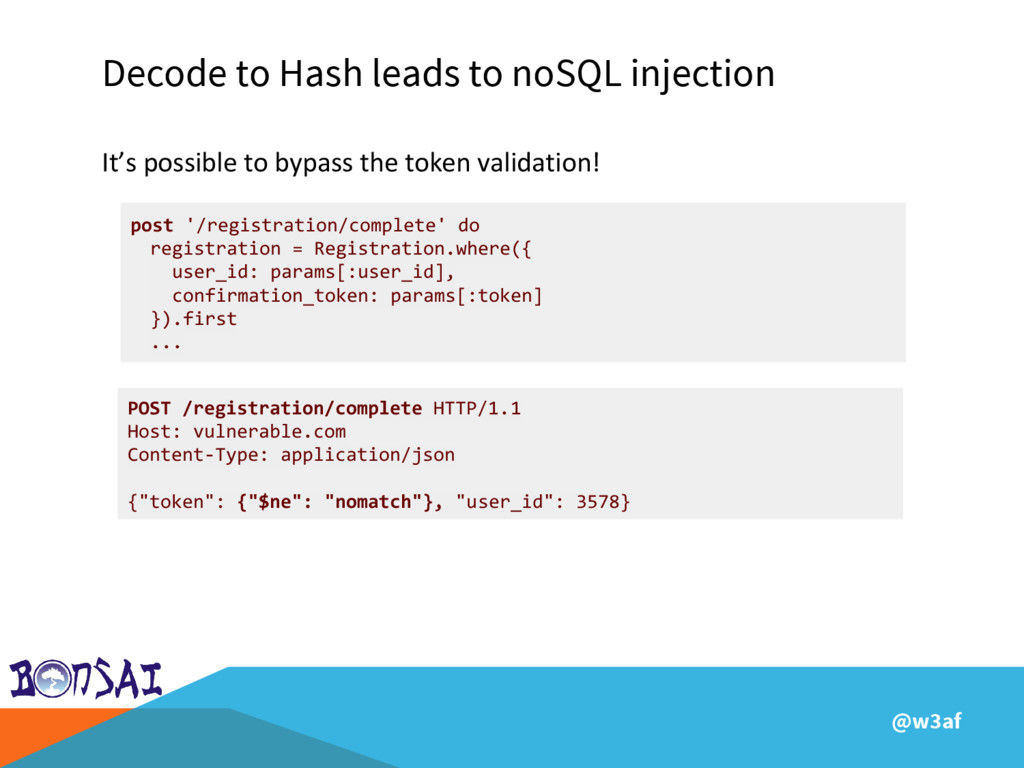
@w3af Decode to Hash leads to noSQL injection It’s possible
to bypass the token validation! post '/registration/complete' do registration = Registration.where({ user_id: params[:user_id], confirmation_token: params[:token] }).first ... POST /registration/complete HTTP/1.1 Host: vulnerable.com Content-Type: application/json {"token": {"$ne": "nomatch"}, "user_id": 3578} -
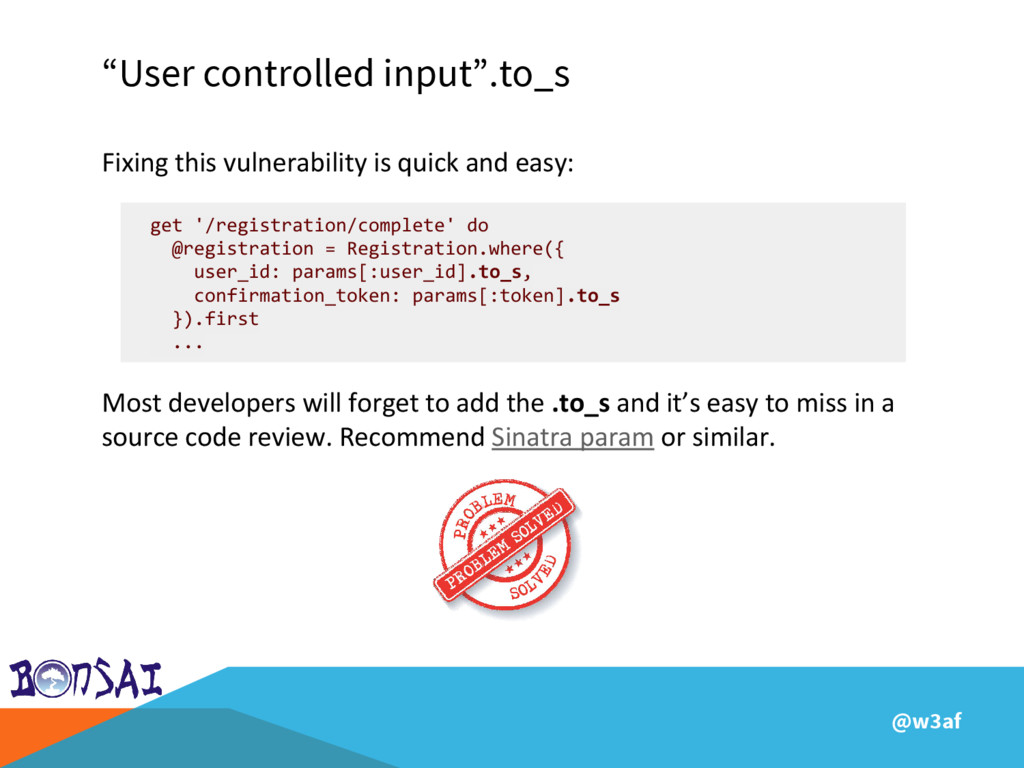
@w3af “User controlled input”.to_s Fixing this vulnerability is quick and
easy: Most developers will forget to add the .to_s and it’s easy to miss in a source code review. Recommend Sinatra param or similar. get '/registration/complete' do @registration = Registration.where({ user_id: params[:user_id].to_s, confirmation_token: params[:token].to_s }).first ... -
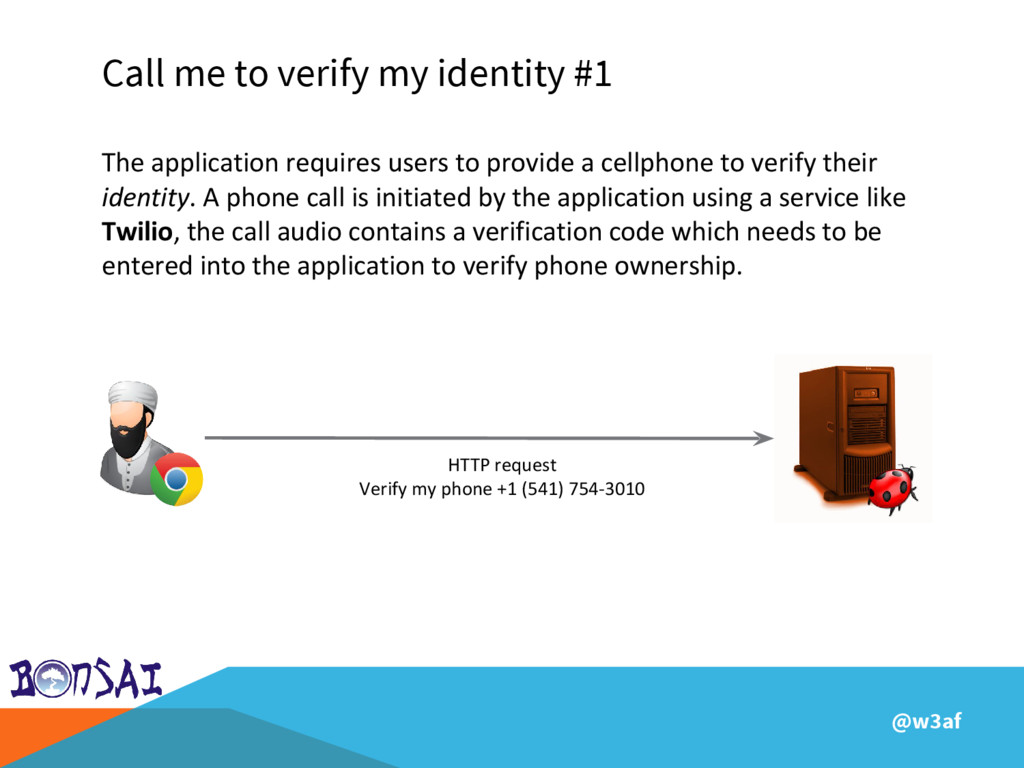
@w3af Call me to verify my identity #1 The application
requires users to provide a cellphone to verify their identity. A phone call is initiated by the application using a service like Twilio, the call audio contains a verification code which needs to be entered into the application to verify phone ownership. HTTP request Verify my phone +1 (541) 754-3010 -
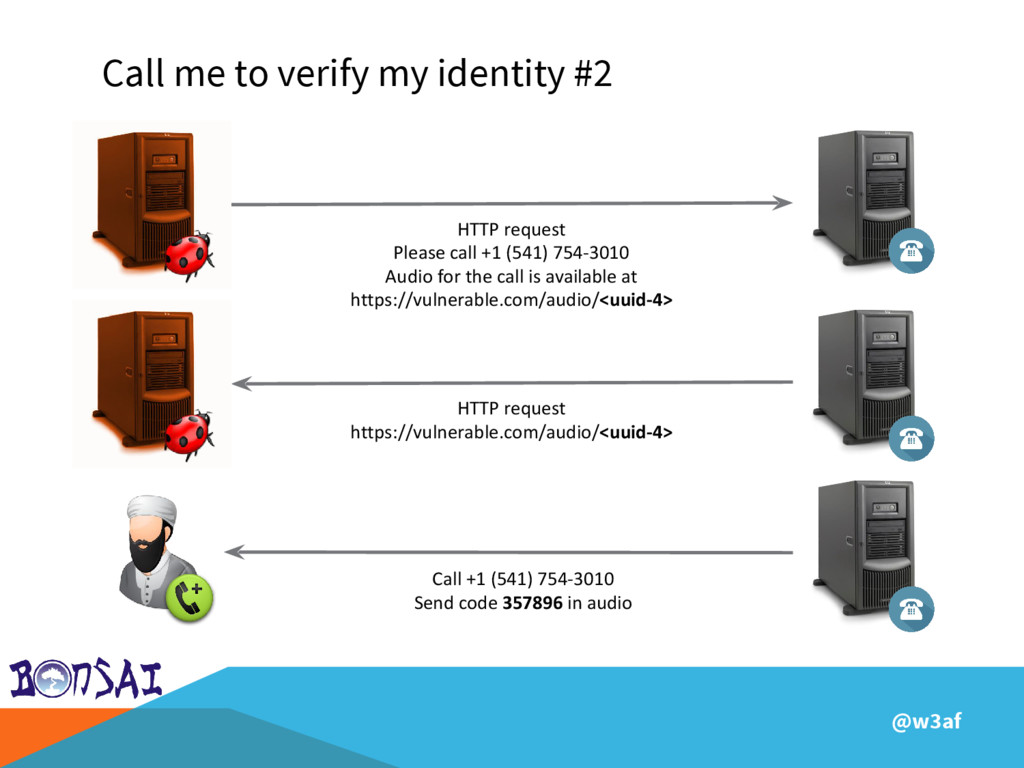
@w3af Call me to verify my identity #2 Call +1
(541) 754-3010 Send code 357896 in audio HTTP request Please call +1 (541) 754-3010 Audio for the call is available at https://vulnerable.com/audio/<uuid-4> HTTP request https://vulnerable.com/audio/<uuid-4> -
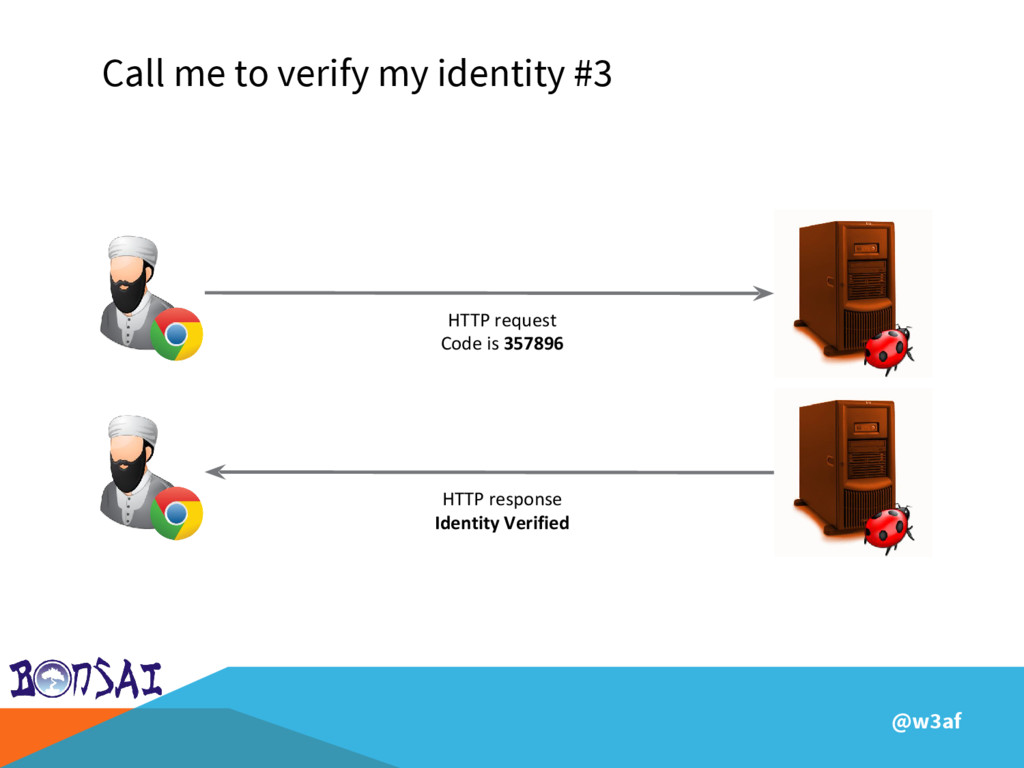
@w3af Call me to verify my identity #3 HTTP request
Code is 357896 HTTP response Identity Verified -
@w3af Bypass phone verification Hacker wants to bypass phone verification,
ideas: ◦ Hack user’s smartphone ◦ Hack vulnerable.com ◦ Create a raw cellphone tower and sniff phone call ◦ Hack Twilio Hacking vulnerable.com seems to be the easiest path to follow. But… what do we need? -
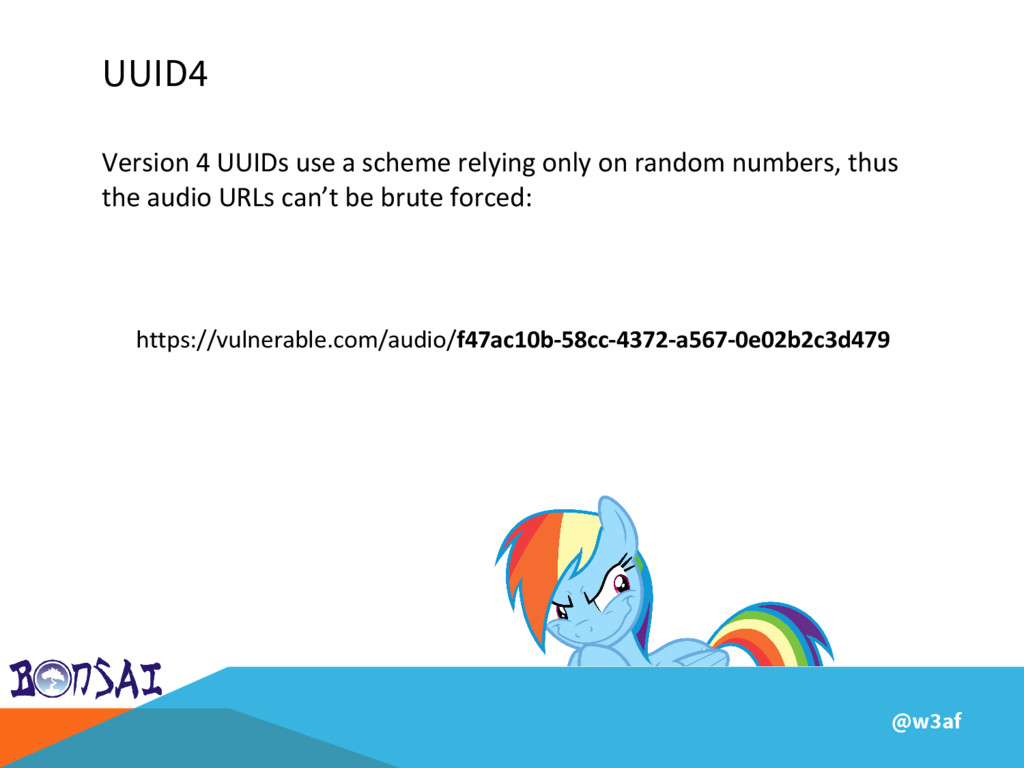
@w3af UUID4 Version 4 UUIDs use a scheme relying only
on random numbers, thus the audio URLs can’t be brute forced: https://vulnerable.com/audio/f47ac10b-58cc-4372-a567-0e02b2c3d479 -
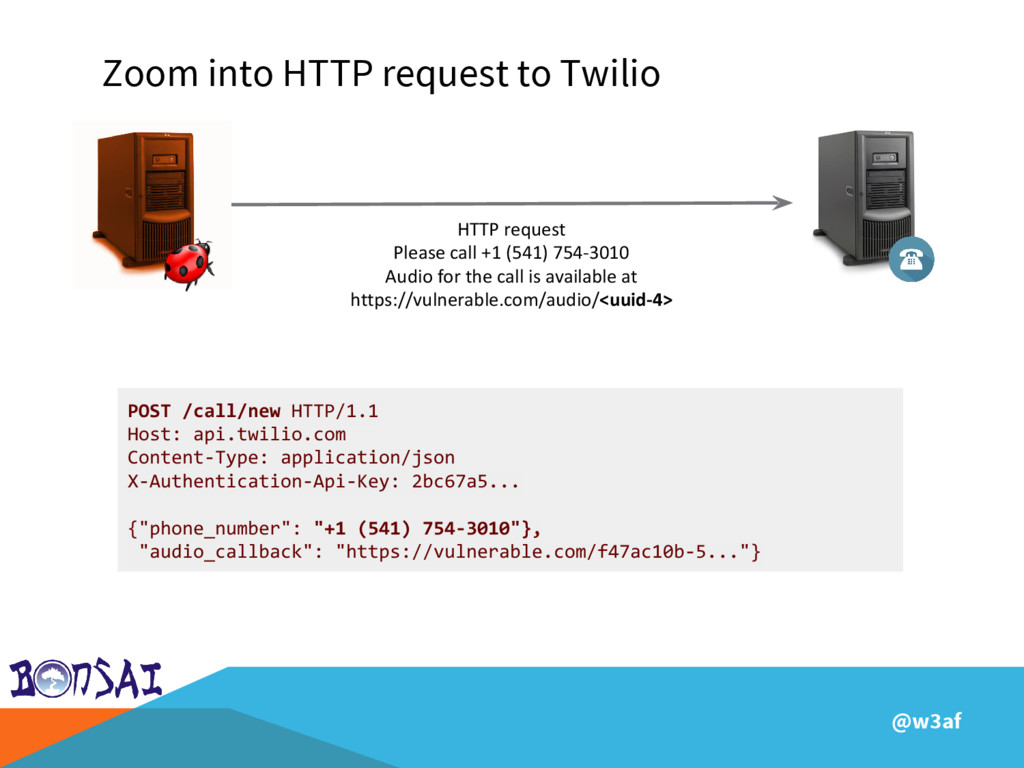
@w3af Zoom into HTTP request to Twilio HTTP request Please
call +1 (541) 754-3010 Audio for the call is available at https://vulnerable.com/audio/<uuid-4> POST /call/new HTTP/1.1 Host: api.twilio.com Content-Type: application/json X-Authentication-Api-Key: 2bc67a5... {"phone_number": "+1 (541) 754-3010"}, "audio_callback": "https://vulnerable.com/f47ac10b-5..."} -
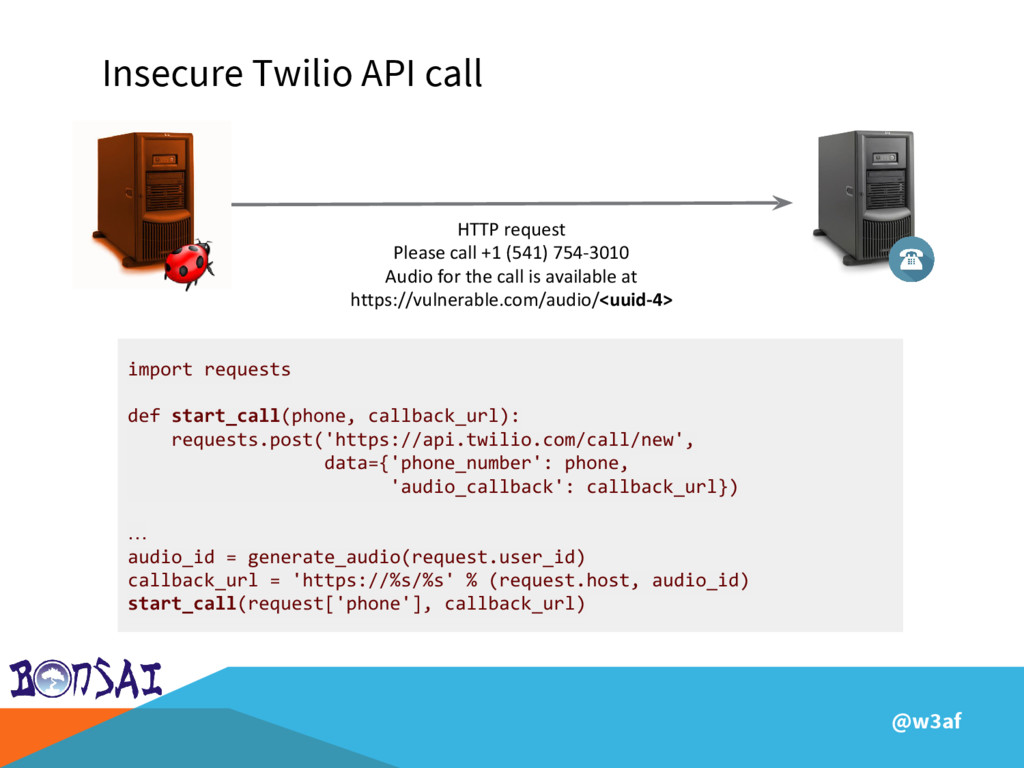
@w3af Insecure Twilio API call HTTP request Please call +1
(541) 754-3010 Audio for the call is available at https://vulnerable.com/audio/<uuid-4> import requests def start_call(phone, callback_url): requests.post('https://api.twilio.com/call/new', data={'phone_number': phone, 'audio_callback': callback_url}) … audio_id = generate_audio(request.user_id) callback_url = 'https://%s/%s' % (request.host, audio_id) start_call(request['phone'], callback_url) -
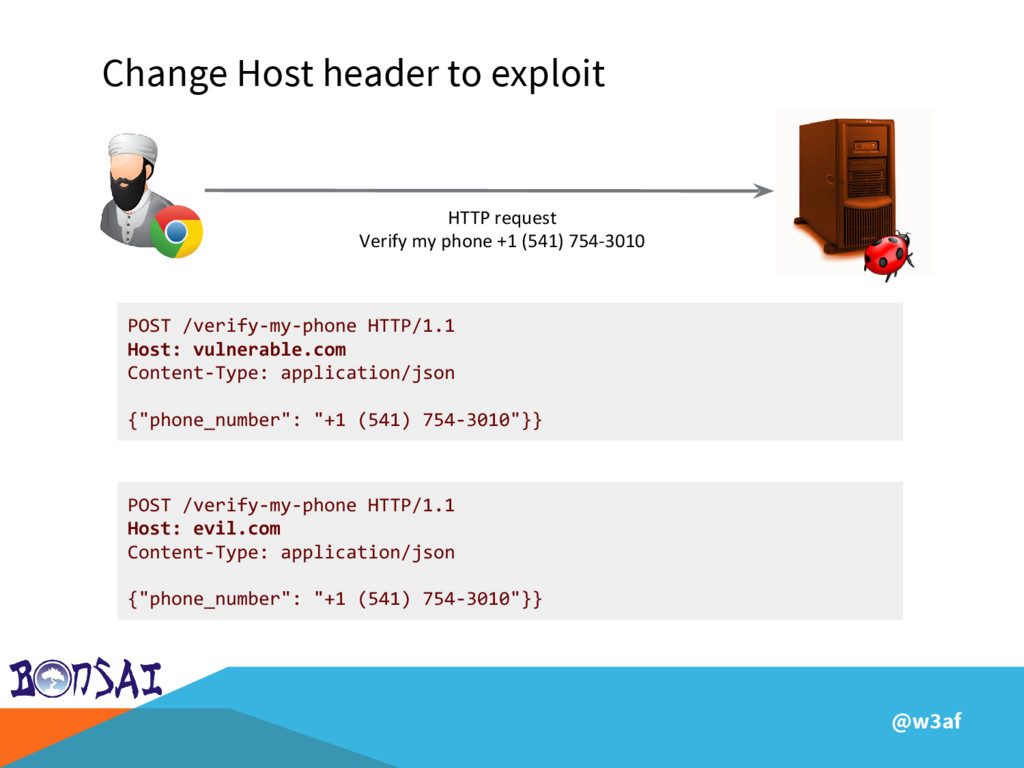
@w3af Change Host header to exploit HTTP request Verify my
phone +1 (541) 754-3010 POST /verify-my-phone HTTP/1.1 Host: vulnerable.com Content-Type: application/json {"phone_number": "+1 (541) 754-3010"}} POST /verify-my-phone HTTP/1.1 Host: evil.com Content-Type: application/json {"phone_number": "+1 (541) 754-3010"}} -
@w3af Exploit results in modified callback_url HTTP request Please call
+1 (541) 754-3010 Audio for the call is available at https://evil.com/audio/<uuid-4> HTTP request https://evil.com/audio/<uuid-4> HTTP request https://vulnerable.com/audio/<uuid-4> -
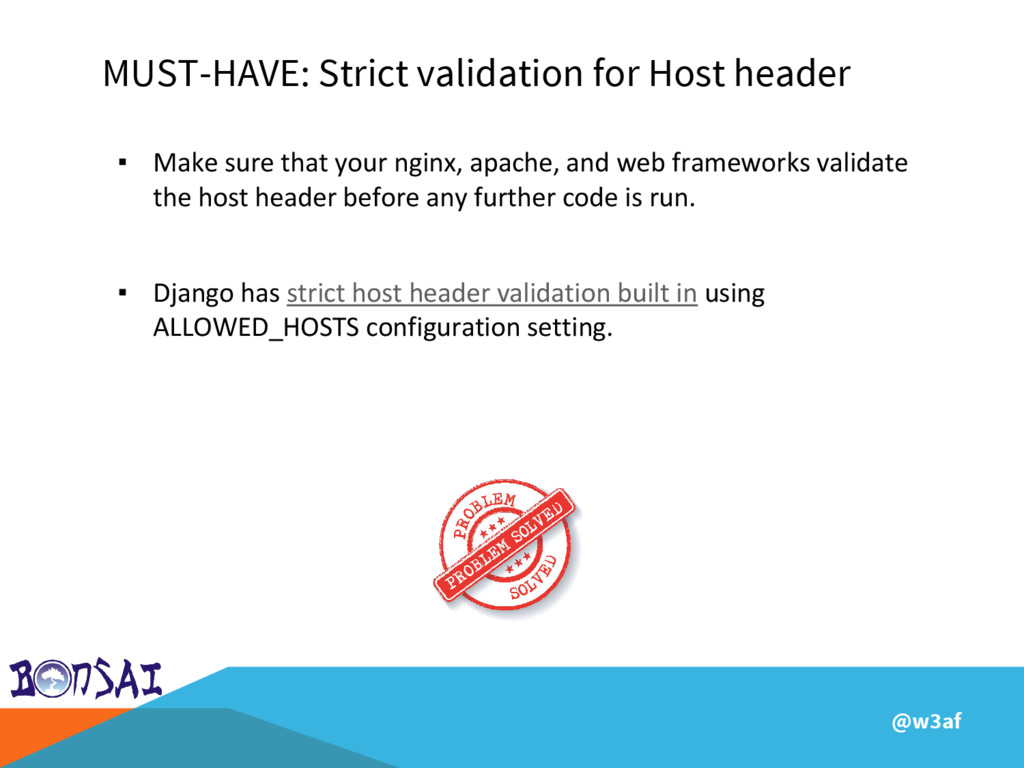
@w3af MUST-HAVE: Strict validation for Host header ▪ Make sure
that your nginx, apache, and web frameworks validate the host header before any further code is run. ▪ Django has strict host header validation built in using ALLOWED_HOSTS configuration setting. -
@w3af Password reset • Password resets are very sensitive and,
in some cases, insecure. The most wanted vulnerability is to be able to reset the password for a user for which we don’t have the password reset token. • Usually password resets are implemented as follows: ◦ User starts a new password reset flow ◦ An email is sent by the application containing a randomly generated token ◦ The token is used to prove that the user has access to the email address and the password is reset. -
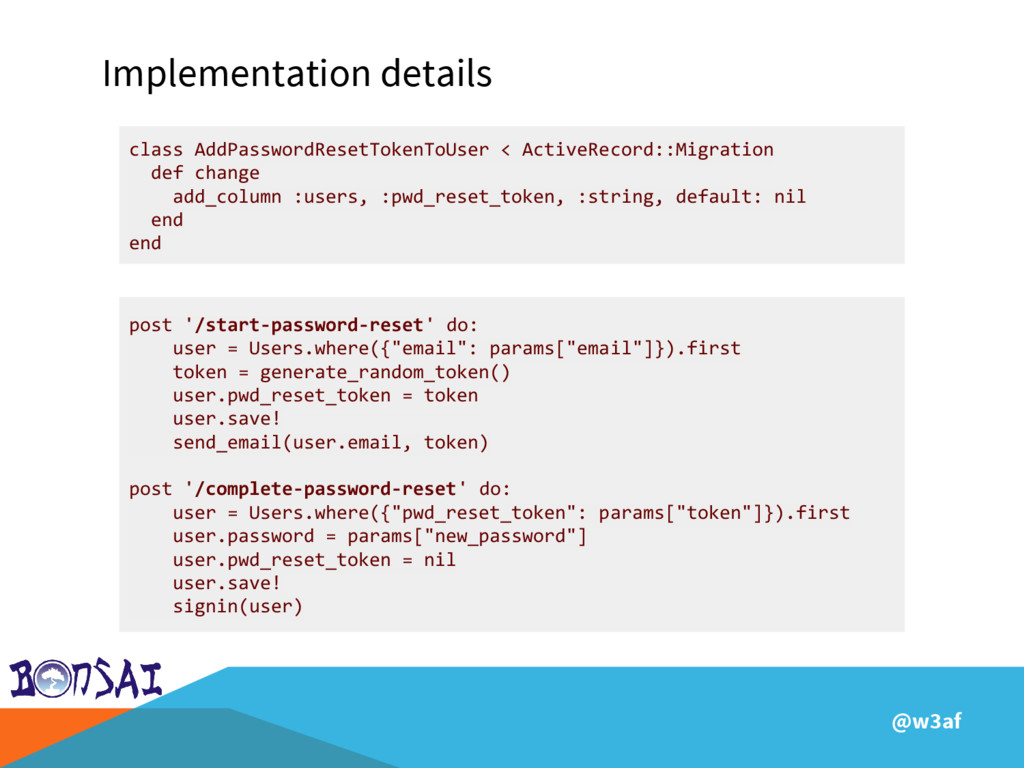
@w3af Implementation details class AddPasswordResetTokenToUser < ActiveRecord::Migration def change add_column
:users, :pwd_reset_token, :string, default: nil end end post '/start-password-reset' do: user = Users.where({"email": params["email"]}).first token = generate_random_token() user.pwd_reset_token = token user.save! send_email(user.email, token) post '/complete-password-reset' do: user = Users.where({"pwd_reset_token": params["token"]}).first user.password = params["new_password"] user.pwd_reset_token = nil user.save! signin(user) -
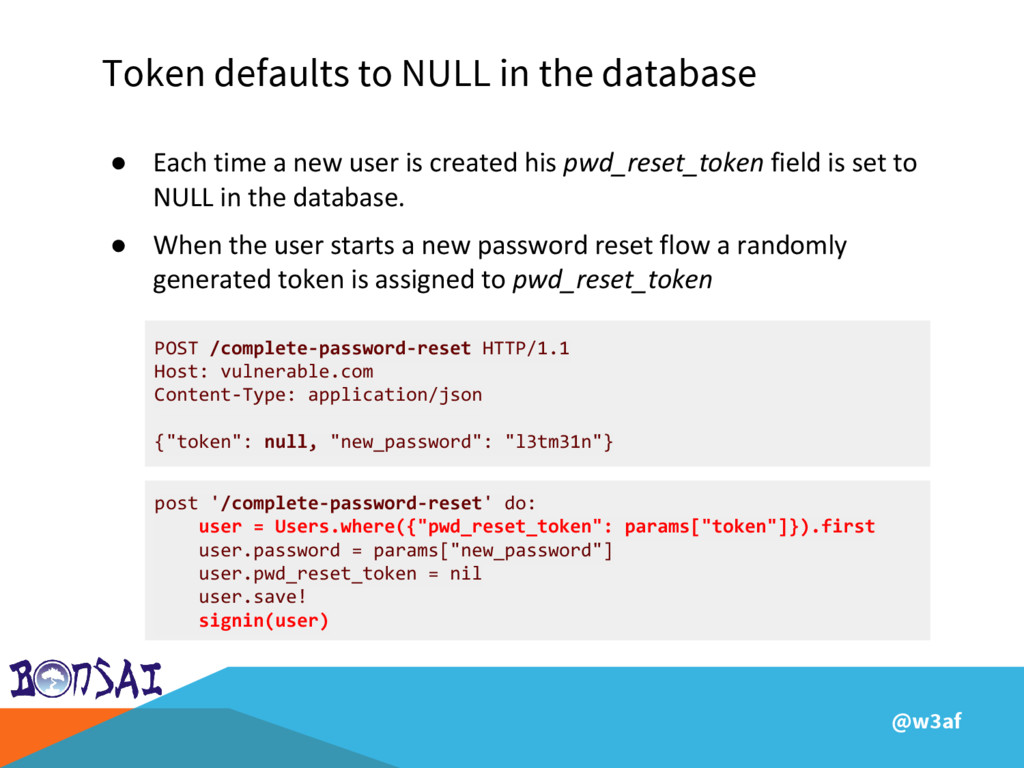
@w3af Token defaults to NULL in the database POST /complete-password-reset
HTTP/1.1 Host: vulnerable.com Content-Type: application/json {"token": null, "new_password": "l3tm31n"} • Each time a new user is created his pwd_reset_token field is set to NULL in the database. • When the user starts a new password reset flow a randomly generated token is assigned to pwd_reset_token post '/complete-password-reset' do: user = Users.where({"pwd_reset_token": params["token"]}).first user.password = params["new_password"] user.pwd_reset_token = nil user.save! signin(user) -
@w3af Safe defaults and strict type validation post '/complete-password-reset' do:
user = Users.where({"pwd_reset_token": params["token"].to_s}).first user.password = params["new_password"] user.pwd_reset_token = nil user.save! class AddPasswordResetTokenToUser < ActiveRecord::Migration def change add_column :users, :pwd_reset_token, :string, default: generate_random_token() end end -
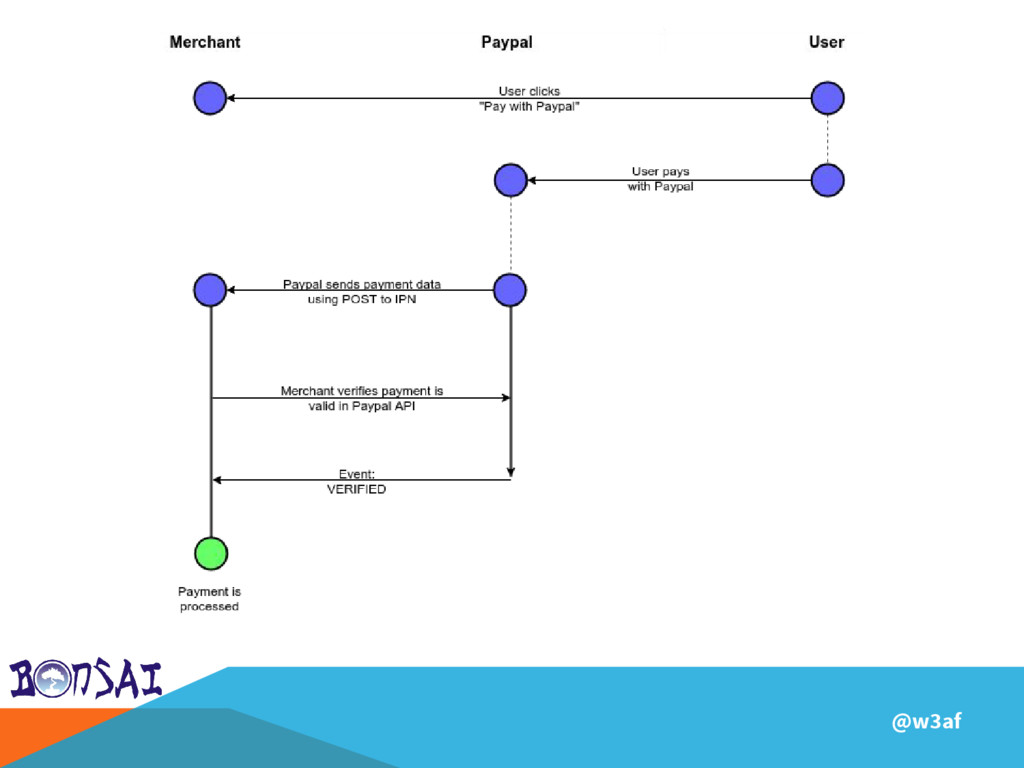
@w3af Paypal’s Instant Payment Notification • I love payment gateways!
See my previous talk on this subject. • Paypal uses IPN to notify a site that a new payment has been processed and further action, such as increasing the user funds in the application, should be performed. • The developer sets the IPN URL in the merchant account settings at Paypal: https://example.com/paypal-handler -
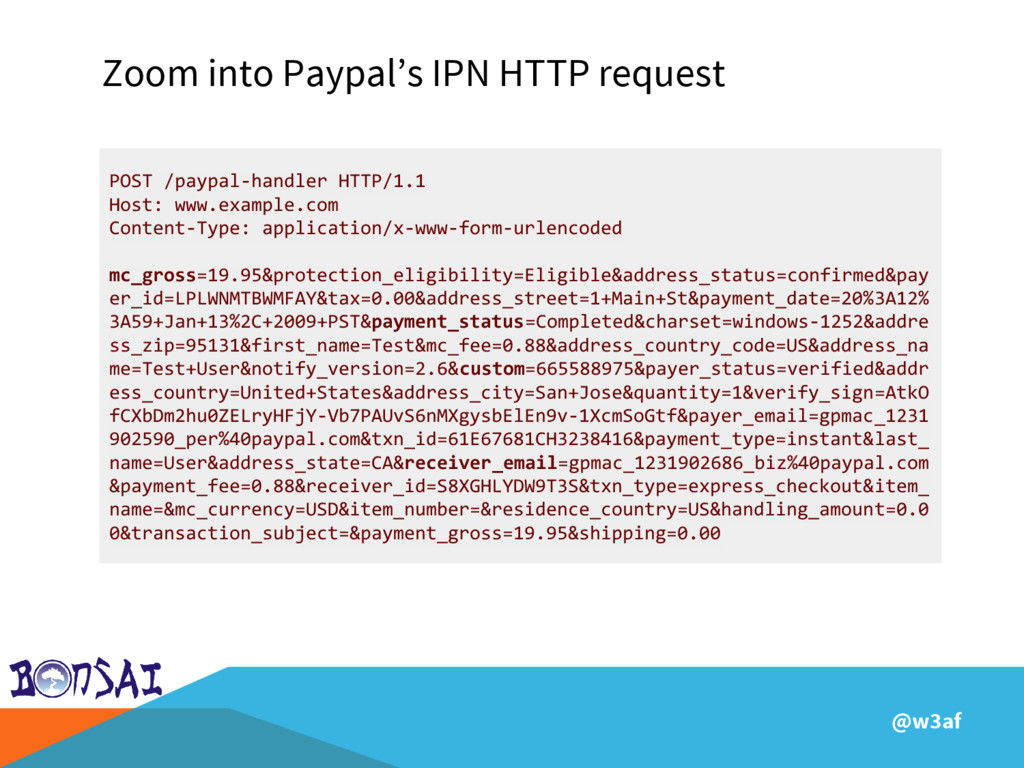
@w3af Zoom into Paypal’s IPN HTTP request POST /paypal-handler HTTP/1.1
Host: www.example.com Content-Type: application/x-www-form-urlencoded mc_gross=19.95&protection_eligibility=Eligible&address_status=confirmed&pay er_id=LPLWNMTBWMFAY&tax=0.00&address_street=1+Main+St&payment_date=20%3A12% 3A59+Jan+13%2C+2009+PST&payment_status=Completed&charset=windows-1252&addre ss_zip=95131&first_name=Test&mc_fee=0.88&address_country_code=US&address_na me=Test+User¬ify_version=2.6&custom=665588975&payer_status=verified&addr ess_country=United+States&address_city=San+Jose&quantity=1&verify_sign=AtkO fCXbDm2hu0ZELryHFjY-Vb7PAUvS6nMXgysbElEn9v-1XcmSoGtf&payer_email=gpmac_1231 902590_per%40paypal.com&txn_id=61E67681CH3238416&payment_type=instant&last_ name=User&address_state=CA&receiver_email=gpmac_1231902686_biz%40paypal.com &payment_fee=0.88&receiver_id=S8XGHLYDW9T3S&txn_type=express_checkout&item_ name=&mc_currency=USD&item_number=&residence_country=US&handling_amount=0.0 0&transaction_subject=&payment_gross=19.95&shipping=0.00 -
@w3af Zoom into Paypal’s IPN HTTP request There are a
few important parameters that we need to understand: • mc_gross=19.95 is the amount paid by the user • payment_status=Completed is the payment status • receiver_email=gpmac_1231902686_biz%40paypal.com is the merchant’s email address • custom=665588975 is the user’s ID at the merchant application, which is sent to Paypal when the user clicks the “Pay with Paypal” button in the merchant’s site -
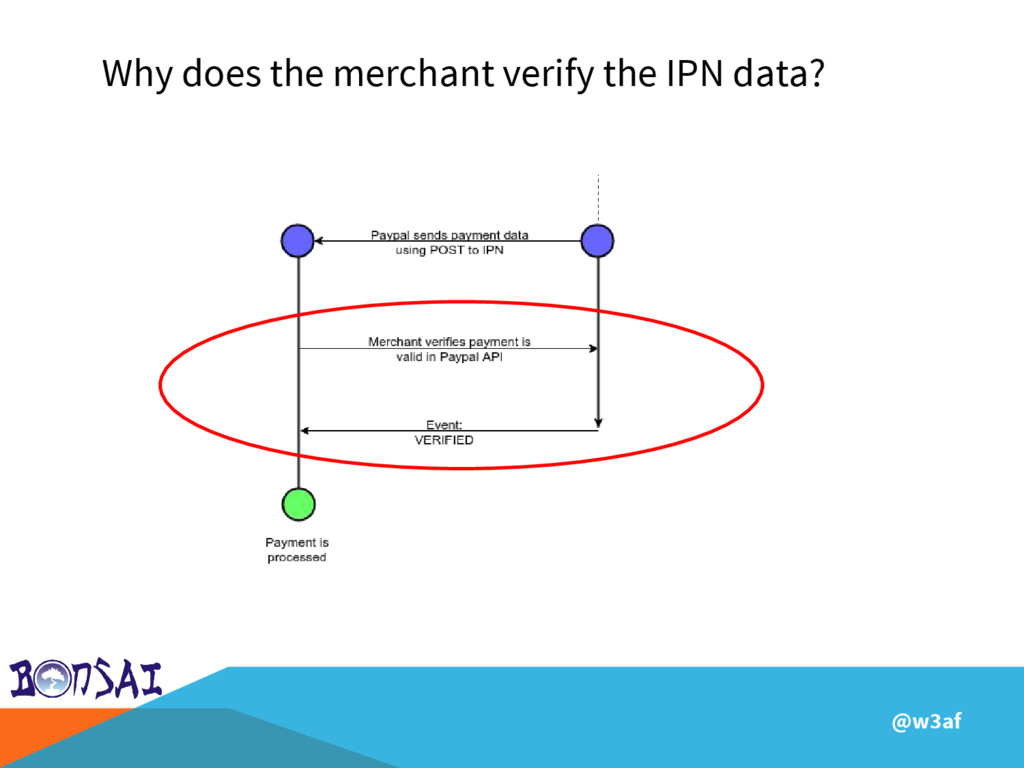
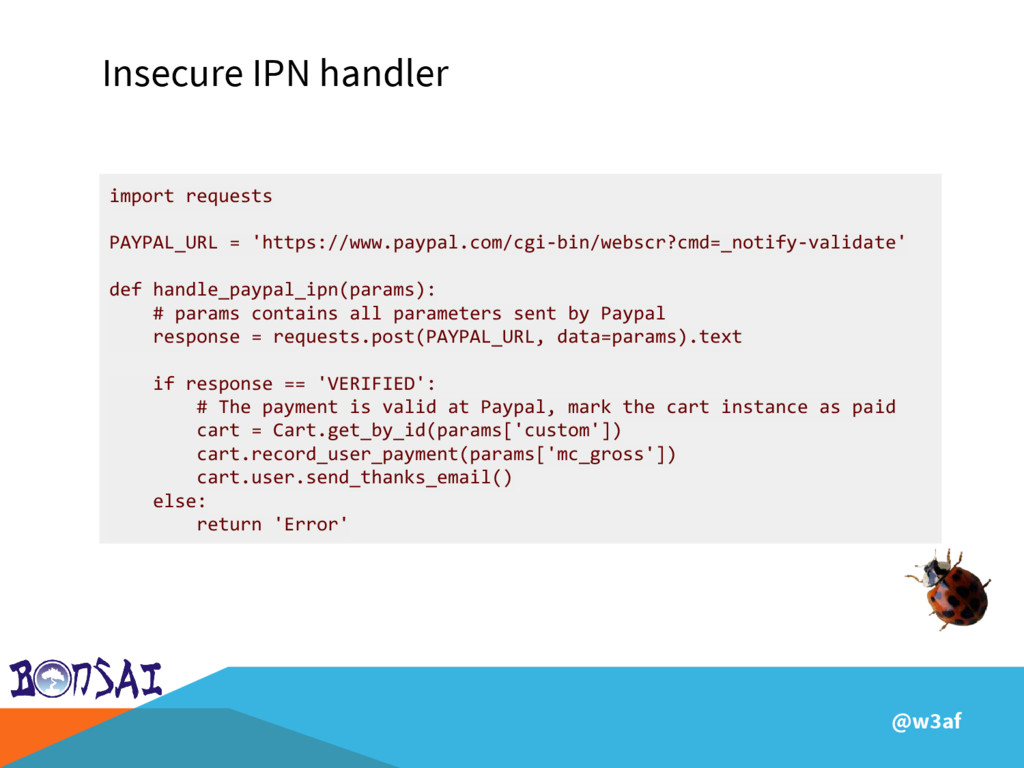
@w3af Insecure IPN handler import requests PAYPAL_URL = 'https://www.paypal.com/cgi-bin/webscr?cmd=_notify-validate' def
handle_paypal_ipn(params): # params contains all parameters sent by Paypal response = requests.post(PAYPAL_URL, data=params).text if response == 'VERIFIED': # The payment is valid at Paypal, mark the cart instance as paid cart = Cart.get_by_id(params['custom']) cart.record_user_payment(params['mc_gross']) cart.user.send_thanks_email() else: return 'Error' -
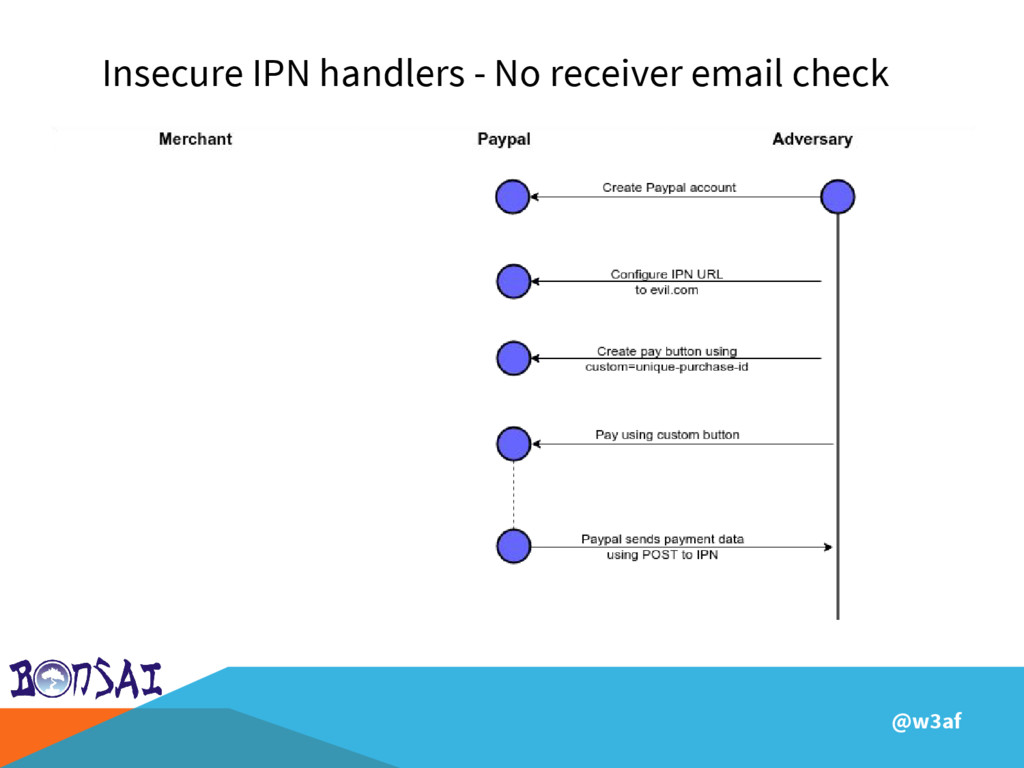
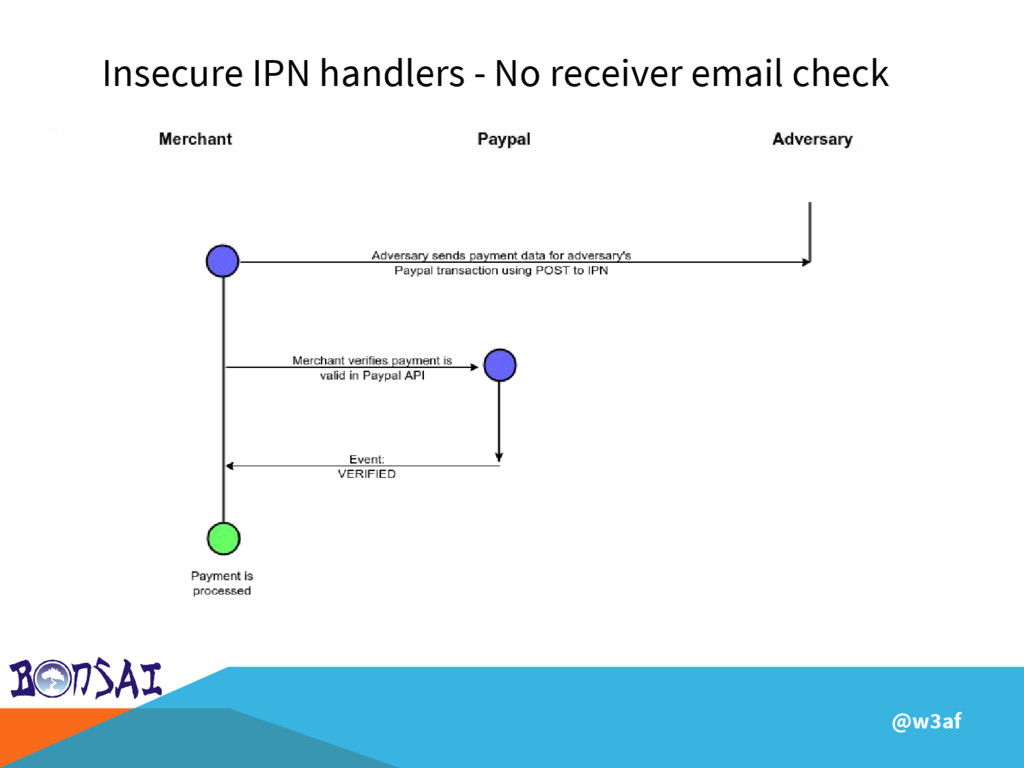
@w3af • Attacker needs to perform a special Paypal payment
using a target specific custom_id parameter which will associate the spoofed payment with his account. • The payment is made from the attacker’s credit card to his paypal account. Money is still under his control, but the attacker will lose Paypal’s commission for each transaction. • Many example IPN implementations in github.com are vulnerable. I wonder how many were used to create applications which are currently live in production? -
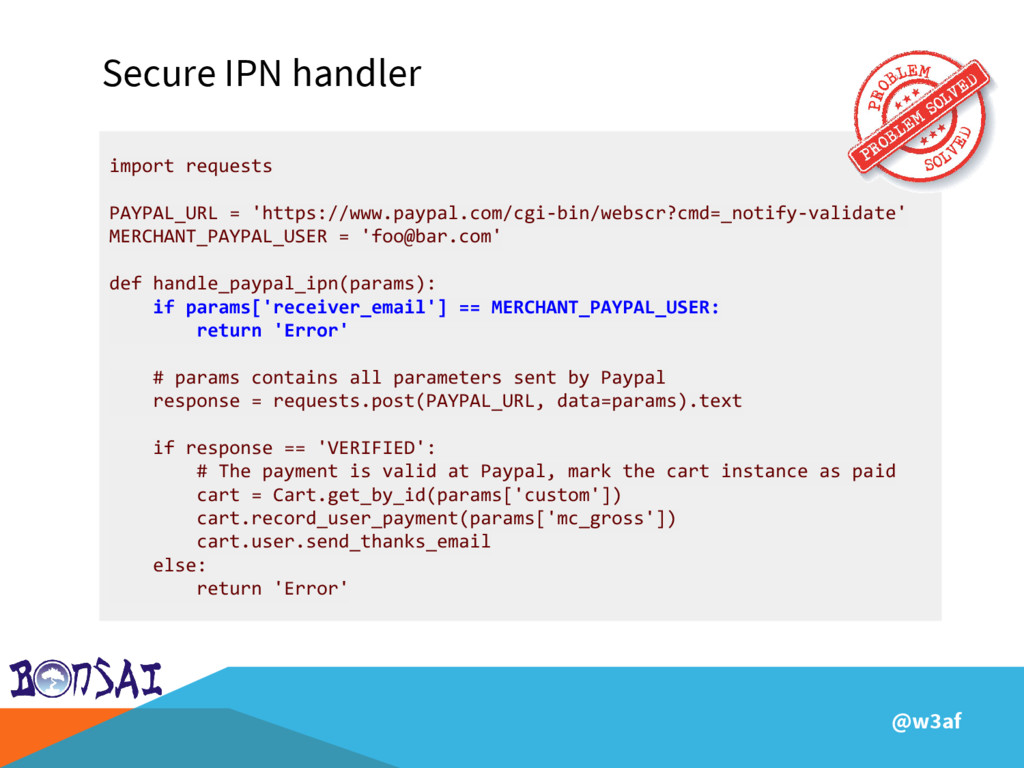
@w3af Secure IPN handler import requests PAYPAL_URL = 'https://www.paypal.com/cgi-bin/webscr?cmd=_notify-validate' MERCHANT_PAYPAL_USER
= '[email protected]' def handle_paypal_ipn(params): if params['receiver_email'] == MERCHANT_PAYPAL_USER: return 'Error' # params contains all parameters sent by Paypal response = requests.post(PAYPAL_URL, data=params).text if response == 'VERIFIED': # The payment is valid at Paypal, mark the cart instance as paid cart = Cart.get_by_id(params['custom']) cart.record_user_payment(params['mc_gross']) cart.user.send_thanks_email else: return 'Error' -
@w3af Is this Paypal’s fault? • No, but it’s design
is not as secure as it could be. • MercadoPago implemented a different communication protocol for their IPN. Their protocol is much better than Paypal’s since it doesn’t rely on the developer’s IPN handler implementation to provide security. MercadoPago sends a GET request with the purchase ID to the IPN URL, then the developer needs to perform a GET request to https://api.mercadopago.com/ in order to retrieve the transaction details. This request is authenticated, and any attempts to access transactions from other merchants is denied. -
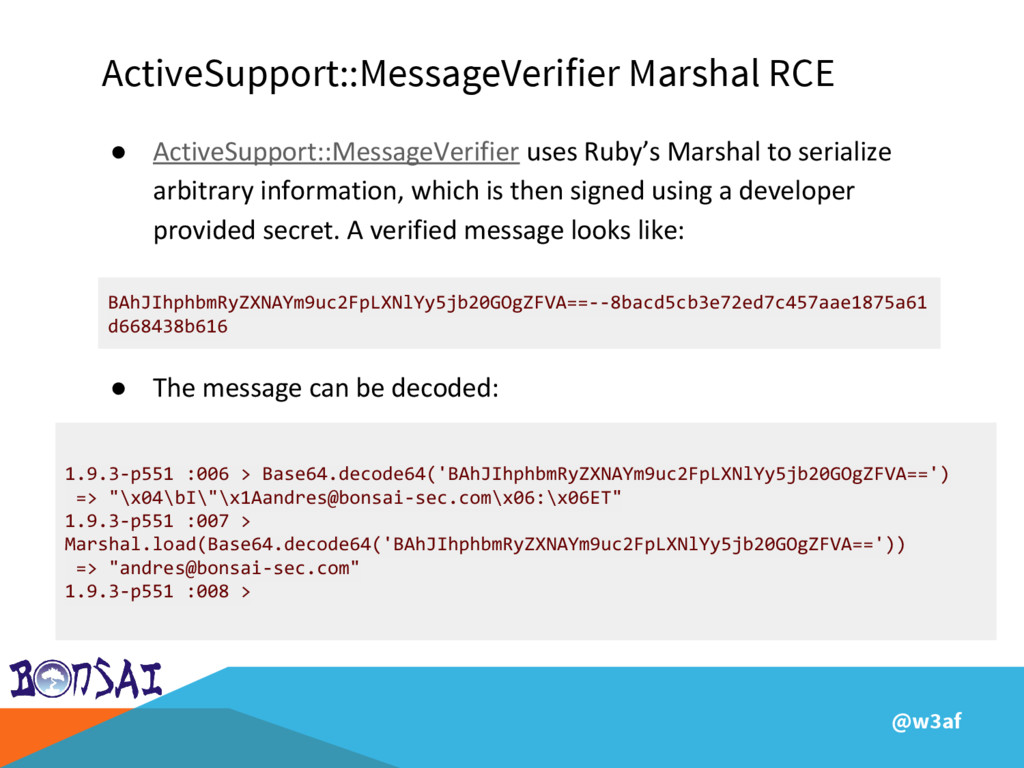
@w3af ActiveSupport::MessageVerifier Marshal RCE • ActiveSupport::MessageVerifier uses Ruby’s Marshal to
serialize arbitrary information, which is then signed using a developer provided secret. A verified message looks like: • The message can be decoded: BAhJIhphbmRyZXNAYm9uc2FpLXNlYy5jb20GOgZFVA==--8bacd5cb3e72ed7c457aae1875a61 d668438b616 1.9.3-p551 :006 > Base64.decode64('BAhJIhphbmRyZXNAYm9uc2FpLXNlYy5jb20GOgZFVA==') => "\x04\bI\"\[email protected]\x06:\x06ET" 1.9.3-p551 :007 > Marshal.load(Base64.decode64('BAhJIhphbmRyZXNAYm9uc2FpLXNlYy5jb20GOgZFVA==')) => "[email protected]" 1.9.3-p551 :008 > -
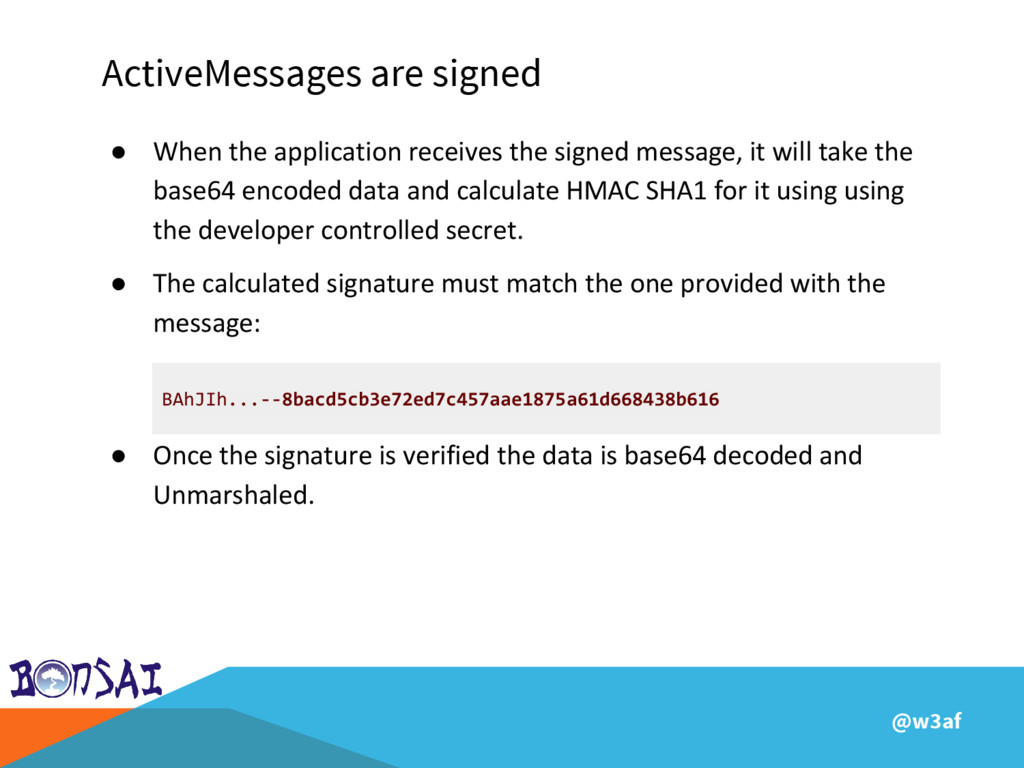
@w3af ActiveMessages are signed • When the application receives the
signed message, it will take the base64 encoded data and calculate HMAC SHA1 for it using using the developer controlled secret. • The calculated signature must match the one provided with the message: • Once the signature is verified the data is base64 decoded and Unmarshaled. BAhJIh...--8bacd5cb3e72ed7c457aae1875a61d668438b616 -
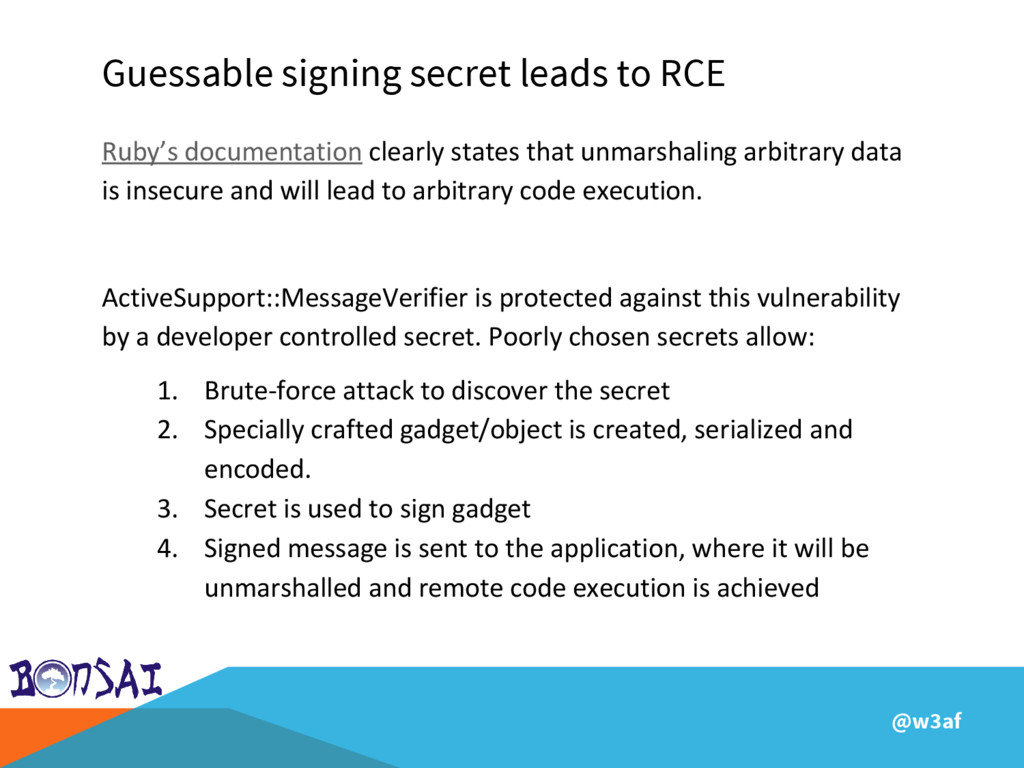
@w3af Guessable signing secret leads to RCE Ruby’s documentation clearly
states that unmarshaling arbitrary data is insecure and will lead to arbitrary code execution. ActiveSupport::MessageVerifier is protected against this vulnerability by a developer controlled secret. Poorly chosen secrets allow: 1. Brute-force attack to discover the secret 2. Specially crafted gadget/object is created, serialized and encoded. 3. Secret is used to sign gadget 4. Signed message is sent to the application, where it will be unmarshalled and remote code execution is achieved -
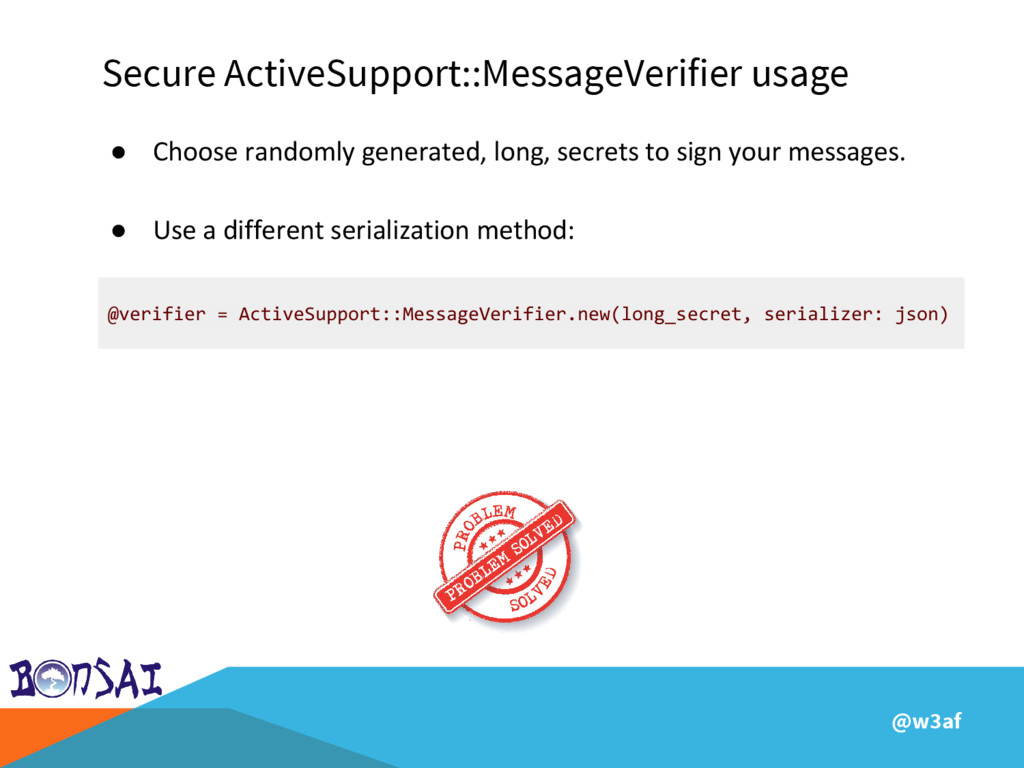
@w3af Secure ActiveSupport::MessageVerifier usage • Choose randomly generated, long, secrets
to sign your messages. • Use a different serialization method: @verifier = ActiveSupport::MessageVerifier.new(long_secret, serializer: json) -
@w3af Vulnerabilities are always there • You’re smarter than your
tools. Let the automation do the grunt work and focus your time on source code review, application logic flaws, issues specific to the target application, etc. • You’re smarter than your client. Convince them that with the source code you’ll be able to identify more vulnerabilities and provide greater ROI. • You’re smarter (well, actually more trained in security, vulnerabilities and risks) than most developers. They will make mistakes, no matter how good they are.
 andresriancho
 veronikapj
 shibuiwilliam
 yyh_gl
 naruogram
 miccheng
 t0yohei
 manfredsteyer
 omatty198
 yuuu
 kazuki1023
 ternbusty
 inariku
 akosma
 caitiem20
 baasie
 oripsolob
 gurzu
 eileencodes
 aleyda
 dugsong
 csswizardry
 ipullrank
 holman
 keithpitt