Share
Embed
apidays New York 2023 - Embedded Payments in B2B and B2C use cases, Adrita Bhor, Paypal
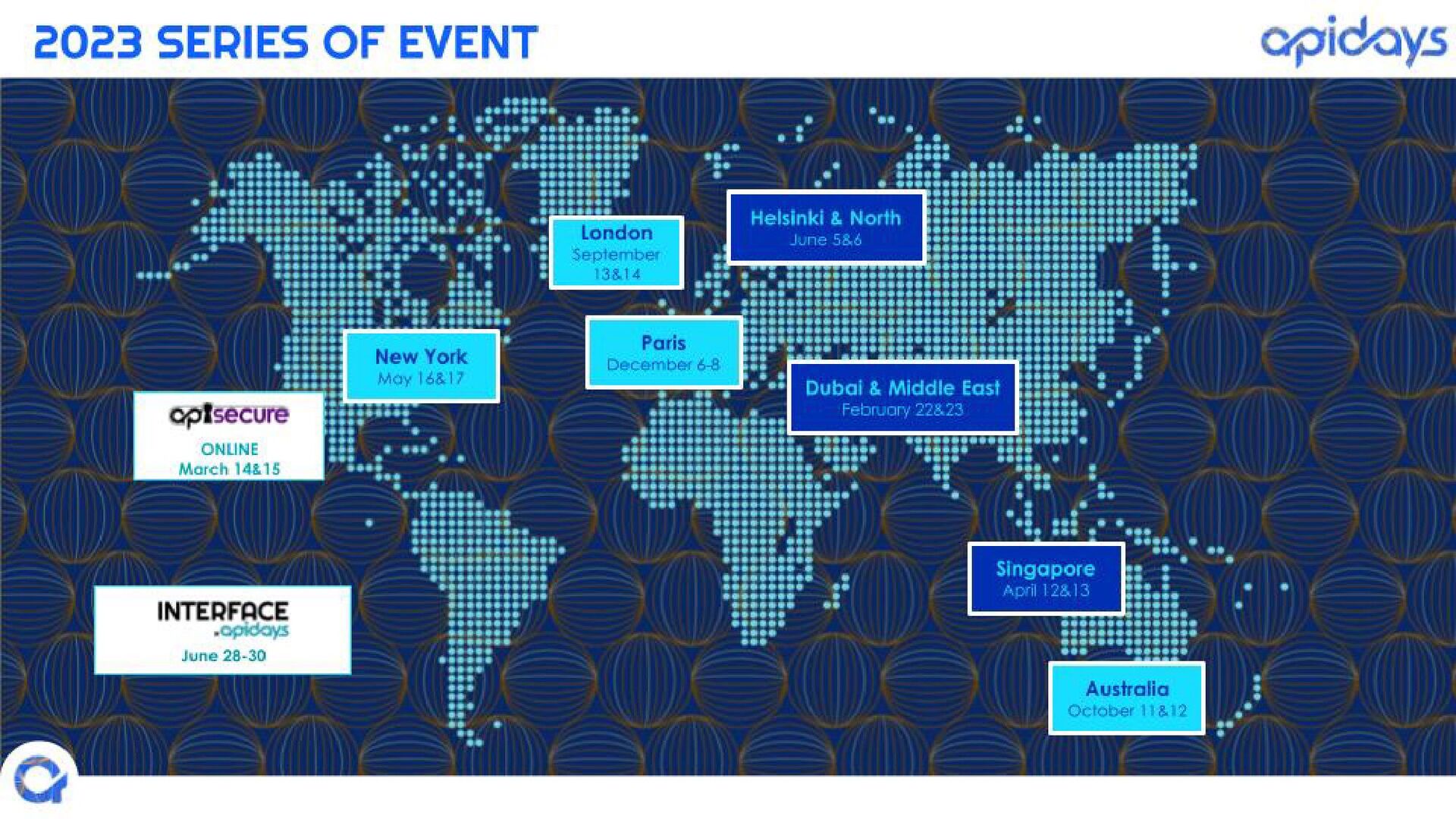
apidays New York 2023
APIs for Embedded Business Models: Finance, Healthcare, Retail, and Media
May 16 & 17, 2023
Embedded Payments in B2B and B2C use cases
Adrita Bhor, Senior Director of Product Management, Paypal
------
Check out our conferences at https://www.apidays.global/
Do you want to sponsor or talk at one of our conferences?
https://apidays.typeform.com/to/ILJeAaV8
Learn more on APIscene, the global media made by the community for the community:
https://www.apiscene.io
Explore the API ecosystem with the API Landscape:
https://apilandscape.apiscene.io/
FOST, powered by apidays PRO
June 29, 2023
Transcript
17 slides
-
EMBEDDED PAYMENTS Use cases in B2B and B2C fintech ADRITA
BHOR, SR. DIRECTOR OF PRODUCT, EX- PAYPAL -
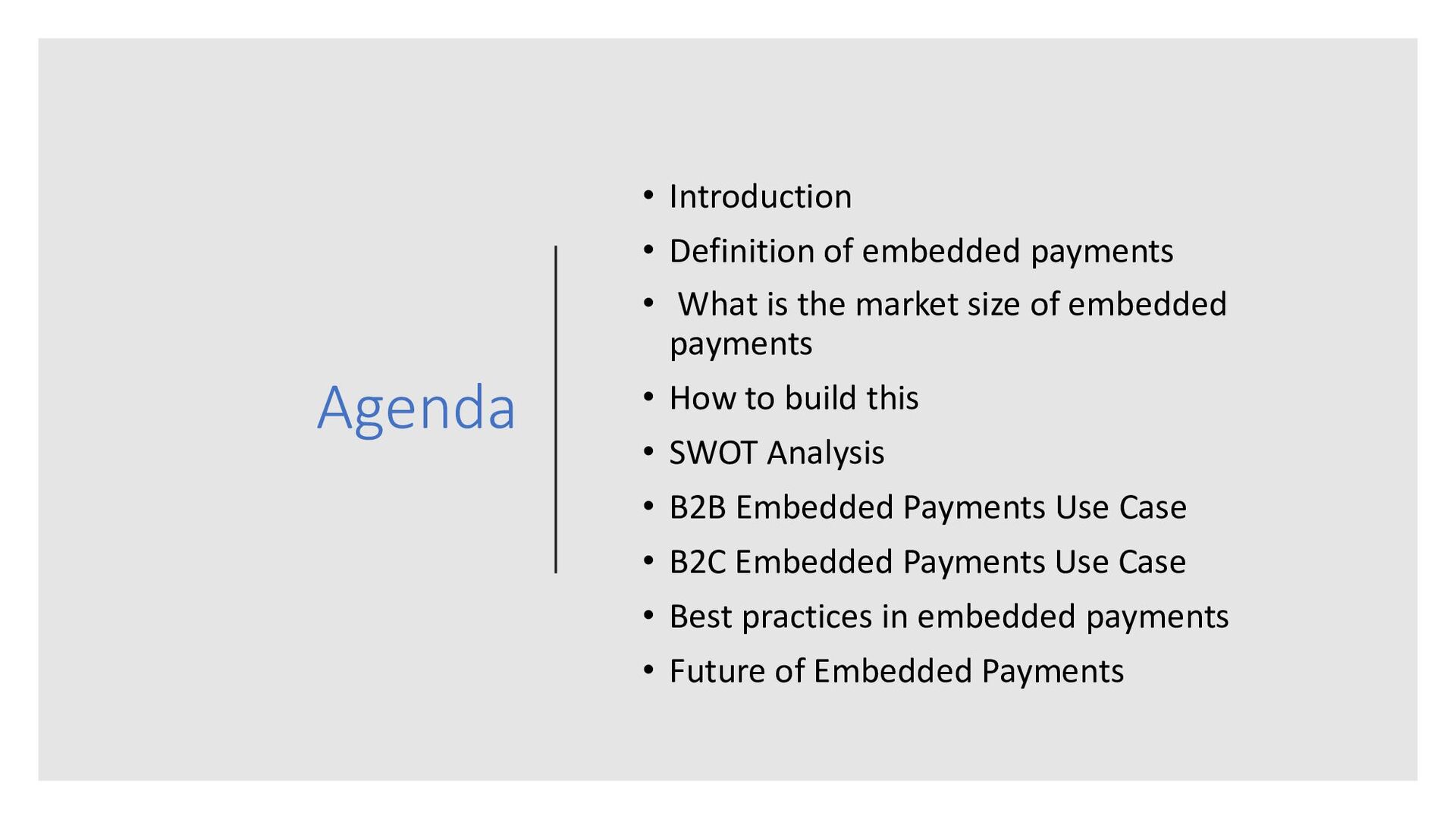
Agenda • Introduction • Definition of embedded payments • What
is the market size of embedded payments • How to build this • SWOT Analysis • B2B Embedded Payments Use Case • B2C Embedded Payments Use Case • Best practices in embedded payments • Future of Embedded Payments -
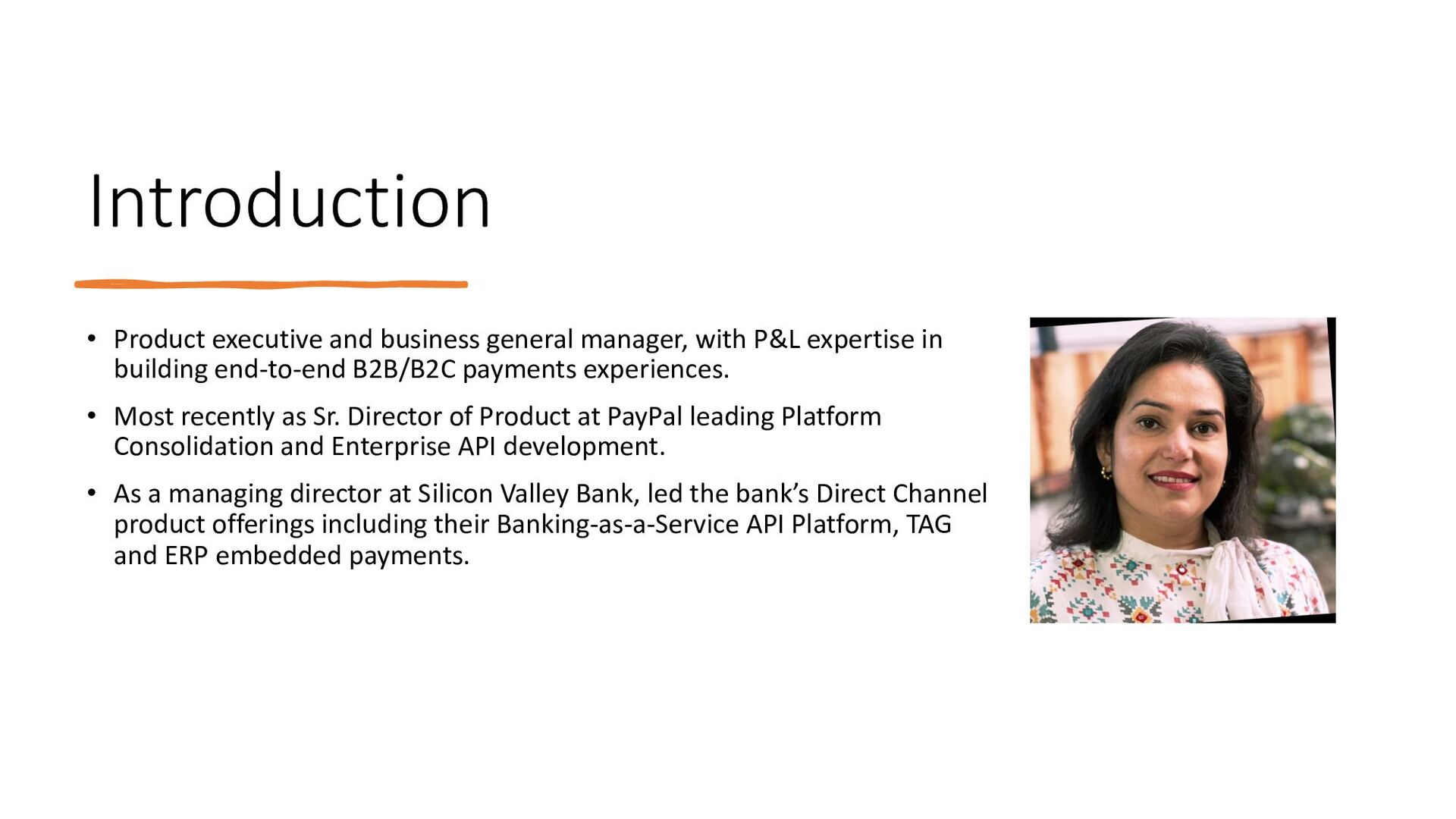
Introduction • Product executive and business general manager, with P&L
expertise in building end-to-end B2B/B2C payments experiences. • Most recently as Sr. Director of Product at PayPal leading Platform Consolidation and Enterprise API development. • As a managing director at Silicon Valley Bank, led the bank’s Direct Channel product offerings including their Banking-as-a-Service API Platform, TAG and ERP embedded payments. -
What are embedded payments and finance? Embedded payments refer to
the integration of payment processing directly into another platform or application. This integration can provide a seamless payment experience for users while also reducing the complexity of payment processing for the business. -
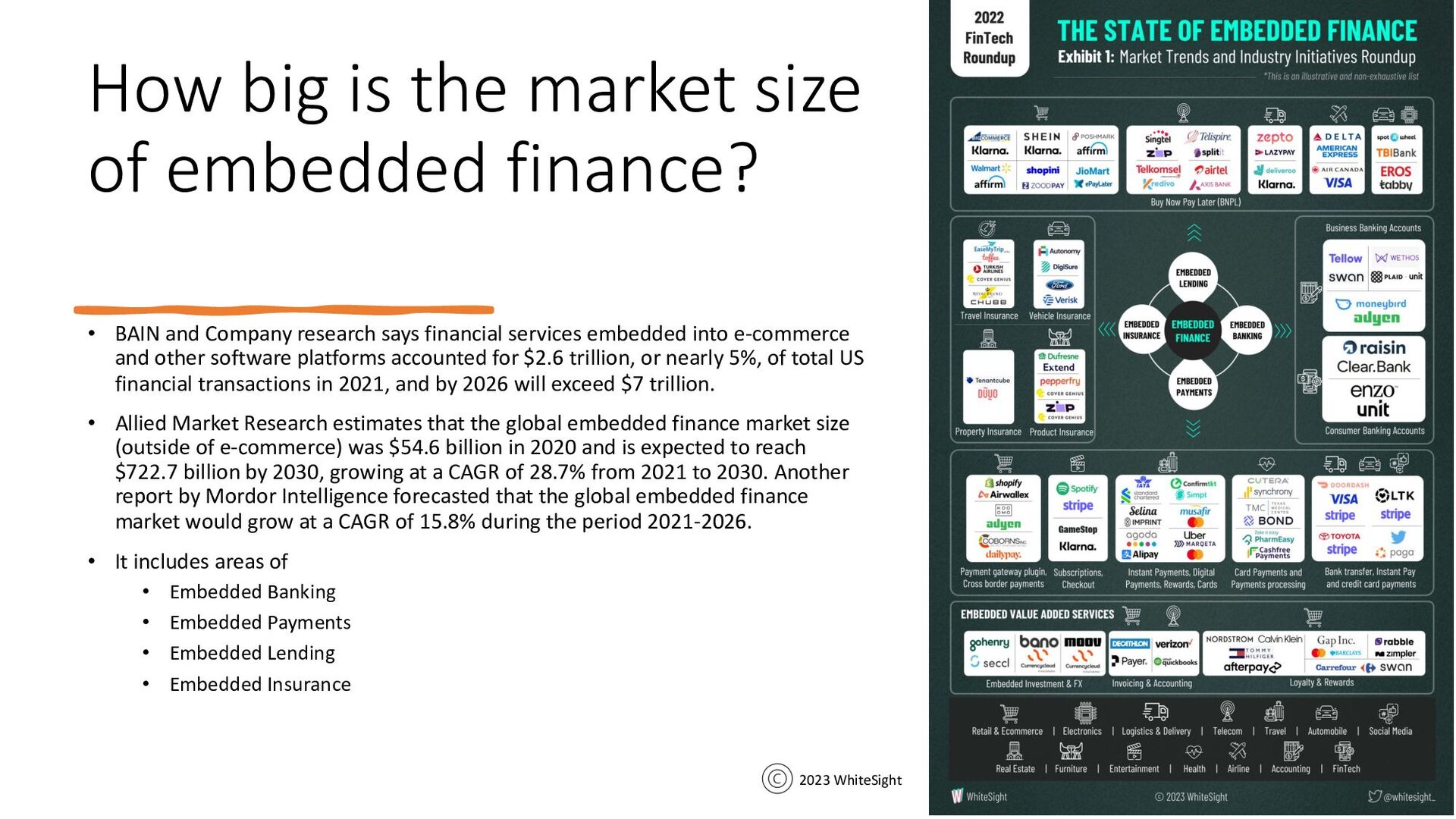
How big is the market size of embedded finance? •
BAIN and Company research says financial services embedded into e-commerce and other software platforms accounted for $2.6 trillion, or nearly 5%, of total US financial transactions in 2021, and by 2026 will exceed $7 trillion. • Allied Market Research estimates that the global embedded finance market size (outside of e-commerce) was $54.6 billion in 2020 and is expected to reach $722.7 billion by 2030, growing at a CAGR of 28.7% from 2021 to 2030. Another report by Mordor Intelligence forecasted that the global embedded finance market would grow at a CAGR of 15.8% during the period 2021-2026. • It includes areas of • Embedded Banking • Embedded Payments • Embedded Lending • Embedded Insurance 2023 WhiteSight -
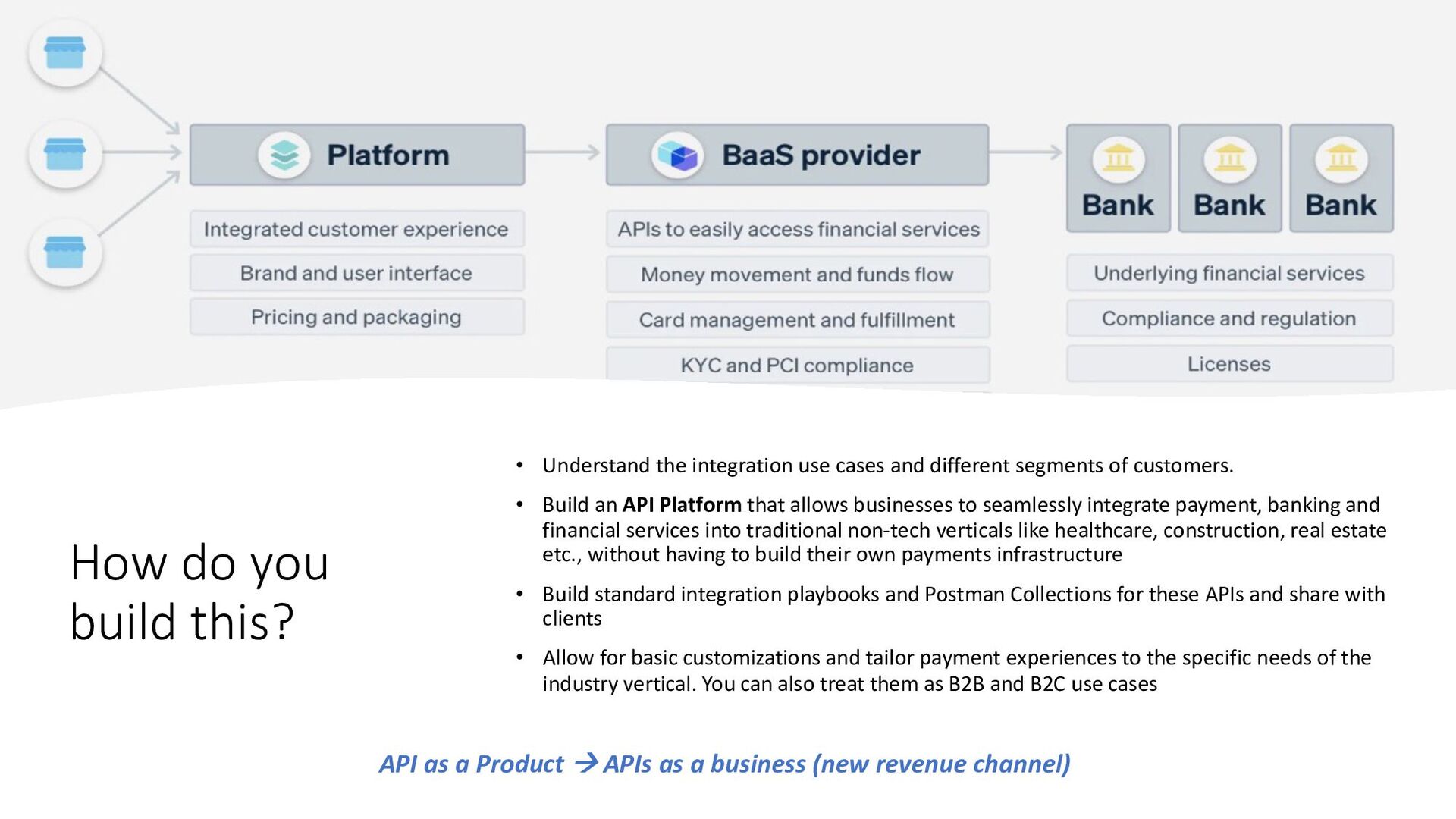
How do you build this? • Understand the integration use
cases and different segments of customers. • Build an API Platform that allows businesses to seamlessly integrate payment, banking and financial services into traditional non-tech verticals like healthcare, construction, real estate etc., without having to build their own payments infrastructure • Build standard integration playbooks and Postman Collections for these APIs and share with clients • Allow for basic customizations and tailor payment experiences to the specific needs of the industry vertical. You can also treat them as B2B and B2C use cases API as a Product à APIs as a business (new revenue channel) -
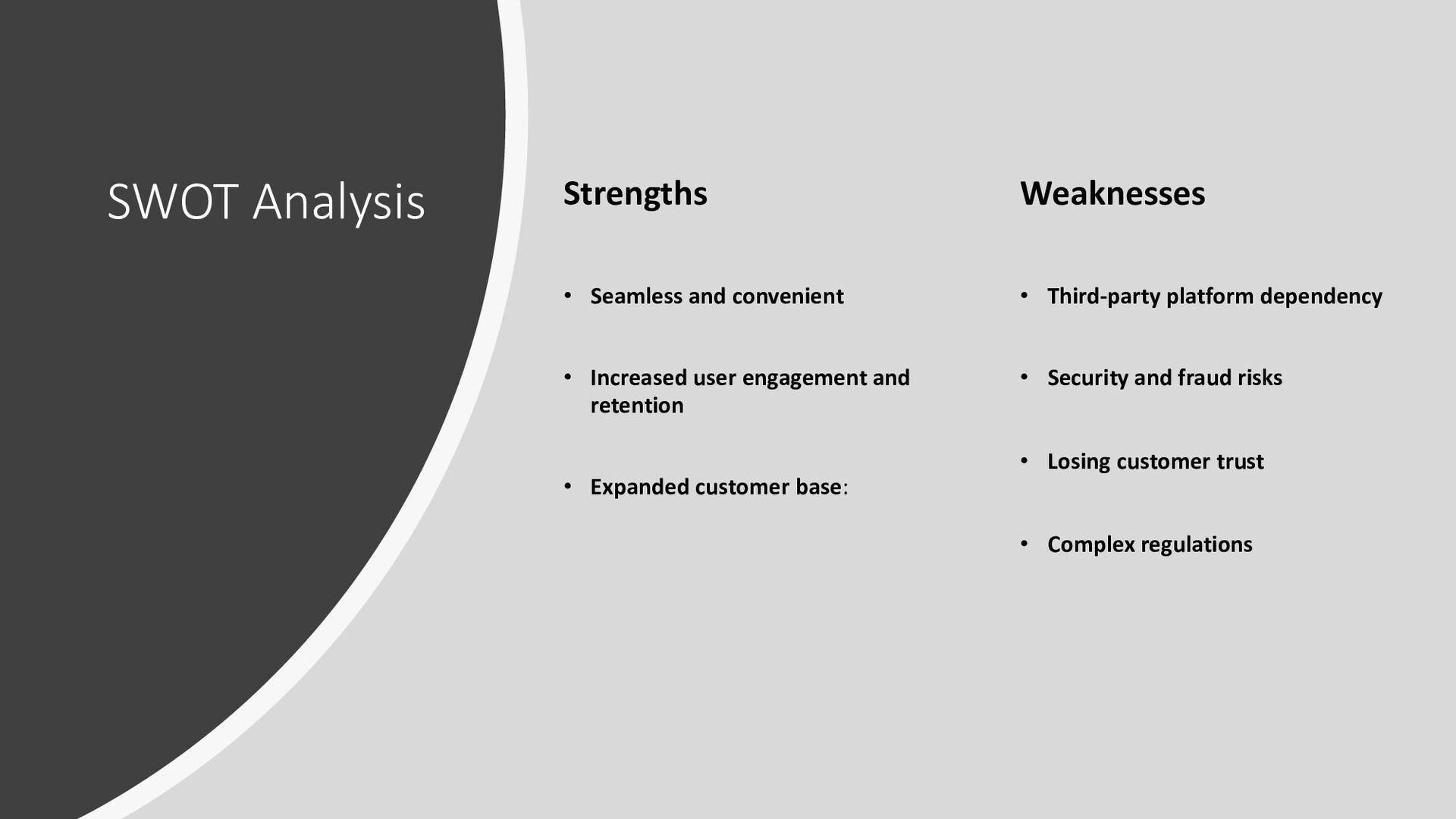
SWOT Analysis Strengths • Seamless and convenient • Increased user
engagement and retention • Expanded customer base: Weaknesses • Third-party platform dependency • Security and fraud risks • Losing customer trust • Complex regulations -
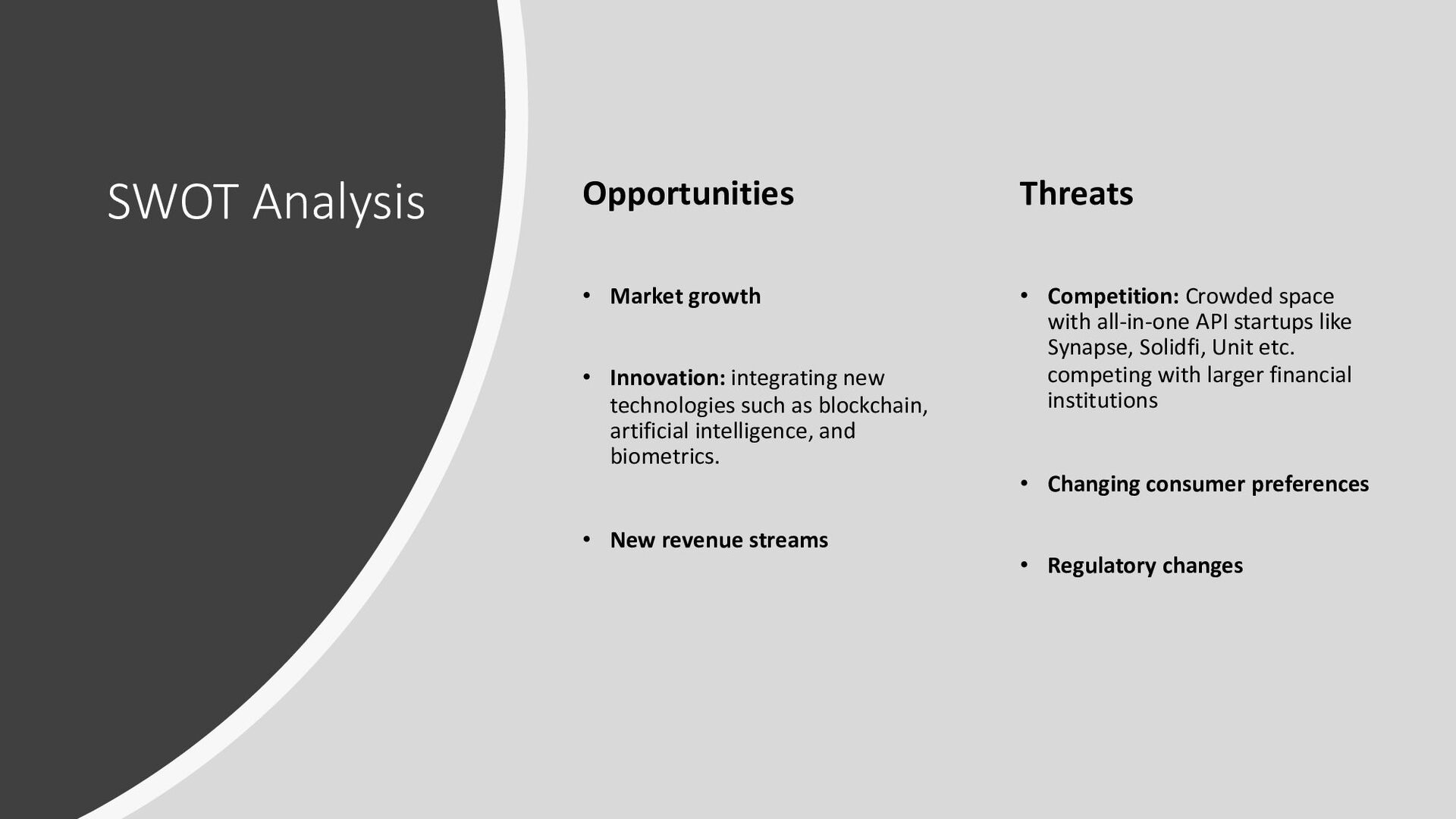
SWOT Analysis Opportunities • Market growth • Innovation: integrating new
technologies such as blockchain, artificial intelligence, and biometrics. • New revenue streams Threats • Competition: Crowded space with all-in-one API startups like Synapse, Solidfi, Unit etc. competing with larger financial institutions • Changing consumer preferences • Regulatory changes -
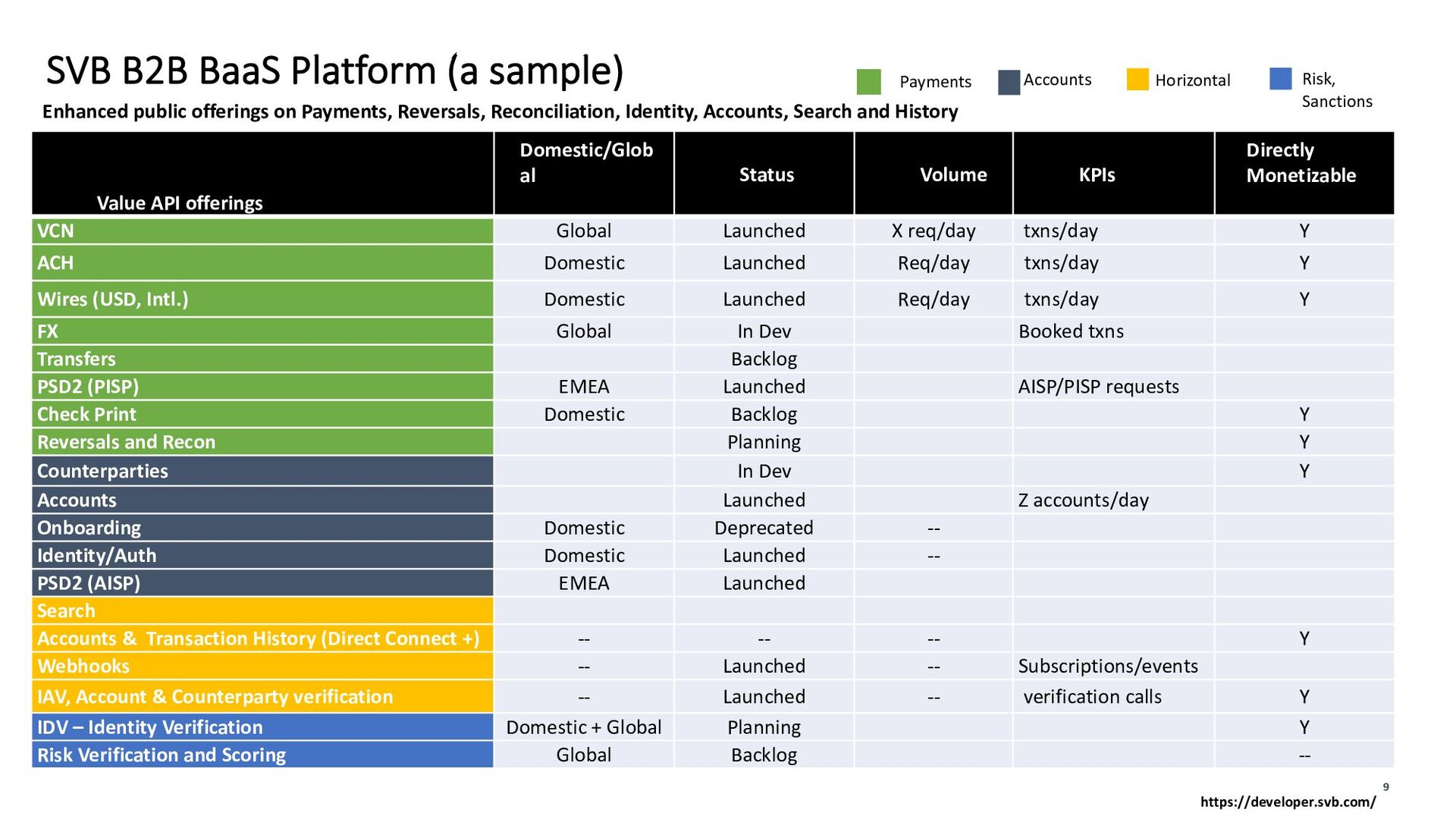
9 Value API offerings Domestic/Glob al Status Volume KPIs Directly
Monetizable VCN Global Launched X req/day txns/day Y ACH Domestic Launched Req/day txns/day Y Wires (USD, Intl.) Domestic Launched Req/day txns/day Y FX Global In Dev Booked txns Transfers Backlog PSD2 (PISP) EMEA Launched AISP/PISP requests Check Print Domestic Backlog Y Reversals and Recon Planning Y Counterparties In Dev Y Accounts Launched Z accounts/day Onboarding Domestic Deprecated -- Identity/Auth Domestic Launched -- PSD2 (AISP) EMEA Launched Search Accounts & Transaction History (Direct Connect +) -- -- -- Y Webhooks -- Launched -- Subscriptions/events IAV, Account & Counterparty verification -- Launched -- verification calls Y IDV – Identity Verification Domestic + Global Planning Y Risk Verification and Scoring Global Backlog -- Enhanced public offerings on Payments, Reversals, Reconciliation, Identity, Accounts, Search and History Risk, Sanctions Accounts Horizontal Payments SVB B2B BaaS Platform (a sample) https://developer.svb.com/ -
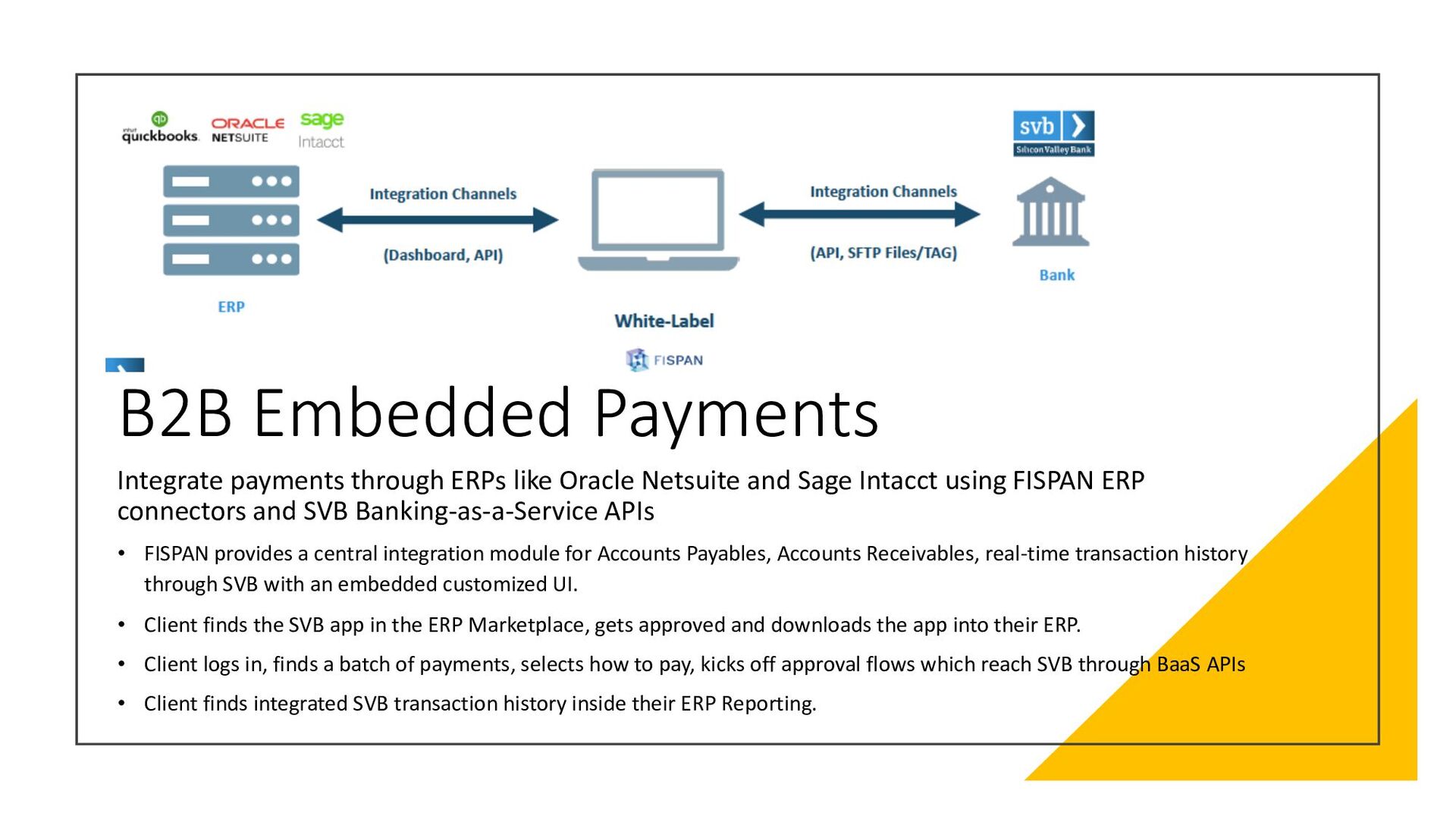
B2B Embedded Payments Integrate payments through ERPs like Oracle Netsuite
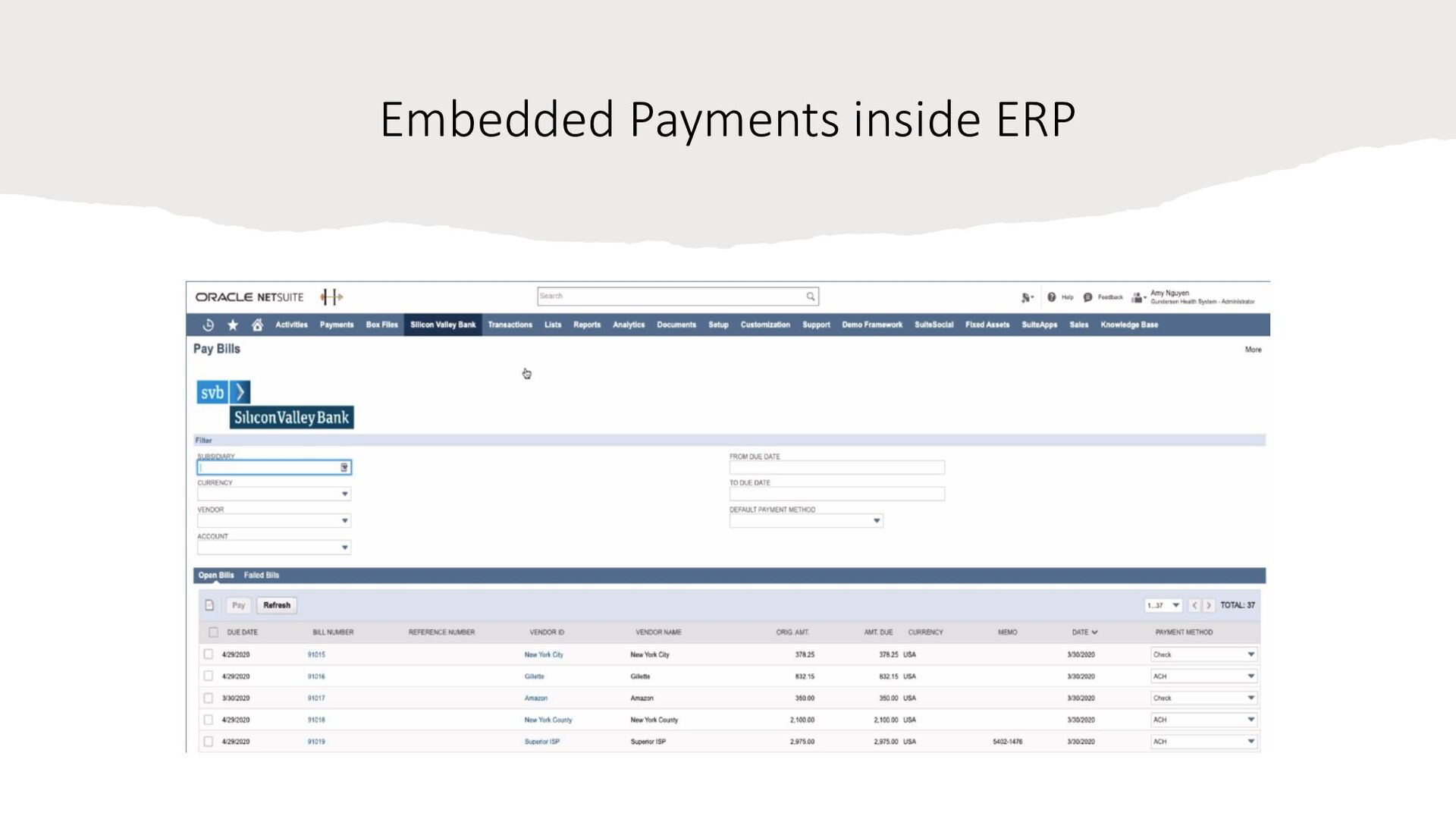
and Sage Intacct using FISPAN ERP connectors and SVB Banking-as-a-Service APIs • FISPAN provides a central integration module for Accounts Payables, Accounts Receivables, real-time transaction history through SVB with an embedded customized UI. • Client finds the SVB app in the ERP Marketplace, gets approved and downloads the app into their ERP. • Client logs in, finds a batch of payments, selects how to pay, kicks off approval flows which reach SVB through BaaS APIs • Client finds integrated SVB transaction history inside their ERP Reporting. -
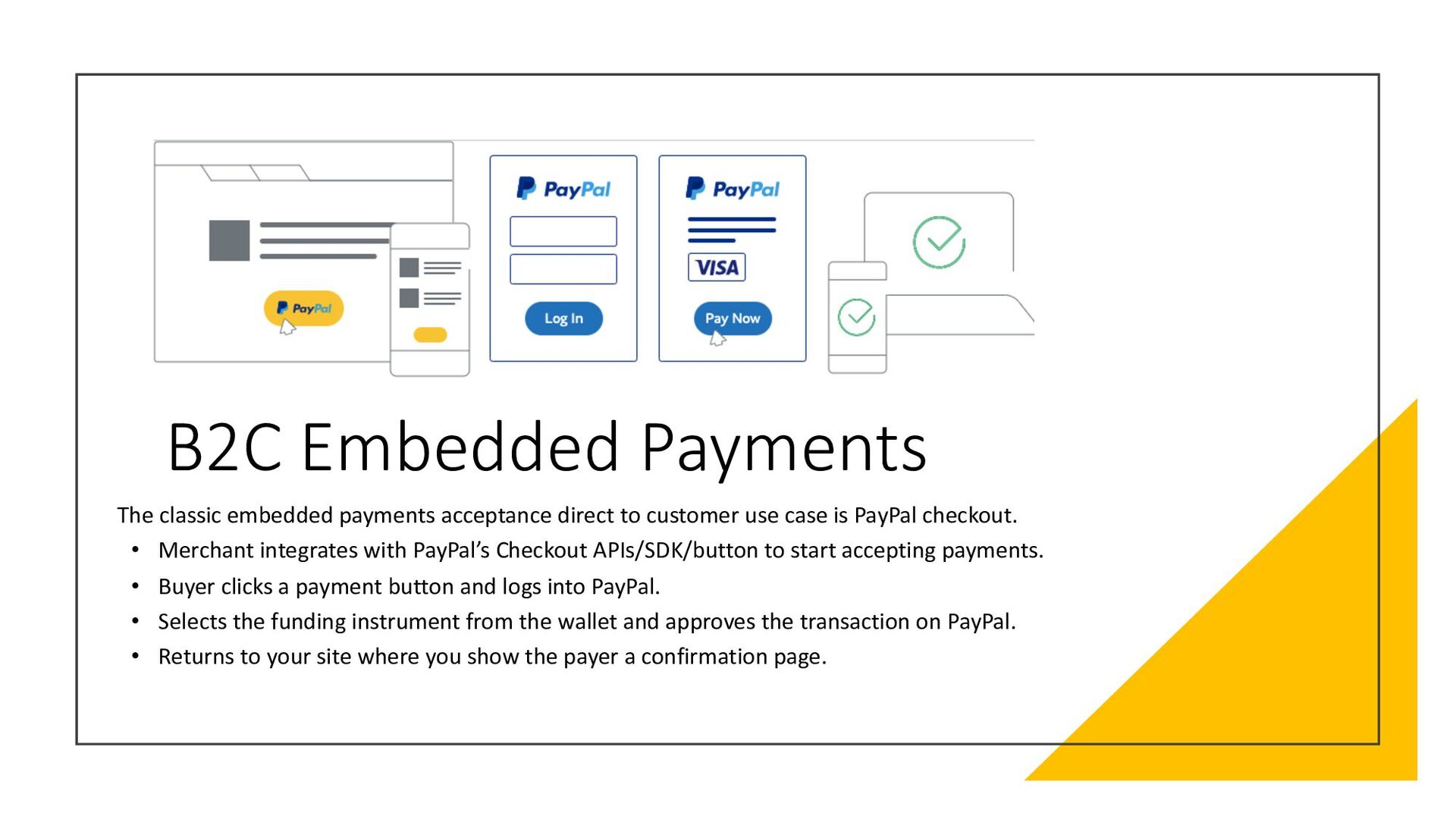
B2C Embedded Payments The classic embedded payments acceptance direct to
customer use case is PayPal checkout. • Merchant integrates with PayPal’s Checkout APIs/SDK/button to start accepting payments. • Buyer clicks a payment button and logs into PayPal. • Selects the funding instrument from the wallet and approves the transaction on PayPal. • Returns to your site where you show the payer a confirmation page. -
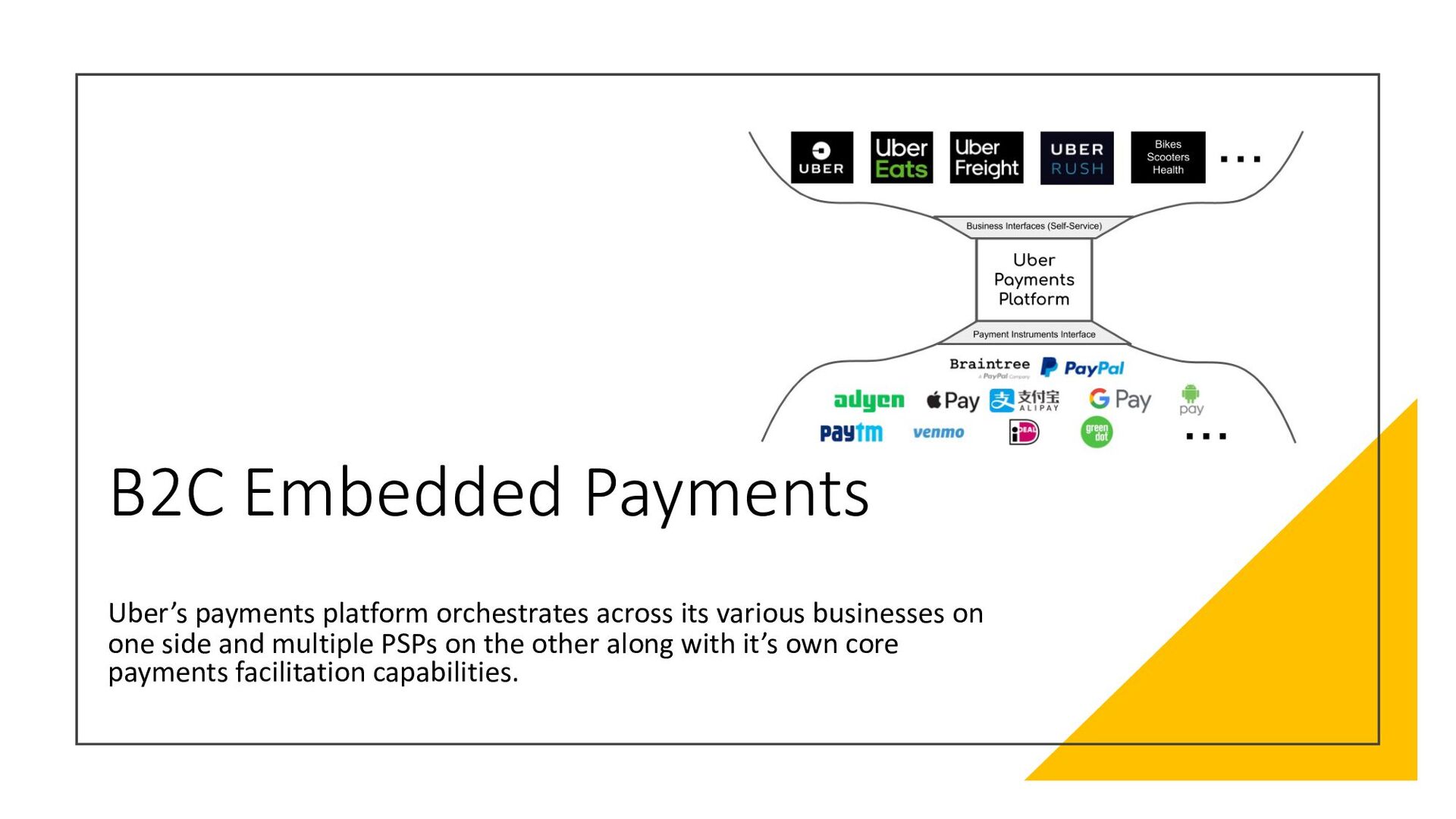
B2C Embedded Payments Uber’s payments platform orchestrates across its various
businesses on one side and multiple PSPs on the other along with it’s own core payments facilitation capabilities. -
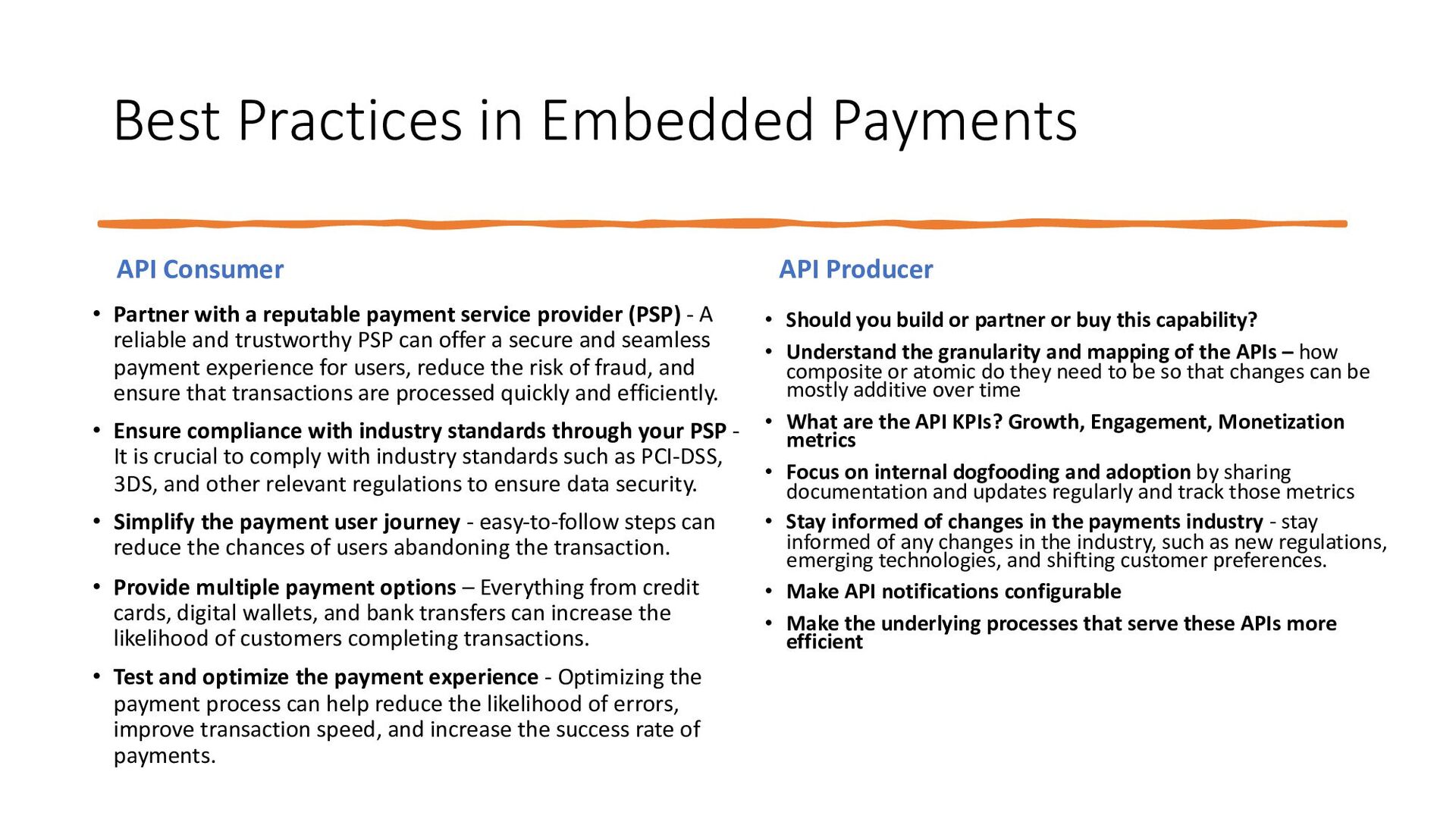
Best Practices in Embedded Payments • Partner with a reputable
payment service provider (PSP) - A reliable and trustworthy PSP can offer a secure and seamless payment experience for users, reduce the risk of fraud, and ensure that transactions are processed quickly and efficiently. • Ensure compliance with industry standards through your PSP - It is crucial to comply with industry standards such as PCI-DSS, 3DS, and other relevant regulations to ensure data security. • Simplify the payment user journey - easy-to-follow steps can reduce the chances of users abandoning the transaction. • Provide multiple payment options – Everything from credit cards, digital wallets, and bank transfers can increase the likelihood of customers completing transactions. • Test and optimize the payment experience - Optimizing the payment process can help reduce the likelihood of errors, improve transaction speed, and increase the success rate of payments. • Should you build or partner or buy this capability? • Understand the granularity and mapping of the APIs – how composite or atomic do they need to be so that changes can be mostly additive over time • What are the API KPIs? Growth, Engagement, Monetization metrics • Focus on internal dogfooding and adoption by sharing documentation and updates regularly and track those metrics • Stay informed of changes in the payments industry - stay informed of any changes in the industry, such as new regulations, emerging technologies, and shifting customer preferences. • Make API notifications configurable • Make the underlying processes that serve these APIs more efficient API Consumer API Producer -
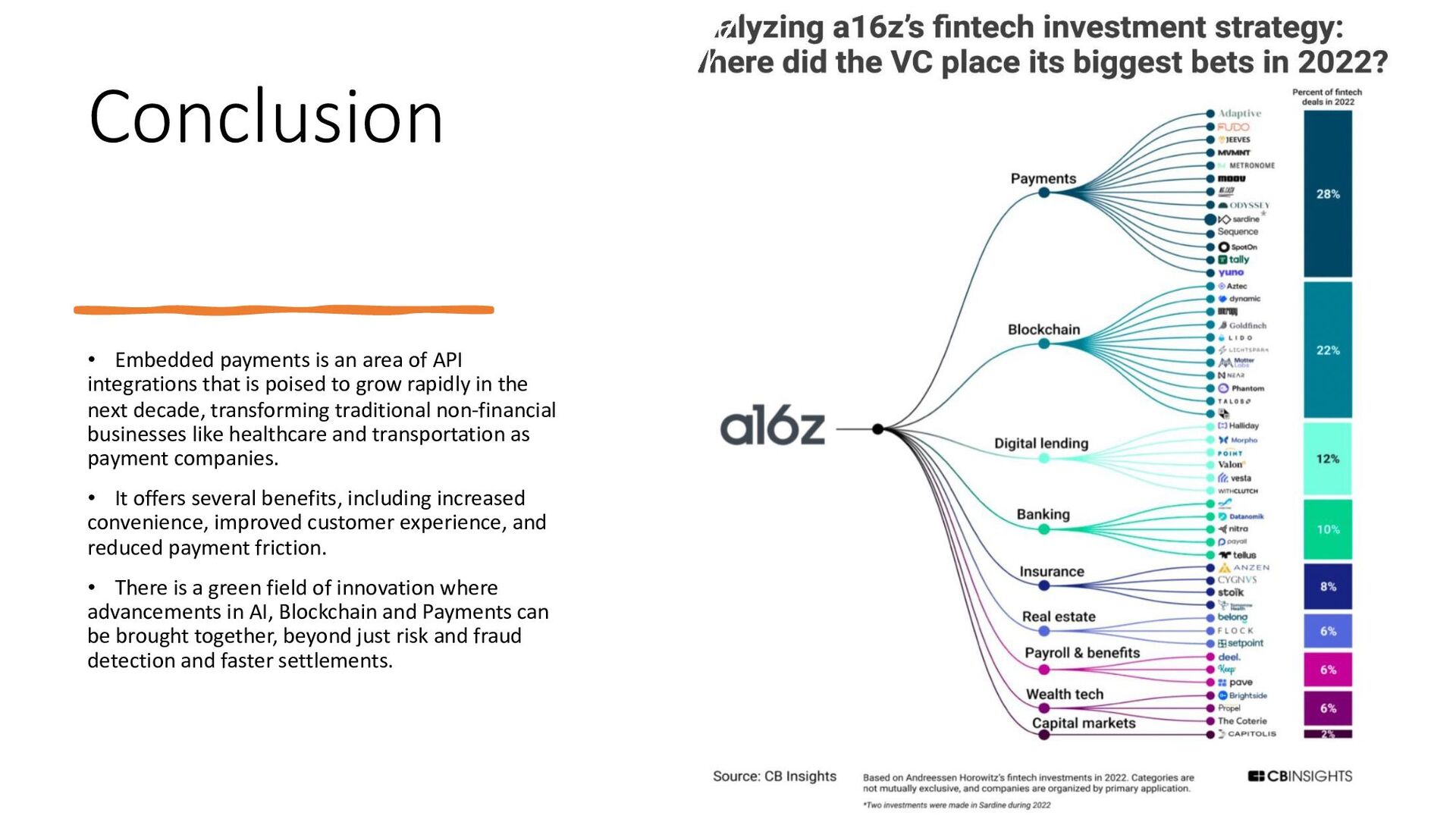
Conclusion • Embedded payments is an area of API integrations
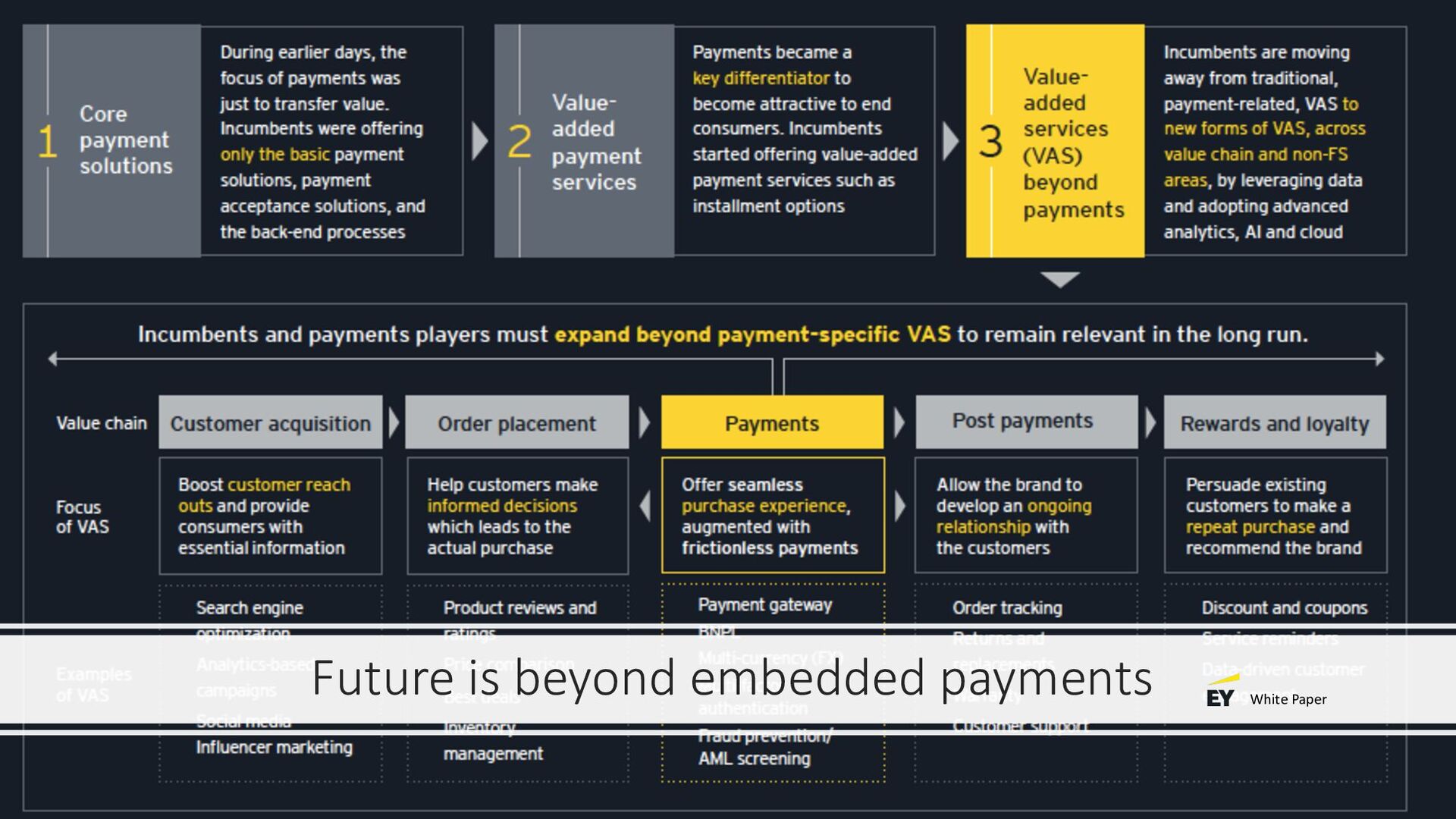
that is poised to grow rapidly in the next decade, transforming traditional non-financial businesses like healthcare and transportation as payment companies. • It offers several benefits, including increased convenience, improved customer experience, and reduced payment friction. • There is a green field of innovation where advancements in AI, Blockchain and Payments can be brought together, beyond just risk and fraud detection and faster settlements.