Your Podcast. Everywhere. Effortlessly.
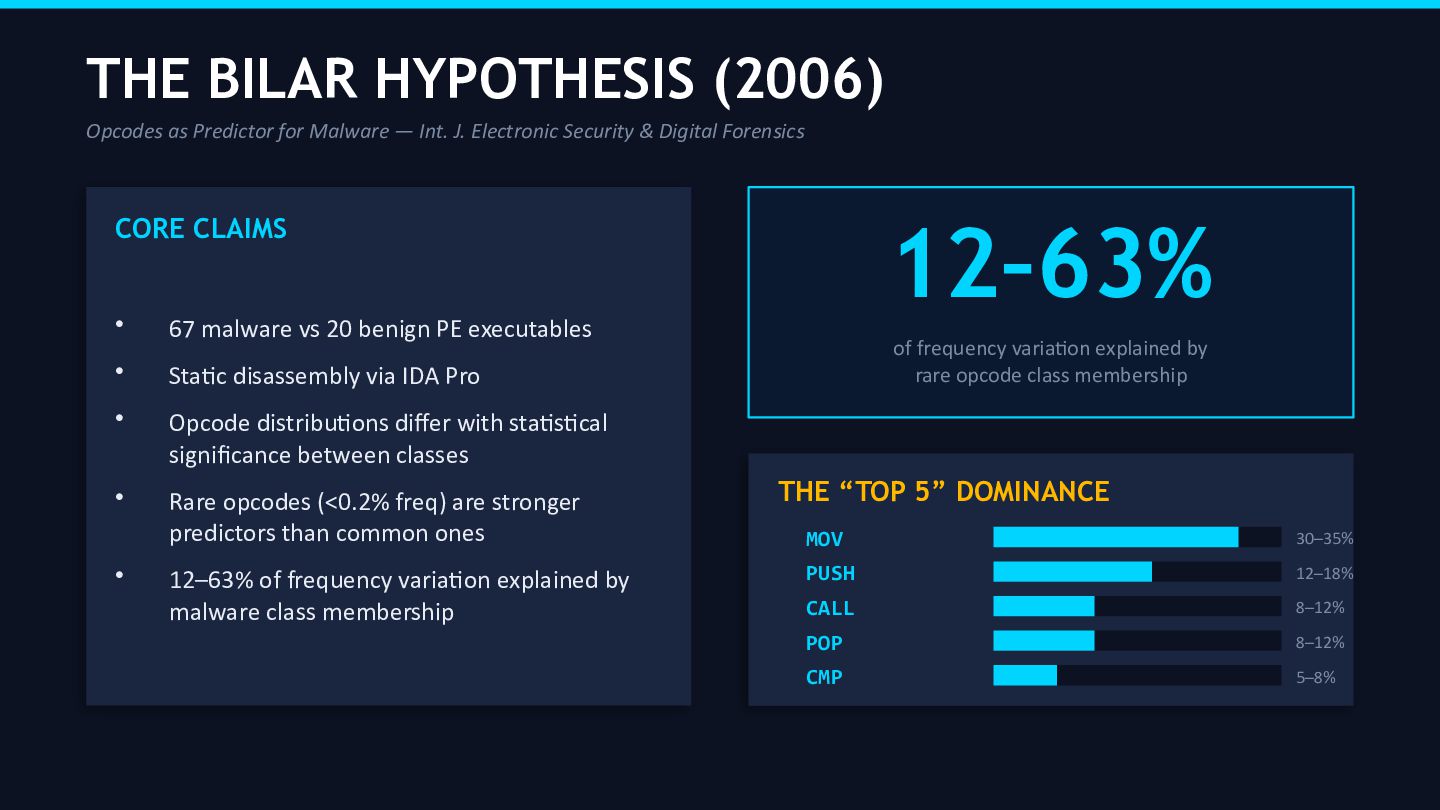
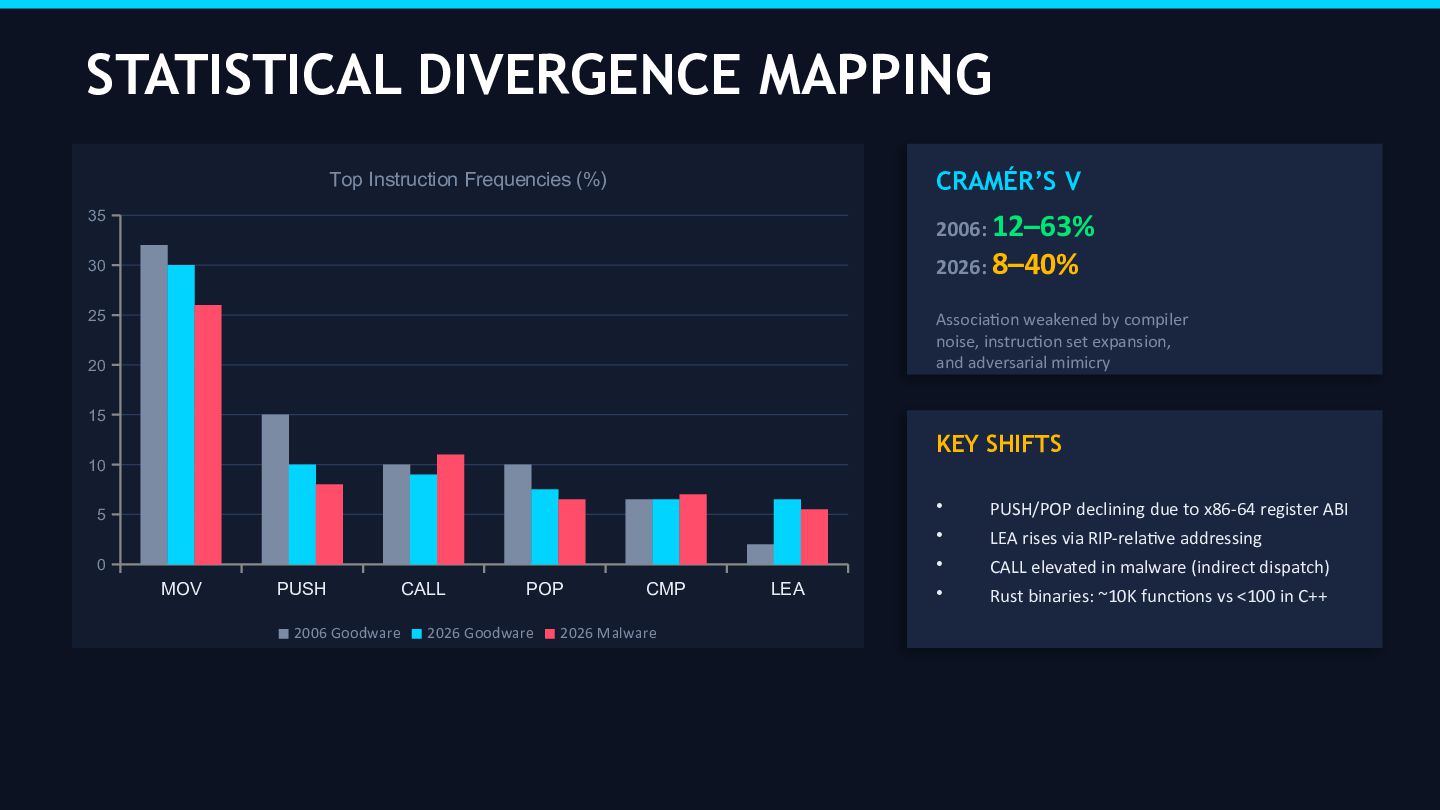
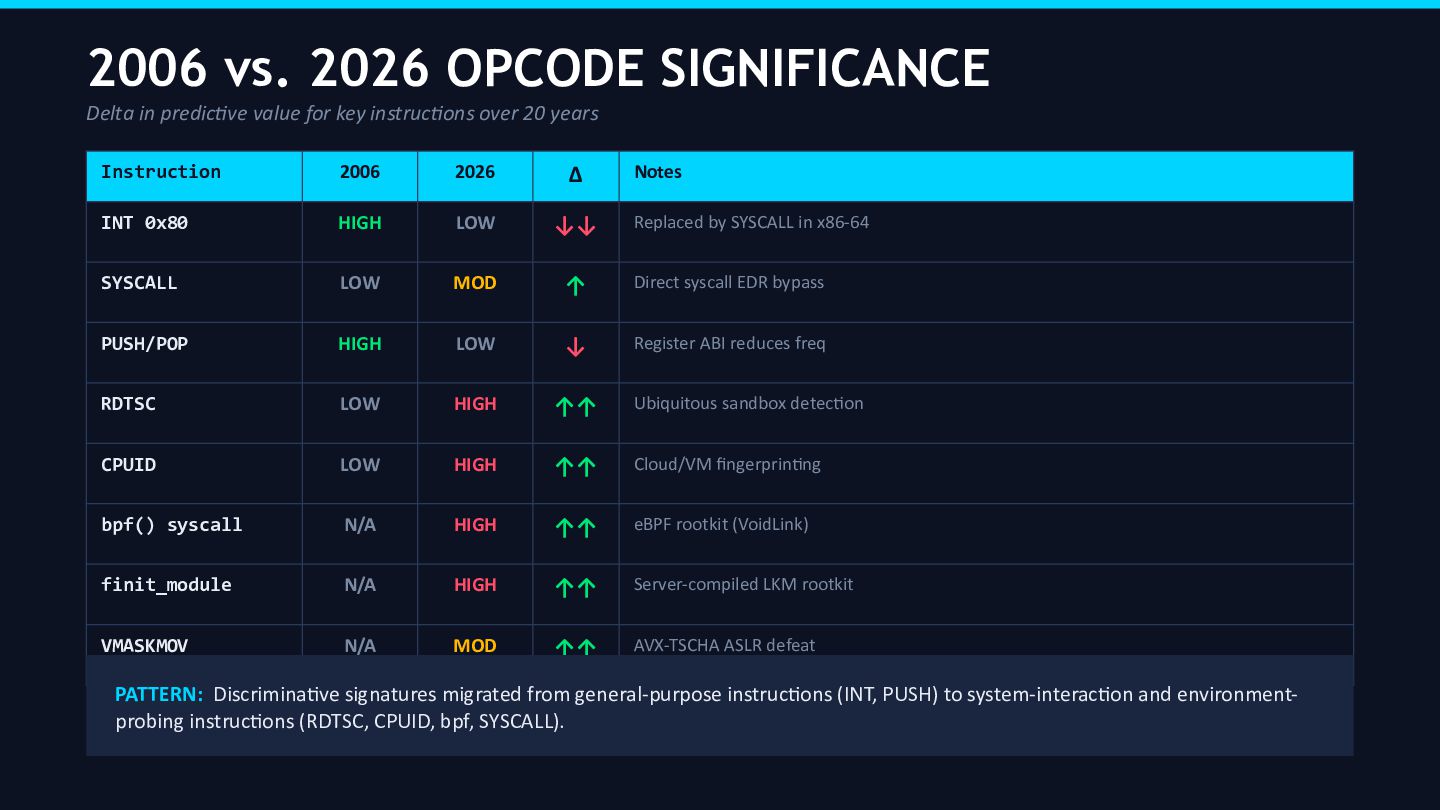
This report presents a longitudinal forensic validation of Bilar’s 2006 research on opcode frequency distributions as predictors of malicious software. Bilar’s original study, published in the International Journal of Electronic Security and Digital Forensics, demonstrated that malware opcode distributions differ in statistically significant ways from benign software, with rare opcodes explaining between 12–63% of frequency variation between the two classes.
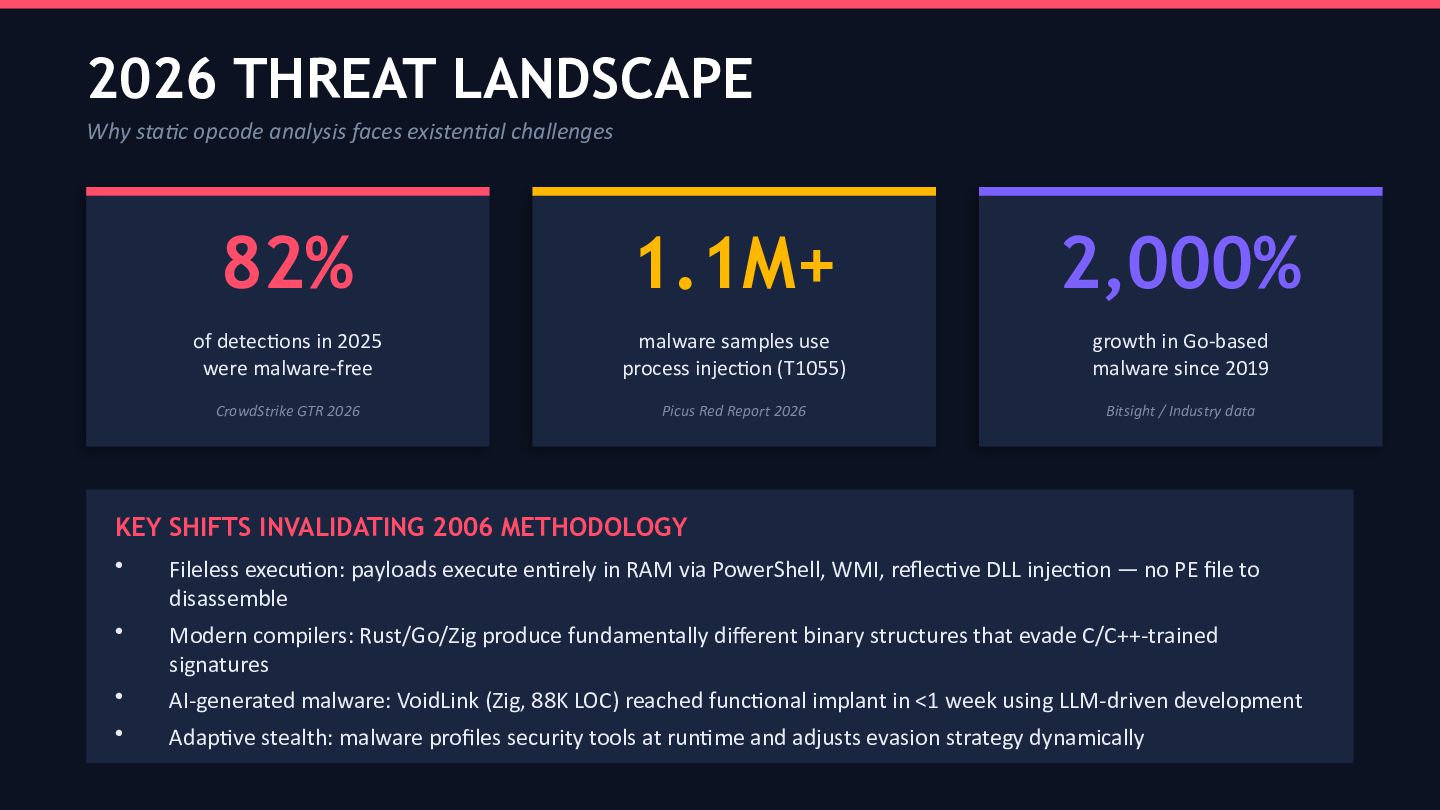
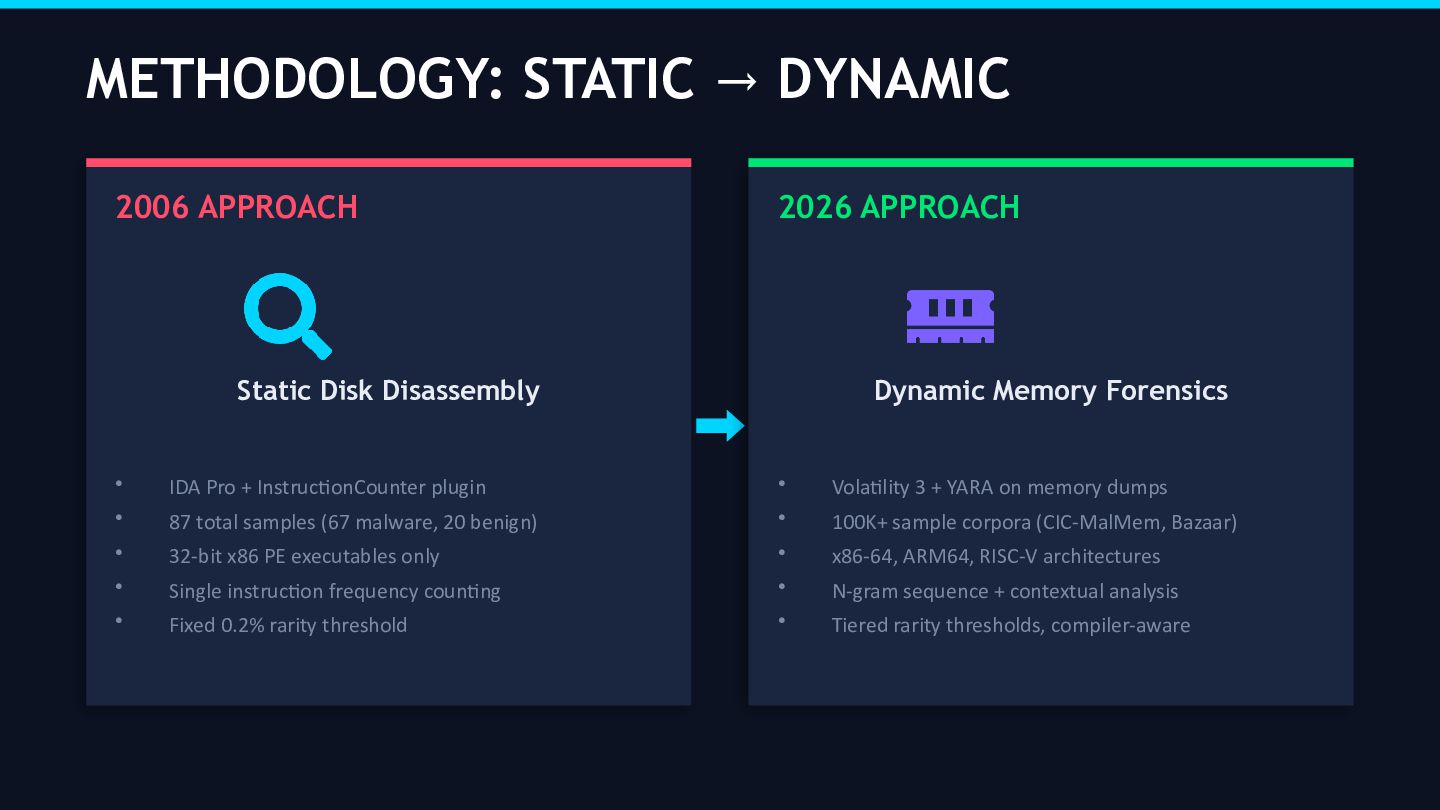
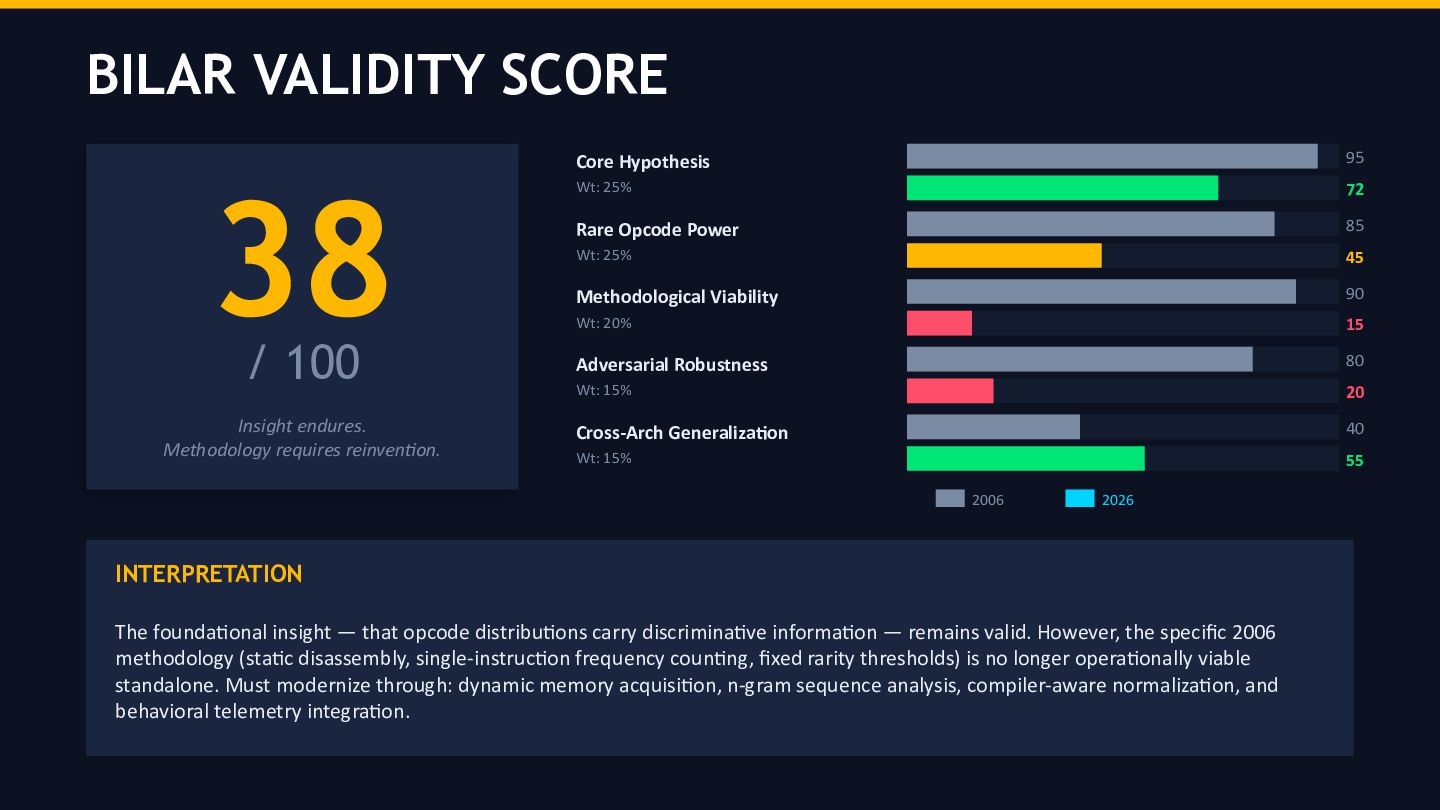
Twenty years later, the threat landscape has undergone a fundamental transformation. The dominant malware paradigm has shifted from disk-resident PE executables compiled in C/C++ to memory-resident, fileless implants authored in Rust, Go, and Zig—often with direct assistance from large language models. This audit re-examines whether Bilar’s structural fingerprinting hypothesis retains validity under these conditions, and what adaptations are required to maintain opcode-based detection as a viable forensic heuristic.
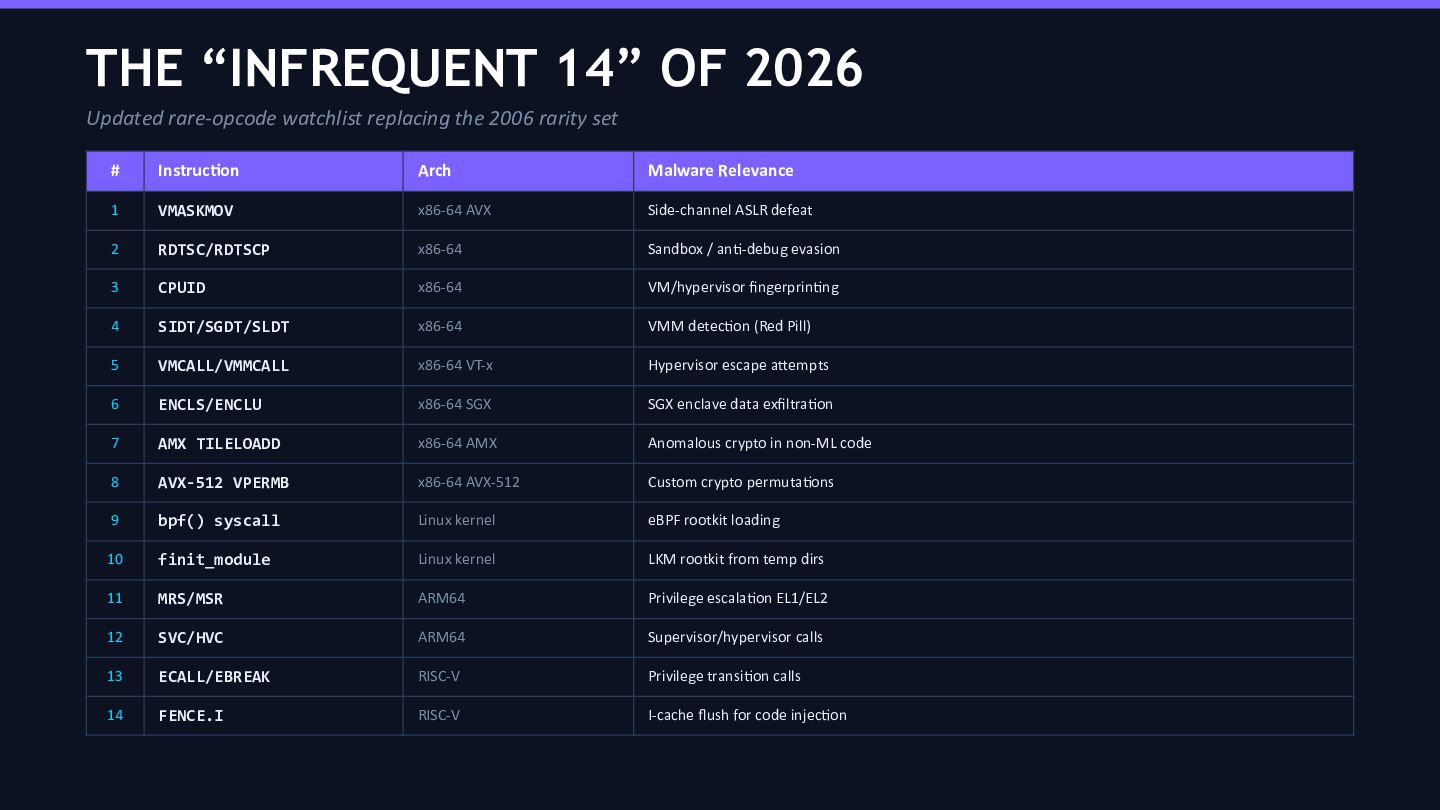
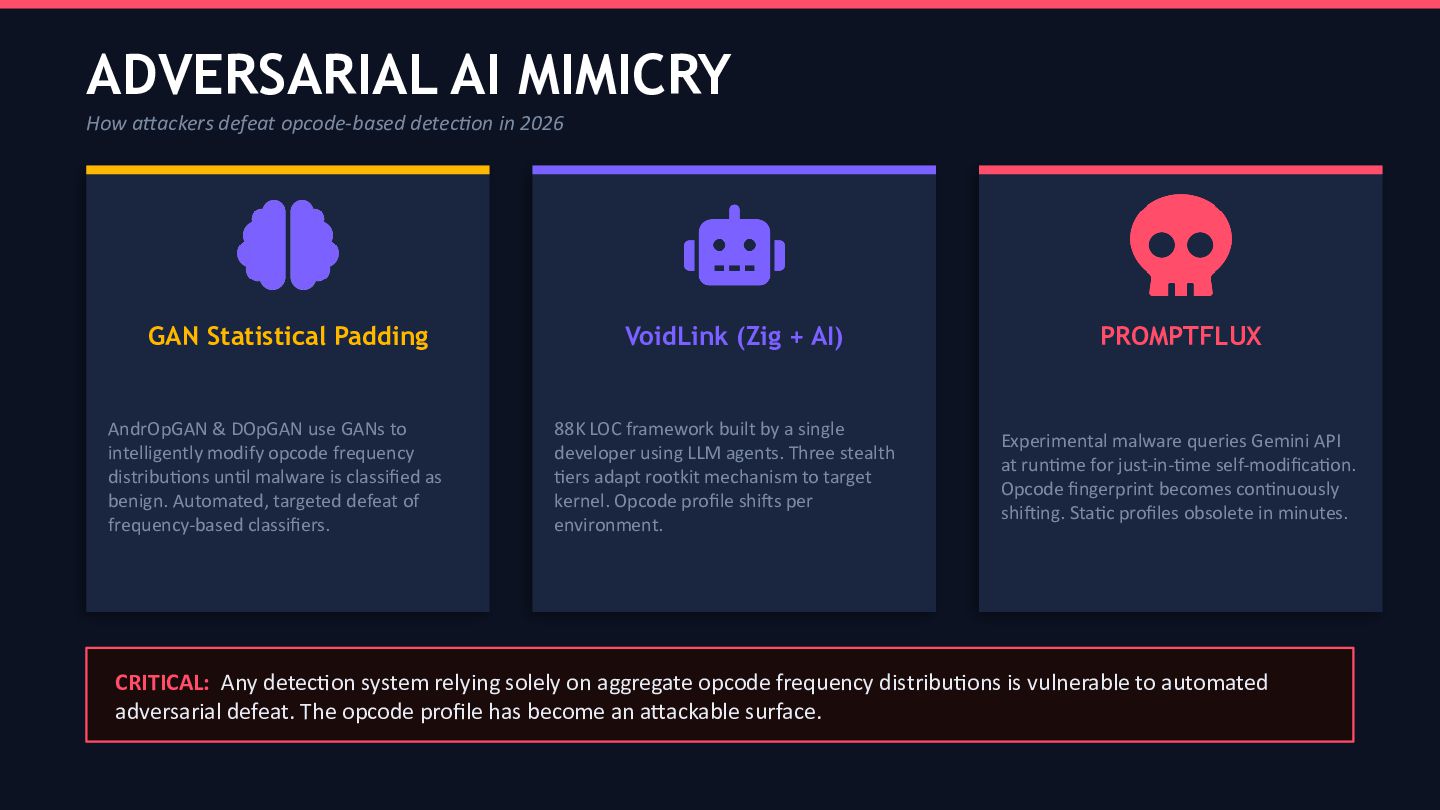
Key findings include: the core statistical divergence between malware and goodware opcode distributions persists at the architectural level, but the discriminative power of individual rare opcodes has degraded substantially. The “Top 5” instruction dominance pattern (mov, push, call, pop, cmp) identified by Bilar remains observable but is now actively targeted by adversarial AI mimicry techniques. Process injection (MITRE ATT&CK T1055) has become the single most prevalent malware technique, observed across more than 1.1 million samples in the Picus Red Report 2026, rendering static disk disassembly largely obsolete as a primary acquisition method. The emergence of VoidLink a Zig-based, AI-generated malware framework documented by Check Point, Sysdig, and Cisco Talos in January–February 2026 serves as the canonical case study for this audit.

https://www.researchgate.net/publication/228694812_Opcodes_as_predictor_for_malware
2006 work discusses a detection mechanism for malicious code through statistical analysis of opcode distributions. A total of 67 malware executables were sampled statically disassembled and their statistical opcode frequency distribution compared with the aggregate statistics of 20 non-malicious samples. We find that malware opcode distributions differ statistically significantly from non-malicious software. Furthermore, rare opcodes seem to be a stronger predictor, explaining 12 63% of frequency variation


 chokmahllc
 hisaokatsumi
 kanekomasahiro
 rikkabotan7
 prinlab
 koide3
.png) satai
satai
 matsumooon
 hariby
 yukako_nakano
 izumiyama_lab
 sokikatayama
 chriscoyier
 rkaga
rkaga
 addyosmani
 aleyda
 uxyall
 raygrieselhuber
 michielstock
 helmedeiros
 pwiseman
 inesmontani
 mojombo