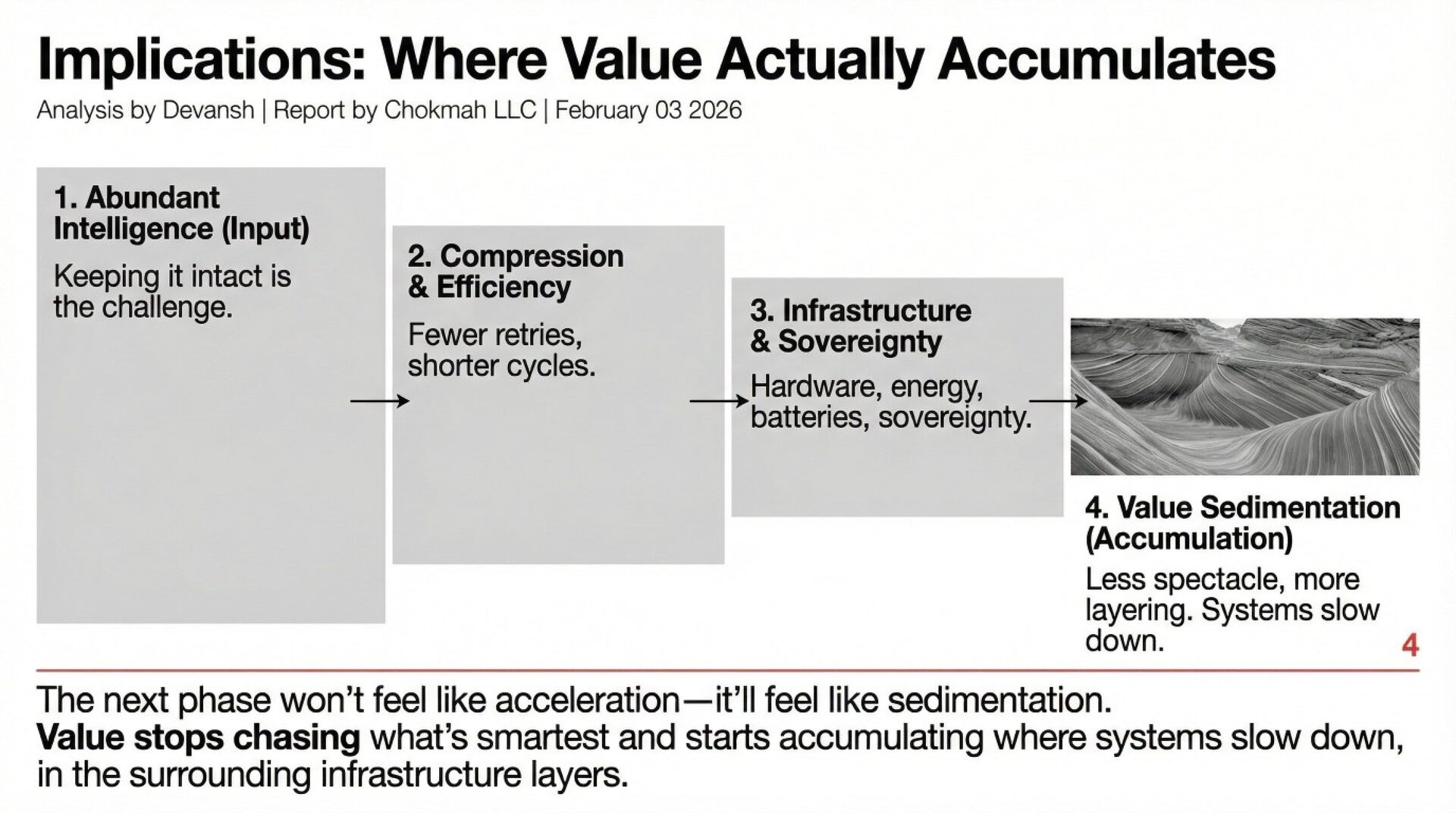
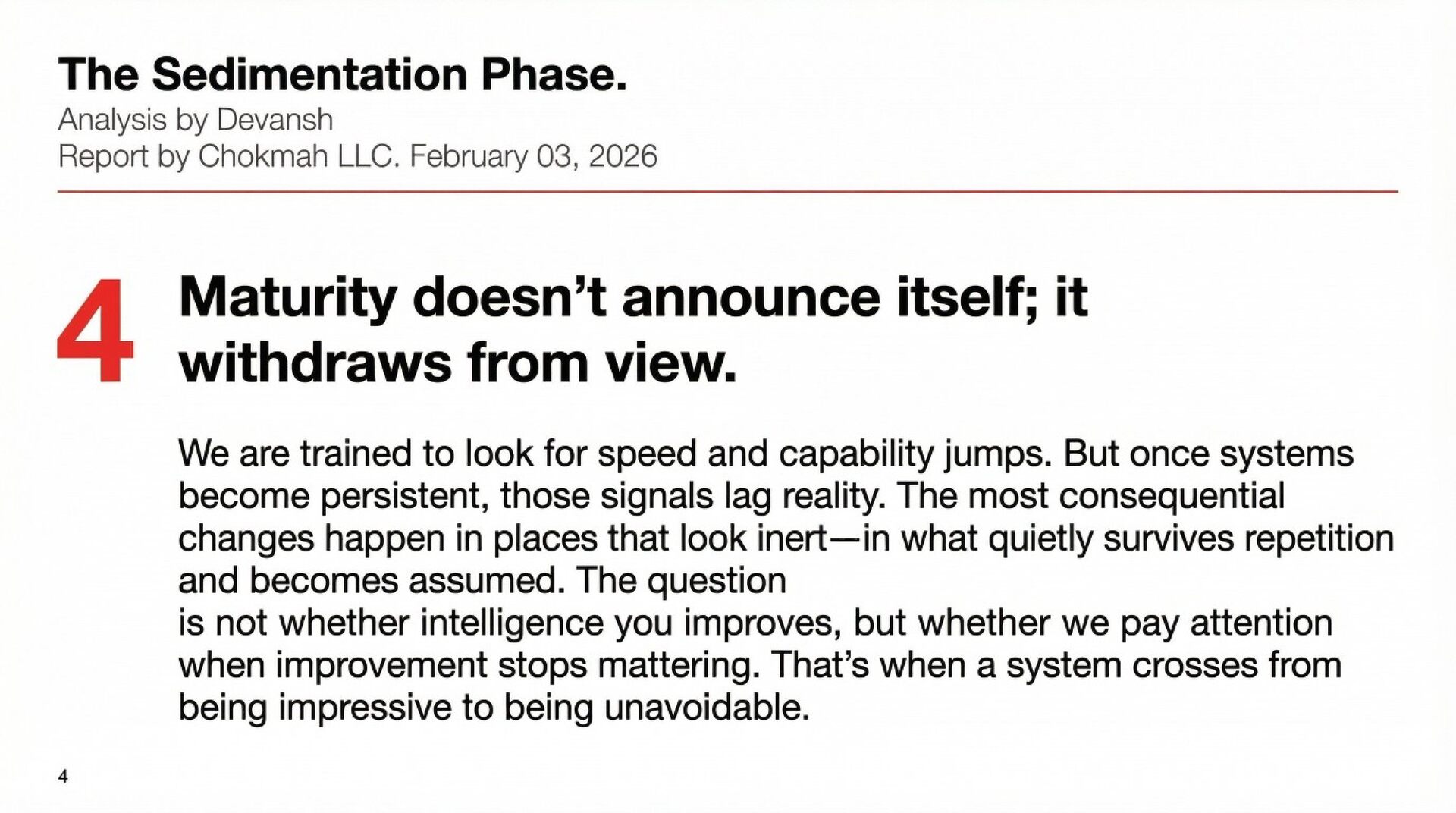
The report argues that AI isn’t in a phase of explosive acceleration but in a “sedimentation” phase where value settles around verifiable, persistent workflows rather than ever-smarter models.
Core thesis
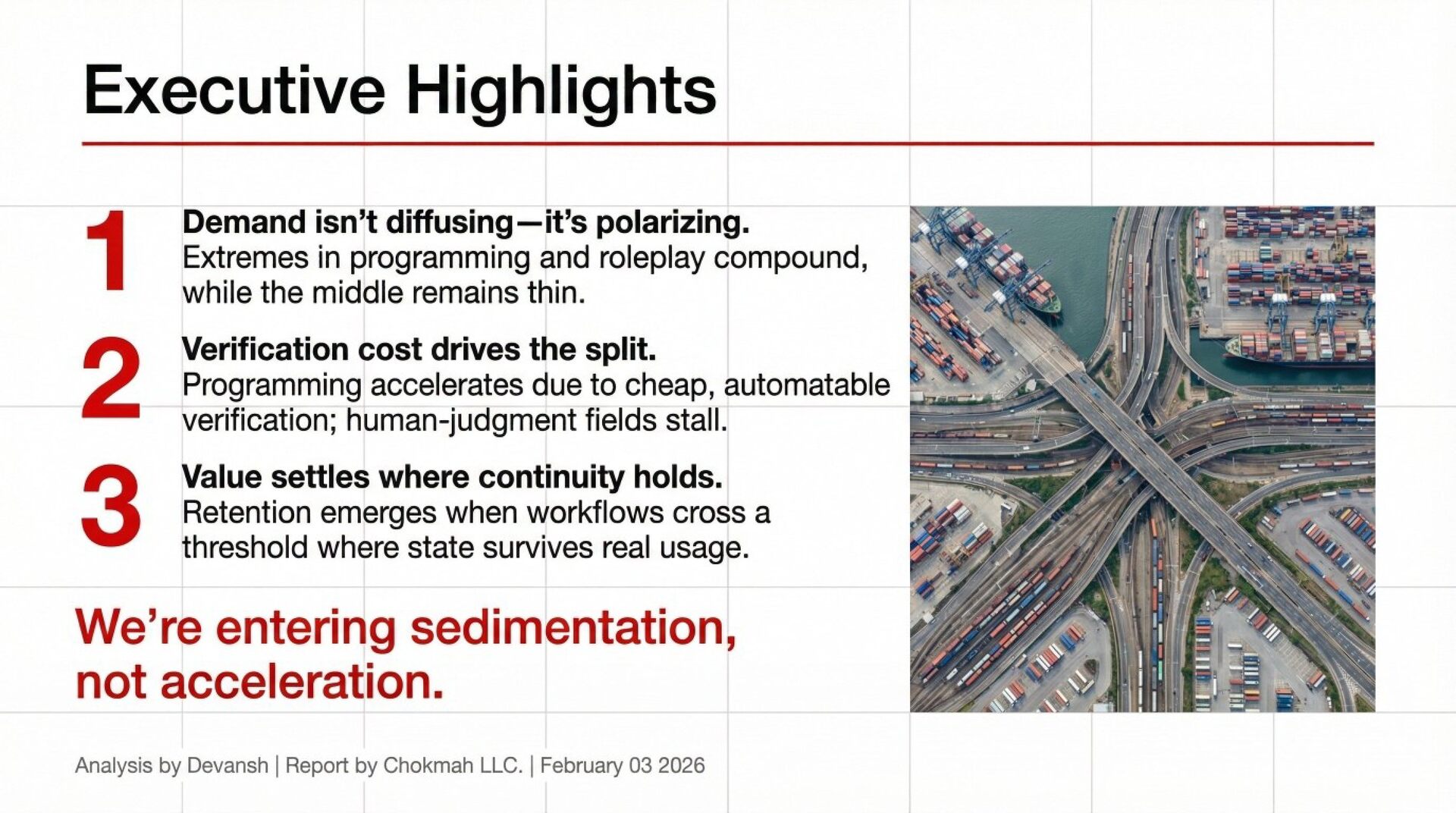
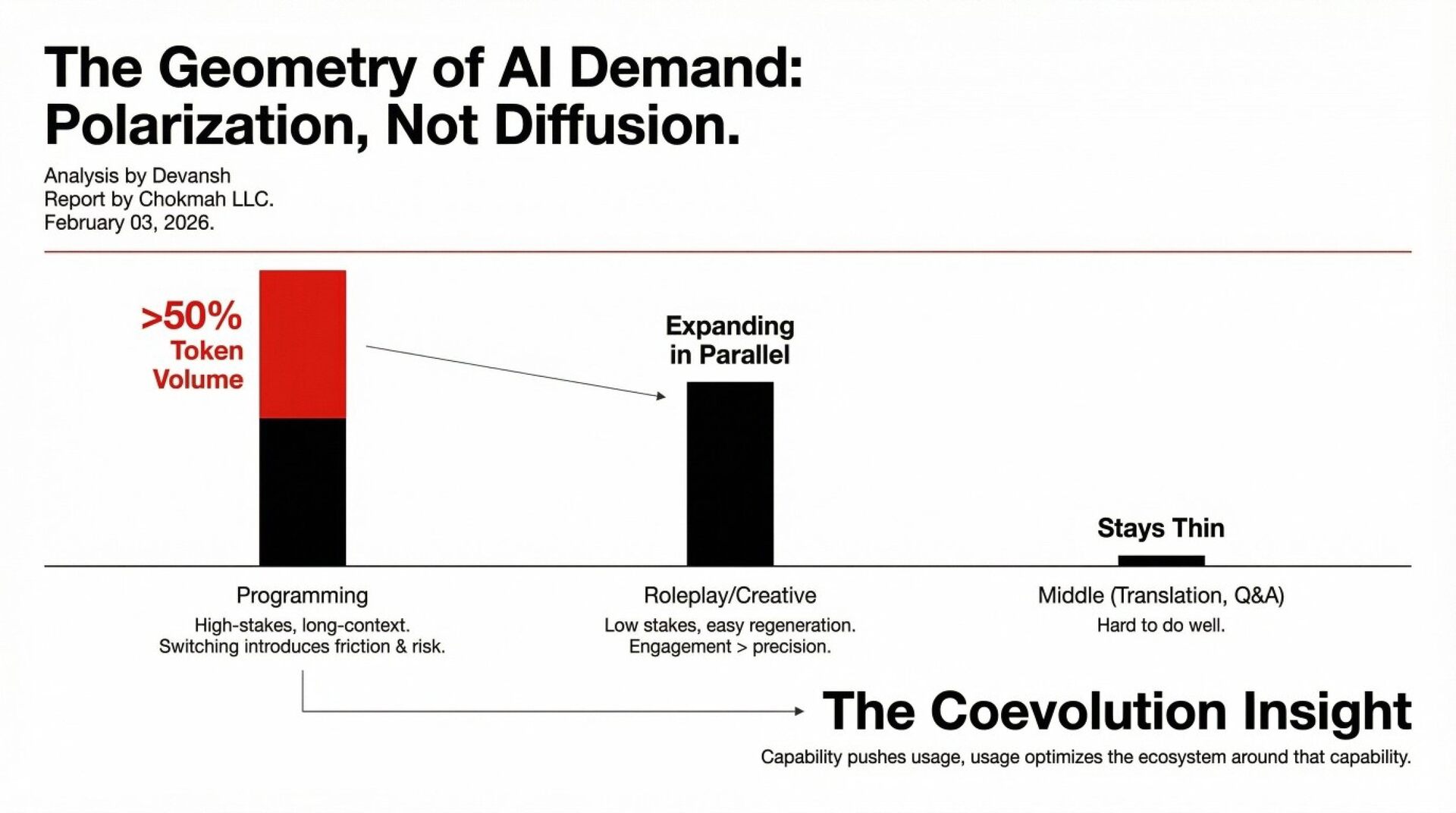
- Demand for AI is polarizing into two extremes—programming and creative roleplay—while middle tasks like generic Q&A and translation remain thin.
- This pattern is driven by **verification**: where outputs are easy to test and automate, usage compounds; where correctness depends on human judgment, progress stalls.
## Verification as the key divider
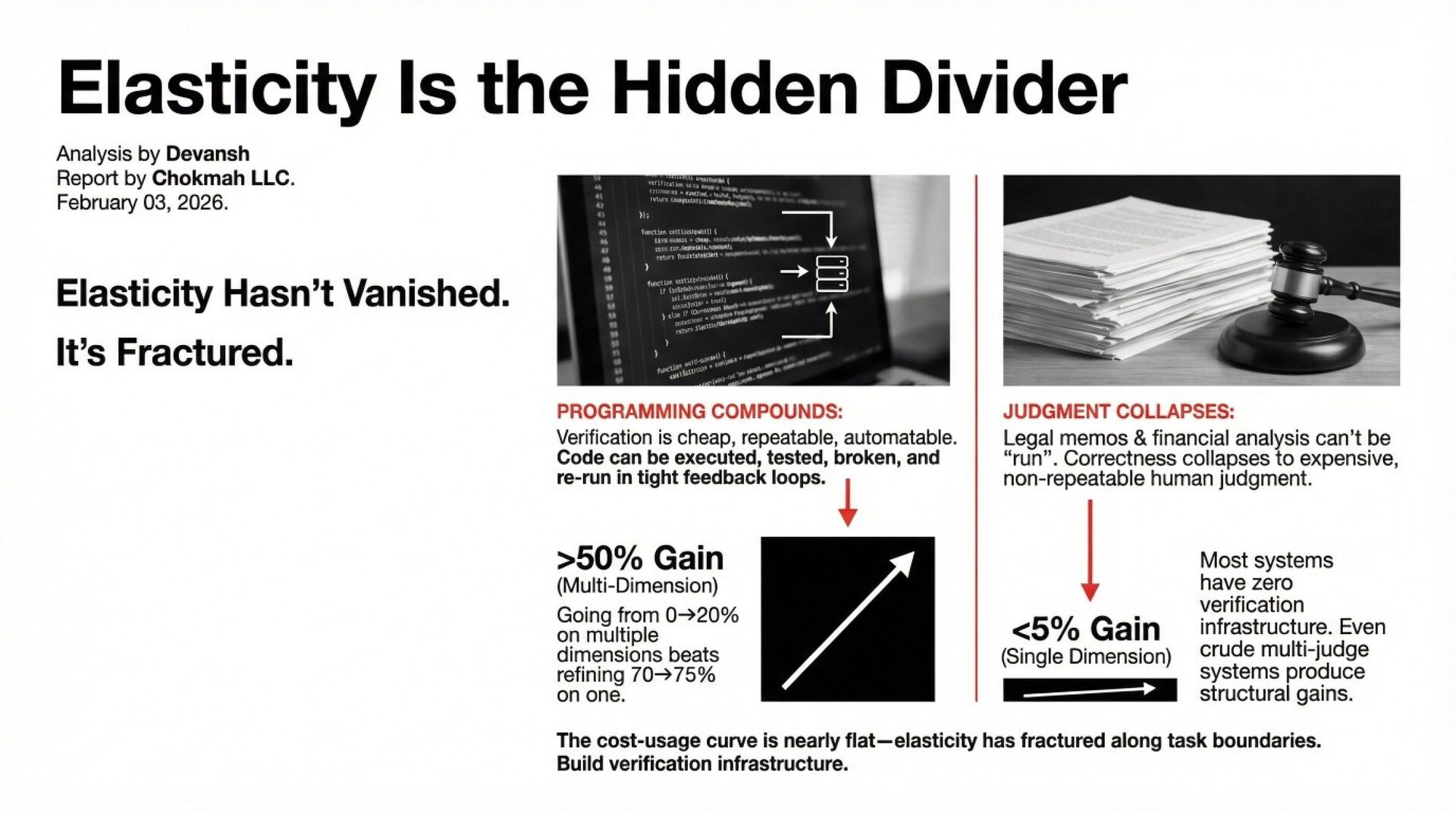
- In programming, verification is cheap, repeatable, and automatable: code can be executed, tested, and re-run in tight feedback loops, so improvements compound and elasticity (responsiveness of demand to quality/price) stays high.
- In judgment-heavy domains (legal memos, financial analysis), correctness reduces to expensive, non-repeatable human review, so small quality gains (<5%) do not justify large adoption, flattening the cost-usage curve.
## Retention and the “glass slipper” effect
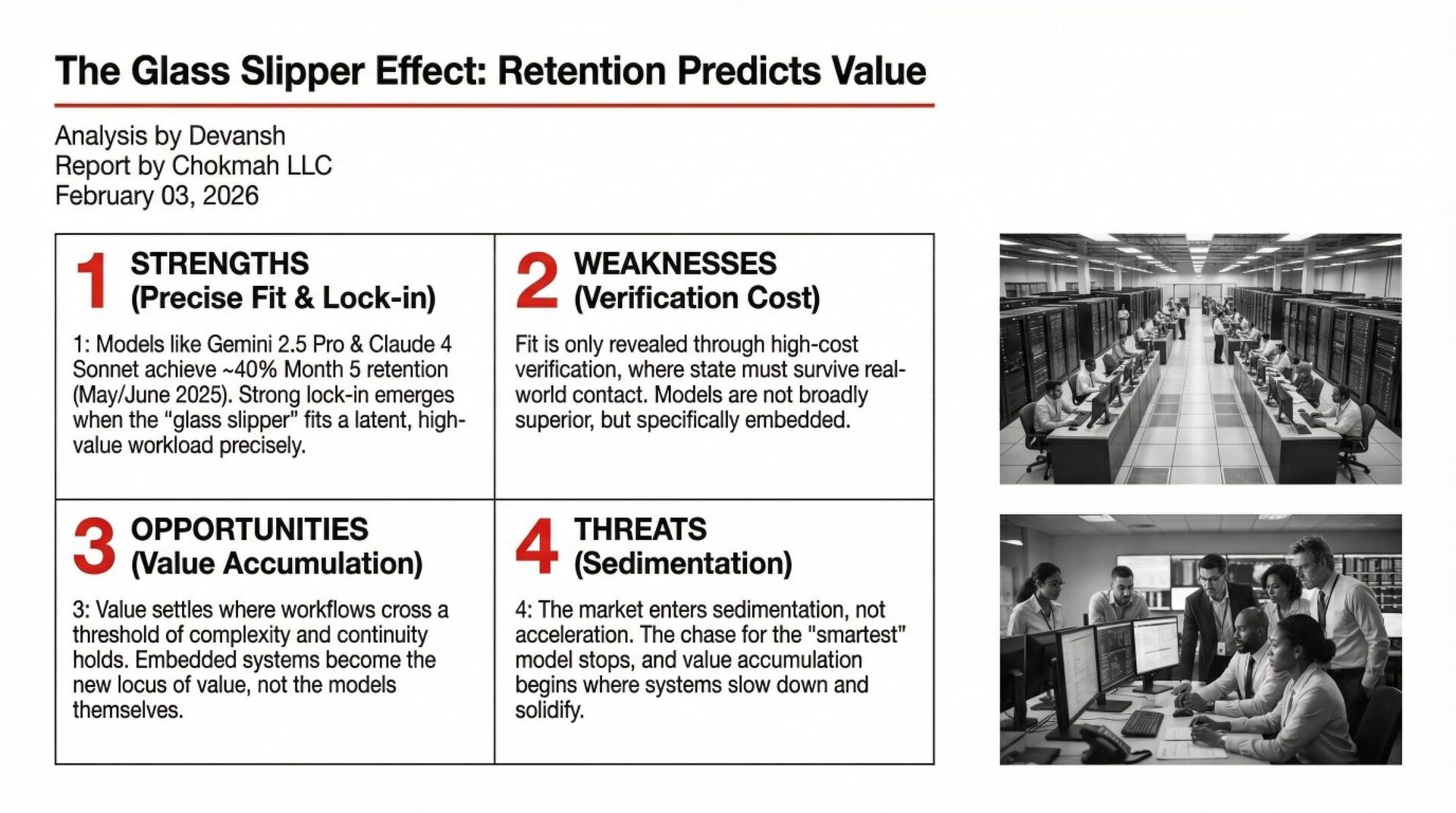
- Models like Gemini 2.5 Pro and Claude 4 Sonnet showed around 40% retention by month 5 in mid‑2025, indicating that when a model fits a specific, high-value workflow very well, users get locked in.
- However, this fit is only revealed through high-cost real-world verification, so value accrues not to generic “smartest model” claims but to specific embedded workflows where state survives repeated use.
## Constraints, infrastructure, and where value settles
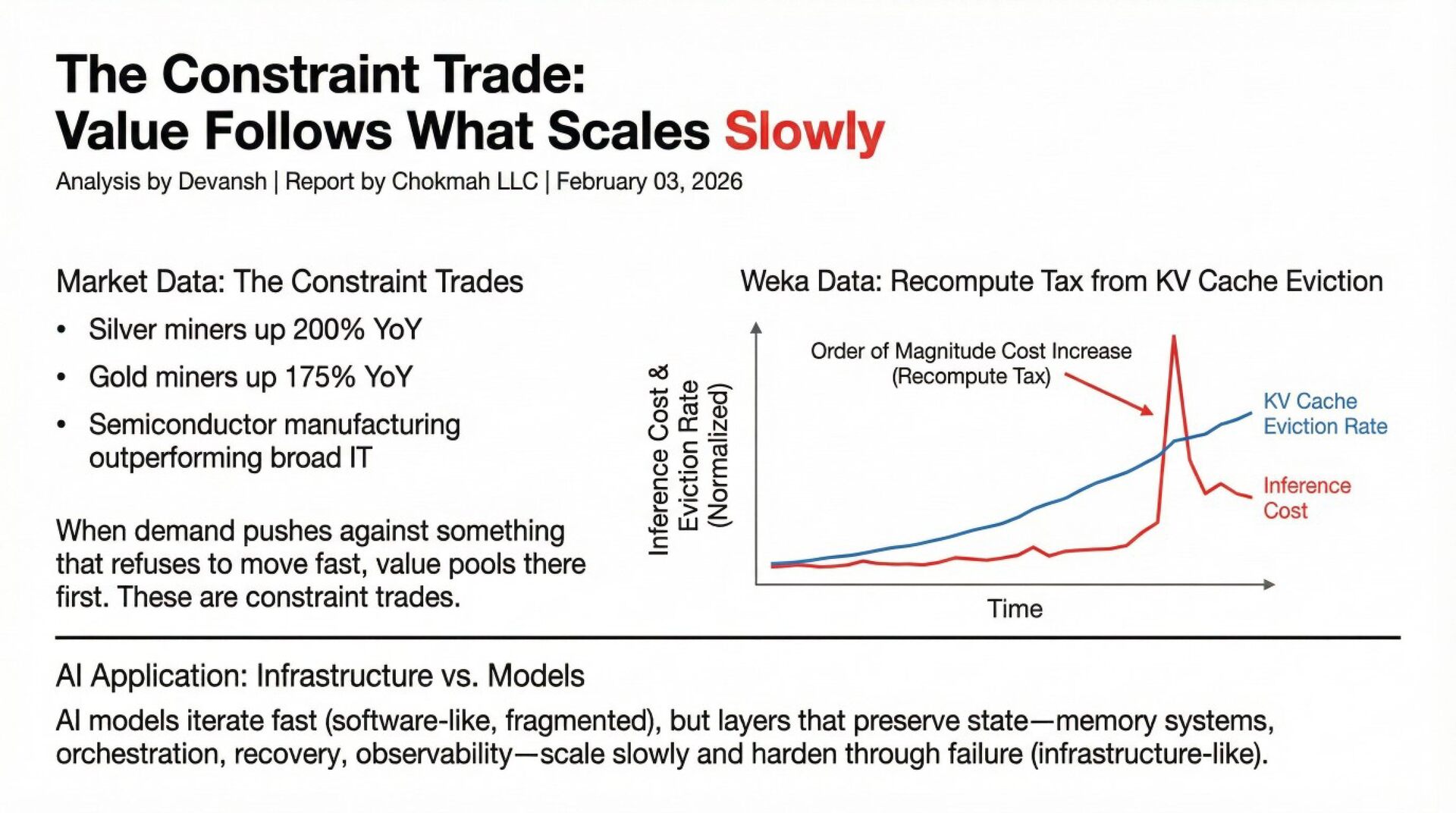
- Value pools where something important cannot scale quickly: examples include silver and gold miners and semiconductor manufacturing outperforming broader IT, presented as “constraint trades.”
- In AI, models iterate quickly, but infrastructure layers that preserve state—memory systems, orchestration, recovery, observability—scale slowly and harden through failure, so value accumulates there rather than in the models alone.
## Strategic implications with verification emphasis
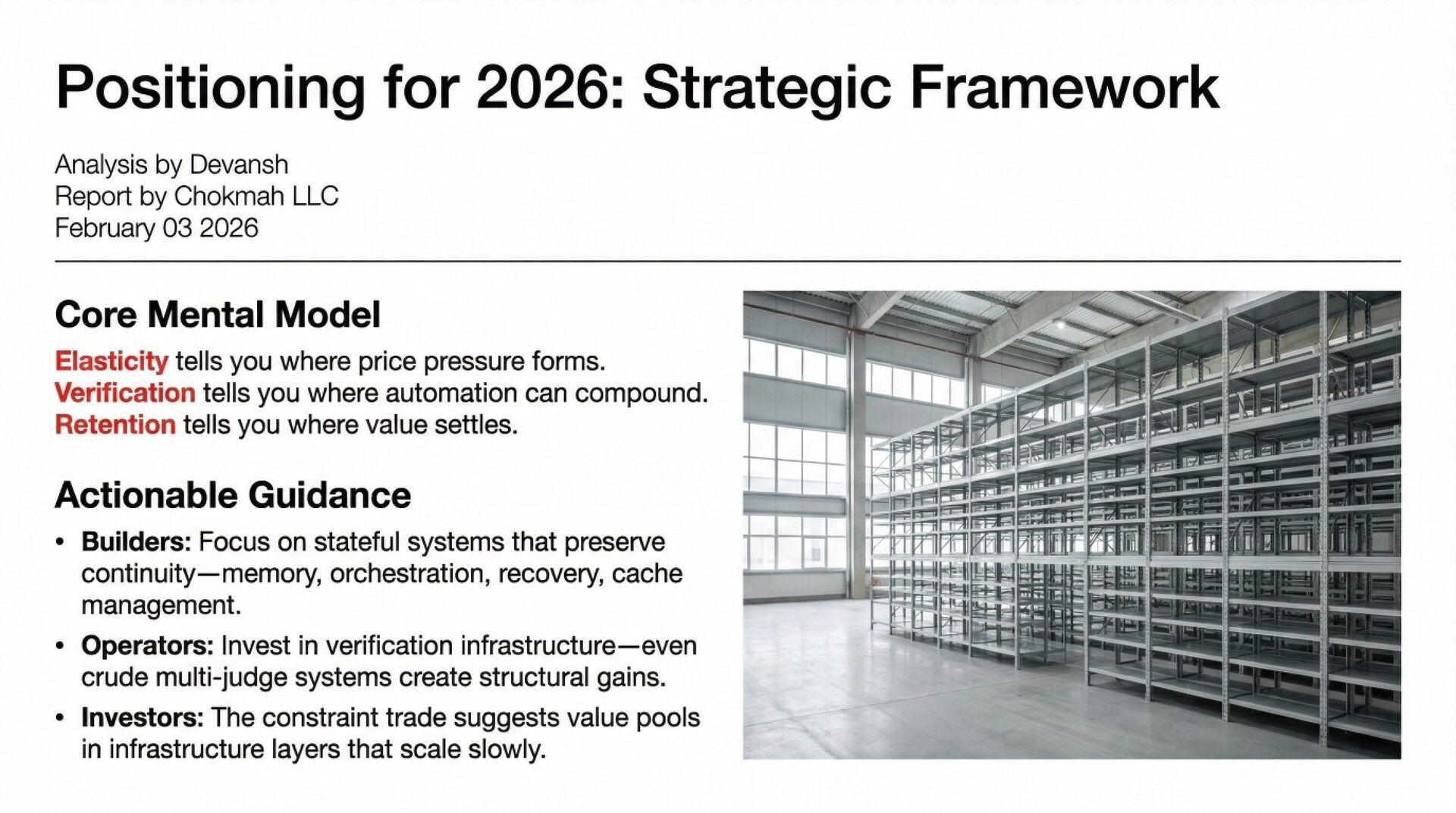
- For builders, the recommendation is to focus on **stateful systems** (memory, orchestration, cache management) that preserve continuity so verification and improvement happen over persistent workflows, not one-off prompts.
- For operators, investing in verification infrastructure—even crude multi-judge setups—creates structural gains because it turns messy judgment work into something partially testable and optimizable over time.
- For investors, the suggested edge is to look for “sedimentation” plays in infrastructure and constrained resources, where systems slow down and value quietly accumulates instead of chasing headline capability jumps.


 chokmahllc
 mkitahara01985
 daisan123
 middleokada
 ecoms_ikeda08
 safie_recruit
 lincwellhr
 canvasedge
 familyalbum
 layerx
 nexera
 hirokiyamamoto14
 konifar
 moore
moore
 sugarenia
 afnizarnur
 asonas
 axbom
axbom
 reverentgeek
 bryan
bryan
 sergeychernyshev
 lindahogenes
 jcasabona
 jnunemaker
 palkan