Share
Embed
[Devoxx 2026] State of Agentic Coding
Talk presented at Devoxx Belgium 2026 in October 08 2026
Daniela Petruzalek
October 08, 2026
Transcript
32 slides
-
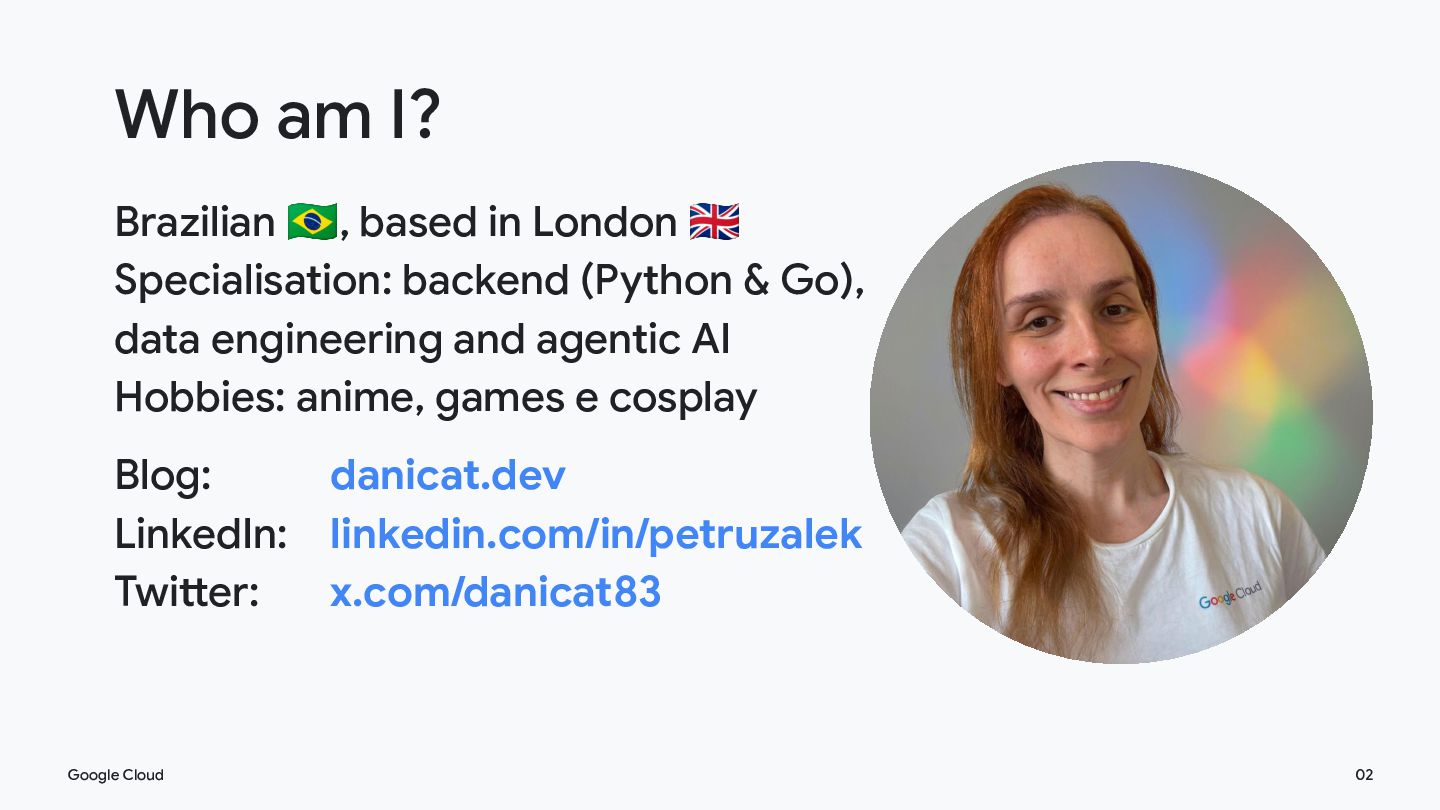
Who am I? Brazilian , based in London Specialisation:
backend (Python & Go), data engineering and agentic AI Hobbies: anime, games e cosplay Blog: danicat.dev LinkedIn: linkedin.com/in/petruzalek Twitter: x.com/danicat83 Google Cloud 02 -
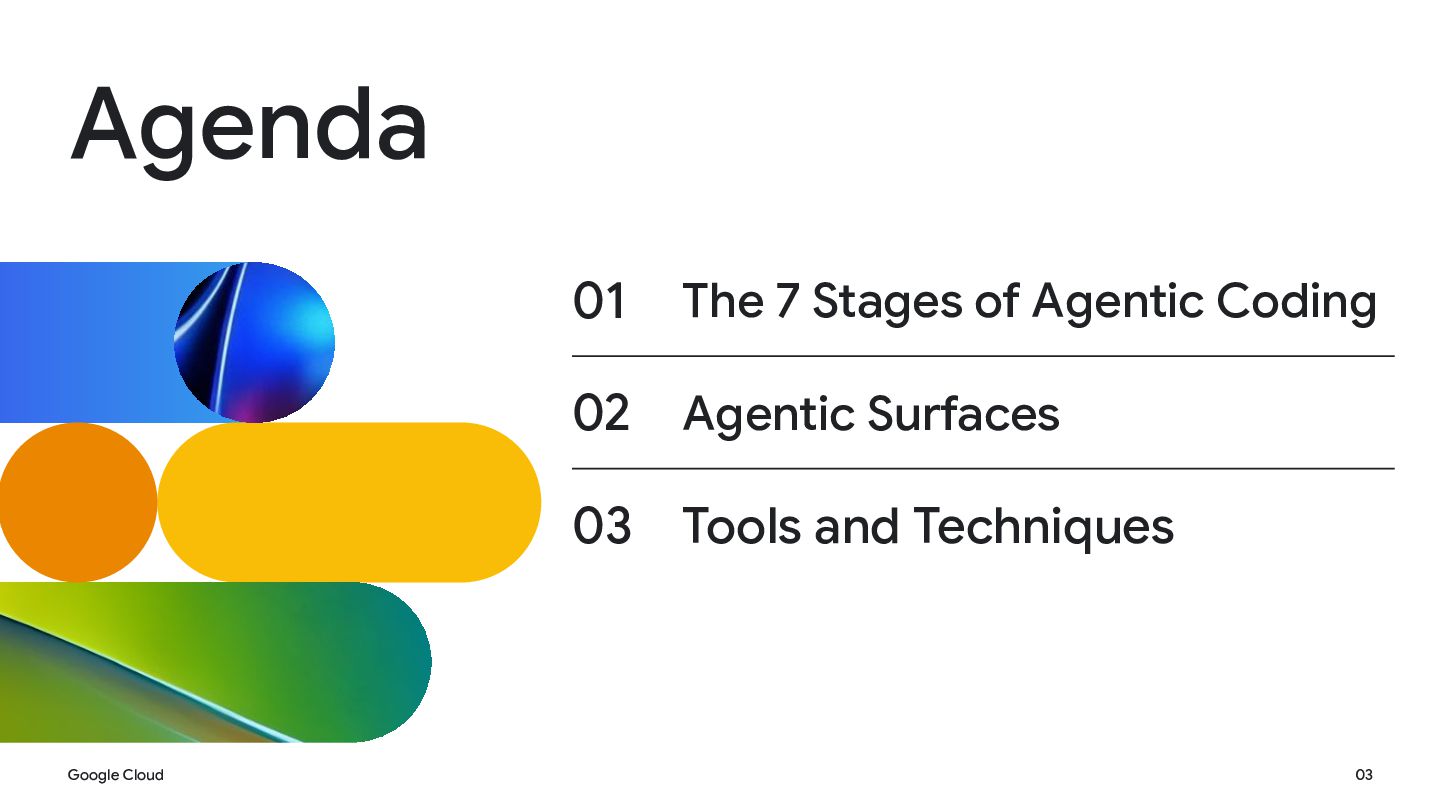
Agenda 01 The 7 Stages of Agentic Coding 02 Agentic
Surfaces 03 Tools and Techniques Google Cloud 03 -
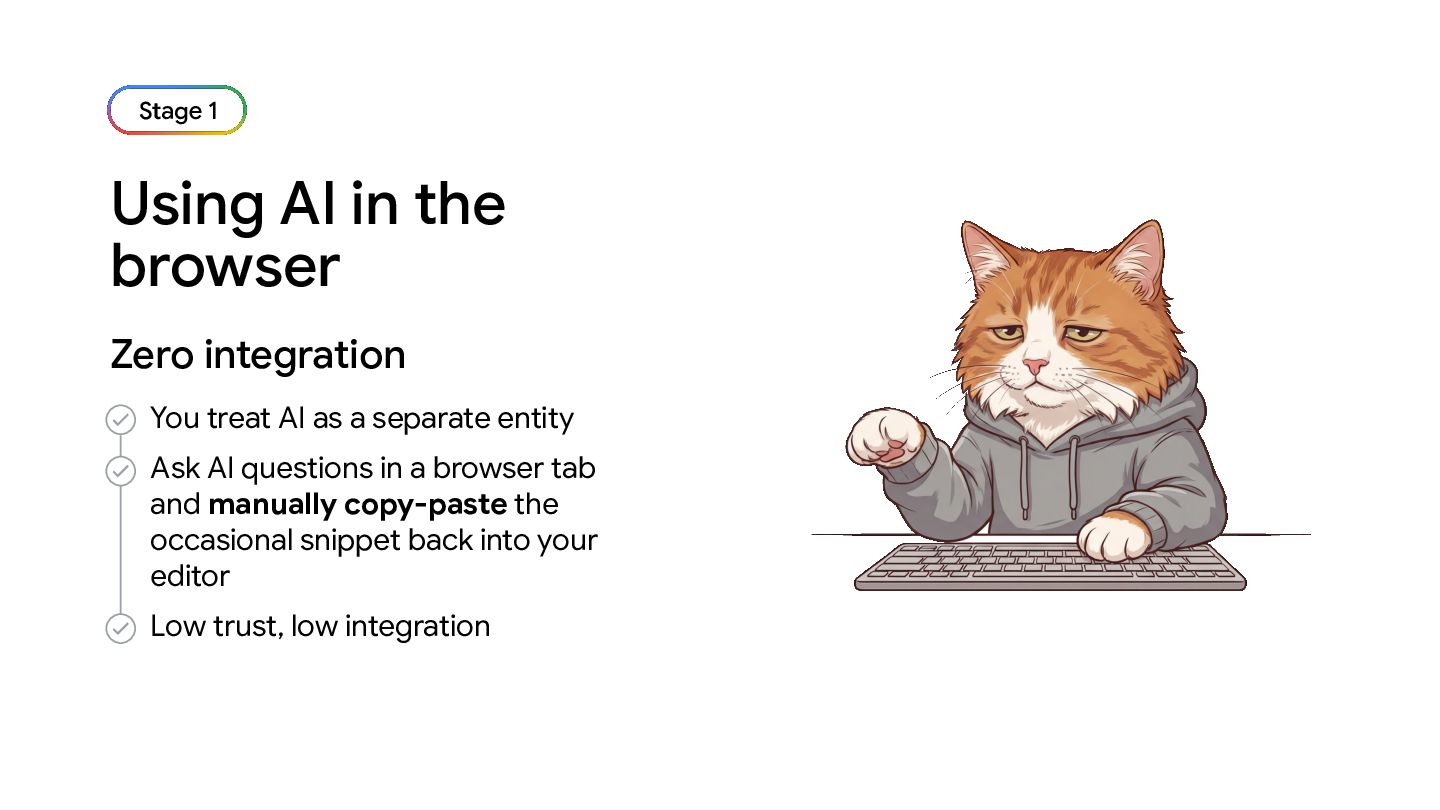
Stage 1 Using AI in the browser Zero integration You
treat AI as a separate entity Ask AI questions in a browser tab and manually copy-paste the occasional snippet back into your editor Low trust, low integration -
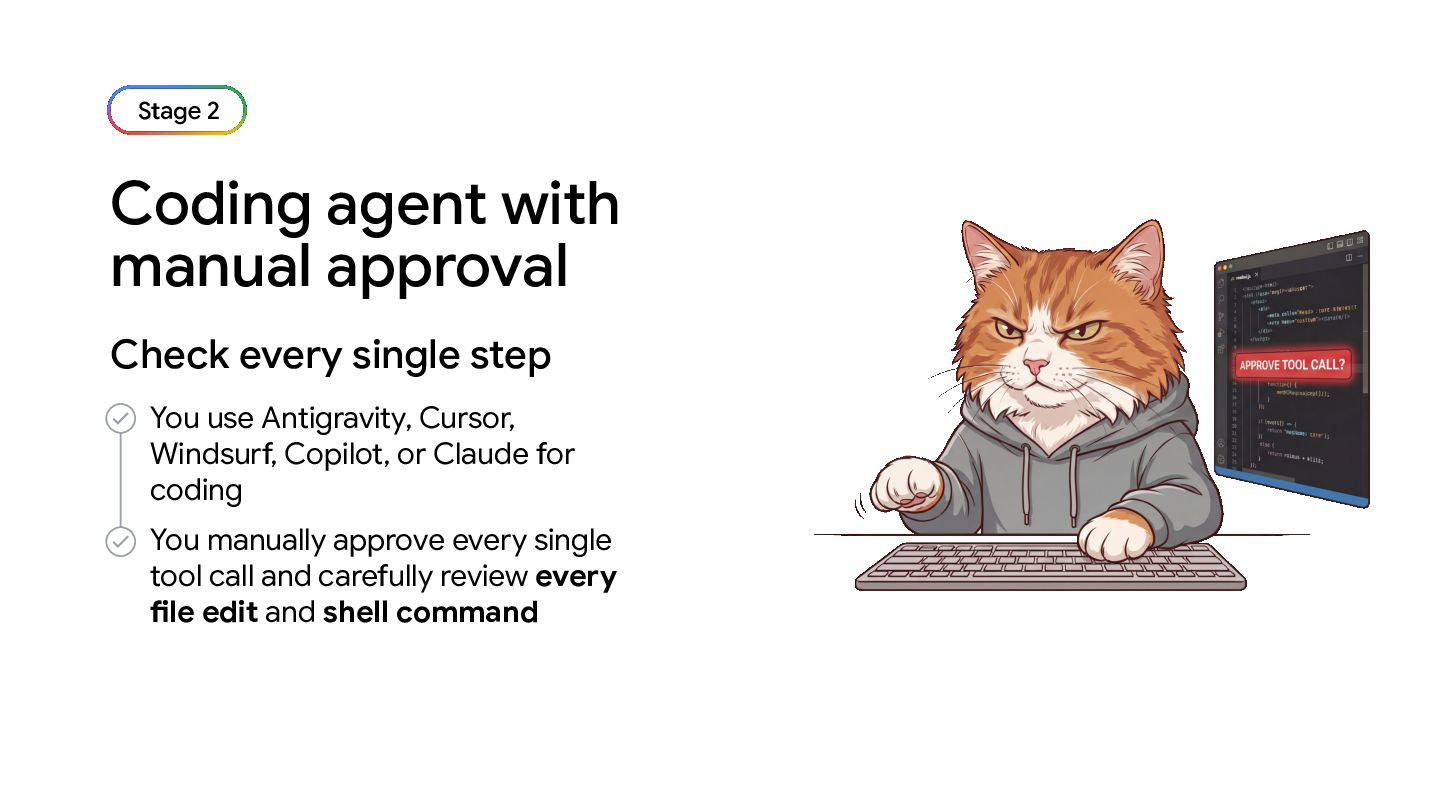
Stage 2 Coding agent with manual approval Check every single
step You use Antigravity, Cursor, Windsurf, Copilot, or Claude for coding You manually approve every single tool call and carefully review every file edit and shell command -
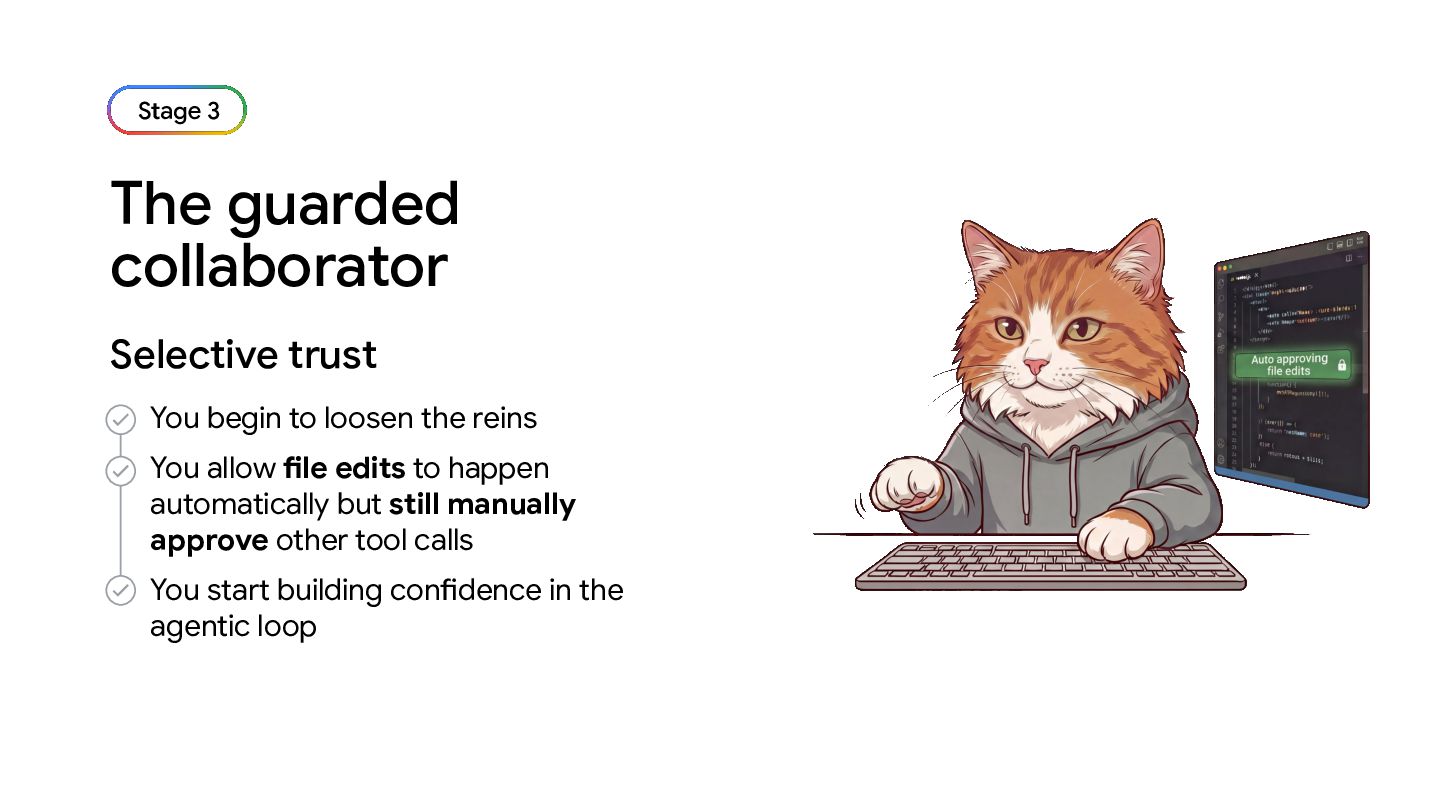
Stage 3 The guarded collaborator Selective trust You begin to
loosen the reins You allow file edits to happen automatically but still manually approve other tool calls You start building confidence in the agentic loop -
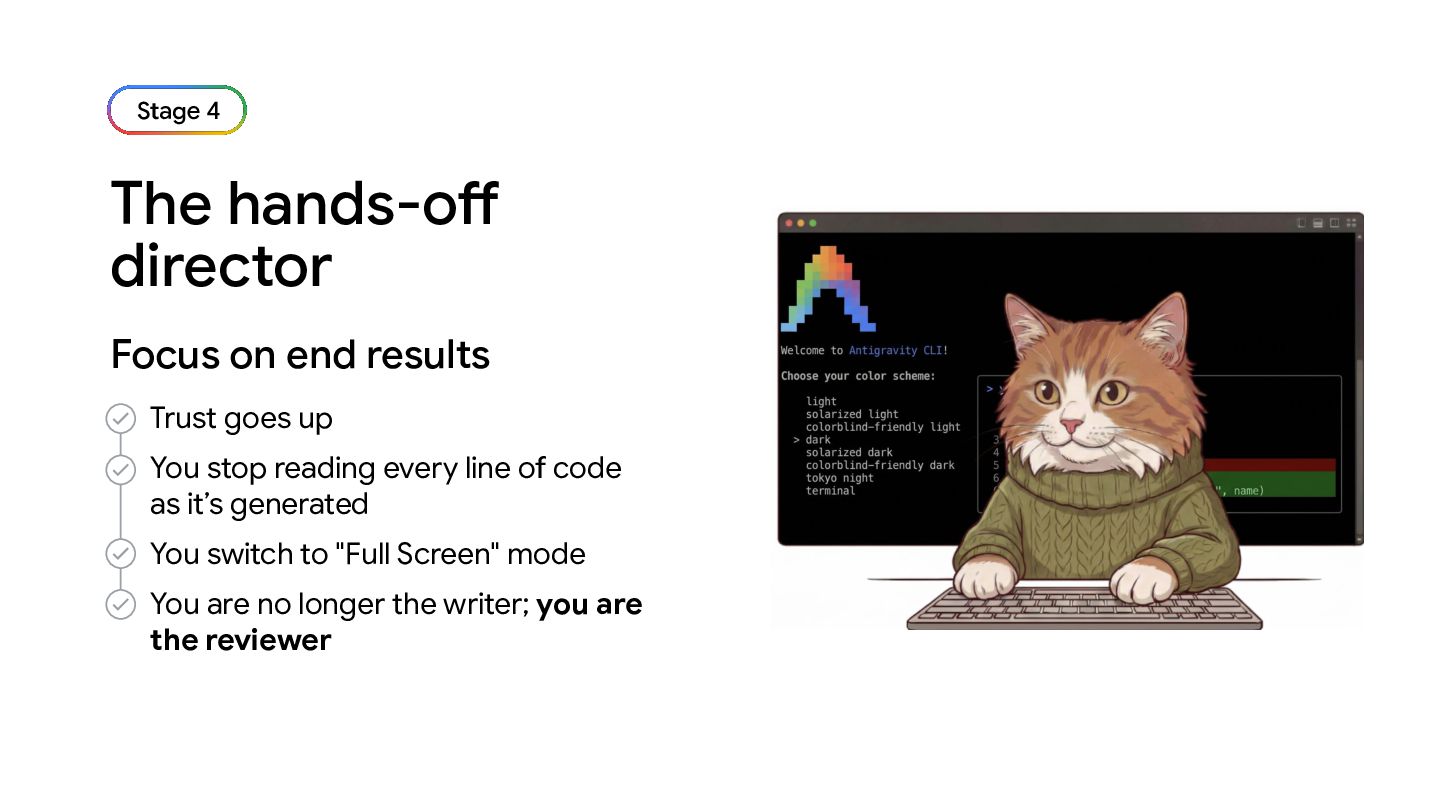
Stage 4 The hands-off director Focus on end results Trust
goes up You stop reading every line of code as it’s generated You switch to "Full Screen" mode You are no longer the writer; you are the reviewer -
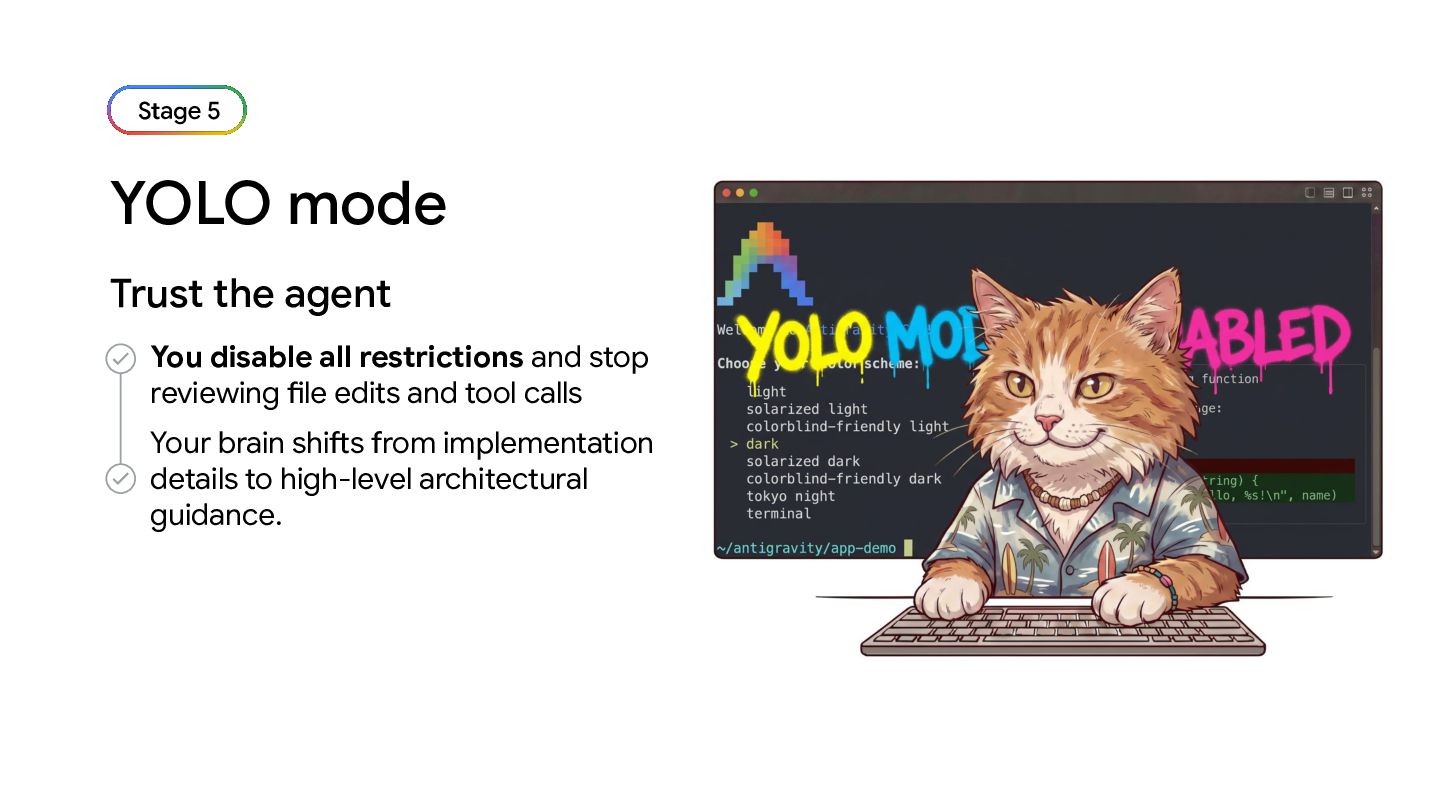
Stage 5 YOLO mode Trust the agent You disable all
restrictions and stop reviewing file edits and tool calls Your brain shifts from implementation details to high-level architectural guidance. -
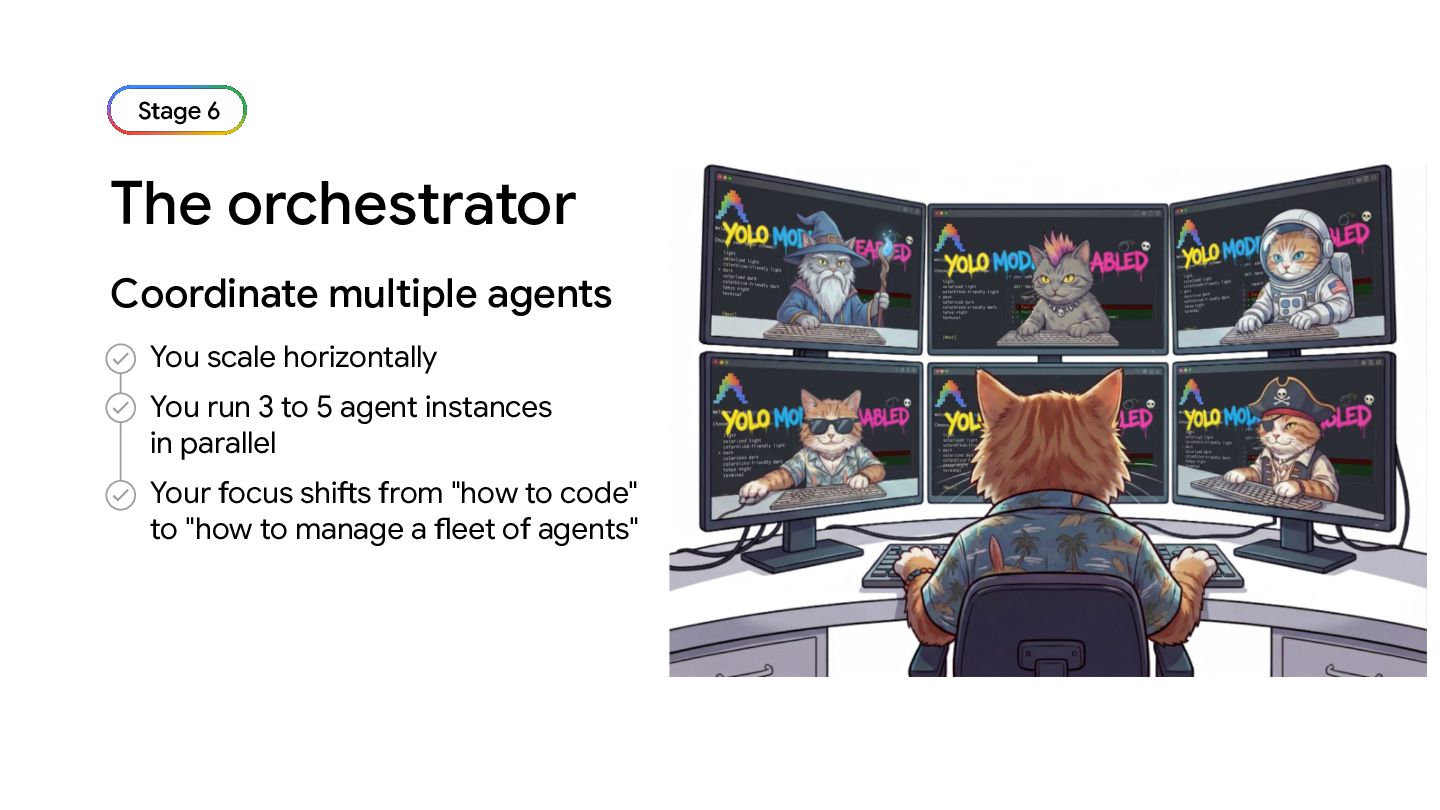
Stage 6 The orchestrator Coordinate multiple agents You scale horizontally
You run 3 to 5 agent instances in parallel Your focus shifts from "how to code" to "how to manage a fleet of agents" -
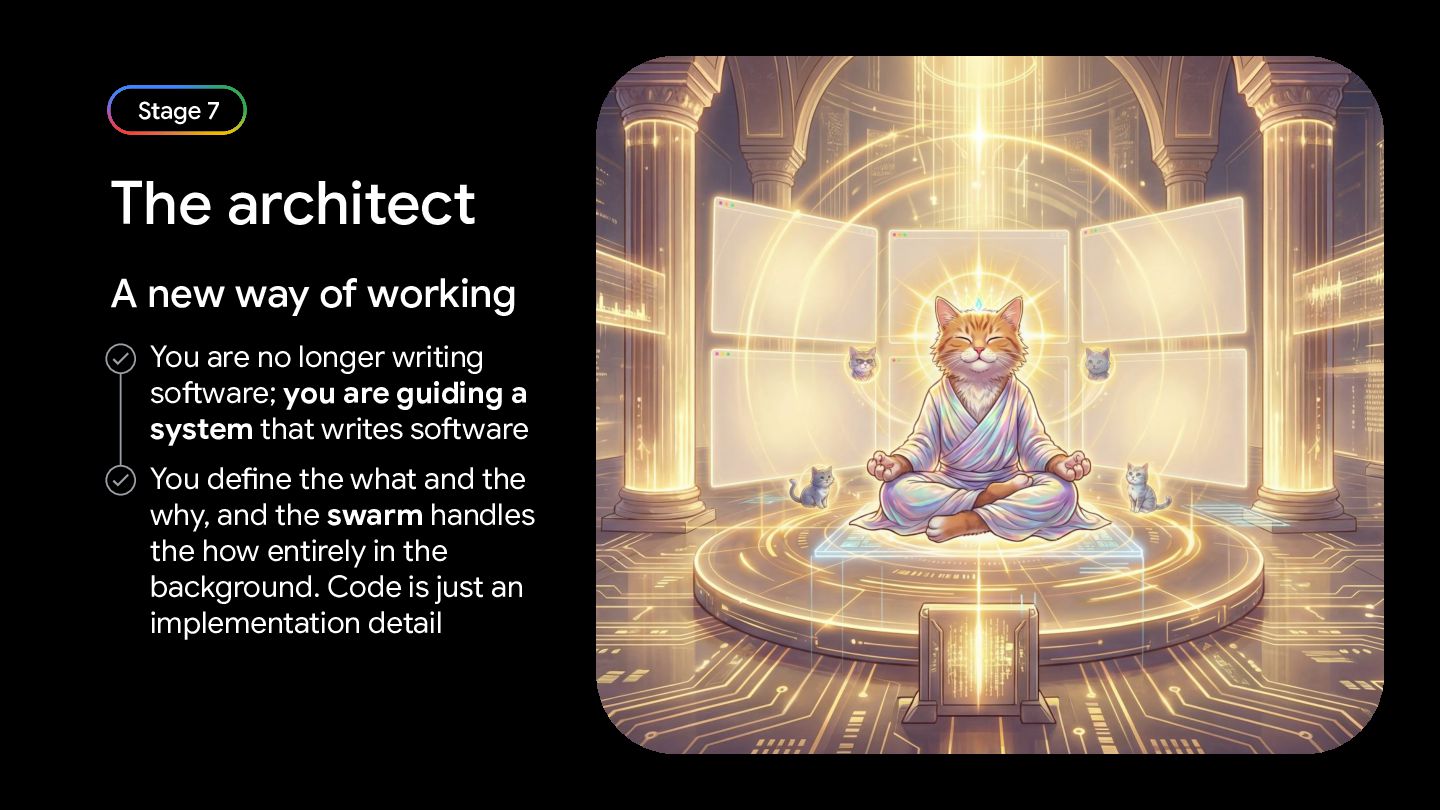
Stage 7 The architect A new way of working You
are no longer writing software; you are guiding a system that writes software You define the what and the why, and the swarm handles the how entirely in the background. Code is just an implementation detail -
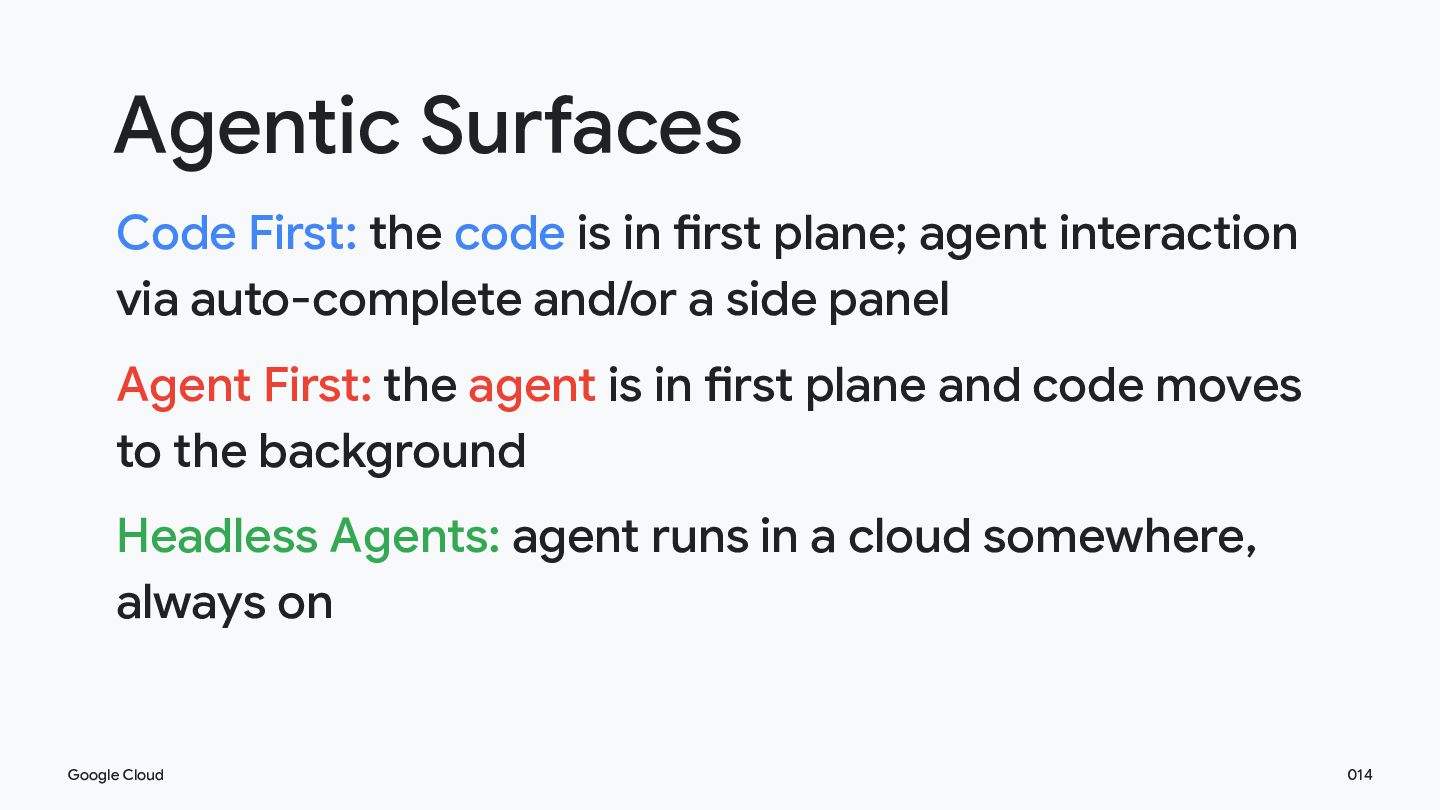
Agentic Surfaces Code First: the code is in first plane;
agent interaction via auto-complete and/or a side panel Agent First: the agent is in first plane and code moves to the background Headless Agents: agent runs in a cloud somewhere, always on Google Cloud 014 -
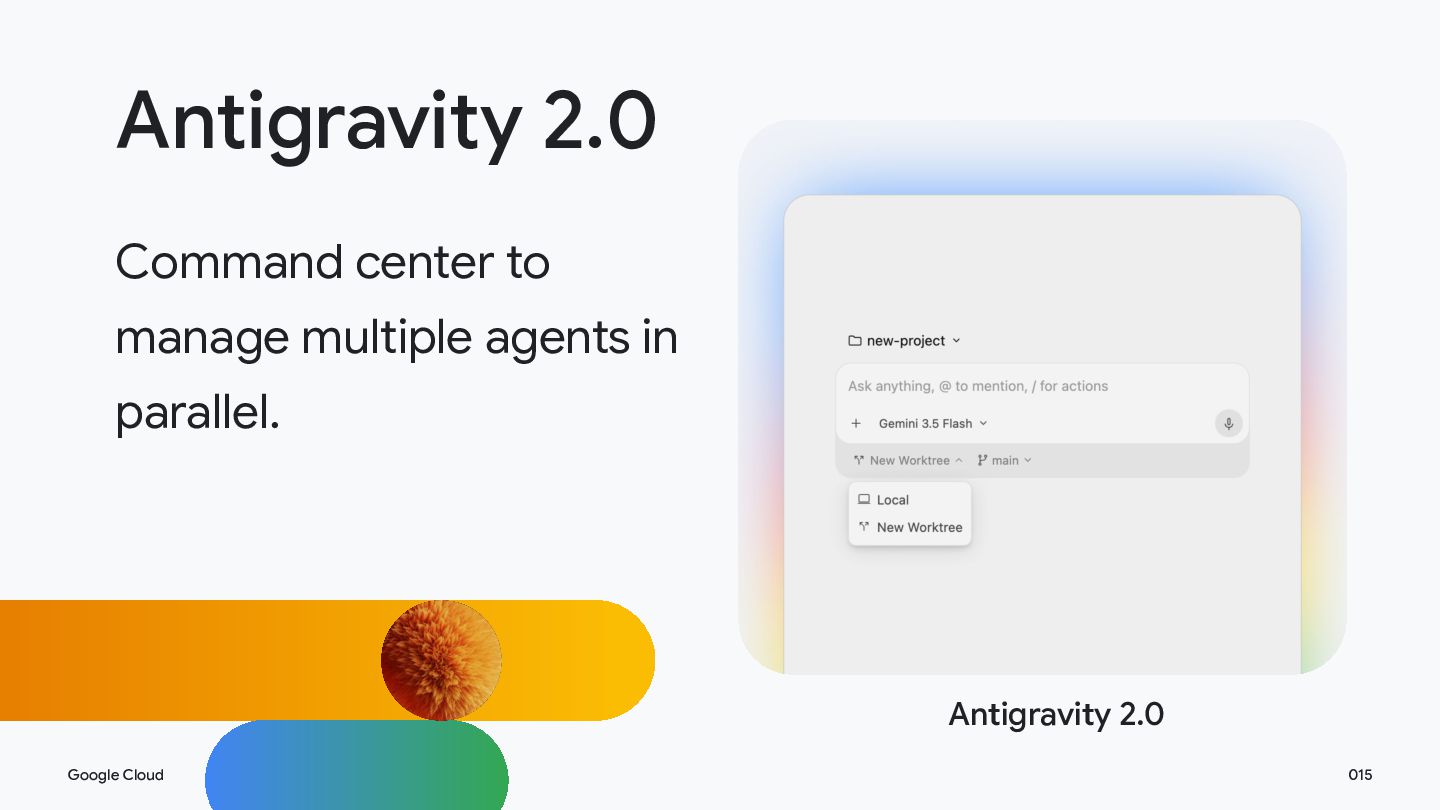
Antigravity 2.0 Command center to manage multiple agents in parallel.
Antigravity 2.0 Google Cloud 015 -
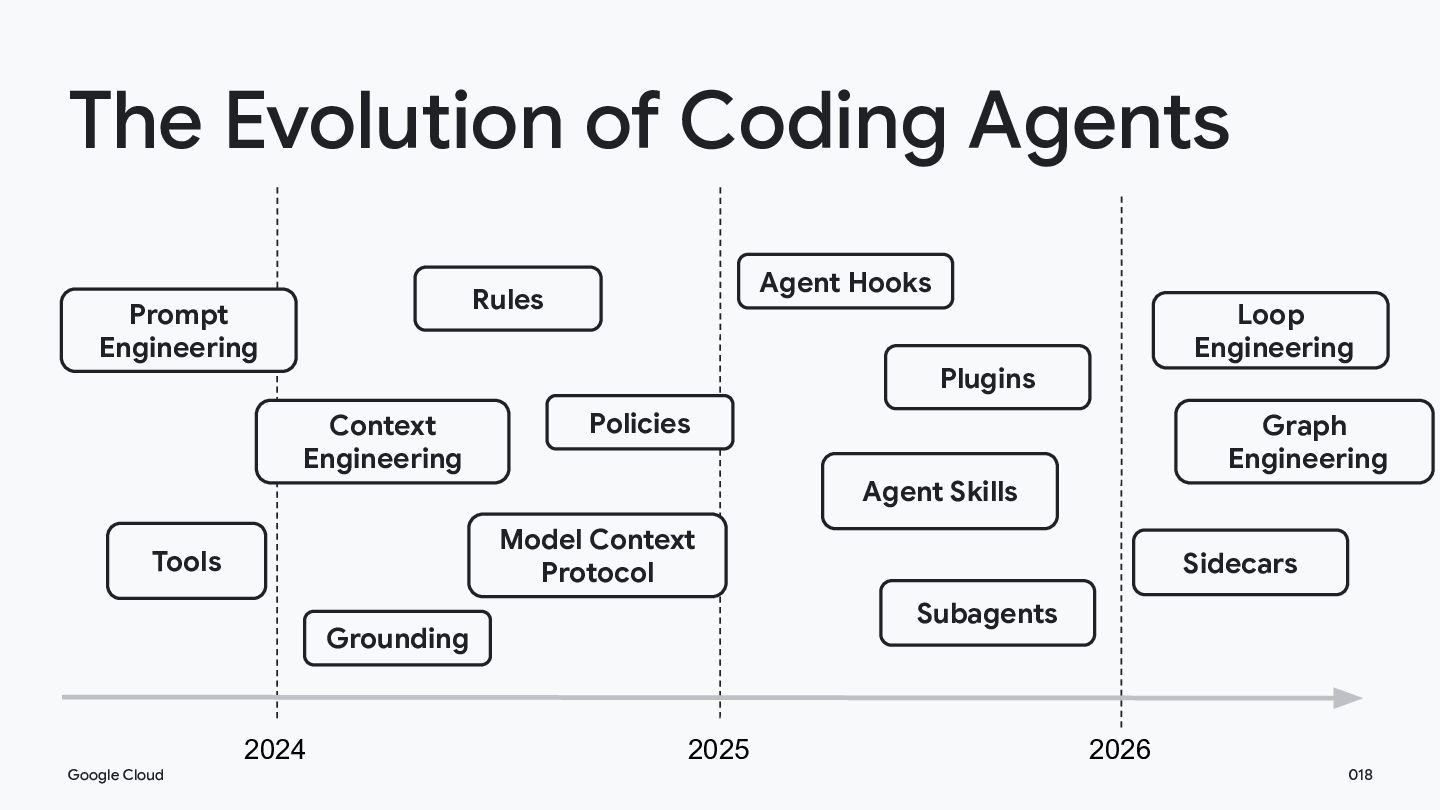
The Evolution of Coding Agents Agent Hooks Rules Prompt Engineering
Plugins Context Engineering Policies Graph Engineering Agent Skills Model Context Protocol Tools 2024 Sidecars Subagents Grounding Google Cloud Loop Engineering 2025 2026 018 -
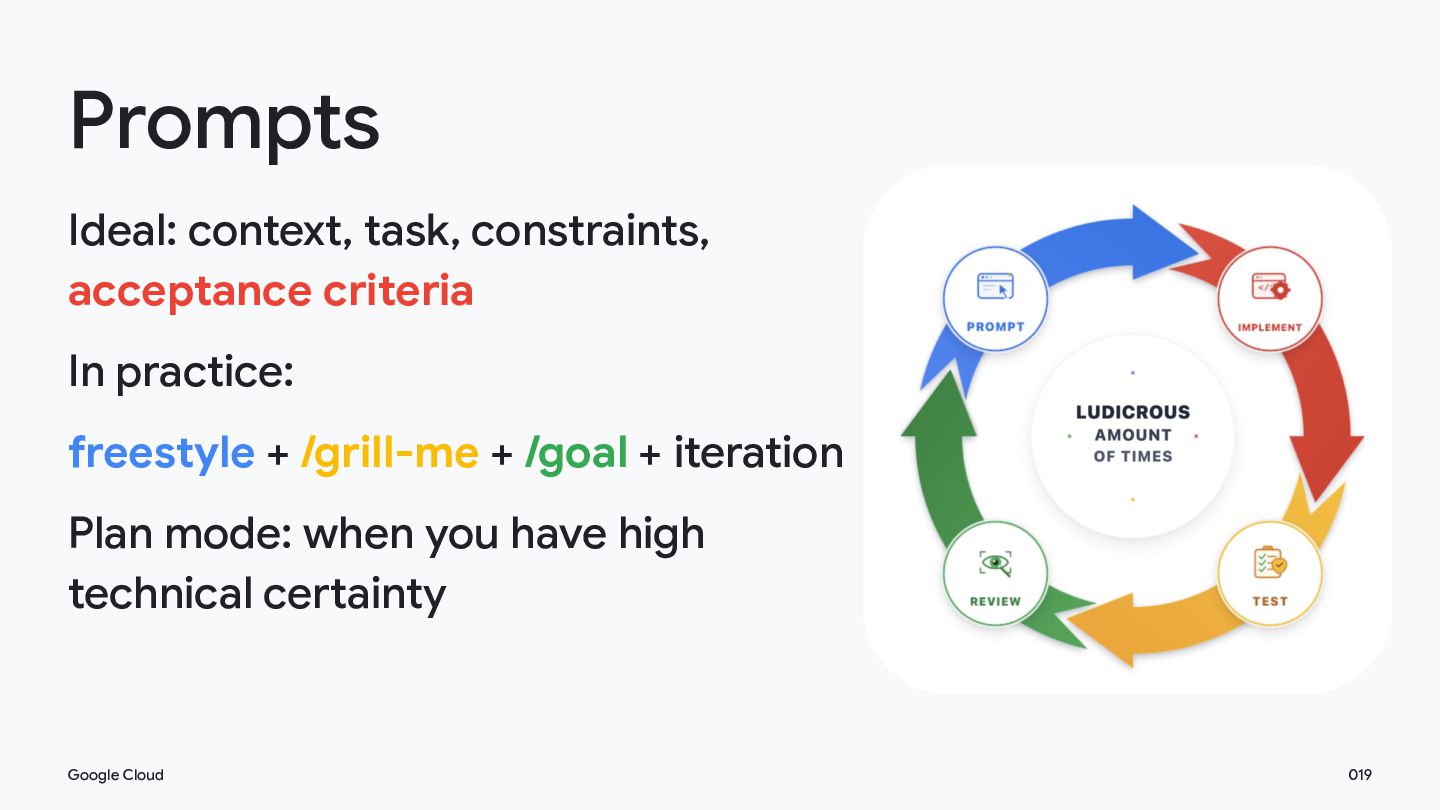
Prompts Ideal: context, task, constraints, acceptance criteria In practice: freestyle
+ /grill-me + /goal + iteration Plan mode: when you have high technical certainty Google Cloud 019 -
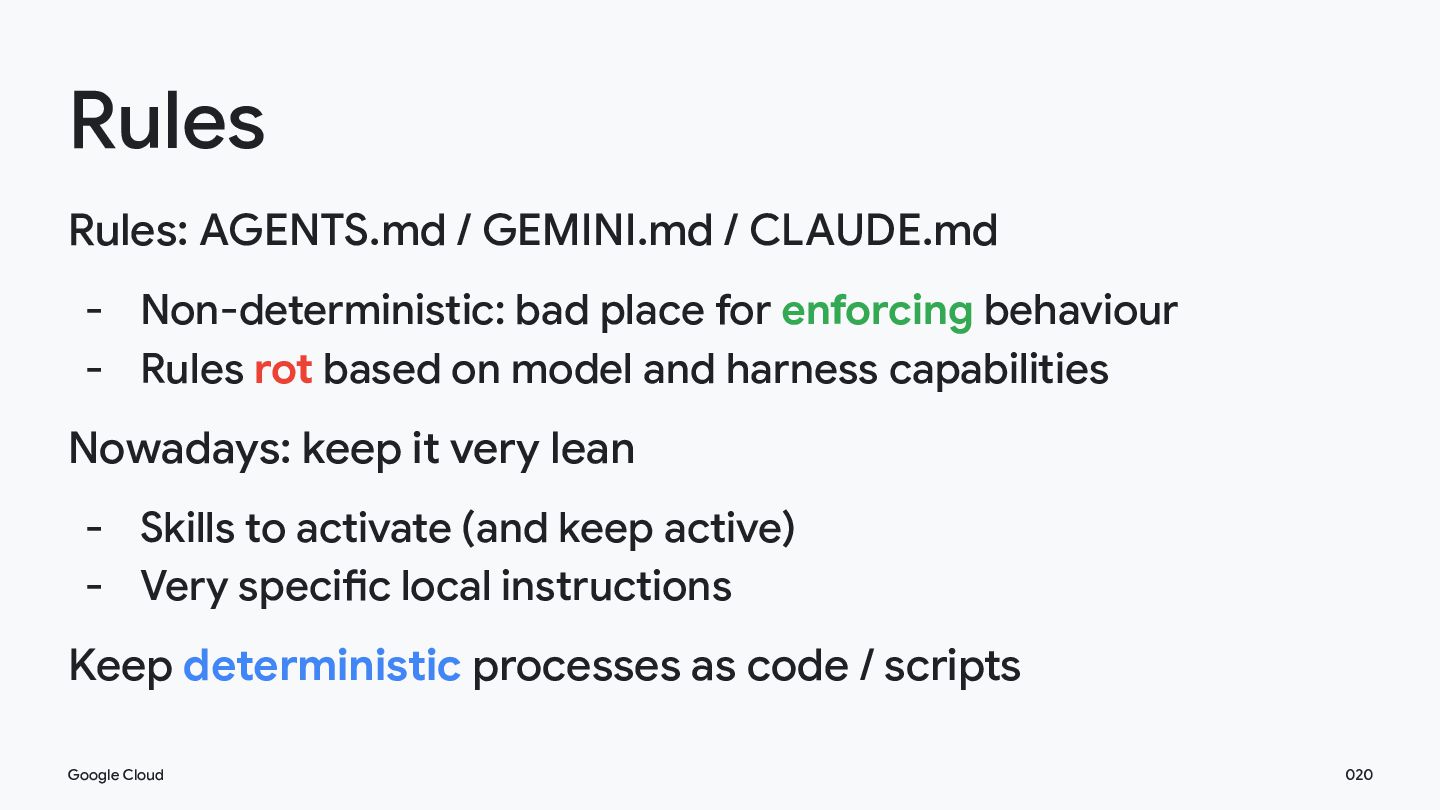
Rules Rules: AGENTS.md / GEMINI.md / CLAUDE.md - Non-deterministic: bad
place for enforcing behaviour - Rules rot based on model and harness capabilities Nowadays: keep it very lean - Skills to activate (and keep active) - Very specific local instructions Keep deterministic processes as code / scripts Google Cloud 020 -
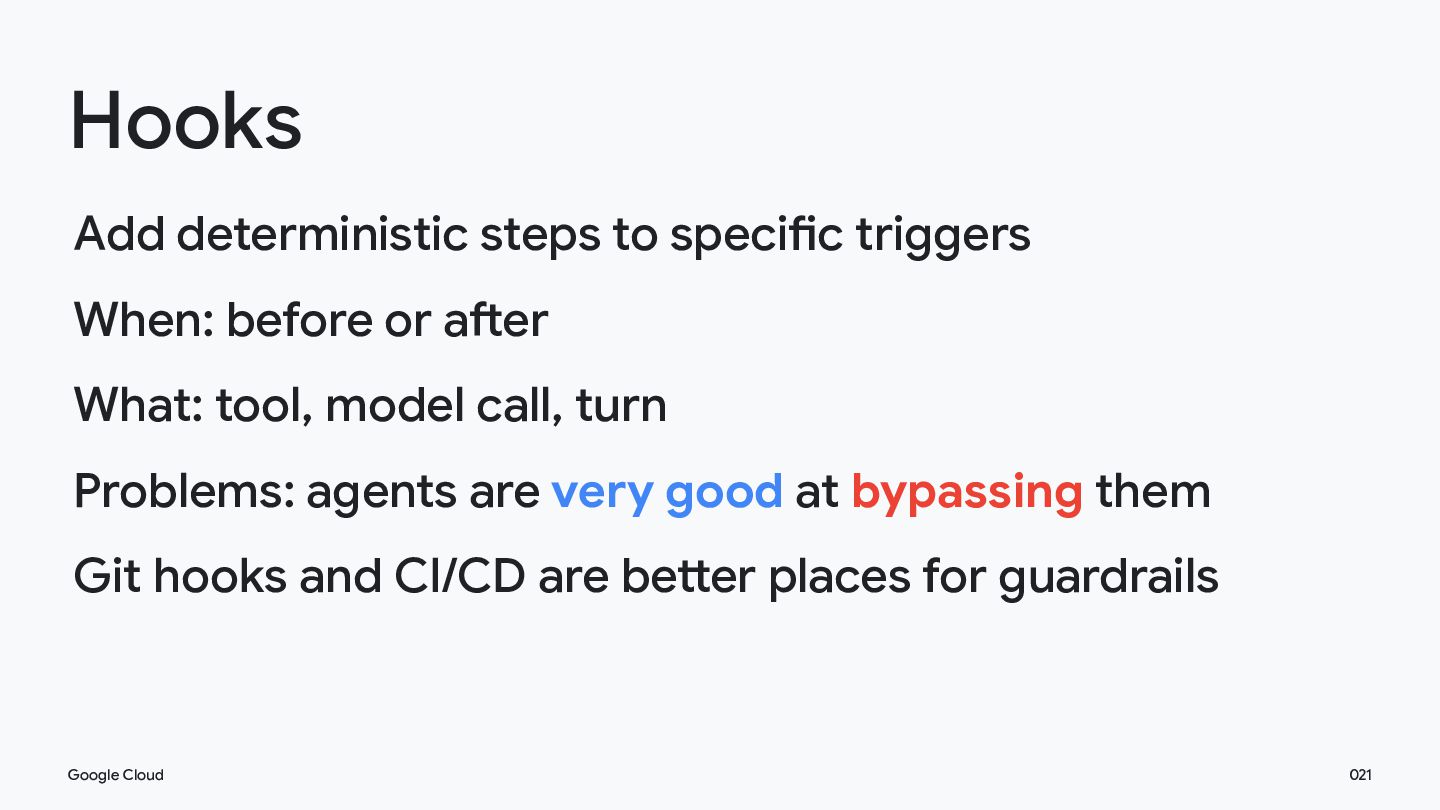
Hooks Add deterministic steps to specific triggers When: before or
after What: tool, model call, turn Problems: agents are very good at bypassing them Git hooks and CI/CD are better places for guardrails Google Cloud 021 -
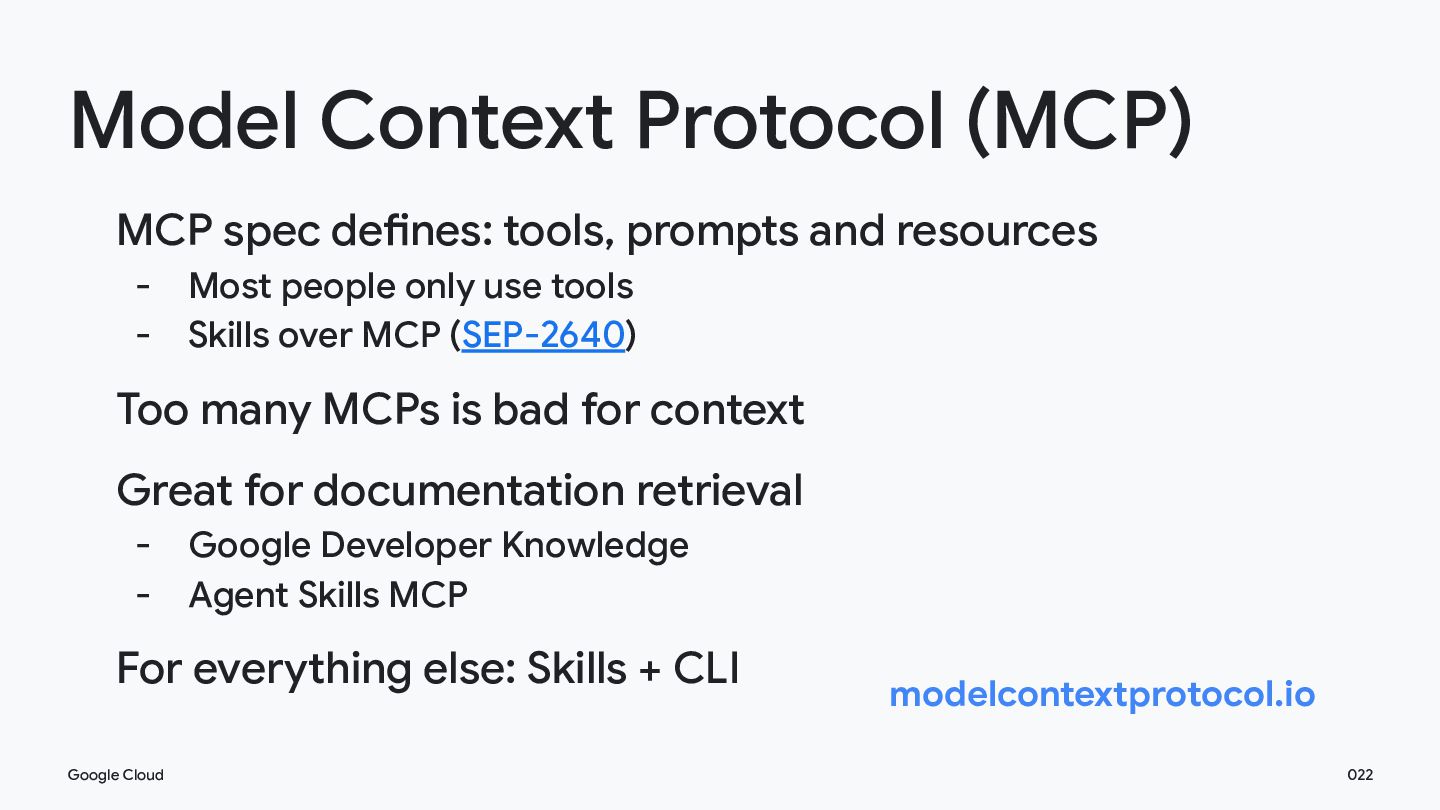
Model Context Protocol (MCP) MCP spec defines: tools, prompts and
resources - Most people only use tools - Skills over MCP (SEP-2640) Too many MCPs is bad for context Great for documentation retrieval - Google Developer Knowledge - Agent Skills MCP For everything else: Skills + CLI Google Cloud modelcontextprotocol.io 022 -
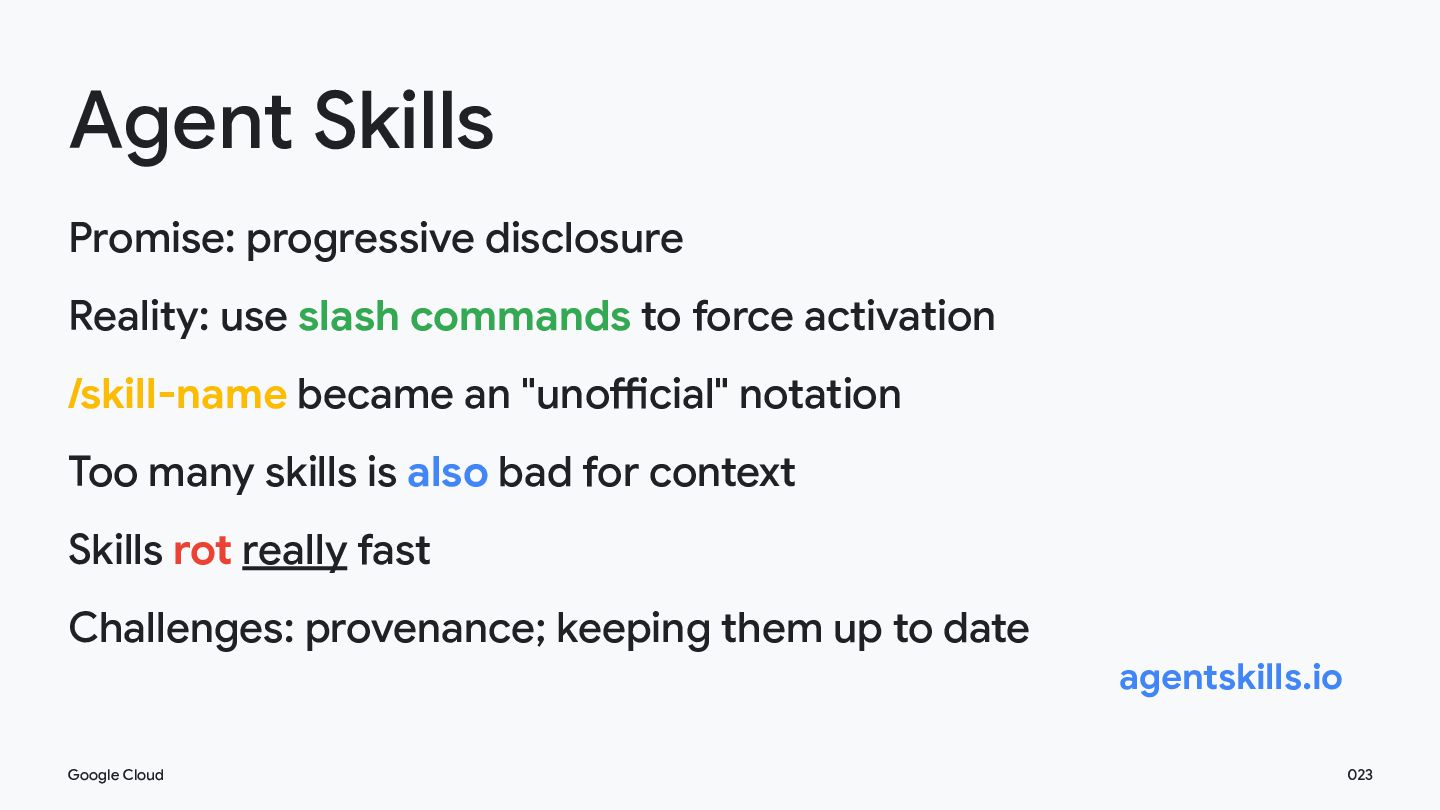
Agent Skills Promise: progressive disclosure Reality: use slash commands to
force activation /skill-name became an "unofficial" notation Too many skills is also bad for context Skills rot really fast Challenges: provenance; keeping them up to date agentskills.io Google Cloud 023 -
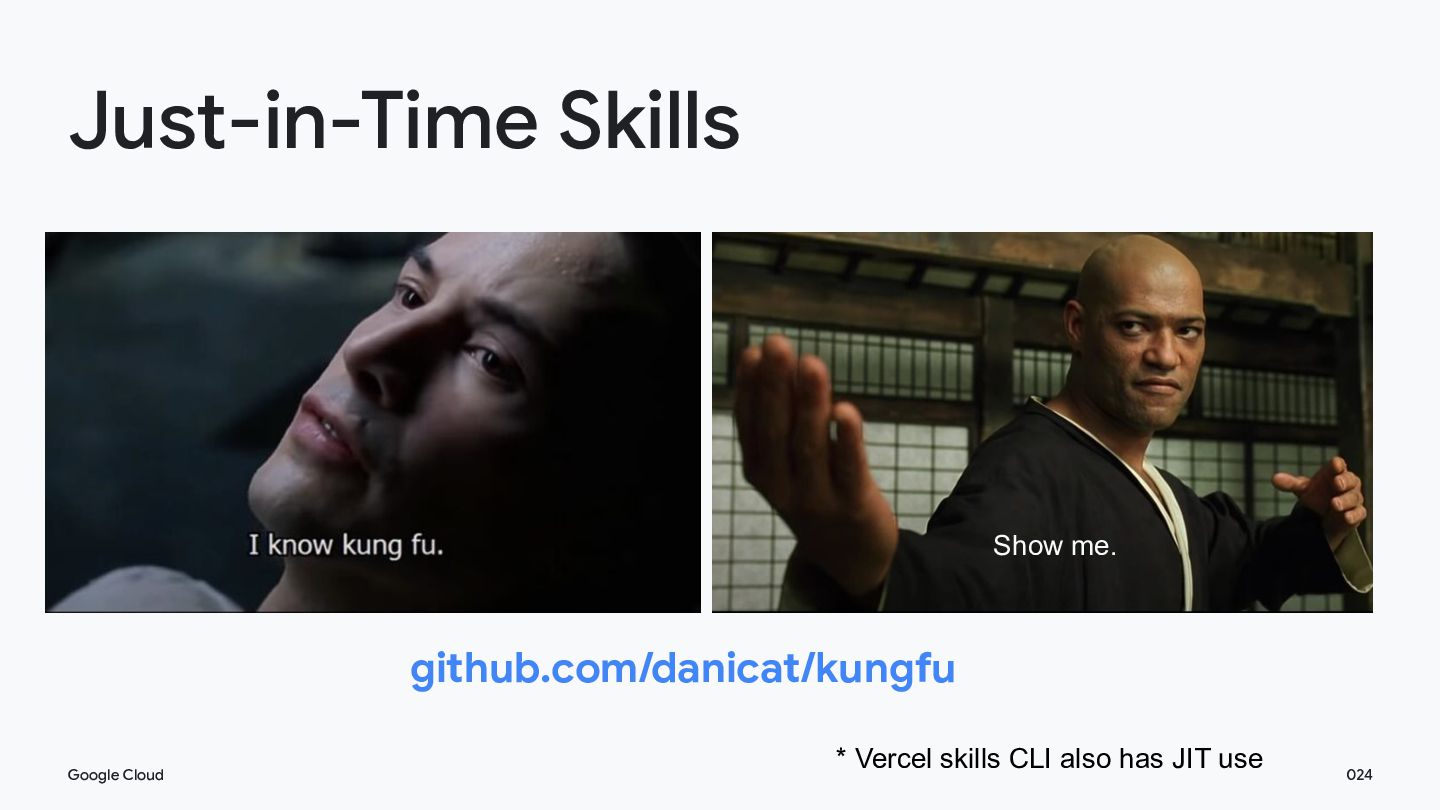
Just-in-Time Skills Show me. github.com/danicat/kungfu Google Cloud * Vercel skills
CLI also has JIT use 024 -
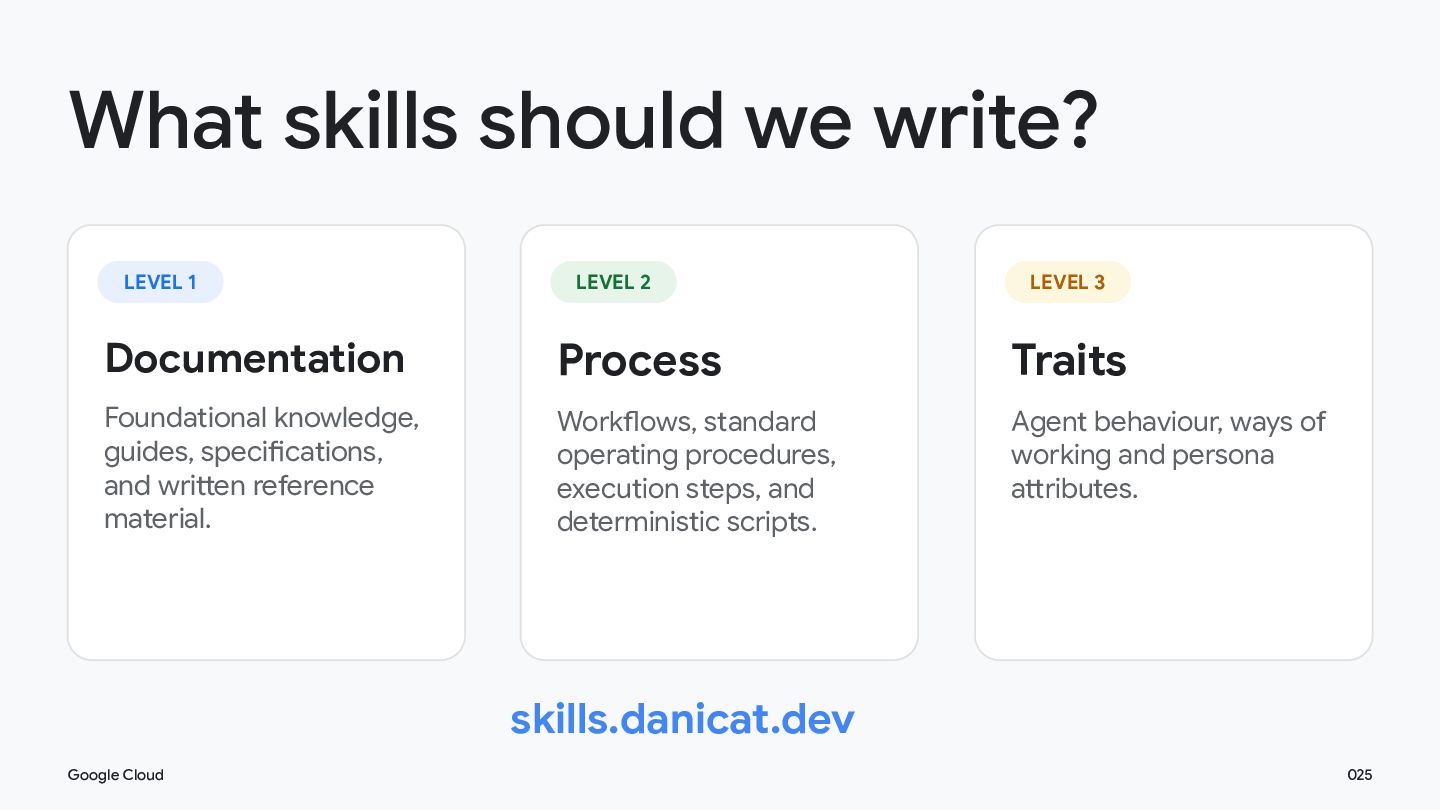
What skills should we write? LEVEL 1 LEVEL 2 LEVEL
3 Documentation Process Traits Foundational knowledge, guides, specifications, and written reference material. Workflows, standard operating procedures, execution steps, and deterministic scripts. Agent behaviour, ways of working and persona attributes. skills.danicat.dev Google Cloud 025 -
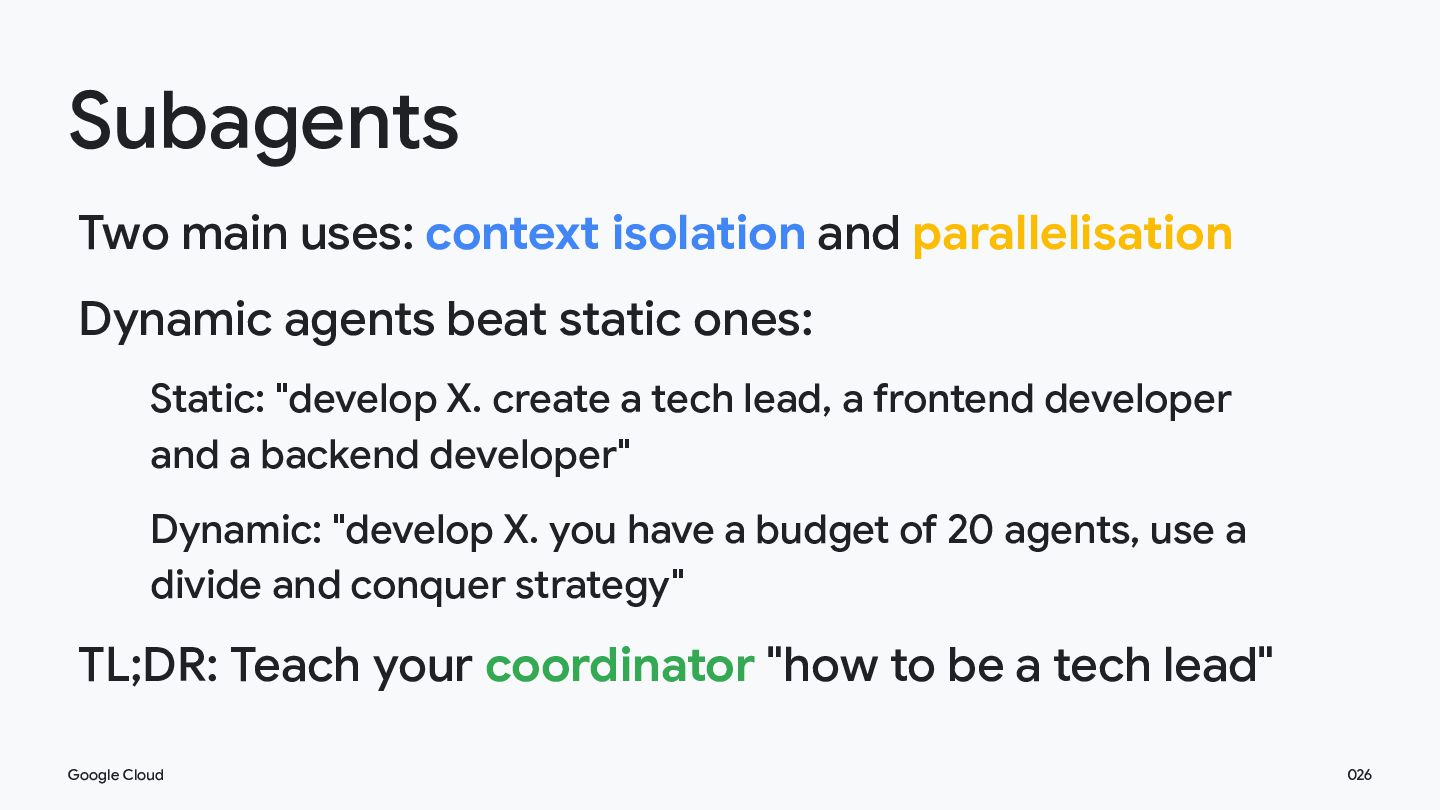
Subagents Two main uses: context isolation and parallelisation Dynamic agents
beat static ones: Static: "develop X. create a tech lead, a frontend developer and a backend developer" Dynamic: "develop X. you have a budget of 20 agents, use a divide and conquer strategy" TL;DR: Teach your coordinator "how to be a tech lead" Google Cloud 026 -
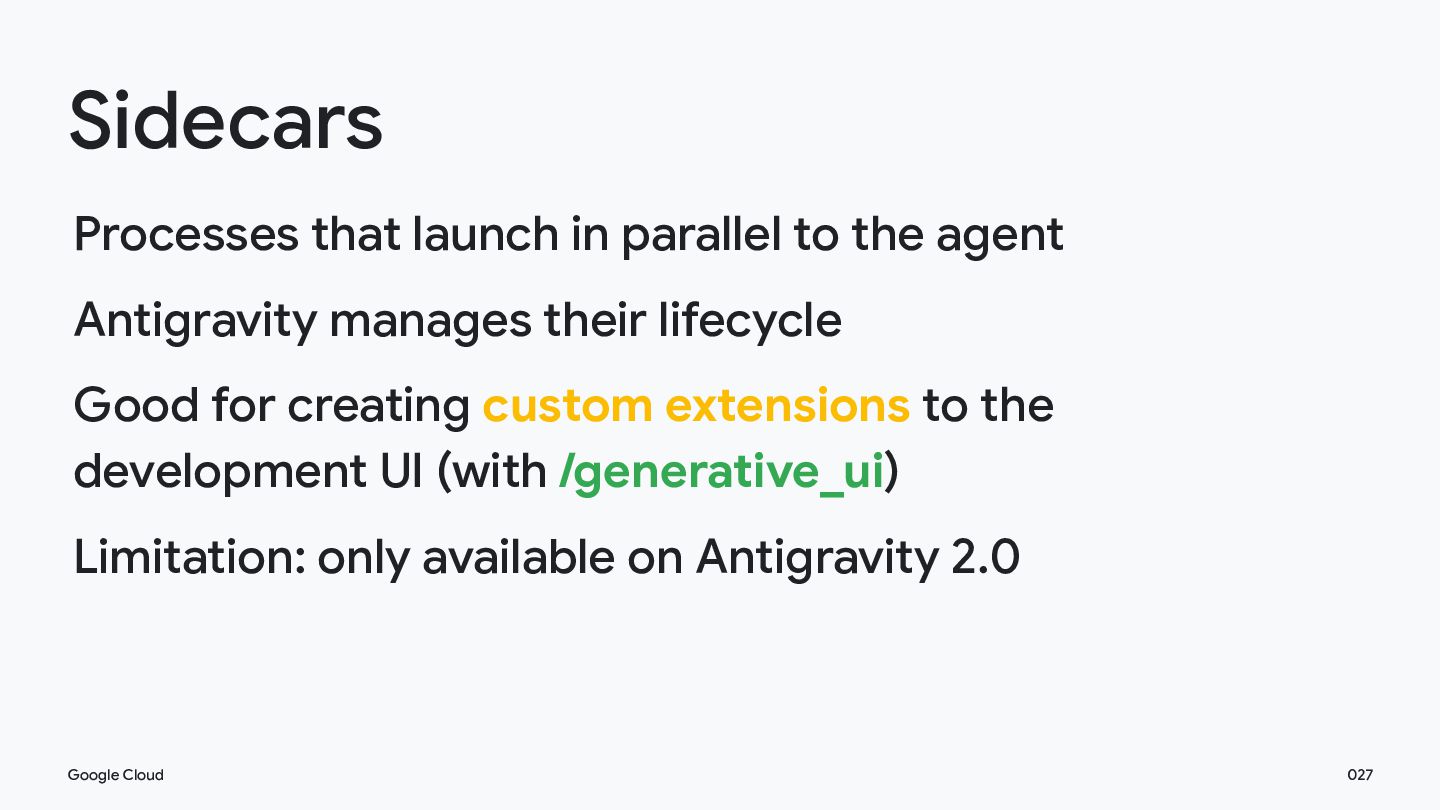
Sidecars Processes that launch in parallel to the agent Antigravity
manages their lifecycle Good for creating custom extensions to the development UI (with /generative_ui) Limitation: only available on Antigravity 2.0 Google Cloud 027 -
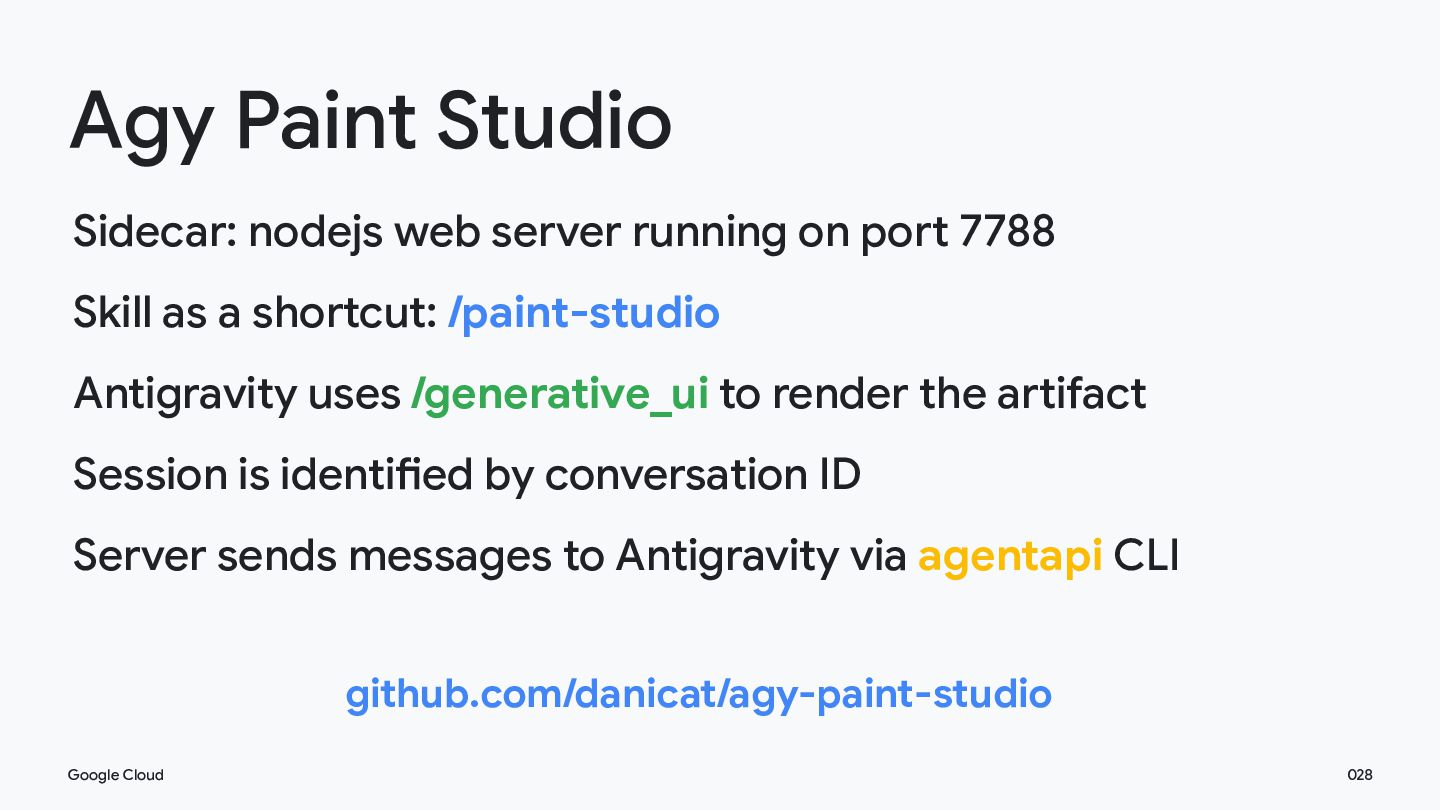
Agy Paint Studio Sidecar: nodejs web server running on port
7788 Skill as a shortcut: /paint-studio Antigravity uses /generative_ui to render the artifact Session is identified by conversation ID Server sends messages to Antigravity via agentapi CLI github.com/danicat/agy-paint-studio Google Cloud 028 -
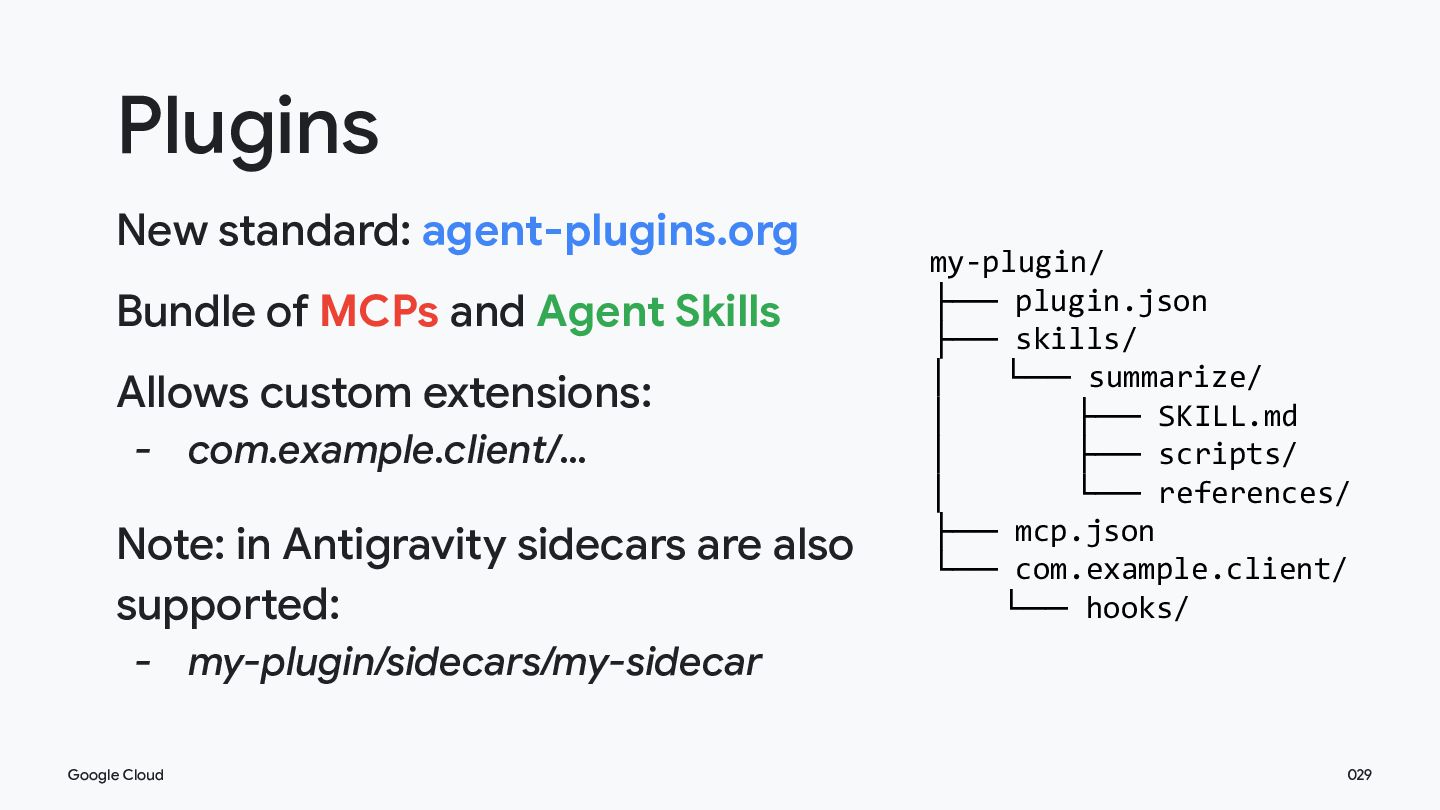
Plugins New standard: agent-plugins.org Bundle of MCPs and Agent Skills
Allows custom extensions: - com.example.client/… Note: in Antigravity sidecars are also supported: my-plugin/ ├── plugin.json ├── skills/ │ └── summarize/ │ ├── SKILL.md │ ├── scripts/ │ └── references/ ├── mcp.json └── com.example.client/ └── hooks/ - my-plugin/sidecars/my-sidecar Google Cloud 029 -
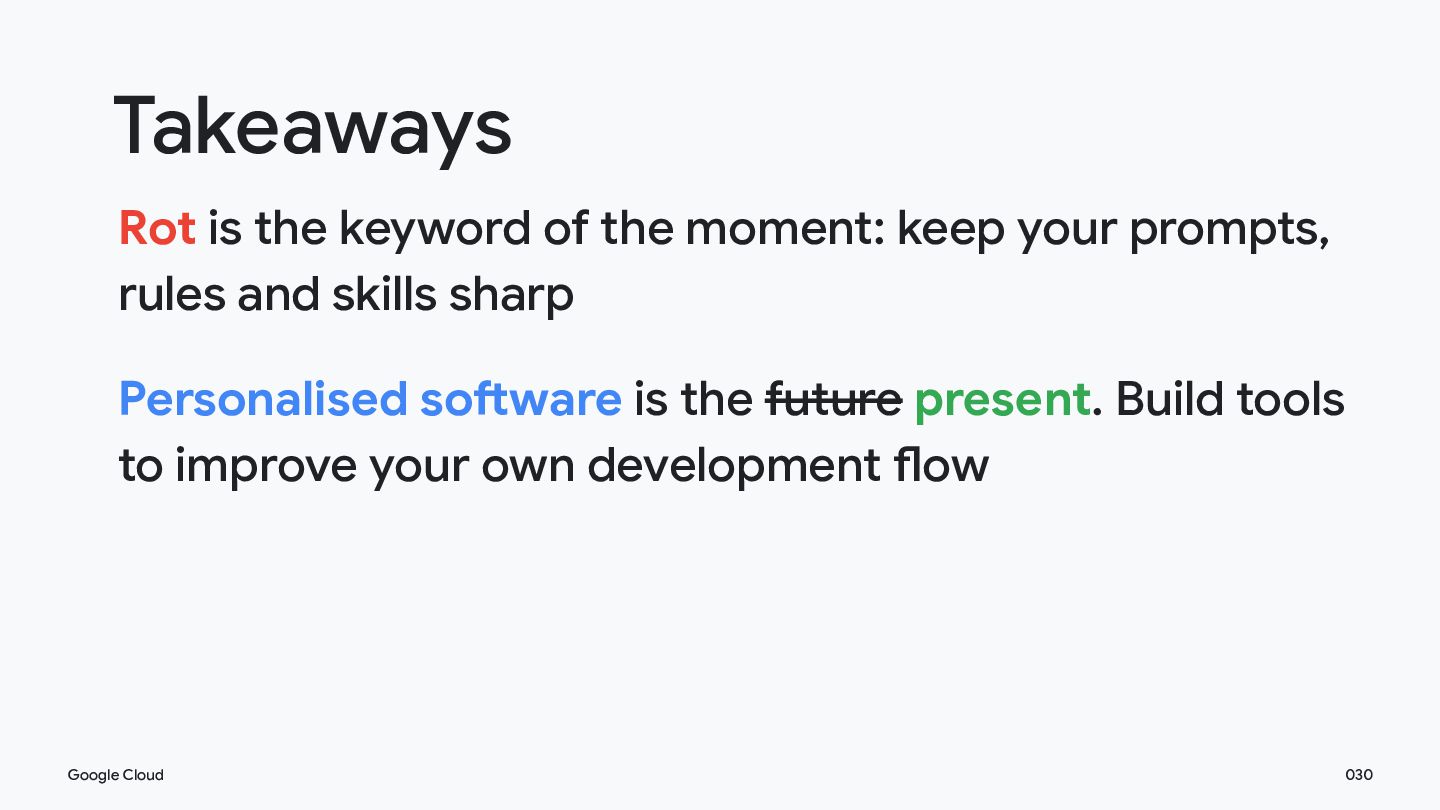
Takeaways Rot is the keyword of the moment: keep your
prompts, rules and skills sharp Personalised software is the future present. Build tools to improve your own development flow Google Cloud 030