Upgrade to Pro — share decks privately, control downloads, hide ads and more …

Foundational Framing: What is Data Governance?

Sponsored · Ship Features Fearlessly Turn features on and off without deploys. Used by thousands of Ruby developers.

Foundational Framing: What is Data Governance?

This deck, "Foundational Framing: What is Data Governance?" from the African Development Bank Institute's Leading Edge Insights Series, opens by reframing data as valuable only through its rules, connections, and context rather than as a standalone asset. It argues that data governance is fundamentally a political question — about who decides, through what process, and on whose behalf — rather than a purely technical matter. Drawing on cases like M-Pesa and digital ID systems, it shows Africa as data-rich yet often power-poor, given dependencies such as a single Google Cloud region for the continent and foreign-norm-embedding donor-funded infrastructure

Avatar for Dominic Orr

Dominic Orr

July 03, 2026

More Decks by Dominic Orr

Other Decks in Technology

Transcript

  1. DATA VALUE We are used to speaking about data as

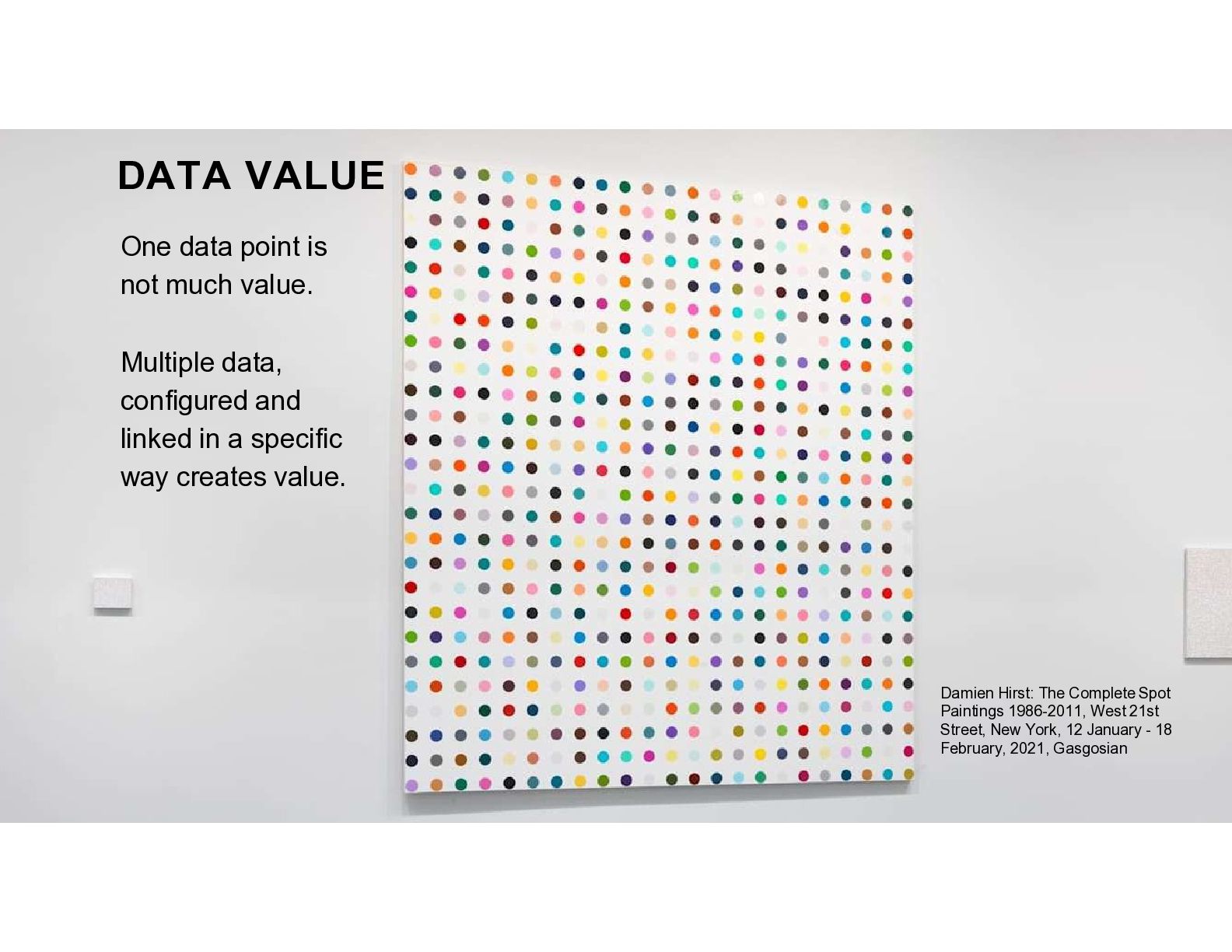
    an asset without recognising that it is the rules, connections and the context of the data points that actually create value. In a Spot Painting by Damian Hirst (2012), no single dot means anything alone. Its meaning is created entirely by its position within the pre-determined grid, its colour relative to every other colour, and the general rules. Damien Hirst: The Complete Spot Paintings 1986-2011, West 21st Street, New York, 12 January - 18 February, 2021, Gasgosian DATA VALUE One data point is not much value. Multiple data, configured and linked in a specific way creates value.
  2. We are used to speaking about data as an asset

    without recognising that it is the rules, connections and the context of the data points that actually create value. In a Spot Painting by Damien Hirst (2012), no single dot means anything alone. Its meaning is created entirely by its position within the pre-determined grid, its colour relative to every other colour, and the general rules.
  3. GOVERNANCE IS A POLITICAL QUESTION Who decides? By what process?

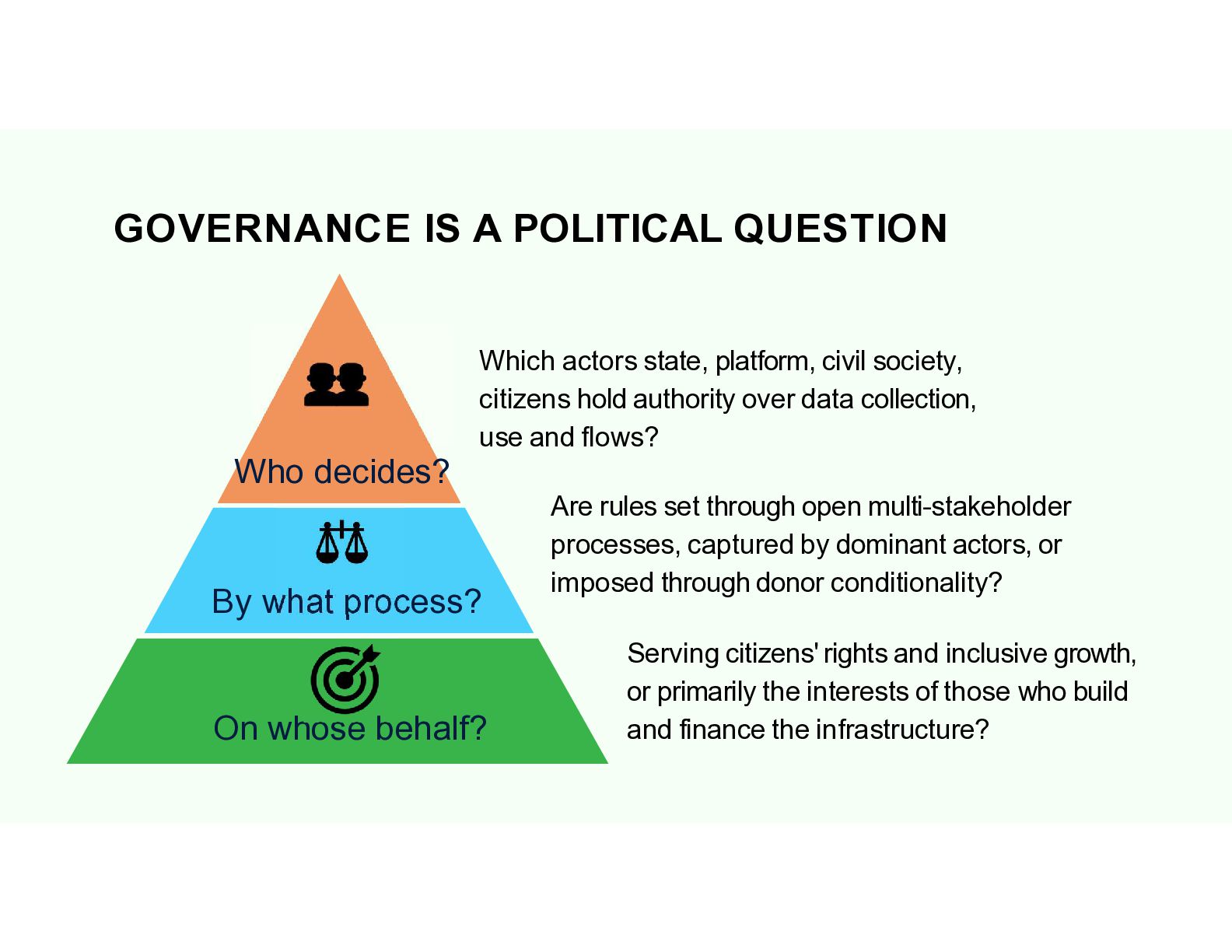
    On whose behalf? Which actors state, platform, civil society, citizens hold authority over data collection, use and flows? Are rules set through open multi-stakeholder processes, captured by dominant actors, or imposed through donor conditionality? Serving citizens' rights and inclusive growth, or primarily the interests of those who build and finance the infrastructure?
  4. AFRICA: DATA-RICH, BUT POWER-POOR? THE ASSET CASE THE STRUCTURAL TENSION

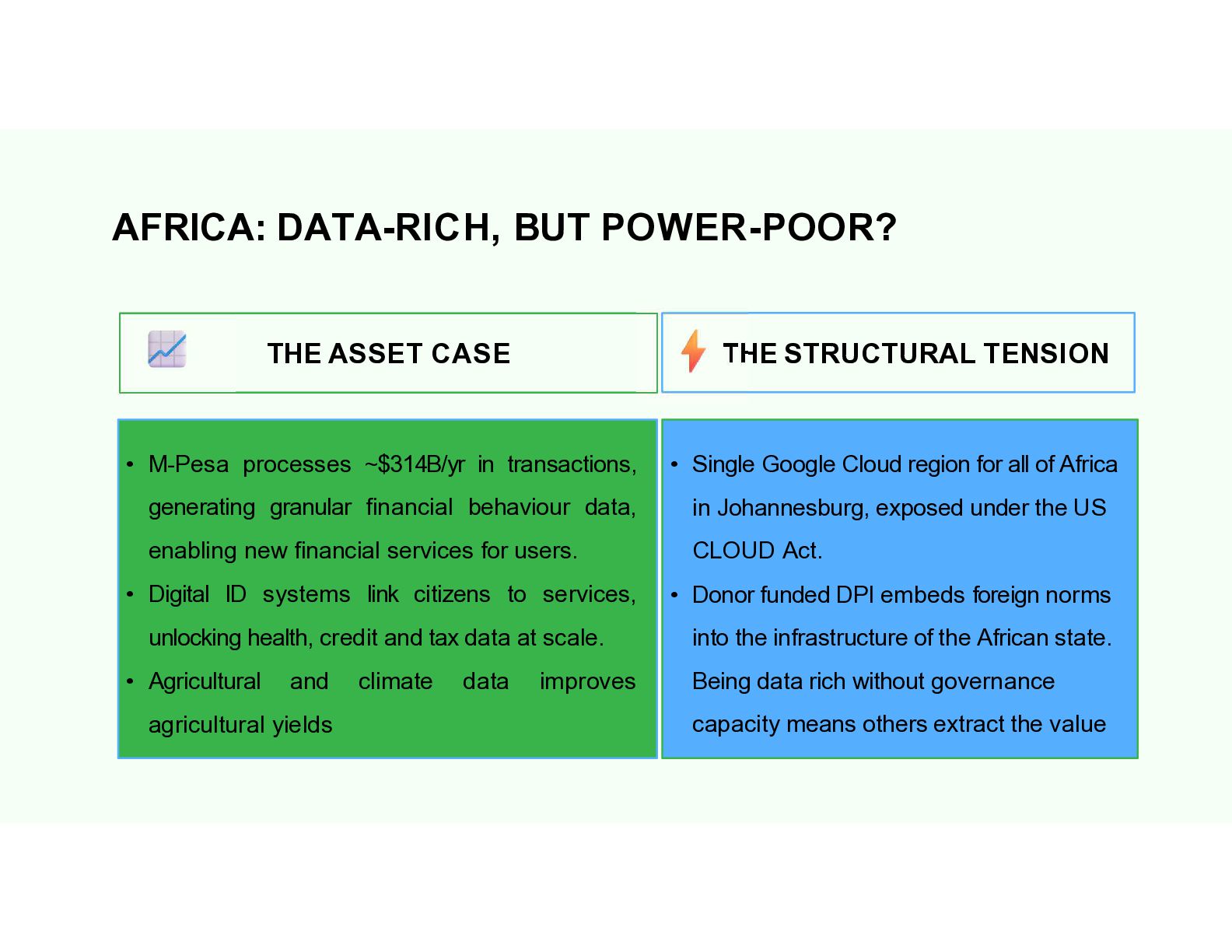
    • M-Pesa processes ~$314B/yr in transactions, generating granular financial behaviour data, enabling new financial services for users. • Digital ID systems link citizens to services, unlocking health, credit and tax data at scale. • Agricultural and climate data improves agricultural yields • Single Google Cloud region for all of Africa in Johannesburg, exposed under the US CLOUD Act. • Donor funded DPI embeds foreign norms into the infrastructure of the African state. Being data rich without governance capacity means others extract the value
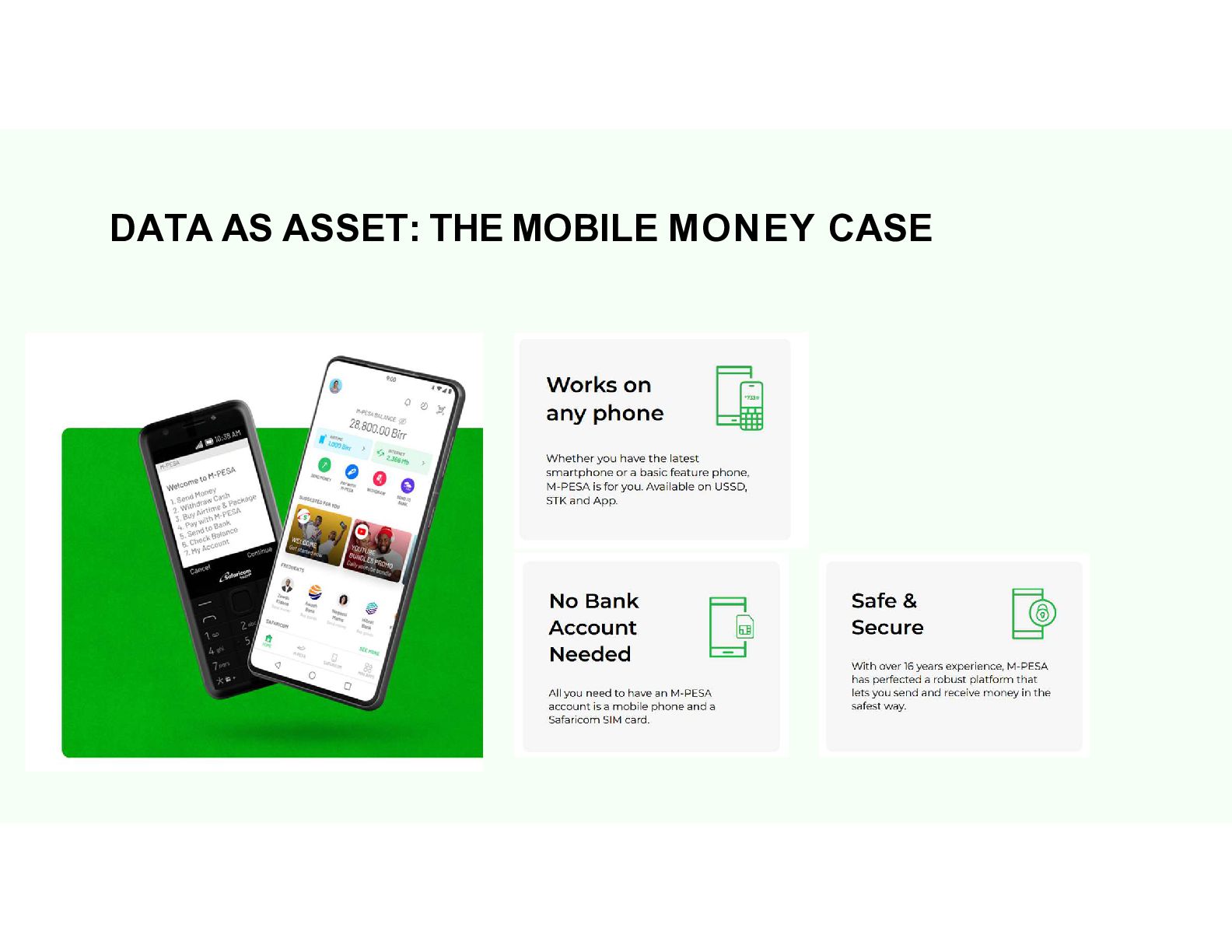
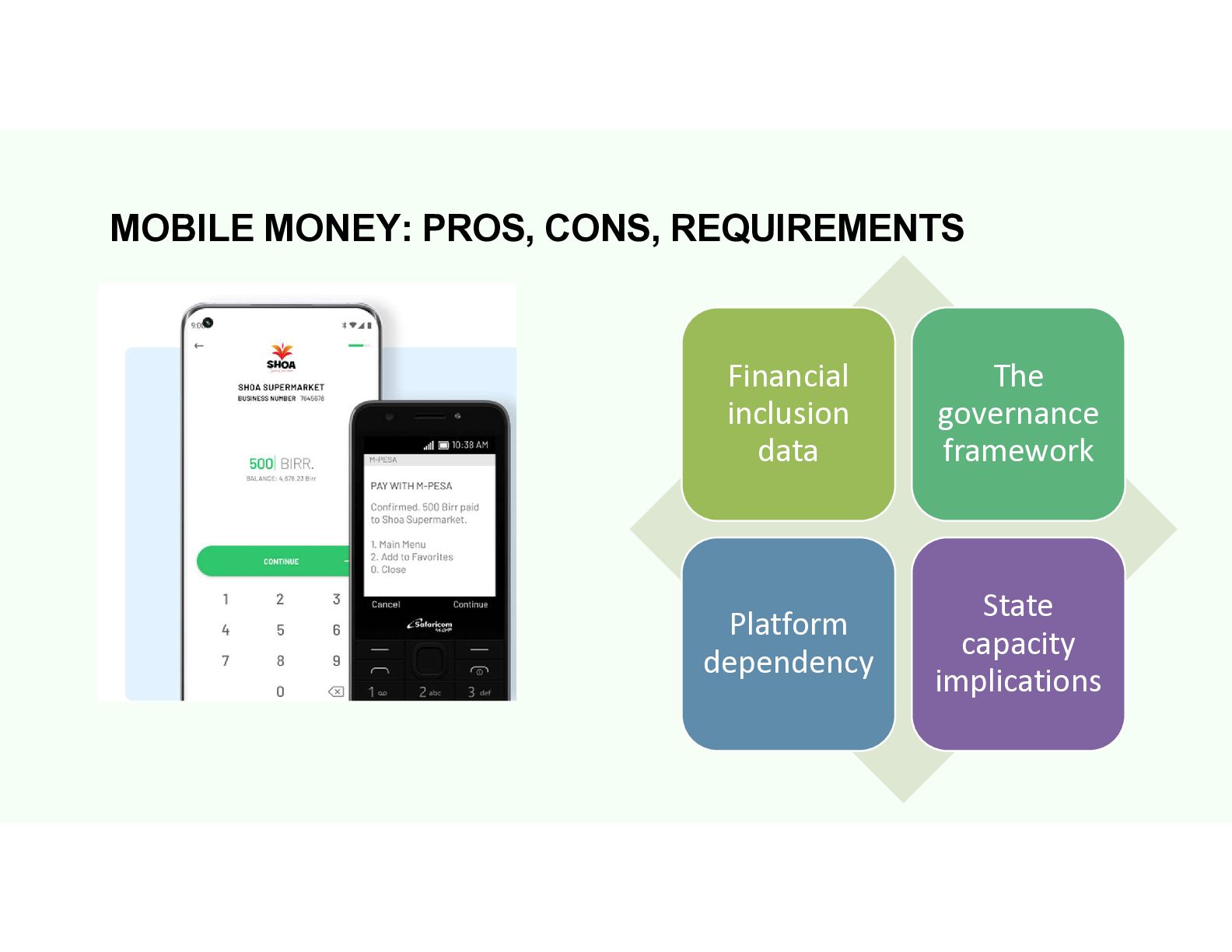
  5. MOBILE MONEY: PROS, CONS, REQUIREMENTS Financial inclusion data The governance

    framework Platform dependency State capacity implications
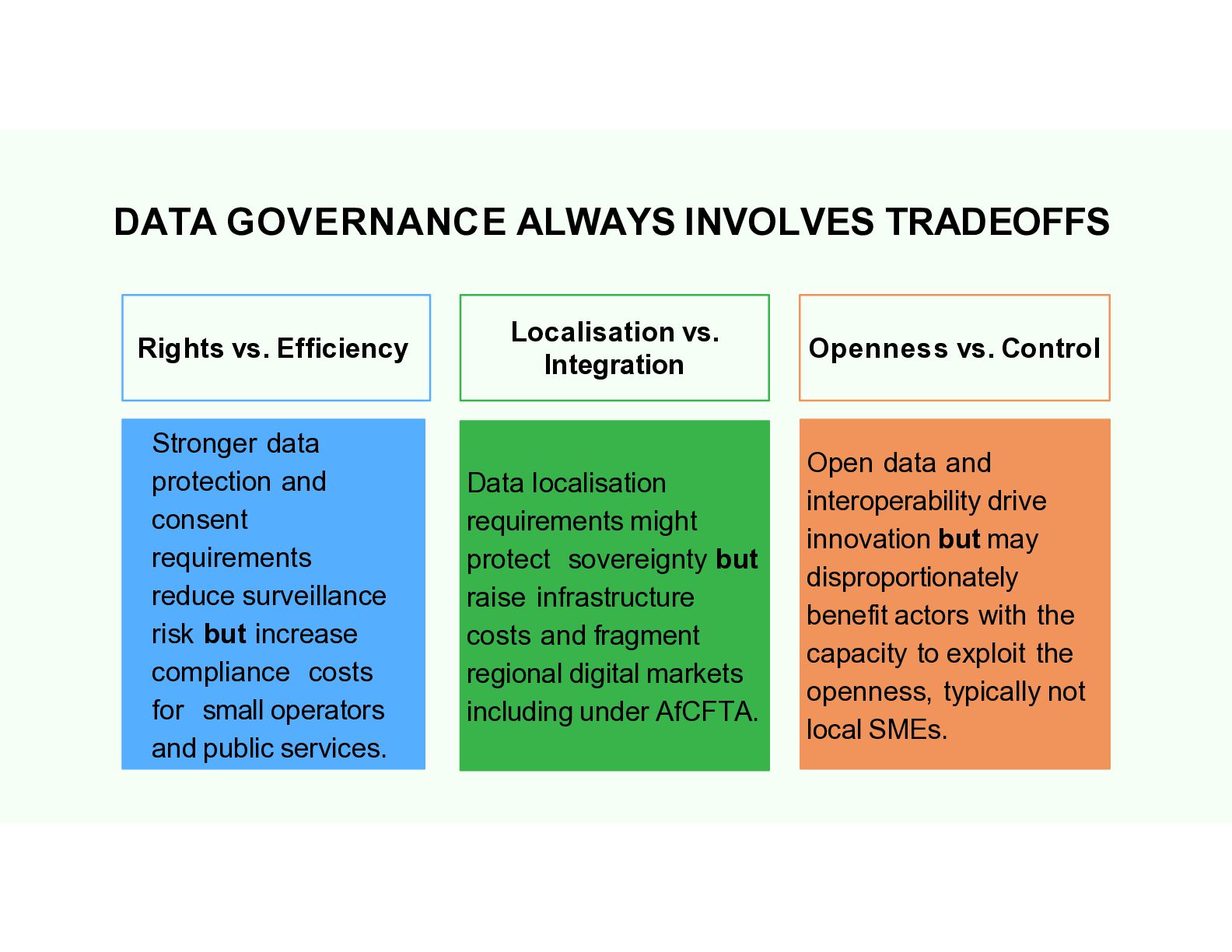
  6. DATA GOVERNANCE ALWAYS INVOLVES TRADEOFFS Rights vs. Efficiency Localisation vs.

    Integration Openness vs. Control Stronger data protection and consent requirements reduce surveillance risk but increase compliance costs for small operators and public services. Open data and interoperability drive innovation but may disproportionately benefit actors with the capacity to exploit the openness, typically not local SMEs. Data localisation requirements might protect sovereignty but raise infrastructure costs and fragment regional digital markets including under AfCFTA.
  7. Can a country steer data governance trade-offs on its own

    terms? Setting the terms under which platforms operate, protecting citizens' rights, and capturing economic value rather than having those terms imposed by infrastructure owners, donors, or trading partners? DATA GOVERNANCE AGENCY
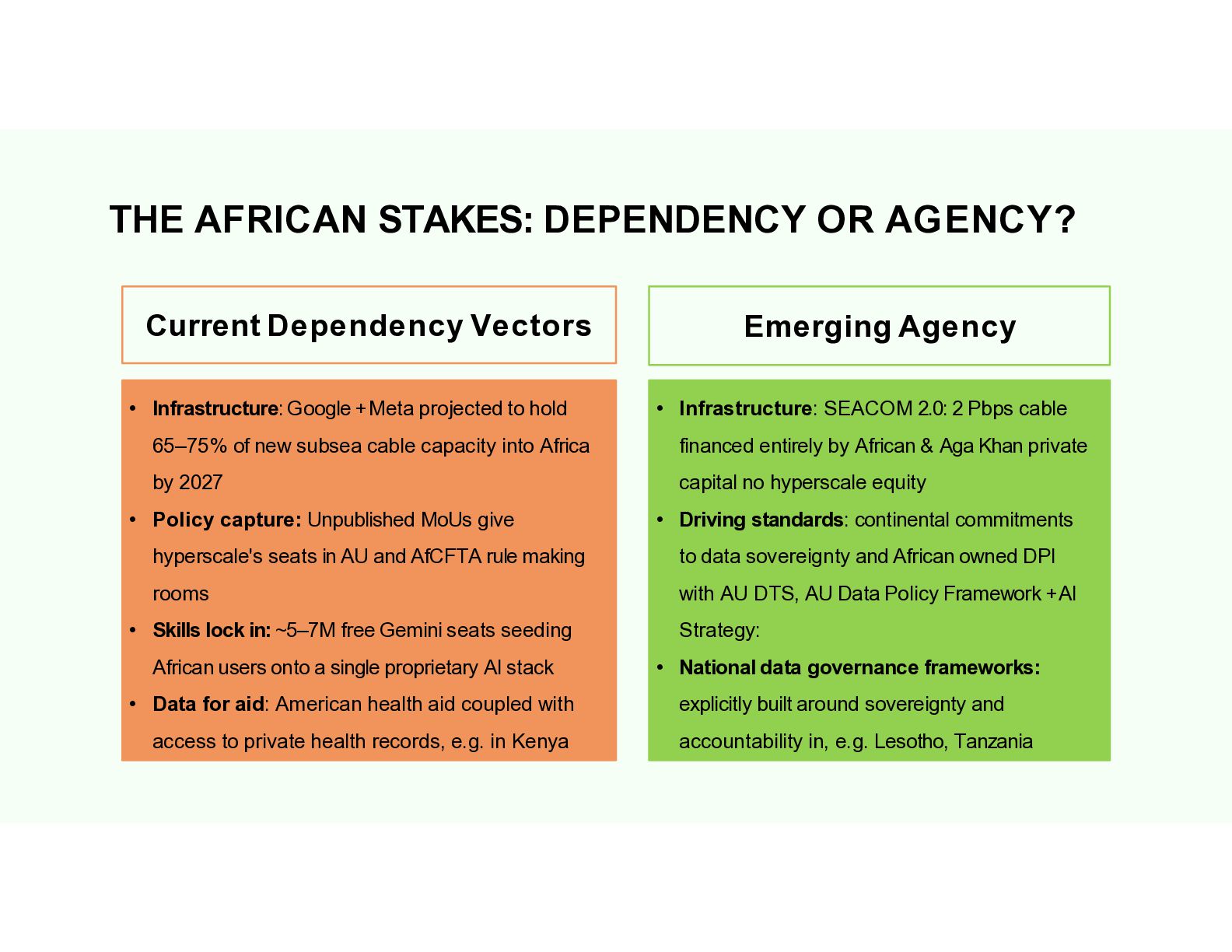
  8. THE AFRICAN STAKES: DEPENDENCY OR AGENCY? Current Dependency Vectors Emerging

    Agency • Infrastructure: Google +Meta projected to hold 65–75% of new subsea cable capacity into Africa by 2027 • Policy capture: Unpublished MoUs give hyperscale's seats in AU and AfCFTA rule making rooms • Skills lock in: ~5–7M free Gemini seats seeding African users onto a single proprietary AI stack • Data for aid: American health aid coupled with access to private health records, e.g. in Kenya • Infrastructure: SEACOM 2.0: 2 Pbps cable financed entirely by African & Aga Khan private capital no hyperscale equity • Driving standards: continental commitments to data sovereignty and African owned DPI with AU DTS, AU Data Policy Framework +AI Strategy: • National data governance frameworks: explicitly built around sovereignty and accountability in, e.g. Lesotho, Tanzania
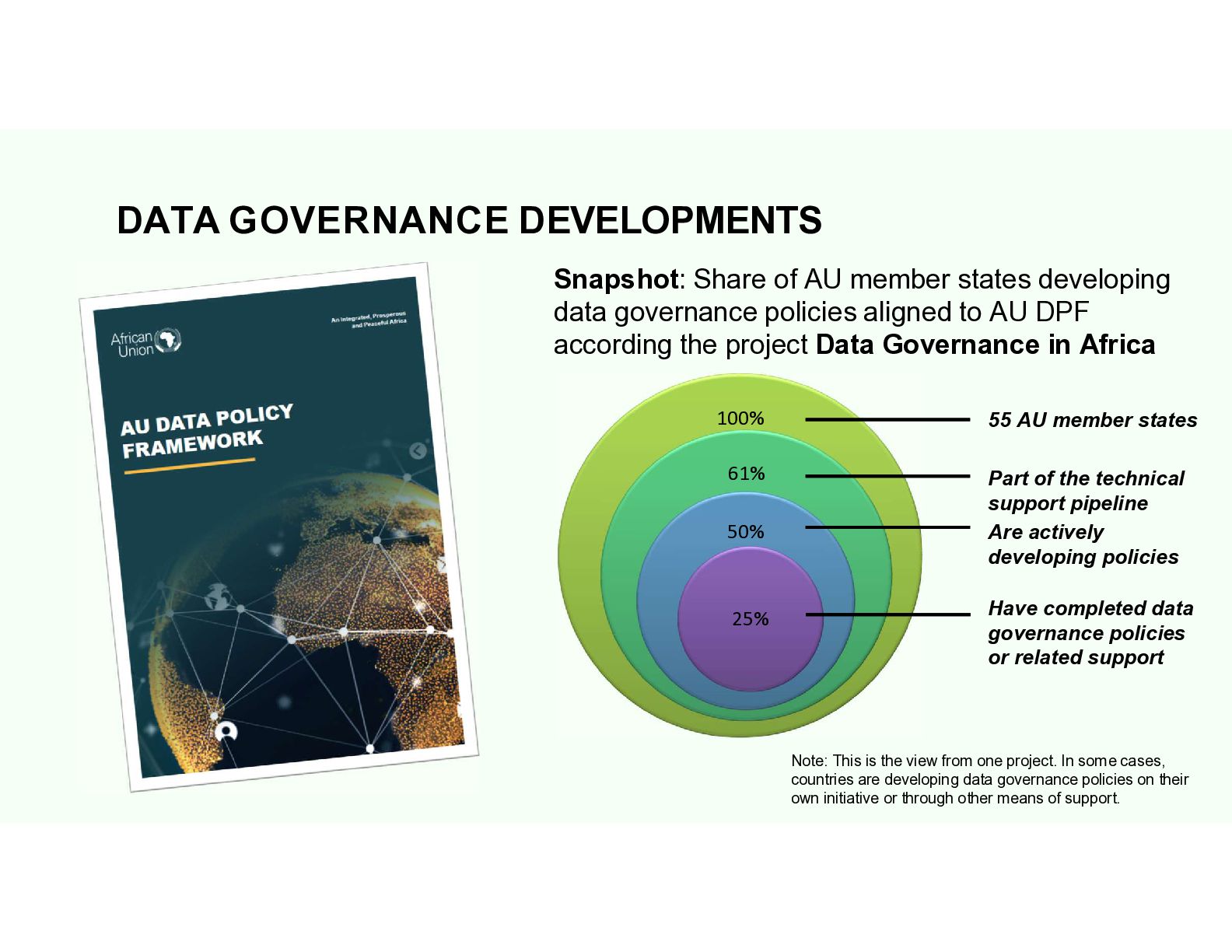
  9. Snapshot: Share of AU member states developing data governance policies

    aligned to AU DPF according the project Data Governance in Africa DATA GOVERNANCE DEVELOPMENTS Note: This is the view from one project. In some cases, countries are developing data governance policies on their own initiative or through other means of support. 100% 61% 50% 25% 55 AU member states Part of the technical support pipeline Are actively developing policies Have completed data governance policies or related support
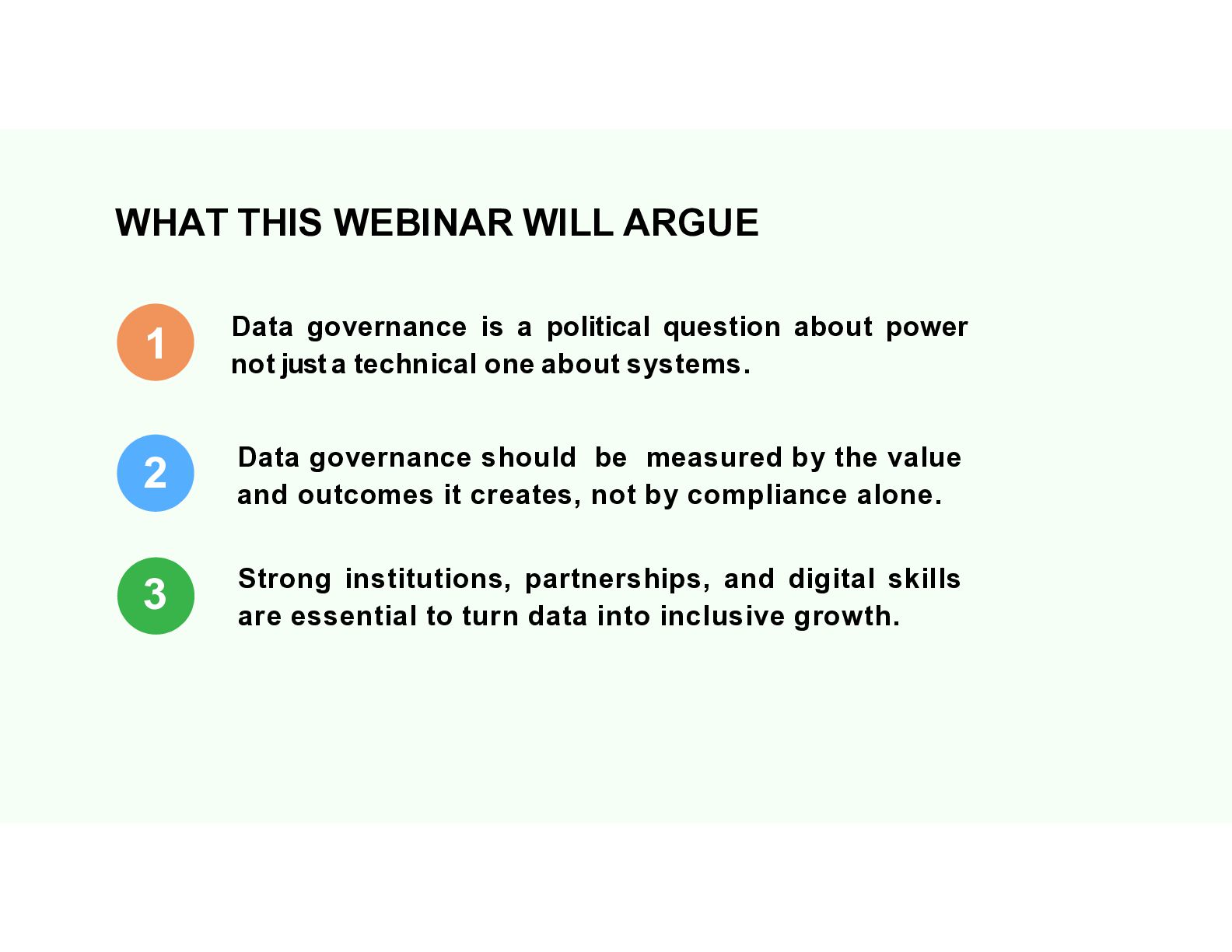
  10. Data governance is a political question about power not just

    a technical one about systems. 1 2 3 Data governance should be measured by the value and outcomes it creates, not by compliance alone. Strong institutions, partnerships, and digital skills are essential to turn data into inclusive growth. WHAT THIS WEBINAR WILL ARGUE