Upgrade to Pro
— share decks privately, control downloads, hide ads and more …
Speaker Deck
Sign up for free
Menu
Search
Features
All features
Private URLs
Password Protection
Custom URLS
Scheduled publishing
Remove Branding
Restrict embedding
Deck Collections
Notes
Features
All features
Private URLs
Password Protection
Custom URLS
Scheduled publishing
Remove Branding
Restrict embedding
Deck Collections
Notes
Explore
Featured decks
Featured speakers
Programming
Technology
Storyboards
Explore
Featured decks
Featured speakers
Programming
Technology
Storyboards
Pricing
Search
Sign in
Sign up for free
ゼロから作るDeepLearning 第7章前半ざっくりまとめ
Search
Sponsored
·
Your Podcast. Everywhere. Effortlessly.
Share. Educate. Inspire. Entertain. You do you. We'll handle the rest.
→
dproject21
February 20, 2017
Science
1.1k
0
Share
Embed
Copy iframe code
Copy JS code
Copy link
Start on current slide
ゼロから作るDeepLearning 第7章前半ざっくりまとめ
dproject21
February 20, 2017
More Decks by dproject21
See All by dproject21
ISTQB/JSTQBシラバスから学ぶAgileTesting / A guide of agile testing based on ISTQB syllabus
dproject21
4
4.1k
JSTQB Advanced Level 模擬問題作成方法 / methodology to questions creation for JSTQB advanced level
dproject21
3
1.6k
試験に絶対出ないJSTQB AL TA,TM問題 / Questions that will never be given on the exam of JSTQB advanced level
dproject21
0
1.6k
The official zip code book is terrible. And what should I do with the address you wrote.
dproject21
0
260
TDD applied Data Cleansing
dproject21
0
2k
Data preprocessing for MachineLearning/BI by Golang and MySQL UDF
dproject21
1
1k
高精度名寄せシステムを支える テキスト処理 (の、ほんのさわり)
dproject21
3
2.7k
ゼロから作るDeepLearning 第5章 誤差逆伝播法による重み更新を追ってみる
dproject21
0
1.3k
ゼロから作るDeepLearning 第6章ざっくりまとめ
dproject21
2
1.5k
Other Decks in Science
See All in Science
[NLP2026 参加報告会] AI for Science まとめ / NLP2026
lychee1223
0
2k
データベース02: データベースの概念
trycycle
PRO
2
1.4k
機械学習 - ニューラルネットワーク入門
trycycle
PRO
0
1.4k
Van Dare naar Durf
voginip
0
310
Understanding CVP Waveforms: Interpretation and Clinical Implications in Anesthesiology
taka88
0
950
How a camera trap data standard enabled an ecosystem of interoperable tools
peterdesmet
0
140
医療 LLM ベンチマークの現在地:多面的評価 と日本ローカライズ
analokmaus
1
740
[TMLR 2026, Featured Certification] Double Bounded α-Divergence Optimization for Density Estimation
gkazunii
1
130
データベース05: SQL(2/3) 結合質問
trycycle
PRO
0
1.4k
知能とはなにか -ヒトとAIのあいだ-
tagtag
PRO
0
230
Visual Linear Algebra - Lecture at Shosen Grande
hiranabe
0
630
データベース12: 正規化(2/2) - データ従属性に基づく正規化
trycycle
PRO
0
1.8k
Featured
See All Featured
Tell your own story through comics
letsgokoyo
1
1.1k
The Mindset for Success: Future Career Progression
greggifford
PRO
0
530
The AI Revolution Will Not Be Monopolized: How open-source beats economies of scale, even for LLMs
inesmontani
PRO
3
3.8k
The World Runs on Bad Software
bkeepers
PRO
72
12k
Docker and Python
trallard
47
4.2k
コードの90%をAIが書く世界で何が待っているのか / What awaits us in a world where 90% of the code is written by AI
rkaga
63
46k
Why Your Marketing Sucks and What You Can Do About It - Sophie Logan
marketingsoph
0
420
Building a Modern Day E-commerce SEO Strategy
aleyda
45
9.2k
The Director’s Chair: Orchestrating AI for Truly Effective Learning
tmiket
1
320
The B2B funnel & how to create a winning content strategy
katarinadahlin
PRO
1
560
Game over? The fight for quality and originality in the time of robots
wayneb77
1
300
Amusing Abliteration
ianozsvald
1
330
Transcript
「ゼロから作るDeepLearning」 第7章前半ざっくりまとめ (7.3章「プーリング」まで) 2017.2.20 たのっち @dproject21
この本のざっくりまとめです • 「ゼロから作るDeepLearning」斎藤 康毅 著 オライリー・ジャパンより2016年9⽉ 発⾏ https://www.oreilly.co.jp/books/9784873117584/ • 公式サポートページ
https://github.com/oreilly-japan/deep-learning-from-scratch • 第7章「畳み込みニューラルネットワーク」前半部です。 (後半の実装については、次回、資料作ります。) https://deeplearning-yokohama.connpass.com/
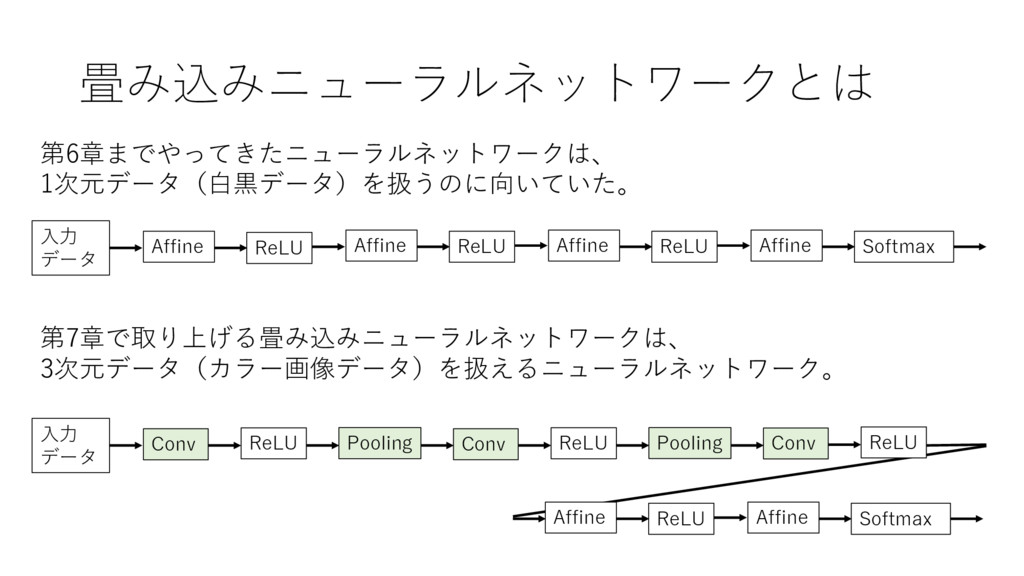
第6章までやってきたニューラルネットワークは、 1次元データ(⽩⿊データ)を扱うのに向いていた。 畳み込みニューラルネットワークとは ⼊⼒ データ Affine ReLU Affine ReLU Affine
ReLU Affine Softmax 第7章で取り上げる畳み込みニューラルネットワークは、 3次元データ(カラー画像データ)を扱えるニューラルネットワーク。 ⼊⼒ データ Conv ReLU Pooling ReLU Affine Softmax Conv ReLU Pooling Conv ReLU Affine
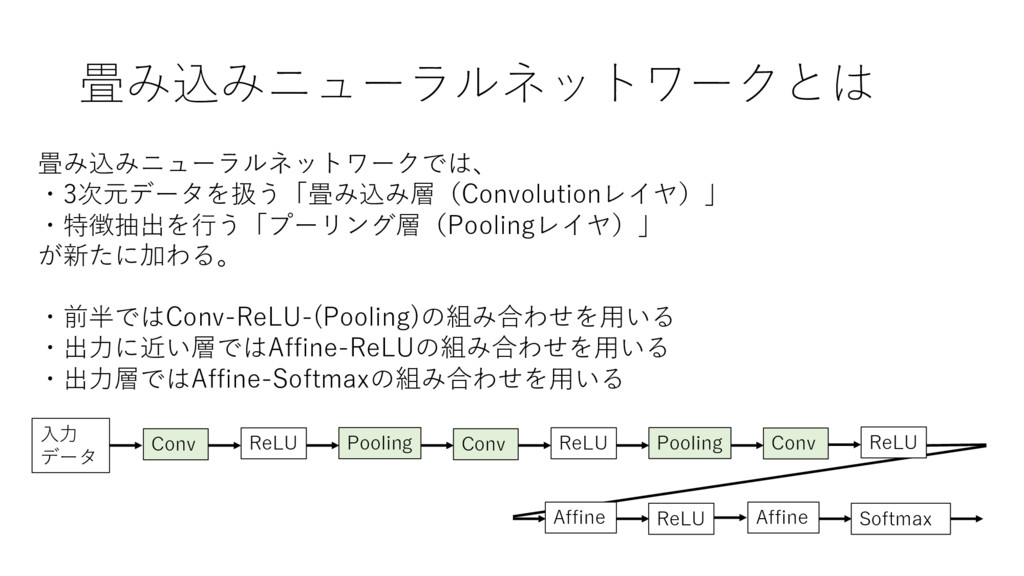
畳み込みニューラルネットワークとは 畳み込みニューラルネットワークでは、 ・3次元データを扱う「畳み込み層(Convolutionレイヤ)」 ・特徴抽出を⾏う「プーリング層(Poolingレイヤ)」 が新たに加わる。 ・前半ではConv-ReLU-(Pooling)の組み合わせを⽤いる ・出⼒に近い層ではAffine-ReLUの組み合わせを⽤いる ・出⼒層ではAffine-Softmaxの組み合わせを⽤いる ⼊⼒ データ
Conv ReLU Pooling ReLU Affine Softmax Conv ReLU Pooling Conv ReLU Affine
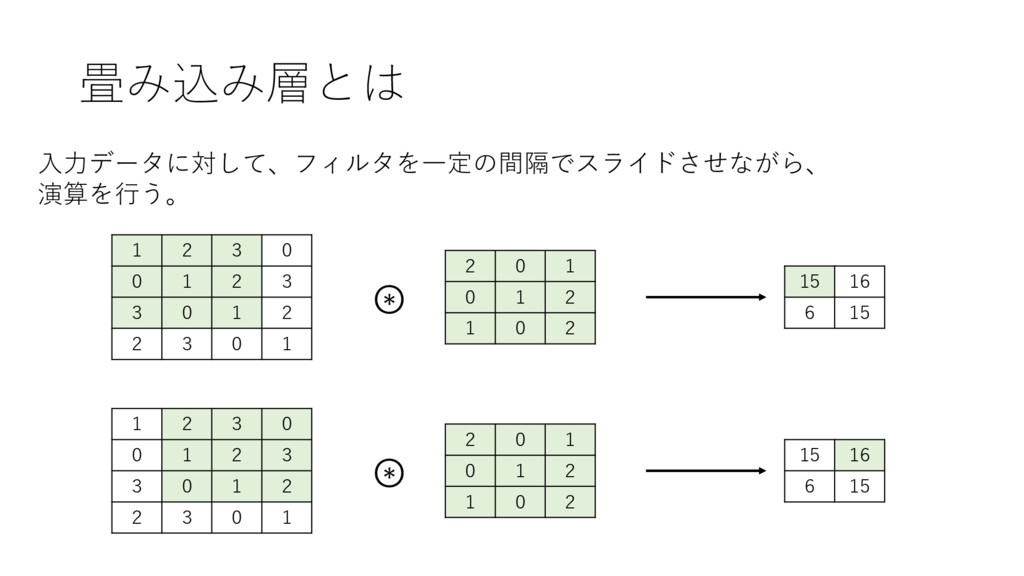
畳み込み層とは 「畳み込み演算」(画像処理で⾔うところの「フィルタ演算」)を⾏う。 ⼊⼒データ(4, 4)に対してフィルタ(3, 3)の積和演算を⾏う。 1 2 3 0 0
1 2 3 3 0 1 2 2 3 0 1 2 0 1 0 1 2 1 0 2 ⊛ 15 16 6 15 ⼊⼒データ フィルタ 出⼒
畳み込み層とは 1 2 3 0 0 1 2 3 3
0 1 2 2 3 0 1 2 0 1 0 1 2 1 0 2 ⊛ 15 16 6 15 1 2 3 0 0 1 2 3 3 0 1 2 2 3 0 1 2 0 1 0 1 2 1 0 2 ⊛ 15 16 6 15 ⼊⼒データに対して、フィルタを⼀定の間隔でスライドさせながら、 演算を⾏う。
畳み込み層とは 1 2 3 0 0 1 2 3 3
0 1 2 2 3 0 1 2 0 1 0 1 2 1 0 2 ⊛ 15 16 6 15 1 2 3 0 0 1 2 3 3 0 1 2 2 3 0 1 2 0 1 0 1 2 1 0 2 ⊛ 15 16 6 15 ⼊⼒データに対して、フィルタを⼀定の間隔でスライドさせながら、 演算を⾏う。
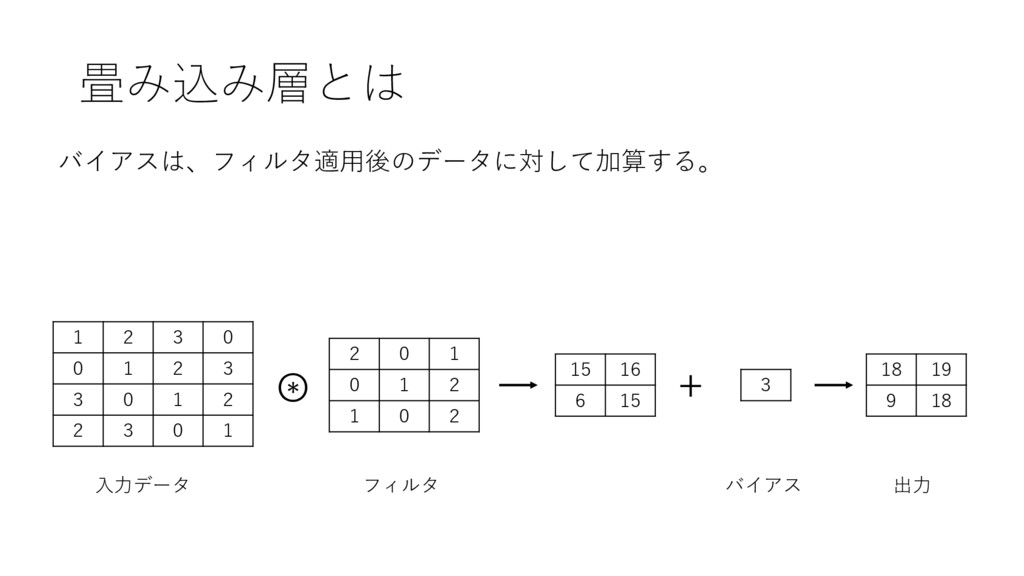
畳み込み層とは バイアスは、フィルタ適⽤後のデータに対して加算する。 1 2 3 0 0 1 2 3
3 0 1 2 2 3 0 1 2 0 1 0 1 2 1 0 2 ⊛ 15 16 6 15 ⼊⼒データ フィルタ 出⼒ + 18 19 9 18 3 バイアス
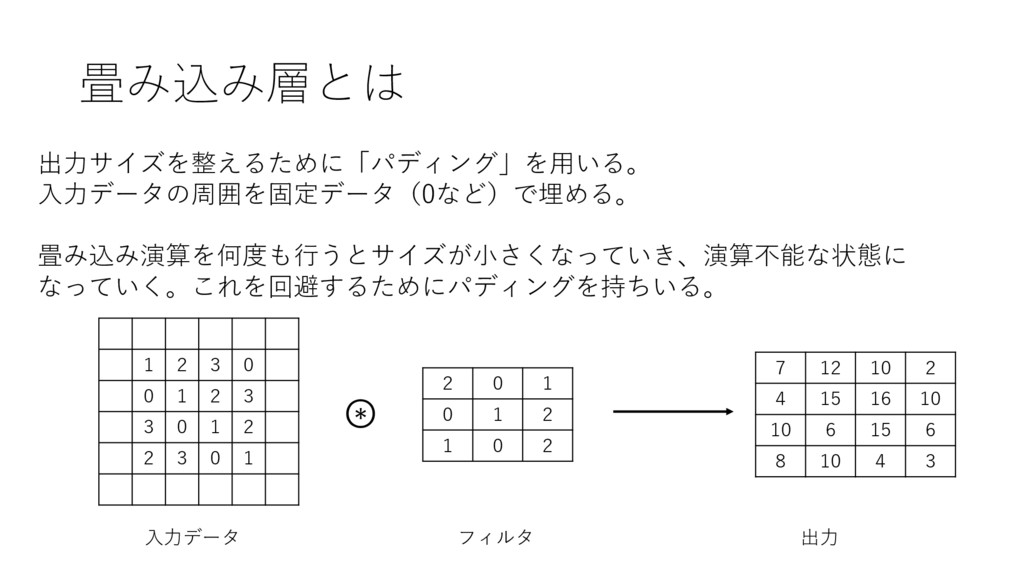
畳み込み層とは 出⼒サイズを整えるために「パディング」を⽤いる。 ⼊⼒データの周囲を固定データ(0など)で埋める。 畳み込み演算を何度も⾏うとサイズが⼩さくなっていき、演算不能な状態に なっていく。これを回避するためにパディングを持ちいる。 1 2 3 0 0
1 2 3 3 0 1 2 2 3 0 1 2 0 1 0 1 2 1 0 2 ⊛ ⼊⼒データ フィルタ 出⼒ 7 12 10 2 4 15 16 10 10 6 15 6 8 10 4 3
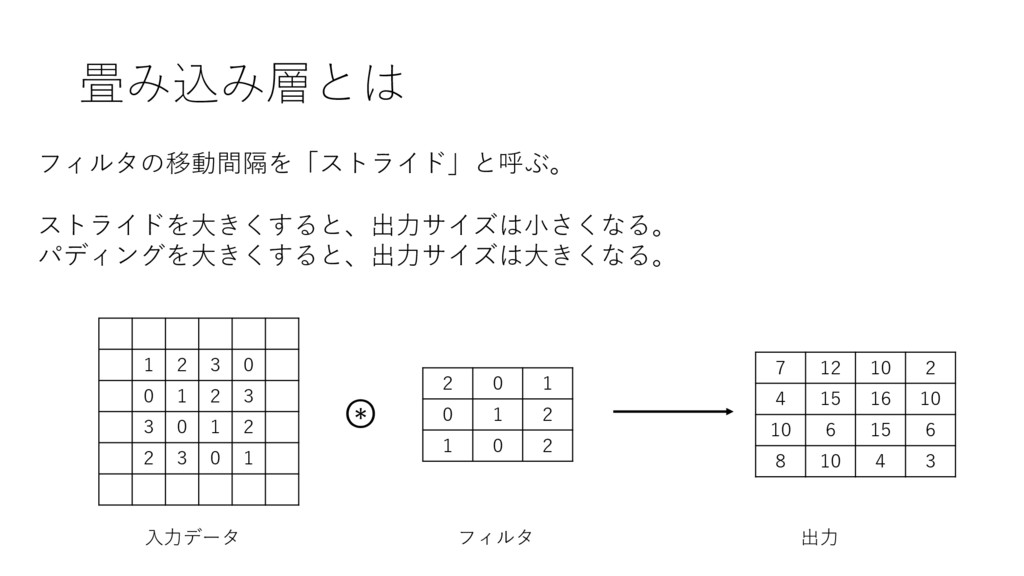
畳み込み層とは フィルタの移動間隔を「ストライド」と呼ぶ。 ストライドを⼤きくすると、出⼒サイズは⼩さくなる。 パディングを⼤きくすると、出⼒サイズは⼤きくなる。 1 2 3 0 0 1
2 3 3 0 1 2 2 3 0 1 2 0 1 0 1 2 1 0 2 ⊛ ⼊⼒データ フィルタ 出⼒ 7 12 10 2 4 15 16 10 10 6 15 6 8 10 4 3
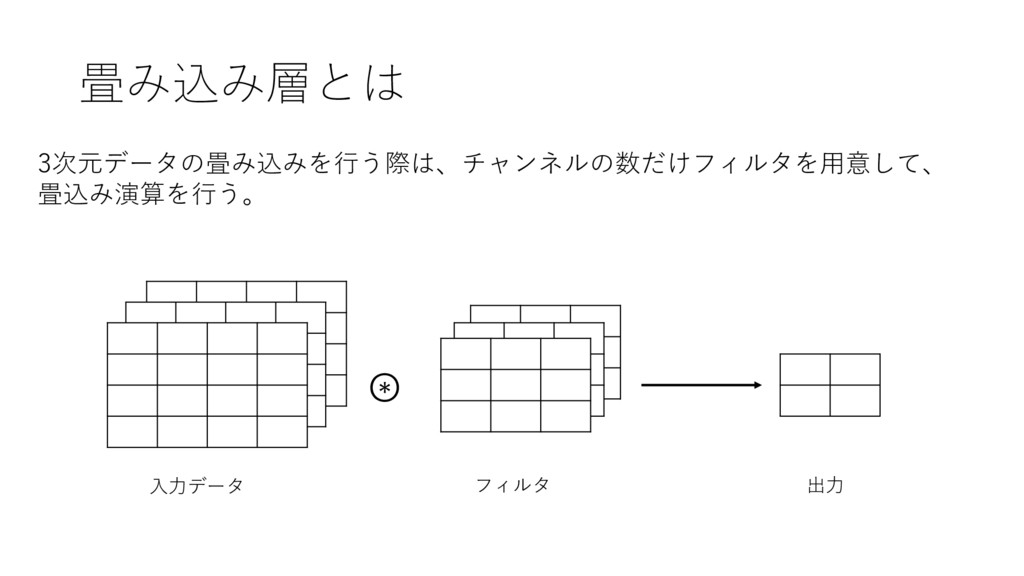
畳み込み層とは 3次元データの畳み込みを⾏う際は、チャンネルの数だけフィルタを⽤意して、 畳込み演算を⾏う。 ⊛ ⼊⼒データ フィルタ 出⼒
畳み込み層とは 各チャンネルごとに出⼒(特徴マップ)を⽤意したい場合、複数のフィルタを ⽤いる。 ⊛ ⼊⼒データ フィルタ 出⼒
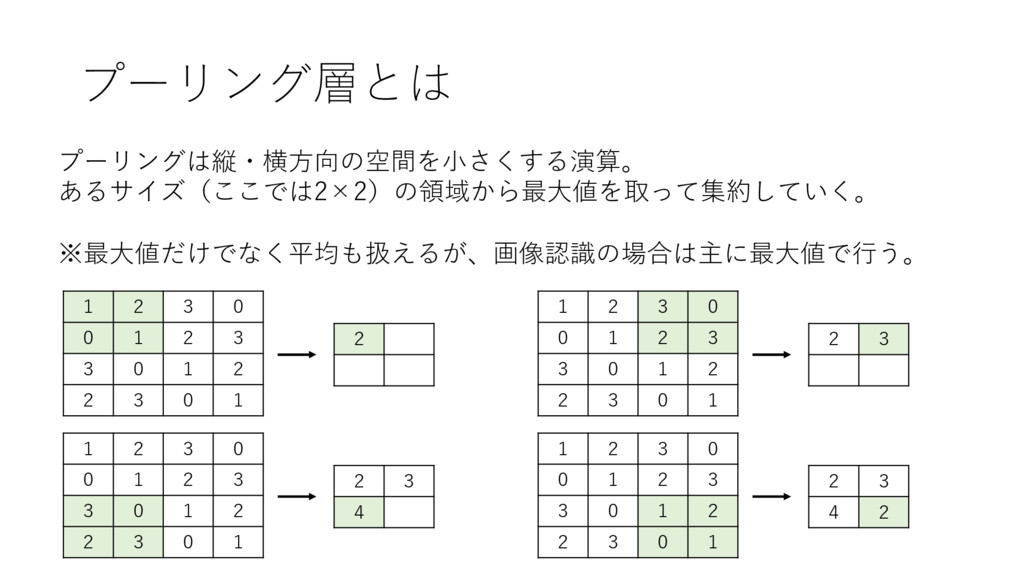
プーリング層とは プーリングは縦・横⽅向の空間を⼩さくする演算。 あるサイズ(ここでは2×2)の領域から最⼤値を取って集約していく。 ※最⼤値だけでなく平均も扱えるが、画像認識の場合は主に最⼤値で⾏う。 1 2 3 0 0 1
2 3 3 0 1 2 2 3 0 1 2 1 2 3 0 0 1 2 3 3 0 1 2 2 3 0 1 2 3 4 1 2 3 0 0 1 2 3 3 0 1 2 2 3 0 1 2 3 1 2 3 0 0 1 2 3 3 0 1 2 2 3 0 1 2 3 4 2


 dproject21
.jpg) lychee1223
lychee1223
 trycycle
 voginip
 taka88
 peterdesmet
 analokmaus
 gkazunii
 tagtag
 hiranabe
 letsgokoyo
 greggifford
 inesmontani
 bkeepers
 trallard
 rkaga
rkaga
 marketingsoph
 aleyda
 tmiket
 katarinadahlin
 wayneb77
 ianozsvald