Upgrade to Pro — share decks privately, control downloads, hide ads and more …

The Arm laptop project

Sponsored · Ship Features Fearlessly Turn features on and off without deploys. Used by thousands of Ruby developers. →

The Arm laptop project

What would it take to run mainline Linux on an Arm laptop built for Windows? That was the question Linaro set out to answer in a project funded by Arm. A bit more than a year later, the Lenovo ThinkPad X13s can now be used as a daily driver while running mainline Linux without any out-of-tree patches on top.

This talk will give an overview of how this project came about; discuss some of the difficulties encountered, how they were addressed and what remains to be done; and provide a summary of the current status of the Arm laptop project.

Johan HOVOLD

Kernel Recipes PRO

October 12, 2023

Transcript

44 slides
  1. Introduction • Windows on Arm (WoA) • Laptops built on

    (Qualcomm) 64-bit Arm SoCs • Quiet and power efficient • Non-standard boot chain • Customised OS
  2. Introduction • Windows on Arm (WoA) • Laptops built on

    (Qualcomm) 64-bit Arm SoCs • Quiet and power efficient • Non-standard boot chain • Customised OS • What would it take to run Linux on them?
  3. Project overview • Linaro project • Funded by Arm and

    Qualcomm • Hardware from Qualcomm and Lenovo • Proof-of-concept: Mainline Linux on Arm laptop (built for Windows) • How far could we get?
  4. People • Johan Hovold • Bj¨ orn Andersson • Linaro’s

    Qualcomm landing team • Building on work done by Qualcomm, Linaro and many others
  5. Talk outline • Background • Status • Work in progress

    • Open issues • Setup instructions • Distro support
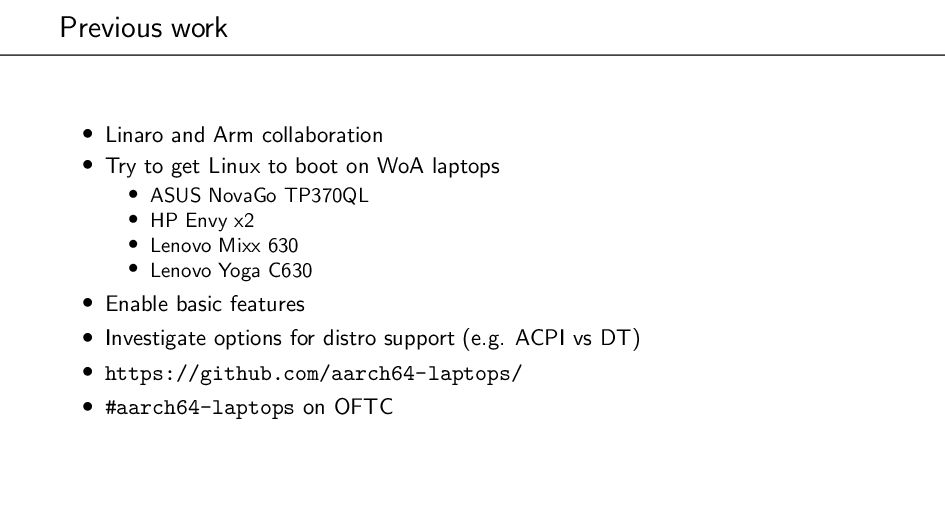
  6. Previous work • Linaro and Arm collaboration • Try to

    get Linux to boot on WoA laptops • ASUS NovaGo TP370QL • HP Envy x2 • Lenovo Mixx 630 • Lenovo Yoga C630 • Enable basic features • Investigate options for distro support (e.g. ACPI vs DT) • https://github.com/aarch64-laptops/ • #aarch64-laptops on OFTC
  7. Lenovo ThinkPad X13s • Snapdragon 8xc Gen3 Compute (sc8280xp) •

    13.3” FHD (1920x1200) display • 32 GB LPDDR4 (up to) • 1 TB NVMe SSD (up to) • Adreno 690 GPU • 2 speakers, 2 microphones, headphone jack • 5 MP camera • Wi-Fi 6E (802.11ax) • Bluetooth 5.1 • 5G modem (optional) • 2 x USB-C 3.2 Gen 2 • 49.5 Wh battery
  8. Boot firmware • Qualcomm and Windows on Arm • UEFI

    • Runtime services not available after boot (e.g. EFI variables) • ACPI vs DT • Supporting Qualcomm’s non-standard ACPI not feasible • DtbLoader.efi • Ship devicetree blob with UEFI firmware • Allows for generic distro installers • Hypervisor • UEFI and Linux starts in EL1 • No virtualisation
  9. Work outline • Feature implementation and mainlining • Reverse engineering

    • Refactoring (technical debt) • Firmware requests • Bug fixing • Patch review • Patch tracking • Work-in-progress (WIP) branches • Support (#aarch64-laptops)
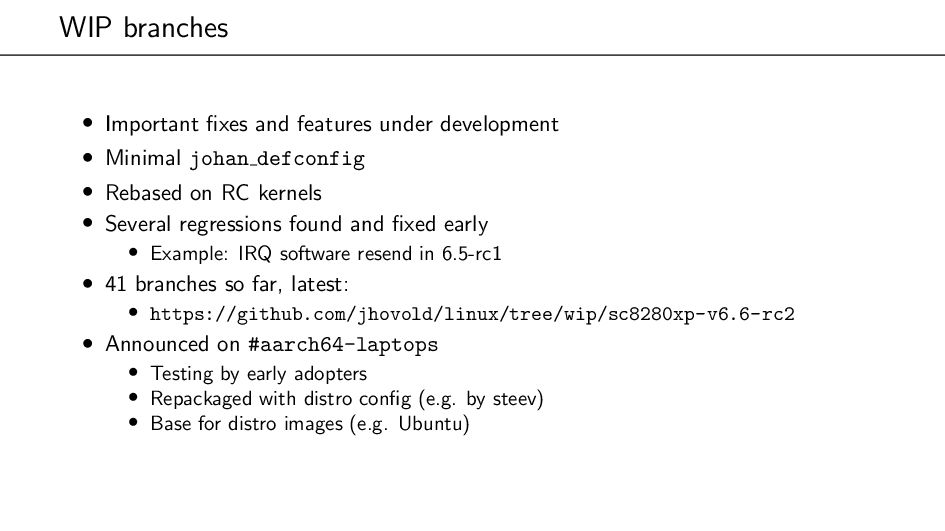
  10. WIP branches • Important fixes and features under development •

    Minimal johan defconfig • Rebased on RC kernels • Several regressions found and fixed early • Example: IRQ software resend in 6.5-rc1 • 41 branches so far, latest: • https://github.com/jhovold/linux/tree/wip/sc8280xp-v6.6-rc2 • Announced on #aarch64-laptops • Testing by early adopters • Repackaged with distro config (e.g. by steev) • Base for distro images (e.g. Ubuntu)
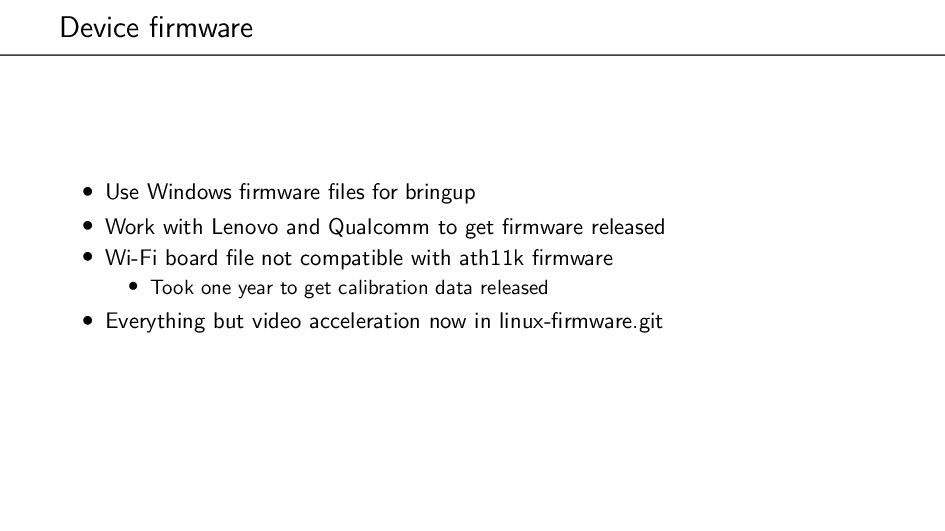
  11. Device firmware • Use Windows firmware files for bringup •

    Work with Lenovo and Qualcomm to get firmware released • Wi-Fi board file not compatible with ath11k firmware • Took one year to get calibration data released • Everything but video acceleration now in linux-firmware.git
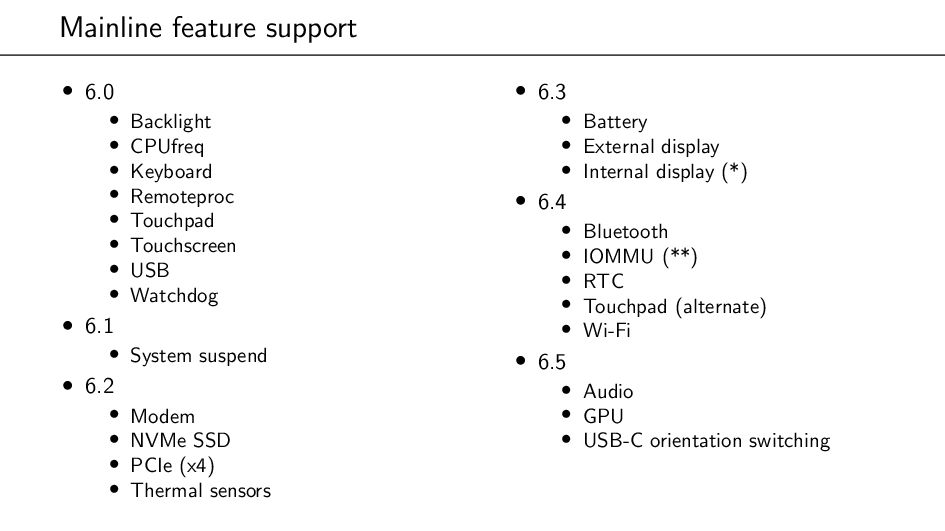
  12. Mainline feature support • 6.0 • Backlight • CPUfreq •

    Keyboard • Remoteproc • Touchpad • Touchscreen • USB • Watchdog • 6.1 • System suspend • 6.2 • Modem • NVMe SSD • PCIe (x4) • Thermal sensors • 6.3 • Battery • External display • Internal display (*) • 6.4 • Bluetooth • IOMMU (**) • RTC • Touchpad (alternate) • Wi-Fi • 6.5 • Audio • GPU • USB-C orientation switching
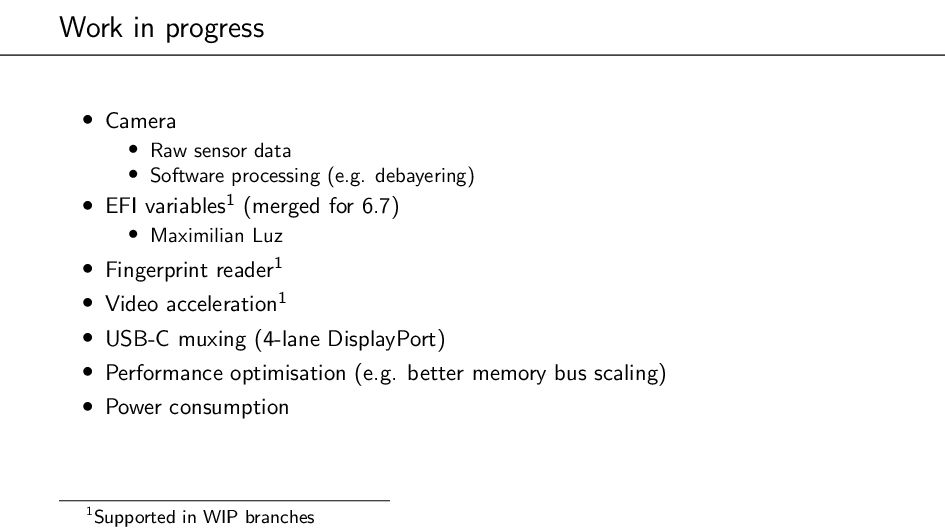
  13. Work in progress • Camera • Raw sensor data •

    Software processing (e.g. debayering) • EFI variables1 (merged for 6.7) • Maximilian Luz • Fingerprint reader1 • Video acceleration1 • USB-C muxing (4-lane DisplayPort) • Performance optimisation (e.g. better memory bus scaling) • Power consumption 1Supported in WIP branches
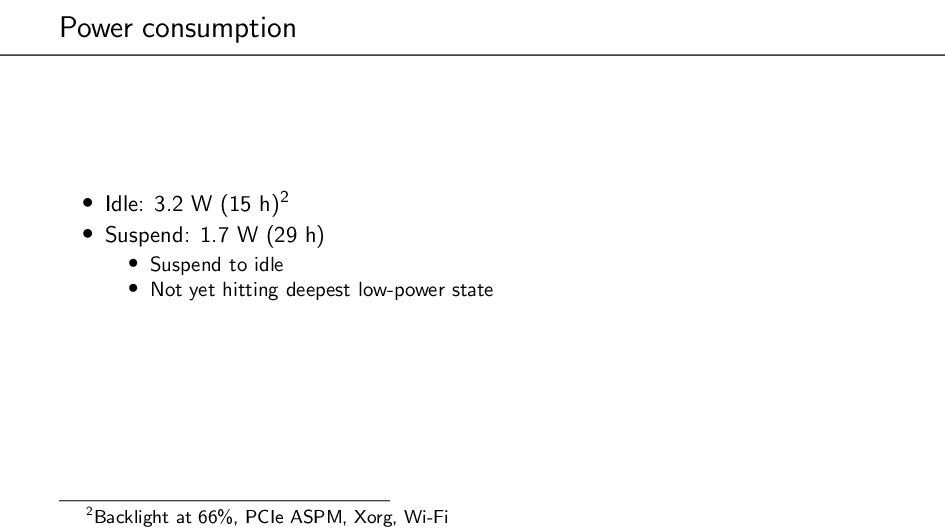
  14. Power consumption • Idle: 3.2 W (15 h)2 • Suspend:

    1.7 W (29 h) • Suspend to idle • Not yet hitting deepest low-power state 2Backlight at 66%, PCIe ASPM, Xorg, Wi-Fi
  15. Audio • Speakers, microphones, headphone jack and DisplayPort working in

    6.5 • Late fix for speaker and headphone distortion • Kernel, topology and UCM files need to be updated in lock step • Known issues • Pops and clicks (partial fix in WIP branch) • Microphone distortion
  16. GPU • Adreno 690 support in Linux 6.5 and Mesa

    23.1 • Rob Clark • Important fix in Mesa 23.1.4 (Firefox crash) • Extracted a690 GMU firmware not (yet) in linux-firmware • Driver will use a660 GMU firmware in 6.6 (and 6.5.3) • Use symlink before 6.5.3 # ln -s a660_gmu.bin a690_gmu.bin
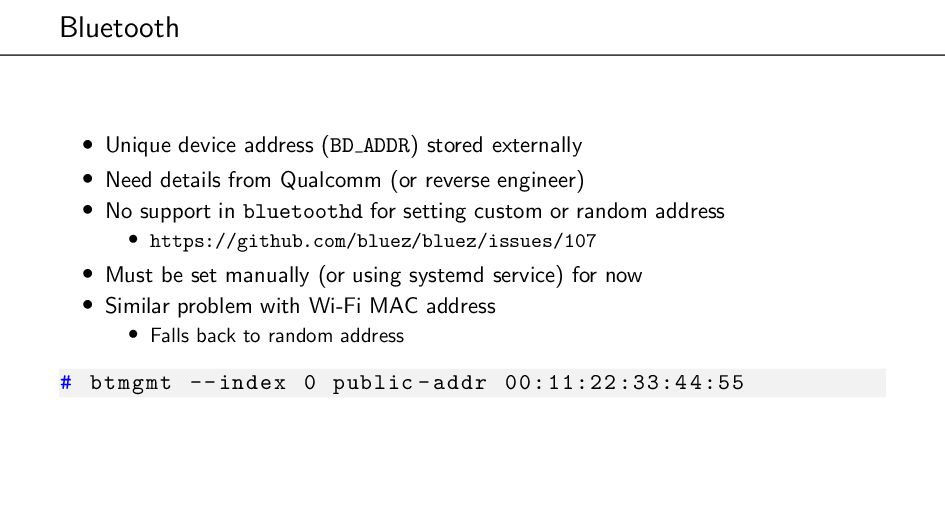
  17. Bluetooth • Unique device address (BD ADDR) stored externally •

    Need details from Qualcomm (or reverse engineer) • No support in bluetoothd for setting custom or random address • https://github.com/bluez/bluez/issues/107 • Must be set manually (or using systemd service) for now • Similar problem with Wi-Fi MAC address • Falls back to random address # btmgmt --index 0 public -addr 00:11:22:33:44:55
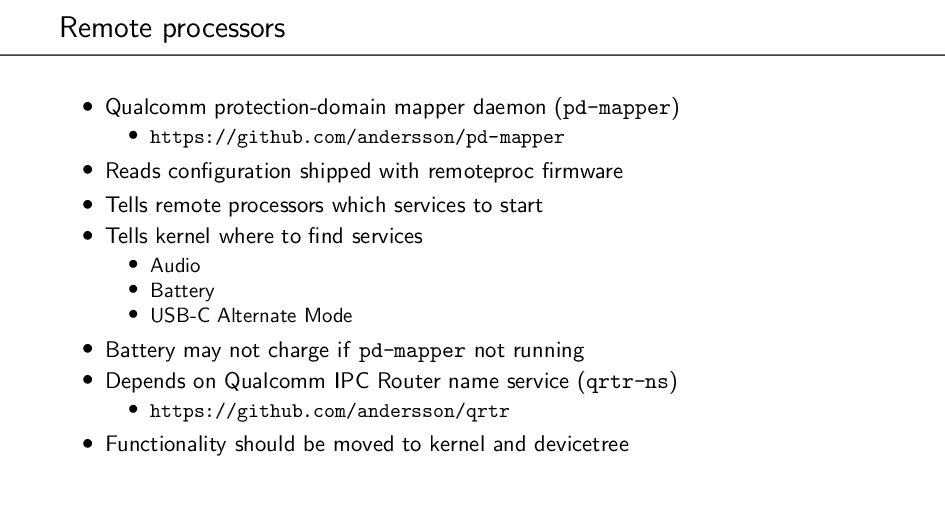
  18. Remote processors • Qualcomm protection-domain mapper daemon (pd-mapper) • https://github.com/andersson/pd-mapper

    • Reads configuration shipped with remoteproc firmware • Tells remote processors which services to start • Tells kernel where to find services • Audio • Battery • USB-C Alternate Mode • Battery may not charge if pd-mapper not running • Depends on Qualcomm IPC Router name service (qrtr-ns) • https://github.com/andersson/qrtr • Functionality should be moved to kernel and devicetree
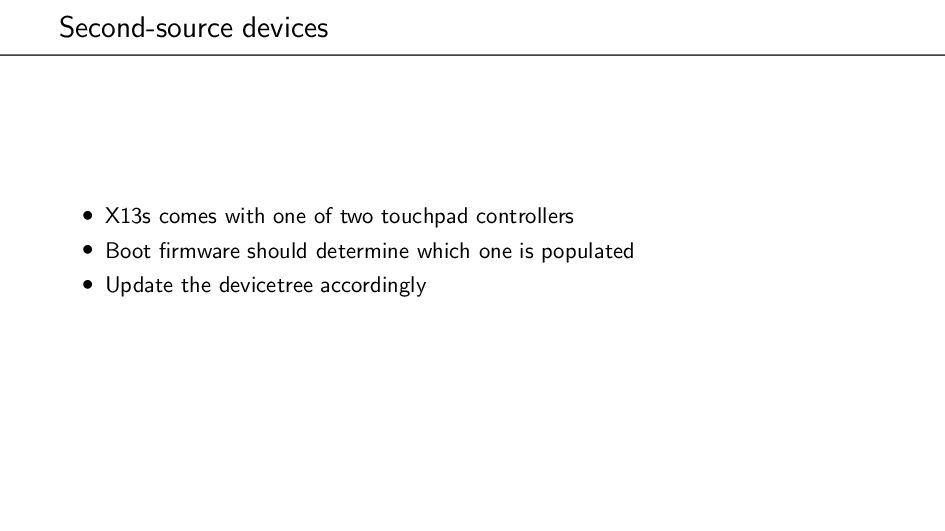
  19. Second-source devices • X13s comes with one of two touchpad

    controllers • Boot firmware should determine which one is populated • Update the devicetree accordingly
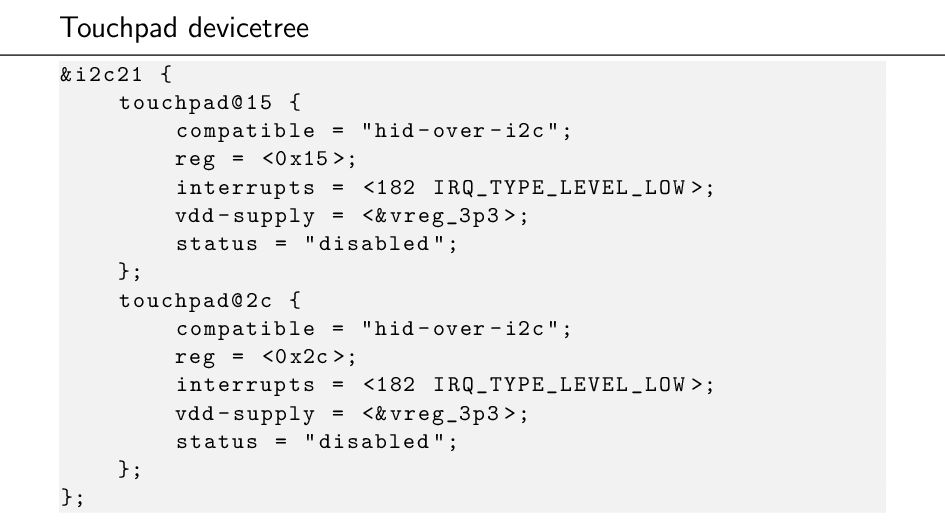
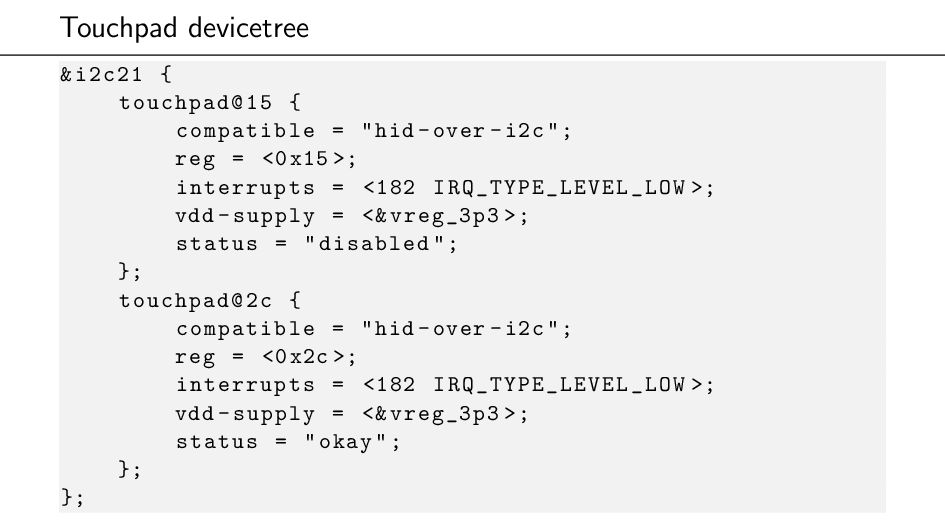
  20. Touchpad devicetree &i2c21 { touchpad@15 { compatible = "hid -over

    -i2c"; reg = <0x15 >; interrupts = <182 IRQ_TYPE_LEVEL_LOW >; vdd -supply = <&vreg_3p3 >; status = "disabled"; }; touchpad@2c { compatible = "hid -over -i2c"; reg = <0x2c >; interrupts = <182 IRQ_TYPE_LEVEL_LOW >; vdd -supply = <&vreg_3p3 >; status = "disabled"; }; };
  21. Touchpad devicetree &i2c21 { touchpad@15 { compatible = "hid -over

    -i2c"; reg = <0x15 >; interrupts = <182 IRQ_TYPE_LEVEL_LOW >; vdd -supply = <&vreg_3p3 >; status = "disabled"; }; touchpad@2c { compatible = "hid -over -i2c"; reg = <0x2c >; interrupts = <182 IRQ_TYPE_LEVEL_LOW >; vdd -supply = <&vreg_3p3 >; status = "okay"; }; };
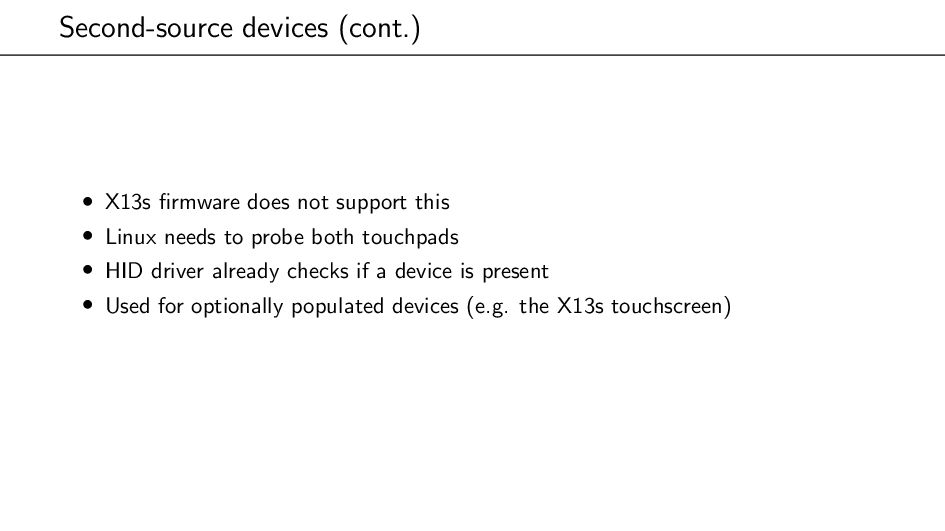
  22. Second-source devices (cont.) • X13s firmware does not support this

    • Linux needs to probe both touchpads • HID driver already checks if a device is present • Used for optionally populated devices (e.g. the X13s touchscreen)
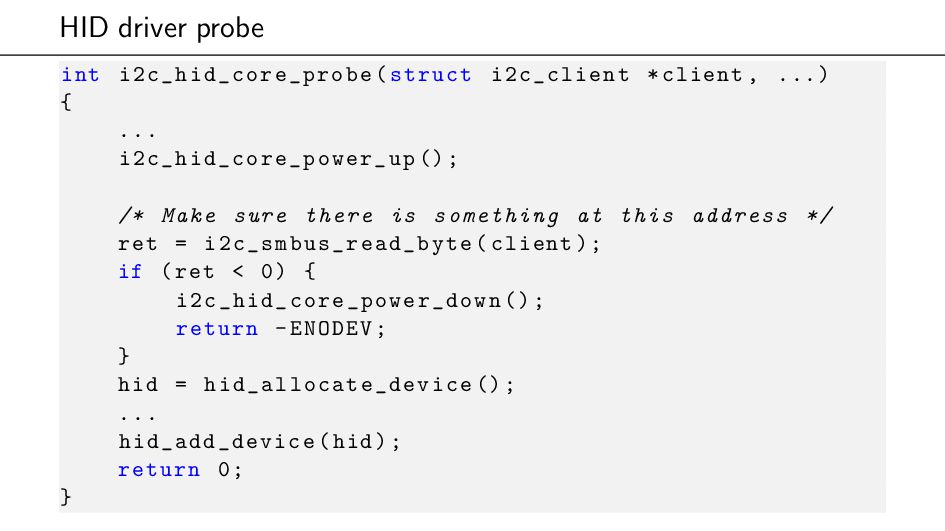
  23. HID driver probe int i2c_hid_core_probe (struct i2c_client *client , ...)

    { ... i2c_hid_core_power_up (); /* Make sure there is something at this address */ ret = i2c_smbus_read_byte (client); if (ret < 0) { i2c_hid_core_power_down (); return -ENODEV; } hid = hid_allocate_device (); ... hid_add_device (hid); return 0; }
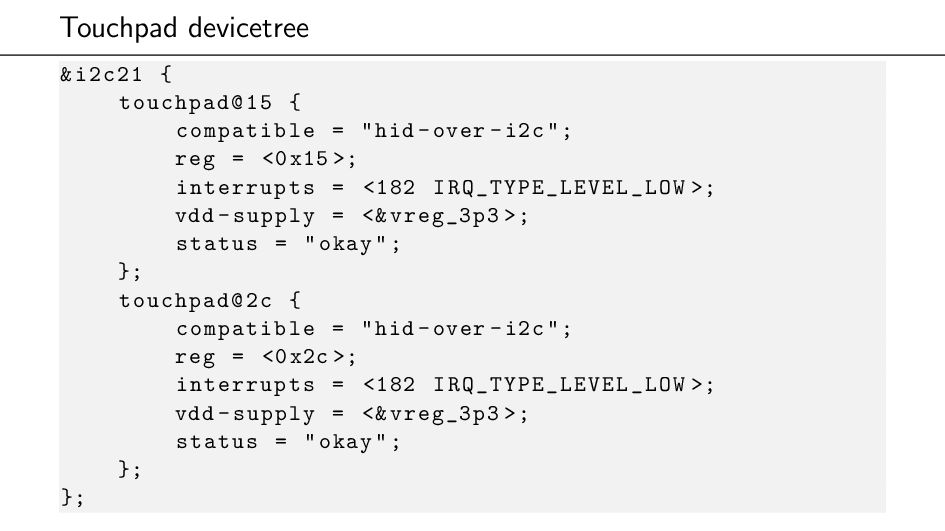
  24. Touchpad devicetree &i2c21 { touchpad@15 { compatible = "hid -over

    -i2c"; reg = <0x15 >; interrupts = <182 IRQ_TYPE_LEVEL_LOW >; vdd -supply = <&vreg_3p3 >; status = "okay"; }; touchpad@2c { compatible = "hid -over -i2c"; reg = <0x2c >; interrupts = <182 IRQ_TYPE_LEVEL_LOW >; vdd -supply = <&vreg_3p3 >; status = "okay"; }; };
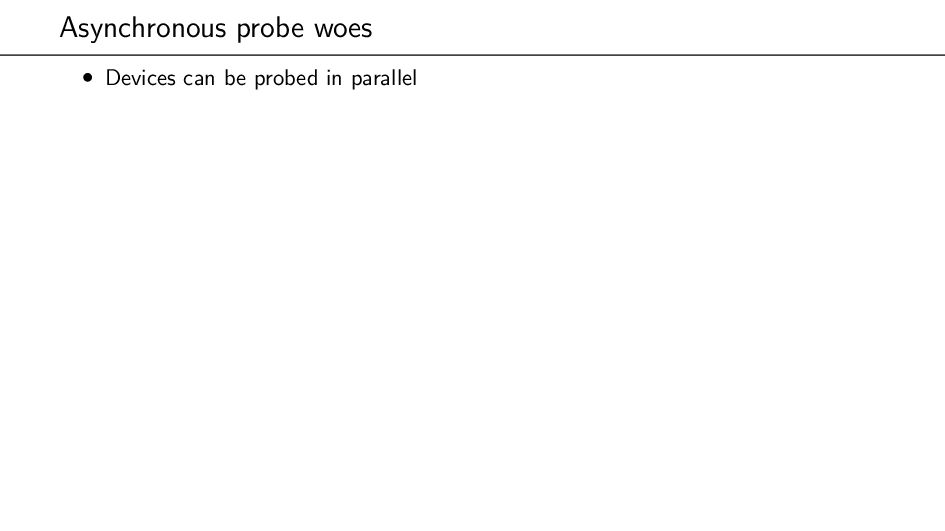
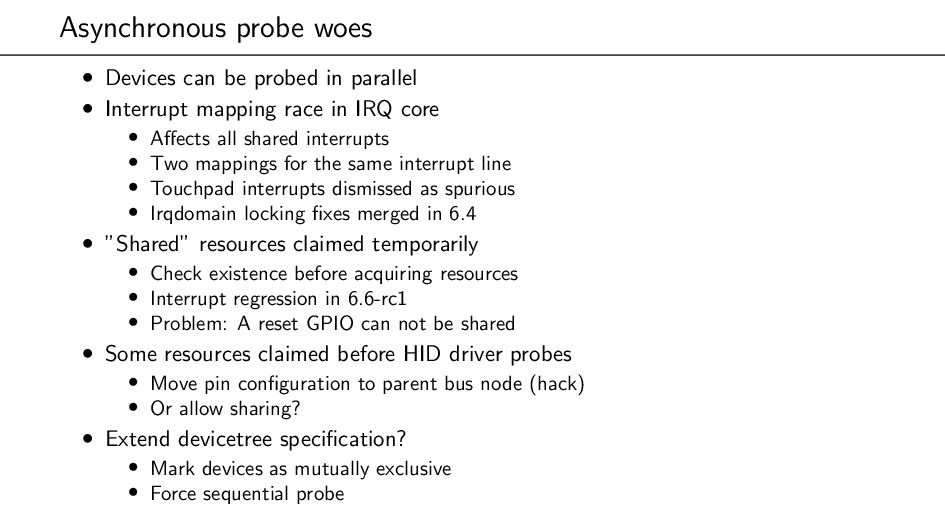
  25. Asynchronous probe woes • Devices can be probed in parallel

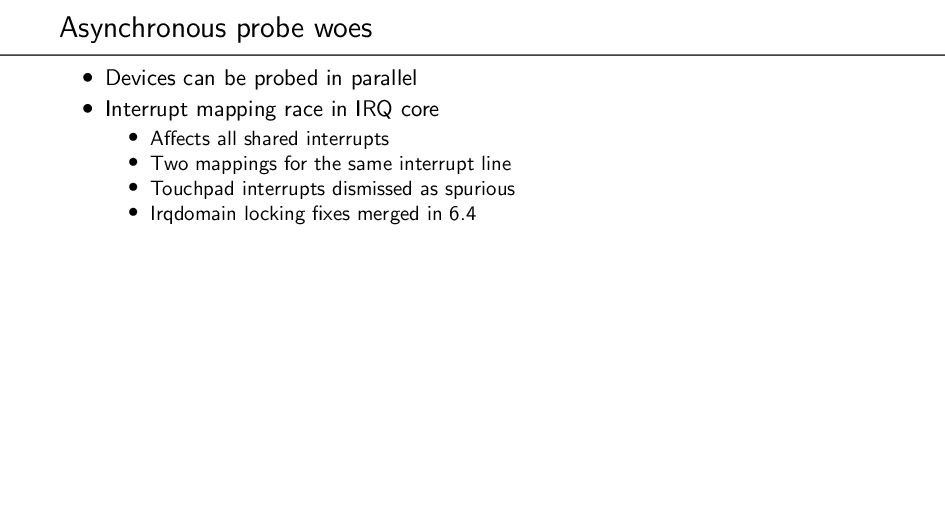
    • Interrupt mapping race in IRQ core • Affects all shared interrupts • Two mappings for the same interrupt line • Touchpad interrupts dismissed as spurious • Irqdomain locking fixes merged in 6.4
  26. Asynchronous probe woes • Devices can be probed in parallel

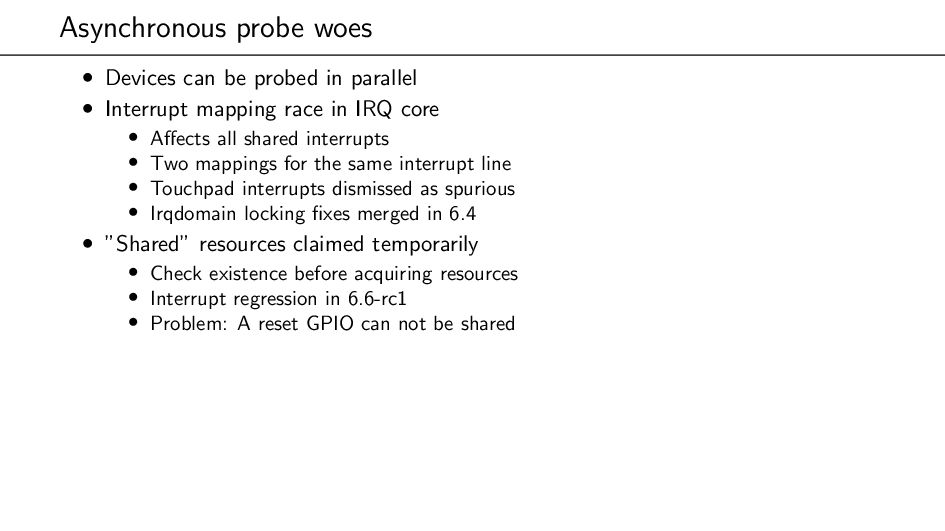
    • Interrupt mapping race in IRQ core • Affects all shared interrupts • Two mappings for the same interrupt line • Touchpad interrupts dismissed as spurious • Irqdomain locking fixes merged in 6.4 • ”Shared” resources claimed temporarily • Check existence before acquiring resources • Interrupt regression in 6.6-rc1 • Problem: A reset GPIO can not be shared
  27. Asynchronous probe woes • Devices can be probed in parallel

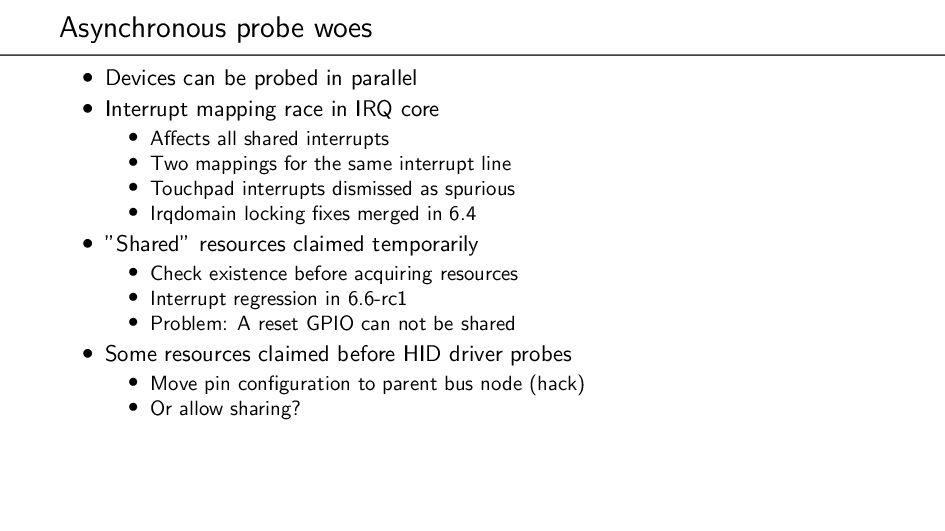
    • Interrupt mapping race in IRQ core • Affects all shared interrupts • Two mappings for the same interrupt line • Touchpad interrupts dismissed as spurious • Irqdomain locking fixes merged in 6.4 • ”Shared” resources claimed temporarily • Check existence before acquiring resources • Interrupt regression in 6.6-rc1 • Problem: A reset GPIO can not be shared • Some resources claimed before HID driver probes • Move pin configuration to parent bus node (hack) • Or allow sharing?
  28. Asynchronous probe woes • Devices can be probed in parallel

    • Interrupt mapping race in IRQ core • Affects all shared interrupts • Two mappings for the same interrupt line • Touchpad interrupts dismissed as spurious • Irqdomain locking fixes merged in 6.4 • ”Shared” resources claimed temporarily • Check existence before acquiring resources • Interrupt regression in 6.6-rc1 • Problem: A reset GPIO can not be shared • Some resources claimed before HID driver probes • Move pin configuration to parent bus node (hack) • Or allow sharing? • Extend devicetree specification? • Mark devices as mutually exclusive • Force sequential probe
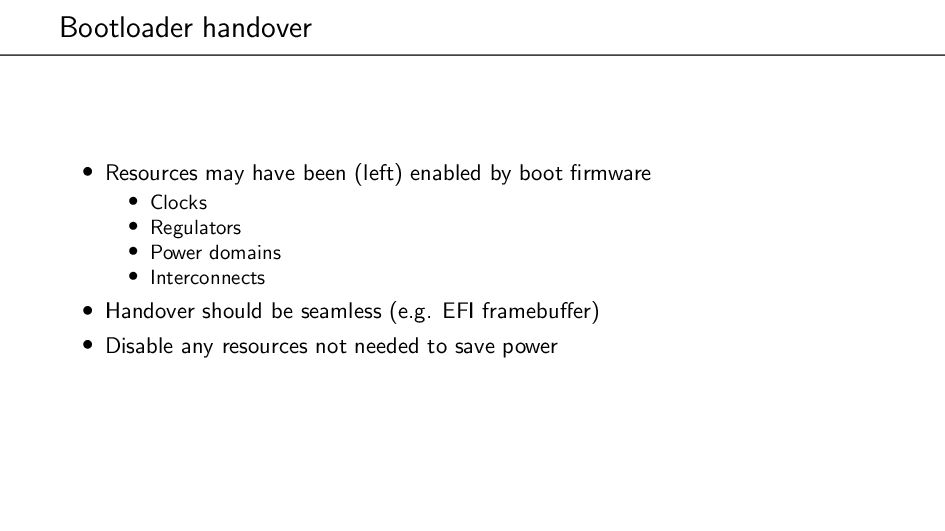
  29. Bootloader handover • Resources may have been (left) enabled by

    boot firmware • Clocks • Regulators • Power domains • Interconnects • Handover should be seamless (e.g. EFI framebuffer) • Disable any resources not needed to save power
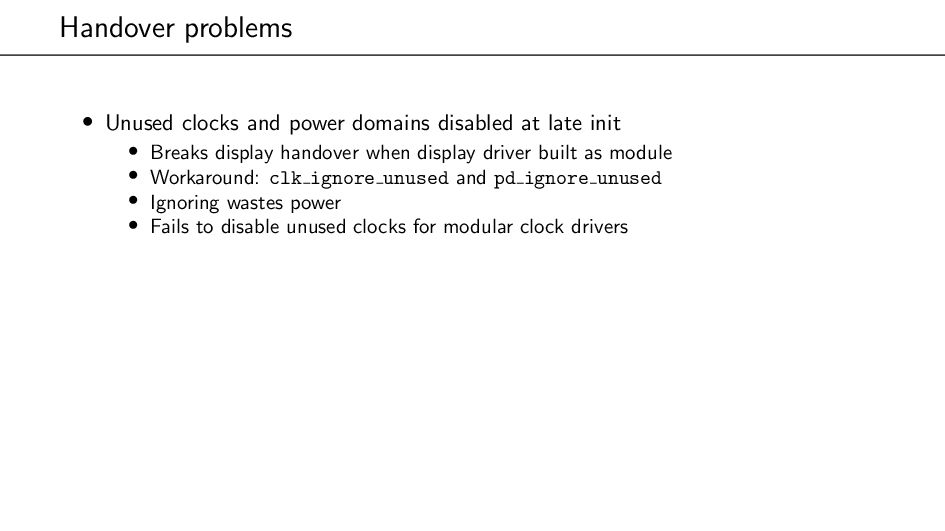
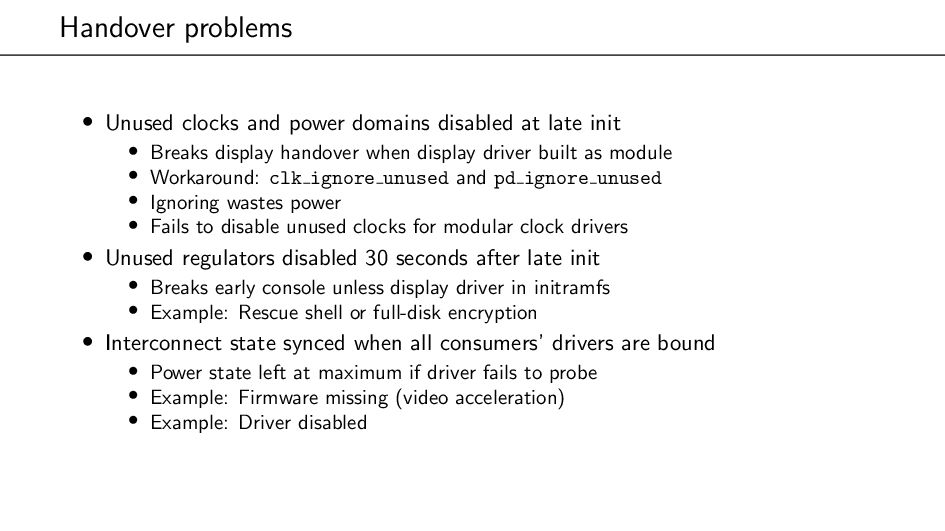
  30. Handover problems • Unused clocks and power domains disabled at

    late init • Breaks display handover when display driver built as module • Workaround: clk ignore unused and pd ignore unused • Ignoring wastes power • Fails to disable unused clocks for modular clock drivers
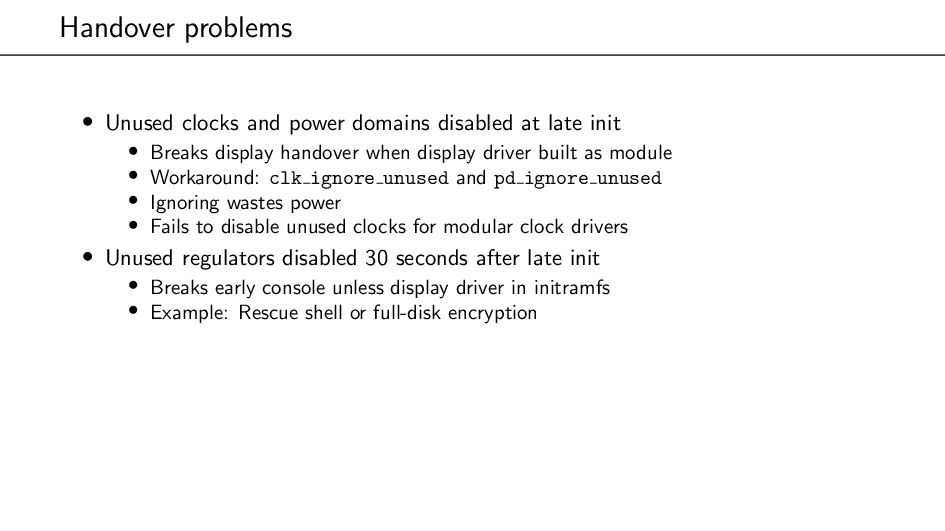
  31. Handover problems • Unused clocks and power domains disabled at

    late init • Breaks display handover when display driver built as module • Workaround: clk ignore unused and pd ignore unused • Ignoring wastes power • Fails to disable unused clocks for modular clock drivers • Unused regulators disabled 30 seconds after late init • Breaks early console unless display driver in initramfs • Example: Rescue shell or full-disk encryption
  32. Handover problems • Unused clocks and power domains disabled at

    late init • Breaks display handover when display driver built as module • Workaround: clk ignore unused and pd ignore unused • Ignoring wastes power • Fails to disable unused clocks for modular clock drivers • Unused regulators disabled 30 seconds after late init • Breaks early console unless display driver in initramfs • Example: Rescue shell or full-disk encryption • Interconnect state synced when all consumers’ drivers are bound • Power state left at maximum if driver fails to probe • Example: Firmware missing (video acceleration) • Example: Driver disabled
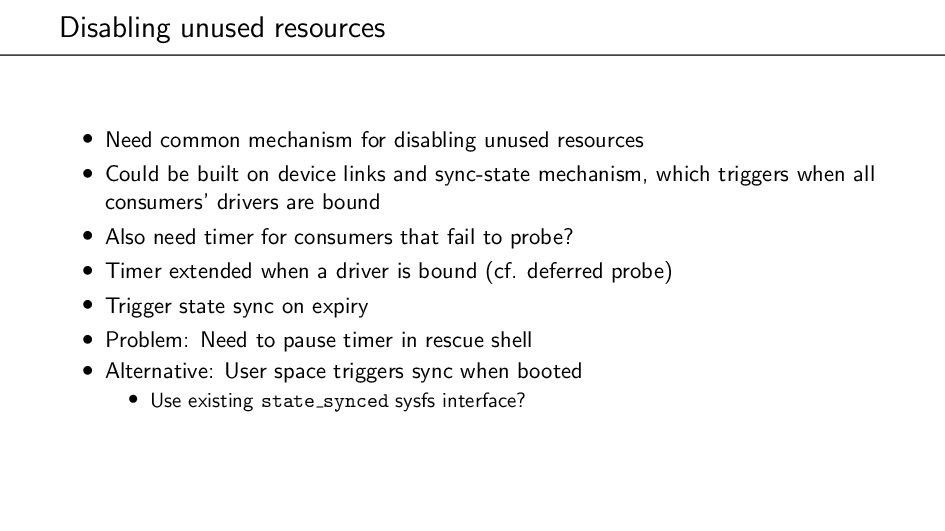
  33. Disabling unused resources • Need common mechanism for disabling unused

    resources • Could be built on device links and sync-state mechanism, which triggers when all consumers’ drivers are bound • Also need timer for consumers that fail to probe? • Timer extended when a driver is bound (cf. deferred probe) • Trigger state sync on expiry • Problem: Need to pause timer in rescue shell • Alternative: User space triggers sync when booted • Use existing state synced sysfs interface?
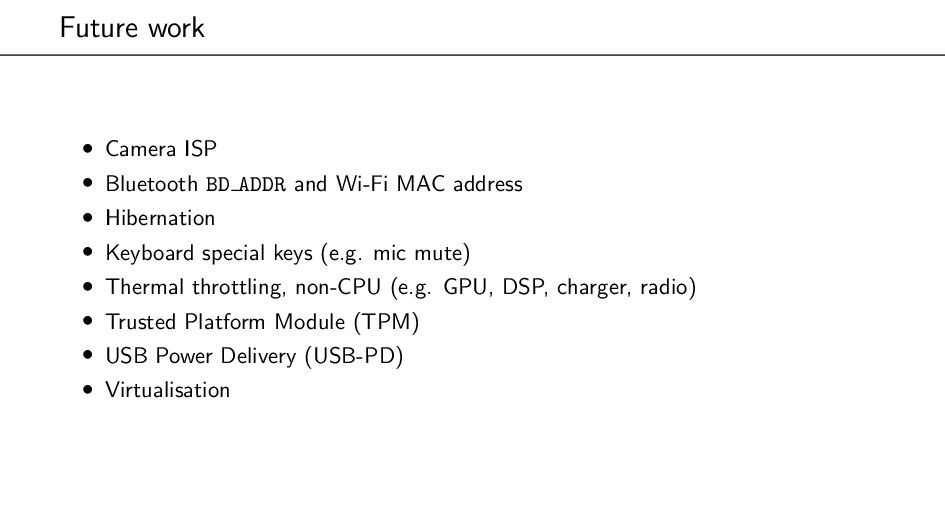
  34. Future work • Camera ISP • Bluetooth BD ADDR and

    Wi-Fi MAC address • Hibernation • Keyboard special keys (e.g. mic mute) • Thermal throttling, non-CPU (e.g. GPU, DSP, charger, radio) • Trusted Platform Module (TPM) • USB Power Delivery (USB-PD) • Virtualisation
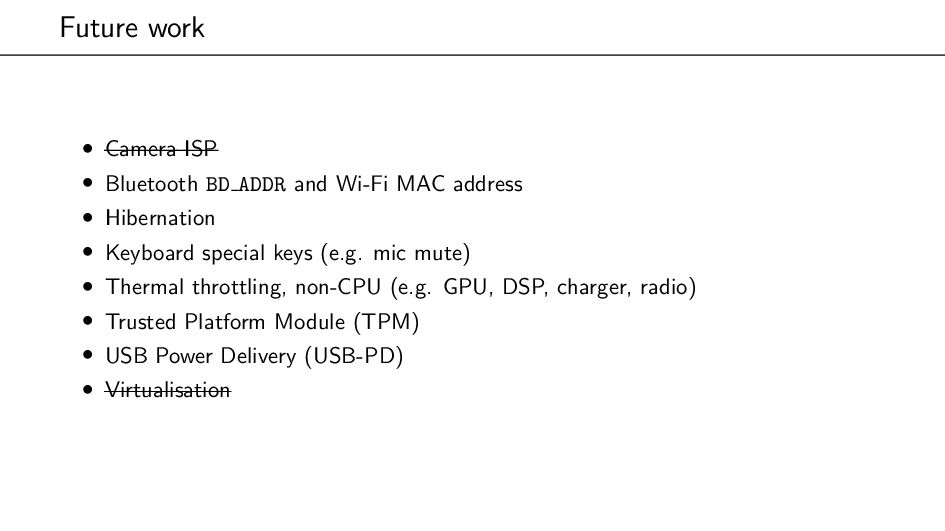
  35. Future work • Camera ISP • Bluetooth BD ADDR and

    Wi-Fi MAC address • Hibernation • Keyboard special keys (e.g. mic mute) • Thermal throttling, non-CPU (e.g. GPU, DSP, charger, radio) • Trusted Platform Module (TPM) • USB Power Delivery (USB-PD) • Virtualisation
  36. Getting started with X13s • Linux 6.5 (mainline or WIP)

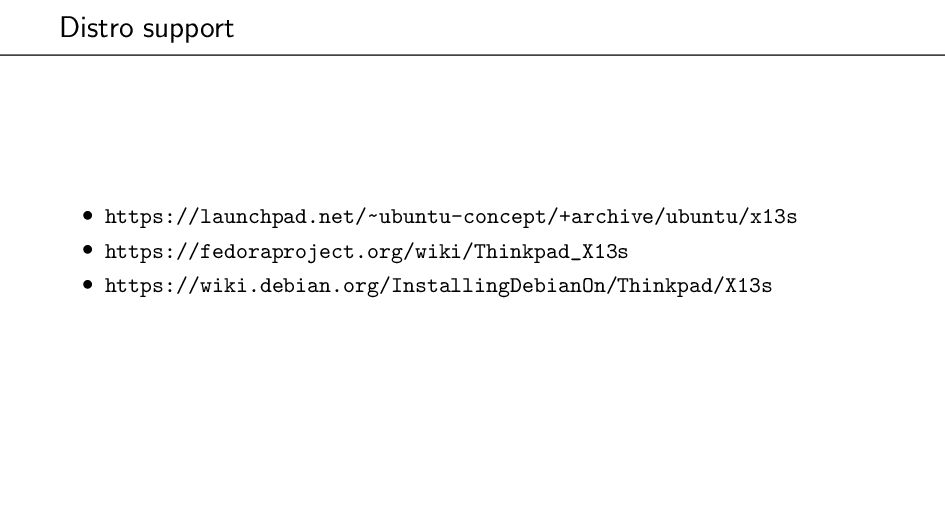
    • https://github.com/jhovold/linux/tree/wip/sc8280xp-v6.5 • make johan defconfig • linux-firmware-20230919 • ln -s a660 gmu.bin a690 gmu.bin • qcvss8280.mbn (with WIP branch) • alsa-ucm-conf 1.2.10 + volume fixes • https://github.com/alsa-project/alsa-ucm-conf/pull/335 • Mesa 23.1.4 • Qualcomm pd-mapper and qrtr-ns daemons • https://github.com/andersson/pd-mapper • https://github.com/andersson/qrtr
  37. Kernel command line • clk ignore unused (generic issue) •

    pd ignore unused (generic issue) • arm64.nopauth (firmware bug) • efi=noruntime (firmware bug) • iommu.passthrough=0 iommu.strict=0 (USB throughput) • pcie aspm.policy=powersupersave (PCIe ASPM)
  38. Initramfs • Modules needed to boot • nvme, phy qcom

    qmp pcie, pcie qcom • Modules needed for early console (optional) • i2c hid of, i2c qcom geni • leds qcom lpg, pwm bl • qrtr, pmic glink altmode, gpio sbu mux, phy qcom qmp combo • panel edp, msm, phy qcom edp • Depends on config • Documented in commit message for johan defconfig • Missing display dependency can break EFI framebuffer
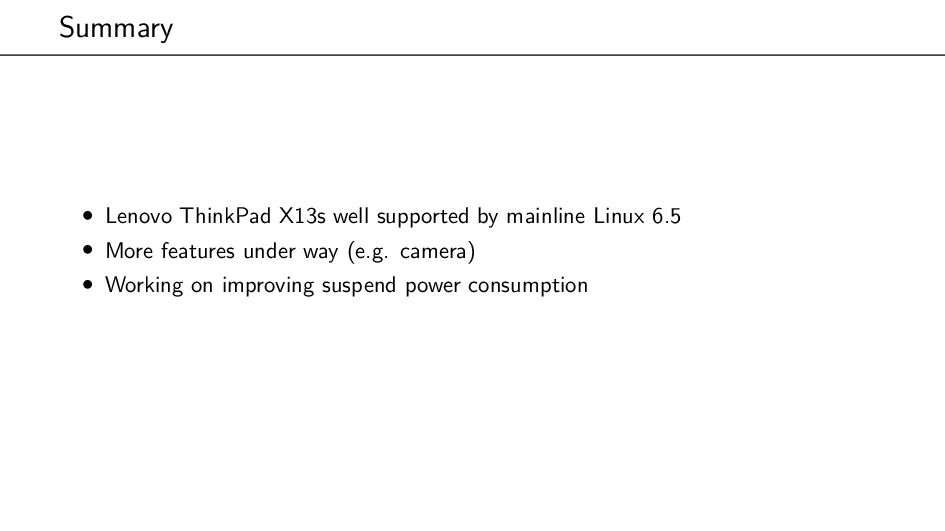
  39. Summary • Lenovo ThinkPad X13s well supported by mainline Linux

    6.5 • More features under way (e.g. camera) • Working on improving suspend power consumption
  40. Wiki • For updated status, known issues and other resources,

    see: • https://github.com/jhovold/linux/wiki/X13s

More Decks by Kernel Recipes

Other Decks in Programming