Share
Embed
academist Prize 4期生 研究トーク延長戦!「美は世界を救う」っていうけど、どうやって?
【こちらのイベントで使用した資料です】
academist Prize 4期生 研究トーク延長戦!「美は世界を救うっていうけど、どうやって?」- スピーカー:櫃割仁平(ヘルムートシュミッド大学)
https://lu.ma/b1ndl1f5
【アーカイブ】
https://youtu.be/FwnsMTzDE0s
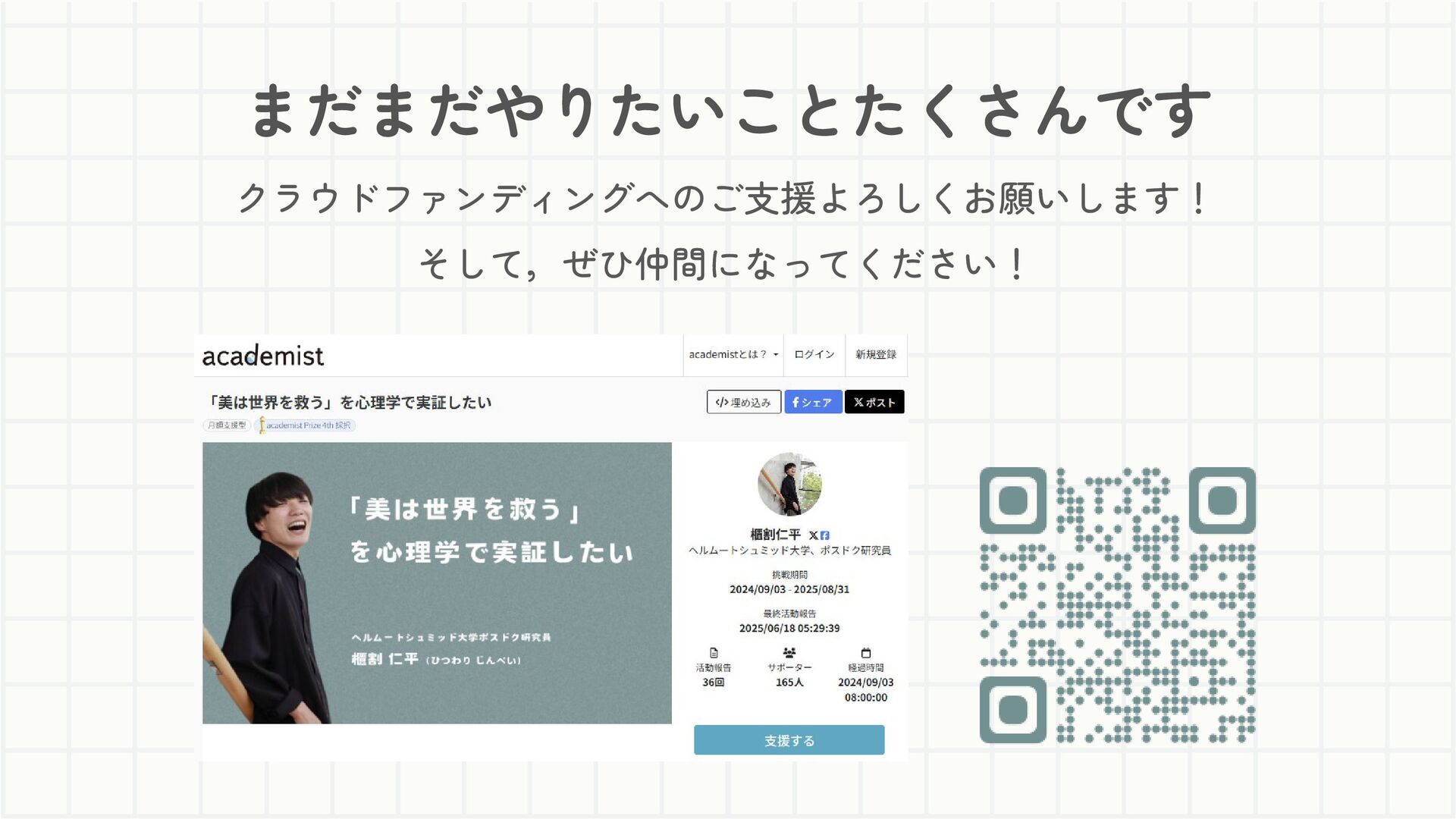
【研究サポーター募集中!】
https://academist-cf.com/fanclubs/358
Jimpei
June 18, 2025
Transcript
49 slides
-
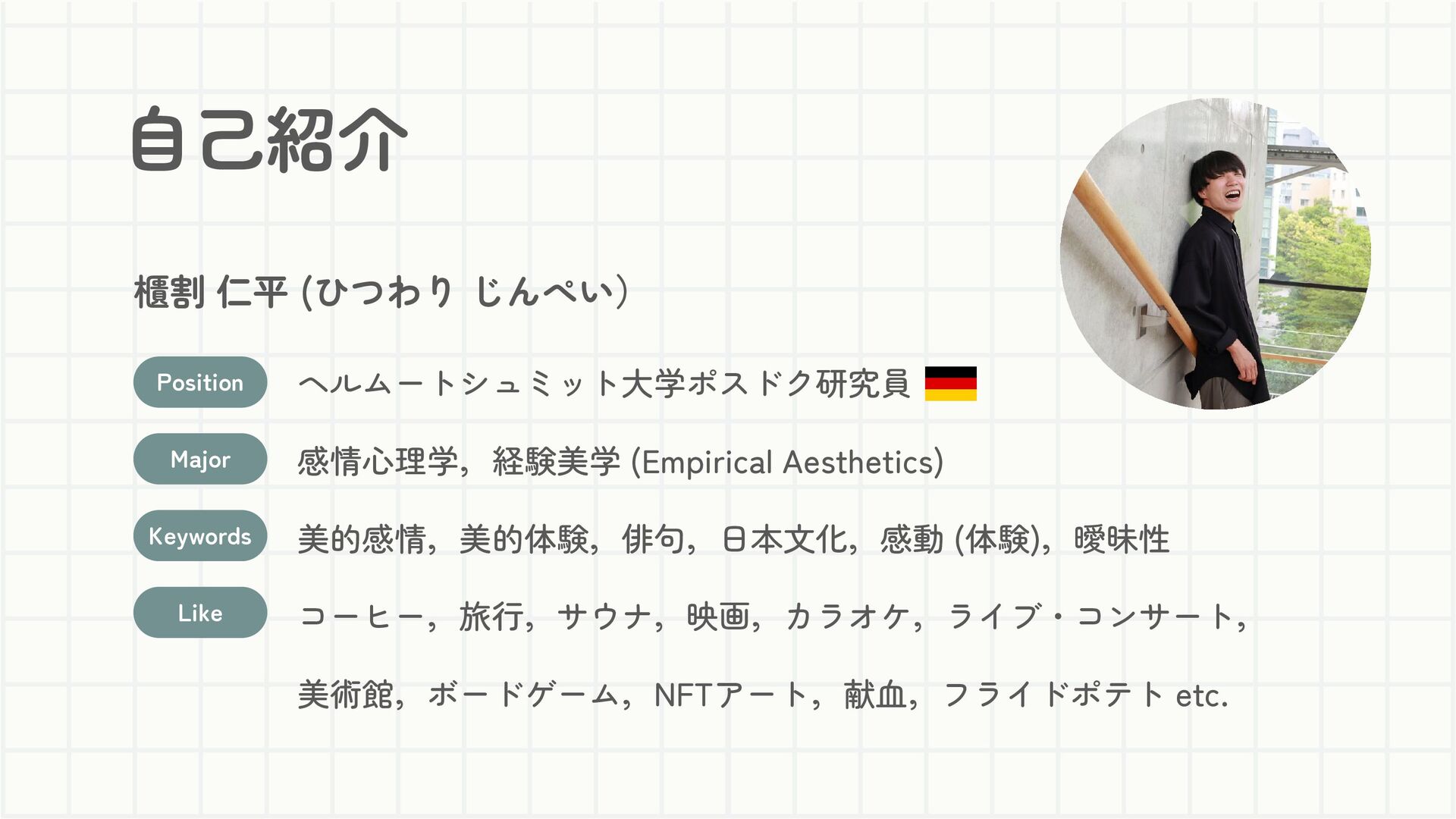
自己紹介 櫃割 仁平 (ひつわり じんぺい) Position ヘルムートシュミット大学ポスドク研究員 感情心理学,経験美学 (Empirical Aesthetics)
美的感情,美的体験,俳句,日本文化,感動 (体験),曖昧性 コーヒー,旅行,サウナ,映画,カラオケ,ライブ・コンサート, 美術館,ボードゲーム,NFTアート,献血,フライドポテト etc. Major Keywords Like -
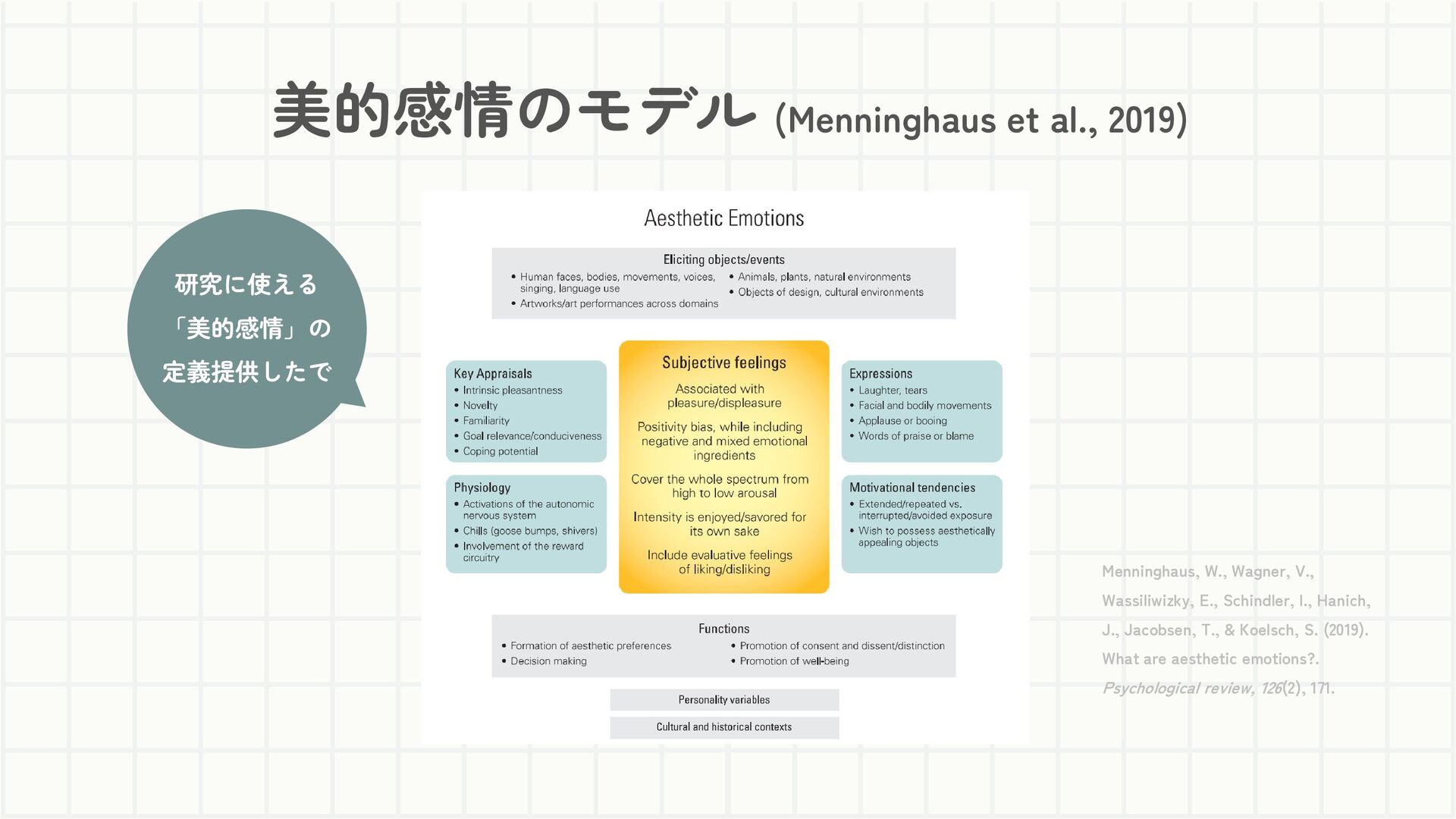
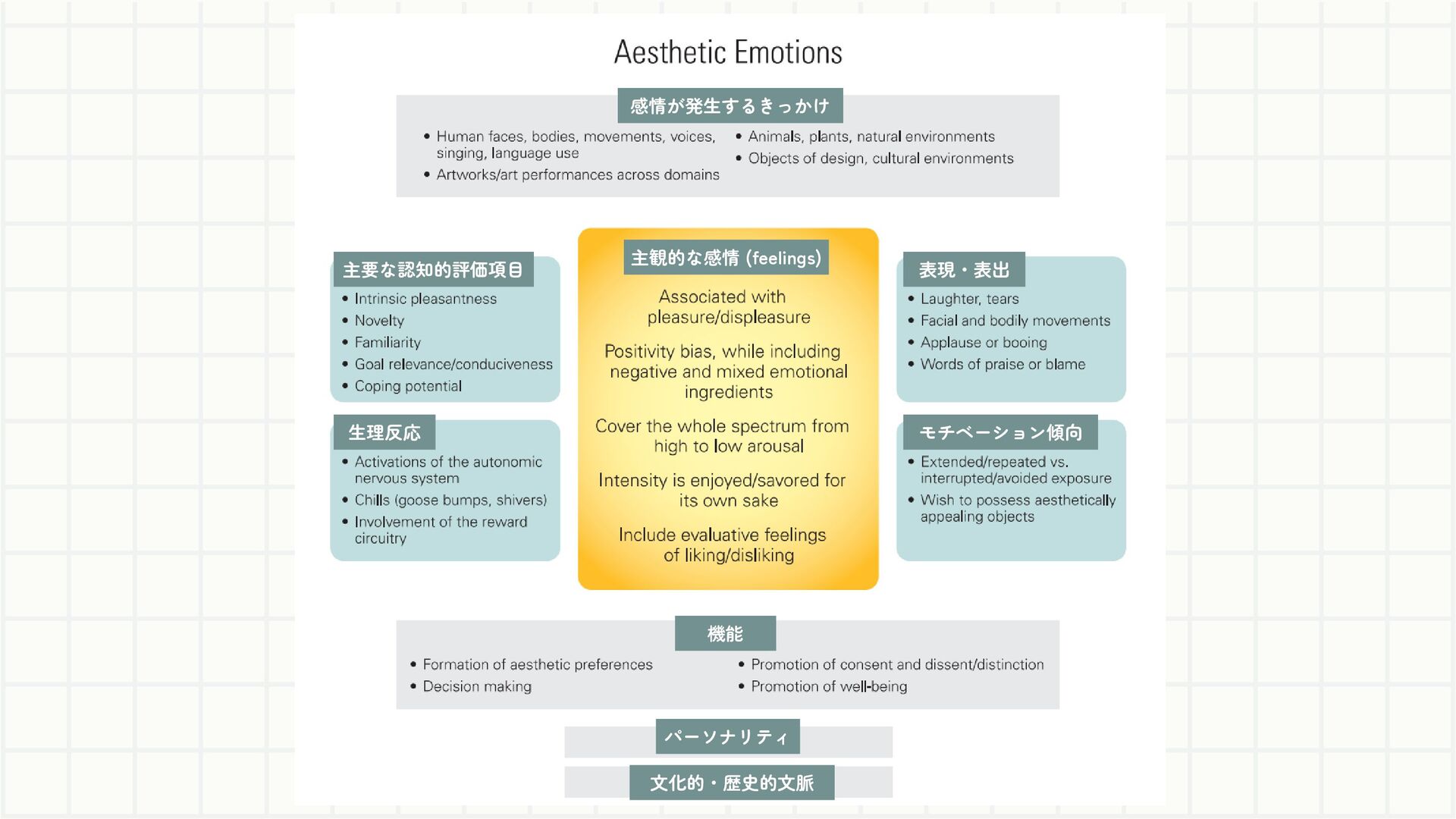
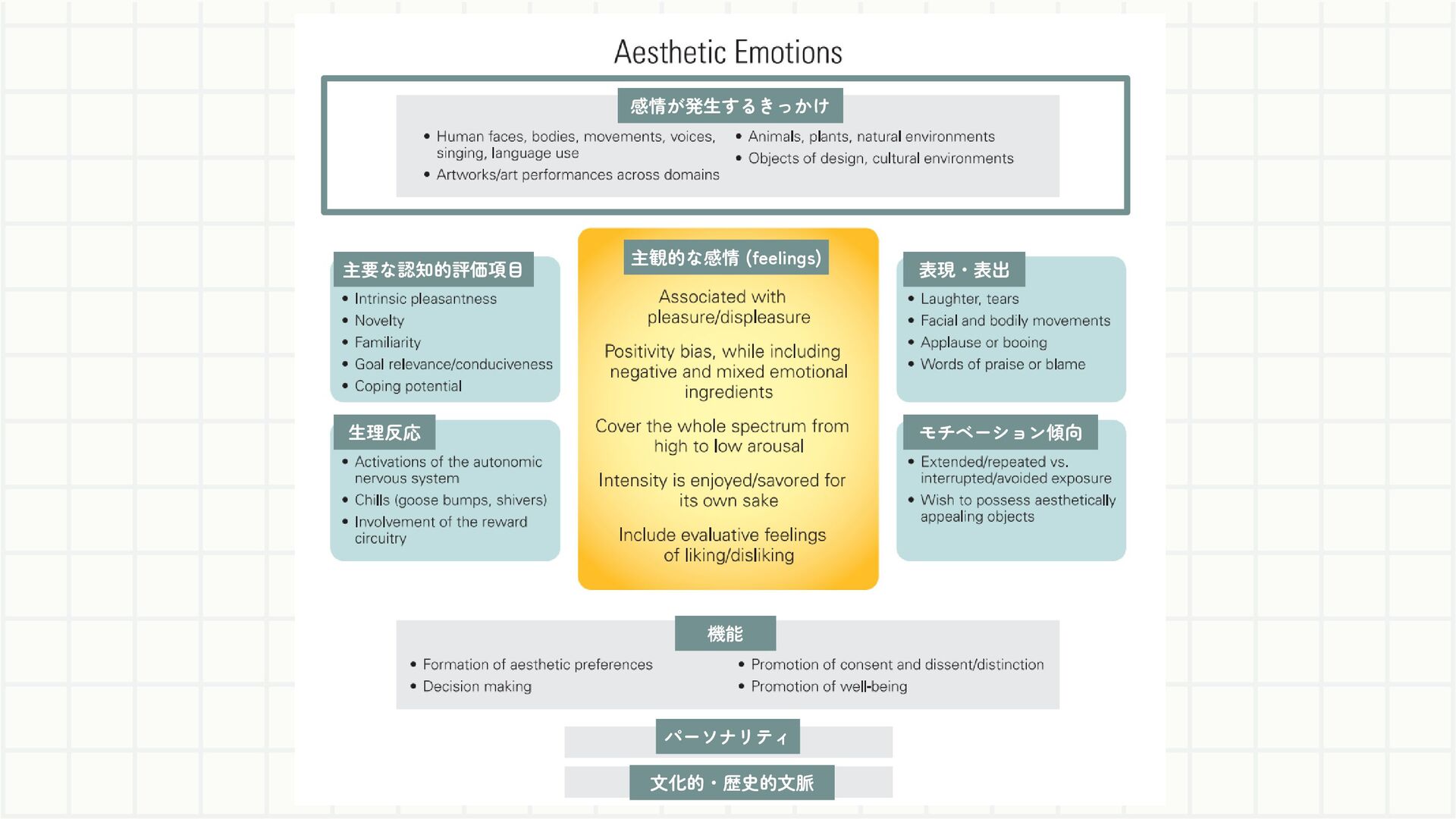
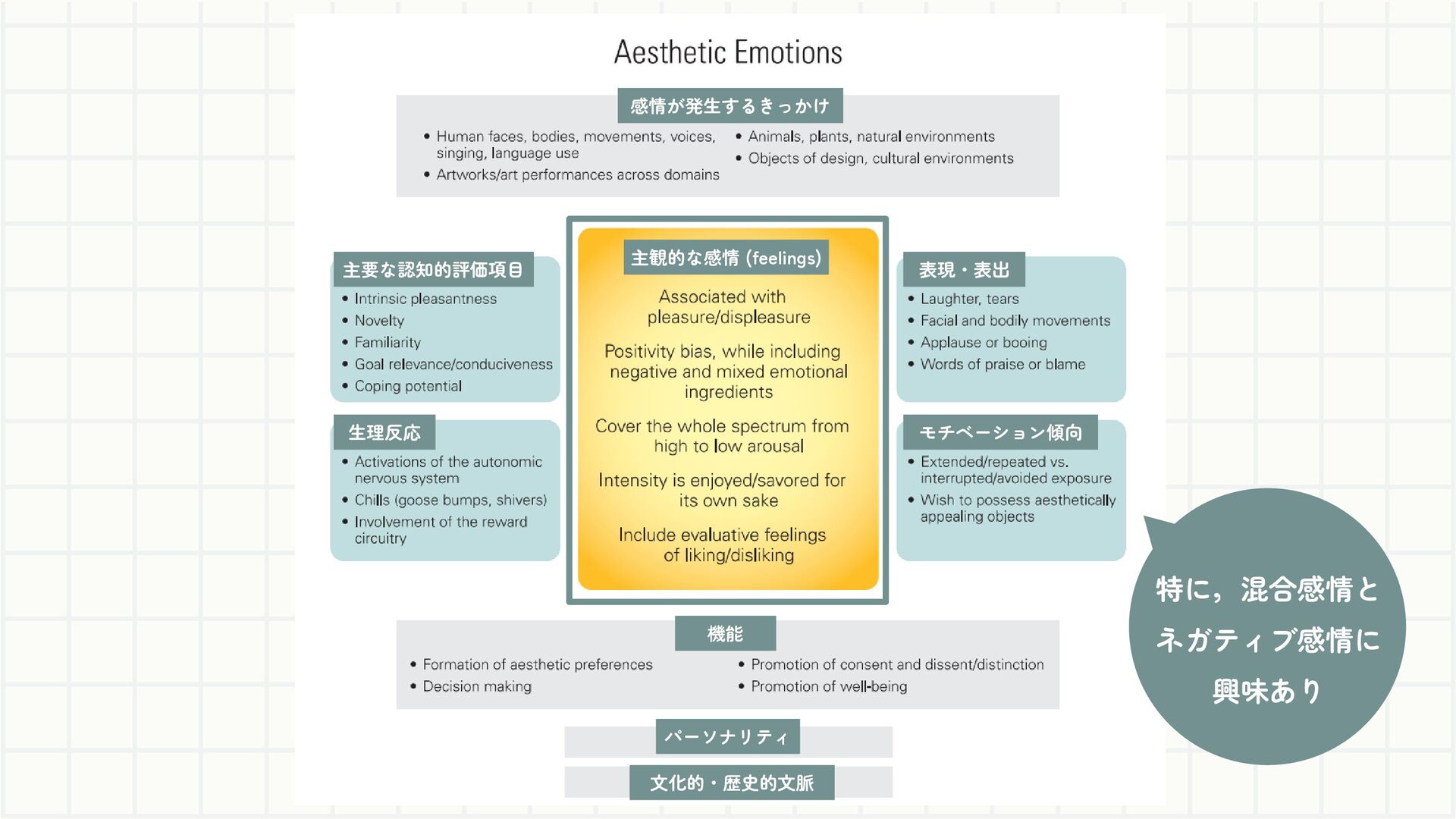
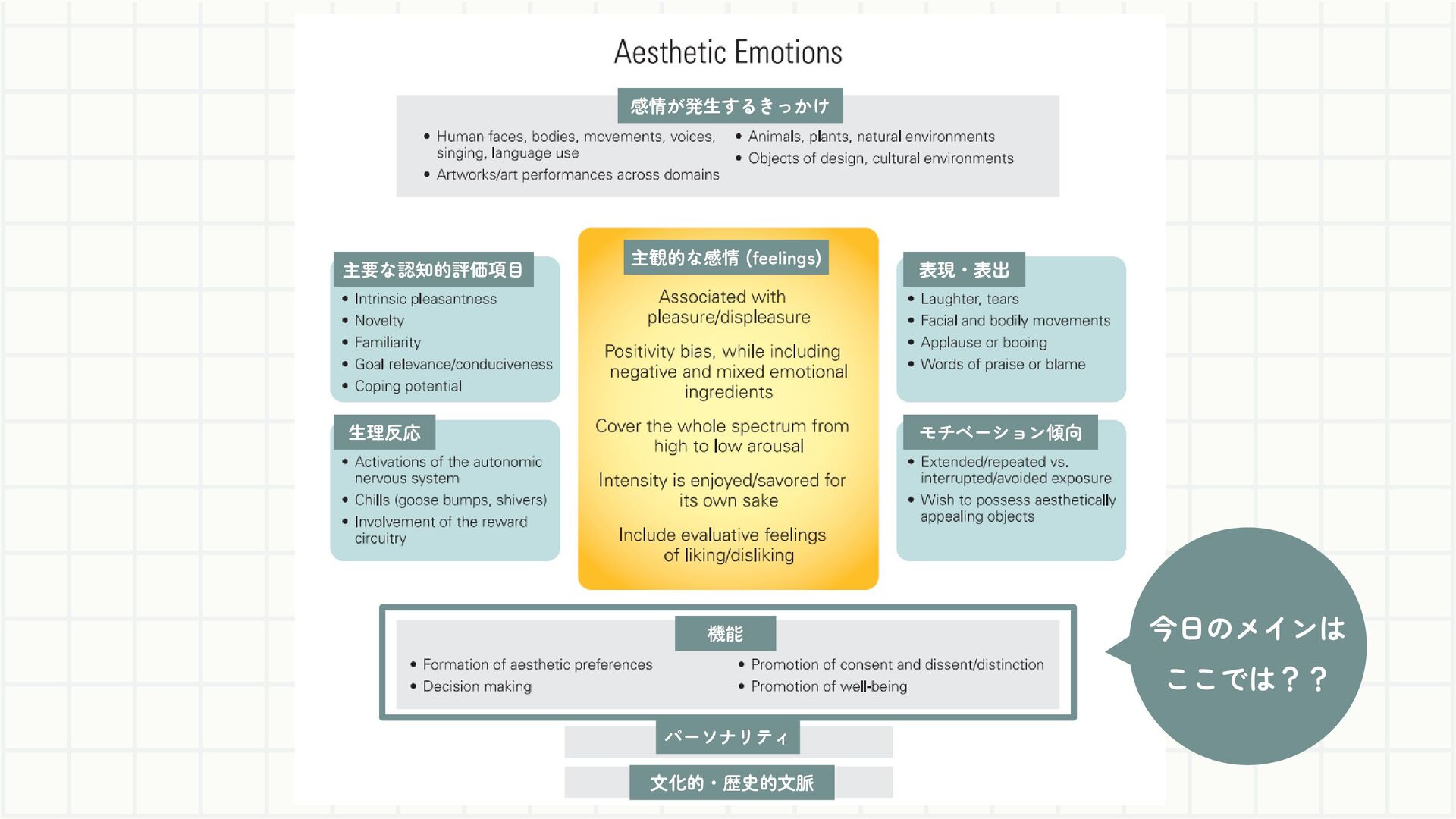
美的感情のモデル (Menninghaus et al., 2019) 研究に使える 「美的感情」の 定義提供したで Menninghaus, W.,
Wagner, V., Wassiliwizky, E., Schindler, I., Hanich, J., Jacobsen, T., & Koelsch, S. (2019). What are aesthetic emotions?. Psychological review, 126(2), 171. -
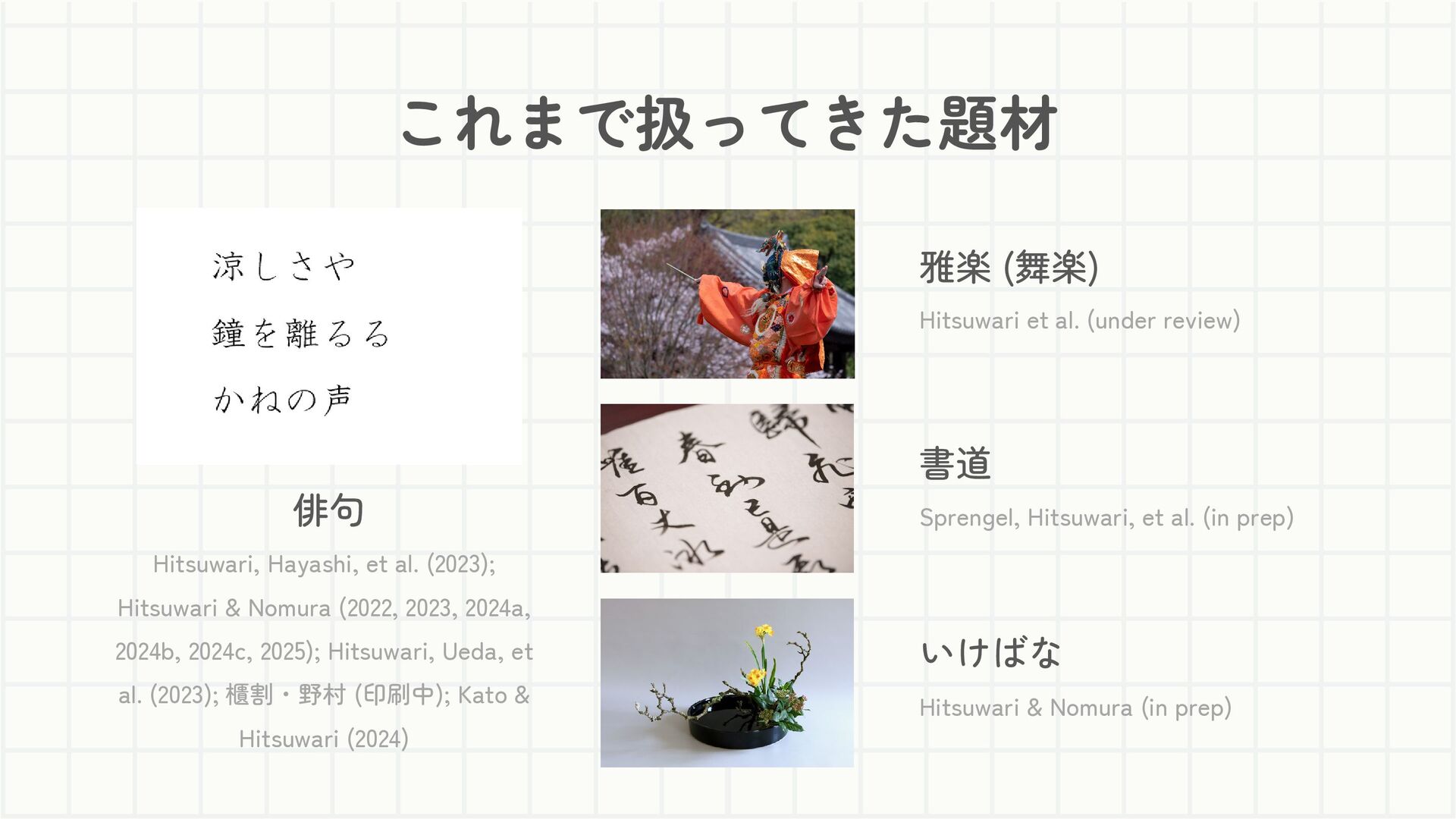
これまで扱ってきた題材 俳句 Sprengel, Hitsuwari, et al. (in prep) 書道 Hitsuwari,
Hayashi, et al. (2023); Hitsuwari & Nomura (2022, 2023, 2024a, 2024b, 2024c, 2025); Hitsuwari, Ueda, et al. (2023); 櫃割・野村 (印刷中); Kato & Hitsuwari (2024) Hitsuwari et al. (under review) 雅楽 (舞楽) Hitsuwari & Nomura (in prep) いけばな -
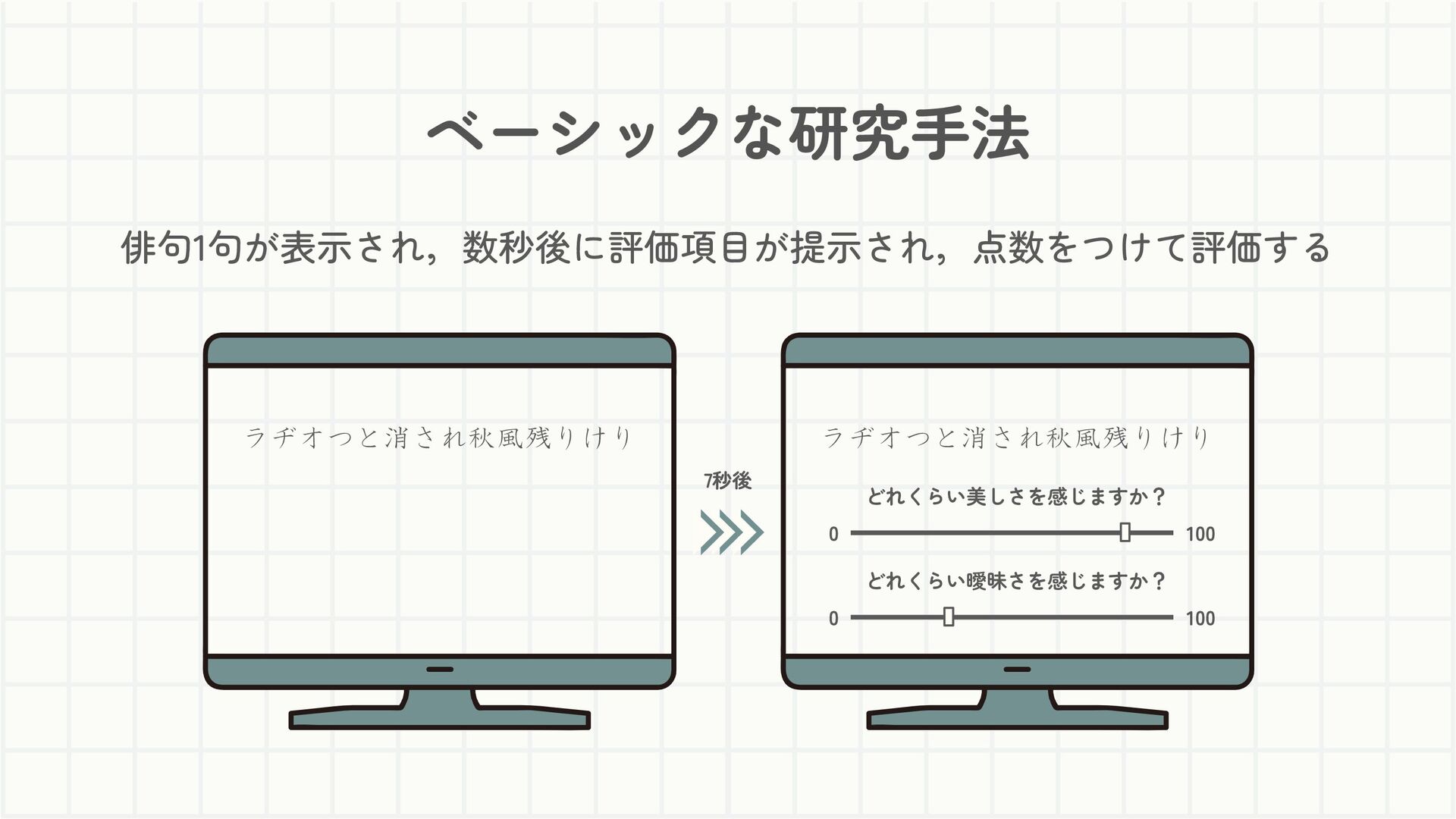
ベーシックな研究手法 ラヂオつと消され秋風残りけり ラヂオつと消され秋風残りけり どれくらい美しさを感じますか? 0 100 どれくらい曖昧さを感じますか? 0 100 7秒後
俳句1句が表示され,数秒後に評価項目が提示され,点数をつけて評価する -
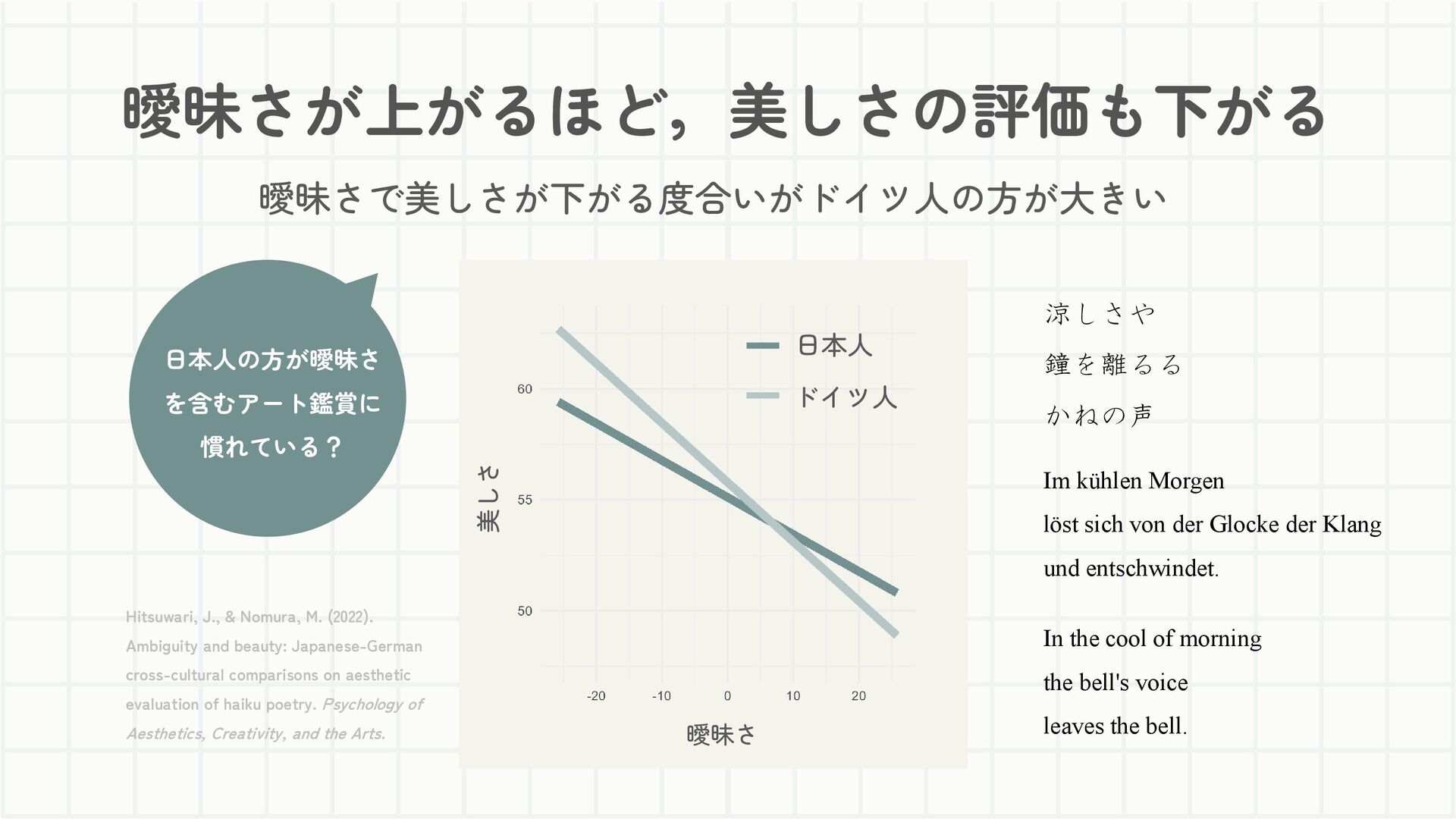
曖昧さが上がるほど,美しさの評価も下がる 曖昧さで美しさが下がる度合いがドイツ人の方が大きい 日本人 ドイツ人 曖昧さ 美しさ 涼しさや 鐘を離るる かねの声 Im
kühlen Morgen löst sich von der Glocke der Klang und entschwindet. In the cool of morning the bell's voice leaves the bell. 日本人の方が曖昧さ を含むアート鑑賞に 慣れている? Hitsuwari, J., & Nomura, M. (2022). Ambiguity and beauty: Japanese-German cross-cultural comparisons on aesthetic evaluation of haiku poetry. Psychology of Aesthetics, Creativity, and the Arts. -
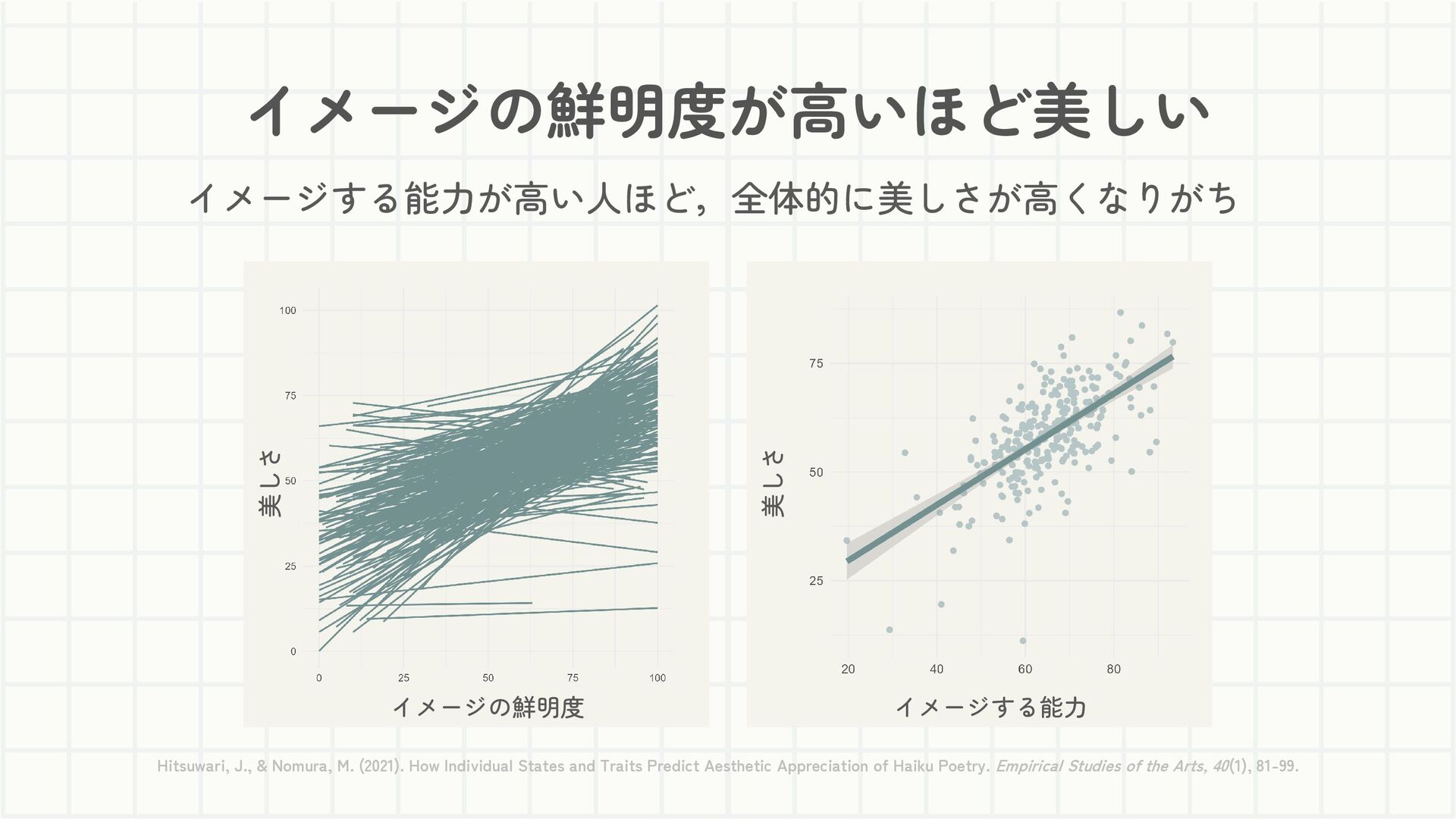
イメージの鮮明度が高いほど美しい イメージする能力が高い人ほど,全体的に美しさが高くなりがち Hitsuwari, J., & Nomura, M. (2021). How Individual
States and Traits Predict Aesthetic Appreciation of Haiku Poetry. Empirical Studies of the Arts, 40(1), 81-99. イメージの鮮明度 美しさ イメージする能力 美しさ -
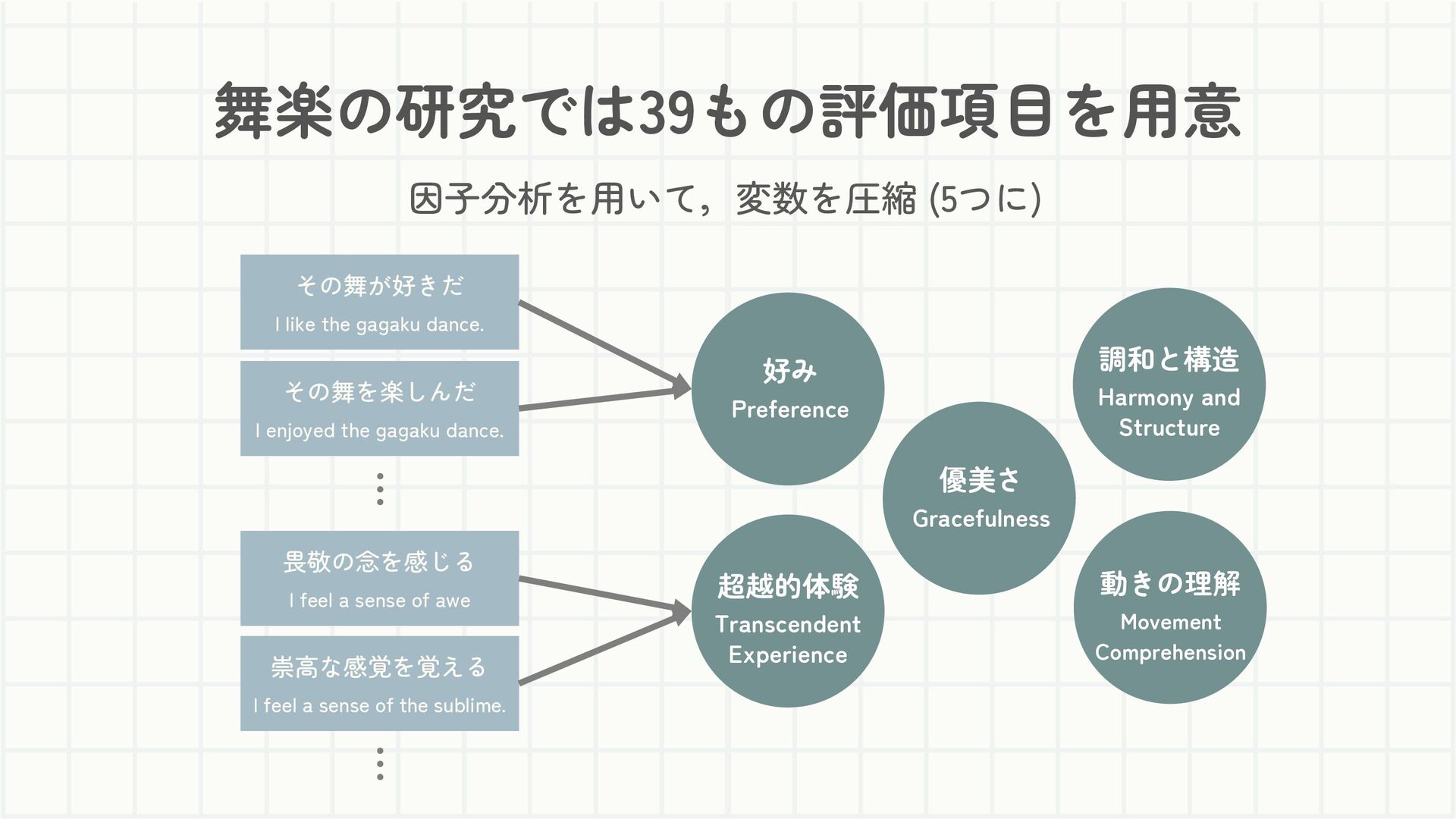
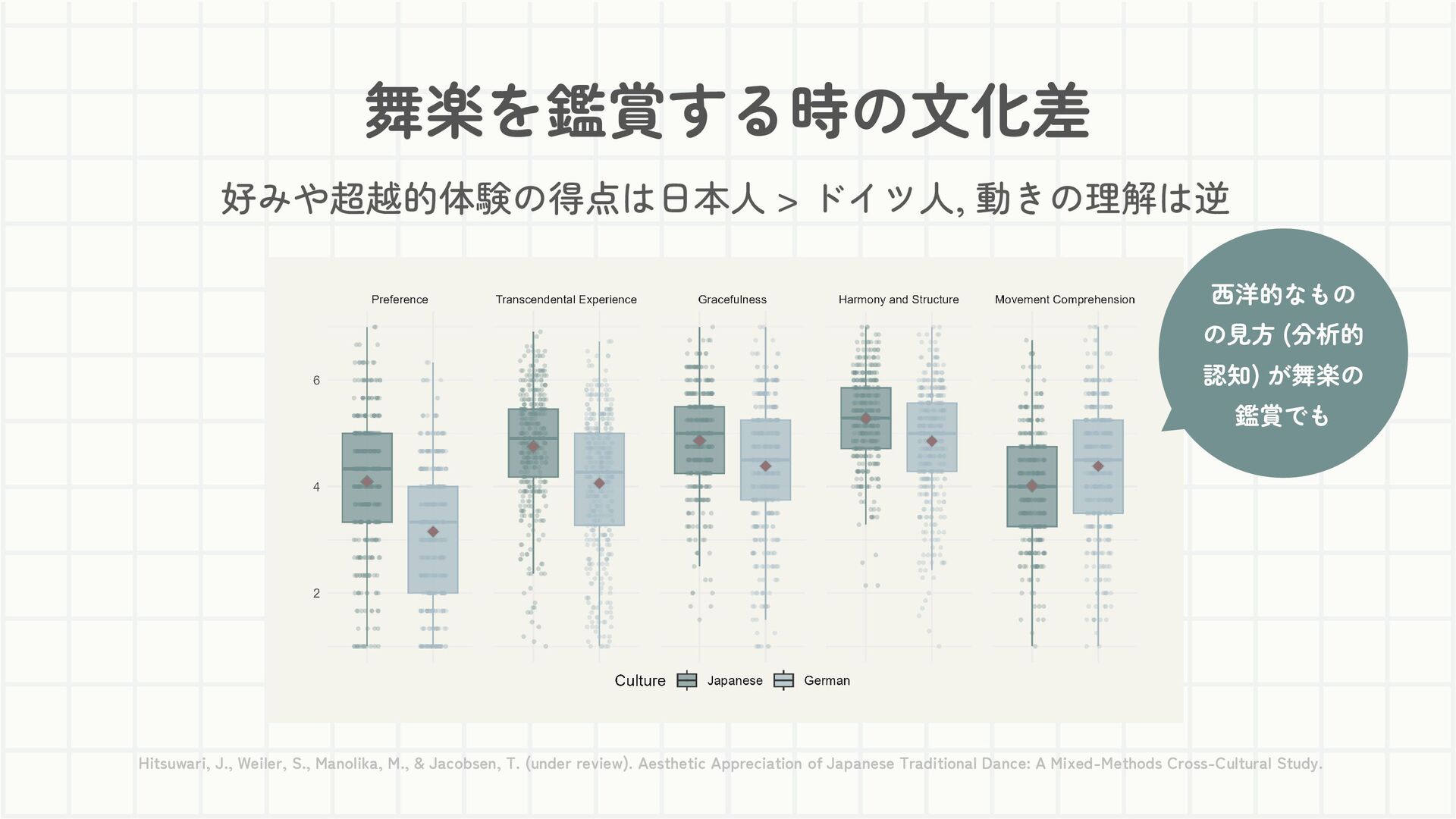
舞楽の研究では39もの評価項目を用意 因子分析を用いて,変数を圧縮 (5つに) 好み Preference 超越的体験 Transcendent Experience 優美さ Gracefulness
調和と構造 Harmony and Structure 動きの理解 Movement Comprehension その舞が好きだ I like the gagaku dance. その舞を楽しんだ I enjoyed the gagaku dance. 畏敬の念を感じる I feel a sense of awe 崇高な感覚を覚える I feel a sense of the sublime. ・ ・ ・ ・ ・ ・ -
舞楽を鑑賞する時の文化差 好みや超越的体験の得点は日本人 > ドイツ人, 動きの理解は逆 Hitsuwari, J., Weiler, S., Manolika,
M., & Jacobsen, T. (under review). Aesthetic Appreciation of Japanese Traditional Dance: A Mixed-Methods Cross-Cultural Study. 西洋的なもの の見方 (分析的 認知) が舞楽の 鑑賞でも -
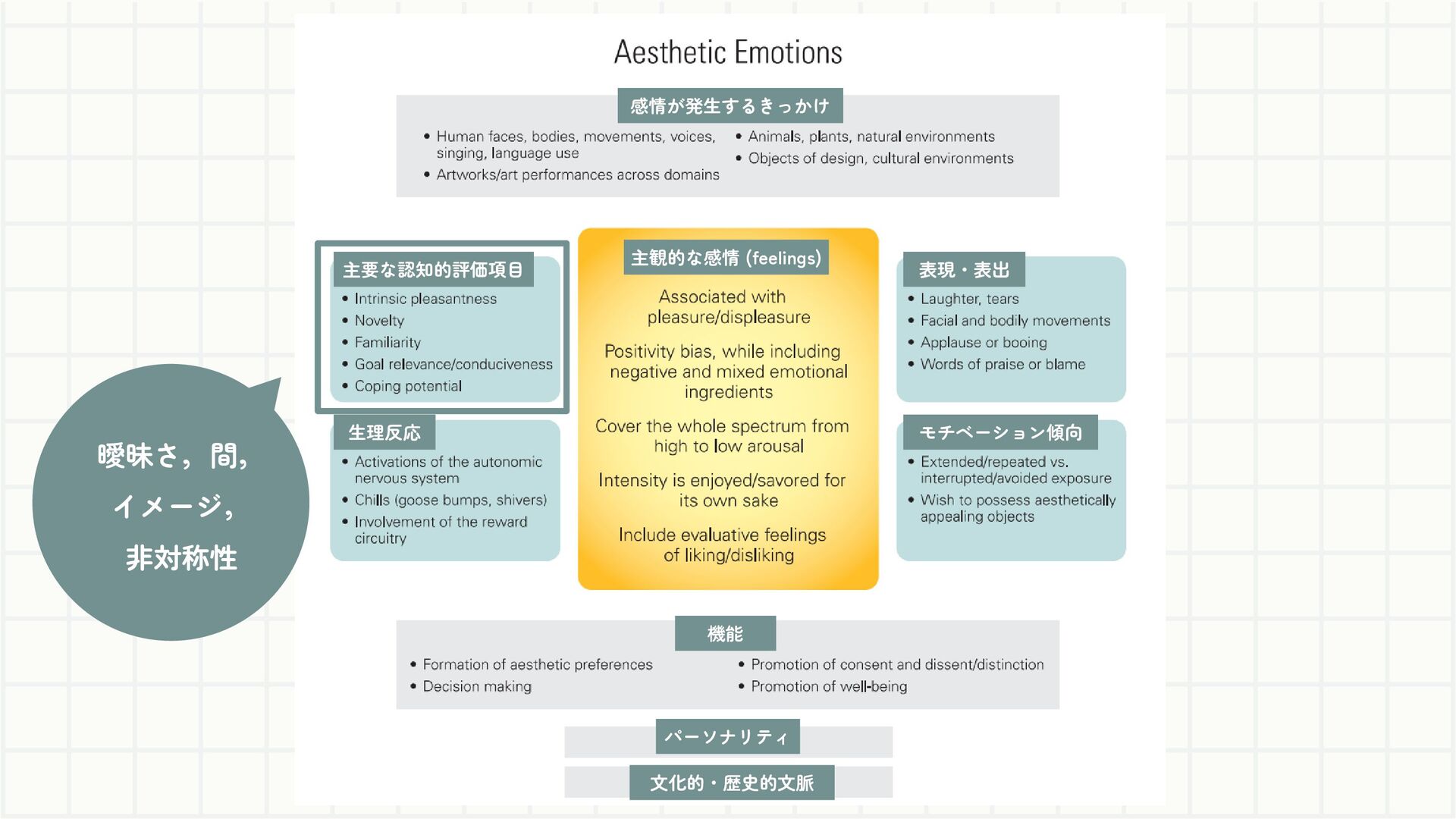
主要な認知的評価項目 生理反応 主観的な感情 (feelings) 表現・表出 モチベーション傾向 機能 感情が発生するきっかけ パーソナリティ 文化的・歴史的文脈
特に,混合感情と ネガティブ感情に 興味あり -
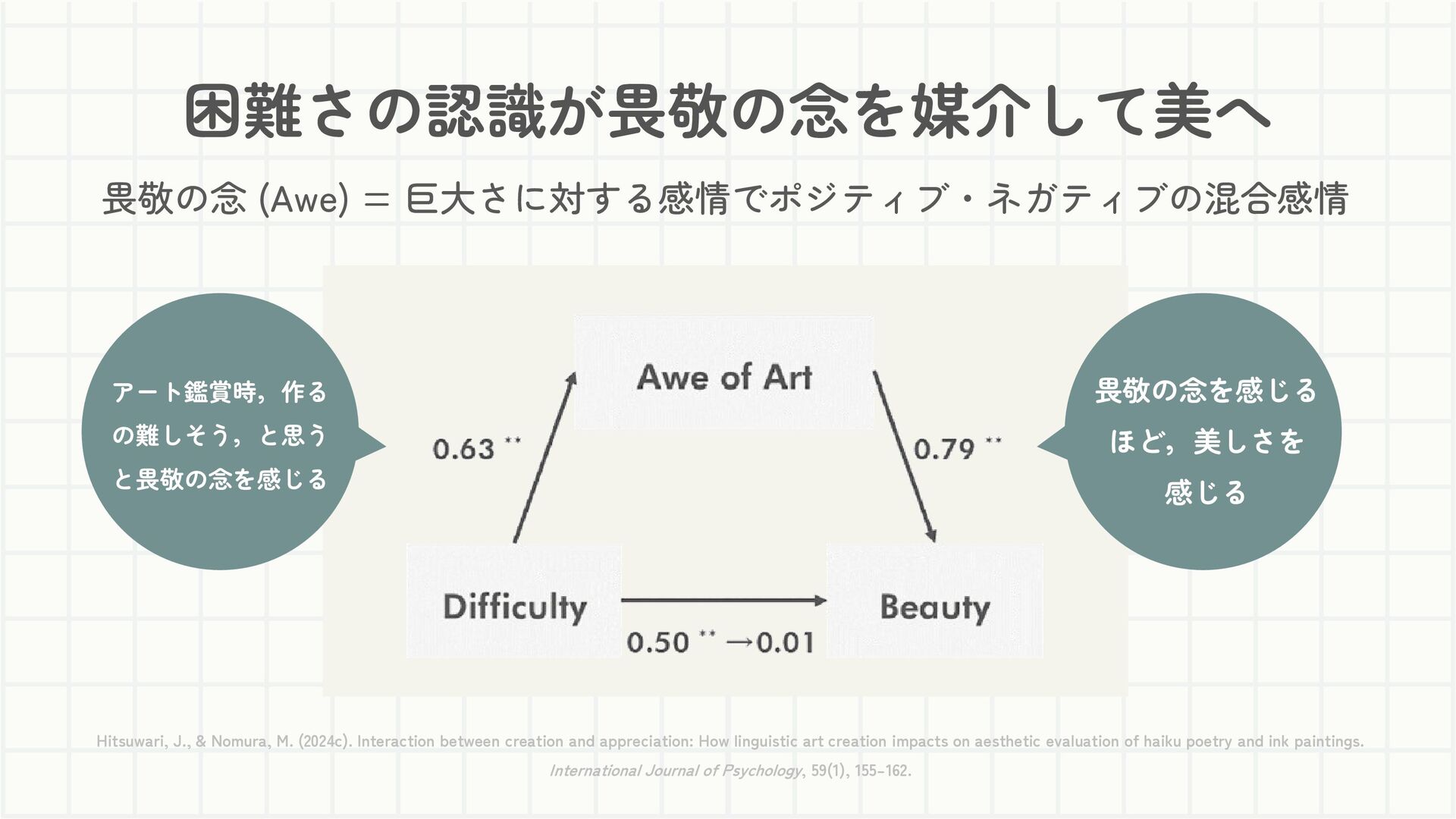
困難さの認識が畏敬の念を媒介して美へ 畏敬の念 (Awe) = 巨大さに対する感情でポジティブ・ネガティブの混合感情 Hitsuwari, J., & Nomura, M.
(2024c). Interaction between creation and appreciation: How linguistic art creation impacts on aesthetic evaluation of haiku poetry and ink paintings. International Journal of Psychology, 59(1), 155–162. アート鑑賞時,作る の難しそう,と思う と畏敬の念を感じる 畏敬の念を感じる ほど,美しさを 感じる -
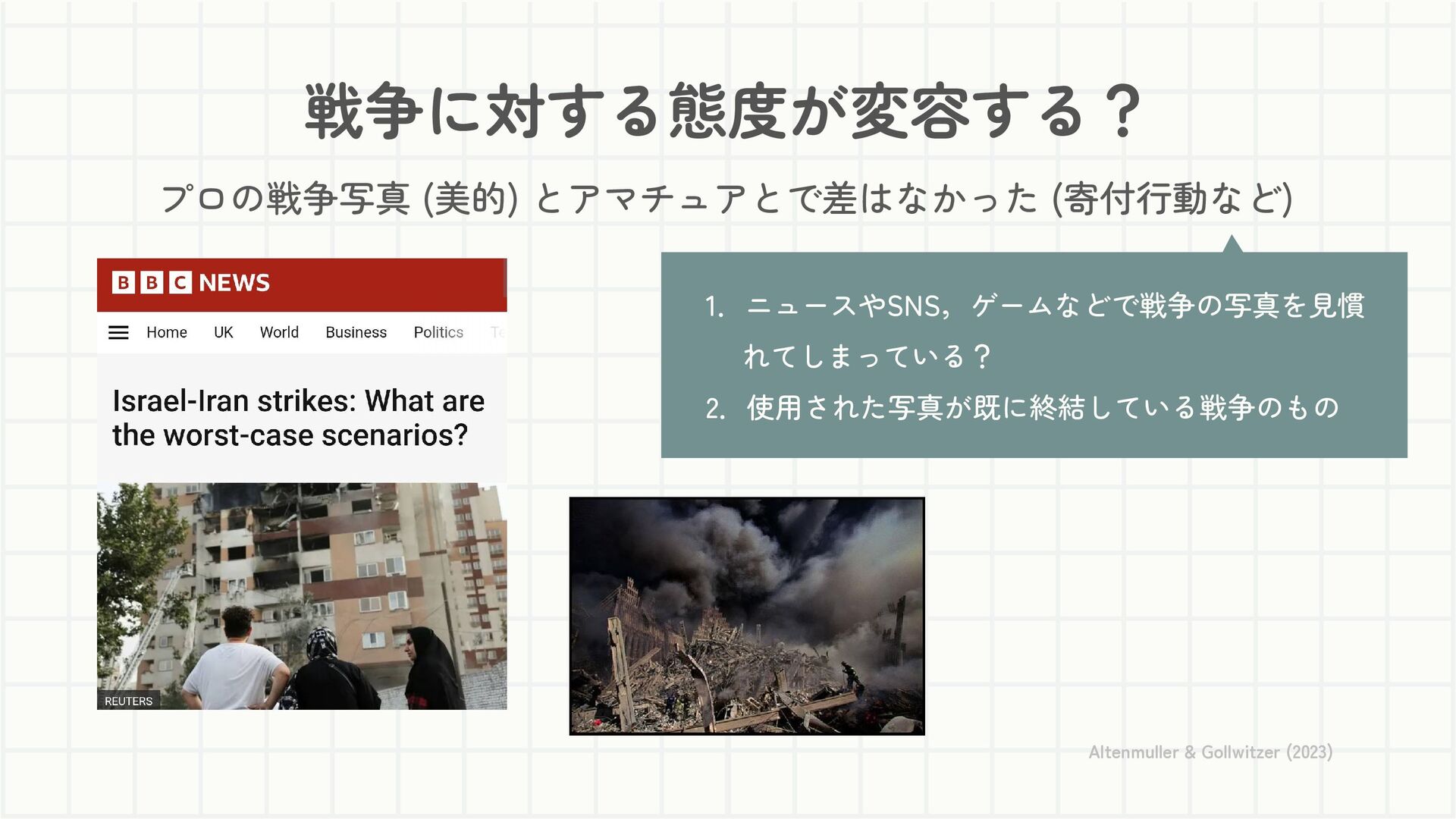
戦争に対する態度が変容する? プロの戦争写真 (美的) とアマチュアとで差はなかった (寄付行動など) Altenmuller & Gollwitzer (2023) 1.ニュースやSNS,ゲームなどで戦争の写真を見慣
れてしまっている? 2.使用された写真が既に終結している戦争のもの -
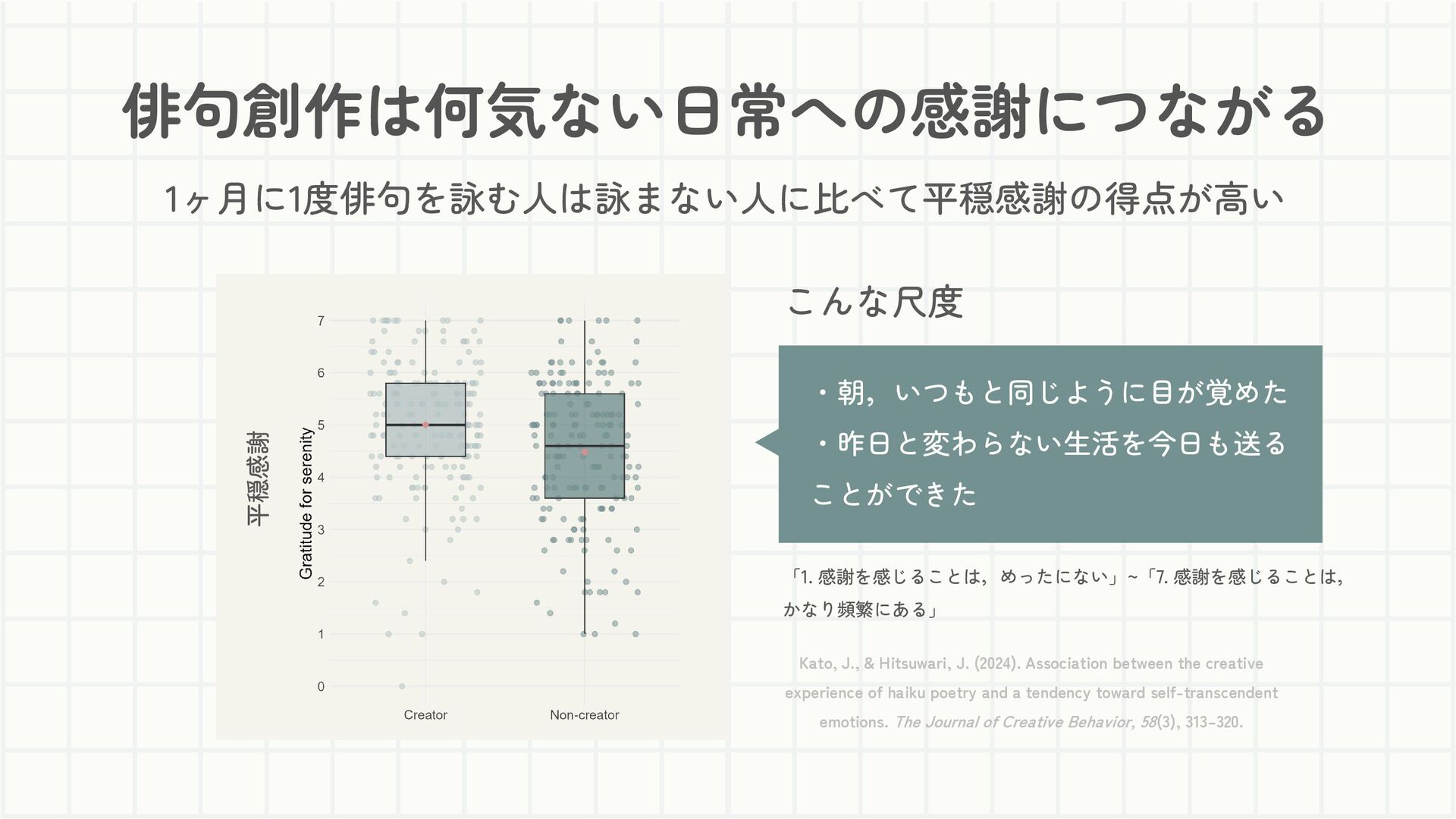
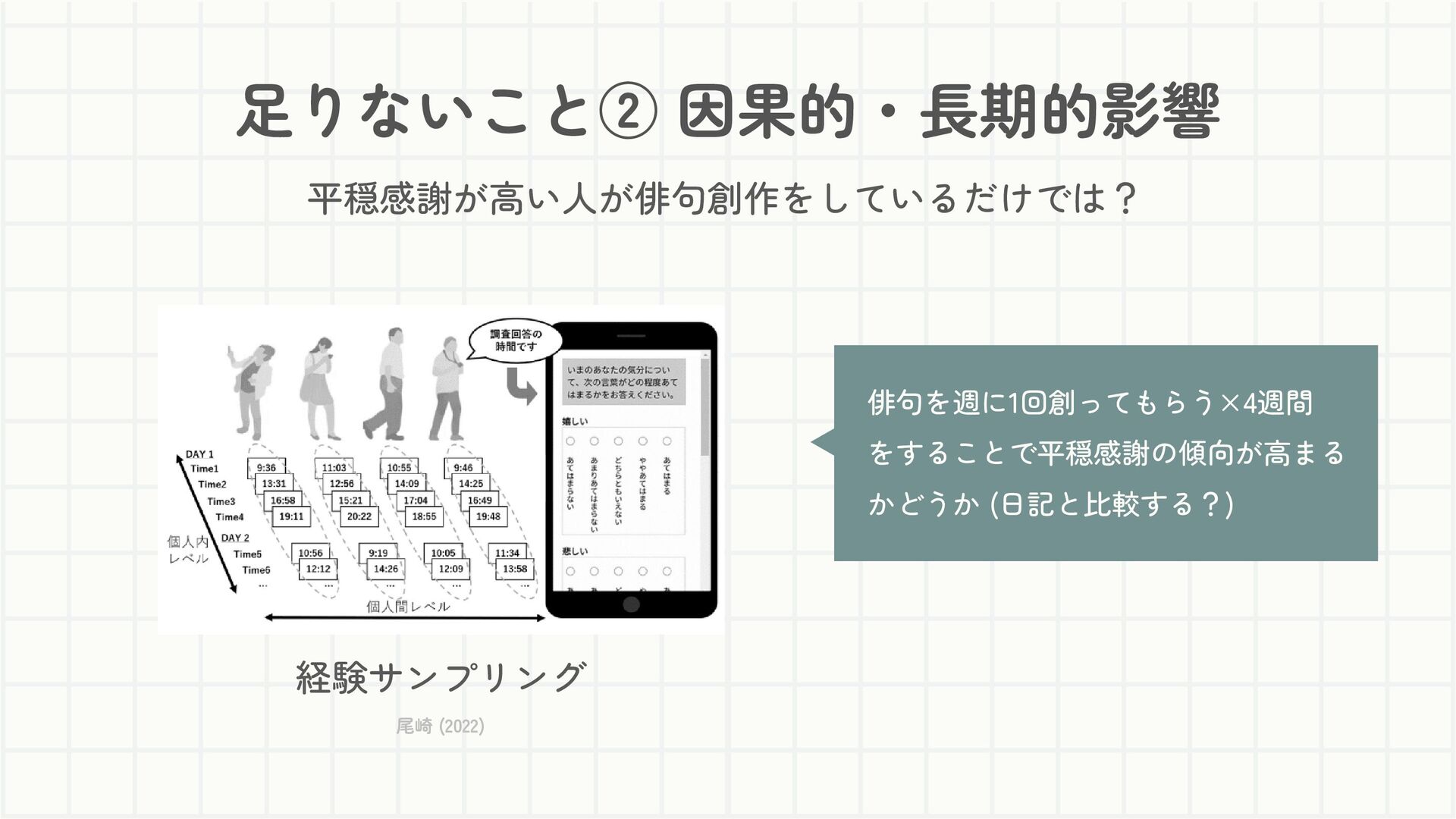
俳句創作は何気ない日常への感謝につながる 1ヶ月に1度俳句を詠む人は詠まない人に比べて平穏感謝の得点が高い Kato, J., & Hitsuwari, J. (2024). Association between
the creative experience of haiku poetry and a tendency toward self-transcendent emotions. The Journal of Creative Behavior, 58(3), 313–320. 平穏感謝 ・朝,いつもと同じように目が覚めた ・昨日と変わらない生活を今日も送る ことができた こんな尺度 「1. 感謝を感じることは,めったにない」~「7. 感謝を感じることは, かなり頻繁にある」 -
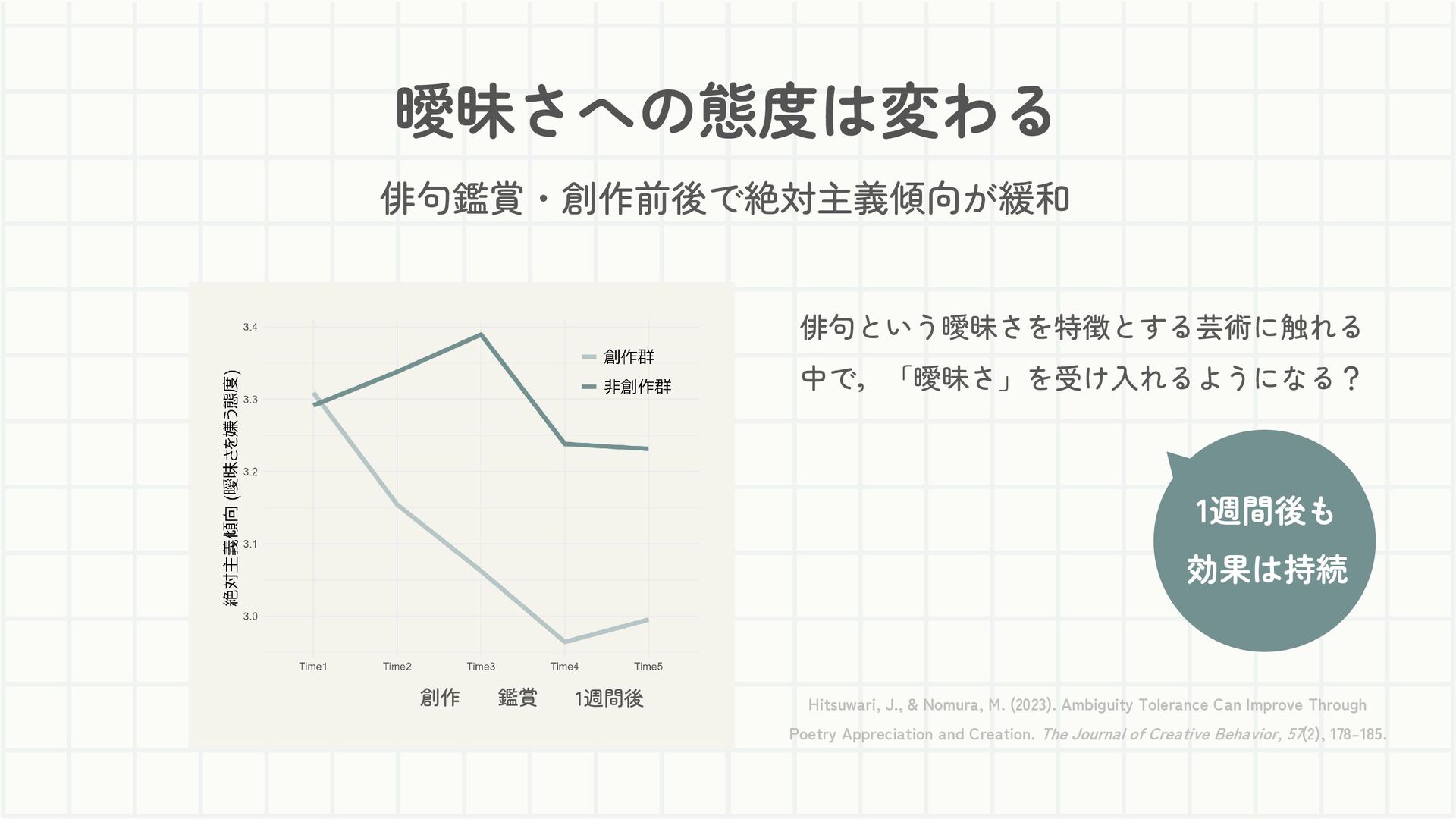
曖昧さへの態度は変わる 俳句鑑賞・創作前後で絶対主義傾向が緩和 Hitsuwari, J., & Nomura, M. (2023). Ambiguity Tolerance
Can Improve Through Poetry Appreciation and Creation. The Journal of Creative Behavior, 57(2), 178–185. 俳句という曖昧さを特徴とする芸術に触れる 中で,「曖昧さ」を受け入れるようになる? 創作 鑑賞 1週間後 1週間後も 効果は持続 -
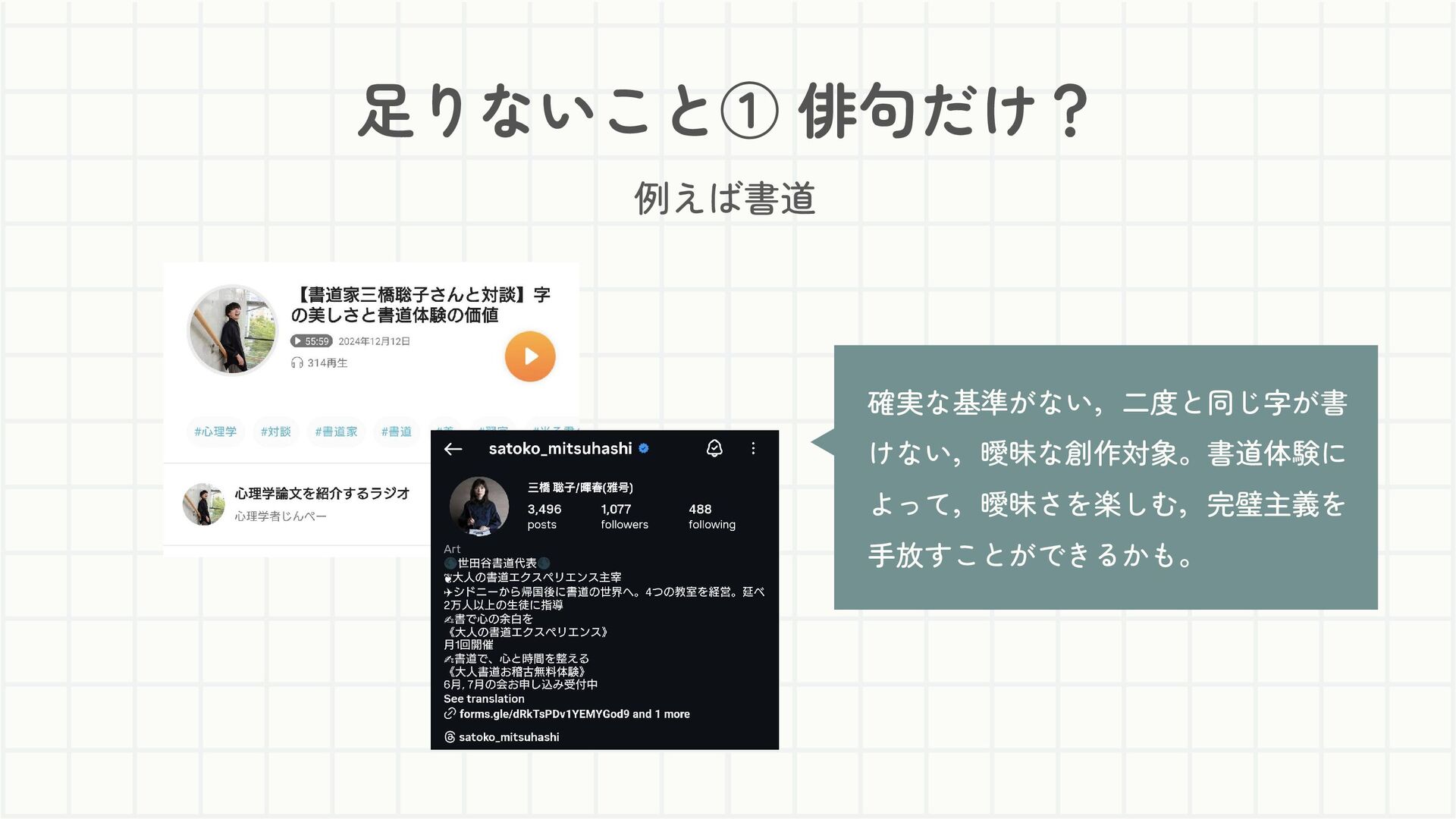
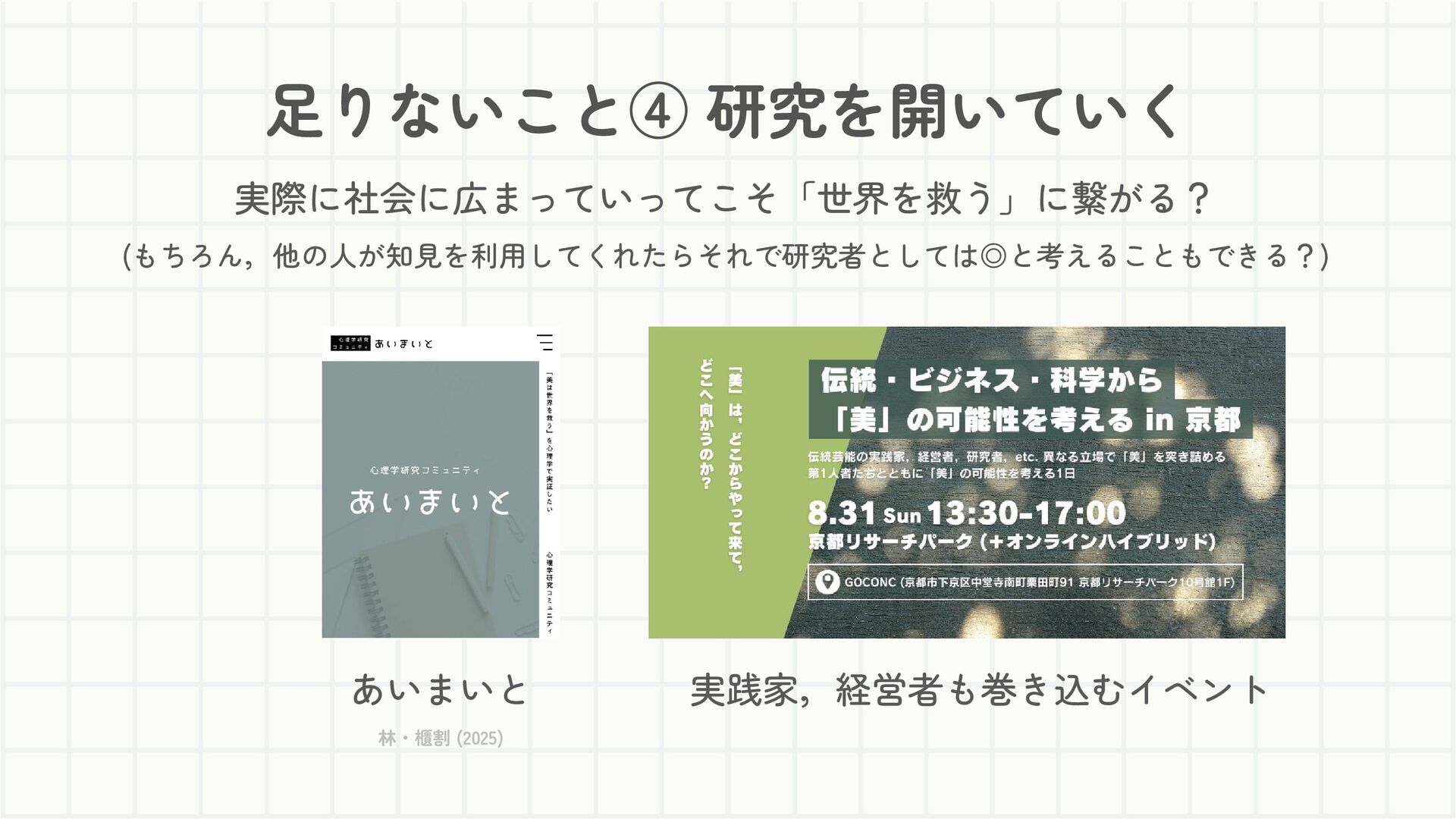
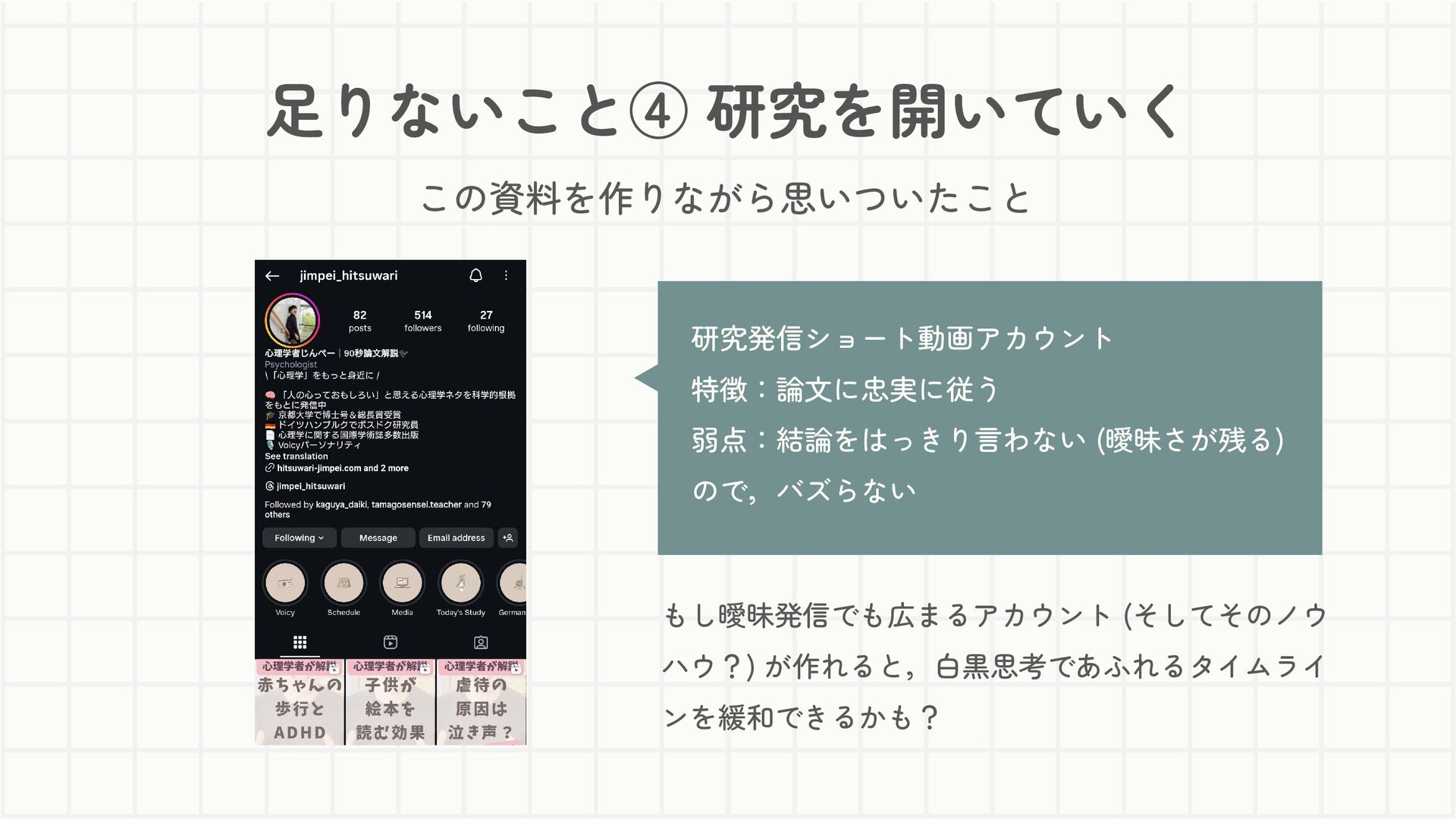
足りないこと④ 研究を開いていく この資料を作りながら思いついたこと もし曖昧発信でも広まるアカウント (そしてそのノウ ハウ?) が作れると,白黒思考であふれるタイムライ ンを緩和できるかも? 研究発信ショート動画アカウント 特徴:論文に忠実に従う
弱点:結論をはっきり言わない (曖昧さが残る) ので,バズらない -
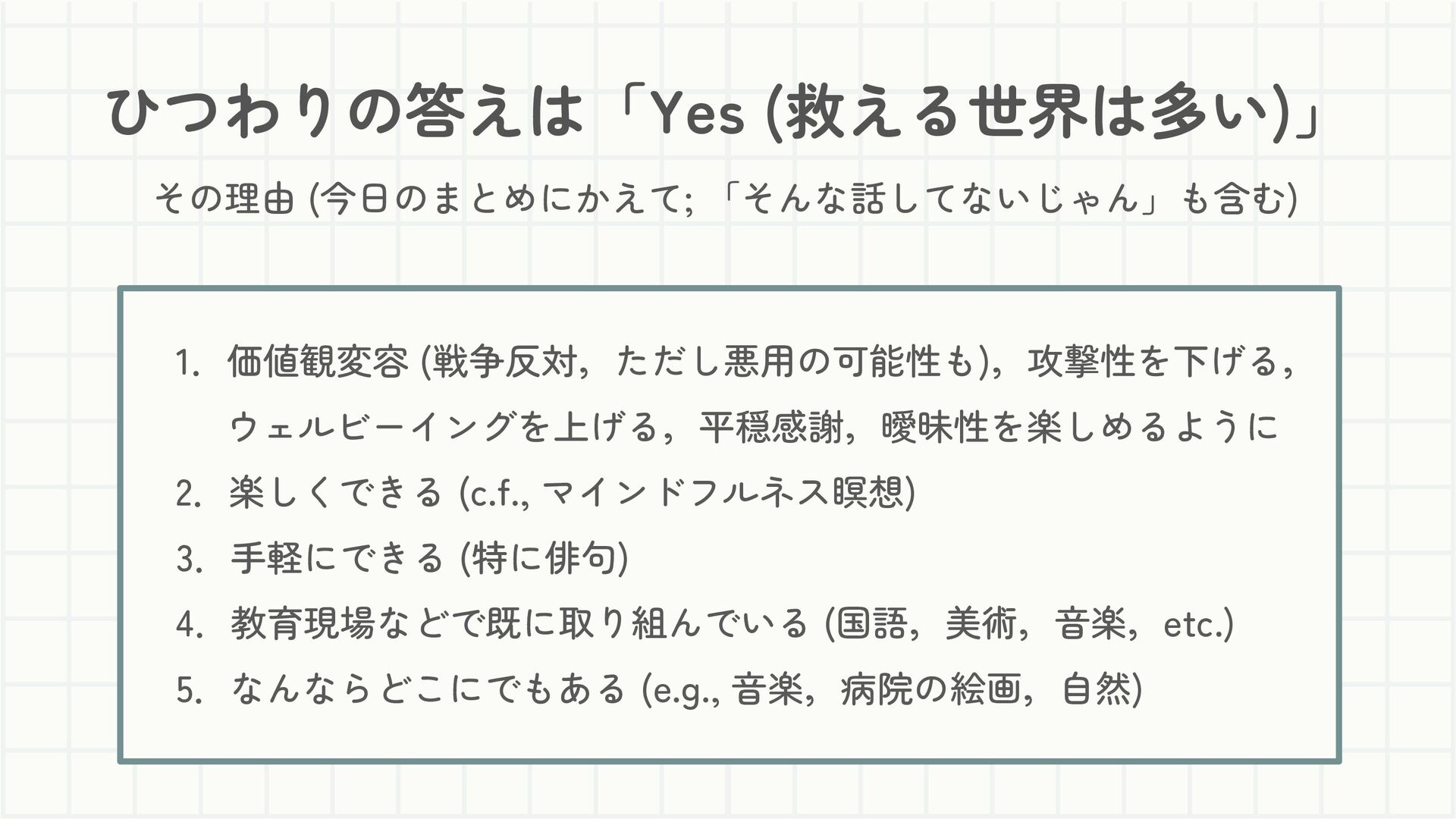
ひつわりの答えは「Yes (救える世界は多い)」 その理由 (今日のまとめにかえて; 「そんな話してないじゃん」も含む) 1.価値観変容 (戦争反対,ただし悪用の可能性も),攻撃性を下げる, ウェルビーイングを上げる,平穏感謝,曖昧性を楽しめるように 2.楽しくできる (c.f.,
マインドフルネス瞑想) 3.手軽にできる (特に俳句) 4.教育現場などで既に取り組んでいる (国語,美術,音楽,etc.) 5.なんならどこにでもある (e.g., 音楽,病院の絵画,自然) -
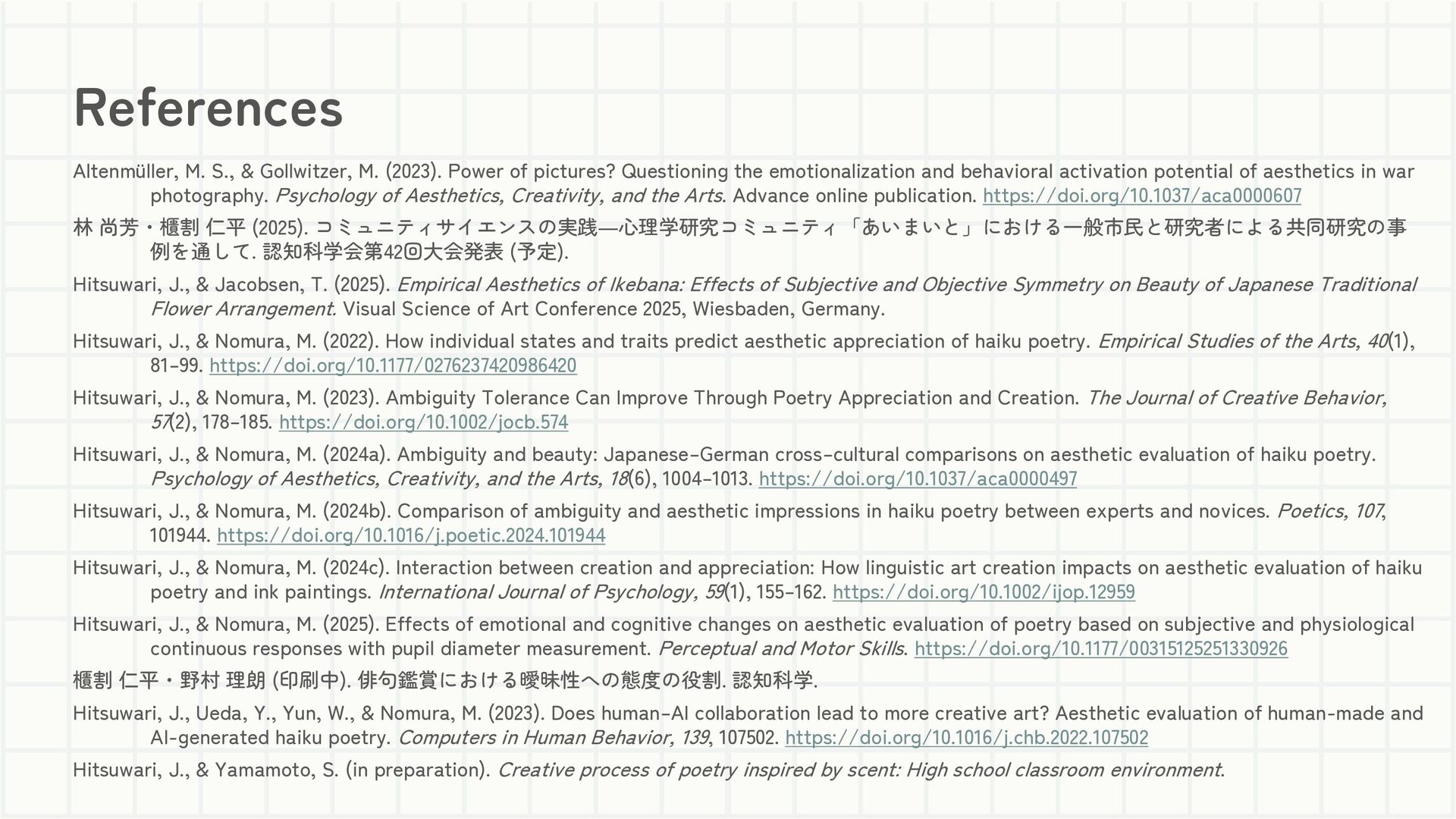
References Altenmüller, M. S., & Gollwitzer, M. (2023). Power of
pictures? Questioning the emotionalization and behavioral activation potential of aesthetics in war photography. Psychology of Aesthetics, Creativity, and the Arts. Advance online publication. https://doi.org/10.1037/aca0000607 林 尚芳・櫃割 仁平 (2025). コミュニティサイエンスの実践―心理学研究コミュニティ「あいまいと」における一般市民と研究者による共同研究の事 例を通して. 認知科学会第42回大会発表 (予定). Hitsuwari, J., & Jacobsen, T. (2025). Empirical Aesthetics of Ikebana: Effects of Subjective and Objective Symmetry on Beauty of Japanese Traditional Flower Arrangement. Visual Science of Art Conference 2025, Wiesbaden, Germany. Hitsuwari, J., & Nomura, M. (2022). How individual states and traits predict aesthetic appreciation of haiku poetry. Empirical Studies of the Arts, 40(1), 81–99. https://doi.org/10.1177/0276237420986420 Hitsuwari, J., & Nomura, M. (2023). Ambiguity Tolerance Can Improve Through Poetry Appreciation and Creation. The Journal of Creative Behavior, 57(2), 178–185. https://doi.org/10.1002/jocb.574 Hitsuwari, J., & Nomura, M. (2024a). Ambiguity and beauty: Japanese–German cross–cultural comparisons on aesthetic evaluation of haiku poetry. Psychology of Aesthetics, Creativity, and the Arts, 18(6), 1004–1013. https://doi.org/10.1037/aca0000497 Hitsuwari, J., & Nomura, M. (2024b). Comparison of ambiguity and aesthetic impressions in haiku poetry between experts and novices. Poetics, 107, 101944. https://doi.org/10.1016/j.poetic.2024.101944 Hitsuwari, J., & Nomura, M. (2024c). Interaction between creation and appreciation: How linguistic art creation impacts on aesthetic evaluation of haiku poetry and ink paintings. International Journal of Psychology, 59(1), 155–162. https://doi.org/10.1002/ijop.12959 Hitsuwari, J., & Nomura, M. (2025). Effects of emotional and cognitive changes on aesthetic evaluation of poetry based on subjective and physiological continuous responses with pupil diameter measurement. Perceptual and Motor Skills. https://doi.org/10.1177/00315125251330926 櫃割 仁平・野村 理朗 (印刷中). 俳句鑑賞における曖昧性への態度の役割. 認知科学. Hitsuwari, J., Ueda, Y., Yun, W., & Nomura, M. (2023). Does human–AI collaboration lead to more creative art? Aesthetic evaluation of human-made and AI-generated haiku poetry. Computers in Human Behavior, 139, 107502. https://doi.org/10.1016/j.chb.2022.107502 Hitsuwari, J., & Yamamoto, S. (in preparation). Creative process of poetry inspired by scent: High school classroom environment. -
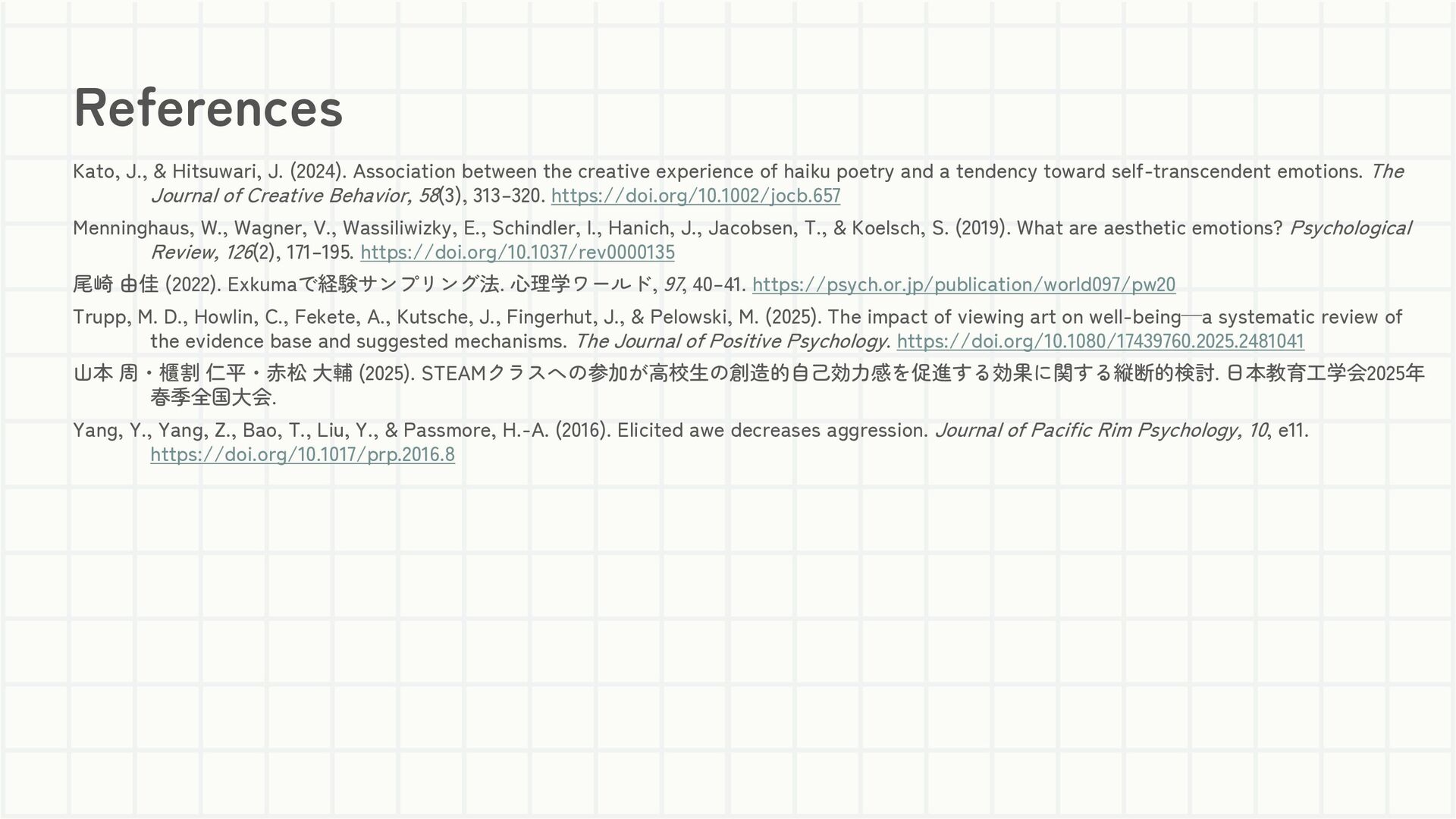
References Kato, J., & Hitsuwari, J. (2024). Association between the
creative experience of haiku poetry and a tendency toward self-transcendent emotions. The Journal of Creative Behavior, 58(3), 313–320. https://doi.org/10.1002/jocb.657 Menninghaus, W., Wagner, V., Wassiliwizky, E., Schindler, I., Hanich, J., Jacobsen, T., & Koelsch, S. (2019). What are aesthetic emotions? Psychological Review, 126(2), 171–195. https://doi.org/10.1037/rev0000135 尾崎 由佳 (2022). Exkumaで経験サンプリング法. 心理学ワールド, 97, 40–41. https://psych.or.jp/publication/world097/pw20 Trupp, M. D., Howlin, C., Fekete, A., Kutsche, J., Fingerhut, J., & Pelowski, M. (2025). The impact of viewing art on well-being—a systematic review of the evidence base and suggested mechanisms. The Journal of Positive Psychology. https://doi.org/10.1080/17439760.2025.2481041 山本 周・櫃割 仁平・赤松 大輔 (2025). STEAMクラスへの参加が高校生の創造的自己効力感を促進する効果に関する縦断的検討. 日本教育工学会2025年 春季全国大会. Yang, Y., Yang, Z., Bao, T., Liu, Y., & Passmore, H.-A. (2016). Elicited awe decreases aggression. Journal of Pacific Rim Psychology, 10, e11. https://doi.org/10.1017/prp.2016.8