Upgrade to Pro
— share decks privately, control downloads, hide ads and more …
Speaker Deck
Sign up for free
Menu
Search
Features
All features
Private URLs
Password Protection
Custom URLS
Scheduled publishing
Remove Branding
Restrict embedding
Deck Collections
Notes
Features
All features
Private URLs
Password Protection
Custom URLS
Scheduled publishing
Remove Branding
Restrict embedding
Deck Collections
Notes
Explore
Featured decks
Featured speakers
Programming
Technology
Storyboards
Explore
Featured decks
Featured speakers
Programming
Technology
Storyboards
Pricing
Search
Sign in
Sign up for free
ZJIT: The Ruby 4 JIT Compiler / Ruby Release 30...
Search
Takashi Kokubun
December 20, 2025
Programming
590
1
Share
Embed
Copy iframe code
Copy JS code
Copy link
Start on current slide
ZJIT: The Ruby 4 JIT Compiler / Ruby Release 30th Anniversary Party
https://rubyassociation.doorkeeper.jp/events/190436
Takashi Kokubun
December 20, 2025
Transcript
55 slides
Ruby Release 30th Anniversary Party 2025 ZJIT: The Ruby 4
JIT Compiler Takashi Kokubun / @k0kubun
self • Takashi Kokubun (@k0kubun) • Shopify: Ruby JIT team
• Ruby committer: MJIT, RJIT, YJIT, ZJIT
YJIT
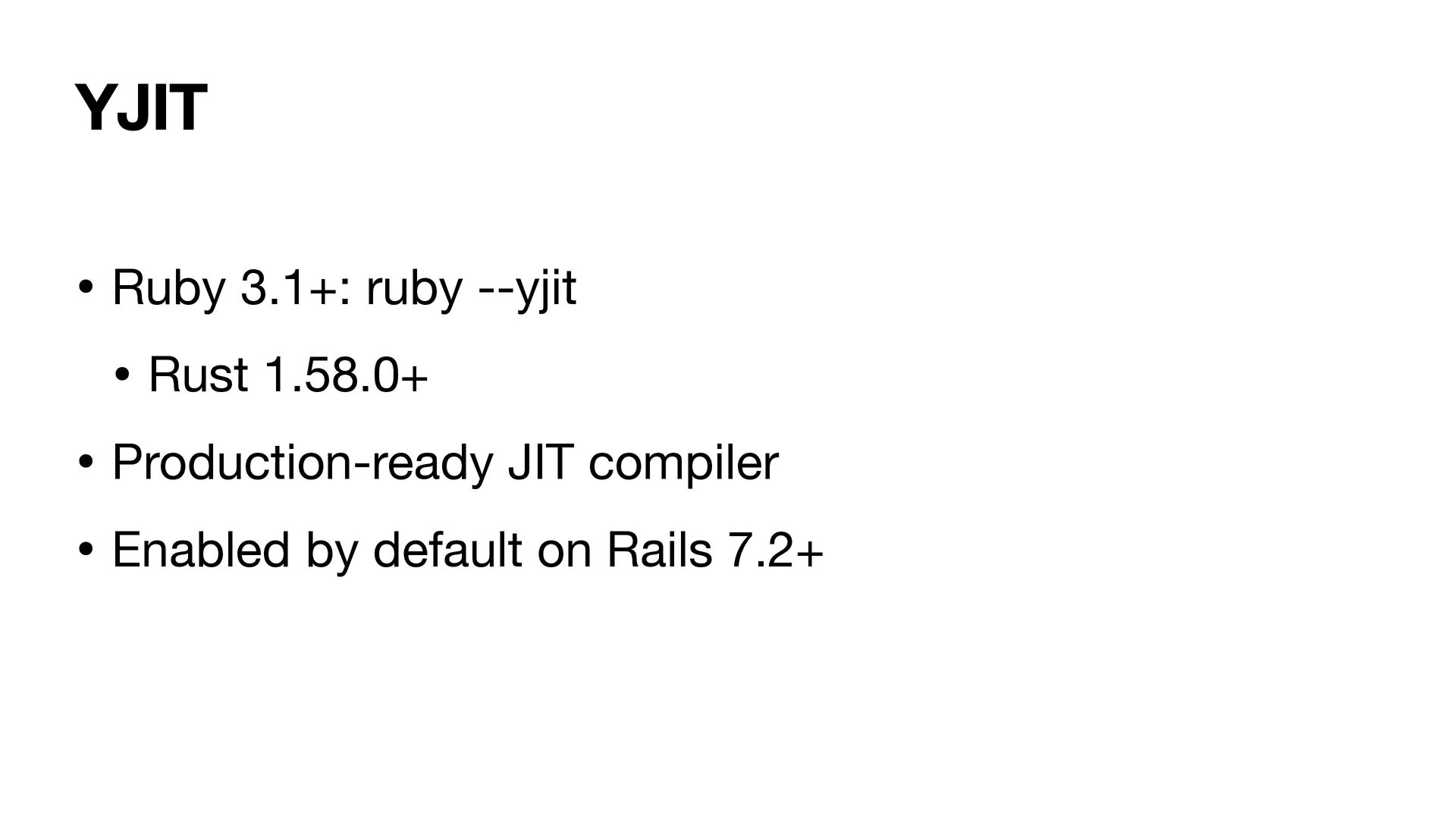
YJIT • Ruby 3.1+: ruby --yjit • Rust 1.58.0+ •
Production-ready JIT compiler • Enabled by default on Rails 7.2+
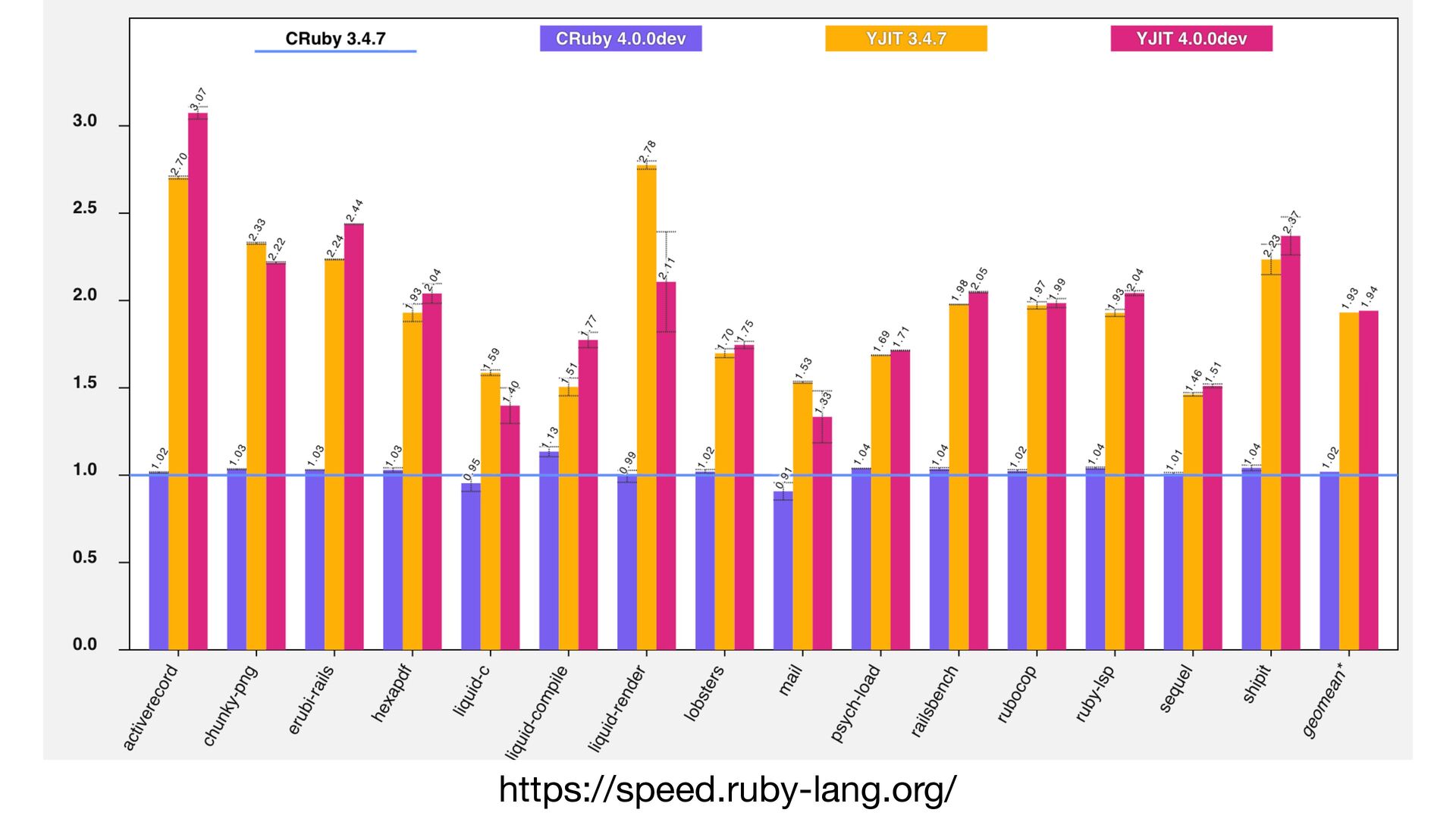
https://speed.ruby-lang.org/
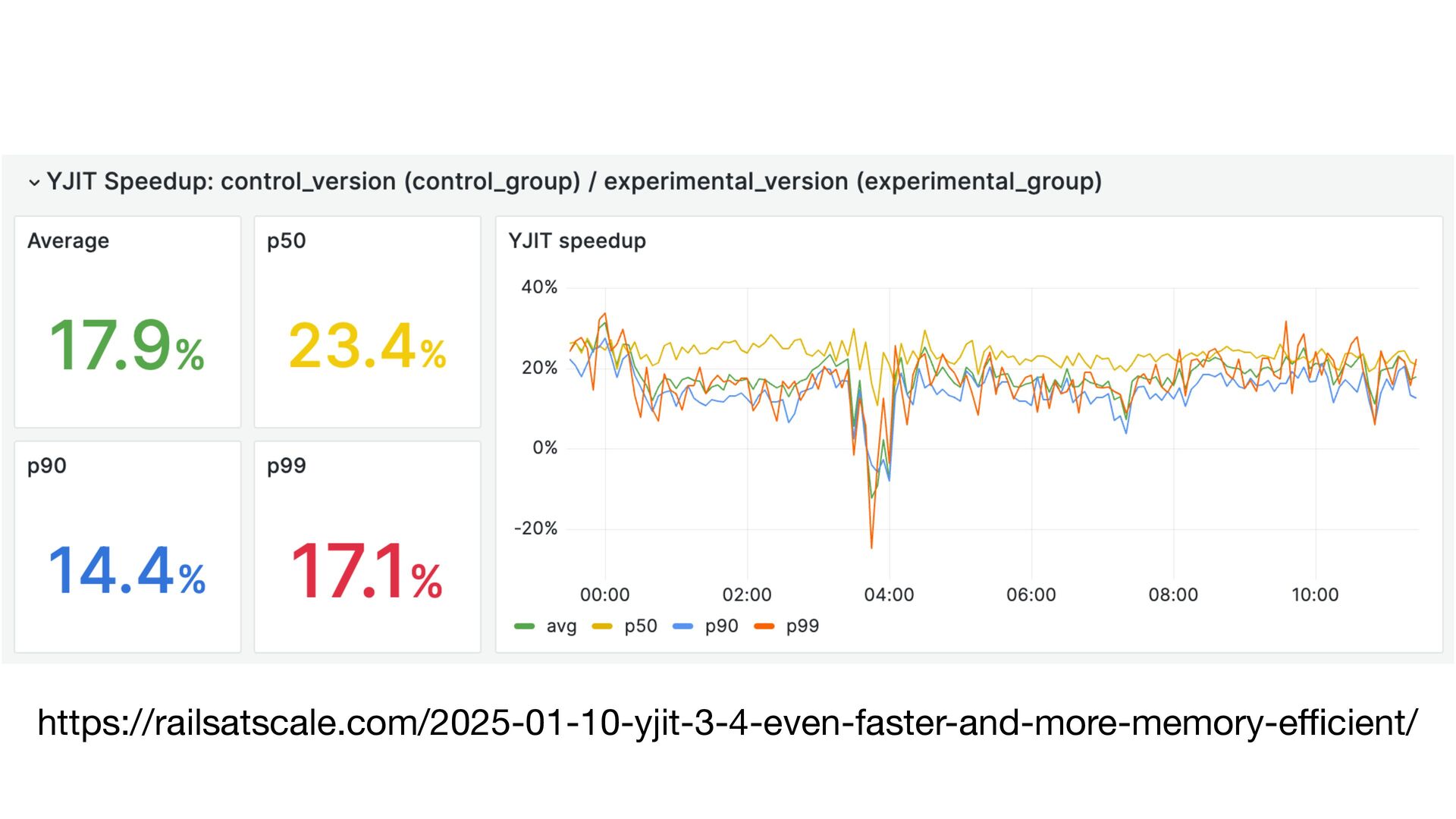
https://railsatscale.com/2025-01-10-yjit-3-4-even-faster-and-more-memory-e ff i cient/
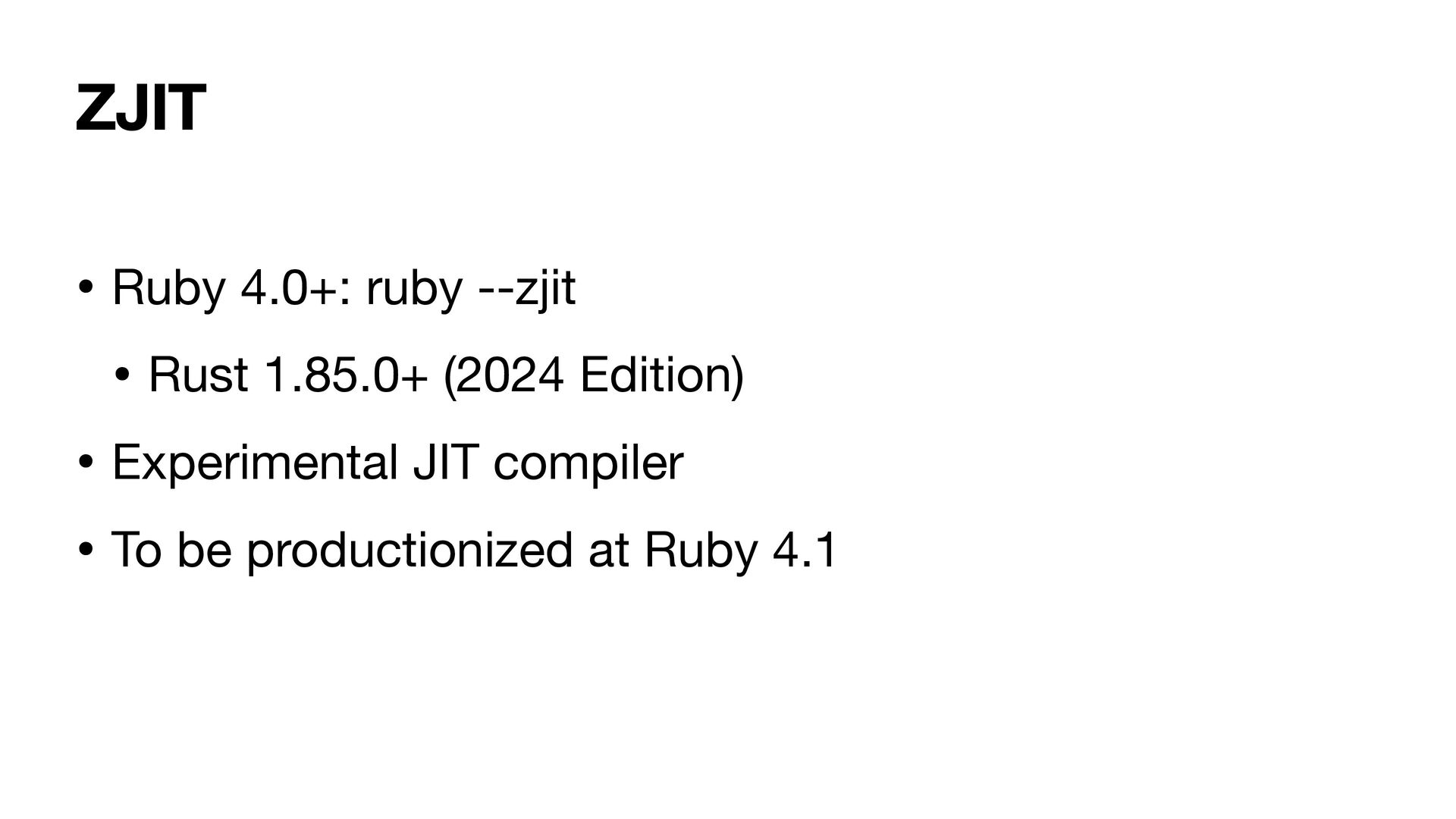
ZJIT
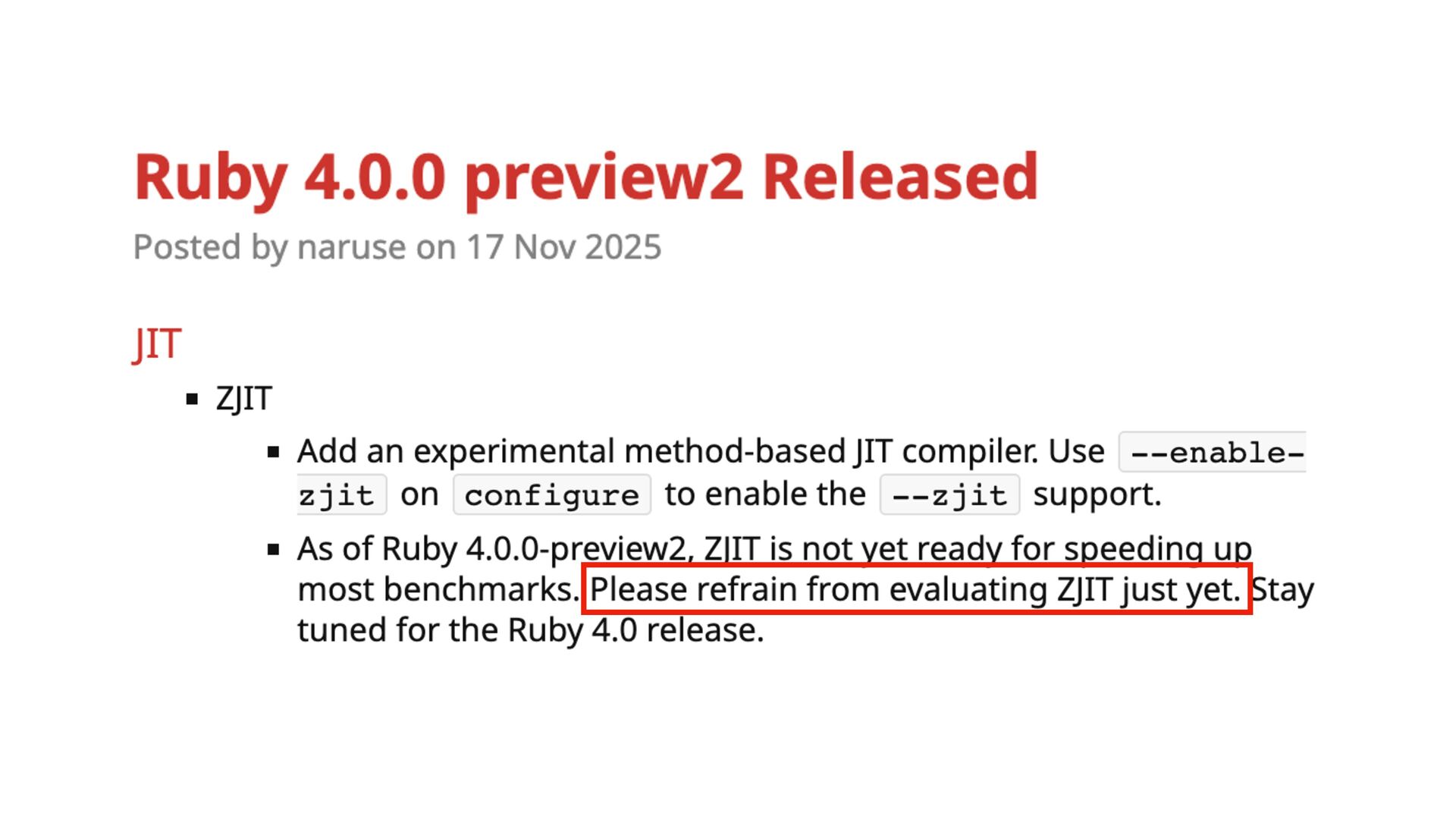
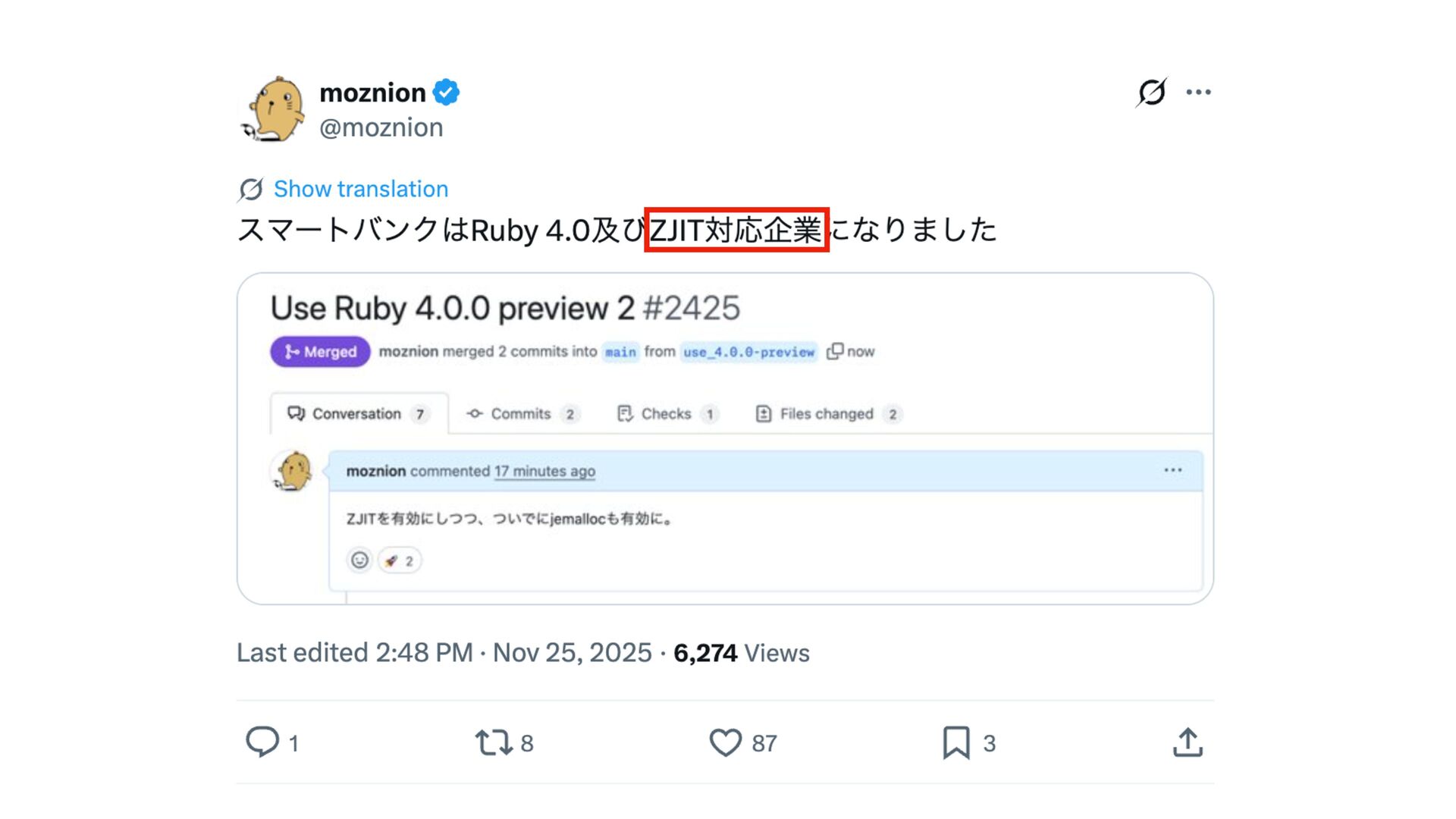
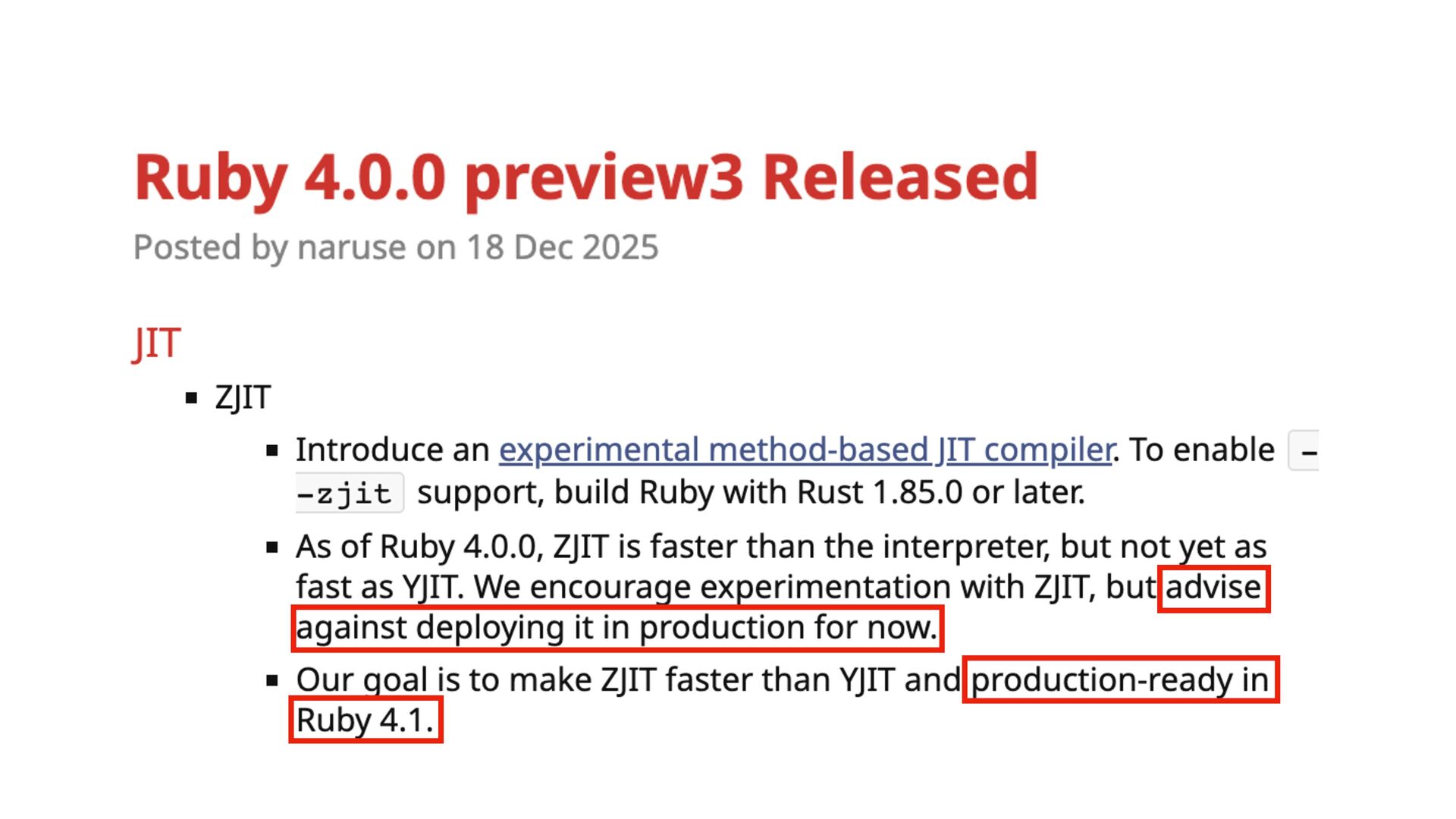
ZJIT • Ruby 4.0+: ruby --zjit • Rust 1.85.0+ (2024
Edition) • Experimental JIT compiler • To be productionized at Ruby 4.1
None
None
None
None
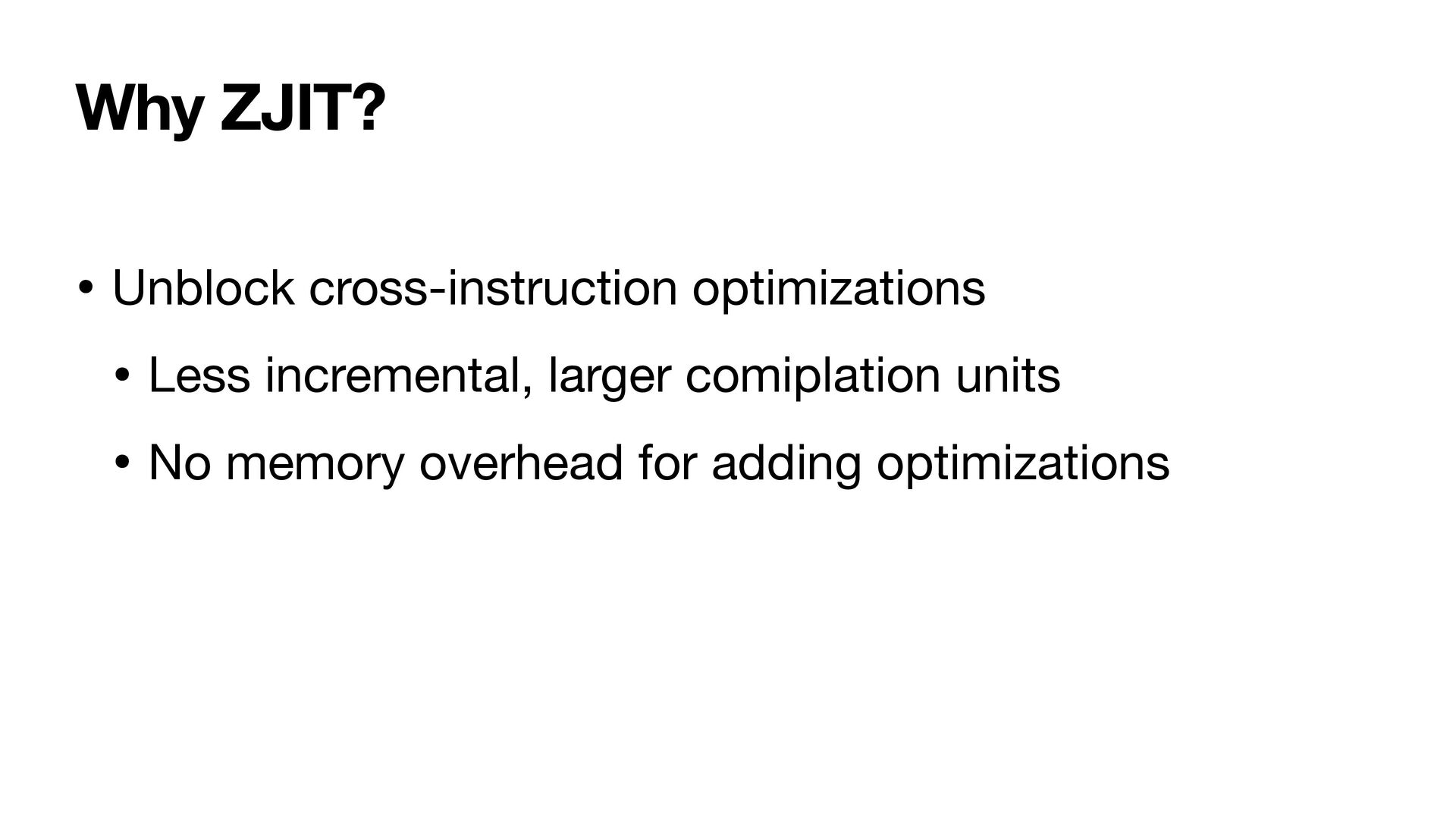
Why ZJIT? • Unblock cross-instruction optimizations • Less incremental, larger
comiplation units • No memory overhead for adding optimizations
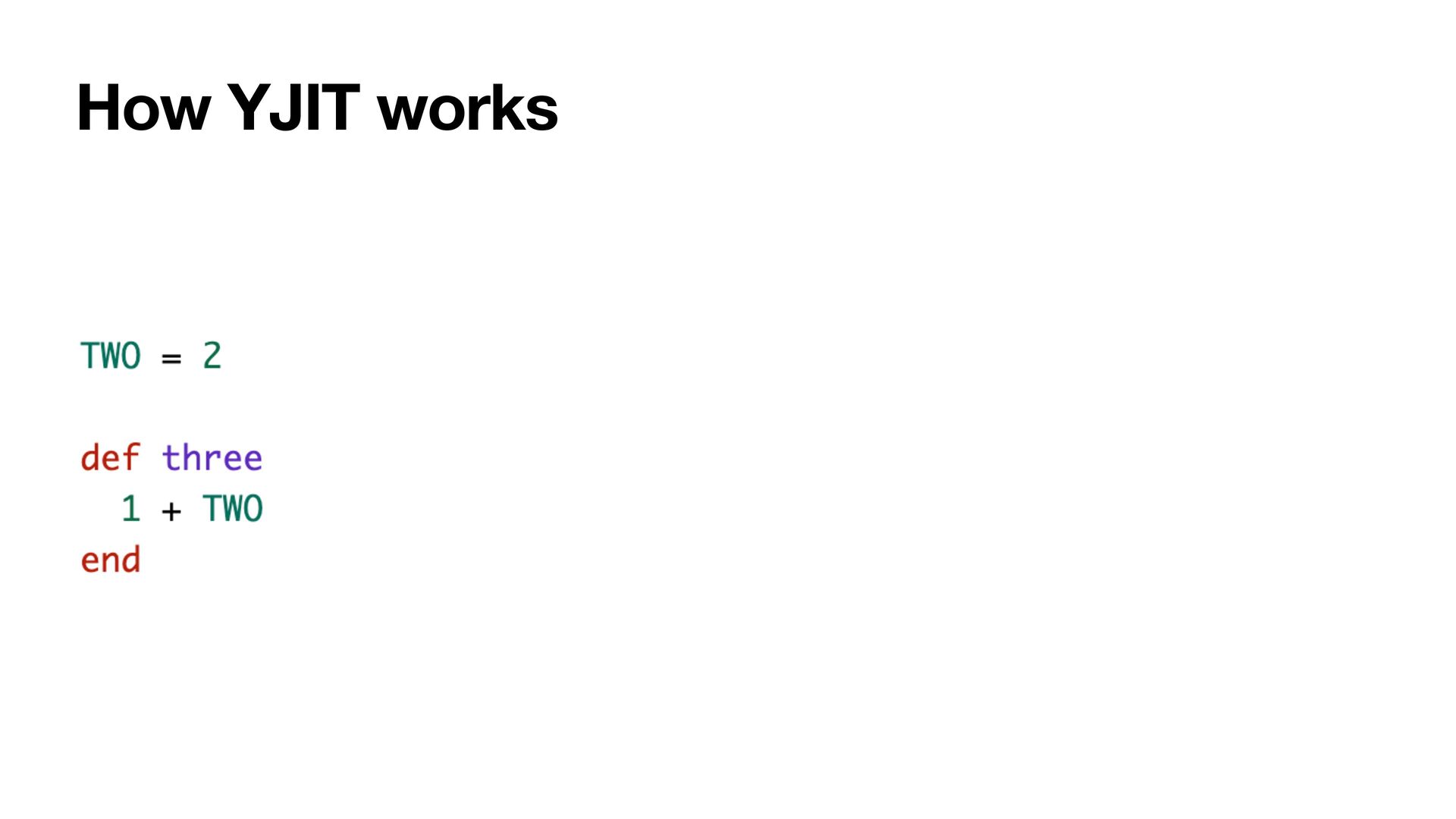
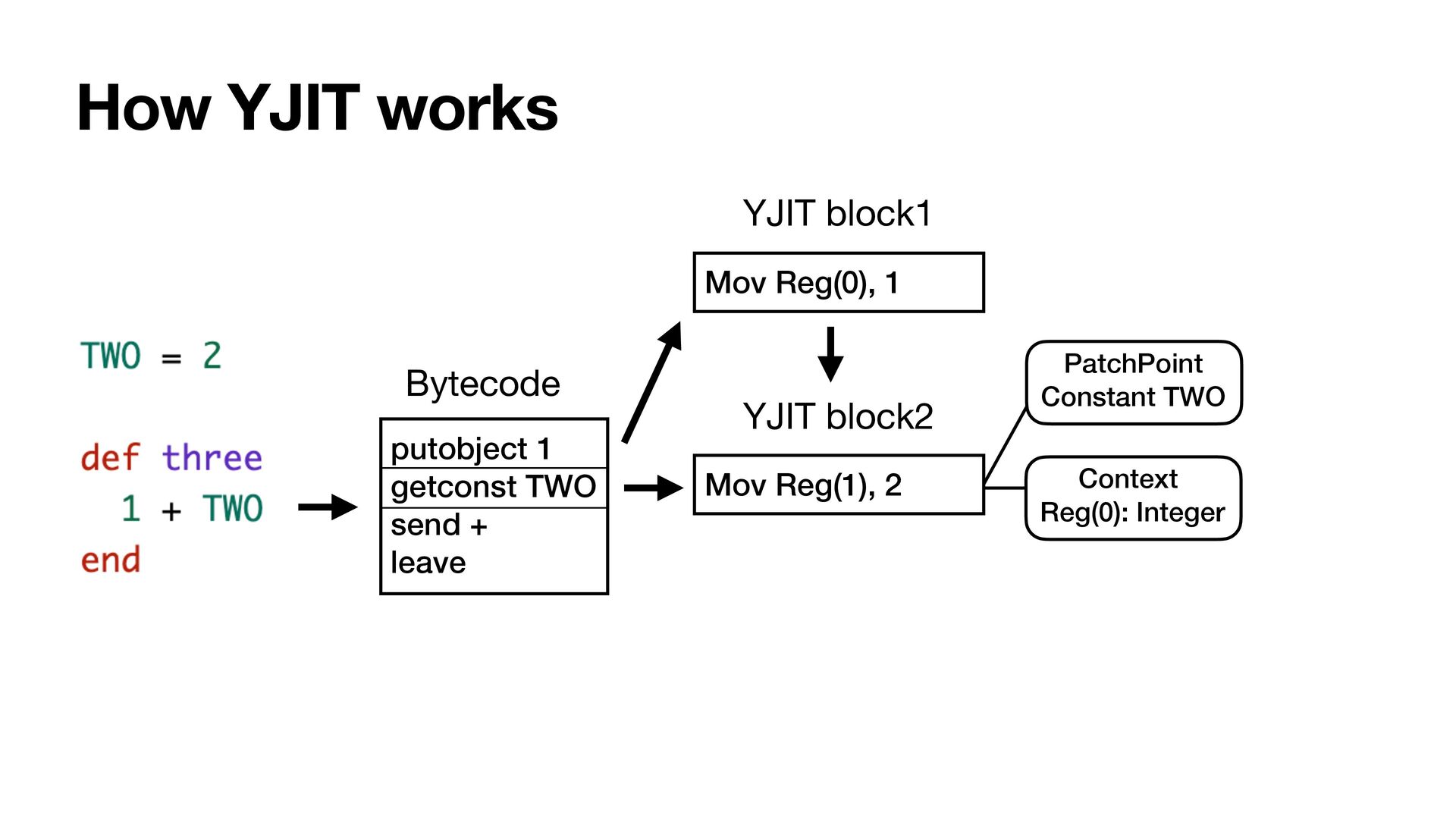
How YJIT works
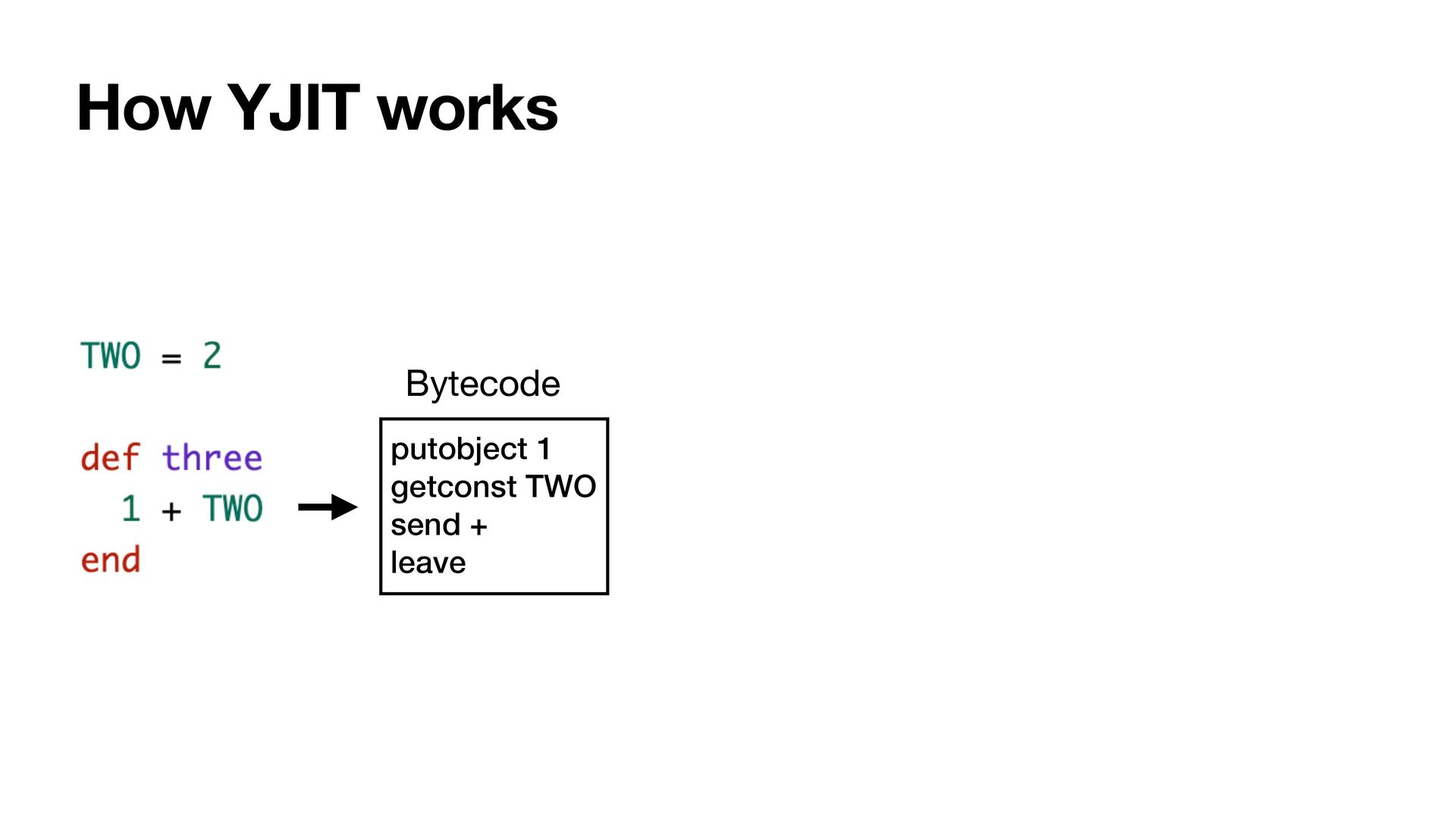
How YJIT works putobject 1 getconst TWO send + leave
Bytecode
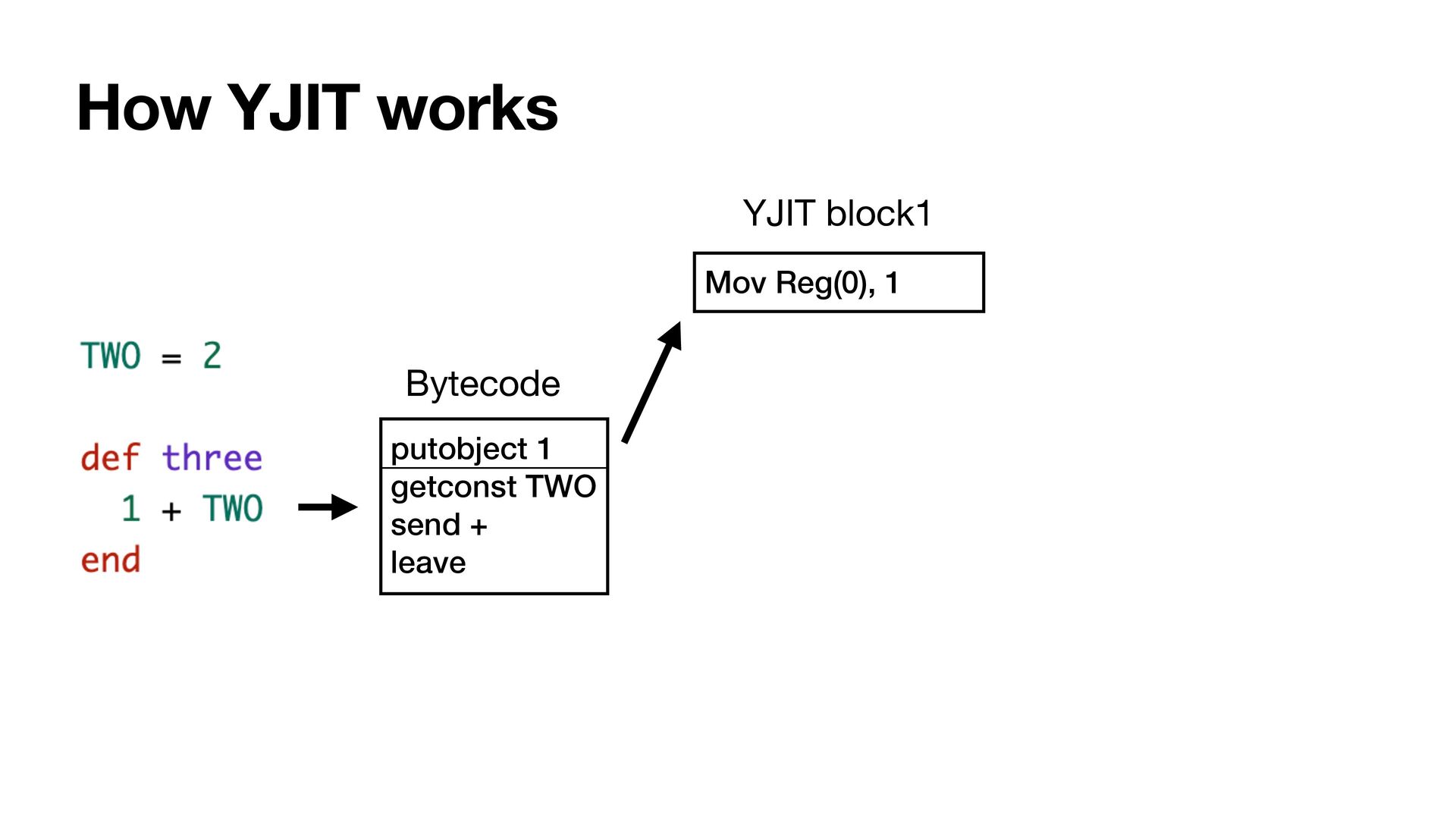
How YJIT works putobject 1 getconst TWO send + leave
Bytecode YJIT block1 Mov Reg(0), 1
How YJIT works putobject 1 getconst TWO send + leave
Bytecode YJIT block1 Mov Reg(0), 1 Context Reg(0): Integer YJIT block2 Mov Reg(1), 2 PatchPoint Constant TWO
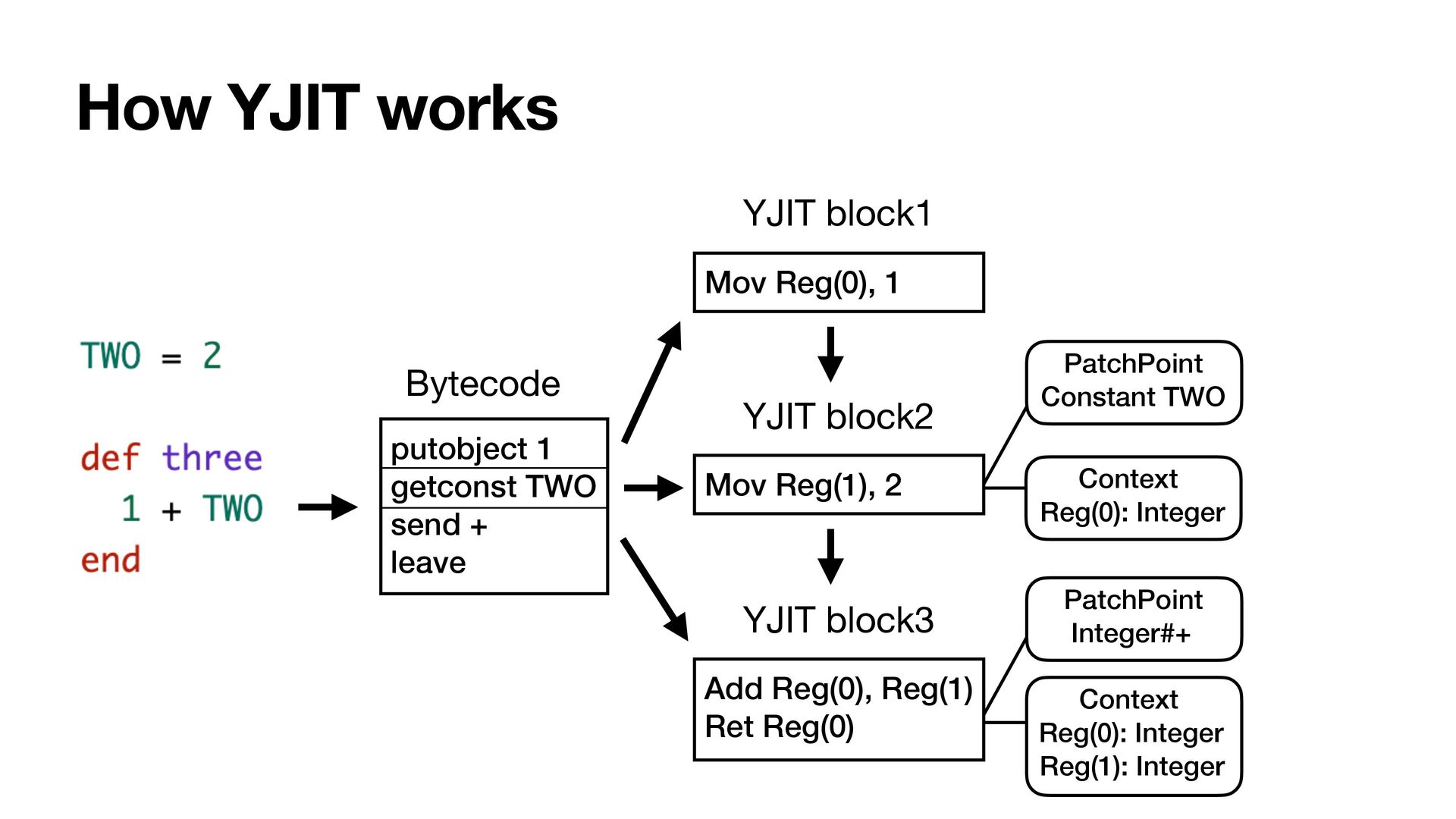
How YJIT works putobject 1 getconst TWO send + leave
Bytecode YJIT block1 Mov Reg(0), 1 Context Reg(0): Integer YJIT block2 YJIT block3 Mov Reg(1), 2 PatchPoint Constant TWO Context Reg(0): Integer Reg(1): Integer PatchPoint Integer#+ Add Reg(0), Reg(1) Ret Reg(0)
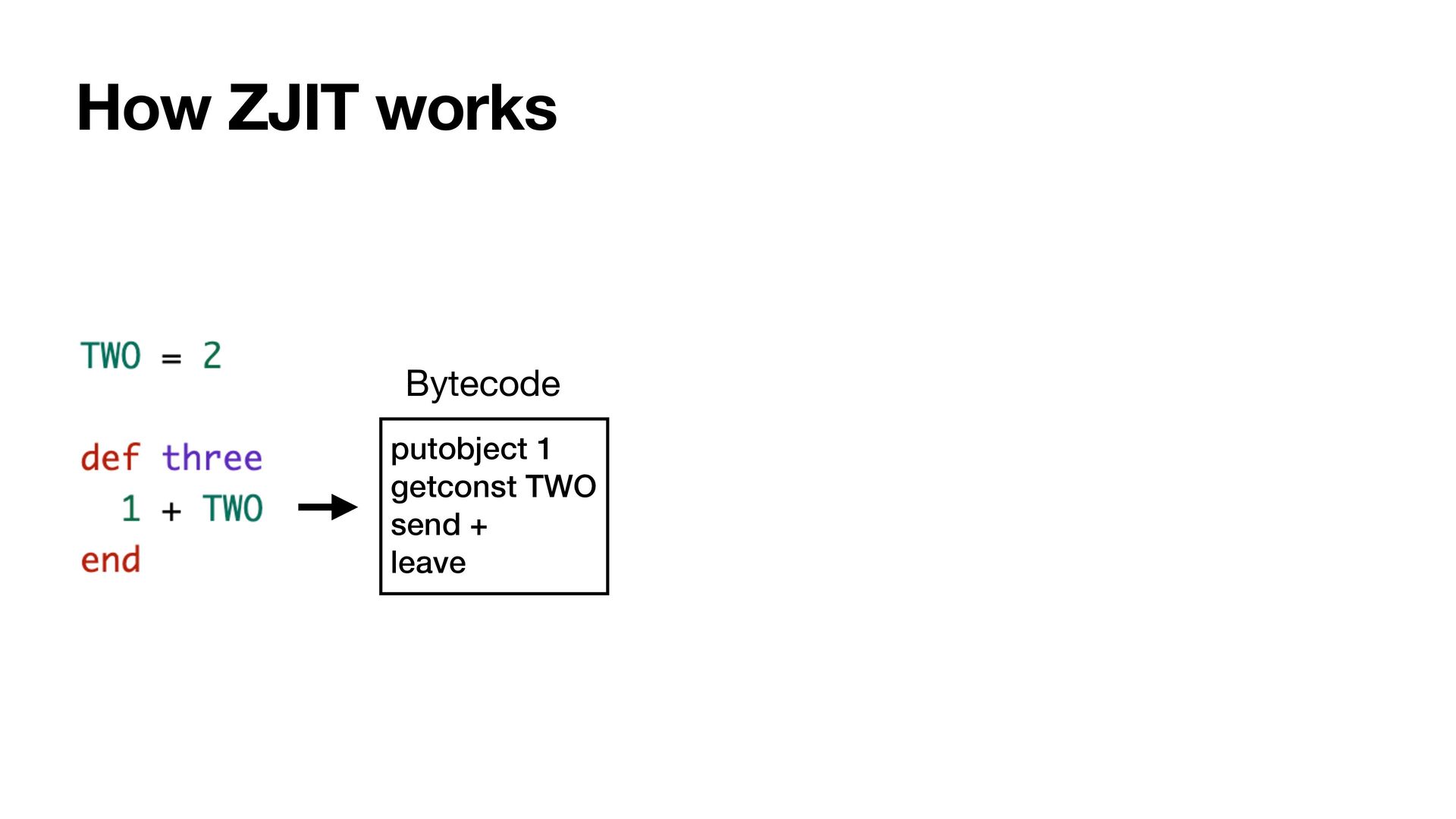
How ZJIT works putobject 1 getconst TWO send + leave
Bytecode
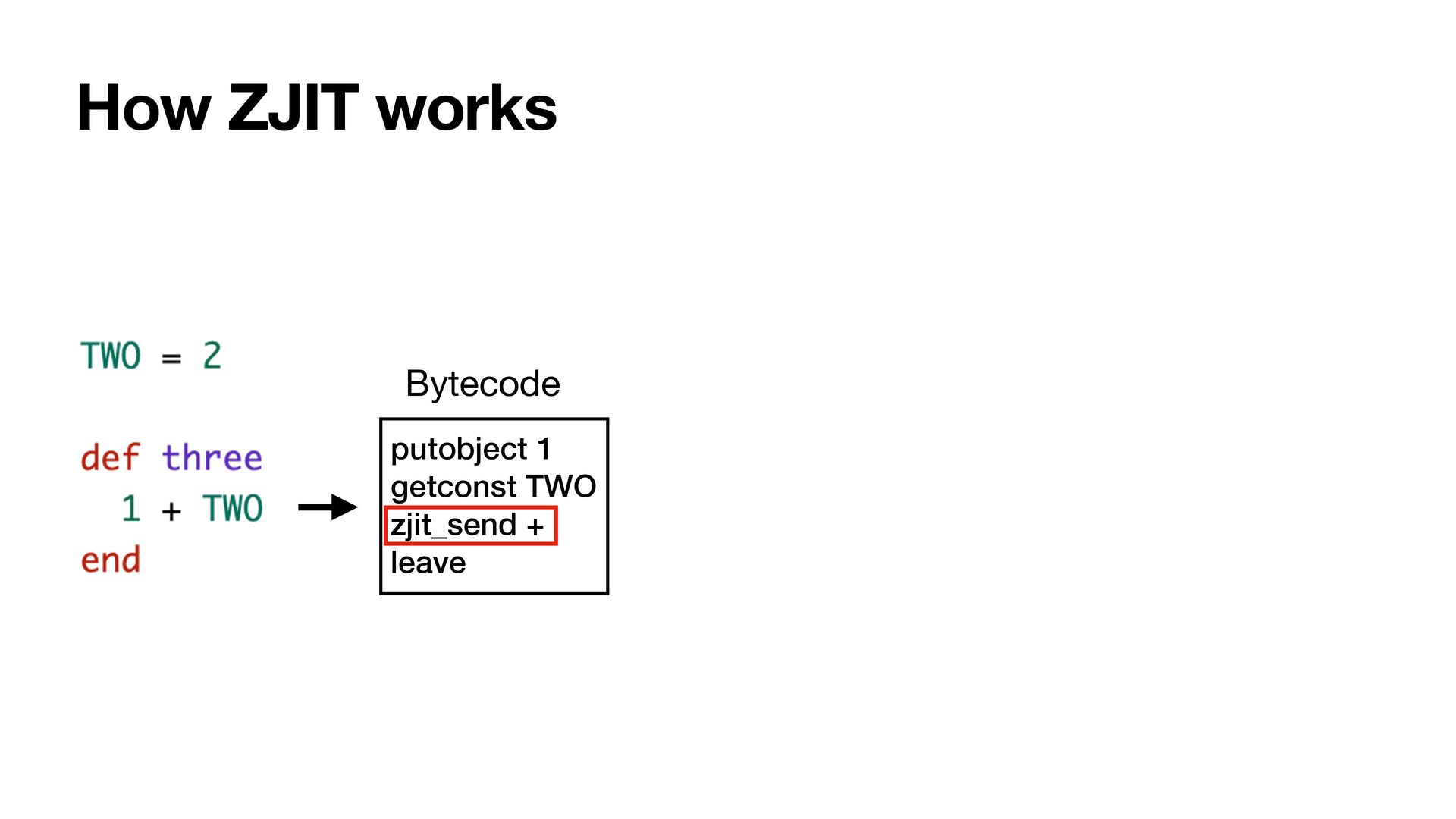
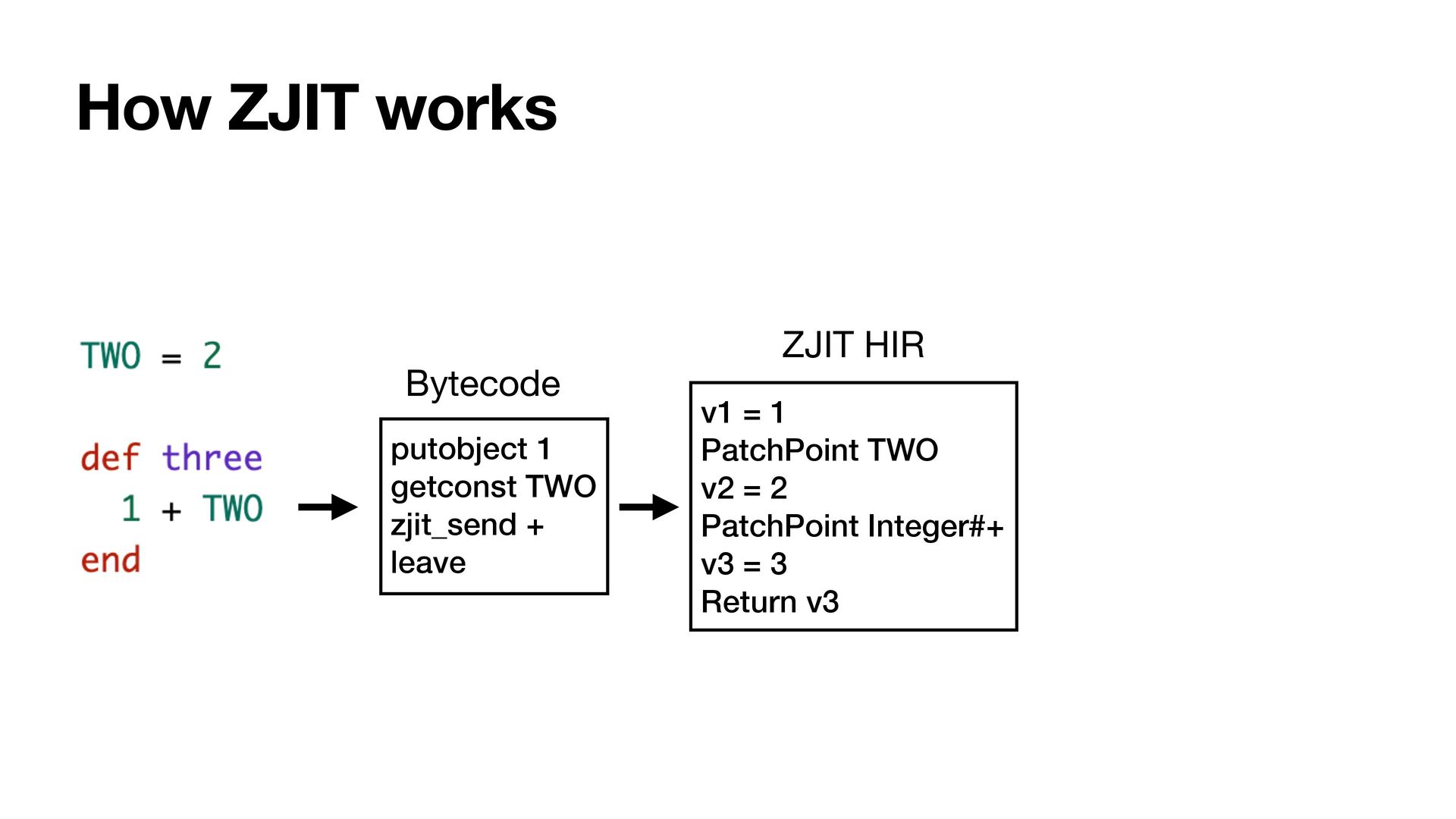
How ZJIT works putobject 1 getconst TWO zjit_send + leave
Bytecode
How ZJIT works putobject 1 getconst TWO zjit_send + leave
Bytecode ZJIT HIR v1 = 1 PatchPoint TWO v2 = 2 PatchPoint Integer#+ v3 = 3 Return v3
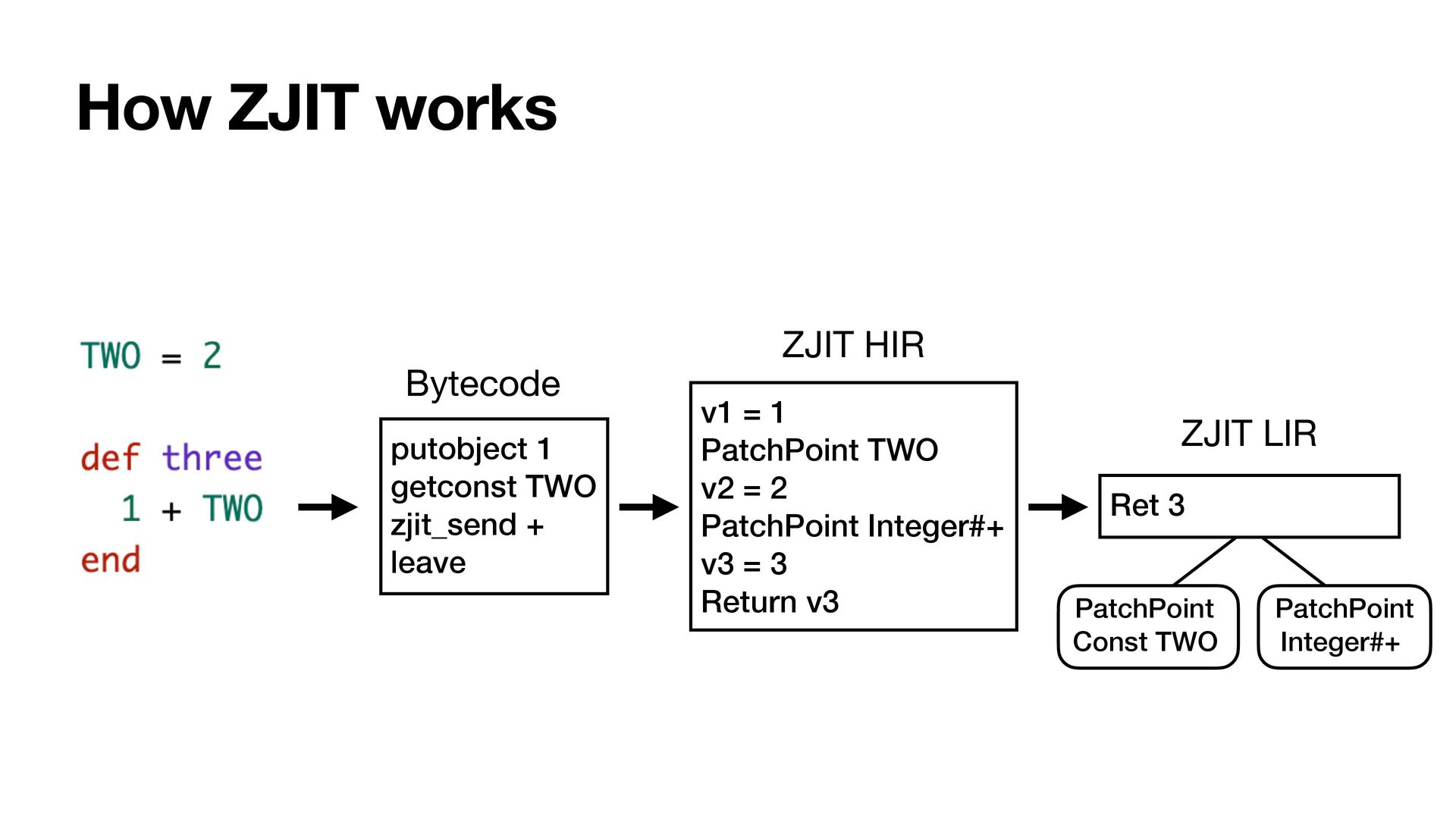
How ZJIT works putobject 1 getconst TWO zjit_send + leave
Bytecode ZJIT HIR v1 = 1 PatchPoint TWO v2 = 2 PatchPoint Integer#+ v3 = 3 Return v3 ZJIT LIR Ret 3 PatchPoint Const TWO PatchPoint Integer#+
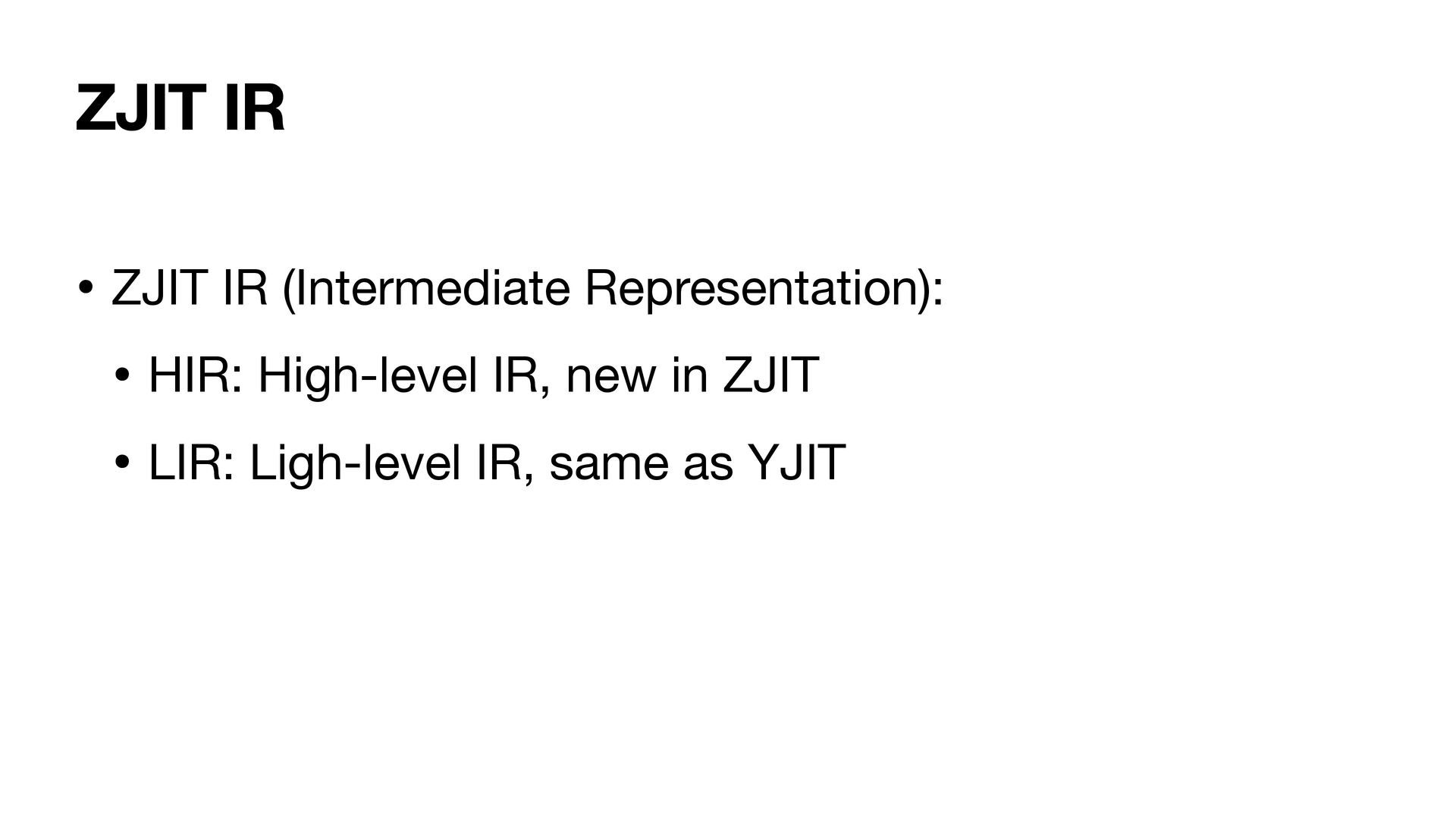
ZJIT IR
ZJIT IR • ZJIT IR (Intermediate Representation): • HIR: High-level
IR, new in ZJIT • LIR: Ligh-level IR, same as YJIT
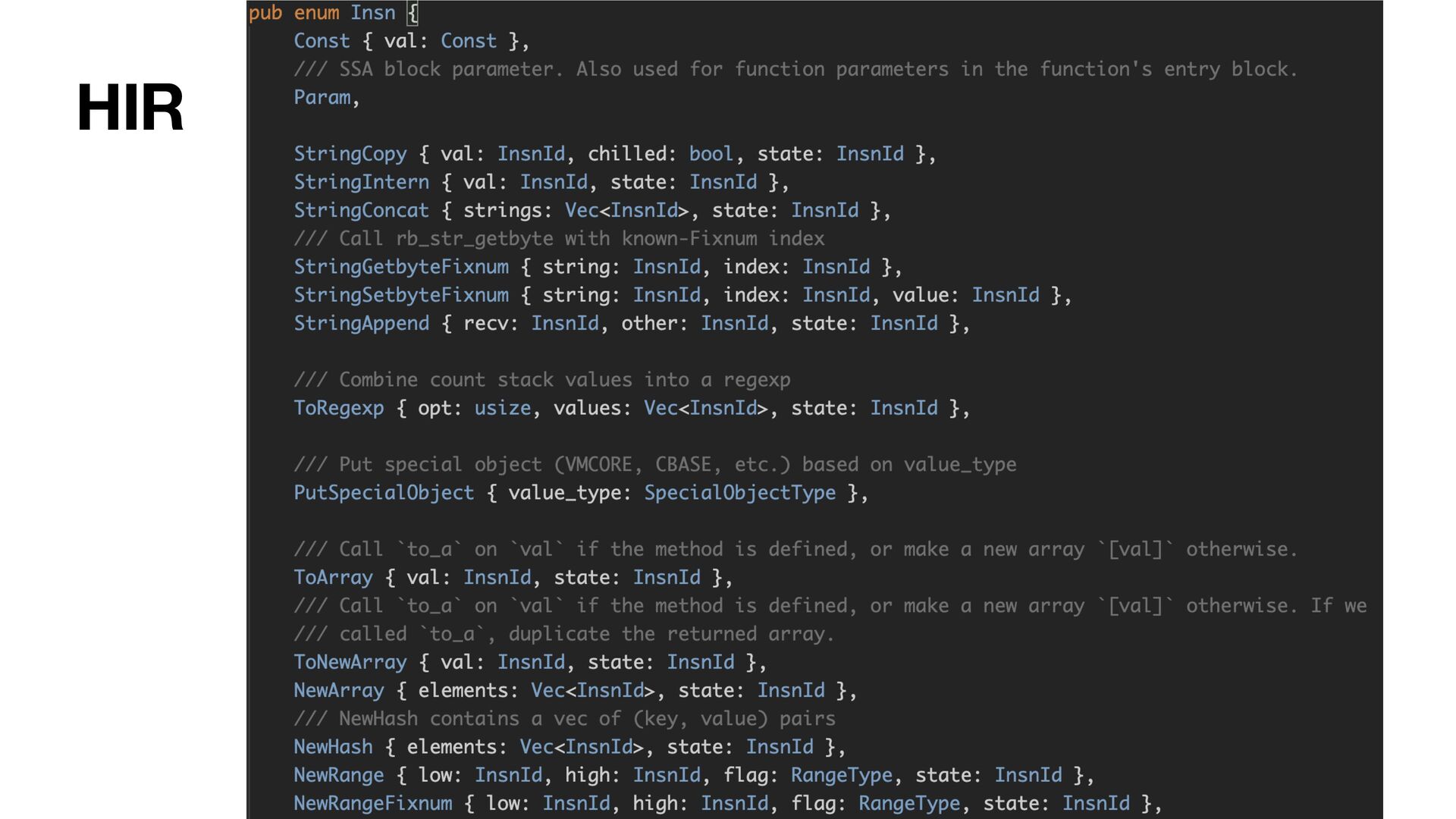
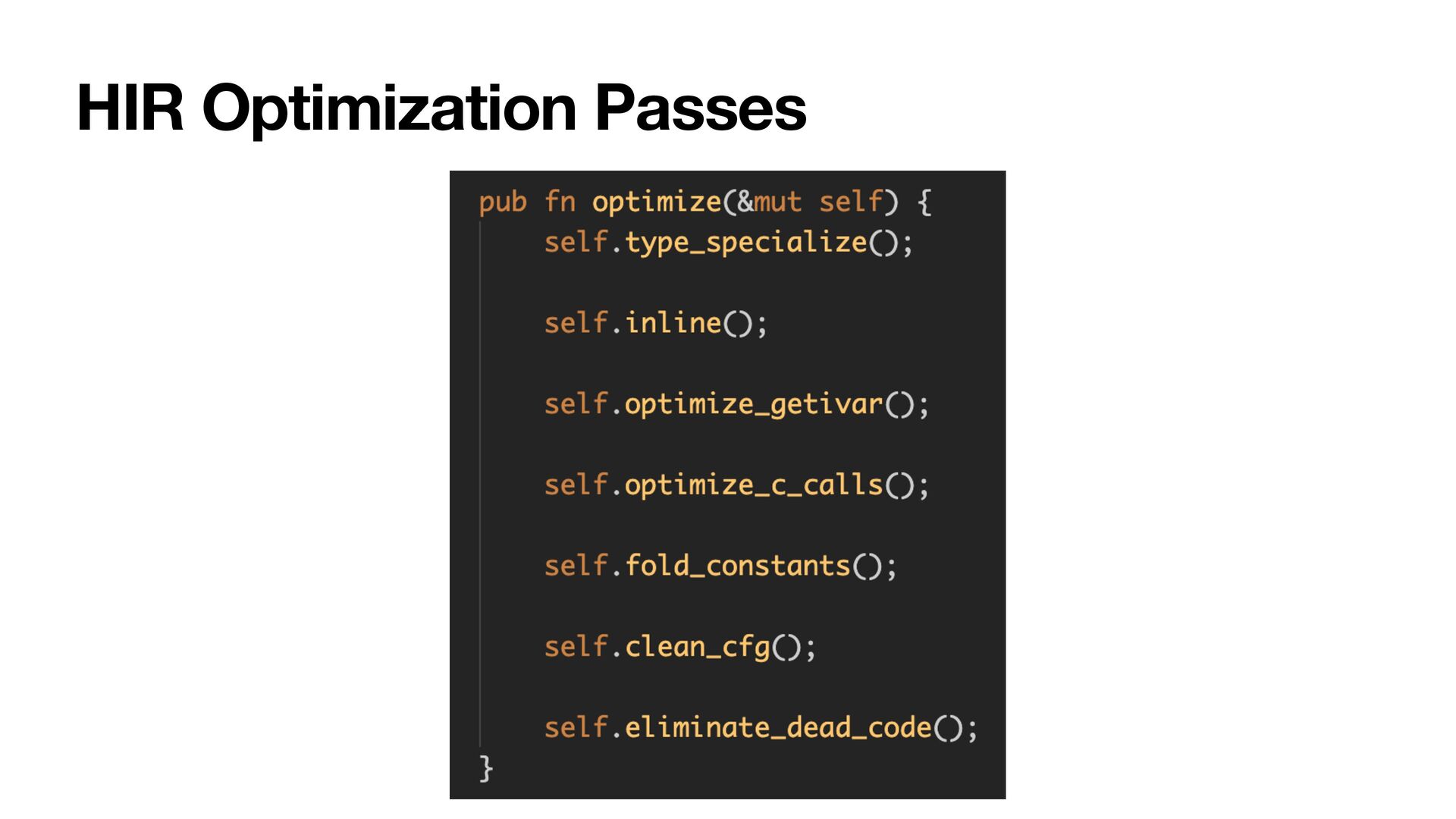
HIR
HIR Optimization Passes
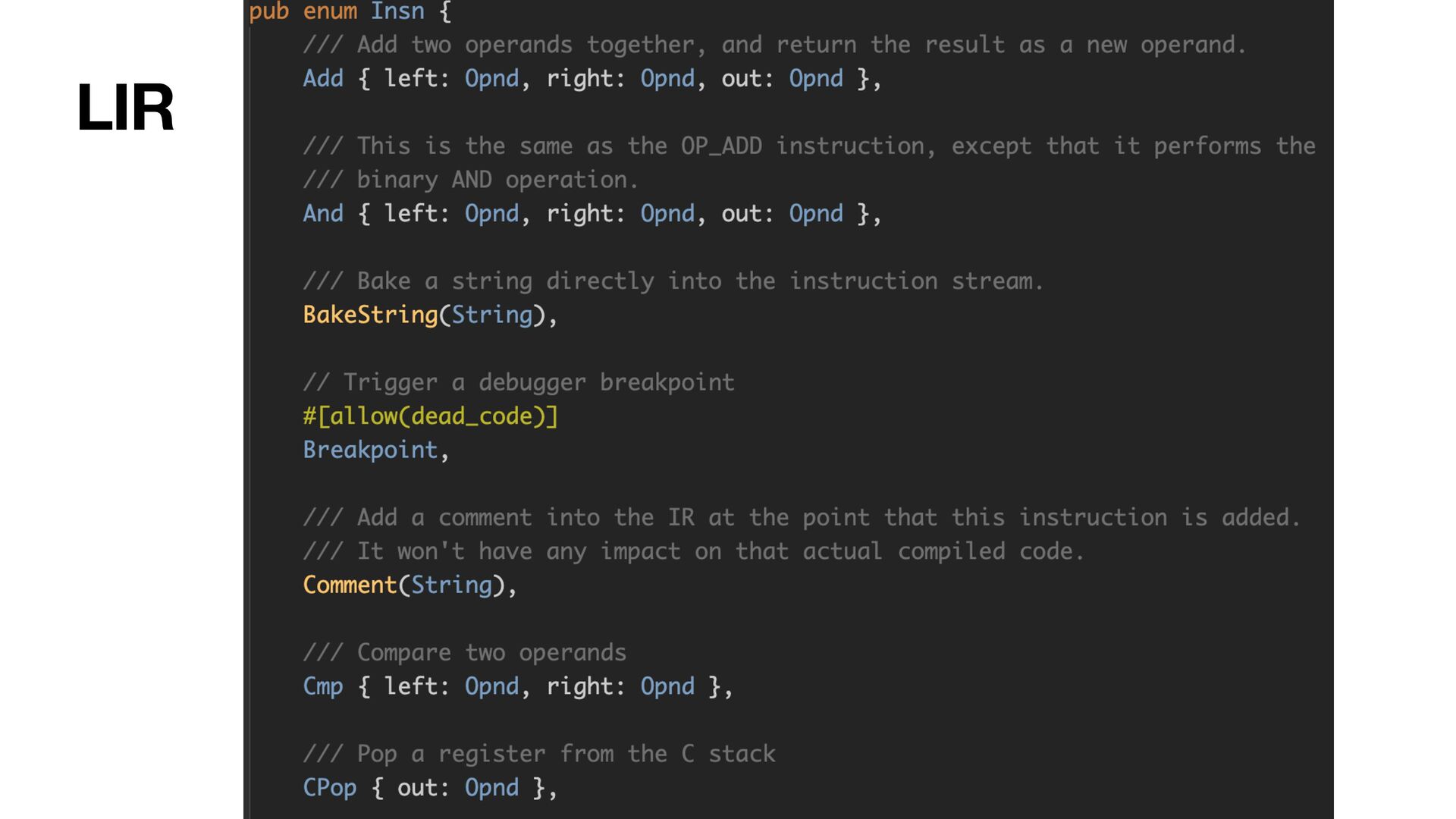
LIR
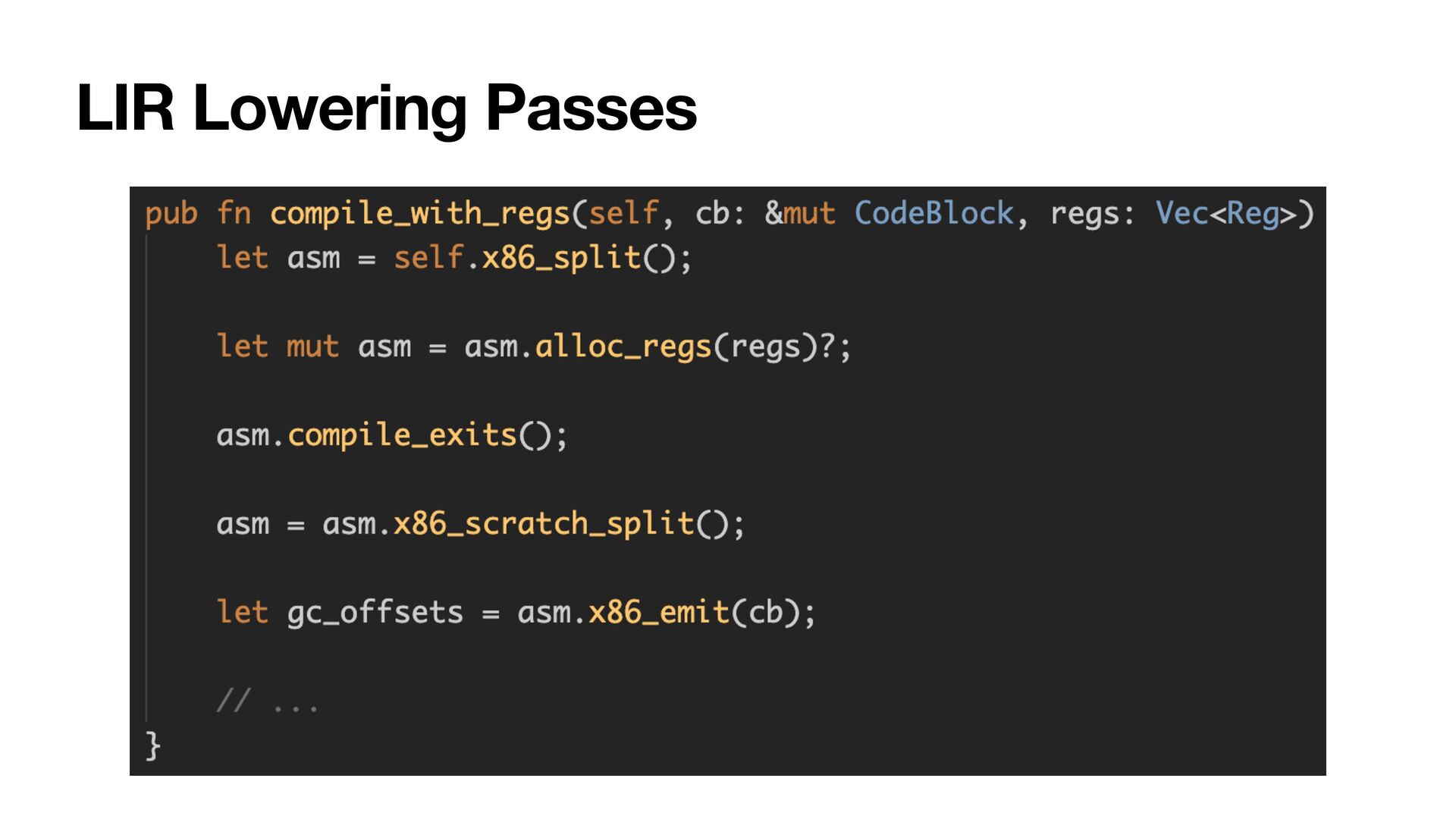
LIR Lowering Passes
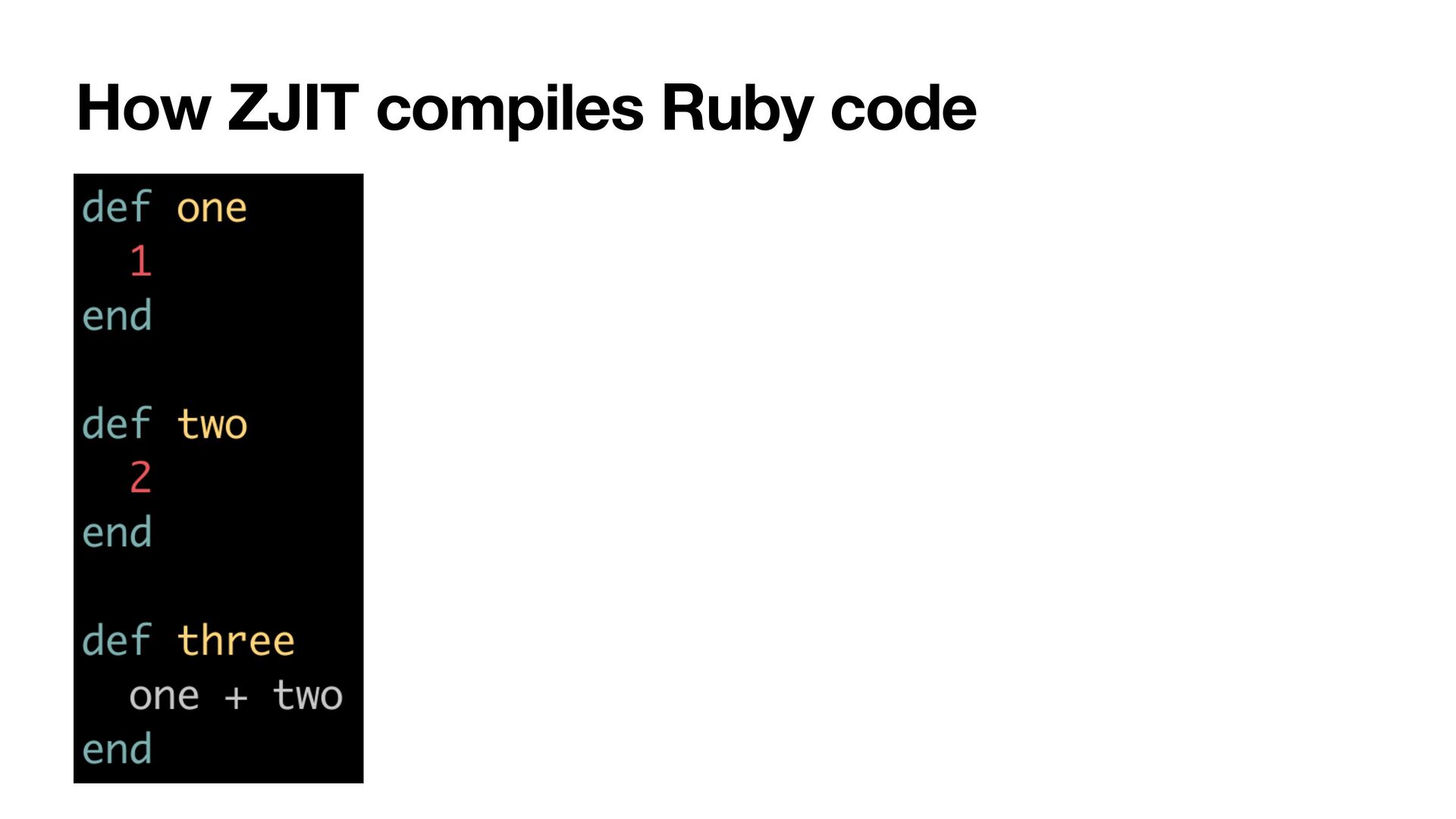
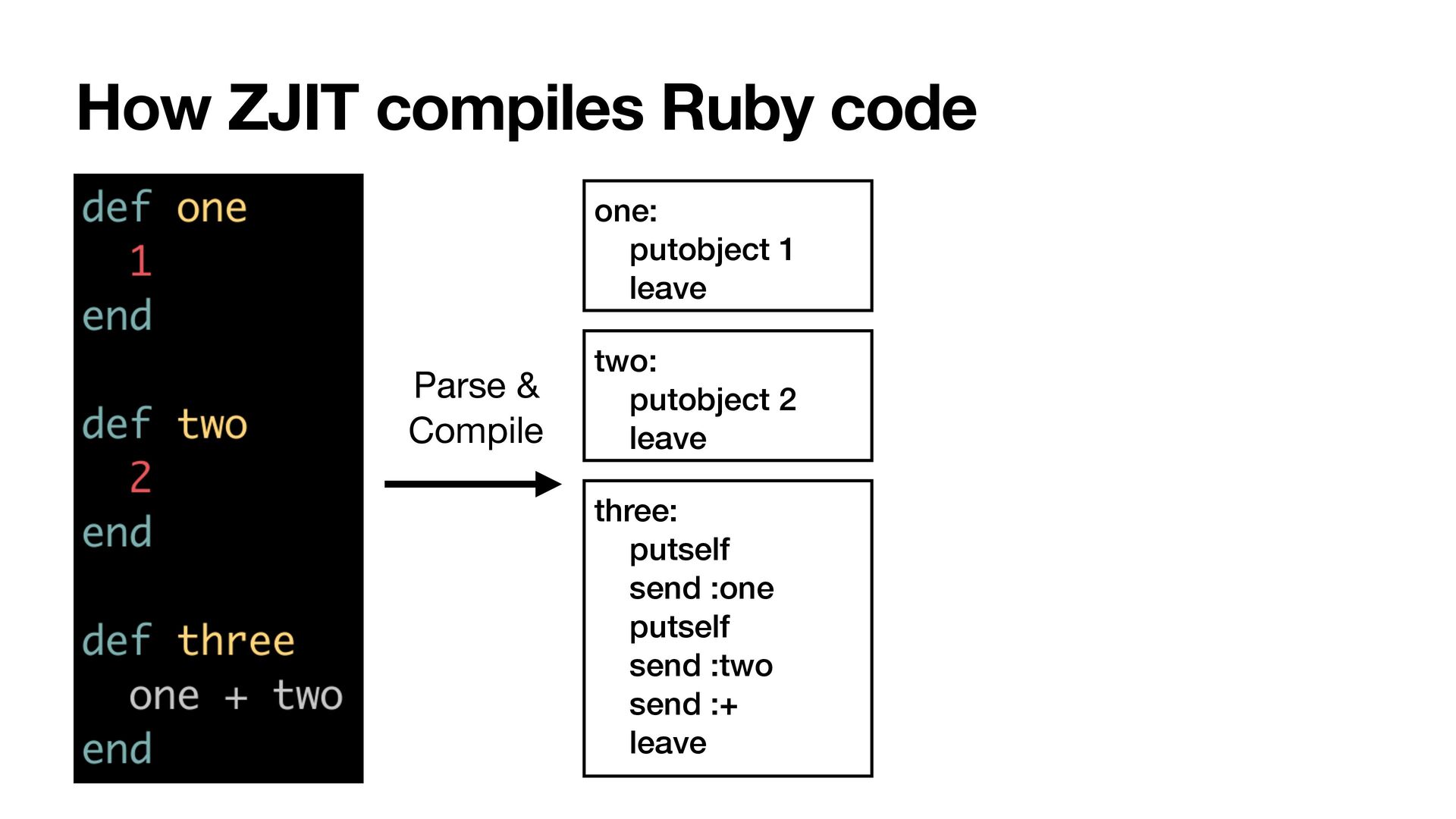
How ZJIT compiles Ruby code
How ZJIT compiles Ruby code one: putobject 1 leave two:
putobject 2 leave three: putself send :one putself send :two send :+ leave Parse & Compile
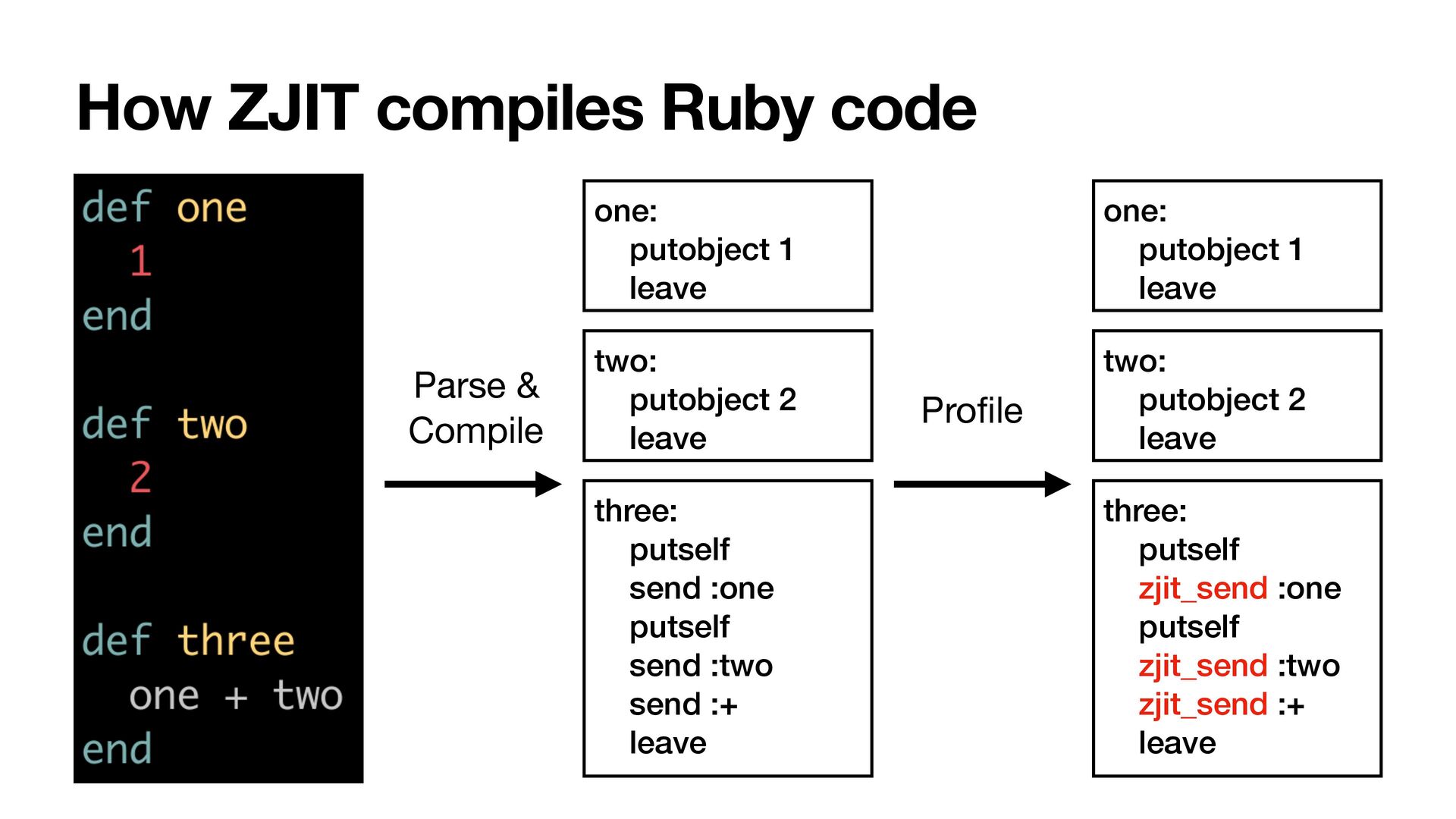
How ZJIT compiles Ruby code one: putobject 1 leave two:
putobject 2 leave three: putself send :one putself send :two send :+ leave one: putobject 1 leave two: putobject 2 leave three: putself zjit_send :one putself zjit_send :two zjit_send :+ leave Parse & Compile Pro fi le
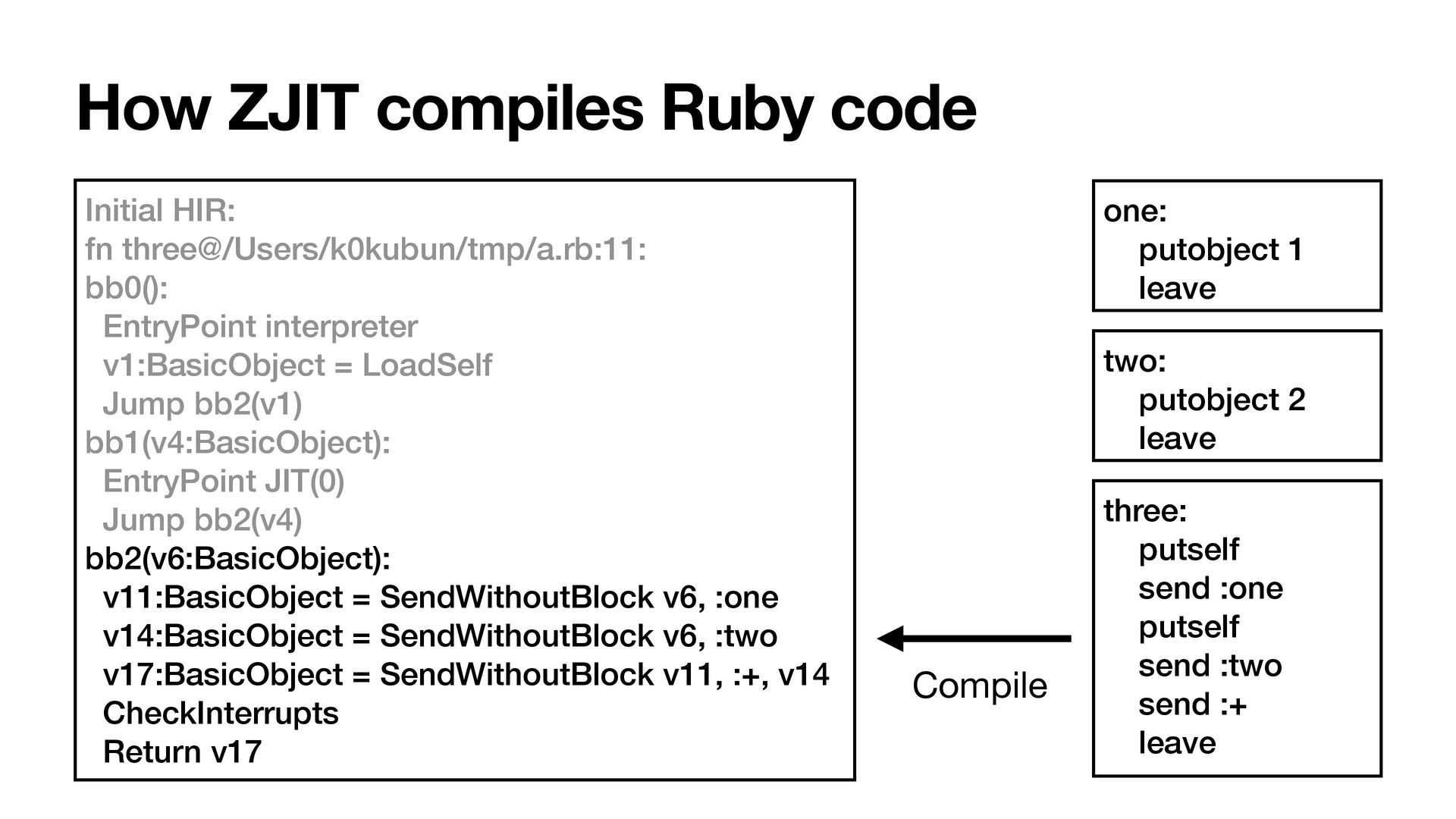
How ZJIT compiles Ruby code Initial HIR: fn three@/Users/k0kubun/tmp/a.rb:11: bb0():
EntryPoint interpreter v1:BasicObject = LoadSelf Jump bb2(v1) bb1(v4:BasicObject): EntryPoint JIT(0) Jump bb2(v4) bb2(v6:BasicObject): v11:BasicObject = SendWithoutBlock v6, :one v14:BasicObject = SendWithoutBlock v6, :two v17:BasicObject = SendWithoutBlock v11, :+, v14 CheckInterrupts Return v17 one: putobject 1 leave two: putobject 2 leave three: putself send :one putself send :two send :+ leave Compile
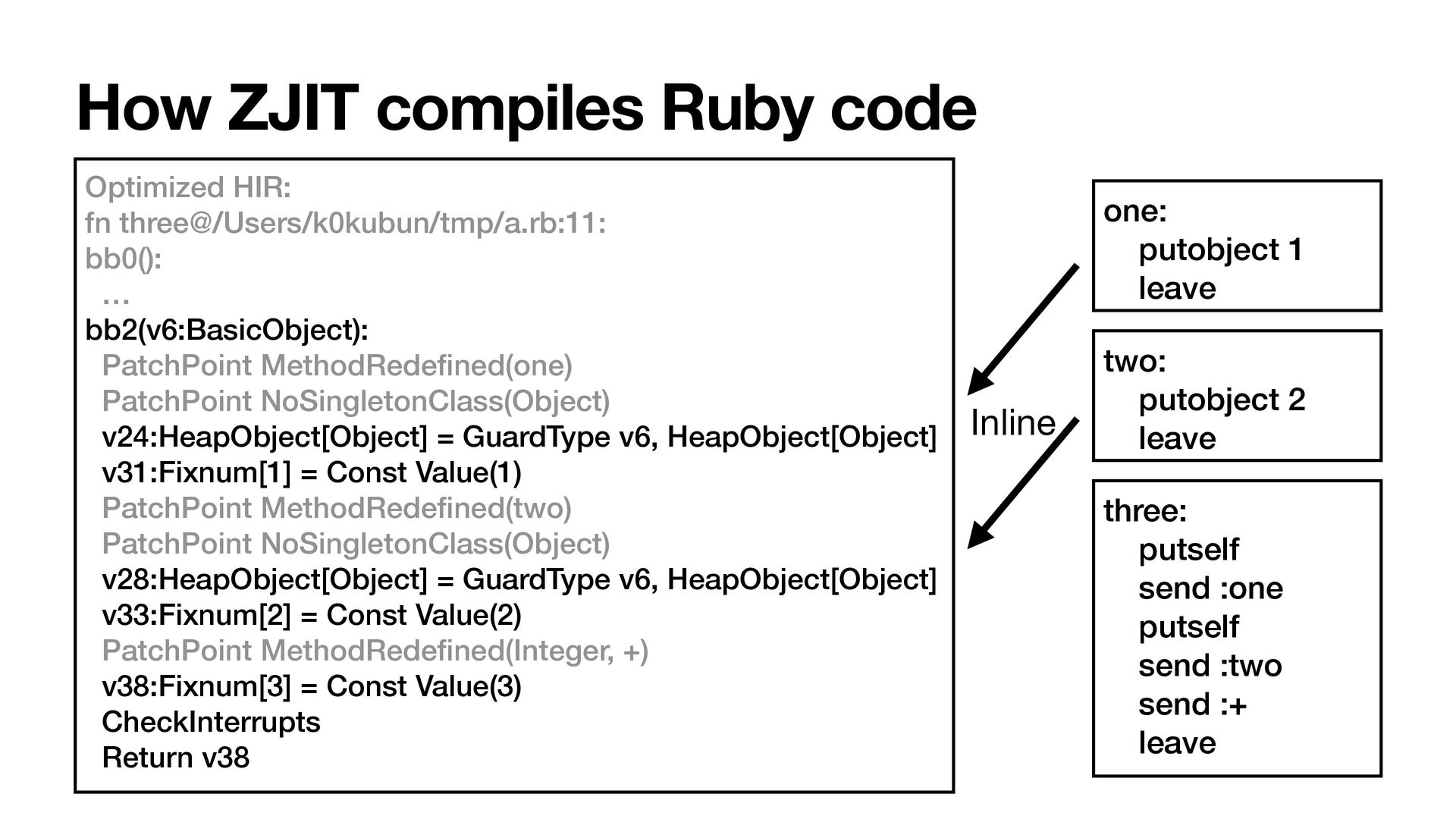
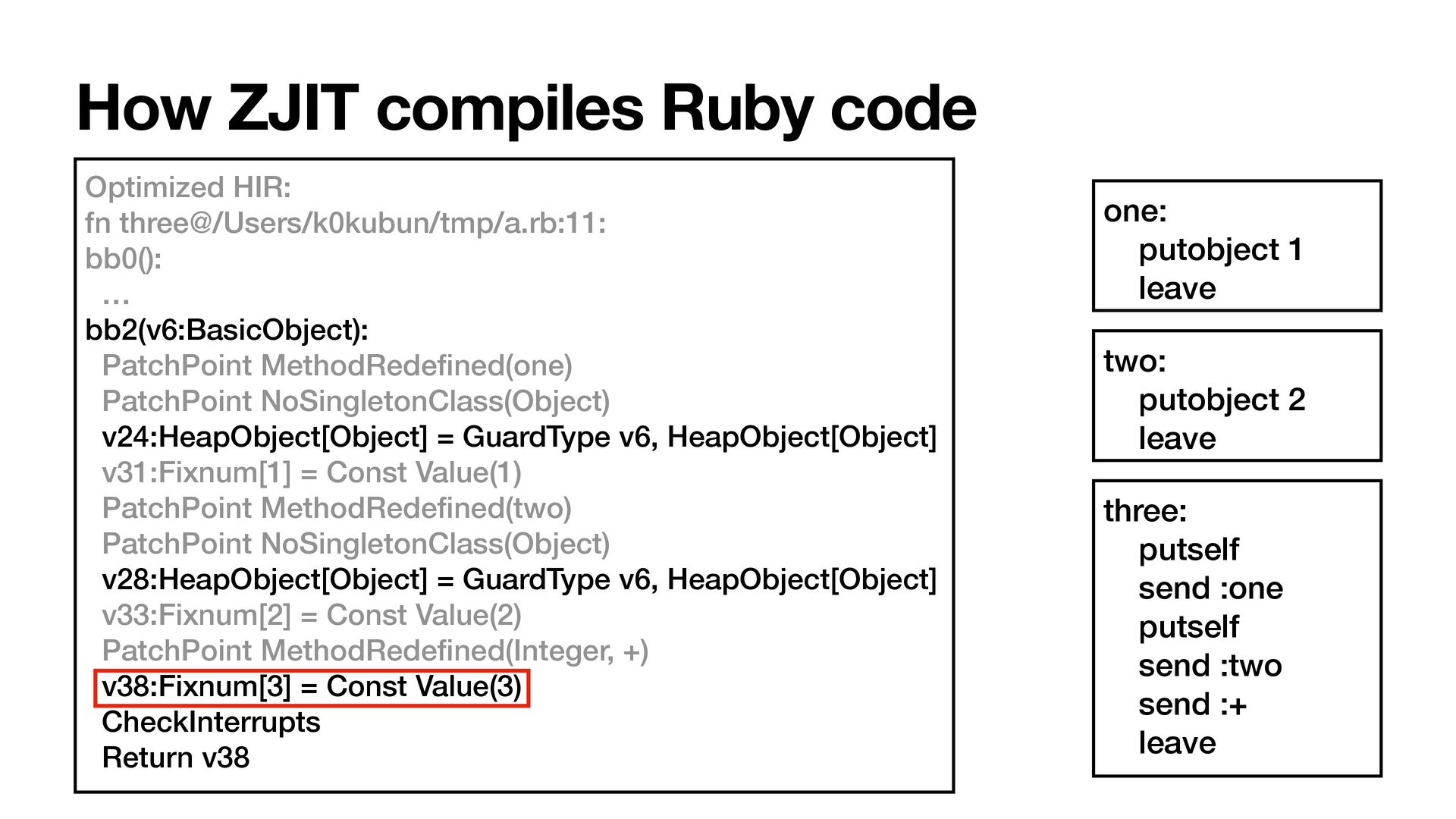
How ZJIT compiles Ruby code Optimized HIR: fn three@/Users/k0kubun/tmp/a.rb:11: bb0():
… bb2(v6:BasicObject): PatchPoint MethodRede fi ned(one) PatchPoint NoSingletonClass(Object) v24:HeapObject[Object] = GuardType v6, HeapObject[Object] v31:Fixnum[1] = Const Value(1) PatchPoint MethodRede fi ned(two) PatchPoint NoSingletonClass(Object) v28:HeapObject[Object] = GuardType v6, HeapObject[Object] v33:Fixnum[2] = Const Value(2) PatchPoint MethodRede fi ned(Integer, +) v38:Fixnum[3] = Const Value(3) CheckInterrupts Return v38 one: putobject 1 leave two: putobject 2 leave three: putself send :one putself send :two send :+ leave Inline
How ZJIT compiles Ruby code Optimized HIR: fn three@/Users/k0kubun/tmp/a.rb:11: bb0():
… bb2(v6:BasicObject): PatchPoint MethodRede fi ned(one) PatchPoint NoSingletonClass(Object) v24:HeapObject[Object] = GuardType v6, HeapObject[Object] v31:Fixnum[1] = Const Value(1) PatchPoint MethodRede fi ned(two) PatchPoint NoSingletonClass(Object) v28:HeapObject[Object] = GuardType v6, HeapObject[Object] v33:Fixnum[2] = Const Value(2) PatchPoint MethodRede fi ned(Integer, +) v38:Fixnum[3] = Const Value(3) CheckInterrupts Return v38 one: putobject 1 leave two: putobject 2 leave three: putself send :one putself send :two send :+ leave
Hacking on ZJIT HIR
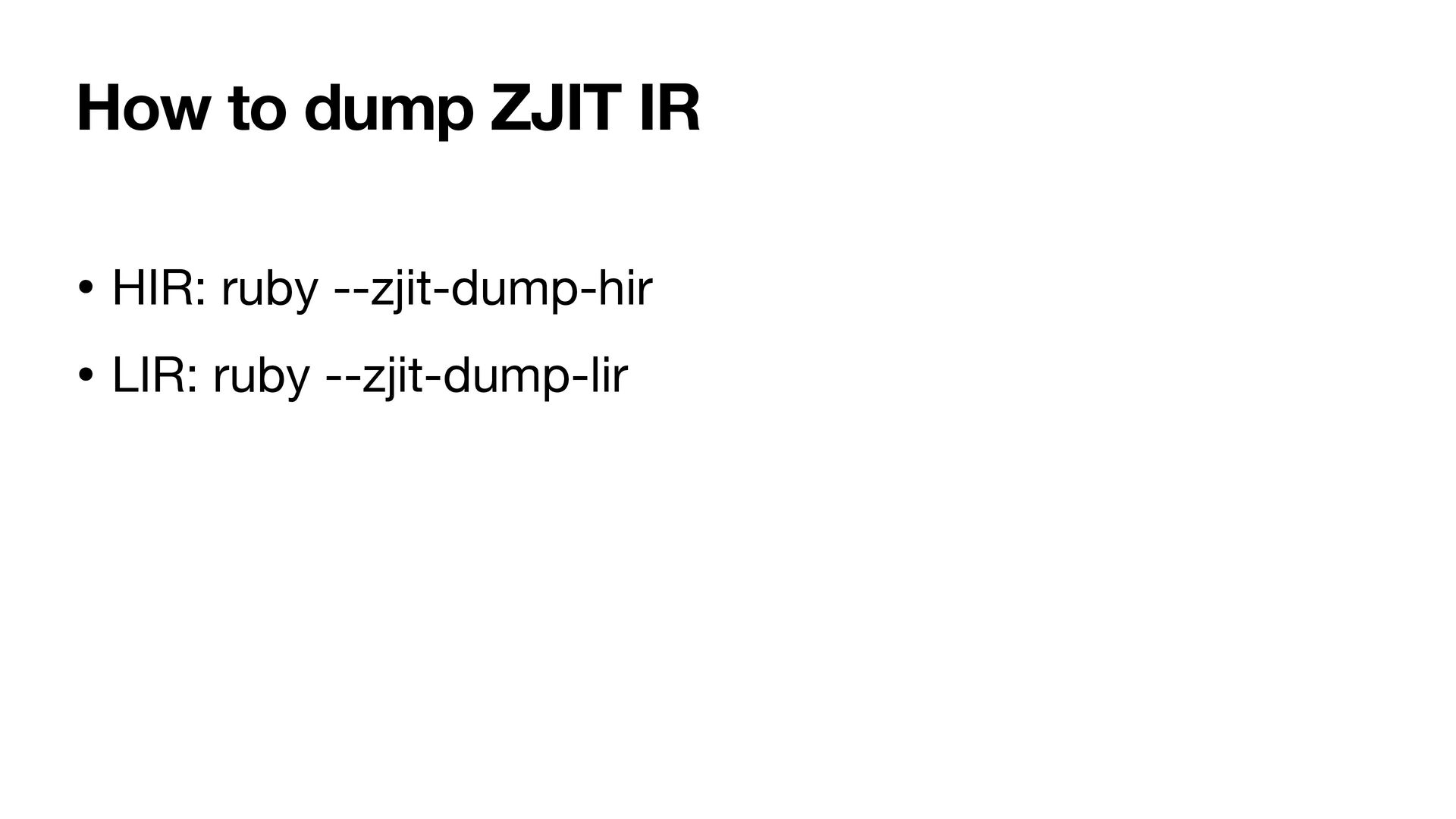
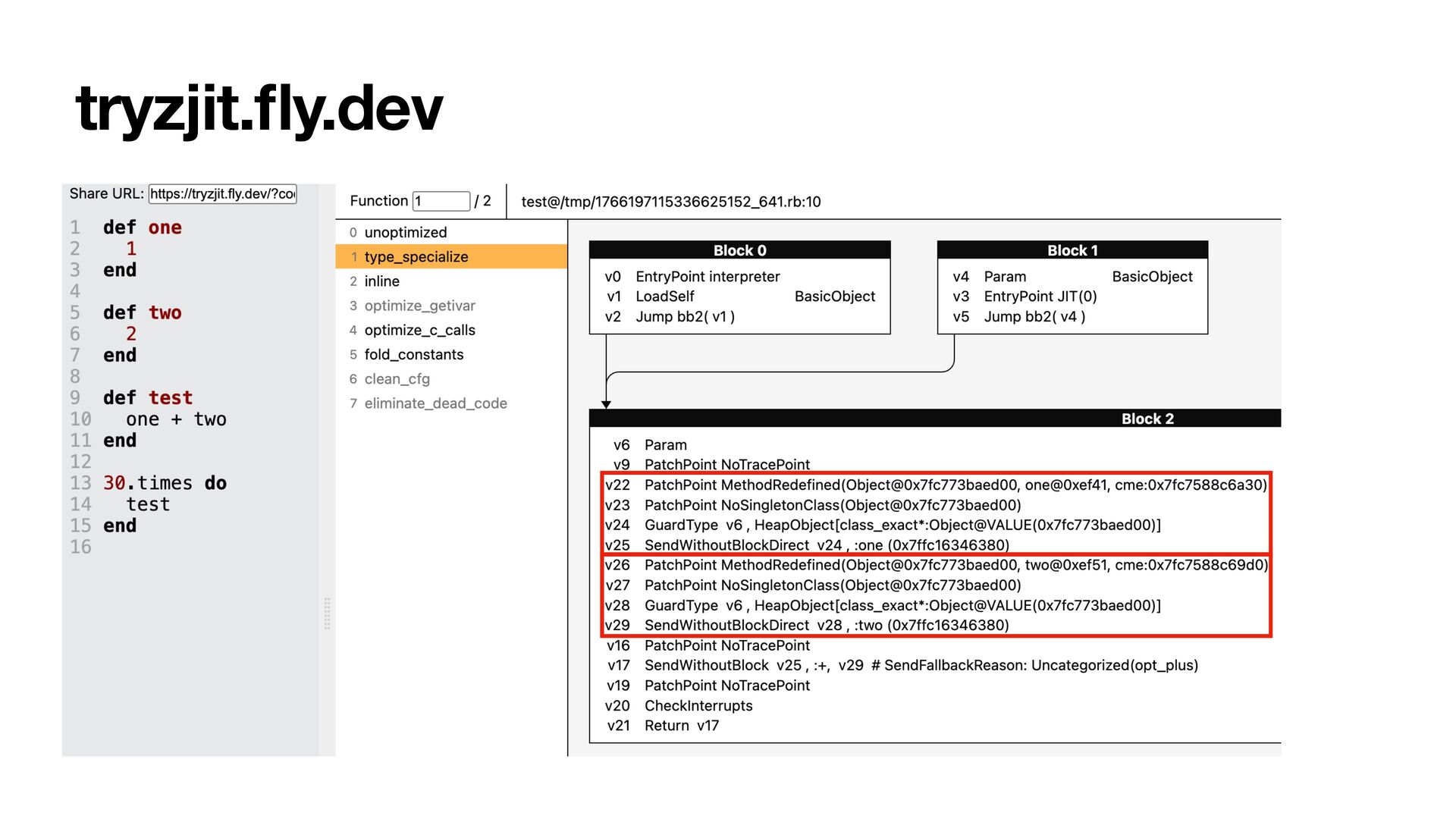
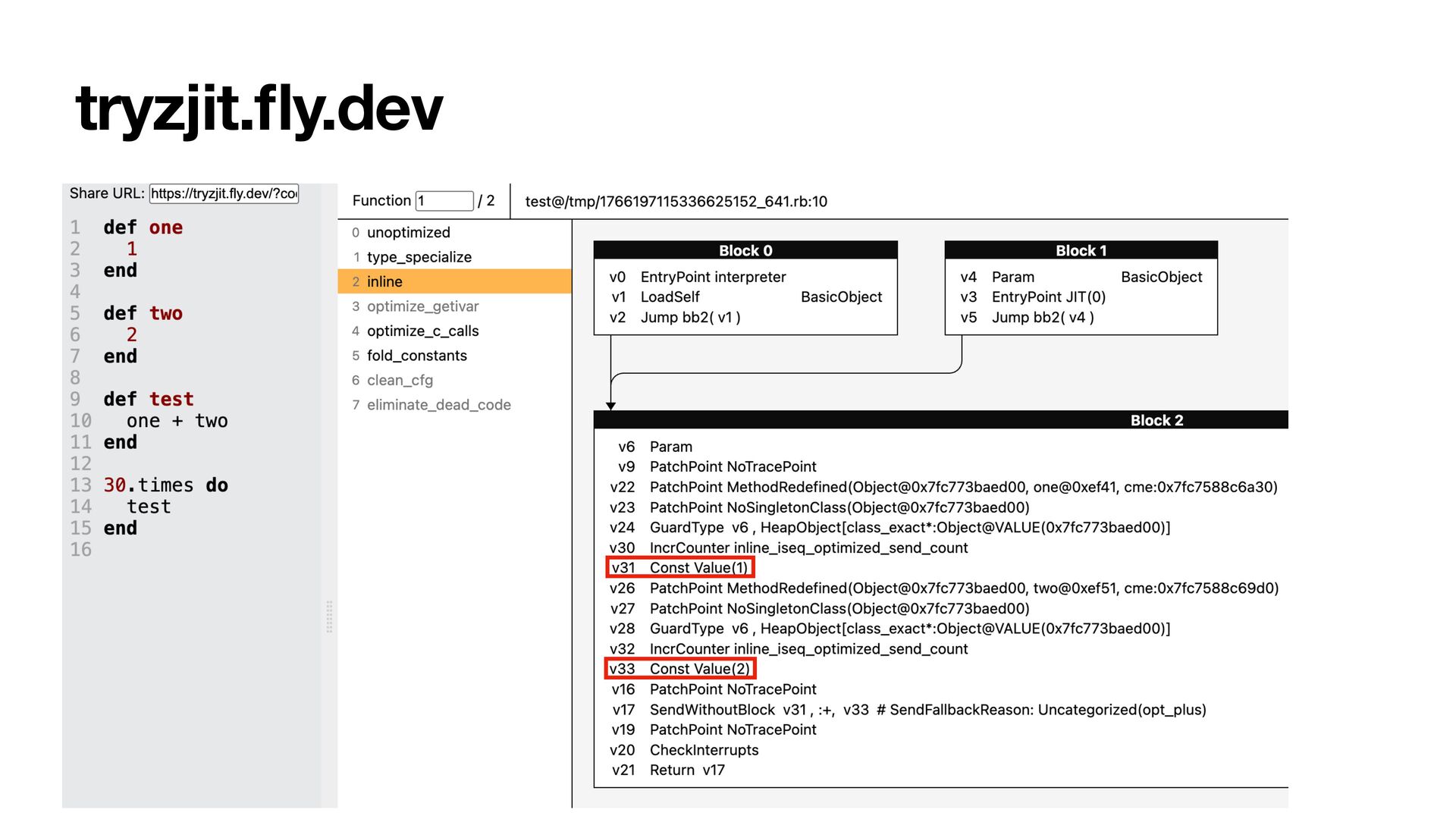
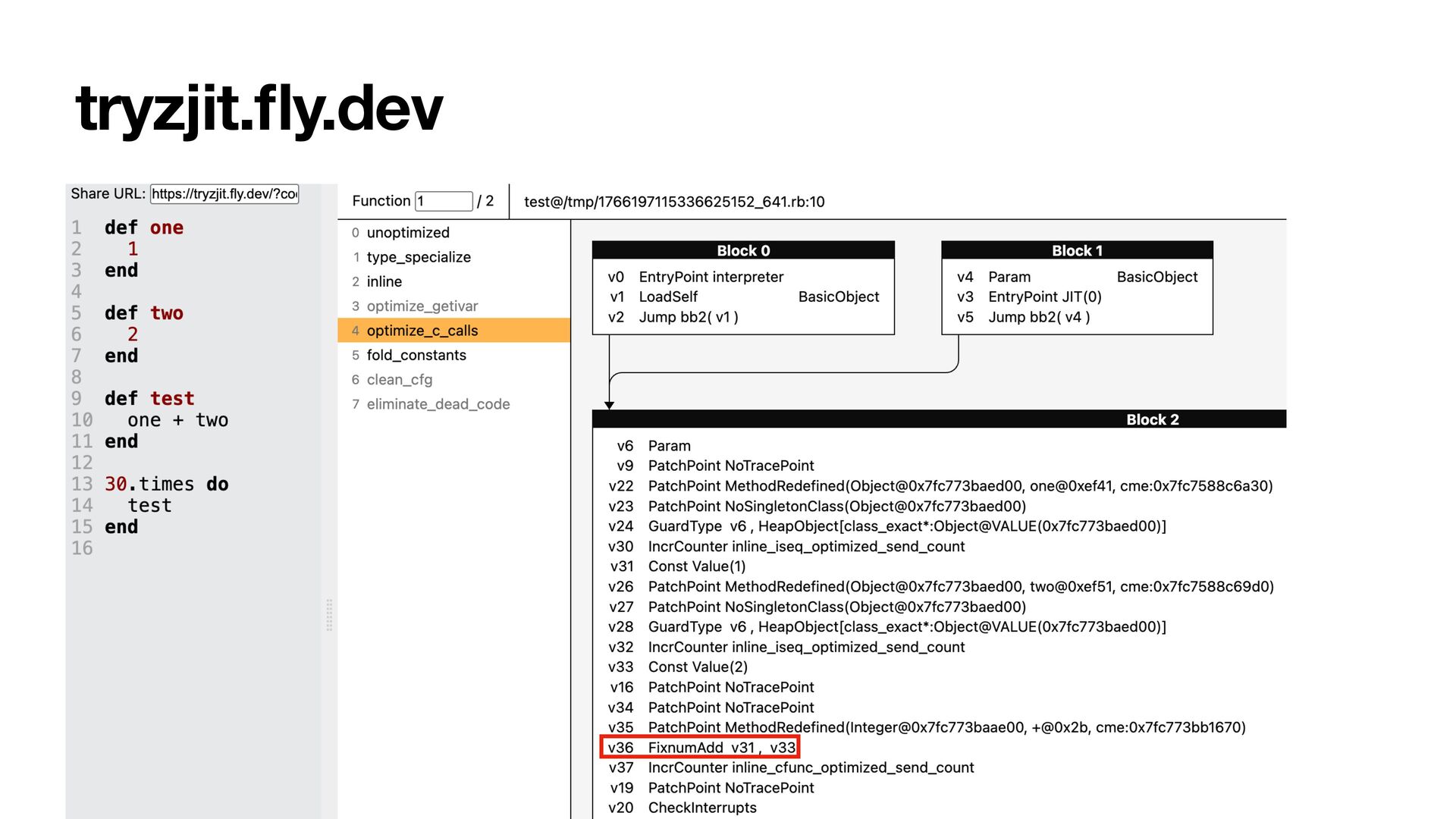
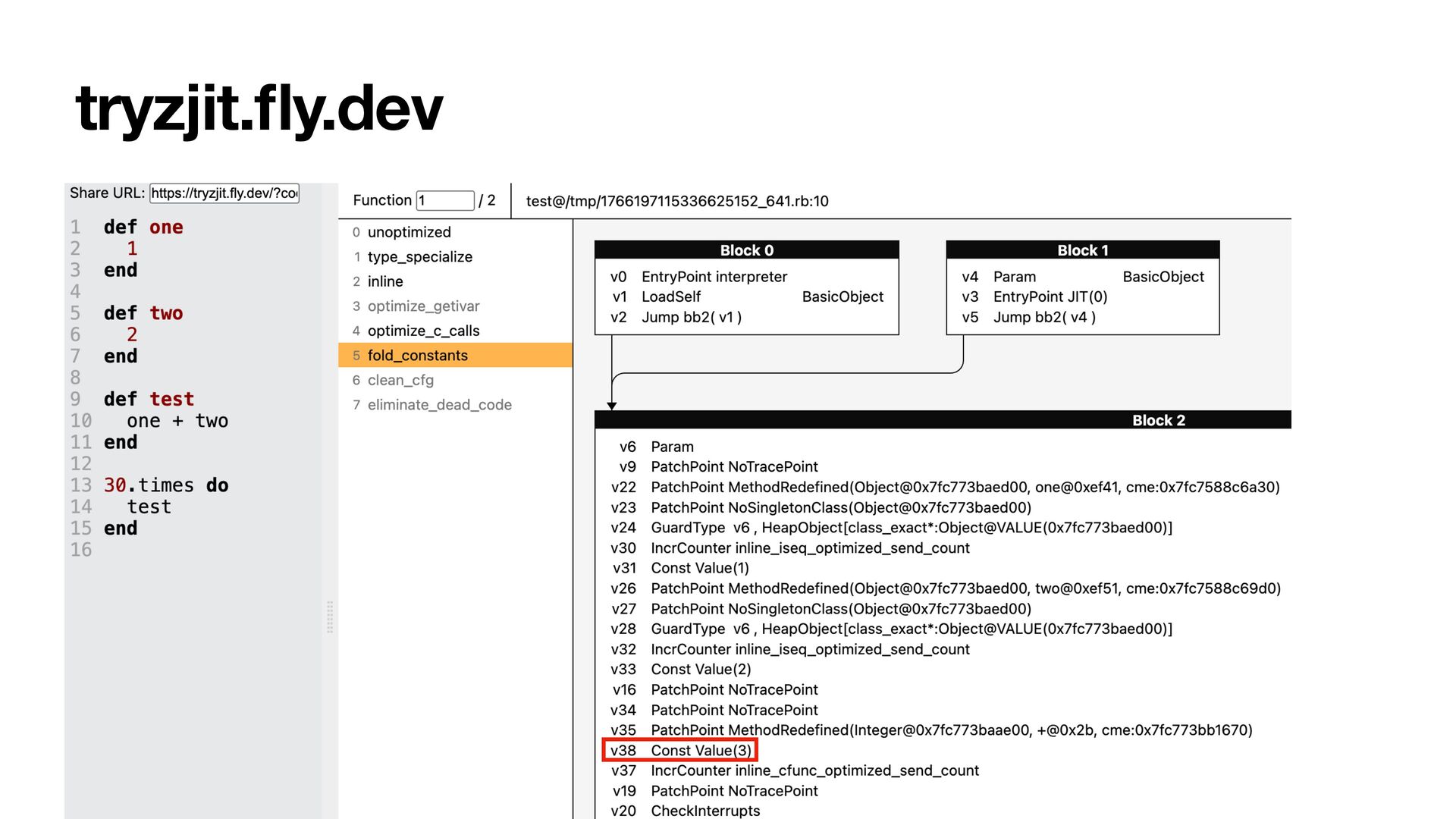
How to dump ZJIT IR • HIR: ruby --zjit-dump-hir •
LIR: ruby --zjit-dump-lir
None
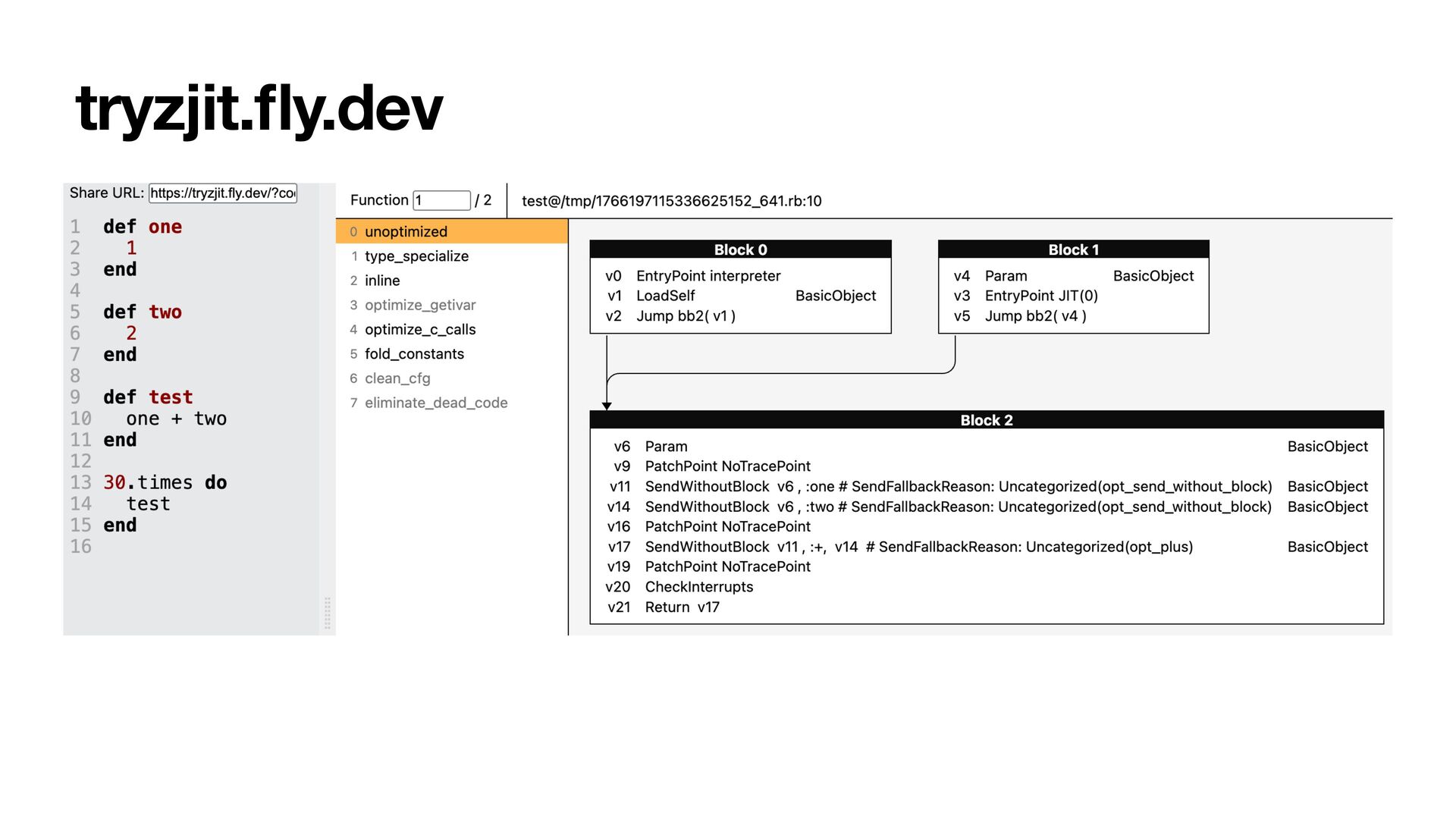
tryzjit. fl y.dev
tryzjit. fl y.dev
tryzjit. fl y.dev
tryzjit. fl y.dev
tryzjit. fl y.dev
None
None
None
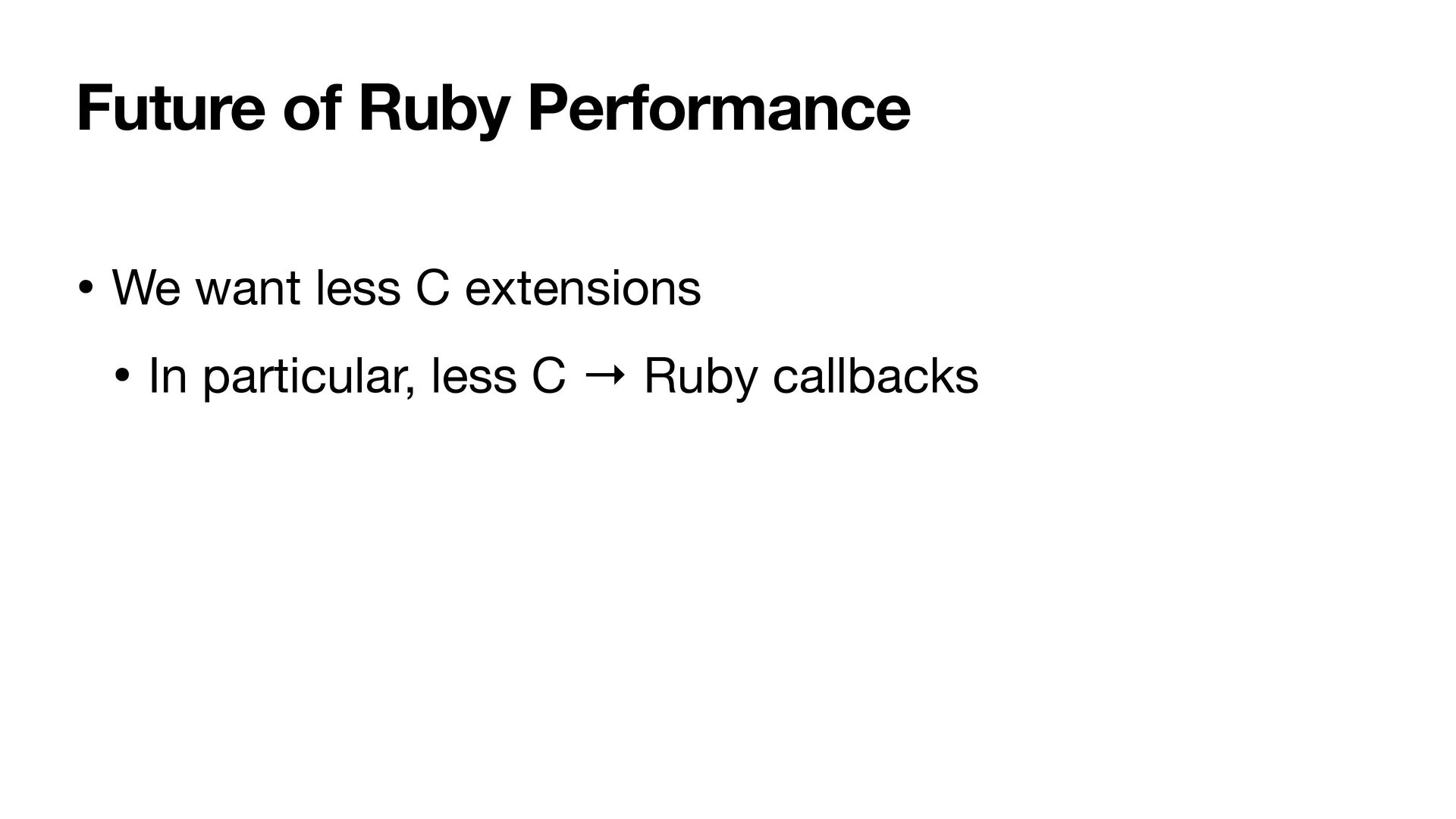
Future of Ruby Performance
Future of Ruby Performance • We want less C extensions
• In particular, less C → Ruby callbacks
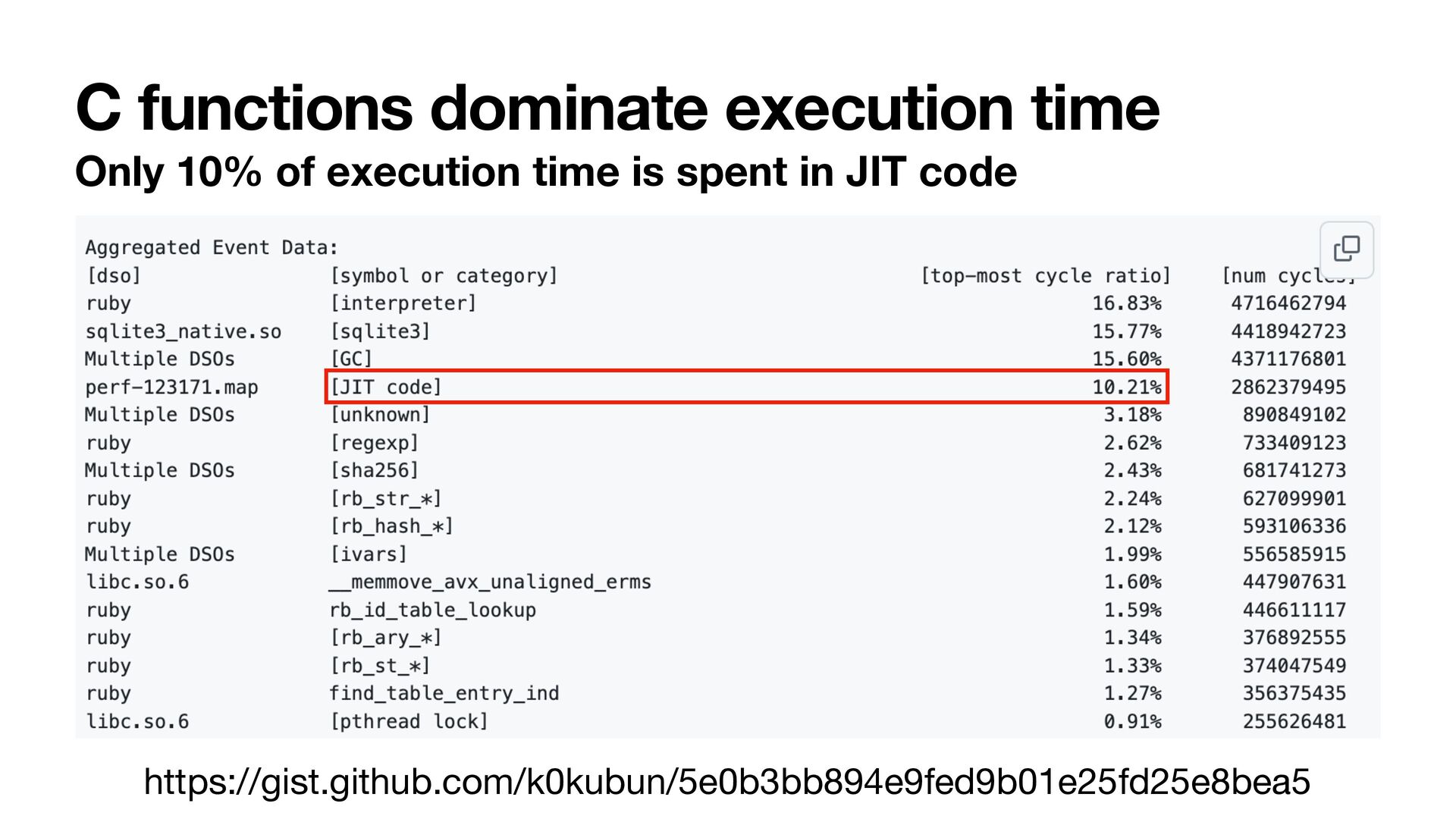
C functions dominate execution time Only 10% of execution time
is spent in JIT code https://gist.github.com/k0kubun/5e0b3bb894e9fed9b01e25fd25e8bea5
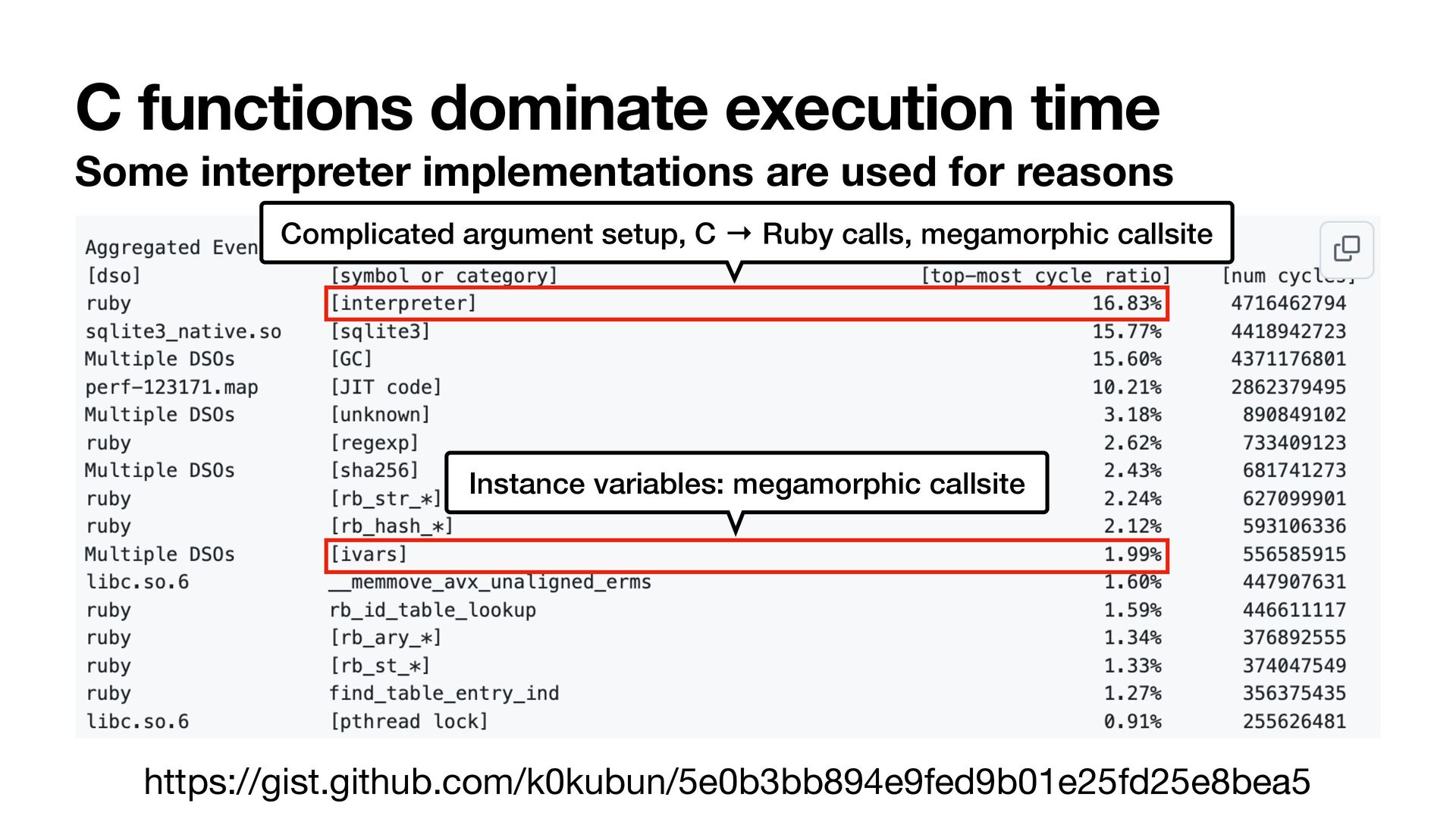
C functions dominate execution time Some interpreter implementations are used
for reasons https://gist.github.com/k0kubun/5e0b3bb894e9fed9b01e25fd25e8bea5 Complicated argument setup, C → Ruby calls, megamorphic callsite Instance variables: megamorphic callsite
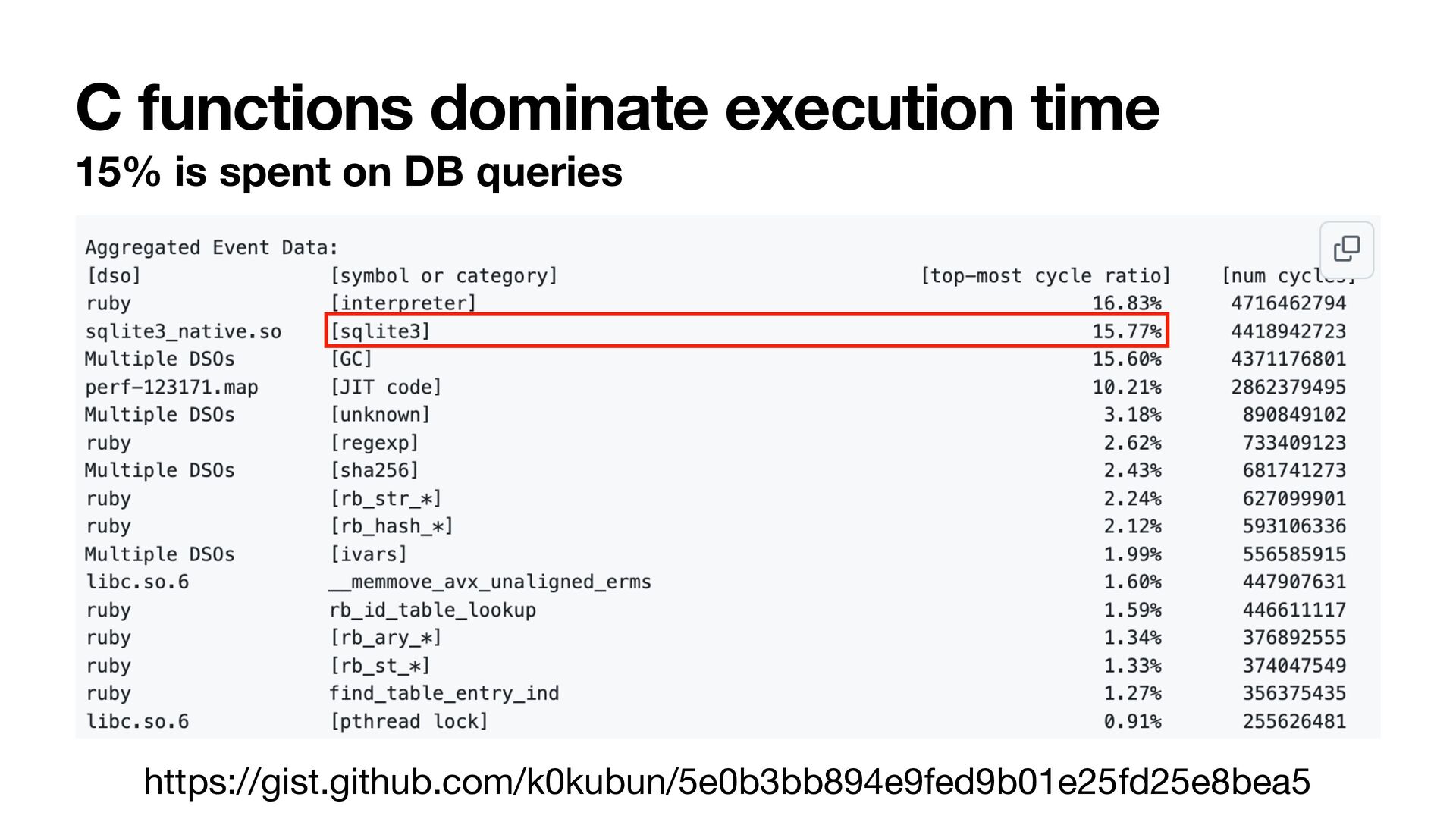
C functions dominate execution time 15% is spent on DB
queries https://gist.github.com/k0kubun/5e0b3bb894e9fed9b01e25fd25e8bea5
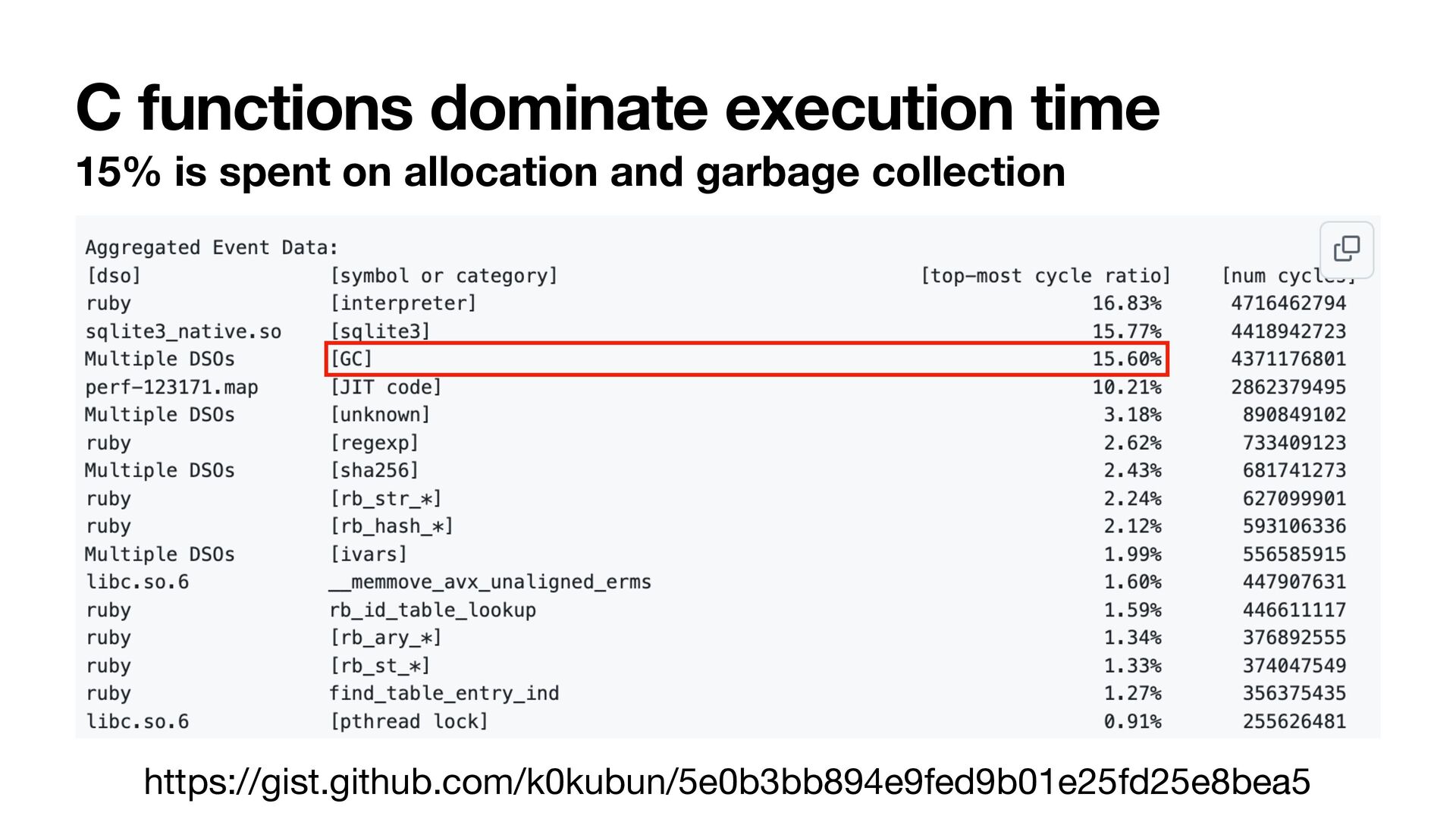
C functions dominate execution time 15% is spent on allocation
and garbage collection https://gist.github.com/k0kubun/5e0b3bb894e9fed9b01e25fd25e8bea5
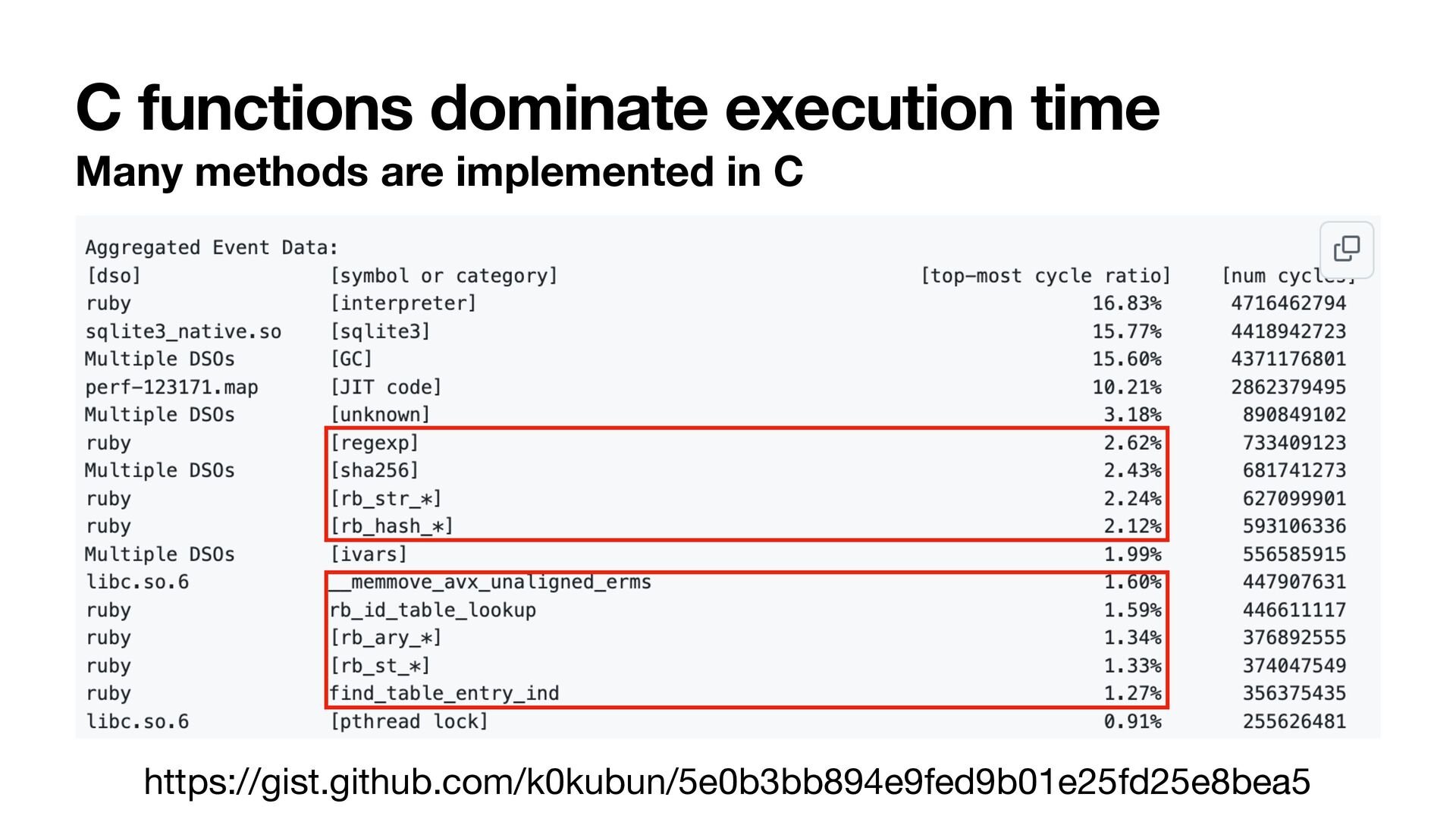
C functions dominate execution time Many methods are implemented in
C https://gist.github.com/k0kubun/5e0b3bb894e9fed9b01e25fd25e8bea5
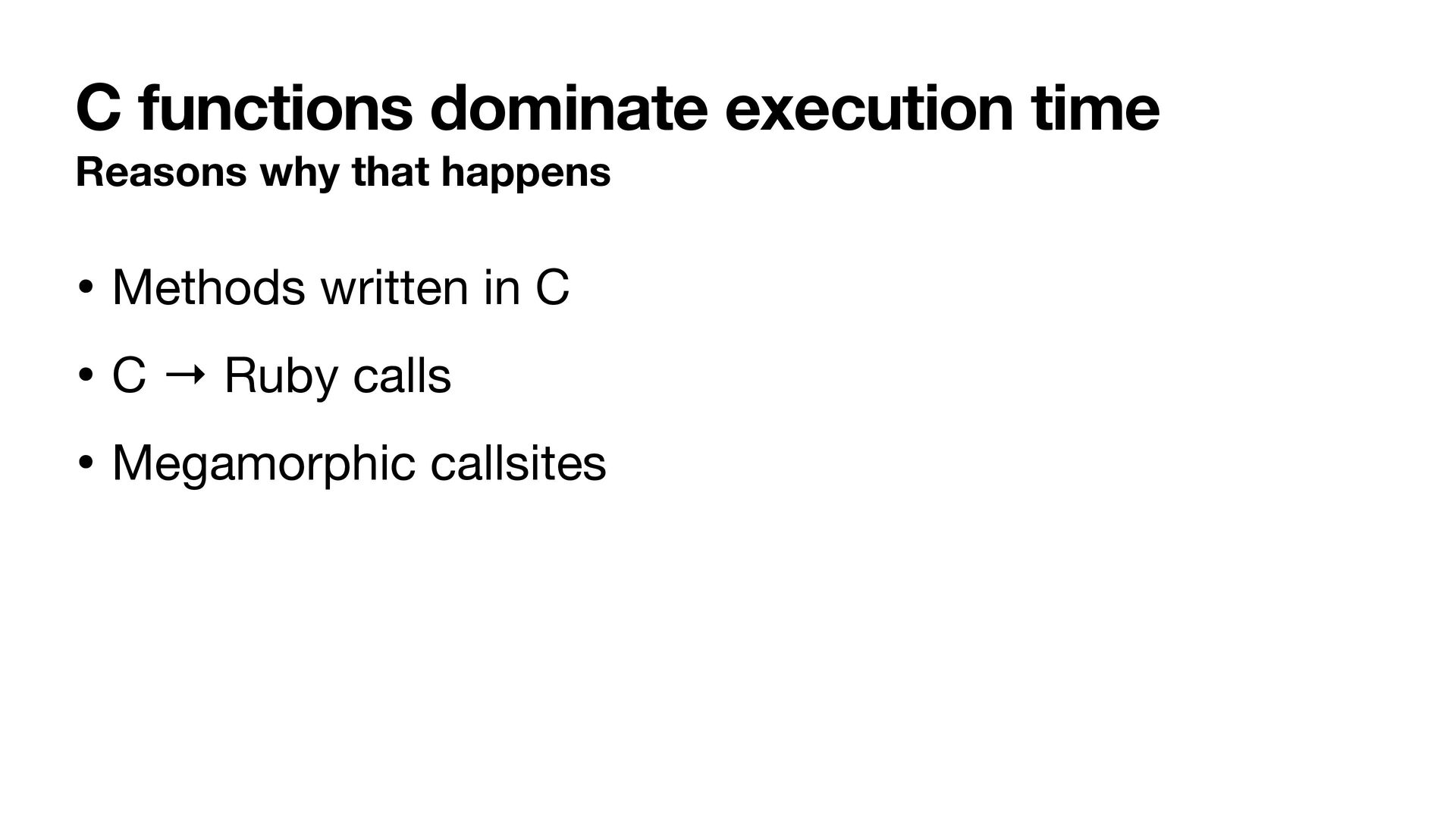
C functions dominate execution time • Methods written in C
• C → Ruby calls • Megamorphic callsites Reasons why that happens
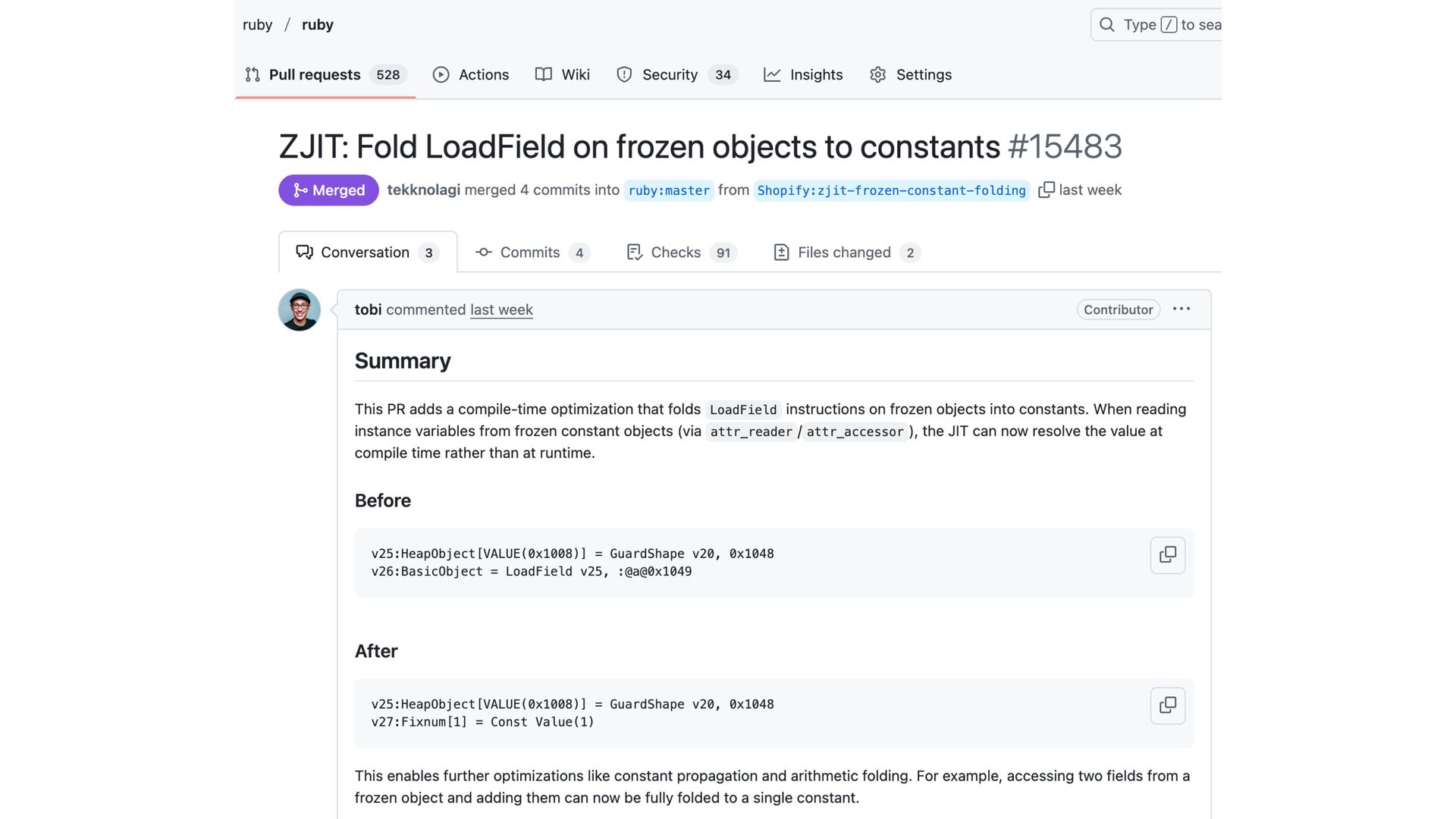
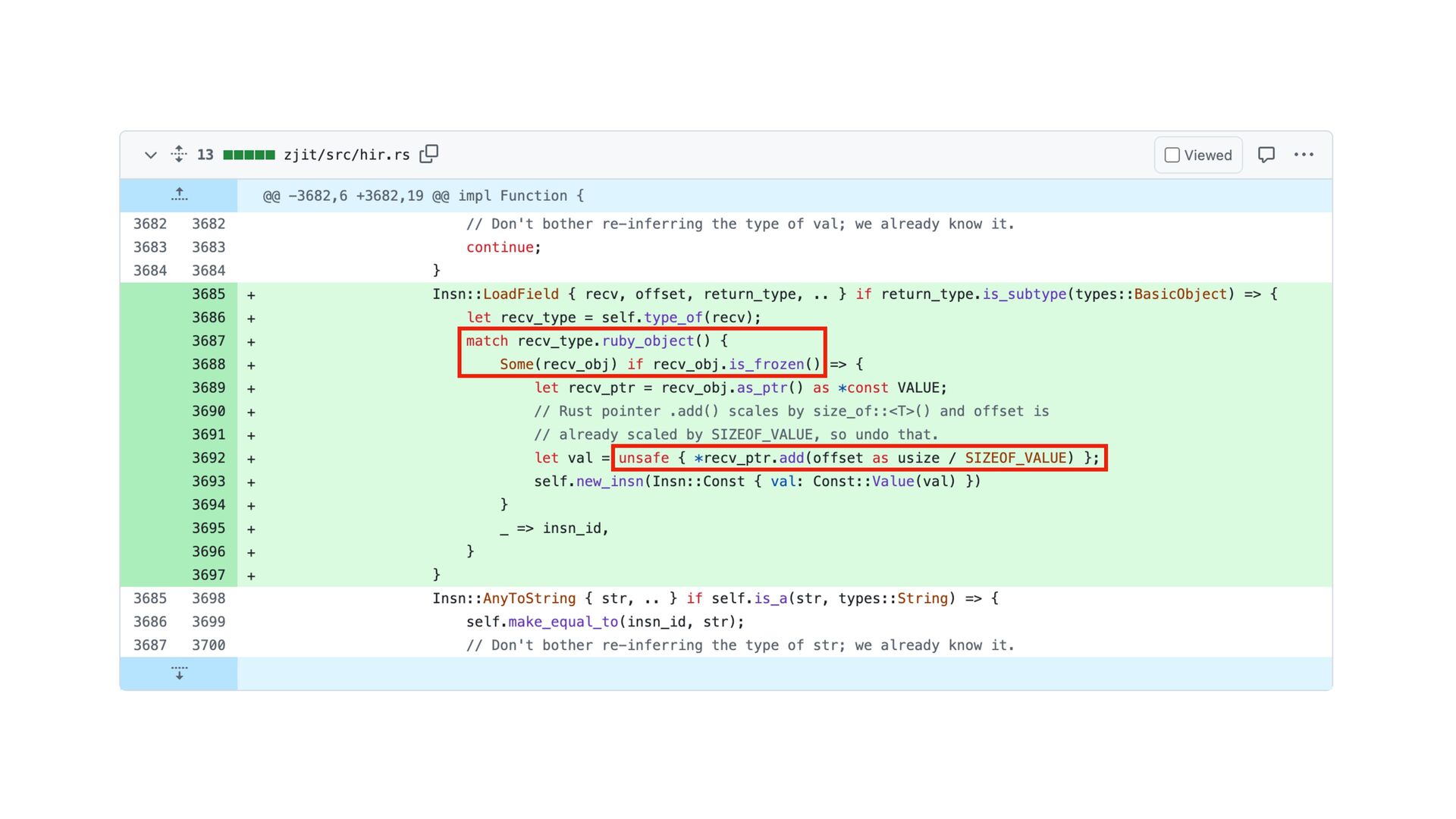
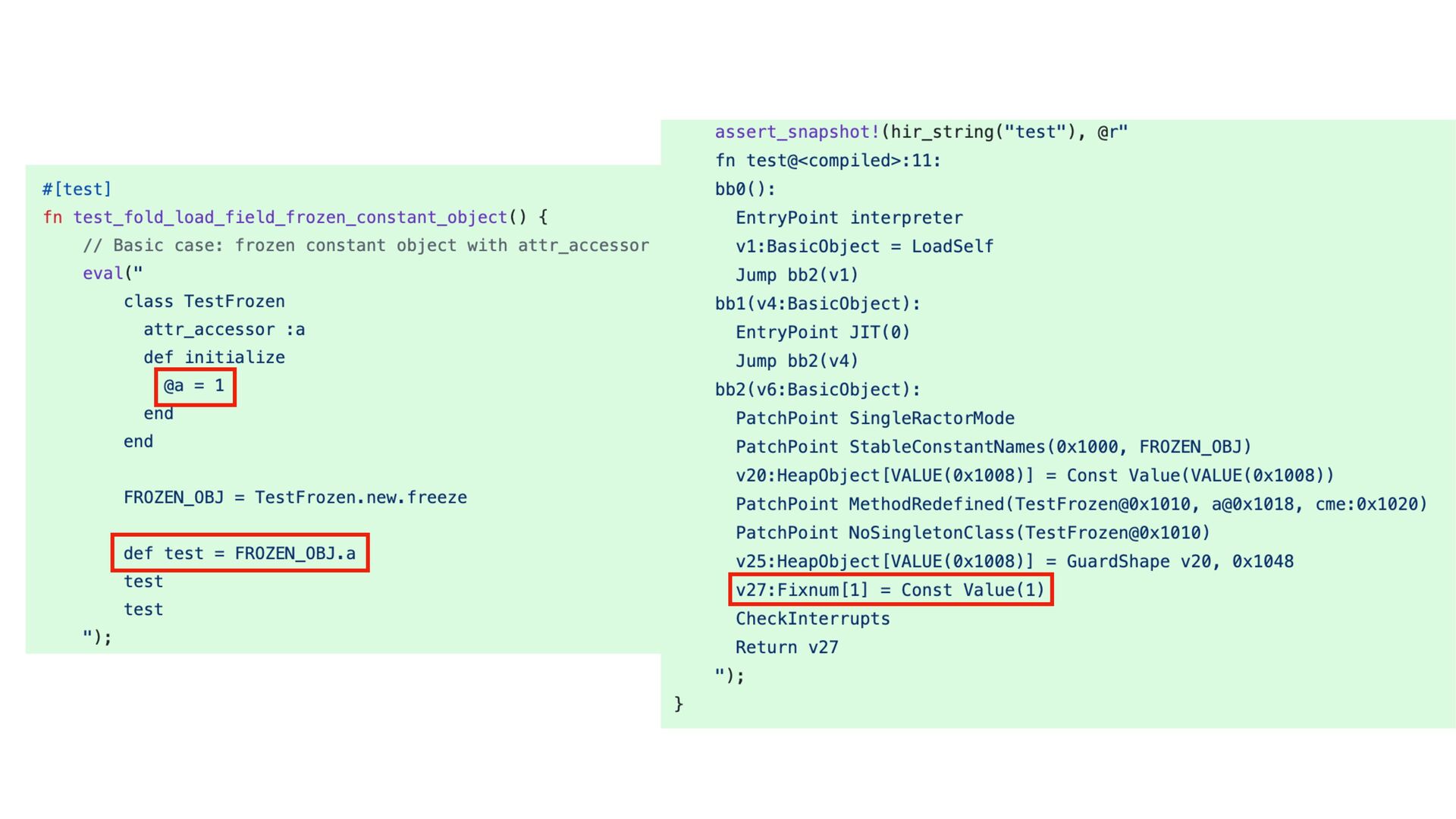
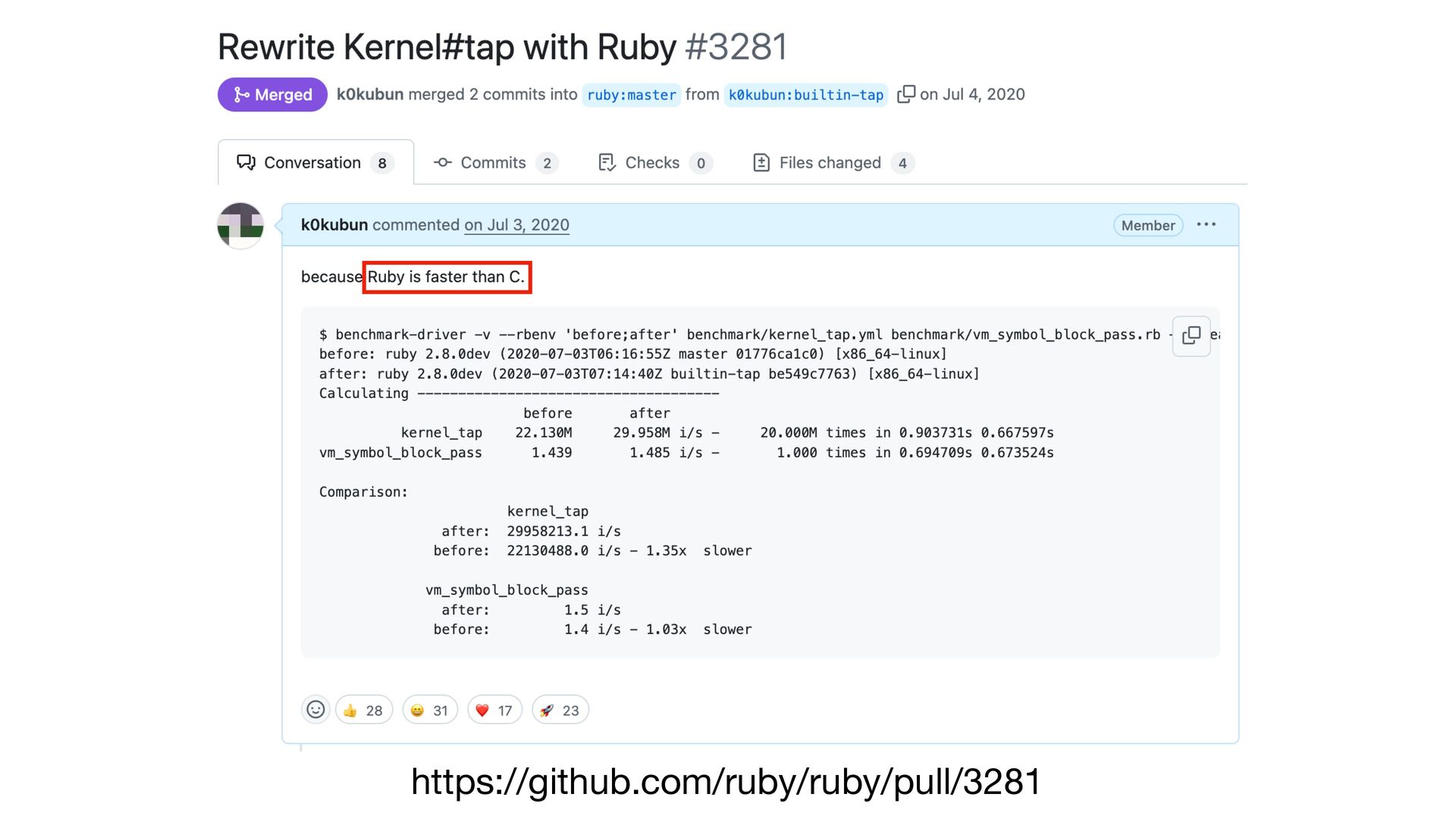
https://github.com/ruby/ruby/pull/3281
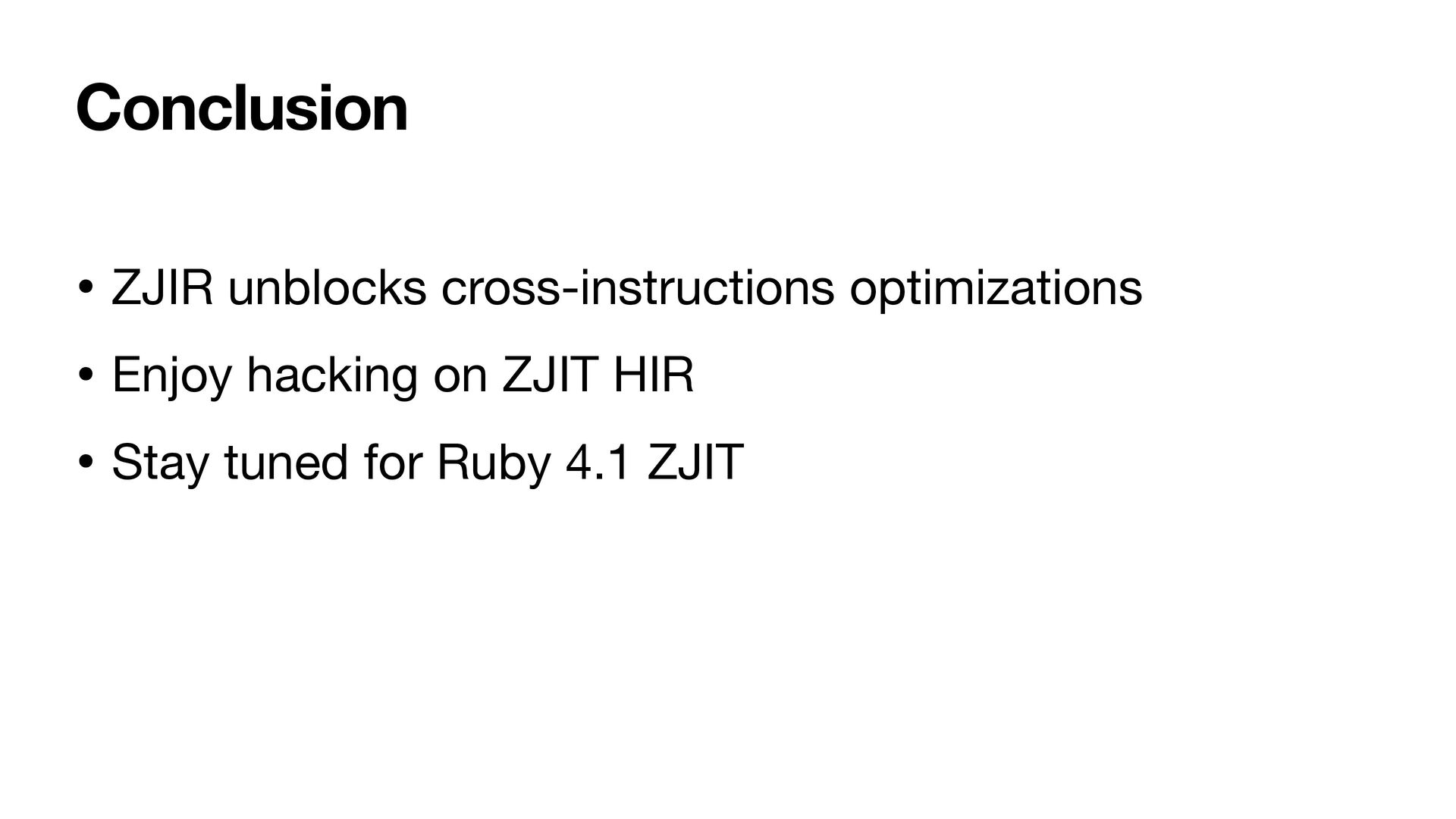
Conclusion • ZJIR unblocks cross-instructions optimizations • Enjoy hacking on
ZJIT HIR • Stay tuned for Ruby 4.1 ZJIT
More Decks by Takashi Kokubun
See All by Takashi Kokubun
Lightning-Fast Method Calls with Ruby 4.1 ZJIT / RubyKaigi 2026
k0kubun
3
4.1k
一度始めたらやめられない開発効率向上術 / Findy あなたのdotfilesを教えて!
k0kubun
4
3.4k
ZJIT: The Future of Ruby Performance / San Francisco Ruby Conference 2025
k0kubun
1
210
ZJIT: Building a New JIT Compiler for Ruby / REBASE 2025
k0kubun
0
190
Deoptimization: How YJIT Speeds Up Ruby by Slowing Down / RubyKaigi 2025
k0kubun
2
5k
YJIT Makes Rails 1.7x faster / RubyKaigi 2024
k0kubun
7
16k
Ruby JIT Hacking Guide / RubyKaigi 2023
k0kubun
2
11k
YJIT: Dive into Ruby's JIT compiler written in Rust / Rust.Tokyo 2022
k0kubun
2
2.4k
Towards Ruby 4 JIT / RubyKaigi 2022
k0kubun
3
12k
Other Decks in Programming
See All in Programming
Snowflake Openflow Connector利用の勘所 / 20261024developersio2026tokyo-snowflake-openflow
kasacchiful
PRO
0
360
オーケストレーション記述言語 Katari
yukikurage
0
270
そのデザイントークン、Flutterでも同じ見た目になりますか?
nakamizu
0
440
プロジェクトコードをキレイキレイしよう!暗黙的な参照を読み解く静的解析
ostk0069
0
220
Distance field of Julia set
kinakomoti321
0
330
AI時代のFlutter品質設計 — アプリ品質を守るQuality Layers
omatty198
0
390
Kawaiicon: Kubernetes, it's no longer cool, but let's secure it anyway!
barnbarn
0
140
Engineering Biometric UX Across Android Versions | DroidKnights 2026
ryunen344
1
220
AI時代のシニアエンジニアとは
yosuke_furukawa
PRO
15
12k
AIコーディング時代のKotest ユニットテストから APIレベルの仕様固定化テストへ
ooga04
0
300
Goコンパイラを作ってGoをもっと理解する / Build a Go compiler to better understand Go
ikura_hamu
0
130
自宅サーバはどこまで再現できるのか - Proxmox VE上のVM環境をIaCとバックアップで戻してみた
youto
0
440
Featured
See All Featured
How Software Deployment tools have changed in the past 20 years
geshan
3
35k
Stewardship and Sustainability of Urban and Community Forests
pwiseman
0
610
B2B Lead Gen: Tactics, Traps & Triumph
marketingsoph
1
310
Mobile First: as difficult as doing things right
swwweet
225
10k
Noah Learner - AI + Me: how we built a GSC Bulk Export data pipeline
techseoconnect
PRO
0
490
Rebuilding a faster, lazier Slack
samanthasiow
85
9.8k
Easily Structure & Communicate Ideas using Wireframe
afnizarnur
194
17k
It's Worth the Effort
3n
188
29k
Future Trends and Review - Lecture 12 - Web Technologies (1019888BNR)
signer
PRO
0
3.8k
Intergalactic Javascript Robots from Outer Space
tanoku
273
28k
Building Adaptive Systems
keathley
44
3.3k
The untapped power of vector embeddings
frankvandijk
2
2k


 k0kubun
 kasacchiful
 yukikurage
 nakamizu
 ostk0069
 kinakomoti321
 omatty198
 barnbarn
 ryunen344
 yosuke_furukawa
 ooga04
 ikura_hamu
 youto
 geshan
 pwiseman
 marketingsoph
 swwweet
 techseoconnect
 samanthasiow
 afnizarnur
 3n
 signer
 tanoku
 keathley
 frankvandijk