Open Data Publishing through Static Site Generation A Decade of Educational LOD Infrastructure Masao Takaku, University of Tsukuba Yuka Egusa, National Institute for Educational Policy Research 1
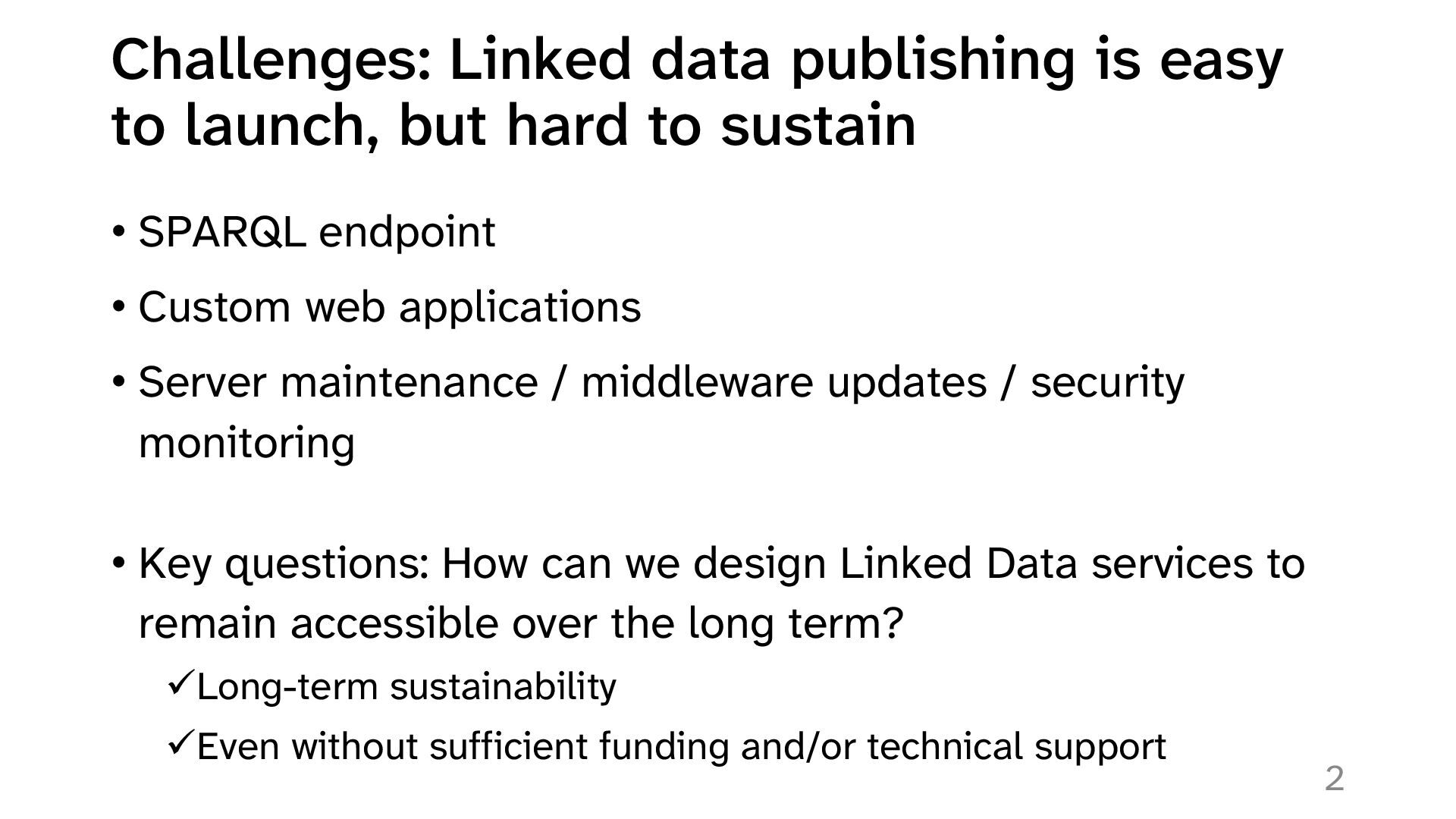
to sustain • SPARQL endpoint • Custom web applications • Server maintenance / middleware updates / security monitoring • Key questions: How can we design Linked Data services to remain accessible over the long term? Long-term sustainability Even without sufficient funding and/or technical support 2
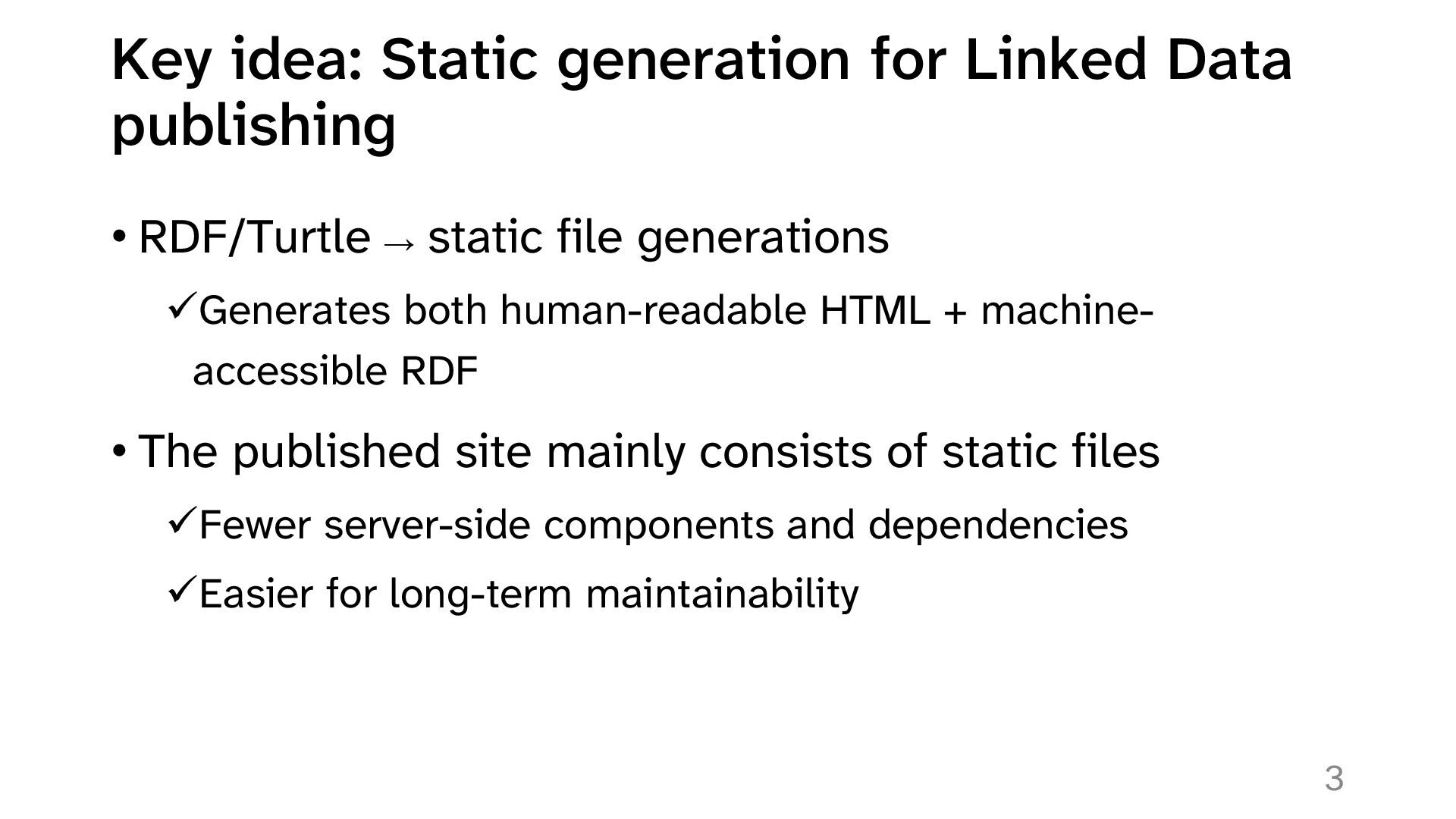
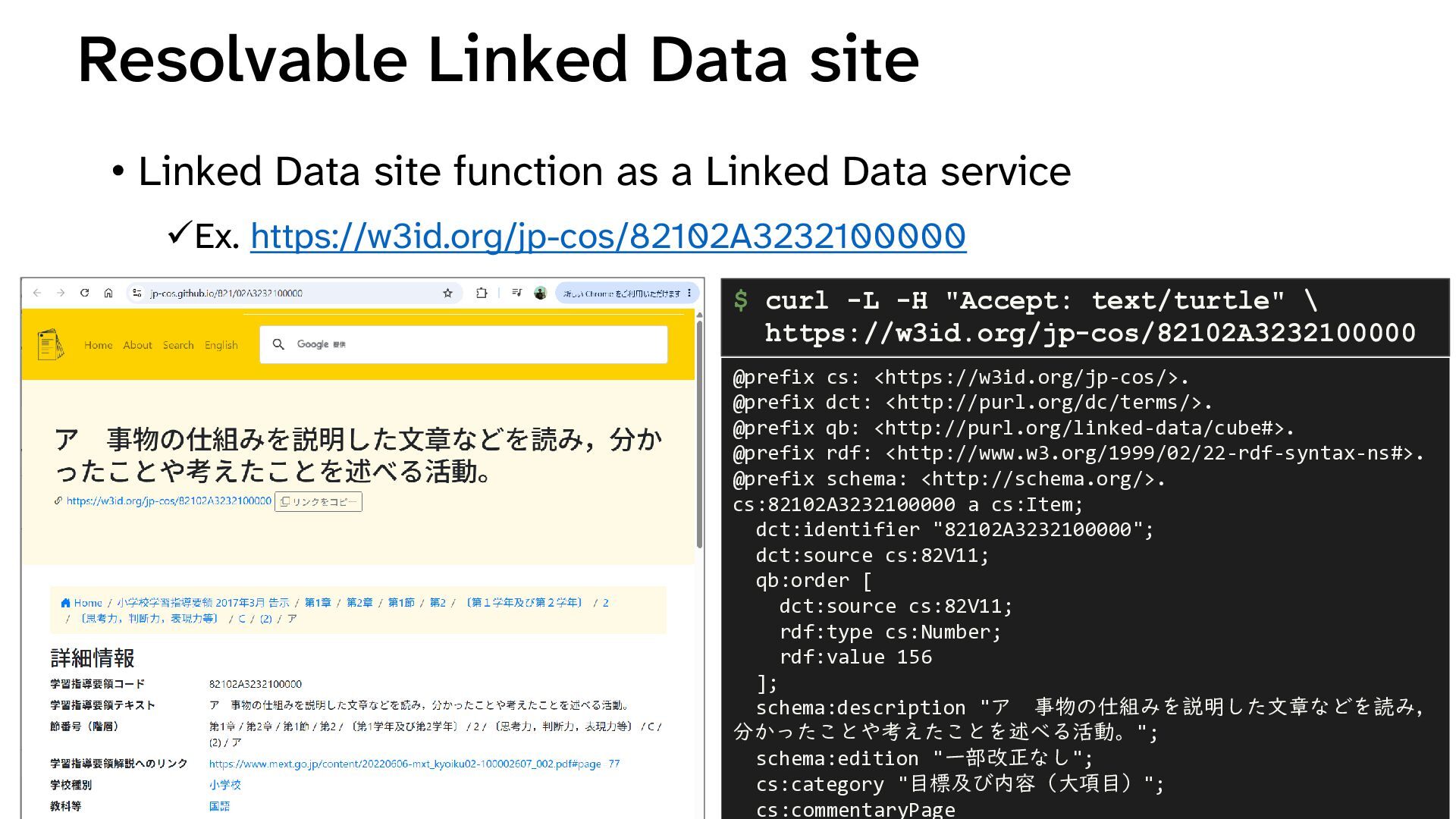
→ static file generations Generates both human-readable HTML + machineaccessible RDF • The published site mainly consists of static files Fewer server-side components and dependencies Easier for long-term maintainability 3
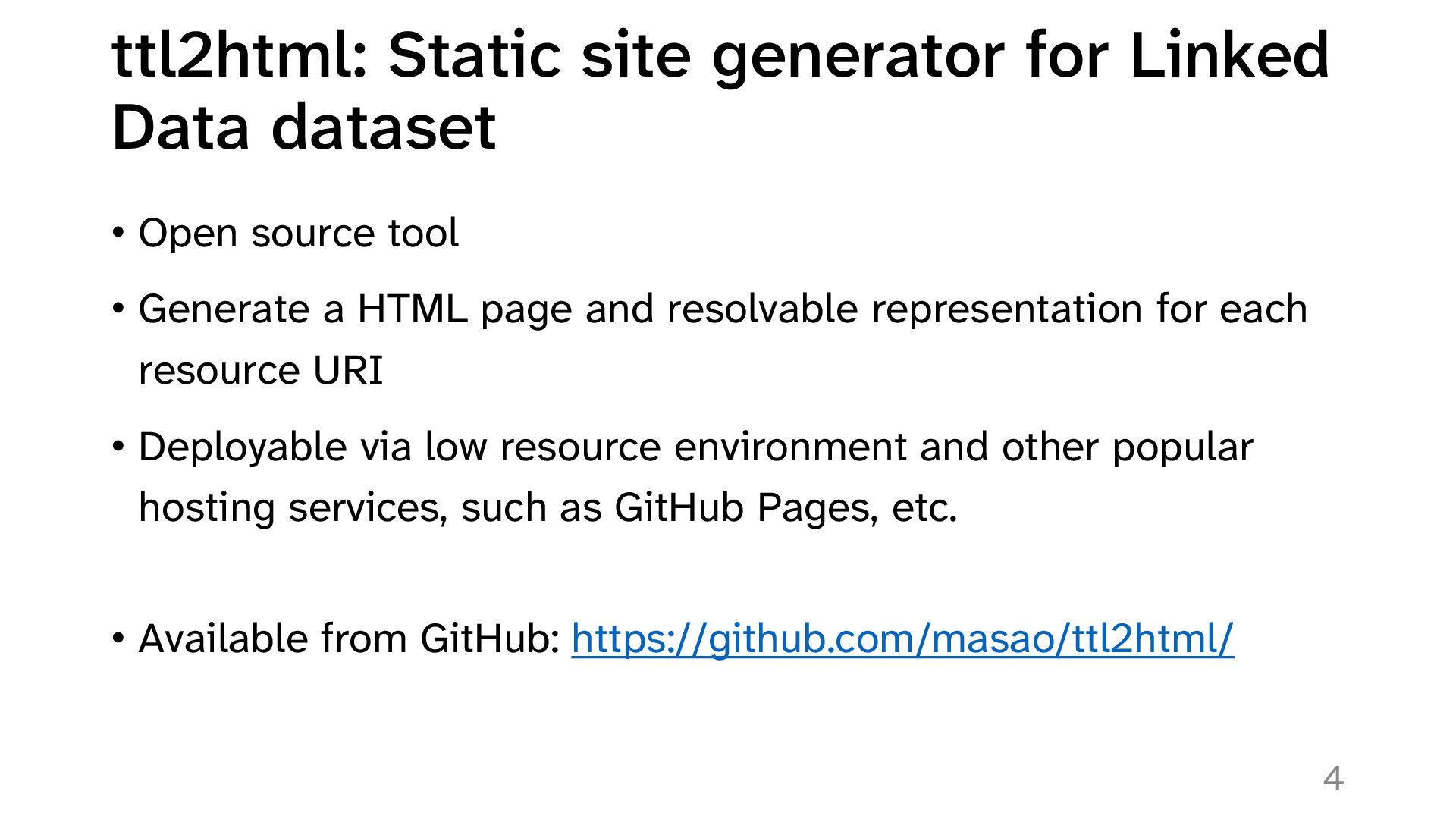
source tool • Generate a HTML page and resolvable representation for each resource URI • Deployable via low resource environment and other popular hosting services, such as GitHub Pages, etc. • Available from GitHub: https://github.com/masao/ttl2html/ 4
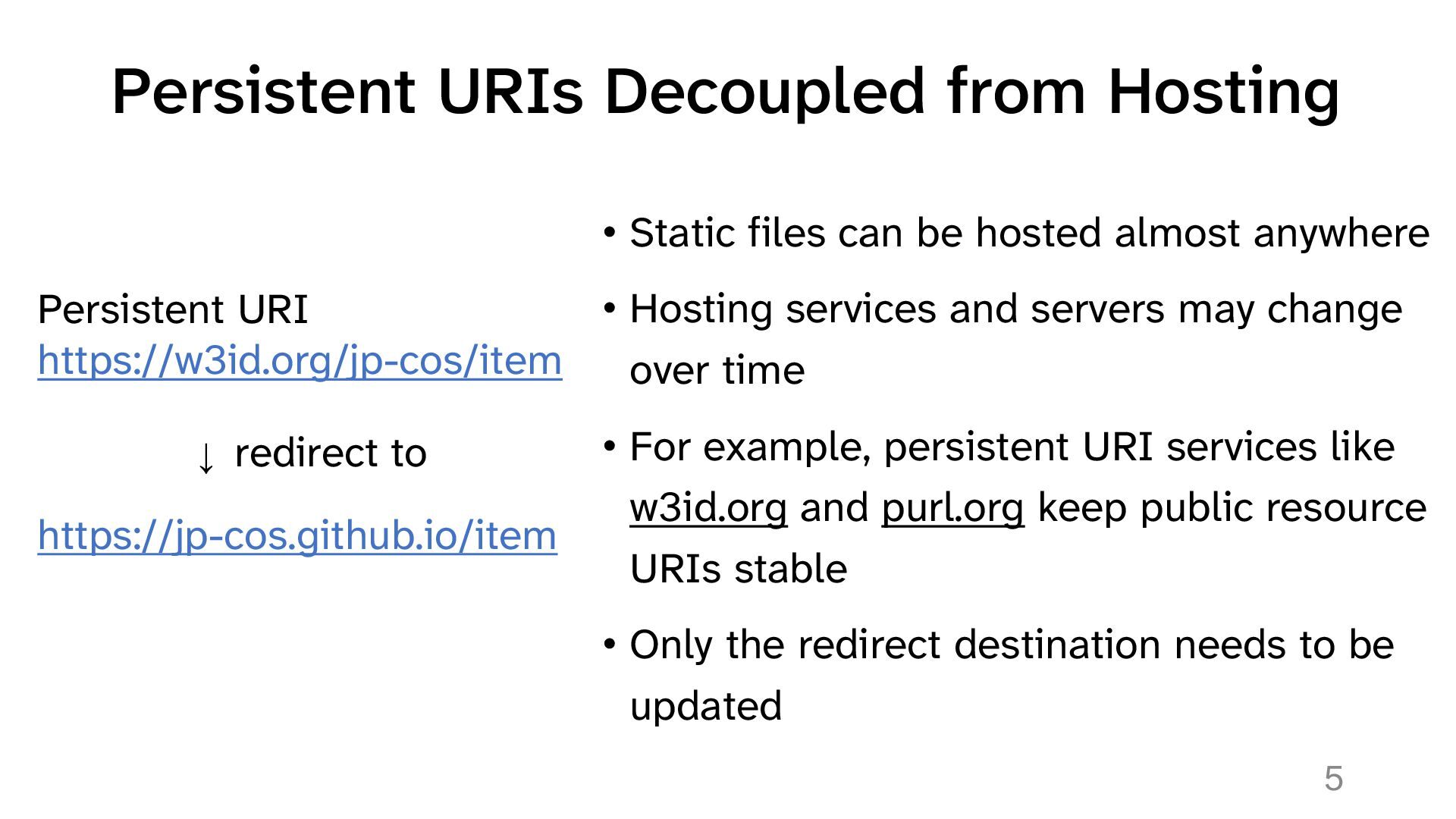
hosted almost anywhere • Hosting services and servers may change Persistent URI https://w3id.org/jp-cos/item over time ↓ redirect to https://jp-cos.github.io/item • For example, persistent URI services like w3id.org and purl.org keep public resource URIs stable • Only the redirect destination needs to be updated 5
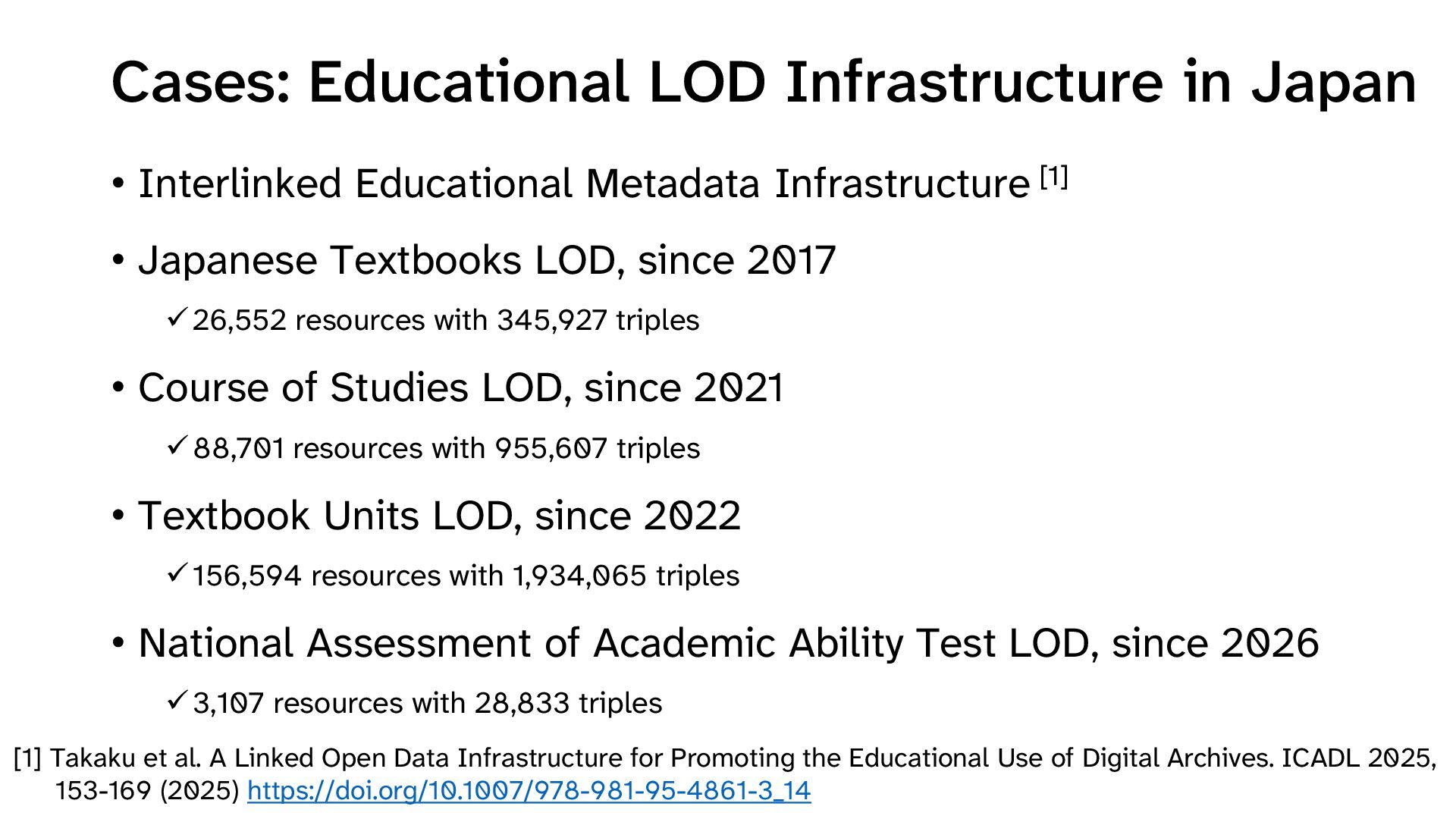
Infrastructure [1] • Japanese Textbooks LOD, since 2017 26,552 resources with 345,927 triples • Course of Studies LOD, since 2021 88,701 resources with 955,607 triples • Textbook Units LOD, since 2022 156,594 resources with 1,934,065 triples • National Assessment of Academic Ability Test LOD, since 2026 3,107 resources with 28,833 triples [1] Takaku et al. A Linked Open Data Infrastructure for Promoting the Educational Use of Digital Archives. ICADL 2025, 7 153-169 (2025) https://doi.org/10.1007/978-981-95-4861-3_14
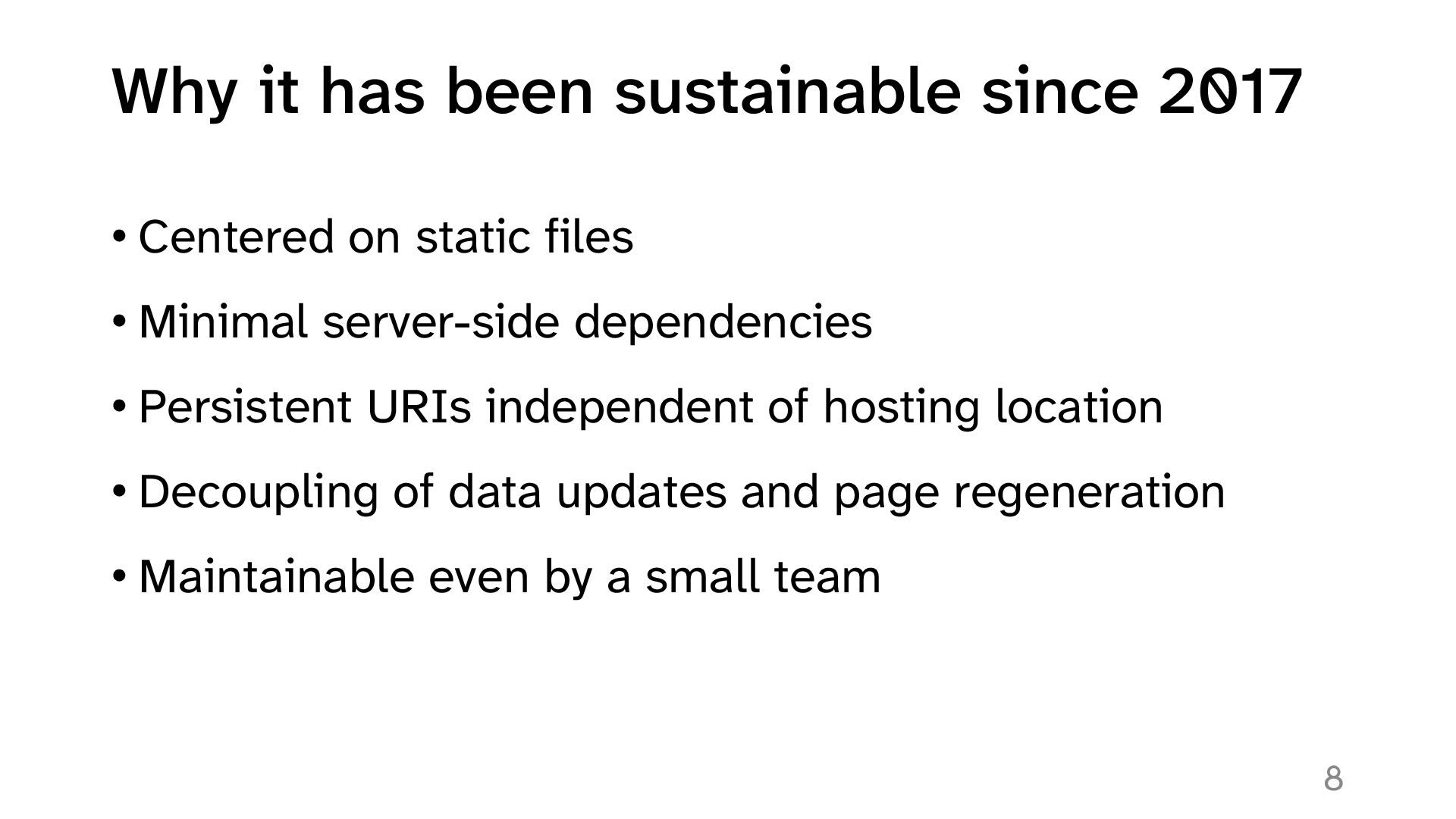
static files • Minimal server-side dependencies • Persistent URIs independent of hosting location • Decoupling of data updates and page regeneration • Maintainable even by a small team 8
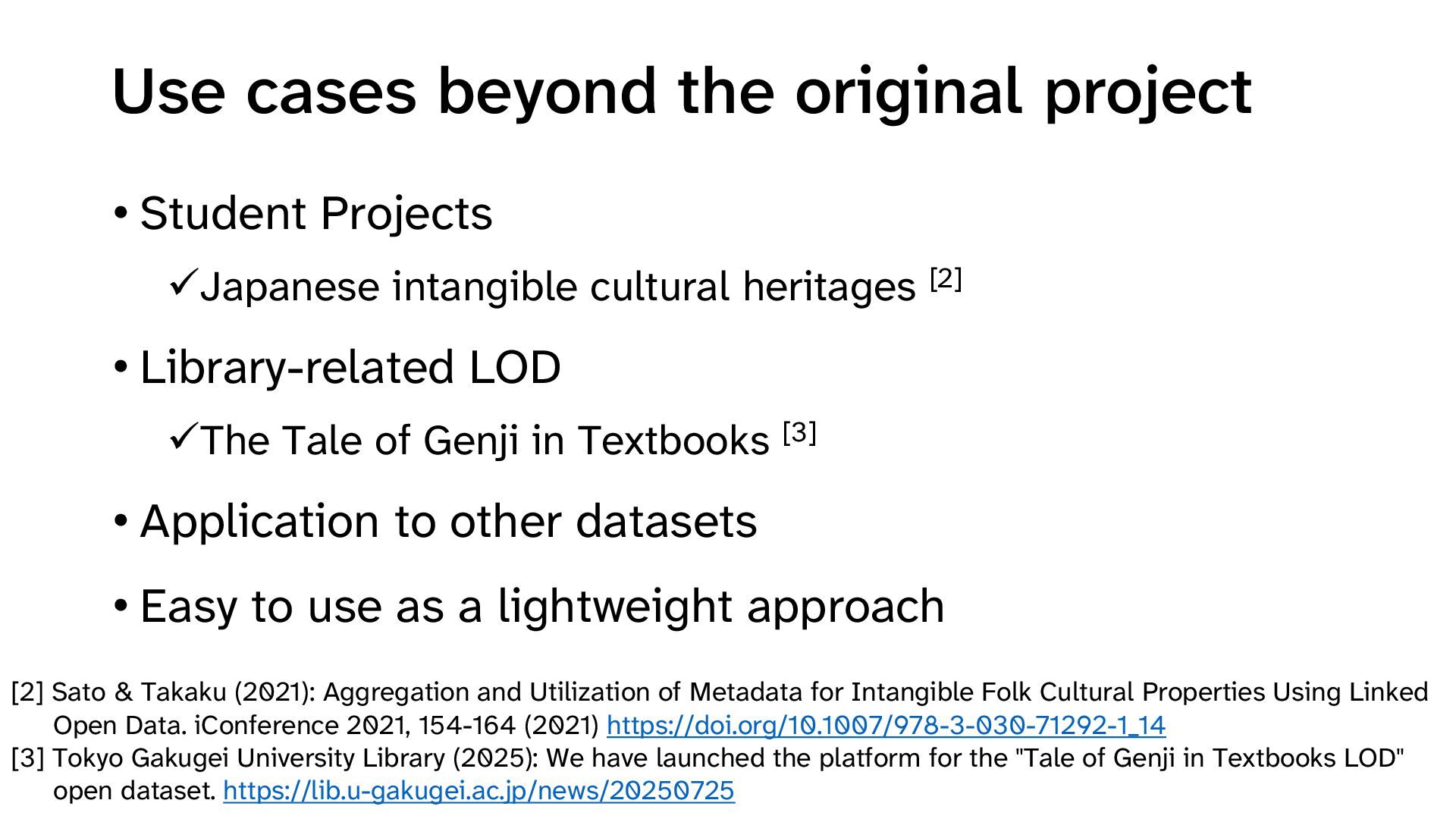
intangible cultural heritages [2] • Library-related LOD The Tale of Genji in Textbooks [3] • Application to other datasets • Easy to use as a lightweight approach [2] Sato & Takaku (2021): Aggregation and Utilization of Metadata for Intangible Folk Cultural Properties Using Linked Open Data. iConference 2021, 154-164 (2021) https://doi.org/10.1007/978-3-030-71292-1_14 [3] Tokyo Gakugei University Library (2025): We have launched the platform for the "Tale of Genji in Textbooks LOD" 9 open dataset. https://lib.u-gakugei.ac.jp/news/20250725
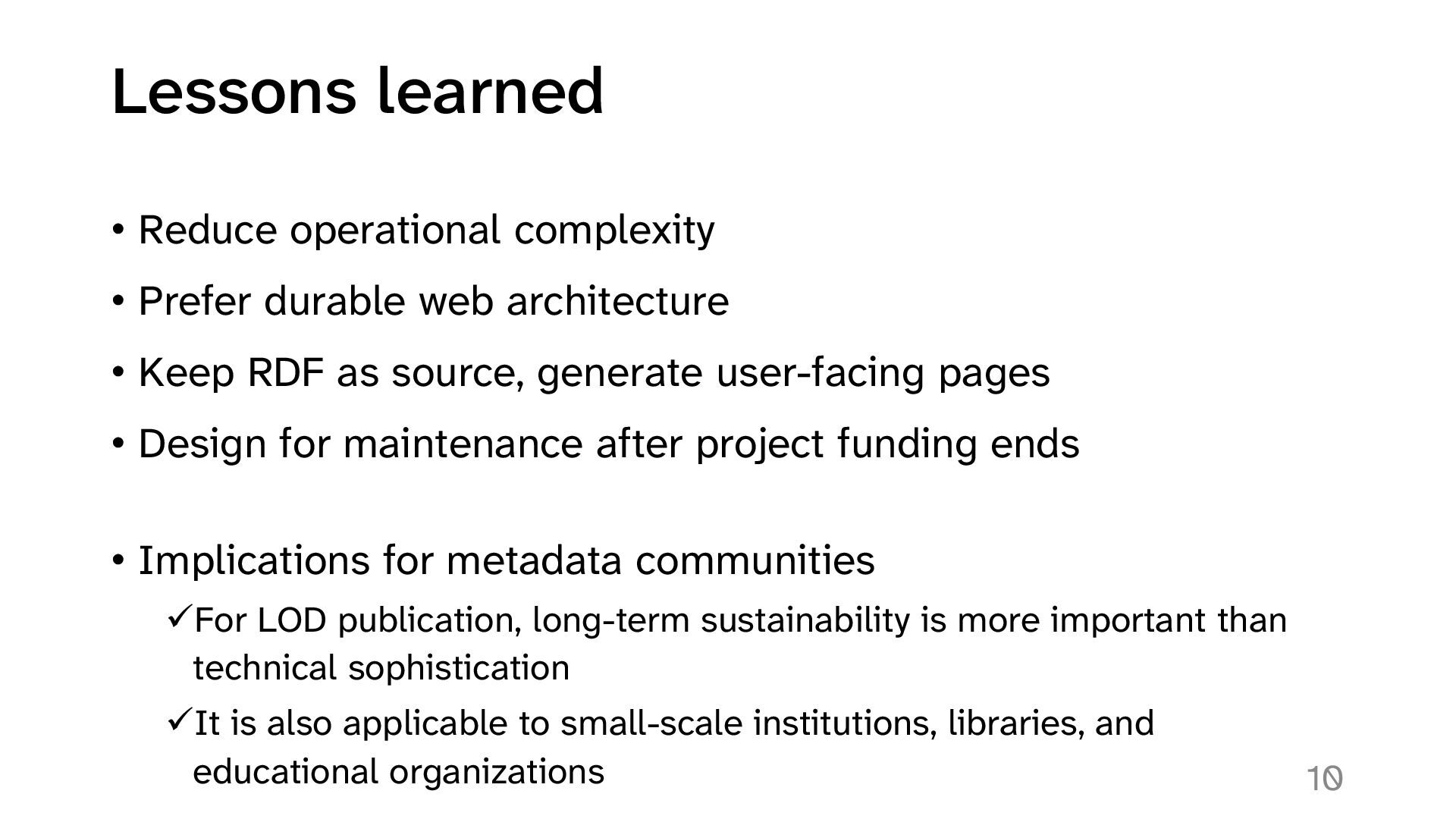
architecture • Keep RDF as source, generate user-facing pages • Design for maintenance after project funding ends • Implications for metadata communities For LOD publication, long-term sustainability is more important than technical sophistication It is also applicable to small-scale institutions, libraries, and educational organizations 10
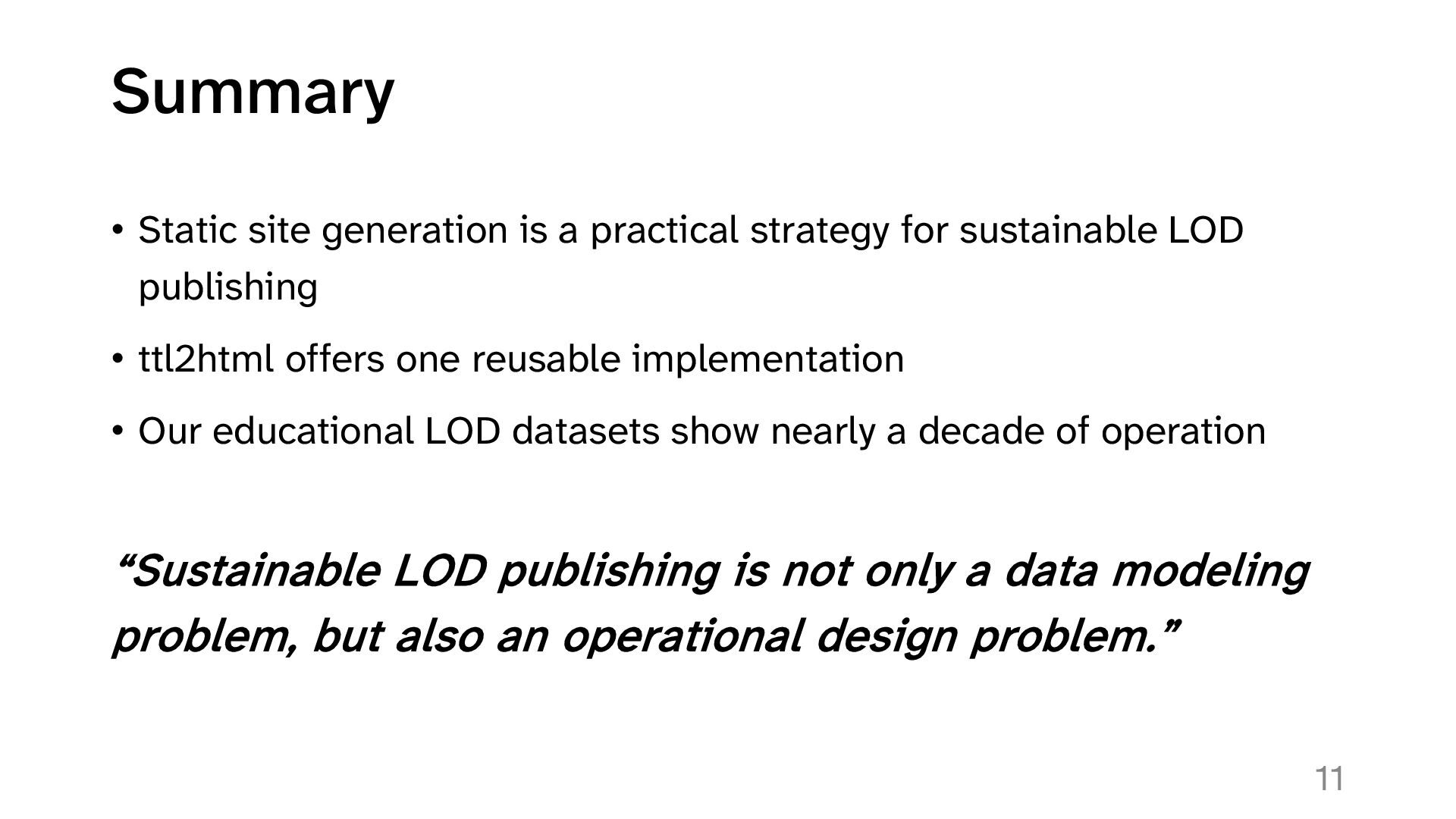
sustainable LOD publishing • ttl2html offers one reusable implementation • Our educational LOD datasets show nearly a decade of operation “Sustainable LOD publishing is not only a data modeling problem, but also an operational design problem.” 11


 masao
masao
 mikimhk
 junkashihara
 junkurihara
.png) satai
satai
 rfujii
 tomonom
 stktu
stktu
 xspa2012
 sazimai
 kanekomasahiro
 institutdelelevage
 kzmssk
 codingconduct
 retrage
 gr2m
gr2m
 ipullrank
 marcduiker
 badams
 mkilby
 lfama
lfama
 addyosmani
 kevinliebholz
 kristinabergwall1
 skoyamalab