Share
Embed
Predictive Analytics
An Introduction to Predictive Analytics, delivered at Teradata Gmbh. Munich, Germany.
Ankit Bahuguna
July 22, 2015
Transcript
44 slides
-
In the 24 hours since the launch of the Apple
Watch on 9 March, Hotwire’s social media analysis picked up 981,021 mentions of the device using the terms Apple Watch, #AppleWatch, and #AppleWatchEvent. Of these mentions, a massive 42 per cent were found to contain negative sentiment towards the devices – 58 per cent was however positive. Source: http://www.thedrum.com/news/2015/03/10/apple-watch-sees-42-negative-response-twitter-battery-life-and-price-being-main -
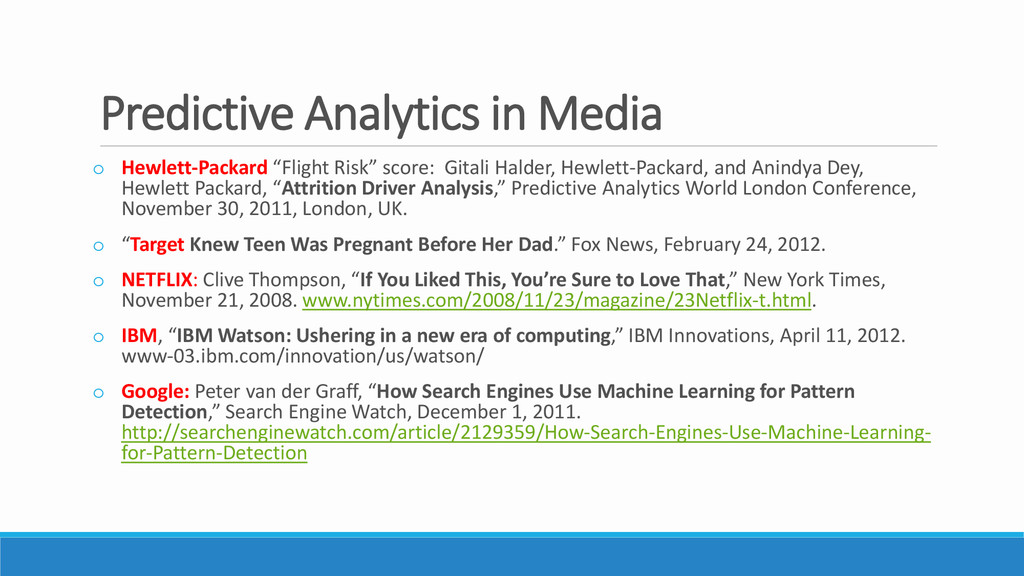
Predictive Analytics in Media o Hewlett-Packard “Flight Risk” score: Gitali
Halder, Hewlett-Packard, and Anindya Dey, Hewlett Packard, “Attrition Driver Analysis,” Predictive Analytics World London Conference, November 30, 2011, London, UK. o “Target Knew Teen Was Pregnant Before Her Dad.” Fox News, February 24, 2012. o NETFLIX: Clive Thompson, “If You Liked This, You’re Sure to Love That,” New York Times, November 21, 2008. www.nytimes.com/2008/11/23/magazine/23Netflix-t.html. o IBM, “IBM Watson: Ushering in a new era of computing,” IBM Innovations, April 11, 2012. www-03.ibm.com/innovation/us/watson/ o Google: Peter van der Graff, “How Search Engines Use Machine Learning for Pattern Detection,” Search Engine Watch, December 1, 2011. http://searchenginewatch.com/article/2129359/How-Search-Engines-Use-Machine-Learning- for-Pattern-Detection -
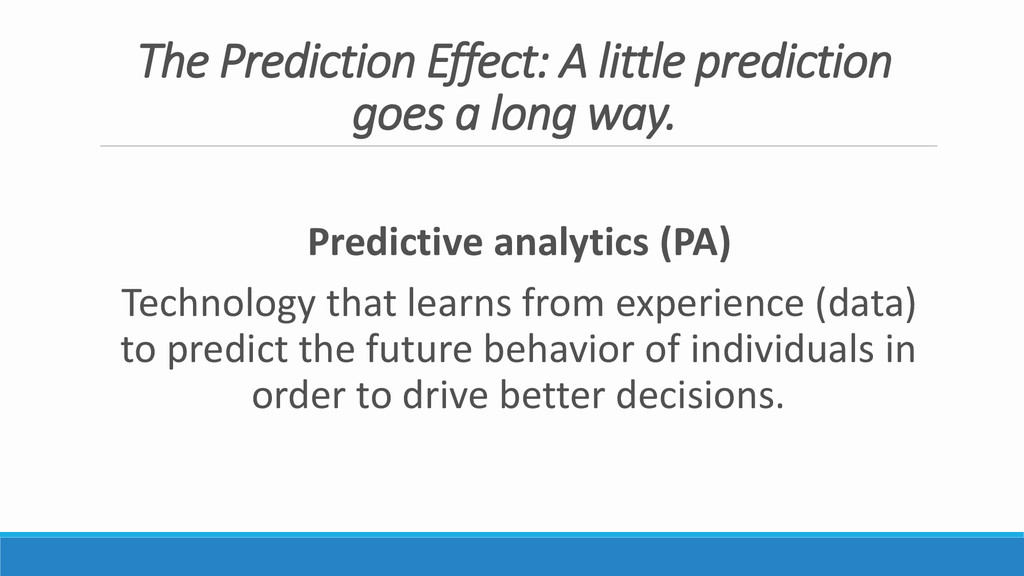
The Prediction Effect: A little prediction goes a long way.
Predictive analytics (PA) Technology that learns from experience (data) to predict the future behavior of individuals in order to drive better decisions. -
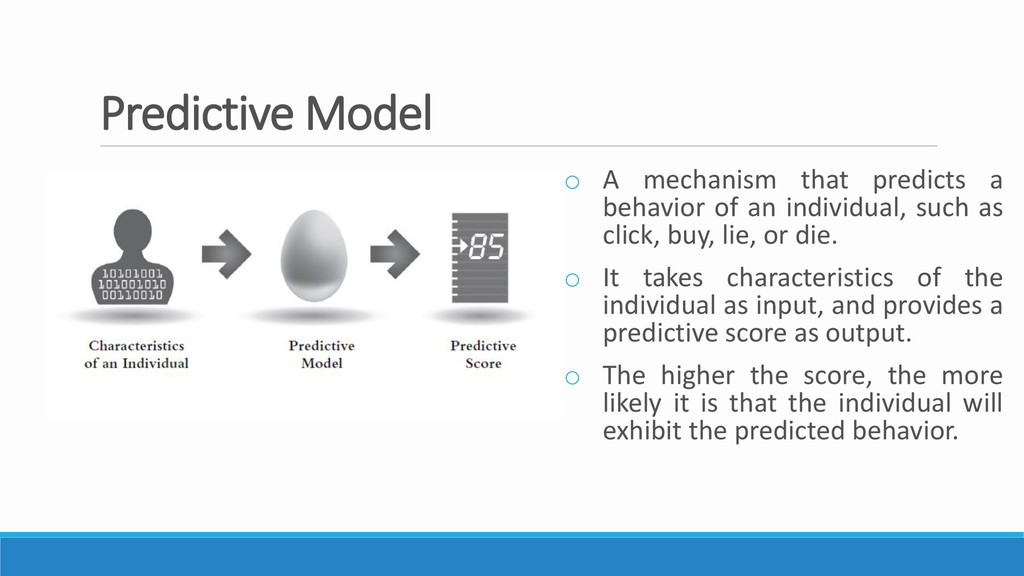
Predictive Model o A mechanism that predicts a behavior of
an individual, such as click, buy, lie, or die. o It takes characteristics of the individual as input, and provides a predictive score as output. o The higher the score, the more likely it is that the individual will exhibit the predicted behavior. -
PA APPLICATION: TARGETING DIRECT MARKETING What’s predicted: Which customers will
respond to marketing contact. What’s done about it: Contact customers more likely to respond. -
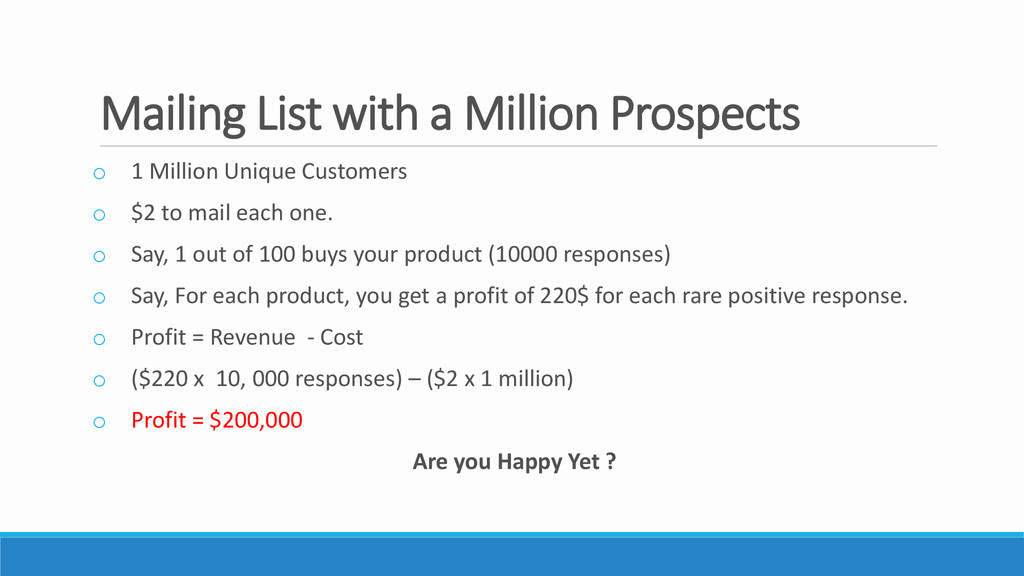
Mailing List with a Million Prospects o 1 Million Unique
Customers o $2 to mail each one. o Say, 1 out of 100 buys your product (10000 responses) o Say, For each product, you get a profit of 220$ for each rare positive response. o Profit = Revenue - Cost o ($220 x 10, 000 responses) – ($2 x 1 million) o Profit = $200,000 Are you Happy Yet ? -
PA Gives: Most Likely Responders o It earmarks a quarter
of entire list o Says “These folks are three times more likely to respond than average!” o Now, you have a short list of 250,000 customers of which 3 percent will respond—7,500 responses. o But again 3% Confidence of Response ? o Let’s do some math again! -
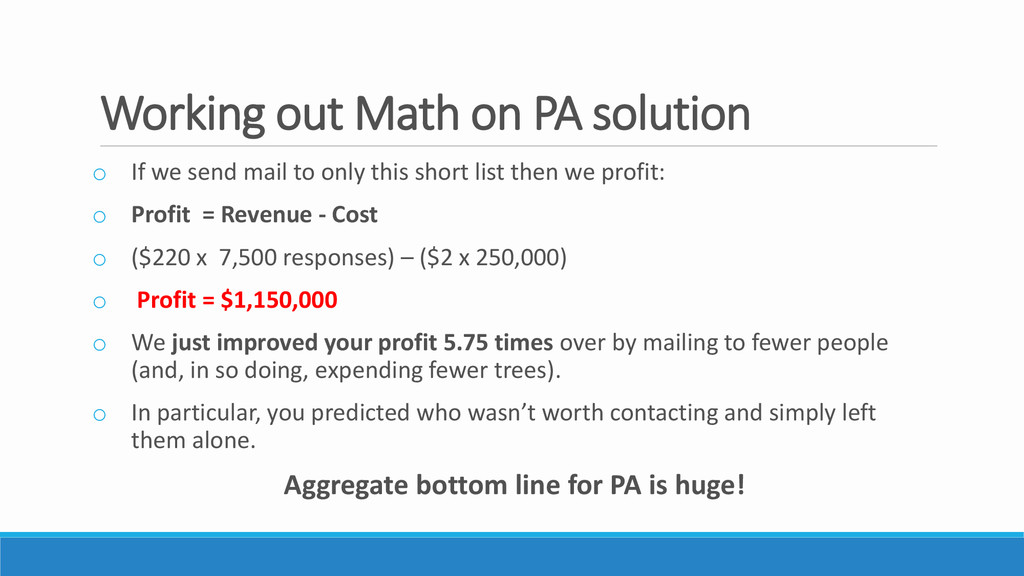
Working out Math on PA solution o If we send
mail to only this short list then we profit: o Profit = Revenue - Cost o ($220 x 7,500 responses) – ($2 x 250,000) o Profit = $1,150,000 o We just improved your profit 5.75 times over by mailing to fewer people (and, in so doing, expending fewer trees). o In particular, you predicted who wasn’t worth contacting and simply left them alone. Aggregate bottom line for PA is huge! -
PA Application: PREDICTIVE ADVERTISEMENT TARGETING What’s predicted: Which ad each
customer is most likely to click. What’s done about it: Display the best ad (based on the likelihood of a click as well as the bounty paid by its sponsor. -
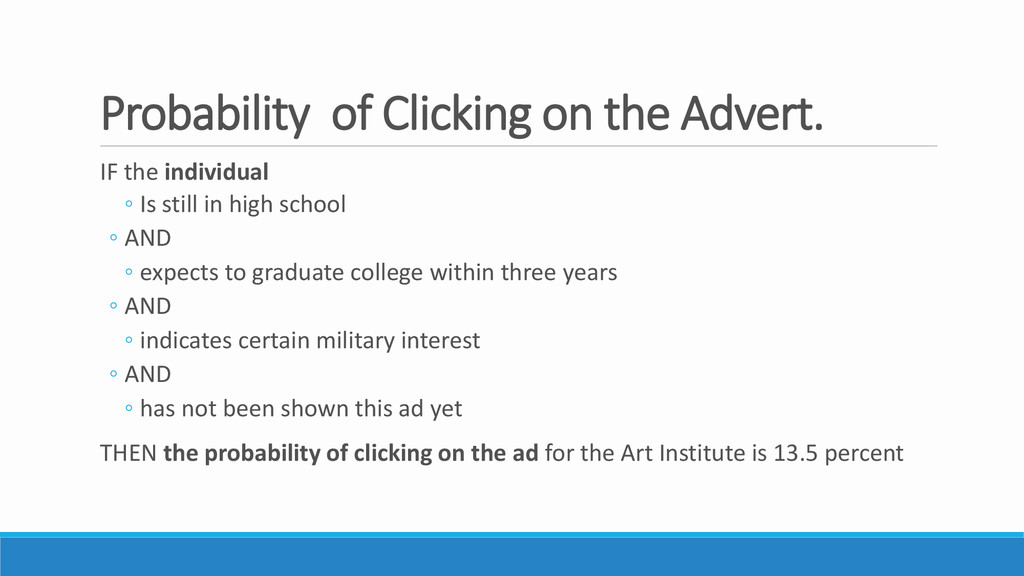
Probability of Clicking on the Advert. IF the individual ◦
Is still in high school ◦ AND ◦ expects to graduate college within three years ◦ AND ◦ indicates certain military interest ◦ AND ◦ has not been shown this ad yet THEN the probability of clicking on the ad for the Art Institute is 13.5 percent -
PA APPLICATION: BLACK BOX TRADING What’s predicted: Whether a stock
will go up or down. What’s done about it: Buy stocks that will go up; sell those that will go down. Several Pointers and Strategies: One of them is financial Sentiment Analysis, which we cover later. -
Machine Learning: Classification In classification, we use an object's characteristics
to identify which class (or group) it belongs to. Source: Wikipedia -
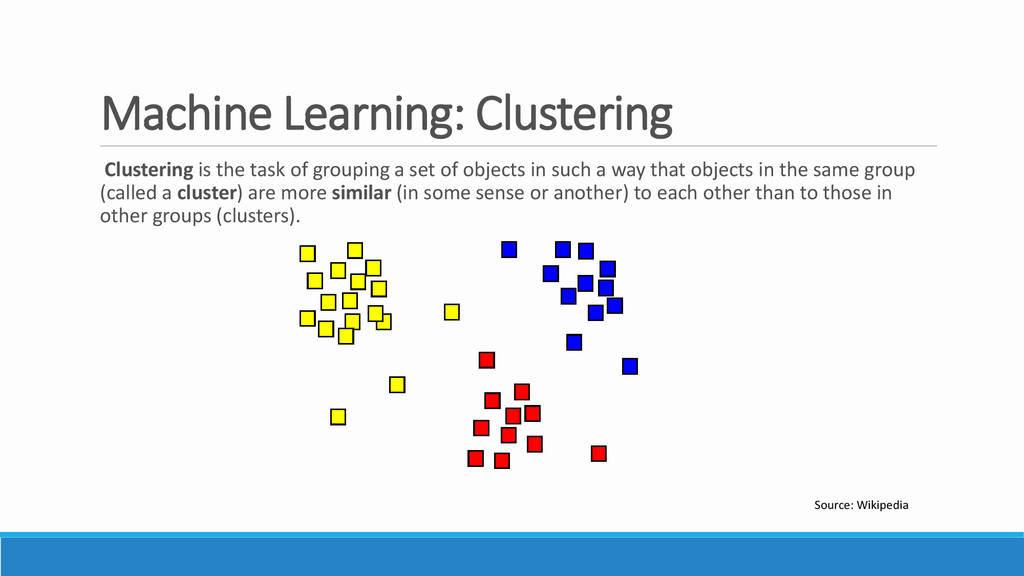
Machine Learning: Clustering Clustering is the task of grouping a
set of objects in such a way that objects in the same group (called a cluster) are more similar (in some sense or another) to each other than to those in other groups (clusters). Source: Wikipedia -
Machine Learning: Supervised vs Unsupervised Supervised learning is the machine
learning task of inferring a function from labeled training data TRAINING DATA: LABELED DATA whereas, The problem of unsupervised learning is that of trying to find hidden structure in unlabeled data. TRAINING DATA: UNLABELED DATA -
Reviews – What do the people say? Valar Morghulis! (All
men must die) Valar Dohaeris! (All men must serve) Love this series! Great actors and I love the characters. I am always on pins and needles waiting for each new season of this show! I think this is a fantastic series. Although the fourth year was not as exciting to me as the first three, I still look forward to seasons 5 and 6. I felt this season was not the strongest of the series. Love the series, a little disappointed that it will have to end one day! -
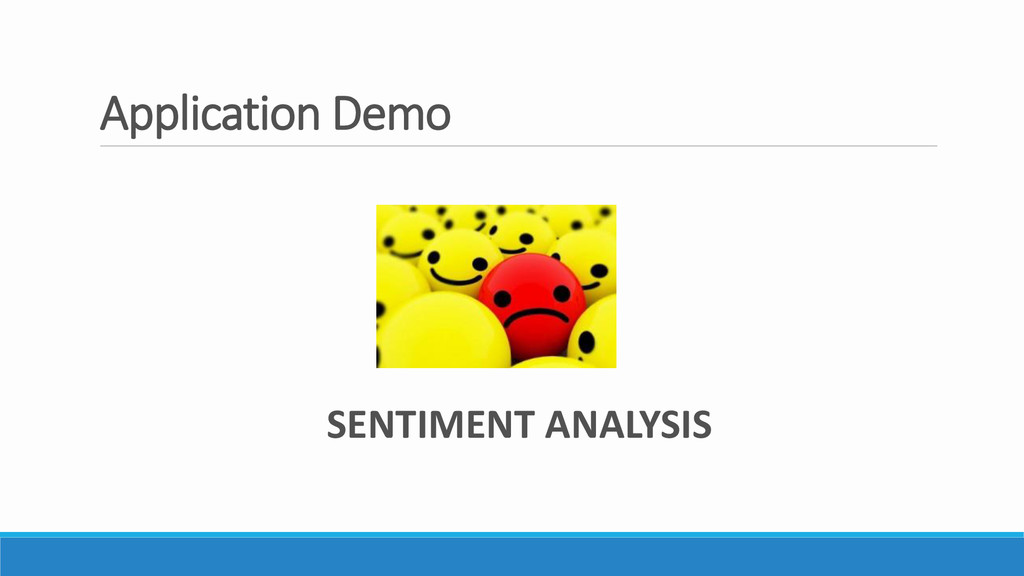
Sentiment Analysis A basic task in sentiment analysis is classifying
the polarity of a given text at the document, sentence, or feature/ aspect level. Whether the expressed opinion in a document, a sentence or an entity feature/ aspect is positive, negative, or neutral. “Beyond polarity" sentiment classification looks at emotional states such as "angry," "sad," and "happy." -
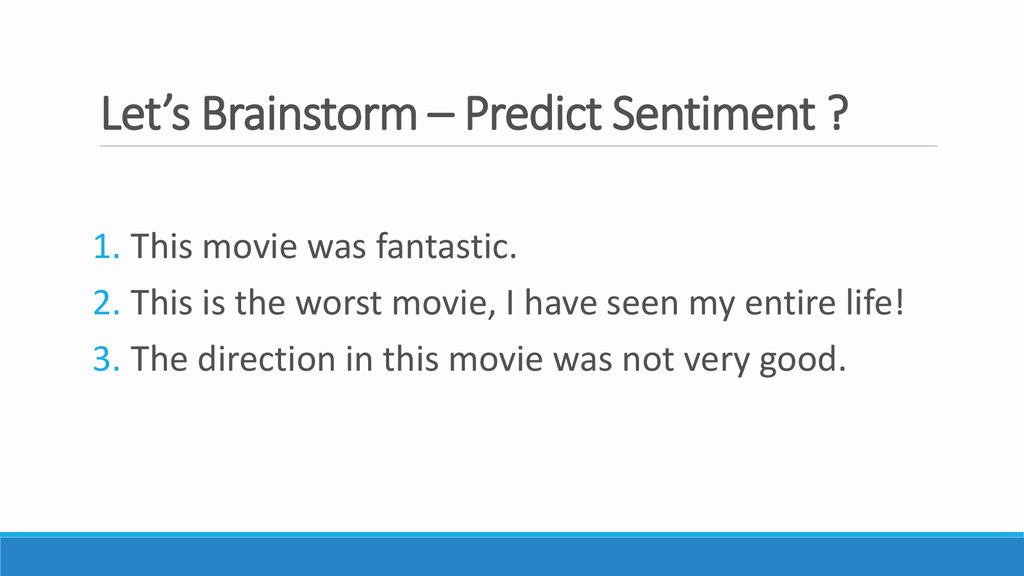
Let’s Brainstorm – Predict Sentiment ? 1. This movie was
fantastic. 2. This is the worst movie, I have seen my entire life! 3. The direction in this movie was not very good. -
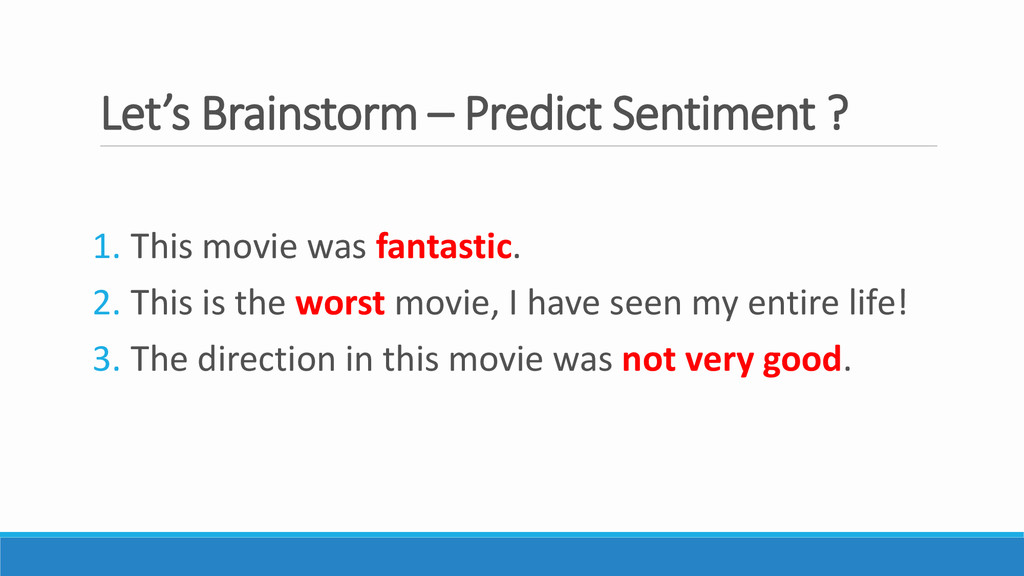
Let’s Brainstorm – Predict Sentiment ? 1. This movie was
fantastic. 2. This is the worst movie, I have seen my entire life! 3. The direction in this movie was not very good. -
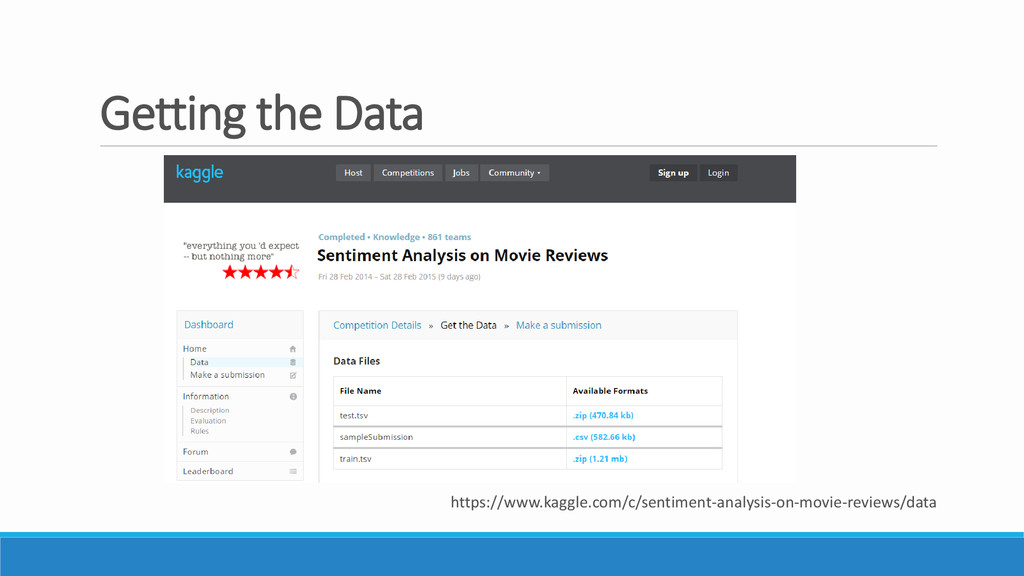
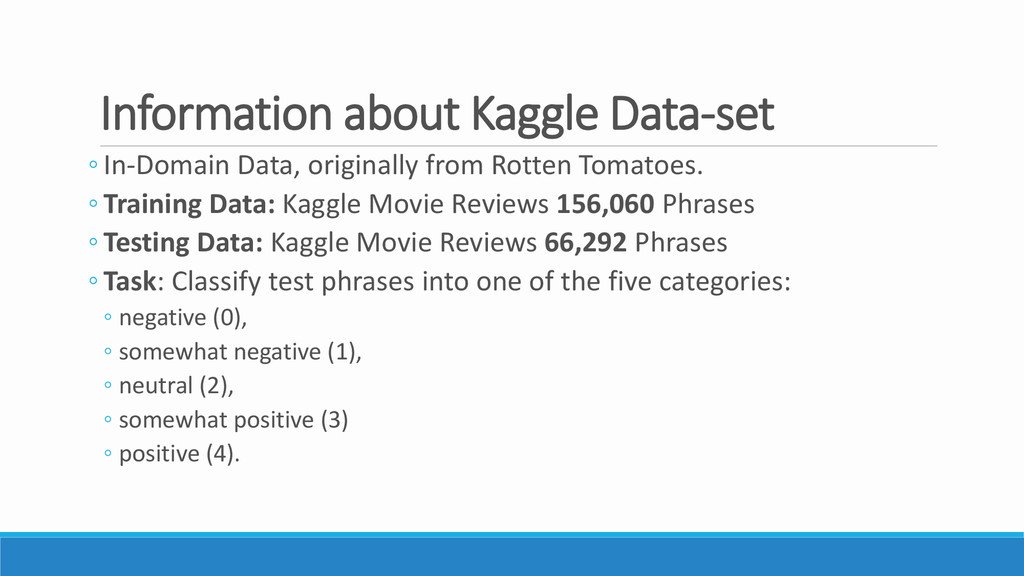
Information about Kaggle Data-set ◦ In-Domain Data, originally from Rotten
Tomatoes. ◦ Training Data: Kaggle Movie Reviews 156,060 Phrases ◦ Testing Data: Kaggle Movie Reviews 66,292 Phrases ◦ Task: Classify test phrases into one of the five categories: ◦ negative (0), ◦ somewhat negative (1), ◦ neutral (2), ◦ somewhat positive (3) ◦ positive (4). -
Data Format – Tab Separated Values Input Training Data PhraseId
SentenceId Phrase Sentiment 64 2 This quiet , introspective and entertaining independent is worth seeking . 4 Input Testing Data PhraseId SentenceId Phrase 156250 8550 All ends well , sort of , but the frenzied comic moments never click . Output – Analyzed Test Data (Comma Separated) PhraseId,Sentiment 156061,2 -
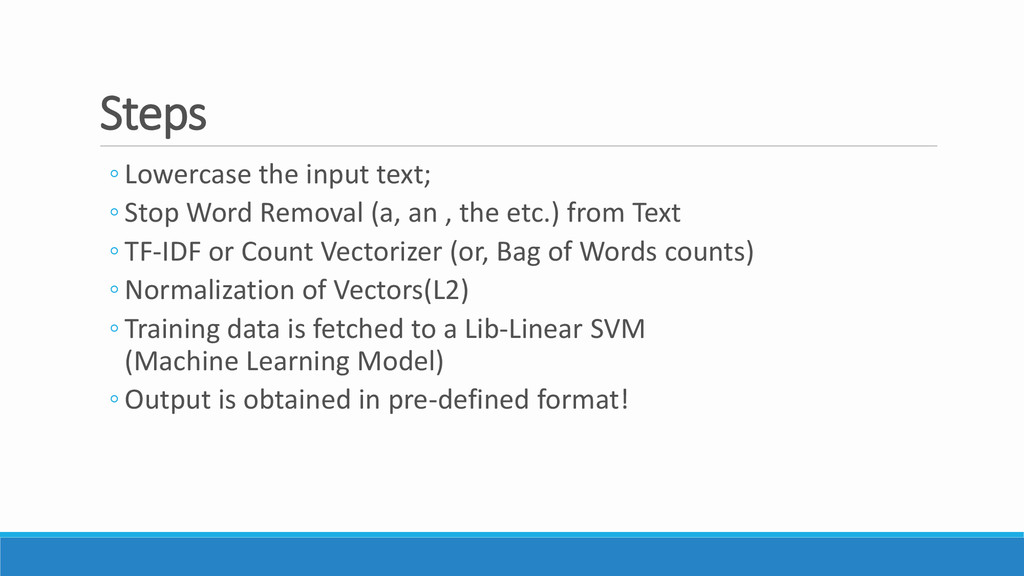
Steps ◦ Lowercase the input text; ◦ Stop Word Removal
(a, an , the etc.) from Text ◦ TF-IDF or Count Vectorizer (or, Bag of Words counts) ◦ Normalization of Vectors(L2) ◦ Training data is fetched to a Lib-Linear SVM (Machine Learning Model) ◦ Output is obtained in pre-defined format! -
Representation: Bag of Words In this model, a text (such
as a sentence or a document) is represented as the bag (multi-set) of its words, disregarding grammar and even word order but keeping multiplicity. Example: D1: John likes to watch movies. Mary likes movies too. D2: John also likes to watch football games. Vocabulary {Word : Index} { "John": 1, "likes": 2, "to": 3, "watch": 4, "movies": 5, "also": 6, "football": 7, "games": 8, "Mary": 9, "too": 10 } There are 10 distinct words and using the indexes of the Vocabulary , each document is represented by a 10-entry vector: [1, 2, 1, 1, 2, 0, 0, 0, 1, 1] [1, 1, 1, 1, 0, 1, 1, 1, 0, 0] Note: Scikit-Learn has direct support this vector representation using a CountVectorizer. Similarly support is available for TF-IDF too. -
Recursive Neural Tensor Networks A new composition function ‘p’ was
introduced in a new compositional model called the RNTN, along with a new sentiment tree-bank, which allows training and evaluation with compositional information. More expressive than any other recursive neural network so far! Idea: Allow more interaction of Vectors. Image Courtesy: Socher et al. 2013 EMNLP -
Conclusion o Important to understand: “Data is always predictive!” o
In real world data science, no single model fits all problems, so one needs to constantly learn about new techniques. o Real world data is notorious and one constantly faces new challenges to handle new problems. o “With more power comes more responsibility”. o The Prediction Effect: A little prediction goes a long way. -
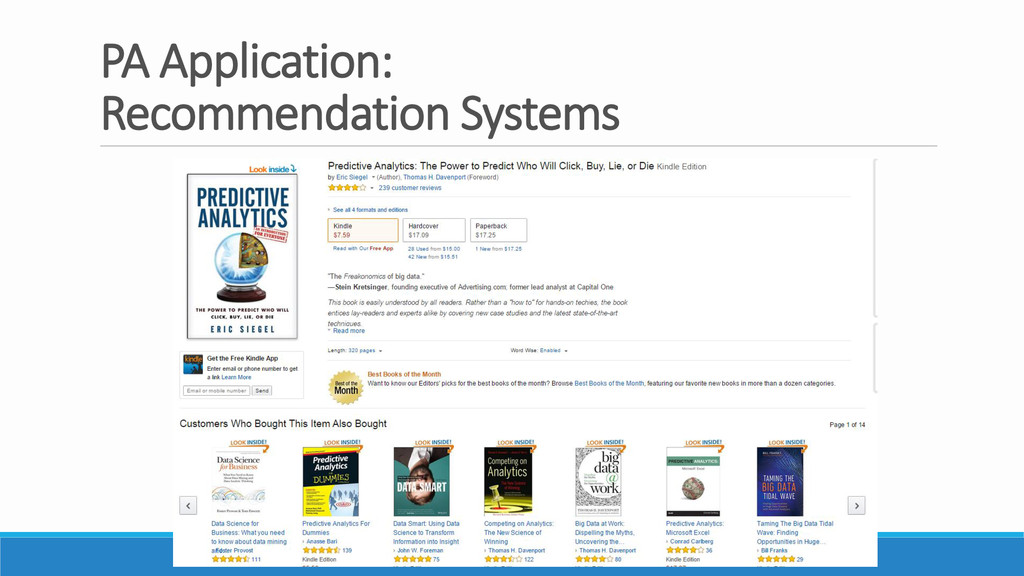
Predictive Analytics – Eric Siegel “The power to predict who
will click, buy, lie or die.” -
Links and References Yongzheng Zhang, Dan Shen and Catherine Baudin
Sentiment Analysis in Practice, Tutorial delivered at ICDM 2011 Scikit Learn Supervised Learning: http://scikit- learn.org/stable/supervised_learning.html#supervised-learning Scikit Learn Working with Text - http://scikit- learn.org/stable/tutorial/text_analytics/working_with_text_data.html Andrew Ng’s Machine Learning Course: https://www.coursera.org/course/ml Manning and Jurafsky, Natural Language Processing Course https://www.coursera.org/course/nlp Learning Scikit-Learn: Machine Learning in Python http://www.amazon.com/Learning-scikit- learn-Machine-Python/dp/1783281936