architecture A for architecture B. • Used when architecture B is not suitable for developing because: ‒ Slow CPU ‒ Low memory & storage ‒ Convenience: Can't be used as developer workstation ‒ Hardware device not available (yet)
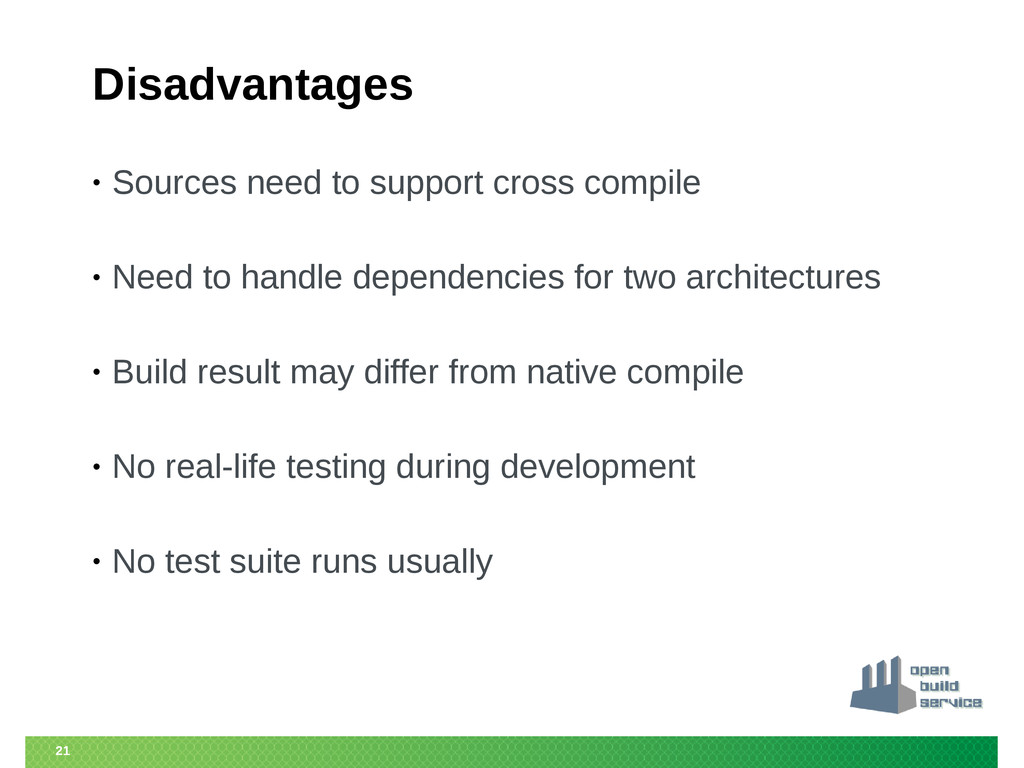
Need to handle dependencies for two architectures • Build result may differ from native compile • No real-life testing during development • No test suite runs usually
usually too slow and not flexible enough. • User land emulation using Qemu: ‒ Install qemu-$ARCH binary for running emulated binaries ‒ Register $ARCH binaries to be handled via qemu-$ARCH binary. The OBS build script can do this during VM setup.
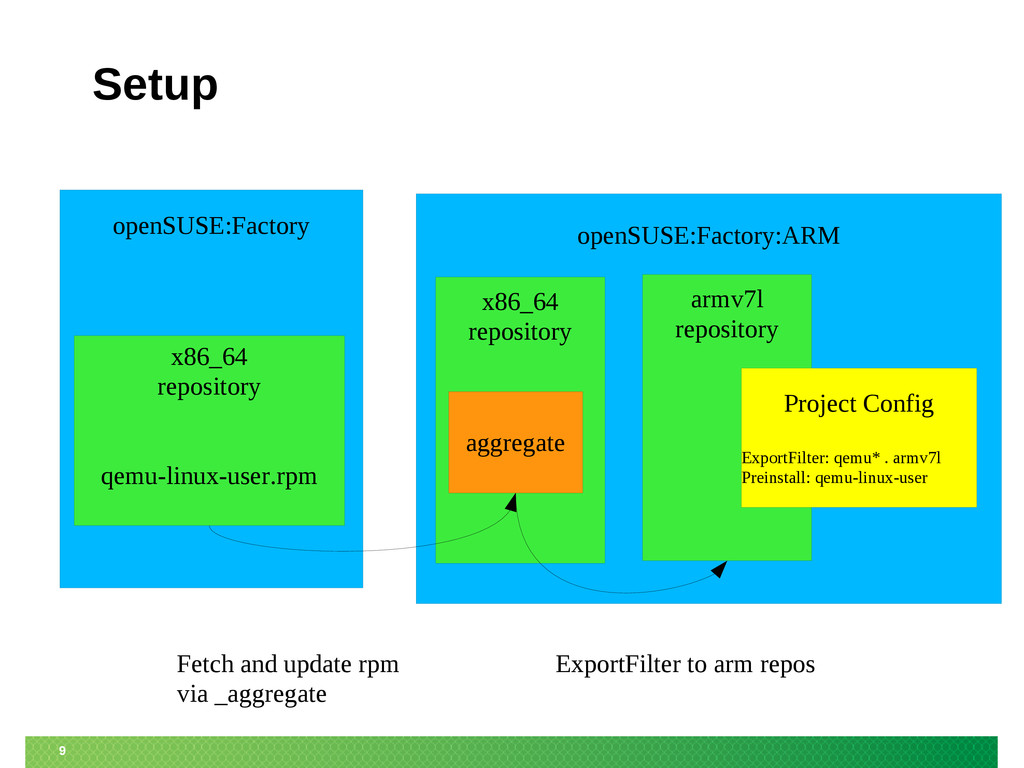
armv7l repository Fetch and update rpm via _aggregate ExportFilter to arm repos Project Config ExportFilter: qemu* . armv7l Preinstall: qemu-linux-user
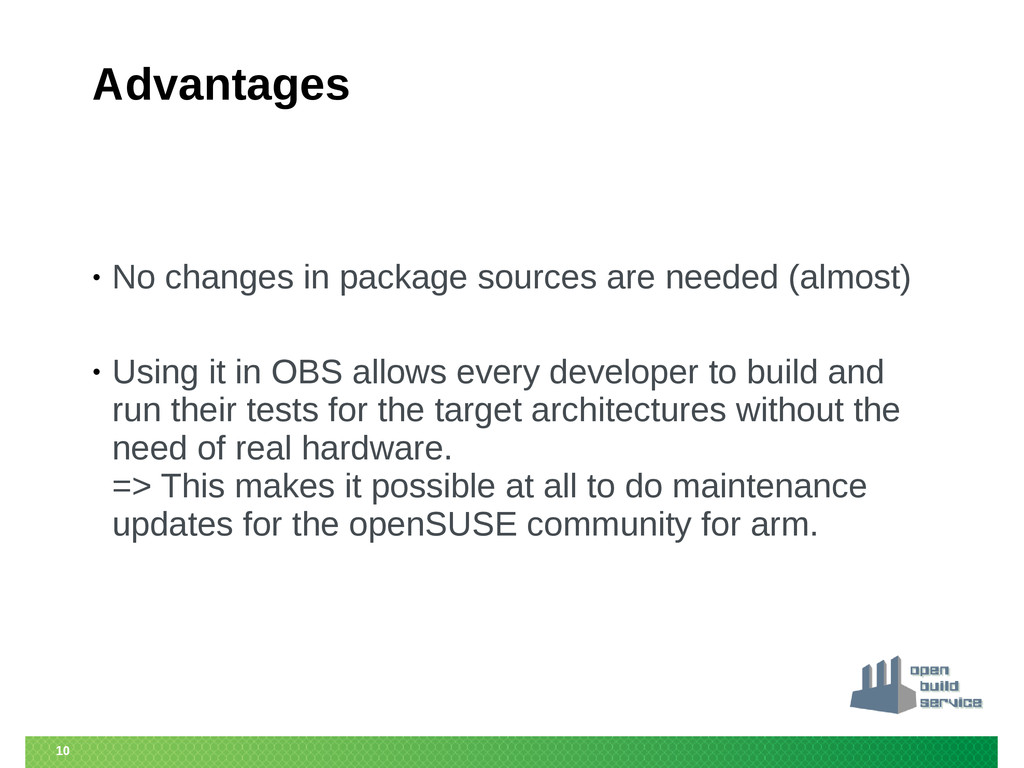
(almost) • Using it in OBS allows every developer to build and run their tests for the target architectures without the need of real hardware. => This makes it possible at all to do maintenance updates for the openSUSE community for arm.
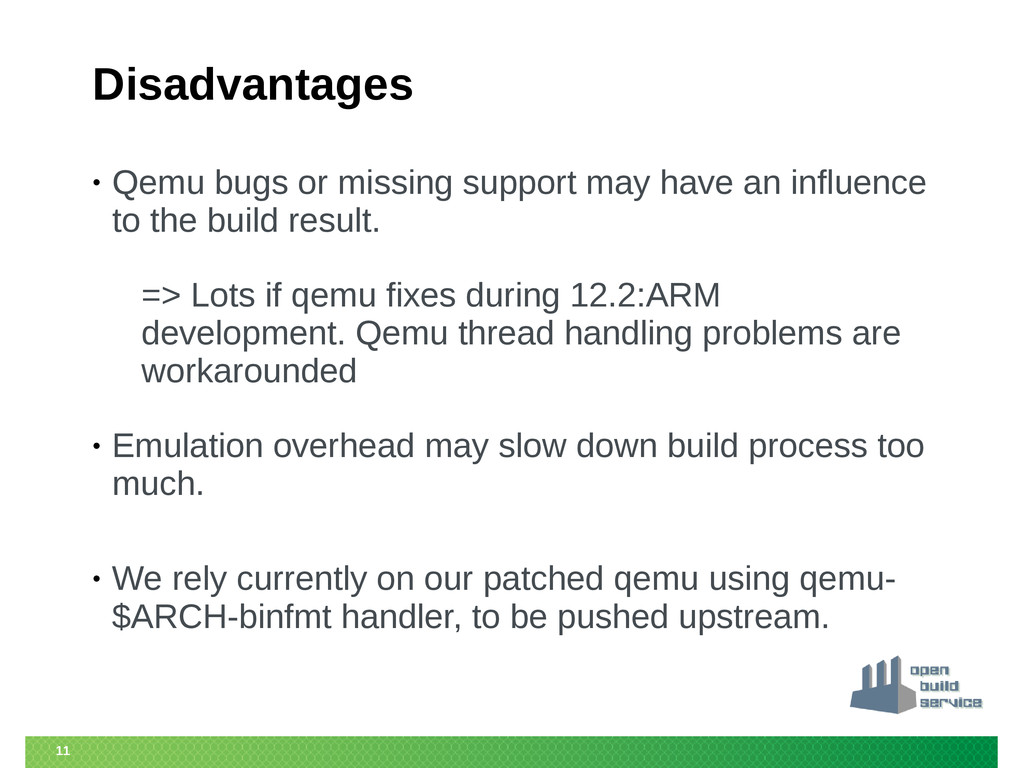
an influence to the build result. => Lots if qemu fixes during 12.2:ARM development. Qemu thread handling problems are workarounded • Emulation overhead may slow down build process too much. • We rely currently on our patched qemu using qemu- $ARCH-binfmt handler, to be pushed upstream.
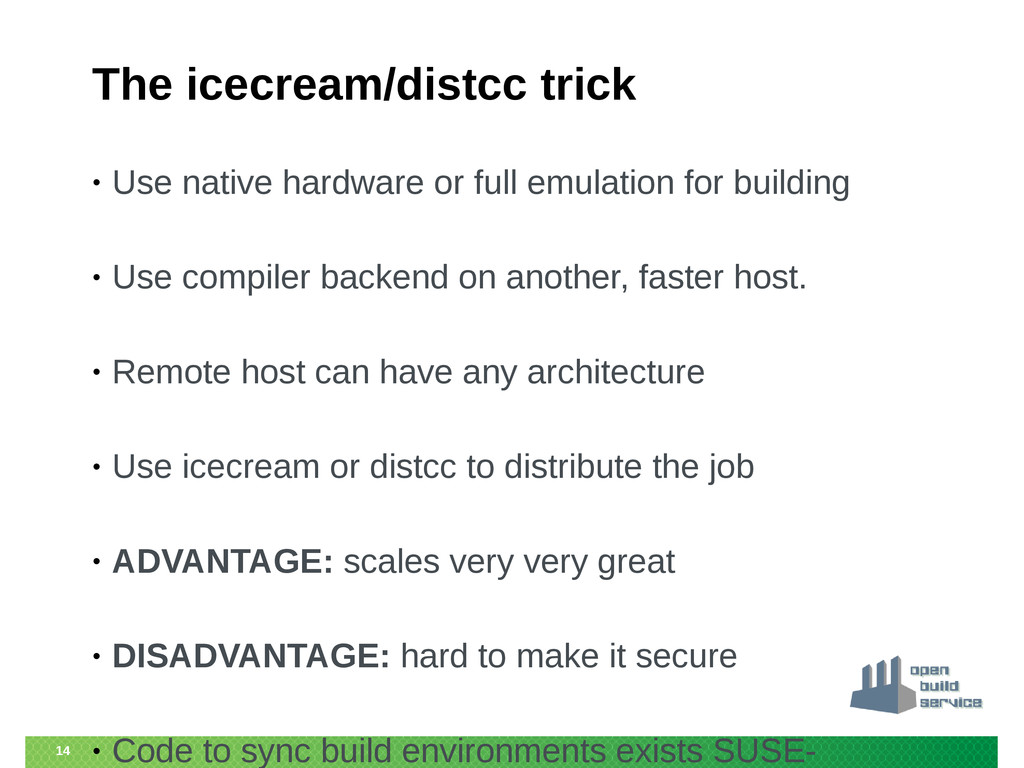
emulation for building • Use compiler backend on another, faster host. • Remote host can have any architecture • Use icecream or distcc to distribute the job • ADVANTAGE: scales very very great • DISADVANTAGE: hard to make it secure • Code to sync build environments exists SUSE-
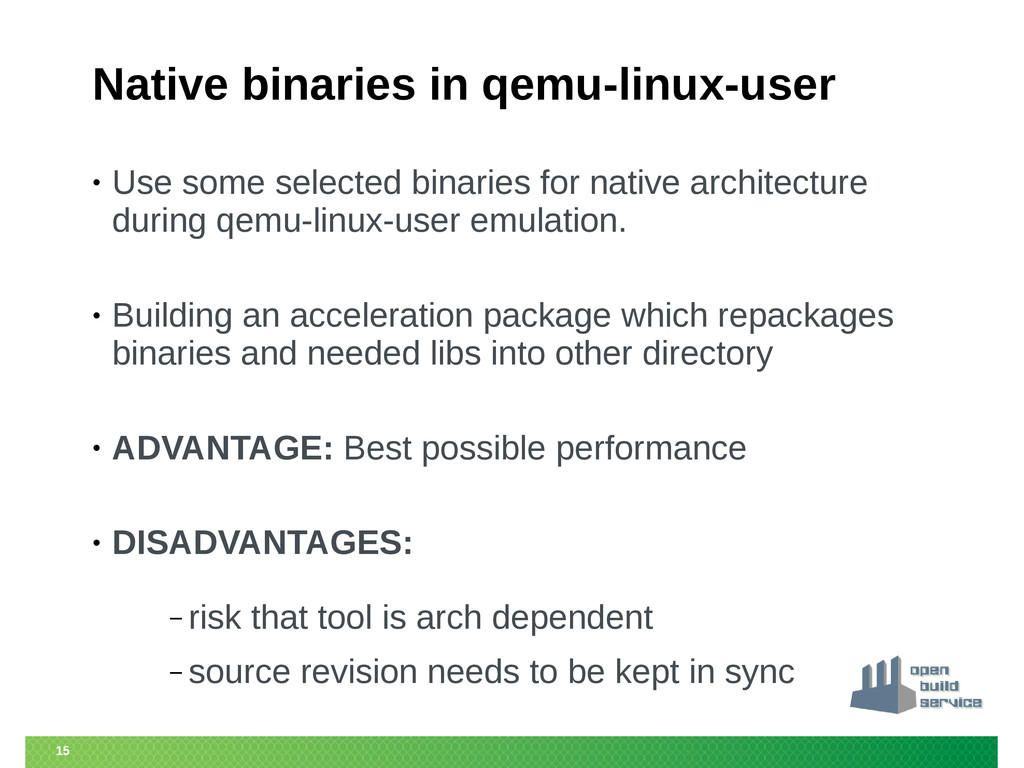
for native architecture during qemu-linux-user emulation. • Building an acceleration package which repackages binaries and needed libs into other directory • ADVANTAGE: Best possible performance • DISADVANTAGES: ‒ risk that tool is arch dependent ‒ source revision needs to be kept in sync
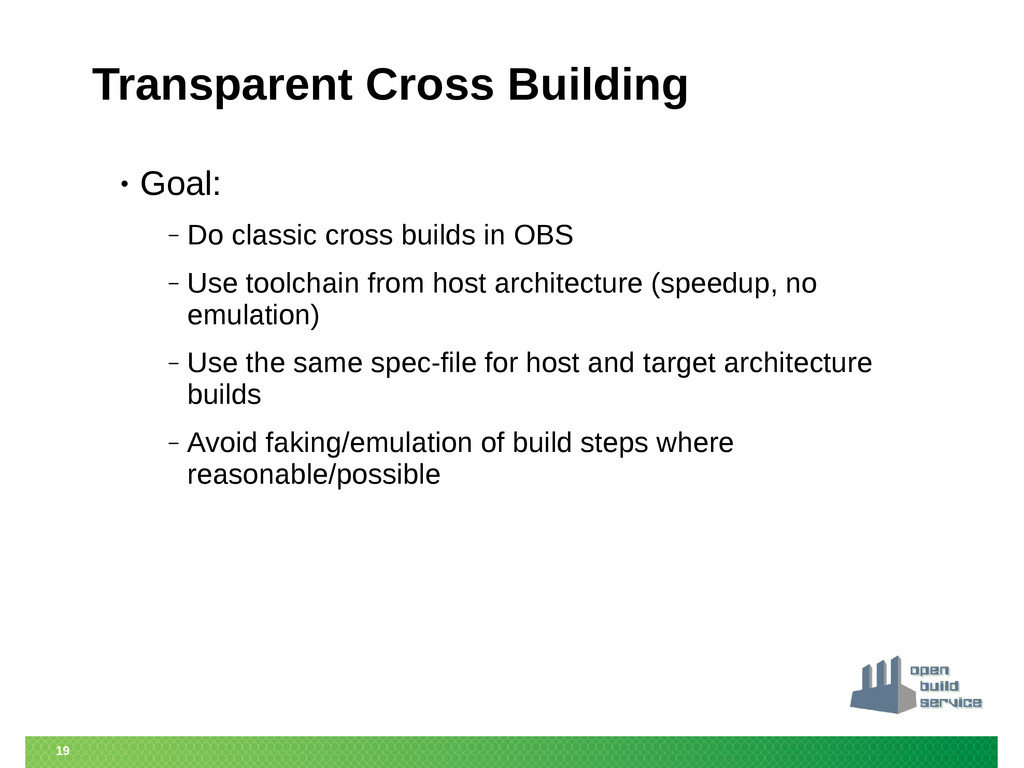
builds in OBS ‒ Use toolchain from host architecture (speedup, no emulation) ‒ Use the same spec-file for host and target architecture builds ‒ Avoid faking/emulation of build steps where reasonable/possible
Need to handle dependencies for two architectures • Build result may differ from native compile • No real-life testing during development • No test suite runs usually
multiple architecture in account • Toolchain BuildRequires get substituted with packages for the host architecture • Setup separated /sysroot for target architecture(s): ‒ /opt/cross-%_target_cpu/ ‒ With separated package database • Exploit cross-compiling support of build environments: ‒ Autotools, CMake, …
get “transparent”? ‒ Some BuildRequires: need to get substituted with Host Arch packages or cross-compilers ‒ %check section gets NOOP in the first round ‒ Common build environment calls in spec files need to make use of common packaging macros: ‒ %configure ‒ %cmake ‒ … • Goal: use the same build spec file ‒ Move arch conditionals to the project config
for me? ‒ Do you have enough time/resources to package your entire project/product yourself? ‒ Are you willing to fix a lot of packages which are not aware of cross building? ‒ Emulated cross builds are not fast enough for your packages/projects? • If all of above applies, this might be the right solution • Otherwise emulated or other OBS cross build might be the right thing for you
to make scheduler aware of multiple architectures ‒ Enable obs-build to setup separated /sysroot ‒ … and do classic cross builds • Later: ‒ Optimize scheduler for taking multiple architectures in account ‒ First round: requires that the entire toolchain of host arch is build ‒ Make some use of binfmt Magic ‒ invoke qemu-$ARCH to run %check or other things ‒ But use as much host toolchain as possible


 openbuildservice
 artoy
artoy
 akit37
 moro
moro
 takai
takai
 siroemk
 tomokon
 yasunori0418
 ichirokano2
 ivargrimstad
 yukiny
 skydoves
 sylph01
 pwiseman
 eileencodes
 joshbly
 techseoconnect
 swwweet
 tammyeverts
 tmiket
 afnizarnur
 rabernat
 mayatellez