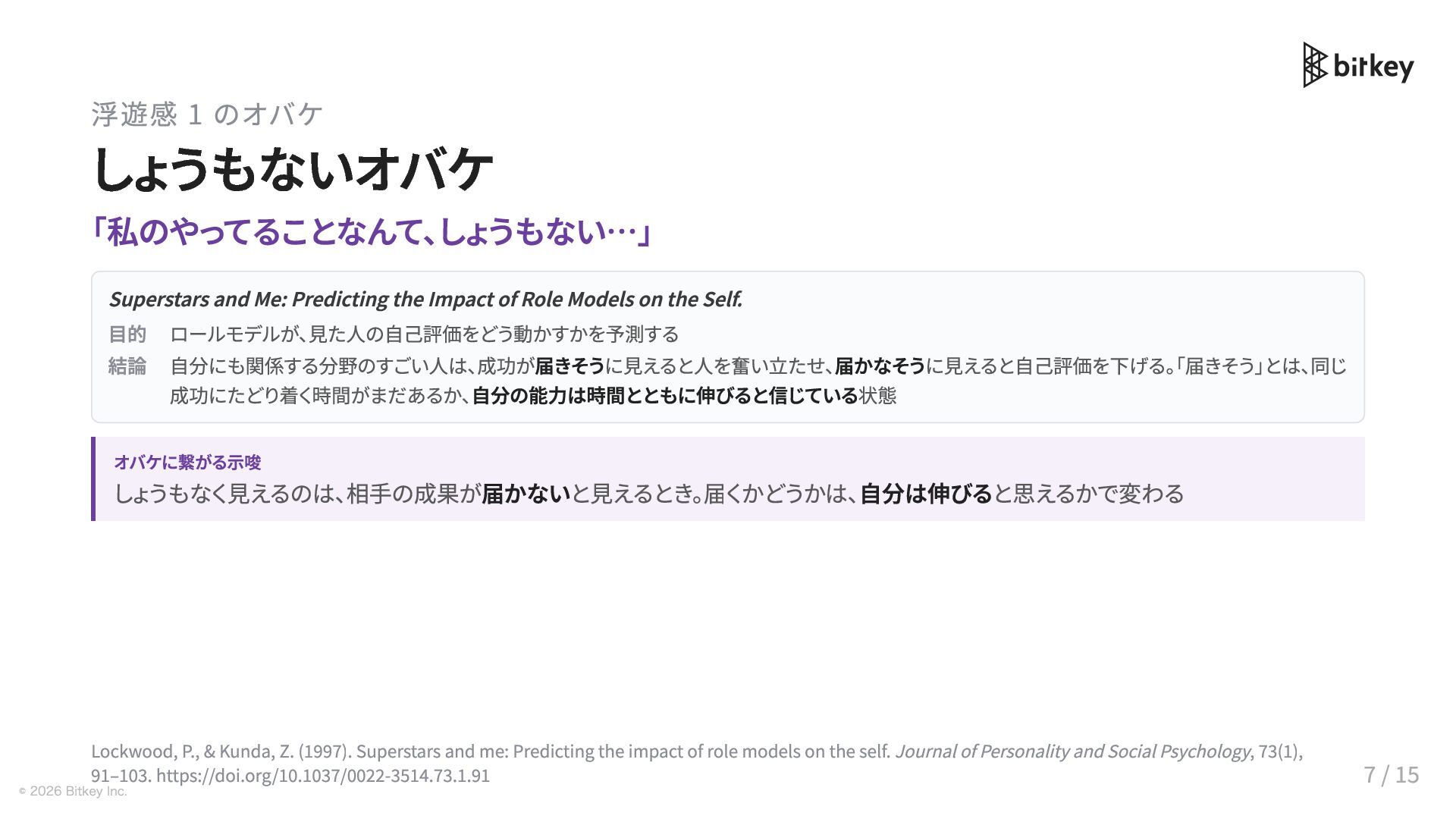
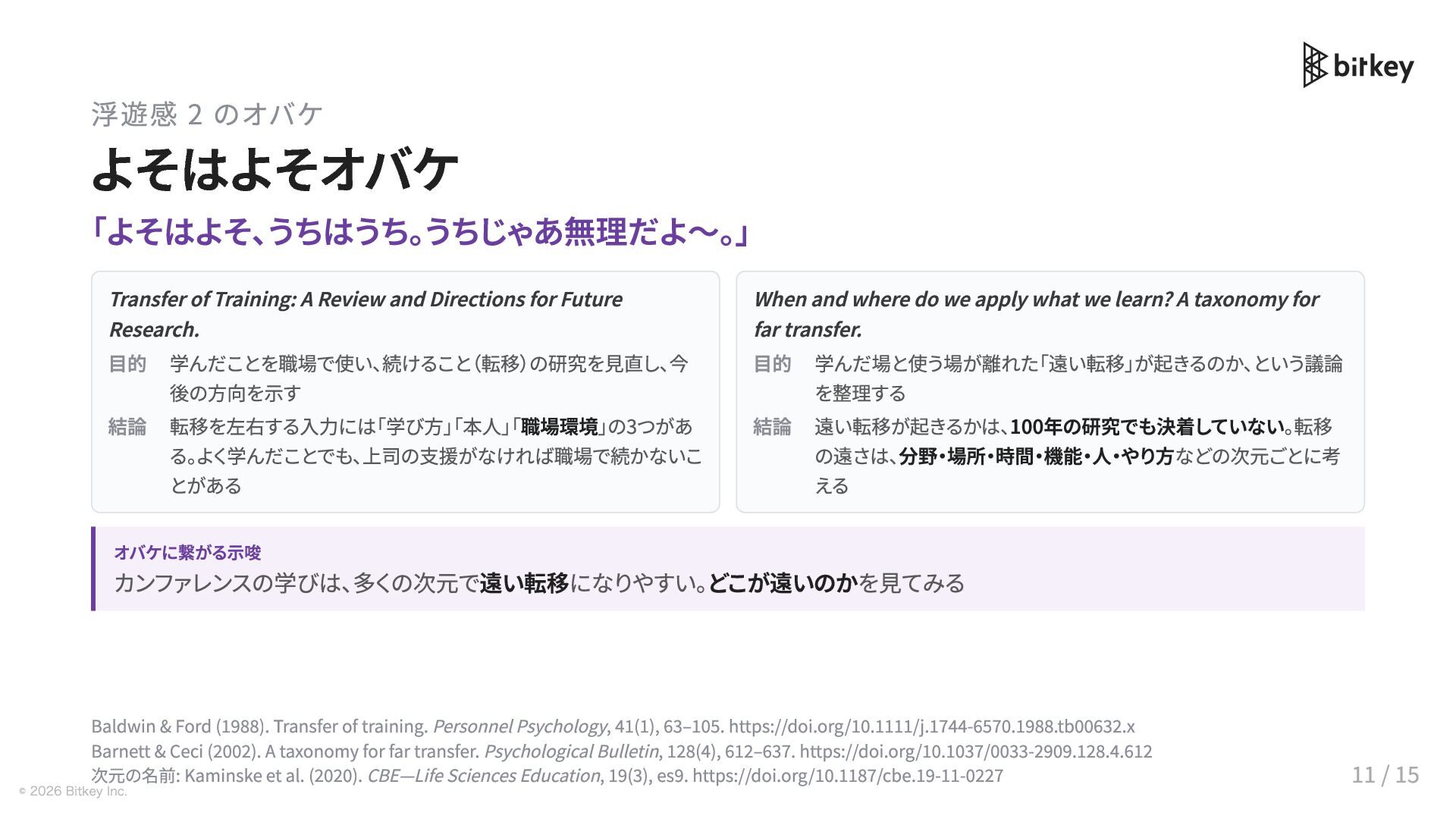
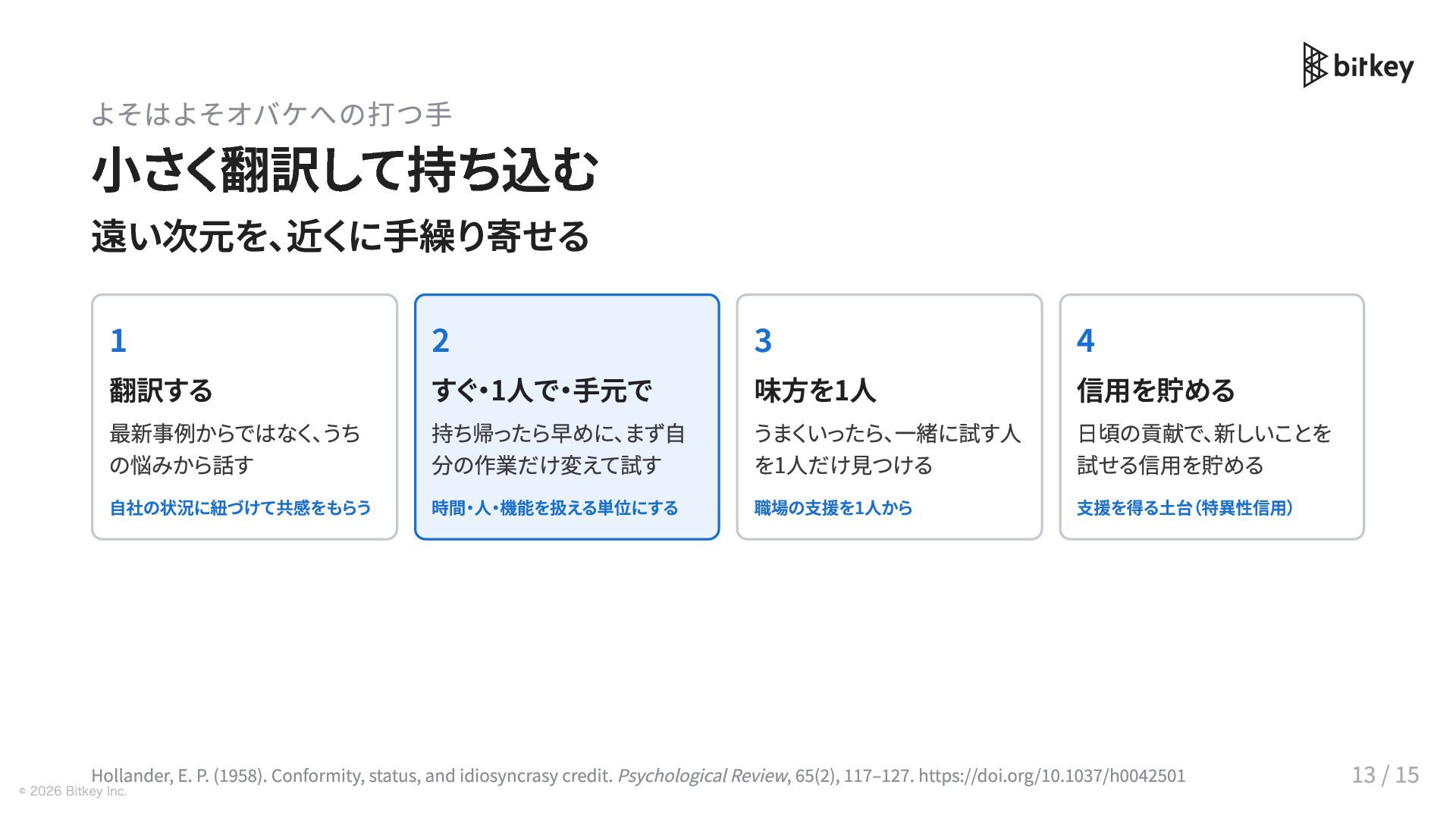
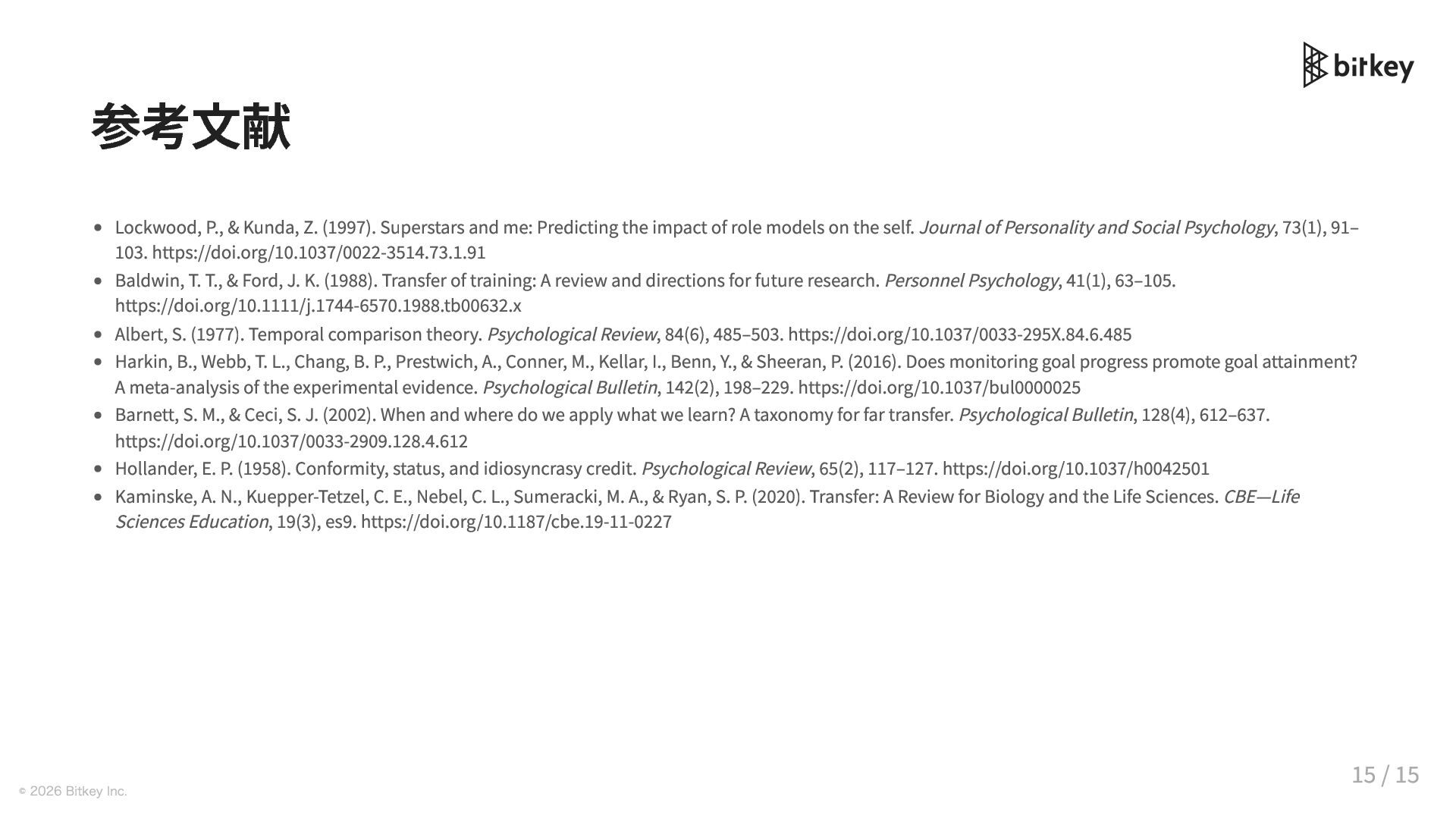
Predicting the impact of role models on the self. Journal of Personality and Social Psychology, 73(1), 91– 103. https://doi.org/10.1037/0022-3514.73.1.91 Baldwin, T. T., & Ford, J. K. (1988). Transfer of training: A review and directions for future research. Personnel Psychology, 41(1), 63–105. https://doi.org/10.1111/j.1744-6570.1988.tb00632.x Albert, S. (1977). Temporal comparison theory. Psychological Review, 84(6), 485–503. https://doi.org/10.1037/0033-295X.84.6.485 Harkin, B., Webb, T. L., Chang, B. P., Prestwich, A., Conner, M., Kellar, I., Benn, Y., & Sheeran, P. (2016). Does monitoring goal progress promote goal attainment? A meta-analysis of the experimental evidence. Psychological Bulletin, 142(2), 198–229. https://doi.org/10.1037/bul0000025 Barnett, S. M., & Ceci, S. J. (2002). When and where do we apply what we learn? A taxonomy for far transfer. Psychological Bulletin, 128(4), 612–637. https://doi.org/10.1037/0033-2909.128.4.612 Hollander, E. P. (1958). Conformity, status, and idiosyncrasy credit. Psychological Review, 65(2), 117–127. https://doi.org/10.1037/h0042501 Kaminske, A. N., Kuepper-Tetzel, C. E., Nebel, C. L., Sumeracki, M. A., & Ryan, S. P. (2020). Transfer: A Review for Biology and the Life Sciences. CBE—Life Sciences Education, 19(3), es9. https://doi.org/10.1187/cbe.19-11-0227 © 2026 Bitkey Inc. 15 / 15


 pauli
pauli
 makocchi
 iktakahiro
 pfn
pfn
 kzkhykw1991
 kenichiodo
 kairim0
 kentarofujii
 yuuuuuuu168
 kaminashi
 ivry_presentationmaterials
 willnet
 tomokusaba
 philnash
 bryan
bryan
 signer
 thirion
 katarinadahlin
 cassininazir
 techseoconnect
 marketingsoph
.png) helenjbeal
helenjbeal
 inesmontani
 sstephenson
 keathley