Upgrade to Pro — share decks privately, control downloads, hide ads and more …

Elasticsearch Performance and Scalability Essen...

Sponsored · SiteGround - Reliable hosting with speed, security, and support you can count on. →

Elasticsearch Performance and Scalability Essentials

Presentation held at the Search Technology Meetup Hamburg on March 17, 2015.

Patrick Peschlow

March 17, 2015

Transcript

38 slides
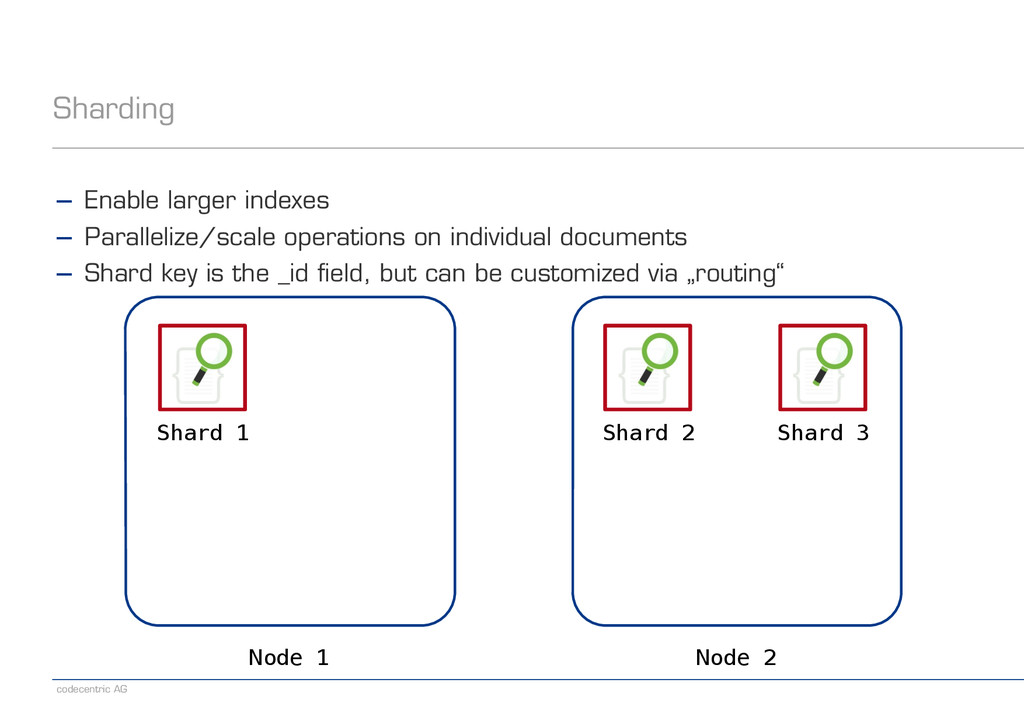
  1. codecentric AG Sharding − Enable larger indexes − Parallelize/scale operations

    on individual documents − Shard key is the _id field, but can be customized via „routing“ Node 1 Node 2 Shard 1 Shard 2 Shard 3
  2. codecentric AG Sharding Gotcha − Number of shards needs to

    be chosen on index creation − No shard splitting later ! − How to determine the required number of shards for an index? − Measure the capacity limit of a single shard − Extrapolate the required number of shards and overallocate a little − Use realistic data and workloads − Use adequate metrics
  3. codecentric AG Replication Primary 1 Primary 2 Primary 3 Replica

    2 Replica 3 Replica 1 − Enable HA − Parallelize/scale searches Node 1 Node 2
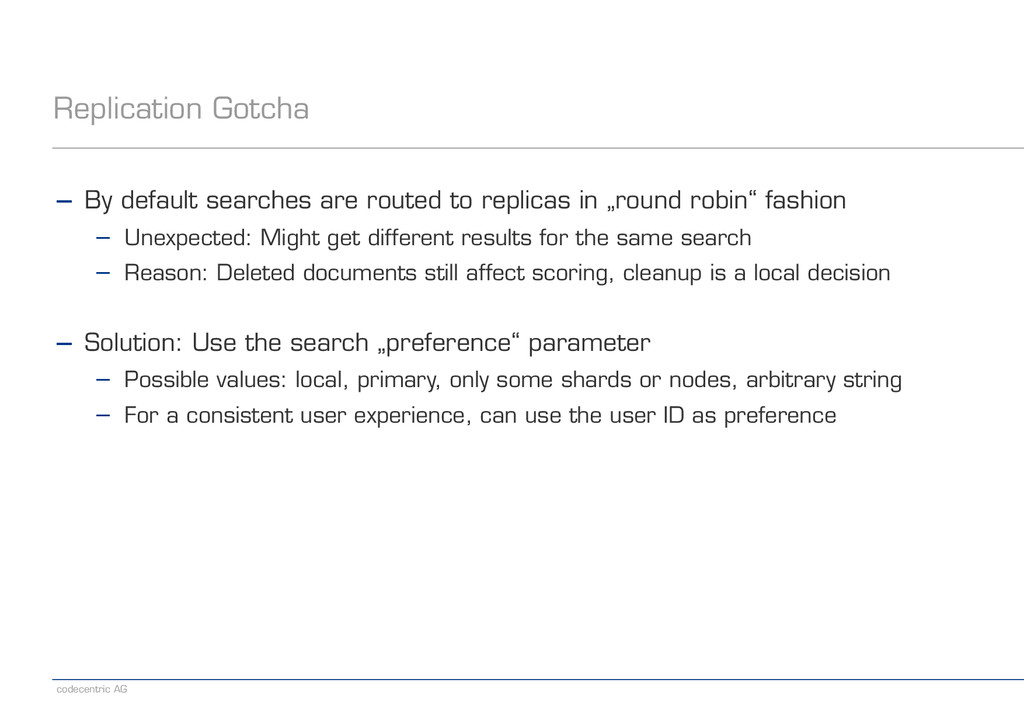
  4. codecentric AG Replication Gotcha − By default searches are routed

    to replicas in „round robin“ fashion − Unexpected: Might get different results for the same search − Reason: Deleted documents still affect scoring, cleanup is a local decision ! − Solution: Use the search „preference“ parameter − Possible values: local, primary, only some shards or nodes, arbitrary string − For a consistent user experience, can use the user ID as preference
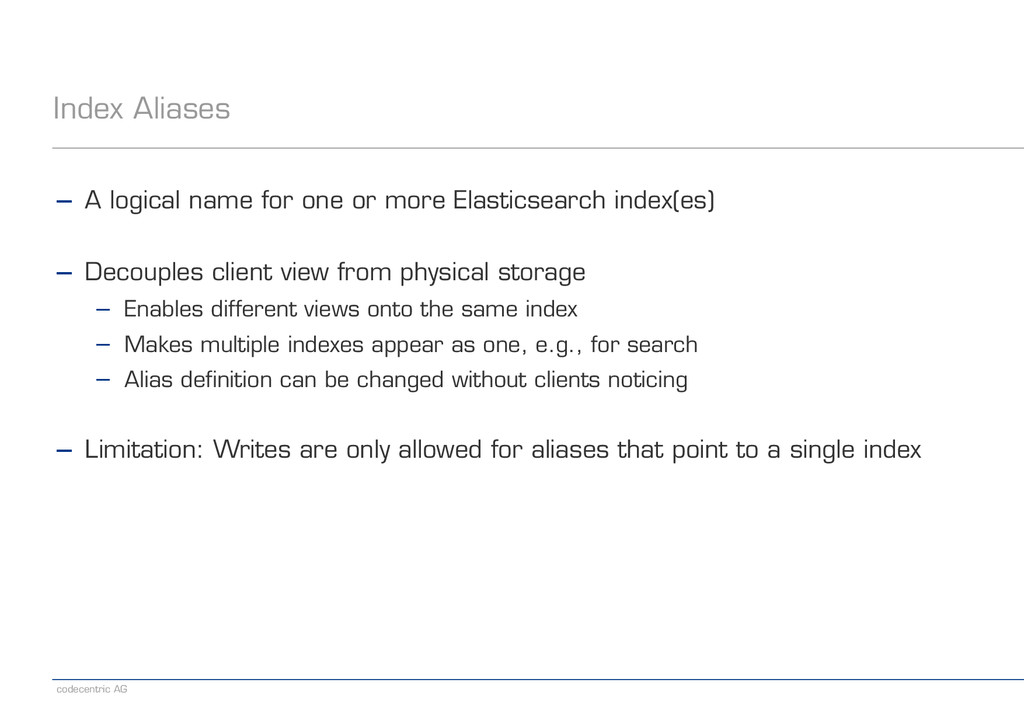
  5. codecentric AG Index Aliases − A logical name for one

    or more Elasticsearch index(es) ! − Decouples client view from physical storage − Enables different views onto the same index − Makes multiple indexes appear as one, e.g., for search − Alias definition can be changed without clients noticing ! − Limitation: Writes are only allowed for aliases that point to a single index
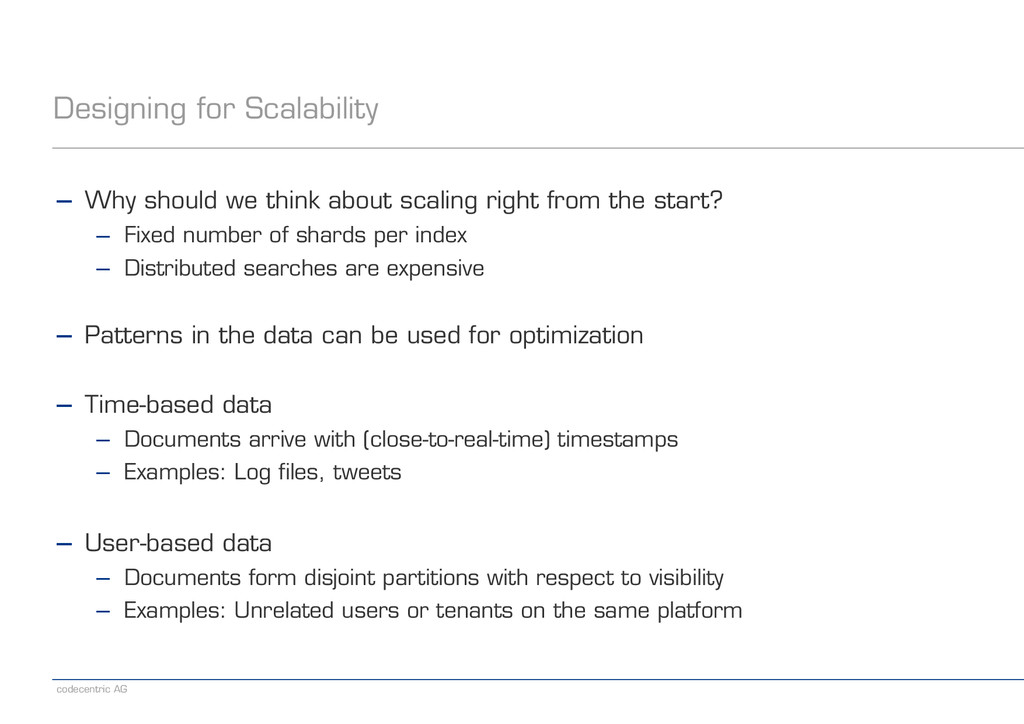
  6. codecentric AG Designing for Scalability − Why should we think

    about scaling right from the start? − Fixed number of shards per index − Distributed searches are expensive ! − Patterns in the data can be used for optimization ! − Time-based data − Documents arrive with (close-to-real-time) timestamps − Examples: Log files, tweets ! − User-based data − Documents form disjoint partitions with respect to visibility − Examples: Unrelated users or tenants on the same platform
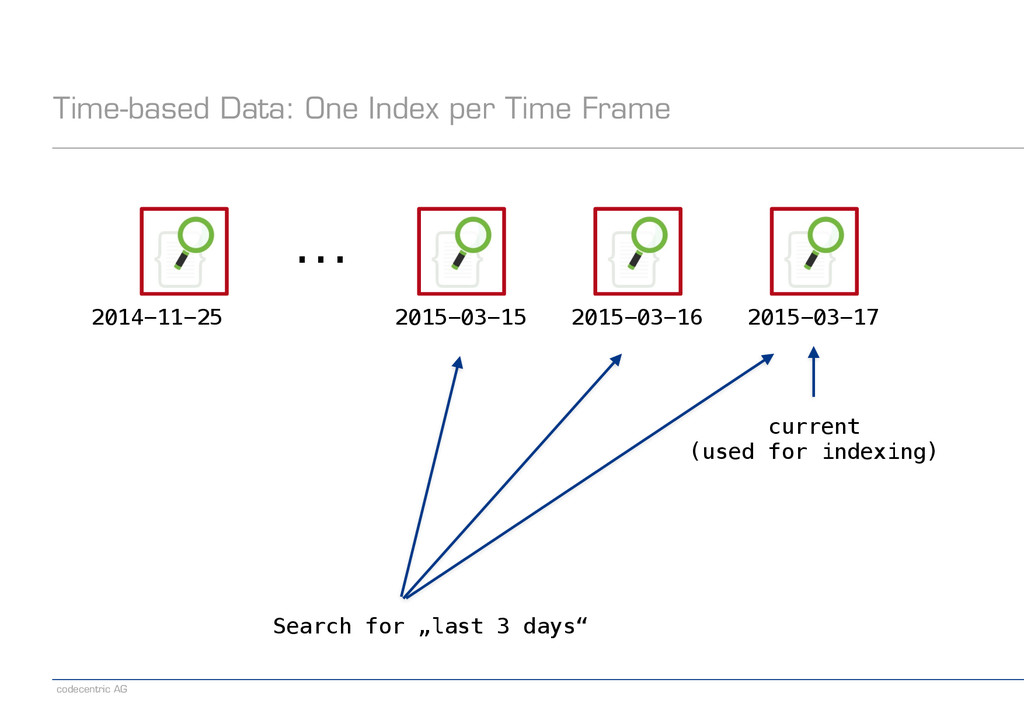
  7. codecentric AG Time-based Data: One Index per Time Frame 2015-03-15

    2015-03-16 current
 (used for indexing) 2015-03-17 Search for „last 3 days“ 2014-11-25 ...
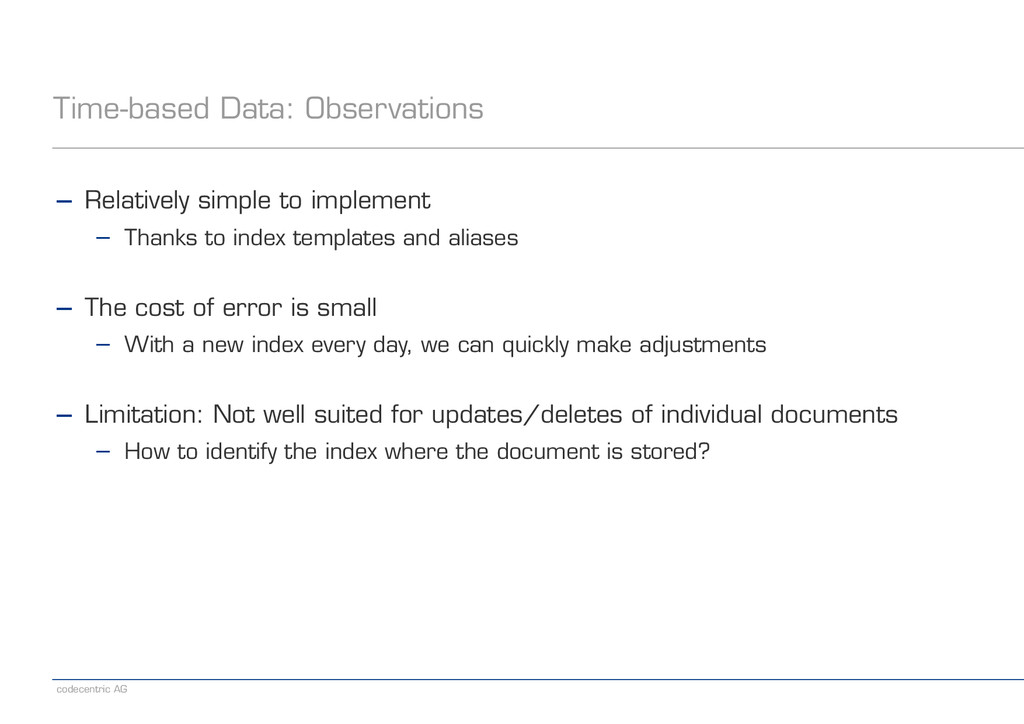
  8. codecentric AG Time-based Data: Observations − Relatively simple to implement

    − Thanks to index templates and aliases ! − The cost of error is small − With a new index every day, we can quickly make adjustments ! − Limitation: Not well suited for updates/deletes of individual documents − How to identify the index where the document is stored?
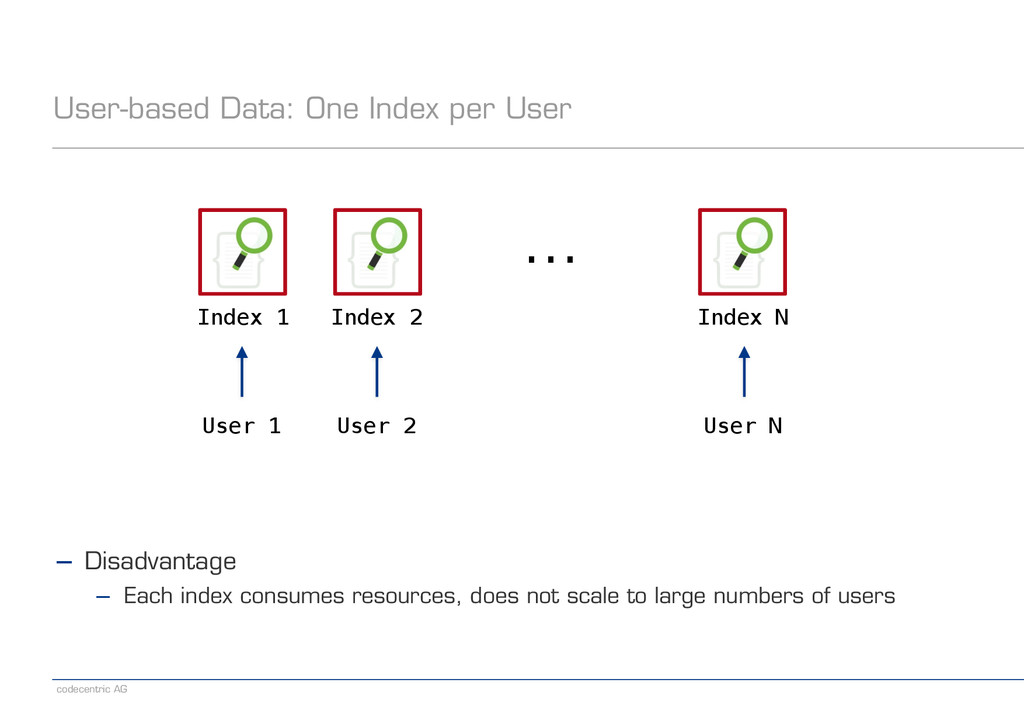
  9. codecentric AG User-based Data: One Index per User Index 1

    Index 2 Index N ... User 1 User 2 User N ! ! ! ! ! ! ! ! ! ! ! − Disadvantage − Each index consumes resources, does not scale to large numbers of users
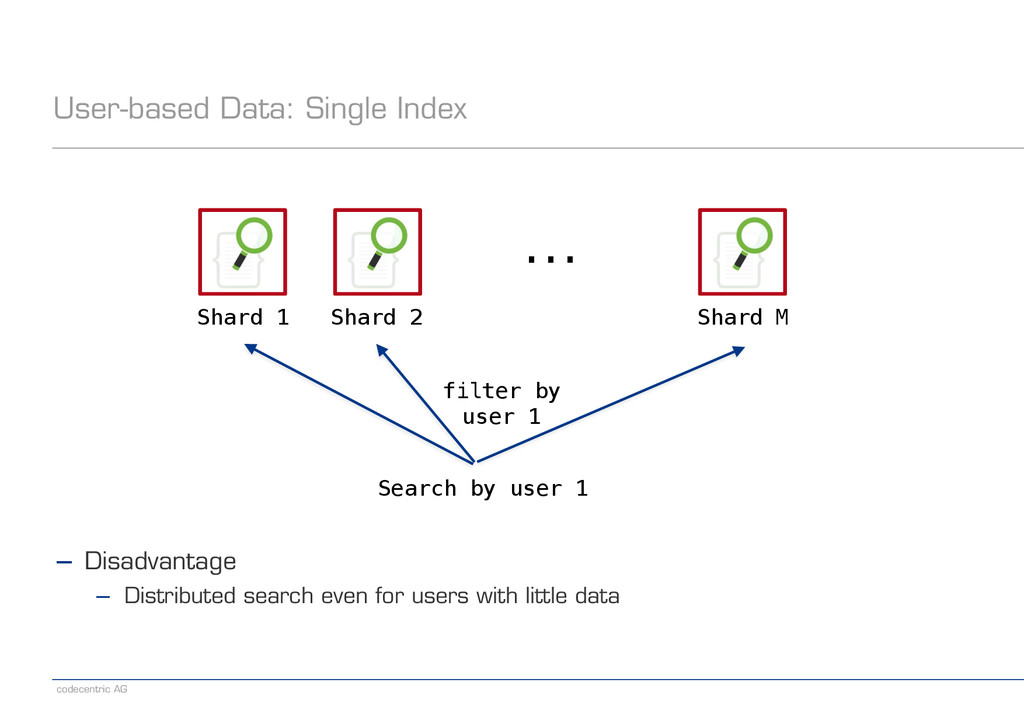
  10. codecentric AG User-based Data: Single Index Shard 1 Shard 2

    Shard M ... Search by user 1 filter by user 1 ! ! ! ! ! ! ! ! ! ! ! − Disadvantage − Distributed search even for users with little data
  11. codecentric AG filter by user 1 User-based Data: Single Index

    with Routing Shard 1 Shard 2 Shard M ... User 2 User 1 User 5 User 3 User 4 User 6 User N User N-1 Search by user 1 ! ! ! ! ! ! ! ! ! ! ! − Disadvantage − Some shards may become much bigger than others
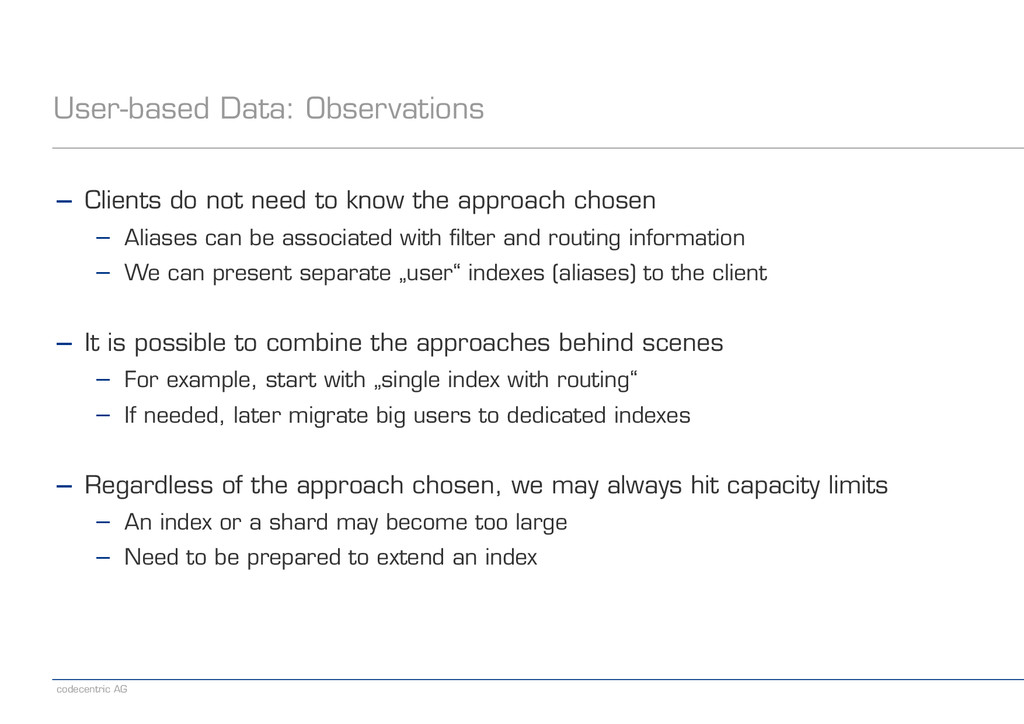
  12. codecentric AG User-based Data: Observations − Clients do not need

    to know the approach chosen − Aliases can be associated with filter and routing information − We can present separate „user“ indexes (aliases) to the client ! − It is possible to combine the approaches behind scenes − For example, start with „single index with routing“ − If needed, later migrate big users to dedicated indexes ! − Regardless of the approach chosen, we may always hit capacity limits − An index or a shard may become too large − Need to be prepared to extend an index
  13. codecentric AG Extending an Index − What to do when

    an index has reached its capacity? ! − Option 1: Extend the index by a second one − Not really nice, requires „manual“ sharding (which index to address?) ! − Option 2: Migrate to a new index with more shards − May require zero downtime migration
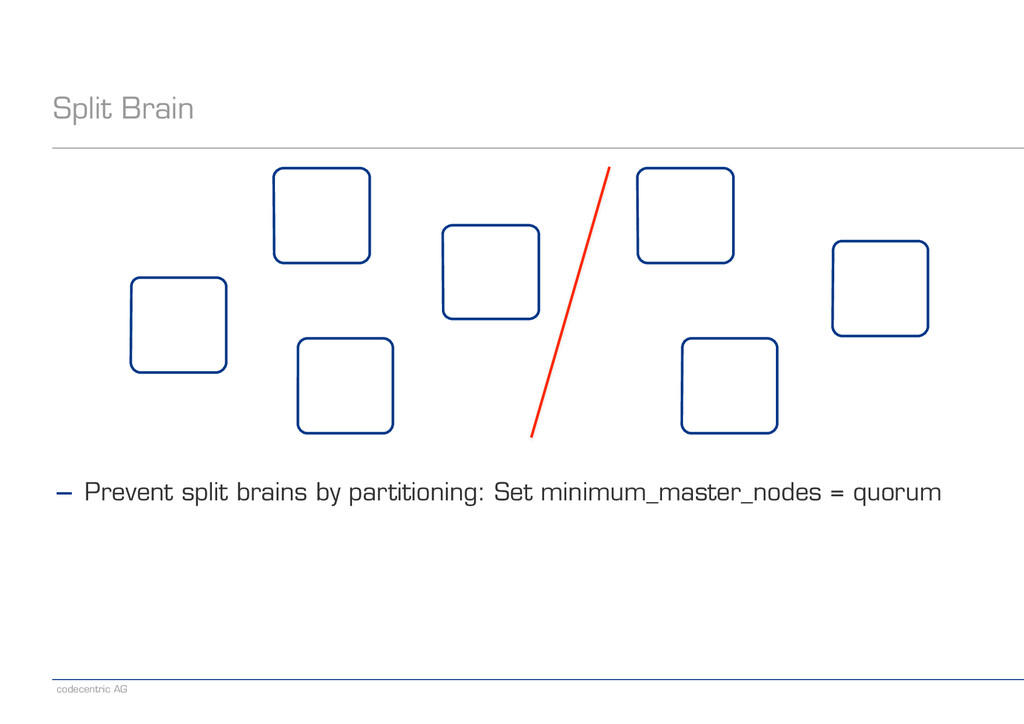
  14. codecentric AG Split Brain ! ! ! ! ! !

    ! ! − Prevent split brains by partitioning: Set minimum_master_nodes = quorum
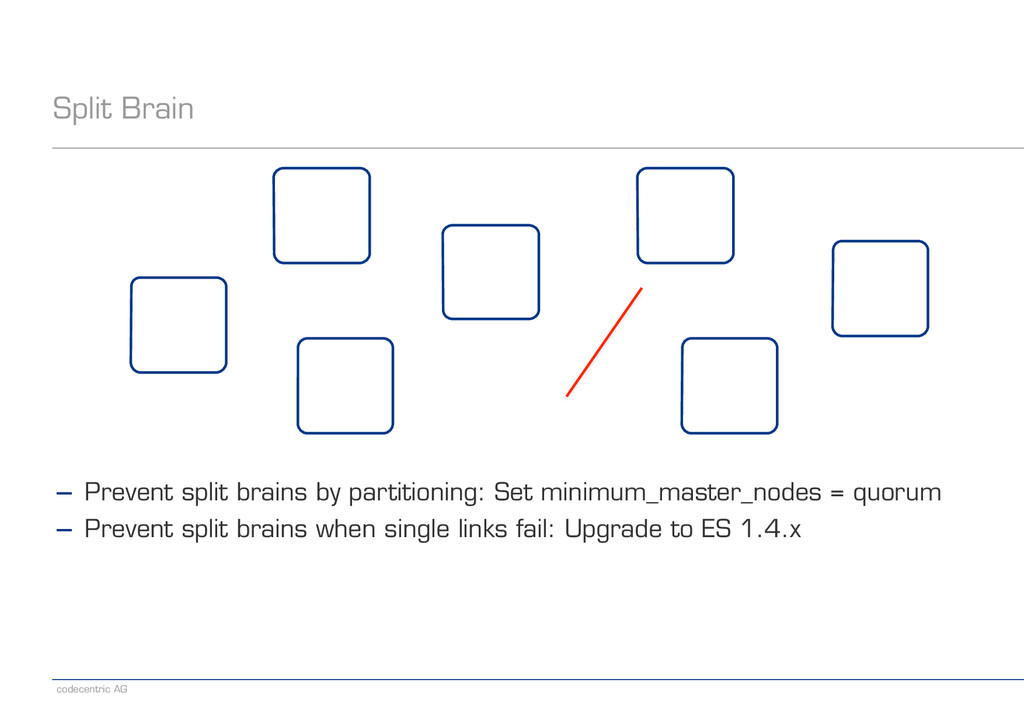
  15. codecentric AG Split Brain ! ! ! ! ! !

    ! ! − Prevent split brains by partitioning: Set minimum_master_nodes = quorum − Prevent split brains when single links fail: Upgrade to ES 1.4.x
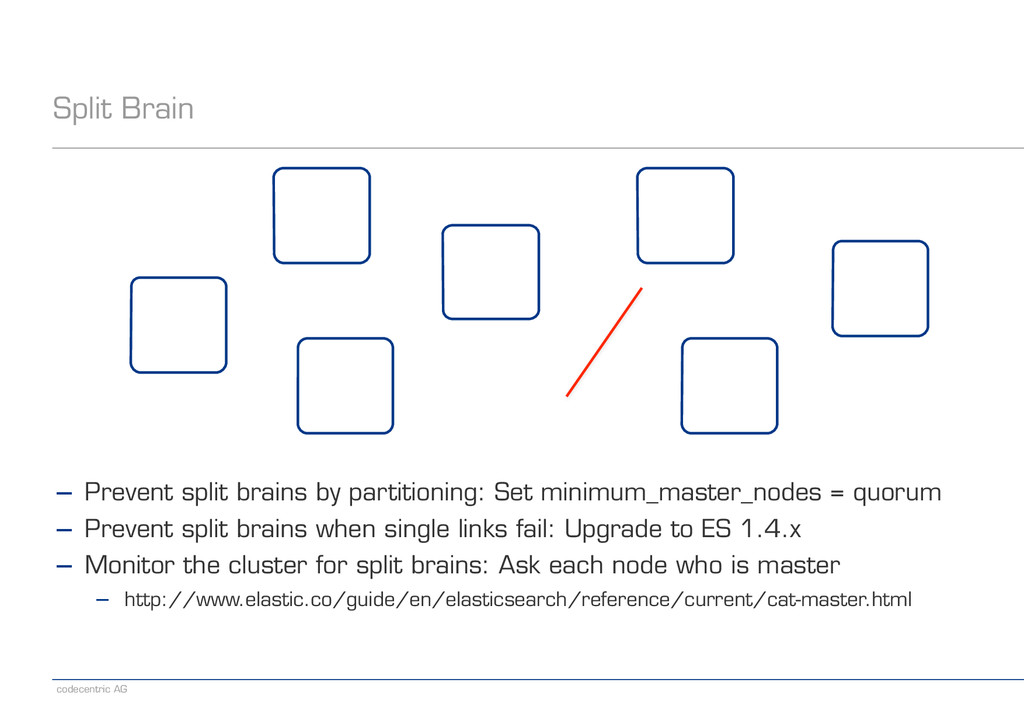
  16. codecentric AG Split Brain ! ! ! ! ! !

    ! ! − Prevent split brains by partitioning: Set minimum_master_nodes = quorum − Prevent split brains when single links fail: Upgrade to ES 1.4.x − Monitor the cluster for split brains: Ask each node who is master − http://www.elastic.co/guide/en/elasticsearch/reference/current/cat-master.html
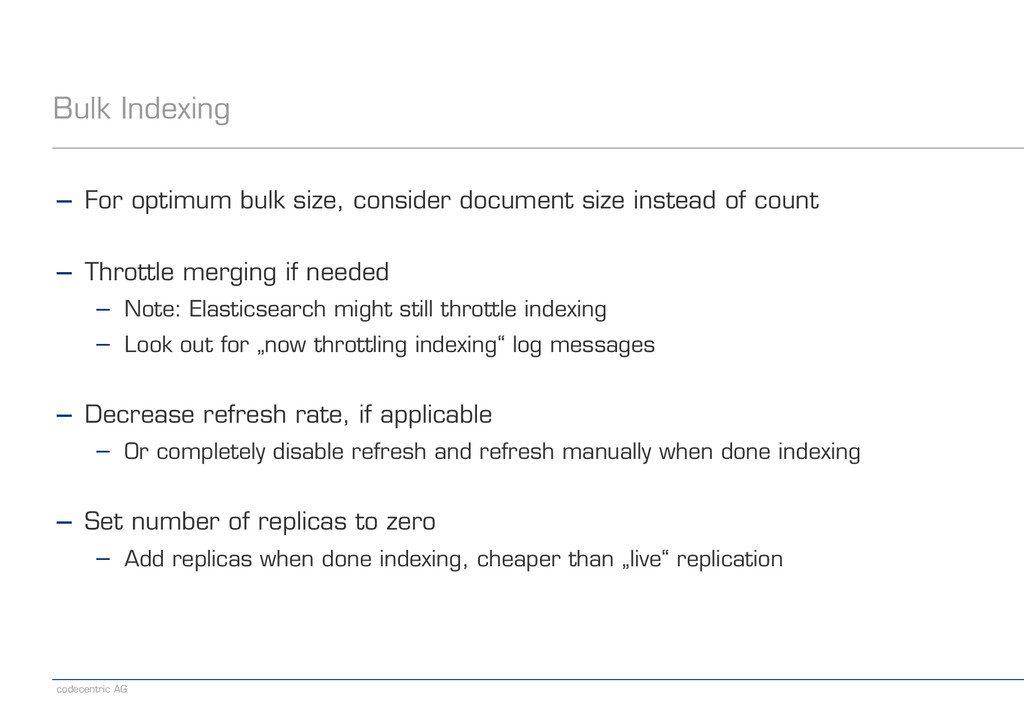
  17. codecentric AG Bulk Indexing − For optimum bulk size, consider

    document size instead of count ! − Throttle merging if needed − Note: Elasticsearch might still throttle indexing − Look out for „now throttling indexing“ log messages ! − Decrease refresh rate, if applicable − Or completely disable refresh and refresh manually when done indexing ! − Set number of replicas to zero − Add replicas when done indexing, cheaper than „live“ replication
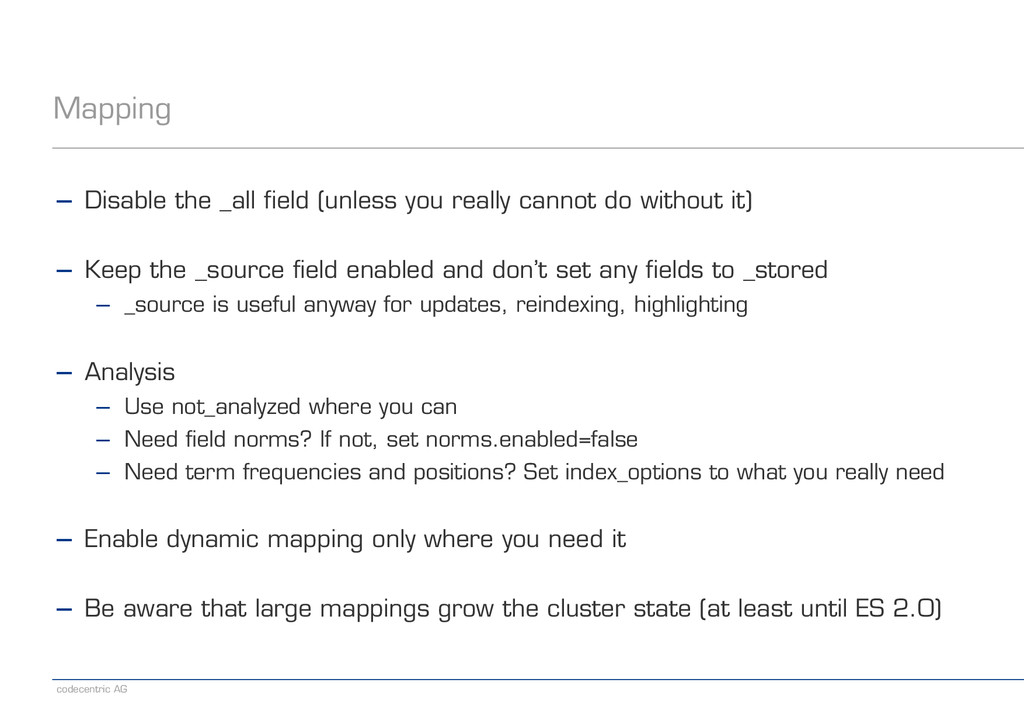
  18. codecentric AG Mapping − Disable the _all field (unless you

    really cannot do without it) ! − Keep the _source field enabled and don’t set any fields to _stored − _source is useful anyway for updates, reindexing, highlighting ! − Analysis − Use not_analyzed where you can − Need field norms? If not, set norms.enabled=false − Need term frequencies and positions? Set index_options to what you really need ! − Enable dynamic mapping only where you need it ! − Be aware that large mappings grow the cluster state (at least until ES 2.0)
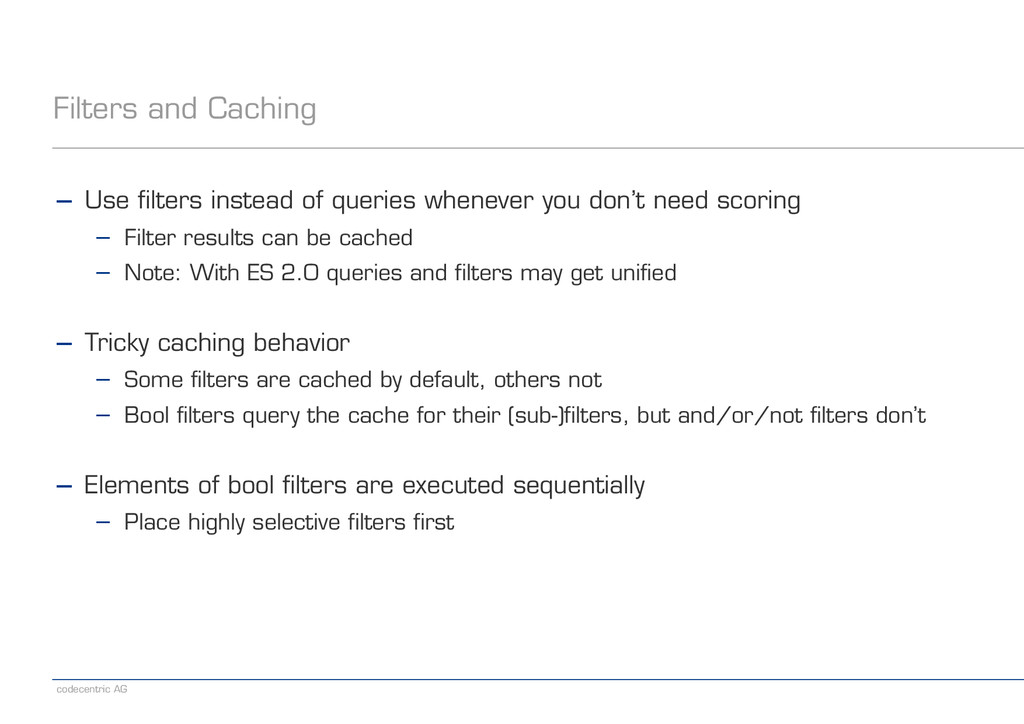
  19. codecentric AG Filters and Caching − Use filters instead of

    queries whenever you don’t need scoring − Filter results can be cached − Note: With ES 2.0 queries and filters may get unified ! − Tricky caching behavior − Some filters are cached by default, others not − Bool filters query the cache for their (sub-)filters, but and/or/not filters don’t ! − Elements of bool filters are executed sequentially − Place highly selective filters first
  20. codecentric AG Queries − Pagination − Don’t load too many

    results with a single query − Avoid deep pagination − Consider using the scan+scroll API when you don’t need sorting ! − Try to replace heavyweight queries by additional index-time operations − For example, prefix query vs. edge ngrams − Might require indexing a source field twice − Consider using the „transform“ feature
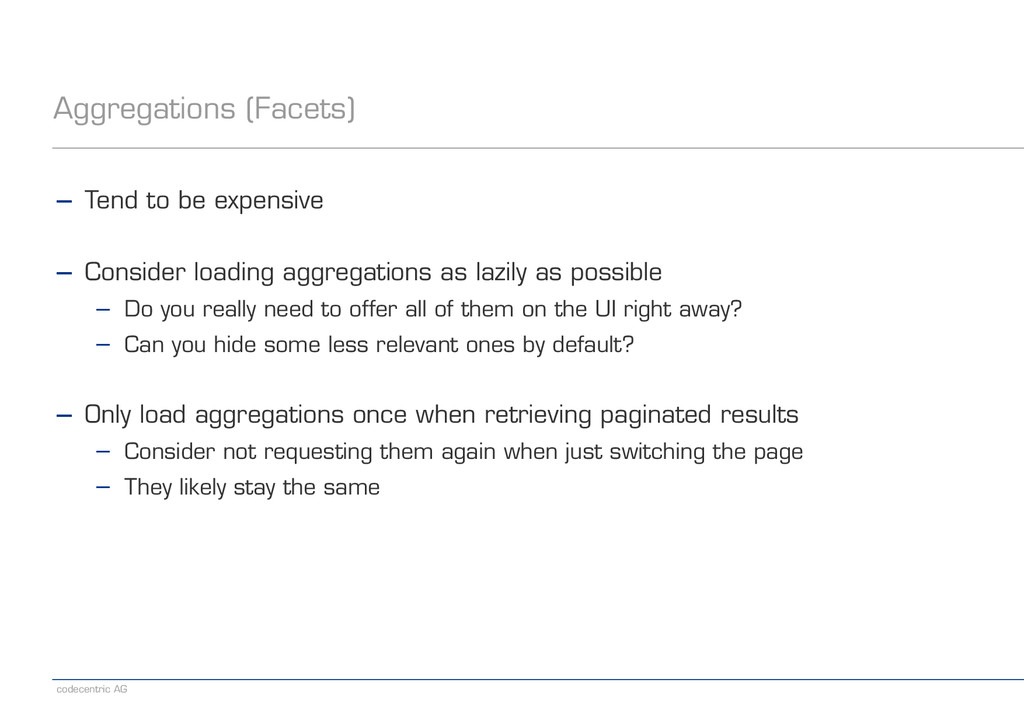
  21. codecentric AG Aggregations (Facets) − Tend to be expensive !

    − Consider loading aggregations as lazily as possible − Do you really need to offer all of them on the UI right away? − Can you hide some less relevant ones by default? ! − Only load aggregations once when retrieving paginated results − Consider not requesting them again when just switching the page − They likely stay the same
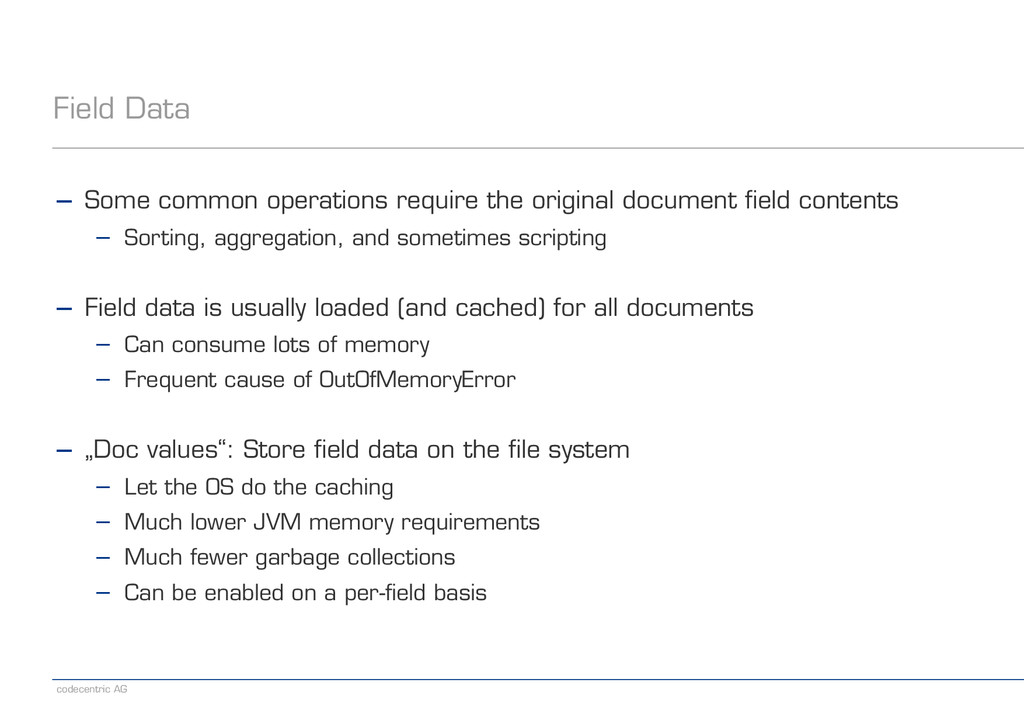
  22. codecentric AG Field Data − Some common operations require the

    original document field contents − Sorting, aggregation, and sometimes scripting ! − Field data is usually loaded (and cached) for all documents − Can consume lots of memory − Frequent cause of OutOfMemoryError ! − „Doc values“: Store field data on the file system − Let the OS do the caching − Much lower JVM memory requirements − Much fewer garbage collections − Can be enabled on a per-field basis
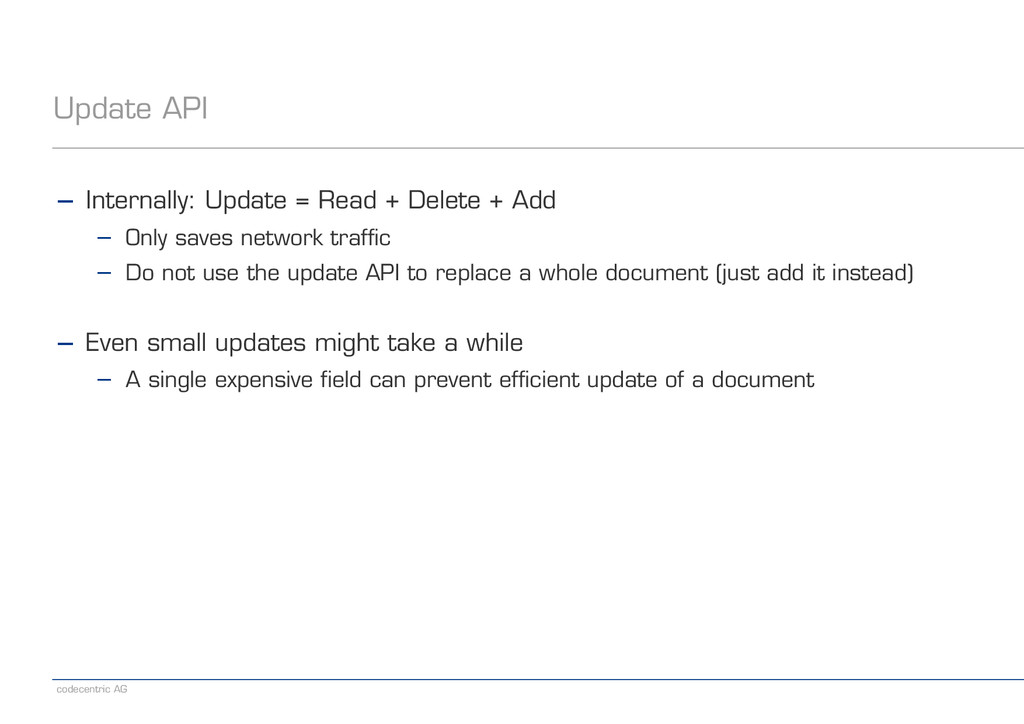
  23. codecentric AG Update API − Internally: Update = Read +

    Delete + Add − Only saves network traffic − Do not use the update API to replace a whole document (just add it instead) ! − Even small updates might take a while − A single expensive field can prevent efficient update of a document
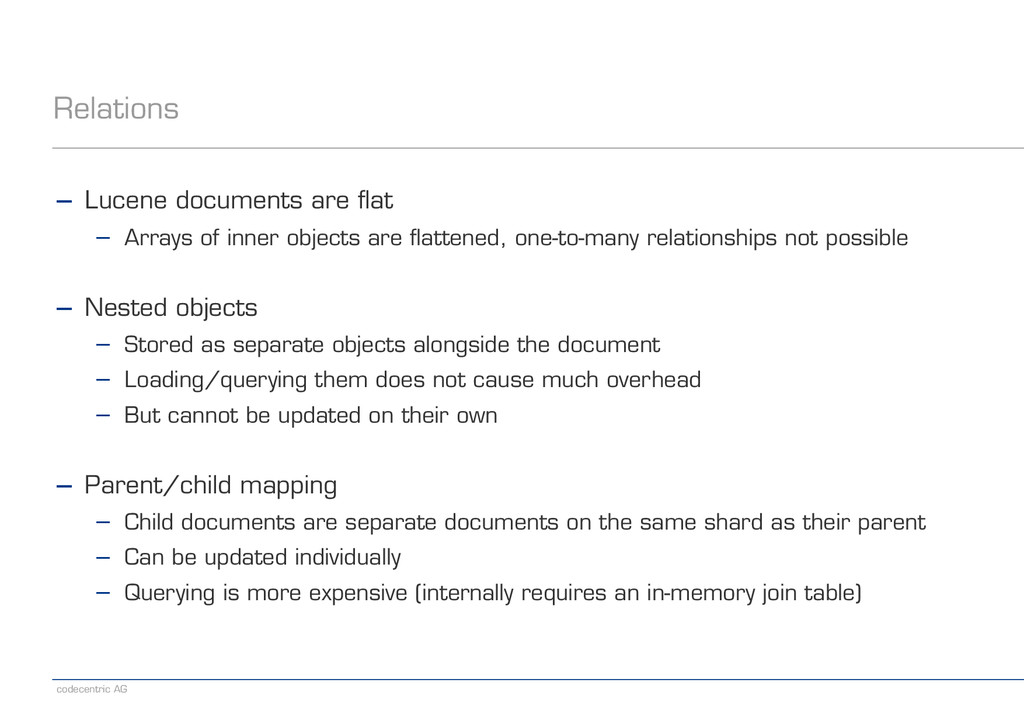
  24. codecentric AG Relations − Lucene documents are flat − Arrays

    of inner objects are flattened, one-to-many relationships not possible ! − Nested objects − Stored as separate objects alongside the document − Loading/querying them does not cause much overhead − But cannot be updated on their own ! − Parent/child mapping − Child documents are separate documents on the same shard as their parent − Can be updated individually − Querying is more expensive (internally requires an in-memory join table)
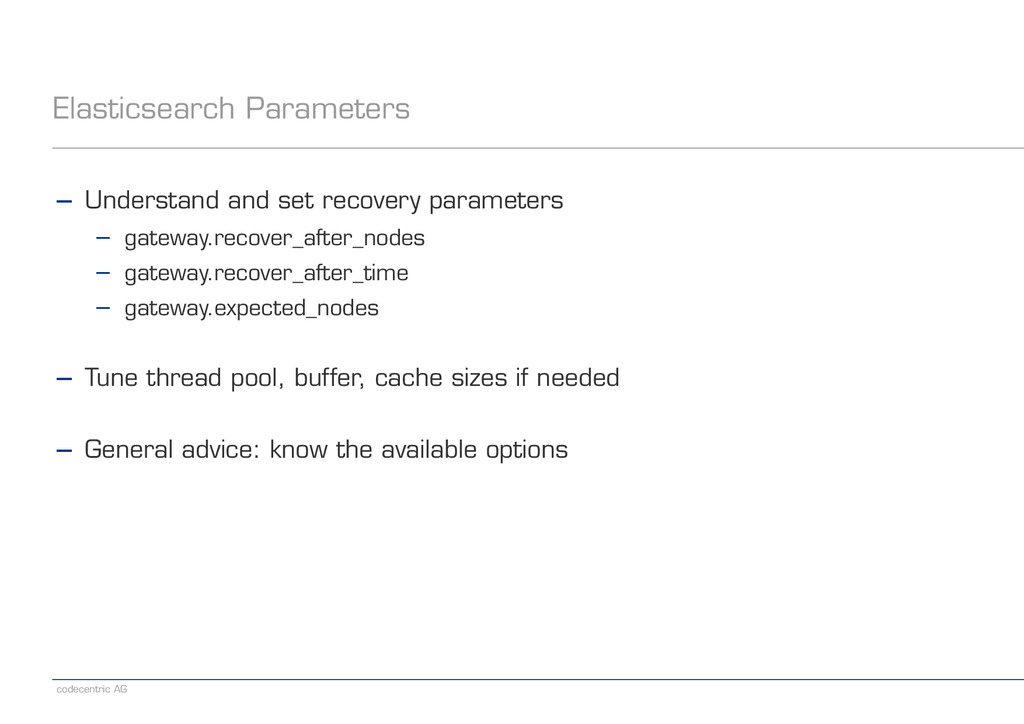
  25. codecentric AG Elasticsearch Parameters − Understand and set recovery parameters

    − gateway.recover_after_nodes − gateway.recover_after_time − gateway.expected_nodes ! − Tune thread pool, buffer, cache sizes if needed ! − General advice: know the available options
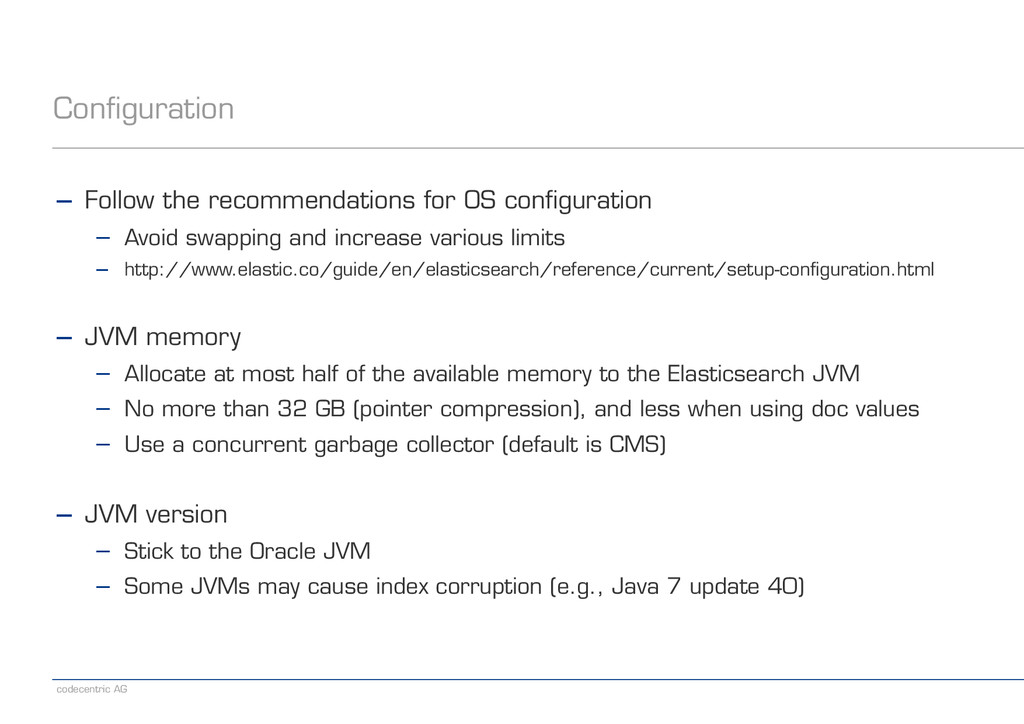
  26. codecentric AG Configuration − Follow the recommendations for OS configuration

    − Avoid swapping and increase various limits − http://www.elastic.co/guide/en/elasticsearch/reference/current/setup-configuration.html ! − JVM memory − Allocate at most half of the available memory to the Elasticsearch JVM − No more than 32 GB (pointer compression), and less when using doc values − Use a concurrent garbage collector (default is CMS) ! − JVM version − Stick to the Oracle JVM − Some JVMs may cause index corruption (e.g., Java 7 update 40)
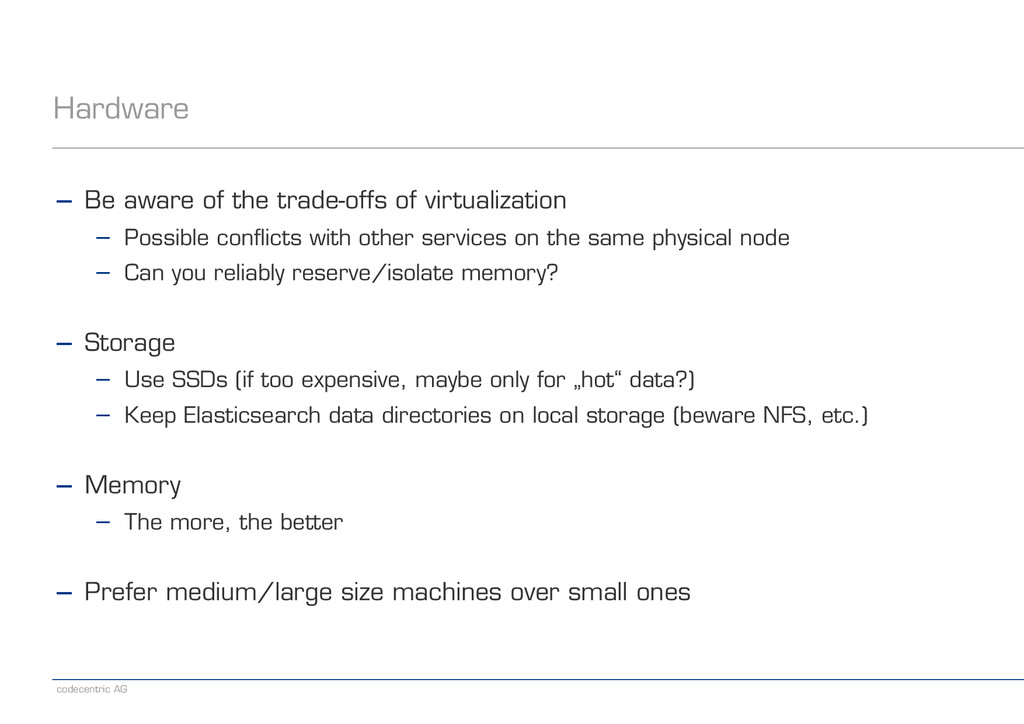
  27. codecentric AG Hardware − Be aware of the trade-offs of

    virtualization − Possible conflicts with other services on the same physical node − Can you reliably reserve/isolate memory? ! − Storage − Use SSDs (if too expensive, maybe only for „hot“ data?) − Keep Elasticsearch data directories on local storage (beware NFS, etc.) ! − Memory − The more, the better ! − Prefer medium/large size machines over small ones
  28. codecentric AG Questions? Dr. rer. nat. Patrick Peschlow
 codecentric AG


    Merscheider Straße 1
 42699 Solingen
 
 tel +49 (0) 212.23 36 28 54
 fax +49 (0) 212.23 36 28 79
 [email protected]
 
 www.codecentric.de

More Decks by Patrick Peschlow

Other Decks in Technology