Upgrade to Pro — share decks privately, control downloads, hide ads and more …

The Agent, Your Business Need

Avatar for Posedio Posedio
September 24, 2026

The Agent, Your Business Need

More businesses than ever explore the use of agentic workflows to automate manual tasks. One common use case is the integration into company data and knowledge landscape. This integration comes with a few challenges: How should one reflect company polices? How can one connect different software solutions to the agent and how can one make sure to reflect and isolate workflows.

In this talk we are going to explore possible answers to each question and present a practical example, how one can integrate agentic workflows to support the company in day-to-day business.

Avatar for Posedio

Posedio

September 24, 2026

More Decks by Posedio

Other Decks in Programming

Transcript

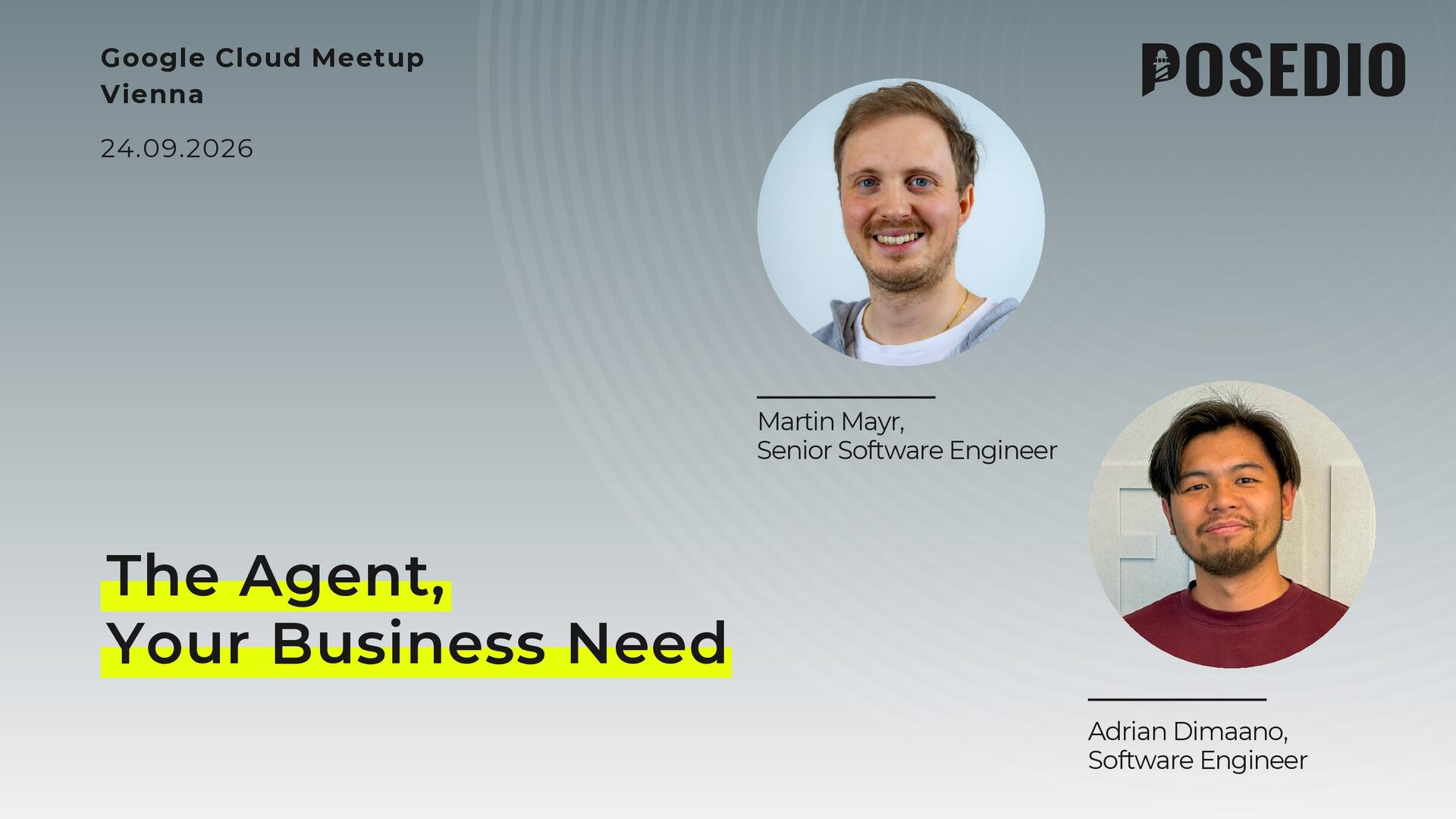
  1. Google Cloud Meetup Vienna 24.09.2026 Martin Mayr, Senior Software Engineer

    The Agent, Your Business Need Adrian Dimaano, Software Engineer
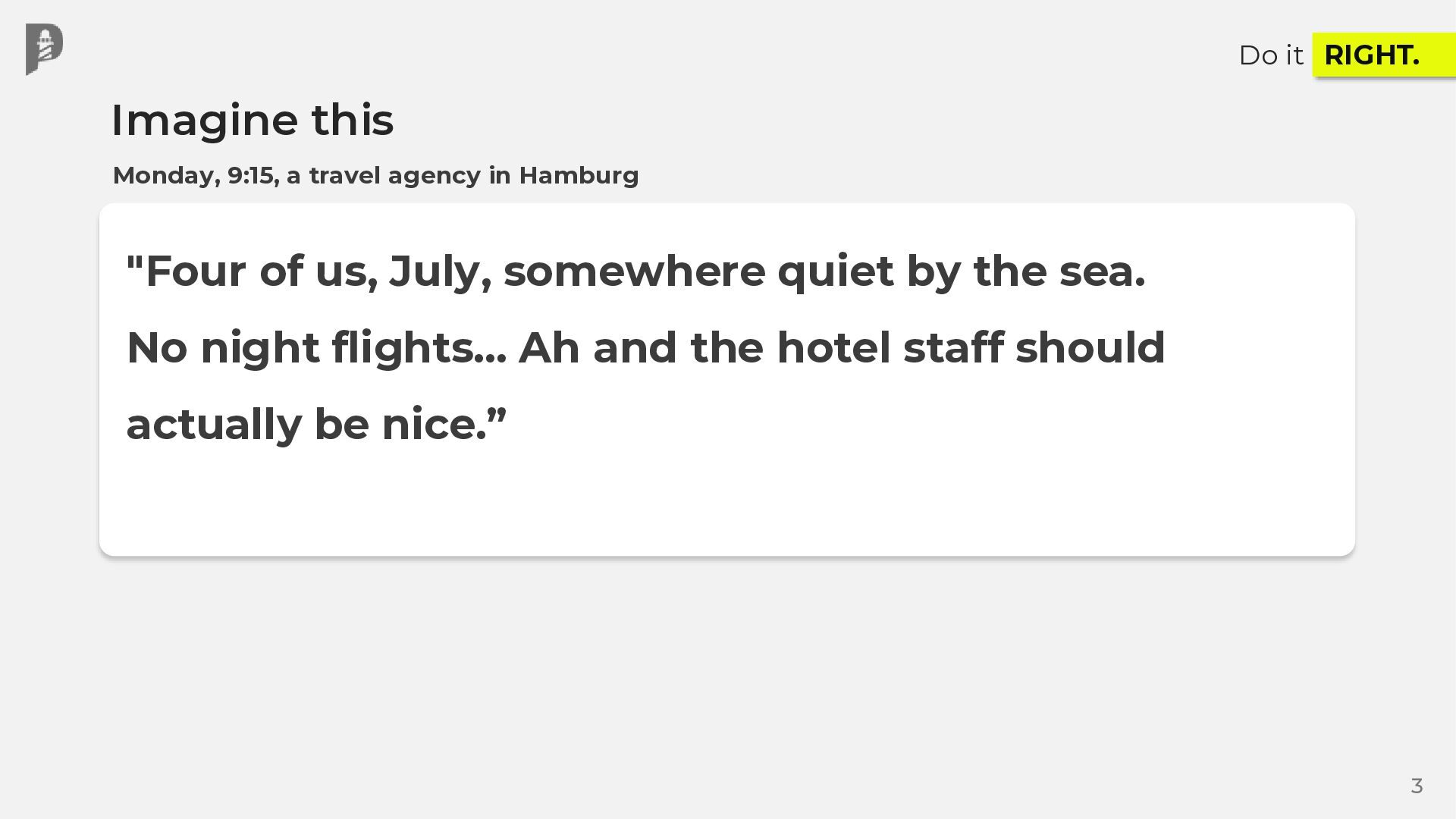
  2. Do it RIGHT. Imagine this Monday, 9:15, a travel agency

    in Hamburg "Four of us, July, somewhere quiet by the sea. No night flights… Ah and the hotel staff should actually be nice.” 3
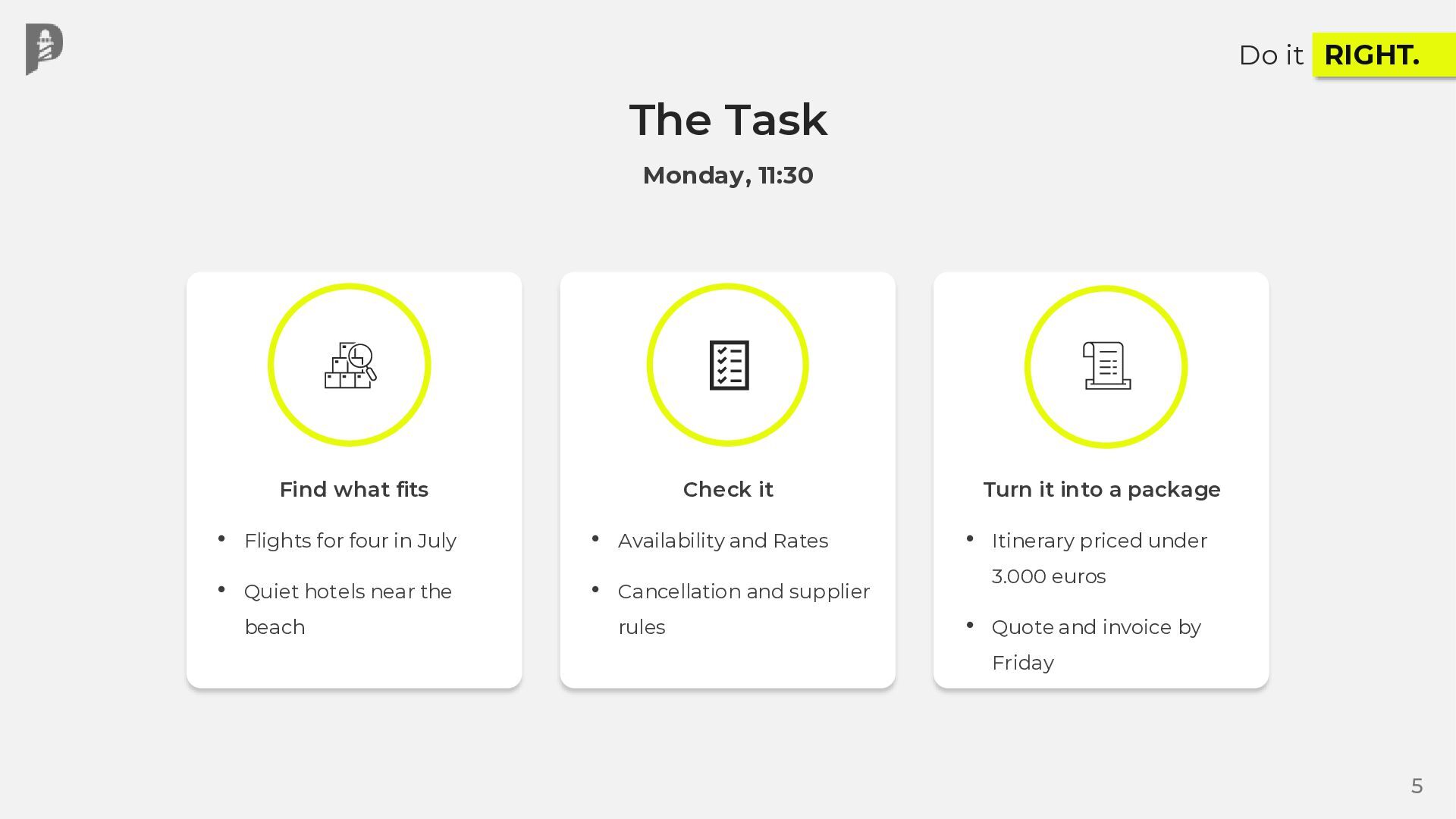
  3. Do it RIGHT. The Task Monday, 11:30 Find what fits

    Check it • Flights for four in July • Availability and Rates • Quiet hotels near the • Cancellation and supplier beach rules Turn it into a package • Itinerary priced under 3.000 euros • Quote and invoice by Friday 5
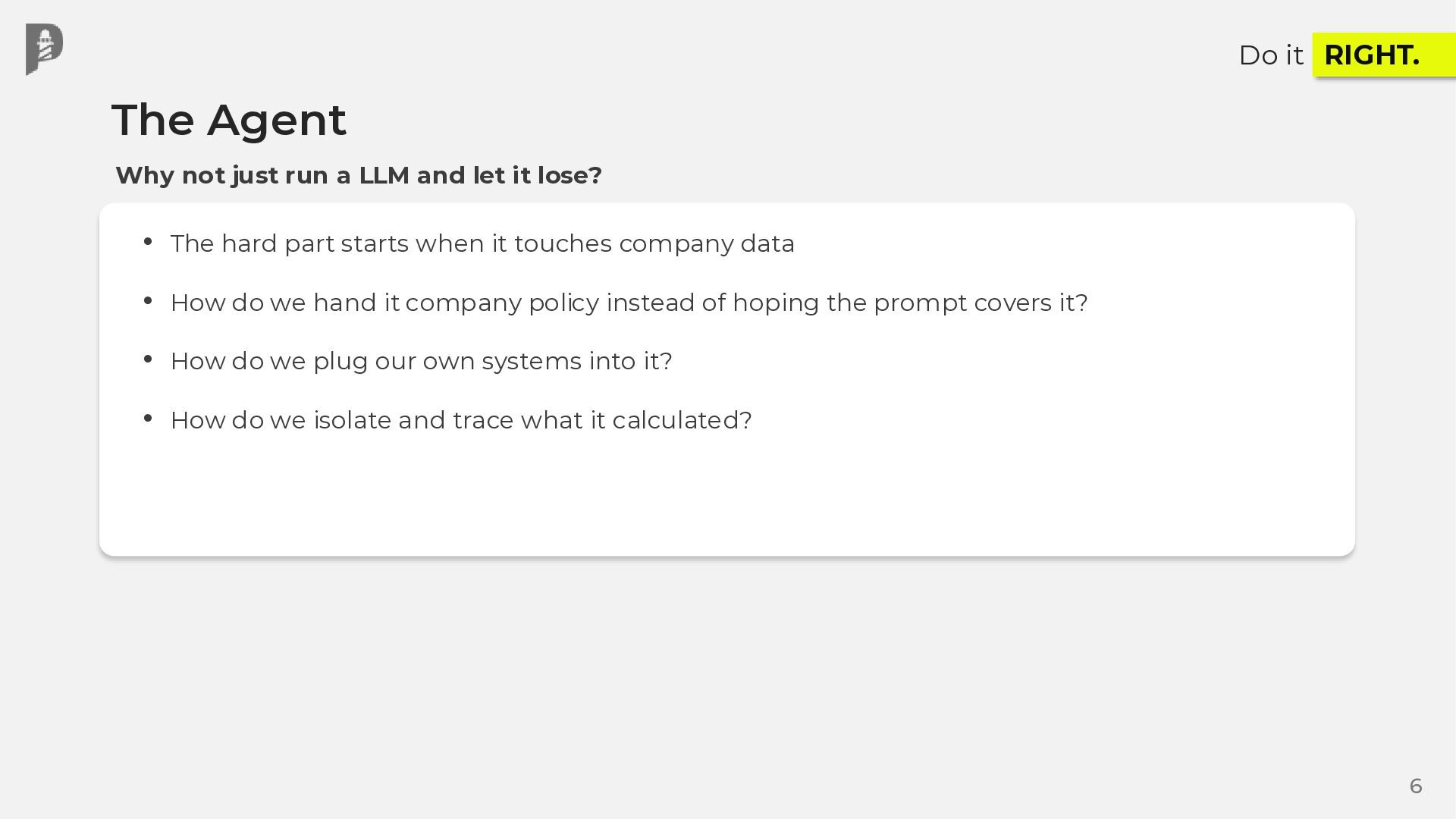
  4. Do it RIGHT. The Agent Why not just run a

    LLM and let it lose? • The hard part starts when it touches company data • How do we hand it company policy instead of hoping the prompt covers it? • How do we plug our own systems into it? • How do we isolate and trace what it calculated? 6
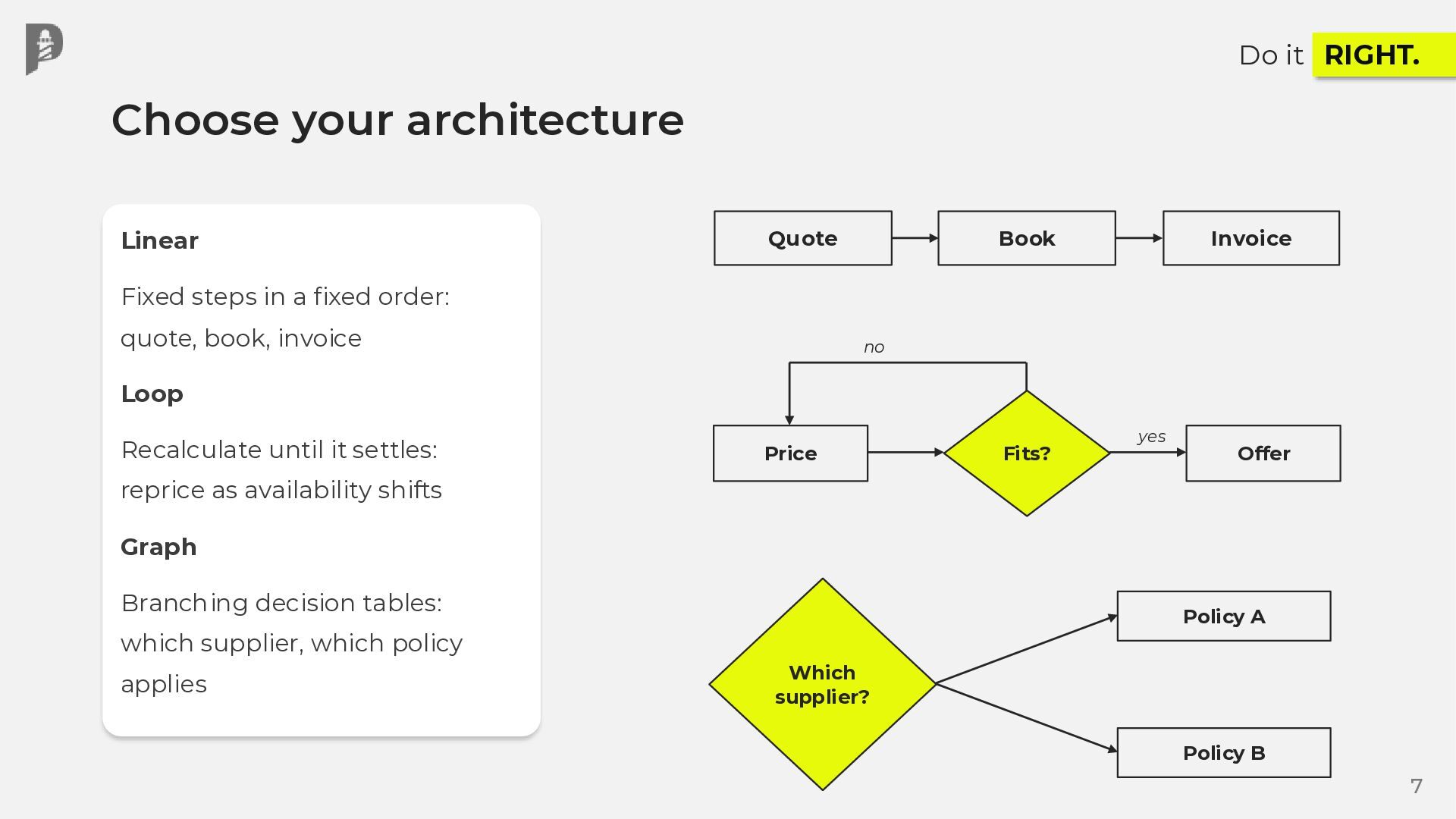
  5. Do it RIGHT. Choose your architecture Linear Quote Book Invoice

    Fixed steps in a fixed order: quote, book, invoice no Loop Recalculate until it settles: Price Fits? yes Offer reprice as availability shifts Graph Branching decision tables: Policy A which supplier, which policy applies Which supplier? Policy B 7
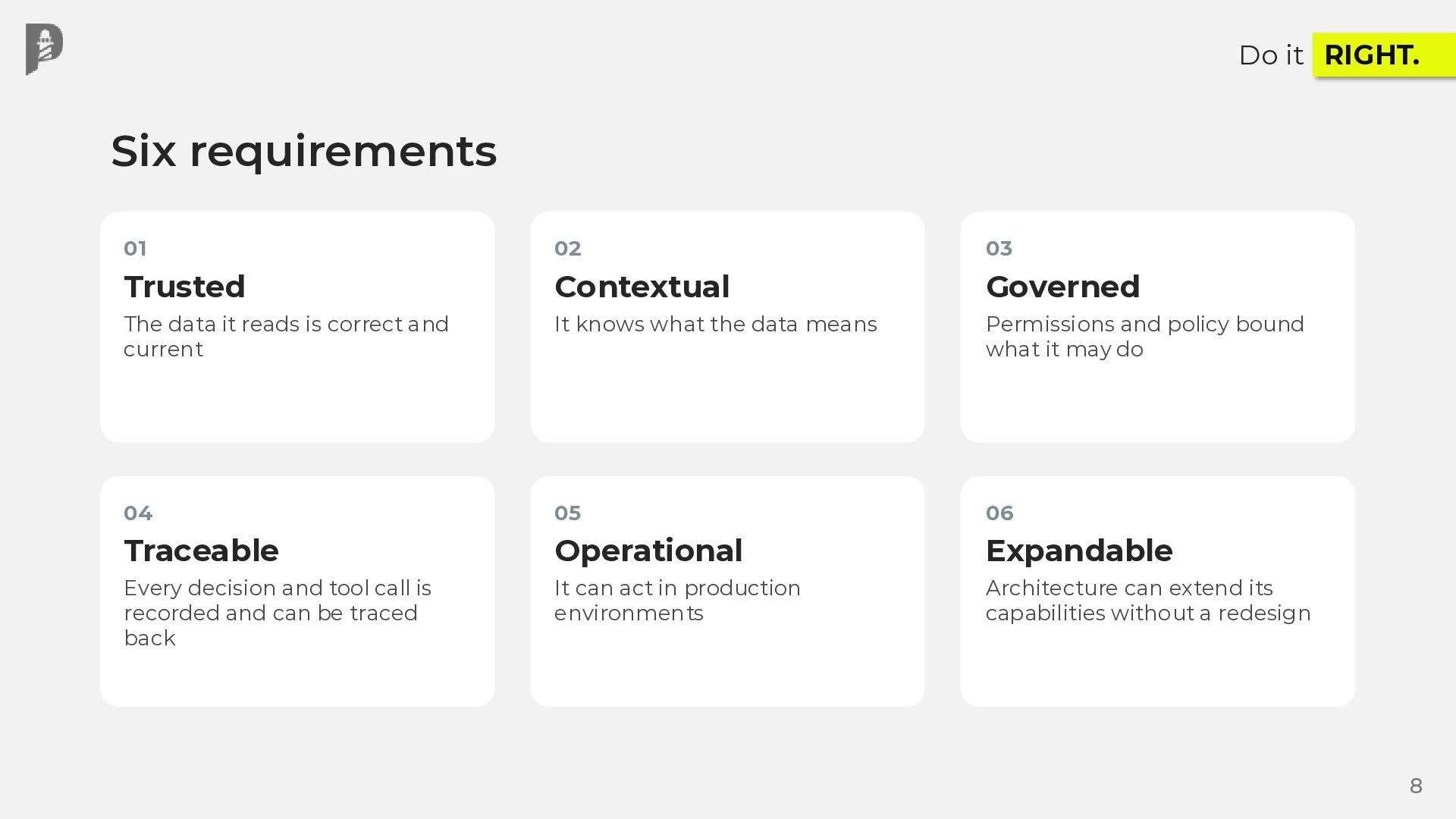
  6. Do it RIGHT. Six requirements 01 02 03 Trusted Contextual

    Governed The data it reads is correct and current It knows what the data means Permissions and policy bound what it may do 04 05 06 Traceable Operational Expandable Every decision and tool call is recorded and can be traced back It can act in production environments Architecture can extend its capabilities without a redesign 8
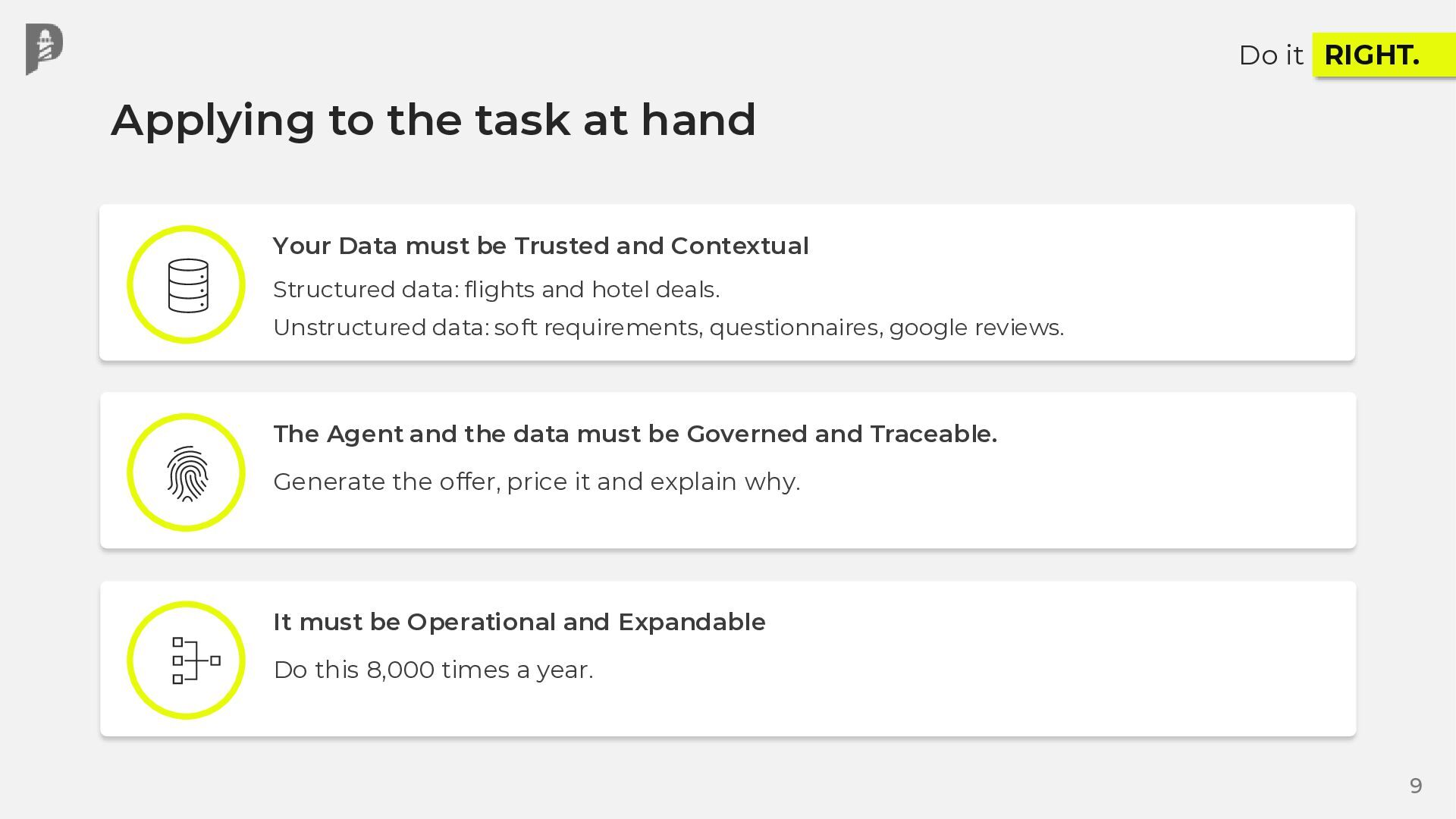
  7. Do it RIGHT. Applying to the task at hand Your

    Data must be Trusted and Contextual Structured data: flights and hotel deals. Unstructured data: soft requirements, questionnaires, google reviews. The Agent and the data must be Governed and Traceable. Generate the offer, price it and explain why. It must be Operational and Expandable Do this 8,000 times a year. 9
  8. Do it RIGHT. Your agent believes anything you feed it

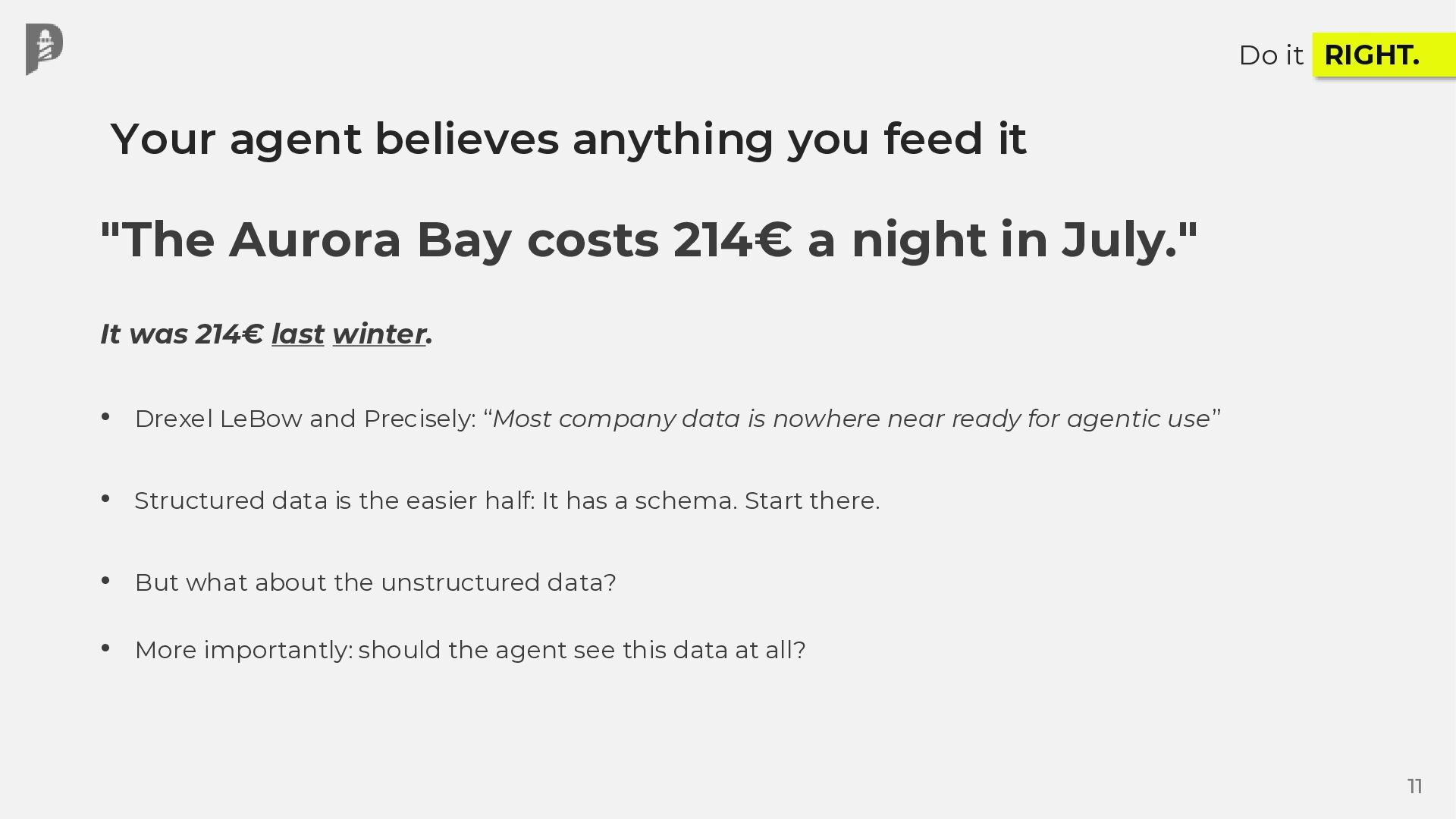
    "The Aurora Bay costs 214€ a night in July." It was 214€ last winter. • Drexel LeBow and Precisely: “Most company data is nowhere near ready for agentic use” • Structured data is the easier half: It has a schema. Start there. • But what about the unstructured data? • More importantly: should the agent see this data at all? 11
  9. Do it RIGHT. Structured Data: Hotel deals are contracts 600

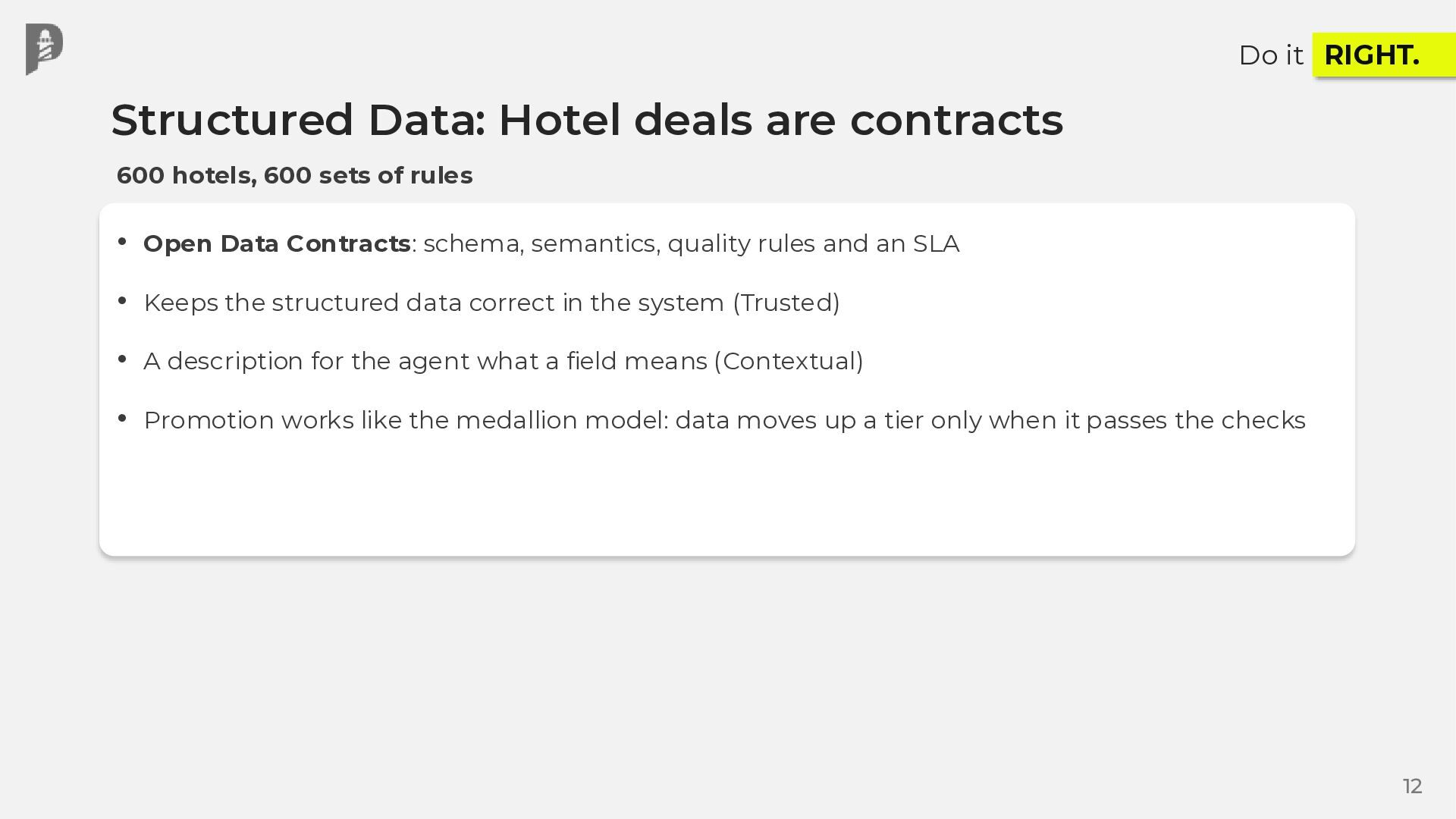
    hotels, 600 sets of rules • Open Data Contracts: schema, semantics, quality rules and an SLA • Keeps the structured data correct in the system (Trusted) • A description for the agent what a field means (Contextual) • Promotion works like the medallion model: data moves up a tier only when it passes the checks 12
  10. Do it RIGHT. What a data contract contains The hotel

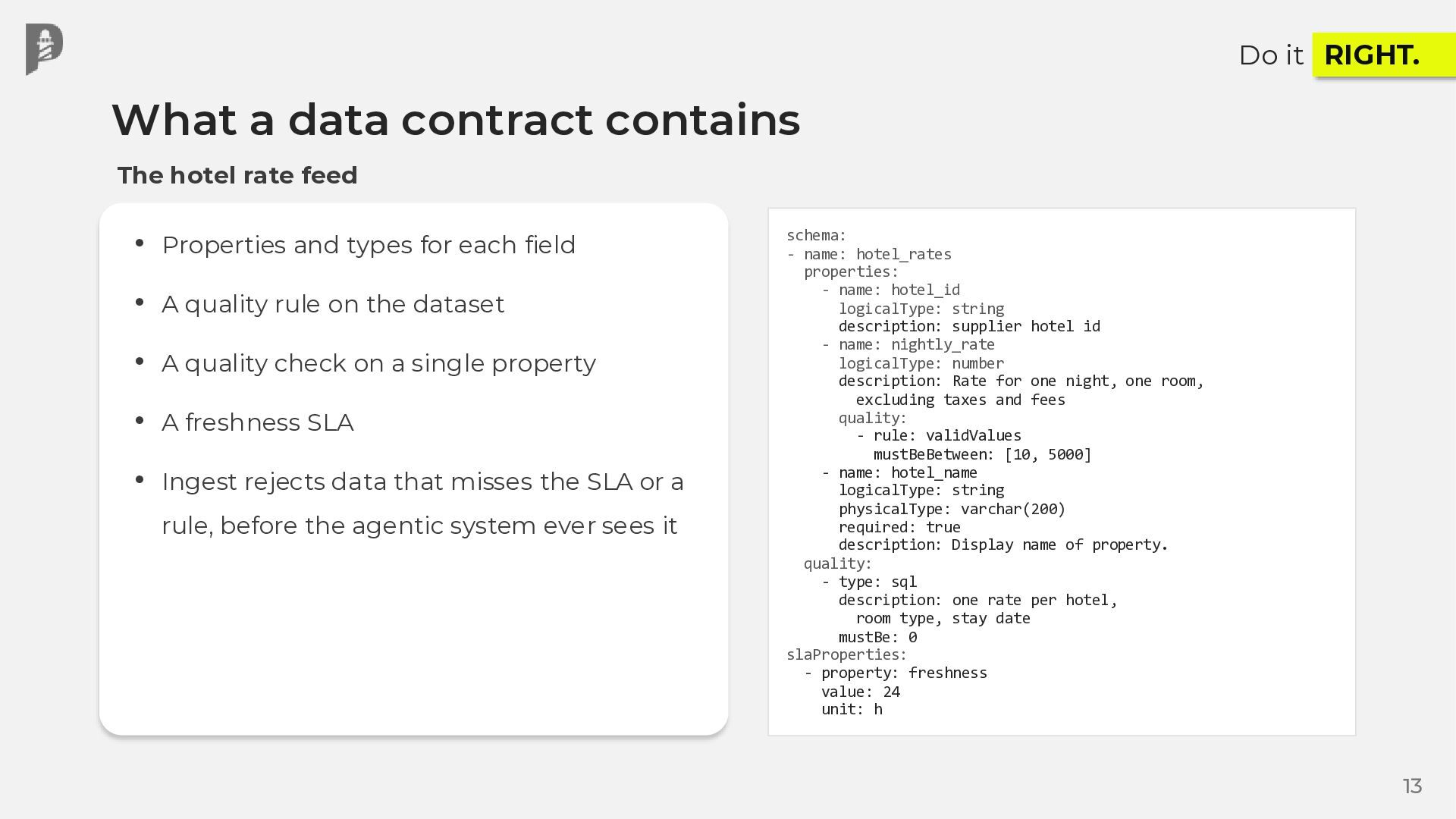
    rate feed • Properties and types for each field • A quality rule on the dataset • A quality check on a single property • A freshness SLA • Ingest rejects data that misses the SLA or a rule, before the agentic system ever sees it schema: - name: hotel_rates properties: - name: hotel_id logicalType: string description: supplier hotel id - name: nightly_rate logicalType: number description: Rate for one night, one room, excluding taxes and fees quality: - rule: validValues mustBeBetween: [10, 5000] - name: hotel_name logicalType: string physicalType: varchar(200) required: true description: Display name of property. quality: - type: sql description: one rate per hotel, room type, stay date mustBe: 0 slaProperties: - property: freshness value: 24 unit: h 13
  11. Do it RIGHT. Unstructured data: The data without a field

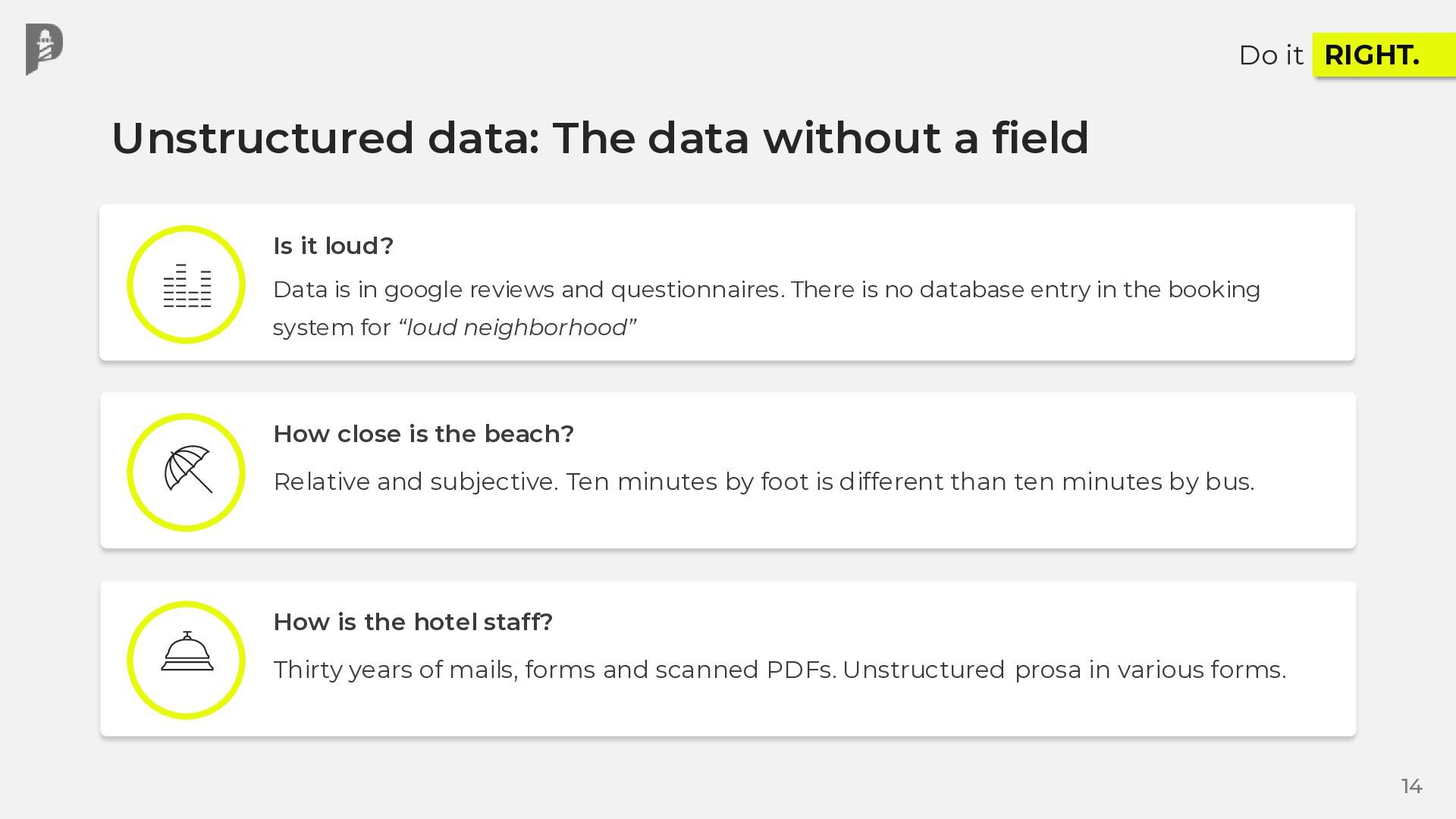
    Is it loud? Data is in google reviews and questionnaires. There is no database entry in the booking system for “loud neighborhood” How close is the beach? Relative and subjective. Ten minutes by foot is different than ten minutes by bus. How is the hotel staff? Thirty years of mails, forms and scanned PDFs. Unstructured prosa in various forms. 14
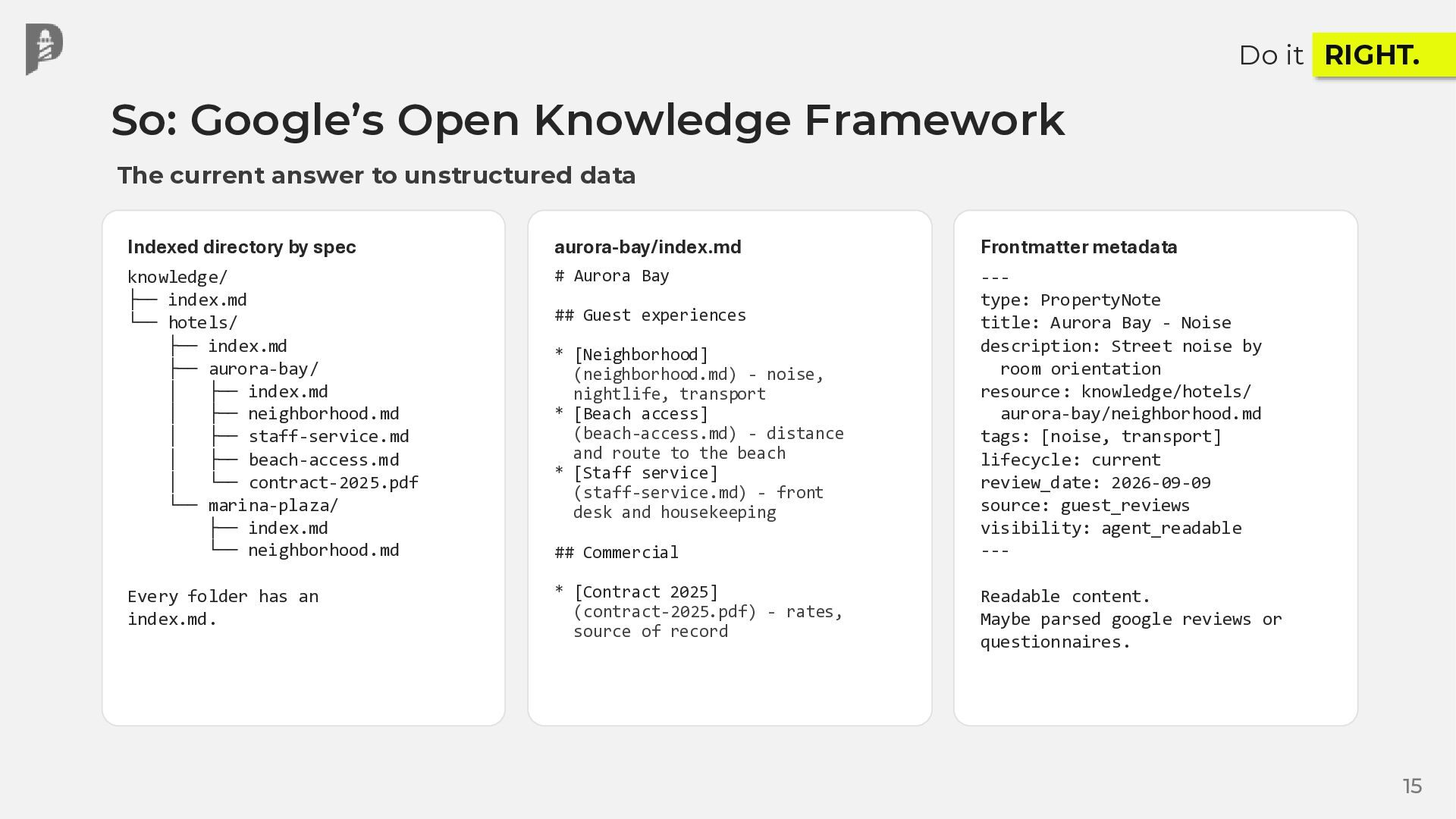
  12. Do it RIGHT. So: Google’s Open Knowledge Framework The current

    answer to unstructured data Indexed directory by spec aurora-bay/index.md Frontmatter metadata knowledge/ ├── index.md └── hotels/ ├── index.md ├── aurora-bay/ │ ├── index.md │ ├── neighborhood.md │ ├── staff-service.md │ ├── beach-access.md │ └── contract-2025.pdf └── marina-plaza/ ├── index.md └── neighborhood.md # Aurora Bay --type: PropertyNote title: Aurora Bay - Noise description: Street noise by room orientation resource: knowledge/hotels/ aurora-bay/neighborhood.md tags: [noise, transport] lifecycle: current review_date: 2026-09-09 source: guest_reviews visibility: agent_readable --- Every folder has an index.md. * [Contract 2025] (contract-2025.pdf) - rates, source of record ## Guest experiences * [Neighborhood] (neighborhood.md) - noise, nightlife, transport * [Beach access] (beach-access.md) - distance and route to the beach * [Staff service] (staff-service.md) - front desk and housekeeping ## Commercial Readable content. Maybe parsed google reviews or questionnaires. 15
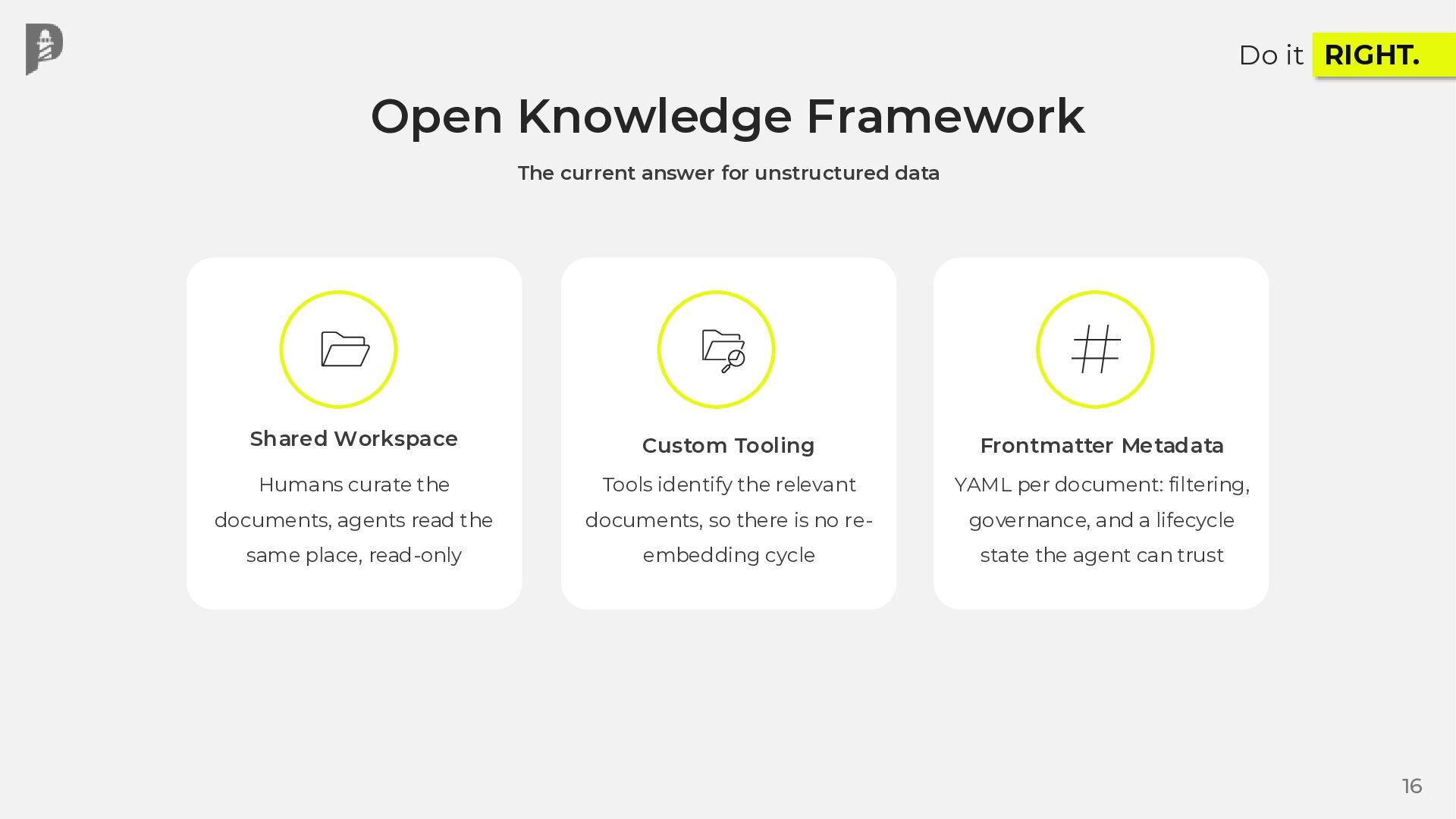
  13. Do it RIGHT. Open Knowledge Framework The current answer for

    unstructured data Shared Workspace Custom Tooling Frontmatter Metadata Humans curate the Tools identify the relevant YAML per document: filtering, documents, agents read the documents, so there is no re- governance, and a lifecycle same place, read-only embedding cycle state the agent can trust 16
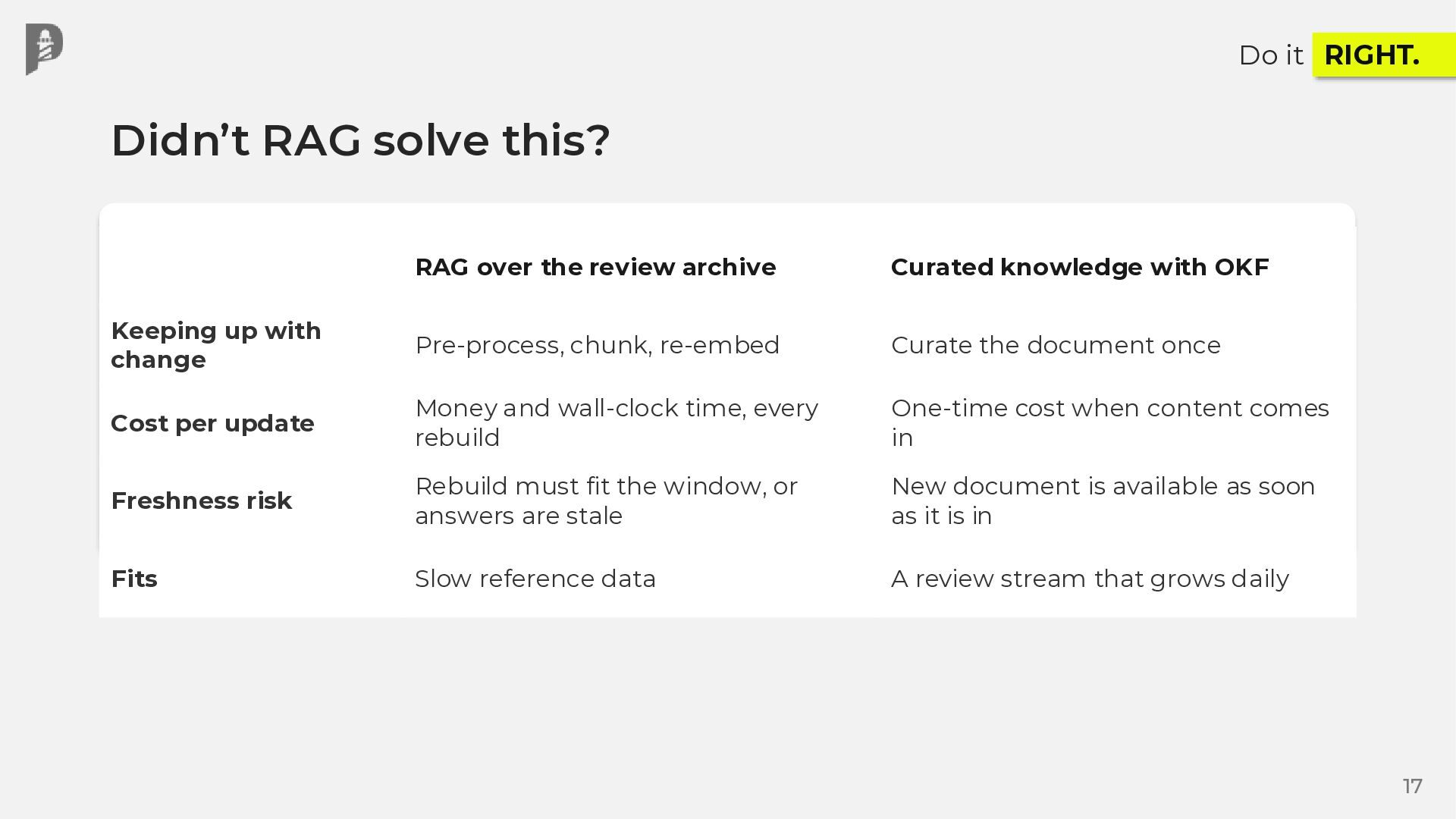
  14. Do it RIGHT. Didn’t RAG solve this? RAG over the

    review archive Curated knowledge with OKF Keeping up with change Pre-process, chunk, re-embed Curate the document once Cost per update Money and wall-clock time, every rebuild One-time cost when content comes in Freshness risk Rebuild must fit the window, or answers are stale New document is available as soon as it is in Fits Slow reference data A review stream that grows daily 17
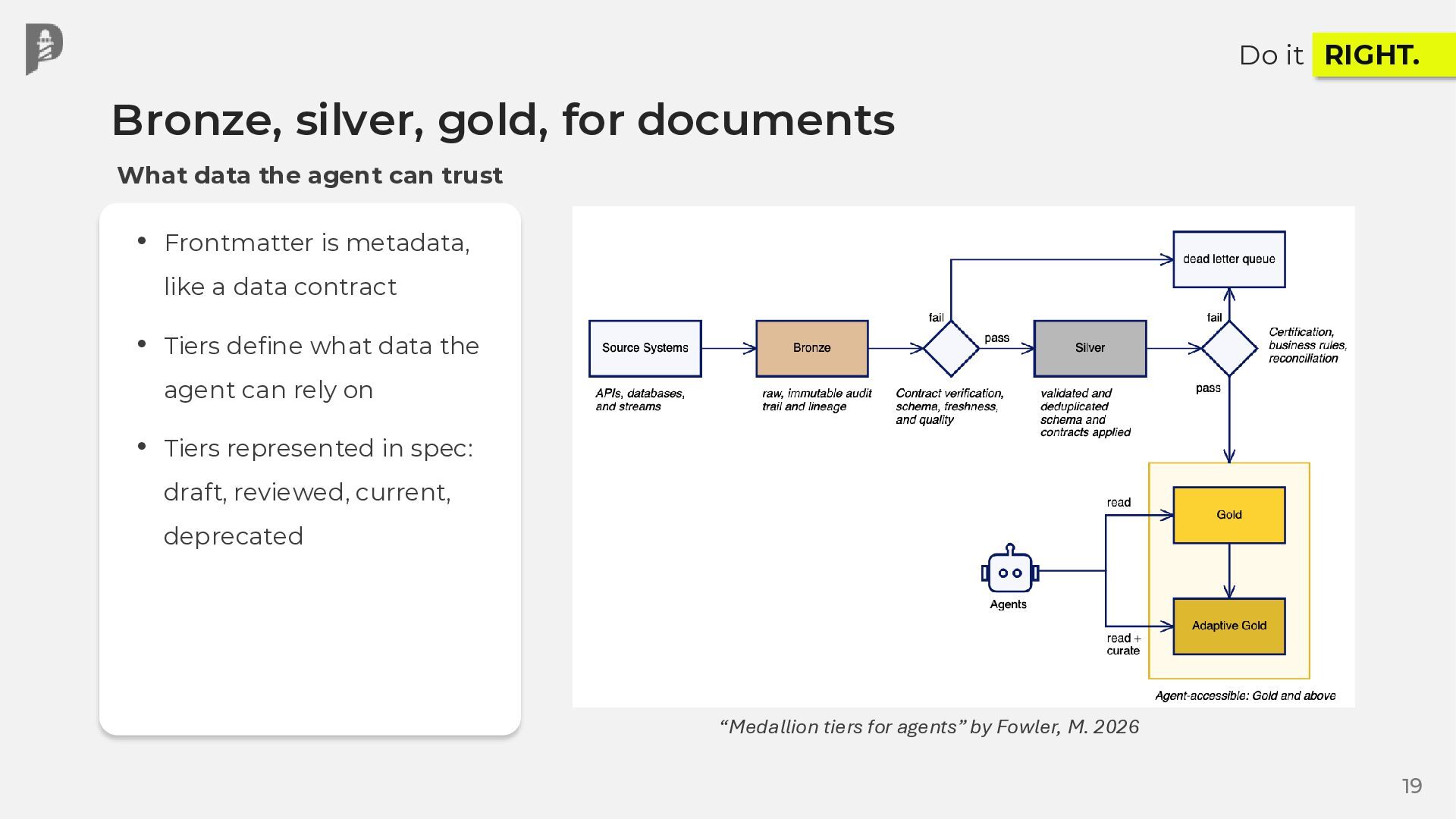
  15. Do it RIGHT. Bronze, silver, gold, for documents What data

    the agent can trust • Frontmatter is metadata, like a data contract • Tiers define what data the agent can rely on • Tiers represented in spec: draft, reviewed, current, deprecated “Medallion tiers for agents” by Fowler, M. 2026 19
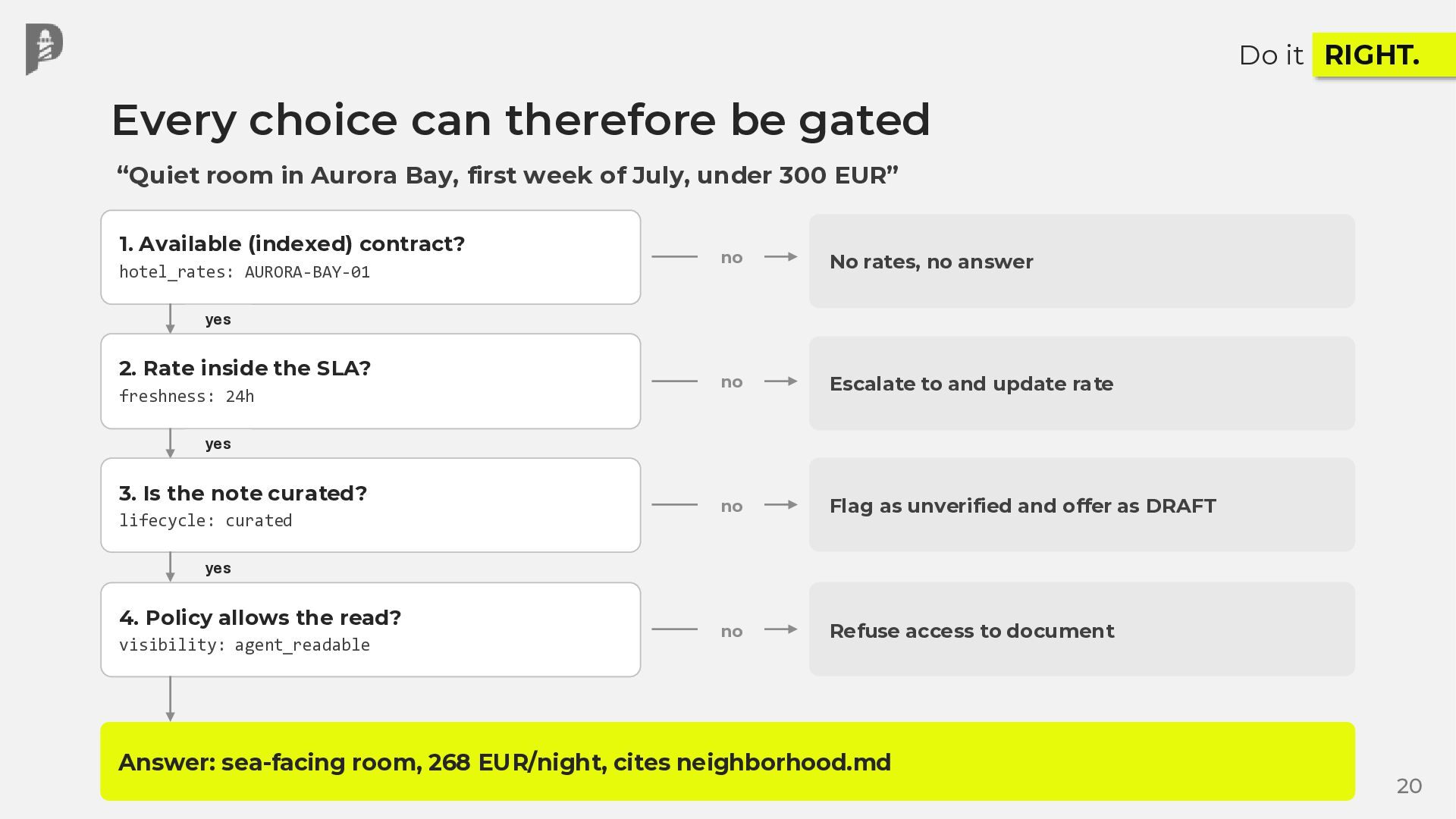
  16. Do it RIGHT. Every choice can therefore be gated “Quiet

    room in Aurora Bay, first week of July, under 300 EUR” 1. Available (indexed) contract? hotel_rates: AURORA-BAY-01 no No rates, no answer no Escalate to and update rate no Flag as unverified and offer as DRAFT no Refuse access to document yes 2. Rate inside the SLA? freshness: 24h yes 3. Is the note curated? lifecycle: curated yes 4. Policy allows the read? visibility: agent_readable Answer: sea-facing room, 268 EUR/night, cites neighborhood.md 20
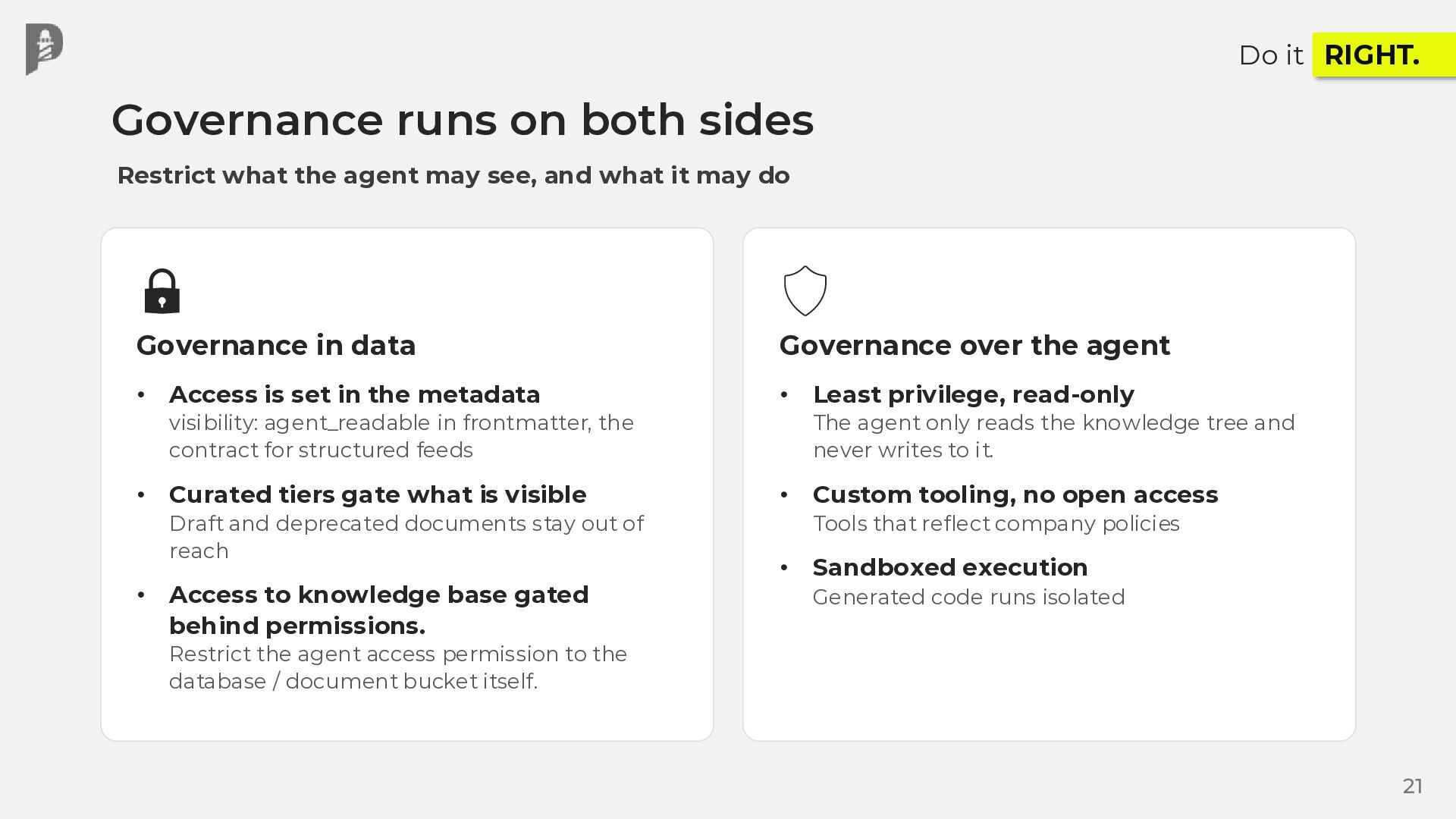
  17. Do it RIGHT. Governance runs on both sides Restrict what

    the agent may see, and what it may do Governance in data • Access is set in the metadata Governance over the agent • visibility: agent_readable in frontmatter, the contract for structured feeds • Curated tiers gate what is visible Draft and deprecated documents stay out of reach • Access to knowledge base gated behind permissions. Least privilege, read-only The agent only reads the knowledge tree and never writes to it. • Custom tooling, no open access Tools that reflect company policies • Sandboxed execution Generated code runs isolated Restrict the agent access permission to the database / document bucket itself. 21
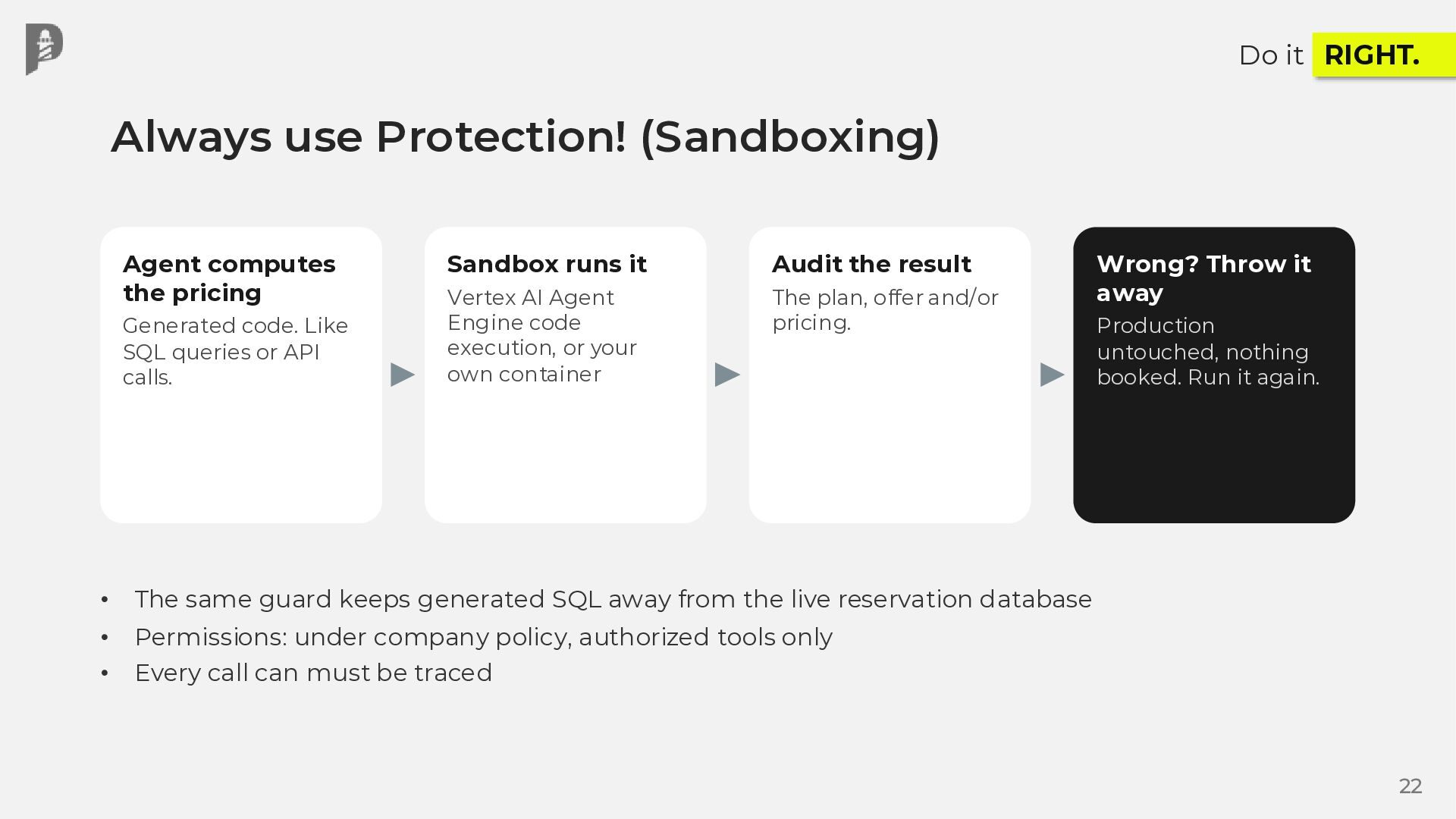
  18. Do it RIGHT. Always use Protection! (Sandboxing) Agent computes the

    pricing Generated code. Like SQL queries or API calls. Sandbox runs it Audit the result Vertex AI Agent Engine code execution, or your own container The plan, offer and/or pricing. • The same guard keeps generated SQL away from the live reservation database • • Permissions: under company policy, authorized tools only Every call can must be traced Wrong? Throw it away Production untouched, nothing booked. Run it again. 22
  19. Do it RIGHT. Why this hotel? Explaining the recommendation and

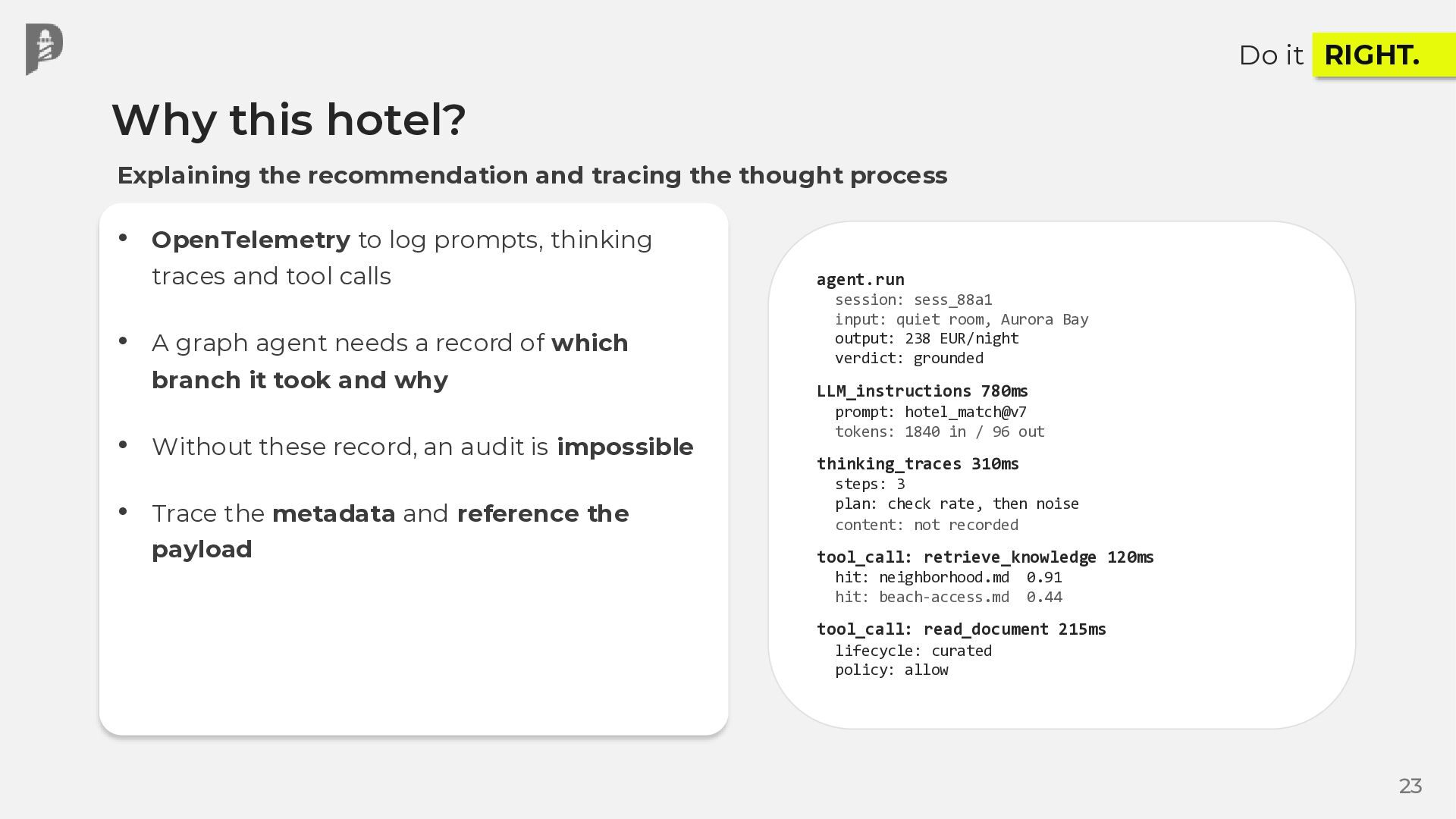
    tracing the thought process • • OpenTelemetry to log prompts, thinking traces and tool calls A graph agent needs a record of which branch it took and why • • Without these record, an audit is impossible Trace the metadata and reference the payload agent.run session: sess_88a1 input: quiet room, Aurora Bay output: 238 EUR/night verdict: grounded LLM_instructions 780ms prompt: hotel_match@v7 tokens: 1840 in / 96 out thinking_traces 310ms steps: 3 plan: check rate, then noise content: not recorded tool_call: retrieve_knowledge 120ms hit: neighborhood.md hit: beach-access.md 0.91 0.44 tool_call: read_document 215ms lifecycle: curated policy: allow 23
  20. Do it RIGHT. Replay the run, node by node Every

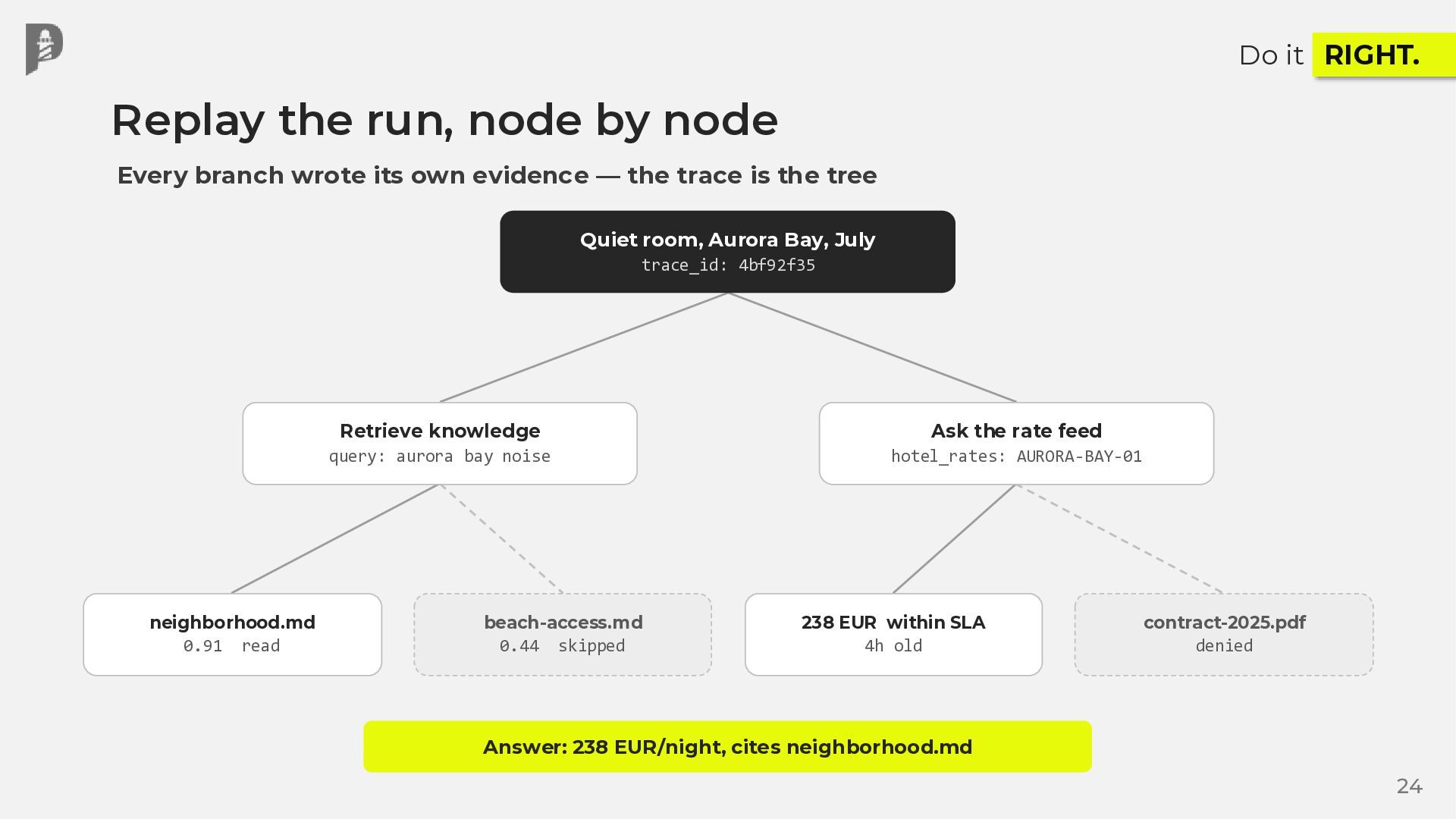
    branch wrote its own evidence — the trace is the tree Quiet room, Aurora Bay, July trace_id: 4bf92f35 neighborhood.md 0.91 read Retrieve knowledge Ask the rate feed query: aurora bay noise hotel_rates: AURORA-BAY-01 beach-access.md 0.44 skipped 238 EUR within SLA 4h old contract-2025.pdf denied Answer: 238 EUR/night, cites neighborhood.md 24