Share
Embed
Transcript
29 slides
-
• Welcome! • Who’s who? • Introduction to MongoDB •
Tutorial & exercises • High Availability tutorial if time Agenda -
About MongoDB • Background – Founded in 2007 – First
release of MongoDB in 2009 – $231M in funding • MongoDB – Core server – Native drivers • Subscriptions, Consulting, Training • Monitoring (MMS) -
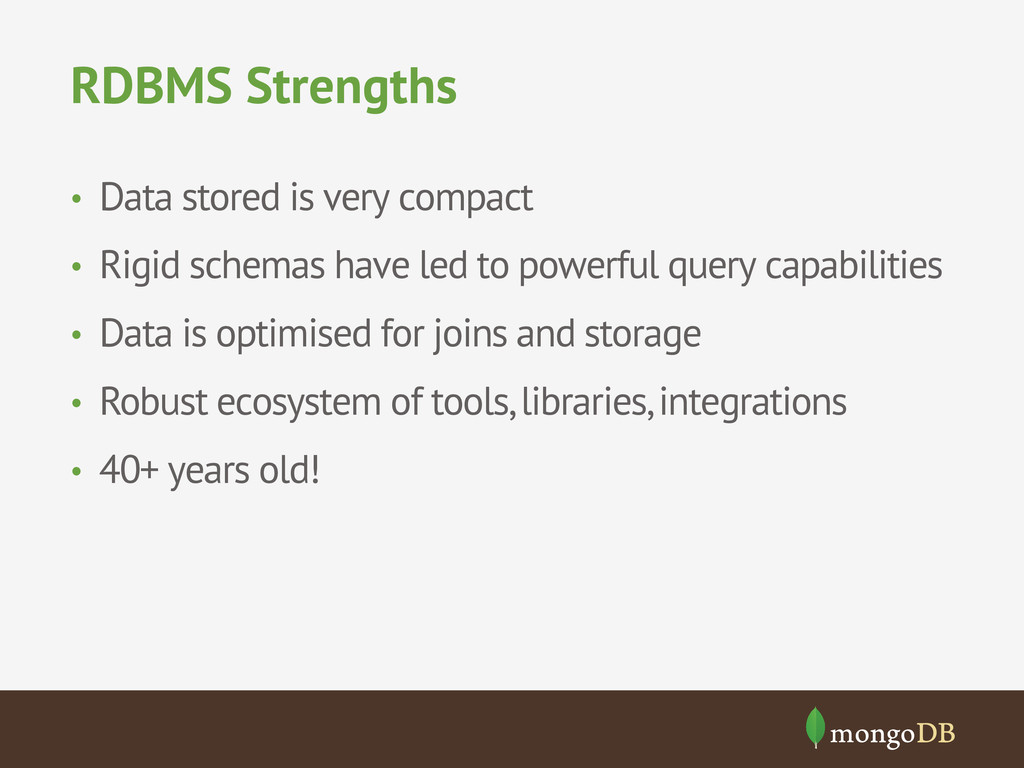
RDBMS Strengths • Data stored is very compact • Rigid
schemas have led to powerful query capabilities • Data is optimised for joins and storage • Robust ecosystem of tools, libraries, integrations • 40+ years old! -
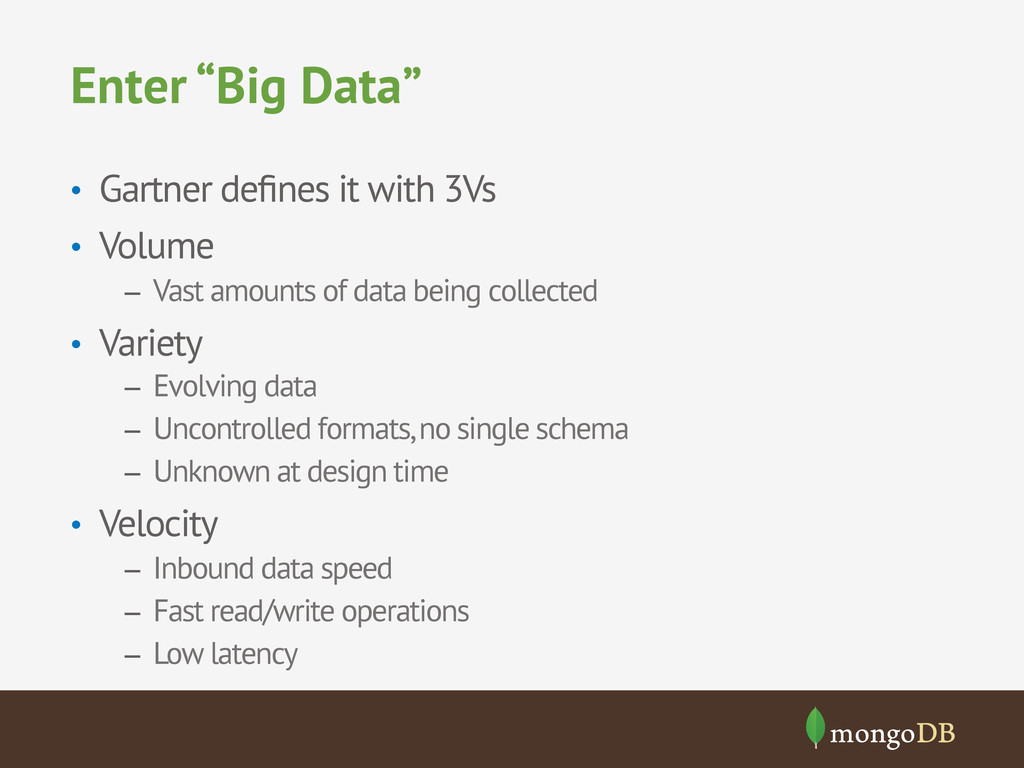
Enter “Big Data” • Gartner defines it with 3Vs •
Volume – Vast amounts of data being collected • Variety – Evolving data – Uncontrolled formats, no single schema – Unknown at design time • Velocity – Inbound data speed – Fast read/write operations – Low latency -
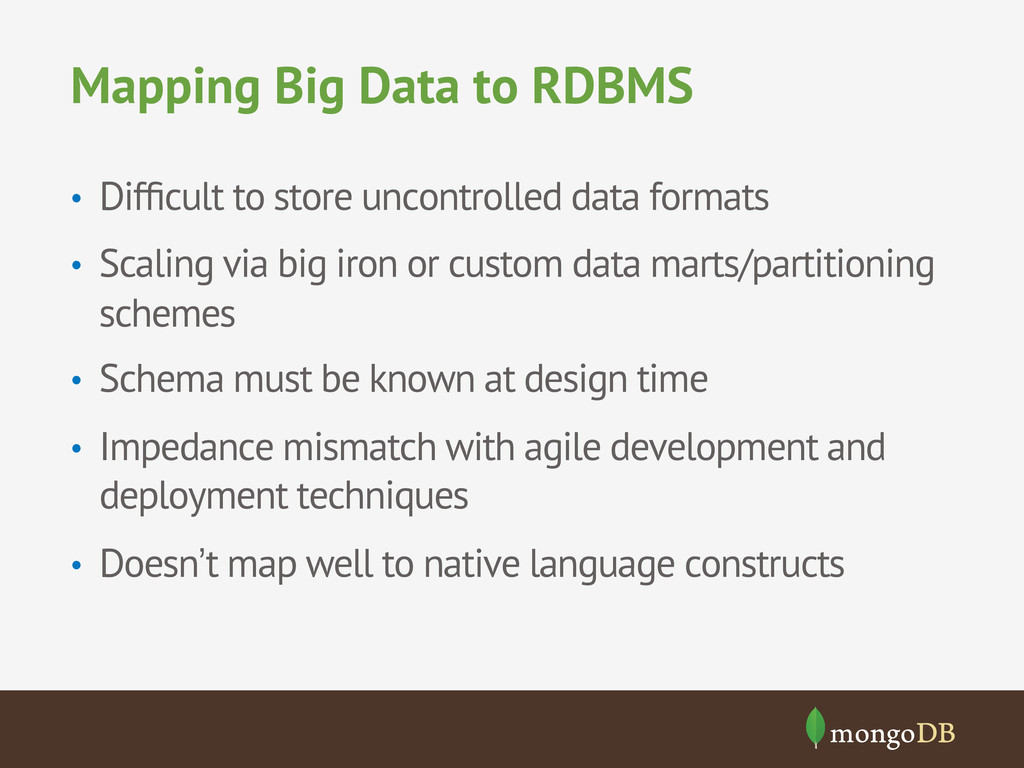
Mapping Big Data to RDBMS • Difficult to store uncontrolled
data formats • Scaling via big iron or custom data marts/partitioning schemes • Schema must be known at design time • Impedance mismatch with agile development and deployment techniques • Doesn’t map well to native language constructs -
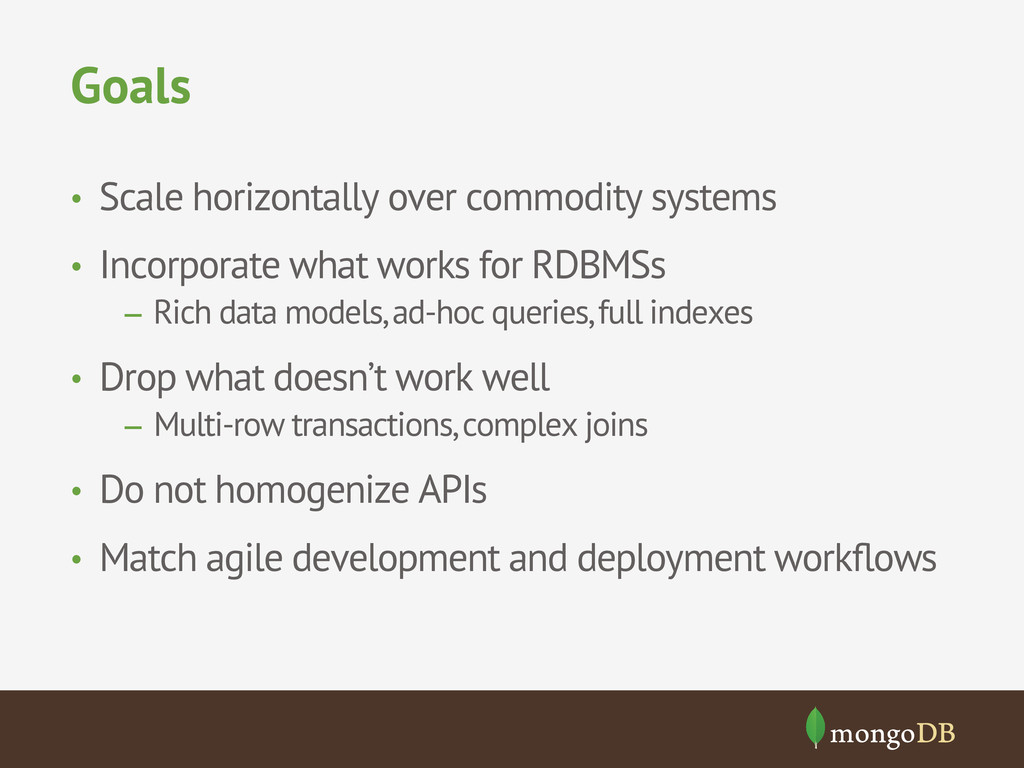
Goals • Scale horizontally over commodity systems • Incorporate what
works for RDBMSs – Rich data models, ad-hoc queries, full indexes • Drop what doesn’t work well – Multi-row transactions, complex joins • Do not homogenize APIs • Match agile development and deployment workflows -
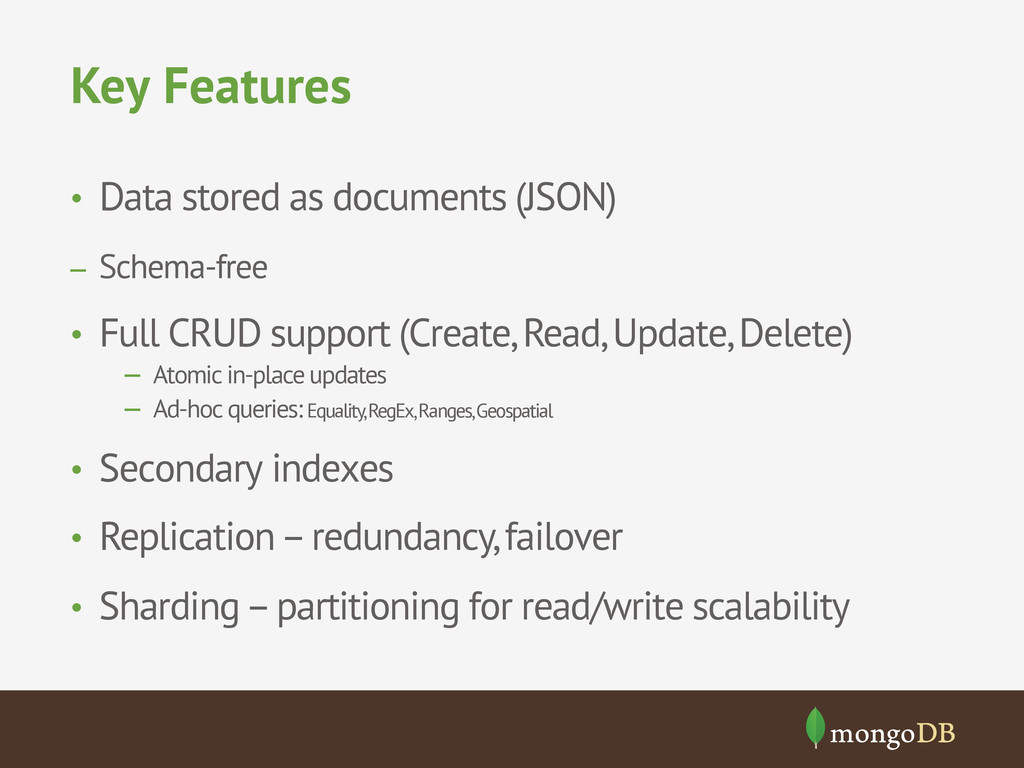
Key Features • Data stored as documents (JSON) – Schema-free
• Full CRUD support (Create, Read, Update, Delete) – Atomic in-place updates – Ad-hoc queries: Equality, RegEx, Ranges, Geospatial • Secondary indexes • Replication – redundancy, failover • Sharding – partitioning for read/write scalability -
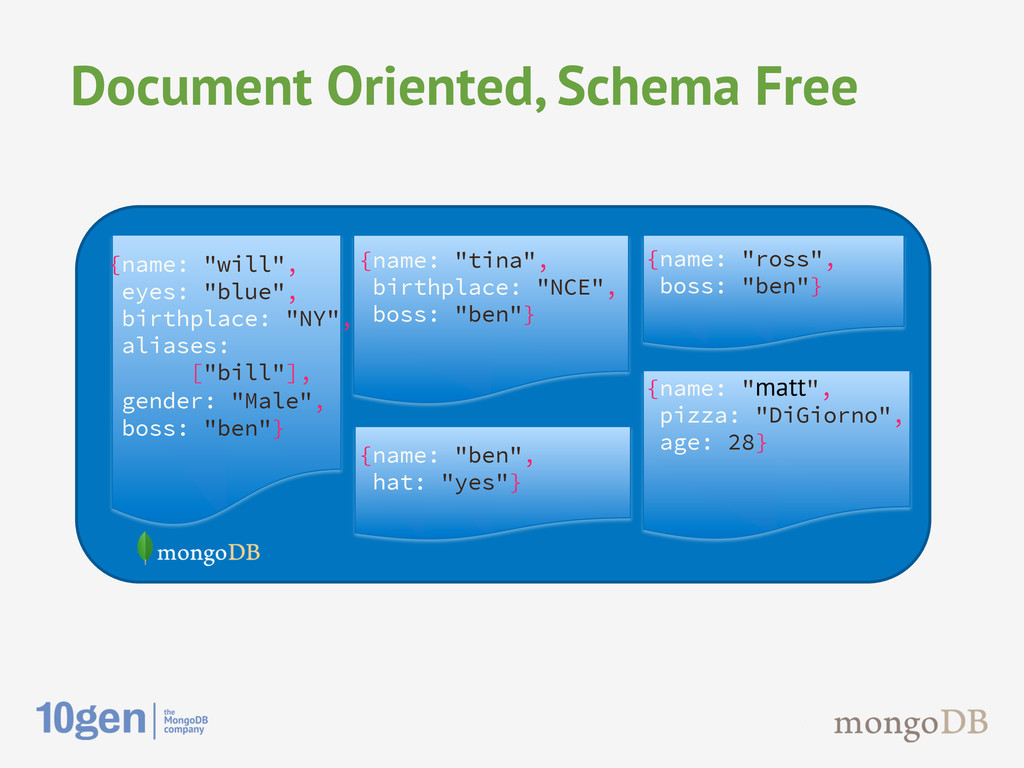
Document Oriented, Schema Free {name: "will", eyes: "blue", birthplace: "NY",
aliases: ["bill"], gender: "Male", boss: "ben"} {name: "tina", birthplace: "NCE", boss: "ben"} {name: "ross", boss: "ben"} {name: "ben", hat: "yes"} {name: "matt", pizza: "DiGiorno", age: 28} -
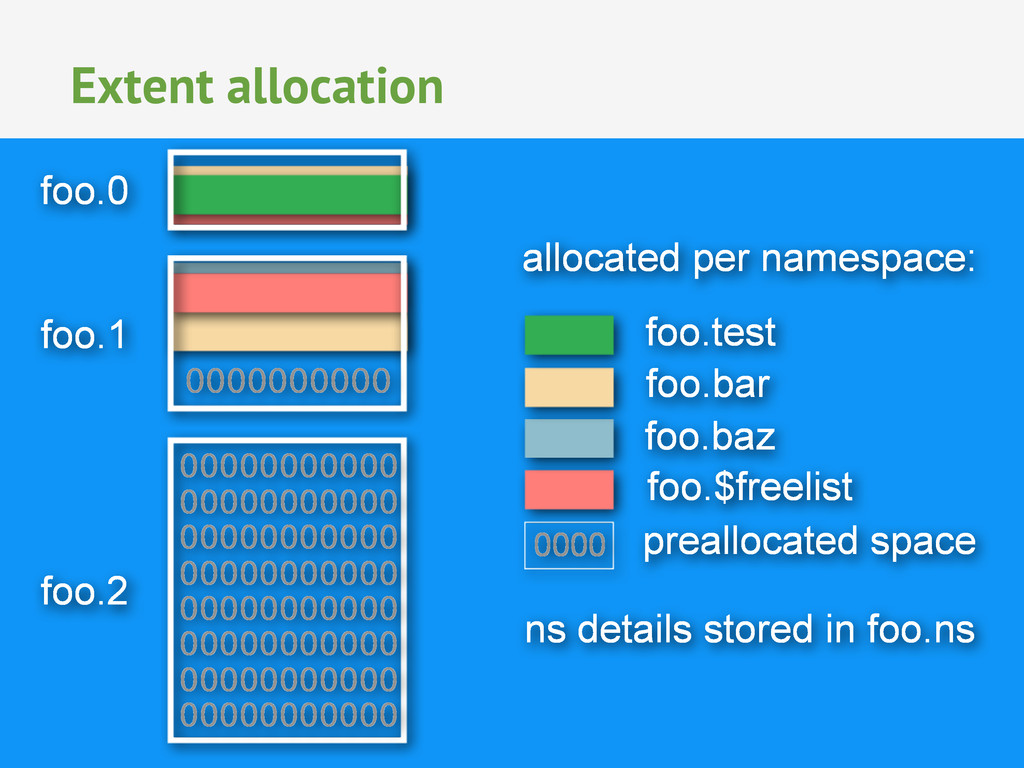
Extent allocation foo.0 foo.1 foo.2 00000000000 00000000000 00000000000 00000000000 00000000000
00000000000 00000000000 00000000000 preallocated space 0000000000 0000 foo.$freelist foo.baz foo.bar foo.test allocated per namespace: ns details stored in foo.ns -
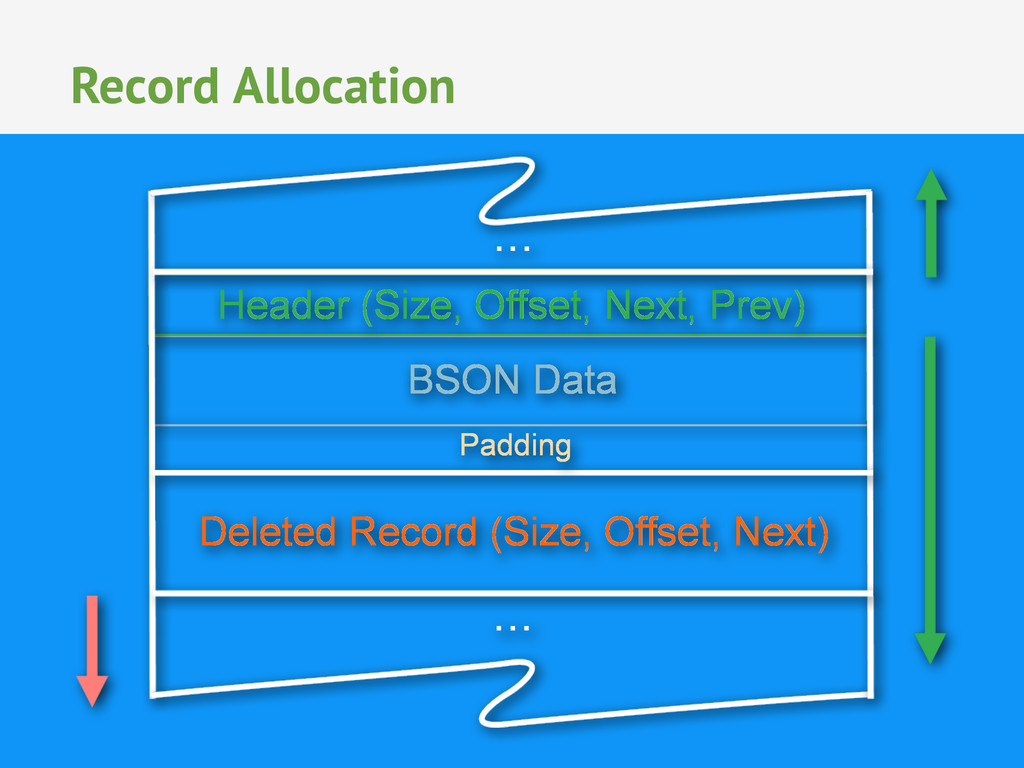
Record Allocation Deleted Record (Size, Offset, Next) BSON Data Header
(Size, Offset, Next, Prev) Padding ... ... -
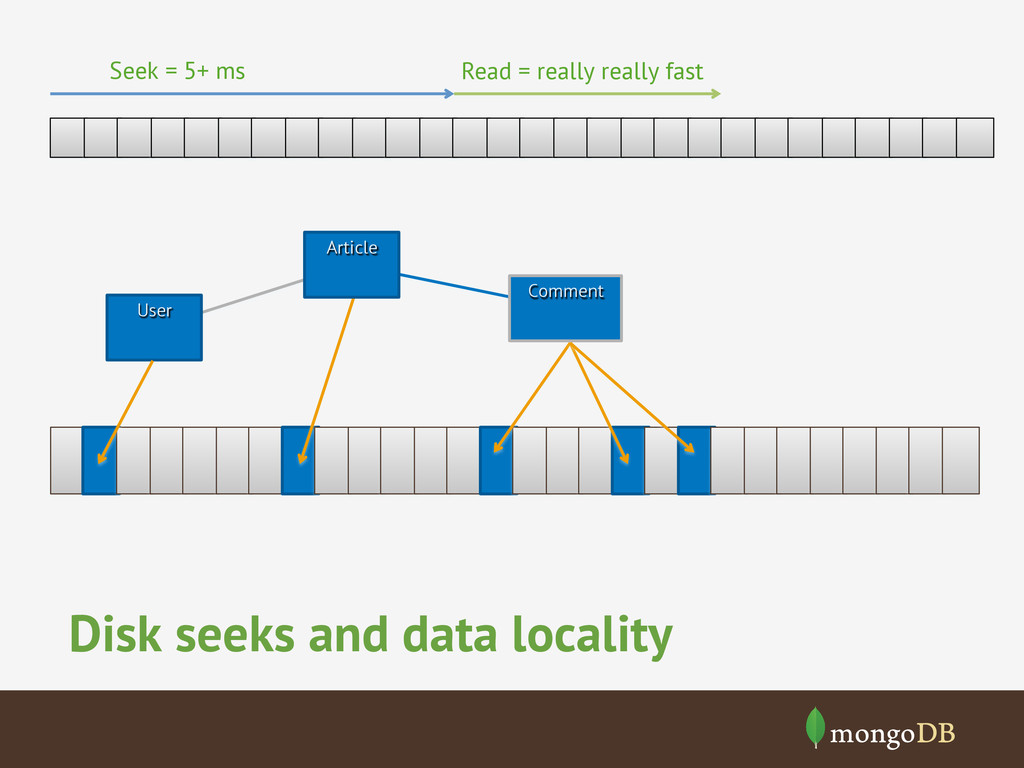
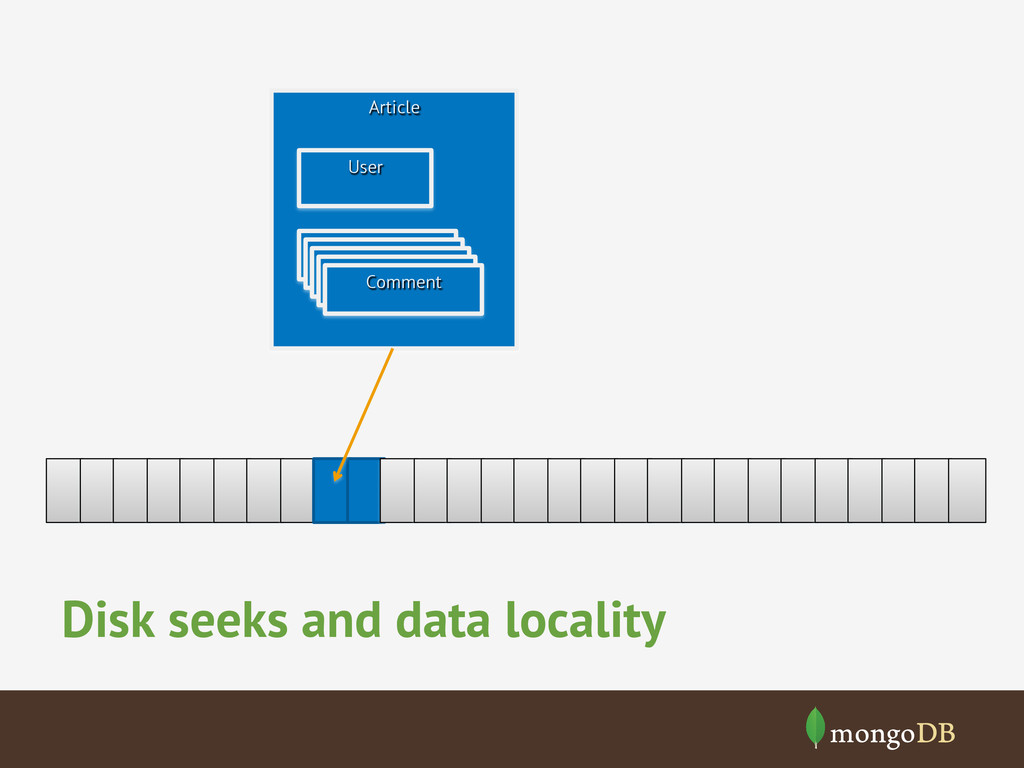
Seek = 5+ ms Read = really really fast Disk
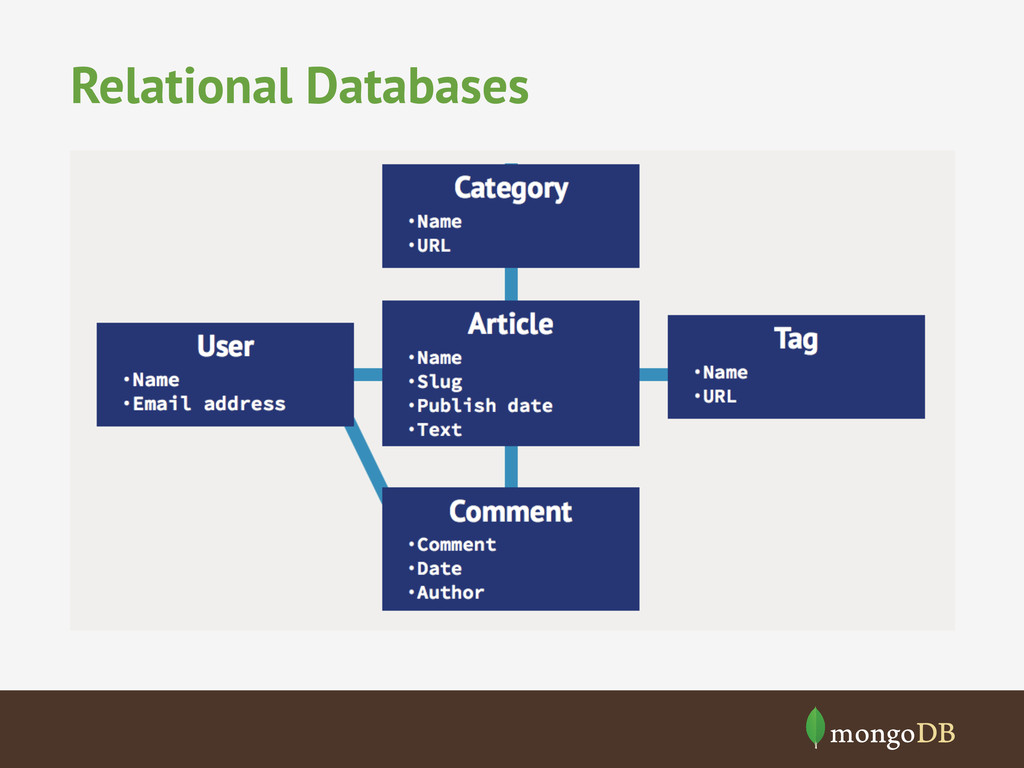
seeks and data locality User Comment Article -
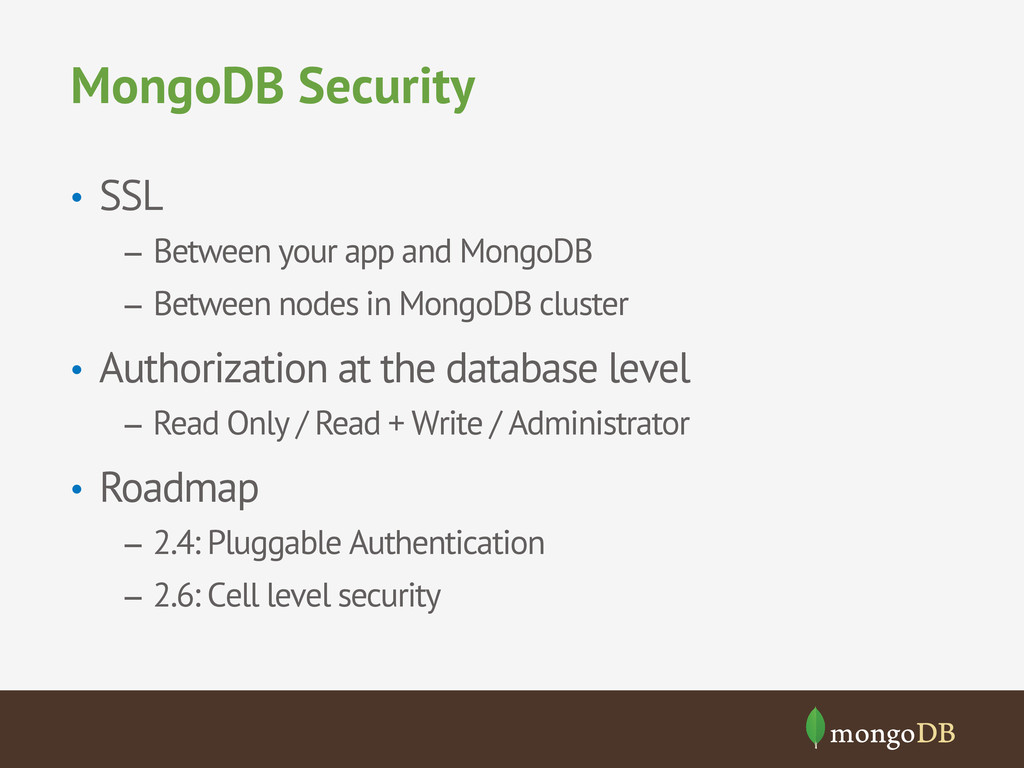
MongoDB Security • SSL – Between your app and MongoDB
– Between nodes in MongoDB cluster • Authorization at the database level – Read Only / Read + Write / Administrator • Roadmap – 2.4: Pluggable Authentication – 2.6: Cell level security -
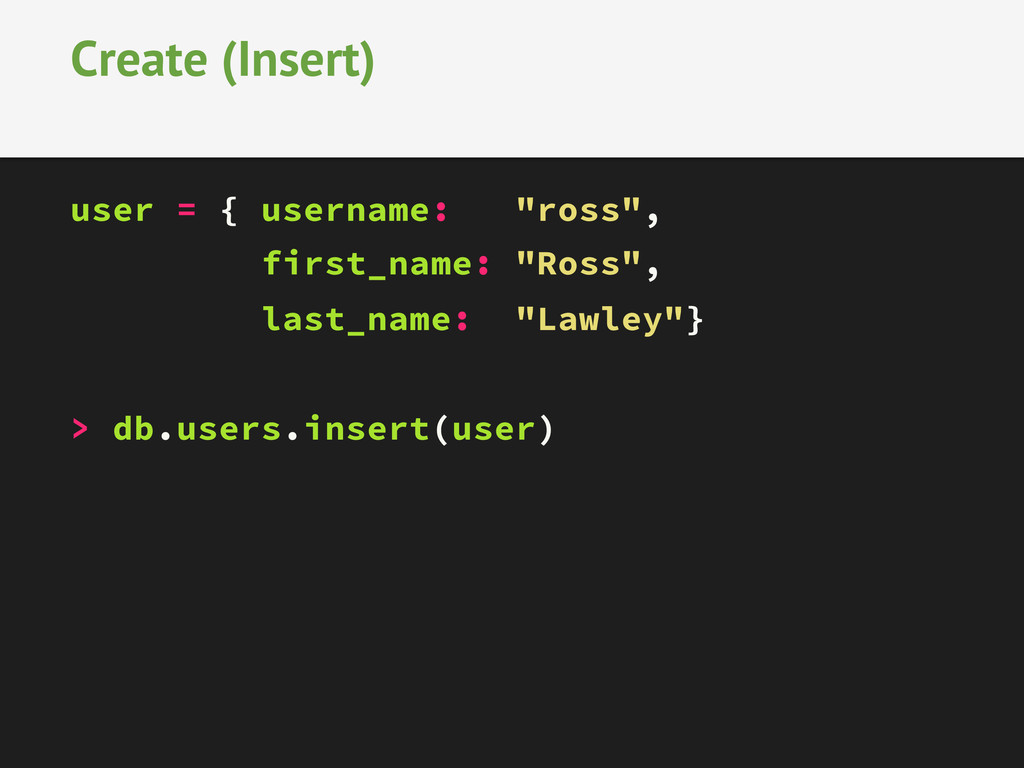
user = { username: "ross", first_name: "Ross", last_name: "Lawley"} >
db.users.insert(user) Create (Insert) -
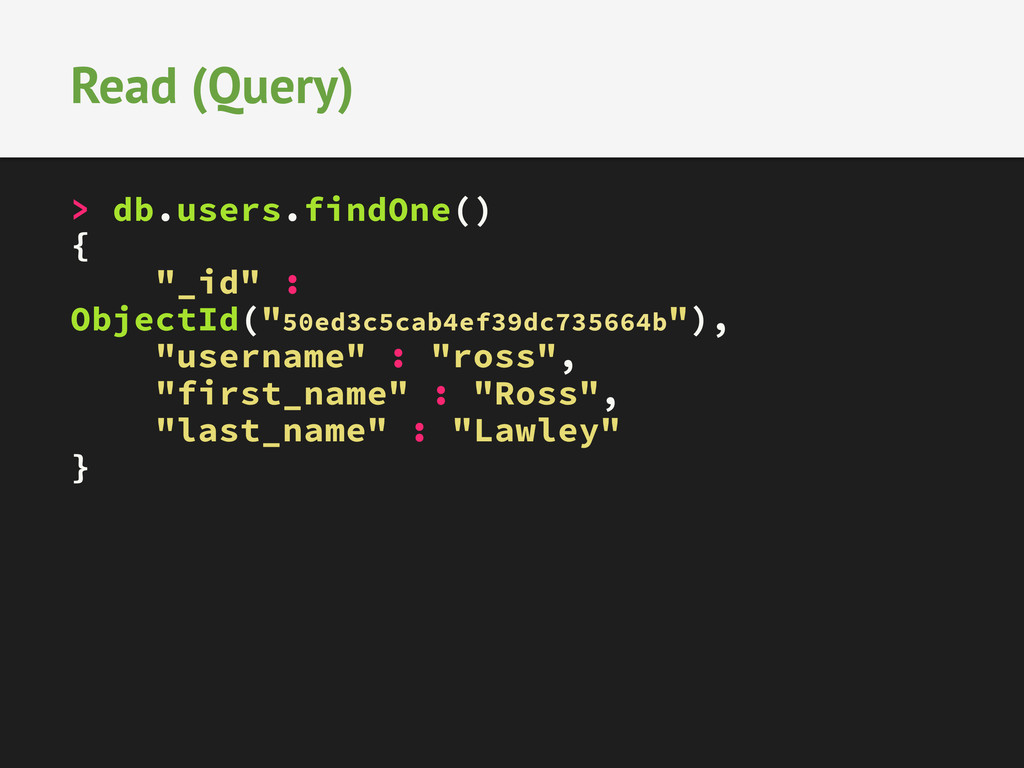
> db.users.findOne() { "_id" : ObjectId("50ed3c5cab4ef39dc735664b"), "username" : "ross", "first_name"
: "Ross", "last_name" : "Lawley" } Read (Query) -
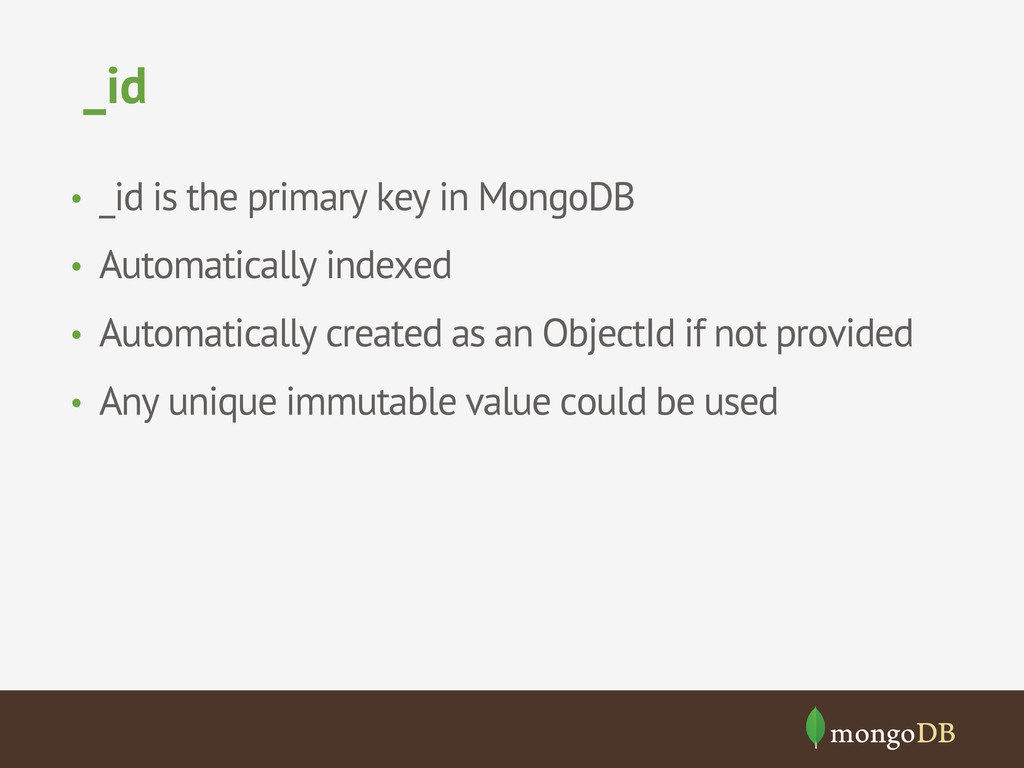
_id • _id is the primary key in MongoDB •
Automatically indexed • Automatically created as an ObjectId if not provided • Any unique immutable value could be used -
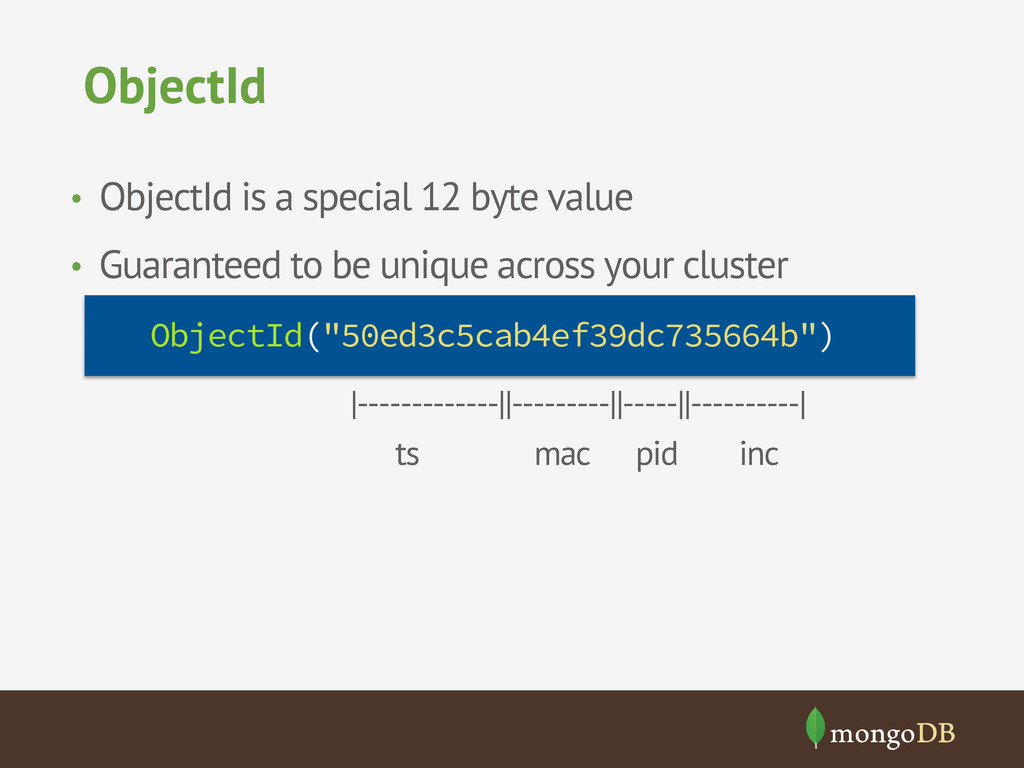
ObjectId • ObjectId is a special 12 byte value •
Guaranteed to be unique across your cluster ObjectId("50ed3c5cab4ef39dc735664b") |-------------||---------||-----||----------| ts mac pid inc -
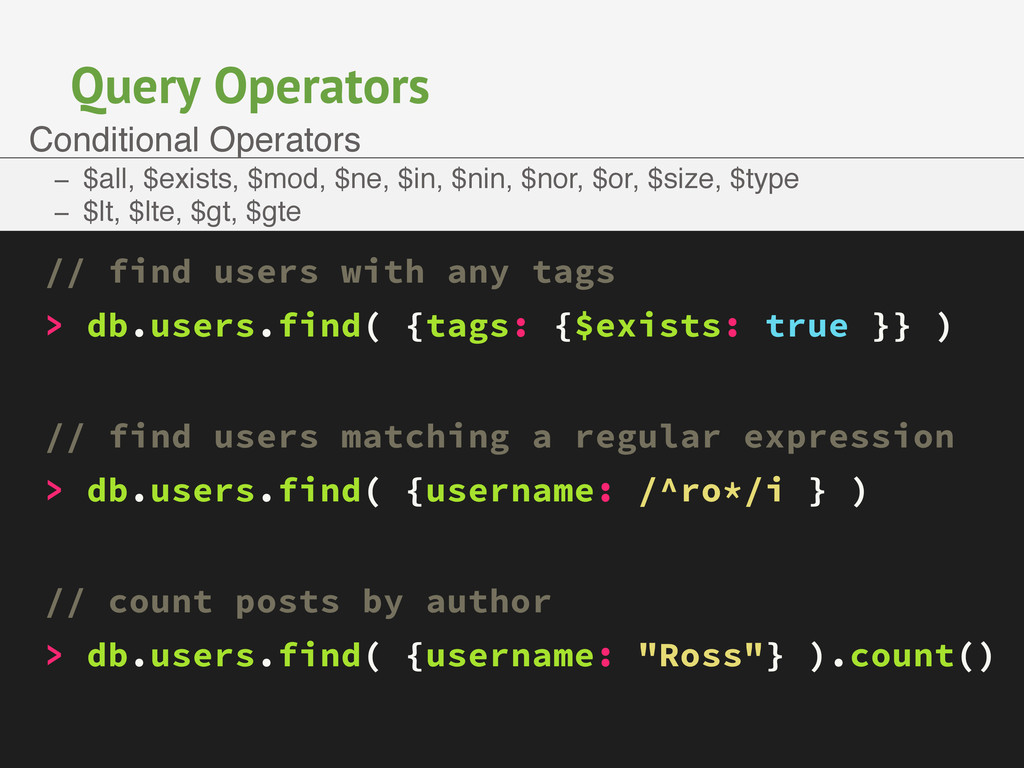
// find users with any tags > db.users.find( {tags: {$exists:
true }} ) // find users matching a regular expression > db.users.find( {username: /^ro*/i } ) // count posts by author > db.users.find( {username: "Ross"} ).count() Query Operators Conditional Operators – $all, $exists, $mod, $ne, $in, $nin, $nor, $or, $size, $type – $lt, $lte, $gt, $gte" -
> tags = ["superuser", "db_admin"] > address = { street:
"Scrutton Street", city: "London" } > db.users.update({}, {"$pushAll": {"tags": tags}, "$set": {"address": address}, "$inc": {"tag_count": 2}}) Update -
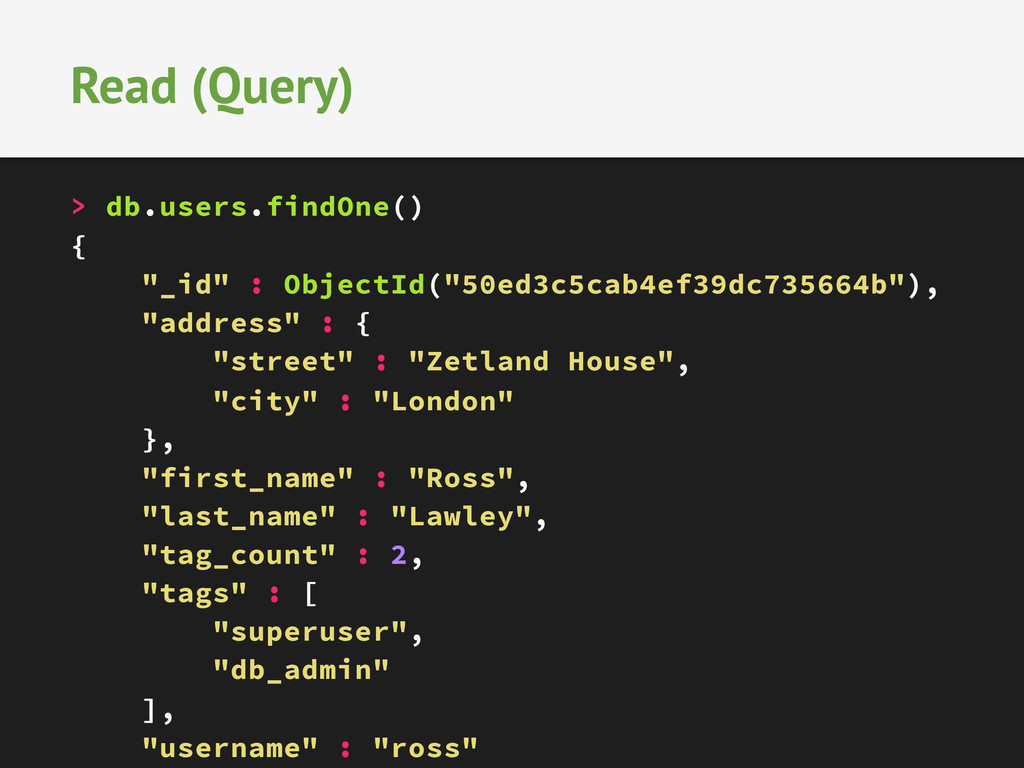
> db.users.findOne() { "_id" : ObjectId("50ed3c5cab4ef39dc735664b"), "address" : { "street"
: "Zetland House", "city" : "London" }, "first_name" : "Ross", "last_name" : "Lawley", "tag_count" : 2, "tags" : [ "superuser", "db_admin" ], "username" : "ross" Read (Query) -
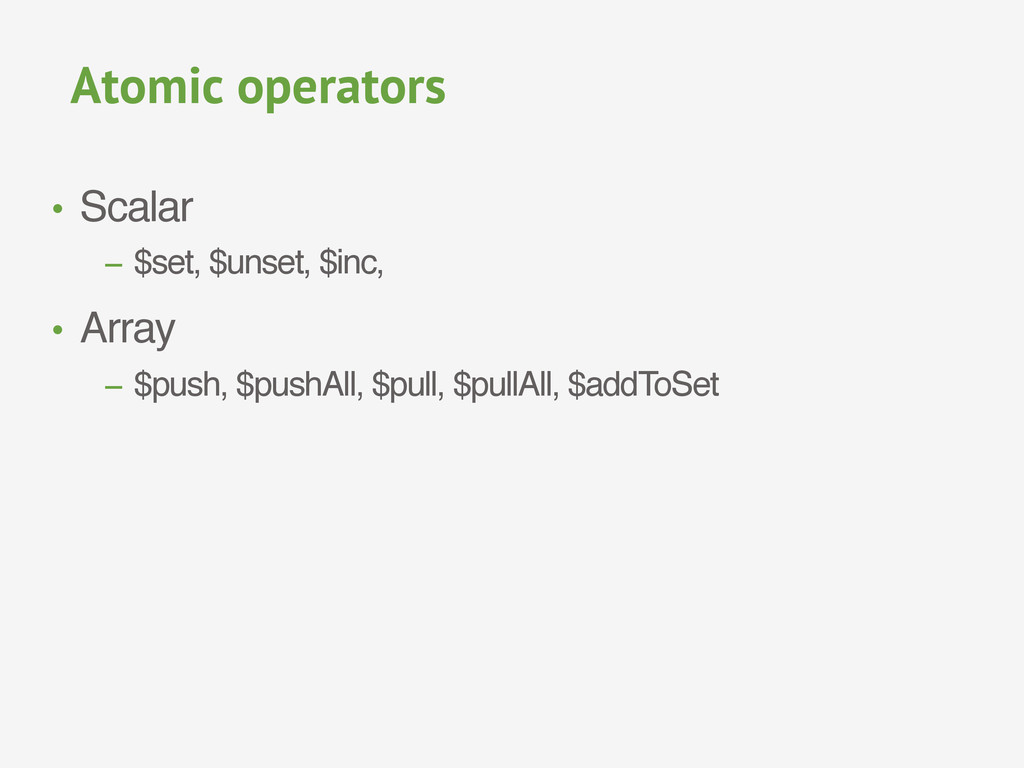
Atomic operators • Scalar – $set, $unset, $inc, • Array
– $push, $pushAll, $pull, $pullAll, $addToSet" -
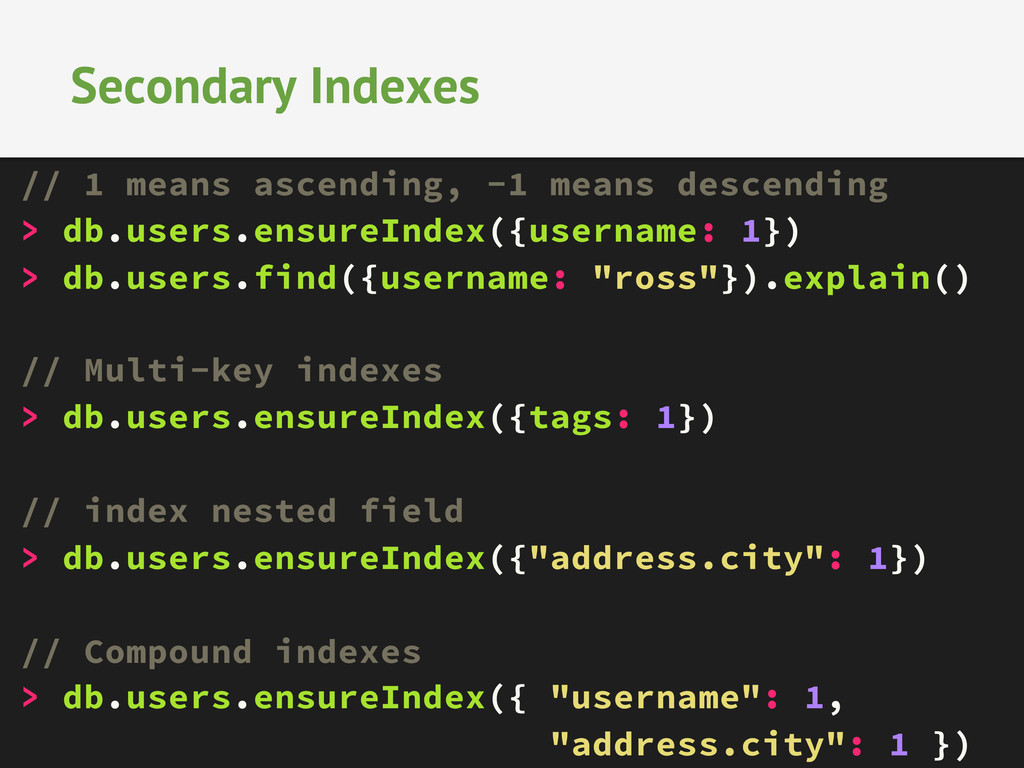
// 1 means ascending, -1 means descending > db.users.ensureIndex({username: 1})
> db.users.find({username: "ross"}).explain() // Multi-key indexes > db.users.ensureIndex({tags: 1}) // index nested field > db.users.ensureIndex({"address.city": 1}) // Compound indexes > db.users.ensureIndex({ "username": 1, "address.city": 1 }) Secondary Indexes